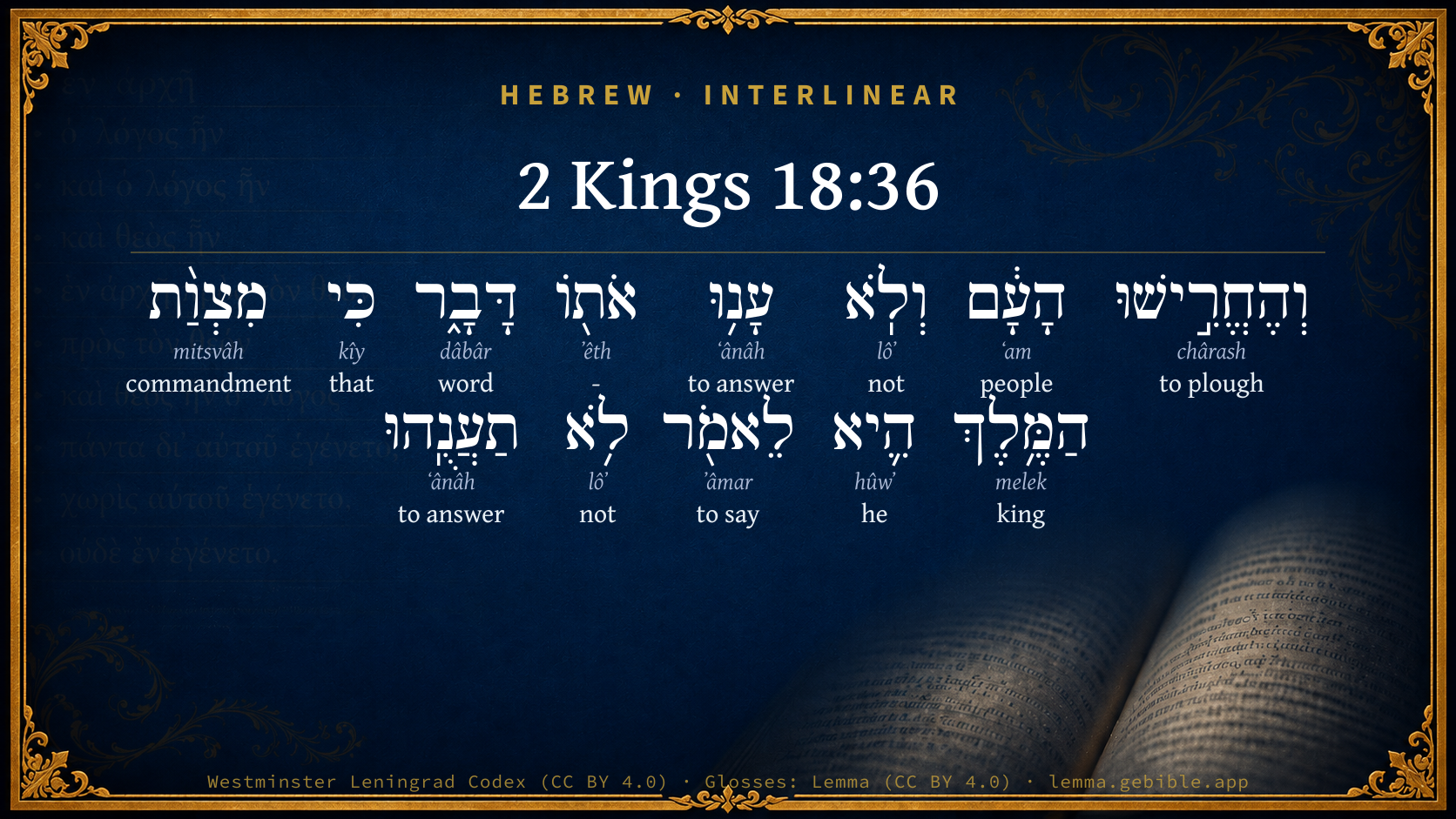
2 Kings 18:36

Hebrew (Westminster Leningrad Codex) 2 Kings 18:36 appears in the Hebrew Old Testament. The text above is from the Westminster Leningrad Codex. Each word links to its Strong’s number, a concise gloss, and parsing drawn from the Open Scriptures Hebrew Bible morphology. Click any word for its full Brown-Driver-Briggs (BDB) entry.
Download image
Cite this verse

2 Kings 18:36 (World English Bible). Public Domain. Lemma interlinear Bible study tool, https://lemma.gebible.app/v/2-kings/18/36.

Show BibTeX & RIS
BibTeX
RIS
English Translation
But the people held their peace, and answered him not a word; for the king's commandment was, saying, Don't answer him.
World English Bible · Public Domain
Download a study sheet

One document with this verse’s original text, its word-by-word gloss line, the meaning frame, cross-references with their text, attributed commentary, and full source and license credits — printable, and it pastes into notes with its structure intact.

This verse Autodidact and up

Study sheet (.html) Plain text (.txt)

A passage Seminary Student

Up to 50 verses in one chapter. A passage sheet keeps up to 6 commentary sources and 12 cross-references per verse, in the order this page ranks them, and says so on the sheet whenever that leaves anything out. Ask for a single verse and you get the Autodidact verse sheet above.

Everything on this page stays free to read, with no account — the sheet is a download of what is already on screen, not access to it.

Want to remove ads? Support Godless Engineer
Compare translations 3

The same verse in 3 English versions, stacked beneath the original-language interlinear above. Click any original word for its lexicon entry.

Each is an independent rendering of the whole verse — the interlinear is not word-aligned to these translations.

Highlighted words mark where these versions differ — a whole-verse word diff, not a word-by-word alignment.

  • World English Bible Public Domain
    But the people held their peace, and answered him not a word; for the king's commandment was, saying, Don't answer him.
  • King James Version Public Domain
    But the people held their peace, and answered him not a word: for the king's commandment was, saying, Answer him not.
  • unfoldingWord Literal Text CC BY-SA 4.0
    But the people were silent and did not answer him a word, for it a commandment of the king, saying, “You shall not answer him.”

unfoldingWord Literal Text — © unfoldingWord, licensed CC BY-SA 4.0. Word-aligned USFM3 via Door43 (git.door43.org/unfoldingWord/en_ult).

Versions to compare (up to 4)

3 of 4 selected

Show all 18 translations

Every available English version of this verse, each an independent rendering of the whole verse.

  • World English Bible Public Domain
    But the people held their peace, and answered him not a word; for the king's commandment was, saying, Don't answer him.
  • Berean Standard Bible Public Domain
    But the people remained silent and did not answer a word, for Hezekiah had commanded, “Do not answer him.”
  • Majority Standard Bible Public Domain
    But the people remained silent and did not answer a word, for Hezekiah had commanded, “Do not answer him.”
  • King James Version Public Domain
    But the people held their peace, and answered him not a word: for the king's commandment was, saying, Answer him not.
  • American Standard Version (1901) Public Domain
    But the people held their peace, and answered him not a word; for the king's commandment was, saying, Answer him not.
  • Revised Version (1885) Public Domain
    But the people held their peace, and answered him not a word: for the king’s commandment was, saying, Answer him not.
  • Geneva Bible (1599) Public Domain
    But the people helde their peace, and answered not him a worde: for the Kings commandement was, saying, Answere ye him not.
  • Douay-Rheims (1899) Public Domain
    But the people held their peace, and answered him not a word: for they had received commandment from the king that they should not answer him.
  • Young's Literal Translation Public Domain
    And the people have kept silent, and have not answered him a word, for the command of the king is, saying, `Do not answer him.'
  • Literal Standard Version CC BY-SA 4.0
    And the people have kept silent, and have not answered him a word, for the command of the king is, saying, “Do not answer him.”
  • Unlocked Literal Bible CC BY-SA 4.0
    But the people remained silent and did not respond, for the king had commanded, “Do not answer him.”
  • unfoldingWord Literal Text CC BY-SA 4.0
    But the people were silent and did not answer him a word, for it a commandment of the king, saying, “You shall not answer him.”
  • Darby Bible Public Domain
    But the people were silent and answered him not a word; for the king's command was, saying, Answer him not.
  • World Messianic Bible Public Domain
    But the people stayed quiet, and answered him not a word; for the king’s commandment was, “Don’t answer him.”
  • Webster's Bible Public Domain
    But the people held their peace, and answered him not a word: for the king's commandment was, saying, Answer him not.
  • Free Bible Version CC BY-SA 4.0
    But the people remained silent and didn't say anything, for Hezekiah had given the order, “Don't answer him.”
  • Bible in Basic English Public Domain
    But the people kept quiet and gave him no answer: for the king's order was, Give him no answer.
  • JPS Tanakh (1917) Public Domain
    But the people held their peace, and answered him not a word; for the king's commandment was, saying: 'Answer him not.'

Literal Standard Version (2020), Covenant Press — licensed CC BY-SA 4.0. Text via the HelloAO Bible API (eBible.org). Unlocked Literal Bible (unfoldingWord) — licensed CC BY-SA 4.0. Text via the HelloAO Bible API (eBible.org). unfoldingWord Literal Text — © unfoldingWord, licensed CC BY-SA 4.0. Word-aligned USFM3 via Door43 (git.door43.org/unfoldingWord/en_ult). Free Bible Version, Dr. Jonathan Gallagher — licensed CC BY-SA 4.0. Text via the HelloAO Bible API (eBible.org).

Word by word

More ways to search: Search by grammar → Find every occurrence → Compare this word →

Practice this passage: Drill this verse → Learn its vocabulary →

וְהֶחֱרִ֣ישׁוּ
chârash
H2790
“and · to plough”
Conjunction + Verb, Hiphil, Perfect, 3rd Person, Common, Plural
Part of Speech
Conjunction + Verb
Stem
Hiphil
Form
Perfect
Person
3rd Person
Gender
Common
Number
Plural
Full BDB Definition

Origin: a primitive root

TWOT: 760 , 761

to cut in, plough, engrave, devise - (Qal) - to cut in, engrave - to plough - to devise - (Niphal) to be ploughed - (Hiphil) to plot evil - to be silent, be dumb, be speechless, be deaf - (Qal) - to be silent - to be deaf - (Hiphil) - to be silent, keep quiet - to make silent - to be deaf, show deafness - (Hithpael) to remain silent
  1. הָעָ֔ם ʻam H5971 “the · people” Particle, Definite Article + Noun, Common, Masculine, Singular, Absolute
  2. וְלֹֽא lôʼ H3808 “and · not” Conjunction + Particle, Negative
  3. עָנ֥וּ ʻânâh H6030 “to answer” Verb, Qal, Perfect, 3rd Person, Common, Plural
  4. אֹת֖וֹ ʼêth H853 “- · him” Particle, Direct Object + Suffix, Personal, 3rd Person, Masculine, Singular
  5. דָּבָ֑ר dâbâr H1697 “word” Noun, Common, Masculine, Singular, Absolute
  6. כִּי kîy H3588 “that” Conjunction
  7. מִצְוַ֨ת mitsvâh H4687 “commandment of” Noun, Common, Feminine, Singular, Construct
  8. הַמֶּ֥לֶךְ melek H4428 “the · king” Particle, Definite Article + Noun, Common, Masculine, Singular, Absolute
  9. הִ֛יא hûwʼ H1931 “he” Pronoun, Personal, 3rd Person, Feminine, Singular
  10. לֵאמֹ֖ר ʼâmar H559 “to say” Preposition + Verb, Qal, Infinitive Construct
  11. לֹ֥א lôʼ H3808 “not” Particle, Negative
  12. תַעֲנֻֽהוּ ʻânâh H6030 “to answer · him” Verb, Qal, Imperfect, 2nd Person, Masculine, Plural + Suffix, Personal, 3rd Person, Masculine, Singular

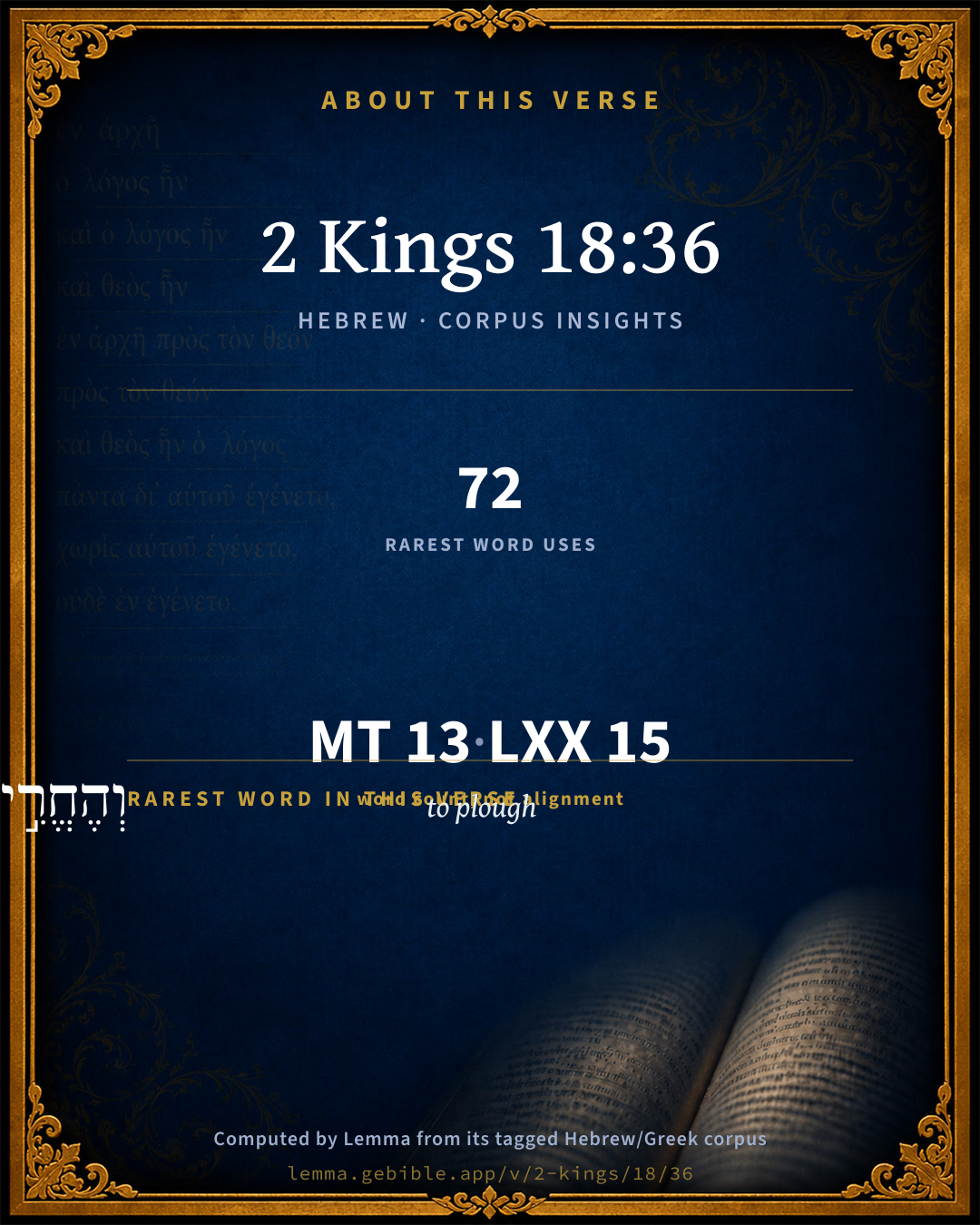
About this verse

These counts appear in no published source. They are computed here, from the morphology-tagged text and Lemma’s own curated glosses. What Lemma adds →

13
words
11
distinct lemmas
Historical
section

Grammatical profile

  • 4 verbs
  • 4 nouns
  • 1 pronoun
  • 1 conjunction
  • 3 particles

Verb forms

  • וְהֶחֱרִ֣ישׁוּ Hiphil · Perfect
  • עָנ֥וּ Qal · Perfect
  • לֵאמֹ֖ר Qal · Infinitive Construct
  • תַעֲנֻֽהוּ Qal · Imperfect

Repetition

Words recur within this verse — often emphatic in Hebrew:

  • עָנ֥וּ to answer H6030 ×2
  • וְלֹֽא not H3808 ×2

Hebrew & Septuagint length

In English translation the verse runs 21 words from the Hebrew and 25 from the Septuagint (LXX English) — closely comparable.

A rough comparison of the two English renderings, which tokenize alike — not a word-level alignment.

Word counts can differ between the Hebrew and the Greek without any difference in meaning — e.g. the Hebrew direct-object marker אֵת has no separate Greek word, and Greek often adds the article ὁ.

In the original languages it is 13 Hebrew tokens and 15 Greek tokens — but the two are counted differently (Hebrew bundles its prefixes and suffixes into one token; the Greek is in lemma form), so that isn’t a like-for-like length.

Cross-references

6

Topical passages linked to 2 Kings 18:36 in the Treasury of Scripture Knowledge — connected by theme and wording, ordered by reader-vote popularity; previews shown in the World English Bible.

  • Psalms 38:13–14 But I, as a deaf man, don't hear. I am as a mute man who doesn't open his mouth.
  • Psalms 39:1 I said, "I will watch my ways, so that I don't sin with my tongue. I will keep my mouth with a bridle while the wicked is before me."
  • Proverbs 9:7 He who corrects a mocker invites insult. He who reproves a wicked man invites abuse.
  • Proverbs 26:4 Don't answer a fool according to his folly, Lest you also be like him.
  • Amos 5:13 Therefore he who is prudent shall keep silence in such a time; For it is an evil time.
  • Matthew 7:6 "Don't give that which is holy to the dogs, neither throw your pearls before the pigs, lest perhaps they trample them under their feet, and turn and tear you to pieces.

Cross-references courtesy of OpenBible.info (CC BY 4.0).

Hebrew and Greek witnesses Masoretic Hebrew ↔ Greek Septuagint

The same verse in the two great witnesses to the Old Testament, shown verse-for-verse.

These are two independent witnesses, not word-aligned to each other, and the Septuagint is shown in lemma (dictionary) form.

Hebrew 2 Kings 18:36 Masoretic · Westminster Leningrad Codex

וְהֶחֱרִ֣ישׁוּ הָעָ֔ם וְלֹֽא עָנ֥וּ אֹת֖וֹ דָּבָ֑ר כִּי מִצְוַ֨ת הַמֶּ֥לֶךְ הִ֛יא לֵאמֹ֖ר לֹ֥א תַעֲנֻֽהוּ

But the people held their peace, and answered him not a word; for the king's commandment was, saying, Don't answer him.

World English Bible · Public Domain

Greek LXX 2 Kings 18:36 Septuagint · lemma form

καί κωφεύω καί οὐ ἀποκρίνω αὐτός λόγος ὅτι ἐντολή ὁ βασιλεύς λέγω οὐ ἀποκρίνω αὐτός

But the men were silent, and answered him not a word: for there was a commandment of the king, saying, You⌃ shall not answer him.

LXX2012 (modern English Septuagint) · Public Domain

Hebrew: Westminster Leningrad Codex (CC BY 4.0). Greek: Septuagint (public domain); English from LXX2012 (modern English Septuagint) (Public Domain). How the Septuagint differs from the Hebrew →

Targum (Aramaic paraphrase)

1

The Targum is the ancient Jewish Aramaic paraphrase of the Hebrew Scriptures — an interpretive translation, not the Hebrew text itself. Onkelos (literal) and Pseudo-Jonathan (expansive) render the Torah, and Jonathan the Prophets. Coverage is partial: where no permissively-licensed English translation exists for a verse, only the Aramaic is shown. This is verse-level text, not a word-by-word alignment to the Hebrew.

  1. Targum Jonathan Prophets (Joshua–Malachi)
    וּשְׁתִיקוּ עַמָא וְלָא אֲתִיבוּ יָתֵיהּ פִּתְגָמָא אֲרֵי תַפְקֵידַת מַלְכָּא הִיא לְמֵימָר לָא תְתִיבוּנֵיהּ:

    (no public-domain English translation for this verse)

    Targum Jonathan — Aramaic: “Mikraot Gedolot” (public domain). English: “Sefaria Community Translation” (CC0 1.0 (public-domain dedication)); “London "Chaldee Paraphrase," 1871” (public domain). Text via Sefaria.

Commentary

Notes on 2 Kings 18:36 from classic Christian and Jewish commentators (each source and its license shown beneath its notes). The classic Christian expositions comment on the surrounding passage and are grouped to its opening verse, so a note may address several verses; the Jewish commentaries on the Tanakh (Rashi and others) are per-verse, so they appear only where the commentator wrote on this verse.

Lemma curates 59 commentaries, every one of them public domain or Creative Commons licensed, each selected and text-cleaned for this edition rather than reprinted as found. About our sources →

Trapp's Complete Commentary

John Trapp

2Ki 18:36 But the people held their peace, and answered him not a word: for the king’s commandment was, saying, Answer him not.

Ver. 36. But the people held their peace.] They punished him with silence, as Isaac did Ishmael. Sile, et funestam dedisti plagam, saith Chrysostom. Silence is the best answer to words of scorn and petulancy, saith learned Hooker. Convitia spreta exolescunt, saith Tacitus. It is best to stop an open mouth with saying nothing, saith Basil. {a} "But I as a deaf man heard not: yea, I was as one dumb, in whose mouth there is no reproof." {Psa 38:14} Princes use to punish the indecencies of ambassadors by denying them audience. Rabshakeh could not be more spited than with no answer. This sulphurous flask therefore dieth in his own smoke, only leaving a hateful stench behind it.

{a} Sιωπη τον ονειδον πνιγειν δει. - Bas., Eph 72.

John Trapp, A Commentary or Exposition upon All the Books of the Old and New Testament (1647–1656) — public domain. Text from a community e-Sword module.

Joseph Benson's Commentary

2Ki 18:36. But the people held their peace — That is, both these three men, and the people that were with them upon the wall, especially the people to whom he had chiefly spoken, and from whom he expected an answer. For the king’s command was, Answer him not — This was wisely ordered, lest by their words they should betray their fears, or provoke their enemies to greater injuries or blasphemies, or give them some advantage or direction for their further proceedings; as also that by this instance of obedience and calmness, the king of Assyria might see the resolution of the people to cleave unto their king, and the vanity of his attempts to seduce them to a defection from him.

Joseph Benson's Commentary on the Old and New Testaments (1811–1818) — public domain. Text from a community e-Sword module.

Adam Clarke's Commentary

Verse 36. Answer him not.] The blasphemy is too barefaced; Jehovah is insulted, not you; let him avenge his own quarrel. See the succeeding chapter.

Adam Clarke's Commentary on the Bible (1810–1826) — public domain. Text from a community e-Sword/MySword module.

The Cambridge Bible for Schools and Colleges

gen. ed. J. J. S. Perowne

36. the people held their peace] Rab-shakeh had hoped to excite the people, at all events, to some expression of discontent, and perhaps had any movement of that kind been displayed, the ‘great host’ of verse 17 would at once have begun the attack, for treason within the city might have opened the gates. But the expectation is utterly disappointed, even the fear of starvation provokes no treachery.

Bp Hall observes here, ‘I do not more wonder at Hezekiah’s wisdom in commanding silence, than at the subjects’ obedience in keeping it. This railer could not be more spited, than with no answer; and if he might be exasperated he could not be reformed. Besides, the rebounding of those multiplied blasphemies might leave some ill impressions in the multitude. This sulphurous flask, therefore, dies in his own smoke; only leaving a hateful stench behind it’.

The Chronicler, though his account is briefer, yet describes in more terrible terms the blasphemies of the Assyrian envoy. Not only does he mention his language to those who came to hear him, but he adds ‘he wrote also letters to rail on the Lord, the God of Israel, and to speak against Him … and they spake against the God of Jerusalem, as against the gods of the people of the earth which were the work of the hands of man’. (2Ch_32:17; 2Ch_32:19.) Perhaps he is alluding to the letter mentioned below (2Ki_19:14).

The Cambridge Bible for Schools and Colleges (gen. ed. J. J. S. Perowne; Cambridge University Press, 1878–1918) — public domain. Text from a community e-Sword module.

Haydock's Catholic Bible Commentary

The people. The three legates, (Calmet) Isaias xxxvi. 21. And they held their peace. (Haydock)

George Leo Haydock (1774–1849), Haydock's Catholic Family Bible and Commentary, 1859 edition — public domain. Excludes Psalms (Douay-Rheims chapter numbering differs from Protestant) and Deuterocanonical books (Catholic canon only).

Matthew Poole's English Annotations

The people, i.e. either these three men, this word being sometimes used of a very few men, as 1Sa 9:24. Or rather, the people that were with then upon the wall, 2Ki 18:26, to whom he spake, and from whom he expected an answer.

Answer him not; which was wisely ordered, partly lest by their words they should either betray their fears, or provoke their enemies to greater injuries or blasphemies, or give them some advantage or direction for their further proceedings; and partly that by this instance of obedience and calmness he might see the resolution of the people to cleave unto their king, and the vanity of his attempts to seduce them to a defection from him.

Matthew Poole's English Annotations on the Holy Bible (1683–1685) — public domain. Text from a community e-Sword/MySword module.

Whedon's Commentary on the Bible

Daniel D. Whedon

36. The people held their peace — There must have been an impressive solemnity as well as a noble dignity in that silence of the people, which left the Assyrian ambassadors in complete ignorance of the impression their message and words had made.

Daniel D. Whedon (gen. ed.), Commentary on the Old and New Testaments (1874–1909) — public domain. Text from a community e-Sword module.

The Pulpit Commentary

But the people held their peace, and answered him not a word. All Rabshakeh"s efforts to produce open disaffection failed. Whatever impression his arguments may have made, no indication was given that they had produced any. If, then, he had hoped to bring about a mutiny, or even to create a disturbance, he was disappointed. For the king"s commandment was, saying, Answer him not. Hezekiah had either anticipated Rabshakeh"s tactics, and given an order beforehand that no word should be uttered, or he had promptly met them by sending such an order, on learning Rabshakeh"s proceedings, The latter is more probable, since such an outrageous course as that which Rabshakeh had pursued can scarcely have been expected.

The Pulpit Commentary (1880–1919), ed. H.D.M. Spence-Jones & Joseph S. Exell — public domain. Text from a community e-Sword module.

unfoldingWord translationNotes

Door43 World Missions Community

Eliakim ... Shebna ... Joah ... Asaph

These are the names of men. (See: How to Translate Names)

who was over the household

"who managed the king's palace"

the recorder

"the history keeper"

chief commander

and is the translation of the Hebrew; some see this as a personal name, "Rabshakeh"

translationWords

command

Eliakim

household

scribe

report

word

unfoldingWord translationNotes — © Distant Shores Media and the Door43 World Missions Community, licensed CC BY-SA 4.0. Source: git.door43.org/Door43/en_tn.

Lesson kit

Teaching starters — assembled from the data on this page, not authored interpretation. Every prompt links to the verse data it draws on. Edit before teaching.

2 Kings, in the Historical, opens this verse with 13 words (11 distinct Hebrew lemmas). Its most distinctive word is chârash (“to plough”). A historical commentator’s framing appears above. Read the whole chapter for the surrounding context.

Discussion questions

  1. What does “to plough” (chârash) contribute to the verse as a whole?
  2. Psalms 38:13–14 shares this passage’s theme. How do the two illuminate each other?
  3. “to answer” occurs 2× in this one verse. What is the effect of the repetition?
  4. These translations render this verse differently. What is at stake in choosing one wording over another?
  5. The verb «וְהֶחֱרִ֣ישׁוּ» is Hiphil Perfect. How does its form color the action?
  6. Reading how Trapp's Complete Commentary and Joseph Benson's Commentary read this verse, where do the two commentators agree and where do they part?

Things to notice

Reading settings

Reading text

Shown beneath each verse's original-language words.

Old Testament
Old Testament edition

Read the OT as the Masoretic Hebrew (MT) or the Greek Septuagint (LXX).

English shown for the Greek Septuagint (in the Hebrew ↔ Greek comparison).

Comparing translations? Open the Compare panel on any verse page to stack up to four side by side.