
Deuteronomy 29:22

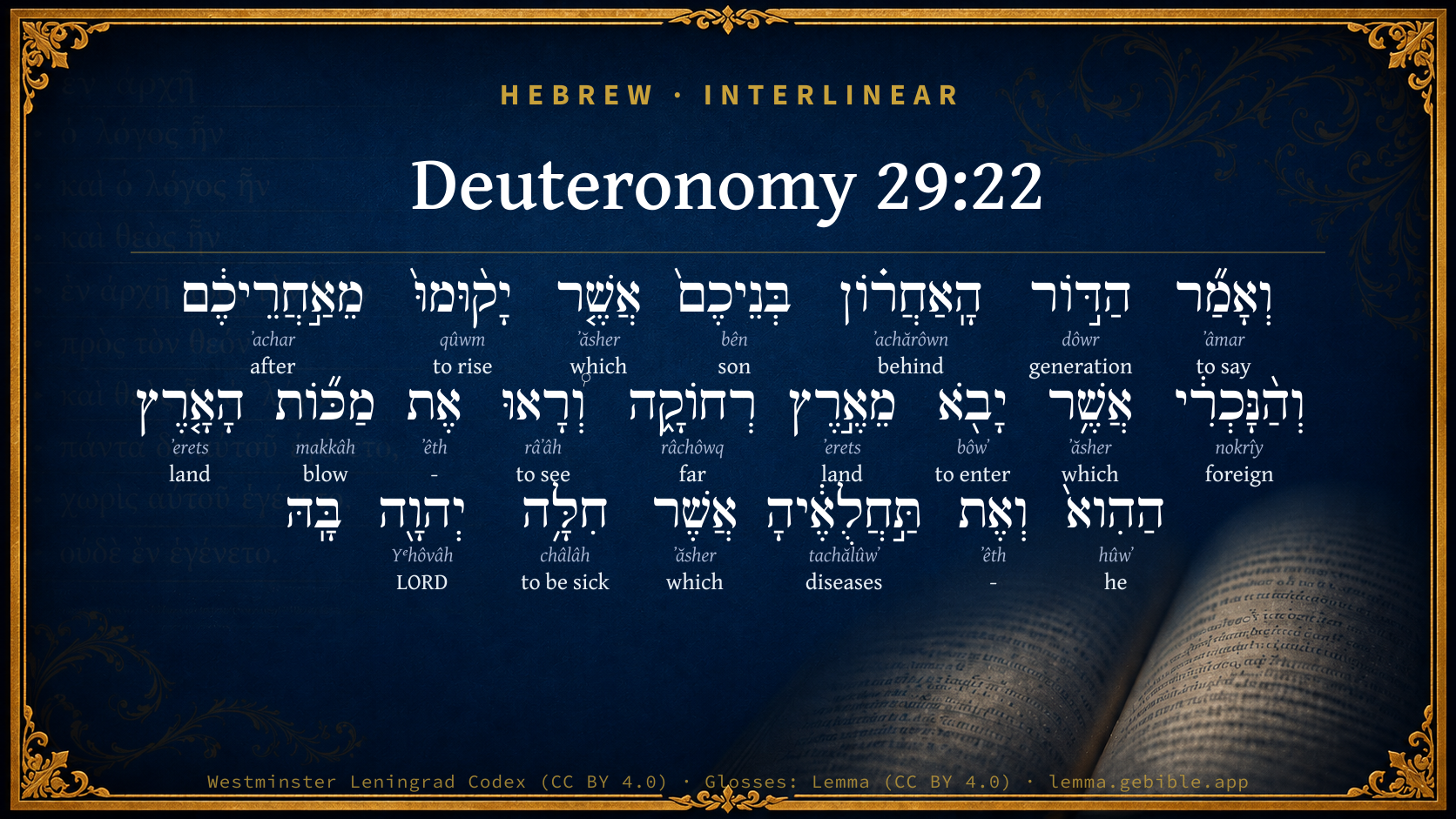
Hebrew (Westminster Leningrad Codex) Deuteronomy 29:22 appears in the Hebrew Old Testament. The text above is from the Westminster Leningrad Codex. Each word links to its Strong’s number, a concise gloss, and parsing drawn from the Open Scriptures Hebrew Bible morphology. Click any word for its full Brown-Driver-Briggs (BDB) entry.
Download image
Cite this verse

Deuteronomy 29:22 (World English Bible). Public Domain. Lemma interlinear Bible study tool, https://lemma.gebible.app/v/deuteronomy/29/22.

Show BibTeX & RIS
BibTeX
RIS
English Translation
The generation to come, your children who shall rise up after you, and the foreigner who shall come from a far land, shall say, when they see the plagues of that land, and the sicknesses with which Yahweh has made it sick;
World English Bible · Public Domain
Highlights
  • 1 first appearance in the Hebrew Bible
Full analysis ↓
Download a study sheet

One document with this verse’s original text, its word-by-word gloss line, the meaning frame, cross-references with their text, attributed commentary, and full source and license credits — printable, and it pastes into notes with its structure intact.

This verse Autodidact and up

Study sheet (.html) Plain text (.txt)

A passage Seminary Student

Up to 50 verses in one chapter. A passage sheet keeps up to 6 commentary sources and 12 cross-references per verse, in the order this page ranks them, and says so on the sheet whenever that leaves anything out. Ask for a single verse and you get the Autodidact verse sheet above.

Everything on this page stays free to read, with no account — the sheet is a download of what is already on screen, not access to it.

Want to remove ads? Support Godless Engineer
Compare translations 3

The same verse in 3 English versions, stacked beneath the original-language interlinear above. Click any original word for its lexicon entry.

Each is an independent rendering of the whole verse — the interlinear is not word-aligned to these translations.

Highlighted words mark where these versions differ — a whole-verse word diff, not a word-by-word alignment.

  • World English Bible Public Domain
    The generation to come, your children who shall rise up after you, and the foreigner who shall come from a far land, shall say, when they see the plagues of that land, and the sicknesses with which Yahweh has made it sick;
  • King James Version Public Domain
    So that the generation to come of your children that shall rise up after you, and the stranger that shall come from a far land, shall say, when they see the plagues of that land, and the sicknesses which the LORD hath laid upon it;
  • unfoldingWord Literal Text CC BY-SA 4.0
    And the latter generation, your children who will rise up after you and the foreigner who comes from a distant land, will say, when they see the plagues of that land and the diseases with which Yahweh has made it sick,

unfoldingWord Literal Text — © unfoldingWord, licensed CC BY-SA 4.0. Word-aligned USFM3 via Door43 (git.door43.org/unfoldingWord/en_ult).

Versions to compare (up to 4)

3 of 4 selected

Show all 18 translations

Every available English version of this verse, each an independent rendering of the whole verse.

  • World English Bible Public Domain
    The generation to come, your children who shall rise up after you, and the foreigner who shall come from a far land, shall say, when they see the plagues of that land, and the sicknesses with which Yahweh has made it sick;
  • Berean Standard Bible Public Domain
    Then the generation to come—your sons who follow you and the foreigner who comes from a distant land—will see the plagues of the land and the sicknesses the LORD has inflicted on it.
  • Majority Standard Bible Public Domain
    Then the generation to come—your sons who follow you and the foreigner who comes from a distant land—will see the plagues of the land and the sicknesses the LORD has inflicted on it.
  • King James Version Public Domain
    So that the generation to come of your children that shall rise up after you, and the stranger that shall come from a far land, shall say, when they see the plagues of that land, and the sicknesses which the LORD hath laid upon it;
  • American Standard Version (1901) Public Domain
    And the generation to come, your children that shall rise up after you, and the foreigner that shall come from a far land, shall say, when they see the plagues of that land, and the sicknesses wherewith Jehovah hath made it sick;
  • Revised Version (1885) Public Domain
    And the generation to come, your children that shall rise up after you, and the foreigner that shall come from a far land, shall say, when they see the plagues of that land, and the sicknesses wherewith the LORD hath made it sick;
  • Geneva Bible (1599) Public Domain
    So that the generatio to come, euen your children, that shall rise vp after you, and the stranger, that shall come from a farre lande, shall say, when they shall see the plagues of this lande, and the diseases thereof, wherewith the Lord shall smite it:
  • Douay-Rheims (1899) Public Domain
    And the following generation shall say, and the children that shall be born hereafter, and the strangers that shall come from afar, seeing the plagues of that land and the evils wherewith the Lord hath afflicted it,
  • Young's Literal Translation Public Domain
    `And the latter generation of your sons who rise after you, and the stranger who cometh in from a land afar off, have said when they have seen the strokes of that land, and its sicknesses which Jehovah hath sent into it, --
  • Literal Standard Version CC BY-SA 4.0
    And the latter generation of your sons who rise after you, and the stranger who comes in from a far-off land, have said, when they have seen the strokes of that land and its sicknesses which YHWH has sent into it:
  • Unlocked Literal Bible CC BY-SA 4.0
    The generation to come, your children who will rise up after you, and the foreigner who comes from a distant land, will speak when they see the plagues on this land and the diseases with which Yahweh has made it sick—
  • unfoldingWord Literal Text CC BY-SA 4.0
    And the latter generation, your children who will rise up after you and the foreigner who comes from a distant land, will say, when they see the plagues of that land and the diseases with which Yahweh has made it sick,
  • Darby Bible Public Domain
    And the generation to come, your children who shall rise up after you, and the foreigner that shall come from a far land, shall say, when they see the plagues of that land, and its sicknesses wherewith Jehovah hath visited it,
  • World Messianic Bible Public Domain
    The generation to come—your children who will rise up after you, and the foreigner who will come from a far land—will say, when they see the plagues of that land, and the sicknesses with which the LORD has made it sick,
  • Webster's Bible Public Domain
    So that the generation to come of your children that shall arise after you, and the stranger that shall come from a distant land, shall say, when they see the plagues of that land, and the sicknesses which the LORD hath laid upon it;
  • Free Bible Version CC BY-SA 4.0
    Later generations, your descendants and foreigners from far away, will see how the Lord has brought disaster on the country and devastated it.
  • Bible in Basic English Public Domain
    And future generations, your children coming after you, and travellers from far countries, will say, when they see the punishments of that land and the diseases which the Lord has sent on it;
  • JPS Tanakh (1917) Public Domain
    (29-21) And the generation to come, your children that shall rise up after you, and the foreigner that shall come from a far land, shall say, when they see the plagues of that land, and the sicknesses wherewith the LORD hath made it sick;

Literal Standard Version (2020), Covenant Press — licensed CC BY-SA 4.0. Text via the HelloAO Bible API (eBible.org). Unlocked Literal Bible (unfoldingWord) — licensed CC BY-SA 4.0. Text via the HelloAO Bible API (eBible.org). unfoldingWord Literal Text — © unfoldingWord, licensed CC BY-SA 4.0. Word-aligned USFM3 via Door43 (git.door43.org/unfoldingWord/en_ult). Free Bible Version, Dr. Jonathan Gallagher — licensed CC BY-SA 4.0. Text via the HelloAO Bible API (eBible.org).

Word by word

More ways to search: Search by grammar → Find every occurrence → Compare this word →

Practice this passage: Drill this verse → Learn its vocabulary →

תַּ֣חֲלֻאֶ֔יהָ
tachălûwʼ
H8463
“diseases · her”
Noun, Common, Masculine, Plural, Construct + Suffix, Personal, 3rd Person, Feminine, Singular
Part of Speech
Noun
Type
Common
Gender
Masculine
Number
Plural
State
Construct
Full BDB Definition

Origin: from H2456

TWOT: 648a

diseases
  1. וְאָמַ֞ר ʼâmar H559 “and · to say” Conjunction + Verb, Qal, Sequential Perfect, 3rd Person, Masculine, Singular
  2. הַדּ֣וֹר dôwr H1755 “the · generation” Particle, Definite Article + Noun, Common, Masculine, Singular, Absolute
  3. הָֽאַחֲר֗וֹן ʼachărôwn H314 “the · behind” Particle, Definite Article + Adjective, Adjective, Masculine, Singular, Absolute
  4. בְּנֵיכֶם֙ bên H1121 “sons · your” Noun, Common, Masculine, Plural, Construct + Suffix, Personal, 2nd Person, Masculine, Plural
  5. אֲשֶׁ֤ר ʼăsher H834 “which” Particle, Relative
  6. יָק֨וּמוּ֙ qûwm H6965 “to rise” Verb, Qal, Imperfect, 3rd Person, Masculine, Plural
  7. מֵאַ֣חֲרֵיכֶ֔ם ʼachar H310 “from · after · you” Preposition + Preposition + Suffix, Personal, 2nd Person, Masculine, Plural
  8. וְהַ֨נָּכְרִ֔י nokrîy H5237 “and · the · foreign” Conjunction + Particle, Definite Article + Adjective, Adjective, Masculine, Singular, Absolute
  9. אֲשֶׁ֥ר ʼăsher H834 “which” Particle, Relative
  10. יָבֹ֖א bôwʼ H935 “to enter” Verb, Qal, Imperfect, 3rd Person, Masculine, Singular
  11. מֵאֶ֣רֶץ ʼerets H776 “from · land” Preposition + Noun, Common, Both, Singular, Absolute
  12. רְחוֹקָ֑ה râchôwq H7350 “far” Adjective, Adjective, Feminine, Singular, Absolute
  13. וְ֠רָאוּ râʼâh H7200 “and · to see” Conjunction + Verb, Qal, Sequential Perfect, 3rd Person, Common, Plural
  14. אֶת ʼêth H853 “-” Particle, Direct Object
  15. מַכּ֞וֹת makkâh H4347 “blows of” Noun, Common, Feminine, Plural, Construct
  16. הָאָ֤רֶץ ʼerets H776 “the · land” Particle, Definite Article + Noun, Common, Both, Singular, Absolute
  17. הַהִוא֙ hûwʼ H1931 “the · he” Particle, Definite Article + Pronoun, Personal, 3rd Person, Feminine, Singular
  18. וְאֶת ʼêth H853 “and · -” Conjunction + Particle, Direct Object
  19. אֲשֶׁר ʼăsher H834 “which” Particle, Relative
  20. חִלָּ֥ה châlâh H2470 “to be sick” Verb, Piel, Perfect, 3rd Person, Masculine, Singular
  21. יְהוָ֖ה Yᵉhôvâh H3068 “LORD” Noun, Proper

About this verse

These counts appear in no published source. They are computed here, from the morphology-tagged text and Lemma’s own curated glosses. What Lemma adds →

23
words
18
distinct lemmas
Pentateuch
section

Notable vocabulary

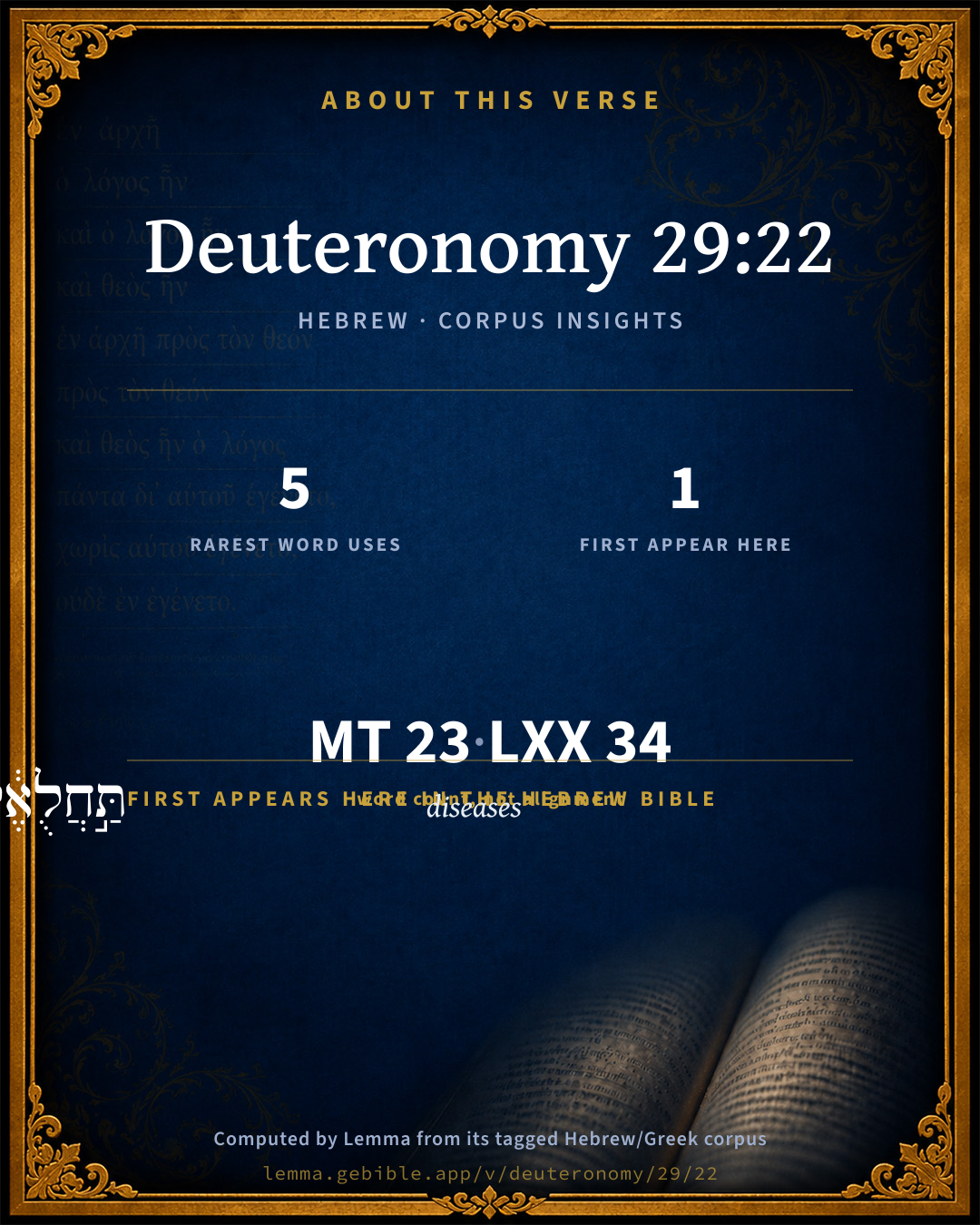
The rarest word here is תַּ֣חֲלֻאֶ֔יהָ diseases H8463 — appearing just 5 times in the whole Hebrew Bible.

First appearance in Scripture

This word makes its first canonical appearance in the Hebrew Bible here:

  • תַּ֣חֲלֻאֶ֔יהָ diseases H8463

Shared distinctive vocabulary

תַּ֣חֲלֻאֶ֔יהָ diseases H8463 occurs in 5 verses of the Hebrew Bible. Also found in:

Grammatical profile

  • 5 verbs
  • 7 nouns
  • 3 adjectives
  • 1 pronoun
  • 2 prepositions
  • 5 particles

Verb forms

  • וְאָמַ֞ר Qal · Sequential Perfect
  • יָק֨וּמוּ֙ Qal · Imperfect
  • יָבֹ֖א Qal · Imperfect
  • וְ֠רָאוּ Qal · Sequential Perfect
  • חִלָּ֥ה Piel · Perfect

Repetition

Words recur within this verse — often emphatic in Hebrew:

  • מֵאֶ֣רֶץ land H776 ×2
  • אֲשֶׁ֤ר which H834 ×3

Hebrew & Septuagint length

In English translation the verse runs 42 words from the Hebrew and 42 from the Septuagint (LXX English) — the same length.

A rough comparison of the two English renderings, which tokenize alike — not a word-level alignment.

Word counts can differ between the Hebrew and the Greek without any difference in meaning — e.g. the Hebrew direct-object marker אֵת has no separate Greek word, and Greek often adds the article ὁ.

In the original languages it is 23 Hebrew tokens and 34 Greek tokens — but the two are counted differently (Hebrew bundles its prefixes and suffixes into one token; the Greek is in lemma form), so that isn’t a like-for-like length.

Cross-references

1

Topical passages linked to Deuteronomy 29:22 in the Treasury of Scripture Knowledge — connected by theme and wording, ordered by reader-vote popularity; previews shown in the World English Bible.

  • Jeremiah 19:8 I will make this city an astonishment, and a hissing; everyone who passes thereby shall be astonished and hiss because of all the plagues of it.

Cross-references courtesy of OpenBible.info (CC BY 4.0).

Hebrew and Greek witnesses Masoretic Hebrew ↔ Greek Septuagint

The same verse in the two great witnesses to the Old Testament, shown verse-for-verse.

These are two independent witnesses, not word-aligned to each other, and the Septuagint is shown in lemma (dictionary) form.

Hebrew Deuteronomy 29:22 Masoretic · Westminster Leningrad Codex

וְאָמַ֞ר הַדּ֣וֹר הָֽאַחֲר֗וֹן בְּנֵיכֶם֙ אֲשֶׁ֤ר יָק֨וּמוּ֙ מֵאַ֣חֲרֵיכֶ֔ם וְהַ֨נָּכְרִ֔י אֲשֶׁ֥ר יָבֹ֖א מֵאֶ֣רֶץ רְחוֹקָ֑ה וְ֠רָאוּ אֶת מַכּ֞וֹת הָאָ֤רֶץ הַהִוא֙ וְאֶת תַּ֣חֲלֻאֶ֔יהָ אֲשֶׁר חִלָּ֥ה יְהוָ֖ה בָּֽהּ

The generation to come, your children who shall rise up after you, and the foreigner who shall come from a far land, shall say, when they see the plagues of that land, and the sicknesses with which Yahweh has made it sick;

World English Bible · Public Domain

Greek LXX Deuteronomy 29:22 Septuagint · lemma form

θεῖος καί ἅλς κατακαίω πᾶς ὁ γῆ αὐτός οὐ σπείρω οὐδέ ἀνατέλλω οὐδέ μή ἀναβαίνω ἐπί αὐτός πᾶς χλωρός ὥσπερ καταστρέφω σοδομα καί γομορρα αδαμα καί σεβωιμ ὅς καταστρέφω κύριος ἐν θυμός καί ὀργή

And another generation shall say—even your sons who shall rise up after you, and the stranger who shall come from a land afar off, and shall see the plagues of that land and their diseases, which the Lord has sent upon it,

LXX2012 (modern English Septuagint) · Public Domain

Hebrew: Westminster Leningrad Codex (CC BY 4.0). Greek: Septuagint (public domain); English from LXX2012 (modern English Septuagint) (Public Domain). How the Septuagint differs from the Hebrew →

Targum (Aramaic paraphrase)

2

The Targum is the ancient Jewish Aramaic paraphrase of the Hebrew Scriptures — an interpretive translation, not the Hebrew text itself. Onkelos (literal) and Pseudo-Jonathan (expansive) render the Torah, and Jonathan the Prophets. Coverage is partial: where no permissively-licensed English translation exists for a verse, only the Aramaic is shown. This is verse-level text, not a word-by-word alignment to the Hebrew.

  1. Targum Onkelos Torah (Genesis–Deuteronomy)
    גָפְרֵתָא וּמִלְחָא יְקִידַת כָּל אַרְעַהּ לָא תִזְרַע וְלָא תַצְמַח וְלָא יִסַק בַּהּ כָּל עֶסְבָּא כְּמַהְפֶּכְתָּא דִסְדֹם וַעֲמֹרָה אַדְמָה וּצְבוֹיִם דִי הֲפַךְ יְיָ בְּרָגְזֵהּ וּבְחֶמְתֵהּ

    (no public-domain English translation for this verse)

    Targum Onkelos — Aramaic: “Onkelos Genesis” (public domain); “Onkelos Exodus” (public domain); “Onkelos Leviticus” (public domain); “Onkelos Numbers” (public domain); “Onkelos Deuteronomy” (public domain). English: “Sefaria Community Translation” (CC0 1.0 (public-domain dedication)); “J.W. Etheridge. The Targums of Onkelos and Jonathan Ben Uzziel on the Pentateuch. London: Longmans, Green, 1862” (public domain). Text via Sefaria.

  2. Targum Pseudo-Jonathan Torah (Genesis–Deuteronomy)
    כּוּבְרֵיתָא וּמִלְחָא עִם אֵשָׁא מְצַלְהֲבָא תְּהֵי יָקְדָא כָּל אַרְעָא לָא תִתְכַּשַׁר לְבַר זְרַע וְלָא תַרְבֵּי צְמָחִין וְלָא יִסַק בָּהּ כָּל עִשְבָּא תִּשְׁתְּקַע הֵיךְ תְּהַפְכָנוּתָא דִסְדוֹם וַעֲמוֹרָא אַדְמָה וּצְבוֹיִים דְהָפַךְ מֵימְרָא דַיְיָ בְּרוּגְזֵיהּ וּבִכְלִיתֵיהּ

    the whole land burnt with brimstone, salt, and fierce heat, no longer fit for sowing, nor productive of a blade of any springing herbage; ruined, as Sedom and Amorah, Admah and Zeboim, were overthrown by the Word of the Lord in His wrath and indignation;

    Targum Pseudo-Jonathan — Aramaic: “Targum Jonathan on Genesis” (public domain); “Targum Jonathan on Exodus” (public domain); “Targum Jonathan on Leviticus” (public domain); “Targum Jonathan on Numbers” (public domain); “Targum Jonathan on Deuteronomy” (public domain). English: “The Targum of Jonathan ben Uzziel, trans. J. W. Etheridge, London, 1862” (public domain). Text via Sefaria.

Commentary

Notes on Deuteronomy 29:22 from classic Christian and Jewish commentators (each source and its license shown beneath its notes). The classic Christian expositions comment on the surrounding passage and are grouped to its opening verse, so a note may address several verses; the Jewish commentaries on the Tanakh (Rashi and others) are per-verse, so they appear only where the commentator wrote on this verse.

Lemma curates 59 commentaries, every one of them public domain or Creative Commons licensed, each selected and text-cleaned for this edition rather than reprinted as found. About our sources →

Trapp's Complete Commentary

John Trapp

Deu 29:22 So that the generation to come of your children that shall rise up after you, and the stranger that shall come from a far land, shall say, when they see the plagues of that land, and the sicknesses which the LORD hath laid upon it;

Ver. 22. When they see the plagues.] A presumptuous offender is a traitor to the state; "and one sinner destroyeth much good." {Ecc 9:18}

John Trapp, A Commentary or Exposition upon All the Books of the Old and New Testament (1647–1656) — public domain. Text from a community e-Sword module.

Joseph Benson's Commentary

Deu 29:22-23. So that the generation — Hebrew And the generation: for it appears to be a new paragraph, the sense whereof is, Whenever your wickedness shall arrive at such a height as to bring upon your nation the terrible desolations before spoken of, all considerate people around you will be convinced that it is the effect of the just judgment of God upon your disobedience to his laws, and a perfect fulfilment of the very threats now left on record. The whole land is brimstone and salt — Is burned up and made barren for the sins of its inhabitants.

Joseph Benson's Commentary on the Old and New Testaments (1811–1818) — public domain. Text from a community e-Sword module.

Keil & Delitzsch

C. F. Keil & F. Delitzsch

How thoroughly Moses was filled with the thought, that not only individuals, but whole families, and in fact the greater portion of the nation, would fall into idolatry, is evident from the further expansion of the threat which follows, and in which he foresees in the Spirit, and foretells, the extermination of whole families, and the devastation of the land by distant nations; as in Lev 26:31-32. Future generations of Israel, and the stranger from a distant land, when they saw the strokes of the Lord which burst upon the land, and the utter desolation of the land, would ask whence this devastation, and receive the reply, The Lord had smitten the land thus in His anger, because its inhabitants (the Israelites) had forsaken His covenant. With regard to the construction, observe that ואמר, in Deu 29:22, is resumed in ואמרוּ, in Deu 29:24, the subject of Deu 29:22 being expanded into the general notion, "all nations" (Deu 29:24). With וראוּ, in Deu 29:22, a parenthetical clause is inserted, giving the reason for the main thought, in the form of a circumstantial clause; and to this there is attached, by a loose apposition in Deu 29:23, a still further picture of the divine strokes according to their effect upon the land. The nouns in Deu 29:23, "brimstone and salt burning," are in apposition to the strokes (plagues), and so far depend upon "they see." The description is borrowed from the character of the Dead Sea and its vicinity, to which there is an express allusion in the words, "like the overthrow of Sodom," etc., i.e., of the towns of the vale of Siddim (see at Gen 14:2), which resembled paradise, the garden of Jehovah, before their destruction (vid., Gen 13:10 and Gen 19:24.).

Keil & Delitzsch — Biblical Commentary on the Old Testament (1861–1891) — public domain (CC PDM 1.0). Text via the HelloAO Bible API. (Old Testament only.)

Geneva Bible (1599)

Geneva Bible translators

God’s plagues upon them that rebel against him, shall be so strong, that all ages shall be astonished.

Geneva Bible (1599) marginal notes — public domain. Text via Bolls.life.

The Cambridge Bible for Schools and Colleges

gen. ed. J. J. S. Perowne

22. plagues] Or strokes, see Deu_28:59; Deu_28:61.

the sicknesses] This word only here, Jer_14:18; Jer_16:4, Psa_103:3, 2Ch_21:19.

The Cambridge Bible for Schools and Colleges (gen. ed. J. J. S. Perowne; Cambridge University Press, 1878–1918) — public domain. Text from a community e-Sword module.

John Gill's Exposition

And that the whole land thereof is brimstone and salt,

and burning,.... That is, is become exceeding barren, as all such land is where there are sulphureous mines, or salt pits, or burning mountains; not that this would be, or has been the case of the land of Judea in a strict literal sense; only these are expressions made use of to show the barrenness of it, which is its case at this day, not through the nature of its soil being changed, but through the slothfulness of the inhabitants of it; to which time it better agrees than to the time of its falling into the hands of the Chaldeans, who left men in it for husbandmen and vinedressers. Aben Ezra understands this as a prayer to God, that the land might be burnt up; that is, for the sins of the people:

that it is not sown, nor beareth, nor any grass groweth therein; not being sown, it would bear and produce no corn for men; and not being manured, no grass would spring up for the cattle: and so would be

like the overthrow of Sodom and Gomorrah, of Admah and Zeboim; which indeed are, strictly speaking, become a sulphurous and bituminous lake, called the salt sea, and the lake Asphaltites, and where no green grass or corn, or any kind of fruit grow: which the Lord overthrew in his anger and in his wrath the Targum of Jonathan is,"which the Word of the Lord overthrew;''and it was Jehovah, the Word, or Son of God, who rained, from Jehovah the Father, out of heaven, fire and brimstone on Sodom and Gomorrah, and the rest of the cities; See Gill on Gen 19:24, in which chapter is the history of this fatal overthrow.

John Gill's Exposition of the Whole Bible (1746–1763) — public domain (CC PDM 1.0). Text via the HelloAO Bible API.

Matthew Poole's English Annotations

The words following, Deu 29:24,25, &c.

Matthew Poole's English Annotations on the Holy Bible (1683–1685) — public domain. Text from a community e-Sword/MySword module.

The Pulpit Commentary

Vers. 22-24. Future generations and foreign visitants, seeing the calamities with which the rebels had been visited, nay, all nations, should ask, in astonishment and horror, Wherefore hath the Lord done thus unto this land? what meaneth the heat of this great anger? It is evident from this that Moses contemplates, and in fact here predicts, a defection, not of individuals or families merely, but of the nation as a whole from the Lord, and the punishment which came in consequence upon the nation. The words from "when they see" (ver. 22) to "wrath" (ver. 23) are a parenthesis, in which a reason for the main thought is given in a circumstantial clause; and the "say" of ver. 22 is resumed by the "say" of ver. 24.

Vers. 22-28. Historical witnesses to the wrath of God.

The chapter preceding this is shaded, yea, dark indeed. Nevertheless, it is an exact forecast of the state of Israel at this very day. In fact, the comparison between the state of the land of Palestine and the words of the Book, suggests two lines of instructive thought.

I HOW MANIFESTLY, IN THE DESOLATION OF THE HOLY LAND, IS SEEN THE EFFECT OF THE WRATH OF GOD! To this even Volney bears witness. He asks, "From whence proceed such melancholy revolutions? For what cause is the fortune of these countries so strikingly changed? Why are so many cities destroyed? Why is not that ancient population reproduced and perpetuated? A mysterious God exercises his incomprehensible judgments. He has doubtless pronounced a secret curse against the land. He has struck with a curse the present race of men in revenge of past generations" (quoted by Jameson, in loc.).

II HOW IS THE ACCURACY OF THIS PART OF THE OLD BOOK THEREBY CONFIRMED! It is now a favorite canon of scientific men, that whatever cannot be verified must be relegated to the past and forgotten. To this there can be no objection, if those who insist on this negative will insist equally on the reciprocal positive, and say that whatever can be verified must be accepted. For it would be simply a proof, either of discreditable ignorance or of perversity, if men were to deny or to spurn the repeated verifications of the words of Moses in the subsequent course of history.

And it is of no use for men to declaim against the possibility of miracles, when there is the standing miracle before our eye, of some superhuman knowledge having forecast, three thousand years ago, precisely the line along which Hebrew history would move, down till the present day. While there is also this difference between miracle in mighty works, and miracle in prophetic words: The proof of the works is most clear to those who see them at the time; it may possibly diminish with the lapse of years. That of a prophetic word is nil at the time: it awaits confirmation from the lapse of years. And as long as our present historical records stand, so long will there remain the confirmation of the precision with which Israel"s lawgiver, speaking in the name of Jehovah, laid down beforehand the lines along which the Jewish nation should move for thousands of years. When we put together the land and the Book, the work and the word, and see the correspondence between them, we cannot but say, "This is the finger of God!

Vers. 22-28. The stranger"s wonder.

The state of the Holy Land

I AN EVIDENCE OF THE TRUTH OF REVELATION. The sterility of Palestine has been urged in disproof of Bible representations of its former fruitfulness and plenty. It should rather be remembered that, were the Holy Land in a less desolate state than it is, Bible predictions would not have been fulfilled revelation would have been discredited.

II A WONDER TO THE STRANGER. Great God!" exclaims Volney, the unbeliever, "from whence proceed such melancholy revolutions? For what cause is the fortune of these countries so strikingly changed? Why are so many cities destroyed? Why is not that ancient population reproduced and perpetuated?" ("Ruins," De 2)

III A JUST RETRIBUTION FOR SIN pointing a warning to ourselves. J.O.

The Pulpit Commentary (1880–1919), ed. H.D.M. Spence-Jones & Joseph S. Exell — public domain. Text from a community e-Sword module.

unfoldingWord translationNotes

Door43 World Missions Community

The generation to come, your children who will rise up after you

The words "your children ... after you" tell who "the generation to come" is.

the plagues on this land and the diseases with which Yahweh has made it sick

"how God cursed the land of Canaan with plagues and disease"

when they see that the whole land has become sulfur and burning salt

People put sulfur and salt on the soil to keep anything from growing. "when they see that Yahweh has burned the land with sulfur and salt"

where nothing is sown or bears fruit

This can be stated in active form. AT: "where no one can sow seed and the crops do not bear fruit" (See: Active or Passive)

like the overthrow of Sodom and Gomorrah

The abstract noun "overthrow" can be translated as a clause. AT: "as when Yahweh completely destroyed Sodom and Gomorrah"

Admah and Zeboyim

These are names of cities that Yahweh destroyed along with Sodom and Gomorrah. (See: How to Translate Names)

in his anger and wrath

The abstract nouns "anger" and "wrath" mean basically the same thing and can be translated as an adjective phrase. AT: "when he was very angry" (See: Doublet)

they will say together with all the other nations ... mean?

This can be translated as an indirect quotation. AT: "they will ask with all the other nations why Yahweh has done this to the land, and what the heat of this great anger means." (See: Direct and Indirect Quotations)

they will say together with all the other nations

"your descendants and the people of all the other nations will say"

What does the heat of this great anger mean?

The writer is communicating one idea through two words. AT: "What does this terrible anger mean?" (See: Hendiadys)

translationWords

generation

children

raise

alien

plague

sulfur

plant

fruit

Sodom

Gomorrah

anger

wrath

nation

unfoldingWord translationNotes — © Distant Shores Media and the Door43 World Missions Community, licensed CC BY-SA 4.0. Source: git.door43.org/Door43/en_tn.

Lesson kit

Teaching starters — assembled from the data on this page, not authored interpretation. Every prompt links to the verse data it draws on. Edit before teaching.

Deuteronomy, in the Pentateuch, opens this verse with 23 words (18 distinct Hebrew lemmas). Its most distinctive word is tachălûwʼ (“diseases”). A historical commentator’s framing appears above. Read the whole chapter for the surrounding context.

Discussion questions

  1. The word tachălûwʼ carries the sense “diseases.” How does it shape the verse?
  2. The word “diseases” first appears here in Scripture. What is being introduced at this debut?
  3. 2 Chronicles 21:19 shares the word «diseases» with this verse. How do the two illuminate each other?
  4. “land” occurs 2× in this one verse. What is the effect of the repetition?
  5. These translations render this verse differently. What is at stake in choosing one wording over another?
  6. The verb «וְאָמַ֞ר» is Qal Sequential Perfect. How does its form color the action?
  7. Reading how Trapp's Complete Commentary and Joseph Benson's Commentary read this verse, where do the two commentators agree and where do they part?

Things to notice

Reading settings

Reading text

Shown beneath each verse's original-language words.

Old Testament
Old Testament edition

Read the OT as the Masoretic Hebrew (MT) or the Greek Septuagint (LXX).

English shown for the Greek Septuagint (in the Hebrew ↔ Greek comparison).

Comparing translations? Open the Compare panel on any verse page to stack up to four side by side.