
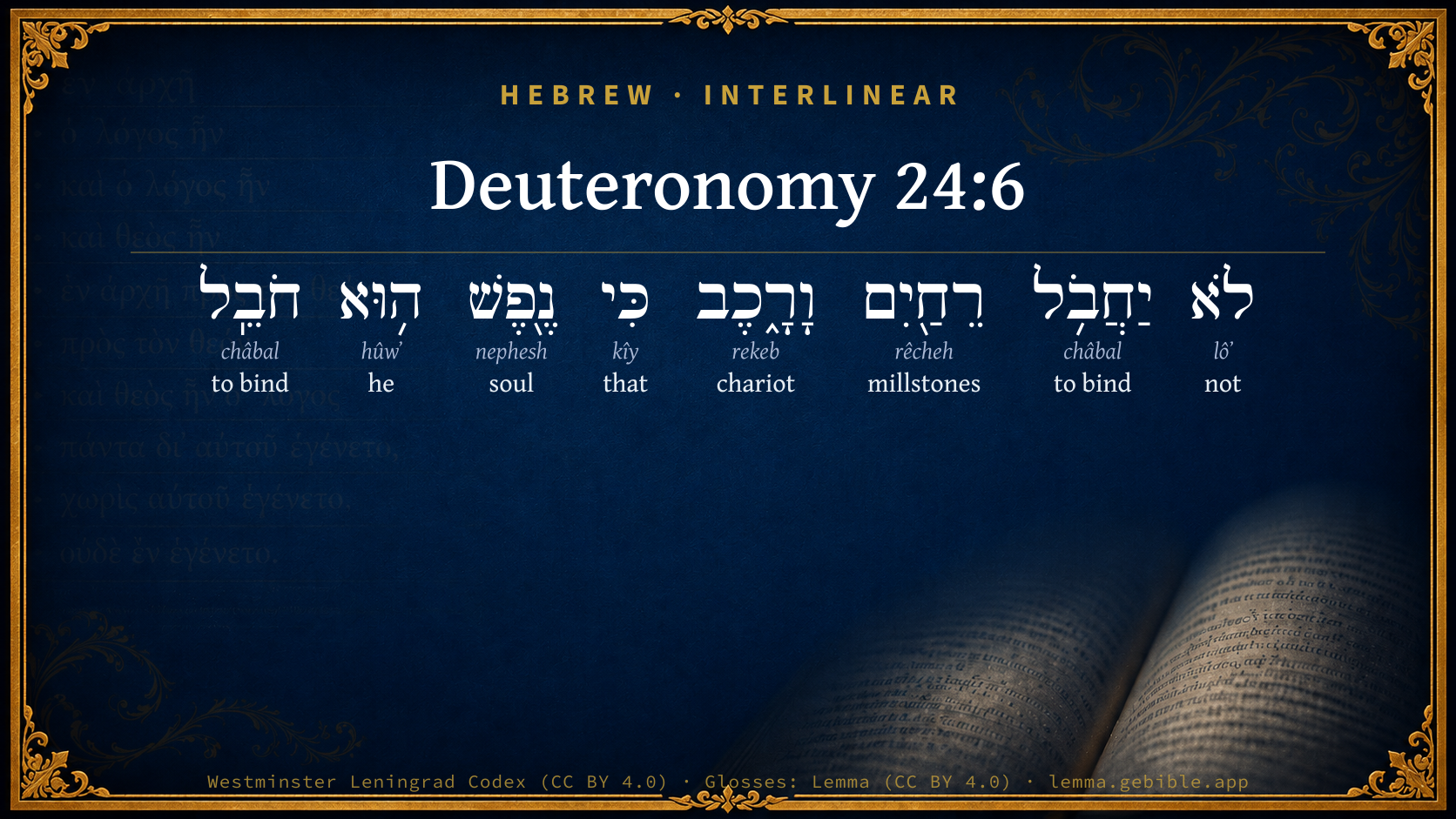
Deuteronomy 24:6

Hebrew (Westminster Leningrad Codex) Deuteronomy 24:6 appears in the Hebrew Old Testament. The text above is from the Westminster Leningrad Codex. Each word links to its Strong’s number, a concise gloss, and parsing drawn from the Open Scriptures Hebrew Bible morphology. Click any word for its full Brown-Driver-Briggs (BDB) entry.
Download image
Cite this verse

Deuteronomy 24:6 (World English Bible). Public Domain. Lemma interlinear Bible study tool, https://lemma.gebible.app/v/deuteronomy/24/6.

Show BibTeX & RIS
BibTeX
RIS
English Translation
No man shall take the mill or the upper millstone to pledge; for he takes [a man's] life to pledge.
World English Bible · Public Domain
Download a study sheet

One document with this verse’s original text, its word-by-word gloss line, the meaning frame, cross-references with their text, attributed commentary, and full source and license credits — printable, and it pastes into notes with its structure intact.

This verse Autodidact and up

Study sheet (.html) Plain text (.txt)

A passage Seminary Student

Up to 50 verses in one chapter. A passage sheet keeps up to 6 commentary sources and 12 cross-references per verse, in the order this page ranks them, and says so on the sheet whenever that leaves anything out. Ask for a single verse and you get the Autodidact verse sheet above.

Everything on this page stays free to read, with no account — the sheet is a download of what is already on screen, not access to it.

Want to remove ads? Support Godless Engineer
Compare translations 3

The same verse in 3 English versions, stacked beneath the original-language interlinear above. Click any original word for its lexicon entry.

Each is an independent rendering of the whole verse — the interlinear is not word-aligned to these translations.

Highlighted words mark where these versions differ — a whole-verse word diff, not a word-by-word alignment.

  • World English Bible Public Domain
    No man shall take the mill or the upper millstone to pledge; for he takes [a man's] life to pledge.
  • King James Version Public Domain
    No man shall take the nether or the upper millstone to pledge: for he taketh a man's life to pledge.
  • unfoldingWord Literal Text CC BY-SA 4.0
    He shall not impound a mill or an upper millstone, for it a life for a pledge.

unfoldingWord Literal Text — © unfoldingWord, licensed CC BY-SA 4.0. Word-aligned USFM3 via Door43 (git.door43.org/unfoldingWord/en_ult).

Versions to compare (up to 4)

3 of 4 selected

Show all 18 translations

Every available English version of this verse, each an independent rendering of the whole verse.

  • World English Bible Public Domain
    No man shall take the mill or the upper millstone to pledge; for he takes [a man's] life to pledge.
  • Berean Standard Bible Public Domain
    Do not take a pair of millstones or even an upper millstone as security for a debt, because that would be taking one’s livelihood as security.
  • Majority Standard Bible Public Domain
    Do not take a pair of millstones or even an upper millstone as security for a debt, because that would be taking one’s livelihood as security.
  • King James Version Public Domain
    No man shall take the nether or the upper millstone to pledge: for he taketh a man's life to pledge.
  • American Standard Version (1901) Public Domain
    No man shall take the mill or the upper millstone to pledge; for he taketh `a man's' life to pledge.
  • Revised Version (1885) Public Domain
    No man shall take the mill or the upper millstone to pledge: for he taketh a man’s life to pledge.
  • Geneva Bible (1599) Public Domain
    No man shall take the nether nor the vpper milstone to pledge: for this gage is his liuing.
  • Douay-Rheims (1899) Public Domain
    Thou shalt not take the nether, nor the upper millstone to pledge: for he hath pledged his life to thee.
  • Young's Literal Translation Public Domain
    `None doth take in pledge millstones, and rider, for life it `is' he is taking in pledge.
  • Literal Standard Version CC BY-SA 4.0
    No one takes millstones and rider in pledge, for it [is one’s] life he is taking in pledge.
  • Unlocked Literal Bible CC BY-SA 4.0
    No man may take a mill or an upper millstone as a pledge, for that would be taking a person's life as a pledge.
  • unfoldingWord Literal Text CC BY-SA 4.0
    He shall not impound a mill or an upper millstone, for it a life for a pledge.
  • Darby Bible Public Domain
    No man shall take the hand-mill or the upper millstone in pledge; for it would be taking life in pledge.
  • World Messianic Bible Public Domain
    No man shall take the mill or the upper millstone as a pledge, for he takes a life in pledge.
  • Webster's Bible Public Domain
    No man shall take the nether or the upper millstone for a pledge: for he taketh a man's life for a pledge.
  • Free Bible Version CC BY-SA 4.0
    Don't accept a pair of millstones, or even just an upper millstone, as security for a debt, because that would put the borrower's life in danger.
  • Bible in Basic English Public Domain
    No one is to take, on account of a debt, the stones with which grain is crushed: for in doing so he takes a man's living.
  • JPS Tanakh (1917) Public Domain
    No man shall take the mill or the upper millstone to pledge; for he taketh a man's life to pledge.

Literal Standard Version (2020), Covenant Press — licensed CC BY-SA 4.0. Text via the HelloAO Bible API (eBible.org). Unlocked Literal Bible (unfoldingWord) — licensed CC BY-SA 4.0. Text via the HelloAO Bible API (eBible.org). unfoldingWord Literal Text — © unfoldingWord, licensed CC BY-SA 4.0. Word-aligned USFM3 via Door43 (git.door43.org/unfoldingWord/en_ult). Free Bible Version, Dr. Jonathan Gallagher — licensed CC BY-SA 4.0. Text via the HelloAO Bible API (eBible.org).

Word by word

More ways to search: Search by grammar → Find every occurrence → Compare this word →

Practice this passage: Drill this verse → Learn its vocabulary →

About this verse

These counts appear in no published source. They are computed here, from the morphology-tagged text and Lemma’s own curated glosses. What Lemma adds →

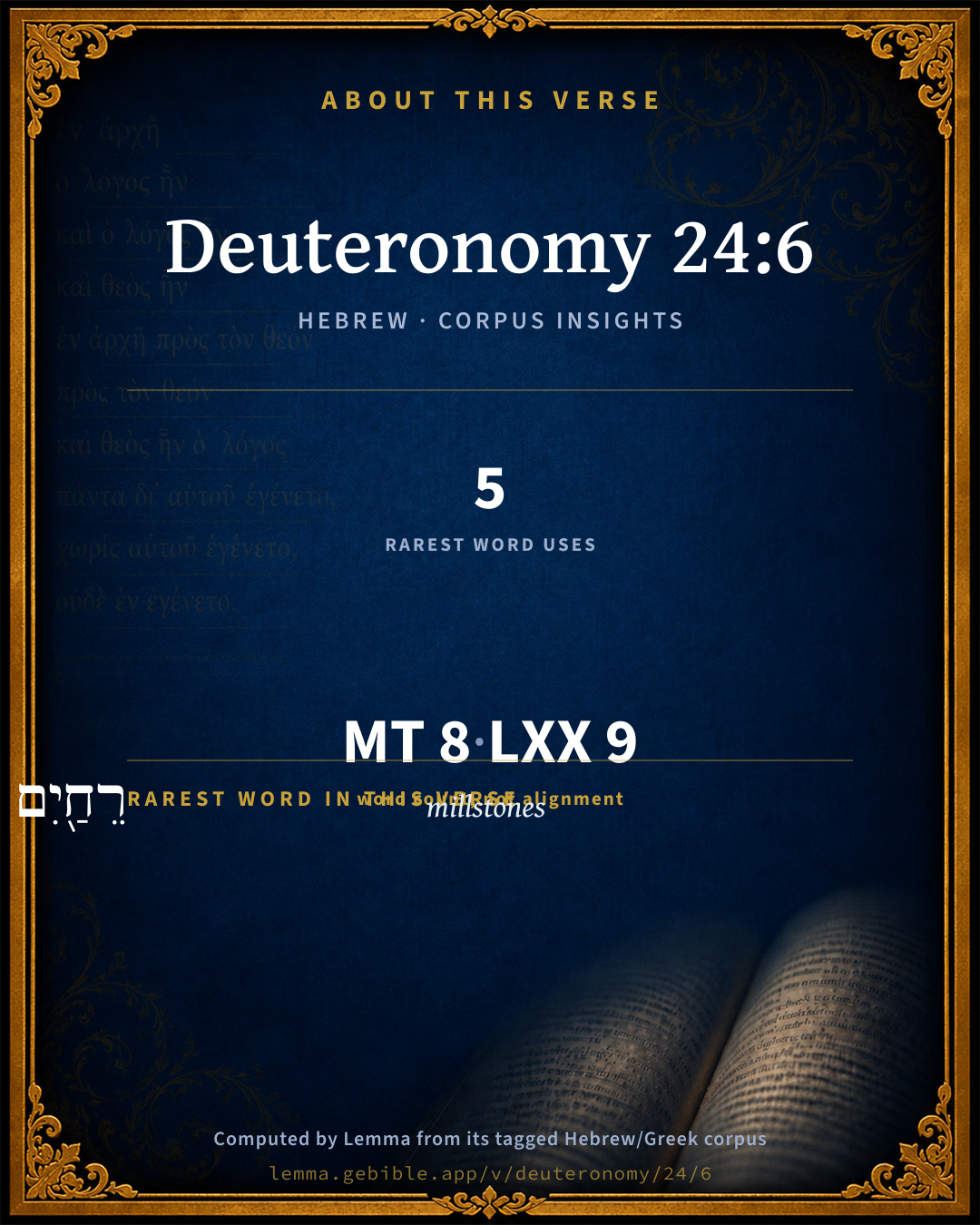
8
words
7
distinct lemmas
Pentateuch
section

Notable vocabulary

The rarest word here is רֵחַ֖יִם millstones H7347 — appearing just 5 times in the whole Hebrew Bible.

Shared distinctive vocabulary

רֵחַ֖יִם millstones H7347 occurs in 5 verses of the Hebrew Bible. Also found in:

Grammatical profile

  • 2 verbs
  • 3 nouns
  • 1 pronoun
  • 1 conjunction
  • 1 particle

Verb forms

  • יַחֲבֹ֥ל Qal · Imperfect
  • חֹבֵֽל Qal · Participle Active

Repetition

A word recurs within this verse — often emphatic in Hebrew:

  • יַחֲבֹ֥ל to bind H2254 ×2

Hebrew & Septuagint length

In English translation the verse runs 20 words from the Hebrew and 52 from the Septuagint (LXX English) — the Septuagint runs noticeably longer here. See the side-by-side →

A rough comparison of the two English renderings, which tokenize alike — not a word-level alignment.

Word counts can differ between the Hebrew and the Greek without any difference in meaning — e.g. the Hebrew direct-object marker אֵת has no separate Greek word, and Greek often adds the article ὁ.

In the original languages it is 8 Hebrew tokens and 9 Greek tokens — but the two are counted differently (Hebrew bundles its prefixes and suffixes into one token; the Greek is in lemma form), so that isn’t a like-for-like length.

Cross-references

5

Topical passages linked to Deuteronomy 24:6 in the Treasury of Scripture Knowledge — connected by theme and wording, ordered by reader-vote popularity; previews shown in the World English Bible.

  • Deuteronomy 20:19 When you shall besiege a city a long time, in making war against it to take it, you shall not destroy the trees of it by wielding an axe against them; for you may eat of them, and you shall not cut them down; for is the tree of the field man, that it should be besieged of you?
  • Luke 12:15 He said to them, "Beware! Keep yourselves from covetousness, for a man's life doesn't consist of the abundance of the things which he possesses."
  • Genesis 44:30 Now therefore when I come to your servant my father, and the boy is not with us; seeing that his life is bound up in the boy's life;
  • Revelation 18:22 The voice of harpists, minstrels, flute players, and trumpeters will be heard no more at all in you. No craftsman, of whatever craft, will be found any more at all in you. The sound of a mill will be heard no more at all in you.
  • Exodus 22:26–27 If you take your neighbor's garment as collateral, you shall restore it to him before the sun goes down,

Cross-references courtesy of OpenBible.info (CC BY 4.0).

Hebrew and Greek witnesses Masoretic Hebrew ↔ Greek Septuagint

The same verse in the two great witnesses to the Old Testament, shown verse-for-verse.

Here the Septuagint runs noticeably longer than the Hebrew — LXX2012 (modern English Septuagint) 52 words vs World English Bible 20. A rough length comparison of the two English translations, not a word-level alignment — read both below.

These are two independent witnesses, not word-aligned to each other, and the Septuagint is shown in lemma (dictionary) form.

Hebrew Deuteronomy 24:6 Masoretic · Westminster Leningrad Codex

לֹא יַחֲבֹ֥ל רֵחַ֖יִם וָרָ֑כֶב כִּי נֶ֖פֶשׁ ה֥וּא חֹבֵֽל

No man shall take the mill or the upper millstone to pledge; for he takes [a man's] life to pledge.

World English Bible · Public Domain

Greek LXX Deuteronomy 24:6 Septuagint · lemma form

οὐ ἐνεχυράζω μύλος οὐδέ ἐπιμύλιος ὅτι ψυχή οὗτος ἐνεχυράζω

the former husband who sent her away shall not be able to return and take her to himself for a wife, after she has been defiled; because it is an abomination before the Lord your God, and you⌃ shall not defile the land, which the Lord your God gives you to inherit.

LXX2012 (modern English Septuagint) · Public Domain

On this verse, The Cambridge Bible for Schools and Colleges discusses the Septuagint’s reading. Read the note in Commentary ↓

Hebrew: Westminster Leningrad Codex (CC BY 4.0). Greek: Septuagint (public domain); English from LXX2012 (modern English Septuagint) (Public Domain). How the Septuagint differs from the Hebrew →

Targum (Aramaic paraphrase)

2

The Targum is the ancient Jewish Aramaic paraphrase of the Hebrew Scriptures — an interpretive translation, not the Hebrew text itself. Onkelos (literal) and Pseudo-Jonathan (expansive) render the Torah, and Jonathan the Prophets. Coverage is partial: where no permissively-licensed English translation exists for a verse, only the Aramaic is shown. This is verse-level text, not a word-by-word alignment to the Hebrew.

  1. Targum Onkelos Torah (Genesis–Deuteronomy)
    לָא יִסַב מַשְׁכּוֹנָא רֵחַיָא וְרִכְבָּא אֲרֵי בְהוֹן מִתְעֲבֵד מָזוֹן לְכָל נְפַשׁ

    (no public-domain English translation for this verse)

    Targum Onkelos — Aramaic: “Onkelos Genesis” (public domain); “Onkelos Exodus” (public domain); “Onkelos Leviticus” (public domain); “Onkelos Numbers” (public domain); “Onkelos Deuteronomy” (public domain). English: “Sefaria Community Translation” (CC0 1.0 (public-domain dedication)); “J.W. Etheridge. The Targums of Onkelos and Jonathan Ben Uzziel on the Pentateuch. London: Longmans, Green, 1862” (public domain). Text via Sefaria.

  2. Targum Pseudo-Jonathan Torah (Genesis–Deuteronomy)
    לָא יְמַשְׁכַּן גְּבַר רֵיחַיָא וְרִיכְבָא אֲרוּם צוֹרְכֵי דִבְהוֹן מִתְעֲבֵיד מָזוֹן לְכָל נַפְשָׁא הוּא מְמַשְׁכַּן וְלָא יֶהֱוֵי גְבַר אֲסַר חַתְנִין וְכַלִּין בְּחַרְשִׁין אֲרוּם נַפְשָׁא דְעָתִיד לְמֵיפַק מִנְהוֹן הוּא מְחַבֵּל

    A man shall not take the millstones, lower or upper, as a pledge; for they are necessary in making food for every one. Neither shall a man join bridegrooms and brides by magical incantations; for what would be born of such would perish.

    Targum Pseudo-Jonathan — Aramaic: “Targum Jonathan on Genesis” (public domain); “Targum Jonathan on Exodus” (public domain); “Targum Jonathan on Leviticus” (public domain); “Targum Jonathan on Numbers” (public domain); “Targum Jonathan on Deuteronomy” (public domain). English: “The Targum of Jonathan ben Uzziel, trans. J. W. Etheridge, London, 1862” (public domain). Text via Sefaria.

Commentary

Notes on Deuteronomy 24:6 from classic Christian and Jewish commentators (each source and its license shown beneath its notes). The classic Christian expositions comment on the surrounding passage and are grouped to its opening verse, so a note may address several verses; the Jewish commentaries on the Tanakh (Rashi and others) are per-verse, so they appear only where the commentator wrote on this verse.

Lemma curates 59 commentaries, every one of them public domain or Creative Commons licensed, each selected and text-cleaned for this edition rather than reprinted as found. About our sources →

Trapp's Complete Commentary

John Trapp

Deu 24:6 No man shall take the nether or the upper millstone to pledge: for he taketh [a man’s] life to pledge.

Ver. 6. A man’s life.] That is, his livelihood. A poor man in his house is like a snail in his shell, crush that and you kill him. See Luk 8:43 Mar 12:44. All her life, ολον του βιον, that is, all her living.

John Trapp, A Commentary or Exposition upon All the Books of the Old and New Testament (1647–1656) — public domain. Text from a community e-Sword module.

The Biblical Illustrator

Joseph S. Exell

Deu_24:6

No man shall take the nether or the upper millstone to pledge.

The law respecting millstones

The Jewish law was important to that people as their national code. Its enactments were wisely adapted to their condition and the land they inhabited, and were calculated to secure their prosperity. But these considerations alone would not have justified its adoption in the Word of God. The Divine mind aims at higher objects than those which are included in this worlds prosperity. Who can imagine, with a worthy idea of infinite wisdom, the laws of this and the two foregoing chapters to have come from God, unless besides the letter in which they served the Jews, they have some deeper import by which they can give wisdom to Christians? Before proceeding further with the subject before us, let me remind you of that most important fact, which is equally true in vegetable growth and in the growth of religion, that all progress is gradual. It is first the blade, then the ear, and then the full corn in the ear. But corn, before it is fit for human food, must be brought to the mill and ground; and this operation is more especially connected with the subject before us.

I. The use of grinding is two fold: first, the separation of the husk and less nutritious portion from the richer interior substance of the corn; and secondly, the trituration and pulverising, which reduces the grain to flour and thus presents it fully prepared for the sustentation of man. Both these essential services are done by the mill. In ancient times each family had its own mill, and the flour for daily use was ground each day. The mill was composed of two circular flat stones; one the upper, the other the lower. In the upper one there was a hole, in which a wooden handle was fixed, by which it was made to go round. The persons grinding sat to their work, and frequently when women did it there would be two, and one passed the handle round to the other, and so the work went on. To this our blessed Lord alludes when He says, at the end of the Church, meant by the end of the age, or world: Two women shall be grinding at the mill, the one shall be taken and the other left (Mat_24:41). These circumstances all guide us to the correspondence. Corn corresponds to the good in life to which truth leads. The virtues which our views of religion open up to us are a harvest of graces; but, as general principles, they are not quite ready for daily use. They require to be rationally investigated, to be stripped of the forms in which we learned them, and to be accommodated to our own wants and circumstances. This is one of the works of the rational faculty in man. In this respect it is a spiritual mill. To know and understand the truth, that we may love and practise it, this is the spirit in which to read and hear the Word. The wisdom we understand enters into the mind, the wisdom we love enters into the heart. The opening of Thy words giveth light, it giveth understanding unto the simple (Psa_119:130). The words which remain in the memory, and do not enter the intellect, leave us, and have left the world, unenlightened and unedified. The grand use of the rational faculty, then, as a spiritual mill is evident. May we never surrender it, or barter it away. But the mill had two stones, an upper and a nether millstone. Stones represent truths of doctrine, especially in relation to the firmness they afford as a foundation and a defensive wall to our faith. In this sense stones are constantly employed in the Word (Isa_28:16; Mat_7:24-25; Luk_20:17; 1Pe_2:5). The two stones of which the mill consists represent the two grand truths into which the whole Word divides itself: those which teach love to God and love to man. The upper stone is the symbol of the first and great commandment. Our Lord refers to this when answering the question, Master, which is the great commandment in the law? Jesus said unto him, Thou shalt love the Lord thy God with all thy heart, and with all thy soul, and with all thy mind (Mat_22:36-38). The two tables of stone, upon which the Ten Commandments, the first and the essential principles of all the Divine Word, were written, were intended to represent the same two-fold division of all heavenly lessons. The mill, then, with its two stones, represents the rational faculty when it is furnished with these two grand truths. With these two universal principles it can do, and is intended to do, the utmost service to man. Everything that enters the mind should be submitted to its inspection and action. Whatever is taught in relation to God which is inconsistent with love to God and love to man should be rejected; whatever is in harmony with both should be received. All that love would do God will do, for God is love; all that love would reject, God will reject, for God is love. So in relation to man. Our duty in all things is to measure our conduct by the great law, Whatsoever ye would that men should do to you, do ye even so to them; for this is the law and the prophets (Mat_7:12). Such is the spiritual mill, and such is its operation. What a wide field of use it has; and how essential is that use! To try to sift, to discriminate, to adapt all that we learn, so that fallacy and mere appearance may be rejected, and only what is really conducive to salvation and blessing be retained: What is the chaff to the wheat? saith the Lord.

II. With this view of the important objects and indispensable character of the millstones, seen in their correspondence, we shall be prepared to see in spiritual light the reason of the command in our text: No man shall take the nether or the upper millstone to pledge: for he taketh a mans life to pledge. The rational faculty, and its two grand essential principles, must never be parted with, nor even be placed in abeyance. Oh! that this great truth that we ought never to suspend, never to forego the use of this grand principle, our rational faculty, were engraven on every heart. In this sublime portion of our nature the essential means of manhood reside. He will never become a man who never thoughtfully dares to reason for himself; who never strives to penetrate the appearances of things, and see with a single eye Divine realities. Here is the judgment seat for each mind. How poor a being he becomes who fears to use this glorious capability, let degenerate millions answer. He has not the fixed instincts of brutes and their obedience to the laws of their order, and while he is born with debased affections, he does not use this grand means of rising forever higher. Without that we cannot free ourselves from our own passions and prejudices, much less from the domination of other men. Without that we cannot rise to the freedom of citizens of heaven. We are things, not men. Let, then, no man take your mill; it is your life. But neither the lower nor the upper millstone must be taken. The two grand essential truths, upon which all others hang, must neither of them be given up. Whatever is not in harmony with them ought not to be received. Whatever is unworthy of our love to God, whatever would lessen our love to man, should be rejected at once. How great a source of elevation should we constantly have, if in all our hearing and reading we should bring our spiritual corn to the mill, furnished with these spiritual stones!

III. Finally, let me earnestly impress upon you all the importance of using the mill. There is no possibility of true manhood being attained without a conscientious use of reason in receiving the things of God. Have no fear in employing the glorious faculties Divine mercy has blessed you with Oh! that men would, rise manfully to the dignity of their, high character as rational and immortal beings capable of reserving the truth, judging of it, loving it, and making it their own by practice. Reject every attempt to place this heavenly mill in pledge, for it is your real manhood, your life, that is wished to be taken, when you are told to forego the use of your reason. Above all, let us see well that our mill is ever, in good condition, the nether and the upper stones. Let us receive no instruction that is inconsistent with love to our neighbour, the spiritual nether millstone. Let no sectarian sentiments, no idea that heaven was made just for this small party who think with us, or that gain our assent. Let us unite with men of love and virtue, of every name, assured that of such is the kingdom of heaven. Let not the upper millstone go into pledge. Let us unceasingly try every sentiment proposed to us as true by the great supreme law of love to God above all things. (J. Bayley, Ph. D.)

The Biblical Illustrator, edited by Joseph S. Exell (c. 1880s–1900s) — public domain. Text from a community e-Sword module.

Joseph Benson's Commentary

Deu 24:6. Millstone — Used in their hand-mills. Under this he understands all other things necessary to get a livelihood, the taking away whereof is against the laws both of charity and prudence, seeing by those things alone he can be enabled both to subsist and to pay his debts. Life — His livelihood, the necessary support of his life.

Joseph Benson's Commentary on the Old and New Testaments (1811–1818) — public domain. Text from a community e-Sword module.

Keil & Delitzsch

C. F. Keil & F. Delitzsch

Various Prohibitions. - Deu 24:6. "No man shall take in pledge the handmill and millstone, for he (who does this) is pawning life." רחים, the handmill; רכב, lit., the runner, i.e., the upper millstone. Neither the whole mill nor the upper millstone was to be asked for as a pledge, by which the mill would be rendered useless, since the handmill was indispensable for preparing the daily food for the house; so that whoever took them away injured life itself, by withdrawing what was indispensable to the preservation of life. The mill is mentioned as one specimen of articles of this kind, like the clothing in Exo 22:25-26, which served the poor man as bed-clothes also. Breaches of this commandment are reproved in Amo 2:8; Job 22:6; Pro 20:16; Pro 22:27; Pro 27:13.

Deu 24:7-9

Repetition of the law against man-stealing (Exo 21:16). - Deu 24:8, Deu 24:9. The command, "Take heed by the plague of leprosy to observe diligently and to do according to all that the priests teach thee," etc., does not mean, that when they saw signs of leprosy they were to be upon their guard, to observe everything that the priests directed them, as Knobel and many others suppose. For, in the first place, the reference to the punishment of Miriam with leprosy is by no means appropriate to such a thought as this, since Miriam did not act in opposition to the priests after she had been smitten with leprosy, but brought leprosy upon herself as a punishment, by her rebellion against Moses (Num 12:10.). And in the second place, this view cannot be reconciled with בּנגע השּׁמר, since השּׁמר with בּ, either to be upon one's guard against (before) anything (Sa2 20:10), or when taken in connection with בּנפשׁ, to beware by the soul, i.e., for the sake of the worth of the soul (Jer 17:21). The thought here, therefore, is, "Be on thy guard because of the plague of leprosy," i.e., that thou dost not get it, have to bear it, as the reward for thy rebellion against what the priests teach according to the commandment of the Lord. "Watch diligently, that thou do not incur the plague of leprosy" (Vulgate); or, "that thou do not sin, so as to be punished with leprosy" (J. H. Michaelis).

Keil & Delitzsch — Biblical Commentary on the Old Testament (1861–1891) — public domain (CC PDM 1.0). Text via the HelloAO Bible API. (Old Testament only.)

Tyndale Open Study Notes

Tyndale Open Resources

24:6 the owner uses it to make a living (literally it is his life): Without his tool, the owner of the millstone might perish. The law imposed a limit on what could secure a loan. The millstone probably represents any means by which an individual made his living.

Tyndale Open Study Notes — © Tyndale Open Resources, licensed CC BY-SA 4.0. Text via the HelloAO Bible API.

Geneva Bible (1599)

Geneva Bible translators

Not anything whereby a man getteth his living.

Geneva Bible (1599) marginal notes — public domain. Text via Bolls.life.

Jamieson, Fausset & Brown

Robert Jamieson, A. R. Fausset & David Brown

No man shall take the nether or the upper millstone to pledge--The "upper" stone being concave, covers the "nether" like a lid; and it has a small aperture, through which the corn is poured, as well as a handle by which it is turned. The propriety of the law was founded on the custom of grinding corn every morning for daily consumption. If either of the stones, therefore, which composed the handmill was wanting, a person would be deprived of his necessary provision.

Jamieson, Fausset & Brown — Commentary Critical and Explanatory on the Whole Bible (1871) — public domain (CC PDM 1.0). Text via the HelloAO Bible API.

Adam Clarke's Commentary

Verse 6. The nether or the upper mill-stone] Small hand-mills which can be worked by a single person were formerly in use among the Jews, and are still used in many parts of the East. As therefore the day's meal was generally ground for each day, they keeping no stock beforehand, hence they were forbidden to take either of the stones to pledge, because in such a case the family must be without bread. On this account the text terms the millstone the man's life.

Adam Clarke's Commentary on the Bible (1810–1826) — public domain. Text from a community e-Sword/MySword module.

Ellicott's Commentary for English Readers

(6) The nether or the upper millstone.—Literally, the two millstones, or even the upper one.

A man’s life.—Literally, a soul. This word connects the two verses (6, 7).

A Bible Commentary for English Readers, edited by Charles John Ellicott (1878–1897) — public domain. Text from a community e-Sword module.

The Cambridge Bible for Schools and Colleges

gen. ed. J. J. S. Perowne

6. Mill or Upper Millstone not to be taken in Pledge. This would be to pledge life itself. Milling (as largely still in Palestine) was mainly domestic, the first indispensable duty of the day; the sound of the millstones as sure a sign of a living family as the light of the candle (Jer_25:10, Rev_18:22; see Jerus. i. 375 f.). The mill, like the Western ‘quern,’ consisted of two stones, as the dual form of the Heb. name indicates (reḥaim, cp. Ar. raḥâ, Baldensperger, PEFQ, 1904, 263), of which the upper, Heb. rçkeb, rider, LXX ἐπιμύλιον, was the lighter and more easily lifted (Jdg_9:53).

This law is peculiar to D, and related to the next but two (10–13), which however is in the direct form of address, as this is not, and uses ‘abat for pledge instead of ḥabal (lit. bind) as here. The position of the law is natural after the previous one. In Israel, lands, houses and children were mortgaged (Neh_5:3; Neh_5:5), in Babylonia and Assyria slaves, lands and houses (Johns, op. cit. ch. 24). Of such pledges there is nothing in D, but note the next law. ‘The ancient Common Law of England provides that no man be distrained by the utensils or instruments of his trade or profession … Cook (sic), I Inst., fo. 47.’ (M. Henry.)

The Cambridge Bible for Schools and Colleges (gen. ed. J. J. S. Perowne; Cambridge University Press, 1878–1918) — public domain. Text from a community e-Sword module.

John Gill's Exposition

No man shall take the nether or the upper millstone to pledge,.... The first word being of the dual number takes in both stones, wherefore Vatablus renders the words,"ye shall not take for a pledge both the millstones, nor indeed the uppermost;''which is the least; so far should they be from taking both, that they were not allowed to take the uppermost, which was the shortest, meanest, and lightest; and indeed if anyone of them was taken, the other became useless, so that neither was to be taken:

for he taketh a man's life to pledge; or with which his life is supported, and the life of his family; for if he has corn to supply them with, yet if his mill or millstones are pawned, he cannot grind his corn, and so he and his family must starve: and in those times and countries they did, as the Arabs do to this day, as Dr. Shaw (d) relates,"most families grind their wheat and barley at home, having two portable millstones for that purpose; the uppermost whereof is turned round by a small handle of wood or iron, that is placed in the rim;''and these millstones being portable, might be the more easily taken for pledges, which is here forbidden, for the above reason; and this takes in any other thing whatever, on which a man's living depends, or by which he gets his bread (e).

(d) Travels, p. 231. Edit. 2. (e) Misn. Bava Metzia, c. 9. sect. 13.

John Gill's Exposition of the Whole Bible (1746–1763) — public domain (CC PDM 1.0). Text via the HelloAO Bible API.

Albert Barnes' Notes on the Bible

Compare Exo 22:25-26.

Albert Barnes' Notes on the Bible (1834–1885) — public domain. Text from a community e-Sword/MySword module.

Haydock's Catholic Bible Commentary

Life, or the means of supporting himself. (Haydock) --- The upper millstone was deemed the lest necessary. In more ancient times it was customary to dry the wheat by fire, and afterwards to pound it in a mortar. Then millstones were invented, which slaves of the meanest condition had to turn. Pliny ([Natural History?] xviii. 10,) mentions, that some few water-mills were used in his time. But this useful invention had been neglected, till Belisarius restored it again in the fifth century, when he was besieged in Rome by the Goths. (Procopius) --- Jonathan, and the paraphrast of Jerusalem, explain this quite in a different sense: "Thou shalt not use any enchantment for the consummation of marriage, since it would be to destroy the lives of the children to be born."

George Leo Haydock (1774–1849), Haydock's Catholic Family Bible and Commentary, 1859 edition — public domain. Excludes Psalms (Douay-Rheims chapter numbering differs from Protestant) and Deuterocanonical books (Catholic canon only).

Matthew Poole's English Annotations

The nether or the upper millstone, used in their handmills; of which see Exo 11:5; Num 11:8; Jer 25:10. Under this one kind he understands all other things necessary to get a livelihood, the taking away whereof is against the laws both of charity and prudence, seeing by those things alone he can be enabled both to subsist and to pay his debts.

A man’s life, i.e. his livelihood, or the necessary supports of his life.

Matthew Poole's English Annotations on the Holy Bible (1683–1685) — public domain. Text from a community e-Sword/MySword module.

Whedon's Commentary on the Bible

Daniel D. Whedon

6. No man shall take the… millstone to pledge — The handmill of the people consisted of two stones. It was necessary for preparing the ordinary food of the family, and was therefore exempt from execution for debt. Comp. Exo_22:25-26.

Daniel D. Whedon (gen. ed.), Commentary on the Old and New Testaments (1874–1909) — public domain. Text from a community e-Sword module.

The Pulpit Commentary

Vers. 6-14. Various prohibitions.

No man shall take the nether or the upper millstone to pledge; rather, the hand mill and the upper millstone (literally, the rider) shall not be taken (literally, one shall not take) in pledge. Neither the mill itself nor the upper millstone, the removal of which would render the mill useless, was to be taken. The upper millstone is still called the rider by the Arabs (Hebrew reehebh, Arabic rekkab). For he taketh a man"s life to pledge; or for (thereby) life itself is pledged; if a man were deprived of that by which food for the sustaining of life could be prepared, his life itself would be imperiled. (cf. Job_22:6; Pro_22:27; Amo_2:8)

Vers. 6-22. Neighborly love and good will to be cultivated in detail.

One golden thread runs through all the varied precepts of this chapter. They are most interesting illustrations, one and all, of the spirit of humanity and of far-reaching wisdom which pervades the Mosaic Law. The following heading include the gist of the several injunctions here given, and show also their relation to each other.

1. Man"s "inhumanity to man" is sternly restrained. No Israelite, however poor, is to be kidnapped and sold into foreign slavery (ver. 7).

2. No one might be deprived of the machinery, tools, or implements on the use of which his daily bread depended, for a pledge (ver. 6). It is doubtless to this humane regulation that we owe the ancient common law of this realm, that no man shall be distrained of the necessaries of his trade or profession as long as there are other things on which the distraint can be made.

3. A man"s house is to be his castle. No one may enter it, even to fetch a pledge (vers. 10, 11). The exception to this is in the case of leprosy, in which instance the priest had a right to enter a man"s house to see into the state of things, i.e. home is to be inviolable save where the public security demands it otherwise. Hence a special caution is given to avoid anything which might bring such a plague upon them. The case of Miriam should be before their eyes (vers. 8, 9).

4. If the poor man has pledged that in which he needs to sleep, it is to be restored to him before sundown (ver. 13).

5. Hired servants were not to be oppressed, but were to have fair and even generous treatment (vers. 14, 15).

6. The spirit of the checks upon blood-revenge, which are found in connection with the cities of refuge (see Homily thereon), is never to be violated, and no one is to suffer any civil penalty on account of another"s sin. Justice is to operate always (ver. 16).

7. No advantage is ever to be taken of the stranger, the fatherless, and the widow. They who are deprived of earthly helpers on whom they might lean are to find their safeguard in the sentiments of honor and benevolence which pervade the people (vers. 17, 18).

8. Not only is no wrong to be done to them, but their aid and comfort are to be specially studied, in the time of harvest, and in the gathering in of the olive and the grape (vers. 19-22).

9. The reason for such cultivation of kindness to others is that God had been kind to them (vers. 18, 22).

I The requirements of God in the social relations of life are righteousness, justice, mercy, love, and good will to all.

II God has fenced round the poor, the weak, the widow, and the fatherless with a special guard.

III A wrong done by man to man is sin against God.

IV The inspiring motive for our showing love to others is the love of God to us. (cf. Mic_6:8, Mic_6:9)

Vers. 6-15. The treatment of the poor.

The helplessness and dependence of the poor expose them to much harsh treatment. The poor man has, however, his Friend and Judge in God, whose Law here steps in for his protection. It ordains

I THAT THE NECESSARIES OF LIFE ARE NOT TO BE TAKEN FROM HIM. The millstone (ver. 6). His raiment, which if taken in pledge is to be restored by nightfall (vers. 12, 13). These are considerate provisions. It is the excess of cruelty to press law against a man to the extent of depriving him of the necessaries of life. This would apply to needful clothing, to a bed, to cooking utensils, to the tools by which he earns his bread. It is nearly as bad to receive and keep these things in pledge or pawn. Help, free and ungrudging, should be forthcoming to all honest persons in need, without driving them to such straits. If men will not work, neither should they eat, (2Th_3:10) but while this may be a reason for refusing to support them in their indolence, it can be no reason for helping them to strip themselves of the necessaries of their existence. Instead of taking a man"s tools from him, he should rather he encouraged to retain and ply them, "working with his hands the thing that is good," that he may both support himself and "have to give to him that needeth". (Eph_4:28)

II THAT HIS PERSONAL FREEDOM IS TO BE RESPECTED. (Ver. 7.) No strong or rich neighbor was to be allowed to steal, enslave, or sell him. The stealing of a man was punishable with death. And the spirit of the Law carries us beyond its letter. It requires that we respect the poor man"s freedom in all the relations of his life. Whatever the degree of his dependence, it does not entitle another to force his convictions, or do aught that would interfere with the exercise of his rights as man or citizen. Yet how often is compulsion and intimidation applied to those in dependent situations to compel them to act, not as their consciences approve, but as their superiors desire! He who takes advantage of a man"s weakness to do anything of the kind is a "man-stealer" in principle and at heart.

III THAT HIS DWELLING IS NOT TO BE INVADED. (Vers. 10, 11.) The fine sense of justice, the delicacy of feeling, in these precepts, is certainly remarkable. The poor man"s house is to be as sacred from invasion as the house of the wealthy. Even his creditor is to wait outside, and let the man fetch as his pledge what he can best spare. We are taught a lesson of respect for the domiciliary and proprietary rights of the poor. Many act as if the homes of the poor were not entitled to have their privacy respected in the same way as the homes of the rich, The Law of God teaches otherwise. We owe it to God, and we owe it to the humanity which is in our poorer brethren as well as in us, that we treat them and their belongings with precisely the same amount of respect that we would show to persons in a better social position.

IV THAT HIS WAGES ARE TO BE PAID WITH REGULARITY. (Vers. 14, 15.) Every day, the text says, and in the East this was necessary. During the Indian famines it was found that the persons engaged on the relief works had to be paid in this manner. Great suffering was sometimes experienced from the neglect of the rule. The law extends to hired service of all kinds, and enjoins in principle regularity in payment of wages. A like principle applies to the payment of tradesmen"s accounts. We have heard tradesmen complain bitterly of the inconvenience to which they were subjected from the singular want of consideration displayed by wealthy families in this particular. Accounts are allowed to run on, and payment is withheld, not from want of ability to pay, but from sheer indolence and carelessness in attending to such matters. While to crave payment would, on the tradesman"s part, mean the forfeiture of custom. J.O.

Vers. 6, 10-13. Prohibited Pledges.

Wealth is power; in every nation we need the safeguards of law to prevent such power from becoming tyranny. The poor are ever liable to become the prey of voracious avarice.

I A SEASONABLE LOAN IS A PRICELESS SERVICE, Men can render service one to another in a thousand different forms. Redundance of possession on the part of one may serviceably supply the deficiencies of another. One man has riches which he cannot profitably employ, another has trade for which his money capital is insufficient. One man has accumulated experience, another has penetrative wisdom, another has technical knowledge. All this is equipment for useful service. So, in the spiritual kingdom, one has tender feeling, another has gift of prayer or gift of speech, another has extended influence. All human endowments are a common fund to be distributed for the benefit of all. There are occasions in human life when a loan is more useful than a gift. Temporary exigencies sometimes arise, for which loan, on fitting security, is the wisest alleviation.

II FOR LOANS SUITABLE PLEDGES SHOULD BE TAKEN.

1. This serves as a check upon facile borrowing. If loans are granted on too easy terms, we may encourage a man in reckless commercial speculation, or destroy the natural checks on personal extravagance.

2. This serves to prevent strife. Borrowers have oftentimes a short memory for liabilities. While human nature has its imperfections and society its scoundrels, it is wiser to have solid guarantee for the redemption of loans, and honest borrowers will not object to give suitable pledges for honesty.

3. Pledges are needed on the ground of uncertain mortality. "We know not what a day may bring forth.

III PLEDGES WHICH TOUCH A MAN"S LIFE ARE PROHIBITED. Money-getting is never to be so pressed as to impinge on the domain of life. Human life is a sacred thing, and must not be trifled with. It has latent capabilities, and may yet become a source of blessing to myriads. Gain becomes as the small dust, an inappreciable thing, when placed in the balance against a human life. The gold of a continent is a bubble in comparison with a man"s soul.

IV GENEROUS SURRENDER OF POVERTY"S PLEDGES AN ACT OF PIETY. Pledges are telltales of common dishonesty. If truthfulness and honor were as prevalent as they ought to be, no pledge would be needed. A man"s word ought to be as good as his pledge. It often does a man good if we make his honor the only pledge. He is ennobled by our confidence. He rises in self-respect. Debts of honor are often paid prior to those which have material security. If we form a high estimate of men, they will often strive to reach the ideal. Generous treatment of the poor secures their warmest interest on our behalf. The poorest of the poor has still access to the audience-chamber of the heavenly palace. Their simple suit on our behalf will sometimes secure blessings which no arithmetic can measure. Deeds of kindness done to the indigent are done to God, for God identifies himself with them. "He that giveth to the poor lendeth to the Lord." If the concession he an act of sterling love, pure from the alloy of selfishness, it is an act of righteousness the fruit of the Divine Spirit"s grace. This is not self-righteousness, for genuine love to men is a gracious affection. It does not begin with self; it does not terminate in self. God is its object; hence it shall be counted for righteousness. As Abraham"s faith counted for righteousness, so does also genuine love. D.

The Pulpit Commentary (1880–1919), ed. H.D.M. Spence-Jones & Joseph S. Exell — public domain. Text from a community e-Sword module.

John Wesley's Explanatory Notes

Mill-stone - Used in their hand-mills. Under this, he understands all other things necessary to get a livelihood, the taking away whereof is against the laws both of charity and prudence, seeing by those things alone he can be enabled both to subsist and to pay his debts. Life - His livelihood, the necessary support of his life.

John Wesley, Explanatory Notes Upon the Whole Bible (1754–1765) — public domain. Text via the GEBible commentary corpus.

unfoldingWord translationNotes

Door43 World Missions Community

mill

a tool for making flour by grinding grain in between two heavy discs of stone

upper millstone

the top disc of stone in a mill

for that would be taking a person's life as a pledge

The word "life" is a metonym for what a person needs to keep himself alive. AT: "because he would be taking from the man what the man needs to make food for his family" (See: Metonymy)

translationWords

pledge

unfoldingWord translationNotes — © Distant Shores Media and the Door43 World Missions Community, licensed CC BY-SA 4.0. Source: git.door43.org/Door43/en_tn.

Rashi

Rabbi Shlomo Yitzchaki (Rashi)

לא יחבל NO MAN SHALL TAKE [THE LOWER OR THE UPPER MILLSTONE] AS PLEDGE — i.e. if one comes to demand a pledge through the court for his debt he should not take as a pledge anything by which food is prepared (Bava Metzia 113b, 115a).

רחים is the lower,

ורכב is the upper millstone.

Rashi on the Tanakh — English translations: “The Judaica Press complete Tanach with Rashi, translated by A. J. Rosenberg” (CC BY 4.0); “Pentateuch with Rashi's commentary by M. Rosenbaum and A.M. Silbermann, 1929-1934” (public domain); “The Metsudah Tanach series, Lakewood, N.J” (CC BY 4.0); and “The Book of Joshua, Metsudah Publications, 1997” (CC BY 4.0). Text via Sefaria.

Lesson kit

Teaching starters — assembled from the data on this page, not authored interpretation. Every prompt links to the verse data it draws on. Edit before teaching.

Deuteronomy, in the Pentateuch, opens this verse with 8 words (7 distinct Hebrew lemmas). Its most distinctive word is rêcheh (“millstones”). The Greek Septuagint runs longer here. A historical commentator’s framing appears above. Read the whole chapter for the surrounding context.

Discussion questions

  1. What does “millstones” (rêcheh) contribute to the verse as a whole?
  2. How does Exodus 11:5, which shares the word «millstones», read alongside this verse?
  3. What does the repetition of “to bind” (2× in this one verse) do in this verse?
  4. The Septuagint runs longer here than the Hebrew. What might account for the difference?
  5. The translations on this page render this verse differently — a whole-verse word diff, not a word-by-word alignment. What might account for the different wordings?
  6. «יַחֲבֹ֥ל» is a Qal Imperfect verb. How does that grammatical form shape the action described?
  7. Compare how Trapp's Complete Commentary and The Biblical Illustrator read this verse. Where do they agree or differ?

Things to notice

Reading settings

Reading text

Shown beneath each verse's original-language words.

Old Testament
Old Testament edition

Read the OT as the Masoretic Hebrew (MT) or the Greek Septuagint (LXX).

English shown for the Greek Septuagint (in the Hebrew ↔ Greek comparison).

Comparing translations? Open the Compare panel on any verse page to stack up to four side by side.