
Song of Solomon 6:9

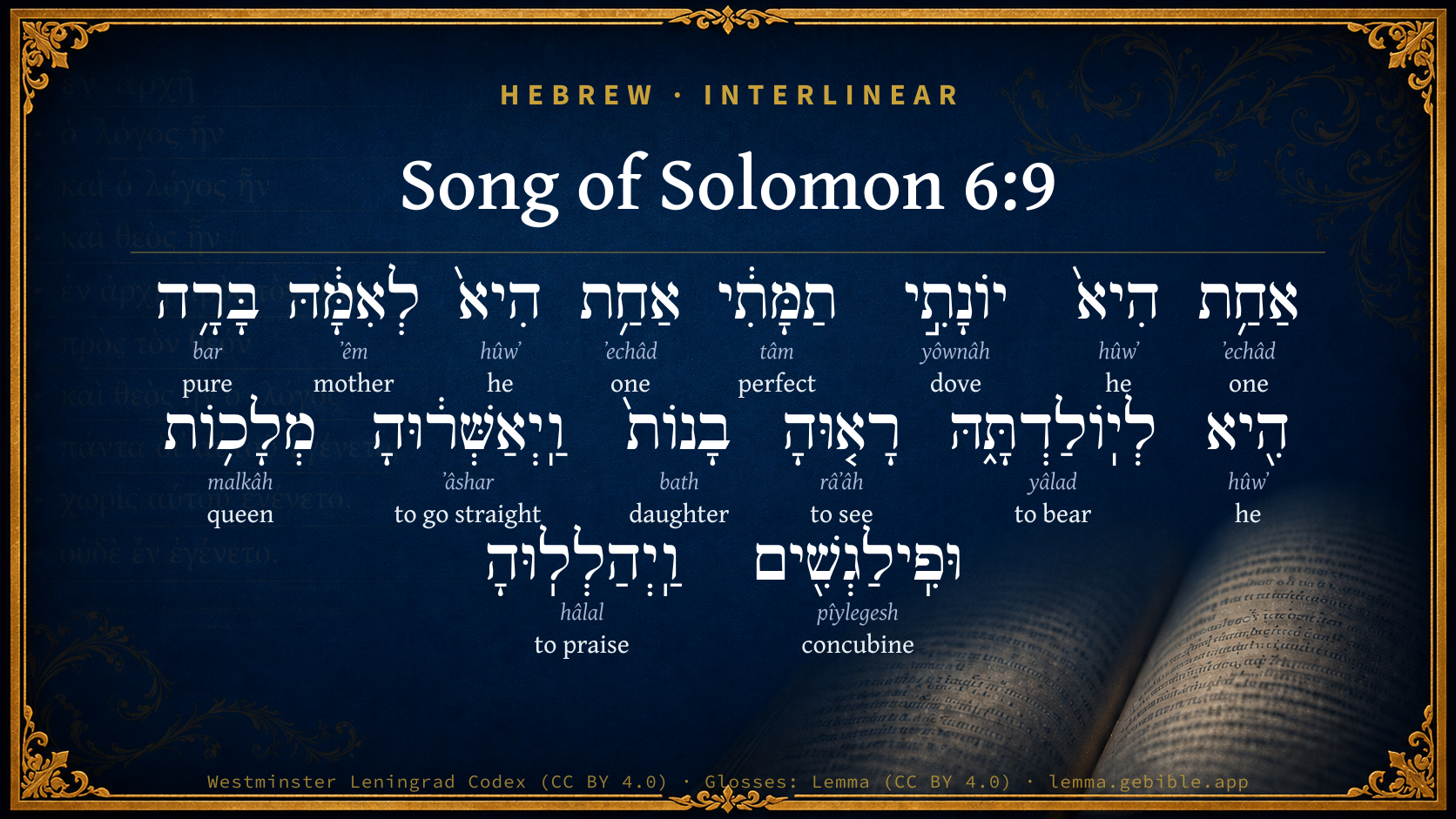
Hebrew (Westminster Leningrad Codex) Song of Solomon 6:9 appears in the Hebrew Old Testament. The text above is from the Westminster Leningrad Codex. Each word links to its Strong’s number, a concise gloss, and parsing drawn from the Open Scriptures Hebrew Bible morphology. Click any word for its full Brown-Driver-Briggs (BDB) entry.
Download image
Cite this verse

Song of Solomon 6:9 (World English Bible). Public Domain. Lemma interlinear Bible study tool, https://lemma.gebible.app/v/song-of-solomon/6/9.

Show BibTeX & RIS
BibTeX
RIS
English Translation
My dove, my perfect one, is unique. She is her mother's only daughter. She is the favorite one of her who bore her. The daughters saw her, and called her blessed, The queens and the concubines, and they praised her.
World English Bible · Public Domain
Download a study sheet

One document with this verse’s original text, its word-by-word gloss line, the meaning frame, cross-references with their text, attributed commentary, and full source and license credits — printable, and it pastes into notes with its structure intact.

This verse Autodidact and up

Study sheet (.html) Plain text (.txt)

A passage Seminary Student

Up to 50 verses in one chapter. A passage sheet keeps up to 6 commentary sources and 12 cross-references per verse, in the order this page ranks them, and says so on the sheet whenever that leaves anything out. Ask for a single verse and you get the Autodidact verse sheet above.

Everything on this page stays free to read, with no account — the sheet is a download of what is already on screen, not access to it.

Want to remove ads? Support Godless Engineer
Compare translations 3

The same verse in 3 English versions, stacked beneath the original-language interlinear above. Click any original word for its lexicon entry.

Each is an independent rendering of the whole verse — the interlinear is not word-aligned to these translations.

Highlighted words mark where these versions differ — a whole-verse word diff, not a word-by-word alignment.

  • World English Bible Public Domain
    My dove, my perfect one, is unique. She is her mother's only daughter. She is the favorite one of her who bore her. The daughters saw her, and called her blessed, The queens and the concubines, and they praised her.
  • King James Version Public Domain
    My dove, my undefiled is but one; she is the only one of her mother, she is the choice one of her that bare her. The daughters saw her, and blessed her; yea, the queens and the concubines, and they praised her.
  • unfoldingWord Literal Text CC BY-SA 4.0
    One she, my dove; my perfect one—one she to her mother; pure she to the woman who bore her. The daughters saw her and called her blessed; the queens and the concubines—they praised her:

unfoldingWord Literal Text — © unfoldingWord, licensed CC BY-SA 4.0. Word-aligned USFM3 via Door43 (git.door43.org/unfoldingWord/en_ult).

Versions to compare (up to 4)

3 of 4 selected

Show all 18 translations

Every available English version of this verse, each an independent rendering of the whole verse.

  • World English Bible Public Domain
    My dove, my perfect one, is unique. She is her mother's only daughter. She is the favorite one of her who bore her. The daughters saw her, and called her blessed, The queens and the concubines, and they praised her.
  • Berean Standard Bible Public Domain
    but my dove, my perfect one, is unique, the favorite of the mother who bore her. The maidens see her and call her blessed; the queens and concubines sing her praises.
  • Majority Standard Bible Public Domain
    but my dove, my perfect one, is unique, the favorite of the mother who bore her. The maidens see her and call her blessed; the queens and concubines sing her praises.
  • King James Version Public Domain
    My dove, my undefiled is but one; she is the only one of her mother, she is the choice one of her that bare her. The daughters saw her, and blessed her; yea, the queens and the concubines, and they praised her.
  • American Standard Version (1901) Public Domain
    My dove, my undefiled, is `but' one; She is the only one of her mother; She is the choice one of her that bare her. The daughters saw her, and called her blessed; `Yea', the queens and the concubines, and they praised her.
  • Revised Version (1885) Public Domain
    My dove, my undefiled, is but one; she is the only one of her mother; she is the choice one of her that bare her. The daughters saw her, and called her blessed; yea, the queens and the concubines, and they praised her.
  • Geneva Bible (1599) Public Domain
    Who is shee that looketh foorth as the morning, fayre as the moone, pure as the sunne, terrible as an armie with banners!
  • Douay-Rheims (1899) Public Domain
    Who is she that cometh forth as the morning rising, fair as the moon, bright as the sun, terrible as an army set in array?
  • Young's Literal Translation Public Domain
    One is my dove, my perfect one, One she `is' of her mother, The choice one she `is' of her that bare her, Daughters saw, and pronounce her happy, Queens and concubines, and they praise her.
  • Literal Standard Version CC BY-SA 4.0
    One is my dove, my perfect one, || She [is] one of her mother, || She [is] the choice one of her that bore her, || Daughters saw, and pronounce her blessed, || Queens and concubines, and they praise her.
  • Unlocked Literal Bible CC BY-SA 4.0
    My dove, my undefiled, is the only one; she is the only daughter of her mother; she is the favorite one of the woman who bore her. The young women saw her and called her blessed; the queens and the concubines saw her also, and they praised her:
  • unfoldingWord Literal Text CC BY-SA 4.0
    One she, my dove; my perfect one—one she to her mother; pure she to the woman who bore her. The daughters saw her and called her blessed; the queens and the concubines—they praised her:
  • Darby Bible Public Domain
    My dove, mine undefiled, is but one; She is the only one of her mother, She is the choice one of her that bore her. The daughters saw her, and they called her blessed; The queens and the concubines, and they praised her.
  • World Messianic Bible Public Domain
    My dove, my perfect one, is unique. She is her mother’s only daughter. She is the favorite one of her who bore her. The daughters saw her, and called her blessed. The queens and the concubines saw her, and they praised her.
  • Webster's Bible Public Domain
    My dove, my undefiled is but one; she is the only one of her mother, she is the choice one of her that bore her. The daughters saw her, and blessed her; yes, the queens and the concubines, and they praised her.
  • Free Bible Version CC BY-SA 4.0
    but my love, my perfect love, she's the only one! She's her mother's favorite, special to the one who gave birth to her. Young women see her and say how lucky she is; queens and concubines sing her praises.
  • Bible in Basic English Public Domain
    My dove, my very beautiful one, is but one; she is the only one of her mother, she is the dearest one of her who gave her birth. The daughters saw her, and gave her a blessing; yes, the queens and the servant-wives, and they gave her praises.
  • JPS Tanakh (1917) Public Domain
    My dove, my undefiled, is but one; she is the only one of her mother; she is the choice one of her that bore her. The daughters saw her, and called her happy; yea, the queens and the concubines, and they praised her.

Literal Standard Version (2020), Covenant Press — licensed CC BY-SA 4.0. Text via the HelloAO Bible API (eBible.org). Unlocked Literal Bible (unfoldingWord) — licensed CC BY-SA 4.0. Text via the HelloAO Bible API (eBible.org). unfoldingWord Literal Text — © unfoldingWord, licensed CC BY-SA 4.0. Word-aligned USFM3 via Door43 (git.door43.org/unfoldingWord/en_ult). Free Bible Version, Dr. Jonathan Gallagher — licensed CC BY-SA 4.0. Text via the HelloAO Bible API (eBible.org).

Word by word

More ways to search: Search by grammar → Find every occurrence → Compare this word →

Practice this passage: Drill this verse → Learn its vocabulary →

בָּרָ֥ה
bar
H1249
“pure”
Adjective, Adjective, Feminine, Singular, Absolute
Part of Speech
Adjective
Type
Adjective
Gender
Feminine
Number
Singular
State
Absolute
Full BDB Definition

Origin: from H1305 (in its various senses)

TWOT: 288a

pure, clear, sincere - clean, empty - purely
  1. אַחַ֥ת ʼechâd H259 “one” Adjective, Cardinal number, Feminine, Singular, Absolute
  2. הִיא֙ hûwʼ H1931 “he” Pronoun, Personal, 3rd Person, Feminine, Singular
  3. יוֹנָתִ֣י yôwnâh H3123 “dove · my” Noun, Common, Feminine, Singular, Construct + Suffix, Personal, 1st Person, Common, Singular
  4. תַמָּתִ֔י tâm H8535 “perfect · my” Adjective, Adjective, Feminine, Singular, Construct + Suffix, Personal, 1st Person, Common, Singular
  5. אַחַ֥ת ʼechâd H259 “one” Adjective, Cardinal number, Feminine, Singular, Absolute
  6. הִיא֙ hûwʼ H1931 “he” Pronoun, Personal, 3rd Person, Feminine, Singular
  7. לְאִמָּ֔הּ ʼêm H517 “to/for · mother · her” Preposition + Noun, Common, Feminine, Singular, Construct + Suffix, Personal, 3rd Person, Feminine, Singular
  8. הִ֖יא hûwʼ H1931 “he” Pronoun, Personal, 3rd Person, Feminine, Singular
  9. לְיֽוֹלַדְתָּ֑הּ yâlad H3205 “to/for · bearing · her” Preposition + Verb, Qal, Participle Active, Feminine, Singular, Construct + Suffix, Personal, 3rd Person, Feminine, Singular
  10. רָא֤וּהָ râʼâh H7200 “to see · her” Verb, Qal, Perfect, 3rd Person, Common, Plural + Suffix, Personal, 3rd Person, Feminine, Singular
  11. בָנוֹת֙ bath H1323 “daughters” Noun, Common, Feminine, Plural, Absolute
  12. וַֽיְאַשְּׁר֔וּהָ ʼâshar H833 “and · to go straight · her” Conjunction + Verb, Piel, Sequential Imperfect, 3rd Person, Masculine, Plural + Suffix, Personal, 3rd Person, Feminine, Singular
  13. מְלָכ֥וֹת malkâh H4436 “queens” Noun, Common, Feminine, Plural, Absolute
  14. וּפִֽילַגְשִׁ֖ים pîylegesh H6370 “and · concubines” Conjunction + Noun, Common, Feminine, Plural, Absolute
  15. וַֽיְהַלְלֽוּהָ hâlal H1984 “and · to praise · her” Conjunction + Verb, Piel, Sequential Imperfect, 3rd Person, Masculine, Plural + Suffix, Personal, 3rd Person, Feminine, Singular

About this verse

These counts appear in no published source. They are computed here, from the morphology-tagged text and Lemma’s own curated glosses. What Lemma adds →

16
words
13
distinct lemmas
Wisdom
section

Notable vocabulary

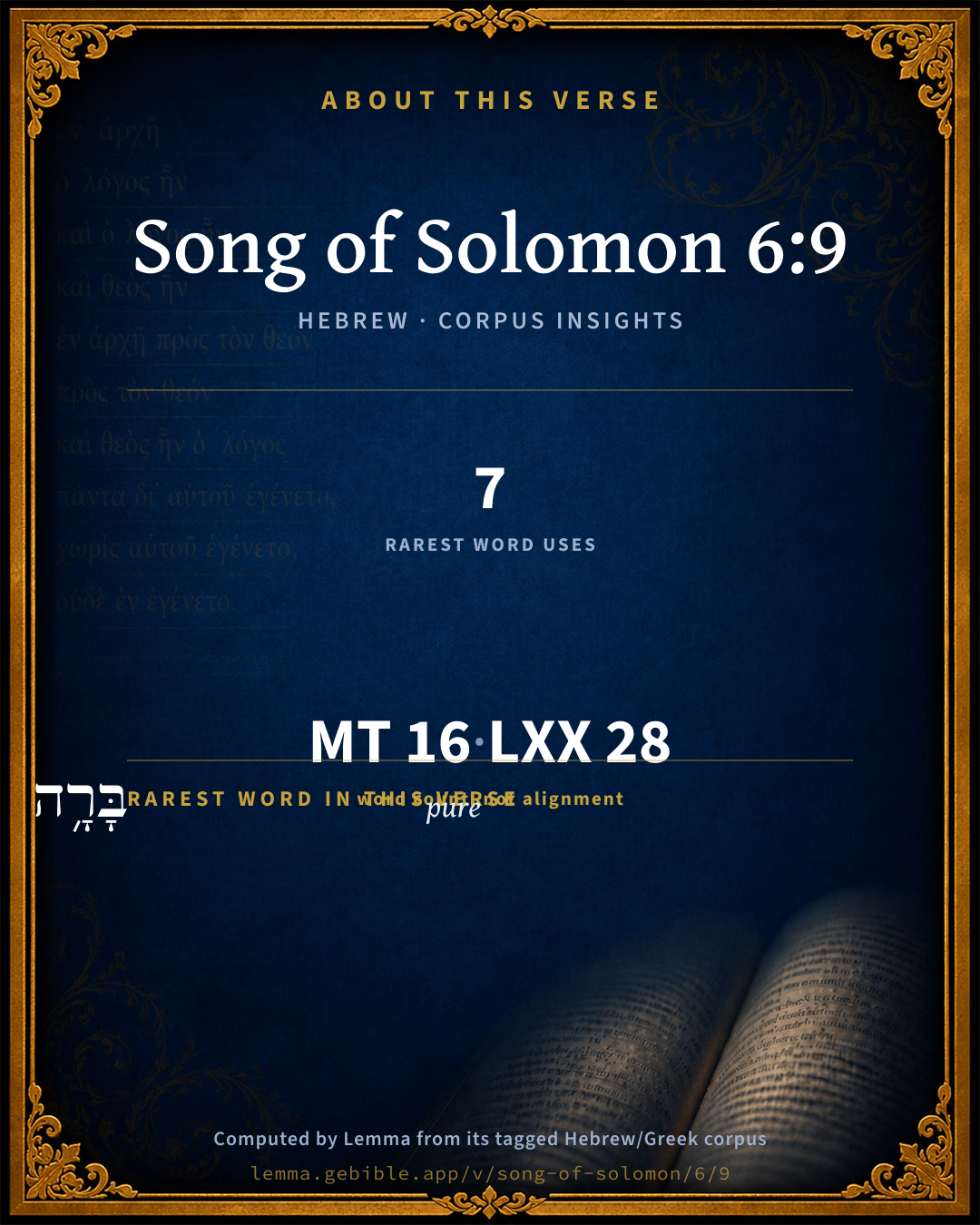
The rarest word here is בָּרָ֥ה pure H1249 — appearing just 7 times in the whole Hebrew Bible.

Shared distinctive vocabulary

בָּרָ֥ה pure H1249 occurs in 7 verses of the Hebrew Bible. Also found in:

Grammatical profile

  • 4 verbs
  • 5 nouns
  • 4 adjectives
  • 3 pronouns

Verb forms

  • לְיֽוֹלַדְתָּ֑הּ Qal · Participle Active
  • רָא֤וּהָ Qal · Perfect
  • וַֽיְאַשְּׁר֔וּהָ Piel · Sequential Imperfect
  • וַֽיְהַלְלֽוּהָ Piel · Sequential Imperfect

Repetition

Words recur within this verse — often emphatic in Hebrew:

  • אַחַ֥ת one H259 ×2
  • הִיא֙ he H1931 ×3

Hebrew & Septuagint length

In English translation the verse runs 40 words from the Hebrew and 23 from the Septuagint (LXX English) — the Septuagint runs noticeably shorter here. See the side-by-side →

A rough comparison of the two English renderings, which tokenize alike — not a word-level alignment.

Word counts can differ between the Hebrew and the Greek without any difference in meaning — e.g. the Hebrew direct-object marker אֵת has no separate Greek word, and Greek often adds the article ὁ.

In the original languages it is 16 Hebrew tokens and 28 Greek tokens — but the two are counted differently (Hebrew bundles its prefixes and suffixes into one token; the Greek is in lemma form), so that isn’t a like-for-like length.

Cross-references

13

Topical passages linked to Song of Solomon 6:9 in the Treasury of Scripture Knowledge — connected by theme and wording, ordered by reader-vote popularity; previews shown in the World English Bible.

  • Song of Solomon 2:14 My dove in the clefts of the rock, In the hiding places of the mountainside, Let me see your face. Let me hear your voice; For your voice is sweet, and your face is lovely.
  • Genesis 30:13 Leah said, "Happy am I, for the daughters will call me happy." She named him Asher.
  • Psalms 45:9 Kings' daughters are among your honorable women. At your right hand the queen stands in gold of Ophir.
  • Proverbs 31:28–29 Her children rise up and call her blessed. Her husband also praises her:
  • Song of Solomon 5:2 I was asleep, but my heart was awake. It is the voice of my beloved who knocks: Open to me, my sister, my love, my dove, my undefiled; For my head is filled with dew, My hair with the dampness of the night.
  • Revelation 21:9–10 One of the seven angels who had the seven bowls, who were loaded with the seven last plagues came, and he spoke with me, saying, "Come here. I will show you the wife, the Lamb's bride."
  • Psalms 126:2 Then our mouth was filled with laughter, And our tongue with singing. Then they said among the nations, "Yahweh has done great things for them."
  • Galatians 4:26 But the Jerusalem that is above is free, which is the mother of us all.
  • Numbers 23:9 For from the top of the rocks I see him, From the hills I see him: behold, it is a people that dwells alone, And shall not be reckoned among the nations.
  • Deuteronomy 4:6–7 Keep therefore and do them; for this is your wisdom and your understanding in the sight of the peoples, who shall hear all these statutes, and say, Surely this great nation is a wise and understanding people.
  • Deuteronomy 33:29 Happy are you, Israel: Who is like you, a people saved by Yahweh, The shield of your help, The sword of your excellency! Your enemies shall submit themselves to you; You shall tread on their high places.
  • Ephesians 4:3–6 being eager to keep the unity of the Spirit in the bond of peace.
  • 2 Thessalonians 1:10 when he comes to be glorified in his saints, and to be admired among all those who have believed (because our testimony to you was believed) in that day.

Cross-references courtesy of OpenBible.info (CC BY 4.0).

Hebrew and Greek witnesses Masoretic Hebrew ↔ Greek Septuagint

The same verse in the two great witnesses to the Old Testament, shown verse-for-verse.

Here the Septuagint runs noticeably shorter than the Hebrew — LXX2012 (modern English Septuagint) 23 words vs World English Bible 40. A rough length comparison of the two English translations, not a word-level alignment — read both below.

These are two independent witnesses, not word-aligned to each other, and the Septuagint is shown in lemma (dictionary) form.

Hebrew Song of Solomon 6:9 Masoretic · Westminster Leningrad Codex

אַחַ֥ת הִיא֙ יוֹנָתִ֣י תַמָּתִ֔י אַחַ֥ת הִיא֙ לְאִמָּ֔הּ בָּרָ֥ה הִ֖יא לְיֽוֹלַדְתָּ֑הּ רָא֤וּהָ בָנוֹת֙ וַֽיְאַשְּׁר֔וּהָ מְלָכ֥וֹת וּפִֽילַגְשִׁ֖ים וַֽיְהַלְלֽוּהָ

My dove, my perfect one, is unique. She is her mother's only daughter. She is the favorite one of her who bore her. The daughters saw her, and called her blessed, The queens and the concubines, and they praised her.

World English Bible · Public Domain

Greek LXX Song of Solomon 6:9 Septuagint · lemma form

εἷς εἰμί περιστερά ἐγώ τέλειος ἐγώ εἷς εἰμί ὁ μήτηρ αὐτός ἐκλεκτός εἰμί ὁ τίκτω αὐτός ὁράω αὐτός θυγάτηρ καί μακαρίζω αὐτός βασίλισσα καί παλλακή καί αἰνέω αὐτός

Who is this that looks forth as the morning, fair as the moon, choice as the sun, terrible as armies set in array?

LXX2012 (modern English Septuagint) · Public Domain

On this verse, The Cambridge Bible for Schools and Colleges discusses the Septuagint’s reading. Read the note in Commentary ↓

Hebrew: Westminster Leningrad Codex (CC BY 4.0). Greek: Septuagint (public domain); English from LXX2012 (modern English Septuagint) (Public Domain). How the Septuagint differs from the Hebrew →

Commentary

Notes on Song of Solomon 6:9 from classic Christian and Jewish commentators (each source and its license shown beneath its notes). The classic Christian expositions comment on the surrounding passage and are grouped to its opening verse, so a note may address several verses; the Jewish commentaries on the Tanakh (Rashi and others) are per-verse, so they appear only where the commentator wrote on this verse.

Lemma curates 59 commentaries, every one of them public domain or Creative Commons licensed, each selected and text-cleaned for this edition rather than reprinted as found. About our sources →

The Cambridge Bible for Schools and Colleges

gen. ed. J. J. S. Perowne

9. but one] The one here is numerical in contrast to the 60 and 80: in the second clause of the verse one is qualitative, unica or unice delecta. As in ch. 2, he compares her to the women of the hareem, and intimates that she alone is worth them all.

the choice one] Heb. bârâh from bârar, ‘to separate,’ and hence ‘to purify.’ LXX, ἐκλεκτή. Here it is the former idea which predominates, the choice one, the darling of her mother, for the relation of mother and daughter is not one to which the idea of ‘purity’ is specially congruous. The only thing against this is that the adj. bar is not used in the O.T. in any sense but ‘pure’ or ‘clean’ (see Oxf. Lex.). But in 1Ch_7:40 and elsewhere the verb is used in the sense of ‘to choose’ or ‘select.’ As the Song is late, but not so late as Chron. probably, it would not be unnatural that the later meaning should be found alongside the earlier in Son_6:9-10 here.

The daughters saw her, and blessed her] Better, daughters, i.e. women, cp. Gen_30:13 and Pro_31:29, saw her and called her happy. Cp. Pro_31:28, where the whole of this clause substantially occurs.

the queens and the concubines, and they praised her] Cp. ch. Son_5:9, “O thou fairest among women.” On the hypothesis that the book is a mere collection of wedding songs, this statement that the women of Solomon’s hareem had seen and praised the Shulammite would be absurd. On our view, it would be quite natural, and unless the bride be brought in some such way as we suppose into connexion with Solomon’s court it is impossible to imagine how this verse could be true. Budde admits the difficulty, but gets over it in a very light-hearted fashion. He admits that a figure of speech which would permit the bridegroom who is called Solomon only because he is a bridegroom, to refer with scorn to the hareem of the actual Solomon, would be bold; but in a somewhat obscure sentence he says it hardly goes beyond what is possible in the circumstances as he supposes them to be. Few, we imagine, will be of that opinion.

The Cambridge Bible for Schools and Colleges (gen. ed. J. J. S. Perowne; Cambridge University Press, 1878–1918) — public domain. Text from a community e-Sword module.

Trapp's Complete Commentary

John Trapp

Son 6:9 My dove, my undefiled is [but] one; she [is] the [only] one of her mother, she [is] the choice [one] of her that bare her. The daughters saw her, and blessed her; [yea], the queens and the concubines, and they praised her.

Ver. 9. My dove, mine undefiled is but one.] For though all the afore named may be called spouses, yet they all make but one. "He that hath the bride (not brides) is the bridegroom," saith the Baptist. And this is "a great mystery," saith Paul, "but I speak concerning Christ and the Church," not churches. {Eph 5:32} Una ecclesia, quia ex una fide, per unum Spiritum nascitur, saith Epiphanius. "Beware therefore of the concision" {Php 3:2} - that is, of those that make divisions, and cut the Church in minutula frustula, as Augustine saith of the Donatists, into little pieces, and sucking congregations, making separations. {a} Peter himself was blamed for this, {Gal 2:11-12} and others branded for profligate professors. "These are they that separate themselves, sensual, having not the Spirit." {Jdg 1:19} The primitive Christians were famous for their unity, animo animaque inter se miscebantur, saith Tertullian. The very heathens acknowledged that no people in the world did hold together, and love one another, so as Christians did. As the curtains of the tabernacles were joined by loops, so were they by love; and as the stones of the temple were so close cemented together, that they seemed to be all but one stone, so was it among them. Neither need we wonder, since Christ’s dove is but one; neither is there any such oneness or entireness anywhere as among the saints. Other societies are but as the clay in the toes of Nebuchadnezzar’s image: they may cleave together, but not incorporated one into another.

She is the only one of her mother,] i.e., Of the world, say some; of the flesh, say others: but they say best that expound it of Jerusalem, "that is above, the mother of us all." {Gal 4:26} Epiphanius makes faith and religion the mother of the Church.

The daughters saw her, and blessed her,] i.e., Called and counted her blessed above all other people. "Happy art thou, O Israel! Who is like unto thee, O people saved by the Lord?" &c. {Deu 33:29} And yet at that time they seemed to be nothing so happy as the Moabites, Edomites, &c., as being in a very unsettled condition in the wilderness. So David, What one nation in the earth is like thy people, like Israel? {2Sa 7:23} Oh "blessed is the people whose God is the Lord." {Psa 144:15} Est Ecclesiae Scoticanae privilegium rarum prae multis in quo eius nomen apud caeteros fuit celebre, &c. {b} It is the singular privilege of the Church of Scotland, and they are deservedly famous for it, that for this fourscore years and upwards they have kept a unity, together with purity of doctrine, without heresy, or so much as schism. This "the daughters" - other Christian reformed churches - "have seen and blessed her; yea, the queens and concubines, and they praised her."

{a} Christi tunica est unica.

{b} Sic in Elogio Proefator. De Confess. in Princip. Syntag. Confess., p. 6.

John Trapp, A Commentary or Exposition upon All the Books of the Old and New Testament (1647–1656) — public domain. Text from a community e-Sword module.

The Biblical Illustrator

Joseph S. Exell

Son_6:9

My dove, My undefiled is but one.

The Church-a dove

I. Comparing the Church to a dove.

1. The dove is a beautiful bird, especially in Eastern countries, where their plumage is so dazzling, and in this particular typifies the Church (Eze_16:14).

2. The believers righteous beauty is from Christ alone (Psa_90:17).

3. The dove is remarkable for her cleanliness; so the Church is both clean and cleanly (Heb_10:22).

4. Doves will feed only on pure grain; so true believers can only live on Christ (Psa_119:140; Tit_1:15; Joh_6:35).

5. The dove delights to be fed by her own mate; so does the Church by Christ (Son_1:7).

6. The dove is remarkable for its love to its mate; so is the Church to Christ (Psa_73:23-28).

7. The dove is remarkable for its deep grief when separated from its mate (Eze_7:16).

8. Doves are sociable creatures, and delight in each others company (1Jn_4:7).

9. Doves are fearful and timid birds (Mat_8:26).

10. Doves are swift on the wing; so David wished for the wings of a dove (Psa_55:6).

II. The oneness of the Church.

1. The Church is but one in respect of the world (Joh_15:19).

2. One in respect of unity and communion with herself (Eph_4:13; Col_2:2).

3. She has but one faith (Eph_4:4-5).

4. One in her conduct and practice (Heb_12:14).

5. One in the spirit and object of love (1Co_6:17).

6. And one in Christ their living Head, by whom they are saved (1Co_12:12).

7. And because Christ has no other spouse than the Church (Lev_20:24).

III. Why she is called His. She belongs unto Him by right of creation, donation, redemption, predestination, regeneration, or baptism, sanctification, and salvation. And as such--

1. She will never be lost while residing in the wilderness, for the Spirit is her guide.

2. No creatures of prey shall ever rob her of life, because Christ is her Protector.

3. Nothing shall keep her from glory, for Christ is in heaven to secure her entrance there. (T. B. Baker.)

The Biblical Illustrator, edited by Joseph S. Exell (c. 1880s–1900s) — public domain. Text from a community e-Sword module.

Tyndale Open Study Notes

Tyndale Open Resources

6:9 sing her praises: Literally called her blessed. If the Song is a drama, the woman has left Solomon’s harem, and the singing took place in the past, when the woman was still there.

Tyndale Open Study Notes — © Tyndale Open Resources, licensed CC BY-SA 4.0. Text via the HelloAO Bible API.

Geneva Bible (1599)

Geneva Bible translators

He showeth that the beginning of the Church was small, but that it grew up to a great multitude.

Geneva Bible (1599) marginal notes — public domain. Text via Bolls.life.

Adam Clarke's Commentary

Verse 9. The daughters saw her, and blessed her] Not only the Jewish women in general spoke well of her on her arrival, but the queens and concubines praised her as the most accomplished of her sex.

With this verse the fourth night of the marriage week is supposed to end.

Adam Clarke's Commentary on the Bible (1810–1826) — public domain. Text from a community e-Sword/MySword module.

Ellicott's Commentary for English Readers

(9) My dove . . . is but one.—“While the monarch’s loves are so many, one is mine, my dove, my perfect one: one, the delight of her mother, the darling of her who bore her.” It is impossible not to see in this a eulogy on monogamy, which, in practice, seems always to have been the rule among the Jews, the exceptions lying only with kings and the very rich. The eulogy is made more pronounced by putting an unconscious testimony to the superiority of monogamy into the mouths of the “queens and concubines,” who praise and bless this pattern of a perfect wife.

A Bible Commentary for English Readers, edited by Charles John Ellicott (1878–1897) — public domain. Text from a community e-Sword module.

Haydock's Catholic Bible Commentary

Who. The companions of the spouse, (Calmet) or the synagogue, admire the Christian Church. (Worthington) --- Morning. Aurora. The Church dissipated the darkness of paganism; she appeared as the moon under persecution, and as the sun, after the conversion of Constantine. (Calmet) --- The like will happen in the days of antichrist. (Ven. Bede) --- The religion of the patriarchs may be compared to the morning-star: that of Moses, to the moon; and of Christ, to the sun. (Menochius)

George Leo Haydock (1774–1849), Haydock's Catholic Family Bible and Commentary, 1859 edition — public domain. Excludes Psalms (Douay-Rheims chapter numbering differs from Protestant) and Deuterocanonical books (Catholic canon only).

Matthew Poole's English Annotations

Is but one; the only beloved of my soul, my only spouse, in comparison of whom I despise all others.

She is the only one of her mother; of Jerusalem above, which is the mother of us all, Gal 4:26. Or if this seem to confound the mother and daughter, the words may be thus rendered,

she is the only one of her mother, i.e. she is as dear and as precious to me as only children use to be to their parents, and especially to their mothers. So there is only a defect of the note of similitude, which is frequently understood, as hath been formerly noted and proved by undeniable instances.

Daughters, called virgins, Son 6:8.

They praised her; as more beautiful and worthy than themselves, which was so evident that they were forced to confess it.

Matthew Poole's English Annotations on the Holy Bible (1683–1685) — public domain. Text from a community e-Sword/MySword module.

Whedon's Commentary on the Bible

Daniel D. Whedon

9. Is but one — That is, there is none like her. It is not affirmed that she is an only child, or even an only daughter, but that she is without like or equal — absolutely peerless in her beauty.

The daughters — That is, The maidens in waiting —

Blessed her… praised her — The verbs should be in the present. The King nowhere ventures to call her his betrothed.

My undefiled — Hebrew, My perfect one. To connect this verse with the following, supply “saying.”

Daniel D. Whedon (gen. ed.), Commentary on the Old and New Testaments (1874–1909) — public domain. Text from a community e-Sword module.

John Wesley's Explanatory Notes

But one - The only beloved of my soul, my only spouse. The only one - She is as dear and as precious to me as only children use to be to their parents, and especially to their mothers. Daughters - Called virgins, ver.

8. Praised - As more beautiful and worthy than themselves.

John Wesley, Explanatory Notes Upon the Whole Bible (1754–1765) — public domain. Text via the GEBible commentary corpus.

Rashi

Rabbi Shlomo Yitzchaki (Rashi)

My dove is but one And of all of them, one is My chosen one as a perfect dove, for she is wholehearted with her mate.

she is one to her mother to her assembly. Many controversies exist in the study halls. All of them stem from the desire to understand the Torah in a well founded manner and according to its true meaning.

she is the pure one of she who bore her Jacob perceived that perfect bed without any blemish, and he thanked and praised the Omnipresent, as it is said (Gen. 47: 31): “And Israel prostrated himself because of the esteem of the bed.”

daughters saw her Israel in her greatness.

and they lauded her And what was their praise?

Rashi on the Tanakh — English translations: “The Judaica Press complete Tanach with Rashi, translated by A. J. Rosenberg” (CC BY 4.0); “Pentateuch with Rashi's commentary by M. Rosenbaum and A.M. Silbermann, 1929-1934” (public domain); “The Metsudah Tanach series, Lakewood, N.J” (CC BY 4.0); and “The Book of Joshua, Metsudah Publications, 1997” (CC BY 4.0). Text via Sefaria.

Lesson kit

Teaching starters — assembled from the data on this page, not authored interpretation. Every prompt links to the verse data it draws on. Edit before teaching.

Song of Solomon, in the Wisdom, opens this verse with 16 words (13 distinct Hebrew lemmas). Its most distinctive word is bar (“pure”). The Greek Septuagint runs shorter here. A historical commentator’s framing appears above. Read the whole chapter for the surrounding context.

Discussion questions

  1. What does “pure” (bar) contribute to the verse as a whole?
  2. Job 11:4 shares the word «pure» with this verse. How do the two illuminate each other?
  3. “one” occurs 2× in this one verse. What is the effect of the repetition?
  4. Compared with the Hebrew, the Septuagint runs shorter here. What questions does that raise?
  5. The translations on this page render this verse differently — a whole-verse word diff, not a word-by-word alignment. What might account for the different wordings?
  6. The verb «לְיֽוֹלַדְתָּ֑הּ» is Qal Participle Active. How does its form color the action?
  7. Reading how The Cambridge Bible for Schools and Colleges and Trapp's Complete Commentary read this verse, where do the two commentators agree and where do they part?

Things to notice

Reading settings

Reading text

Shown beneath each verse's original-language words.

Old Testament
Old Testament edition

Read the OT as the Masoretic Hebrew (MT) or the Greek Septuagint (LXX).

English shown for the Greek Septuagint (in the Hebrew ↔ Greek comparison).

Comparing translations? Open the Compare panel on any verse page to stack up to four side by side.