Judges 1:26

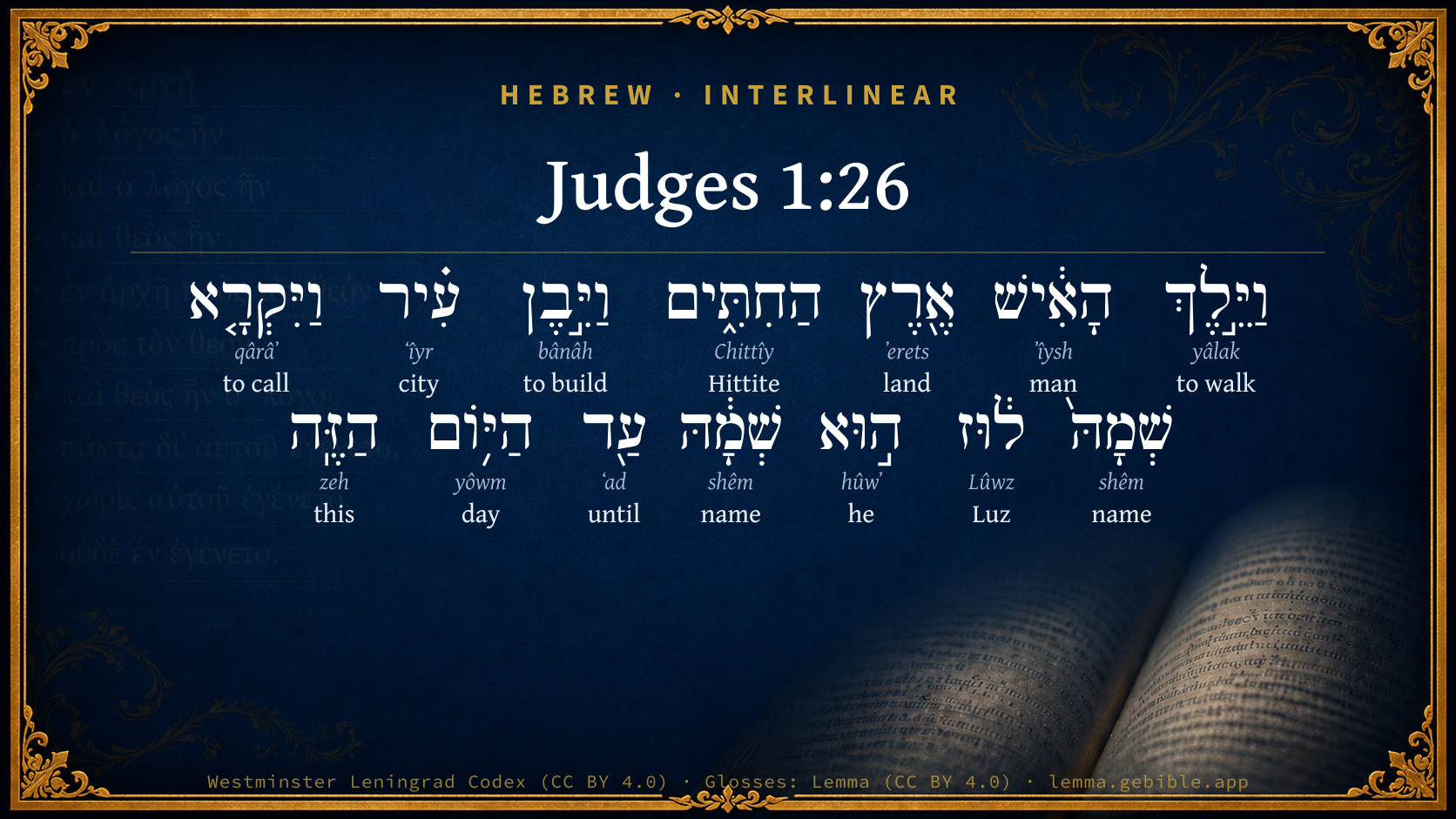
Hebrew (Westminster Leningrad Codex) Judges 1:26 appears in the Hebrew Old Testament. The text above is from the Westminster Leningrad Codex. Each word links to its Strong’s number, a concise gloss, and parsing drawn from the Open Scriptures Hebrew Bible morphology. Click any word for its full Brown-Driver-Briggs (BDB) entry.
Download image
Cite this verse

Judges 1:26 (World English Bible). Public Domain. Lemma interlinear Bible study tool, https://lemma.gebible.app/v/judges/1/26.

Show BibTeX & RIS
BibTeX
RIS
English Translation
The man went into the land of the Hittites, and built a city, and called the name of it Luz, which is the name of it to this day.
World English Bible · Public Domain
Download a study sheet

One document with this verse’s original text, its word-by-word gloss line, the meaning frame, cross-references with their text, attributed commentary, and full source and license credits — printable, and it pastes into notes with its structure intact.

This verse Autodidact and up

Study sheet (.html) Plain text (.txt)

A passage Seminary Student

Up to 50 verses in one chapter. A passage sheet keeps up to 6 commentary sources and 12 cross-references per verse, in the order this page ranks them, and says so on the sheet whenever that leaves anything out. Ask for a single verse and you get the Autodidact verse sheet above.

Everything on this page stays free to read, with no account — the sheet is a download of what is already on screen, not access to it.

Want to remove ads? Support Godless Engineer
Compare translations 3

The same verse in 3 English versions, stacked beneath the original-language interlinear above. Click any original word for its lexicon entry.

Each is an independent rendering of the whole verse — the interlinear is not word-aligned to these translations.

Highlighted words mark where these versions differ — a whole-verse word diff, not a word-by-word alignment.

  • World English Bible Public Domain
    The man went into the land of the Hittites, and built a city, and called the name of it Luz, which is the name of it to this day.
  • King James Version Public Domain
    And the man went into the land of the Hittites, and built a city, and called the name thereof Luz: which is the name thereof unto this day.
  • unfoldingWord Literal Text CC BY-SA 4.0
    Then the man went the land of the Hittites and he built a city, and he called the name of it Luz. That the name of it until this day.

unfoldingWord Literal Text — © unfoldingWord, licensed CC BY-SA 4.0. Word-aligned USFM3 via Door43 (git.door43.org/unfoldingWord/en_ult).

Versions to compare (up to 4)

3 of 4 selected

Show all 18 translations

Every available English version of this verse, each an independent rendering of the whole verse.

  • World English Bible Public Domain
    The man went into the land of the Hittites, and built a city, and called the name of it Luz, which is the name of it to this day.
  • Berean Standard Bible Public Domain
    And the man went to the land of the Hittites, built a city, and called it Luz, which is its name to this day.
  • Majority Standard Bible Public Domain
    And the man went to the land of the Hittites, built a city, and called it Luz, which is its name to this day.
  • King James Version Public Domain
    And the man went into the land of the Hittites, and built a city, and called the name thereof Luz: which is the name thereof unto this day.
  • American Standard Version (1901) Public Domain
    And the man went into the land of the Hittites, and built a city, and called the name thereof Luz, which is the name thereof unto this day.
  • Revised Version (1885) Public Domain
    And the man went into the land of the Hittites, and built a city, and called the name thereof Luz: which is the name thereof unto this day.
  • Geneva Bible (1599) Public Domain
    Then the man went into the lande of the Hittites, and built a citie, and called the name thereof Luz, which is the name thereof vnto this daie.
  • Douay-Rheims (1899) Public Domain
    Who being sent away, went into the land of Hethim, and built there a city, and called it Luza: which is so called until this day.
  • Young's Literal Translation Public Domain
    and the man goeth to the land of the Hittites, and buildeth a city, and calleth its name Luz -- it `is' its name unto this day.
  • Literal Standard Version CC BY-SA 4.0
    and the man goes to the land of the Hittites, and builds a city, and calls its name Luz—it [is] its name to this day.
  • Unlocked Literal Bible CC BY-SA 4.0
    Then the man went to the land of the Hittites and built a city and called it Luz, which is its name to this day.
  • unfoldingWord Literal Text CC BY-SA 4.0
    Then the man went the land of the Hittites and he built a city, and he called the name of it Luz. That the name of it until this day.
  • Darby Bible Public Domain
    And the man went to the land of the Hittites and built a city, and called its name Luz; that is its name to this day.
  • World Messianic Bible Public Domain
    The man went into the land of the Hittites, built a city, and called its name Luz, which is its name to this day.
  • Webster's Bible Public Domain
    And the man went into the land of the Hittites, and built a city, and called the name of it Luz: which is its name to this day.
  • Free Bible Version CC BY-SA 4.0
    The man moved to the country of the Hittites, and built a town there and called it Luz, which is its name to this day.
  • Bible in Basic English Public Domain
    And he went into the land of the Hittites, building a town there and naming it Luz: which is its name to this day.
  • JPS Tanakh (1917) Public Domain
    And the man went into the land of the Hittites, and built a city, and called the name thereof Luz, which is the name thereof unto this day.

Literal Standard Version (2020), Covenant Press — licensed CC BY-SA 4.0. Text via the HelloAO Bible API (eBible.org). Unlocked Literal Bible (unfoldingWord) — licensed CC BY-SA 4.0. Text via the HelloAO Bible API (eBible.org). unfoldingWord Literal Text — © unfoldingWord, licensed CC BY-SA 4.0. Word-aligned USFM3 via Door43 (git.door43.org/unfoldingWord/en_ult). Free Bible Version, Dr. Jonathan Gallagher — licensed CC BY-SA 4.0. Text via the HelloAO Bible API (eBible.org).

Word by word

More ways to search: Search by grammar → Find every occurrence → Compare this word →

Practice this passage: Drill this verse → Learn its vocabulary →

ל֔וּז
Lûwz
H3870
“Luz”
Noun, Proper
Part of Speech
Noun
Type
Proper
Full BDB Definition

Origin: probably from H3869 (as growing there)

TWOT: None

Luz = "almond tree" - the early name of Bethel and probably the name of the town in close proximity to the actual location of the altar and pillar of Jacob - the name of a town in the land of the Hittites; site unknown
  1. וַיֵּ֣לֶךְ yâlak H3212 “and · to walk” Conjunction + Verb, Qal, Sequential Imperfect, 3rd Person, Masculine, Singular
  2. הָאִ֔ישׁ ʼîysh H376 “the · man” Particle, Definite Article + Noun, Common, Masculine, Singular, Absolute
  3. אֶ֖רֶץ ʼerets H776 “land of” Noun, Common, Both, Singular, Construct
  4. הַחִתִּ֑ים Chittîy H2850 “the · Hittites” Particle, Definite Article + Noun, Gentilic, Masculine, Plural, Absolute
  5. וַיִּ֣בֶן bânâh H1129 “and · to build” Conjunction + Verb, Qal, Sequential Imperfect, 3rd Person, Masculine, Singular
  6. עִ֗יר ʻîyr H5892 “city” Noun, Common, Feminine, Singular, Absolute
  7. וַיִּקְרָ֤א qârâʼ H7121 “and · to call” Conjunction + Verb, Qal, Sequential Imperfect, 3rd Person, Masculine, Singular
  8. שְׁמָהּ֙ shêm H8034 “name · her” Noun, Common, Masculine, Singular, Construct + Suffix, Personal, 3rd Person, Feminine, Singular
  9. ה֣וּא hûwʼ H1931 “he” Pronoun, Personal, 3rd Person, Masculine, Singular
  10. שְׁמָ֔הּ shêm H8034 “name · her” Noun, Common, Masculine, Singular, Construct + Suffix, Personal, 3rd Person, Feminine, Singular
  11. עַ֖ד ʻad H5704 “until” Preposition
  12. הַיּ֥וֹם yôwm H3117 “the · day” Particle, Definite Article + Noun, Common, Masculine, Singular, Absolute
  13. הַזֶּֽה zeh H2088 “the · this” Particle, Definite Article + Pronoun, Demonstrative, Masculine, Singular

About this verse

These counts appear in no published source. They are computed here, from the morphology-tagged text and Lemma’s own curated glosses. What Lemma adds →

14
words
13
distinct lemmas
Historical
section

Notable vocabulary

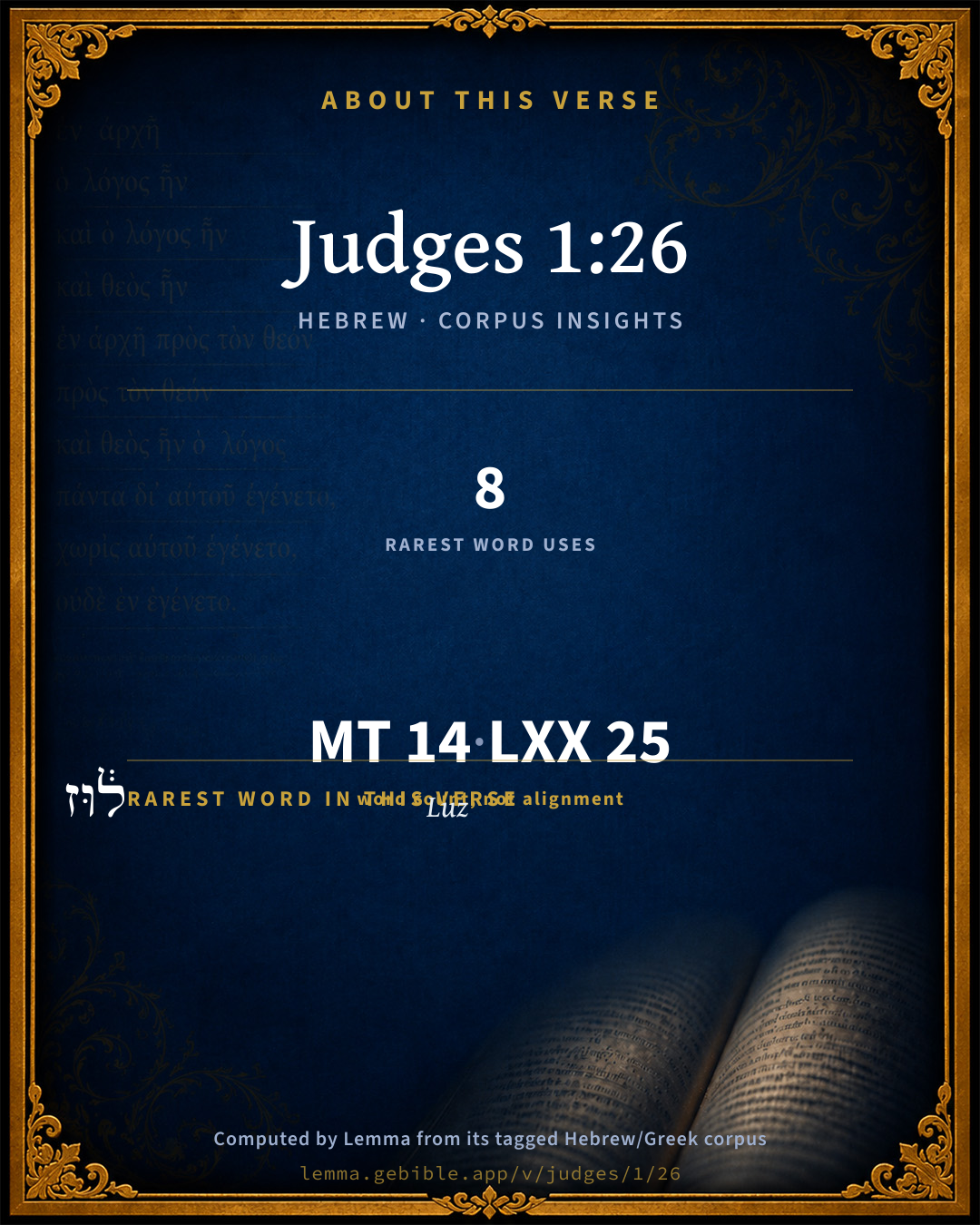
The rarest word here is ל֔וּז Luz H3870 — appearing just 8 times in the whole Hebrew Bible.

Shared distinctive vocabulary

ל֔וּז Luz H3870 occurs in 7 verses of the Hebrew Bible. Also found in:

Grammatical profile

  • 3 verbs
  • 8 nouns
  • 2 pronouns
  • 1 preposition

Verb forms

  • וַיֵּ֣לֶךְ Qal · Sequential Imperfect
  • וַיִּ֣בֶן Qal · Sequential Imperfect
  • וַיִּקְרָ֤א Qal · Sequential Imperfect

Repetition

A word recurs within this verse — often emphatic in Hebrew:

  • שְׁמָהּ֙ name H8034 ×2

Hebrew & Septuagint length

In English translation the verse runs 29 words from the Hebrew and 28 from the Septuagint (LXX English) — closely comparable.

A rough comparison of the two English renderings, which tokenize alike — not a word-level alignment.

Word counts can differ between the Hebrew and the Greek without any difference in meaning — e.g. the Hebrew direct-object marker אֵת has no separate Greek word, and Greek often adds the article ὁ.

In the original languages it is 14 Hebrew tokens and 25 Greek tokens — but the two are counted differently (Hebrew bundles its prefixes and suffixes into one token; the Greek is in lemma form), so that isn’t a like-for-like length.

Cross-references

2

Topical passages linked to Judges 1:26 in the Treasury of Scripture Knowledge — connected by theme and wording, ordered by reader-vote popularity; previews shown in the World English Bible.

  • 2 Kings 7:6 For the Lord had made the host of the Syrians to hear a noise of chariots, and a noise of horses, even the noise of a great host: and they said one to another, Behold, the king of Israel has hired against us the kings of the Hittites, and the kings of the Egyptians, to come on us.
  • 2 Chronicles 1:17 They brought up and brought out of Egypt a chariot for six hundred pieces of silver, and a horse for one hundred fifty: and so for all the kings of the Hittites, and the kings of Syria, did they bring them out by their means.

Cross-references courtesy of OpenBible.info (CC BY 4.0).

Hebrew and Greek witnesses Masoretic Hebrew ↔ Greek Septuagint

The same verse in the two great witnesses to the Old Testament, shown verse-for-verse.

These are two independent witnesses, not word-aligned to each other, and the Septuagint is shown in lemma (dictionary) form.

Hebrew Judges 1:26 Masoretic · Westminster Leningrad Codex

וַיֵּ֣לֶךְ הָאִ֔ישׁ אֶ֖רֶץ הַחִתִּ֑ים וַיִּ֣בֶן עִ֗יר וַיִּקְרָ֤א שְׁמָהּ֙ ל֔וּז ה֣וּא שְׁמָ֔הּ עַ֖ד הַיּ֥וֹם הַזֶּֽה

The man went into the land of the Hittites, and built a city, and called the name of it Luz, which is the name of it to this day.

World English Bible · Public Domain

Greek LXX Judges 1:26 Septuagint · lemma form

καί πορεύομαι ὁ ἀνήρ εἰς γῆ χεττιιν καί οἰκοδομέω ἐκεῖ πόλις καί καλέω ὁ ὄνομα αὐτός λουζα οὗτος ὁ ὄνομα αὐτός ἕως ὁ ἡμέρα οὗτος

And the man went into the land of Chettin, and built there a city, and called the name of it Luza; this is its name until this day.

LXX2012 (modern English Septuagint) · Public Domain

Hebrew: Westminster Leningrad Codex (CC BY 4.0). Greek: Septuagint (public domain); English from LXX2012 (modern English Septuagint) (Public Domain). How the Septuagint differs from the Hebrew →

Targum (Aramaic paraphrase)

1

The Targum is the ancient Jewish Aramaic paraphrase of the Hebrew Scriptures — an interpretive translation, not the Hebrew text itself. Onkelos (literal) and Pseudo-Jonathan (expansive) render the Torah, and Jonathan the Prophets. Coverage is partial: where no permissively-licensed English translation exists for a verse, only the Aramaic is shown. This is verse-level text, not a word-by-word alignment to the Hebrew.

  1. Targum Jonathan Prophets (Joshua–Malachi)
    וַאֲזַל גַבְרָא לְאַרְעָא חִתָּאֵי וּבְנָא קַרְתָּא וּקְרָא שְׁמָהּ לוּז הוּא שְׁמָהּ עַד יוֹמָא הָדֵין:

    (no public-domain English translation for this verse)

    Targum Jonathan — Aramaic: “Mikraot Gedolot” (public domain). English: “Sefaria Community Translation” (CC0 1.0 (public-domain dedication)); “London "Chaldee Paraphrase," 1871” (public domain). Text via Sefaria.

Commentary

Notes on Judges 1:26 from classic Christian and Jewish commentators (each source and its license shown beneath its notes). The classic Christian expositions comment on the surrounding passage and are grouped to its opening verse, so a note may address several verses; the Jewish commentaries on the Tanakh (Rashi and others) are per-verse, so they appear only where the commentator wrote on this verse.

Lemma curates 59 commentaries, every one of them public domain or Creative Commons licensed, each selected and text-cleaned for this edition rather than reprinted as found. About our sources →

Trapp's Complete Commentary

John Trapp

Jdg 1:26 And the man went into the land of the Hittites, and built a city, and called the name thereof Luz: which [is] the name thereof unto this day.

Ver. 26. And built a city.] Therefore it seemeth he was well rewarded, and not in counterfeit coin: as the Spaniard rewarded a countryman of ours who had betrayed a town to him in the Netherlands, saying that false money was good enough for so false a knave.

John Trapp, A Commentary or Exposition upon All the Books of the Old and New Testament (1647–1656) — public domain. Text from a community e-Sword module.

Joseph Benson's Commentary

Jdg 1:26. The man went and built a city — Which is an argument that the children of Ephraim dismissed him and his family, with all their goods and estate. The land of the Hittites — Where the Hittites fixed themselves after they were driven out of Canaan, which seems to have been northward from Canaan, and not far distant from it.

Joseph Benson's Commentary on the Old and New Testaments (1811–1818) — public domain. Text from a community e-Sword module.

Jamieson, Fausset & Brown

Robert Jamieson, A. R. Fausset & David Brown

Luz--(See on Gen 12:7; Gen 28:18).

Jamieson, Fausset & Brown — Commentary Critical and Explanatory on the Whole Bible (1871) — public domain (CC PDM 1.0). Text via the HelloAO Bible API.

Adam Clarke's Commentary

Verse 26. The land of the Hittites] Probably some place beyond the land of Canaan, in Arabia, whither this people emigrated when expelled by Joshua. The man himself appears to have been a Hittite, and to perpetuate the name of his city he called the new one which he now founded Luz, this being the ancient name of Beth-el.

Adam Clarke's Commentary on the Bible (1810–1826) — public domain. Text from a community e-Sword/MySword module.

Ellicott's Commentary for English Readers

(26) Into the land of the Hittites.—Probably the inhabitants of Bethel belonged to this tribe of Canaanites. In Jos_1:4 their name is used for all the inhabitants of Canaan, but probably it means the coastdwellers. They are often conjecturally classed with the inhabitants of Citium, in Cyprus. They first appear as “children of Heth,” in Gen_23:19, but seem at that time to have been only a small tribe. Abraham, as Ewald observes, went to the Amorites for his allies, but to the Hittites for his grave. The Talmud says that this Luz was famous for its purple dye, and partly on this account Thomson identifies it with Kulb Louzy, not far from Antioch. It was not uncommon in ancient days for the fugitives from a city to build another city elsewhere of the same name. Thus Teucer, when driven from Salamis, built a new Salamis in Cyprus:

“Ambiguam tellure novâ Salamina futuram” (Hor. Od. i. 7).

Although the site of this new Luz has not been certainly identified, it was probably in some northern district on the Phœnician frontier (Ewald).

Unto this day.—This formula implies the lapse of some time between the event and this record of it.

A Bible Commentary for English Readers, edited by Charles John Ellicott (1878–1897) — public domain. Text from a community e-Sword module.

The Cambridge Bible for Schools and Colleges

gen. ed. J. J. S. Perowne

26. the land of the Hittites] Cappadocia seems to have been the original home of the powerful, non-Semitic race of the Hittites, known to the Egyptians as Ḫeta. They are first mentioned in the inscriptions of Thothmes III (1500 b.c.), in whose time their empire extended southwards to the district of Kommagene, N. of Carchemish. Later on they pushed further south, into the upper valley of the Orontes. Throughout the period of the Tell el-Amarna tablets (c. 1400 b.c.) and of the Assyrian inscriptions from the 12th to the 8th cents. (Tiglath-pileser I to Sargon) ‘the land of the Hittites,’ mat Ḫatti, is in N. Syria. This is no doubt the situation intended here and in Jdg_3:3 (corrected), Jos_1:4, 1Ki_10:20, 2Ki_7:6. Later writers, especially P, mention Hittites as settled in Central or Southern Palestine (Hebron), Gen_23:10 etc., Gen_26:34, Num_13:29, perhaps using the term loosely for the original inhabitants of Canaan. We have no means of identifying the northern Luz. The tradition of its origin reminds us of the story of the northern Dan, Jdg_18:27 ff.

The Cambridge Bible for Schools and Colleges (gen. ed. J. J. S. Perowne; Cambridge University Press, 1878–1918) — public domain. Text from a community e-Sword module.

John Gill's Exposition

And the man went into the land of the Hittites,.... With his family; Kimchi says this was not one of the seven nations of Canaan; and it is very clear from this narrative, that the land this man went to was not in the land of Canaan; though it is certain a people of this name formerly dwelt there, Gen 15:20; and the land of Canaan is called the land of the Hittites, Jos 1:4; these either might flee to another country upon Joshua's entry into the land of Canaan, or a colony of them from thence might settle elsewhere, to which this man chose to go, who might be originally of them:

and built a city; his family was numerous, and he a man of wealth, and was allowed to carry all his substance with him:

and called the name of it Luz; in memory of the place he left, and had long lived in. There is a city called Loussa, among the cities which Josephus says (s) were taken by the Jews from the Arabians; and which is very probably the Lysa of Ptolemy (t), which he places in Arabia Petraea, and might be the same with this Luz; and, if so, this shows the land this man went into was in Edom, which is not unlikely; there is another Luza, which Jerom (u) says fell to the lot of the sons of Joseph, near Sichem, three miles from Neapolis:

which is the name thereof unto this day: the time of the writing of this book; See Gill on Jdg 1:21.

(s) Antiqu. l. 14. c. 1. sect. 4. (t) Geograph. l. 5. c. 17. (u) De loc. Heb. fol. 92. M.

John Gill's Exposition of the Whole Bible (1746–1763) — public domain (CC PDM 1.0). Text via the HelloAO Bible API.

Albert Barnes' Notes on the Bible

The site of this new Luz is not known, but “the land of the Hittites” was apparently in the north of Palestine, on the borders of Syria (Gen 10:15 note).

Albert Barnes' Notes on the Bible (1834–1885) — public domain. Text from a community e-Sword/MySword module.

Haydock's Catholic Bible Commentary

Hetthim. The Hethite lived towards the south of Chanaan. The man probably retired into the stony Arabia, where we find the city of Lusa or Elysa. (Ptolemy v. 16.) --- He gave it this name in memory of his native city, (Calmet) which was called Luza, or "of nuts." (Menochius)

George Leo Haydock (1774–1849), Haydock's Catholic Family Bible and Commentary, 1859 edition — public domain. Excludes Psalms (Douay-Rheims chapter numbering differs from Protestant) and Deuterocanonical books (Catholic canon only).

Matthew Poole's English Annotations

The land of the Hittites; where the Hittites seated themselves after they were driven out of Canaan, which seems to be northward from Canaan, and near unto it. See 1Ki 11:1; 2Ch 1:17.

Matthew Poole's English Annotations on the Holy Bible (1683–1685) — public domain. Text from a community e-Sword/MySword module.

Whedon's Commentary on the Bible

Daniel D. Whedon

26. The man went into the land of the Hittites — The Hebrew historian had special interest in the fortunes of those who, like this man and Rahab, advanced the interests of Israel. The land of the Hittites is an obscure expression. It seems, in some passages, to refer to the whole interior of Palestine. Jos_1:4. Eusebius and Jerome refer it to the island of Cyprus. Cassel thinks it here refers “to the familiarly known Chittim, north of Israel,” and he accordingly seeks for the Luz which this man built in the northern coasts of Phenicia, and suggests its identity with the ruins of Kulb Lousy, which Thomson discovered far in the north of Palestine. But the subject is too much involved in obscurity for a positive settlement.

Daniel D. Whedon (gen. ed.), Commentary on the Old and New Testaments (1874–1909) — public domain. Text from a community e-Sword module.

John Wesley's Explanatory Notes

The Hittites - Where the Hittites seated themselves after they were driven out of Canaan, which seems to be northward from Canaan, and near upon it.

John Wesley, Explanatory Notes Upon the Whole Bible (1754–1765) — public domain. Text via the GEBible commentary corpus.

Keil & Delitzsch

C. F. Keil & F. Delitzsch

The man whom they had permitted to go free, went with his family into the land of the Hittites, and there built a town, to which he gave the name of his earlier abode, viz., Luz. The situation of this Luz is altogether unknown. Even the situation of the land of the Hittites cannot be more precisely determined; for we find Hittites at Hebron in the times of Abraham and Moses (Gen 23), and also upon the mountains of Palestine (Num 13:29), and at a later period on the north-east of Canaan on the borders of Syria (Kg1 10:29). That the Hittites were one of the most numerous and widespread of the tribes of the Canaanites, is evident from the fact that, in Jos 1:4, the Canaanites generally are described as Hittites.

Keil & Delitzsch — Biblical Commentary on the Old Testament (1861–1891) — public domain (CC PDM 1.0). Text via the HelloAO Bible API. (Old Testament only.)

Rashi

Rabbi Shlomo Yitzchaki (Rashi)

Luz. Small nuts grow on this. "Coudre" in old French.

It is so entitled to this day. Sancheriv did not "jumble" it, and Nevuchadnetzar did not devastate it.

Rashi on the Tanakh — English translations: “The Judaica Press complete Tanach with Rashi, translated by A. J. Rosenberg” (CC BY 4.0); “Pentateuch with Rashi's commentary by M. Rosenbaum and A.M. Silbermann, 1929-1934” (public domain); “The Metsudah Tanach series, Lakewood, N.J” (CC BY 4.0); and “The Book of Joshua, Metsudah Publications, 1997” (CC BY 4.0). Text via Sefaria.

Radak

Rabbi David Kimhi (Radak)

The land of the Hittim. These aren't the Hittim from the 7 nations.

Radak on the Tanakh — English translations: “Sefaria Community Translation” (CC0 1.0 (public-domain dedication)); “Eliyahu Munk, HaChut Hameshulash” (CC BY 4.0); “Rabbi Mike Feuer, Jerusalem Anthology” (CC BY 4.0); and “R. David Kimhi on the first book of Psalms, Translated by R.G. Finch, London, 1919” (public domain). Text via Sefaria.

Lesson kit

Teaching starters — assembled from the data on this page, not authored interpretation. Every prompt links to the verse data it draws on. Edit before teaching.

Judges, in the Historical, opens this verse with 14 words (13 distinct Hebrew lemmas). Its most distinctive word is Lûwz (“Luz”). A historical commentator’s framing appears above. Read the whole chapter for the surrounding context.

Discussion questions

  1. How does “Luz” (Lûwz) shape what this verse is saying?
  2. How does Genesis 28:19, which shares the word «Luz», read alongside this verse?
  3. What does the repetition of “name” (2× in this one verse) do in this verse?
  4. These translations render this verse differently; the difference is in the English rendering, not the original. What questions does that raise?
  5. «וַיֵּ֣לֶךְ» is a Qal Sequential Imperfect verb. How does that grammatical form shape the action described?
  6. Compare how Trapp's Complete Commentary and Joseph Benson's Commentary read this verse. Where do they agree or differ?

Things to notice

Reading settings

Reading text

Shown beneath each verse's original-language words.

Old Testament
Old Testament edition

Read the OT as the Masoretic Hebrew (MT) or the Greek Septuagint (LXX).

English shown for the Greek Septuagint (in the Hebrew ↔ Greek comparison).

Comparing translations? Open the Compare panel on any verse page to stack up to four side by side.