
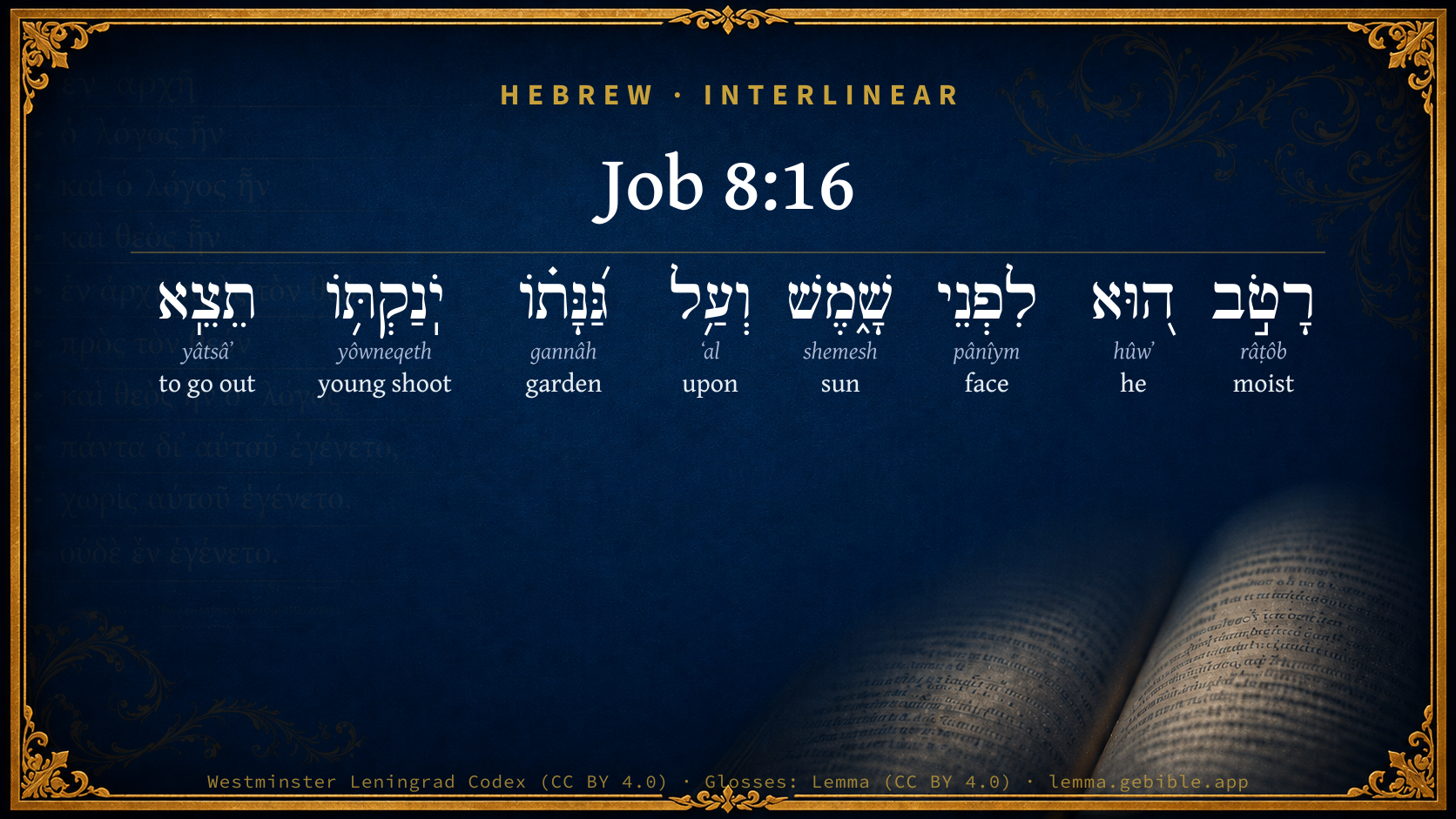
Job 8:16

Hebrew (Westminster Leningrad Codex) Job 8:16 appears in the Hebrew Old Testament. The text above is from the Westminster Leningrad Codex. Each word links to its Strong’s number, a concise gloss, and parsing drawn from the Open Scriptures Hebrew Bible morphology. Click any word for its full Brown-Driver-Briggs (BDB) entry.
Download image
Cite this verse

Job 8:16 (World English Bible). Public Domain. Lemma interlinear Bible study tool, https://lemma.gebible.app/v/job/8/16.

Show BibTeX & RIS
BibTeX
RIS
English Translation
He is green before the sun, His shoots go forth over his garden.
World English Bible · Public Domain
Highlights
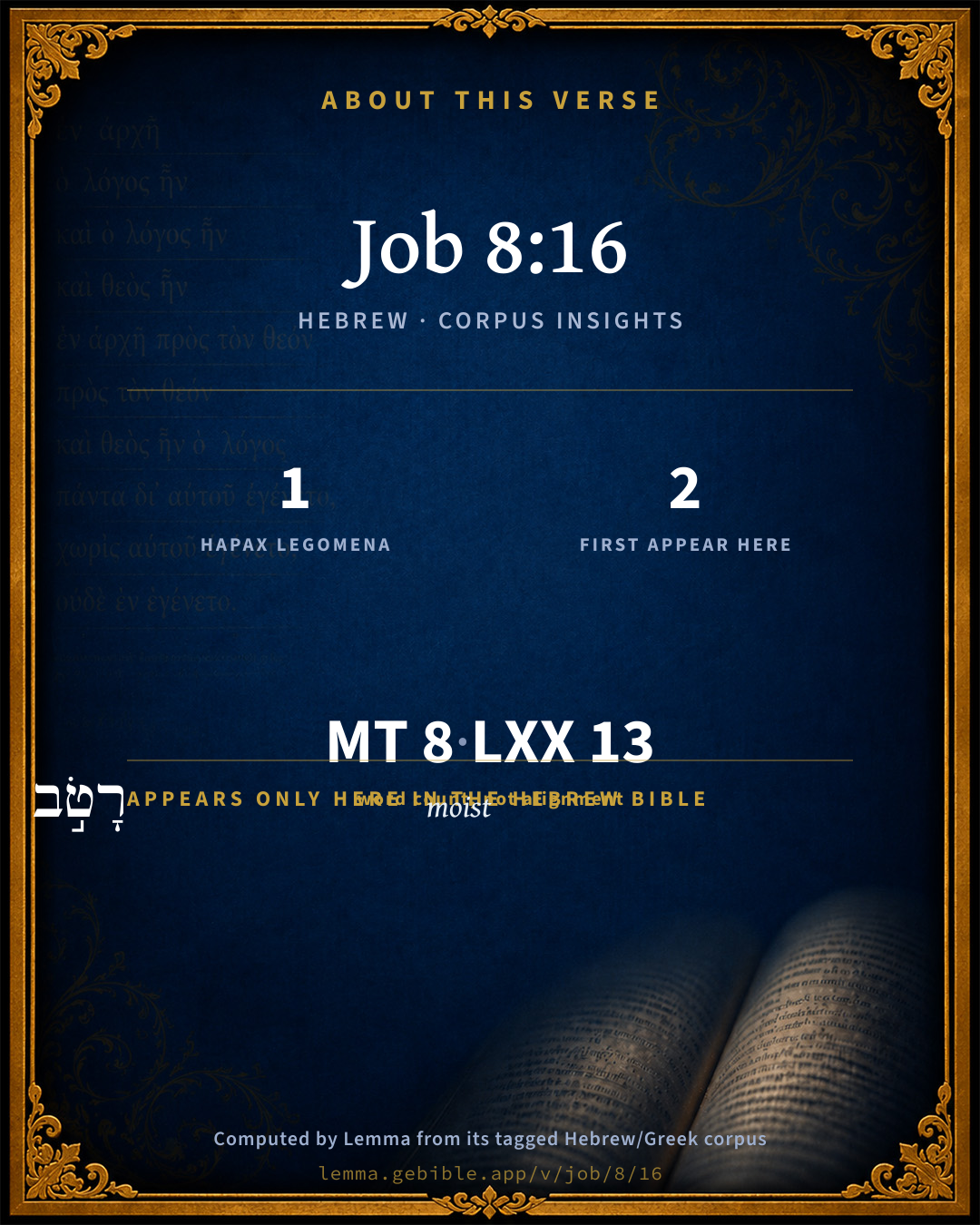
  • 1 hapax legomenon — only here in the Hebrew Bible
  • 2 first appearances in the Hebrew Bible
Full analysis ↓
Download a study sheet

One document with this verse’s original text, its word-by-word gloss line, the meaning frame, cross-references with their text, attributed commentary, and full source and license credits — printable, and it pastes into notes with its structure intact.

This verse Autodidact and up

Study sheet (.html) Plain text (.txt)

A passage Seminary Student

Up to 50 verses in one chapter. A passage sheet keeps up to 6 commentary sources and 12 cross-references per verse, in the order this page ranks them, and says so on the sheet whenever that leaves anything out. Ask for a single verse and you get the Autodidact verse sheet above.

Everything on this page stays free to read, with no account — the sheet is a download of what is already on screen, not access to it.

Want to remove ads? Support Godless Engineer
Compare translations 3

The same verse in 3 English versions, stacked beneath the original-language interlinear above. Click any original word for its lexicon entry.

Each is an independent rendering of the whole verse — the interlinear is not word-aligned to these translations.

Highlighted words mark where these versions differ — a whole-verse word diff, not a word-by-word alignment.

  • World English Bible Public Domain
    He is green before the sun, His shoots go forth over his garden.
  • King James Version Public Domain
    He is green before the sun, and his branch shooteth forth in his garden.
  • unfoldingWord Literal Text CC BY-SA 4.0
    It lush to the face of the sun, and its shoots go out over its garden.

unfoldingWord Literal Text — © unfoldingWord, licensed CC BY-SA 4.0. Word-aligned USFM3 via Door43 (git.door43.org/unfoldingWord/en_ult).

Versions to compare (up to 4)

3 of 4 selected

Show all 18 translations

Every available English version of this verse, each an independent rendering of the whole verse.

  • World English Bible Public Domain
    He is green before the sun, His shoots go forth over his garden.
  • Berean Standard Bible Public Domain
    He is a well-watered plant in the sunshine, spreading its shoots over the garden.
  • Majority Standard Bible Public Domain
    He is a well-watered plant in the sunshine, spreading its shoots over the garden.
  • King James Version Public Domain
    He is green before the sun, and his branch shooteth forth in his garden.
  • American Standard Version (1901) Public Domain
    He is green before the sun, And his shoots go forth over his garden.
  • Revised Version (1885) Public Domain
    He is green before the sun, and his shoots go forth over his garden.
  • Geneva Bible (1599) Public Domain
    The tree is greene before the sunne, and the branches spread ouer the garden thereof.
  • Douay-Rheims (1899) Public Domain
    He seemeth to have moisture before the sun cometh, and at his rising his blossom shall shoot forth.
  • Young's Literal Translation Public Domain
    Green he `is' before the sun, And over his garden his branch goeth out.
  • Literal Standard Version CC BY-SA 4.0
    He [is] green before the sun, || And over his garden his branch goes out.
  • Unlocked Literal Bible CC BY-SA 4.0
    Under the sun he is green, and his shoots go out over his entire garden.
  • unfoldingWord Literal Text CC BY-SA 4.0
    It lush to the face of the sun, and its shoots go out over its garden.
  • Darby Bible Public Domain
    He is full of sap before the sun, and his sprout shooteth forth over his garden;
  • World Messianic Bible Public Domain
    He is green before the sun. His shoots go out along his garden.
  • Webster's Bible Public Domain
    He is green before the sun, and his branch shooteth forth in his garden.
  • Free Bible Version CC BY-SA 4.0
    Those who live without God are like a luxuriant plant growing in the sun, spreading its shoots all over the garden.
  • Bible in Basic English Public Domain
    He is full of strength before the sun, and his branches go out over his garden.
  • JPS Tanakh (1917) Public Domain
    He is green before the sun, and his shoots go forth over his garden.

Literal Standard Version (2020), Covenant Press — licensed CC BY-SA 4.0. Text via the HelloAO Bible API (eBible.org). Unlocked Literal Bible (unfoldingWord) — licensed CC BY-SA 4.0. Text via the HelloAO Bible API (eBible.org). unfoldingWord Literal Text — © unfoldingWord, licensed CC BY-SA 4.0. Word-aligned USFM3 via Door43 (git.door43.org/unfoldingWord/en_ult). Free Bible Version, Dr. Jonathan Gallagher — licensed CC BY-SA 4.0. Text via the HelloAO Bible API (eBible.org).

Word by word

More ways to search: Search by grammar → Find every occurrence → Compare this word →

Practice this passage: Drill this verse → Learn its vocabulary →

About this verse

These counts appear in no published source. They are computed here, from the morphology-tagged text and Lemma’s own curated glosses. What Lemma adds →

8
words
8
distinct lemmas
Wisdom
section

Notable vocabulary

1 hapax legomenon — a word that appears only here in the entire Hebrew Bible:

  • רָטֹ֣ב moist H7373

First appearance in Scripture

These words make their first canonical appearance in the Hebrew Bible here:

  • רָטֹ֣ב moist H7373
  • יֹֽנַקְתּ֥וֹ young shoot H3127

Shared distinctive vocabulary

יֹֽנַקְתּ֥וֹ young shoot H3127 occurs in 6 verses of the Hebrew Bible. Also found in:

Grammatical profile

  • 1 verb
  • 4 nouns
  • 1 adjective
  • 1 pronoun
  • 1 preposition

Verb forms

  • תֵצֵֽא Qal · Imperfect

Hebrew & Septuagint length

In English translation the verse runs 13 words from the Hebrew and 17 from the Septuagint (LXX English) — closely comparable.

A rough comparison of the two English renderings, which tokenize alike — not a word-level alignment.

Word counts can differ between the Hebrew and the Greek without any difference in meaning — e.g. the Hebrew direct-object marker אֵת has no separate Greek word, and Greek often adds the article ὁ.

In the original languages it is 8 Hebrew tokens and 13 Greek tokens — but the two are counted differently (Hebrew bundles its prefixes and suffixes into one token; the Greek is in lemma form), so that isn’t a like-for-like length.

Cross-references

6

Topical passages linked to Job 8:16 in the Treasury of Scripture Knowledge — connected by theme and wording, ordered by reader-vote popularity; previews shown in the World English Bible.

  • Psalms 80:11 It sent out its branches to the sea, Its shoots to the River.
  • Job 5:3 I have seen the foolish taking root, But suddenly I cursed his habitation.
  • Job 21:7–15 "Why do the wicked live, Become old, yes, and grow mighty in power?
  • Psalms 37:35–36 I have seen the wicked in great power, Spreading himself like a green tree in its native soil.
  • Psalms 73:3–12 For I was envious of the arrogant, When I saw the prosperity of the wicked.
  • Jeremiah 11:16 Yahweh called your name, A green olive tree, beautiful with goodly fruit: with the noise of a great tumult he has kindled fire on it, and the branches of it are broken.

Cross-references courtesy of OpenBible.info (CC BY 4.0).

Hebrew and Greek witnesses Masoretic Hebrew ↔ Greek Septuagint

The same verse in the two great witnesses to the Old Testament, shown verse-for-verse.

These are two independent witnesses, not word-aligned to each other, and the Septuagint is shown in lemma (dictionary) form.

Hebrew Job 8:16 Masoretic · Westminster Leningrad Codex

רָטֹ֣ב ה֭וּא לִפְנֵי שָׁ֑מֶשׁ וְעַ֥ל גַּ֝נָּת֗וֹ יֹֽנַקְתּ֥וֹ תֵצֵֽא

He is green before the sun, His shoots go forth over his garden.

World English Bible · Public Domain

Greek LXX Job 8:16 Septuagint · lemma form

ὑγρός γάρ εἰμί ὑπό ἥλιος καί ἐκ σαπρία αὐτός ὁ ῥάδαμνος αὐτός ἐκἔρχομαι

For it is moist under the sun, and his branch shall come forth out of his dung-heap.

LXX2012 (modern English Septuagint) · Public Domain

Hebrew: Westminster Leningrad Codex (CC BY 4.0). Greek: Septuagint (public domain); English from LXX2012 (modern English Septuagint) (Public Domain). How the Septuagint differs from the Hebrew →

Commentary

Notes on Job 8:16 from classic Christian and Jewish commentators (each source and its license shown beneath its notes). The classic Christian expositions comment on the surrounding passage and are grouped to its opening verse, so a note may address several verses; the Jewish commentaries on the Tanakh (Rashi and others) are per-verse, so they appear only where the commentator wrote on this verse.

Lemma curates 59 commentaries, every one of them public domain or Creative Commons licensed, each selected and text-cleaned for this edition rather than reprinted as found. About our sources →

Trapp's Complete Commentary

John Trapp

Job 8:16 He [is] green before the sun, and his branch shooteth forth in his garden.

Ver. 16. He is green before the sun] Succosus est, saith Tremellius, he is sappy and juicy, having a confluence of all kind of comforts and contentments, even more than heart could wish, as David expresseth it, Psa 73:7. The hypocrite is all this; the height of whose happiness is here set forth by a third similitude, lest any should think that the two former did not reach home to the thing intended. Look how, saith Bildad, a great and tall tree, having many roots and branches, may be so cut up and thrown down, that no footstep, or sign of it, may any more appear; so may it fare with a wicked man: though he be as a tree green or juiceful before the sun, or when the sun shineth hottest upon him, the rush may then wither, but not the tree. See Psa 37:35. A hypocrite may abound exceedingly in outward prosperity; yea, he may be green for a while before the sun of persecution, as was Alexander the coppersmith, Act 19:32 2Ti 4:14. The thorny ground stood out the heat of the sunbeams, and shrank not in the wetting.

And his branch shooteth forth in his garden] Mr Broughton translates, His suckers sprout out over his orchard, that is, he grows luxuriously eminent in the place where he liveth, which he hath made to become a kind of a paradise, or garden of delight. By garden here we are to understand, saith Mercer, all those ways and means whereby a wicked man fenceth and increaseth his own greatness. Some of the Jewish doctors, and others also after them, think that Bildad here beginneth to speak of the godly man’s happiness; and they read the text thus, But the perfect man (so they supply the text out of Job 8:20) is green before the sun, and his branches, &c. His roots are wrapped near the fountain, and he windeth himself about the stony building (that is, it spreadeth and twisteth its boughs round about the fountain vault, being strongly built with stone); shall he be taken out of his place, which may deny, saying, I have not seen thee? No, that cannot be, Lo, this shall be that joy of his way, even out of his mould shall others grow, i.e. his very dust shall live and grow up after him. Thus Beza, and after him Diodati; he is like an exquisite tree set in a pleasant garden in sight of his master’s palace, sucking the sweet moistness of the quick springs, without ever fading or withering, Psa 1:3 Jer 17:8. That is to say, he shall have a lively root of faith, continually nourished by God’s grace; under his safeguard and favour he shall be strong in all assays, abundant in good works, and all manner of blessings. Uterque sensus egregius est, saith Mercer; this also is a good sense, but the former I conceive to be the better, and more agreeable to the letter of the text.

John Trapp, A Commentary or Exposition upon All the Books of the Old and New Testament (1647–1656) — public domain. Text from a community e-Sword module.

Joseph Benson's Commentary

Job 8:16. He, &c. — The hypocrite, or the secure and prosperous sinner, may think himself degraded when he is compared to a rush or flag. Compare him, then, to a flourishing and well-rooted tree, which spreads its branches in a fair garden. Yet, even then, shall he suddenly wither and come to nothing. Is green before the sun — Flourisheth in the world publicly, and in the view of all men. And his branch shooteth forth — His children, who are here mentioned as additions, not only to his comfort, but also to his strength and safety. In his garden — A place where it is defended from those injuries to which the trees of the field are subject, and where, besides the advantages common to all trees, it hath peculiar helps from the art and industry of men. So he supposes this man to be placed in the most desirable circumstances.

Joseph Benson's Commentary on the Old and New Testaments (1811–1818) — public domain. Text from a community e-Sword module.

Tyndale Open Study Notes

Tyndale Open Resources

8:16-17 In this parable, a plant with roots that grow down through a pile of stones gains stability by becoming entwined with the rocks.

Tyndale Open Study Notes — © Tyndale Open Resources, licensed CC BY-SA 4.0. Text via the HelloAO Bible API.

Geneva Bible (1599)

Geneva Bible translators

He compareth the just to a tree, which although it be removed out of one place unto another, yet flourisheth: so the affliction of the godly turneth to their profit.

Geneva Bible (1599) marginal notes — public domain. Text via Bolls.life.

Jamieson, Fausset & Brown

Robert Jamieson, A. R. Fausset & David Brown

before the sun--that is, he (the godless) is green only before the sun rises; but he cannot bear its heat, and withers. So succulent plants like the gourd (Jon 4:7-8). But the widespreading in the garden does not quite accord with this. Better, "in sunshine"; the sun representing the smiling fortune of the hypocrite, during which he wondrously progresses [UMBREIT]. The image is that of weeds growing in rank luxuriance and spreading over even heaps of stones and walls, and then being speedily torn away.

Jamieson, Fausset & Brown — Commentary Critical and Explanatory on the Whole Bible (1871) — public domain (CC PDM 1.0). Text via the HelloAO Bible API.

Adam Clarke's Commentary

Verse 16. He is green before the sun] This is another metaphor. The wicked is represented as a luxuriant plant, in a good soil, with all the advantages of a good situation; well exposed to the sun; the roots intervolving themselves with stones, so as to render the tree more stable; but suddenly a blast comes, and the tree begins to die. The sudden fading of its leaves, &c., shows that its root is become as rottenness, and its vegetable life destroyed. I have often observed sound and healthy trees, which were flourishing in all the pride of vegetative health, suddenly struck by some unknown and incomprehensible blast, begin to die away, and perish from the roots. I have seen also the prosperous wicked, in the inscrutable dispensations of the Divine providence, blasted, stripped, made bare, and despoiled, in the same way.

Adam Clarke's Commentary on the Bible (1810–1826) — public domain. Text from a community e-Sword/MySword module.

Ellicott's Commentary for English Readers

(16) He is green.—Here begins, as we understand it, another and an opposite picture, which fact is marked in the Hebrew by an emphatic pronoun. “Green is he (see Job_8:6) before the sun, &c., quite unlike the watery paper-plant. This man is verdant and luxuriant, not in the midst of moisture, but even before the sun.” There is not the same promise of verdure, but a greater realisation of it.

A Bible Commentary for English Readers, edited by Charles John Ellicott (1878–1897) — public domain. Text from a community e-Sword module.

The Cambridge Bible for Schools and Colleges

gen. ed. J. J. S. Perowne

16–19. A new figure of a spreading, luxuriant plant, suddenly destroyed, and leaving not a trace of itself behind.

before the sun] This scarcely means openly, in broad day and in the face of the sun, but, under the fostering heat of the sun.

The Cambridge Bible for Schools and Colleges (gen. ed. J. J. S. Perowne; Cambridge University Press, 1878–1918) — public domain. Text from a community e-Sword module.

John Gill's Exposition

His roots are wrapped about the heap,.... The heap of stones where the tree stands; it strikes its roots among them, and implicates and twists them about them, and secures itself and grows up notwithstanding them: and this expresses the seeming stable state and condition of hypocrites for a season, who not only flourish, but seem to take root; and who maintain their ground amidst some difficulties; this fitly agrees with and describes such hearers of the word, and professors of religion, comparable to the seed sown on stony ground, Mat 13:5,

and seeth the place of stones; or, "the house of stones" (n); a house built of stones, high and stately; yet this tree rises higher than that, overtops and overlooks it; and is represented as viewing it thoroughly, or looking down upon it, and all around it, being so high and so spreading; the Targum renders it, implicateth the house of stones; "platteth", as Mr. Broughton, or twists about them, and so many of the Jewish writers; but this seems to be designed in the former clause: all this suits very well with good men, whose "roots are wrapped about the fountain" (o); as the words may be rendered; about the love of God, in which they are rooted and grounded, and are like trees planted by rivers of water, the river of divine love, which refreshes, revives, and makes them fruitful; and about Christ, the fountain of gardens and well of living waters; in whom they are rooted and built up, increase, flourish, and are established; and though they are among stones, and attended with many difficulties, yet they abide and surmount all; believe in hope against hope, and see and enjoy, yea, even dwell in the house of stones, the church of God, built on a rock, against which the gates of hell cannot prevail.

(n) "domum lapidum", Montanus, Cocceius, Schmidt, Michaelis, Schultens; so Tigurine version, Codurcus, Junius & Tremellius. (o) "juxta fontem", Pagninus, Mercerus; so Vatablus, Piscator, Gersom, and Bar Tzemach.

John Gill's Exposition of the Whole Bible (1746–1763) — public domain (CC PDM 1.0). Text via the HelloAO Bible API.

Albert Barnes' Notes on the Bible

He is green before the sun - Vulgate, “antequam veniat sol - before the sun comes.” So the Chaldee, “before the rising of the sun.” So Eichhorn renders it. According to this, which is probably the true interpretation, the passage means that he is green and flourishing before the sun rises, but that he cannot hear its heat and withers away. A new illustration is here introduced, and the object is to compare the hypocrite with a vigorous plant that grows up quick and sends its branches afar, but which has no depth of root, and which, when the intense heat of the sun comes upon it, withers away. The comparison is not with a tree, which would bear the heat of the sun, but rather with those succulent plants which have a large growth of leaves and branches, like a gourd or vine, but which will not bear a drought or endure the intense heat of the sun. “This comparison of the transitory nature of human hope and prosperity to the sudden blight which over throws the glory of the forest and of the garden,” says the Editor of the Pictorial Bible (on Psa 37:35), “is at once so beautiful and so natural, as to have been employed by poets of every age.” One such comparison of exquisite finish occurs in Shakespeare:

This is the state of man! Today he puts forth

The tender leaves of hope; tomorrow blossoms,

And hears his blushing honours thick upon him:

The third day comes a frost, a killing frost,

And, when he thinks, good easy man, full surely

His greatness is a ripening, nips his shoot,

And then he falls, as I do.

And his branch shooteth forth ... - A comparison of a prosperous person or nation with a vine which spreads in this manner, is common in the Scriptures. See Psa 80:11 :

She sent out her boughs unto the sea,

And her branches unto the river.

Compare the note at Isa 16:8. A similar figure occurs in Psa 37:35 :

I have seen the wicked in great power,

And spreading himself like a green bay tree.

Albert Barnes' Notes on the Bible (1834–1885) — public domain. Text from a community e-Sword/MySword module.

Haydock's Catholic Bible Commentary

Seemeth. Hebrew, "he is green before the sun" beat upon him. --- Rising, ortu, for horto, (Haydock) as the Hebrew, &c., have "garden," (Menochius) with some Latin editions. He had compared the wicked to a rush without moisture. But the just is like a plant in a fine garden, which is not hurt by the sun beams. It will grow even among stones, (Calmet) and may be transplanted without danger, ver. 19. (Haydock) --- The whole may be, however, a continuation of the former simile. The rush will presently be scorched, as if it were thrown among stones, and its place will know it no longer, ver. 18. (Menochius)

George Leo Haydock (1774–1849), Haydock's Catholic Family Bible and Commentary, 1859 edition — public domain. Excludes Psalms (Douay-Rheims chapter numbering differs from Protestant) and Deuterocanonical books (Catholic canon only).

Matthew Poole's English Annotations

He; either,

1. The perfect man, here understood out of Job 8:20, where it is expressed; or rather,

2. The hypocrite, of whom he hath hitherto treated, to whom this and the following verses very well agree; whom he before compared to a rush, and then to a spider’s web, and now to a tree, which is of a more solid substance, and more durable; as if he said, As some wicked men are quickly cut off in the very beginnings of their prosperity, so there are others who seem to be more firmly grounded, and yet they also at last come to ruin.

Is green, i.e. flourisheth in the world.

Before the sun; either,

1. Publicly, and in the view of all men, who observe it with admiration, and applause, and envy: compare 2Sa 12:12. Or rather,

2. Notwithstanding all the scorching heat of the sun, which quickly withers the rushes and herbs, of which he spake before, but doth only cherish and refresh the tree. And so doth many a wicked man secure himself, and thrive and prosper even in times of great danger and trouble, and in spite of all opposition.

His branch; or, his branches; the singular number for the plural; either,

1. Properly, and so this belongs to the description of a flourishing tree, by the spreading of its branches here, as by the depth of its root, Job 8:17. Or,

2. Metaphorically, to wit, his children, which are here mentioned as additions, not only to his comfort, but also to his strength and safety.

In his garden; a place where it is defended from those injuries to which the trees of the field are subject from men and beasts, and where, besides the natural advantages common to all trees, it hath peculiar helps from the art and industry of men, by whom it is watered and assisted as need requires. So he supposeth this man to be placed in the most desirable circumstances.

Matthew Poole's English Annotations on the Holy Bible (1683–1685) — public domain. Text from a community e-Sword/MySword module.

Whedon's Commentary on the Bible

Daniel D. Whedon

16. Before the sun — “In the glow of the sun, where other plants wither, it thrives and remains fresh.” — Hirtzel. The poem has spoken of marsh plants; it now suddenly introduces a climbing plant of the garden, probably parasitical. This was more familiar, and would better illustrate Bildad’s theme.

Daniel D. Whedon (gen. ed.), Commentary on the Old and New Testaments (1874–1909) — public domain. Text from a community e-Sword module.

The Pulpit Commentary

He is green before the sun. Bildad here introduces a third and more elaborate simile. The hypocrite, or ungodly man (ver. 13), is as a, (Jon_4:6) or other rapidly growing plant, which shoots forth at sunrise with a wealth of greenery, spreading itself over a whole garden, and even sending forth its sprays and tendrils beyond it (comp. Gen_49:22) lovely to look at, and full, apparently, of life and vigour. And his branch shooteth forth in his garden; rather, over his garden, or beyond his, garden.

The Pulpit Commentary (1880–1919), ed. H.D.M. Spence-Jones & Joseph S. Exell — public domain. Text from a community e-Sword module.

John Wesley's Explanatory Notes

He - The secure and prosperous sinner may think himself wronged, when he is compared to a rush or flag. Compare him then to a flourishing and well-rooted tree. Yet even then shall he be suddenly cut off. Green - Flourisheth in the world. Before the sun - Publickly and in the view of all men. Branch - His children, who are here mentioned as additions not only to his comfort, but also to his strength and safety. Garden - A place where it is defended from those injuries to which the trees of the field are subject, and where, besides the advantages common to all trees, it hath peculiar helps from the art and industry of men. So he supposes this man to be placed in the most desirable circumstances.

John Wesley, Explanatory Notes Upon the Whole Bible (1754–1765) — public domain. Text via the GEBible commentary corpus.

Keil & Delitzsch

C. F. Keil & F. Delitzsch

16 He dwells with sap in the sunshine,

And his branch spreads itself over his garden.

17 His roots intertwine over heaps of stone,

He looks upon a house of stones.

18 If He casts him away from his place,

It shall deny him: I have not seen thee.

19 Behold, thus endeth his blissful course,

And others spring forth from the dust.

The subject throughout is not the creeping-plant directly, but the ungodly, who is likened to it. Accordingly the expression of the thought is in part figurative and in part literal, יחזה אבנים בּית (Job 8:17). As the creeper has stones before it, and by its interwindings, as it were, so rules them that it may call them its own (v. Gerlach: the exuberant growth twines itself about the walls, and looks proudly down upon the stony structure); so the ungodly regards his fortune as a solid structure, which he has quickly caused to spring up, and which seems to him imperishable. Ewald translates: he separates one stone from another; בּית, according to 217, g, he considers equivalent to בּינת, and signifies apart from one another; but although חזה = חזז, according to its radical idea, may signify to split, pierce through, still בּית, when used as a preposition, can signify nothing else but, within. Others, e.g., Rosenmller, translate: he marks a place of stones, i.e., meets with a layer of stones, against which he strikes himself; for this also בּית will not do. He who casts away (Job 8:18) is not the house of stone, but God. He who has been hitherto prosperous, becomes now as strange to the place in which he flourished so luxuriantly, as if it had never seen him. Behold, that is the delight of his way (course of life), i.e., so fashioned, so perishable is it, so it ends. From the ground above which he sprouts forth, others grow up whose fate, when they have no better ground of confidence than he, is the same. After he has placed before Job both the blessed gain of him who trusts, and the sudden destruction of him who forgets, God, as the result of the whole, Bildad recapitulates:

Keil & Delitzsch — Biblical Commentary on the Old Testament (1861–1891) — public domain (CC PDM 1.0). Text via the HelloAO Bible API. (Old Testament only.)

unfoldingWord translationNotes

Door43 World Missions Community

General Information:

Here pronouns "he" and "his" refer to the godless person who represents godless people in general. It may be helpful to readers to use the plural pronouns "they" and "their." (See: Generic Noun Phrases)

Under the sun he is green, and his shoots go out over his entire garden

Here Bildad compares the godless person to a plant that is healthy. (See: Metaphor)

Under the sun he is green

The meaning of the Hebrew text is unclear. Possible meanings are 1) he is healthy during the day or 2) he is watered before the sun rises.

His roots are wrapped about the heaps of stone ... they look for good places among the rocks

These two phrases have similar meaning, but the meaning is unclear. Possible meanings are 1) he appears to be well-rooted in the rocks, taking advantage of every opening or 2) his roots cannot find fertile ground and must try to find nutrients among the rocks. (See: Parallelism and Metaphor)

if this person is destroyed out of his place

This can be stated in active form. AT: "if someone pulls him out of his place" or "if a gardener tears him out of the garden" (See: Active or Passive)

his place

"the rocky ground" or "the garden"

that place will deny him and say, 'I never saw you.'

The garden is spoken of as if it had human ability to speak. The garden immediately forgets that he existed. (See: Personification and Metaphor)

translationWords

stone

unfoldingWord translationNotes — © Distant Shores Media and the Door43 World Missions Community, licensed CC BY-SA 4.0. Source: git.door43.org/Door43/en_tn.

Rashi

Rabbi Shlomo Yitzchaki (Rashi)

It is fresh His fortune is moist and strong before the time of the visitation of the heat plague—which dries him out—comes to him. And because he [Bildad] compares him [the wicked] to the papyrus, he speaks according to that metaphor.

and on its garden its tender branch emerges Heb. יונקתו, its root that draws sustenance, or a young branch that grows this year, like (Ezek. 17: 22), “I will pluck from the top of his young twigs (ינקותיו).”

Rashi on the Tanakh — English translations: “The Judaica Press complete Tanach with Rashi, translated by A. J. Rosenberg” (CC BY 4.0); “Pentateuch with Rashi's commentary by M. Rosenbaum and A.M. Silbermann, 1929-1934” (public domain); “The Metsudah Tanach series, Lakewood, N.J” (CC BY 4.0); and “The Book of Joshua, Metsudah Publications, 1997” (CC BY 4.0). Text via Sefaria.

Lesson kit

Teaching starters — assembled from the data on this page, not authored interpretation. Every prompt links to the verse data it draws on. Edit before teaching.

Job, in the Wisdom, opens this verse with 8 words (8 distinct Hebrew lemmas). Its most distinctive word is râṭôb (“moist”). A historical commentator’s framing appears above. Read the whole chapter for the surrounding context.

Discussion questions

  1. How does “moist” (râṭôb) shape what this verse is saying?
  2. This verse holds 1 word here found nowhere else in the Hebrew Bible. What might the rare word draw attention to?
  3. 2 words here appear for the first time in Scripture. What is being introduced at this debut?
  4. Job 14:7 shares the word «young shoot» with this verse. How do the two illuminate each other?
  5. The translations on this page render this verse differently — a whole-verse word diff, not a word-by-word alignment. What might account for the different wordings?
  6. The verb «תֵצֵֽא» is Qal Imperfect. How does its form color the action?
  7. Reading how Trapp's Complete Commentary and Joseph Benson's Commentary read this verse, where do the two commentators agree and where do they part?

Things to notice

Reading settings

Reading text

Shown beneath each verse's original-language words.

Old Testament
Old Testament edition

Read the OT as the Masoretic Hebrew (MT) or the Greek Septuagint (LXX).

English shown for the Greek Septuagint (in the Hebrew ↔ Greek comparison).

Comparing translations? Open the Compare panel on any verse page to stack up to four side by side.