
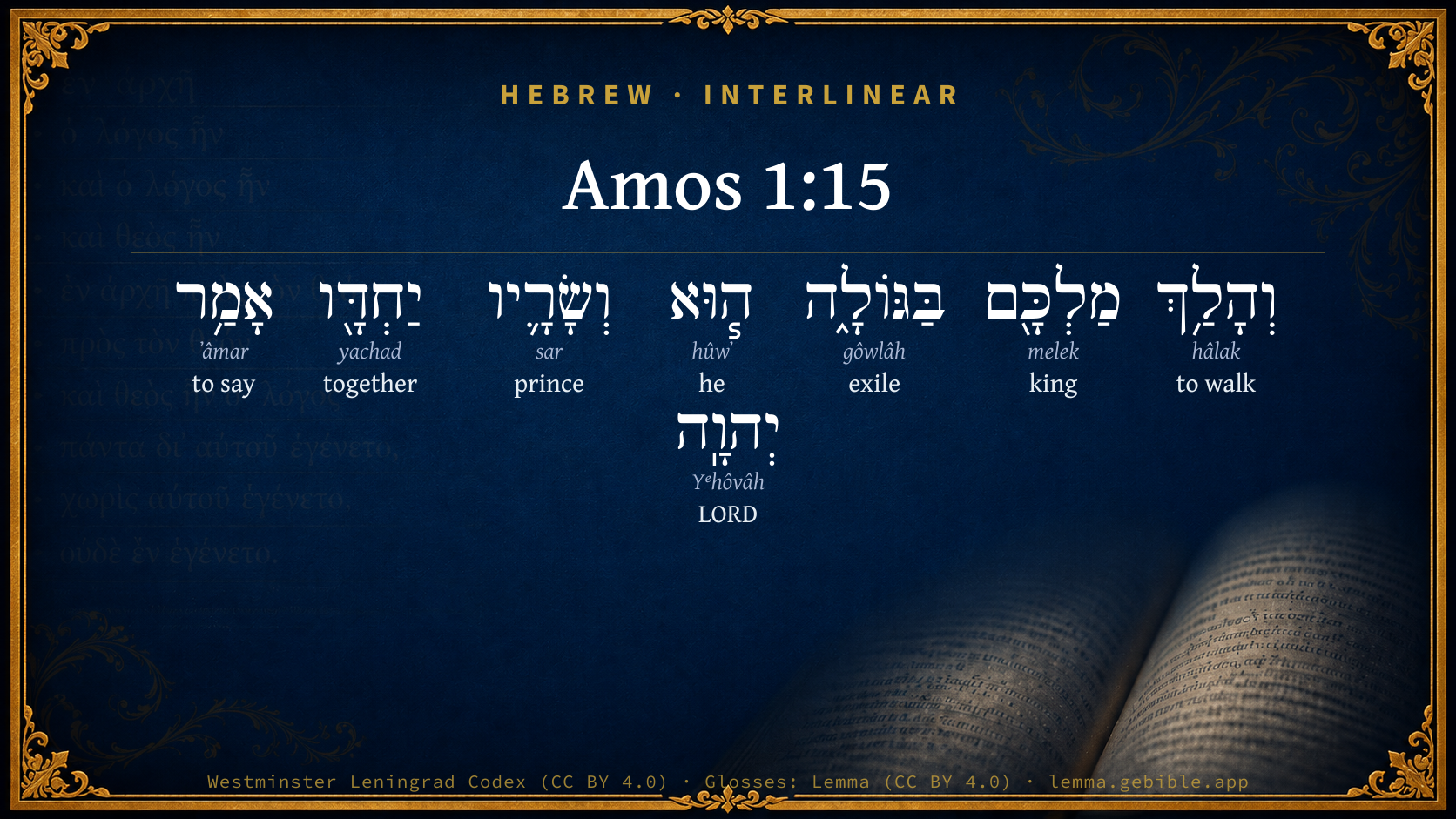
Amos 1:15

Hebrew (Westminster Leningrad Codex) Amos 1:15 appears in the Hebrew Old Testament. The text above is from the Westminster Leningrad Codex. Each word links to its Strong’s number, a concise gloss, and parsing drawn from the Open Scriptures Hebrew Bible morphology. Click any word for its full Brown-Driver-Briggs (BDB) entry.
Download image
Cite this verse

Amos 1:15 (World English Bible). Public Domain. Lemma interlinear Bible study tool, https://lemma.gebible.app/v/amos/1/15.

Show BibTeX & RIS
BibTeX
RIS
English Translation
And their king will go into captivity, He and his princes together," says Yahweh.
World English Bible · Public Domain
Download a study sheet

One document with this verse’s original text, its word-by-word gloss line, the meaning frame, cross-references with their text, attributed commentary, and full source and license credits — printable, and it pastes into notes with its structure intact.

This verse Autodidact and up

Study sheet (.html) Plain text (.txt)

A passage Seminary Student

Up to 50 verses in one chapter. A passage sheet keeps up to 6 commentary sources and 12 cross-references per verse, in the order this page ranks them, and says so on the sheet whenever that leaves anything out. Ask for a single verse and you get the Autodidact verse sheet above.

Everything on this page stays free to read, with no account — the sheet is a download of what is already on screen, not access to it.

Want to remove ads? Support Godless Engineer
Compare translations 3

The same verse in 3 English versions, stacked beneath the original-language interlinear above. Click any original word for its lexicon entry.

Each is an independent rendering of the whole verse — the interlinear is not word-aligned to these translations.

Highlighted words mark where these versions differ — a whole-verse word diff, not a word-by-word alignment.

  • World English Bible Public Domain
    And their king will go into captivity, He and his princes together," says Yahweh.
  • King James Version Public Domain
    And their king shall go into captivity, he and his princes together, saith the LORD.
  • unfoldingWord Literal Text CC BY-SA 4.0
    Their king will go into captivity, he and his officials together,” says Yahweh.

unfoldingWord Literal Text — © unfoldingWord, licensed CC BY-SA 4.0. Word-aligned USFM3 via Door43 (git.door43.org/unfoldingWord/en_ult).

Versions to compare (up to 4)

3 of 4 selected

Show all 18 translations

Every available English version of this verse, each an independent rendering of the whole verse.

  • World English Bible Public Domain
    And their king will go into captivity, He and his princes together," says Yahweh.
  • Berean Standard Bible Public Domain
    Their king will go into exile—he and his princes together,” says the LORD.
  • Majority Standard Bible Public Domain
    Their king will go into exile—he and his princes together,” says the LORD.
  • King James Version Public Domain
    And their king shall go into captivity, he and his princes together, saith the LORD.
  • American Standard Version (1901) Public Domain
    and their king shall go into captivity, he and his princes together, saith Jehovah.
  • Revised Version (1885) Public Domain
    and their king shall go into captivity, he and his princes together, saith the LORD.
  • Geneva Bible (1599) Public Domain
    And their King shall go into captiuitie, he and his princes together, saith the Lord.
  • Douay-Rheims (1899) Public Domain
    And Melchom shall go into captivity, both he, and his princes together, saith the Lord.
  • Young's Literal Translation Public Domain
    And gone hath their king in a removal, He and his heads together, said Jehovah!
  • Literal Standard Version CC BY-SA 4.0
    And their king has gone in a removal, || He and his heads together,” said YHWH!
  • Unlocked Literal Bible CC BY-SA 4.0
    Their king will go into captivity, he and his officials together,” says Yahweh.
  • unfoldingWord Literal Text CC BY-SA 4.0
    Their king will go into captivity, he and his officials together,” says Yahweh.
  • Darby Bible Public Domain
    And their king shall go into captivity, he and his princes together, saith Jehovah.
  • World Messianic Bible Public Domain
    and their king will go into captivity, he and his princes together,” says the LORD.
  • Webster's Bible Public Domain
    And their king shall go into captivity, he and his princes together, saith the LORD.
  • Free Bible Version CC BY-SA 4.0
    Their king will be sent into exile together with his princes, says the Lord.
  • Bible in Basic English Public Domain
    And their king will be made prisoner, he and his captains together, says the Lord.
  • JPS Tanakh (1917) Public Domain
    And their king shall go into captivity, he and his princes together, saith the LORD.

Literal Standard Version (2020), Covenant Press — licensed CC BY-SA 4.0. Text via the HelloAO Bible API (eBible.org). Unlocked Literal Bible (unfoldingWord) — licensed CC BY-SA 4.0. Text via the HelloAO Bible API (eBible.org). unfoldingWord Literal Text — © unfoldingWord, licensed CC BY-SA 4.0. Word-aligned USFM3 via Door43 (git.door43.org/unfoldingWord/en_ult). Free Bible Version, Dr. Jonathan Gallagher — licensed CC BY-SA 4.0. Text via the HelloAO Bible API (eBible.org).

Word by word

More ways to search: Search by grammar → Find every occurrence → Compare this word →

Practice this passage: Drill this verse → Learn its vocabulary →

About this verse

These counts appear in no published source. They are computed here, from the morphology-tagged text and Lemma’s own curated glosses. What Lemma adds →

8
words
8
distinct lemmas
Prophets
section

Shared distinctive vocabulary

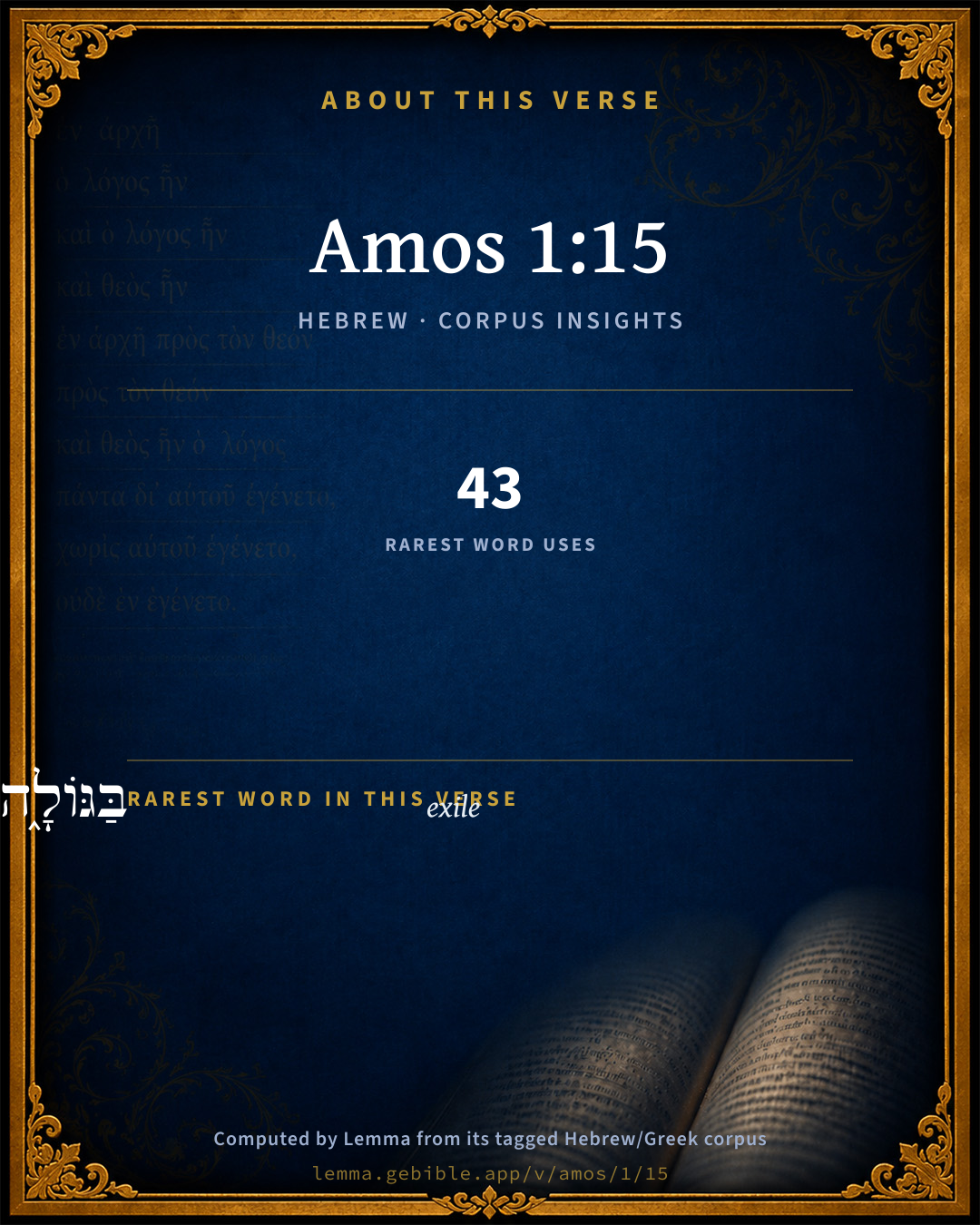
בַּגּוֹלָ֑ה exile H1473 occurs in 42 verses of the Hebrew Bible. Also found in:

Grammatical profile

  • 2 verbs
  • 4 nouns
  • 1 pronoun
  • 1 adverb

Verb forms

  • וְהָלַ֥ךְ Qal · Sequential Perfect
  • אָמַ֥ר Qal · Perfect

Hebrew & Septuagint length

In English translation the verse runs 14 words from the Hebrew and 16 from the Septuagint (LXX English) — closely comparable.

A rough comparison of the two English renderings, which tokenize alike — not a word-level alignment.

Word counts can differ between the Hebrew and the Greek without any difference in meaning — e.g. the Hebrew direct-object marker אֵת has no separate Greek word, and Greek often adds the article ὁ.

Cross-references

1

Topical passages linked to Amos 1:15 in the Treasury of Scripture Knowledge — connected by theme and wording, ordered by reader-vote popularity; previews shown in the World English Bible.

  • Jeremiah 49:3 Wail, Heshbon, for Ai is laid waste; cry, you daughters of Rabbah, gird you with sackcloth: lament, and run back and forth among the fences; for Malcam shall go into captivity, his priests and his princes together.

Cross-references courtesy of OpenBible.info (CC BY 4.0).

Hebrew and Greek witnesses Masoretic Hebrew ↔ Greek Septuagint

The same verse in the two great witnesses to the Old Testament, shown verse-for-verse.

These are two independent witnesses, not word-aligned to each other, and the Septuagint is shown in lemma (dictionary) form.

Hebrew Amos 1:15 Masoretic · Westminster Leningrad Codex

וְהָלַ֥ךְ מַלְכָּ֖ם בַּגּוֹלָ֑ה ה֧וּא וְשָׂרָ֛יו יַחְדָּ֖ו אָמַ֥ר יְהוָֽה

And their king will go into captivity, He and his princes together," says Yahweh.

World English Bible · Public Domain

Greek LXX Amos 1:15 Septuagint · lemma form

καί πορεύομαι ὁ βασιλεύς αὐτός ἐν αἰχμαλωσία ὁ ἱερεύς αὐτός καί ὁ ἄρχων αὐτός ἐπί ὁ αὐτός λέγω κύριος

and her kings shall go into captivity, their priests and their rulers together, says the Lord.

LXX2012 (modern English Septuagint) · Public Domain

On this verse, Jamieson, Fausset & Brown discusses the Septuagint’s reading. Read the note in Commentary ↓

Hebrew: Westminster Leningrad Codex (CC BY 4.0). Greek: Septuagint (public domain); English from LXX2012 (modern English Septuagint) (Public Domain). How the Septuagint differs from the Hebrew →

Targum (Aramaic paraphrase)

1

The Targum is the ancient Jewish Aramaic paraphrase of the Hebrew Scriptures — an interpretive translation, not the Hebrew text itself. Onkelos (literal) and Pseudo-Jonathan (expansive) render the Torah, and Jonathan the Prophets. Coverage is partial: where no permissively-licensed English translation exists for a verse, only the Aramaic is shown. This is verse-level text, not a word-by-word alignment to the Hebrew.

  1. Targum Jonathan Prophets (Joshua–Malachi)
    וִיהַךְ מַלְכֵּהוֹן בְּגָלוּתָא הוּא וְרַבְרְבוֹהִי כַּחֲדָא אֲמַר יְיָ:

    (no public-domain English translation for this verse)

    Targum Jonathan — Aramaic: “Mikraot Gedolot” (public domain). English: “Sefaria Community Translation” (CC0 1.0 (public-domain dedication)); “London "Chaldee Paraphrase," 1871” (public domain). Text via Sefaria.

Commentary

Notes on Amos 1:15 from classic Christian and Jewish commentators (each source and its license shown beneath its notes). The classic Christian expositions comment on the surrounding passage and are grouped to its opening verse, so a note may address several verses; the Jewish commentaries on the Tanakh (Rashi and others) are per-verse, so they appear only where the commentator wrote on this verse.

Lemma curates 59 commentaries, every one of them public domain or Creative Commons licensed, each selected and text-cleaned for this edition rather than reprinted as found. About our sources →

Trapp's Complete Commentary

John Trapp

Amo 1:15 And their king shall go into captivity, he and his princes together, saith the LORD.

Ver. 15. And their king shall go into captivity] Where he may find as little favour as Zedekiah did with Nebuchadnezzar, Valerian with Sapores the Persian, Bajazet with Tamerlane the Scythian; and not so much as Gilimer, king of Vandals, with Belisarius, of whom he requested (and obtained) these three things, a loaf, a spunge, and a harp; a loaf to relieve him, a spunge to wipe his weeping eyes, and a harp to cheer him up in his captivity.

He and his princes together] Lords and lowlies shall fare alike; the sword spares neither. And in hell potentes potenter torquebuntur, mighty men shall be mightily tormented.

John Trapp, A Commentary or Exposition upon All the Books of the Old and New Testament (1647–1656) — public domain. Text from a community e-Sword module.

Tyndale Open Study Notes

Tyndale Open Resources

1:15 their king: The Hebrew term malkam may be a reference to the Ammonite god Molech. In ancient times, people believed that a conquered nation’s god or gods went into exile together with them (see 5:26-27; 1 Sam 5:1-2; Isa 46:1).

Tyndale Open Study Notes — © Tyndale Open Resources, licensed CC BY-SA 4.0. Text via the HelloAO Bible API.

Jamieson, Fausset & Brown

Robert Jamieson, A. R. Fausset & David Brown

their king . . . princes--or else, "their Molech (the idol of Ammon) and his priests" [GROTIUS and Septuagint]. Isa 43:28 so uses "princes" for "priests." So Amo 5:26, "your Molech"; and Jer 49:3, Margin. English Version, however, is perhaps preferable both here and in Jer 49:3; see on Jer 49:3.

Next: Amos Chapter 2

Jamieson, Fausset & Brown — Commentary Critical and Explanatory on the Whole Bible (1871) — public domain (CC PDM 1.0). Text via the HelloAO Bible API.

Adam Clarke's Commentary

Verse 15. Their king shall go into captivity] Probably מלכם malcham should be Milcom, who was a chief god of the Ammonites; and the following words, he and his princes, may refer to the body of his priesthood. See 1Kg 11:33, and the notes there. All these countries were subdued by Nebuchadnezzar.

Adam Clarke's Commentary on the Bible (1810–1826) — public domain. Text from a community e-Sword/MySword module.

John Calvin's Commentaries

He finally adds, And their king shall go into captivity, he and his princes together As מלכם, melcam, was an idol of the people, some regard it here as a proper name; but he says, מלכם הוא ושריו, melcam eva ushariu, ‘their king, he and his princes;’ hence the Prophet, no doubt, names the king of Ammon, for he joins with him his princes. He says then that the ruin of the kingdom would be such, that the king himself would be led captive by the Assyrians. This prediction was no doubt fulfilled, though there is no history of it extant.

John Calvin's Commentaries (1540-1563) — public domain. Text from the Calvin Translation Society English edition (1840s-50s) via the Christian Classics Ethereal Library (ccel.org). Calvin's coverage is partial (roughly two-thirds of the Bible); uncommented books and verses are honest gaps, never fabricated. The 19th-century editor's footnotes and remarks are omitted so the notes are faithfully Calvin's own voice.

Ellicott's Commentary for English Readers

(15) Their king.—Not as Syrian and Vulg. read the original, Malcam or Milcom, i.e., Moloch. E.V. is supported by LXX., Targ., and context of the passage. So far we find the prophet denouncing the sin which trifles with blood, covenants, and ancient agreements, and recognising the responsibilities of race; but closer inspection shows in this, and in Amos 2, that the prophet condemns all violations of those natural laws and rights of which he regards Jehovah as custodian and executor.

A Bible Commentary for English Readers, edited by Charles John Ellicott (1878–1897) — public domain. Text from a community e-Sword module.

The Cambridge Bible for Schools and Colleges

gen. ed. J. J. S. Perowne

15. And their king shall go into captivity, &c.] into exile (Amo_1:5). The verse is borrowed by Jeremiah, with slight changes, in his prophecy against the Ammonites (Jer_49:3), “For their king shall go into exile, his priests and his princes together”—where the addition of ‘priests’ makes it probable that for malcâm ‘their king,’ we should read, with most of the ancient versions, Milcom, the name of the national God of the Ammonites (1Ki_11:5, &c.).

The Cambridge Bible for Schools and Colleges (gen. ed. J. J. S. Perowne; Cambridge University Press, 1878–1918) — public domain. Text from a community e-Sword module.

John Gill's Exposition

And their king shall go into captivity,.... Not only the common people that are left of the sword shall be carried captive, but their king also. This was, Baalis their last king, who was accessary to the murder of Gedaliah, Jer 40:14; whom the king of Babylon had set over the remnant of the Jews left in Judea; which might provoke him to send Nebuzaradan his general against him, who put his country to fire and sword, destroyed his chief city Rabbah, and carried him and his nobles into captivity. Some understand this of Milchom, or Mo, the god of the children of Ammon, who should be so far from saving them, that he himself should be taken and carried off; it being usual with the conquerors to carry away with them the gods of the nations they conquered; see Jer 48:7. So Ptolemy Euergetes king of Egypt, having conquered Callinicus king of Syria, carried captive into Egypt the gods he then took, Dan 11:8; and it was usual with the Romans to carry the gods of the nations captive which they conquered, and to carry them in their triumphs as such; so Marcellus was blamed for rendering the city of Rome envied and hated by other nations, because not men only, but the gods also, were carried in pomp as captives: and of Paulus Aemylius it is said, that the first day of his triumph was scarce sufficient for the passing along of the captive statues, pictures, and colosses, which were drawn on two hundred and fifty chariots (k):

he and his princes together, saith the Lord: which is repeated, and especially the last words added, for the confirmation of it. The Septuagint, Syriac, and Arabic versions, read, "their priests and their princes", as in Jer 49:3. This was fulfilled five years after the destruction of Jerusalem, as Josephus (l) relates.

(k) Vid. Plutarch. in Vita Marcelli & Aemylii. (l) Antiqu. l. 10. c. 9. sect. 7. Vid. Judith i. 12.

Next: Amos Chapter 2

John Gill's Exposition of the Whole Bible (1746–1763) — public domain (CC PDM 1.0). Text via the HelloAO Bible API.

Albert Barnes' Notes on the Bible

And their king - The king was commonly, in those nations, the center of their energy. When “he and his princes” were “gone into captivity,” there was no one to make head against the conqueror, and renew revolts. Hence, as a first step in the subdual, the reigning head and those who shared his counsels were removed. Ammon then, savage as it was in act, was no ill-organized horde. On the contrary, barren and waste as all that country now is, it must once have been highly cultivated by a settled and laborious people. The abundance of its ruins attests the industry and habits of the population. “The whole of the country,” says Burckhardt , “must have been extremely well cultivated, to have afforded subsistence to the inhabitants of so many towns.” “The low hills are, for the most part, crowned with ruins.” Of the “thirty ruined or deserted places, which including Amman,” have been even lately “counted east of Assalt” (the village which probably represents Ramoth-Gilead, “about 16 miles west of Philadelphia that is, Amman) several are in Ammonitis. Little as the country has been explored, ruins of large and important towns have been found south-southeast. and south of Amman .

Two hours southeast of Amman, Buckingham relates , “an elevation opened a new view before us, in the same direction. On a little lower level, was a still more extensive track of cultivated plain than that even which we had already passed - Throughout its whole extent were seen ruined towns in every direction, both before, behind, and on each side of us; generally seated on small eminences; all at a short distance from each other; and all, as far as we had yet seen, bearing evident marks of former opulency and consideration. There was not a tree in sight as far as the eye could reach; but my guide, who had been over every part of it, assured me that the whole of the plain was covered with the finest soil, and capable of being made the most productive grain-land in the world - For a space of more than thirty miles there did not appear to me a single interruption of hill, rock or wood, to impede immediate tillage.

The great plain of Esdraelon, so justly celebrated for its extent and fertility, is inferior in both to this plain of Belkah. Like Esdraelon, it appears to have been once the seat of an active and numerous population; but in the former the monuments of the dead only remain, while here the habitations of the living are equally mingled with the tombs of the departed, all thickly strewn over every part of the soil from which they drew their sustenance.” Nor does the crown, of a “talent of gold weight, with precious stones” 2Sa 12:30, belong to an uncivilized people. Such hordes too depend on the will and guidance of their single Skeikh or head. This was a hereditary kingdom 2Sa 10:1. The kings of Ammon had their constitutional advisers. These were they who gave the evil and destructive counsel to insult the ambassadors of David. Evil kings have evermore evil counselors. It is ever the curse of such kings to have their own evil, reflected, anticipated, fomented, enacted by bad advisers around them. “Hand in hand the wicked shall not be unpunished” Pro 11:21. They link together, but to drag one another into a common destruction. Together they had counseled against God; “king and princes together,” they should go into captivity.

There is also doubtless, in the word Malcham, a subordinate allusion to the god whom they worshiped under the title Molech or Malchom. Certainly Jeremiah “seems” so to have understood it. For, having said of Moab, “Chemosh shall go into captivity, his priests and his princes together” Jer 48:7, he says as to Ammon, in the self-same formula and almost in the words of Amos ; “Malcham shall go into captivity, his priests and his princes together.” Zephaniah Zep 1:5 also speaks of the idol under the same name Malcham, “their king.” Yet since Ammon had kings before this time, and just before their subdual by Nebuchadnezzar, and king Baalis Jer 40:14 was a murderer, it is hardly likely that Jeremiah too should not have included him in the sentence of his people, of whose sins he was a mainspring. Probably, then, Amos and Jeremiah foretell, in a comprehensive way, the powerlessness of all their stays, human and idolatrous. All in which they trusted should not only fail them, but should be carried captive from them.

Albert Barnes' Notes on the Bible (1834–1885) — public domain. Text from a community e-Sword/MySword module.

Haydock's Catholic Bible Commentary

Melchom, the god or idol of the Ammonites, otherwise called Moloch, and Melech; which, in Hebrew, signifies a king, or Melchom their king. (Challoner) --- He assumed the title of "their king," Judges xi. 14., and Jeremias xlix. 3. (Haydock) --- Blind people, who could not see the vanity of such impotent gods! (Calmet) --- Both he. Septuagint, "and their priests." (Haydock)

George Leo Haydock (1774–1849), Haydock's Catholic Family Bible and Commentary, 1859 edition — public domain. Excludes Psalms (Douay-Rheims chapter numbering differs from Protestant) and Deuterocanonical books (Catholic canon only).

Matthew Poole's English Annotations

Their king; or Milchore, or Moloch, the idol of the Ammonites, so it signifieth, as well as king. I suppose the prophet may intend both, their god as well as their king shall be carried captive, as was customary with conquerors, 1Sa 5:2; Isa 46:2.

He: this repeats and confirms the threat, whether it refer to the idol or the king.

His princes; either nobles and ministers of state, who attend and serve the king, or the priests and ministers of the idol; here both may be included, and the utter overthrow of their affairs in religion and state be signified and foretold.

Saith the Lord: this, as elsewhere, doth ratify and insure all; it shall so be, for God hath spoken it.

Matthew Poole's English Annotations on the Holy Bible (1683–1685) — public domain. Text from a community e-Sword/MySword module.

The Pulpit Commentary

Their king; Septuagint, oiJ basileiv aujthv. So Keil, Trochon, and others consider that the King of the Ammonites is meant. The Vulgate, with Aquila, Symmachus, the Syriac, and Jerome, retrains the word Melchous, or Melcham, which is the same as Molech, their god. This interpretation is favoured by passages in Jeremiah, of which one is evidently quoted from Amos, "For Malcam shall go into captivity, his priests and his princes together"; (Jer_49:3) and the other (Jer_48:7) is similar, with the substitution of "Chemosh," the god of Moab, for "Maleam." That the localized deity should share the fortunes of his worshippers is quite in accordance with the ideas of the time. (comp. Isa_46:1, Isa_46:2) Probably Amos meant to include both notions their "Malcam," whether king or god. should be carried into captivity, accompanied by the princes, all the chiefs, military and sacerdotal, so that no one should he left to head a future revolt.

The Pulpit Commentary (1880–1919), ed. H.D.M. Spence-Jones & Joseph S. Exell — public domain. Text from a community e-Sword module.

Lesson kit

Teaching starters — assembled from the data on this page, not authored interpretation. Every prompt links to the verse data it draws on. Edit before teaching.

Amos, in the Prophets, opens this verse with 8 words (8 distinct Hebrew lemmas). Its most distinctive word is gôwlâh (“exile”). A historical commentator’s framing appears above. Read the whole chapter for the surrounding context.

Discussion questions

  1. What does “exile” (gôwlâh) contribute to the verse as a whole?
  2. How does 2 Kings 24:14, which shares the word «exile», read alongside this verse?
  3. These translations render this verse differently; the difference is in the English rendering, not the original. What questions does that raise?
  4. «וְהָלַ֥ךְ» is a Qal Sequential Perfect verb. How does that grammatical form shape the action described?
  5. Compare how Trapp's Complete Commentary and Tyndale Open Study Notes read this verse. Where do they agree or differ?

Things to notice

Reading settings

Reading text

Shown beneath each verse's original-language words.

Old Testament
Old Testament edition

Read the OT as the Masoretic Hebrew (MT) or the Greek Septuagint (LXX).

English shown for the Greek Septuagint (in the Hebrew ↔ Greek comparison).

Comparing translations? Open the Compare panel on any verse page to stack up to four side by side.