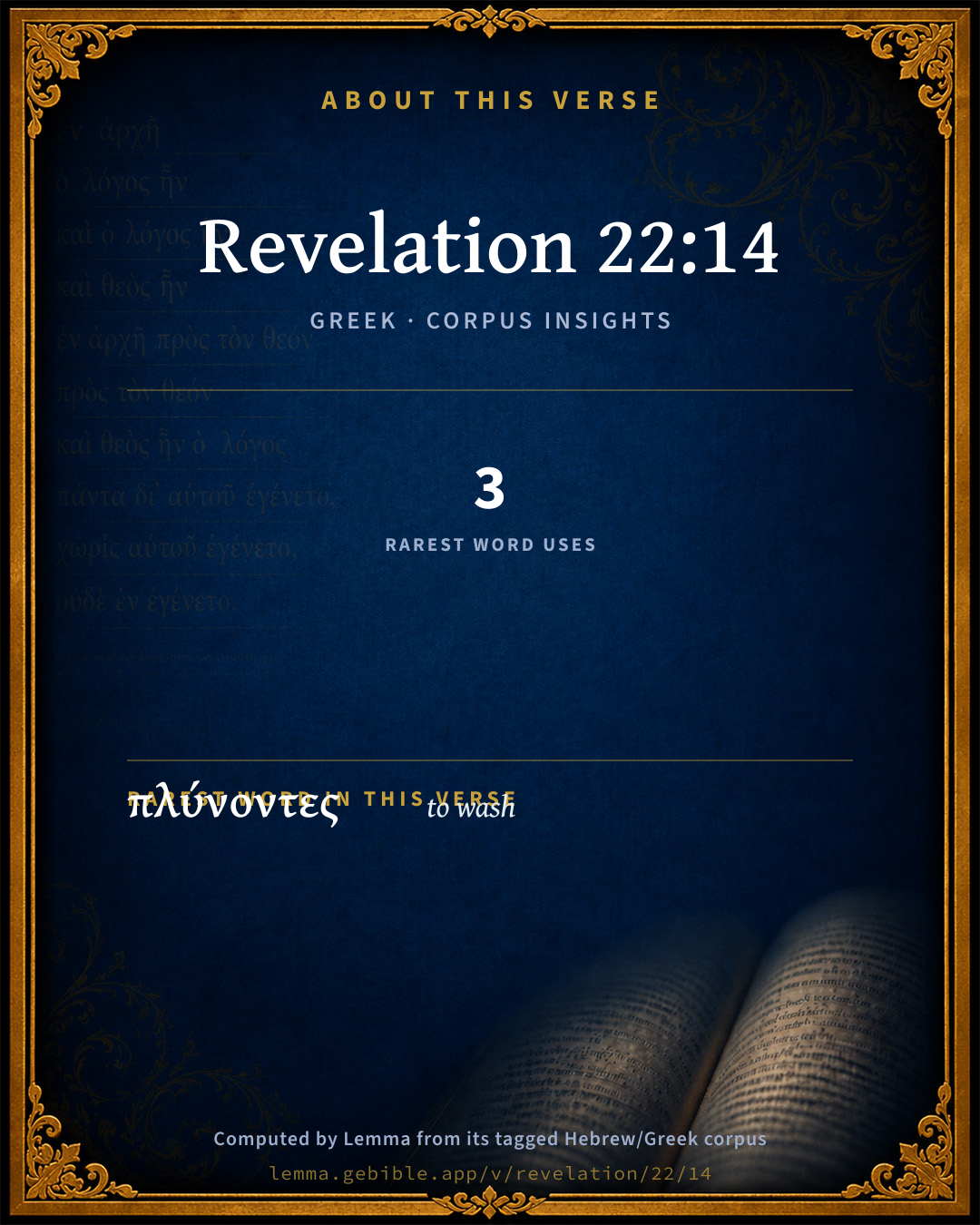
Revelation 22:14

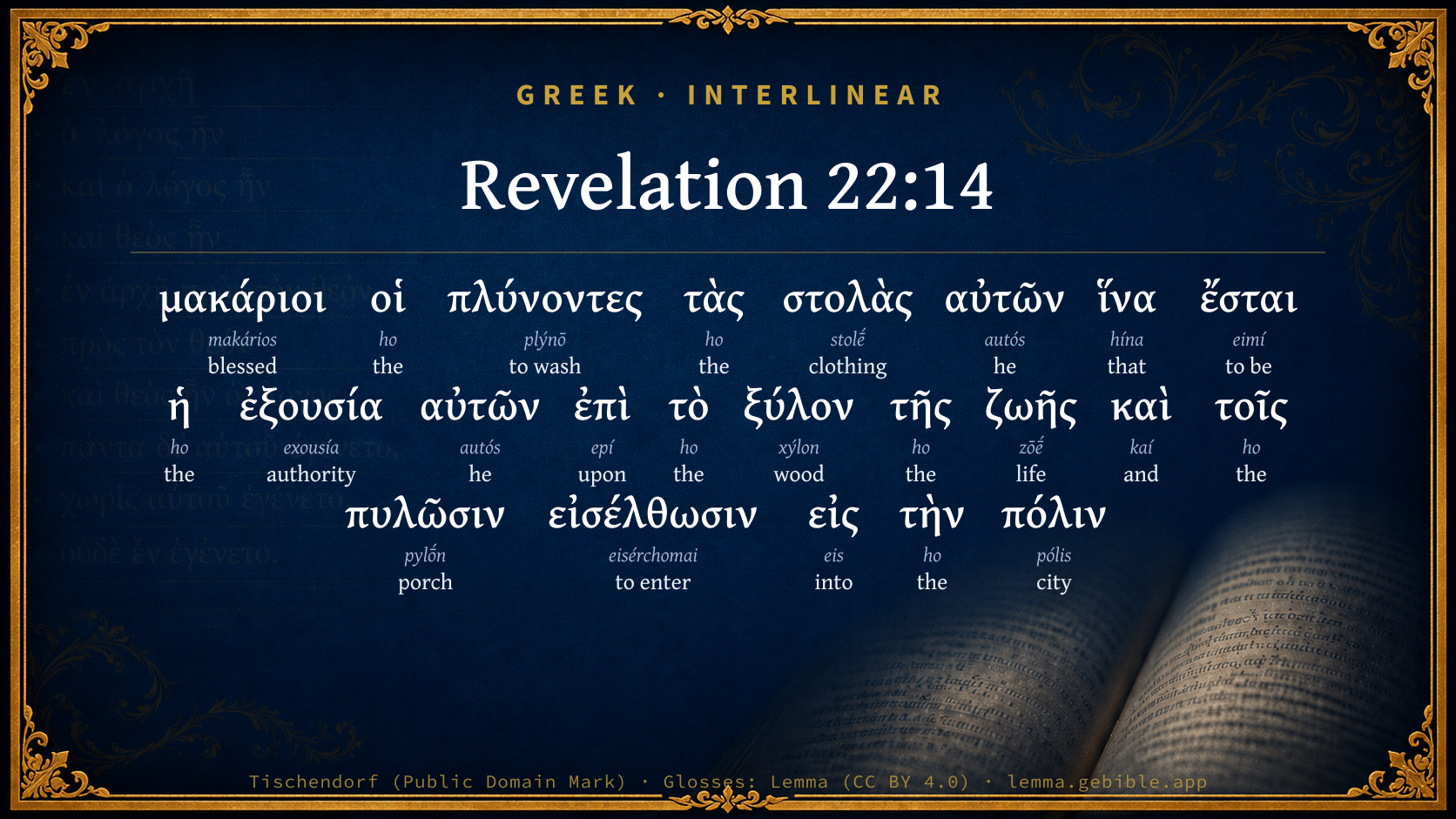
Greek (Tischendorf 8th ed.) Revelation 22:14 appears in the Greek New Testament. The text above is from the Tischendorf 8th edition. Each word links to its Strong’s number and a concise gloss. Click any word for its full Thayer’s Greek Lexicon entry.
Download image
Cite this verse

Revelation 22:14 (World English Bible). Public Domain. Lemma interlinear Bible study tool, https://lemma.gebible.app/v/revelation/22/14.

Show BibTeX & RIS
BibTeX
RIS
English Translation
Blessed are those who do his commandments, that they may have the right to the tree of life, and may enter in by the gates into the city.
World English Bible · Public Domain
Download a study sheet

One document with this verse’s original text, its word-by-word gloss line, the meaning frame, cross-references with their text, attributed commentary, and full source and license credits — printable, and it pastes into notes with its structure intact.

This verse Autodidact and up

Study sheet (.html) Plain text (.txt)

A passage Seminary Student

Up to 50 verses in one chapter. A passage sheet keeps up to 6 commentary sources and 12 cross-references per verse, in the order this page ranks them, and says so on the sheet whenever that leaves anything out. Ask for a single verse and you get the Autodidact verse sheet above.

Everything on this page stays free to read, with no account — the sheet is a download of what is already on screen, not access to it.

Want to remove ads? Support Godless Engineer
Compare translations 3

The same verse in 3 English versions, stacked beneath the original-language interlinear above. Click any original word for its lexicon entry.

Each is an independent rendering of the whole verse — the interlinear is not word-aligned to these translations.

Highlighted words mark where these versions differ — a whole-verse word diff, not a word-by-word alignment.

  • World English Bible Public Domain
    Blessed are those who do his commandments, that they may have the right to the tree of life, and may enter in by the gates into the city.
  • King James Version Public Domain
    Blessed are they that do his commandments, that they may have right to the tree of life, and may enter in through the gates into the city.
  • unfoldingWord Literal Text CC BY-SA 4.0
    Blessed the ones washing their robes so that their authority over the tree of life will be and they may enter into the city by the gates.

unfoldingWord Literal Text — © unfoldingWord, licensed CC BY-SA 4.0. Word-aligned USFM3 via Door43 (git.door43.org/unfoldingWord/en_ult).

Versions to compare (up to 4)

3 of 4 selected

Show all 19 translations

Every available English version of this verse, each an independent rendering of the whole verse.

  • World English Bible Public Domain
    Blessed are those who do his commandments, that they may have the right to the tree of life, and may enter in by the gates into the city.
  • Berean Standard Bible Public Domain
    Blessed are those who wash their robes, so that they may have the right to the tree of life and may enter the city by its gates.
  • Majority Standard Bible Public Domain
    Blessed are those who do His commandments, so that they may have the right to the tree of life and may enter the city by its gates.
  • King James Version Public Domain
    Blessed are they that do his commandments, that they may have right to the tree of life, and may enter in through the gates into the city.
  • American Standard Version (1901) Public Domain
    Blessed are they that wash their robes, that they may have the right `to come' to the tree of life, and may enter in by the gates into the city.
  • Revised Version (1885) Public Domain
    Blessed are they that wash their robes, that they may have the right to come to the tree of life, and may enter in by the gates into the city.
  • Geneva Bible (1599) Public Domain
    Blessed are they, that doe his commandements, that their right may be in the tree of life, and may enter in through the gates into the Citie.
  • Douay-Rheims (1899) Public Domain
    Blessed are they that wash their robes in the blood of the Lamb: that they may have a right to the tree of life, and may enter in by the gates into the city.
  • Young's Literal Translation Public Domain
    `Happy are those doing His commands that the authority shall be theirs unto the tree of the life, and by the gates they may enter into the city;
  • Literal Standard Version CC BY-SA 4.0
    Blessed are those washing their robes that the authority will be theirs to the Tree of Life, and they may enter into the city by the gates;
  • Unlocked Literal Bible CC BY-SA 4.0
    Blessed are those who wash their robes so that they will have the right to eat from the tree of life and to enter the city through the gates.
  • unfoldingWord Literal Text CC BY-SA 4.0
    Blessed the ones washing their robes so that their authority over the tree of life will be and they may enter into the city by the gates.
  • Darby Bible Public Domain
    Blessed [are] they that wash their robes, that they may have right to the tree of life, and that they should go in by the gates into the city.
  • World Messianic Bible Public Domain
    Blessed are those who do his commandments, that they may have the right to the tree of life, and may enter in by the gates into the city.
  • Webster's Bible Public Domain
    Blessed are they that do his commandments, that they may have right to the tree of life, and may enter in through the gates into the city.
  • Free Bible Version CC BY-SA 4.0
    Blessed are those who wash their robes so that they have the right to the tree of life, and can enter into the city through the gates.
  • Bible in Basic English Public Domain
    A blessing on those whose robes are washed, so that they may have a right to the tree of life, and may go in by the doors into the town.
  • Text-Critical English NT CC BY 4.0
    Blessed are those who keep God's commandments, so that they may have the right to the tree of life and may enter the city by its gates.
  • Tyndale New Testament (1534) Public Domain
    Blessed are they that do hys commaundmentes that their power maye be in the tree of lyfe and maye entre in thorow the gates into the cite.

Literal Standard Version (2020), Covenant Press — licensed CC BY-SA 4.0. Text via the HelloAO Bible API (eBible.org). Unlocked Literal Bible (unfoldingWord) — licensed CC BY-SA 4.0. Text via the HelloAO Bible API (eBible.org). unfoldingWord Literal Text — © unfoldingWord, licensed CC BY-SA 4.0. Word-aligned USFM3 via Door43 (git.door43.org/unfoldingWord/en_ult). Free Bible Version, Dr. Jonathan Gallagher — licensed CC BY-SA 4.0. Text via the HelloAO Bible API (eBible.org).

Word by word

More ways to search: Search by grammar → Find every occurrence → Compare this word →

Practice this passage: Drill this verse → Learn its vocabulary →

πλύνοντες
plýnō
G4150
“to wash”
Verb, Present, Active, Participle, Nominative, Plural, Masculine
Part of Speech
Verb
Tense
Present
Voice
Active
Mood
Participle
Case
Nominative
Number
Plural
Gender
Masculine
Full Thayer's Definition

Origin: "a prolonged form of an obsolete pluo (to "flow")"

TDNT: None

1. to wash: with reference to clothing a. use figuratively of those who by faith so appropriate the results of Christ's expiation as to be regarded by God as pure and sinless
  1. μακάριοι makários G3107 “blessed” Adjective, Nominative, Plural, Masculine
  2. οἱ ho G3588 “the” Article, Nominative, Plural, Masculine
  3. τὰς ho G3588 “the” Article, Accusative, Plural, Feminine
  4. στολὰς stolḗ G4749 “clothing” Noun, Accusative, Plural, Feminine
  5. αὐτῶν autós G846 “he” Personal pronoun, Genitive, Plural, Masculine
  6. ἵνα hína G2443 “that” Conjunction
  7. ἔσται eimí G1510 “to be” Verb, Future, Middle deponent, Indicative, 3rd person, Singular
  8. ἡ ho G3588 “the” Article, Nominative, Singular, Feminine
  9. ἐξουσία exousía G1849 “authority” Noun, Nominative, Singular, Feminine
  10. αὐτῶν autós G846 “he” Personal pronoun, Genitive, Plural, Masculine
  11. ἐπὶ epí G1909 “upon” Preposition
  12. τὸ ho G3588 “the” Article, Accusative, Singular, Neuter
  13. ξύλον xýlon G3586 “wood” Noun, Accusative, Singular, Neuter
  14. τῆς ho G3588 “the” Article, Genitive, Singular, Feminine
  15. ζωῆς zōḗ G2222 “life” Noun, Genitive, Singular, Feminine
  16. καὶ kaí G2532 “and” Conjunction
  17. τοῖς ho G3588 “the” Article, Dative, Plural, Masculine
  18. πυλῶσιν pylṓn G4440 “porch” Noun, Dative, Plural, Masculine
  19. εἰσέλθωσιν eisérchomai G1525 “to enter” Verb, Aorist, Active, Subjunctive, 3rd person, Plural
  20. εἰς eis G1519 “into” Preposition
  21. τὴν ho G3588 “the” Article, Accusative, Singular, Feminine
  22. πόλιν pólis G4172 “city” Noun, Accusative, Singular, Feminine

About this verse

These counts appear in no published source. They are computed here, from the morphology-tagged text and Lemma’s own curated glosses. What Lemma adds →

23
words
16
distinct lemmas
Revelation
section

Notable vocabulary

The rarest word here is πλύνοντες to wash G4150 — appearing just 3 times in the whole Greek New Testament.

Shared distinctive vocabulary

πλύνοντες to wash G4150 occurs in 3 verses of the Greek New Testament. Also found in:

Repetition

Words recur within this verse:

  • οἱ the G3588 ×7
  • αὐτῶν he G846 ×2

Cross-references

27

Topical passages linked to Revelation 22:14 in the Treasury of Scripture Knowledge — connected by theme and wording, ordered by reader-vote popularity; previews shown in the World English Bible.

  • Revelation 21:27 There will in no way enter into it anything profane, or one who causes an abomination or a lie, but only those who are written in the Lamb's book of life.
  • 1 John 5:3 For this is the love of God, that we keep his commandments. His commandments are not grievous.
  • Revelation 22:7 "Behold, I come quickly. Blessed is he who keeps the words of the prophecy of this book."
  • 1 John 3:23–24 This is his commandment, that we should believe in the name of his Son, Jesus Christ, and love one another, even as he commanded.
  • 1 John 3:3 Everyone who has this hope set on him purifies himself, even as he is pure.
  • Revelation 2:7 He who has an ear, let him hear what the Spirit says to the assemblies. To him who overcomes I will give to eat of the tree of life, which is in the Paradise of my God.
  • John 14:15 If you love me, keep my commandments.
  • 1 Corinthians 7:19 Circumcision is nothing, and uncircumcision is nothing, but the keeping of the commandments of God.
  • John 15:10–14 If you keep my commandments, you will remain in my love; even as I have kept my Father's commandments, and remain in his love.
  • John 14:21–23 One who has my commandments, and keeps them, that person is one who loves me. One who loves me will be loved by my Father, and I will love him, and will reveal myself to him."
  • Psalms 119:1–6 Blessed are those whose ways are blameless, Who walk according to Yahweh's law.
  • John 10:7 Jesus therefore said to them again, "Most assuredly, I tell you, I am the sheep's door.
  • John 10:9 I am the door. If anyone enters in by me, he will be saved, and will go in and go out, and will find pasture.
  • Revelation 22:2 in the middle of its street. On this side of the river and on that was the tree of life, bearing twelve kinds of fruits, yielding its fruit every month. The leaves of the tree were for the healing of the nations.
  • Psalms 112:1 Praise Yah! Blessed is the man who fears Yahweh, Who delights greatly in his commandments.
  • Galatians 5:6 For in Christ Jesus neither circumcision amounts to anything, nor uncircumcision, but faith working through love.
  • Revelation 7:14 I told him, "My lord, you know." He said to me, "These are those who came out of the great tribulation. They washed their robes, and made them white in the Lamb's blood.
  • Matthew 7:21–27 Not everyone who says to me, 'Lord, Lord,' will enter into the Kingdom of Heaven; but he who does the will of my Father who is in heaven.
  • Psalms 106:3–5 Blessed are those who keep justice. Blessed is one who does what is right at all times.
  • John 14:6 Jesus said to him, "I am the way, the truth, and the life. No one comes to the Father, except through me.
  • Revelation 21:12 having a great and high wall; having twelve gates, and at the gates twelve angels; and names written on them, which are the names of the twelve tribes of the children of Israel.
  • Isaiah 56:1–2 Thus says Yahweh, Keep you justice, and do righteousness; for my salvation is near to come, and my righteousness to be revealed.
  • Daniel 12:12 Blessed is he who waits, and comes to the one thousand three hundred thirty-five days.
  • Luke 12:37–38 Blessed are those servants, whom the lord will find watching when he comes. Most assuredly I tell you, that he will dress himself, and make them recline, and will come and serve them.
  • John 4:12 Are you greater than our father, Jacob, who gave us the well, and drank of it himself, as did his children, and his cattle?"
  • 1 Corinthians 8:9 But be careful that by no means does this liberty of yours become a stumbling block to the weak.
  • 1 Corinthians 9:5 Have we no right to take along a wife who is a believer, even as the rest of the apostles, and the brothers of the Lord, and Cephas?

Cross-references courtesy of OpenBible.info (CC BY 4.0).

Where the printed editions differ

2 variants

Places in this verse where the major printed Greek editions disagree on the wording in a way that affects the translation — a comparison of editions, not a manuscript-by-manuscript collation. The editions are the modern critical texts (Nestlé-Aland 28/27, SBL, Westcott-Hort, Tregelles, Tyndale House) and the traditional texts behind the KJV (the Textus Receptus and the Byzantine/Majority text). It is not a claim about which reading is original.

  1. Different wording
    πλύνοντες

    “washing”

    In NA28NA27TynSBLWHTreg Not in TRByz

    ποιοῦντες (poiountes) 'doing' occurs in traditional manuscripts (TR+Byz) instead of πλύνοντες (plunontes) 'washing' in older manuscripts (NA28+NA27+Tyn+SBL+WH+Treg)

  2. Different wording
    στολὰς αὐτῶν,

    “robes of them,”

    In NA28NA27TynSBLWHTreg Not in TRByz

    ἐντολὰς (entolas) 'commandments' occurs in traditional manuscripts (TR+Byz) instead of στολὰς (stolas) 'robes' in older manuscripts (NA28+NA27+Tyn+SBL+WH+Treg)

Textual data: Translators Amalgamated Greek New Testament (STEPBible TAGNT) · CC BY 4.0.

Commentary

Notes on Revelation 22:14 from classic Christian and Jewish commentators (each source and its license shown beneath its notes). The classic Christian expositions comment on the surrounding passage and are grouped to its opening verse, so a note may address several verses; the Jewish commentaries on the Tanakh (Rashi and others) are per-verse, so they appear only where the commentator wrote on this verse.

Lemma curates 59 commentaries, every one of them public domain or Creative Commons licensed, each selected and text-cleaned for this edition rather than reprinted as found. About our sources →

MacLaren's Expositions of Holy Scripture

Alexander MacLaren

Revelation

EDEN LOST AND RESTORED

Gen 3:24. - Rev 22:14.

Better is the end of a thing than the beginning.’ Eden was fair, but the heavenly city shall be fairer. The Paradise regained is an advance on the Paradise that was lost. These are the two ends of the history of man, separated by who knows how many millenniums. Heaven lay about him in his infancy, but as he journeyed westwards its morning blush faded into the light of common day-and only at eventide shall the sky glow again with glory and colour, and the western heaven at last outshine the eastern, with a light that shall never die. A fall, and a rise-a rise that reverses the fall, a rise that transcends the glory from which he fell,-that is the Bible’s notion of the history of the world, and I, for my part, believe it to be true, and feel it to be the one satisfactory explanation of what I see round about me and am conscious of within me.

1. Man had an Eden and lost it.

I take the Fall to be a historical fact. To all who accept the authority of Scripture, no words are needed beyond the simple statement before us, but we may just gather up the signs that there are on the wide field of the world’s history, and in the narrower experience of individuals, that such a fall has been.

Look at the condition of the world: its degradation, its savagery-all its pining myriads, all its untold millions who sit in darkness and the shadow of death. Will any man try to bring before him the actual state of the heathen world, and, retaining his belief in a God, profess that these men are what God meant men to be? It seems to me that the present condition of the world is not congruous with the idea that men are in their primitive state, and if this is what God meant men for, then I see not how the dark clouds which rest on His wisdom and His love are to be lifted off.

Then, again-if the world has not a Fall in its history, then we must take the lowest condition as the one from which all have come; and is that idea capable of defence? Do we see anywhere signs of an upward process going on now? Have we any experience of a tribe raising itself? Can you catch anywhere a race in the act of struggling up, outside of the pale of Christianity? Is not the history of all a history of decadence, except only where the Gospel has come in to reverse the process?

But passing from this: What mean the experiences of the individual-these longings; this hard toil; these sorrows?

How comes it that man alone on earth, manifestly meant to be leader, lord, etc., seems but cursed with a higher nature that he may know greater sorrows, and raised above the beasts in capacity that he may sink below them in woe, this capacity only leading to a more exquisite susceptibility, to a more various as well as more poignant misery?

Whence come the contrarieties and discordance in his nature?

It seems to me that all this is best explained as the Bible explains it by saying: {1} Sin has done it; {2} Sin is not part of God’s original design, but man has fallen; {3} Sin had a personal beginning. There have been men who were pure, able to stand but free to fall.

It seems to me that that explanation is more in harmony with the facts of the case, finds more response in the unsophisticated instinct of man, than any other. It seems to me that, though it leaves many dark and sorrowful mysteries all unsolved, yet that it alleviates the blackest of them, and flings some rays of hope on them all. It seems to me that it relieves the character and administration of God from the darkest dishonour; that it delivers man’s position and destiny from the most hopeless despair; that though it leaves the mystery of the origin of evil, it brings out into clearest relief the central truths that evil is evil, and sin and sorrow are not God’s will; that it vindicates as something better than fond imaginings the vague aspirations of the soul for a fair and holy state; that it establishes, as nothing else will, at once the love of God and the dignity of man; that it leaves open the possibility of the final overthrow of that Sin which it treats as an intrusion and stigmatises as a fall; that it therefore braces for more vigorous, hopeful conflict against it, and that while but for it the answer to the despairing question, Hast Thou made all men in vain? must be either the wailing echo ‘In vain,’ or the denial that He has made them at all, there is hope and there is power, and there is brightness thrown on the character of God and on the fate of man, by the old belief that God made man upright, and that man made himself a sinner.

2. Heaven restores the lost Eden.

‘God is not ashamed to be called their God, for He hath prepared them a city.’

The highest conception we can form of heaven is the reversal of all the evil of earth, and the completion of its incomplete good: the sinless purity-the blessed presence of God-the fulfilment of all desires-the service which is blessed, not toil-the changelessness which is progress, not stagnation.

3. Heaven surpasses the lost Eden.

{1} Garden-City.

The perfection of association-the nations of the saved. Here ‘we mortal millions live alone,’ even when united with dearest. Like Egyptian monks of old, each dwelling in his own cave, though all were a community.

{2} The richer experience.

The memory of past sorrows which are understood at last.

Heaven’s bliss in contrast with earthly joys.

Sinlessness of those who have been sinners will be more intensely lustrous for its dark background in the past. Redeemed men will be brighter than angels.

The impossibility of a fall.

Death behind us.

The former things shall no more come to mind, being lost in blaze of present transcendent experience, but yet shall be remembered as having led to that perfect state.

Christ not only repairs the ‘tabernacle which was fallen,’ but builds a fairer temple. He brings ‘a statelier Eden,’ and makes us dwell for ever in a Garden City.

Revelation

THE LAST BEATITUDE OF THE ASCENDED CHRIST

Rev 22:14

The Revised Version reads: ‘Blessed are they that wash their robes that they may have the right to come to the Tree of Life.’

That may seem a very large change to make, from ‘keep His commandments,’ to ‘wash their robes,’ but in the Greek it is only a change of three letters in one word, one in the next, and two in the third. And the two phrases, written, look so like each other, that a scribe, hasty, or for the moment careless, might very easily mistake the one for the other. There can be no doubt whatever that the reading in the Revised Version is the correct one. Not only is it sustained by a great weight of authority, but also it is far more in accordance with the whole teaching of the New Testament than that which stands in our Authorized Version.

‘Blessed are they that do His commandments, that they may have right to the Tree of Life,’ carries us back to the old law, and has no more hopeful a sound in it than the thunders of Sinai. If it were, indeed, amongst Christ’s last words to us, it would be a most sad instance of His ‘building again the things He had destroyed.’ It is relegating us to the dreary old round of trying to earn Heaven by doing good deeds; and I might almost say it is ‘making the Cross of Christ of none effect.’ The fact that that corrupt reading came so soon into the Church and has held its ground so long, is to me a very singular proof of the difficulty which men have always had in keeping themselves up to the level of the grand central Gospel truth: Not by works of righteousness which we have done, but by His mercy. He saved us.’

‘Blessed are they that wash their robes, that they may have right to the Tree of Life,’ has the clear ring of the New Testament music about it, and is in full accord with the whole type of doctrine that runs through this book; and is not unworthy to be almost the last word that the lips of the Incarnate Wisdom spoke to men from Heaven. So then, taking that point of view, I wish to look with you at three things that come plainly out of these words: - First, that principle that if men are clean it is because they are cleansed; ‘Blessed are they that wash their robes.’ Secondly, It is the cleansed who have unrestrained access to the source of life. And lastly, It is the cleansed who pass into the society of the city. Now, let me deal with these three things: -

I. If we are clean it is because we have been made so. The first beatitude that Jesus Christ spoke from the mountain was, ‘Blessed are the poor in spirit.’ The last beatitude that He speaks from Heaven is, ‘Blessed are they that wash their robes.’ And the act commended in the last is but the outcome of the spirit extolled in the first. For they who are poor in spirit are such as know themselves to be sinful men; and those who know themselves to be sinful men are they who will cleanse their robes in the blood of Jesus Christ.

I need not remind you, I suppose, how continually this symbol of the robe is used in Scripture as an expression for moral character. This Book of the Apocalypse is saturated through and through with Jewish implications and allusions, and there can be no doubt whatever that in this metaphor of the cleansing of the robes there is an allusion to that vision that the Apocalyptic seer of the Old Covenant, the prophet Zechariah, had when he saw the high priest standing before the altar clad in foul raiment, and the word came forth, ‘Take away the filthy garments from him.’ Nor need I do more than remind you how the same metaphor is often on the lips of our Lord Himself, notably in the story of the man that had not on the wedding garment, and in the touching and beautiful incident in the parable of the Prodigal Son, where the exuberance of the father’s love bids them cast the best robe round the rags and the leanness of his long-lost boy. Nor need I remind you how Paul catches up the metaphor, and is continually referring to an investing and a divesting - the putting on and the putting off of the new and the old man. In this same Book of the Apocalypse we see, gleaming all through it, the white robes of the purified soul: ‘They shall walk with Me in white, for they are worthy.’ ‘I beheld a great multitude, whom no man could number, who had washed their robes and made them white in the blood of the Lamb.’

And so there are gathered up into these last words, all these allusions and memories, thick and clustering, when Christ speaks from Heaven and says, ‘Blessed are they that wash their robes.’

Well then, I suppose we may say roughly, in our more modern phraseology, that the robe thus so frequently spoken of in Scripture answers substantially to what we call character. It is not exactly the man - and yet it is the man. It is the self- and yet it is a kind of projection and making visible of the self, the vesture which is cast round ‘the hidden man of the heart.’

This mysterious robe, which answers nearly to what we mean by character, is made by the wearer.

That is a solemn thought. Every one of us carries about with him a mystical loom, and we are always weaving - weave, weave, weaving - this robe which we wear, every thought a thread of the warp, every action a thread of the weft. We weave it as the spider does its web, out of its own entrails, if I might so say. We weave it, and we dye it, and we cut it, and we stitch it, and then we put it on and wear it, and it sticks to us. Like a snail that crawls about your garden patches, and makes its shell by a process of secretion from out of its own substance, so you and I are making that mysterious, solemn thing that we call character, moment by moment. It is our own self, modified by our actions. Character is the precipitate from the stream of conduct which, like the Nile Delta, gradually rises solid and firm above the parent river and confines its flow.

The next step that I ask you to take is one that I know some of you do not like to take, and it is this: All the robes are foul. I do not say all are equally splashed, I do not say all are equally thickly spotted with the flesh. I do not wish to talk dogmas, I wish to talk experience; and I appeal to your own consciences, with this plain question, that every man and woman amongst us can answer if they like - Is it true or is it not, that the robe is all dashed with mud caught on the foul ways, with stains in some of us of rioting and banqueting and revelry and drunkenness; sins of the flesh that have left their mark upon the flesh; but with all of us grey and foul as compared with the whiteness of His robe who sits above us there?

Ah I would that I could bring to all hearts that are listening to me now, whether the hearts of professing Christians or no, that consciousness more deeply than we have ever had it, of how full of impurity and corruption our characters are. I do not charge you with crimes; I do not charge you with guilt in the world’s eyes, but, if we seriously ponder over our past, have we not lived, some of us habitually, all of us far too often, as if there were no God at all, or as if we had nothing to do with Him? and is not that godlessness practical Atheism, the fountain of all foulness from which black brooks flow into our lives, and stain our robes?

The next step is. The foul robe can be cleansed. My text does not go any further in a statement of the method, but it rests upon the great words of this Book of the Revelation, which I have already quoted for another purpose, in which we read ‘they washed their robes, and made them white in the blood of the Lamb.’ And the same writer, in his Epistle, has the same paradox, which seems to have been, to him, a favorite way of putting the central Gospel truth: ‘The blood of Jesus Christ cleanses from all sin.’ John saw the paradox, and saw that the paradox helped to illustrate the great truth that he was trying to proclaim, that the red blood whitened the black robe, and that in its full tide there was a limpid river of water of life, clear as crystal, proceeding out of the Cross of Christ.

Guilt can be pardoned, character can be sanctified. Guilt can be pardoned! Men say: No! We live in a universe of inexorable laws; "What a man soweth that he must also reap." If he has done wrong he must inherit the consequences.’

But the question whether guilt can be pardoned or not has only to do very remotely with consequences. The question is not whether we live in a universe of inexorable laws, but whether there is anything in the universe but the laws; for forgiveness is a personal act, and has only to do secondarily and remotely with the consequences of a man’s doings. So that, if we believe in a personal God, and believe that He has got any kind of living relation to men at all, we can believe- blessed be His name! - in the doctrine of forgiveness; and leave the inexorable laws full scope to work, according as His wisdom and His mercy may provide. For the heart of the Christian doctrine of pardon does not touch those laws, but the heart of it is this: ‘O Lord! Thou wast angry with me, but Thine anger is turned away, Thou hast comforted me!’ So guilt may be pardoned.

Character may be sanctified and elevated. Why not, if you can bring a sufficiently strong new force to bear upon it? And you can bring such a force, in the blessed thought of Christ’s death for me, and in the gift of His love. There is such a force in the thought that He has given Himself for our sin. There is such a force in the Spirit of Christ given to us through His death to cleanse us by His presence in our hearts. And so I say, the blood of Jesus Christ, the power of His sacrifice and Cross, cleanses from all sin, both in the sense of taking away all my guilt, and in the sense of changing my character into something loftier and nobler and purer.

Men and women! Do you believe that? If you do not, why do you not? If you do, are you trusting to what you believe, and living the life that befits the confidence?

One word more. The washing of your robes has to be done by you. ‘Blessed are they that wash their robes.’ On one hand is all the fullness of cleansing, on the other is the heap of dirty rags that will not be cleansed by you sitting there and looking at them. You must bring the two into contact. How? By the magic band that unites strength and weakness, purity and foulness, the Saviour and the penitent; the magic band of simple affiance, and trust and submission of myself to the cleansing power of His death and of His life.

Only remember, ‘Blessed are they that are washing,’ as the Greek might read. Not once and for all, but a continuous process, a blessed process running on all through a man’s life.

These are the conditions as they come from Christ’s own lips, in almost the last words that human ears, either in fact or in vision, heard Him utter. These are the conditions under which noble life, and at last Heaven, are possible for men, namely, that their foul characters shall be cleansed, and that continuously, by daily recurrence and recourse to the Fountain opened in His sacrifice and death.

Friends, you may know much of the beauty and nobleness of Christianity, you may know much of the tenderness and purity of Christ, but if you have not apprehended Him in this character, there is an inner sanctuary yet to be trod, of which your feet know nothing, and the sweetest sweetness of all you have not yet tasted, for it is His forgiving love and cleansing power that most deeply manifest His Divine affection and bind us to Himself.

II. The second thought that I would suggest is that these cleansed ones, and by implication these only, have unrestrained access to the source of life: ‘Blessed are they that wash their robes, that they may have right “to the Tree of Life.” ‘That, of course, carries us back to the old mysterious narrative at the beginning of the Book of Genesis.

Although it does not bear very closely upon my present subject, I cannot help pausing to point out one thing, how remarkable and how beautiful it is that the last page of the Revelation should come bending round to touch the first page of Genesis. The history of man began with angels with frowning faces and flaming swords barring the way to the Tree of Life. It ends here with the guard of Cherubim withdrawn; or rather, perhaps, sheathing their swords and becoming guides to the no longer forbidden fruit, instead of being its guards. That is the Bible’s grand symbolical way of saying that all between - the sin, the misery, the death - is a parenthesis. God’s purpose is not going to be thwarted, and the end of His majestic march through human history is to be men’s access to the Tree of Life from which, for the dreary ages - that are but as a moment in the great eternities - they were barred out by their sin.

However, that is not the point that I meant to say a word about. The Tree of Life stands as the symbol here of an external source of life. I take ‘life’ to be used here in what I believe to be its predominant New Testament meaning, not bare continuance in existence, but a full, blessed perfection and activity of all the faculties and possibilities of the man, which this very Apostle himself identifies with the knowledge of God and of Jesus Christ. And that life, says John, has an external source in Heaven as on earth.

There is an old Christian legend, absurd as a legend, beautiful as a parable, that the Cross on which Christ was crucified was made out of the wood of the Tree of Life. It is true in idea, for He and His work will be the source of all life, for earth and for Heaven, whether of body, soul, or spirit. They that wash their robes have the right of unrestrained access to Him in whose presence, in that loftier state, no impurity can live.

I need not dwell upon the thought that is involved here, of how, whilst on earth and in the beginnings of the Christian career, life is the basis of righteousness: in that higher world, in a very profound sense, righteousness is the condition of fuller life.

The Tree of Life, according to some of the old Rabbinical legends, lifted its branches, by an indwelling motion, high above impure hands that were stretched to touch them, and until our hands are cleansed through faith in Jesus Christ, its richest fruit hangs unreachable, golden, above our heads. Oh! brother, the fullness of the life of Heaven is only granted to them who, drawing near Jesus Christ by faith on earth, have thereby cleansed themselves from all filthiness of the flesh and spirit.

III. Finally, those who are cleansed, and they only, have entrance into the society of the city.

There again we have a whole series of Old and New Testament metaphors gathered together. In the old world the whole power and splendor of great kingdoms were gathered in their capitals, Babylon and Nineveh in the past, Rome in the present. To John the forces of evil were all concentrated in that city on the Seven Hills. To him the antagonistic forces which were the hope of the world were all concentrated in the real ideal city which he expected to come down from Heaven - the New Jerusalem. And he and his brother who wrote the Epistle to the Hebrews, whoever he was - trained substantially in the same school - have taught us the same lesson that our picture of the future is not to be of a solitary or self -regarding Heaven, but of ‘a city which hath foundations.’

Genesis began with a garden, man’s sin sent him out of the garden. God, out of evil, evolves good, and for the lost garden comes the better thing, the found city. ‘Then comes the statelier Eden back to man.’ For surely it is better that men should live in the activities of the city than in the sweetness and indolence of the garden; and manifold and miserable as are the sins and the sorrows of great cities, the opprobria of our modern so-called civilization, yet still the aggregation of great masses of men for worthy objects generates a form of character, and sets loose energies and activities which no other kind of life could have produced.

And so I believe a great step in progress is set forth when we read of the final condition of mankind as being their assembling in the city of God. And surely there, amidst the solemn troops and sweet societies, the long loved, long-lost will be found again. I cannot believe that, like the Virgin and Joseph, we shall have to go wandering up and down the streets of Jerusalem when we get there, looking for our dear ones. ‘Wist ye not that I should be in the Father’s house?’ We shall know where to find them.

‘We shall clasp them again,

And with God be the rest.’

The city is the emblem of security and of permanence. No more shall life be as a desert march, with changes which only bring sorrow, and yet a dreary monotony amidst them all. We shall dwell amid abiding realities, ourselves fixed in unchanging but ever-growing completeness and peace. The tents shall be done with, we shall inhabit the solid mansions of the city which hath foundations, and shall wonderingly exclaim, as our unaccustomed eyes gaze on their indestructible strength, ‘What manner of stones and what buildings are here!’ - and not one stone of these shall ever be thrown down.

Dear friends! the sum of all my poor words now is the earnest beseeching of every one of you to bring all your foulness to Christ, who alone can make you clean. ‘Though thou wash thee with nitre, and take thee much soap, yet thine iniquity is marked before

Me, saith the Lord.’ ‘The blood of Jesus Christ cleanseth from all sin.’ Submit yourselves, I pray you, to its purifying power, by humble faith. Then you will have the true possession of the true life today, and will be citizens of the city of God, even while in this far-off dependency of that great metropolis. And when the moment comes for you to leave this prison-house, an angel ‘mighty and beauteous, though his face be hid,’ shall come to you, as once of old to the sleeping Apostle. His touch shall wake you, and lead you, scarce knowing where you are or what is happening, from the sleep of life, past the first and second ward, and through the iron gate that leadeth unto the city. Smoothly it will turn on its hinges, opening to you of its own accord, and then you will come to yourself and know of a surety that the Lord hath sent His angel, and that he has led you into the home of your heart, the city of God, which they enter as its fitting inhabitants who wash their robes in the blood of the Lamb.

Alexander MacLaren, Expositions of Holy Scripture (1904–1910) — public domain. Text from a community e-Sword module.

Tyndale Open Study Notes

Tyndale Open Resources

22:14 Blessed are those: In response to the connection between actions and ultimate results (22:12), the seventh blessing of Revelation (see also 1:3; 14:13; 16:15; 19:9; 20:6; 22:7) promises acceptance for those who wash their robes—those who have been purified by trusting in Christ and following him faithfully (3:5; 6:11; 7:9-10, 14; 19:13; Eph 5:26; Heb 10:22). • enter through the gates of the city: See study note on Rev 21:24-25.

Tyndale Open Study Notes — © Tyndale Open Resources, licensed CC BY-SA 4.0. Text via the HelloAO Bible API.

Bengel's Gnomon

Johann Albrecht Bengel

Rev 22:14. Αὐτοῦ, of Him) of Him, who is coming: Rev 22:12. He Himself speaks concerning Himself. There is a very similar phrase, ch. Rev 5:10: them, that is, us.—ἵνα ἔσται) ἵνα explains the blessedness here mentioned, as ch. Rev 14:13; and ἔσται for ᾖ makes the discourse exceedingly emphatic.—τὸ ξύλον τῆς ζωῆς, the tree of life) of which they who eat, live for ever: Gen 3:22.

Bengel's Gnomon of the New Testament — English translation (T&T Clark, Edinburgh, 1860) — public domain. Text from a community e-Sword module.

Geneva Bible (1599)

Geneva Bible translators

The blessedness of the godly set down by their title and interest thereunto: and their fruit in the same.

Geneva Bible (1599) marginal notes — public domain. Text via Bolls.life.

Jamieson, Fausset & Brown

Robert Jamieson, A. R. Fausset & David Brown

do his commandments--so B, Syriac, Coptic, and CYPRIAN. But A, Aleph, and Vulgate read, "(Blessed are they that) wash their robes," namely, in the blood of the Lamb (compare Rev 7:14). This reading takes away the pretext for the notion of salvation by works. But even English Version reading is quite compatible with salvation by grace; for God's first and grand Gospel "commandment" is to believe on Jesus. Thus our "right" to (Greek, "privilege" or "lawful authority over") the tree of life is due not to our doings, but to what He has done for us. The right, or privilege, is founded, not on our merits, but on God's grace.

through--Greek, "by the gates."

Jamieson, Fausset & Brown — Commentary Critical and Explanatory on the Whole Bible (1871) — public domain (CC PDM 1.0). Text via the HelloAO Bible API.

Adam Clarke's Commentary

Verse 14. Blessed are they that do his commandments] They are happy who are obedient.

That they may have right to the tree of life] The original is much more expressive, Ἱνα εσται ἡ εξουσια αυτων επι το ξυλον της ζωης· That they may have authority over the tree of life; an authority founded on right, this right founded on obedience to the commandments of God, and that obedience produced by the grace of God working in them. Without grace no obedience; without obedience no authority to the tree of life; without authority no right; without right no enjoyment: God's grace through Christ produces the good, and then rewards it as if all had been our own.

Adam Clarke's Commentary on the Bible (1810–1826) — public domain. Text from a community e-Sword/MySword module.

Ellicott's Commentary for English Readers

(14) Blessed are they that do his commandments . . .—The reading of two of the best MSS. is, “Blessed are they that wash their robes.” If we adopt, as we probably ought, this reading, the line of thought suggested above is helped forward: there is in Him who is the First and the Last, refuge from the power of sin and law against which such solemn warning has been given. The blood of Jesus Christ cleanseth from all sin: the best who have striven and conquered were victors not by their own might, but by the blood of the Lamb (Rev_12:11). If, however, we follow the Received text, we have a benediction which echoes the blessing promised to obedience in Rev_22:7; Rev_22:9 : this echoing of promises from point to point is in harmony with the spirit of the whole epilogue. (Comp. Rev_22:7; Rev_22:9; Rev_22:7; Rev_22:12.) The special blessing held out to those who wash their robes (or do His commandments) is the right or authority over the tree of life. Blessed are they . . . that they may have (and continue to have) authority over the tree of life, and that they may enter in by the gates into the city. Admission into the city by the gate, which is of one pearl, and the continuous access to the tree of life, are the privileges of the faithful; and these privileges are free to all, for warnings do not forfeit privileges, but rather do they urge us to use them.

A Bible Commentary for English Readers, edited by Charles John Ellicott (1878–1897) — public domain. Text from a community e-Sword module.

The Cambridge Bible for Schools and Colleges

gen. ed. J. J. S. Perowne

14. that do his commandments] Read, that wash their robes: cf. Rev_7:14. The change from one reading to the other is in the Greek only one of a few letters; it seems uncalled for to charge the copyists who introduced the received reading with a wish to substitute justification by works for justification by faith. There are plenty of Scriptural parallels for the sentence, read either way: but there seems to be no doubt which way St John in fact wrote it.

that they may have right] Lit. that the right (or power, or license) may be theirs. The right of approaching the Tree of Life is a definite privilege, granted to a certain class, viz. those who “wash their robes.”

The Cambridge Bible for Schools and Colleges (gen. ed. J. J. S. Perowne; Cambridge University Press, 1878–1918) — public domain. Text from a community e-Sword module.

John Gill's Exposition

Blessed are they that do his commandments,.... Either the commandments of God, Rev 12:17 the precepts of the moral law, which are the whole duty of man; which are done either legally in order to obtain life, and then they must be perfectly done, which no man can do; hence none live, and are justified by the deeds of it, and consequently are not blessed, but cursed; or evangelically, when they are done in the strength of Christ, from love to God, in the exercise of faith upon him, with a view to his glory, and without dependence on them, acknowledging the imperfection of them, and looking unto Jesus for righteousness and life, in whom such find both, and so are blessed persons: or else the commandments of Jesus are intended, who is speaking in the context, Rev 22:12 and is speaking of himself, and his, as the angel does in Rev 22:6 Christ's commandments are his new commandment of love, and the ordinances of baptism, and the Lord's supper; which are to be observed in the same evangelical manner as the commandments of God, and to be kept exactly as they are delivered, without any alteration, addition, or diminution; and they are to be attended to immediately, and without delay; and such as regard them in a right way and manner are blessed; they have much pleasure and delight in the observance of them; these commandments are not grievous, especially when they have the presence of Christ, the discoveries of his love, and are under the gracious influences of his Spirit: or it may be rather the commandments in this book are designed, for it may be rendered, "that do its commandments"; keep the sayings of this book, as in Rev 22:7 such as relate to the worship of God, and forbid the worship of the beast, which caution against idolatry, and exhort to come out of Babylon, and direct to follow the Lamb, and charge not to add or take from anything written in this prophecy; and such persons as keep the words of it are pronounced blessed, Rev 1:3. The Alexandrian copy reads, "that wash their garments"; and so the Ethiopic version, and also the Vulgate Latin, which adds, "in the blood of the Lamb", agreeably to Rev 7:13 and such whose persons and garments are washed in the blood of Christ are blessed indeed; they are justified by it, pardoned through it, and both they and their services are accepted on account of it. The instances of their that they may have right to the tree of life; or "power over the tree of life"; that is, Christ, not of government over him, but of enjoyment of him; a liberty of eating of the fruit of this tree, having interest in it, and so a right to partake of it; which right, or liberty, is not obtained by obedience to the commands of God, or Christ, or of this book, for this is what is due to God, and obligatory on men; and which, when done, is but their duty, and can merit nothing; though a cheerful and evangelical obedience to the divine will makes such appear to have a right to such a privilege, as the disciples of Christ are not made so, but appear to be such by bringing forth fruit, Joh 15:8 but to have interest in Christ, the tree of life, and a right, power, and liberty to eat thereof, is a free grace gift, Rev 2:7 and happy are those who enjoy such a privilege! Pro 3:18.

And may enter in through the gates into the city: the Ethiopic version reads, "into this holy city": and which intends not entrance into a particular church of Christ, the way into which is faith in Christ, and a profession of it, and submission to the ordinance of baptism; nor entrance into heaven, which, as a Gospel church, is often called a city, and into which none shall enter, but such who are justified by the righteousness of Christ, and are regenerated by his Spirit, the gates of it are Christ and his grace; but the holy city, the new Jerusalem, is meant, and entrance into that, which is so largely described in the preceding chapter, and particularly its gates; and they must be happy persons, indeed, who enter there; and their right to it is from, and lies in Christ, his blood, righteousness, and grace, under a sense of which they yield a ready obedience to his will, which makes their right to appear. Frequent mention is made of the gates of this city in the book of Zohar; and, says R. Isaac (i),

"when the soul , "is fit" (or worthy, or has a right) "to enter through the gates of Jerusalem" that is above, Michael the great prince goes with it, who anticipates for it the peace of the ministering angels, wondering at him, and inquiring concerning it, saying, "who is this that comes out of the wilderness", &c. Sol 3:6.''

(i) Medrash Haneelam in Zohar in Gen. fol. 77. 1.

John Gill's Exposition of the Whole Bible (1746–1763) — public domain (CC PDM 1.0). Text via the HelloAO Bible API.

Trapp's Complete Commentary

John Trapp

14 Blessed are they that do his commandments, that they may have right to the tree of life, and may enter in through the gates into the city.

Ver. 14. That they may have right] That they may be assured of their interest in Christ and his kingdom. Plutarch tells of Eudoxas, that he would be willing to be burnt up by the sun presently, so he might be admitted to come so near it as to learn the nature of it. What then should not we be content to do or suffer for the enjoyment of Christ and heaven?

John Trapp, A Commentary or Exposition upon All the Books of the Old and New Testament (1647–1656) — public domain. Text from a community e-Sword module.

Albert Barnes' Notes on the Bible

Blessed are they that do his commandments - See the notes on Rev 1:3; Rev 22:7.

That they may have right - That they may be entitled to approach the tree of life; that this privilege may be granted to them. It is not a right in the sense that they have merited it, but in the sense that the privilege is conferred on them as one of the rewards of God, and that, in virtue of the divine arrangements, they will be entitled to this honor. So the word used here - ἐξουσία exousia - means in Joh 1:12, rendered “power.” The reason why this right or privilege is conferred is not implied in the use of the word. In this case it is by grace, and all the right which they have to the tree of life is founded on the fact that God has been pleased graciously to confer it on them.

To the tree of life - See the notes on Rev 22:2. They would not be forbidden to approach that tree as Adam was, but would be permitted always to partake of it, and would live forever.

And may enter in through the gates into the city - The New Jerusalem, Rev 21:2. They would have free access there; they would be permitted to abide there forever.

Albert Barnes' Notes on the Bible (1834–1885) — public domain. Text from a community e-Sword/MySword module.

Haydock's Catholic Bible Commentary

That they may have a right or power to eat of the tree of life. A right grounded on the promises of God and his graces. (Witham)

George Leo Haydock (1774–1849), Haydock's Catholic Family Bible and Commentary, 1859 edition — public domain. Excludes Psalms (Douay-Rheims chapter numbering differs from Protestant) and Deuterocanonical books (Catholic canon only).

Whedon's Commentary on the Bible

Daniel D. Whedon

14. Have right—All these expressions point to the tree of life as the final reward of a successful probation; and show that not the millennium is meant, but the final heaven beyond the universal resurrection.

May enter… gates—May be allowed a life in the new earth, of which entrance to the capital is a right.

Daniel D. Whedon (gen. ed.), Commentary on the Old and New Testaments (1874–1909) — public domain. Text from a community e-Sword module.

The Pulpit Commentary

Blessed are they that do his commandments. The Revised Version adopts the reading, oi plunontev ta , "they that wash their robes," which is found in a, A, 1, 33, Vulgate, Aethiopic, Armenian, Primasius, and which is probably correct. The reading of the Textus Receptus, poiountev ta , "they that do his commandments," is found in B, Syriac, Coptic, etc. The Vulgate adds, "in the blood of the Lamb," as in Rev_7:14, which is, of course, the full meaning. The free will of man is implied in the active form of the participle. That they may have right to the tree of life; in order that they may have authority over the tree of life; i.e. the right to partake of it. Ebrard makes this clause dependent (as a consequence) upon "do:" "They do them in order that they may have," etc. Others attach this clause to "blessed: They are blessed because they may have the right," etc. Both significations may well be implied. "The tree of life" is that described in ver. 2, and promised "to him that overcometh" in Rev_2:7. And may enter in through the gates into the city; by the portals; that is, in the natural way of people who have a right to enter. (See homily on Rev_7:1-17)

The blessed ones.

In the Revised Version and the Authorized Version there is a notable difference of reading. In the former the text reads, "Blessed are they that wash their robes;" in the latter it is, "Blessed are they that do his commandments." But there is no real contradiction; for they that wash are they that will therefore obey, and they that obey are those who by their obedience show that they "wash their robes." For note

I WHAT IS IT TO THUS "WASH"? What does the expression mean? Some copies add on what is found in Revelation 7, "in the blood of the Lamb," and no doubt such washing is meant. But what does it all mean? Let it be remembered that by "Christ"s blood is meant the spirit of his whole life his love poured forth in sacrifice for men, his self devotion unto death for truth and righteousness" sake, all concentrated, fulfilled, and brought to the point when, on the cross, he bowed his head and died. Drink in that spirit, and you possess, not only hereafter, but now, eternal life. It is life, and it alone. Bathe your heart and intelligence, imagination and spirit, in the spirit of that life and death, till all it was and means flows through your whole nature and life as blood through your veins; wash all your outward life, your habits, your manners, your doings at home and abroad, all the robes of your life, in the spirit which made Jesus pour forth his blood upon the cross, and make them white and pure thereby. Then you will understand no, not understand, but know forever, and live forever by the truth that "the blood of Jesus Christ cleanseth from all sin. In short, the possession of, and yet more the being possessed by, the mind and spirit of the Lord Jesus Christ when he shed his blood for us, is to be washed in his blood, and to have our robes made white therein. This, surely, is the meaning of this much misunderstood but precious word. Then note

II WHO THEY ARE THAT THUS WASH.

1. They were such as needed cleansing. The blessed were not always holy, but sin defiled as are we all.

2. They sought this cleansing. It does not come unsought. If we have no love for the cleansing it brings, we shall Bet have it. It cannot be hurried up in a moment at the last extremity of life, as too many think it can, and so leave seeking it till then.

3. And have obtained it. For it is said "they wash," that is, they come to him whose it is to impart this cleansing, and they gain it.

4. And this they continue to do. It is not an act done once for all. It is not true that "there is life for a look at the Crucified One;" there is the beginning of life in such look if it be genuine and real, but if the life is to continue and grow and develop, and become eternal life, we must be ever "looking unto Jesus;" it must be the habitual posture of the soul. Such are the blessed.

III WHEREIN THEIR BLESSEDNESS CONSISTS.

1. They have right to the tree of life.

(1) To its fruit, which in some mysterious way nurtures and preserves the life of the spiritual body as did the original tree of life, told of in Genesis, the life of the natural body. After man had sinned the perpetuation forever of that life would have been a fearful calamity, and therefore man was driven forth from the place where that tree stood, for the express purpose, so we are told, "lest he should put forth his hand, and take of the fruit, and eat, and live forever." But now that man, as seen in our text, is restored, because washed in the blood of Christ, perpetuated life may be given him, and it is given him. All that he lost by the first Adam is given back to him through the second. Paradise is more than regained. How can he, then, be otherwise than blessed?

(2) And to the leaves; those leaves which are said to be "for the healing of the heathen." They are without the city; for it is they who are told of, by their common characteristics, in the next verse. Without the city is not the same as the lake of fire, but within reach of the light that radiates and streams forth from the city. They yet need healing, and to minister to that shall, it is probable, be part of the blessed employ of the blessed in the holy city.

2. Their entry "through the gates into the city. As in triumphal procession, not in any concealed or forbidden way. But through the gates of pearl the new and living way, which is Christ. Theirs is the greater salvation salvation in fulness; an entrance "administered abundantly" into the kingdom of the Lord. For others there may be, there seems to be, a lesser salvation, a place without the city; a walking in its light, though not admitted within as its citizens. Thus is the living God in Christ the "Saviour of all men, but especially of them that believe." In other parts of this book, and of this and the foregoing chapter, many of the elements of the joy that belongs to the citizens of the holy Jerusalem are set forth; the ills that are here, but are not there; the blessings that are not here, but are there. Shall we be of these blessed ones? Have we come to Christ, and do we keep coming? That is to wash our robes, as is here said. God help us so to do! S.C.

The Pulpit Commentary (1880–1919), ed. H.D.M. Spence-Jones & Joseph S. Exell — public domain. Text from a community e-Sword module.

John Wesley's Explanatory Notes

Happy are they that do his commandments - His, who saith, I come - He speaks of himself. That they may have right - Through his gracious covenant. To the tree of life - To all the blessings signified by it. When Adam broke his commandment, he was driven from the tree of life. They who keep his commandments "shall eat thereof."

John Wesley, Explanatory Notes Upon the Whole Bible (1754–1765) — public domain. Text via the GEBible commentary corpus.

Godbey's Commentary on the New Testament

William B. Godbey

CATHOLICISM EXPOSED AND PURITY VINDICATED

14. “Blessed are they who wash their robes, in order that access unto the Tree of Life shall be theirs, and they may enter through the gates into the city.” Here you see we correct an important error in the English version, which reads: “Blessed are they who do His commandments.” You see the true reading from the critical Greek is, “Blessed are they who wash their robes.” This translation is corroborated by the Revised Version, which is translated out of the Sinaitic manuscript, which lies before me. Why is not our English Bible correct? Because it passed through the Dark Ages a thousand years, during which not one man in a thousand could read or write, while ignorance, brutality, and barbarism filled the world. The art of printing had not been invented. Therefor they must undergo the tedious and laborious work of writing the Scriptures by hand. The result was two thousand errors found their way into our English New Testament. Do those errors affect the plan of salvation? They do not. The way to heaven is so plain that “wayfaring men, though fools, cannot err therein” (Isa 35:9). You find salvation flooding the Bible like a heavenly ocean, from the Alpha of Genesis to the Omega of Revelation. Then why is it important for us to correct these errors? So that we may know the whole will of God. While doubtless nearly all of these errors crept in inadvertently, I trow some of the most important were purposely made by corrupt, intriguing priests, to vindicate their craft and palliate their guilty consciences. How do you know that the Greek Testament, from which you write these commentaries, is correct? This Sinaitic manuscript was discovered by Dr. Tischendorf in the Convent of St. Catherine, on Mt. Sinai, in 1859. The chirography locates it far back in the post-apostolic times, before the Dark Ages set in. Hence it is free from the corruptions of the Dark Ages. The discovery of this manuscript was a sunburst on the Christian world, flooding the inspired pages with the light of original exegesis. True religion imputes all salvation to God, while false religion imputes it to man. Just as the people of this world have taken the government of the nations out of God’s hands, so they have usurped the government of the Church, and even taken the plan of salvation into their own hands. There is much Roman Catholicism in the English Bible. When the English Church made that translation in 1611, she was full of Romish heresies. Romanism and all the fallen Churches preach salvation by works, while the true gospel teaches that you are saved by grace, and not by works. You see in this verse, as your English reads, heaven is assured to those “who do His commandments.” Don’t you see that is the Romish heresy of salvation by works? Millions of people, depending on their good works to save them, now lift up their wails in hell. The Bible everywhere teaches that purity is the only condition of admission into heaven.

Hence you see the true translation of this passage, “Blessed are they who wash their robes,” is in perfect harmony with the uniform teaching of the Bible; while the English, “Blessed are they who do His commandments,” offering salvation by works, antagonizes the great truth revealed throughout the Bible, that we are saved

“by grace through faith, and that not of yourselves, it is the gift of God; not by works, lest any one may boast” (Eph 2:5; Eph 2:9).

15. “Dogs, sorcerers, fornicators, murderers, idolaters, and every one who maketh and loveth falsehood, are outside.” This verse is the antithesis of the preceding. That tells us who are saved. There is but one class, and they are those “who wash their robes” in the blood of the Lamb. This tells us who are excluded and forever left out of heaven. The dog, in the Bible, constantly symbolizes impurity. Consequently, we see that all of the impure — i.e., unsanctified — are left out of heaven. “Sorcerers” would take in all of the actual heretics of all ages, who have depended on human arts and devices instead of the plain word of God. “Fornicators” really takes in every soul who is not entirely sanctified, because nothing but the full sanctification of your heart saves you from spiritual fornication, and enthrones Jesus as the only lover of your soul. “Murderers” includes all people having the malevolent affections which lead to, and are the essence of, homicide. “Idolaters” comprehends every devotee except the truly sanctified worshiper of the Most High, as none others are entirely free from idolatry in some of its forms or phases. Popular religion is full of idolatry. You see that all these are left out of heaven. Last of all, in this dark catalogue, “every one who practiceth and loveth falsehood.” This statement of the Holy Ghost is weepingly comprehensive, excluding from heaven all who do not take the Bible for their only guide, and live and die in the delightful practice of and obedience to its blessed truths. Hence we see from these discriminations of the Holy Ghost that, while only one class is admitted into heaven — i.e., those “who have washed their robes and made them white in the blood of the Lamb;” i.e., the wholly sanctified — many different classes are forever excluded from the city of God.

16. The glorified Savior here testifies to His Divinity and humanity. As God, He is the root of David; as man, He is the offspring. Meanwhile, He is the bright morning-star of all human hope.

William B. Godbey, Commentary on the New Testament (1896–1900) — public domain. Text from a community e-Sword module.

The People's New Testament

B. W. Johnson

14. Blessed are they that wash their robes. See the Revision. Those who have their robes washed are those whose sins are forgiven, and who obey Christ. These have the right to enter the city, for no sinner can enter there.

B. W. Johnson's The People's New Testament with Notes (1889–1891) — public domain. Electronic text from the Christian Classics Ethereal Library (CCEL) ThML edition.

unfoldingWord translationNotes

Door43 World Missions Community

Connecting Statement:

Jesus continues giving his closing greeting.

those who wash their robes

Becoming righteous is spoken of as if it were washing one's clothing. See how you translated as similar phrase in Revelation 7:14. AT: "those who have become righteous, as if they have washed their robes" (See: Metaphor)

Outside

This means they are outside the city and not allowed to enter.

are the dogs

In that culture the dog was an unclean, despised animal. Here the word "dogs" is derogatory and refers to people who are wicked. (See: Metaphor and Assumed Knowledge and Implicit Information)

translationWords

bless

robe

life

gate

sorcerer

sexual immorality

false god

love

unfoldingWord translationNotes — © Distant Shores Media and the Door43 World Missions Community, licensed CC BY-SA 4.0. Source: git.door43.org/Door43/en_tn.

Cambridge Greek Testament for Schools and Colleges

14. οἱ πλύνοντες τὰς στολὰς αὐτῶν. Text. Rec[883] reads οἱ ποιοῦντες τὰς ἐντολὰς αὐτοῦ with B2 Tert[884] Cyp[885] Tyc[886][883] Rec. Textus Receptus as printed by Scrivener.

[884] Tertullian as quoted by Haussleiter.

[885] St Cyprian as quoted by Haussleiter.

[886] Tyconius.

14. οἱ πλύνοντες τὰς στολάς. See crit. note. Closely as the two readings resemble each other it is a question whether that of Text. Rec[898] began as a clerical error or as a gloss; as a gloss it may well be correct, cf. Rev 19:8, for the tense is different in Rev 7:14, though the tenses of participles are not always to be pressed in this book (see on ὁ πλανῶν Rev 20:10). There are plenty of Scriptural parallels for the sentences read either way and for either sense of the true text.

[898] Rec. Textus Receptus as printed by Scrivener.

ἵνα ἔσται ἡ ἐξουσία. This is closely connected with μακάριος: this shall be their blessedness to have such right. The right of approaching the Tree of Life is a definite privilege granted to a certain class, viz., those who “wash their robes.” The reason that ἔσται is in the indicative, εἰσέλθωσιν in the subjunctive, may be that ἔσται depends on μακάριοι, εἰσέλθωσιν on πλύνοντες.

Cambridge Greek Testament for Schools and Colleges (Cambridge University Press, 1896; 21 vols, various authors incl. Carr, Maclear, Plummer, Farrar, Lumby, Moule, M. R. James, Simcox) — public domain. Text from a community e-Sword module.

Vincent's Word Studies in the New Testament

Marvin R. Vincent

That do His commandments [οι ποιουντες τας εντολας αυτου] . Read oiJ plunontev tav stolav aujtwn they that wash their robes. Compare ch. 7 14.

That they may have right to the tree of life [ινα εσται η εξουσια αυτων επι το ξυλον της ζωης] . Lit., in order that theirs shall be authority over the tree of life. For ejxousia right, authority, see on Joh 1:12. Epi may be the preposition of direction : "may have right to come to" (so Rev.) or may be rendered over.

Marvin R. Vincent, Word Studies in the New Testament (1887–1900) — public domain. Text from a community e-Sword/MySword module.

Lesson kit

Teaching starters — assembled from the data on this page, not authored interpretation. Every prompt links to the verse data it draws on. Edit before teaching.

Revelation, in the Revelation, opens this verse with 23 words (16 distinct Greek lemmas). Its most distinctive word is plýnō (“to wash”). A historical commentator’s framing appears above. Read the whole chapter for the surrounding context.

Discussion questions

  1. What does “to wash” (plýnō) contribute to the verse as a whole?
  2. Luke 5:2 shares the word «to wash» with this verse. How do the two illuminate each other?
  3. “the” occurs 7× in this one verse. What is the effect of the repetition?
  4. The translations on this page render this verse differently — a whole-verse word diff, not a word-by-word alignment. What might account for the different wordings?
  5. Reading how MacLaren's Expositions of Holy Scripture and Tyndale Open Study Notes read this verse, where do the two commentators agree and where do they part?

Things to notice

Reading settings

Reading text

Shown beneath each verse's original-language words.

Old Testament
Old Testament edition

Read the OT as the Masoretic Hebrew (MT) or the Greek Septuagint (LXX).

English shown for the Greek Septuagint (in the Hebrew ↔ Greek comparison).

Comparing translations? Open the Compare panel on any verse page to stack up to four side by side.