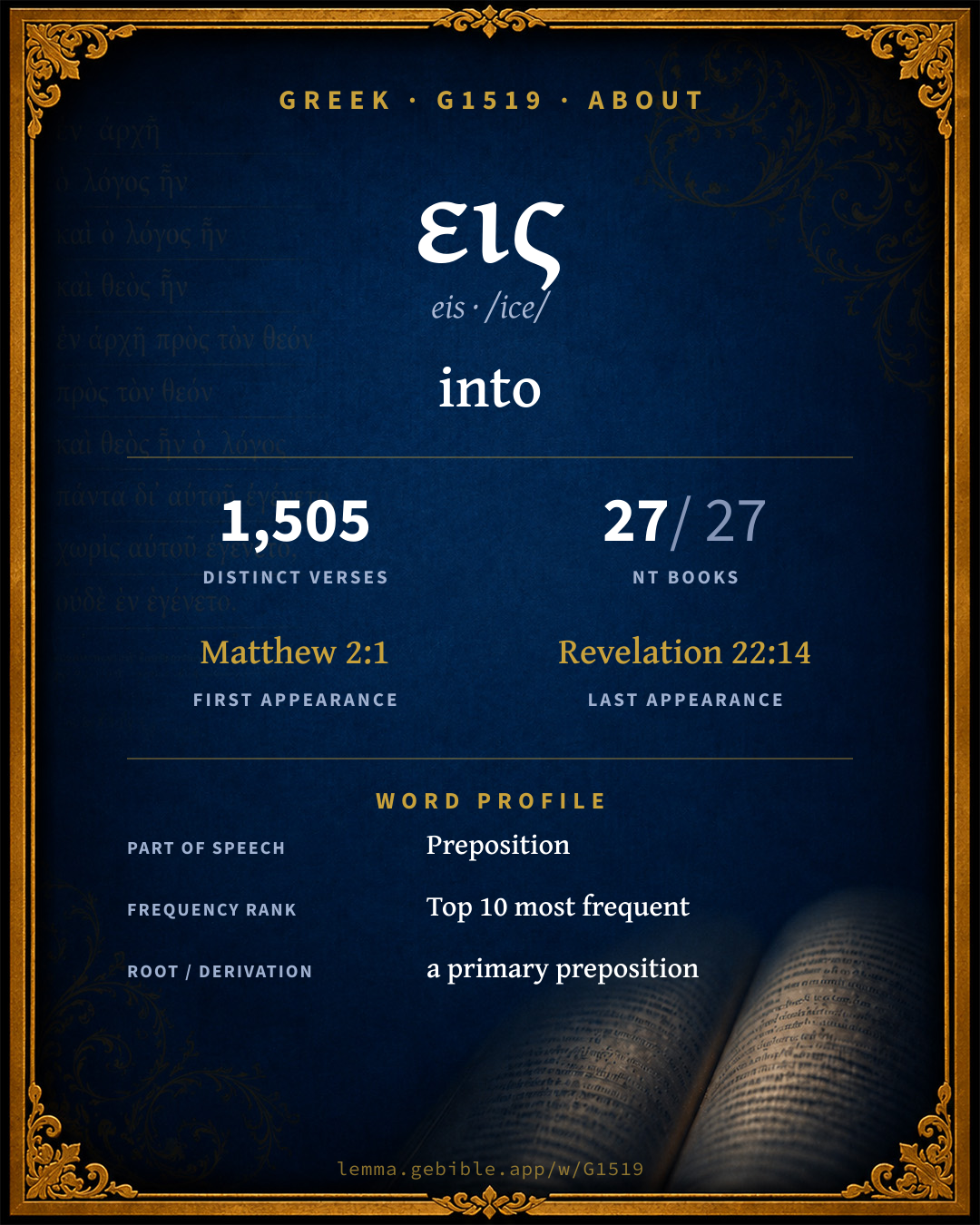
εἰς
into
Full lexicon entry — Thayer's Greek Lexicon
From Thayer's Greek Lexicon
Where this word appears
Grammar key — what these labels mean
Part of speech
- Preposition
- A relational word governing a noun in a particular case.
Every verse where G1519 appears in the Book of 2 John — 3 distinct verses. Click any verse to open its interlinear word-by-word view. Verse text shown in the World English Bible for context — . Each verse’s Greek form is shown with its reference; the English is not keyword-highlighted, since the data carries no word-level English alignment. Use “Compare translations” on any verse to read it across multiple English versions. This concordance covers the Greek New Testament; Septuagint (Greek Old Testament) occurrences of this word are not indexed here.
2 John
- 2 John 1:2 εἰς prep for the truth's sake, which remains in us, and it will be with us forever:
- 2 John 1:7 εἰς prep For many deceivers have gone out into the world, those who don't confess that Jesus Christ came in the flesh. This is the deceiver and the Antichrist.
- 2 John 1:10 εἰς prep If anyone comes to you, and doesn't bring this teaching, don't receive him into your house, and don't welcome him,
About this entry
At a glance — auto-summarized from this page’s data, not written by a person. Every figure links to its source below. This summary describes the numbers; it doesn’t interpret them.
εις (eis) is a Greek preposition most often rendered “into.” It first appears in Matthew 2:1. Spanning 1,505 verses in 27 books, it ranks among the most common words of the Greek New Testament. Related forms include εισαγω, εισακουω and εισδεχομαι. For the data behind this summary, explore the sense tree and the renderings breakdown below.
Gloss history
Strong's 1890 vs modern scholarship

About this word
Strong's G1519 catalogs a Greek word from the Greek New Testament.
These counts are not copied from any lexicon or concordance. They are computed here, from the morphology-tagged Greek New Testament. What Lemma adds →
- 1,505
- distinct verses
- The word appears in 1,505 distinct verses.
- 27 / 27
- NT books
- The word appears in 27 of 27 New Testament books.
- #9
- by frequency
- Top 10 most frequent Greek words (rank 9 of 5,347 Greek words by occurrence).
View all 1,505 occurrences in the concordance →
By section of the New Testament
By traditional corpus
Conventional, traditional groupings — biblical authorship is debated, so this is a traditional corpus grouping, not an authorship claim. Some books belong to more than one corpus (Luke is in both the Gospels and the Lukan corpus, and so on), so these shares overlap and need not total 100%. Each figure is a share of the word’s 1,505 distinct verses.
- Gospels 695 verses · 46%
- Lukan (Luke–Acts) 455 verses · 30%
- Pauline corpus 350 verses · 23%
- Johannine 242 verses · 16%
- General (Catholic) Epistles 75 verses · 5%
- Revelation 67 verses · 4%
- Hebrews 64 verses · 4%
How translations render this word
Counts come from each version’s own published word-to-Strong’s tagging or interlinear alignment — an approximate guide to how each version renders this word, not a word-level alignment the data otherwise carries. Because each total is that version’s own tagged count, the per-version totals vary from one another and need not match the appearance or distinct-verse counts above. These counts may also differ from a printed concordance because Lemma counts each distinctly tagged rendering and does not collapse phrase taggings into a single head-word total. This is a fixed set of word-tagged versions (KJV, ASV, BSB, ULT) and does not change with the reading translation you choose elsewhere. Each version’s license is shown beside its name below (and on Sources).
- King James Version: Into 568×, To 324×, Unto 202×
- American Standard Version: Into 525×, To 289×, Unto 244×
- Berean Standard Bible: To 483×, Into 304×, In 179×
- unfoldingWord Literal Text: To 576×, Into 509×, For 205×
King James Version Public Domain
Renders G1519 across 1,742 tagged occurrences — most commonly:
Plus other, less common renderings. Plus 79 renderings that appear only once — usually multi-word phrases or single function words the recovered tagging swept in, not distinct renderings. Not rendered by a distinct English word in 33 further occurrences.
American Standard Version Public Domain
Renders G1519 across 1,681 tagged occurrences — most commonly:
Plus other, less common renderings. Plus 121 renderings that appear only once — usually multi-word phrases or single function words the recovered tagging swept in, not distinct renderings. Not rendered by a distinct English word in 2 further occurrences.
Berean Standard Bible Public Domain
Renders G1519 across 1,383 tagged occurrences — most commonly:
Plus other, less common renderings. Plus 45 renderings that appear only once — usually multi-word phrases or single function words the recovered tagging swept in, not distinct renderings. Not rendered by a distinct English word in 289 further occurrences.
unfoldingWord Literal Text CC BY-SA 4.0
Renders G1519 across 1,780 tagged occurrences — most commonly:
Plus other, less common renderings. Plus 70 renderings that appear only once — usually multi-word phrases or single function words the recovered tagging swept in, not distinct renderings.
Senses in Thayer's
The 1 sense Thayer's distinguishes for this word, in lexicon order (not ranked by frequency or importance). The full entry — with sub-senses — is in the Lexicon Entry tab.
- into, unto, to, towards, for, among "For" (as used in Acts 2:38 "for the forgiveness...") could have twomeanings. If you…
Word origin
Origin: a primary preposition
A primary preposition; to or into (indicating the point reached or entered) of place time or (figuratively) purpose (result etc.); also in adverbial phrases. : - [abundant-] ly against among as at [back-] ward before by concerning + continual + far more exceeding for [intent purpose] fore + forth in (among at unto -so much that -to) to the intent that + of one mind + never of (up-) on + perish + set at one again (so) that therefore (-unto) throughout till to (be the end -ward) (here-) until (-to)... ward [where-] fore with. Often used in composition with the same general import but only with verbs (etc.) expressing motion (literallyor figuratively.
— Strong’s Exhaustive Concordance (1890), public domain.
Forms in the corpus
The 4 distinct written forms G1519 takes in the Greek New Testament, most frequent first — each parse links to that case’s occurrences in the concordance.
| Form | Parsing | Example | Uses |
|---|---|---|---|
| εἰς eis | Preposition | Matthew 2:1 | 1,760 |
| εἴς eís | Preposition | Mark 2:13 | 2 |
| Εἰς Eis | Preposition | 2 Thessalonians 1:11 | 1 |
| εις eis | Preposition | John 7:53 | 1 |
Same root — word family
Other Thayer's entries built from the same root as G1519, grouped by Strong’s listed origin. These share a root / origin per the lexicon — not necessarily a shared meaning. Each links to that word’s own entry.
Derived from this word
- εισαγω eiságō G1521 to bring in
- εισακουω eisakoúō G1522 to obey
- εισδεχομαι eisdéchomai G1523 to receive
- εισειμι eíseimi G1524 to go in
- εισερχομαι eisérchomai G1525 to enter
- εισκαλεω eiskaléō G1528 to invite
- εισοδος eísodos G1529 entrance
- εισπηδαω eispēdáō G1530 to rush in
- εισπορευομαι eisporeúomai G1531 to enter
- ειστρεχω eistréchō G1532 to run in
- εισφερω eisphérō G1533 to bring in
- εν en G1722 in
- εσοπτρον ésoptron G2072 mirror
- εσω ésō G2080 within
- σκυβαλον skýbalon G4657 refuse
Compare all same-root words → Showing 4 of 16 — not the complete family. They share a root, not necessarily a meaning.
Septuagint usage
The same Greek word εις appears 5,627 times in the Greek Old Testament (Septuagint), across 4,462 verses in 38 books.
- 5,627
- LXX occurrences
- Tagged occurrences of this Greek word in the Septuagint.
- 4,462
- verses
- Distinct Septuagint verses containing this word.
- 38 / 39
- OT books
- The word appears in 38 of the 39 Old Testament books.
Sample Septuagint occurrences
- Genesis 1:9 εἰς
- Exodus 1:1 εἰς
- Leviticus 1:10 εἰς
- Numbers 3:38 εἰς
- Deuteronomy 1:7 εἰς
- Joshua 1:2 εἰς
- Judges 1:4 εἰς
- Ruth 1:2 εἰς
- 1 Samuel 1:3 εἰς
- 2 Samuel 1:22 εἰς
- 1 Kings 1:15 εἰς
- 2 Kings 1:3 εἰς
Septuagint occurrences (same lexeme)
Every verse where the same Strong’s number (G1519) appears in the Greek Septuagint — showing the first 50 of 4,462. Verse text shown in the World English Bible for context; the Greek form is the matched word — the English is not keyword-highlighted.
- Genesis 1:9 εἰς God said, "Let the waters under the sky be gathered together to one place, and let the dry land appear," and it was so.
- Genesis 1:14 εἰς God said, "Let there be lights in the expanse of sky to divide the day from the night; and let them be for signs, and for seasons, and for days and years;
- Genesis 1:15 εἰς and let them be for lights in the expanse of sky to give light on the earth," and it was so.
- Genesis 1:16 εἰς God made the two great lights: the greater light to rule the day, and the lesser light to rule the night. He also made the stars.
- Genesis 1:29 εἰς God said, "Behold, I have given you every herb yielding seed, which is on the surface of all the earth, and every tree, which bears fruit yielding seed. It will be your food.
- Genesis 1:30 εἰς To every animal of the earth, and to every bird of the sky, and to everything that creeps on the earth, in which there is life, I have given every green herb for food." And it was so.
- Genesis 2:7 εἰς Yahweh God formed man from the dust of the ground, and breathed into his nostrils the breath of life; and man became a living soul.
- Genesis 2:9 εἰς Out of the ground Yahweh God made every tree to grow that is pleasant to the sight, and good for food; the tree of life also in the midst of the garden, and the tree of the knowledge of good and evil.
- Genesis 2:10 εἰς A river went out of Eden to water the garden; and from there it was parted, and became four heads.
- Genesis 2:22 εἰς He made the rib, which Yahweh God had taken from the man, into a woman, and brought her to the man.
- Genesis 2:24 εἰς Therefore a man will leave his father and his mother, and will join with his wife, and they will be one flesh.
- Genesis 3:6 εἰς When the woman saw that the tree was good for food, and that it was a delight to the eyes, and that the tree was to be desired to make one wise, she took of the fruit of it, and ate; and she gave some to her husband with her, and he ate.
- Genesis 3:19 εἰς By the sweat of your face will you eat bread until you return to the ground, for out of it you were taken. For you are dust, and to dust you shall return."
- Genesis 3:22 εἰς Yahweh God said, "Behold, the man has become like one of us, knowing good and evil. Now, lest he put forth his hand, and also take of the tree of life, and eat, and live forever..."
- Genesis 4:8 εἰς Cain said to Abel, his brother, "Let's go into the field." It happened, when they were in the field, that Cain rose up against Abel, his brother, and killed him.
- Genesis 4:23 εἰς Lamech said to his wives, "Adah and Zillah, Hear my voice, You wives of Lamech, listen to my speech, For I have slain a man for wounding me, A young man for bruising me.
- Genesis 6:3 εἰς Yahweh said, "My Spirit will not strive with man forever, because he also is flesh; yet will his days be one hundred twenty years."
- Genesis 6:16 εἰς You shall make a roof in the ark, and to a cubit shall you finish it upward. You shall set the door of the ark in the side of it. You shall make it with lower, second, and third levels.
- Genesis 6:18 εἰς But I will establish my covenant with you. You shall come into the ark, you, your sons, your wife, and your sons' wives with you.
- Genesis 6:19 εἰς Of every living thing of all flesh, you shall bring two of every sort into the ark, to keep them alive with you. They shall be male and female.
- Genesis 7:1 εἰς Yahweh said to Noah, "Come with all of your household into the ark, for I have seen your righteousness before me in this generation.
- Genesis 7:7 εἰς Noah went into the ark with his sons, his wife, and his sons' wives, because of the waters of the flood.
- Genesis 7:9 εἰς went by pairs to Noah into the ark, male and female, as God commanded Noah.
- Genesis 7:13 εἰς In the same day Noah, and Shem, Ham, and Japheth, the sons of Noah, and Noah's wife, and the three wives of his sons with them, entered into the ark;
- Genesis 7:15 εἰς They went to Noah into the ark, by pairs of all flesh with the breath of life in them.
- Genesis 8:9 εἰς but the dove found no place to rest her foot, and she returned to him into the ark; for the waters were on the surface of the whole earth. He put forth his hand, and took her, and brought her to him into the ark.
- Genesis 9:3 εἰς Every moving thing that lives will be food for you. As the green herb, I have given everything to you.
- Genesis 9:12 εἰς God said, "This is the token of the covenant which I make between me and you and every living creature that is with you, for perpetual generations:
- Genesis 9:13 εἰς I set my rainbow in the cloud, and it will be for a sign of a covenant between me and the earth.
- Genesis 9:15 εἰς and I will remember my covenant, which is between me and you and every living creature of all flesh, and the waters will no more become a flood to destroy all flesh.
- Genesis 10:19 εἰς The border of the Canaanites was from Sidon, as you go toward Gerar, to Gaza; as you go toward Sodom, Gomorrah, Admah, and Zeboiim, to Lasha.
- Genesis 10:30 εἰς Their dwelling was from Mesha, as you go toward Sephar, the mountain of the east.
- Genesis 11:3 εἰς They said one to another, "Come, let's make brick, and burn them thoroughly." They had brick for stone, and they used tar for mortar.
- Genesis 11:31 εἰς Terah took Abram his son, Lot the son of Haran, his son's son, and Sarai his daughter-in-law, his son Abram's wife. They went forth from Ur of the Chaldees, to go into the land of Canaan. They came to Haran, and lived there.
- Genesis 12:1 εἰς Now Yahweh said to Abram, "Get out of your country, and from your relatives, and from your father's house, to the land that I will show you.
- Genesis 12:2 εἰς I will make of you a great nation. I will bless you, and make your name great. You will be a blessing.
- Genesis 12:5 εἰς Abram took Sarai his wife, Lot his brother's son, all their substance that they had gathered, and the souls who they had gotten in Haran; and they went forth to go into the land of Canaan. Into the land of Canaan they came.
- Genesis 12:6 εἰς Abram passed through the land to the place of Shechem, to the oak of Moreh. The Canaanite was then in the land.
- Genesis 12:8 εἰς He left from there to the mountain on the east of Bethel, and pitched his tent, having Bethel on the west, and Ai on the east. There he built an altar to Yahweh, and called on the name of Yahweh.
- Genesis 12:10 εἰς There was a famine in the land. Abram went down into Egypt to live as a foreigner there, for the famine was sore in the land.
- Genesis 12:11 εἰς It happened, when he was come near to enter into Egypt, that he said to Sarai his wife, "See now, I know that you are a beautiful woman to look on.
- Genesis 12:14 εἰς It happened that when Abram had come into Egypt, the Egyptians saw that the woman was very beautiful.
- Genesis 12:15 εἰς The princes of Pharaoh saw her, and praised her to Pharaoh; and the woman was taken into Pharaoh's house.
- Genesis 12:19 εἰς Why did you say, 'She is my sister,' so that I took her to be my wife? Now therefore, see your wife, take her, and go your way."
- Genesis 13:1 εἰς Abram went up out of Egypt: he, his wife, all that he had, and Lot with him, into the South.
- Genesis 13:3 εἰς He went on his journeys from the South even to Bethel, to the place where his tent had been at the beginning, between Bethel and Ai,
- Genesis 13:4 εἰς to the place of the altar, which he had made there at the first. There Abram called on the name of Yahweh.
- Genesis 13:9 εἰς Isn't the whole land before you? Please separate yourself from me. If you go to the left hand, then I will go to the right. Or if you go to the right hand, then I will go to the left."
- Genesis 13:10 εἰς Lot lifted up his eyes, and saw all the plain of the Jordan, that it was well watered every where, before Yahweh destroyed Sodom and Gomorrah, like the garden of Yahweh, like the land of Egypt, as you go to Zoar.
- Genesis 13:17 εἰς Arise, walk through the land in the length of it and in the breadth of it; for I will give it to you."
These are occurrences of the same Greek lexeme (G1519) in the Septuagint — not a translation of any one Hebrew word. The store carries no word-level Hebrew↔Greek alignment, so no Hebrew original is asserted here. Counts come from the recovered LXX Strong's tagging — high-frequency vocabulary is well covered, while rare or late forms may be untagged — so they reflect tagged occurrences and may slightly undercount.