
Matthew 9:38

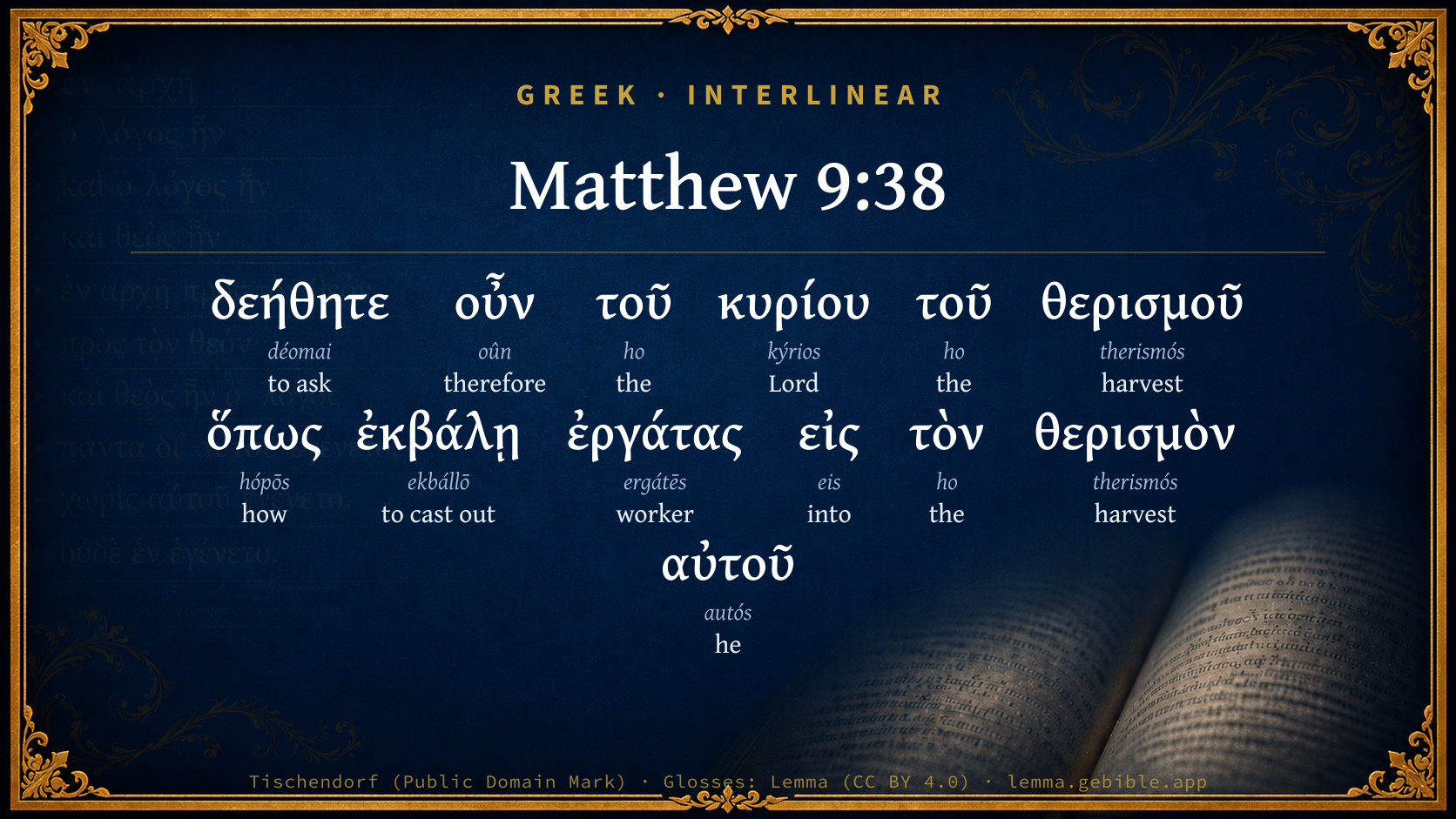
Greek (Tischendorf 8th ed.) Matthew 9:38 appears in the Greek New Testament. The text above is from the Tischendorf 8th edition. Each word links to its Strong’s number and a concise gloss. Click any word for its full Thayer’s Greek Lexicon entry.
Download image
Cite this verse

Matthew 9:38 (World English Bible). Public Domain. Lemma interlinear Bible study tool, https://lemma.gebible.app/v/matthew/9/38.

Show BibTeX & RIS
BibTeX
RIS
English Translation
Pray therefore that the Lord of the harvest will send out laborers into his harvest."
World English Bible · Public Domain
Highlights
  • 1 first appearance in the Greek New Testament
Full analysis ↓
Download a study sheet

One document with this verse’s original text, its word-by-word gloss line, the meaning frame, cross-references with their text, attributed commentary, and full source and license credits — printable, and it pastes into notes with its structure intact.

This verse Autodidact and up

Study sheet (.html) Plain text (.txt)

A passage Seminary Student

Up to 50 verses in one chapter. A passage sheet keeps up to 6 commentary sources and 12 cross-references per verse, in the order this page ranks them, and says so on the sheet whenever that leaves anything out. Ask for a single verse and you get the Autodidact verse sheet above.

Everything on this page stays free to read, with no account — the sheet is a download of what is already on screen, not access to it.

Want to remove ads? Support Godless Engineer
Compare translations 3

The same verse in 3 English versions, stacked beneath the original-language interlinear above. Click any original word for its lexicon entry.

Each is an independent rendering of the whole verse — the interlinear is not word-aligned to these translations.

Highlighted words mark where these versions differ — a whole-verse word diff, not a word-by-word alignment.

  • World English Bible Public Domain
    Pray therefore that the Lord of the harvest will send out laborers into his harvest."
  • King James Version Public Domain
    Pray ye therefore the Lord of the harvest, that he will send forth labourers into his harvest.
  • unfoldingWord Literal Text CC BY-SA 4.0
    Therefore, earnestly ask the Lord of the harvest, so that he might send out laborers into his harvest.”

unfoldingWord Literal Text — © unfoldingWord, licensed CC BY-SA 4.0. Word-aligned USFM3 via Door43 (git.door43.org/unfoldingWord/en_ult).

Versions to compare (up to 4)

3 of 4 selected

Show all 19 translations

Every available English version of this verse, each an independent rendering of the whole verse.

  • World English Bible Public Domain
    Pray therefore that the Lord of the harvest will send out laborers into his harvest."
  • Berean Standard Bible Public Domain
    Ask the Lord of the harvest, therefore, to send out workers into His harvest.”
  • Majority Standard Bible Public Domain
    Ask the Lord of the harvest, therefore, to send out workers into His harvest.”
  • King James Version Public Domain
    Pray ye therefore the Lord of the harvest, that he will send forth labourers into his harvest.
  • American Standard Version (1901) Public Domain
    Pray ye therefore the Lord of the harvest, that he send forth laborers into his harvest.
  • Revised Version (1885) Public Domain
    Pray ye therefore the Lord of the harvest, that he send forth labourers into his harvest.
  • Geneva Bible (1599) Public Domain
    Wherefore pray the Lord of the haruest, that he woulde sende foorth labourers into his haruest.
  • Douay-Rheims (1899) Public Domain
    Pray ye therefore the Lord of the harvest, that he send forth labourers into his harvest.
  • Young's Literal Translation Public Domain
    beseech ye therefore the Lord of the harvest, that he may put forth workmen to His harvest.'
  • Literal Standard Version CC BY-SA 4.0
    therefore implore the Lord of the harvest that He may put forth workmen to His harvest.”
  • Unlocked Literal Bible CC BY-SA 4.0
    Therefore urgently pray to the Lord of the harvest, so that he may send out laborers into his harvest.”
  • unfoldingWord Literal Text CC BY-SA 4.0
    Therefore, earnestly ask the Lord of the harvest, so that he might send out laborers into his harvest.”
  • Darby Bible Public Domain
    supplicate therefore the Lord of the harvest, that he send forth workmen unto his harvest.
  • World Messianic Bible Public Domain
    Pray therefore that the Lord of the harvest will send out laborers into his harvest.”
  • Webster's Bible Public Domain
    Pray ye therefore the Lord of the harvest, that he will send forth laborers into his harvest.
  • Free Bible Version CC BY-SA 4.0
    Pray to the Lord of the harvest, and ask him to send more workers for his harvest.”
  • Bible in Basic English Public Domain
    Make prayer, then, to the Lord of the grain-fields, that he may send out workers to get in his grain.
  • Text-Critical English NT CC BY 4.0
    Therefore ask the Lord of the harvest to send out workers into his harvest.”
  • Tyndale New Testament (1534) Public Domain
    Wherfore praye the Lorde of the harvest to sende forthe laborers into hys harvest.

Literal Standard Version (2020), Covenant Press — licensed CC BY-SA 4.0. Text via the HelloAO Bible API (eBible.org). Unlocked Literal Bible (unfoldingWord) — licensed CC BY-SA 4.0. Text via the HelloAO Bible API (eBible.org). unfoldingWord Literal Text — © unfoldingWord, licensed CC BY-SA 4.0. Word-aligned USFM3 via Door43 (git.door43.org/unfoldingWord/en_ult). Free Bible Version, Dr. Jonathan Gallagher — licensed CC BY-SA 4.0. Text via the HelloAO Bible API (eBible.org).

Word by word

More ways to search: Search by grammar → Find every occurrence → Compare this word →

Practice this passage: Drill this verse → Learn its vocabulary →

θερισμοῦ
therismós
G2326
“harvest”
Noun, Genitive, Singular, Masculine
Part of Speech
Noun
Case
Genitive
Number
Singular
Gender
Masculine
Full Thayer's Definition

Origin: from G2325

TDNT: 05:13,3

1. harvest, the act of reaping a. fig. of the gathering of men into the kingdom of God b. referring to time of reaping, the final judgment, when the righteous are gathered into the kingdom of God and the wicked are cast into hell for ever
  1. δεήθητε déomai G1189 “to ask” Verb, Aorist, Passive deponent, Imperative, 2nd person, Plural
  2. οὖν oûn G3767 “therefore” Conjunction
  3. τοῦ ho G3588 “the” Article, Genitive, Singular, Masculine
  4. κυρίου kýrios G2962 “Lord” Noun, Genitive, Singular, Masculine
  5. τοῦ ho G3588 “the” Article, Genitive, Singular, Masculine
  6. ὅπως hópōs G3704 “how” Adverb
  7. ἐκβάλῃ ekbállō G1544 “to cast out” Verb, Aorist, Active, Subjunctive, 3rd person, Singular
  8. ἐργάτας ergátēs G2040 “worker” Noun, Accusative, Plural, Masculine
  9. εἰς eis G1519 “into” Preposition
  10. τὸν ho G3588 “the” Article, Accusative, Singular, Masculine
  11. θερισμὸν therismós G2326 “harvest” Noun, Accusative, Singular, Masculine
  12. αὐτοῦ autós G846 “he” Personal pronoun, Genitive, Singular, Masculine

About this verse

These counts appear in no published source. They are computed here, from the morphology-tagged text and Lemma’s own curated glosses. What Lemma adds →

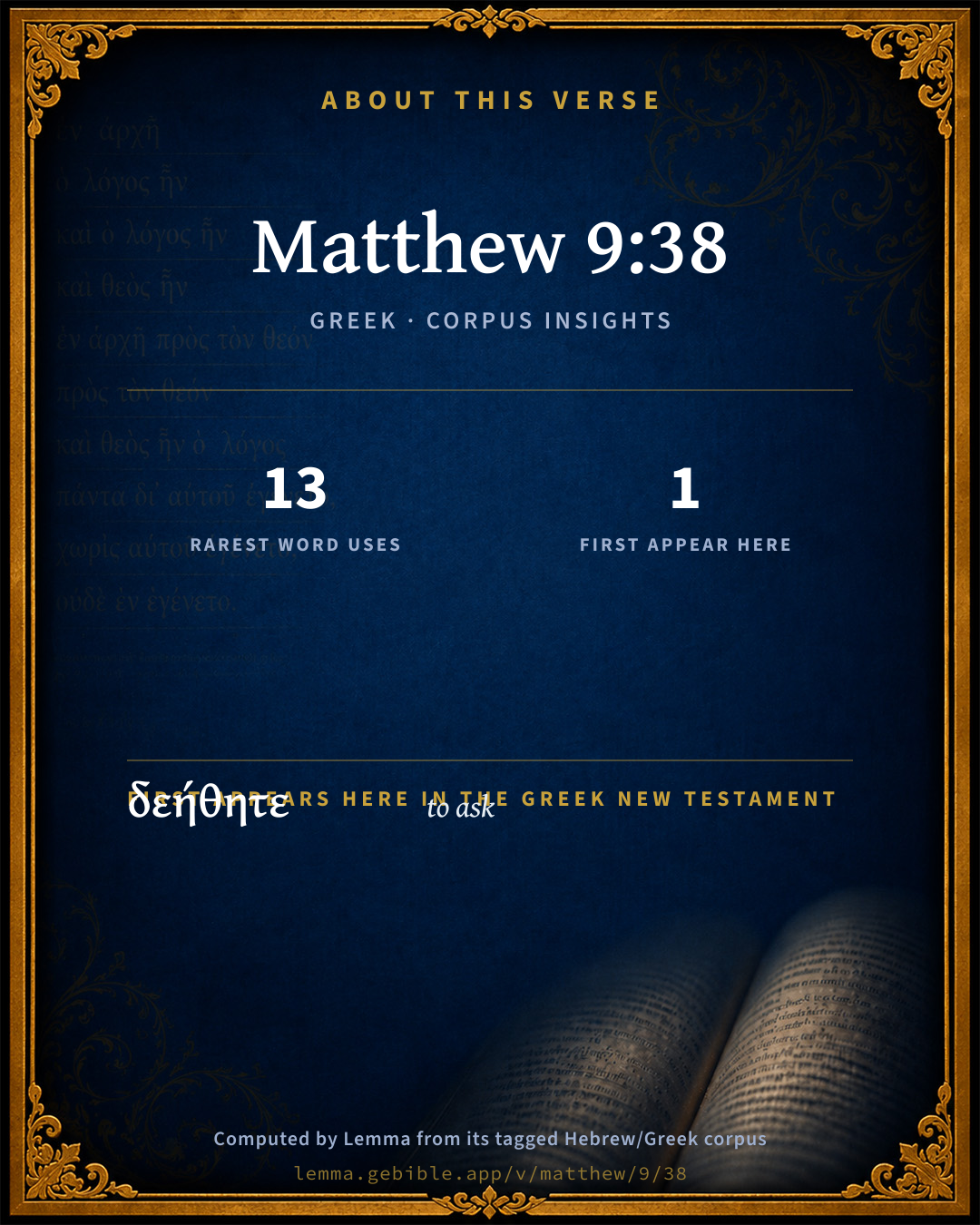
13
words
10
distinct lemmas
Gospels
section

Notable vocabulary

The rarest word here is θερισμοῦ harvest G2326 — appearing just 13 times in the whole Greek New Testament.

First appearance in Scripture

This word makes its first canonical appearance in the Greek New Testament here:

  • δεήθητε to ask G1189

Shared distinctive vocabulary

θερισμοῦ harvest G2326 occurs in 8 verses of the Greek New Testament. Also found in:
Repetition

Words recur within this verse:

  • θερισμοῦ harvest G2326 ×2
  • τοῦ the G3588 ×3

Cross-references

13

Topical passages linked to Matthew 9:38 in the Treasury of Scripture Knowledge — connected by theme and wording, ordered by reader-vote popularity; previews shown in the World English Bible.

  • Luke 10:1–2 Now after these things, the Lord also appointed seventy others, and sent them two by two ahead of him into every city and place, where he was about to come.
  • Jeremiah 3:15 and I will give you shepherds according to my heart, who shall feed you with knowledge and understanding.
  • 2 Thessalonians 3:1 Finally, brothers, pray for us, that the word of the Lord may spread rapidly and be glorified, even as also with you;
  • Acts 13:2 As they served the Lord and fasted, the Holy Spirit said, "Separate Barnabas and Saul for me, for the work to which I have called them."
  • John 20:21 Jesus therefore said to them again, "Peace be to you. As the Father has sent me, even so I send you."
  • Psalms 68:11 The Lord announced the word. The ones who proclaim it are a great company.
  • Acts 8:4 Therefore those who were scattered abroad went around preaching the word.
  • 1 Corinthians 12:28 God has set some in the assembly: first apostles, second prophets, third teachers, then miracle workers, then gifts of healings, helps, governments, and various kinds of languages.
  • Micah 5:7 The remnant of Jacob will be in the midst of many peoples, Like dew from Yahweh, Like showers on the grass, That don't wait for man, Nor wait for the sons of men.
  • Ephesians 4:11 He gave some to be apostles; and some, prophets; and some, evangelists; and some, shepherds and teachers;
  • Matthew 10:1–3 He called to himself his twelve disciples, and gave them authority over unclean spirits, to cast them out, and to heal every disease and every sickness.
  • Luke 6:12–13 It happened in these days, that he went out to the mountain to pray, and he continued all night in prayer to God.
  • Psalms 68:18 You have ascended on high. You have led away captives. You have received gifts among men, Yes, among the rebellious also, that Yah God might dwell there.

Cross-references courtesy of OpenBible.info (CC BY 4.0).

Commentary

Notes on Matthew 9:38 from classic Christian and Jewish commentators (each source and its license shown beneath its notes). The classic Christian expositions comment on the surrounding passage and are grouped to its opening verse, so a note may address several verses; the Jewish commentaries on the Tanakh (Rashi and others) are per-verse, so they appear only where the commentator wrote on this verse.

Lemma curates 59 commentaries, every one of them public domain or Creative Commons licensed, each selected and text-cleaned for this edition rather than reprinted as found. About our sources →

The Biblical Illustrator

Joseph S. Exell

Mat_9:38

Pray ye therefore the Lord of the harvest.

The spiritual harvest-field

1. How closely connected the spiritual commission of the apostles was with deep sympathy for the physical wants of humanity.

2. That it is the Lord of the harvest who has power to send forth labourers into His harvest. We rely too much on our own agencies.

3. The strong expression of constraint which the Lord here uses-that He may cast out. It has been so with the more eminent saints at all times. (S. Leathes, D. D.)

The harvest-field and the harvest labourers

I. The field is the world.

1. It is precious, in the very fact that it is a harvest-field. Men are the fruit for the sake of which the world was made.

2. It is plenteous.

(1):Pagans.

(2) Mahomedans.

(3) Papists.

3. It is ripe.

4. It is perishing.

II. The harvest labourers.

1. All who try to win souls are in His eye as reapers gathering the wheat into the garner. Labourers are not a high class of functionaries, and need not expect to get all their own will as to the times and places of their toils.

2. In the judgment of our Lord labourers are few. His heart is so enlarged toward a lost world that He will complain, Few are coming. Few, in proportion to the worlds need-a contrast to the multitude pressing to the natural harvest.

3. When additional labourers enter the field, they are sent into it by the Lord of the harvest. They are grasped by the Providential hand of God.

4. The Lord of the harvest presses labourers into the field in answer to the prayers of His people. (W. Arnot.)

The multitudes pressing to the natural harvest

The pressure has slackened of late; but a few years ago you might have seen, any day about the beginning of autumn, dense crowds of Irish labourers clustering like bees about the wharves of Liverpool and Glasgow. On one occasion the master of a Londonderry steamer, on arriving at Glasgow, was prosecuted for admitting a much greater number of passengers than his ship was legally entitled to carry. His defence was that the men rushed on board in spite of his efforts to prevent them, and took forcible possession of the deck. Such were the numbers that poured into the Scottish harvest-fields at that time, and such the eagerness of each man to get a share of the work and the reward. (W. Arnot.)

The harvest-field near

Exercise is provided for the spiritual life. None shall be able to say that the field was too distant, and that lie consequently had not an opportunity of rendering service as a reaper. A man cannot sit at meals in his own family, walk along the streets, or pursue his daily toil on the farm or in the workshop, without passing along this laden harvest-field. Everywhere precious fruit, ready to perish, offers itself to the reapers hand. (W. Arnot.)

Labourers wanted

I. Christ manifested an intense zeal for the evangelization of the world. And Jesus went about all their cities, etc.

1. Christ was the great Teacher-Teaching in their synagogues, etc.

2. Christ was the great Physician-and healing every sickness.

II. Christ displayed the tenderest sympathy while evangelizing the world. The spirit in which Christ did His work, almost as important as the work itself.

1. Christ was deeply affected by the spiritual depression of the people-they fainted.

2. Christ was deeply affected at the spiritual destitution of the people-were scattered abroad.

III. Christ enjoined a devout spirit for evangelizing the world-Pray ye therefore, etc.

1. Christ indicated the right spirit for the work-Pray ye.

2. Christ indicated the right men for the work-Labourers in His harvest, etc. (J. T. Woodhouse.)

Harvest-men wanted

I. Our lord states the case. The people who gathered round Him He likened to harvest-fields: wherein lay the similarity?

1. The thought of multitude rises naturally from the sight of a harvest-field. You cannot count the ears of corn, neither will you be able to count the sons of men.

2. The second idea was that of value. He did not speak of blades of grass, but ears of corn. The souls of men precious in the sight of God.

3. The idea of danger. Fear lest it should perish.

4. Accessible. Multitudes are near at hand.

5. Immediate need.

II. The service needed. Labourers are wanted. We must not despise instrumentalities. God could do without them, but does not.

1. They must be labourers. Idler no use.

2. They must go down into flee wheat.

3. He cuts right through. Delicate words useless. The preacher must not file off the edge of his scythe for fear it should hurt somebody.

4. He binds it together.

III. Our Lord directed his disciples how to obtain a supply.

1. Pray ye.

2. Pray ye therefore.

3. Pray to the Lord.

IV. The lord jesus heard their prayers. And when He had called unto Him His twelve disciples, he gave them power, etc. (C. H. Spurgeon.)

The Biblical Illustrator, edited by Joseph S. Exell (c. 1880s–1900s) — public domain. Text from a community e-Sword module.

Bengel's Gnomon

Johann Albrecht Bengel

Mat 9:38. Δεήθητε, pray ye) See of how great value prayers are. The Lord of the harvest Himself wishes Himself to be moved by them. More blessings, without doubt, would accrue to the human race, if more men would, on men’s behalf,[437] meet the ever ready will of GOD. See Gnomon on 1Ti 2:3. The reaping and sowing is for our advantage. The Lord Himself exhorts us to entreat Him. He prevents us, that He may teach us to prevent Him.[438] (Cf. Joh 16:5.) And forthwith, whilst He is commanding us to pray, He implants the desire, to which it is He too that hearkens. See ch. Mat 10:1. These same persons who are commanded to pray [for labourers], are presently appointed labourers themselves (ibid.)—Κυρίου, the Lord) see ch. Mat 10:1, Mat 13:37. Christ is the Lord of the harvest.—ὄπως ἐκβάλλῃ,[439] to send forth) ἐκβάλλειν[440] does not always imply force, as it does in Mat 9:33.

[437] Those who are nearer to God praying in behalf of those who are further removed from Him.—V. g.

[438] Prevent is here used in the old Engl. sense of anticipate, be before another in doing a thing; as in the Book of Common Prayer, “Prevent us, O Lord, in all our doings with thy most gracious favour.” God would have us also, as it were, prevent Him, or be the first to ask those things, which He really knoweth and willeth to give us before we either desire or ask them, Isa 41:21; Isa 43:26.—ED.

[439] E. M. ἐκβάλῃ.—(I. B.)

[440] See Author’s Preface. Sect. xiv. and footnotes.—(I. B.)

Bengel's Gnomon of the New Testament — English translation (T&T Clark, Edinburgh, 1860) — public domain. Text from a community e-Sword module.

Geneva Bible (1599)

Geneva Bible translators

Word for word, cast them out: for men are very slow in so holy a work.

Geneva Bible (1599) marginal notes — public domain. Text via Bolls.life.

Jamieson, Fausset & Brown

Robert Jamieson, A. R. Fausset & David Brown

Pray ye therefore the Lord of the harvest--the great Lord and Proprietor of all. Compare Joh 15:1, "I am the true vine, and My Father is the husbandman."

that he will send forth labourers into his harvest--The word properly means "thrust forth"; but this emphatic sense disappears in some places, as in Mat 9:25, and Joh 10:4 --"When He putteth forth His own sheep." (See on Mat 4:1).

Next: Matthew Chapter 10

Jamieson, Fausset & Brown — Commentary Critical and Explanatory on the Whole Bible (1871) — public domain (CC PDM 1.0). Text via the HelloAO Bible API.

Adam Clarke's Commentary

Verse 38. That he will send forth labourers] οπως εκβαλλη εργατας, that he would thrust forth labourers. Those who are fittest for the work are generally most backward to the employment. The man who is forward to become a preacher knows little of God, of human nature, or of his own heart. It is, God's province to thrust out such preachers as shall labour; and it is our duty to entreat him to do so. A minister of Christ is represented as a day-labourer: he comes into the harvest, not to become lord of it, not to live on the labour of others, but to work, and to labour his day. Though the work may be very severe, yet, to use a familiar expression, there is good wages in the harvest-home; and the day, though hot, is but a short one. How earnestly should the flock of Christ pray to the good Shepherd to send them pastors after his own heart, who will feed them with knowledge, and who shall be the means of spreading the knowledge of his truth and the savour of his grace over the face of the whole earth!

The subject of fasting, already slightly noticed in the preceding notes, should be farther considered.

In all countries, and under all religions, fasting has not only been considered a duty, but also of extraordinary virtue to procure blessings, and to avert evils. Hence it has often been practised with extraordinary rigour, and abused to the most superstitious purposes. There are twelve kinds of fasts among the Hindoos: -

1. The person neither eats nor drinks for a day and night. This fast is indispensable, and occurs twenty-nine times in the year.

2. The person fasts during the day, and eats at night.

3. The person eats nothing but fruits, and drinks milk or water.

4. He eats once during the day and night.

5. Eats one particular kind of food during the day and night, but as often as he pleases.

6. Called Chanderaym, which is, to eat on the first day, only one mouthful; two on the second; and thus continue increasing one mouthful every day for a month, and then decreasing a mouthful every day, till he leaves off where he began.

7. The person neither eats nor drinks for twelve days.

8. Lasts twelve days: the first three days he eats a little once in the day; the next three, he eats only once in the night; the next three, he eats nothing, unless it be brought to him; and, during the last three days, he neither eats nor drinks.

9. Lasts fifteen days. For three days and three nights, he eats only one handful at night; the next three days and nights, he eats one handful if it be brought him, if not, he takes nothing. Then he eats nothing for three days and three nights. The next three days and nights he takes only a handful of warm water each day. The next three days and nights he takes a handful of warm milk each day.

10. For three days and nights he neither eats nor drinks. He lights a fire, and sits at a door where there enters a hot wind, which he draws in with his breath.

11. Lasts fifteen days. Three, days and three nights he eats nothing but leaves; three days and three nights, nothing but the Indian fig; three days and three nights, nothing but the seed of the lotus; three days and three nights, nothing but peepul leaves; three days and three nights, the expressed juice of a particular kind of grass called doobah.

12. Lasts a week. First day he eats milk; second, milk-curds; third, ghee, i.e. clarified butter; fourth, cow's urine; fifth, cow's dung; sixth, water; seventh, nothing.

During every kind of fast, the person sleeps on the ground, plays at no game, has no connection with women, neither shaves nor anoints himself, and bestows alms each day. - AYEEN AKBERY, vol. iii. p. 247-250. How much more simple and effectual is the way of salvation taught in the BIBLE! But, because it is true, it Is not credited by fallen man.

FASTING is considered by the Mohammedans as an essential part of piety. Their orthodox divines term it the gate of religion. With them, it is of two kinds, voluntary and incumbent; and is distinguished by the Mosliman doctors into three degrees:

1. The refraining from every kind of nourishment or carnal indulgence.

2. The restraining the various members from every thing which might excite sinful or corrupt desires.

3. The abstracting the mind wholly from worldly cares, and fixing it exclusively upon God.

Their great annual fast is kept on the month Ramzan, or Ramadhan, beginning at the first new moon, and continuing until the appearance of the next; during which, it is required to abstain from every kind of nourishment from day-break till after sun-set of each day. From this observance none are excused but the sick, the aged, and children. This is properly the Mohammedan Lent. See HEDAYAH, prel. Dis. p. LV. LVI.

It is worthy of remark, that these children of the Bridegroom, the disciples, did not mourn, were exposed to no persecution, while the Bridegroom, the Lord Jesus, was with them, but after he had been taken from them, by death and his ascension, they did fast and mourn; they were exposed to all manner of hardships, persecutions, and even death itself, in some of its worst forms.

Adam Clarke's Commentary on the Bible (1810–1826) — public domain. Text from a community e-Sword/MySword module.

Ellicott's Commentary for English Readers

(38) The Lord of the harvest—i.e., the Father who had sent Him to be the Sower of the divine seed, and who, through Him, was about to send forth the labourers.

A Bible Commentary for English Readers, edited by Charles John Ellicott (1878–1897) — public domain. Text from a community e-Sword module.

The Cambridge Bible for Schools and Colleges

gen. ed. J. J. S. Perowne

38. send forth] The original word is more forcible, implying a strong impulse; it is used Mar_1:12. “The spirit driveth him into the wilderness;” and frequently of casting out evil spirits, also of casting into outer darkness (ch. Mat_25:30).

The Cambridge Bible for Schools and Colleges (gen. ed. J. J. S. Perowne; Cambridge University Press, 1878–1918) — public domain. Text from a community e-Sword module.

Trapp's Complete Commentary

John Trapp

38 Pray ye therefore the Lord of the harvest, that he will send forth labourers into his harvest.

Ver. 38. Labourers into his harvest] Harvestmen, of all others, have the hardest labour, a sore sweating labour. So have faithful ministers. "The householder hath somewhat to do," said Luther, "the magistrate more, but the minister most of all. He labours more in a day many times, than the husbandman doth in a month. The sweat of the brow is nothing to that of the brain; the former furthers health, the latter impairs it, wearying and wearing out the body: wasting the vitals, and hastening old age and untimely death:" Labores Ecclesiastici alterani corpus, et tanquam ex imis medullis succum ex hauriunt, senium mortemque accelerant.

John Trapp, A Commentary or Exposition upon All the Books of the Old and New Testament (1647–1656) — public domain. Text from a community e-Sword module.

Matthew Poole's English Annotations

The plain sense of these two verses is this: John the Baptist and Christ had now been preaching for some time, God inclined the hearts of great multitudes to follow both the one and the other; there was a great people prepared for the Lord: Mat 11:12, From the days of John the Baptist, the kingdom of heaven had suffered violence, and the violent took it by force; men were exceeding fond of hearing the gospel.

The fields were white to the harvest, as our Saviour expresses it, Joh 4:35. But there were few that would faithfully deliver the mind of God; there were abundance of idle Pharisees, and scribes, and priests, that spent their time in teaching people their rites, and ceremonies, and traditions, but the labourers were few; such must be God’s gift to the people, and they must be thrust out. No arguments will be sufficient to persuade men to the weighty work of the ministry, with an intention to fulfil it, but the power of God inclining their hearts to it. You had need therefore pray unto God that he would send, nay, that he would εκβαλη, thrust out, labourers into his harvest.

1. The inclination and desire of multitudes to hear Divine truth is God’s harvest.

2. Ministers’ work is a labour, Gal 4:11; Phi 4:3; 1Ti 5:17; if rightly discharged, it must be with labour.

3. God is the Lord of the harvest; ministers ought to look upon him as so.

4. None ought to thrust themselves into the work of the ministry, till God thrust them out, Heb 5:4.

5. There always were but a few labourers in God’s harvest. Hence Chrysostom thought that but a few ministers would be saved.

Our Saviour in this chapter prefaces his work of which we shall discourse in the next chapter, viz. his sending forth his twelve apostles.

Matthew Poole's English Annotations on the Holy Bible (1683–1685) — public domain. Text from a community e-Sword/MySword module.

Whedon's Commentary on the Bible

Daniel D. Whedon

38. Pray ye therefore — For though it be the act of God, it depends upon the prayer of man. Divine operation waits upon human co-operation. God will do, m answer to prayer, what will not be done without prayer. Low faith in the Church produces slow development of the work of salvation. No doubt our Lord primarily has in view the Jewish multitudes before him. Yet in more distant prospect is to be included the wide field of the world and its vast harvest in the coming age.

And now, in the next chapter, we find Jesus sending forth his Twelve.

Daniel D. Whedon (gen. ed.), Commentary on the Old and New Testaments (1874–1909) — public domain. Text from a community e-Sword module.

The Pulpit Commentary

Pray ye. Express it as your personal need (dehyhte , here only in the New Testament outside the writings of St. Luke and St. Paul). Therefore. Since more workers are so greatly needed. The Lord of the harvest; cf. Clem. Romans, who illustrates the thought by a most interesting composite quotation of Isa_40:10 (Isa_62:11 Pro_24:12) and Rev_22:12. That he will (omit with the Revised Version) send forth . (Opwv ekbalh ; ut ejieiat, Vulgate Wordsworth and White, ut mittat, Vulgate ordinary edition.) The verb suggests alike his constraining power and their separation from their previous position. (cf. Mat_7:4) Mr. J. A. Robinson"s note, however, in the Cambridge "Texts and Studies," I 3:124, shows that one must not lay much stress on the thought of constraint. Labourers into his harvest.

The Pulpit Commentary (1880–1919), ed. H.D.M. Spence-Jones & Joseph S. Exell — public domain. Text from a community e-Sword module.

John Wesley's Explanatory Notes

The Lord of the harvest - Whose peculiar work and office it is, and who alone is able to do it: that he would thrust forth - for it is an employ not pleasing to flesh and blood; so full of reproach, labour, danger, temptation of every kind, that nature may well be averse to it. Those who never felt this, never yet knew what it is to be labourers in Christ's harvest. He sends them forth, when he calls them by his Spirit, furnishes them with grace and gifts for the work, and makes a way for them to be employed therein.

John Wesley, Explanatory Notes Upon the Whole Bible (1754–1765) — public domain. Text via the GEBible commentary corpus.

The People's New Testament

B. W. Johnson

38. Pray ye therefore the Lord of the harvest. The Lord of the harvest is Christ. When we pray the Lord for anything we must work to fulfill our own prayers. If we pray for laborers, we must be willing to become laborers ourselves, or to send and sustain other laborers.

B. W. Johnson's The People's New Testament with Notes (1889–1891) — public domain. Electronic text from the Christian Classics Ethereal Library (CCEL) ThML edition.

Cambridge Greek Testament for Schools and Colleges

38. ὅπως ἐκβάλῃ. The verb ἐκβάλλειν, to thrust forth, send out, denotes the enthusiastic impulse of mission work: cp. Mar 1:12, τὸ πνεῦμα ἐκβάλλει αὐτὸν εἰς τὴν ἔρημον—driveth him like a wind; and Mat 13:52, of the enthusiastic teacher, ὅστις ἐκβάλλει ἐκ τοῦ θησαυροῦ αὐτοῦ καινὰ καὶ παλαιά.

Cambridge Greek Testament for Schools and Colleges (Cambridge University Press, 1896; 21 vols, various authors incl. Carr, Maclear, Plummer, Farrar, Lumby, Moule, M. R. James, Simcox) — public domain. Text from a community e-Sword module.

Alford’s Greek Testament

Henry Alford

38.] … τίνος οὖν ἕνεκεν ἔλεγε ‘δεήθητε τοῦ κυρίου τοῦ θερισμοῦ, ἵνα ἐκβάλῃ ἐργάτας εἰς τὸν θερισμὸν αὐτοῦ,’ καὶ οὐδένα αὐτοῖς προσέθηκεν; ὅτι καὶ δώδεκα ὄντας πολλοὺς ἐποίησε λοιπόν, οὐχὶ τῷ ἀριθμῷ προσθείς, ἀλλὰ δύναμιν χαρισάμενος. εἶτα δεικνὺς ἡλίκον τὸ δῶρόν ἐστι, φησὶ ‘δεήθητε τοῦ κυρίου τοῦ θερισμοῦ·’ καὶ λανθανόντως ἑαυτὸν ἐμφαίνει τὸν τὸ κῦρος ἔχοντα. εἰπὼν γὰρ ‘δεήθητε τοῦ κυρίου τοῦ θερισμοῦ,’—οὐδὲν δεηθέντων αὐτῶν, οὐδὲ εὐξαμένων, αὐτὸς αὐτοὺς εὐθὺς χειροτονεῖ, ἀναμιμνήσκων αὐτοὺς καὶ τῶν Ἰωάννου ῥημάτων, καὶ τῆς ἅλω, καὶ τοῦ λικμῶντος, καὶ τοῦ ἀχύρον, καὶ τοῦ σίτον. ὅθεν δῆλον ὅτι αὐτός ἐστιν ὁ γεωργός, αὐτὸς ὁ τοῦ θερισμοῦ κύριος, αὐτὸς ὁ τῶν προφητῶν δεσπότης. Chrysost. Hom. xxxii. 2, 3, p. 367.

Henry Alford, The Greek Testament (1849–1861) — public domain. Text from a community e-Sword module.

Vincent's Word Studies in the New Testament

Marvin R. Vincent

Send forth [εκβαλη] . So A. V. and Rev. But the word is stronger : thrust out, force them out, as from urgent necessity.

Marvin R. Vincent, Word Studies in the New Testament (1887–1900) — public domain. Text from a community e-Sword/MySword module.

Lesson kit

Teaching starters — assembled from the data on this page, not authored interpretation. Every prompt links to the verse data it draws on. Edit before teaching.

Matthew, in the Gospels, opens this verse with 13 words (10 distinct Greek lemmas). Its most distinctive word is therismós (“harvest”). A historical commentator’s framing appears above. Read the whole chapter for the surrounding context.

Discussion questions

  1. The word therismós carries the sense “harvest.” How does it shape the verse?
  2. The word “to ask” first appears here in Scripture. What is being introduced at this debut?
  3. Matthew 9:37 shares the word «harvest» with this verse. How do the two illuminate each other?
  4. “harvest” occurs 2× in this one verse. What is the effect of the repetition?
  5. These translations render this verse differently; the difference is in the English rendering, not the original. What questions does that raise?
  6. Reading how The Biblical Illustrator and Bengel's Gnomon read this verse, where do the two commentators agree and where do they part?

Things to notice

  • 1 word makes its first canonical appearance in Scripture here.
  • These translations choose different wording for 9 words in this verse.
  • “harvest” occurs 2× in this single verse.
  • 10 distinct Greek lemmas span 13 words in this verse.

Reading settings

Reading text

Shown beneath each verse's original-language words.

Old Testament
Old Testament edition

Read the OT as the Masoretic Hebrew (MT) or the Greek Septuagint (LXX).

English shown for the Greek Septuagint (in the Hebrew ↔ Greek comparison).

Comparing translations? Open the Compare panel on any verse page to stack up to four side by side.