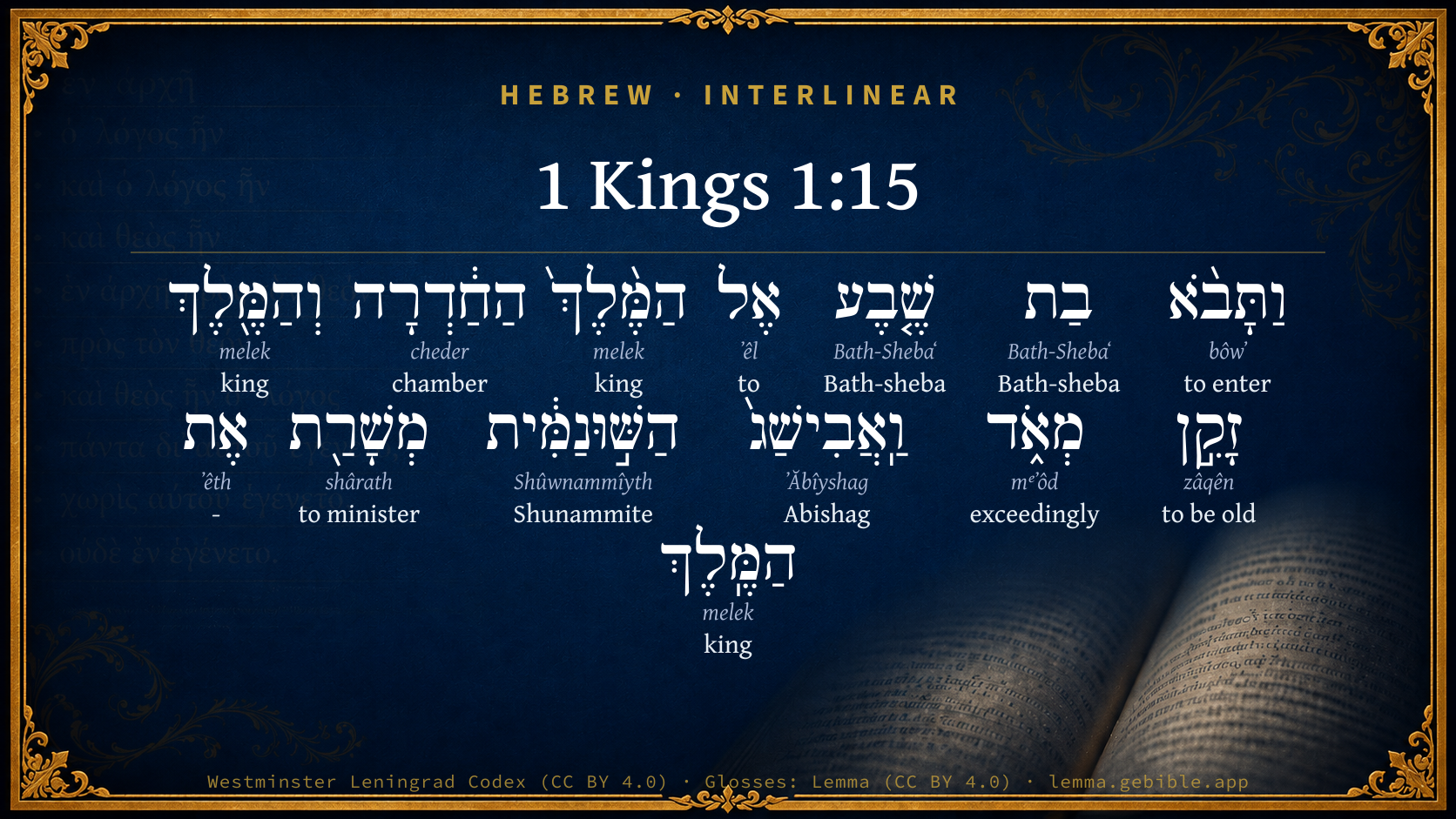
1 Kings 1:15

Hebrew (Westminster Leningrad Codex) 1 Kings 1:15 appears in the Hebrew Old Testament. The text above is from the Westminster Leningrad Codex. Each word links to its Strong’s number, a concise gloss, and parsing drawn from the Open Scriptures Hebrew Bible morphology. Click any word for its full Brown-Driver-Briggs (BDB) entry.
Download image
Cite this verse

1 Kings 1:15 (World English Bible). Public Domain. Lemma interlinear Bible study tool, https://lemma.gebible.app/v/1-kings/1/15.

Show BibTeX & RIS
BibTeX
RIS
English Translation
Bathsheba went in to the king into the chamber: and the king was very old; and Abishag the Shunammite was ministering to the king.
World English Bible · Public Domain
Download a study sheet

One document with this verse’s original text, its word-by-word gloss line, the meaning frame, cross-references with their text, attributed commentary, and full source and license credits — printable, and it pastes into notes with its structure intact.

This verse Autodidact and up

Study sheet (.html) Plain text (.txt)

A passage Seminary Student

Up to 50 verses in one chapter. A passage sheet keeps up to 6 commentary sources and 12 cross-references per verse, in the order this page ranks them, and says so on the sheet whenever that leaves anything out. Ask for a single verse and you get the Autodidact verse sheet above.

Everything on this page stays free to read, with no account — the sheet is a download of what is already on screen, not access to it.

Want to remove ads? Support Godless Engineer
Compare translations 3

The same verse in 3 English versions, stacked beneath the original-language interlinear above. Click any original word for its lexicon entry.

Each is an independent rendering of the whole verse — the interlinear is not word-aligned to these translations.

Highlighted words mark where these versions differ — a whole-verse word diff, not a word-by-word alignment.

  • World English Bible Public Domain
    Bathsheba went in to the king into the chamber: and the king was very old; and Abishag the Shunammite was ministering to the king.
  • King James Version Public Domain
    And Bathsheba went in unto the king into the chamber: and the king was very old; and Abishag the Shunammite ministered unto the king.
  • unfoldingWord Literal Text CC BY-SA 4.0
    So Bathsheba came to the king, into the room. (Now the king had aged greatly, and Abishag the Shunammitess was serving the king.)

unfoldingWord Literal Text — © unfoldingWord, licensed CC BY-SA 4.0. Word-aligned USFM3 via Door43 (git.door43.org/unfoldingWord/en_ult).

Versions to compare (up to 4)

3 of 4 selected

Show all 18 translations

Every available English version of this verse, each an independent rendering of the whole verse.

  • World English Bible Public Domain
    Bathsheba went in to the king into the chamber: and the king was very old; and Abishag the Shunammite was ministering to the king.
  • Berean Standard Bible Public Domain
    So Bathsheba went to see the king in his bedroom. Since the king was very old, Abishag the Shunammite was serving him.
  • Majority Standard Bible Public Domain
    So Bathsheba went to see the king in his bedroom. Since the king was very old, Abishag the Shunammite was serving him.
  • King James Version Public Domain
    And Bathsheba went in unto the king into the chamber: and the king was very old; and Abishag the Shunammite ministered unto the king.
  • American Standard Version (1901) Public Domain
    And Bath-sheba went in unto the king into the chamber: and the king was very old; and Abishag the Shunammite was ministering unto the king.
  • Revised Version (1885) Public Domain
    And Bath-sheba went in unto the king into the chamber: and the king was very old; and Abishag the Shunammite ministered unto the king.
  • Geneva Bible (1599) Public Domain
    So Bath-sheba went in vnto the King into the chamber, and the King was verie olde, and Abishag the Shunammite ministred vnto ye King.
  • Douay-Rheims (1899) Public Domain
    So Bethsabee went in to the king into the chamber: now the king was very old, and Abisag the Sunamitess ministered to him.
  • Young's Literal Translation Public Domain
    And Bath-Sheba cometh in unto the king, to the inner chamber, and the king `is' very aged, and Abishag the Shunammite is serving the king:
  • Literal Standard Version CC BY-SA 4.0
    And Bathsheba comes in to the king, [into] the inner chamber, and the king [is] very aged, and Abishag the Shunammite is serving the king;
  • Unlocked Literal Bible CC BY-SA 4.0
    So Bathsheba went into the king's room. The king was very old, and Abishag the Shunammite was serving the king.
  • unfoldingWord Literal Text CC BY-SA 4.0
    So Bathsheba came to the king, into the room. (Now the king had aged greatly, and Abishag the Shunammitess was serving the king.)
  • Darby Bible Public Domain
    And Bathsheba went in to the king into the chamber; and the king was very old; and Abishag the Shunammite ministered to the king.
  • World Messianic Bible Public Domain
    Bathsheba went in to the king in his room. The king was very old; and Abishag the Shunammite was serving the king.
  • Webster's Bible Public Domain
    And Bath-sheba went to the king into the chamber: and the king was very old; and Abishag the Shunamite ministered to the king.
  • Free Bible Version CC BY-SA 4.0
    So Bathsheba went to see the king in his bedroom. He was very old and Abishag was looking after him.
  • Bible in Basic English Public Domain
    Then Bath-sheba went into the king's room; now the king was very old, and Abishag the Shunammite was waiting on him.
  • JPS Tanakh (1917) Public Domain
    And Bath-sheba went in unto the king into the chamber. — Now the king was very old; and Abishag the Shunammite ministered unto the king. —

Literal Standard Version (2020), Covenant Press — licensed CC BY-SA 4.0. Text via the HelloAO Bible API (eBible.org). Unlocked Literal Bible (unfoldingWord) — licensed CC BY-SA 4.0. Text via the HelloAO Bible API (eBible.org). unfoldingWord Literal Text — © unfoldingWord, licensed CC BY-SA 4.0. Word-aligned USFM3 via Door43 (git.door43.org/unfoldingWord/en_ult). Free Bible Version, Dr. Jonathan Gallagher — licensed CC BY-SA 4.0. Text via the HelloAO Bible API (eBible.org).

Word by word

More ways to search: Search by grammar → Find every occurrence → Compare this word →

Practice this passage: Drill this verse → Learn its vocabulary →

וַֽאֲבִישַׁג֙
ʼĂbîyshag
H49
“and · Abishag”
Conjunction + Noun, Proper
Part of Speech
Conjunction + Noun
Type
Proper
Full BDB Definition

Origin: from H1 and H7686

TWOT: None

Abishag = "my father is a wanderer" - David's beautiful young nurse
  1. וַתָּבֹ֨א bôwʼ H935 “and · to enter” Conjunction + Verb, Qal, Sequential Imperfect, 3rd Person, Feminine, Singular
  2. בַת Bath-Shebaʻ H1339 “Bath-sheba” Noun, Proper
  3. שֶׁ֤בֶע Bath-Shebaʻ H1339 “Bath-sheba” Noun, Proper
  4. אֶל ʼêl H413 “to” Preposition
  5. הַמֶּ֨לֶךְ֙ melek H4428 “the · king” Particle, Definite Article + Noun, Common, Masculine, Singular, Absolute
  6. הַחַ֔דְרָה cheder H2315 “the · chamber · toward” Particle, Definite Article + Noun, Common, Masculine, Singular, Absolute + Suffix, Demonstrative
  7. וְהַמֶּ֖לֶךְ melek H4428 “and · the · king” Conjunction + Particle, Definite Article + Noun, Common, Masculine, Singular, Absolute
  8. זָקֵ֣ן zâqên H2204 “to be old” Verb, Qal, Perfect, 3rd Person, Masculine, Singular
  9. מְאֹ֑ד mᵉʼôd H3966 “exceedingly” Adverb
  10. הַשּׁ֣וּנַמִּ֔ית Shûwnammîyth H7767 “the · Shunammite” Particle, Definite Article + Noun, Gentilic, Feminine, Singular, Absolute
  11. מְשָׁרַ֖ת shârath H8334 “ministering” Verb, Piel, Participle Active, Feminine, Singular, Absolute
  12. אֶת ʼêth H853 “-” Particle, Direct Object
  13. הַמֶּֽלֶךְ melek H4428 “the · king” Particle, Definite Article + Noun, Common, Masculine, Singular, Absolute

About this verse

These counts appear in no published source. They are computed here, from the morphology-tagged text and Lemma’s own curated glosses. What Lemma adds →

14
words
11
distinct lemmas
Historical
section

Notable vocabulary

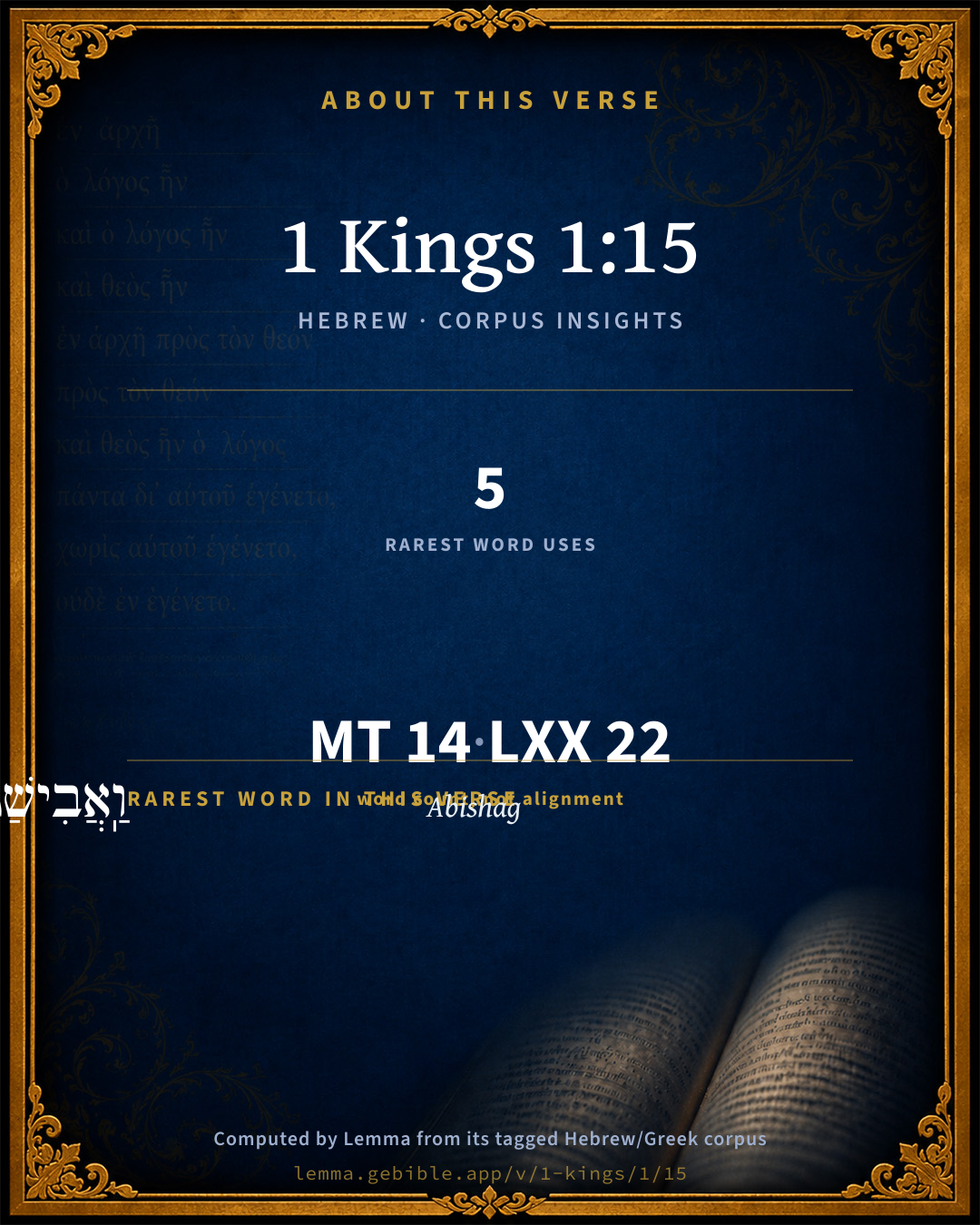
The rarest word here is וַֽאֲבִישַׁג֙ Abishag H49 — appearing just 5 times in the whole Hebrew Bible.

Shared distinctive vocabulary

וַֽאֲבִישַׁג֙ Abishag H49 occurs in 5 verses of the Hebrew Bible. Also found in:

Grammatical profile

  • 3 verbs
  • 8 nouns
  • 1 preposition
  • 1 adverb
  • 1 particle

Verb forms

  • וַתָּבֹ֨א Qal · Sequential Imperfect
  • זָקֵ֣ן Qal · Perfect
  • מְשָׁרַ֖ת Piel · Participle Active

Repetition

Words recur within this verse — often emphatic in Hebrew:

  • הַמֶּ֨לֶךְ֙ king H4428 ×3
  • בַת Bath-sheba H1339 ×2

Hebrew & Septuagint length

In English translation the verse runs 24 words from the Hebrew and 25 from the Septuagint (LXX English) — closely comparable.

A rough comparison of the two English renderings, which tokenize alike — not a word-level alignment.

Word counts can differ between the Hebrew and the Greek without any difference in meaning — e.g. the Hebrew direct-object marker אֵת has no separate Greek word, and Greek often adds the article ὁ.

In the original languages it is 14 Hebrew tokens and 22 Greek tokens — but the two are counted differently (Hebrew bundles its prefixes and suffixes into one token; the Greek is in lemma form), so that isn’t a like-for-like length.

Cross-references

1

Topical passages linked to 1 Kings 1:15 in the Treasury of Scripture Knowledge — connected by theme and wording, ordered by reader-vote popularity; previews shown in the World English Bible.

  • 1 Kings 1:1 Now king David was old and stricken in years; and they covered him with clothes, but he got no heat.

Cross-references courtesy of OpenBible.info (CC BY 4.0).

Hebrew and Greek witnesses Masoretic Hebrew ↔ Greek Septuagint

The same verse in the two great witnesses to the Old Testament, shown verse-for-verse.

These are two independent witnesses, not word-aligned to each other, and the Septuagint is shown in lemma (dictionary) form.

Hebrew 1 Kings 1:15 Masoretic · Westminster Leningrad Codex

וַתָּבֹ֨א בַת שֶׁ֤בֶע אֶל הַמֶּ֨לֶךְ֙ הַחַ֔דְרָה וְהַמֶּ֖לֶךְ זָקֵ֣ן מְאֹ֑ד וַֽאֲבִישַׁג֙ הַשּׁ֣וּנַמִּ֔ית מְשָׁרַ֖ת אֶת הַמֶּֽלֶךְ

Bathsheba went in to the king into the chamber: and the king was very old; and Abishag the Shunammite was ministering to the king.

World English Bible · Public Domain

Greek LXX 1 Kings 1:15 Septuagint · lemma form

καί εἰςἔρχομαι βηρσαβεε πρός ὁ βασιλεύς εἰς ὁ ταμιεῖον καί ὁ βασιλεύς πρεσβύτης σφόδρα καί αβισακ ὁ σωμανῖτις εἰμί λειτουργέω ὁ βασιλεύς

So Bersabee went in to the king into the chamber: and the king was very old, and Abisag the Somanite was ministering to the king.

LXX2012 (modern English Septuagint) · Public Domain

Hebrew: Westminster Leningrad Codex (CC BY 4.0). Greek: Septuagint (public domain); English from LXX2012 (modern English Septuagint) (Public Domain). How the Septuagint differs from the Hebrew →

Targum (Aramaic paraphrase)

1

The Targum is the ancient Jewish Aramaic paraphrase of the Hebrew Scriptures — an interpretive translation, not the Hebrew text itself. Onkelos (literal) and Pseudo-Jonathan (expansive) render the Torah, and Jonathan the Prophets. Coverage is partial: where no permissively-licensed English translation exists for a verse, only the Aramaic is shown. This is verse-level text, not a word-by-word alignment to the Hebrew.

  1. Targum Jonathan Prophets (Joshua–Malachi)
    וַעֲלַת בַּת שֶׁבַע לָקֳדָם מַלְכָּא לְאִידְרוֹן בֵּית מִשְׁכְּבָא וּמַלְכָּא סִיב לַחֲדָא וַאֲבִישַׁג דְמִן שׁוּנֵם מְשַׁמְשָׁא קֳדָם מַלְכָּא:

    (no public-domain English translation for this verse)

    Targum Jonathan — Aramaic: “Mikraot Gedolot” (public domain). English: “Sefaria Community Translation” (CC0 1.0 (public-domain dedication)); “London "Chaldee Paraphrase," 1871” (public domain). Text via Sefaria.

Commentary

Notes on 1 Kings 1:15 from classic Christian and Jewish commentators (each source and its license shown beneath its notes). The classic Christian expositions comment on the surrounding passage and are grouped to its opening verse, so a note may address several verses; the Jewish commentaries on the Tanakh (Rashi and others) are per-verse, so they appear only where the commentator wrote on this verse.

Lemma curates 59 commentaries, every one of them public domain or Creative Commons licensed, each selected and text-cleaned for this edition rather than reprinted as found. About our sources →

Trapp's Complete Commentary

John Trapp

1Ki 1:15 And Bathsheba went in unto the king into the chamber: and the king was very old; and Abishag the Shunammite ministered unto the king.

Ver. 15. And the king was very old.] Yet little more than half so old as a plain countryman whom I spoke with yesterday, being May 15, A.D. 1656, at Stratford-upon-Avon, who assured me, and gave good proof of it, that he was a hundred and twenty-eight of age, being born A.D. 1527. He is still hearty and healthy, living at Bedworth in Warwickshire, Thomas Egerton by name.

John Trapp, A Commentary or Exposition upon All the Books of the Old and New Testament (1647–1656) — public domain. Text from a community e-Sword module.

The Preacher's Complete Homiletical Commentary

Joseph S. Exell (gen. ed.)

CRITICAL AND EXPLANATORY NOTES.—

1Ki_1:16. Bowed and did obeisance—The latter word denoting the prostrate attitude customary in the East before kings.

1Ki_1:21. Shall be counted offenders—Counted is not in the Hebrew, though implied in the connexion; they will be חַטָּאִים—i.e., guilty of a capital crime, treated as traitors deserving death.

HOMILETICS OF 1Ki_1:15-21

THE PERSUASIVE PLEADING OF AN ANXIOUS MOTHER

I. Is profoundly deferential. Bathsheba hesitates not to venture at once into the inner chamber of the aged and dying king. Her maternal instincts and concern for her son’s future render her courageous. Her presence pleaded eloquently, but her speech, tremulous with the conflicting emotions of the wife and mother, was overwhelming. “Bathsheba bowed and did obeisance unto the king” (1Ki_1:16). She paid every respect due to David as her prince and husband. If we would find favour with superiors, we must show them becoming respect. We should cherish a dutiful regard towards those from whom we expect kindness. Nothing is ever lost by sincere politeness. It evidences a refined and gentle spirit. It propitiates the most morose, and often wins a favourable reception in the most difficult suit. It succeeds where an unmannerly brusqueness fails. It is irresistible in a true woman. Life is not so short but there is always time enough for courtesy.

II. Urges the religious obligation of an oath. 1Ki_1:17, “Thou swarest by the Lord thy God.” A conscientious man is morally bound by his promised word; but an oath is inviolable. We are engaged if we have promised; if we have sworn, we are bound. Neither heaven nor earth has any gyves for that man who can recklessly shake off the fetters of an oath. Such a man has no regard for that God whose awful name he dare invoke to a falsehood. He who cares not for God will not care for man. It is a powerful leverage to move a man to right action when we can remind him of his solemnly pledged word. An oath should be religiously remembered and conscientiously fulfilled. It is a duty we owe to both God and man. Even the highest in authority should be faithfully reminded of this duty, and warned as to the consequences of a careless repudiation of trust. A faithful friend in a palace is rare.

III. Graphically depicts the distraction of rebellion (1Ki_1:18-19).

1. The throne is seized by an ungrateful son. “Adonijah reigneth.” Without waiting for the death of his father, or seeking his sanction, and even without his knowledge, the presumptuous son assumes all the authority and external display of royalty. Had his right to the succession been ever so good, such conduct was undutiful and treasonable. An unprincipled ambition corrupts natural affection: it acknowledges obedience to none but its own imperious will.

2. Excessive festivity prevails. Indulgence is often provocative of vain boasting, extravagant designs, and riotous conduct. It leads to cruelty and disaster.

3. The members of the royal family and the true friends of the aged king are seduced from their allegiance. There was disorder in the household. The children of David repaid his paternal kindness with unfaithfulness and wild rebellion. The ingratitude of children, for whom so much has been sacrificed and endured, is one of the sharpest pangs of a disappointed parent’s heart. Polygamy, in however limited a degree, is a prolific source of domestic trouble. Any violation of the moral order carries with it its own Nemesis. The infidelity of Abiathar and Joab—men with whom he had repeatedly trusted his life—was a severe blow to David. Little does the renegade friend think of the anguish caused by his treachery. Confidence in human nature is shattered.

4. The king-designate is ignored. “But Solomon thy servant”—not thy sovereign, as Adonijah affects to be—“hath he not called.” He is evidently regarded as a rival, and every attempt is made to prevent his gaining the throne. It is not an oversight, but a contempt of the act of settlement, which had been made sufficiently public, that Solomon is neglected. All the fondly cherished plans of David are threatened with a rude and ignominious overthrow. The scene of confusion created by the rebels, thus graphically presented, was calculated to deeply affect the dying monarch—as the husband, the father, and the king.

IV. Earnestly advocates the pressing claims of the nation (1Ki_1:20). The rebellion had not gone so far as that of Absalom’s in stealing away the hearts of the people. There was a grave pause in the kingdom. The people hesitated what to do, until the royal intention was publicly proclaimed. David was too firmly seated in the affections of his subjects to allow them to act without the knowledge of his declared will. This ominous silence of the national voice was Nathan’s opportunity and Adonijah’s doom. In troublous times the nation looks to the king. In him is vested supreme authority. He is the guide and defender of the empire. The interests of all are in his keeping; and his power should ever be exercised on the side of justice, equity, and peace. A divine sentence is in the lips of the king. “That thou shouldest tell them who shall sit on the throne.” This some princes love not to do—Queen Elizabeth, for instance. A false Jesuit wrote that she wished she might, after her death, hang awhile in the air, to see what scuffling there would be for her kingdom. Men should use whatever power or influence they possess, not in compassing their own selfish ends, but in advancing the kingdom of the Messiah.

V. Is full of genuine pathos.

1. A mournful contingency is referred to (1Ki_1:21). “When my Lord shall sleep with his fathers.” Here the heart of the wife speaks out. It was evident David’s end was near; and Bathsheba could not contemplate that event without deep emotion. Death is compared to a sleep. Beautiful simile! Such a view robs death of its terror, and soothes the sorrow of the bereaved. Death is but the gentle sinking of the tired and spent body into the lap of rest. Silently it reposes among the hallowed dust of bye-gone generations, until the last great trumpet shall wake it into newness of life.

2. A tender allusion is made to threatened personal peril. “I and my son Solomon shall be counted offenders.” Here the heart of the mother speaks out. It is suggested by some commentators that, probably, Adonijah had spoken slightingly of Bathsheba as an adultress and of Solomon as illegitimate, and, therefore, not fit to be king. The reputation of mother and son was in danger, and must be protected. Not only so: if Adonijah succeeded, they would both be reckoned traitors and public enemies, and their lives sacrificed. Adonijah would not have dealt so mercifully with Solomon as Solomon did with him. He who usurps a throne will stop at no cruelty to secure himself in it. If anything will rouse the soul into earnest concern, it is the peril to which those dear to it are exposed.

LESSONS:—

1. The mother exerts a powerful influence on the destiny of the family.

2. It is an unspeakable advantage for a youthful prince to have a wise and capable mother.

3. The eloquence of a mother’s heart is irresistible.

GERM NOTES ON THE VERSES

1Ki_1:15-21. Bathsheba before the king. She reminds him of his duty—

1. Towards God, before whom he had sworn. What one has vowed before God, according to God’s will, one must hold to under all circumstances; of this one must remind kings and princes.

2. Towards the people, whose well-being and whose woe were in his keeping. The great responsibility of him towards whom all eyes are directed.

3. Towards the wife and son, whose happiness and life were at stake. Woe to the father through whose guilt wife and children, after his death, fall into contempt and wretchedness.—Lange.

1Ki_1:16. “What wouldest thou?” A question the King of Heaven is ever asking—

1. The perplexed enquirer.

2. The penitent suppliant.

3. The complaining sufferer.

4. The solitary mourner.

5. The ambitious self-seeker.

1Ki_1:18. “Thou knowest it not. The isolation of the aged and infirm—

1. Presents a melancholy contrast to the joyous excitement of an active life.

2. Renders them oblivious of the most important events of the outside world.

3. Ignorant of the calamities that threaten their dearest interests.

4. Familiarizes their minds with suffering and approaching death.

5. Calls for the kindly attention and sympathy of loving hearts.

1Ki_1:20. The grave responsibilities of the monarch. 1. All eyes are turned to him in times of national distress.

2. He is expected to promptly and effectually crush rebellion.

3. The best interests of his subjects should be his chief concern.

4. He should make the wisest arrangements for the future peace and stability of the kingdom.

5. He is accountable to God, from whom he derives his authority.

The Preacher's Complete Homiletical Commentary (gen. ed. Joseph S. Exell; Funk & Wagnalls, c. 1892) — public domain (pre-1929). A full-Bible homiletical/sermon-outline anthology covering 65 of 66 books (2 John is absent from the source module). Text from a community e-Sword module.

The Cambridge Bible for Schools and Colleges

gen. ed. J. J. S. Perowne

15–21. Bath-sheba before King David (Not in Chronicles)

15. and the king was very old] This sentence is in explanation why Bath-sheba went into the bedchamber of the king. David was too feeble to go forth, and those who would see him must come there for audience.

The Cambridge Bible for Schools and Colleges (gen. ed. J. J. S. Perowne; Cambridge University Press, 1878–1918) — public domain. Text from a community e-Sword module.

John Gill's Exposition

And Bathsheba went in unto the king into the chamber,.... Where he lay, being bedridden; she took Nathan's advice, and directly went to the king's apartment:

and the king was very old: and decrepit, borne down with the infirmities of old age, though but seventy years of age:

and Abishag the Shunammite ministered unto the king; she was then waiting upon the king, and serving him with what was necessary and proper for him; and perhaps there was no other in the chamber at that time.

John Gill's Exposition of the Whole Bible (1746–1763) — public domain (CC PDM 1.0). Text via the HelloAO Bible API.

Albert Barnes' Notes on the Bible

Into the chamber - The “bed-chamber” or “inner chamber.” Abishag was a disinterested witness present, who heard all that Bath-sheba said to David.

Albert Barnes' Notes on the Bible (1834–1885) — public domain. Text from a community e-Sword/MySword module.

Whedon's Commentary on the Bible

Daniel D. Whedon

15. Into the chamber — Into the bedchamber, where, on account of his age and infirmities, the king was obliged to keep himself.

Daniel D. Whedon (gen. ed.), Commentary on the Old and New Testaments (1874–1909) — public domain. Text from a community e-Sword module.

The Pulpit Commentary

And Bathsheba went In unto the king into the chamber lit. inner chamber, qalamov, cubiculum penetrale, Buxtorf. Same word 2Sa_4:7 2Sa_13:10 and the king was very old the repetition (see ver. 1) is not idle or unmeaning. Here the word refers to feebleness rather than age. It is mentioned to explain David"s confinement to his chamber and Abishag the Shunammite ministered unto the king. This is introduced to show the king"s helplessness. It does not prove that "there was a disinterested witness present" (Rawlinson), for she may have withdrawn, as Bathsheba did presently (ver. 23), and Nathan (ver. 32). It is a graphic touch, painted probably from the life, and by the hand of Nathan, from whom this narrative is derived. And Solomon awoke; and, behold, it was a dream That is to say, this passed while Solomon slept; but it was more than a dream. The same words are used of Pharaoh (Gen_41:7) when God showed him what He was about to do (vers. 25, 28, cf., Gen_40:8) and this was such a dream as Pharaoh"s and as Joseph"s. (Mat_1:20 Mat_2:19) It was a dream, i.e., in which a Divine revelation was made to him. Wordsw. refers to Solomon"s words, "I sleep, but my heart waketh (Song of Son_5:2), and "He giveth to his beloved (Jedidiah) in sleep". Psa_127:2 And he came to Jerusalem, and stood before the ark of the covenant the other sanctuary of that period (2 Samuel 1Ch_16:37-40 and offered up burnt offerings probably in continuation of the sacrifices of Gibeon, ver. 4, and offered peace offerings in testimony of his thankfulness for the signal favour recently vouchsafed to him and made a feast lit., a drinking. After the example of David, 1Ch_16:3. Cf. 1Ki_8:65. It was not exclusively a symposium. The flesh of the animals offered in sacrifice was eaten by the worshippers and their Guests. (Lev_7:15, Lev_7:31; 1Sa_2:16; 1Co_8:13) This was "a sacrificial meal of the (Keil). See on ch. 1Ki_8:63 to all his servants.

The Pulpit Commentary (1880–1919), ed. H.D.M. Spence-Jones & Joseph S. Exell — public domain. Text from a community e-Sword module.

unfoldingWord translationNotes

Door43 World Missions Community

the king's room

"the room in which the king slept"

Abishag the Shunammite

This is the young virgin that King David's servants had brought to care for him. See how you translated this in 1 Kings 1:3.

bowed and prostrated herself before the king

"bowed close to the ground in front of the king"

What do you desire?

"What can I do for you?"

you swore to

The form of "you" here is emphatic. AT: "you yourself swore to"

your servant

Bathsheba speaks as if she were another person to show David that she respects him. See how you translated this in 1 Kings 1:13. AT: "me, your servant"

Yahweh

This is the name of God that he revealed to his people in the Old Testament. See the translationWord page about Yahweh concerning how to translate this.

he shall sit on my throne

Sitting on the throne is a metonym for being king. See how you translated this in 1 Kings 1:13. AT: "he will be king just as I was" (See: Metonymy)

translationWords

bow

Yahweh

God

throne

unfoldingWord translationNotes — © Distant Shores Media and the Door43 World Missions Community, licensed CC BY-SA 4.0. Source: git.door43.org/Door43/en_tn.

Lesson kit

Teaching starters — assembled from the data on this page, not authored interpretation. Every prompt links to the verse data it draws on. Edit before teaching.

1 Kings, in the Historical, opens this verse with 14 words (11 distinct Hebrew lemmas). Its most distinctive word is ʼĂbîyshag (“Abishag”). A historical commentator’s framing appears above. Read the whole chapter for the surrounding context.

Discussion questions

  1. The word ʼĂbîyshag carries the sense “Abishag.” How does it shape the verse?
  2. 1 Kings 1:3 shares the word «Abishag» with this verse. How do the two illuminate each other?
  3. “king” occurs 3× in this one verse. What is the effect of the repetition?
  4. These translations render this verse differently. What is at stake in choosing one wording over another?
  5. The verb «וַתָּבֹ֨א» is Qal Sequential Imperfect. How does its form color the action?
  6. Reading how Trapp's Complete Commentary and The Preacher's Complete Homiletical Commentary read this verse, where do the two commentators agree and where do they part?

Things to notice

Reading settings

Reading text

Shown beneath each verse's original-language words.

Old Testament
Old Testament edition

Read the OT as the Masoretic Hebrew (MT) or the Greek Septuagint (LXX).

English shown for the Greek Septuagint (in the Hebrew ↔ Greek comparison).

Comparing translations? Open the Compare panel on any verse page to stack up to four side by side.