
Matthew 4:24

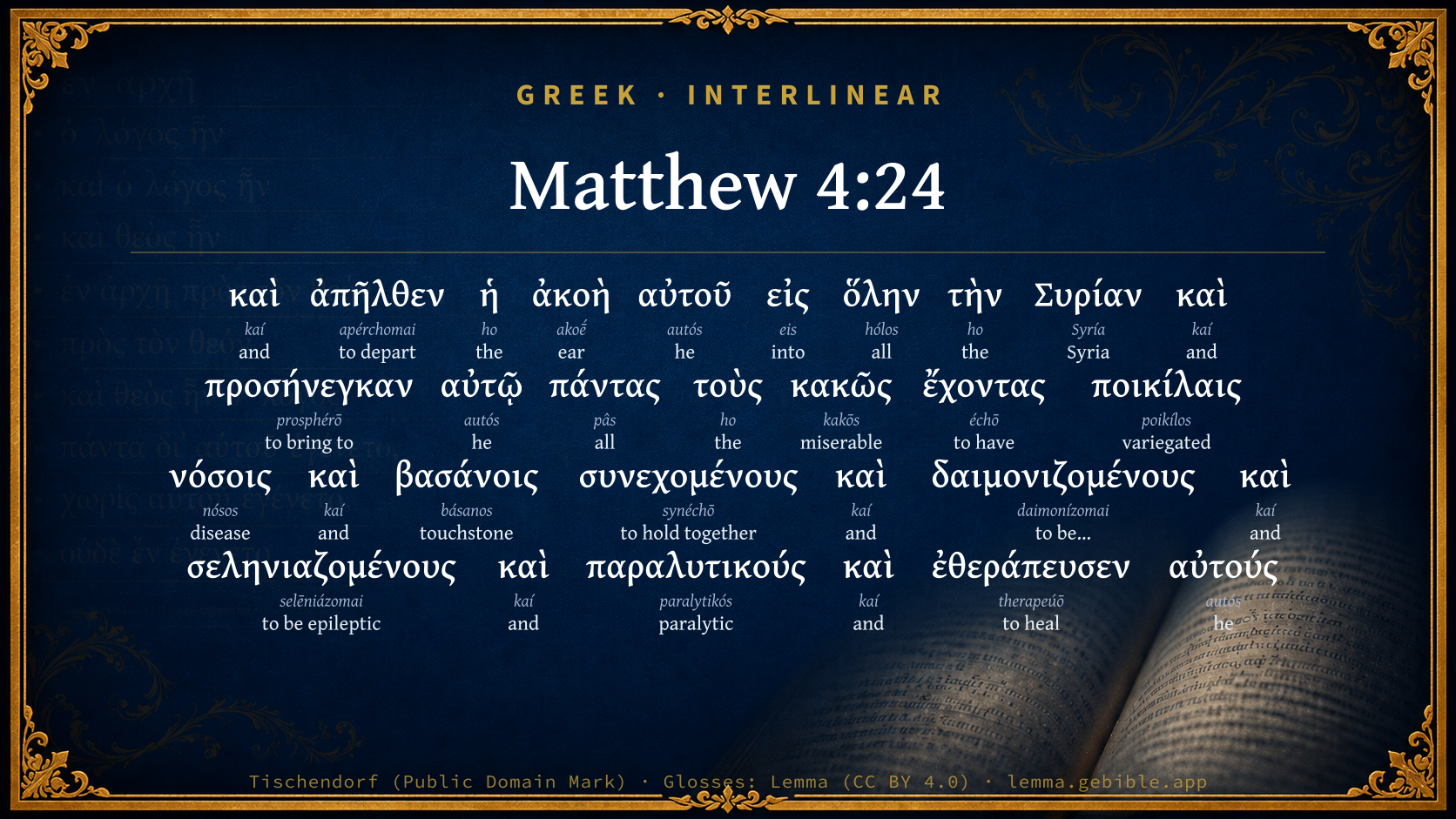
Greek (Tischendorf 8th ed.) Matthew 4:24 appears in the Greek New Testament. The text above is from the Tischendorf 8th edition. Each word links to its Strong’s number and a concise gloss. Click any word for its full Thayer’s Greek Lexicon entry.
Download image
Cite this verse

Matthew 4:24 (World English Bible). Public Domain. Lemma interlinear Bible study tool, https://lemma.gebible.app/v/matthew/4/24.

Show BibTeX & RIS
BibTeX
RIS
English Translation
The report about him went out into all Syria. They brought to him all who were sick, afflicted with various diseases and torments, possessed with demons, epileptics, and paralytics; and he healed them.
World English Bible · Public Domain
Highlights
  • 9 first appearances in the Greek New Testament
Full analysis ↓
Download a study sheet

One document with this verse’s original text, its word-by-word gloss line, the meaning frame, cross-references with their text, attributed commentary, and full source and license credits — printable, and it pastes into notes with its structure intact.

This verse Autodidact and up

Study sheet (.html) Plain text (.txt)

A passage Seminary Student

Up to 50 verses in one chapter. A passage sheet keeps up to 6 commentary sources and 12 cross-references per verse, in the order this page ranks them, and says so on the sheet whenever that leaves anything out. Ask for a single verse and you get the Autodidact verse sheet above.

Everything on this page stays free to read, with no account — the sheet is a download of what is already on screen, not access to it.

Want to remove ads? Support Godless Engineer
Compare translations 3

The same verse in 3 English versions, stacked beneath the original-language interlinear above. Click any original word for its lexicon entry.

Each is an independent rendering of the whole verse — the interlinear is not word-aligned to these translations.

Highlighted words mark where these versions differ — a whole-verse word diff, not a word-by-word alignment.

  • World English Bible Public Domain
    The report about him went out into all Syria. They brought to him all who were sick, afflicted with various diseases and torments, possessed with demons, epileptics, and paralytics; and he healed them.
  • King James Version Public Domain
    And his fame went throughout all Syria: and they brought unto him all sick people that were taken with divers diseases and torments, and those which were possessed with devils, and those which were lunatick, and those that had the palsy; and he healed them.
  • unfoldingWord Literal Text CC BY-SA 4.0
    And the news of him went out into all Syria, and they brought to him all the ones having sickness, being afflicted by various diseases and pains, and being possessed by demons, and the epileptic and the paralytic, and he healed them.

unfoldingWord Literal Text — © unfoldingWord, licensed CC BY-SA 4.0. Word-aligned USFM3 via Door43 (git.door43.org/unfoldingWord/en_ult).

Versions to compare (up to 4)

3 of 4 selected

Show all 19 translations

Every available English version of this verse, each an independent rendering of the whole verse.

  • World English Bible Public Domain
    The report about him went out into all Syria. They brought to him all who were sick, afflicted with various diseases and torments, possessed with demons, epileptics, and paralytics; and he healed them.
  • Berean Standard Bible Public Domain
    News about Him spread all over Syria, and people brought to Him all who were ill with various diseases, those suffering acute pain, the demon-possessed, those having seizures, and the paralyzed—and He healed them.
  • Majority Standard Bible Public Domain
    News about Him spread all over Syria, and people brought to Him all who were ill with various diseases, those suffering acute pain, the demon-possessed, those having seizures, and the paralyzed, and He healed them.
  • King James Version Public Domain
    And his fame went throughout all Syria: and they brought unto him all sick people that were taken with divers diseases and torments, and those which were possessed with devils, and those which were lunatick, and those that had the palsy; and he healed them.
  • American Standard Version (1901) Public Domain
    And the report of him went forth into all Syria: and they brought unto him all that were sick, holden with divers diseases and torments, possessed with demons, and epileptic, and palsied; and he healed them.
  • Revised Version (1885) Public Domain
    And the report of him went forth into all Syria: and they brought unto him all that were sick, holden with divers diseases and torments, possessed with devils, and epileptic, and palsied; and he healed them.
  • Geneva Bible (1599) Public Domain
    And his fame spread abroad through all Syria: and they brought vnto him all sicke people, that were taken with diuers diseases and torments, and them that were possessed with deuils, and those which were lunatike, and those that had the palsey: and he healed them.
  • Douay-Rheims (1899) Public Domain
    And his fame went throughout all Syria, and they presented to him all sick people that were taken with divers diseases and torments, and such as were possessed by devils, and lunatics, and those that had palsy, and he cured them:
  • Young's Literal Translation Public Domain
    and his fame went forth to all Syria, and they brought to him all having ailments, pressed with manifold sicknesses and pains, and demoniacs, and lunatics, and paralytics, and he healed them.
  • Literal Standard Version CC BY-SA 4.0
    and His fame went forth to all Syria, and they brought to Him all the ill having manifold oppressing diseases and torments—and demoniacs, and lunatics, and paralytics—and He healed them.
  • Unlocked Literal Bible CC BY-SA 4.0
    The news about him went out into all of Syria, and the people brought to him all those who were sick, ill with various diseases and pains, those possessed by demons, and the epileptic and paralytic. Jesus healed them.
  • unfoldingWord Literal Text CC BY-SA 4.0
    And the news of him went out into all Syria, and they brought to him all the ones having sickness, being afflicted by various diseases and pains, and being possessed by demons, and the epileptic and the paralytic, and he healed them.
  • Darby Bible Public Domain
    And his fame went out into the whole [of] Syria, and they brought to him all that were ill, suffering under various diseases and pains, and those possessed by demons, and lunatics, and paralytics; and he healed them.
  • World Messianic Bible Public Domain
    The report about him went out into all Syria. They brought to him all who were sick, afflicted with various diseases and torments, possessed with demons, epileptics, and paralytics; and he healed them.
  • Webster's Bible Public Domain
    And his fame spread throughout all Syria: and they brought to him all sick people that were taken with diverse diseases and torments, and those who were possessed with demons, and those who were lunatic, and those that had the palsy; and he healed them.
  • Free Bible Version CC BY-SA 4.0
    News about him spread throughout the province of Syria. They brought everyone who was sick to him: people troubled by seizures, the demon-possessed, those who were mentally ill, people who were paralyzed, and he healed all of them.
  • Bible in Basic English Public Domain
    And news of him went out through all Syria; and they took to him all who were ill with different diseases and pains, those having evil spirits and those who were off their heads, and those who had no power of moving. And he made them well.
  • Text-Critical English NT CC BY 4.0
    So the news about him went out into all of Syria, and the people brought to him all who were sick with various diseases, those suffering severe pain, the demon-possessed, epileptics, and paralytics. And he healed them.
  • Tyndale New Testament (1534) Public Domain
    And his fame spreed abroode through oute all Siria. And they brought vnto hym all sicke people that were taken with divers diseases and gripinges and them that were possessed with devils and those which were lunatyke and those that had the palsie: and he healed them.

Literal Standard Version (2020), Covenant Press — licensed CC BY-SA 4.0. Text via the HelloAO Bible API (eBible.org). Unlocked Literal Bible (unfoldingWord) — licensed CC BY-SA 4.0. Text via the HelloAO Bible API (eBible.org). unfoldingWord Literal Text — © unfoldingWord, licensed CC BY-SA 4.0. Word-aligned USFM3 via Door43 (git.door43.org/unfoldingWord/en_ult). Free Bible Version, Dr. Jonathan Gallagher — licensed CC BY-SA 4.0. Text via the HelloAO Bible API (eBible.org).

Word by word

More ways to search: Search by grammar → Find every occurrence → Compare this word →

Practice this passage: Drill this verse → Learn its vocabulary →

σεληνιαζομένους
selēniázomai
G4583
“to be epileptic”
Verb, Present, Middle or Passive deponent, Participle, Accusative, Plural, Masculine
Part of Speech
Verb
Tense
Present
Voice
Middle or Passive deponent
Mood
Participle
Case
Accusative
Number
Plural
Gender
Masculine
Full Thayer's Definition

Origin: middle voice or passive from a presumed derivative of G4582

TDNT: None

1. to be moon-struck or lunatic 2. to be epileptic a. epilepsy being supposed to return and increase with the increase of the moon. This meaning is doubtful as the Greeks knew nothing of epilepsy.
  1. καὶ kaí G2532 “and” Conjunction
  2. ἀπῆλθεν apérchomai G565 “to depart” Verb, Aorist, Active, Indicative, 3rd person, Singular
  3. ἡ ho G3588 “the” Article, Nominative, Singular, Feminine
  4. ἀκοὴ akoḗ G189 “ear” Noun, Nominative, Singular, Feminine
  5. αὐτοῦ autós G846 “he” Personal pronoun, Genitive, Singular, Masculine
  6. εἰς eis G1519 “into” Preposition
  7. ὅλην hólos G3650 “all” Adjective, Accusative, Singular, Feminine
  8. τὴν ho G3588 “the” Article, Accusative, Singular, Feminine
  9. Συρίαν Syría G4947 “Syria” Noun, Accusative, Singular, Feminine
  10. καὶ kaí G2532 “and” Conjunction
  11. προσήνεγκαν prosphérō G4374 “to bring to” Verb, Aorist, Active, Indicative, 3rd person, Plural
  12. αὐτῷ autós G846 “he” Personal pronoun, Dative, Singular, Masculine
  13. πάντας pâs G3956 “all” Adjective, Accusative, Plural, Masculine
  14. τοὺς ho G3588 “the” Article, Accusative, Plural, Masculine
  15. κακῶς kakōs G2560 “miserable” Adverb
  16. ἔχοντας échō G2192 “to have” Verb, Present, Active, Participle, Accusative, Plural, Masculine
  17. ποικίλαις poikílos G4164 “variegated” Adjective, Dative, Plural, Feminine
  18. νόσοις nósos G3554 “disease” Noun, Dative, Plural, Feminine
  19. καὶ kaí G2532 “and” Conjunction
  20. βασάνοις básanos G931 “touchstone” Noun, Dative, Plural, Feminine
  21. συνεχομένους synéchō G4912 “to hold together” Verb, Present, Passive, Participle, Accusative, Plural, Masculine
  22. καὶ kaí G2532 “and” Conjunction
  23. δαιμονιζομένους daimonízomai G1139 “to be demon-possessed” Verb, Present, Middle or Passive deponent, Participle, Accusative, Plural, Masculine
  24. καὶ kaí G2532 “and” Conjunction
  25. καὶ kaí G2532 “and” Conjunction
  26. παραλυτικούς paralytikós G3885 “paralytic” Adjective, Accusative, Plural, Masculine
  27. καὶ kaí G2532 “and” Conjunction
  28. ἐθεράπευσεν therapeúō G2323 “to heal” Verb, Aorist, Active, Indicative, 3rd person, Singular
  29. αὐτούς autós G846 “he” Personal pronoun, Accusative, Plural, Masculine

About this verse

These counts appear in no published source. They are computed here, from the morphology-tagged text and Lemma’s own curated glosses. What Lemma adds →

30
words
20
distinct lemmas
Gospels
section

Notable vocabulary

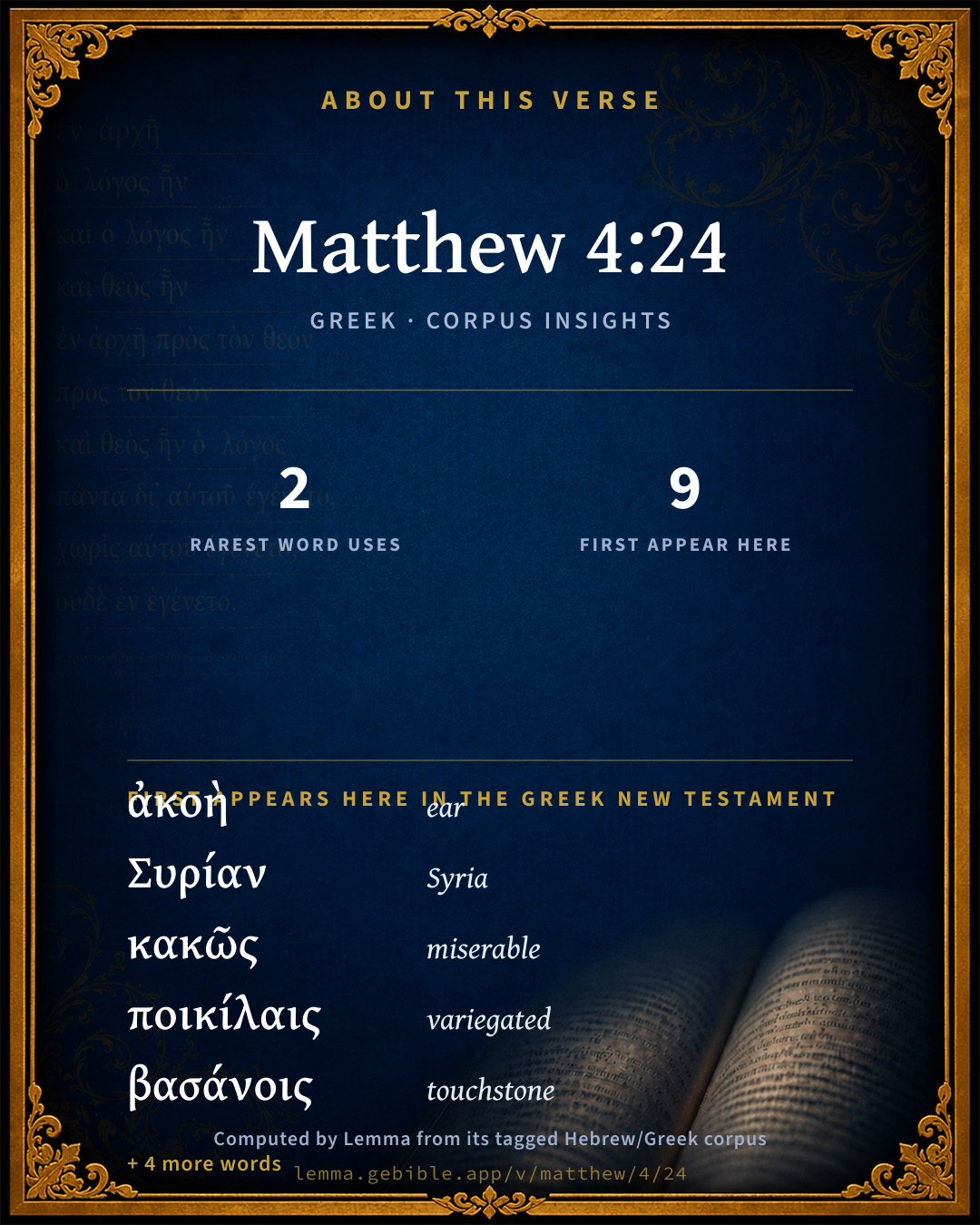
The rarest word here is σεληνιαζομένους to be epileptic G4583 — appearing just 2 times in the whole Greek New Testament.

First appearance in Scripture

These words make their first canonical appearance in the Greek New Testament here (9 in total — showing 8):

  • ἀκοὴ ear G189
  • Συρίαν Syria G4947
  • κακῶς miserable G2560
  • ποικίλαις variegated G4164
  • βασάνοις touchstone G931
  • συνεχομένους to hold together G4912
  • δαιμονιζομένους to be demon-possessed G1139
  • σεληνιαζομένους to be epileptic G4583

Shared distinctive vocabulary

σεληνιαζομένους to be epileptic G4583 occurs in 2 verses of the Greek New Testament. Also found in:
Repetition

Words recur within this verse:

Cross-references

32

Topical passages linked to Matthew 4:24 in the Treasury of Scripture Knowledge — connected by theme and wording, ordered by reader-vote popularity; previews shown in the World English Bible.

  • Matthew 8:6 and saying, "Lord, my servant lies in the house paralyzed, grievously tormented."
  • Matthew 17:15 "Lord, have mercy on my son, for he is epileptic, and suffers grievously; for he often falls into the fire, and often into the water.
  • Matthew 12:22 Then one possessed by a demon, blind and mute, was brought to him and he healed him, so that the blind and mute man both spoke and saw.
  • Matthew 15:22 Behold, a Canaanite woman came out from those borders, and cried, saying, "Have mercy on me, Lord, you son of David! My daughter is severely demonized!"
  • Matthew 17:18 Jesus rebuked him, the demon went out of him, and the boy was cured from that hour.
  • Luke 2:2 This was the first enrollment made when Quirinius was governor of Syria.
  • Luke 5:15 But the report concerning him spread much more, and great multitudes came together to hear, and to be healed by him of their infirmities.
  • Acts 10:38 even Jesus of Nazareth, how God anointed him with the Holy Spirit and with power, who went about doing good and healing all who were oppressed by the devil, for God was with him.
  • Exodus 15:26 and he said, "If you will diligently listen to the voice of Yahweh your God, and will do that which is right in his eyes, and will pay attention to his commandments, and keep all his statutes, I will put none of the diseases on you, which I have put on the Egyptians; for I am Yahweh who heals you."
  • Matthew 4:23 Jesus went about in all Galilee, teaching in their synagogues, preaching the Gospel of the Kingdom, and healing every disease and every sickness among the people.
  • Matthew 9:31–32 But they went out and spread abroad his fame in all that land.
  • Mark 1:32 At evening, when the sun had set, they brought to him all who were sick, and those who were possessed by demons.
  • Mark 2:3 Four people came, carrying a paralytic to him.
  • Acts 15:23 They wrote these things by their hand: "The apostles, the elders, and the brothers, to the brothers who are of the Gentiles in Antioch, Syria, and Cilicia: greetings.
  • Joshua 6:27 So Yahweh was with Joshua; and his fame was in all the land.
  • 1 Kings 4:31 For he was wiser than all men; than Ethan the Ezrahite, and Heman, and Calcol, and Darda, the sons of Mahol: and his fame was in all the nations round about.
  • 1 Kings 10:1 When the queen of Sheba heard of the fame of Solomon concerning the name of Yahweh, she came to prove him with hard questions.
  • 1 Chronicles 14:17 The fame of David went out into all lands; and Yahweh brought the fear of him on all nations.
  • Matthew 8:13–16 Jesus said to the centurion, "Go your way. Let it be done for you as you have believed." His servant was healed in that hour.
  • Matthew 9:2–8 Behold, they brought to him a man who was paralyzed, lying on a bed. Jesus, seeing their faith, said to the paralytic, "Son, cheer up! Your sins are forgiven you."
  • Matthew 14:1 At that time, Herod the tetrarch heard the report concerning Jesus,
  • Mark 1:28 The report of him went out immediately everywhere into all the region of Galilee and its surrounding area.
  • Luke 4:14 Jesus returned in the power of the Spirit into Galilee, and news about him spread through all the surrounding area.
  • Luke 4:33–35 In the synagogue there was a man who had a spirit of an unclean demon, and he cried out with a loud voice,
  • Luke 8:27–37 When Jesus stepped ashore, a certain man out of the city who had demons for a long time met him. He wore no clothes, and didn't live in a house, but in the tombs.
  • Acts 15:41 He went through Syria and Cilicia, strengthening the assemblies.
  • 2 Samuel 8:6 Then David put garrisons in Syria of Damascus; and the Syrians became servants to David, and brought tribute. Yahweh gave victory to David wherever he went.
  • Matthew 8:28 When he came to the other side, into the country of the Gergesenes, two people possessed by demons met him there, coming out of the tombs, exceedingly fierce, so that nobody could pass by that way.
  • Matthew 9:26 The report of this went out into all that land.
  • Matthew 9:35 Jesus went about all the cities and the villages, teaching in their synagogues, and preaching the Gospel of the Kingdom, and healing every disease and every sickness among the people.
  • Mark 5:2–18 When he had come out of the boat, immediately there met him out of the tombs a man with an unclean spirit,
  • John 10:21 Others said, "These are not the sayings of one possessed by a demon. It isn't possible for a demon to open the eyes of the blind, is it?"

Cross-references courtesy of OpenBible.info (CC BY 4.0).

Commentary

Notes on Matthew 4:24 from classic Christian and Jewish commentators (each source and its license shown beneath its notes). The classic Christian expositions comment on the surrounding passage and are grouped to its opening verse, so a note may address several verses; the Jewish commentaries on the Tanakh (Rashi and others) are per-verse, so they appear only where the commentator wrote on this verse.

Lemma curates 59 commentaries, every one of them public domain or Creative Commons licensed, each selected and text-cleaned for this edition rather than reprinted as found. About our sources →

Joseph Benson's Commentary

Mat 4:24. His fame went through all Syria — Of which the country of the Jews and Samaritans was but a small part. Pliny tells us, that Syria contained several provinces, Comagene to the north, Phœnicia to the west, Cœlosyria to the south, Palmyrene, and the province of Seleucia, in the middle part. If, by all Syria, the evangelist means all these different provinces of Syria, our Lord’s fame must at this time have been exceedingly great. Nor is there any thing incredible in the evangelist’s affirmation, taken in the largest sense. For considering the number and greatness of the miracles which he performed, it would not have been beyond belief, had the historian told us that the fame of them reached as far as the communication of the Jews with the rest of the world extended. And they brought unto him those that were possessed with devils, and those lunatic, and those that had the palsy — These are justly reckoned cases of as great misery, and of as little hope, as any to be found among men. The evangelist, therefore, properly instanced these. And he healed them, and thereby wonderfully displayed both his power and his love.

Joseph Benson's Commentary on the Old and New Testaments (1811–1818) — public domain. Text from a community e-Sword module.

Tyndale Open Study Notes

Tyndale Open Resources

4:24-25 During Jesus’ day, much of Palestine was in the Roman jurisdiction of Syria (a term that could refer to the entire eastern shore of the Mediterranean). Matthew mentions Syria to show how widespread the news of Jesus was. • The word translated epileptic refers to epilepsy or demonic oppression. In 17:15, one so described “falls into fire and water,” that is, the boy was unable to control himself. • The Ten Towns was a federation of ten cities, most of which were east of the Jordan and southeast of the Sea of Galilee (Damascus, Raphana, Hippos, Abila [or Canatha], Gadara, Scythopolis, Pella, Dion, Gerasa, and Philadelphia [Amman]). These cities were predominantly Gentile and Hellenistic in culture.

Tyndale Open Study Notes — © Tyndale Open Resources, licensed CC BY-SA 4.0. Text via the HelloAO Bible API.

Bengel's Gnomon

Johann Albrecht Bengel

Mat 4:24. Ἀπῆλθεν, went out thence) sc. afar.—ἀκοὴ, fame) The LXX. frequently render שמעה[162] by ἀκοὴ.—Συρίαν, Syria) The province of which Palestine was considered a part.—ΠΡΟΣΉΝΕΓΚΑΝ ΑὐΤῷ, they brought unto Him) Even the Syrians did so.—τοὺς κακῶς ἔχοντας, those who were ill)[163] The miracles of Jesus Christ were performed for the good[164] of men.—See Joh 6:2; Mat 11:5; Act 10:38.—δαιμονιζομένους, possessed with devils) The sick and the possessed are frequently mentioned together.—See Act 5:16.

[162] שְׁמוּעָה and שְׁמֻעָה prop. that which heard: hence (1) a message, tidings, whether joyful or sorrowful, especially a message sent from God: hence (2), i.q. instruction, teaching doctrine; (3), rumour.—GESENIUS.—(I. B.)

[163] “Male habentes.”—(I. B.)

[164] Salutem, health or salvation—i.e, they were [with rare exceptions] miracles of mercy, the effect of which was to improve the condition of those on whom they were performed.—(I. B.)

Bengel's Gnomon of the New Testament — English translation (T&T Clark, Edinburgh, 1860) — public domain. Text from a community e-Sword module.

Meyer's Critical & Exegetical Commentary

Heinrich August Wilhelm Meyer

Mat_4:24. Εἰς ὅλην τὴν Συρίαν] His reputation spread from Galilee into the whole province.

πάντας τοὺς κακῶς ἔχοντας] all the sufferers that there were. The following ποικίλ. νόσοις belongs not to κακῶς ἔχοντας (Syriac, Euth. Zigabenus), but to συνεχομένους.

νόσοις κ. βασάνοις] Sicknesses and torments.

The first is general, the last special.

καὶ δαιμον. καὶ σελην. κ. παραλυτ.] makes prominent three special kinds of what had previously been described in a general manner, so that the first καί is to be rendered: especially also, particularly also.

δαιμονιζομένους] according to the popular view, shared by the evangelist: possessed by demons (Mat_9:34, Mat_12:26), whose bodies had become the seat and organ of demoniacal working; δαιμόνιον is not a diminutive form, little devil (Ewald, Keim), but the neuter of δαιμόνιος as substantive. See Stallbaum, ad Plat. Ap. Socr. p. 27 f. They were real sick persons with diseases of a peculiar character (mania, epilepsy, delirium, hypochondria, paralytic condition, temporary dumbness), whose sufferings, being apparently inexplicable from physical causes, were believed to have their foundation not in an abnormal organization, or in natural disturbances of the physical condition, but in diabolical possessionthat is, in the actual indwelling of demoniac personalities, very many of which might even be counted in one sick person (Mar_5:9; Mar_16:9).[394] This belief, which is conceivable from the decay of the old theocratic consciousness and of its moral strength, which referred all misfortune to Gods sending, is, however, a belief which rendered healing possible only through the acceptance of the existing view leaving the idea itself untouched, but made it all the more certain for the Messiah, who has power over the kingdom of devils, and who now, in the pure manifestation of Jesus, accompanied with miraculous working, stood victoriously opposed to all diabolic power. Comp. Ewald, Jahrb. VII. p. 54 ff., also Bleek, Neander, p. 237 ff. If we assume, however, that Jesus Himself shared the opinion of His age and nation regarding the reality of demoniacal possession of the sick (Strauss, Keim, Weiss), we find ourselves in the dilemma of either being obliged again to set up the old doctrine upon the authority of Jesus, or of attributing to the latter an erroneous belief not by any means remote from the religious sphere, and only of a physiological kind, but of an essentially religious character, and which would be irreconcilable with the pure height of the Lords divine knowledge.

καὶ σελην. κ. παραλυτ.] Epileptics, whose sufferings, it was observed, increased as the month advanced (Wetstein), and sufferers from nervous diseases (Richter, de paralysi, 1775). Epilepsy also might be of such a kind as to be regarded as demoniacal sickness (Mat_17:15); here, however, is meant the form of sickness which is regarded as natural.

[394] After the old view of actual bodily possession of the sick had, after Balth. Becker (bezauberte Welt, iv. 5 ff.), Mead (medica sacra, ix.), Wetstein, been, especially by Semler (Comment. de daemoniacis, 1760, u. umständliche Untersuch. d. dämonischen Leute, 1762), successfully refuted, and had disappeared altogether (see also Timmermaim, de daemoniac. evangelior. 1786; Winzer, de daemonologia N. T., 1812, 1821), although attempts at its defence were not wanting (Storr, Opusc. I. p. 53 ff.; Eschenmayer, Mysticism, 1823; Jahn, Nachträge zu s. theol. Werken, 1821), the old view was again brought forward, partly before (v. Meyer, Bibeldut. p. 40 ff.; Olshausen on Mat_8:28, and others), partly after, the assaults of Strauss (Krabbe, Hoffmann, Ebrard, Arnoldi, Hofmann, Steinmeyer), and supported with more or less acuteness, and with turns of a partly obscure and evasive character, especially by means of comparisons with magnetism. Delitzsch, bibl. Psychol. p. 293 ff.; Ebrard in Herzogs Encykl. III. p. 240 ff. Not so, however, Lange, 11. 1, p. 285 ff., who, regarding the condition as a natural one, refers it to a nervous disease, having an elective affinity with demoniacal influences, which the patient as well as the people represented to himself as possession. By this the old view is not retained even in appearance. Against its tenability, however, irrespective of all objections of a physiological and medical kind, the following are decisive proofs: (1) The non-occurrence of demons in the O. T.; (2) the undisputed healing of the same by exorcists (Mat_12:27; Mar_9:38; Josephus, Antt. viii. 2. 5; Justin, c. Tryph. 85; Lucian. Philopseud. 16); as well as (3) the non-occurrence of reliable instances in modern times (? Justinus Kerner, Gesch. Besessener neuerer Zeit., Carlsruhe 1834), although the same sicknesses, which were deemed to be demoniacal, are common; and (4) the complete silence of John, which (comp. especially Luk_9:49) is the more eloquent the more essentially he also regards miraculous healing as belonging to the work of the Messiah, and the conquest of the devil as the Messiahs task. In John, moreover, diabolical possession is found mentioned (Mat_13:27), but not as the effect of physical sickness, but of spiritual domination and obduracy, the so-called obsessio spiritualis. Comp. Joh_7:28; Joh_8:48; Joh_10:20. Definite references to the expulsion of demons from the sick are wanting also in Pauls Epistles, although they might be included with others in 1Co_12:9. Observe, moreover, (5) the demoniacs were not at all filled with godless dispositions and anti-Christian wickedness, which, nevertheless, was necessarily to be expected as the result of the real indwelling of devils.

Meyer — Critical and Exegetical Commentary on the New Testament — English translation by Peter Christie, edited by Frederick Crombie (T&T Clark, 1880) — public domain. Text from a community e-Sword module.

Geneva Bible (1599)

Geneva Bible translators

Weak and feeble men, who have the parts of their body loosed, and so weakened, that they are neither able to gather them up together, nor put them out as they would.

The word signifieth properly, the stone wherewith gold is tried: and by a borrowed kind of speech is applied to all kinds of examination by torture, when as by rough dealing and torments, we go about to draw out the truth of men, which otherwise they would not confess: and in this place it is taken for those diseases, which put sick men to great woe.

Which at every full Moon, or other changes of the Moon, are shrewdly troubled and diseased.

Geneva Bible (1599) marginal notes — public domain. Text via Bolls.life.

Jamieson, Fausset & Brown

Robert Jamieson, A. R. Fausset & David Brown

And his fame went throughout all Syria--reaching first to the part of it adjacent to Galilee, called Syro-Phœnicia (Mar 7:26), and thence extending far and wide.

and they brought unto him all sick people--all that were ailing or unwell. Those

that were taken--for this is a distinct class, not an explanation of the "unwell" class, as our translators understood it.

with divers diseases and torments--that is, acute disorders.

and those which were possessed with devils--that were demonized or possessed with demons.

and those which were lunatic--moon-struck.

and those that had the palsy--paralytics, a word not naturalized when our version was made.

and he healed them--These healings were at once His credentials and illustrations of "the glad tidings" which He proclaimed. After reading this account of our Lord's first preaching tour, can we wonder at what follows?

Jamieson, Fausset & Brown — Commentary Critical and Explanatory on the Whole Bible (1871) — public domain (CC PDM 1.0). Text via the HelloAO Bible API.

Adam Clarke's Commentary

Verse 24. Sick people] Τους, κακως εχοντας, those who felt ill - were afflicted with any species of malady.

And torments] βασανοις, from βασανιζω, to examine by torture, such as cholics, gouts, and rheumatisms, which racked every joint.

Possessed with devils] Daemoniacs. Persons possessed by evil spirits. This is certainly the plain obvious meaning of daemoniac in the Gospels.

Many eminent men think that the sacred writers accommodated themselves to the unfounded prejudices of the common people, in attributing certain diseases to the influence of evil spirits, which were merely the effects of natural causes: but that this explanation can never comport with the accounts given of these persons shall be proved as the places occur.

Our common version, which renders the word, those possessed by devils, is not strictly correct; as the word devil, διαβολος, is not found in the plural in any part of the Sacred Writings, when speaking of evil spirits: for though there are multitudes of daemons, Mr 5:9, yet it appears there is but one DEVIL, who seems to be supreme, or head, over all the rest. διαβολος signifies an accuser or slanderer, 1Ti 3:11; 2Ti 3:3; Tit 2:3. Perhaps Satan was called so,

1st. because he accused or slandered God in paradise, as averse from the increase of man's knowledge and happiness, Ge 3:5; Joh 8:44; and

2dly. because he is the accuser of men, Re 12:9-10. See also Clarke on "Job 1:2".

The word comes from δια, through, and βαλλειν, to cast, or shoot, because of the influence of his evil suggestions; compared, Eph 6:16, to fiery darts; and thus it is nearly of the same meaning with οπειραζων, he who pierces through. See on Mt 4:3.

Lunatic] Persons afflicted with epileptic or other disorders, which are always known to have a singular increase at the change and full of the moon. This undoubtedly proceeds from the superadded attractive influence of the sun and moon upon the earth's atmosphere, as, in the periods mentioned above, these two luminaries are both in conjunction; and their united attractive power being exerted on the earth at the same time, not only causes the flux and reflux of the ocean, but occasions a variety of important changes in the bodies of infirm persons, of animals in general, but more particularly in those who are more sensible of these variations. And is this any wonder, when it is well known, that a very slight alteration in the atmosphere causes the most uncomfortable sensations to a number of invalids! But sometimes even these diseases were caused by demons. See on Mt 8:16; Mt 8:34, and Mt 17:15.

Palsy] Palsy is defined, a sudden loss of tone and vital power in a certain part of the human body. This may affect a limb, the whole side, the tongue, or the whole body. This disorder is in general incurable, except by the miraculous power of God, unless in its slighter stages.

He healed them.] Either with a word or a touch; and thus proved that all nature was under his control.

Adam Clarke's Commentary on the Bible (1810–1826) — public domain. Text from a community e-Sword/MySword module.

Ellicott's Commentary for English Readers

(24) Throughout all Syria.—The word is probably used popularly, rather than with the definite significance of the Roman province with which St. Luke uses it in Luk_2:2. Our Lord’s ministry, with the one exception of the journey to the coasts of Tyre and Sidon (Mat_15:21), was confined to what is commonly known as Palestine. Traces of the wider fame are, however, found in the mention of hearers from Idumæa, and Tyre, and Sidon among the crowds that followed Him (Mar_3:8); in the faith of the Syro-Phœnician woman in His power to heal (Mar_7:26); perhaps in the existence of disciples at Damascus so soon after the Ascension (Act_9:2); perhaps, also, in St. Peter’s appeal to the friends of Cornelius at Cæsarea, as knowing already the broad facts of our Lord’s ministry and miraculous working (Act_10:37).

Possessed with devils. . . . lunatick.—The phenomena of what is called possession, and the theories to which the phenomena have been referred, will best be discussed in dealing with the great representative instance of the Gadarene demoniacs (Mat_8:28). Here it will be enough to notice (1) that the word rendered “devil” is not the same as that used for the Tempter in 4:1, but “demon” in the sense of an evil spirit, (2) that the possessed with demons are at once grouped with the “lunaticks,” both exhibiting forms of mental disease, and distinguished from them. The latter term implies in the Greek, as in the Latin and our own, “moonstruck madness”—the belief that the moon exercised a disturbing influence on the brain (a coup de lune being dreaded by Eastern travellers almost as much as a coup de soleil), and that the intensity of the disturbance varied, when the disease had once set in, with the moon’s changes.

Those that had the palsy.—Here the word (literally, the paralytics) points, not to a view of the cause of the disease, but to its conspicuous phenomena—the want of muscular power to control motion, and the consequent “looseness,” in popular phraseology, of limbs or head.

A Bible Commentary for English Readers, edited by Charles John Ellicott (1878–1897) — public domain. Text from a community e-Sword module.

The Cambridge Bible for Schools and Colleges

gen. ed. J. J. S. Perowne

24. throughout all Syria] The fame passes to the north and east, rather than to the south. Galilee is connected by trade and affinity with Damascus rather than with Jerusalem.

torments] The original Greek word signifies a “touch-stone,” then “torture,” the touch-stone of justice; then a disease that racks and agonizes the limbs like the torture which many a poor Galilean had experienced in the courts of law.

possessed with devils] The possession of the human soul by spiritual powers or beings is distinguished from ordinary diseases here, and also by St Luke, who, as a physician, is exact in his description of the various forms of disease. The distinguishing feature of such demoniacal possession may be described as the phenomenon of double consciousness. The occult spiritual power becomes, as it were, a second self, ruling and checking the better self. The Greek word in the text, lit. subject to a dæmon or dæmonion, has no precise English equivalent. The word “devil” should be confined to the translation of διάβολος, see note, ch. Mat_4:1. It is most unhappily used as a rendering of δαιμόνια in 1Co_10:20-21. In classical Greek the word is used of the divine voice which warned Socrates, and of the divine power or force which Demosthenes sometimes fancied to be hurrying on the Hellenic race in a fatal course.

those which were lunatick] Lit. affected by the moon; the changes of the moon being thought to influence mad persons. The passage is important as distinguishing dæmoniacal possession from lunacy.

The only special instance of curing a lunatic is recorded in ch. Mat_17:14-21 and in the parallel passages. The origin of mental disease may often be traced to licentious living. Observe the frequent instances of unclean spirits met with in these districts.

The Christian Church has followed her divine Founder’s example in this tendance of bodily ailment. The founding of hospitals and the care of the sick are distinguishing features of Christianity and among the most blessed fruits of it. A deeper respect for life and a deeper sense of purity have followed as necessary consequences.

It is contended by some that the “several house” of 2Ch_26:21 was a hospital. Possibly this was so, but the spirit of Judaism in this respect was not the spirit of Christianity. It may readily be acknowledged, however, that the Jews of the present day are the foremost in works of charity and tender regard for the sick.

The Cambridge Bible for Schools and Colleges (gen. ed. J. J. S. Perowne; Cambridge University Press, 1878–1918) — public domain. Text from a community e-Sword module.

Trapp's Complete Commentary

John Trapp

24 And his fame went throughout all Syria: and they brought unto him all sick people that were taken with divers diseases and torments, and those which were possessed with devils, and those which were lunatick, and those that had the palsy; and he healed them.

Ver. 24. And his fame went through all Syria] Fame followeth desert, as a sweet scent the rose. This gave occasion to the poets to feign that Achilles’ tomb was ever garnished with green amaranth. "A good name is better than great riches," saith Solomon, Pro 22:1. And if I can keep my credit, I am rich enough, saith the heathen. ( Ego si bonam famam servasso, sat dives ero. Plaut.) Blessing and good report are expressed by one and the same word in the Old Testament, to show what a blessing of God it is. And it could not but be a great comfort to David, that whatsoever he did pleased the people, 2Sa 3:36. Cicero saith that perfect glory consisteth in these three things: if the multitude love a man, if they will trust him, and if they hold him worthy of admiration, praise, and honour. (Offic. ii. 5.) Now none of these were wanting to our Saviour, as appeareth in his holy history, and as others have fully set forth. "Do worthily in Ephratah, and so be famous in Bethlehem," Rth 4:11.

And they brought unto him all sick people] All that were in ill case and taking: for, Si vales, bene est, If you are well I am well, saith one; and, Vita non est vivere, sed valere, Life is not to live, but influence, saith another. The Latins call a sick man aeger, which some derive of αι, αι, the voice of complaint and grief. And the Stoics when they affirmed that to live agreeable to nature is to live virtuously and valiantly, although the body be never so out of order, they perceived when their own turn came to be sick, saith Jerome, se magnificentius locutos esse quam verius, that they had spoken more trimly than truly.

That were taken with divers diseases and torments] That were besieged and hemmed in on every side, as by an enemy straitened and perplexed (συνεχομενους), so that they knew not whither to look, only their eyes were toward Christ.

Diseases and torments] As of those that are put upon the rack. Pharaoh was so when God extorted from him that confession, "I have sinned;" which (being gotten off) he soon bit in again. The word here used in the original (βασανος), properly signifieth the test or touchstone, wherewith gold is tried; and, by a borrowed kind of speech, is applied to all kind of examination, and (peculiarly) to inquisition by torture, to any pain or painful diseases, as of the palsy, lunacy, &c., in this text, and Mat 8:6. As also to the torments of hell, Luk 16:23, whereof sicknesses are but a beginning, a foretaste, a very typical hell to those that have not the fruits of their sickness. ( Morbos virtutum officinas vocat. Ambrosius.) And this "is all the fruits, even the taking away of their sin," Isa 27:9. I blush not to confess, saith a great divine of Scotland, that I have gained more sound knowledge of God and of myself in this sickness than ever I had before. ( Non erubesco profiteri, &c. Rolloc. apud. Melch. Adam.) Happy sickness, that draws the sick matter out of the soul. Physicians hold that in every two years there is such store of ill humours and excrements engendered in the body, that a vessel of one hundred ounces will scarcely contain them. Certain it is, there is a world of wickedness and superfluity of naughtiness (that bed of spiritual diseases) daily gathered and gotten together in the sin-sick soul: which therefore we must labour to purge out by the practice of mortification, lest God purge and whiten us to our sorrow by some sharp sickness, {Dan 11:35; Dan 12:10} he did Gehazi, whose white forehead had made him a white soul: his disease cured him, as some are of the opinion, 2Ki 5:27.

Possessed with devils] Such as whose minds and senses the devil perverted.

Those that were lunatic] Or such as had the falling sickness, as appeareth by those symptoms of this disease set down by St Matthew. {Mat 17:15} (Scultet. Exerc. Evang. ii. 12.) This is otherwise called Morbus Sacer Sacred disease. For the priests of old (that they might thereby enrich themselves) feigned that the gods tormented men with this, among other sudden and fearful diseases. (Becman, Orig. Ling. Latinae.)

John Trapp, A Commentary or Exposition upon All the Books of the Old and New Testament (1647–1656) — public domain. Text from a community e-Sword module.

Albert Barnes' Notes on the Bible

And his fame went throughout all Syria - It is not easy to fix the exact bounds of Syria in the time of our Saviour. It was, perhaps, the general name for the country lying between the Euphrates on the east, and the Mediterranean on the west; and between Mount Taurus on the north, and Arabia on the south. Through all this region his celebrity was spread by his power of working miracles; and, as might be expected, the sick from every quarter were brought to him, in the hope that he would give relief.

Those possessed with devils - Much difficulty exists, and much has been written respecting those in the New Testament said to be possessed with the devil. It has been maintained by many that the sacred writers only meant by this expression to denote those who were melancholy or epileptic, or afflicted with some other grievous disease. This opinion has been supported by arguments too long to be repeated here. On the other hand, it has been supposed that the persons so described were under the influence of evil spirits, who had complete possession of the faculties, and who produced many symptoms of disease not unlike melancholy, madness, and epilepsy. That such was the fact will appear from the following considerations:

Christ and the apostles spoke to them and of them as such; they addressed them, and managed them, precisely as if they were so possessed, leaving their hearers to infer beyond a doubt that such was their real opinion. Those who were thus possessed spake, conversed, asked questions, gave answers, and expressed their knowledge of Christ, and their fear of him things that certainly could not be said of diseases, Mat 8:28; Luk 8:27. The devils, or evil spirits, are represented as going out of the persons possessed, and entering the bodies of others, Mat 8:32. Jesus spake to them, and asked their name, and they answered him. He threatened them, commanded them to be silent, to depart, and not to return, Mar 1:25; Mar 5:8; Mar 9:25. Those possessed are said “to know Christ; to be acquainted with the Son of God,” Luk 4:34; Mar 1:24. This could not be said of diseases. The early fathers of the Church interpreted these passages in the same way. They derived their opinions probably from the apostles themselves, and their opinions are a fair interpretation of the apostles’ sentiments. If it is denied that Christ believed in such possessions, it does not appear why any other clearly-expressed sentiment of his may not in the same way be disputed. There is, perhaps, no subject on which he expressed himself more clearly, or acted more uniformly, or which he left more clearly impressed on the minds of his disciples.

Nor is there any absurdity in the opinion that those persons were really under the influence of devils. For:

It is no more absurd to suppose that an angel, or many angels, should have fallen and become wicked than that so many people should. It is no more absurd that Satan should have possession of the human faculties, or inflict diseases, than that people should do it a thing which is done every day. What is more common than for a wicked man to corrupt the morals of others, or, by inducing them to become intemperate, to produce a state of body and mind quite as bad as to be possessed with the devil? We still see a multitude of cases that no man can prove not to be produced by the presence of an evil spirit. Who would attempt to say that some evil being may not have much to do in the case of madmen? It afforded an opportunity for Christ to show his power over the enemies of himself and of man, and thus to evince himself qualified to meet every enemy of the race, and triumphantly to redeem his people. He came to destroy the power of Satan, Act 26:18; Rom 16:20-21.

Those which were lunatic - This name is given to the disease from the Latin name of the moon (Luna). It has the same origin in Greek. It was given because it was formerly imagined that the patient was affected by the increase or the decrease of the moon. The name is still retained, although it is certain that the moon has no effect on the disease. The disease is mentioned only in this place, and in Mat 17:15. It was probably the falling-sickness or epilepsy, the same as the disease mentioned Mar 9:18-20; Luk 9:39-40.

And those that had the palsy - Many infirmities were included under the general name of palsy in the New Testament.

The paralytic shock, affecting the whole body. The hemiplegy, affecting only one side of the body; the most frequent form of the disease. The paraplegy, affecting all the system below the neck. The catalepsy. This is caused by a contraction of the muscles in the whole or a part of the body, and is very dangerous. The effects are very violent and fatal. For instance, if, when a person is struck, he happens to have his hand extended, he is unable to draw it back; if not extended, he is unable to stretch it out. It gradually becomes diminished in size, and dried up in appearance. Hence, it was called the withered hand, Mat 12:10-13. The cramp. This, in Eastern countries, is a fearful malady, and by no means unfrequent. It originates from chills in the night. The limbs, when seized by it, remain unmovable, and the person afflicted with it resembles one undergoing a torture. This was probably the disease of the servant of the centurion, Mat 8:6; Luk 7:2. Death follows from this disease in a few days.

And he healed them - This was done evidently by miraculous power. A miracle is an effect produced by divine power above, or opposed to, what are regular effects of the laws of nature. It is not a violation of the laws of nature, but is a suspension of their usual operation, for some important purpose. For instance, the regular effect of death is that the body returns to corruption. The ordinary laws of chemistry had been suspended by the operation of life - a power superior to those laws, and producing new combinations of matter in the animal or vegetable organization. When life is extinct those laws act in their proper power, and the body is decomposed; that is, the materials of which it is composed, under chemical laws, return to their natural forms of gases and earths. When one who claims to be from God suspends that regular effect, and gives life to a dead body for some important purpose, it is a miracle. Such an effect is clearly the result of divine power. No other being but God can do it. When, therefore, Christ and the apostles exercised this power, it was clear evidence that God approved of their doctrines; that he had commissioned them; and that they were authorized to declare his will. He would not give this attestation to a false doctrine. Most or all of these diseases were incurable. When Christ cured them by a word, it was the clearest of all proofs that he was sent from heaven. This is one of the strong arguments for Christianity.

Albert Barnes' Notes on the Bible (1834–1885) — public domain. Text from a community e-Sword/MySword module.

Haydock's Catholic Bible Commentary

Many came to Christ to beg to be cured of their corporal infirmities; nor do we read o fa single one here, who came to be delivered from spiritual sickness. Our blessed Savior nevertheless, bearing with their imperfection, condescends to heal them, that he might thence take occasion of exciting their faith, and preparing them for their spiritual cure. (Jansenius) --- It is much to be regretted, that the conduct of Christians at the present day, is not more reasonable than that of the Jews here mentioned. If the Almighty, says the eloquent Masillon, had not the power or will of dispensing goods and evils, how small would be the number of those who would ever retire to the temple to present their petition to Him. (Haydock) --- Our Saviour asks not, if they believed, as he did on other occasions; they had given him sufficient proof, by bringing their sick from distant parts. (St. John Chrysostom, hom. xiv.)

George Leo Haydock (1774–1849), Haydock's Catholic Family Bible and Commentary, 1859 edition — public domain. Excludes Psalms (Douay-Rheims chapter numbering differs from Protestant) and Deuterocanonical books (Catholic canon only).

Matthew Poole's English Annotations

Syria is said to be bounded on the north by Cilicia, by Egypt on the south, on the west with the sea, and on the east with Euphrates, and to comprehend within it all Judea, Bethany, Galilee, Decapolis, Samaria, Idumea, Palestina, Syrophoenicia, Syria of Damascus, and Syria of Antioch. Christ’s fame spread very far doubtless, because of the good he did, and the miracles he wrought, and they brought unto him all sick people that were taken with divers diseases: ‘all’ here again can signify no more than very many that were indisposed and ill affected as to their bodily health, those that were sick of, or detained in their beds or houses by, divers diseases. Though Christ showed his power in curing some diseases which physicians judge incurable, yet he showed his kindness also in relieving others not so fatally sick.

And torments; such as were troubled with great pains, as if they were upon racks, or in the hands of tormentors, that set themselves to torture them.

And those which were possessed with devils: of these sorts of persons we shall read often in the gospel: this is the first time we meet with the term. It is observed that in the Old Testament we read little of any such persons; (we read only of Saul’s being vexed with an evil spirit); we read much of them in the New Testament, and in ecclesiastical history for some years after Christ: they called them energumeni. Some think God, in those first times of the gospel, permitted the devil to this degree, that the power of our Saviour might be the more seen in casting them out, and in giving authority to his disciples to cast them out, which was a great demonstration of his Divinity. Others think that God did it for a demonstration of the error of the Sadducees, who held there were no spirits. The gospel seemeth to hint two sorts of these persons: some upon whom the devil had power no further than to rack and torture them, Mar 5:3-5; Luk 9:39; others in whom he dwelled bodily, and divined and prophesied in them, Act 16:16.

And those which were lunatic; affected with such diseases as use to increase in some times of the moon, or at such times to seize persons: of this nature we know divers, more particularly the falling sickness and dropsy.

And those that had the palsy, a disease caused by the resolution of the nerves. Those diseases are mentioned which men account hardest to be cured, if capable of cure by men: Christ, to show his Divine power, healed them. Christ did not only cure these bodily distempers, but he also preached the gospel of the kingdom to heal their soul distempers. We read of many who came to him for bodily cure, but of none that said to him: What shall we do to be saved? How sensible are men and women of their bodily pains and diseases, more than of their soul’s wants!

Matthew Poole's English Annotations on the Holy Bible (1683–1685) — public domain. Text from a community e-Sword/MySword module.

Whedon's Commentary on the Bible

Daniel D. Whedon

24. All Syria — The extent of the country of Syria cannot be defined with much exactness. The name was, perhaps, derived from Syr or Tyre, so that Syria is equivalent to Tyria. In its widest limits it seems to have comprehended all the country lying between the Mediterranean and the Euphrates. The rumour of our Lord’s miracles was no doubt circulated with more or less clearness over all that land. The territory from which there came followers and bearers of invalids was of a much narrower extent, as defined in the following verse.

Diseases and torments — Diseases are those illnesses by which the body is enfeebled and the life consumed. Torments are those inflictions producing bodily torture and agony. Possessed with devils — That evil spirits are permitted, in some ages of gross wickedness, to possess men, has been the doctrine of the Church in all ages, until the cavils of some modern thinkers, more skeptical than wise, brought it in question. The word here rendered devils is more properly demons. Strictly speaking, there is but one devil, diabolus. He is called Satan, and is the prince of evil spirits or demons. Possession implies that the demon occupied the body of a man, like a second more powerful soul, controlled his mental faculties, spoke through his organs, and mastered his limbs. These phenomena might be combined with natural disease. A person enfeebled by malady might be the more easily overcome by the demon, and physical or mental derangements might invite his entrance. Especially maladies and corruption produced by vices and depravity might fit a man for demoniac possession; the demon might operate through his diseases, maliciously aggravate their symptoms, and increase their violence. But the possession and the disease were two distinct things. This appears from the preceding verse. Diseases, torments, lunacy, and palsy are all mentioned as separate afflictions, differing in nature from demoniac possession. Lunatic — This word is derived from luna, the moon. It signifies insane persons, whose case is supposed to be aggravated by the influence of the moon. The name remains as a simple term for insane persons after the belief in the influence of the moon has ceased. Its use does not imply at the present day, nor any more in the evangelist, any belief that the moon produces insanity. The most skeptical physician of the present day would not hesitate to use the word, apart from all reference to its etymology.

Daniel D. Whedon (gen. ed.), Commentary on the Old and New Testaments (1874–1909) — public domain. Text from a community e-Sword module.

The Pulpit Commentary

And his fame; Revised Version, and the report of him (h akoh autou). Our use of the word "fame" implies reputation and honour, which are not included under akoh . Went throughout all (ver. 23) Syria; Revised Version, went forth into; aphlyen eiv . The expression not merely means that the report spread far and wide, but that it went beyond the expected limits of the Holy Land into the whole of Syria, i.e. , probably, the Roman province with which Palestine was in some degree (Schurer, 1:2:46) incorporated. All sick people that were taken with divers diseases; Revised Version, grammatically, all that were sick, holden with, etc. Possibly, "all that were sick" is the genus of which the following expressions represent species; but Mat_8:16 and Mar_1:32-34 suggest that the words all to diseases refer to bodily diseases only. The arrangement would then be

(1) bodily diseases,

(a) ordinary (poikilaiv nosoiv),

(b) violent and painful eases (basanoiv);

(2) mental diseases,

(a) supernatural,

(b) natural;

(3) incurable, affecting the body also. And those which were possessed with devils. Weiss, "Life," 2. pp. 76-88 (especially against Meyer), points out that our Lord shared the belief in the reality of possession by evil spirits, and that therefore, though some of the current ideas may have been superstitious, there must have been a basis of truth in the belief. See by all means Trench on the healing of the Gadarene demoniacs. (Mat_8:28) And those which were lunatick; Revised Version, and epileptic being supposed to return and increase with the increase of the moon". (Thayer, s.v. selhniazesyai which occurs in the New Testament only here and in Mat_17:15)

The Pulpit Commentary (1880–1919), ed. H.D.M. Spence-Jones & Joseph S. Exell — public domain. Text from a community e-Sword module.

John Wesley's Explanatory Notes

Through all Syria - The whole province, of which the Jewish country was only a small part. And demoniacs - Men possessed with devils: and lunatics, and paralytics - Men ill of the palsy, whose cases were of all others most deplorable and most helpless.

John Wesley, Explanatory Notes Upon the Whole Bible (1754–1765) — public domain. Text via the GEBible commentary corpus.

Scofield Reference Notes

C. I. Scofield

possessed

(Greek - δαιμονίζομαι," demonized; (See Scofield "Mat 7:22").

The Scofield Reference Bible (1917 edition), notes by C. I. Scofield — public domain. Text from a community e-Sword module.

Kretzmann's Popular Commentary

Paul E. Kretzmann

The result was natural:

v. 24. And His fame went throughout all Syria. And they brought unto Him all sick people that were taken with divers diseases and torments, and those which were possessed with devils, and those which were lunatic, and those that had the palsy; and He healed them.

Throughout the Syrian country, most likely along the road frequented by caravans, the accounts of the Lord’s miraculous powers were spread. And so all those that were tormented or afflicted with any kind of ailment were brought to Christ by their relatives or friends. There is a formal catalog of diseases. There were minor painful disorders that required the touch of His healing hand. There were demoniacs, such as were subject to disease through the influence of unclean spirits; there were lunatics, or epileptics, upon whom changes in the sidereal bodies, especially the phases of the moon, had an ill effect; there were paralytics, those that were palsied as the result of nervous disorders and atmospheric changes. And of them all the evangelist has the same to say, telling it in just three words: "He healed them. " The power of the sickness had to yield before the omnipotence of the divine Healer.

Paul E. Kretzmann, Popular Commentary of the Bible (1921–1924) — public domain. Text from a community e-Sword module.

Burkitt's Expository Notes on the New Testament

William Burkitt

Observe here, 1. That although our Savior’s doctrine needed no confirmation beyond his own authority, yet he was graciously pleased to exert the power of his godhead in working miracles for the establishment of our faith.

Observe, 2. That the miracles which Christ wrought were not judicial, but beneficial to mankind, Moses’ miracles were as great judgments as wonders; but Christ’s miracles were salubrious and healing, full of goodness and compassion, and very advantageous to the world: he dispossesed devils, healed the sick, cleansed the lepers, was eyes to the blind, and feet to the lame.

O blessed Savior! thy life in all instances was a life of universal serviceableness and beneficialness to all mankind.

William Burkitt's Expository Notes on the New Testament (1700–1703) — public domain. Text from a community e-Sword module.

The People's New Testament

B. W. Johnson

24. His fame went through all Syria. The great Roman province north and east of Palestine, and, at the time of our Savior, including the latter. The cities of Damascus and Antioch were in the province. Possessed with devils. The word demon is the correct translation, and means an evil spirit. Persons were actually subject to the control of demons. Of this there is the following proof: (1) Supernatural strength (Mark 5:4). (2) Mind is not the source of blindness (Matt. 12:22). (3) Insanity cannot divine (Acts 16:17). (4) Demons knew Jesus (Mark 1:24). (5) Jesus addresses the demons (Matt. 8:32). (6) Demoniacs confess this control (Mark 5:9). (7) Apostles assert it (Luke 10:17). (8) Jesus admitted it (Matt. 12:28). (9) Peter assures use of it (Acts 10:38). Lunatics. Epileptics in the Revision.

B. W. Johnson's The People's New Testament with Notes (1889–1891) — public domain. Electronic text from the Christian Classics Ethereal Library (CCEL) ThML edition.

Cambridge Greek Testament for Schools and Colleges

24. εἰς ὅλην τὴν Συρίαν. The fame passes to the north and east, rather than to the south. Galilee is connected by trade and affinity with Damascus rather than with Jerusalem.

βασάνοις … συνεχομένους. βάσανος is (1) a ‘touch-stone,’ the lapis Lydius by which the quality of gold and other metals was tested. The process is alluded to Herod. VII. 10. Cp. also Theognis 417, ἐς βάσανον δʼ ἐλθὼν παρατρίβομαι ὥστε μολίβδῳ | χρυσός. (2) Then ‘torture’ the touch-stone of justice, because no testimony was believed unless elicited by this means, comp. the same sequence of thought in the expression ‘to put to the question.’ (3) Hence a disease that racks and agonizes the limbs like the torture which many a poor Galilæan had experienced in the courts of law.

For the question of ‘demoniacal possession’ see ch. Mat 7:22.

συνέχειν is used specially of the pressure and constraint of disease and pain; cp. Luk 4:38, συνεχομένη πυρετῷ μεγάλῳ.

σεληνιαζομένους, ‘affected by the moon;’ the changes of the moon being thought to influence mad persons. The passage is important as distinguishing demoniacal possession from lunacy.

The only special instance of curing a lunatic is recorded in ch. Mat 17:14-21 and in the parallel passages, where the symptoms described are those of epilepsy. The origin of mental disease may often be traced to licentious living. Observe the frequent instances of unclean spirits met with in these districts.

The Christian Church has followed her divine Founder’s example in this tendance of bodily ailment. The founding of hospitals and the care of the sick are distinguishing features of Christianity and among the most blessed fruits of it. A deeper respect for life and a deeper sense of purity have followed as necessary consequences.

It is contended by some that the ‘several house’ of 2Ch 26:21 was a hospital. Possibly this was so, but the spirit of Judaism in this respect was not the spirit of Christianity. It may readily be acknowledged, however, that the Jews of the present day are the foremost in works of charity and tender regard for the sick.

Cambridge Greek Testament for Schools and Colleges (Cambridge University Press, 1896; 21 vols, various authors incl. Carr, Maclear, Plummer, Farrar, Lumby, Moule, M. R. James, Simcox) — public domain. Text from a community e-Sword module.

Alford’s Greek Testament

Henry Alford

24. Συρίαν] Answering to ὅλην τὴν περίχωρον τῆς Γαλιλαίας, Mar 1:28. On βάσανος, see Lexx. Our word ‘trial’ has undergone a change of meaning very similar. On the δαιμονιζόμενοι see note on ch. 8:28. The σεληνιαζόμενοι were probably epileptics: see an instance in ch. 17:14 and ║.

Henry Alford, The Greek Testament (1849–1861) — public domain. Text from a community e-Sword module.

International Critical Commentary

24. Συρία] never occurs in Mk.—συνέχομαι] in this sense only here and in Lk. and Acts amongst the New Testament writers.—βάσανος of disease only here.—βασάνοις συνεχομέος] occurs in a different sense in 4 Mac 15:32.—δαιμουίζεσθαι] in this sense only in late writers.—παραλυτικός] a New Testament word, Mt. and Mk. Lk. (5:18, 24) and twice in Acts has παραλελυμένος—σεληνιαζομένος] i.e. epileptic, again in 17:15; a late and rare word.—καὶ ἐθεράπενσεν αὐτούς D a b c g1 h have καὶ πάντας ἐθεράπευσεν Cf. 8:16, 12:15, 14:36.

(E)

International Critical Commentary — older volumes (1896–1929), various authors — public domain. Text from a community e-Sword module.

Lesson kit

Teaching starters — assembled from the data on this page, not authored interpretation. Every prompt links to the verse data it draws on. Edit before teaching.

Matthew, in the Gospels, opens this verse with 30 words (20 distinct Greek lemmas). Its most distinctive word is selēniázomai (“to be epileptic”). A historical commentator’s framing appears above. Read the whole chapter for the surrounding context.

Discussion questions

  1. The word selēniázomai carries the sense “to be epileptic.” How does it shape the verse?
  2. 9 words here appear for the first time in Scripture. What is being introduced at this debut?
  3. Matthew 17:15 shares the word «to be epileptic» with this verse. How do the two illuminate each other?
  4. “and” occurs 7× in this one verse. What is the effect of the repetition?
  5. The translations on this page render this verse differently — a whole-verse word diff, not a word-by-word alignment. What might account for the different wordings?
  6. Reading how Joseph Benson's Commentary and Tyndale Open Study Notes read this verse, where do the two commentators agree and where do they part?

Things to notice

  • 9 words make their first canonical appearance in Scripture here.
  • These translations choose different wording for 30 words in this verse.
  • “and” occurs 7× in this single verse.
  • 20 distinct Greek lemmas span 30 words in this verse.

Reading settings

Reading text

Shown beneath each verse's original-language words.

Old Testament
Old Testament edition

Read the OT as the Masoretic Hebrew (MT) or the Greek Septuagint (LXX).

English shown for the Greek Septuagint (in the Hebrew ↔ Greek comparison).

Comparing translations? Open the Compare panel on any verse page to stack up to four side by side.