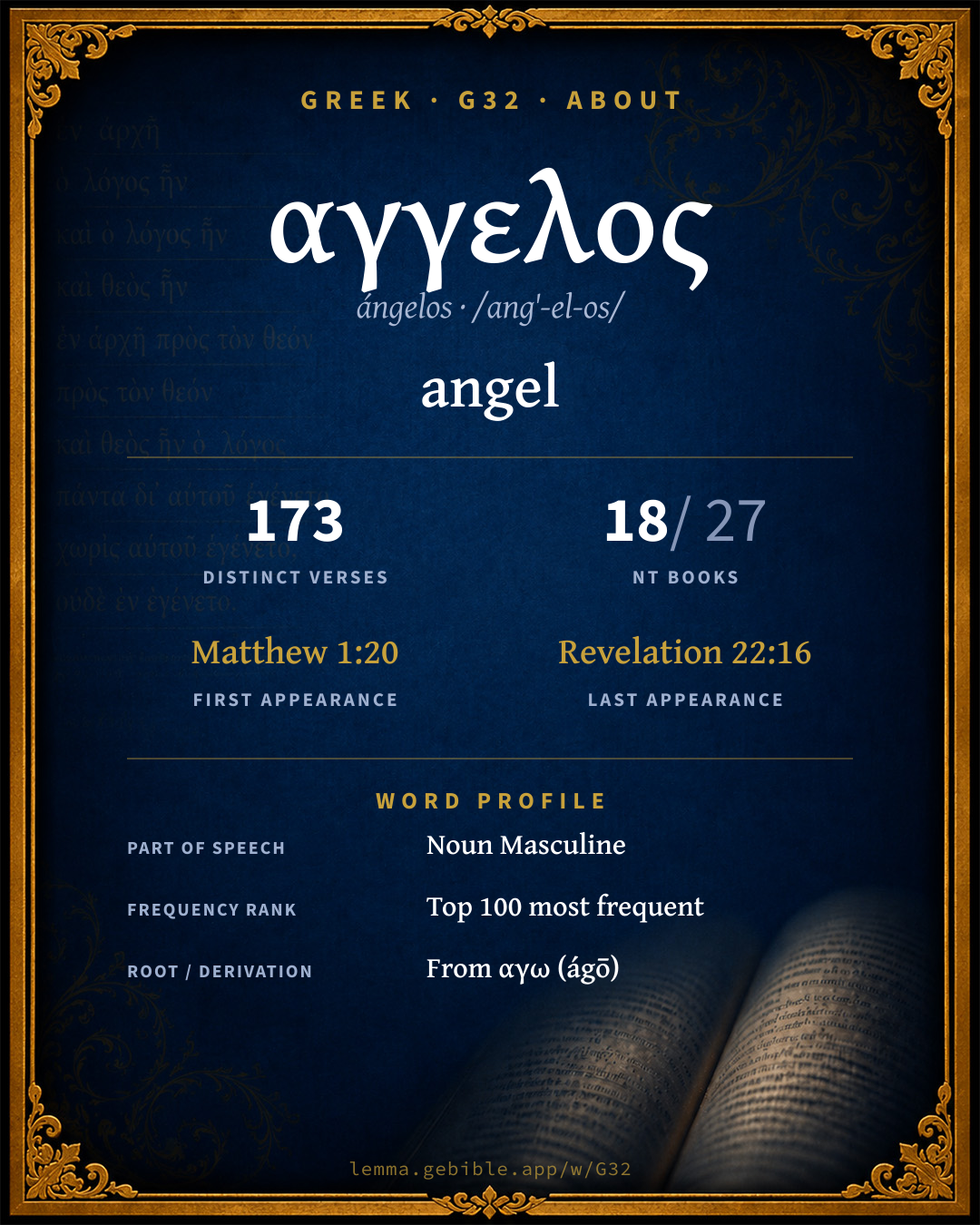
ἄγγελος
angel
Full lexicon entry — Thayer's Greek Lexicon
From Thayer's Greek Lexicon
Where this word appears
See every Nominative-case word in the Greek New Testament →
Grammar key — what these labels mean
Part of speech
- Noun
- A naming word — a person, place, thing, or idea.
- Verb
- An action or state-of-being word.
Tense
- Aorist
- Action viewed as a simple whole, without regard to duration — often past (perfective aspect).
Voice
- Active
- The subject performs the action.
Mood
- Indicative
- States a fact or asks a factual question (the mood of reality).
Case
- Nominative
- The case of the subject (and the predicate nominative).
- Genitive
- The case of source, possession, or “of” — answers “whose / from what.”
- Accusative
- The case of the direct object and of extent.
- Dative
- The case of the indirect object, means, or location — “to / for / with / in.”
Person
- 3rd person
- The one spoken about (“he / she / it / they”).
Gender
- Masculine
- Grammatically masculine.
Number
- Singular
- One.
- Plural
- More than one.
Grammatical forms 9 distinct
- Noun, Nominative, Singular, Masculine 48 times (27%)
- Noun, Genitive, Plural, Masculine 31 times (18%)
- Noun, Nominative, Plural, Masculine 23 times (13%)
- Noun, Accusative, Singular, Masculine 22 times (12%)
- Noun, Accusative, Plural, Masculine 20 times (11%)
- Noun, Genitive, Singular, Masculine 14 times (8%)
- Noun, Dative, Plural, Masculine 9 times (5%)
- Noun, Dative, Singular, Masculine 9 times (5%)
+1 more form (1 occurrence)
Parsed forms decoded from the imported morphology (Robinson–Tischendorf, public domain), counted across 177 parsed occurrences — not distinct verses.
Every verse where G32 appears — 173 distinct verses across 18 books. Click any verse to open its interlinear word-by-word view. Verse text shown in the World English Bible for context — . Each verse’s Greek form is shown with its reference; the English is not keyword-highlighted, since the data carries no word-level English alignment. Use “Compare translations” on any verse to read it across multiple English versions. This concordance covers the Greek New Testament; Septuagint (Greek Old Testament) occurrences of this word are not indexed here.
Matthew 20 verses
- Matthew 1:20 ἄγγελος n nom sg masc But when he thought about these things, behold, an angel of the Lord appeared to him in a dream, saying, "Joseph, son of David, don't be afraid to take to yourself Mary, your wife, for that which is conceived in her is of the Holy Spirit.
- Matthew 1:24 ἄγγελος n nom sg masc Joseph arose from his sleep, and did as the angel of the Lord commanded him, and took his wife to himself;
- Matthew 2:13 ἄγγελος n nom sg masc Now when they had departed, behold, an angel of the Lord appeared to Joseph in a dream, saying, "Arise and take the young child and his mother, and flee into Egypt, and stay there until I tell you, for Herod will seek the young child to destroy him."
- Matthew 2:19 ἄγγελος n nom sg masc But when Herod was dead, behold, an angel of the Lord appeared in a dream to Joseph in Egypt, saying,
- Matthew 4:6 ἀγγέλοις n dat pl masc and said to him, "If you are the Son of God, throw yourself down, for it is written, 'He will give his angels charge concerning you.' and, 'On their hands they will bear you up, So that you don't dash your foot against a stone.'"
- Matthew 4:11 ἄγγελοι n nom pl masc Then the devil left him, and behold, angels came and ministered to him.
- Matthew 11:10 ἄγγελόν n acc sg masc For this is he, of whom it is written, 'Behold, I send my messenger before your face, who will prepare your way before you.'
- Matthew 13:39 ἄγγελοί n nom pl masc The enemy who sowed them is the devil. The harvest is the end of the age, and the reapers are angels.
- Matthew 13:41 ἀγγέλους n acc pl masc The Son of Man will send out his angels, and they will gather out of his Kingdom all things that cause stumbling, and those who do iniquity,
- Matthew 13:49 ἄγγελοι n nom pl masc So will it be in the end of the world. The angels will come forth, and separate the wicked from among the righteous,
- Matthew 16:27 ἀγγέλων n gen pl masc For the Son of Man will come in the glory of his Father with his angels, and then he will render to everyone according to his deeds.
- Matthew 18:10 ἄγγελοι n nom pl masc See that you don't despise one of these little ones, for I tell you that in heaven their angels always see the face of my Father who is in heaven.
- Matthew 22:30 ἄγγελοι n nom pl masc For in the resurrection they neither marry, nor are given in marriage, but are like God's angels in heaven.
- Matthew 24:31 ἀγγέλους n acc pl masc He will send out his angels with a great sound of a trumpet, and they will gather together his chosen ones from the four winds, from one end of the sky to the other.
- Matthew 24:36 ἄγγελοι n nom pl masc But no one knows of that day and hour, not even the angels of heaven, but my Father only.
- Matthew 25:31 ἄγγελοι n nom pl masc "But when the Son of Man comes in his glory, and all the holy angels with him, then he will sit on the throne of his glory.
- Matthew 25:41 ἀγγέλοις n dat pl masc Then he will say also to those on the left hand, 'Depart from me, you cursed, into the eternal fire which is prepared for the devil and his angels;
- Matthew 26:53 ἀγγέλων n gen pl masc Or do you think that I couldn't ask my Father, and he would even now send me more than twelve legions of angels?
- Matthew 28:2 ἄγγελος n nom sg masc Behold, there was a great earthquake, for an angel of the Lord descended from the sky, and came and rolled away the stone from the door, and sat on it.
- Matthew 28:5 ἄγγελος n nom sg masc The angel answered the women, "Don't be afraid, for I know that you seek Jesus, who has been crucified.
Mark 6 verses
- Mark 1:2 ἄγγελόν n acc sg masc As it is written in the prophets, "Behold, I send my messenger before your face, Who will prepare your way before you.
- Mark 1:13 ἄγγελοι n nom pl masc He was there in the wilderness forty days tempted by Satan. He was with the wild animals; and the angels were ministering to him.
- Mark 8:38 ἀγγέλων n gen pl masc For whoever will be ashamed of me and of my words in this adulterous and sinful generation, the Son of Man also will be ashamed of him, when he comes in the glory of his Father with the holy angels."
- Mark 12:25 ἄγγελοι n nom pl masc For when they will rise from the dead, they neither marry, nor are given in marriage, but are like angels in heaven.
- Mark 13:27 ἀγγέλους n acc pl masc Then he will send out his angels, and will gather together his chosen ones from the four winds, from the ends of the earth to the ends of the sky.
- Mark 13:32 ἄγγελοι n nom pl masc But of that day or that hour no one knows, not even the angels in heaven, nor the Son, but only the Father.
Luke 26 verses
- Luke 1:11 ἄγγελος n nom sg masc An angel of the Lord appeared to him, standing on the right side of the altar of incense.
- Luke 1:13 ἄγγελος n nom sg masc But the angel said to him, "Don't be afraid, Zacharias, because your request has been heard, and your wife, Elizabeth, will bear you a son, and you shall call his name John.
- Luke 1:18 ἄγγελον n acc sg masc Zacharias said to the angel, "How can I be sure of this? For I am an old man, and my wife is well advanced in years."
- Luke 1:19 ἄγγελος n nom sg masc The angel answered him, "I am Gabriel, who stands in the presence of God. I was sent to speak to you, and to bring you this good news.
- Luke 1:26 ἄγγελος n nom sg masc Now in the sixth month, the angel Gabriel was sent from God to a city of Galilee, named Nazareth,
- Luke 1:28 ἄγγελος n nom sg masc Having come in, the angel said to her, "Rejoice, you highly favored one! The Lord is with you. Blessed are you among women!"
- Luke 1:30 ἄγγελος n nom sg masc The angel said to her, "Don't be afraid, Mary, for you have found favor with God.
- Luke 1:34 ἄγγελον n acc sg masc Mary said to the angel, "How can this be, seeing I am a virgin?"
- Luke 1:35 ἄγγελος n nom sg masc The angel answered her, "The Holy Spirit will come on you, and the power of the Most High will overshadow you. Therefore also the holy one who is born from you will be called the Son of God.
- Luke 1:38 ἄγγελος n nom sg masc Mary said, "Behold, the handmaid of the Lord; be it to me according to your word." The angel departed from her.
- Luke 2:9 ἄγγελος n nom sg masc Behold, an angel of the Lord stood by them, and the glory of the Lord shone around them, and they were terrified.
- Luke 2:10 ἄγγελος n nom sg masc The angel said to them, "Don't be afraid, for behold, I bring you good news of great joy which will be to all the people.
- Luke 2:13 ἀγγέλῳ n dat sg masc Suddenly, there was with the angel a multitude of the heavenly host praising God, and saying,
- Luke 2:15 ἄγγελοι n nom pl masc It happened, when the angels went away from them into the sky, that the shepherds said one to another, "Let's go to Bethlehem, now, and see this thing that has happened, which the Lord has made known to us."
- Luke 2:21 ἀγγέλου n gen sg masc When eight days were fulfilled for the circumcision of the child, his name was called Jesus, which was given by the angel before he was conceived in the womb.
- Luke 4:10 ἀγγέλοις n dat pl masc for it is written, 'He will give his angels charge concerning you, to guard you;'
- Luke 7:24 ἀγγέλων n gen pl masc When John's messengers had departed, he began to tell the multitudes about John, "What did you go out into the wilderness to see? A reed shaken by the wind?
- Luke 7:27 ἄγγελόν n acc sg masc This is he of whom it is written, 'Behold, I send my messenger before your face, Who will prepare your way before you.'
- Luke 9:26 ἀγγέλων n gen pl masc For whoever will be ashamed of me and of my words, of him will the Son of Man be ashamed, when he comes in his glory, and the glory of the Father, and of the holy angels.
- Luke 9:52 ἀγγέλους n acc pl masc and sent messengers before his face. They went, and entered into a village of the Samaritans, so as to prepare for him.
- Luke 12:8 ἀγγέλων n gen pl masc "I tell you, everyone who confesses me before men, him will the Son of Man also confess before the angels of God;
- Luke 12:9 ἀγγέλων n gen pl masc but he who denies me in the presence of men will be denied in the presence of the angels of God.
- Luke 15:10 ἀγγέλων n gen pl masc Even so, I tell you, there is joy in the presence of the angels of God over one sinner repenting."
- Luke 16:22 ἀγγέλων n gen pl masc It happened that the beggar died, and that he was carried away by the angels to Abraham's bosom. The rich man also died, and was buried.
- Luke 22:43 ἄγγελος n nom sg masc An angel from heaven appeared to him, strengthening him.
- Luke 24:23 ἀγγέλων n gen pl masc and when they didn't find his body, they came saying that they had also seen a vision of angels, who said that he was alive.
John 4 verses
- John 1:52 ἀγγέλους n acc pl masc
- John 4:51 ἤγγειλαν aor act ind 3pl As he was now going down, his servants met him and reported, saying "Your child lives!"
- John 12:29 ἄγγελος n nom sg masc The multitude therefore, who stood by and heard it, said that it had thundered. Others said, "An angel has spoken to him."
- John 20:12 ἀγγέλους n acc pl masc and she saw two angels in white sitting, one at the head, and one at the feet, where the body of Jesus had lain.
Acts 21 verses
- Acts 5:19 ἄγγελος n nom sg masc But an angel of the Lord opened the prison doors by night, and brought them out, and said,
- Acts 6:15 ἀγγέλου n gen sg masc All who sat in the council, fastening their eyes on him, saw his face like it was the face of an angel.
- Acts 7:30 ἄγγελος n nom sg masc "When forty years were fulfilled, an angel of the Lord appeared to him in the wilderness of Mount Sinai, in a flame of fire in a bush.
- Acts 7:35 ἀγγέλου n gen sg masc "This Moses, whom they refused, saying, 'Who made you a ruler and a judge?'--God has sent him as both a ruler and a deliverer by the hand of the angel who appeared to him in the bush.
- Acts 7:38 ἀγγέλου n gen sg masc This is he who was in the assembly in the wilderness with the angel that spoke to him on Mount Sinai, and with our fathers, who received living oracles to give to us,
- Acts 7:53 ἀγγέλων n gen pl masc You received the law as it was ordained by angels, and didn't keep it!"
- Acts 8:26 Ἄγγελος n nom sg masc But an angel of the Lord spoke to Philip, saying, "Arise, and go toward the south to the way that goes down from Jerusalem to Gaza. This is a desert."
- Acts 10:3 ἄγγελον n acc sg masc At about the ninth hour of the day, he clearly saw in a vision an angel of God coming to him, and saying to him, "Cornelius!"
- Acts 10:7 ἄγγελος n nom sg masc When the angel who spoke to him had departed, Cornelius called two of his household servants and a devout soldier of those who waited on him continually.
- Acts 10:22 ἀγγέλου n gen sg masc They said, "Cornelius, a centurion, a righteous man and one who fears God, and well spoken of by all the nation of the Jews, was directed by a holy angel to invite you to his house, and to listen to what you say."
- Acts 11:13 ἄγγελον n acc sg masc He told us how he had seen the angel standing in his house, and saying to him, 'Send to Joppa, and get Simon, whose surname is Peter,
- Acts 12:7 ἄγγελος n nom sg masc And behold, an angel of the Lord stood by him, and a light shone in the cell. He struck Peter on the side, and woke him up, saying, "Stand up quickly!" His chains fell off from his hands.
- Acts 12:8 ἄγγελος n nom sg masc The angel said to him, "Get dressed and put on your sandals." He did so. He said to him, "Put on your cloak, and follow me."
- Acts 12:9 ἀγγέλου n gen sg masc And he went out and followed him. He didn't know that what was being done by the angel was real, but thought he saw a vision.
- Acts 12:10 ἄγγελος n nom sg masc When they were past the first and the second guard, they came to the iron gate that leads into the city, which opened to them by itself. They went out, and went down one street, and immediately the angel departed from him.
- Acts 12:11 ἄγγελον n acc sg masc When Peter had come to himself, he said, "Now I truly know that the Lord has sent out his angel and delivered me out of the hand of Herod, and from everything the Jewish people were expecting."
- Acts 12:15 ἄγγελός n nom sg masc They said to her, "You are crazy!" But she insisted that it was so. They said, "It is his angel."
- Acts 12:23 ἄγγελος n nom sg masc Immediately an angel of the Lord struck him, because he didn't give God the glory, and he was eaten by worms and died.
- Acts 23:8 ἄγγελον n acc sg masc For the Sadducees say that there is no resurrection, nor angel, nor spirit; but the Pharisees confess all of these.
- Acts 23:9 ἄγγελος n nom sg masc A great clamor arose, and some of the scribes of the Pharisees part stood up, and contended, saying, "We find no evil in this man. But if a spirit or angel has spoken to him, let's not fight against God!"
- Acts 27:23 ἄγγελος n nom sg masc For there stood by me this night an angel, belonging to the God whose I am and whom I serve,
Romans 1 verse
1 Corinthians 4 verses
- 1 Corinthians 4:9 ἀγγέλοις n dat pl masc For, I think that God has displayed us, the apostles, last of all, like men sentenced to death. For we are made a spectacle to the world, both to angels and men.
- 1 Corinthians 6:3 ἀγγέλους n acc pl masc Don't you know that we will judge angels? How much more, things that pertain to this life?
- 1 Corinthians 11:10 ἀγγέλους n acc pl masc For this cause the woman ought to have authority on her head, because of the angels.
- 1 Corinthians 13:1 ἀγγέλων n gen pl masc If I speak with the languages of men and of angels, but don't have love, I have become sounding brass, or a clanging cymbal.
2 Corinthians 2 verses
- 2 Corinthians 11:14 ἄγγελον n acc sg masc And no wonder, for even Satan masquerades as an angel of light.
- 2 Corinthians 12:7 ἄγγελος n nom sg masc By reason of the exceeding greatness of the revelations, that I should not be exalted excessively, there was given to me a thorn in the flesh, a messenger of Satan to buffet me, that I should not be exalted excessively.
Galatians 3 verses
- Galatians 1:8 ἄγγελος n nom sg masc But even though we, or an angel from heaven, should preach to you any gospel other than that which we preached to you, let him be cursed.
- Galatians 3:19 ἀγγέλων n gen pl masc What then is the law? It was added because of transgressions, until the seed should come to whom the promise has been made. It was ordained through angels by the hand of a mediator.
- Galatians 4:14 ἄγγελον n acc sg masc That which was a temptation to you in my flesh, you didn't despise nor reject; but you received me as an angel of God, even as Christ Jesus.
Colossians 1 verse
2 Thessalonians 1 verse
1 Timothy 2 verses
- 1 Timothy 3:16 ἀγγέλοις n dat pl masc Without controversy, the mystery of godliness is great: God was revealed in the flesh, Justified in the spirit, Seen by angels, Preached among the nations, Believed on in the world, And received up in glory.
- 1 Timothy 5:21 ἀγγέλων n gen pl masc I charge you in the sight of God, and Christ Jesus, and the chosen angels, that you observe these things without prejudice, doing nothing by partiality.
Hebrews 12 verses
- Hebrews 1:4 ἀγγέλων n gen pl masc having become so much better than the angels, as he has inherited a more excellent name than they have.
- Hebrews 1:5 ἀγγέλων n gen pl masc For to which of the angels did he say at any time, "You are my Son, Today have I become your father?" and again, "I will be to him a Father, And he will be to me a Son?"
- Hebrews 1:6 ἄγγελοι n nom pl masc Again, when he brings in the firstborn into the world he says, "Let all the angels of God worship him."
- Hebrews 1:7 ἀγγέλους ἀγγέλους n acc pl masc n acc pl masc Of the angels he says, "Who makes his angels winds, And his servants a flame of fire."
- Hebrews 1:13 ἀγγέλων n gen pl masc But of which of the angels has he said at any time, "Sit at my right hand, Until I make your enemies the footstool of your feet?"
- Hebrews 2:2 ἀγγέλων n gen pl masc For if the word spoken through angels proved steadfast, and every transgression and disobedience received a just recompense;
- Hebrews 2:5 ἀγγέλοις n dat pl masc For he didn't subject the world to come, of which we speak, to angels.
- Hebrews 2:7 ἀγγέλους n acc pl masc You made him a little lower than the angels; You crowned him with glory and honor.
- Hebrews 2:9 ἀγγέλους n acc pl masc But we see him who has been made a little lower than the angels, Jesus, because of the suffering of death crowned with glory and honor, that by the grace of God he should taste of death for everyone.
- Hebrews 2:16 ἀγγέλων n gen pl masc For most assuredly, not to angels does he give help, but he gives help to the seed of Abraham.
- Hebrews 12:22 ἀγγέλων n gen pl masc But you have come to Mount Zion, and to the city of the living God, the heavenly Jerusalem, and to innumerable hosts of angels,
- Hebrews 13:2 ἀγγέλους n acc pl masc Don't forget to show hospitality to strangers, for in doing so, some have entertained angels without knowing it.
James 1 verse
1 Peter 2 verses
- 1 Peter 1:12 ἄγγελοι n nom pl masc To them it was revealed, that not to themselves, but to you, did they minister these things, which now have been announced to you through those who preached the Gospel to you by the Holy Spirit sent out from heaven; which things angels desire to look into.
- 1 Peter 3:22 ἀγγέλων n gen pl masc who is at the right hand of God, having gone into heaven, angels and authorities and powers being made subject to him.
2 Peter 2 verses
- 2 Peter 2:4 ἀγγέλων n gen pl masc For if God didn't spare angels when they sinned, but cast them down to Tartarus, and committed them to pits of darkness, to be reserved to judgment;
- 2 Peter 2:11 ἄγγελοι n nom pl masc whereas angels, though greater in might and power, don't bring a railing judgment against them before the Lord.
Jude 1 verse
Revelation 64 verses
- Revelation 1:1 ἀγγέλου n gen sg masc This is the Revelation of Jesus Christ, which God gave him to show to his servants the things which must happen soon, which he sent and made known by his angel to his servant, John,
- Revelation 1:20 ἄγγελοι n nom pl masc the mystery of the seven stars which you saw in my right hand, and the seven golden lampstands. The seven stars are the angels of the seven assemblies. The seven lampstands are seven assemblies.
- Revelation 2:1 ἀγγέλῳ n dat sg masc To the angel of the assembly in Ephesus write: "He who holds the seven stars in his right hand, he who walks among the seven golden lampstands says these things:
- Revelation 2:8 ἀγγέλῳ n dat sg masc "To the angel of the assembly in Smyrna write: "The first and the last, who was dead, and has come to life says these things:
- Revelation 2:12 ἀγγέλῳ n dat sg masc "To the angel of the assembly in Pergamum write: "He who has the sharp two-edged sword says these things:
- Revelation 2:18 ἀγγέλῳ n dat sg masc "To the angel of the assembly in Thyatira write: "The Son of God, who has his eyes like a flame of fire, and his feet are like burnished brass, says these things:
- Revelation 3:1 ἀγγέλῳ n dat sg masc "And to the angel of the assembly in Sardis write: He who has the seven Spirits of God, and the seven stars says these things: "I know your works, that you have a reputation of being alive, but you are dead.
- Revelation 3:5 ἀγγέλων n gen pl masc He who overcomes will be arrayed in white garments, and I will in no way blot his name out of the book of life, and I will confess his name before my Father, and before his angels.
- Revelation 3:7 ἀγγέλῳ n dat sg masc "To the angel of the assembly in Philadelphia write: "He who is holy, he who is true, he who has the key of David, he who opens and no one can shut, and who shuts and no one opens, says these things:
- Revelation 3:14 ἀγγέλῳ n dat sg masc "To the angel of the assembly in Laodicea write: "The Amen, the Faithful and True Witness, the Head of God's creation, says these things:
- Revelation 5:2 ἄγγελον n acc sg masc I saw a mighty angel proclaiming with a loud voice, "Who is worthy to open the book, and to break its seals?"
- Revelation 5:11 ἀγγέλων n gen pl masc I saw, and I heard something like a voice of many angels around the throne, the living creatures, and the elders; and the number of them was ten thousands of ten thousands, and thousands of thousands;
- Revelation 7:1 ἀγγέλους n acc pl masc After this, I saw four angels standing at the four corners of the earth, holding the four winds of the earth, so that no wind would blow on the earth, or on the sea, or on any tree.
- Revelation 7:2 ἄγγελον ἀγγέλοις n acc sg masc n dat pl masc I saw another angel ascend from the sunrise, having the seal of the living God. He cried with a loud voice to the four angels to whom it was given to harm the earth and the sea,
- Revelation 7:11 ἄγγελοι n nom pl masc All the angels were standing around the throne, the elders, and the four living creatures; and they fell on their faces before his throne, and worshiped God,
- Revelation 8:2 ἀγγέλους n acc pl masc I saw the seven angels who stand before God, and seven trumpets were given to them.
- Revelation 8:3 ἄγγελος n nom sg masc Another angel came and stood over the altar, having a golden censer. Much incense was given to him, that he should add it to the prayers of all the saints on the golden altar which was before the throne.
- Revelation 8:4 ἀγγέλου n gen sg masc The smoke of the incense, with the prayers of the saints, went up before God out of the angel's hand.
- Revelation 8:5 ἄγγελος n nom sg masc The angel took the censer, and he filled it with the fire of the altar, and threw it on the earth. There followed thunders, sounds, lightnings, and an earthquake.
- Revelation 8:6 ἄγγελοι n nom pl masc The seven angels who had the seven trumpets prepared themselves to sound.
- Revelation 8:8 ἄγγελος n nom sg masc The second angel sounded, and something like a great burning mountain was thrown into the sea. One third of the sea became blood,
- Revelation 8:10 ἄγγελος n nom sg masc The third angel sounded, and a great star fell from the sky, burning like a torch, and it fell on one third of the rivers, and on the springs of the waters.
- Revelation 8:12 ἄγγελος n nom sg masc The fourth angel sounded, and one third of the sun was struck, and one third of the moon, and one third of the stars; so that one third of them would be darkened, and the day wouldn't shine for one third of it, and the night in the same way.
- Revelation 8:13 ἀγγέλων n gen pl masc I saw, and I heard an eagle, flying in mid heaven, saying with a loud voice, "Woe! Woe! Woe for those who dwell on the earth, because of the other voices of the trumpets of the three angels, who are yet to sound!"
- Revelation 9:1 ἄγγελος n nom sg masc The fifth angel sounded, and I saw a star from the sky which had fallen to the earth. The key to the pit of the abyss was given to him.
- Revelation 9:11 ἄγγελον n acc sg masc They have over them as king the angel of the abyss. His name in Hebrew is "Abaddon," but in Greek, he has the name "Apollyon."
- Revelation 9:13 ἄγγελος n nom sg masc The sixth angel sounded. I heard a voice from the horns of the golden altar which is before God,
- Revelation 9:14 ἀγγέλῳ ἀγγέλους n dat sg masc n acc pl masc saying to the sixth angel who had one trumpet, "Free the four angels who are bound at the great river Euphrates!"
- Revelation 9:15 ἄγγελοι n nom pl masc The four angels were freed who had been prepared for that hour and day and month and year, so that they might kill one third of mankind.
- Revelation 10:1 ἄγγελον n acc sg masc I saw a mighty angel coming down out of the sky, clothed with a cloud. A rainbow was on his head. His face was like the sun, and his feet like pillars of fire.
- Revelation 10:5 ἄγγελος n nom sg masc The angel who I saw standing on the sea and on the land lifted up his right hand to the sky,
- Revelation 10:7 ἀγγέλου n gen sg masc but in the days of the voice of the seventh angel, when he is about to sound, then the mystery of God is finished, as he declared to his servants, the prophets.
- Revelation 10:8 ἀγγέλου n gen sg masc The voice which I heard from heaven, again speaking with me, said, "Go, take the book which is open in the hand of the angel who stands on the sea and on the land."
- Revelation 10:9 ἄγγελον n acc sg masc I went to the angel, telling him to give me the little book. He said to me, "Take it, and eat it up. It will make your stomach bitter, but in your mouth it will be as sweet as honey."
- Revelation 10:10 ἀγγέλου n gen sg masc I took the little book out of the angel's hand, and ate it up. It was as sweet as honey in my mouth. When I had eaten it, my stomach was made bitter.
- Revelation 11:15 ἄγγελος n nom sg masc The seventh angel sounded, and great voices in heaven followed, saying, "The kingdom of the world has become the Kingdom of our Lord, and of his Christ. He will reign forever and ever!"
- Revelation 12:7 ἄγγελοι ἄγγελοι n nom pl masc n nom pl masc There was war in the sky. Michael and his angels made war on the dragon. The dragon and his angels made war.
- Revelation 12:9 ἄγγελοι n nom pl masc The great dragon was thrown down, the old serpent, he who is called the devil and Satan, the deceiver of the whole world. He was thrown down to the earth, and his angels were thrown down with him.
- Revelation 14:6 ἄγγελον n acc sg masc I saw an angel flying in mid heaven, having an eternal Gospel to proclaim to those who dwell on the earth, and to every nation, tribe, language, and people.
- Revelation 14:8 ἄγγελος n nom sg masc Another, a second angel, followed, saying, "Babylon the great has fallen, which has made all the nations to drink of the wine of the wrath of her sexual immorality."
- Revelation 14:9 ἄγγελος n nom sg masc Another angel, a third, followed them, saying with a great voice, "If anyone worships the beast and his image, and receives a mark on his forehead, or on his hand,
- Revelation 14:10 ἀγγέλων n gen pl masc he also will drink of the wine of the wrath of God, which is prepared unmixed in the cup of his anger. He will be tormented with fire and sulfur in the presence of the holy angels, and in the presence of the Lamb.
- Revelation 14:15 ἄγγελος n nom sg masc Another angel came out from the temple, crying with a loud voice to him who sat on the cloud, "Send forth your sickle, and reap; for the hour to reap has come; for the harvest of the earth is ripe!"
- Revelation 14:17 ἄγγελος n nom sg masc Another angel came out from the temple which is in heaven. He also had a sharp sickle.
- Revelation 14:18 ἄγγελος n nom sg masc Another angel came out from the altar, he who has power over fire, and he called with a great voice to him who had the sharp sickle, saying, "Send forth your sharp sickle, and gather the clusters of the vine of the earth, for the earth's grapes are fully ripe!"
- Revelation 14:19 ἄγγελος n nom sg masc The angel thrust his sickle into the earth, and gathered the vintage of the earth, and threw it into the great winepress of the wrath of God.
- Revelation 15:1 ἀγγέλους n acc pl masc I saw another great and marvelous sign in the sky: seven angels having the seven last plagues, for in them God's wrath is finished.
- Revelation 15:6 ἄγγελοι n nom pl masc The seven angels who had the seven plagues came out, clothed with pure, bright linen, and wearing golden sashes around their breasts.
- Revelation 15:7 ἀγγέλοις n dat pl masc One of the four living creatures gave to the seven angels seven golden bowls full of the wrath of God, who lives forever and ever.
- Revelation 15:8 ἀγγέλων n gen pl masc The temple was filled with smoke from the glory of God, and from his power. No one was able to enter into the temple, until the seven plagues of the seven angels would be finished.
- Revelation 16:1 ἀγγέλοις n dat pl masc I heard a loud voice out of the temple, saying to the seven angels, "Go and pour out the seven bowls of the wrath of God on the earth!"
- Revelation 16:5 ἀγγέλου n gen sg masc I heard the angel of the waters saying, "You are righteous, who are and who were, you Holy One, because you have judged these things.
- Revelation 17:1 ἀγγέλων n gen pl masc One of the seven angels who had the seven bowls came and spoke with me, saying, "Come here. I will show you the judgment of the great prostitute who sits on many waters,
- Revelation 17:7 ἄγγελος n nom sg masc The angel said to me, "Why do you wonder? I will tell you the mystery of the woman, and of the beast that carries her, which has the seven heads and the ten horns.
- Revelation 18:1 ἄγγελον n acc sg masc After these things, I saw another angel coming down out of the sky, having great authority. The earth was illuminated with his glory.
- Revelation 18:21 ἄγγελος n nom sg masc A mighty angel took up a stone like a great millstone and cast it into the sea, saying, "Thus with violence will Babylon, the great city, be thrown down, and will be found no more at all.
- Revelation 19:17 ἄγγελον n acc sg masc I saw an angel standing in the sun. He cried with a loud voice, saying to all the birds that fly in the sky, "Come! Be gathered together to the great supper of God,
- Revelation 20:1 ἄγγελον n acc sg masc I saw an angel coming down out of heaven, having the key of the abyss and a great chain in his hand.
- Revelation 21:9 ἀγγέλων n gen pl masc One of the seven angels who had the seven bowls, who were loaded with the seven last plagues came, and he spoke with me, saying, "Come here. I will show you the wife, the Lamb's bride."
- Revelation 21:12 ἀγγέλους n acc pl masc having a great and high wall; having twelve gates, and at the gates twelve angels; and names written on them, which are the names of the twelve tribes of the children of Israel.
- Revelation 21:17 ἀγγέλου n gen sg masc Its wall is one hundred forty-four cubits, by the measure of a man, that is, of an angel.
- Revelation 22:6 ἄγγελον n acc sg masc He said to me, "These words are faithful and true. The Lord God of the spirits of the prophets sent his angel to show to his bondservants the things which must happen soon."
- Revelation 22:8 ἀγγέλου n gen sg masc Now I, John, am the one who heard and saw these things. When I heard and saw, I fell down to worship before the feet of the angel who had shown me these things.
- Revelation 22:16 ἄγγελόν n acc sg masc I, Jesus, have sent my angel to testify these things to you for the assemblies. I am the root and the offspring of David; the Bright and Morning Star."
About this entry
At a glance — auto-summarized from this page’s data, not written by a person. Every figure links to its source below. This summary describes the numbers; it doesn’t interpret them.
“angel” is the headline sense of the Greek noun αγγελος (ángelos). Scripture first uses it in Matthew 1:20. It appears 173 verses across 18 books of the Greek New Testament, among its common vocabulary. More than a third of its appearances fall in Revelation. It shares a root with αγω, αγε and αγελη. See the sense tree, 173-verse concordance, and the renderings breakdown below.
Gloss history
Strong's 1890 vs modern scholarship
About this word
Strong's G32 catalogs a Greek word from the Greek New Testament.
These counts are not copied from any lexicon or concordance. They are computed here, from the morphology-tagged Greek New Testament. What Lemma adds →
- 173
- distinct verses
- The word appears in 173 distinct verses.
- 18 / 27
- NT books
- The word appears in 18 of 27 New Testament books.
- #88
- by frequency
- Top 100 most frequent Greek words (rank 88 of 5,347 Greek words by occurrence).
View all 173 occurrences in the concordance →
Most concentrated in
- Revelation 64 verses 37%
- Luke 26 verses 15%
- Acts 21 verses 12%
By section of the New Testament
By traditional corpus
Conventional, traditional groupings — biblical authorship is debated, so this is a traditional corpus grouping, not an authorship claim. Some books belong to more than one corpus (Luke is in both the Gospels and the Lukan corpus, and so on), so these shares overlap and need not total 100%. Each figure is a share of the word’s 173 distinct verses.
- Johannine 68 verses · 39%
- Revelation 64 verses · 37%
- Gospels 56 verses · 32%
- Lukan (Luke–Acts) 47 verses · 27%
- Pauline corpus 14 verses · 8%
- Hebrews 12 verses · 7%
- General (Catholic) Epistles 6 verses · 3%
How translations render this word
Counts come from each version’s own published word-to-Strong’s tagging or interlinear alignment — an approximate guide to how each version renders this word, not a word-level alignment the data otherwise carries. Because each total is that version’s own tagged count, the per-version totals vary from one another and need not match the appearance or distinct-verse counts above. These counts may also differ from a printed concordance because Lemma counts each distinctly tagged rendering and does not collapse phrase taggings into a single head-word total. This is a fixed set of word-tagged versions (KJV, ASV, BSB, ULT) and does not change with the reading translation you choose elsewhere. Each version’s license is shown beside its name below (and on Sources).
- King James Version: Angel 96×, Angels 79×, Messenger 4×
- American Standard Version: Angel 82×, Angels 79×, Messenger 4×
- Berean Standard Bible: Angel 86×, Angels 81×, Messenger 4×
- unfoldingWord Literal Text: Angel 88×, Angels 81×, The 9×
King James Version Public Domain
Renders G32 across 186 tagged occurrences — most commonly:
Plus 2 renderings that appear only once — usually multi-word phrases or single function words the recovered tagging swept in, not distinct renderings.
American Standard Version Public Domain
Renders G32 across 177 tagged occurrences — most commonly:
Plus 6 renderings that appear only once — usually multi-word phrases or single function words the recovered tagging swept in, not distinct renderings.
Berean Standard Bible Public Domain
Renders G32 across 175 tagged occurrences — most commonly:
Plus 2 renderings that appear only once — usually multi-word phrases or single function words the recovered tagging swept in, not distinct renderings.
unfoldingWord Literal Text CC BY-SA 4.0
Renders G32 across 189 tagged occurrences — most commonly:
Plus 2 renderings that appear only once — usually multi-word phrases or single function words the recovered tagging swept in, not distinct renderings.
Senses in Thayer's
The 1 sense Thayer's distinguishes for this word, in lexicon order (not ranked by frequency or importance). The full entry — with sub-senses — is in the Lexicon Entry tab.
- a messenger, envoy, one who is sent, an angel, a messenger from God
Word origin
Derived from αγω (ágō) (G71) — to lead.
Forms in the corpus
The 13 distinct written forms G32 takes in the Greek New Testament, most frequent first — each parse links to that case’s occurrences in the concordance.
| Form | Parsing | Example | Uses |
|---|---|---|---|
| ἄγγελος ángelos | Noun, Nominative, Singular, Masculine | Matthew 1:20 | 46 |
| ἀγγέλων angélōn | Noun, Genitive, Plural, Masculine | Matthew 16:27 | 31 |
| ἄγγελοι ángeloi | Noun, Nominative, Plural, Masculine | Matthew 4:11 | 22 |
| ἀγγέλους angélous | Noun, Accusative, Plural, Masculine | Matthew 13:41 | 20 |
| ἄγγελον ángelon | Noun, Accusative, Singular, Masculine | Luke 1:18 | 18 |
| ἀγγέλου angélou | Noun, Genitive, Singular, Masculine | Luke 2:21 | 14 |
| ἀγγέλοις angélois | Noun, Dative, Plural, Masculine | Matthew 4:6 | 9 |
| ἀγγέλῳ angélō | Noun, Dative, Singular, Masculine | Luke 2:13 | 9 |
| ἄγγελόν ángelón | Noun, Accusative, Singular, Masculine | Matthew 11:10 | 4 |
| ἄγγελοί ángeloí | Noun, Nominative, Plural, Masculine | Matthew 13:39 | 1 |
| ἄγγελός ángelós | Noun, Nominative, Singular, Masculine | Acts 12:15 | 1 |
| Ἄγγελος Ángelos | Noun, Nominative, Singular, Masculine | Acts 8:26 | 1 |
| ἤγγειλαν ḗngeilan | Verb, Aorist, Active, Indicative, 3rd person, Plural | John 4:51 | 1 |
Same root — word family
Other Thayer's entries built from the same root as G32, grouped by Strong’s listed origin. These share a root / origin per the lexicon — not necessarily a shared meaning. Each links to that word’s own entry.
Derives from
Shares the same root
- αγε áge G33 come
- αγελη agélē G34 herd
- αγρα ágra G61 prey
- αγρος agrós G68 land
- αγωγη agōgḗ G72 conduct
- αγων agṓn G73 assembly
- αξιος áxios G514 worthy
- ηγεομαι hēgéomai G2233 to govern
Derived from this word
Compare all same-root words → Showing 4 of 11 — not the complete family. They share a root, not necessarily a meaning.
Septuagint usage
The same Greek word αγγελος appears 246 times in the Greek Old Testament (Septuagint), across 230 verses in 24 books.
- 246
- LXX occurrences
- Tagged occurrences of this Greek word in the Septuagint.
- 230
- verses
- Distinct Septuagint verses containing this word.
- 24 / 39
- OT books
- The word appears in 24 of the 39 Old Testament books.
Sample Septuagint occurrences
- Genesis 16:7 ἄγγελος
- Exodus 3:2 ἄγγελος
- Numbers 20:14 ἄγγελος
- Deuteronomy 32:8 ἄγγελος
- Joshua 7:22 ἄγγελος
- Judges 2:1 ἄγγελος
- 1 Samuel 6:21 ἄγγελος
- 2 Samuel 2:5 ἄγγελος
- 1 Kings 13:18 ἄγγελος
- 2 Kings 1:2 ἄγγελος
- 1 Chronicles 14:1 ἄγγελος
- 2 Chronicles 18:12 ἄγγελος
Septuagint occurrences (same lexeme)
Every verse where the same Strong’s number (G32) appears in the Greek Septuagint — showing the first 50 of 230. Verse text shown in the World English Bible for context; the Greek form is the matched word — the English is not keyword-highlighted.
- Genesis 16:7 ἄγγελος The angel of Yahweh found her by a fountain of water in the wilderness, by the fountain in the way to Shur.
- Genesis 16:8 ἄγγελος He said, "Hagar, Sarai's handmaid, where did you come from? Where are you going?" She said, "I am fleeing from the face of my mistress Sarai."
- Genesis 16:9 ἄγγελος The angel of Yahweh said to her, "Return to your mistress, and submit yourself under her hands."
- Genesis 16:10 ἄγγελος The angel of Yahweh said to her, "I will greatly multiply your seed, that they will not be numbered for multitude."
- Genesis 16:11 ἄγγελος The angel of Yahweh said to her, "Behold, you are with child, and will bear a son. You shall call his name Ishmael, because Yahweh has heard your affliction.
- Genesis 19:1 ἄγγελος The two angels came to Sodom at evening. Lot sat in the gate of Sodom. Lot saw them, and rose up to meet them. He bowed himself with his face to the earth,
- Genesis 19:15 ἄγγελος When the morning arose, then the angels hurried Lot, saying, "Arise, take your wife, and your two daughters who are here, lest you be consumed in the iniquity of the city."
- Genesis 19:16 ἄγγελος But he lingered; and the men laid hold on his hand, and on the hand of his wife, and on the hand of his two daughters, Yahweh being merciful to him; and they took him out, and set him outside of the city.
- Genesis 21:17 ἄγγελος God heard the voice of the boy. The angel of God called to Hagar out of the sky, and said to her, "What ails you, Hagar? Don't be afraid. For God has heard the voice of the boy where he is.
- Genesis 22:11 ἄγγελος The angel of Yahweh called to him out of the sky, and said, "Abraham, Abraham!" He said, "Here I am."
- Genesis 22:15 ἄγγελος The angel of Yahweh called to Abraham a second time out of the sky,
- Genesis 24:7 ἄγγελος Yahweh, the God of heaven, who took me from my father's house, and from the land of my birth, who spoke to me, and who swore to me, saying, 'I will give this land to your seed.' He will send his angel before you, and you shall take a wife for my son from there.
- Genesis 24:40 ἄγγελος He said to me, 'Yahweh, before whom I walk, will send his angel with you, and prosper your way. You shall take a wife for my son of my relatives, and of my father's house.
- Genesis 28:12 ἄγγελος He dreamed. Behold, a stairway set up on the earth, and the top of it reached to heaven. Behold, the angels of God ascending and descending on it.
- Genesis 31:11 ἄγγελος The angel of God said to me in the dream, 'Jacob,' and I said, 'Here I am.'
- Genesis 32:2 ἄγγελος When he saw them, Jacob said, "This is God's host." He called the name of that place Mahanaim.
- Genesis 32:4 ἄγγελος He commanded them, saying, "This is what you shall tell my lord, Esau: 'This is what your servant, Jacob, says. I have lived as a foreigner with Laban, and stayed until now.
- Genesis 32:7 ἄγγελος Then Jacob was greatly afraid and was distressed: and he divided the people who were with him, and the flocks, and the herds, and the camels, into two companies;
- Genesis 48:16 ἄγγελος the angel who has redeemed me from all evil, bless the lads, and let my name be named on them, and the name of my fathers Abraham and Isaac. Let them grow into a multitude in the midst of the earth."
- Exodus 3:2 ἄγγελος The angel of Yahweh appeared to him in a flame of fire out of the midst of a bush. He looked, and behold, the bush burned with fire, and the bush was not consumed.
- Exodus 4:24 ἄγγελος It happened on the way at a lodging place, that Yahweh met him and wanted to kill him.
- Exodus 14:19 ἄγγελος The angel of God, who went before the camp of Israel, moved and went behind them; and the pillar of cloud moved from before them, and stood behind them.
- Exodus 23:20 ἄγγελος "Behold, I send an angel before you, to keep you by the way, and to bring you into the place which I have prepared.
- Exodus 23:23 ἄγγελος For my angel shall go before you, and bring you in to the Amorite, the Hittite, the Perizzite, the Canaanite, the Hivite, and the Jebusite; and I will cut them off.
- Exodus 32:34 ἄγγελος Now go, lead the people to the place of which I have spoken to you. Behold, my angel shall go before you. Nevertheless in the day when I punish, I will punish them for their sin."
- Exodus 33:2 ἄγγελος I will send an angel before you; and I will drive out the Canaanite, the Amorite, and the Hittite, and the Perizzite, the Hivite, and the Jebusite:
- Numbers 20:14 ἄγγελος Moses sent messengers from Kadesh to the king of Edom, Thus says your brother Israel, You know all the travail that has happened to us:
- Numbers 20:16 ἄγγελος and when we cried to Yahweh, he heard our voice, and sent an angel, and brought us forth out of Egypt: and, behold, we are in Kadesh, a city in the uttermost of your border.
- Numbers 22:22 ἄγγελος God's anger was kindled because he went; and the angel of Yahweh placed himself in the way for an adversary against him. Now he was riding on his donkey, and his two servants were with him.
- Numbers 22:23 ἄγγελος The donkey saw the angel of Yahweh standing in the way, with his sword drawn in his hand; and the donkey turned aside out of the way, and went into the field: and Balaam struck the donkey, to turn her into the way.
- Numbers 22:24 ἄγγελος Then the angel of Yahweh stood in a narrow path between the vineyards, a wall being on this side, and a wall on that side.
- Numbers 22:25 ἄγγελος The donkey saw the angel of Yahweh, and she thrust herself to the wall, and crushed Balaam's foot against the wall: and he struck her again.
- Numbers 22:26 ἄγγελος The angel of Yahweh went further, and stood in a narrow place, where was no way to turn either to the right hand or to the left.
- Numbers 22:27 ἄγγελος The donkey saw the angel of Yahweh, and she lay down under Balaam: and Balaam's anger was kindled, and he struck the donkey with his staff.
- Numbers 22:31 ἄγγελος Then Yahweh opened the eyes of Balaam, and he saw the angel of Yahweh standing in the way, with his sword drawn in his hand; and he bowed his head, and fell on his face.
- Numbers 22:32 ἄγγελος The angel of Yahweh said to him, Why have you struck your donkey these three times? behold, I am come forth for an adversary, because your way is perverse before me:
- Numbers 22:34 ἄγγελος Balaam said to the angel of Yahweh, I have sinned; for I didn't know that you stood in the way against me: now therefore, if it displease you, I will get me back again.
- Numbers 22:35 ἄγγελος The angel of Yahweh said to Balaam, Go with the men; but only the word that I shall speak to you, that you shall speak. So Balaam went with the princes of Balak.
- Numbers 24:12 ἄγγελος Balaam said to Balak, Didn't I also tell your messengers who you sent to me, saying,
- Deuteronomy 32:8 ἄγγελος When the Most High gave to the nations their inheritance, When he separated the children of men, He set the bounds of the peoples According to the number of the children of Israel.
- Deuteronomy 32:43 ἄγγελος Rejoice, you nations, [with] his people: For he will avenge the blood of his servants, Will render vengeance to his adversaries, Will make expiation for his land, for his people.
- Deuteronomy 33:2 ἄγγελος He said, Yahweh came from Sinai, Rose from Seir to them; He shined forth from Mount Paran, He came from the ten thousands of holy ones: At his right hand was a fiery law for them.
- Joshua 7:22 ἄγγελος So Joshua sent messengers, and they ran to the tent; and, behold, it was hid in his tent, and the silver under it.
- Judges 2:1 ἄγγελος The angel of Yahweh came up from Gilgal to Bochim. He said, I made you to go up out of Egypt, and have brought you to the land which I swore to your fathers; and I said, I will never break my covenant with you:
- Judges 2:4 ἄγγελος It happened, when the angel of Yahweh spoke these words to all the children of Israel, that the people lifted up their voice, and wept.
- Judges 4:8 ἄγγελος Barak said to her, If you will go with me, then I will go; but if you will not go with me, I will not go.
- Judges 5:16 ἄγγελος Why sat you among the sheepfolds, To hear the whistling for the flocks? At the watercourses of Reuben There were great searchings of heart.
- Judges 5:23 ἄγγελος Curse you Meroz, said the angel of Yahweh. Curse you bitterly the inhabitants of it, Because they didn't come to the help of Yahweh, To the help of Yahweh against the mighty.
- Judges 6:11 ἄγγελος The angel of Yahweh came, and sat under the oak which was in Ophrah, that pertained to Joash the Abiezrite: and his son Gideon was beating out wheat in the winepress, to hide it from the Midianites.
- Judges 6:12 ἄγγελος The angel of Yahweh appeared to him, and said to him, Yahweh is with you, you mighty man of valor.
These are occurrences of the same Greek lexeme (G32) in the Septuagint — not a translation of any one Hebrew word. The store carries no word-level Hebrew↔Greek alignment, so no Hebrew original is asserted here. Counts come from the recovered LXX Strong's tagging — high-frequency vocabulary is well covered, while rare or late forms may be untagged — so they reflect tagged occurrences and may slightly undercount.