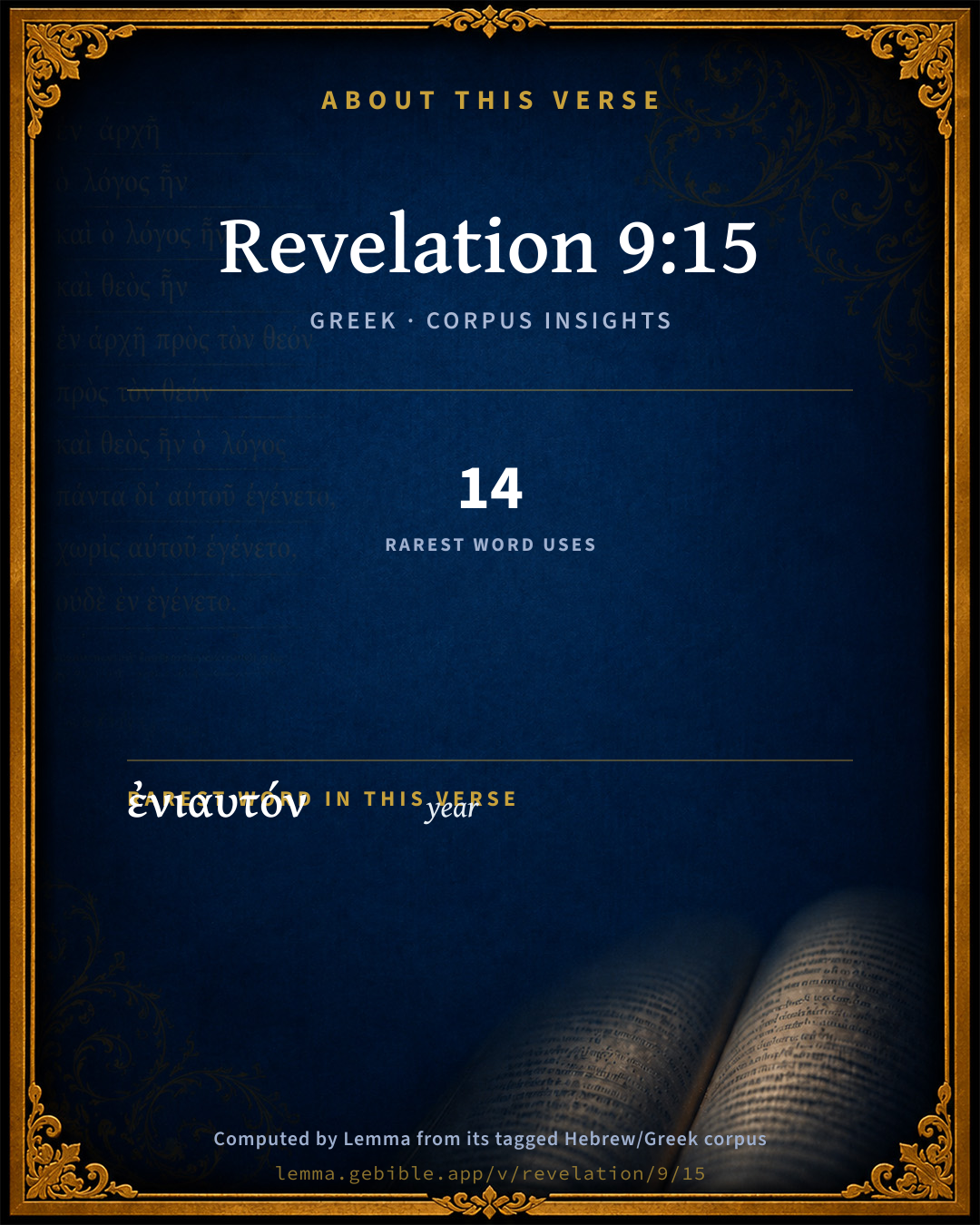
Revelation 9:15

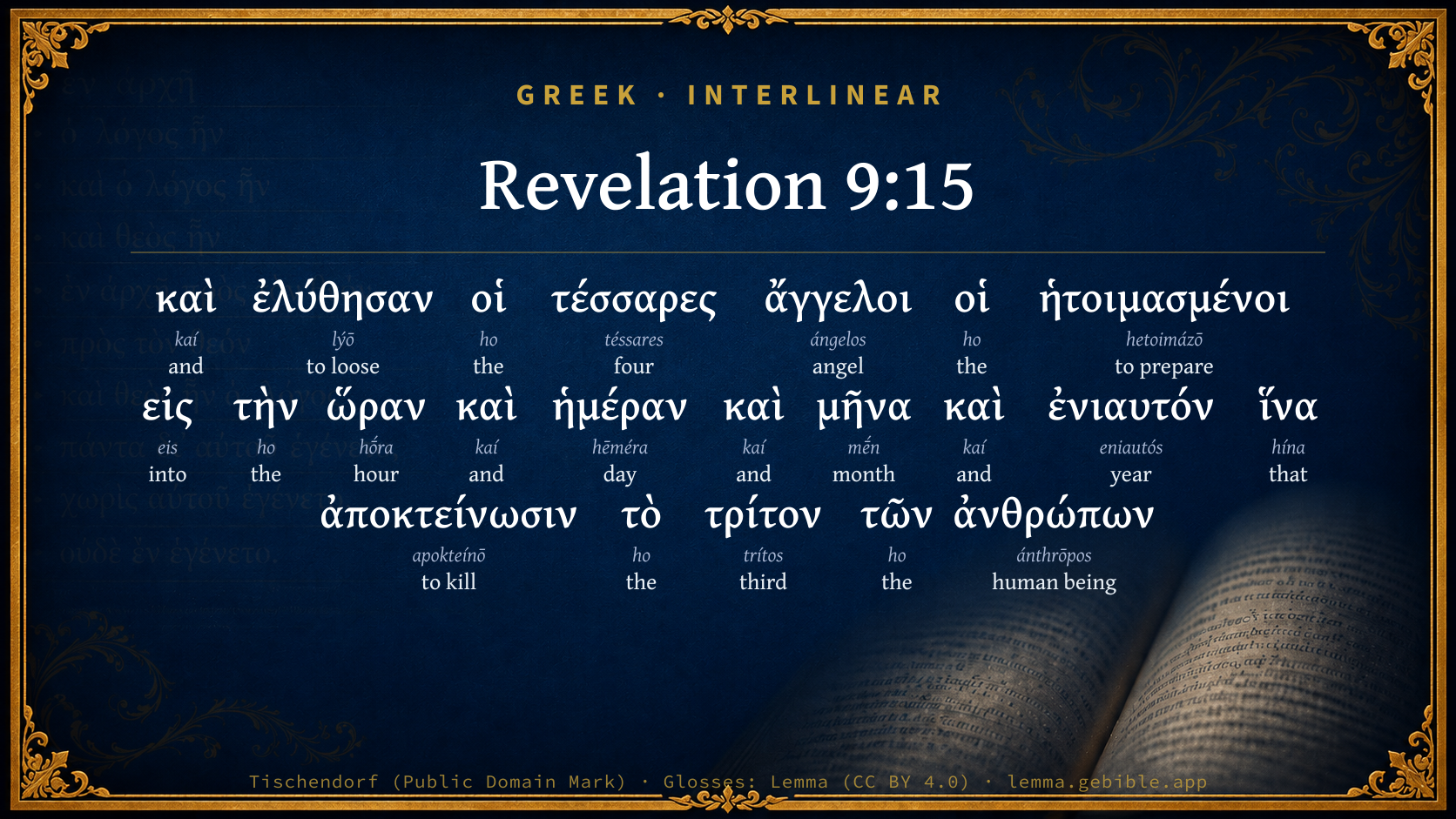
Greek (Tischendorf 8th ed.) Revelation 9:15 appears in the Greek New Testament. The text above is from the Tischendorf 8th edition. Each word links to its Strong’s number and a concise gloss. Click any word for its full Thayer’s Greek Lexicon entry.
Download image
Cite this verse

Revelation 9:15 (World English Bible). Public Domain. Lemma interlinear Bible study tool, https://lemma.gebible.app/v/revelation/9/15.

Show BibTeX & RIS
BibTeX
RIS
English Translation
The four angels were freed who had been prepared for that hour and day and month and year, so that they might kill one third of mankind.
World English Bible · Public Domain
Download a study sheet

One document with this verse’s original text, its word-by-word gloss line, the meaning frame, cross-references with their text, attributed commentary, and full source and license credits — printable, and it pastes into notes with its structure intact.

This verse Autodidact and up

Study sheet (.html) Plain text (.txt)

A passage Seminary Student

Up to 50 verses in one chapter. A passage sheet keeps up to 6 commentary sources and 12 cross-references per verse, in the order this page ranks them, and says so on the sheet whenever that leaves anything out. Ask for a single verse and you get the Autodidact verse sheet above.

Everything on this page stays free to read, with no account — the sheet is a download of what is already on screen, not access to it.

Want to remove ads? Support Godless Engineer
Compare translations 3

The same verse in 3 English versions, stacked beneath the original-language interlinear above. Click any original word for its lexicon entry.

Each is an independent rendering of the whole verse — the interlinear is not word-aligned to these translations.

Highlighted words mark where these versions differ — a whole-verse word diff, not a word-by-word alignment.

  • World English Bible Public Domain
    The four angels were freed who had been prepared for that hour and day and month and year, so that they might kill one third of mankind.
  • King James Version Public Domain
    And the four angels were loosed, which were prepared for an hour, and a day, and a month, and a year, for to slay the third part of men.
  • unfoldingWord Literal Text CC BY-SA 4.0
    And the four angels having been prepared for the hour and day and month and year were released so that they might kill a third of men.

unfoldingWord Literal Text — © unfoldingWord, licensed CC BY-SA 4.0. Word-aligned USFM3 via Door43 (git.door43.org/unfoldingWord/en_ult).

Versions to compare (up to 4)

3 of 4 selected

Show all 19 translations

Every available English version of this verse, each an independent rendering of the whole verse.

  • World English Bible Public Domain
    The four angels were freed who had been prepared for that hour and day and month and year, so that they might kill one third of mankind.
  • Berean Standard Bible Public Domain
    So the four angels who had been prepared for this hour and day and month and year were released to kill a third of mankind.
  • Majority Standard Bible Public Domain
    So the four angels who had been prepared for this hour and day and month and year were released to kill a third of mankind.
  • King James Version Public Domain
    And the four angels were loosed, which were prepared for an hour, and a day, and a month, and a year, for to slay the third part of men.
  • American Standard Version (1901) Public Domain
    And the four angels were loosed, that had been prepared for the hour and day and month and year, that they should kill the third part of men.
  • Revised Version (1885) Public Domain
    And the four angels were loosed, which had been prepared for the hour and day and month and year, that they should kill the third part of men.
  • Geneva Bible (1599) Public Domain
    And the foure Angels were loosed, which were prepared at an houre, at a day, at a moneth, and at a yeere, to slay the thirde part of men.
  • Douay-Rheims (1899) Public Domain
    And the four angels were loosed, who were prepared for an hour, and a day, and a month, and a year: for to kill the third part of men.
  • Young's Literal Translation Public Domain
    and loosed were the four messengers, who have been made ready for the hour, and day, and month, and year, that they may kill the third of men;
  • Literal Standard Version CC BY-SA 4.0
    and the four messengers were loosed, who have been made ready for the hour, and day, and month, and year, that they may kill the third of mankind;
  • Unlocked Literal Bible CC BY-SA 4.0
    The four angels who had been prepared for that hour, that day, that month, and that year, were released to kill a third of mankind.
  • unfoldingWord Literal Text CC BY-SA 4.0
    And the four angels having been prepared for the hour and day and month and year were released so that they might kill a third of men.
  • Darby Bible Public Domain
    And the four angels were loosed, who are prepared for the hour and day and month and year, that they might slay the third part of men;
  • World Messianic Bible Public Domain
    The four angels were freed who had been prepared for that hour and day and month and year, so that they might kill one third of mankind.
  • Webster's Bible Public Domain
    And the four angels were loosed, who were prepared for an hour, and a day, and a month, and a year, to slay the third part of men.
  • Free Bible Version CC BY-SA 4.0
    The four angels who had been kept ready for this particular hour, day, month and year were released to kill one third of humanity.
  • Bible in Basic English Public Domain
    And the four angels were made free, who were ready for the hour and day and month and year, that they might put to death a third part of men.
  • Text-Critical English NT CC BY 4.0
    So the four angels who were prepared for this hour, day, month, and year were released to kill a third of mankind.
  • Tyndale New Testament (1534) Public Domain
    And the iiii. angelles were loosed which wer prepared for an houre for a daye for a moneth and for a yeare for to slee the thyrde part of men.

Literal Standard Version (2020), Covenant Press — licensed CC BY-SA 4.0. Text via the HelloAO Bible API (eBible.org). Unlocked Literal Bible (unfoldingWord) — licensed CC BY-SA 4.0. Text via the HelloAO Bible API (eBible.org). unfoldingWord Literal Text — © unfoldingWord, licensed CC BY-SA 4.0. Word-aligned USFM3 via Door43 (git.door43.org/unfoldingWord/en_ult). Free Bible Version, Dr. Jonathan Gallagher — licensed CC BY-SA 4.0. Text via the HelloAO Bible API (eBible.org).

Word by word

More ways to search: Search by grammar → Find every occurrence → Compare this word →

Practice this passage: Drill this verse → Learn its vocabulary →

ἐνιαυτόν
eniautós
G1763
“year”
Noun, Accusative, Singular, Masculine
Part of Speech
Noun
Case
Accusative
Number
Singular
Gender
Masculine
Full Thayer's Definition

Origin: prolongation from a primary enos (a year)

TDNT: None

1. a year, in a wider sense, for some fixed definite period of time
  1. καὶ kaí G2532 “and” Conjunction
  2. ἐλύθησαν lýō G3089 “to loose” Verb, Aorist, Passive, Indicative, 3rd person, Plural
  3. οἱ ho G3588 “the” Article, Nominative, Plural, Masculine
  4. τέσσαρες téssares G5064 “four” Adjective, Nominative, Plural, Masculine
  5. ἄγγελοι ángelos G32 “angel” Noun, Nominative, Plural, Masculine
  6. οἱ ho G3588 “the” Article, Nominative, Plural, Masculine
  7. ἡτοιμασμένοι hetoimázō G2090 “to prepare” Verb, Perfect, Passive, Participle, Nominative, Plural, Masculine
  8. εἰς eis G1519 “into” Preposition
  9. τὴν ho G3588 “the” Article, Accusative, Singular, Feminine
  10. ὥραν hṓra G5610 “hour” Noun, Accusative, Singular, Feminine
  11. καὶ kaí G2532 “and” Conjunction
  12. ἡμέραν hēméra G2250 “day” Noun, Accusative, Singular, Feminine
  13. καὶ kaí G2532 “and” Conjunction
  14. μῆνα mḗn G3376 “month” Noun, Accusative, Singular, Masculine
  15. καὶ kaí G2532 “and” Conjunction
  16. ἵνα hína G2443 “that” Conjunction
  17. ἀποκτείνωσιν apokteínō G615 “to kill” Verb, Aorist, Active, Subjunctive, 3rd person, Plural
  18. τὸ ho G3588 “the” Article, Accusative, Singular, Neuter
  19. τρίτον trítos G5154 “third” Adjective, Accusative, Singular, Neuter
  20. τῶν ho G3588 “the” Article, Genitive, Plural, Masculine
  21. ἀνθρώπων ánthrōpos G444 “human being” Noun, Genitive, Plural, Masculine

About this verse

These counts appear in no published source. They are computed here, from the morphology-tagged text and Lemma’s own curated glosses. What Lemma adds →

22
words
15
distinct lemmas
Revelation
section

Notable vocabulary

The rarest word here is ἐνιαυτόν year G1763 — appearing just 14 times in the whole Greek New Testament.

Shared distinctive vocabulary

ἐνιαυτόν year G1763 occurs in 14 verses of the Greek New Testament. Also found in:

Repetition

Words recur within this verse:

Cross-references

5

Topical passages linked to Revelation 9:15 in the Treasury of Scripture Knowledge — connected by theme and wording, ordered by reader-vote popularity; previews shown in the World English Bible.

  • Revelation 9:18 By these three plagues were one third of mankind killed: by the fire, the smoke, and the sulfur, which proceeded out of their mouths.
  • Revelation 8:7 The first sounded, and there followed hail and fire, mixed with blood, and they were thrown to the earth. One third of the earth was burnt up, and one third of the trees were burnt up, and all green grass was burnt up.
  • Revelation 8:9 and one third of the living creatures which were in the sea died. One third of the ships were destroyed.
  • Revelation 8:11–12 The name of the star is called "Wormwood." One third of the waters became wormwood. Many people died from the waters, because they were made bitter.
  • Revelation 9:10 They have tails like those of scorpions, and stings. In their tails they have power to harm men for five months.

Cross-references courtesy of OpenBible.info (CC BY 4.0).

Commentary

Notes on Revelation 9:15 from classic Christian and Jewish commentators (each source and its license shown beneath its notes). The classic Christian expositions comment on the surrounding passage and are grouped to its opening verse, so a note may address several verses; the Jewish commentaries on the Tanakh (Rashi and others) are per-verse, so they appear only where the commentator wrote on this verse.

Lemma curates 59 commentaries, every one of them public domain or Creative Commons licensed, each selected and text-cleaned for this edition rather than reprinted as found. About our sources →

Tyndale Open Study Notes

Tyndale Open Resources

9:15 hour and day and month and year: The fourfold time designation for releasing the four angels confirms that even evil forces must observe God’s timing.

Tyndale Open Study Notes — © Tyndale Open Resources, licensed CC BY-SA 4.0. Text via the HelloAO Bible API.

Bengel's Gnomon

Johann Albrecht Bengel

Rev 9:15. Τὴν) The article removes the distributive force, as E. Schmid teaches in his Notes on the New Testament, f. 806; wherefore it is not any hour, day, month, year, whatever that is meant, but a definite period of times; that is, a period of about 207 years, if it seem correct, from A. 629 to A. 836, or from A. 634 to A. 840, that is, from the last time of Abubeker[100] to the death of Motassem.[101] See especially the Saracenic Chronicle of Drechsler enlarged by Reiske, pp. 14–37, and Hottinger Eccl. Hist. Sec. vii. viii. and ix., and Comp. Theatr. Orient. Part i. ch. 3.

[100] Abubeker, the friend and successor of Mahomet.—T.

[101] Motassem, the last of the Caliphs.—T.

Bengel's Gnomon of the New Testament — English translation (T&T Clark, Edinburgh, 1860) — public domain. Text from a community e-Sword module.

Expositor's Greek Testament

ed. W. Robertson Nicoll

Rev 9:15 . This quartette of angels (= complete ruin, Zec 1:18 f.) has been kept in readiness, or reserved for this occasion, though they are not to be connected (as by Spitta) with the four moments of time hour, day, month , and year . Like the use of δεῖ , μέλλει , and ἐδόθη , this touch of predestined action brings out the strong providential belief running through the Apocalypse. On the rôle of destructive angels in Jewish eschatology cf. Charles on Slav. En. x. 3 and for the astrological basis (En. lxxvi. 10 f.) of this tradition see Fries in Jahrb f. d. klass. Alterth . (1902) 705 f. Probably the author means that the angels set in motion the hordes of cavalry (two hundred million) described in the semi-mythical, semi-historical pageant of the next passage. But he does not directly connect the two, and it is evident that here as at Rev 7:1 f., we have “dream-like inconsequences” (Simcox), or else two fragments of apocalyptic tradition, originally heterogeneous, which are pieced together (at Rev 9:16 ). The four angels here do not correspond in function or locality to the four unfettered angels of Rev 7:1 ; they rather represent some variation of that archaic tradition in which four angels (perhaps angel-princes of the pagan hordes) were represented as bound (like winds?) at the Euphrates a geographical touch due to the history of contemporary warfare, in which the Parthians played a rôle similar to that of the Huns, the Vikings, or the Moors in later ages. Since the first century B.C. a Parthian invasion of some kind had formed part of the apocalyptic apparatus so that there is no particular need to allegorise the Euphrates into the Tiber or to find the four angels in Psa 78:49 (LXX). The bloody and disastrous Parthian campaign of 58 62 ( cf. on Rev 6:2 ) may account for the heightened colour of the scene, whether the fragment was composed at that period, or (as is most probable) written with it in retrospect. But the entire vision is one powerful imaginative development of a tradition preserved in a Syriac Apocalypse of Ezra (published by Baethgen) which may be based on old Jewish materials: “and a voice was heard, Let those four kings be loosed, who are bound at the great river Euphrates, who are to destroy a third part of men. And they were loosed, and there was a mighty uproar.” Could this be reckoned as proof of an independent tradition it would help to illumine the application of the idea in John’s Apocalypse, especially if one could accept with Köhler the attractive conjecture of Iselin that ἀγγέλους represents a confusion (or variety of reading, cf. 2Sa 11:1 , 1Ch 20:1 ) between מלאכים (= ἄγγ .) and מלכים in a Hebrew original of Rev 9:15 ( Zeits. aus der Schweis , 1887, 64). The conjecture (Spitta, de Faye, J. Weiss) ἀγέλαι (= hosts, as in Mal 3:18Mal 3:18 , etc.) is less likely, and in ἐπὶ cannot be taken with λῦσον (Bruston). Cavalry formed a standing feature of the final terror for the Jewish imagination ever since the Parthians loomed on the political horizon (Ass. Mos. iii. 1). The whole passage was one of those denounced by the Alogi as fantastic and ridiculous ( cf. Epiph, Haer. li. 34). Gaius also criticised it as inconsistent with Mat 24:7 .

The Expositor's Greek Testament, edited by W. Robertson Nicoll (1897–1910) — public domain. Text from a community e-Sword module.

Geneva Bible (1599)

Geneva Bible translators

The execution of the commandment is in two points: one, that those butchers are let loose, that out of their tower of the spiritual Babylon they might with fury run abroad through all the world, as well the thief of that crew which are most prompt unto all assays, in this verse: as their multitudes, both most copious, of which a number certain is named for a number infinite, Verse 16, and in themselves by all means fully furnished to hide and to hurt, Verse 17, as being armed with fire, smoke and brimstone, as appeareth in the color of their armor, which dazzleth the eyes of all men: and have the strength of Lions to hurt withal, from which (as out of their mouth) the fiery, smoky, and stinking darts of the Pope are shot out, Verse 18. The other point is, that these butchers have effected the commandment of God by fraud and violence, in the two verses following.

Geneva Bible (1599) marginal notes — public domain. Text via Bolls.life.

Jamieson, Fausset & Brown

Robert Jamieson, A. R. Fausset & David Brown

were--"which had been prepared" [TREGELLES rightly].

for an hour, and a day, and a month, and a year--rather as Greek, "for (that is, against) THE hour, and day, and month, and year," namely, appointed by God. The Greek article (teen), put once only before all the periods, implies that the hour in the day, and the day in the month, and the month in the year, and the year itself, had been definitely fixed by God. The article would have been omitted had a sum-total of periods been specified, namely, three hundred ninety-one years and one month (the period from A.D. 1281, when the Turks first conquered the Christians, to 1672, their last conquest of them, since which last date their empire has declined).

slay--not merely to "hurt" (Rev 9:10), as in the fifth trumpet.

third part--(See on Rev 8:7-12).

of men--namely, of earthy men, Rev 8:13, "inhabiters of the earth," as distinguished from God's sealed people (of which the sealed of Israel, Rev 7:1-8, form the nucleus).

Jamieson, Fausset & Brown — Commentary Critical and Explanatory on the Whole Bible (1871) — public domain (CC PDM 1.0). Text via the HelloAO Bible API.

Adam Clarke's Commentary

Verse 15. For an hour, and a day, and a month, and a year] We have in this place a year resolved into its component parts. Twenty-four hours constitute a day, seven days make a week, four weeks make a month, and twelve months make a year. Probably no more is meant than that these four angels were at all times prepared and permitted to inflict evil on the people against whom they had received their commission. There are some who understand these divisions of time as prophetical periods, and to these I must refer, not professing to discuss such uncertainties.

Adam Clarke's Commentary on the Bible (1810–1826) — public domain. Text from a community e-Sword/MySword module.

Ellicott's Commentary for English Readers

(15) And the four angels . . .—Better, And there were loosed the four angels who had been made ready unto (or for, i.e., ready for) the (not “an hour,” but the) hour, and day, and month, and year, that they should slay the third part of mankind. The English version reads as though the hour, day, month and year were to be understood as the length of time over which this plague of war should last. This idea has been adopted by many of the historical school of interpreters, and great ingenuity has been exercised to find some period which exactly corresponds with this, and during which disastrous wars prevailed. But the expression (“made ready unto the hour,” &c.) is not to be taken to imply that such was the duration of the plague; it implies that the loosing of the angels would take place at a definite period, the year, month, day and hour of which were known; the expression corresponds somewhat with our Lord’s words, “Of that day and hour knoweth no man.” It reminds us that there is a period—an unknown period, but nevertheless a certain period—at which the latent powers of retribution wake and begin to avenge themselves, at which the restraints which have withheld the long-deserved scourges are removed. Men and nations little think of this. Peace they cry, where there is no peace, for they have been by their sins mining the ground under their feet, or dwelling in that abode of false security which Bunyan might have called the city of Meanwell, and that abode is built on the sands; and when the angels of judgment are loosed, and the restraining influences of public opinion broken, the tempest is abroad, the frail house of formal religion falls, and the time of testing leaves its inmates unsheltered. Happy only are they who are ready for the hour of the Lord’s return. The angels are made ready that they should kill the third part of mankind. The way in which this slaughter is to take place is explained in Rev_9:17-18 : it is a wide and devastating slaughter carrying away a large portion of the human race.

A Bible Commentary for English Readers, edited by Charles John Ellicott (1878–1897) — public domain. Text from a community e-Sword module.

The Cambridge Bible for Schools and Colleges

gen. ed. J. J. S. Perowne

15. for an hour] Should be “for the hour.” The article is not repeated, but plainly the one article belongs to all the nouns: they are “prepared for the hour, and day, and month, and year,” when God has decreed to execute the vengeance here foretold.

The Cambridge Bible for Schools and Colleges (gen. ed. J. J. S. Perowne; Cambridge University Press, 1878–1918) — public domain. Text from a community e-Sword module.

John Gill's Exposition

And the four angels were loosed,.... The time being come, fixed by the decrees of God, making use of the Turks for the destruction of the eastern empire, the restraints of divine Providence were taken off from them, and they were suffered to pass the river Euphrates; they were let loose like so many furies, and in a little time overran and destroyed the whole empire, and settled their own, now called the Turkish or Ottoman empire; and which was done about the year 1301.

Which were prepared for an hour and a day, and a month, and a year,

for to slay the third part of men; which may in general denote their readiness, vigilance, and quick dispatch: they lay for a good while hovering over the banks of the river Euphrates, as if they were waiting for an order, or a commission to go over it: they were ready not only at a year's, a month's, a day's, but at an hour's warning, and all of them together; and as soon as ever they had the divine permission, they lost no time; they improved every opportunity, every year, every month, every day, every hour, to settle and enlarge their dominions to the ruin of others; and in a very short time did they accomplish what they desired: though others think this refers to a certain time fixed by God, in which they should be employed in killing men; and the sense is, that these people were prepared in the purposes and decrees of God, or were appointed for such a length of time here signified, by several dates, in which they should destroy a large multitude of men, by way of punishment for their idolatries, murders, sorceries, fornication, and thefts, Rev 9:20. An hour, which is the twenty fourth of a day or year, in the prophetic style, is fifteen days, and a day is a year, and a month is thirty years, and a year is three hundred sixty five years and a quarter, or ninety one days; in all, three hundred and ninety six years, and a hundred and six days; which is the precise time between A. D. 1057, when the Turkish empire begun, the empire of the Saracens being entirely demolished by Togrul Beg, or Tangrolipix, and A. D. 1453, in which year Constantinople was taken by the Turks, and an end put to the eastern Roman empire, signified by the third part of men; or else this space of time may be reckoned from the date of Ottoman's reign, May 19, 1301, which, to September 1, 1697, is just this term of time, when Prince Eugene obtained a remarkable victory over the Turks, the effect of which was the peace at Carlowitz the next year, since which time the Turks have done but little in Europe: and by this it should seem that their time of killing men here is over, and that their own destruction is hastening on. Mr. Daubuz rejects these computations, since a prophetic year consists of 360 days or years, and not 365, as those suppose; and thinks there is no mystery in these dates, and only signify the angels' unanimous execution of their commission at once.

John Gill's Exposition of the Whole Bible (1746–1763) — public domain (CC PDM 1.0). Text via the HelloAO Bible API.

Trapp's Complete Commentary

John Trapp

15 And the four angels were loosed, which were prepared for an hour, and a day, and a month, and a year, for to slay the third part of men.

Ver. 15. And the four angels were loosed] As fierce and fell creatures out of a cave, now set upon spoil and rapine. They have a proverb in the eastern parts, Where the Great Turk once setteth his foot, there never grows grass again; he blasts and desolates all.

For an hour and a day] At any time whensoever God shall command them out, and bid them fall on; they are at an hour’s warning, in arms at an instant. Mr Brightman gathereth from this text, that the Turkish empire shall determine about the year 1696.

The third part of men] Mahomet I was in his time the death of 800,000 men. Selymus II, in revenge of his loss received at the battle of Lepanto, would have put to death all the Christians in his dominions, who were in number infinite. (Turk. Hist.)

John Trapp, A Commentary or Exposition upon All the Books of the Old and New Testament (1647–1656) — public domain. Text from a community e-Sword module.

Albert Barnes' Notes on the Bible

And the four angels were loosed - Who had this mighty host under restraint. The loosening of the angels was, in fact, also a letting loose of all these hosts, that they might accomplish the work which they were commissioned to do.

Which were prepared - See Rev 9:7. The word used here properly refers to what is made ready, suited up, arranged for anything: as persons prepared for a journey, horses for battle, a road for travelers, food for the hungry, a house to live in, etc. See Robinson’s Lexicon, sub. voce Ἑτοιμάζω Hetoimazō. As used here, the word means “that whatever was necessary to prepare these angels” - the leaders of this host - for the work which they were commissioned to perform, was now done, and that they stood in a state of readiness to execute the design. In the fulfillment of this it will be necessary to look for some arrangements existing in the vicinity of the Euphrates, by which these restrained hosts were in a state of readiness to be summoned forth to the execution of this work, or in such a condition that they would go forth spontaneously if the restraints existing were removed.

For an hour, ... - Margin, “at.” The Greek - εἰς eis - means properly “unto, with reference to”; and the sense is, that, with reference to that hour, they had all the requisite preparation. Prof. Stuart explains it as meaning that they were “prepared for the particular year, month, day, and hour, destined by God for the great catastrophe which is to follow.” The meaning, however, rather seems to be that they were prepared, not for the commencement of such a period, but they were prepared for the whole period indicated by the hour, the day, the month, and the year; that is, that the continuance of this “woe” would extend along through the whole period. For:

(a)This is the natural interpretation of the word “for” - εἰς eis;

(b)It makes the whole sentence intelligible - for though it might be proper to say of anything that it was “prepared for an hour,” indicating the commencement of what was to be done, it is not usual to say of anything that it is “prepared for an hour, a month, a day, a year,” when the design is merely to indicate the beginning of it; and,

(c)It is in accordance with the prediction respecting the first “woe” Rev 9:5, where the time is specified in language similar to this, to wit, “five months.” It seems to me, therefore, that we are to regard the time here mentioned as a prophetic indication of the period during which this woe would continue.

An hour, and a day, and a month, and a year - If this were to be taken literally, it would, of course, be but little more than a year. If it be taken, however, in the common prophetic style, where a day is put for a year (see the notes on Dan 9:24 ff; also Editor’s Preface, p. xxv. etc.), then the amount of time (360 + 30 + 1 + an hour) would be 391 years, and the portion of a year indicated by an hour - a twelfth part or twenty-fourth part, according as the day was supposed to be divided into twelve or twenty-four hours. That this is the true view seems to be clear, because this accords with the usual style in this book; because it can hardly be supposed that the “preparation” here referred to would have been for so brief a period as the time would be if literally interpreted; and because the mention of so small a portion of time as an “hour,” if literally taken, would be improbable in so great transactions. The fair interpretation, therefore, will require us to find some events that will fill up the period of about 391 years.

For to slay the third part of men - Compare Rev 8:7, Rev 8:9,Rev 8:12. The meaning here is, that the immense host which was restrained on the Euphrates would, when loosed, spread desolation over about a third part of the world. We are not to suppose that this is to be understood in exactly a literal sense; but the meaning is, that the desolation would be so widespread that it would seem to embrace a third of the world. No such event as the cutting off of a few thousands of Jews in the siege of Jerusalem would correspond with the language here employed, and we must look for events more general and more disastrous to mankind at large.

Albert Barnes' Notes on the Bible (1834–1885) — public domain. Text from a community e-Sword/MySword module.

Haydock's Catholic Bible Commentary

And the four angels were loosed. This seems to indicate the moment in which Satan himself is loosed from the abyss or hell, where, as we shall see [in] Apocalypse xx. 2. he was chained up for a thousand years. This is the time of antichrist, whose coming, as St. Paul says, is according to the working of Satan. (2 Thessalonians ii. 9.) The antichristian period is described by the ancient Fathers as the most dreadful of all; and the Apocalypse plainly shews it to be so, as we shall see. But we have this comfort, that his time will be short. He must be loosed a little time. (Apocalypse xx. 3.)

George Leo Haydock (1774–1849), Haydock's Catholic Family Bible and Commentary, 1859 edition — public domain. Excludes Psalms (Douay-Rheims chapter numbering differs from Protestant) and Deuterocanonical books (Catholic canon only).

Matthew Poole's English Annotations

For an hour, and a day, and a month, and a year; that is, say some, for any time whatsoever God would have them move; or for that certain time which God had determined; but Mr. Mede hath here a peculiar notion; he observeth that an hour, and a day, and a month, and a year, make just three hundred and ninety-six years. In a year are three hundred and sixty-five days in a month thirty, which make three hundred and ninety-five, to which add the odd day, they make three hundred and ninety-six. The Turks began their empire under Ottoman, who began his reign Anno 1296: but their leader, Tangrolipix, upon the taking of Bagdad was inaugurated, and put on the imperial robe, Anno 1057. Constantinople was taken by them Anno 1453, between which are just three hundred and ninety-six years. In which time they slew a numberless number of men, called here

the third part.

Matthew Poole's English Annotations on the Holy Bible (1683–1685) — public domain. Text from a community e-Sword/MySword module.

Whedon's Commentary on the Bible

Daniel D. Whedon

15. For an hour—Our version gives the indefinite article instead of the definite the, and thus misleads some interpreters into a very devious course. They have taken these notes of time as telling how long the war was to last, and then, having calculated, symbolically, the length of the period, have endeavoured to find a war of the exact length in actual history. But these time-words indicate not the length of any one war, but the precise instant when, by divine permission, they commence. At the right hour, in its due place in month and year, the minister of vengeance springs forth.

For to slay—The error-demons only torment; the war-demons slay.

Third part of men—The divine number three indicates, like the five months of Rev_9:5, (where see note,) a divinely-fixed limitation. It of course implies no literal fulfilment as to number.

Daniel D. Whedon (gen. ed.), Commentary on the Old and New Testaments (1874–1909) — public domain. Text from a community e-Sword module.

The Pulpit Commentary

And the four angels were loosed, which were prepared for an hour, and a day, and a month, and a year, for to slay the third part of men. The alterations in the Revised Version make the meaning much plainer: which had been prepared for the bout, and day, and month, and year, that they should kill, etc. That is to say those "which had" in God"s foreknowledge "been prepared" in order to operate at the exact period required the exact year, month, day, and even hour. Each knew his appointed time. Four is the number used to denote universality in things of this world. (see on Rev_4:6) The number, therefore, seems to imply that the power of the angels is of universal extent. The third part are destroyed; that is, a great part, though not the larger. (cf. Rev_8:7, et seq. )

The Pulpit Commentary (1880–1919), ed. H.D.M. Spence-Jones & Joseph S. Exell — public domain. Text from a community e-Sword module.

John Wesley's Explanatory Notes

And the four angels were loosed, who were prepared - By loosing them, as well as by their strength and rage. To kill the third part of men - That is, an immense number of them. For the hour, and day, and month, and year - All this agrees with the slaughter which the Saracens made for a long time after Mahomet's death. And with the number of angels let loose agrees the number of their first and most eminent caliphs. These were Ali, Abubeker, Omar, and Osman. Mahomet named Ali, his cousin and son-in-law, for his successor; but he was soon worked out by the rest, till they severally died, and so made room for him. They succeeded each other, and each destroyed innumerable multitudes of men. There are in a prophetic Com. Years. Com. Days. Hour 8 \ Day 196 \ in all 212 years. Month 15 318 / Year 196 117 / Now, the second woe, as also the beginning of the third, has its place between the ceasing of the locusts and the rising of the beast out of the sea, even at the time that the Saracens, who were chiefly cavalry, were in the height of their carnage; from their, first caliph, Abubeker, till they were repulsed from Rome under Leo IV. These 212 years may therefore be reckoned from the year 634 to 847. The gradation in reckoning the time, beginning with the hour and ending with a year, corresponds with their small beginning and vast increase. Before and after Mahomet's death, they had enough to do to settle their affairs at home. Afterwards Abubeker went farther, and in the year 634 gained great advantage over the Persians and Rom. in Syria. Under Omar was the conquest of Mesopotamia, Palestine, and Egypt made. Under Osman, that of Afric, (with the total suppression of the Roman government in the year 647,) of Cyprus, and of all Persia in 651. After Ali was dead, his son Ali Hasen, a peaceable prince, was driven out by Muavia; under whom, and his successors, the power of the Saracens so increased, that within fourscore years after Mahomet's death they had extended their conquests farther than the warlike Roman did in four hundred years.

John Wesley, Explanatory Notes Upon the Whole Bible (1754–1765) — public domain. Text via the GEBible commentary corpus.

Scofield Reference Notes

C. I. Scofield

angels

(See Scofield "Heb 1:4").

The Scofield Reference Bible (1917 edition), notes by C. I. Scofield — public domain. Text from a community e-Sword module.

The People's New Testament

B. W. Johnson

15. And the four angels were loosed. Whatever these angels represent, they are no longer restrained. It is implied that there were four agencies, or a fourfold division. Prepared for an hour, and a day, and a month, and a year. The Greek word used that for the regular solar year of 365 1–4 days, Julius Cæsar having reformed the calendar. This would make 365 1–4, plus 30, plus 1, plus 1–12, equal 396 1–3 days. Or, a day being a symbol of a year, three hundred and ninety-six years and four months.

B. W. Johnson's The People's New Testament with Notes (1889–1891) — public domain. Electronic text from the Christian Classics Ethereal Library (CCEL) ThML edition.

Cambridge Greek Testament for Schools and Colleges

15. εἰς τὴν ὥραν, “for the hour.” The article is not repeated, but plainly the one article belongs to all the nouns: they are “prepared for the hour, and day, and month, and year,” when God has decreed to execute the vengeance here foretold.

Cambridge Greek Testament for Schools and Colleges (Cambridge University Press, 1896; 21 vols, various authors incl. Carr, Maclear, Plummer, Farrar, Lumby, Moule, M. R. James, Simcox) — public domain. Text from a community e-Sword module.

Vincent's Word Studies in the New Testament

Marvin R. Vincent

For an hour and a day and a month and a year. This rendering is wrong, since it conveys the idea that the four periods mentioned are to be combined as representing the length of the preparation or of the continuance of the plague. But it is to be noted that neither the article nor the preposition are repeated before day and month and year. The meaning is that the angels are prepared unto the hour appointed by God, and that this hour shall fall in its appointed day and month and year.

Marvin R. Vincent, Word Studies in the New Testament (1887–1900) — public domain. Text from a community e-Sword/MySword module.

Lesson kit

Teaching starters — assembled from the data on this page, not authored interpretation. Every prompt links to the verse data it draws on. Edit before teaching.

Revelation, in the Revelation, opens this verse with 22 words (15 distinct Greek lemmas). Its most distinctive word is eniautós (“year”). A historical commentator’s framing appears above. Read the whole chapter for the surrounding context.

Discussion questions

  1. The word eniautós carries the sense “year.” How does it shape the verse?
  2. Luke 4:19 shares the word «year» with this verse. How do the two illuminate each other?
  3. “the” occurs 5× in this one verse. What is the effect of the repetition?
  4. The translations on this page render this verse differently — a whole-verse word diff, not a word-by-word alignment. What might account for the different wordings?
  5. Reading how Tyndale Open Study Notes and Bengel's Gnomon read this verse, where do the two commentators agree and where do they part?

Things to notice

Reading settings

Reading text

Shown beneath each verse's original-language words.

Old Testament
Old Testament edition

Read the OT as the Masoretic Hebrew (MT) or the Greek Septuagint (LXX).

English shown for the Greek Septuagint (in the Hebrew ↔ Greek comparison).

Comparing translations? Open the Compare panel on any verse page to stack up to four side by side.