1 Peter 3:22

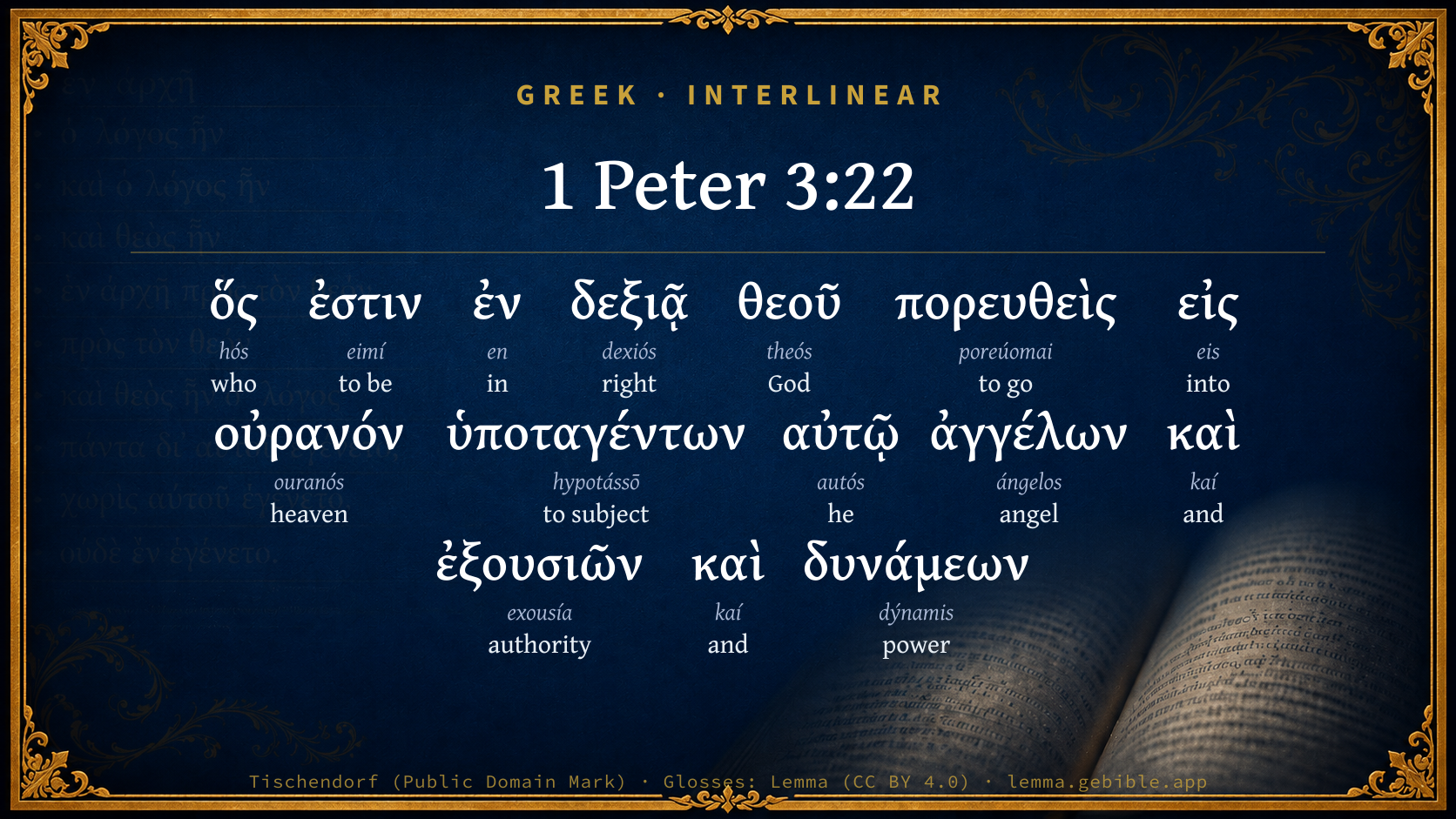
Greek (Tischendorf 8th ed.) 1 Peter 3:22 appears in the Greek New Testament. The text above is from the Tischendorf 8th edition. Each word links to its Strong’s number and a concise gloss. Click any word for its full Thayer’s Greek Lexicon entry.
Download image
Cite this verse

1 Peter 3:22 (World English Bible). Public Domain. Lemma interlinear Bible study tool, https://lemma.gebible.app/v/1-peter/3/22.

Show BibTeX & RIS
BibTeX
RIS
English Translation
who is at the right hand of God, having gone into heaven, angels and authorities and powers being made subject to him.
World English Bible · Public Domain
Download a study sheet

One document with this verse’s original text, its word-by-word gloss line, the meaning frame, cross-references with their text, attributed commentary, and full source and license credits — printable, and it pastes into notes with its structure intact.

This verse Autodidact and up

Study sheet (.html) Plain text (.txt)

A passage Seminary Student

Up to 50 verses in one chapter. A passage sheet keeps up to 6 commentary sources and 12 cross-references per verse, in the order this page ranks them, and says so on the sheet whenever that leaves anything out. Ask for a single verse and you get the Autodidact verse sheet above.

Everything on this page stays free to read, with no account — the sheet is a download of what is already on screen, not access to it.

Want to remove ads? Support Godless Engineer
Compare translations 3

The same verse in 3 English versions, stacked beneath the original-language interlinear above. Click any original word for its lexicon entry.

Each is an independent rendering of the whole verse — the interlinear is not word-aligned to these translations.

Highlighted words mark where these versions differ — a whole-verse word diff, not a word-by-word alignment.

  • World English Bible Public Domain
    who is at the right hand of God, having gone into heaven, angels and authorities and powers being made subject to him.
  • King James Version Public Domain
    Who is gone into heaven, and is on the right hand of God; angels and authorities and powers being made subject unto him.
  • unfoldingWord Literal Text CC BY-SA 4.0
    who is at the right hand of God, having gone into heaven, with angels and authorities and powers having been subjected to him.

unfoldingWord Literal Text — © unfoldingWord, licensed CC BY-SA 4.0. Word-aligned USFM3 via Door43 (git.door43.org/unfoldingWord/en_ult).

Versions to compare (up to 4)

3 of 4 selected

Show all 19 translations

Every available English version of this verse, each an independent rendering of the whole verse.

  • World English Bible Public Domain
    who is at the right hand of God, having gone into heaven, angels and authorities and powers being made subject to him.
  • Berean Standard Bible Public Domain
    who has gone into heaven and is at the right hand of God, with angels, authorities, and powers subject to Him.
  • Majority Standard Bible Public Domain
    who has gone into heaven and is at the right hand of God, with angels, authorities, and powers subject to Him.
  • King James Version Public Domain
    Who is gone into heaven, and is on the right hand of God; angels and authorities and powers being made subject unto him.
  • American Standard Version (1901) Public Domain
    who is one the right hand of God, having gone into heaven; angels and authorities and powers being made subject unto him.
  • Revised Version (1885) Public Domain
    who is on the right hand of God, having gone into heaven; angels and authorities and powers being made subject unto him.
  • Geneva Bible (1599) Public Domain
    Which is at the right hand of God, gone into heauen, to whom the Angels, and Powers, and might are subiect.
  • Douay-Rheims (1899) Public Domain
    Who is on the right hand of God, swallowing down death, that we might be made heirs of life everlasting: being gone into heaven, the angels and powers and virtues being made subject to him.
  • Young's Literal Translation Public Domain
    who is at the right hand of God, having gone on to heaven -- messengers, and authorities, and powers, having been subjected to him.
  • Literal Standard Version CC BY-SA 4.0
    who is at the right hand of God, having gone on to Heaven—messengers, and authorities, and powers, having been subjected to Him.
  • Unlocked Literal Bible CC BY-SA 4.0
    Christ is at the right hand of God. He went into heaven. Angels, authorities, and powers must submit to him.
  • unfoldingWord Literal Text CC BY-SA 4.0
    who is at the right hand of God, having gone into heaven, with angels and authorities and powers having been subjected to him.
  • Darby Bible Public Domain
    who is at [the] right hand of God, gone into heaven, angels and authorities and powers being subjected to him.
  • World Messianic Bible Public Domain
    who is at the right hand of God, having gone into heaven, angels and authorities and powers being made subject to him.
  • Webster's Bible Public Domain
    Who is gone into heaven, and is on the right hand of God; angels, and authorities, and powers being made subject to him.
  • Free Bible Version CC BY-SA 4.0
    Having ascended to heaven, he stands at God's right hand, with angels, authorities, and powers placed under his control.
  • Bible in Basic English Public Domain
    Who has gone into heaven, and is at the right hand of God, angels and authorities and powers having been put under his rule.
  • Text-Critical English NT CC BY 4.0
    who has gone into heaven and is at the right hand of God, with angels, authorities, and powers subject to him.
  • Tyndale New Testament (1534) Public Domain
    which is oure right honde of God and is gone into heven angels power and myght subdued vnto him.

Literal Standard Version (2020), Covenant Press — licensed CC BY-SA 4.0. Text via the HelloAO Bible API (eBible.org). Unlocked Literal Bible (unfoldingWord) — licensed CC BY-SA 4.0. Text via the HelloAO Bible API (eBible.org). unfoldingWord Literal Text — © unfoldingWord, licensed CC BY-SA 4.0. Word-aligned USFM3 via Door43 (git.door43.org/unfoldingWord/en_ult). Free Bible Version, Dr. Jonathan Gallagher — licensed CC BY-SA 4.0. Text via the HelloAO Bible API (eBible.org).

Word by word

More ways to search: Search by grammar → Find every occurrence → Compare this word →

Practice this passage: Drill this verse → Learn its vocabulary →

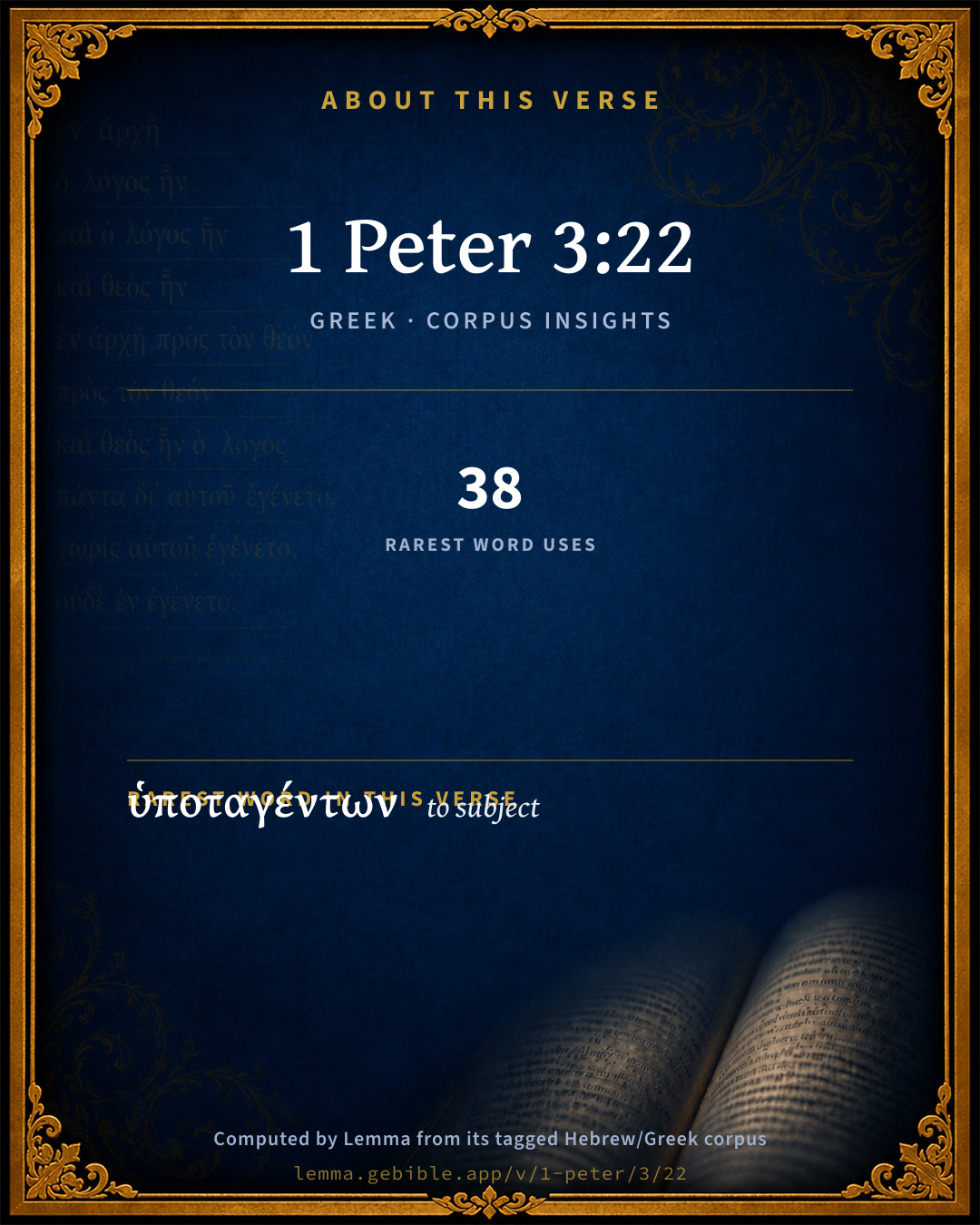
ὑποταγέντων
hypotássō
G5293
“to subject”
Verb, Aorist, Passive, Participle, Genitive, Plural, Masculine
Part of Speech
Verb
Tense
Aorist
Voice
Passive
Mood
Participle
Case
Genitive
Number
Plural
Gender
Masculine
Full Thayer's Definition

Origin: from G5259 and G5021

TDNT: 08:39,1

1. to arrange under, to subordinate 2. to subject, put in subjection 3. to subject one's self, obey 4. to submit to one's control 5. to yield to one's admonition or advice 6. to obey, be subject A Greek military term meaning "to arrange [troop divisions] in amilitary fashion under the command of a leader". In non-military use,it was "a voluntary attitude of giving in, cooperating, assumingresponsibility, and carrying a burden".
  1. ὅς hós G3739 “who” Relative pronoun, Nominative, Singular, Masculine
  2. ἐστιν eimí G1510 “to be” Verb, Present, Active, Indicative, 3rd person, Singular
  3. ἐν en G1722 “in” Preposition
  4. δεξιᾷ dexiós G1188 “right” Adjective, Dative, Singular, Feminine
  5. θεοῦ theós G2316 “God” Noun, Genitive, Singular, Masculine
  6. πορευθεὶς poreúomai G4198 “to go” Verb, Aorist, Passive deponent, Participle, Nominative, Singular, Masculine
  7. εἰς eis G1519 “into” Preposition
  8. οὐρανόν ouranós G3772 “heaven” Noun, Accusative, Singular, Masculine
  9. αὐτῷ autós G846 “he” Personal pronoun, Dative, Singular, Masculine
  10. ἀγγέλων ángelos G32 “angel” Noun, Genitive, Plural, Masculine
  11. καὶ kaí G2532 “and” Conjunction
  12. ἐξουσιῶν exousía G1849 “authority” Noun, Genitive, Plural, Feminine
  13. καὶ kaí G2532 “and” Conjunction
  14. δυνάμεων dýnamis G1411 “power” Noun, Genitive, Plural, Feminine

About this verse

These counts appear in no published source. They are computed here, from the morphology-tagged text and Lemma’s own curated glosses. What Lemma adds →

15
words
14
distinct lemmas
General Epistles
section

Shared distinctive vocabulary

ὑποταγέντων to subject G5293 occurs in 31 verses of the Greek New Testament. Also found in:

Repetition

A word recurs within this verse:

Cross-references

20

Topical passages linked to 1 Peter 3:22 in the Treasury of Scripture Knowledge — connected by theme and wording, ordered by reader-vote popularity; previews shown in the World English Bible.

  • Hebrews 9:24 For Christ hasn't entered into holy places made with hands, which are representations of the true, but into heaven itself, now to appear in the presence of God for us;
  • Hebrews 12:2 looking to Jesus, the author and perfecter of faith, who for the joy that was set before him endured the cross, despising shame, and has sat down at the right hand of the throne of God.
  • Hebrews 10:12 but he, when he had offered one sacrifice for sins for ever, sat down on the right hand of God;
  • Ephesians 1:20–21 which he worked in Christ, when he raised him from the dead, and made him to sit at his right hand in the heavenly places,
  • Mark 16:19 So then the Lord Jesus, after he had spoken to them, was received up into heaven, and sat down at the right hand of God.
  • Romans 8:34 Who is he who condemns? It is Christ who died, yes rather, who was raised from the dead, who is at the right hand of God, who also makes intercession for us.
  • Hebrews 8:1 Now in the things which we are saying, the main point is this. We have such a high priest, who sat down on the right hand of the throne of the Majesty in the heavens,
  • Romans 8:38 For I am persuaded, that neither death, nor life, nor angels, nor principalities, nor things present, nor things to come, nor powers,
  • Hebrews 6:20 where as a forerunner Jesus entered for us, having become a high priest forever after the order of Melchizedek.
  • Psalms 110:1 Yahweh says to my Lord, "Sit at my right hand, Until I make your enemies your footstool for your feet."
  • Matthew 22:44 'The Lord said to my Lord, Sit on my right hand, Until I make your enemies a footstool for your feet?'
  • Mark 12:36 For David himself said in the Holy Spirit, 'The Lord said to my Lord, Sit at my right hand, Until I make your enemies the footstool of your feet.'
  • Colossians 3:1 If then you were raised together with Christ, seek the things that are above, where Christ is, seated on the right hand of God.
  • Acts 1:11 who also said, "You men of Galilee, why do you stand looking into the sky? This Jesus, who was received up from you into the sky will come back in the same way as you saw him going into the sky."
  • Acts 2:34–36 For David didn't ascend into the heavens, but he says himself, 'The Lord said to my Lord, "Sit by my right hand,
  • Acts 3:21 whom heaven must receive until the times of restoration of all things, which God spoke long ago by the mouth of his holy prophets.
  • 1 Corinthians 15:24 Then the end comes, when he will deliver up the Kingdom to God, even the Father; when he will have abolished all rule and all authority and power.
  • Hebrews 1:3 His Son is the radiance of his glory, the very image of his substance, and upholding all things by the word of his power, when he had by himself made purification for our sins, sat down on the right hand of the Majesty on high;
  • Hebrews 1:13 But of which of the angels has he said at any time, "Sit at my right hand, Until I make your enemies the footstool of your feet?"
  • Luke 20:42 David himself says in the book of Psalms, 'The Lord said to my Lord, "Sit at my right hand,

Cross-references courtesy of OpenBible.info (CC BY 4.0).

Commentary

Notes on 1 Peter 3:22 from classic Christian and Jewish commentators (each source and its license shown beneath its notes). The classic Christian expositions comment on the surrounding passage and are grouped to its opening verse, so a note may address several verses; the Jewish commentaries on the Tanakh (Rashi and others) are per-verse, so they appear only where the commentator wrote on this verse.

Lemma curates 59 commentaries, every one of them public domain or Creative Commons licensed, each selected and text-cleaned for this edition rather than reprinted as found. About our sources →

Tyndale Open Study Notes

Tyndale Open Resources

3:22 all the angels and authorities and powers accept his authority: In the ancient world, spiritual beings were widely believed to directly affect the course of affairs on earth. Christians needed to be reminded that Christ has already won his victory over these spiritual powers. It means that we don’t need to fear even the spiritual realm (cp. 3:14).

Tyndale Open Study Notes — © Tyndale Open Resources, licensed CC BY-SA 4.0. Text via the HelloAO Bible API.

Bengel's Gnomon

Johann Albrecht Bengel

1Pe 3:22. Ὅς ἐστιν ἐν δεξιᾷ τοῦ Θεοῦ, καταπιὼν τὸν θάνατον, ἵνα ζωῆς αἰωνίοι κληρονόμοι γενώμεθα) Such is the reading of the version which is by far the most ancient of all. Who is on the right hand of God, after having swallowed up death, that we might be made the heirs of eternal life.[34] This reading is followed by Augustine, Cassiodorus, Fulgentius, Beda, and, as Mill affirms, by all the Latin writers. See App. Crit. Ed. ii. on this passage. Peter derives special uses from the sufferings of Christ, from His death, from His return to life, from His resurrection, from His going into heaven, from His judging the quick and dead; but from His sitting at the right hand of God he either derives no use, or that which is still read in the Latin Version. By His death, Christ altogether destroyed death: but His sitting on the right hand of God presupposes that this death has been once for all exhausted, that He may claim life for us; and it involves a STATE of LIFE which is glorious, eternal, and salutary for us. Act 2:28; Rom 6:9-10; Heb 7:16; Heb 7:24-25; 1Co 15:54; Joh 14:19. The signification of past time in καταπιὼν ought especially to be considered.—πορευθεὶς) after that He had gone.—ἀγγέλων, angels) To Him angels are subject, and that too of all ranks, whether good or evil; and so also are men.

[34] “Qui est in dexterâ Dei, [deglutiens mortem, ut vitæ æternæ hæredes efficeremur.”] Vulgate in Amiat. and other oldest MSS. Fuldensis MS., however, and others, omit the words in brackets; and they are not supported by Greek MSS.—E.

Bengel's Gnomon of the New Testament — English translation (T&T Clark, Edinburgh, 1860) — public domain. Text from a community e-Sword module.

Meyer's Critical & Exegetical Commentary

Heinrich August Wilhelm Meyer

1Pe_3:22. ὅς ἐστιν ἐν δεξιᾷ τοῦ Θεοῦ] This brings to a close the whole train of thought with reference to Christ, from 1Pe_3:18 and onwards, inasmuch as to His sufferings, death, resurrection, and going to the spirits in prison, there is now added, His sitting down at the right hand of God. This expression, which points out the present condition of the glorified Redeemer, occurs likewise in Rom_8:34, Col_3:1, and in other passages of the N. T.

πορευθεὶς εἰς οὐρανόν] corresponds to πορευθείς, 1Pe_3:19.

ὑποταγέντων … δυνάμεων] added in order to give prominence to the unlimited sway of Christ (Eph_1:21-22; Col_2:10; 1Co_15:27; Heb_2:8), extending even over all heavenly powers, whatever their name or office.

The expressions ἐξουσίαι and δυνάμεις arewith the exception of in this passageused only by Paul as names of angels (with δυνάμεις, cf. Psa_103:21; Psa_148:2, LXX.); and in the same sequence. ἄγγελοι is not here the general term to which ἐξουσίαι and δυνάμεις (καὶ … καί, equivalent to cum … turn) are subordinate, but the three conceptions are co-ordinate, and connected by the repeated copula. This is shown by Rom_8:38, where, instead of ἐξουσίαι, the name ἀρχαί is used. For the various names, comp. Meyer on Eph_1:21; Col_1:16.

ὑποταγ. expresses, not enforced, but voluntary subjection.

With regard to the relation of this whole passage to what precedes, ὅτι καὶ Χριστὸς … ἔπαθεν shows that in the first instance confirmation is given to the thought that it is better to suffer for well than for evil doing, by reference to the sufferings of Christ, similarly as is done in chap. 1Pe_2:21. But as the last-mentioned passage passes beyond the limits of the typical,that is, first by the addition of ὑπὲρ ὑμῶν to ἔπαθεν, and then by the statements of 1Pe_2:24,the same takes place here. There, reference is made to the redeeming death of the abased Christ; here, to the living work of the glorified Christ. The chief separate points have already been stated. The allusion of baptism appears indeed to be a digression, yet it belongs essentially to the train of thought; for after that mention had been made of Christs work among the spirits in prison in His exalted condition, it was necessary to call attention likewise to His redeeming work on earth, the effects of which are communicated through baptism. That Peter speaks of this medium (not that of the word, etc.) is explained by his reference to the deluge as the type of the approaching judgment, and to the water by which Noah and those with him were saved, and which appeared as a τύπος of baptism.[230]

[230] Since that which is stated in this paragraph does not keep within the limits of the typical, it may very wellin spite of Hofmanns assertion to the contrarybe described as a digression.

Meyer — Critical and Exegetical Commentary on the New Testament — English translation by Peter Christie, edited by Frederick Crombie (T&T Clark, 1880) — public domain. Text from a community e-Sword module.

Expositor's Greek Testament

ed. W. Robertson Nicoll

1Pe 3:22 . Christ went into Heaven and now is on God’s right hand (Psa 110:1 ) when angels and authorities and powers had subjected themselves to Him in accordance with prophecy (Psa 8:7 ; cf. Heb 2:8 ; 1Co 15:24 ff.). For the orders of angels see also Rom 8:38 ; Eph 1:21 . Clearly they include the rebels of 1Pe 3:19 f. whom Jubilees calls the angels of the Lord (Jub. iv. 15) and Onkelos the sons of the mighty and their children (?) the giants .

The Expositor's Greek Testament, edited by W. Robertson Nicoll (1897–1910) — public domain. Text from a community e-Sword module.

Jamieson, Fausset & Brown

Robert Jamieson, A. R. Fausset & David Brown

(Psa 110:1; Rom 8:34, Rom 8:38; Co1 15:24; Eph 1:21; Eph 3:10; Col 1:16; Col 2:10-15). The fruit of His patience in His voluntary endured and undeserved sufferings: a pattern to us, Pe1 3:17-18.

gone-- (Luk 24:51). Proving against rationalists an actual material ascension. Literally, "is on the right hand of God, having gone into heaven." The oldest manuscripts of the Vulgate and the Latin Fathers, add what expresses the benefit to us of Christ's sitting on God's right hand, "Who is on the right hand of God, having swallowed up death that we may become heirs of everlasting life"; involving for us A STATE OF LIFE, saved, glorious, and eternal. The Greek manuscripts, however, reject the words. Compare with this verse Peter's speeches, Act 2:32-35; Act 3:21, Act 3:26; Act 10:40, Act 10:42.

Next: 1 Peter Chapter 4

Jamieson, Fausset & Brown — Commentary Critical and Explanatory on the Whole Bible (1871) — public domain (CC PDM 1.0). Text via the HelloAO Bible API.

Adam Clarke's Commentary

Verse 22. Who is gone into heaven] Having given the fullest proof of his resurrection from the dead, and of his having accomplished the end for which he came into the world.

On the right hand of God] In the place of the highest dignity, honour, and influence.

The Vulgate, one copy of the Itala, Augustine, Fulgentius, Cassiodorus, and Bede, have the following remarkable addition after the above words: Deglutiens mortem, ut vitae aeternae haeredes efficeremur. "Having abolished (swallowed down) death, that we might be made heirs of eternal life." But this addition is found in no Greek copy, nor in any other of the ancient versions.

Angels and authorities and powers] That is, all creatures and beings, both in the heavens and in the earth, are put under subjection to Jesus Christ. He has all power in the heavens and in the earth. He alone can save; and he alone can destroy. None need fear who put their trust in him, as he can do whatsoever he will in behalf of his followers, and has good and evil spirits under his absolute command. Well may his enemies tremble, while his friends exult and sing. He can raise the dead, and save to the uttermost all that come unto the Father through him.

If he have all power, if angels and authorities and powers be subject to him, then he can do what he will, and employ whom he will. To raise the dead can be no difficulty to him, because he has power over all things. He created the world; he can destroy it, and he can create it anew. We can conceive nothing too difficult for Omnipotence. This same omnipotent Being is the friend of man. Why then do we not come to him with confidence, and expect the utmost salvation of which our souls and bodies are capable?

Adam Clarke's Commentary on the Bible (1810–1826) — public domain. Text from a community e-Sword/MySword module.

John Calvin's Commentaries

22 Who is on the right hand of God. He recommends to us the ascension of Christ unto heaven, lest our eyes should seek him in the world; and this belongs especially to faith. He commends to our notice his session on the Father’s right hand, lest we should doubt his power to save us. And what his sitting at the right hand of the Father means, we have elsewhere explained, that is, that Christ exercises supreme power everywhere as God’s representative. And an explanation of this is what follows, angels being made subject to him; and he adds powers and authorities only for the sake of amplification, for angels are usually designated by such words. It was then Peter’s object to set forth by these high titles the sovereignty of Christ.

John Calvin's Commentaries (1540-1563) — public domain. Text from the Calvin Translation Society English edition (1840s-50s) via the Christian Classics Ethereal Library (ccel.org). Calvin's coverage is partial (roughly two-thirds of the Bible); uncommented books and verses are honest gaps, never fabricated. The 19th-century editor's footnotes and remarks are omitted so the notes are faithfully Calvin's own voice.

Ellicott's Commentary for English Readers

(22) Who is gone into heaven, and is on the right hand of God.—This verse (which partakes of the character of a doxology) serves two purposes. First, it carries on the history of Jesus Christ. How carefully, in spite of what seem at first irrelevant digressions, St. Peter holds his threads. Christ’s passion and death, activity among the dead, resurrection from among them, ascension into heaven, perpetual session in glory, follow one another in due order. The second purpose of the clause runs parallel to the first. St. Peter is teaching the entire conformity of the believer to the Lord. If the believer will but retain his good conscience, he may hope for a precisely similar experience. The Latin and several other good versions, together with several Latin Fathers, add a curious sentence after the words “on the right hand of God,” which runs: swallowing up death, that we might be made heirs of eternal life; but there is no sufficient authority for the sentence. The first notion of being “on the right hand of God,” taken, probably, from Psa_110:1, seems to be that of occupying the highest post of honour possible, next after that of God—i.e., the Father—Himself It is not necessary here to consider what else may be implied in the phrase as to the conditions of our Lord’s human existence; but when we compare St. Paul’s statement, in Eph_4:10, about His now “filling all things,” we feel that these pictorial words, such as “heaven” and “right hand of God,” are intended to convey the notion that His humanity is now entirely without conditions, though still retaining all that is truly essential to humanity. It may be observed that, assuming (as even most sceptical critics do) the genuineness of this Epistle, we have here at first hand the deliberate evidence of one who had been perfectly familiar with Jesus Christ as man with man. By what stretch of imagination can we suppose that such a person could ever have invented, or have accepted from others this mode of speaking about his former Teacher, had he not been conscious of the resurrection and ascension of Jesus as simply historical facts, of the same order as the fact of His death?

Angels and authorities and powers being made subject unto him.—There can be no doubt that this whole verse is coloured by recollection of the circular letter which St. Paul had sent to the Churches of Asia, which we call the Epistle to the Ephesians. Perhaps the heresy which St. Paul lamented in that Epistle may still have lingered in existence, in cabalistic Jewish circles, among those same Churches when St. Peter thus wrote to them. He may, for the moment, be glancing away from his faint-hearted Hebrew brethren, who, in fear of persecution, were slinking back into Judaism, and turning rather to those Gnosticising Jews who began to abound in Asia, who made “genealogies” of æons, and gave Christ a place among them. In favour of such an opinion one might appeal to the vivid picture of licentiousness in the next chapter, and the development of the same, manifestly under Gnostic influence, in the Second Epistle and in the Apocalypse. From the expression “being made subject,” or, literally, having been subdued (or, subjected) “we may infer that St. Peter meant evil spirits, this being a crowning triumph of Christ, and not only a mark of His exaltation. We need not think that St. Peter, any more than St. Paul, is distinctly teaching that there are such grades of spiritual beings; he is probably only borrowing the titles from the heretics glanced at, and saying that, whatever unseen powers there are, whatever they may be called, they are now cubdued to Christ.

A Bible Commentary for English Readers, edited by Charles John Ellicott (1878–1897) — public domain. Text from a community e-Sword module.

The Cambridge Bible for Schools and Colleges

gen. ed. J. J. S. Perowne

22. who is gone into heaven] The parallelism between the substance of this verse and that of 1Ti_3:16, and of both with the closing clauses of the second section of the Apostles’ Creed, leaves scarcely any room for doubt that we have here a precious fragment of the baptismal profession of faith of the Apostolic Church. The train of thought of the previous verse naturally led on to this. This was what the answer of a good conscience towards God involved. In the union of confession with the mouth and belief in the resurrection of Jesus Christ, in Rom_10:9, we may probably trace a reference to a like formulary. The word for “he is gone” is the same participle as that in 1Pe_3:19 and is important as determining its meaning. If there was a real Ascension into Heaven, there was also a real descent into Hades. St Peter seems to echo the words of St Paul, “Now that he ascended, what is it but that He also descended first into the lower parts of the earth?” (Eph_4:9.)

angels and authorities and powers] Here again the phraseology reminds us of that of the twin Epistles of St Paul (Eph_1:21, Col_1:16). “Authorities” and “powers” are used as comprehensive terms, including the whole hierarchy of heaven, Cherubim, Seraphim and the like; probably also, looking to Col_2:15, Php_2:10, and the manifest sequence of thought from 1Pe_3:19, the powers of evil who had been subdued by the conquering Christ in His descent into Hades.

The Cambridge Bible for Schools and Colleges (gen. ed. J. J. S. Perowne; Cambridge University Press, 1878–1918) — public domain. Text from a community e-Sword module.

Trapp's Complete Commentary

John Trapp

22 Who is gone into heaven, and is on the right hand of God; angels and authorities and powers being made subject unto him.

Ver. 22. Angels and authorities] Psa 68:17. The word rendered angels signifieth seconds, as being second to Christ, or next to him. See Dan 10:13.

John Trapp, A Commentary or Exposition upon All the Books of the Old and New Testament (1647–1656) — public domain. Text from a community e-Sword module.

Albert Barnes' Notes on the Bible

Who is gone into heaven - See the notes at Act 1:9.

And is on the right hand of God - See the notes at Mar 16:19.

Angels and authorities and powers being made subject unto him - See the notes at Eph 1:20-21. The reason why the apostle here adverts to the fact that the Lord Jesus is raised up to the right hand of God, and is so honored in heaven, seems to have been to encourage those to whom he wrote to persevere in the service of God, though they were persecuted. The Lord Jesus was in like manner persecuted. He was reviled, and rejected, and put to death. Yet he ultimately triumphed. He was raised from the dead, and was exalted to the highest place of honor in the universe. Even so they, if they did not faint, might hope to come off in the end triumphant. As Noah, who had been faithful and steadfast when surrounded by a scoffing world, was at last preserve by his faith from ruin, and as the Redeemer, though persecuted and put to death, was at last exalted to the right hand of God, so would it be with them if they bore their trials patiently, and did not faint or fail in the persecutions which they endured.

In view of the exposition in 1Pe 3:1-2, we may remark:

(1) That it is our duty to seek the conversion and salvation of our impenitent relatives and friends. All Christians have relatives and friends who are impenitent; it is a rare thing that some of the members of their own families are not so. In most families, even Christian families, there is a husband or a wife, a father or a mother, a son or daughter, a brother or sister, who is not converted. To all such, they who are Christians owe important duties, and there is none more important than that of seeking their conversion. That this is a duty is clearly implied in this passage in reference to a wife, and for the same reason it is a duty in reference to all other persons. It may be further apparent from these considerations:

(a) It is an important part of the business of all Christians to seek the salvation of others. This is clearly the duty of ministers of the gospel; but it is no less the duty of all who profess to be followers of the Saviour, and to take him as their example and guide. Compare Jam 5:19-20.

(b) It is a duty especially devolving on those who have relatives who are unconverted, on account of the advantages which they have for doing it. They are with them constantly; they have their confidence and affection; they can feel more for them than anyone else can; and if they are not concerned for their salvation, they cannot hope that any others will be.

(c) It is not wholly an improper motive to seek their salvation from the happiness which it would confer on those who are already Christians. It is not improper that a wife should be stimulated to desire the conversion of her husband from the increased enjoyment which she would have if her partner in life were united with her in the same hope of heaven, and from the pleasure which it would give to enjoy the privilege of religious worship in the family, and the aid which would be furnished in training up her children in the Lord. A Christian wife and mother has important duties to perform toward her children; it is not improper that in performing those duties she should earnestly desire the cooperation of her partner in life.

(2) Those who have impenitent husbands and friends should be encouraged in seeking their conversion. It is plainly implied 1Pe 3:1-2 that it was not to be regarded as a hopeless thing, but that in all cases they were to regard it as possible that unbelieving husbands might be brought to the knowledge of the truth. If this is true of husbands, it is no less true of other friends. We should never despair of the conversion of a friend as long as life lasts, however far he may be from the path of virtue and piety. The grounds of encouragement are such as these:

(a) You have an influence over them which no other one has; and that influence may be regarded as capital, which will give you great advantages in seeking their conversion.

(b) You have access to them at times when their minds are most open to serious impressions. Every man has times when he may be approached on the subject of religion; when he is pensive and serious; when he is disappointed and sad; when the affairs of this world do not go well with him, and his thoughts are drawn along to a better. There are times in the life of every man when he is ready to open his mind to a friend on the subject of religion, and when he would be glad of a word of friendly counsel and encouragement. It is much to have access to a man at such times.

(c) If all the facts were known which have occurred, there would be no lack of encouragement to labor for the conversion of impenitent relatives and friends. Many a husband owes his salvation to the persevering solicitude and prayers of a wife; many a son will enter heaven because a mother never ceased to pray for his salvation, even when to human view there seemed no hope of it.

(3) We may learn 1Pe 3:1-2 what are the principal means by which we are to hope to secure the conversion and salvation of impenitent friends. It is to be mainly by a pure life; by a holy walk; by a consistent example. Conversation, properly so called, is not to be regarded as excluded from those means, but the main dependence is to be on a holy life. This is to be so, because:

(a) most persons form their notions of religion from what they see in the lives of its professed friends. It is not so much what they hear in the pulpit, because they regard preaching as a mere professional business, by which a man gets a living; not so much by books in defense and explanation of religion, for they seldom or never read them; not by what religion enabled the martyrs to do, for they may have scarcely heard the names of even the most illustrious of the martyrs; but by what they see in the walk and conversation of those who profess to be Christians, especially of those who are their near relations. The husband is forming his views of religion constantly from what he sees on the brow and in the eye of his professedly Christian wife; the brother from what he sees in his sister; the child from what he sees in the parent.

(b) Those who profess to be Christians have an opportunity of showing the power of religion in a way which is superior to any abstract argument. It controls their temper; it makes them kind and gentle; it sustains them in trial; it prompts them to deeds of benevolence; it disposes them to be contented, to be forgiving, to be patient in the reverses of life. Everyone may thus be always doing something to make an impression favorable to religion on the minds of others. Yet it is also true that much may be done, and should be done for the conversion of others, by conversation properly so called, or by direct address and appeal. There is nothing, however, which requires to be managed with more prudence than conversation with those who are not Christians, or direct efforts to lead them to attend to the subject of religion. In regard to this it may be observed:

(a) that it does no good to be always talking with them. Such a course only produces disgust.

(b) It does no good to talk to them at unseasonable and improper times. If they are specially engaged in their business, and would not like to be interrupted - if they are in company with others, or even with their family - it does little good to attempt a conversation with them. It is “the word that fitly spoken that is like apples of gold in pictures of silver,” Pro 25:11.

(c) It does no good to scold them on the subject of religion, with a view to make them Christians. In such a case you show a spirit the very reverse of that religion which you are professedly endeavoring to persuade them to embrace.

(d) All conversation with impenitent sinners should be kind, and tender, and respectful. It should be addressed to them when they will be disposed to listen; usually when they are alone; and especially when from trials or other causes they may be in such a state of mind that they will be willing to listen. It may be added, that impenitent sinners are much more frequently in such a state of mind than most Christians suppose, and that they often wonder that their Christian friends do not speak to them about the salvation of the soul.

From the exposition given of the important 1Pe 3:18-21, we may derive the following inferences:

(1) The pre-existence of Christ. If he preached to the antediluvians in the time of Noah, he must have had an existence at that time.

(2) His divinity. If he was “quickened” or restored to life by his own exalted nature, he must be divine; for there is no more inalienable attribute of the Deity than the power of raising the dead.

(3) If Christ preached to the pagan world in the time of Noah, for the same reason it may be regarded as true that all the messages which are brought to people, calling them to repentance, in any age or country, are through him. Thus, it was Christ who spake by the prophets and by the apostles; and thus he speaks now by his ministers.

(4) If this interpretation is wellfounded, it takes away one of the strongest supports of the doctrine of purgatory. There is no stronger passage of the Bible in support of this doctrine than the one before us; and if this does not countenance it, it may be safely affirmed that it has not a shadow of proof in the sacred Scriptures.

(5) It follows that there is no hope or prospect that the gospel will be preached to those who are lost. This is the only passage in the Bible that could be supposed to teach any such doctrine; and if the interpretation above proposed be correct, this furnishes no ground of belief that if a man dies impenitent he will ever be favored with another offer of mercy. This interpretation also accords with all the other representations in the Bible. “As the tree falleth, so it lies.” “He that is holy, let him be holy still; and he that is filthy, let him be filthy still.” All the representations in the Bible lead us to suppose that the eternal destiny of the soul after death is fixed, and that the only change which can ever occur in the future state is that which will be produced by development: the developement of the principles of piety in heaven; the development of the principles of evil in hell.

(6) It follows, that if there is not a place of purgatory in the future world there is a place of punishment. If the word prison, in the passage before us, does not mean purgatory, and does not refer to a detention with a prospect or possibility of release, it must refer to detention of another kind, and for another purpose, and that can be only with reference “to the judgment of the great day,” 2Pe 2:14; Jud 1:6. From that gloomy prison there is no evidence that any have been, or will be, released.

(7) People should embrace the gospel at once. Now it is offered to them; in the future world it will not be. But even if it could be proved that the gospel would be offered to them in the future world, it would be better to embrace it now. Why should people go down to that world to suffer long before they become reconciled to God? Why choose to taste the sorrows of hell before they embrace the offers of mercy? Why go to that world of woe at all? Are people so in love with suffering and danger that they esteem it wise to go down to that dark prison-house, with the intention or the hope that the gospel may be offered to them there, and that when there they may be disposed to embrace it? Even if it could be shown, therefore, that they might again hear the voice of mercy and salvation, how much wiser would it be to hearken to the voice now, and become reconciled to God here, and never experience in any way the pangs of the second death! But of any such offer of mercy in the world of despair, the Bible contains no intimation; and he who goes to the eternal world unreconciled to God, perishes for ever. The moment when he crosses the line between time and eternity, he goes forever beyond the boundaries of hope.

Albert Barnes' Notes on the Bible (1834–1885) — public domain. Text from a community e-Sword/MySword module.

Haydock's Catholic Bible Commentary

Jesus now as our Redeemer, and as man, sitteth on the right hand of God, (see Mark xvi. 19.; Colossians i.; Hebrews i. 3. &c.) having swallowed up[4] (devoured or destroyed) death; having conquered and triumphed over the devil, sin, and death, that by his grace and his merits we might become heirs of eternal life; and is gone into heaven, Angels, &c. being made subject to him. (Witham)

===============================

[BIBLIOGRAPHY]

These words, found in all Latin copies, and cited by the Latin Fathers, are scarce found in any Greek manuscript and so are omitted in the Protestant translation.

====================

George Leo Haydock (1774–1849), Haydock's Catholic Family Bible and Commentary, 1859 edition — public domain. Excludes Psalms (Douay-Rheims chapter numbering differs from Protestant) and Deuterocanonical books (Catholic canon only).

Matthew Poole's English Annotations

Who is gone into heaven, and is on the right hand of God: see Rom 8:34; Heb 1:3. This is added as another ground of faith and a good conscience.

Angels and authorities and powers: see Rom 8:38; Eph 1:20,21; Col 1:16; Col 2:10.

Being made subject unto him; viz. by his Father, to whom this subjecting all things to Christ is elsewhere ascribed, 1Co 15:27; Eph 1:22; Heb 2:8.

Matthew Poole's English Annotations on the Holy Bible (1683–1685) — public domain. Text from a community e-Sword/MySword module.

Whedon's Commentary on the Bible

Daniel D. Whedon

22. Gone into heaven—At his ascension, to take his place as crowned King, to send the Holy Spirit, and to exercise kingly power in bringing men to God.

The right hand—The place of highest honour, to which God exalted him. See notes on Acts 12:55, and Rom_8:34.

Made subject—To him, the glorified God-man, as supreme Lord. Whether, as Steiger considers, the authorities be reigning authorities, and the powers acting powers, we know not. But see notes on Rom_8:38; Eph_1:21; and Col_2:15.

Daniel D. Whedon (gen. ed.), Commentary on the Old and New Testaments (1874–1909) — public domain. Text from a community e-Sword module.

The Pulpit Commentary

Who is gone into heaven. The word here rendered "gone" is that used in ver. 19, "he went and preached (poreuqeiv)" (comp. Eph_4:9, "Now that he ascended, what is it but that he also descended first into the lower parts of the earth? And is on the right hand of God. (comp. Psa_110:1; Rom_8:34; Colossians Eph_1:20 Heb_1:3) It is better to suffer for well-doing than for evil-doing, for he who is the signal Example, who suffered, the Just for the unjust, is now exalted to the right hand of the Majesty on high; and "is able to save them to the uttermost that come to God by him, seeing he ever liveth to make intercession for them." Angels and authorities and powers being made subject unto him. God "hath set him at his own right hand in the heavenly places, far above all principality, and power, and might, and dominion, and every name that is named, not only in this world, but also in that which is to come." All the angels of God, in the various grades of the heavenly hierarchy, are made subject to Christ. The words seem to include, especially when read in comparison with Col_2:15, the evil angels also; they are made subject against their will to Christ; they asked him once if he was come to torment them before the time. He can restrain their malice and save his people from their power.

The Pulpit Commentary (1880–1919), ed. H.D.M. Spence-Jones & Joseph S. Exell — public domain. Text from a community e-Sword module.

John Wesley's Explanatory Notes

Angels and authorities and powers - That is, all orders both of angels and men.

John Wesley, Explanatory Notes Upon the Whole Bible (1754–1765) — public domain. Text via the GEBible commentary corpus.

Scofield Reference Notes

C. I. Scofield

angels

(See Scofield "Heb 1:4").

The Scofield Reference Bible (1917 edition), notes by C. I. Scofield — public domain. Text from a community e-Sword module.

Burkitt's Expository Notes on the New Testament

William Burkitt

Our apostle having in the close of the former verse, spoken of the resurrection of Christ, and of the benefits which we receive thereby, he makes mention in this verse,

1. Of his going into heaven, there to dispatch all that remained to be done for the completing the salvation of his people.

2. He is here affirmed to be at God’s right hand. The right hand is the upper hand, the hand of honour; and the right hand is the hand of power; accordingly Christ sitting at God’s right hand, as an enthroned king, imports sovereign honour and supreme power: and that God has exalted his Son Jesus Christ with great triumph to his kingdom in heaven.

3. It is asserted, that angels, authorities, and powers are made subject to him; that is, our Jesus, in whom we hope, believe, and trust, is advanced in heaven to a pre-eminency above, and to a superiority over, all angels and celestial powers, waiting and expecting until all his enemies on earth become his footstool.

For though his victory is yet incomplete and inconsummate, and we see not all things yet put under him, it may suffice at present that we see Jesus crowned with glory and honour, and that’s enough to show that the power of his enemies is broken; and that though they make some opposition still, yet it is to no purpose at all: for refusing to submit to his sceptre, they will fall by the rod of his strength, Angels and principalities in heaven, and all powers and potentates upon earth, being made subject unto him.

William Burkitt's Expository Notes on the New Testament (1700–1703) — public domain. Text from a community e-Sword module.

The People's New Testament

B. W. Johnson

22. Who is on the right hand of God. Christ's exaltation followed his death and resurrection. See Eph. 1:20–23.

B. W. Johnson's The People's New Testament with Notes (1889–1891) — public domain. Electronic text from the Christian Classics Ethereal Library (CCEL) ThML edition.

Cambridge Greek Testament for Schools and Colleges

22. ὅς ἐστιν ἐν δεξιᾷ θεοῦ. Some MSS. of the Vulgate and the Latin writers, Augustine, Fulgentius, Cassiodorus and Bede, add the words “having swallowed up death that we might be made heirs of eternal life,” but there is no Greek authority for this addition. The first part of it may be derived from Isa 25:8, quoted by St Paul, 1Co 15:54, κατεπόθη ὁ θάνατος εἰς νῖκος. The second clause may be based upon 1Pe 1:3, ὁ ἀναγεννήσας ἡμᾶς … διʼ ἀναστάσεως Ἰησοῦ Χριστοῦ ἐκ νεκρῶν εἰς κληρονομίαν …, and the phrase κληρονομεῖν ζωὴν αἰώνιον occurs in Mat 19:29; Mar 10:17; Luk 10:25; Luk 18:18; cf. Tit 3:7.

Possibly there may be a double purpose in this reference to the Session of Christ at God’s right hand:

(a) That as it was to present us to God that Christ died, therefore the Christian who claims in Baptism to share Christ’s resurrection must set his affections on things above, where Christ sitteth at the right hand of God, cf. Col 3:1.

(b) That suffering and death culminated in glory in Christ’s case, and the same will be true for His followers.

The doctrine of Christ’s Session at the right hand of God is based upon our Lord’s application to Himself of Psa 110:1, “Sit thou on my right hand,” etc. It is stated in Mar 16:19, in St Peter’s speeches in Act 2:33-34; Act 5:31, by St Paul in Rom 8:34, Col 3:1, and Eph 1:20, where there is a similar mention of the subordination of angelic powers. Cf. also Heb 1:3-13; Heb 8:1; Heb 10:12; Heb 12:2.

ὑποταγέντως αὐτῷ ἀγγέλων καὶ ἐξουσιῶν καὶ δυνάμεων. R.V. angels and authorities and powers being made subject unto him. Possibly, however, ἀγγέλων may govern the two substantives which follow, as in the Book of Henoch lxi. 10, a book of which St Peter seems to shew other traces, “angels of power and angels of principalities” are mentioned among the various grades of angels.

For ὑποταγέντων cf. 1Co 15:27; Eph 1:22; Heb 2:8, all of which passages are based upon Psa 8:7, which originally described the sovereignty of man.

For the exaltation of Christ above all grades of angels, cf. Eph 1:21; Rom 8:38; Col 2:10, and in Col 1:16 various grades of angels are described as having been created by, in and for Christ.

ADDITIONAL NOTE A

The Descent into Hell

In the Gospels the only passage which bears upon the subject is the promise to the penitent thief, “To-day shalt thou be with me in Paradise,” Luk 23:43.

In St Paul we have three possible allusions to the subject:

Rom 10:7, “Say not … who shall descend into the abyss, that is to bring Christ up from the dead?”

Rom 14:9, “For to this end Christ died and lived again that He might be Lord of both the dead and the living.”

Eph 4:9, “Now this, He ascended, what is it but that He also descended into the lower parts of the earth?” This verse might, however, merely mean that Christ came down from heaven to the lower sphere of this earth, and so refer to the Incarnation (but see Robinson, ad loc.).

In St Peter,

Act 2:27; Act 2:31, In his speech on the day of Pentecost St Peter quotes Psa 16:8-11, “Thou wilt not leave my soul in Hades,” and shews that it was true of Christ.

In this Epistle,

1Pe 3:19 states that Christ, being put to death in the flesh but quickened in spirit, went in that spirit and preached to the spirits in prison who were disobedient in the days of Noah.

1Pe 4:6 states that good tidings was preached to the dead in order that, despite their judgment in the flesh, they may live according to God in the spirit.

The only N.T. writer therefore who says anything about the object of our Lord’s descent into Hades or of His work there is St Peter. We have, however, no evidence as to the source from which he derived his teaching. According to early Jewish conceptions there were social and national distinctions in Sheol, and in the second century B.C. moral and ethical distinctions between the righteous and the wicked among the dead were introduced, but there was no idea of any moral improvement or possibility of change in the condition of the dead. Unless, therefore, we are prepared to treat St Peter’s words merely as a pious conjecture, we must believe either that he learned these mysterious facts from the mouth of the Risen Lord Himself, or that it was specially revealed to him “not by flesh and blood but by the Father in heaven.”

In the Early Fathers the descent of Christ to Hades is constantly referred to.

In the Apocryphal Gospel of Peter three men are seen coming forth from the tomb, two of them supporting the other, and a cross following them; and the head of the two reached to heaven, but that of Him who was led by them overpassed the heavens. And they heard a voice from the heavens saying, “Thou didst preach (ἐκήρυξας) to them that sleep,” and a response was heard from the Cross, “Yea.”

Ignatius (ad Magn. IX.) says, “Even the prophets, being His disciples, were expecting Him as their teacher through the Spirit. And for this cause He whom they rightly awaited when He came raised them from the dead” (cf. ad Philad. IX.).

Justin Martyr (Dial. 72) quotes a passage from Jeremiah, “The Lord God remembered His dead people of Israel, who lay in the graves and descended to preach to them His own salvation.” This passage he accuses the Jews of having cut out from their copies of the Scriptures. It does not, however, occur in any extant MSS. of the LXX., but Irenaeus quotes it several times (once as from Isaiah, once as from Jeremiah, and in other passages anonymously (see iii. 20, iv. 22, 33, v. 31), in the last of which he definitely connects the preaching with the three days between the Crucifixion and the Resurrection). Irenaeus says nothing, however, about the Jews having cut out the words, and, from the fact that he assigns them to two different prophets, it would seem that the words were not contained in the current text of the LXX. If we could assume that this passage was known to St Peter, he might be referring to it, but there is no sufficient evidence for this, and St Peter’s reference to those who were disobedient in the days of Noah would not be explained by this passage.

Irenaeus also (iv. 27) relates a discourse which he heard from “an elder” (i.e. a Christian of the generation before his own) who had heard it from personal companions of the apostles and their disciples, “that the Lord descended to the parts beneath the earth preaching His Advent there also and declaring remission of sins as available for those who believe in Him; but those have believed in Him whose hopes were set on Him, that is, those who foretold His Advent, just men and prophets and patriarchs.”

Hermas (Sim. IX.) describes the apostles and first teachers of the Gospel as preaching to those who had previously fallen asleep, of whom he mentions the prophets and the ministers of God as well as the first two generations of mankind which preceded them.

Clement of Alexandria (Strom. II. 9), quoting the above passage of Hermas, extends the preaching to pious heathen as well as Jews, and in Strom. vi. 6 he says that the Apostles followed the example of our Lord by preaching in Hades, but, while Jesus preached there only to the Jews, they addressed themselves to the righteous heathen.

In the Apocryphal Preaching of Thaddeus to Abgarus King of Edessa, quoted in Eusebius H. E. I. 13, Christ is stated to have descended into Hades and burst the bars which from eternity had not been broken, and raised the dead, for He descended alone, but rose with many, and thus ascended to His Father.

Tertullian, de Anima 55, speaking of the days between the death and resurrection of Christ, says “He descended to the lower parts of the earth that there he might make patriarchs and prophets partakers of Himself.”

Hippolytus, de Antichristo 45, represents John the Baptist after his death as preaching in Hades that the Saviour will come there also to deliver the souls of the saints.

Origen (contra Celsum II. 43) says, “With His soul stripped of His body Christ associated with souls stripped of their bodies, converting to Himself those even of them who were willing or those who for reasons which He Himself knew were more fitted for it.”

In the Apocryphal Gospel of Nicodemus, the date of which is uncertain, but which may be based upon a second century work, the two sons of the aged Symeon are described as having been raised from the dead, and giving an account of Christ’s work in Hades, that He delivered Adam from the penalty of his sin, and brought the patriarchs from a lower to a higher blessedness, and emptied the prison house and set the captives free, and erected the Cross in the midst of Hades that there also it might preach salvation.

Marcion accepted the descent of Christ into Hades, but, according to his opponents, regarding the Demiurge, the God of the O.T., as a different God from the God of the N.T., he maintained that the righteous men and prophets under the old dispensation, as being subjects of the Demiurge, refused to listen to Christ’s preaching, and only Cain and the other wicked characters of the O.T. listened and were saved.

Athanasius (de Incarnatione), arguing against the Apollinarians, who denied that Christ had any human spirit (πνεῦμα), says that the Lord appeared in Hades in an incorporeal state to shew the souls there present the presence of His own soul as having received the bonds of death, so that He might burst the bonds of the souls which were held fast in Hades.

Gregory Nazianzen inquires whether we are to suppose that Christ, appearing in Hades, did save all without exception, or did save there, as He does here, only such as believed.

Cyril of Alexandria, in commenting on Joh 16:16, says, “After three days He came to life again, having preached also to the spirits in prison. For thus there was the fullest manifestation of His love to men, I mean, in the fact that He not only saved those who were still alive upon the earth, but also to those who had already departed and were seated in darkness in the recesses of the abyss He preached deliverance as it is written.”

Also de Incarnatione he says that the soul of Christ went to Hades and appeared also to the spirits there.

Jerome, commenting on Ephesians, says that our Lord and Saviour descended into Hell that He might lead with Him in triumph to heaven the souls of the saints that were shut up in prison.

Augustine, in his letter to Euodius 164, argues that the prophets and patriarchs were already in happiness and enjoyed the presence of God, and therefore needed no translation by the descent of Christ to Hades. Others who were in the pains of hell were released, but it would be very rash to suppose that Christ released all whom He found there. But Augustine confesses himself to be very doubtful whether 1Pe 3:19 can be satisfactorily explained as referring to the descent into Hell, and he suggests the possibility of its referring to the Spirit of Christ preaching to the world in the days of Noah.

In Creeds the clause “He descended into Hell” is not contained in the Nicene Creed. It occurs first in the creed drawn up by the Homoeans at Sirmium to be presented to the Western Council at Ariminum 359, “He descended into Hell (εἰς τὰ καταχθόνια) and disposed matters there; at the sight of whom the door-keepers of Hades trembled.”

In Western Creeds the clause first occurs in the Creed of Aquileia, as given by Rufinus about 400 A.D. He states that it was not contained in the Creed of Rome nor in the Eastern Creeds, but argues that it was meant to be included in the statement that Christ was buried. He quotes this passage of St Peter in support of it.

In the Articles of 1553 the English copy runs as follows, “As Christ died and was buried for us, so also it is to be believed that He went down to Hell. For the body lay in the sepulchre until the resurrection, but His ghost departing from Him was with the ghosts that were in prison or in hell, and did preach to the same, as the place of St Peter doth testify.” In the Latin form of the article there had been an additional clause that “by His descent the Lord did not deliver any from prison or from torment.” In our present 3rd article only the first sentence of the above article is retained, but this passage of St Peter is still appointed as the Epistle for Easter Eve, implying that it is to be interpreted of the work of Christ between His death and resurrection.

Cambridge Greek Testament for Schools and Colleges (Cambridge University Press, 1896; 21 vols, various authors incl. Carr, Maclear, Plummer, Farrar, Lumby, Moule, M. R. James, Simcox) — public domain. Text from a community e-Sword module.

Alford’s Greek Testament

Henry Alford

22.] The persons and the things compared must be carefully borne in mind. The ὀλίγοι in Noah’s day were saved by water; we also are saved by water. The ἀντίτυπον to that water on which the ark floated, saving its inmates, is the water of baptism; but as ours is a spiritual, not a material rescue, so the ἀντίτυπον is not the washing of our flesh by that water,—the form in which it is applied to us, as the bearing up their ark was the form in which their water was applied to them,—but a far nobler thing, the clearness and purity of our inner consciousness towards God: and this saving power of the water of baptism in our case is by virtue of the resurrection and exaltation of Christ, into whose death and resurrection we are baptized. Thus by our very profession we are united to Him in sufferings as in glory. He through His innocent sufferings has glorified suffering and death, even in death working mercy, and now exalted as our Head above all principality and power. The course of thought is unusual, is startling, is mysterious; but it is not unaccountable, it is not arbitrary. From the mention of the spiritual nature of our Lord’s resurrection life, arises the mention of His blessed employ even in that state of the pure spirit to which His sufferings brought Him: from that mention comes the connexion of a great type of that day of Noah with our share, by baptismal union with Christ, in His salvation and triumphs; by which thoughts the final point is reached, His utmost exaltation through suffering, our union with and following of Him. Having said thus much on the whole connexion, we can now go into the details.

22.] who is on the right hand of God (Psa 110:1), having gone (cf. πορευθείς above, ver. 19) to heaven (i. e. into the place of angels and supramundane powers, but distinguished from them by being Himself at God’s right hand. On the whole subject of Christ’s exaltation, see Hofmann, Schriftb. ii. 1, pp. 370-407), angels and authorities and powers (the whole heavenly hierarchy, as in Col 2:10-15) being subjected to Him. And thus is announced the glorious completion of the result of Christ’s voluntary and innocent sufferings: glorious for Himself, and glorious for us, who are by baptism united to Him. And now the practical inference for us follows.

Henry Alford, The Greek Testament (1849–1861) — public domain. Text from a community e-Sword module.

Vincent's Word Studies in the New Testament

Marvin R. Vincent

Gone into heaven. Perhaps with the scene of the ascension in Peter's mind.

Marvin R. Vincent, Word Studies in the New Testament (1887–1900) — public domain. Text from a community e-Sword/MySword module.

Lesson kit

Teaching starters — assembled from the data on this page, not authored interpretation. Every prompt links to the verse data it draws on. Edit before teaching.

1 Peter, in the General Epistles, opens this verse with 15 words (14 distinct Greek lemmas). Its most distinctive word is hypotássō (“to subject”). A historical commentator’s framing appears above. Read the whole chapter for the surrounding context.

Discussion questions

  1. How does “to subject” (hypotássō) shape what this verse is saying?
  2. Luke 2:51 shares the word «to subject» with this verse. How do the two illuminate each other?
  3. “and” occurs 2× in this one verse. What is the effect of the repetition?
  4. The translations on this page render this verse differently — a whole-verse word diff, not a word-by-word alignment. What might account for the different wordings?
  5. Reading how Tyndale Open Study Notes and Bengel's Gnomon read this verse, where do the two commentators agree and where do they part?

Things to notice

Reading settings

Reading text

Shown beneath each verse's original-language words.

Old Testament
Old Testament edition

Read the OT as the Masoretic Hebrew (MT) or the Greek Septuagint (LXX).

English shown for the Greek Septuagint (in the Hebrew ↔ Greek comparison).

Comparing translations? Open the Compare panel on any verse page to stack up to four side by side.