Romans 8:38

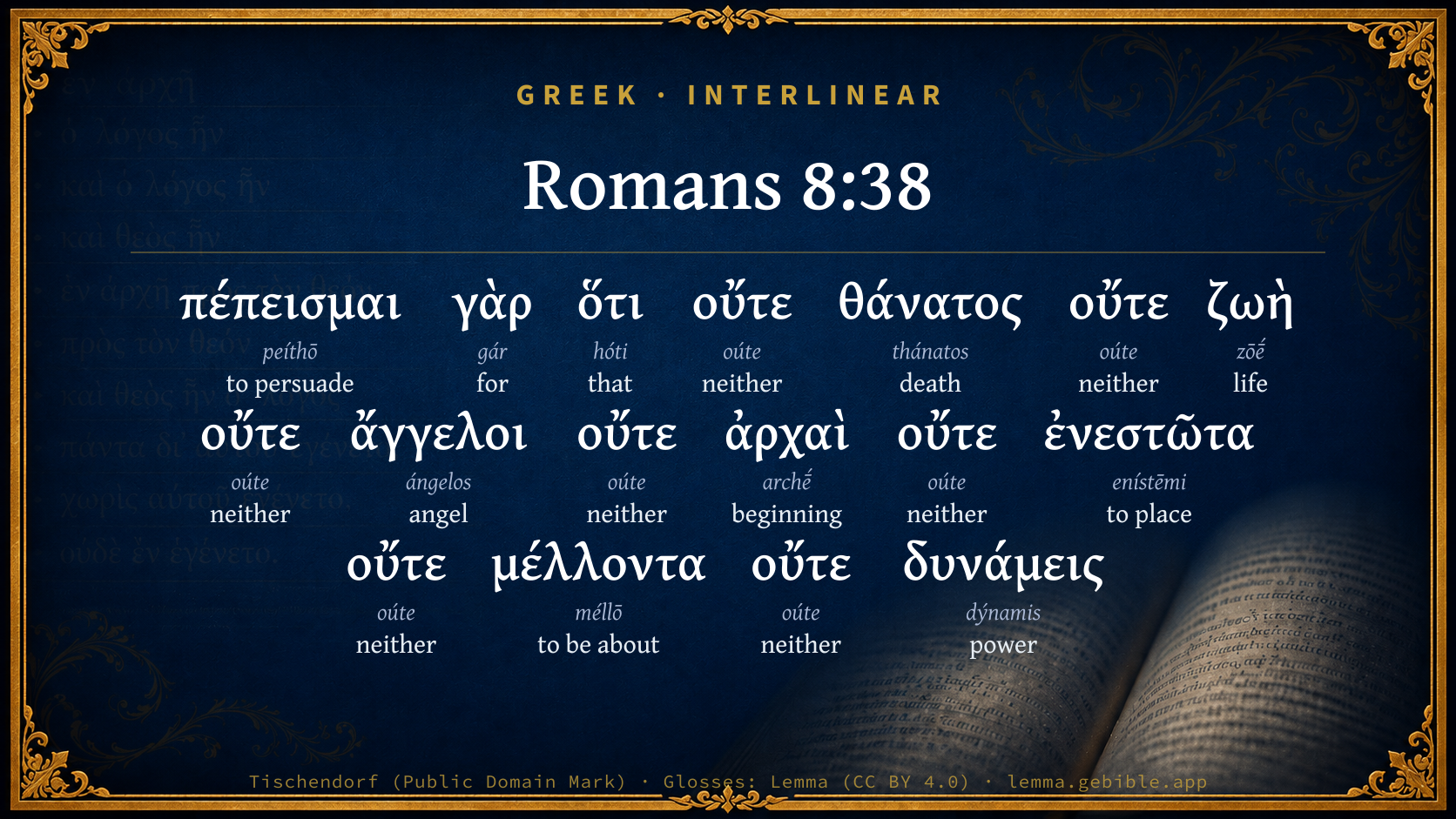
Greek (Tischendorf 8th ed.) Romans 8:38 appears in the Greek New Testament. The text above is from the Tischendorf 8th edition. Each word links to its Strong’s number and a concise gloss. Click any word for its full Thayer’s Greek Lexicon entry.
Download image
Cite this verse

Romans 8:38 (World English Bible). Public Domain. Lemma interlinear Bible study tool, https://lemma.gebible.app/v/romans/8/38.

Show BibTeX & RIS
BibTeX
RIS
English Translation
For I am persuaded, that neither death, nor life, nor angels, nor principalities, nor things present, nor things to come, nor powers,
World English Bible · Public Domain
Highlights
  • 1 first appearance in the Greek New Testament
Full analysis ↓
Download a study sheet

One document with this verse’s original text, its word-by-word gloss line, the meaning frame, cross-references with their text, attributed commentary, and full source and license credits — printable, and it pastes into notes with its structure intact.

This verse Autodidact and up

Study sheet (.html) Plain text (.txt)

A passage Seminary Student

Up to 50 verses in one chapter. A passage sheet keeps up to 6 commentary sources and 12 cross-references per verse, in the order this page ranks them, and says so on the sheet whenever that leaves anything out. Ask for a single verse and you get the Autodidact verse sheet above.

Everything on this page stays free to read, with no account — the sheet is a download of what is already on screen, not access to it.

Want to remove ads? Support Godless Engineer
Compare translations 3

The same verse in 3 English versions, stacked beneath the original-language interlinear above. Click any original word for its lexicon entry.

Each is an independent rendering of the whole verse — the interlinear is not word-aligned to these translations.

Highlighted words mark where these versions differ — a whole-verse word diff, not a word-by-word alignment.

  • World English Bible Public Domain
    For I am persuaded, that neither death, nor life, nor angels, nor principalities, nor things present, nor things to come, nor powers,
  • King James Version Public Domain
    For I am persuaded, that neither death, nor life, nor angels, nor principalities, nor powers, nor things present, nor things to come,
  • unfoldingWord Literal Text CC BY-SA 4.0
    For I am persuaded that neither death, nor life, nor angels, nor governments, nor things present, nor things to come, nor powers,

unfoldingWord Literal Text — © unfoldingWord, licensed CC BY-SA 4.0. Word-aligned USFM3 via Door43 (git.door43.org/unfoldingWord/en_ult).

Versions to compare (up to 4)

3 of 4 selected

Show all 19 translations

Every available English version of this verse, each an independent rendering of the whole verse.

  • World English Bible Public Domain
    For I am persuaded, that neither death, nor life, nor angels, nor principalities, nor things present, nor things to come, nor powers,
  • Berean Standard Bible Public Domain
    For I am convinced that neither death nor life, neither angels nor principalities, neither the present nor the future, nor any powers,
  • Majority Standard Bible Public Domain
    For I am convinced that neither death nor life, neither angels nor principalities nor powers, neither the present nor the future,
  • King James Version Public Domain
    For I am persuaded, that neither death, nor life, nor angels, nor principalities, nor powers, nor things present, nor things to come,
  • American Standard Version (1901) Public Domain
    For I am persuaded, that neither death, nor life, nor angels, nor principalities, nor things present, nor things to come, nor powers,
  • Revised Version (1885) Public Domain
    For I am persuaded, that neither death, nor life, nor angels, nor principalities, nor things present, nor things to come, nor powers,
  • Geneva Bible (1599) Public Domain
    For I am perswaded that neither death, nor life, nor Angels, nor principalities, nor powers, nor things present, nor things to come,
  • Douay-Rheims (1899) Public Domain
    For I am sure that neither death, nor life, nor angels, nor principalities, nor powers, nor things present, nor things to come, nor might,
  • Young's Literal Translation Public Domain
    for I am persuaded that neither death, nor life, nor messengers, nor principalities, nor powers, nor things present,
  • Literal Standard Version CC BY-SA 4.0
    for I am persuaded that neither death, nor life, nor messengers, nor principalities, nor powers, nor things present,
  • Unlocked Literal Bible CC BY-SA 4.0
    For I have been convinced that neither death, nor life, nor angels, nor governments, nor things present, nor things to come, nor powers,
  • unfoldingWord Literal Text CC BY-SA 4.0
    For I am persuaded that neither death, nor life, nor angels, nor governments, nor things present, nor things to come, nor powers,
  • Darby Bible Public Domain
    For I am persuaded that neither death, nor life, nor angels, nor principalities, nor things present, nor things to come, nor powers,
  • World Messianic Bible Public Domain
    For I am persuaded that neither death, nor life, nor angels, nor principalities, nor things present, nor things to come, nor powers,
  • Webster's Bible Public Domain
    For I am persuaded, that neither death, nor life, nor angels, nor principalities, nor powers, nor things present, nor things to come,
  • Free Bible Version CC BY-SA 4.0
    I'm absolutely convinced that neither death nor life, neither angels nor devils, neither the present nor the future, nor powers,
  • Bible in Basic English Public Domain
    For I am certain that not death, or life, or angels, or rulers, or things present, or things to come, or powers,
  • Text-Critical English NT CC BY 4.0
    For I am persuaded that neither death, nor life, nor angels, nor rulers, nor powers, nor things present, nor things to come,
  • Tyndale New Testament (1534) Public Domain
    Ye and I am sure that nether deeth nether lyfe nether angels nor rule nether power nether thinges present nether thinges to come

Literal Standard Version (2020), Covenant Press — licensed CC BY-SA 4.0. Text via the HelloAO Bible API (eBible.org). Unlocked Literal Bible (unfoldingWord) — licensed CC BY-SA 4.0. Text via the HelloAO Bible API (eBible.org). unfoldingWord Literal Text — © unfoldingWord, licensed CC BY-SA 4.0. Word-aligned USFM3 via Door43 (git.door43.org/unfoldingWord/en_ult). Free Bible Version, Dr. Jonathan Gallagher — licensed CC BY-SA 4.0. Text via the HelloAO Bible API (eBible.org).

Word by word

More ways to search: Search by grammar → Find every occurrence → Compare this word →

Practice this passage: Drill this verse → Learn its vocabulary →

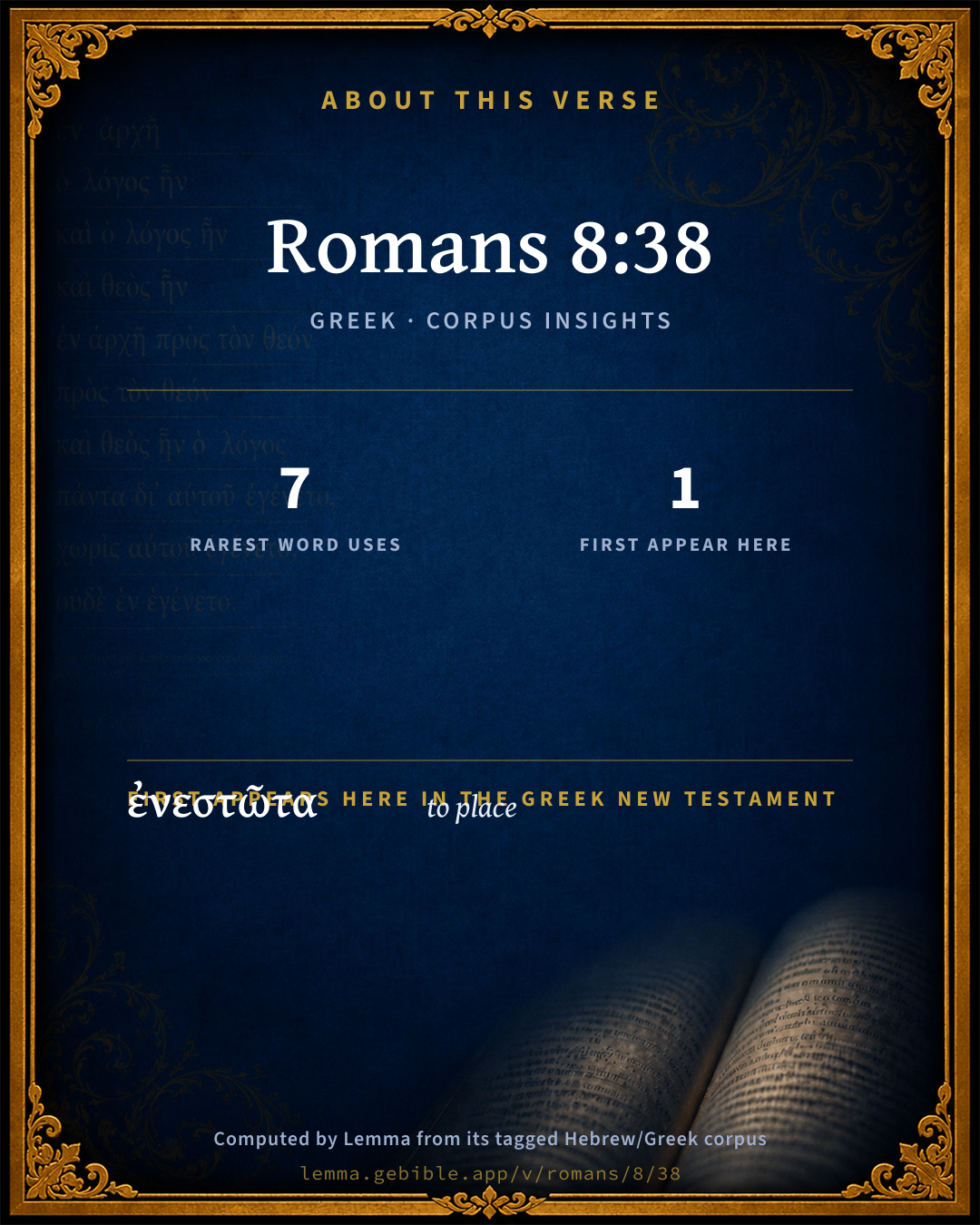
ἐνεστῶτα
enístēmi
G1764
“to place”
Verb, Perfect, Active, Participle, Nominative, Plural, Neuter
Part of Speech
Verb
Tense
Perfect
Voice
Active
Mood
Participle
Case
Nominative
Number
Plural
Gender
Neuter
Full Thayer's Definition

Origin: from G1722 and G2476

TDNT: 11:03,2

1. to place in or among, to put in 2. to be upon, impend, threaten 3. close at hand 4. present
  1. πέπεισμαι peíthō G3982 “to persuade” Verb, Perfect, Passive, Indicative, 1st person, Singular
  2. γὰρ gár G1063 “for” Conjunction
  3. ὅτι hóti G3754 “that” Conjunction
  4. οὔτε oúte G3777 “neither” Conjunction, Negative
  5. θάνατος thánatos G2288 “death” Noun, Nominative, Singular, Masculine
  6. οὔτε oúte G3777 “neither” Conjunction, Negative
  7. ζωὴ zōḗ G2222 “life” Noun, Nominative, Singular, Feminine
  8. οὔτε oúte G3777 “neither” Conjunction, Negative
  9. ἄγγελοι ángelos G32 “angel” Noun, Nominative, Plural, Masculine
  10. οὔτε oúte G3777 “neither” Conjunction, Negative
  11. ἀρχαὶ archḗ G746 “beginning” Noun, Nominative, Plural, Feminine
  12. οὔτε oúte G3777 “neither” Conjunction, Negative
  13. οὔτε oúte G3777 “neither” Conjunction, Negative
  14. μέλλοντα méllō G3195 “to be about” Verb, Present, Active, Participle, Nominative, Plural, Neuter
  15. οὔτε oúte G3777 “neither” Conjunction, Negative
  16. δυνάμεις dýnamis G1411 “power” Noun, Nominative, Plural, Feminine

About this verse

These counts appear in no published source. They are computed here, from the morphology-tagged text and Lemma’s own curated glosses. What Lemma adds →

17
words
11
distinct lemmas
Pauline Epistles
section

Notable vocabulary

The rarest word here is ἐνεστῶτα to place G1764 — appearing just 7 times in the whole Greek New Testament.

First appearance in Scripture

This word makes its first canonical appearance in the Greek New Testament here:

  • ἐνεστῶτα to place G1764

Shared distinctive vocabulary

ἐνεστῶτα to place G1764 occurs in 7 verses of the Greek New Testament. Also found in:

Repetition

A word recurs within this verse:

  • οὔτε neither G3777 ×7

Cross-references

17

Topical passages linked to Romans 8:38 in the Treasury of Scripture Knowledge — connected by theme and wording, ordered by reader-vote popularity; previews shown in the World English Bible.

  • John 10:28 I give eternal life to them. They will never perish, and no one will snatch them out of my hand.
  • Romans 14:8 For if we live, we live to the Lord. Or if we die, we die to the Lord. If therefore we live or die, we are the Lord's.
  • 2 Timothy 1:12 For this cause I suffer also these things. Yet I am not ashamed, for I know him whom I have believed, and I am persuaded that he is able to guard that which I have committed to him against that day.
  • 1 Peter 5:8–10 Be sober and self-controlled. Be watchful. Your adversary the devil, walks around like a roaring lion, seeking whom he may devour.
  • 1 Peter 3:22 who is at the right hand of God, having gone into heaven, angels and authorities and powers being made subject to him.
  • Colossians 1:16 For by him were all things created, in the heavens and on the earth, things visible and things invisible, whether thrones or dominions or principalities or powers; all things have been created through him, and for him.
  • 1 Corinthians 3:22–23 whether Paul, or Apollos, or Cephas, or the world, or life, or death, or things present, or things to come. All are yours,
  • Colossians 2:15 having stripped the principalities and the powers, he made a show of them openly, triumphing over them in it.
  • Ephesians 1:21 far above all rule, and authority, and power, and dominion, and every name that is named, not only in this age, but also in that which is to come.
  • Ephesians 6:11–12 Put on the whole armor of God, that you may be able to stand against the wiles of the devil.
  • Romans 4:21 and being fully assured that what he had promised, he was able also to perform.
  • 1 Corinthians 15:54–58 But when this corruptible will have put on incorruption, and this mortal will have put on immortality, then what is written will happen: "Death is swallowed up in victory."
  • 2 Corinthians 4:13 But having the same spirit of faith, according to that which is written, "I believed, and therefore I spoke." We also believe, and therefore also we speak;
  • 2 Corinthians 5:4–8 For indeed we who are in this tent do groan, being burdened; not that we desire to be unclothed, but that we desire to be clothed, that what is mortal may be swallowed up by life.
  • 2 Corinthians 11:14 And no wonder, for even Satan masquerades as an angel of light.
  • Philippians 1:20–23 according to my earnest expectation and hope, that I will in no way be disappointed, but with all boldness, as always, now also Christ will be magnified in my body, whether by life, or by death.
  • Hebrews 11:13 These all died in faith, not having received the promises, but having seen them and embraced them from afar, and having confessed that they were strangers and pilgrims on the earth.

Cross-references courtesy of OpenBible.info (CC BY 4.0).

Commentary

Notes on Romans 8:38 from classic Christian and Jewish commentators (each source and its license shown beneath its notes). The classic Christian expositions comment on the surrounding passage and are grouped to its opening verse, so a note may address several verses; the Jewish commentaries on the Tanakh (Rashi and others) are per-verse, so they appear only where the commentator wrote on this verse.

Lemma curates 59 commentaries, every one of them public domain or Creative Commons licensed, each selected and text-cleaned for this edition rather than reprinted as found. About our sources →

The Biblical Illustrator

Joseph S. Exell

Rom_8:38-39

For I am persuaded that neither death nor life … shall be able to separate us from the love of God which is in Christ Jesus.

The best persuasion

A visitor said to a poor wounded soldier, who lay dying in the hospital, What Church are you of? Of the Church of Christ, he replied. I mean, what persuasion are you of? Persuasion! said the dying man, as he looked heavenward, beaming with love to the Saviour, I am persuaded, that neither death, nor life, nor angels, nor principalities, nor powers, nor things present, nor things to come, shall be able to separate us from the love of God, which is in Christ Jesus.

Loves triumph

These rapturous words are the climax of the apostles long demonstration that the gospel is the power of God unto salvation. His argument started with sombre, sad words about mans sinfulness; like some stream rising among black and barren cliffs, or melancholy moorlands, and foaming through narrow rifts in gloomy ravines, it reaches at last fertile lands, and flows calm, the sunlight dancing on its broad surface, till it loses itself at last in the unfathomable ocean of the love of God. We are told that the biblical view of human nature is too dark. Well, the important question is not whether it be dark, but whether it be true. Certainly, a part of it is very dark. The picture of what men are, painted at the beginning of this Epistle, is black like a canvas of Rembrandts. But to get the whole doctrine, we have to see what men may become. Christianity begins indeed with, There is none that doeth good, no, not one, but it ends with this victorious paean, which tells us that the love of God is--

I. Unaffected by the extremest changes of our condition.

1. The apostle begins his catalogue of vanquished foes by a pair of opposites, neither death nor life, which cover the whole ground, and represent the extremes of change which can befall us. If these two stations, so far from each other, are equally near to Gods love, then no intermediate point can be far from it. Whether we live, we live unto the Lord; and whether we die, we die unto the Lord. His love to us makes no account of that mightiest of changes. How should it be affected by slighter ones? The distance of a star is measured by the apparent change in its position, as seen from different points of the earths surface or orbit. But this great light stands steadfast in our heaven, nor moves a hairs breadth, nor pours a feebler ray on us, whether we look up to it from the midsummer of busy life, or from the midwinter of death.

2. Of course the confidence of immortality is implied in this thought. Death does not affect the essential vitality of the soul; so it does not affect the outflow of Gods love to that soul. It is a change of condition and circumstance, and no more.

3. How this thought contrasts with the saddest aspect of the power of death! Death unclasps our hands from the closest, dearest grasp, parts soul and body, loosens every bond of society; but there is one bond which his abhorred shears cannot cut. Their edge is turned on it. One Hand holds us in a grasp which the fleshless fingers of death in vain strive to loosen. The separator becomes the uniter; he rends us apart from the world that he may bring us to God. The love filtered by drops on us in life is poured upon us in a flood in death!

II. Undiverted from us by any other order of beings. Nor angels, nor principalities, nor powers. The supposition which is, indeed, an impossible one, that these ministering spirits should so forget their mission and contradict their nature as to seek to bar us out from the love which it is their chiefest joy to bring to us; and its very impossibility gives energy to his conclusion (see also Gal_1:8), preaching another gospel than that which he had preached to them. The general thought implies--

1. The utter powerlessness of any third party in regard to the relations between our souls and God. We have to do with Him alone. These two, God and the soul, have to transact, as if there were no other beings in the universe.

(1) Angels, principalities, etc., may behold with sympathetic joy, and minister blessing in many ways; but the decisive act of union between God and the soul they can neither effect nor prevent.

(2) And as for them, so for men around us; the limits of their power to harm us are soon set. They may shut us out from human love by calumnies, and annoy us in a thousand ways; they may build a wall around us, and imprison us from many a joy and fair prospect: but they cannot put a roof on it to keep out the sweet influences from above, or hinder us from looking up to the heavens. Nobody can come between us and God but ourselves.

2. These blessed spirits do not absorb and intercept His love. The planet nearest the sun is saturated with fiery brightness, but the rays pass on to each of the sister spheres in its turn, and travel away outwards to where the remotest of them all rolls in its far-off orbit. Like that poor woman who could lay her fingers on the hem of Christs garment, notwithstanding the thronging multitude, we can reach our hands through all the crowd, or rather He reaches His strong hand to us and heals and blesses us. All the guests are fed full at that great table. Ones gain is not anothers loss. The multitudes sit on the green grass, and the last man of the last fifty gets as much as the first; and more remains than fed them all. This healing fountain is not exhausted of its curative power by the early comers.

III. Raised above the power of time. Nor things present, nor things to come. We had first a pair of opposites, and then a triplet; now again a pair of opposites, again followed by a triplet. The effect of this is to divide the whole into two, and to throw the first and second classes more closely together, as also the third and fourth. Time and space, these two mysterious ideas, which work so fatally on all human love, are powerless here.

1. The great revelation of God, on which the whole of Judaism was built, was that made to Moses of the name I am that I am. And parallel was that symbol of the bush, which signified not the continuance of Israel, unharmed by the fiery furnace of persecution, but the eternity of Israels God. Both proclaimed the same great truth of self-derived, self-determined, timeless, undecaying being.

2. And this eternity of being is no mere metaphysical abstraction. It is eternity of love, for God is love. We know of earthly loves which cannot die, and we have to thank God for such instances of love stronger than death, which make it easier for us to believe in the unchanging duration of His. But we know, too, of love that can change, and we know that all love must part. How blessed then to know of a love which cannot change or die! The past, the present and the future are all the same to Him. The whole of what He has been to any past, He is to us to-day.

3. So we may bring the blessedness of all the past into the present, and calmly face the misty future, sure that it cannot rob us of His love. Looking on all the flow of ceaseless change of earthly affection, we can lift up with gladness, heightened by the contrast, the triumphant song of the ancient Church, Oh, give thanks unto the Lord: for He is good: because His mercy endureth for ever!

IV. Present everywhere. The apostle ends with, nor height, nor depth, nor any other creature, as if he had got impatient of the enumeration of impotencies, and having named the outside boundaries in space, flings, as it were, with one rapid toss, into that large room the whole that it can contain, and triumphs over it all. As the former clause proclaimed the powerlessness of time, so this proclaims the powerlessness of that other great mystery of creatural life which we call space. Height or depth, it matters not. That diffusive love diffuses itself equally in all directions. The distance from the centre is equal to Zenith or to Nadir. Here we have the same process applied to that idea of omnipresence as was applied in the former clause to the idea of eternity. That thought, so hard to grasp with vividness, and not altogether a glad one to a sinful soul, is all softened and glorified, as some solemn Alpine cliff of bare rock is when the tender morning light glows on it, when it is thought of as the omnipresence of love. Then, God, seest me, may be a stern word, if the God who sees be but a mighty Maker or a righteous Judge. But how different it all is when we can east over the marble whiteness of that solemn thought the warm hue of life. In that great ocean of the Divine love we live and move and have our being, floating in it like some sea flower which spreads its filmy beauty and waves its long tresses in the depths of mid-ocean. The sound of its waters is ever in our ears, and above, beneath, around us, its mighty currents run evermore. We need not fear the omnipresence of love, nor the omniscience which knows us altogether, and loves us even as it knows. Rather we shall be glad that we are ever in His presence.

Conclusion:

1. The recognition of this triumphant sovereignty of love over all these real and supposed antagonists makes us, too, lords over them, and delivers us from the temptations which some of them present us to separate ourselves from the love of God. They all become our servants and helpers, uniting us to that love. So we are set free from the dread of death and from the distractions incident to life. So we are delivered from superstitious dread of an unseen world, and from craven fear of men. So we are emancipated from absorption in the present and from careful thought for the future. So we are at home everywhere, and every corner of the universe is to us one of the many mansions of our Fathers house. All things are yours … . and ye are Christs; and Christ is Gods.

2. But remember that this love of God is in Christ Jesus our Lord. Love illimitable, all-pervasive, eternal; yes, but a love which has a channel and a course, love which has a method and a process by which it pours itself over the world. In Christ the love of God is all centred and embodied, that it may be imparted to all sinful and hungry hearts, even as burning coals are gathered on a hearth that they may give warmth to all that are in the house. (A. Maclaren, D.D.)

Persuaded of the constancy of the Divine love

We begin with the form of protestation, I am persuaded, where the apostle, while he speaks of the state of a true believer in reference to grace and salvation, speaks of it as a matter of certainty and full persuasion. There are two manner of ways especially, whereby we come to be assured of our salvation.

1. By the inward persuasion of the Holy Ghost in our own consciences.

2. We come to be assured of our condition, from the reflection of conscience itself, our rejoicing is this (2Co_1:12; 1Jn_3:21). The second is the matter of it, or thing itself protested; and that is much one with that which he had before harped upon, That nothing shall be able to separate us from the love of God in Christ. Now this again is here laid down in these two verses together, two manner of ways. First, by an enumeration or induction of the several particulars; and secondly, by a winding-up of all together in one general conclusion. First, death shall not do it; death, it makes a great separation, it separates the soul from the body, two friends which have been a great while joined together, and it separates a man from the world. Oh! but for all this it does not separate a believer from Christ. First, for the souls of Gods children; these are not separated from Him by death. Not separated? Nay, they are so much the more conjoined. St. Paul desired to be dissolved, that he might be with Christ (Php_1:23; 2Co_5:6; 2Co_5:8). And so likewise for the bodies of Christians; these they are not separated from Christ neither, even when they lie in the grave, they are very accountable in the eyes of God, and He has a special care of them and regard unto them. The very dust of Gods people is precious, and their very bones are numbered by Him. No, nor secondly again by life; that is another part of this link. Life, it shall not prove hurtful or prejudicial to the people of God. First, not the good of life--I mean the outward good, and comfortableness of it. There is a great deal of hazard and danger in this. First, as it is an occasion to make men to be so much the more in love with the world. But Gods children are delivered from it, as having their affections weaned in them. A second evil of life in the prosperous part of it is, that it makes a man to defer his repentance and conversion to God. Thirdly, life is thus far dangerous, as it keeps a man from suffering for Christ; the more that any man has to lose, the less commonly is he willing to it. So again, as to the evils of life, ye may take it there also, that life in this sense is not prejudicial to Gods servants, but sanctified to them. First, as it is a time of sinning, for so this present life is, and therein irksome to Gods children. Secondly, as it is a time of misery. And thirdly, as the time of deferring of their reward; as long as Gods children live they are kept out of their inheritance. Thus we see how Gods children have an interest in life and death both, as making for their advantage, and it does belong unto them, as it is elsewhere expressed (Rom_14:8). The second is, Nor angels, nor principalities, nor powers. First, not the good angels. Why? Whoever suspected them? What need was there for the apostle to put in that? I answer upon a double account. First, by way of supposition. The apostle seems to argue here, as he does also in another place, Though we, or an angel from heaven, etc. (Gal_1:8). Not as if they were likely to endeavour it, but if they should do it, it would be to no purpose, for they should never effect it. The good angels may be conceived to be possibly prejudicial to the saints and servants of God ministerially, and in reference to their office; and that is, by the withdrawing of their help to us, or as being instruments of inflicting punishment and vengeance upon us; but thus now they are not to Gods elect, for they are still active for them to good upon all occasions. We may understand it of the devils. Thus (Rev_12:8) it is said that Michael and his angels fought, and the dragon and his angels. It is most certain that the devil, that is, the chief and principal of them, hath very great power for a while permitted unto him, as to the trouble of Gods servants. I will instance in one particular amongst the rest, and that is his casting of evil and troublesome fancies and conceits into the mind, and that sometimes with that force and violence, as that the mind shall not be able to resist them or keep them out. These are those kind of thoughts wherewith the devil does oftentimes disturb and perplex the minds of Christians; but that these are no way prejudicial to them in matter of guilt, or arguments for the questions of Gods love, or real ground of disquieting to them, will appear unto us upon these considerations. First, from their manner of acting and proceeding in the soul itself, wherein there is neither assent nor consent given unto them, but only a bare apprehension of them. Secondly, this may also appear from the suddenness and quickness of them; for they are commonly darted into the mind without any connection or dependence, whereas a mans own proper thoughts are with more leisure, and deliberation, and subordination of one thing to another. Thirdly, from the frequency and multiplicity of them, together with their unseasonableness; for they may be a thousand times in a day passing as lightning into an house from one end of it to another, and in continual motion. Fourthly, from the quality and condition of them, as being contrary to the very light of nature, and the habitual frame and disposition of the soul, which of itself is considerable in it. The main ground and foundation of this restrainedness of Satans power is intimated to us in the text, and that is in reference to Christ; it is the love of God in Him, and therefore Satan cannot separate us from it; and Christ is considerable of us under a double notion, of an head, and of an advocate. The third is neither things present nor things to come. These shall not be able neither to separate us from Gods love in Christ. First, not things present; they shall not be able to do it, whether we take it in good things or in evil. This is a point very satisfactory in the worst times that are. No, nor yet, secondly, Things to come, These shall not do it neither. Things to come--they are such things as are hid from mens discerning, and they know not what to make of them; yea, but thus far they are certain, as they shall make for the good of Gods people; and therefore in the place before cited (1Co_3:22), as things present are made a part of their portion, and said to be theirs; so are things to come likewise. And so indeed upon the point, all things in the full latitude and extent of being. If we speak of things to come, but as to this life, and as taken under the notion of uncertainty, Gods children are not at a loss here, but upon very good terms; but then if we speak of things to come as to the life following, and as under the notion of certainty, here they are infinitely and transcendently glorious. Things to come--these are the greatest interest and concernment of believers, and such as above all others they do most reckon and depend upon. It is the great disadvantage and prejudices of men of the world that their happiness it is confined to things present. (Thomas Horton, D. D.)

The triumphant hope of the Christian

Who can look upon the sun setting in the west and not be silent with wonder? One who sees Mont Blanc from the Lake of Geneva for the first time, lifting itself in awful splendour and glory, does not break forth into words, but gazes silently. So there are texts which, like the one before us, subdue us to silence.

I. This crowning love of God is made known to us in the Bible. The sea swelling with its tides, this great earth revolving on its axis, and rushing forward in its orbit the systems of worlds, all speak of the power of God. That He is a God of beauty we read in the leaf, the flower, the sea shell. But we do not find out from nature that God loves. When we understand this love of God, then are we ready to understand redemption.

II. This love fastens itself upon human beings. Compared with the mighty forces of nature, how weak we are; compared with eternity, how brief is life. What is man that God should observe him, and, much less, love him? Then we are so severed from God in capacity of mind, and so impure. We can readily believe that God loves the Church, or this and that eminent Christian, or the martyrs, but we doubt concerning ourselves. So many a Christian walks this world with timid apprehensions instead of the assurance of one who walks a world he knows his Father rules. If he realised that God loved him, then would he be joyous and triumphant--be strong for any service.

III. The eternity of this love. We feel at times that God loves us. But is this love eternal or fleeting? Is it fastened upon our personality, or upon our changing disposition? If we have been deceived in the character of one we love, or if that character has undergone a change, our love changes. Now if there is a radical change or degradation of character, Gods love may change; but aside from such change, it is not possible that anything can produce a change in the love of God. The assurance of this is the wine of life, poured from the chalice in Gods hand, into our fainting hearts.

1. Death cannot separate from the love of God. We go with a friend up to the last moment on earth. We see the mind still active, the memory clear, the noble impulses of the soul still predominant. Do you suppose that he who built the cathedral is ended while the work of his hand calls forth the admiration of mankind? We have the assurance in the resurrection of Christ, that death does not destroy the soul. Rather it sets the soul free from the lassitude and inactiveness of the body. The body hampers and manacles the soul. Now, can you conceive that death, which so adds to the spirit, can separate from the love of God? Death does not affect our love for our departed friends, save to augment it. How much more will it but augment the love of God.

2. But may not life? Life may reach its fourscore years and work many changes. The vigour is gone, and the beauty; decrepitude has come. But what is life to eternity? A dewdrop to the ocean; less than a single modest daisy to the innumerable worlds above. Shall the decrepitude of this brief life stand against an eternity without decrepitude? No changes wrought in the circumstances of life can affect the love of God. These are as nothing to the God of infinite resources. To Him, what matters it whether we dwell in a palace or a cottage? The favour is rather on the side of those who are in adverse circumstances. We love these who struggle more than those who enjoy; those who suffer patiently more than those who reign in royal splendour. Christ, when in the world, did not take His apostles from among the rulers; He made His abode with the poor rather than the rich. No; life cannot bring from the love of God, but rather brings us nearer because of its trials, temptations, and weaknesses.

3. But may not other powers? There are mighty ones above. May not these absorb the love of God? No; He takes care of the least as of the greatest. No star staggers in its course and halts to be caught in the grasp of God and held in its place. All the universe goes on evenly, quietly, surely. His love cannot be exhausted any more than His power. Weakness makes more certain this love. He sees us struggling against temptation which angels cannot experience, Nay, more, this love came to us through Jesus, His only Son.

4. May not time produce this separation? In the unrolling cycles, may not changes be wrought, powers developed, etc.? No; here come in the unchanging nature and the eternity of God. The same yesterday, to-day, and for ever. Yesterday just gone, to-day which is here, and for ever--oh, what a launch of thought!

5. May not space cause this separation? When we think of the vast distances in the universe; that the diameter of this system is seven hundred million miles; that astronomers, by an approximate parallax, show us that yonder star is so far away that it would take its light, travelling twelve millions of miles a minute, seventy-two years to reach us; that the unresolved nebula is so far away that its light would not reach us for seven hundred thousand years. When we think of these vast spaces, have we not reason to be fearful that there may be something in them that can separate us from Gods love? No, God is everywhere Master.

Conclusion:

1. What a terrific power is sin, since it can separate us from this love of God! More powerful than life or death, than all the universe.

2. What a privilege is this of the Christian to be safe in the love of God beyond all power of harm, to have a portion with God for ever. (R. S. Storrs, D.D.)

Things that cannot separate from the love of God

First, neither the height of worldly advancement nor the depth of worldly abasement. First, honour and advancement, dignity and height of place or preferment, that shall not do it. It is that which it sometimes does to some kind of persons, when they are not more watchful of themselves; high-standing it is apt to make men giddy, especially when they shall look down upon others which are far inferior to them. And there are great temptations which are now and then attending thereupon, of pride, and scornfulness, and security, and self-confidence, and the like. A child of God he shall not be afraid of that which is high, as we find the phrase used in another sense, and upon another occasion, in Ecc_12:5. And so for abasement and lowness of condition; he does not suffer from that neither, as St. Paul says of himself in another place: He knows how to abound, and he knows to be abased; to be full, and to be hungry; to abound, and to suffer need. There is a depth of affliction as well as an height of prosperity. And so for all other kinds and conditions of abasements of reproach, and contempt, and ignominy, which is cast upon them; these things they are digested by them. He that is low in his own eyes he can be content to be low in anothers. Secondly, not the height of spiritual enlargement, nor the depth of spiritual desertions. Spiritual enlargement, it is an height, and a very great one. Neither is the doctrine of assurance a doctrine of pride; neither is the state of assurance a state of pride. So again, as to spiritual desertions; the depth of that shall not hinder neither. This in Scripture is sometimes called a depth, as in Psa_130:1. Thirdly, take this height and depth here spoken of, as to the mysteries, whether of faith or providence, and ye shall find that neither these shall prove any disparagement to Gods servants. Lastly, neither height nor depth; that is, neither things above nor things below. It is a large and comprehensive expression which the Scripture uses in suchlike cases, when it will take in all, and so speak of anything, as to leave nothing out. Yet if we will take it more restrainedly and particularly, we may take it thus. First, take it as to the influences of Heaven. These are such as many people, especially now at this time, have a great regard unto, and that a great deal more than to other things which are more to be regarded. But those which are the servants of God are above all these heights. Those who are the children of God, and careful to walk in His fear, they shall not need to be dismayed at the signs of heaven (Jer_10:2). And so likewise we may take it as to the earth and the depths thereof. How many dangers are we here incident to, and yet graciously preserved from them? Now while the apostle is thus curious in this exact enumeration of particulars, and such as are so full and comprehensive, there are two things which we may gather from it: First, the weakness of our faith, especially in times of temptation, which the Spirit of God is fain to provide for, by such a complete dealing with us. Secondly, it shows the certainty of our own salvation. Seeing none of these things fore-mentioned are able to hinder us, we may from hence take notice of the sureness of the thing itself against all opposition. The second is, the general conclusion or main doctrine itself, and that is, that nothing shall be able to separate us from the love of God in Christ Jesus. Wherein again we have two branches more: First, the firmness or immovableness of Gods affection. That nothing whatsoever shall be able to separate us from it. This is agreeable to the whole current of Scripture (Psa_125:1; Heb_12:28). Now the firmness and stability of Gods people, in regard of their spiritual estate, may be thus surrendered: First, from the promise of God; it is a part of His gracious covenant with them. Secondly, the strength and power of Christ, that does likewise lay a ground for this truth; there His ability joined to Gods faithfulness, and the power of God joined to the truth of God (Heb_7:25). Thirdly, it may be further evinced from the nature of saving grace itself, and the work of regeneration, which is a constant and abiding principle, and so is signified to us to be in 1Jn_3:9. Take anything else in the world, besides true grace indeed, and ye shall find an uncertainty in it; let it be education, or custom, or natural conscience, or the credit of religion; none of these things are sure to hold or to continue long. But now for the power of godliness, and a true gracious heart in good earnest, it is such as is lasting and remaining. Fourthly, a Christians unmovableness is confirmed from the intercession of Christ. Whatever it is that Christ asks in the behalf of believers, it is most undoubtedly granted unto them. Fifthly, from the nature of election, which is a firm, and unchangeable decree; thus in verse 33 of this present chapter, Who shall lay anything to the charge of Gods elect? And so much may suffice to have spoken of the first particular in this second general, which is the firmness or immovableness of Gods affection considered in itself; that nothing is able to separate true Christians and believers from His love. The second is the ground or conveyance of this affection, and that is expressed in these words--Which is in Christ Jesus our Lord. First, He is the conveyance of His Fathers love unto us, by virtue of that near union and relation which we have to Him; forasmuch as we are very members incorporate into Him, and made one with Him. Secondly, Christ is also the conveyance of the Fathers love to us meritoriously, and by way of procurement; Christ has obtained of God the Father to love us together with Himself. (Thomas Horton, D.D.)

Faiths final paean

We seem to have been climbing up Jacobs ladder, all through this magnificent dissertation, and now we have reached its summit. The base was on earth, and there we found peace with God through our Lord Jesus Christ; the summit is the skies, and here the song which we sing is one of enraptured triumph. Christ is the first and the last in the scale of the Christians boasting and joy. It is through Him that we have no condemnation; and now it is in Him that we have confidence of happiness for ever. In the matter of our redemption He is all and in all, the Alpha, and the Omega, the author and the finisher of our faith.

I. The constancy of the love of God to them that are in Christ Jesus.

1. We are the objects of Gods love. Now, it is the very nature of love, in its truer and more noble forms, to be constant. Love is strong as death. Many waters cannot quench love, etc. Love is not mere transient sentiment; it is a passion which moves with innate energy; of all moral forces the strongest. You may torture and slay a man, but you cannot coerce his affections. Formidable difficulties may oppose his love in its course, but love will surmount them or perish in the attempt. There may be unworthiness on the part of its objects, but even then how often have we seen a mothers, a wifes, a daughters love burn as brightly as ever. Love can accomplish what no mechanical or physical force can. There is truth in the quaint old fable, which represents a traveller pursuing his way with a mantle round his shoulders. The sun and the wind contested as to which was strong enough to compel the wayfarer to abandon his cherished covering. First, Boreas blew his fiercest blast, but the harder he blew, the faster did the traveller bind and clasp his cloak. Then Sol began to pour upon his head his melting beams. In a little while our hero freely surrendered; the oppressive garment was unwrapped, and loosened, and thrown open, and finally flung away altogether. The wind represents physical force, and the sun the energy of love. Well, now, God loves us; and we may at least be sure of this, that Gods love is a nobler affection than any human love whatever (Isa_49:15; Jer_31:3).

2. This love is Gods love. If it were the love of a creature, mighty and good, we might fairly put confidence in its stability; but now we see it to be that of the Creator. If He loves us, who can separate us from His love? Look at--

(1) The power of the Almighty. There may be angels, men, heights, depths, things present and things to come; but all are equally powerless against the Omnipotent. None can injure whom He defends; none can impoverish whom He enriches.

(2) The sovereignty of His will (Mal_3:6). God knew everything about us before He set His love upon us. He has nothing further to learn concerning us. We cannot surprise Him by new revelations of character. He elected us as objects of His love while we were yet sinners. All being known to Him, and all being in His hands, surely it is impossible that if He once resolved to love us, He could ever be moved from that love.

3. Gods love is in Christ Jesus our Lord. In other words, it is a love whose outflow and development are based upon the redeeming work of Christ, and whose constancy, therefore, is guaranteed and assured by all the value and validity which attach to that work.

II. The creatures presumably hostile to the saints.

1. Death, whether natural or by violence, may sever us from many comforts and companions, but not from Jesus or His love. On the contrary, death brings us nearer to Christ than we were before. When we die, we go to be with Jesus, which is far better. Death, then, is an enemy converted into a friend.

2. Life. It is often a more perilous thing to live than to die. But let us not fear life. If for us to die would be gain, for us to live is Christ.

3. Angels, nor principalities, nor powers. We conceive of the angels as divided into ranks; some being higher and more powerful than the rest. But whether they are the ordinary angels, or whether they be the captains and chieftains, subordinate or supreme, of the angelic creation, all alike are powerless to intercept Gods love. But suppose it possible that all the angels, good and bad together, were to be in league against us; suppose that the malice of the one class were to be combined with the majesty of the other, we should still be secure, invulnerable, inviolable, and nothing they could do should separate us from the love of God.

4. Things present. Things visible are all our present surroundings of difficulty and circumstances of trial. These are enumerated, in some measure, in the former verses; but God loves us through them all. He will not suffer us to be tempted beyond our power of endurance, but does with every exigency open a door for our escape.

5. Things to come. We often forebode evil, and dread the future. But things to come are known to God; and whatever may betide, He will stand by us to the last. As our days, our strength shall be.

6. Height and depth. Whatever high thing there is, or whatever low thing, it need not alarm, as it cannot over power us. It may be worldly honour or abasement, but still we need not fear them. Neither the luxurious blandishments of affluence, nor the humiliating straitnesses of penury, shall separate us from God or destroy our interest in His love.

7. Any other creature. There, I have mentioned everything I could think of, and if I have omitted anything there is nothing to fear. (T. G. Horton.)

Assurance, not presumption

From this passage you see how safe and scriptural a full assurance is. By assurance I mean a firm, unfaltering trust in the declarations and promises of God. By personal assurance I mean a firm, unfaltering trust in the promises of God, as made to me from the moment that by believing in Jesus I make these promises my own. The apostle first of all believed in Jesus, and then as a believer in Jesus he was sure that he would go to heaven. He cast his helpless, guilty soul on Christ, and from that moment he was persuaded that he was the object of Gods love, and was persuaded that nothing could ever separate him from that love. And he was anxious to bring his Roman friends to the same persuasion. For the sake of their salvation he wished them to repose entirely on the finished work of Christ, but for the sake of their comfort and eminent sanctification, he wished them, having done this, to rejoice in hope of glory. Some tender-hearted Christians almost deprecate personal assurance, and probably the reason is that they have seen some profess assurance whose hope was evident presumption. But no two things can be more distinct. Presumption is Satans lie; assurance is the gift of the Holy Ghost. Presumption is hope without foundation; assurance is founded on the Word of God without, and the work of the Spirit within. Presumption makes a man proud and hard-hearted, censorious and flippant, reckless and undevout. Assurance makes a man stoop in humility lower and lower, the more be is persuaded of his heavenly Fathers love. And it gives him a panting after the living God. And it makes him tender-hearted--makes him like his Master, who does not despise the day of small things, who, when a bruised reed is put into His hand, does not snap it asunder and fling the fragments from Him; who, when a smoking flax is put upon His altar, does not sweep it off because it is flax, nor extinguish it because it is only smoking, but cherishes and fans that smouldering tow, till it burst in flames and fire the living sacrifice; and who shows His power and Divine compassion by taking the drooping shattered reed, and making it the rod of His might, a staff of strength in His hand. Even so real assurance is considerate and tender-hearted, does not scowl disdain on the smoky beginnings of grace in any heart, but finds a godlike pleasure in fostering it into a flame. Presumption is an intoxicating poison, and sends the self-deceiver reeling forward in a merry delusion, neglecting known duty and perpetrating known sin from day to day, and yet fancying that the Spirit of Christ is in him; assurance enlightens the eyes, and whether sedate or ecstatic, is always a cautious and circumspect thing, abhorring the garment spotted with the flesh. Presumption is impudent; assurance is filial and affectionate. Presumption talks about crosses; assurance carries them. Presumption is bustling and loquacious; assurance is full of zeal, but is often doing much when it says nothing. Presumption is heady and high-minded; assurance is sober, and vaunteth not itself. Presumption is self-indulgent; assurance is self-denied. Presumption, like an eastern nabob, would shut his eyes, and fold his hands, and nestle his cheek upon some balmy pillow, and then without any trouble to himself be walled to heaven in a silken palanquin; whilst assurance, like a primitive disciple, is content to strap on the pilgrims sandals, and shoulder the weighty cross, and foot it all the way to glory in the steps of the great Forerunner. Presumption is a vile fleshly counterfeit; assurance is a holy and sanctifying grace, because the gift of the holy and sanctifying Spirit. (J. Hamilton, D.D.)

Christian confidence

The account given of the death of Mr. Robert Bruce of Kinnaird is very beautiful in its simplicity: That morning before the Lord called him to his rest he came to breakfast at his table. After he had eaten, as his use was, a single egg, he said to his daughter, I think I am yet hungry; you may bring me another egg, and instantly fell silent; and, after having mused a little, he said, Hold, daughter, hold; my Master calleth me. With these words his sight failed him, and he called for the Bible; but finding he was not able to read, he said, Cast me up the eighth chapter to the Romans, verses twenty-eight to thirty-nine, much of which he repeated, particularly I am persuaded, that neither death, nor life shall be able to separate me from the love of God, which is in Christ Jesus my Lord, and caused his finger to be put upon them, which was done. Now, said he, is my finger upon them? They told him it was. Then he said, God be with you, my children; I have breakfasted with you, and shall sup with my Lord Jesus Christ this night, and straightway gave up the ghost without one groan or shiver.

Security

A lady was riding in her carriage, when, spying a beautiful flower by the side of a large rock, she alighted to take it up, that she might remove it to her conservatory, but found that, delicate as it appeared, it resisted all her efforts, because the root ran under the rock. Ah, thought she, this is an illustration of the safety of the Christian, whose life of beauty is under the shelter of the Rock, and whose root of strength runs far beneath it.

The Biblical Illustrator, edited by Joseph S. Exell (c. 1880s–1900s) — public domain. Text from a community e-Sword module.

Joseph Benson's Commentary

Rom 8:38-39. For I am persuaded, &c. — This period describes the full assurance of hope, and the inference is made in admirable order; neither death — Terrible as it is to natural men, a violent death in particular; nor the fear of it, Rom 8:36; nor life — With all the affliction and distress it can bring, Rom 8:35; or a long, easy life, and the love of it; or all living men; nor angels — Whether good (if it were possible they should attempt it) or bad, with all their subtlety and strength: nor principalities, nor powers — Not even those of the highest rank, or of the most eminent power. “Because angels are distinguished from principalities and powers, Beza and some others are of opinion that powers in this passage, as Luk 12:11, signify the persecuting rulers and potentates of the earth, who endeavoured to make the first Christians renounce their faith. But as evil angels, in other passages of Scripture, are called principalities and powers, and as the apostle rises in his description, it is probable that he speaks of these malicious spirits, the inveterate enemies of mankind; and that he calls them principalities and powers, by a metonymy of the office, or power possessed, for the persons possessing it.” — Macknight. Nor things present — Difficult as they are, or such as may befall us during our pilgrimage, or till the world passeth away; nor things to come — Extreme as they may prove; that is, future sufferings, or things which may occur, either when our time on earth is past, or when time itself is at an end, as the final judgment, the general conflagration, the everlasting fire. The apostle does not mention things past, because they have no influence on the mind, unless so far as the like things are either hoped or feared. Nor height, nor depth — The former sentence respected the differences of times; this respects the differences of places. How many, great, and various things are contained in these words, we do not, need not, cannot know yet. The height, in St. Paul’s sublime style, is put for heaven; the depth for the great abyss: that is, neither the heights, I will not say of walls, mountains, waves of the sea, but of heaven itself, can move us; nor the abyss itself, the very thought of which might astonish the boldest creature. Or his meaning may be, Neither the height of prosperity, nor the depth of adversity can move us. Nor any other creature — Above or beneath, in heaven, earth, or hell: nothing beneath the Almighty. In this general clause the apostle includes whatever else could be named, as having any influence to separate believers from the love of God, exercised toward them through Christ: shall be able — Either by force, Rom 8:35, or by any legal claim, Rom 8:33, &c., to separate us from the love of God in Christ — Which will surely save, protect, and deliver us, who believe, and persevere so to do, in and through, and from them all.

Joseph Benson's Commentary on the Old and New Testaments (1811–1818) — public domain. Text from a community e-Sword module.

MacLaren's Expositions of Holy Scripture

Alexander MacLaren

Romans

LOVE’S TRIUMPH

Rom 8:38 - Rom 8:39.

These rapturous words are the climax of the Apostle’s long demonstration that the Gospel is the revelation of ‘the righteousness of God from faith to faith,’ and is thereby ‘the power of God unto salvation.’ What a contrast there is between the beginning and the end of his argument! It started with sombre, sad words about man’s sinfulness and aversion from the knowledge of God. It closes with this sunny outburst of triumph; like some stream rising among black and barren cliffs, or melancholy moorlands, and foaming through narrow rifts in gloomy ravines, it reaches at last fertile lands, and flows calm, the sunlight dancing on its broad surface, till it loses itself at last in the unfathomable ocean of the love of God.

We are told that the Biblical view of human nature is too dark. Well, the important question is not whether it is dark, but whether it is true. But, apart from that, the doctrine of Scripture about man’s moral condition is not dark, if you will take the whole of it together. Certainly, a part of it is very dark. The picture, for instance, of what men are, painted at the beginning of this Epistle, is shadowed like a canvas of Rembrandt’s. The Bible is ‘Nature’s sternest painter but her best.’ But to get the whole doctrine of Scripture on the subject, we have to take its confidence as to what men may become, as well as its portrait of what they are-and then who will say that the anthropology of Scripture is gloomy? To me it seems that the unrelieved blackness of the view which, because it admits no fall, can imagine no rise, which sees in all man’s sins and sorrows no token of the dominion of an alien power, and has, therefore, no reason to believe that they can be separated from humanity, is the true ‘Gospel of despair,’ and that the system which looks steadily at all the misery and all the wickedness, and calmly proposes to cast it all out, is really the only doctrine of human nature which throws any gleam of light on the darkness. Christianity begins indeed with, ‘There is none that doeth good, no, not one,’ but it ends with this victorious pæan of our text.

And what a majestic close it is to the great words that have gone before, fitly crowning even their lofty height! One might well shrink from presuming to take such words as a text, with any idea of exhausting or of enhancing them. My object is very much more humble. I simply wish to bring out the remarkable order, in which Paul here marshals, in his passionate, rhetorical amplification, all the enemies that can be supposed to seek to wrench us away from the love of God; and triumphs over them all. We shall best measure the fullness of the words by simply taking these clauses as they stand in the text.

I. The love of God is unaffected by the extremest changes of our condition.

The Apostle begins his fervid catalogue of vanquished foes by a pair of opposites which might seem to cover the whole ground-’neither death nor life.’ What more can be said? Surely, these two include everything. From one point of view they do. But yet, as we shall see, there is more to be said. And the special reason for beginning with this pair of possible enemies is probably to be found by remembering that they are a pair, that between them they do cover the whole ground and represent the extremes of change which can befall us. The one stands at the one pole, the other at the other. If these two stations, so far from each other, are equally near to God’s love, then no intermediate point can be far from it. If the most violent change which we can experience does not in the least matter to the grasp which the love of God has on us, or to the grasp which we may have on it, then no less violent a change can be of any consequence. It is the same thought in a somewhat modified form, as we find in another word of Paul’s, ‘Whether we live, we live unto the Lord; and whether we die, we die unto the Lord.’ Our subordination to Him is the same, and our consecration should be the same, in all varieties of condition, even in that greatest of all variations. His love to us makes no account of that mightiest of changes. How should it be affected by slighter ones?

The distance of a star is measured by the apparent change in its position, as seen from different points of the earth’s surface or orbit. But this great Light stands steadfast in our heaven, nor moves a hair’s-breadth, nor pours a feebler ray on us, whether we look up to it from the midsummer day of busy life, or from the midwinter of death. These opposites are parted by a distance to which the millions of miles of the world’s path among the stars are but a point, and yet the love of God streams down on them alike.

Of course, the confidence in immortality is implied in this thought. Death does not, in the slightest degree, affect the essential vitality of the soul; so it does not, in the slightest degree, affect the outflow of God’s love to that soul. It is a change of condition and circumstance, and no more. He does not lose us in the dust of death. The withered leaves on the pathway are trampled into mud, and indistinguishable to human eyes; but He sees them even as when they hung green and sunlit on the mystic tree of life.

How beautifully this thought contrasts with the saddest aspect of the power of death in our human experience! He is Death the Separator, who unclasps our hands from the closest, dearest grasp, and divides asunder joints and marrow, and parts soul and body, and withdraws us from all our habitude and associations and occupations, and loosens every bond of society and concord, and hales us away into a lonely land. But there is one bond which his ‘abhorred shears’ cannot cut. Their edge is turned on it. One Hand holds us in a grasp which the fleshless fingers of Death in vain strive to loosen. The separator becomes the uniter; he rends us apart from the world that He may ‘bring us to God.’ The love filtered by drops on us in life is poured upon us in a flood in death; ‘for I am persuaded, that neither death nor life shall be able to separate us from the love of God.’

II. The love of God is undiverted from us by any other order of beings.

‘Nor angels, nor principalities, nor powers,’ says Paul. Here we pass from conditions affecting ourselves to living beings beyond ourselves. Now, it is important for understanding the precise thought of the Apostle to observe that this expression, when used without any qualifying adjective, seems uniformly to mean good angels, the hierarchy of blessed spirits before the throne. So that there is no reference to ‘spiritual wickedness in high places’ striving to draw men away from God. The supposition which the Apostle makes is, indeed, an impossible one, that these ministering spirits, who are sent forth to minister to them who shall be heirs of salvation, should so forget their mission and contradict their nature as to seek to bar us out from the love which it is their chiefest joy to bring to us. He knows it to be an impossible supposition, and its very impossibility gives energy to his conclusion, just as when in the same fashion he makes the other equally impossible supposition about an angel from heaven preaching another gospel than that which he had preached to them.

So we may turn the general thought of this second category of impotent efforts in two different ways, and suggest, first, that it implies the utter powerlessness of any third party in regard to the relations between our souls and God.

We alone have to do with Him alone. The awful fact of individuality, that solemn mystery of our personal being, has its most blessed or its most dread manifestation in our relation to God. There no other Being has any power. Counsel and stimulus, suggestion or temptation, instruction or lies, which may tend to lead us nearer to Him or away from Him, they may indeed give us; but after they have done their best or their worst, all depends on the personal act of our own innermost being. Man or angel can affect that, but from without. The old mystics called prayer ‘the flight of the lonely soul to the only God.’ It is the name for all religion. These two, God and the soul, have to ‘transact,’ as our Puritan forefathers used to say, as if there were no other beings in the universe but only they two. Angels and principalities and powers may stand beholding with sympathetic joy; they may minister blessing and guardianship in many ways; but the decisive act of union between God and the soul they can neither effect nor prevent.

And as for them, so for men around us; the limits of their power to harm us are soon set. They may shut us out from human love by calumnies, and dig deep gulfs of alienation between us and dear ones; they may hurt and annoy us in a thousand ways with slanderous tongues, and arrows dipped in poisonous hatred, but one thing they cannot do. They may build a wall around us, and imprison us from many a joy and many a fair prospect, but they cannot put a roof on it to keep out the sweet influences from above, or hinder us from looking up to the heavens. Nobody can come between us and God but ourselves.

Or, we may turn this general thought in another direction, and say, These blessed spirits around the throne do not absorb and intercept His love. They gather about its steps in their ‘solemn troops and sweet societies’; but close as are their ranks, and innumerable as is their multitude, they do not prevent that love from passing beyond them to us on the outskirts of the crowd. The planet nearest the sun is drenched and saturated with fiery brightness, but the rays from the centre of life pass on to each of the sister spheres in its turn, and travel away outwards to where the remotest of them all rolls in its far-off orbit, unknown for millenniums to dwellers closer to the sun, but through all the ages visited by warmth and light according to its needs. Like that poor, sickly woman who could lay her wasted fingers on the hem of Christ’s garment, notwithstanding the thronging multitude, we can reach our hands through all the crowd, or rather He reaches His strong hand to us and heals and blesses us. All the guests are fed full at that great table. One’s gain is not another’s loss. The multitudes sit on the green grass, and the last man of the last fifty gets as much as the first. ‘They did all eat, and were filled’; and more remains than fed them all. So all beings are ‘nourished from the King’s country,’ and none jostle others out of their share. This healing fountain is not exhausted of its curative power by the early comers. ‘I will give unto this last, even as unto thee.’ ‘Nor angels, nor principalities, nor powers, shall be able to separate us from the love of God.’

III. The love of God is raised above the power of time.

‘Nor things present, nor things to come,’ is the Apostle’s next class of powers impotent to disunite us from the love of God. The rhythmical arrangement of the text deserves to be noticed, as bearing not only on its music and rhetorical flow, but as affecting its force. We had first a pair of opposites, and then a triplet; ‘death and life: angels, principalities, and powers.’ We have again a pair of opposites; ‘things present, things to come,’ again followed by a triplet, ‘height nor depth, nor any other creature.’ The effect of this is to divide the whole into two, and to throw the first and second classes more closely together, as also the third and fourth. Time and Space, these two mysterious ideas, which work so fatally on all human love, are powerless here.

The great revelation of God, on which the whole of Judaism was built, was that made to Moses of the name ‘I Am that I Am.’ And parallel to the verbal revelation was the symbol of the Bush, burning and unconsumed, which is so often misunderstood. It appears wholly contrary to the usage of Scriptural visions, which are ever wont to express in material form the same truth which accompanies them in words, that the meaning of that vision should be, as it is frequently taken as being, the continuance of Israel unharmed by the fiery furnace of persecution. Not the continuance of Israel, but the eternity of Israel’s God is the teaching of that flaming wonder. The burning Bush and the Name of the Lord proclaimed the same great truth of self-derived, self-determined, timeless, undecaying Being. And what better symbol than the bush burning, and yet not burning out, could be found of that God in whose life there is no tendency to death, whose work digs no pit of weariness into which it falls, who gives and is none the poorer, who fears no exhaustion in His spending, no extinction in His continual shining?

And this eternity of Being is no mere metaphysical abstraction. It is eternity of love, for God is love. That great stream, the pouring out of His own very inmost Being, knows no pause, nor does the deep fountain from which it flows ever sink one hair’s-breadth in its pure basin.

We know of earthly loves which cannot die. They have entered so deeply into the very fabric of the soul, that like some cloth dyed in grain, as long as two threads hold together they will retain the tint. We have to thank God for such instances of love stronger than death, which make it easier for us to believe in the unchanging duration of His. But we know, too, of love that can change, and we know that all love must part. Few of us have reached middle life, who do not, looking back, see our track strewed with the gaunt skeletons of dead friendships, and dotted with ‘oaks of weeping,’ waving green and mournful over graves, and saddened by footprints striking away from the line of march, and leaving us the more solitary for their departure.

How blessed then to know of a love which cannot change or die! The past, the present, and the future are all the same to Him, to whom ‘a thousand years,’ that can corrode so much of earthly love, are in their power to change ‘as one day,’ and ‘one day,’ which can hold so few of the expressions of our love, may be ‘as a thousand years’ in the multitude and richness of the gifts which it can be expanded to contain. The whole of what He has been to any past, He is to us to-day. ‘The God of Jacob is our refuge.’ All these old-world stories of loving care and guidance may be repeated in our lives.

So we may bring the blessedness of all the past into the present, and calmly face the misty future, sure that it cannot rob us of His love.

Whatever may drop out of our vainly-clasping hands, it matters not, if only our hearts are stayed on His love, which neither things present nor things to come can alter or remove. Looking on all the flow of ceaseless change, the waste and fading, the alienation and cooling, the decrepitude and decay of earthly affection, we can lift up with gladness, heightened by the contrast, the triumphant song of the ancient Church: ‘Give thanks unto the Lord: for He is good: because His mercy endureth for ever!’

IV. The love of God is present everywhere.

The Apostle ends his catalogue with a singular trio of antagonists; ‘nor height, nor depth, nor any other creature,’ as if he had got impatient of the enumeration of impotencies, and having named the outside boundaries in space of the created universe, flings, as it were, with one rapid toss, into that large room the whole that it can contain, and triumphs over it all.

As the former clause proclaimed the powerlessness of Time, so this proclaims the powerlessness of that other great mystery of creatural life which we call Space, Height or depth, it matters not. That diffusive love diffuses itself equally in all directions. Up or down, it is all the same. The distance from the centre is the same to Zenith or to Nadir.

Here, we have the same process applied to that idea of Omnipresence as was applied in the former clause to the idea of Eternity. That thought, so hard to grasp with vividness, and not altogether a glad one to a sinful soul, is all softened and glorified, as some solemn Alpine cliff of bare rock is when the tender morning light glows on it, when it is thought of as the Omnipresence of Love. ‘Thou, God, seest me,’ may be a stern word, if the God who sees be but a mighty Maker or a righteous Judge. As reasonably might we expect a prisoner in his solitary cell to be glad when he thinks that the jailer’s eye is on him from some unseen spy-hole in the wall, as expect any thought of God but one to make a man read that grand one hundred and thirty-ninth Psalm with joy: ‘If I ascend into heaven, Thou art there; if I make my bed in Sheol, behold, Thou art there.’ So may a man say shudderingly to himself, and tremble as he asks in vain, ‘Whither shall I flee from Thy Presence?’ But how different it all is when we can cast over the marble whiteness of that solemn thought the warm hue of life, and change the form of our words into this of our text: ‘Nor height, nor depth, shall be able to separate us from the love of God.’

In that great ocean of the divine love we live and move and have our being, floating in it like some sea flower which spreads its filmy beauty and waves its long tresses in the depths of mid-ocean. The sound of its waters is ever in our ears, and above, beneath, around us, its mighty currents run evermore. We need not cower before the fixed gaze of some stony god, looking on us unmoved like those Egyptian deities that sit pitiless with idle hands on their laps, and wide-open lidless eyes gazing out across the sands. We need not fear the Omnipresence of Love, nor the Omniscience which knows us altogether, and loves us even as it knows. Rather we shall be glad that we are ever in His Presence, and desire, as the height of all felicity and the power for all goodness, to walk all the day long in the light of His countenance, till the day come when we shall receive the crown of our perfecting in that we shall be ‘ever with the Lord.’

The recognition of this triumphant sovereignty of love over all these real and supposed antagonists makes us, too, lords over them, and delivers us from the temptations which some of them present us to separate ourselves from the love of God. They all become our servants and helpers, uniting us to that love. So we are set free from the dread of death and from the distractions incident to life. So we are delivered from superstitious dread of an unseen world, and from craven fear of men. So we are emancipated from absorption in the present and from careful thought for the future. So we are at home everywhere, and every corner of the universe is to us one of the many mansions of our Father’s house. ‘All things are yours, . . . and ye are Christ’s; and Christ is God’s.’

I do not forget the closing words of this great text. I have not ventured to include them in our present subject, because they would have introduced another wide region of thought to be laid down on our already too narrow canvas.

But remember, I beseech you, that this love of God is explained by our Apostle to be ‘in Christ Jesus our Lord.’ Love illimitable, all-pervasive, eternal; yes, but a love which has a channel and a course; love which has a method and a process by which it pours itself over the world. It is not, as some representations would make it, a vague, nebulous light diffused through space as in a chaotic half-made universe, but all gathered in that great Light which rules the day-even in Him who said: ‘I am the Light of the world.’ In Christ the love of God is all centred and embodied, that it may be imparted to all sinful and hungry hearts, even as burning coals are gathered on a hearth that they may give warmth to all that are in the house. ‘God so loved the world’-not merely so much, but in such a fashion-’that’-that what? Many people would leap at once from the first to the last clause of the verse, and regard eternal life for all and sundry as the only adequate expression of the universal love of God. Not so does Christ speak. Between that universal love and its ultimate purpose and desire for every man He inserts two conditions, one on God’s part, one on man’s. God’s love reaches its end, namely, the bestowal of eternal life, by means of a divine act and a human response. ‘God so loved the world, that He gave His only begotten Son, that whosoever believeth in Him should not perish, but have everlasting life.’ So all the universal love of God for you and me and for all our brethren is ‘in Christ Jesus our Lord,’ and faith in Him unites us to it by bonds which no foe can break, no shock of change can snap, no time can rot, no distance can stretch to breaking. ‘For I am persuaded, that neither death nor life, nor angels, nor principalities, nor powers, nor things present, nor things to come, nor height, nor depth, nor any other creature, shall be able to separate us from the love of God, which is in Christ Jesus our Lord.’

Alexander MacLaren, Expositions of Holy Scripture (1904–1910) — public domain. Text from a community e-Sword module.

Bengel's Gnomon

Johann Albrecht Bengel

Rom 8:38. Πέπεισμαι, I am persuaded) all doubt being overcome.—γὰρ) Things of less weight do not hurt us: for even things of greater weight shall not hurt us.—οὔτε θάνατος, κ.τ.λ., neither death, etc.) This is introduced from Rom 8:34, in an admirable order:

Neither death shall hurt us,

for Christ hath died:

nor life: comp. Rom 14:9.

He rose again:

nor angels, nor principalities, nor things present, nor things to come: comp. Eph 1:20-21.

Christ is at the right hand of God.

nor power, nor height, nor depth, nor any other creature.

He makes intercession.

Hence we have an illustration of the order of the words. For the enumeration moves in pairs; neither death nor life; nor things present, nor things to come. The other two pairs are subjoined by chiasmus;[103] nor power [1], nor height [2], nor depth [3], nor any other [4] creature; [the first referring to the fourth, the second to the third]; in such a way, however, that in some sense, also power and height, depth and any creature may be respectively joined together. A similar chiasmus occurs at Mat 12:22, so that the blind and dumb both spake and saw, [blind referring to saw; dumb to spake]. But if any one should prefer the more commonly received reading of the order of enumeration, he may read as follows.—

[103] See Appendix. From the Greek X. When the component parts of two pairs of words or propositions have a mutual relation, inverse or direct.

Neither death, nor life:

nor angels, nor principalities, nor powers:

nor things present, nor things to come:

nor height, nor depth, nor any other creature,

so that there may be four pairs of species, and the second and fourth pairs may have the genus added in the first or last place. But testimony of higher antiquity maintains the former order of enumeration to be superior.[104] See Appendix. Crit. Ed. ii., p. 329, etc. I acknowledge for my own part that the generally received order of the words is more easy, and the reader is free to choose either. At all events the relation of this enumeration to Rom 8:34, which was demonstrated above, is so evident, and so full of the doctrine of salvation, that it cannot be admitted to be an arbitrary interpretation. Now, we shall look at the same clauses one by one.—θάνατος, death) Death is considered as a thing most terrible and here it is put first, with which comp. Rom 8:34, and the order of its series, and Rom 8:36. Therefore the death also, which is inflicted by men, is indicated: burning alive, strangulation, casting to wild beasts, etc.[105]—ζωὴ, life) and in it θλίψις, affliction, etc., Rom 8:35: likewise length of life, tranquillity, and all living men [as opposed to angels]. None of these things shall be hurtful, comp. 1Co 3:22 [in Rom 8:21 men are included].—ἄγγελοι, angels) The mention of angels is made, after the implied mention of men, in the way of gradation; 1Co 15:24, note. In this passage the statement may be understood as referring to good angels (conditionally, as Gal 1:8), and of wicked angels (categorically): (for it will be found that

[104] ABCD(Λ)Gfg. Memph. later Syr. Versions, Orig. Hilary 291, Vulg. put the δυνάμεις before ὄυτε ὕψωμα. Rec. Text has no very ancient authority but Syr. Vers. for putting δυνάμεις before ὄυτε ἐνεστῶτα.—ED.

[105] The author in his Germ. Vers. expresses the suspicion, that the state of the dead is here indicated rather than actual slaughter; from the consideration, that already in ver 35, every kind of death may be comprehended under the term sword.—E. B.

the latter are also called angels absolutely, not merely angels of the devil; Mat 25:41); 1Co 4:9; 1Co 6:3; 1Co 11:10; 1Ti 3:16; 1Pe 3:22; 2Pe 2:4; Jud 1:6; Rev 9:11, etc.; Psa 78:49.—ἀρχαὶ, principalities) These are also comprehended under the general name angels, as well as other orders, Heb 1:4; Heb 1:14; but those seem to be specially denominated angels, who are more frequently sent than the rest of the heavenly orders. They are thus called principalities, and also thrones, Col 1:16; but not kingdoms, for the kingdom belongs to the Son of God, 1Co 15:24-25.—οὔτε ἐνεστῶτα οὔτε μέλλοντα, nor things present nor things to come) Things past are not mentioned, not even sins; for they have all passed away. Present things are the events, that happen to us during our earthly pilgrimage, or which befall the whole world, until it come to an end. For the saints are viewed either individually, or as a united body. Things future refer to whatever will occur to us either after our time in the world, or after that of the whole world has terminated, as the last judgment, the conflagration of the world, eternal punishment; or those things, which, though they now exist, will yet become known to us at length by name in the world to come, and not till then.—οὔτε δύναμις,1[106] nor power)[107] Δύναμις often corresponds to the Hebrew word צבא, and signifies forces, hosts.

[106] 1 fg Vulg. Ambrose and Augustine support the singular δύναμις. But all the other authorities quoted in my last note support δυνάμεις.—ED.

[107] D corrected by a later hand, d.

Bengel's Gnomon of the New Testament — English translation (T&T Clark, Edinburgh, 1860) — public domain. Text from a community e-Sword module.

Meyer's Critical & Exegetical Commentary

Heinrich August Wilhelm Meyer

Rom_8:38-39. Paul now confirms what he had said in Rom_8:37 by the enthusiastic declaration of his conviction that no power, in whatever shape it may exist or be conceived of, etc. For the singular πέπεισμαι there is as little necessity for seeking a special reason (Hofmann, e.g., thinks that Paul wished to justify the confidence, with which he had expressed Rom_8:37) as in the case of λογίζομαι in Rom_8:18, especially as Rom_8:37 contains only the simple assertion of a state of fact, and not a how of that assertion.

The following expressions (θάνατος κ.τ.λ.) are to be left in the generality of their sense, which is, partly in itself and partly through the connection, beyond doubt; every arbitrary limitation is purely opposed to the purpose of declaring everythingeverything possibleincapable of separating the believers from the love of God in Christ. Hence: οὔτε θάνατος οὔτε ζωή: neither death nor life, as the two most general states, in which man can be. We may die or live: we remain in the love of God. The mention of death first was occasioned very naturally by Rom_8:36. It is otherwise in 1Co_3:22. Grotius (following Chrysostom and Jerome, ad Aglas. 9) imports the idea: metus mortis; spes vitae, which Philippi also regards as a correct paraphrase of the sense.

οὔτε ἄγγελοι οὔτε ἀρχαί] Neither angels (generally) nor (angelic) powers (in particular). ἄγγ. is, with Chrysostom, Theophylact, Beza, Tholuck, Philippi, Fritzsche, Hofmann, and others, to be understood of good angels, because the wicked are never termed ἄγγελοι without some defining adjunct (Mat_25:41; 2Co_12:7; 2Pe_2:4; comp. Jud_1:6). The objection repeated by Reiche (who, with Clemens Alexandrinus, Toletus, Grotius, Estius, and others, understands it of wicked angels), that an attempt on the part of the good angels to separate Christians from God is inconceivable, does not hold, since, according to Gal_1:8, the case of such an attempt falling within the sphere of possibility could certainly benot believed, butconceived ex hypothesi by Paul. Theophylact already aptly says: οὐχ ὡς τῶν ἀγγέλων ἀφιστώντων τοὺς ἀνθρώπους ἀπὸ Χριστοῦ, ἀλλὰ καθʼ ὑπόθεσιν τὸν λόγον τιθείς. Against the view that ἄγγ. denotes good and wicked angels (Wolf, Bengel, Koppe, and van Hengel), the linguistic usage is likewise decisive, since according to it the absolute ἀγγ. signifies nothing else than simply good angels. Comp. on 1Co_4:9.

ἀρχαί] obtains, through its connection with ἀγγ., its definite reference to particular powers in the category of angelsthose invested with power in the angelic world. Paul recognises a diversity of rank and power in the angelic hierarchy (of the good and the wicked), and finds occasion, especially in his later epistles, to mention it (Col_1:16; Eph_1:21; 1Co_15:24; Eph_6:12; Col_2:15); without, however (comp. on Eph_1:21), betraying any participation in the fluctuating definitions of the later Jews. See, respecting these definitions, Bartolocci, Bibl. rabb. I. p. 267 ff.; Eisenmenger, entdecktes Judenthum, II. p. 370 ff. Olearius, Wetstein, Loesner, Morus, Rosenmüller, Flatt, and Weiss, bibl. Theol. p. 460, refer ἀρχ. to human ruling powers; van Hengel to principatus quoslibet. Against these its connection with ἀγγ. is decisive, because no contrast is suggested of non-angelic powers. Just as little, because without any trace in the text, are we to understand with Hofmann the ἈΡΧΑΊ, in contrast to the good God-serving ἌΓΓΕΛΟΙ, as spirits that in self-will exercise a dominion, with which they do not live to the service of God, i.e. as evil spirits.

οὔτε ἐνεστῶτα οὔτε μέλλοντα] neither that which has set in nor that which is future. Comp. 1Co_3:22. Quite general, and not to be limited to sufferings (Vatablus, Grotius, Flatt, and others). ἐνεστ., however, does not absolutely coincide with the idea things present (as it is usually taken), which is in itself linguistically possible, but is never the case in the N. T. (see on Gal_1:4); but it denotes rather what is in the act of having set in, has already begun (and μελλ. that, the emergence of which is still future). So, according to Gal_1:4; 1Co_3:22; 1Co_7:26; 2Th_2:2. Aptly rendered by the Vulgate: instantia. Comp. Lucretius, i. 461: quae res instet, quid porro deinde sequatur.

οὔτε δυνάμεις] nor powers; to be left in its utmost generality, personal and impersonal (Hofmann arbitrarily limiting it to the latter). The common interpretation, angelic powers, would be correct, if its position after ἀρχαί were right; but see the crit. remarks. The incongruity of the apparent isolation of this link vanishes on observing that Paul, in his enumeration, twice arranges the elements in pairs (θάνατος … ἀρχαι), and then twice again in threes (viz. οὔτε ἐνεστ. οὔτε μέλλ. οὔτε δυνάμ., and ΟὔΤΕ ὝΨΩΜΑ ΟὔΤΕ ΒΆΘΟς ΟὔΤΕ ΤΊς ΚΤΊΣΙς ἙΤΈΡΑ), and the latter indeed in such a way, that to the two that stand contrasted he adds a third of a general character.

ΟὔΤΕ ὝΨΩΜΑ ΟὔΤΕ ΒΆΘΟς] neither height nor depth; likewise without any alteration or limitation of the quite general sense of the words. No dimension of space can separate us, etc. Arbitrary definitions are given: heaven and hell or the nether world (Theodoret, Bengel, Wetstein, Michaelis, Klee, Baumgarten-Crusius, Ewald, and Hofmann); heaven and earth (Fritzsche; comp. Theophylact, Morus, and Flatt); the height of bliss and the depth of misery (Koppe); spes honorum and metus ignominiae (Grotius, Rosenmüller); sapientia haereticorum and communes vulgi errores (Melancthon); neque altitudo, ex qua quis minaretur praecipitium, neque profundum, in quo aliquis minaretur demersionem (Thomas Aquinas, Anselm, Estius).

οὔτε τίς κτίσις ἑτέρα] nor any other created thing whatever, covers all not yet embraced in the foregoing elements; and thus the idea of nothing in the world in the shape of a creature is fully exhausted. The attempt to bring the collective elements named in their consecutive order under definite logical categories leads to artificialities of exposition, which ought not to be applied to such enthusiastic outbursts of the moment.

Instead of τῆς ἀγ. τοῦ Χριστοῦ (Rom_8:35), Paul now says, Τῆς ἈΓ. ΤΟῦ ΘΕΟῦ Τῆς ἘΝ Χ. Ἰ., not thereby expressing something different, but characterizing the love of Christ (toward us) as the love of God which is in Christ Jesus. The love of Christ, namely, is nothing else than the love of God Himself, which has its seat and place of operation in Christ. God is the original fountain, Christ the constant organ and mediating channel of one and the same love; so that in Christ is the love of God, and the love of Christ is the love of God in Christ. Comp. Rom_5:6; Rom_5:8.

Meyer — Critical and Exegetical Commentary on the New Testament — English translation by Peter Christie, edited by Frederick Crombie (T&T Clark, 1880) — public domain. Text from a community e-Sword module.

Expositor's Greek Testament

ed. W. Robertson Nicoll

Rom 8:38 f. The Apostle’s personal conviction given in confirmation of all that has been said, especially of Rom 8:37 . πέπεισμαι cf. 2Ti 1:12 . οὔτε θάνατος οὔτε ζωὴ : death is mentioned first, either with Rom 8:36 in mind, or as the most tremendous enemy the Apostle could conceive. If Christ’s love can hold us in and through death, what is left for us to fear? Much of the N.T. bears on this very point, cf. Joh 8:51 ; Joh 10:28 ; Joh 11:25 f., 1Th 4:13-18 , 1Co 15 , 2Co 4:16 to 2Co 5:5 , Rom 14:8 , Heb 2:14 f. The blank horror of dying is annihilated by the love of Christ. Neither death nor life is to be explained: explanations “only limit the flight of the Apostle’s thoughts just when they would soar above all limitation” (Gifford). οὔτε ἄγγελοι οὔτε ἀρχαὶ : this, according to the best authorities, forms a second pair of forces conceivably hostile to the Christian. As in every pair there is a kind of contrast, some have sought one here also: either making ἄγγελοι good and ἀρχαὶ evil powers, though both spiritual; or ἄγγελοι heavenly, and ἀρχαὶ (as in Luk 12:11 , Tit 3:1 ) earthly powers, in which case either might be either good or bad. But this is arbitrary: and a comparison of 1Co 15:24 , Eph 1:21 favours a suggestion in S. and H. that possibly in a very early copy οὔτε δυνάμεις had been accidentally omitted after οὔτε ἀρχαὶ , and then added in the margin, but reinserted in a wrong place. The T.R. “neither angels nor principalities nor powers” brings together all the conceptions with which the Apostle peopled the invisible spiritual world, whatever their character, and declares their inability to come between us and the love of Christ. οὔτε ἐνεστῶτα οὔτε μέλλοντα : cf. 1Co 3:22 . οὔτε ὕψωμα οὔτε βάθος : no dimensions of space. Whether these words pictured something to Paul’s imagination we cannot tell; the patristic attempts to give them definiteness are not happy. οὔτε τις κτίσις ἑτέρα : nor any created thing of different kind. All the things Paul has mentioned come under the head of κτίσις ; if there is anything of a different kind which comes under the same head, he includes it too. The suggestions of “another world,” or of “aspects of reality out of relation to our faculties,” and therefore as yet unknown to us, are toys, remote from the seriousness and passion of the Apostle’s mind. Nothing that God has made, whatever be its nature, shall be able to separate us ἀπὸ τῆς ἁγάπης τοῦ θεοῦ τῆς ἐν Χ . Ἰ . τοῦ κ . ἡμῷν , The love of Christ is God’s love. manifested to us in Him; and it is only in Him that a Divine love is manifested which can inspire the triumphant assurance of this verse.

The Expositor's Greek Testament, edited by W. Robertson Nicoll (1897–1910) — public domain. Text from a community e-Sword module.

Godet's Commentaries

Frédéric Louis Godet

Vv. 38-39. “For I am persuaded, that neither death, nor life, nor angels, nor principalities, nor things present, nor things to come, nor powers, nor height, nor depth, nor any other creation, shall be able to separate us from the love of God, which is in Christ Jesus our Lord.”

The challenge which the apostle had just thrown out to condemnation, and sin and suffering of every kind, he now extends to all the hostile powers of the universe which could threaten the bond of love whereby Christ, and God Himself, are united to the believer. The for expresses an argument a fortiori: “none of the enemies mentioned is to be feared, for not even throughout the whole universe is there a being to be dreaded.

Paul reverts to the form I, which he had dropped after Rom 8:18; the reason being that here, as well as in Rom 8:38, the matter in question is a personal conviction of a moral rather than a systematic nature. We must not forget the: “if at least you persevere,” which Paul himself wrote, Col 1:23, nor examples such as that of Demas, 2Ti 4:10. It is by ὑπομονή (Rom 8:25), perseverance in believing in the love of Christ to us, that this love exercises its irresistible power over us. The conviction here expressed by Paul does not apply to himself only, but to all believers (us, Rom 8:39).

The adversaries who rise before his view seem to advance in pairs. The first pair is death and life. Death is put first, in connection no doubt with Rom 8:35-36. The inverse order which we find 1Co 3:22, is occasioned there by the difference of the context. Death: the apostle is thinking of martyrdom, the fear of which may lead to apostasy. With death and its agonies, he contrasts life with its distractions, its interests and seductions, which may lead to lukewarmness and unfaithfulness, as in the case of Demas.

The second pair: angels and principalities. Undoubtedly principalities, ἀρχαί, might be regarded as an order of angels superior to common angels—archangels. But in the other pairs there is always found a contrast of character: it is therefore natural to apply these two terms to spirits of opposite kinds; the first to good angels (though this sense is not exclusively the meaning of ἄγγελοι, as Meyer alleges; comp. 1Co 4:9; 1Co 6:3); the second to malignant angels, as 1Co 15:24 and Eph 6:12 (Hofmann). It will be asked how good angels could labor to separate us from Christ; but this may only be a hypothesis like that of Gal 1:8. And may not what is of itself good contribute to lead us astray, if our attachment or admiration stops short at the creature, instead of rising to God?

The Byzs. here read a third term almost synonymous: δυνάμεις, powers; and a Mj. (C) with some Mnn. even adds a fourth: ἐξουσίαι, dominations. This last term is evidently an interpolation to form a pair with the third. As to the latter, according to the Mjj. of the other two families, it has its place, if it is really authentic, after the following pair.

Third pair: things present and things to come. The first term embraces all earthly eventualities, death included; the second, all that await us in the future life. The word ἐνεστῶτα, which strictly signifies what is imminent, when contrasted with things to come, takes the meaning: all that is already present.

If the term powers is authentic, it must be taken as embracing in one idea the two terms of the following pair: height and depth. These are all the powers of the invisible world, whether those which exalt us to the third heaven (height), but which in an instant, by reason of pride or even violently excited sensuality, may occasion the most frightful falls to the poor human heart; or those which plunge us into the most mysterious and unspeakable agonies (depth), like that of Jesus at Gethsemane, when He exclaimed: “My soul is sorrowful even unto death;” comp. what He added soon after: “This is your hour and the power of darkness.” It is scarcely necessary to refute the following interpretations which have been proposed: good fortune and bad; or honor and disgrace; the wisdom of heretics and vulgar prejudices (Mel.); the heights from which martyrs were precipitated, and the depths of the ocean where they were buried (Thomas Aquinas); or finally, the opposite dimensions of space (Meyer).

The last term, κτίσις ἕτερα, is usually translated by the expression: any other creature, and made a sort of et caetera. This meaning would certainly be rather poor after expressions of such ample comprehension as those which precede. But more than that, it hardly suits the word ἕτερα, which signifies different, and not merely other, as the word ἄλλη would do (for the distinction between these two adjectives, comp. 1Co 15:37-41). It seems, then, that the word κτίσις signifies here, not creature, as if the reference were to a particular being, to be put side by side with several others, but creation. Paul sees in thought this whole creation disappear, on the theatre of which there has been wrought the greatest wonder of divine love; and he asks whether, if a new creation arise, and more magnificent marvels are displayed before the eyes of man, the cross in those new ages will not run the risk of being eclipsed, and the love of God in Jesus Christ of being relegated to the oblivion of the past. And he boldly affirms that whatever new creations may succeed one another, the first place in the heart of believers will ever remain for the redeeming love of which they have been the object here below.

Paul here speaks of the love of Jesus as being the love of God Himself; for it is in the former that the latter is incarnated for us, and becomes the eternal anchor of which our faith lays hold for eternity; comp. Rom 5:15 and Luke 15, where the compassion of God is completely identified with the work of Jesus on the earth.

Nowhere has the feeling of St. Paul been displayed in such overflowing measure, and yet the thread of logical deduction is not broken for an instant. This passage sums up, as we have seen, all that Paul has hitherto expounded in this Epistle. He leaves us at the end of this chapter face to face with this divinely wrought salvation, which is complete, and assured, and founded on faith alone, to be apprehended, and ever apprehended anew by the same means. Then, after a moment of contemplation and rest, he takes us again by the hand to guide us to the theatre of history, and show us this divine work unfolding itself on a great scale in the human race.

Frédéric Louis Godet — Commentaries on Luke, John, Romans, and 1 Corinthians — English translation (T&T Clark, Edinburgh, 1870s–1890s) — public domain. Text from a community e-Sword module.

Hodge's Commentary on Romans, Ephesians & First Corinthians

Charles Hodge

Rom_8:38, Rom_8:39

In these verses the confidence of the apostle is expressed in the strongest language. He heaps words together in the effort to set forth fully the absolute inability of all created things, separately or united, to frustrate the purpose of God, or to turn away his love from those whom he has determined to save.

For I am persuaded, that neither death, nor life, etc. It is somewhat doubtful how far the apostle intended to express distinct ideas by the several words here used. The enumeration is by some considered as expressing the general idea that nothing in the universe can injure believers, the detail being designed merely as amplification. This, however, is not very probable. The former view is to be preferred. Neither death. That is, though cut off in this world, their connection with Christ is not thereby destroyed. They shall never perish, neither shall any pluck them out of my hand, Joh_10:28. Nor life, neither its blandishments nor its trials. Whether we live, we live unto the Lord, or whether we die, we die unto the Lord. So that living or dying we are the Lords. Rom_14:8.

Nor angels, nor principalities, nor powers. Principalities and powers are by many understood here to refer to the authorities of this world as distinguished from angels. But to this it may be objected, that Paul frequently uses these terms in connection to designate the different orders of spiritual beings, Eph_1:21; Col_1:16; and secondly, that corresponding terms were in common use among the Jews in this sense. It is probable, from the nature of the passage, that this clause is to be taken generally, without any specific reference to either good or bad angels as such. No superhuman power, no angel, however mighty, shall ever be able to separate us from the love of God. Neither things present, nor things to come. Nothing in this life, nor in the future; no present or future event, etc.

Charles Hodge — Commentary on Romans (1835), First Corinthians (1857), and Ephesians (1856) — public domain. Text from a community e-Sword module.

Jamieson, Fausset & Brown

Robert Jamieson, A. R. Fausset & David Brown

For I am persuaded, that neither death, nor life, nor angels, nor principalities, nor powers--whether good or bad. But as the bad are not called "angels," or "principalities," or "powers," save with some addition to show that such are meant (Mat 25:41; Col 2:15; Eph 6:12; Pe2 2:4 --except perhaps Co1 6:3), probably the good are meant here, but merely as the same apostle supposes an angel from heaven to preach a false gospel. (So the best interpreters).

nor things present, nor things to come--no condition of the present life and none of the unknown possibilities of the life to come.

Jamieson, Fausset & Brown — Commentary Critical and Explanatory on the Whole Bible (1871) — public domain (CC PDM 1.0). Text via the HelloAO Bible API.

Adam Clarke's Commentary

Verse 38. For I am persuaded] After the blessed experience we have had of support by the grace and Spirit of him that loved us, that neither fear of death, nor hope of life, nor evil angels, nor principalities, nor powers, persecuting us for Christ's sake; nor the things we endure at present, nor the things to come, whatever tribulation we may be called to suffer in future;

Adam Clarke's Commentary on the Bible (1810–1826) — public domain. Text from a community e-Sword/MySword module.

John Calvin's Commentaries

38. He is now carried away into hyperbolic expressions, that he might confirm us more fully in those things which are to be experienced. Whatever, he says, there is in life or in death, which seems capable of tearing us away from God, shall effect nothing; nay, the very angels, were they to attempt to overturn this foundation, shall do us no harm. It is no objection, that angels are ministering spirits, appointed for the salvation of the elect, (Hebrews 1:14:) for Paul reasons here on what is impossible, as he does in Galatians 1:8; and we may hence observe, that all things ought to be deemed of no worth, compared with the glory of God, since it is lawful to dishonor even angels in vindicating his truth. Angels are also meant by principalities and powers, and they are so called, because they are the primary instruments of the Divine power: and these two words were added, that if the word angels sounded too insignificant, something more might be expressed. But you would, perhaps, prefer this meaning, “Nor angels, and whatever powers there may be;” which is a mode of speaking that is used, when we refer to things unknown to us, and exceeding our capacities.

Nor present things, nor future things, etc. Though he speaks hyperbolically, yet he declares, that by no length of time can it be effected, that we should be separated from the Lord’s favor: and it was needful to add this; for we have not only to struggle with the sorrow which we feel from present evils, but also with the fear and the anxiety with which impending dangers may harass us. The meaning then is, — that we ought not to fear, lest the continuance of evils, however long, should obliterate the faith of adoption.

This declaration is clearly against the schoolmen, who idly talk and say, that no one is certain of final perseverance, except through the gift of special revelation, which they make to be very rare. By such a dogma the whole faith is destroyed, which is certainly nothing, except it extends to death and beyond death. But we, on the contrary, ought to feel confident, that he who has begun in us a good work, will carry it on until the day of the Lord Jesus.

John Calvin's Commentaries (1540-1563) — public domain. Text from the Calvin Translation Society English edition (1840s-50s) via the Christian Classics Ethereal Library (ccel.org). Calvin's coverage is partial (roughly two-thirds of the Bible); uncommented books and verses are honest gaps, never fabricated. The 19th-century editor's footnotes and remarks are omitted so the notes are faithfully Calvin's own voice.

Ellicott's Commentary for English Readers

(38) Neither death, nor life . . .—The enumeration that follows is intended to include (poetically rather than logically) every possible category of being, especially those unseen powers of evil against which the warfare of the Christian was more particularly directed.

Nor principalities.—Comp. Eph_6:12, “We wrestle . . . against principalities, against powers;” terms belonging to the Jewish enumeration of angels. The critical evidence is however absolutely decisive in separating “powers” from “principalities” in this instance and placing it after “things present, nor things to come.” It would be better therefore to take it in a wider sense: “Agencies of every kind, personal or impersonal.”

A Bible Commentary for English Readers, edited by Charles John Ellicott (1878–1897) — public domain. Text from a community e-Sword module.

The Cambridge Bible for Schools and Colleges

gen. ed. J. J. S. Perowne

38. I am persuaded] Same word as Rom_14:14, Rom_15:14; 2Ti_1:5; 2Ti_1:12; Heb_6:9. The word implies firm assurance on good grounds. Here, of course, this amounts (unless the passage is to end with an anticlimax) to the utmost certainty of expectation.

death] Through which we “depart, and are with Christ.” Php_1:23. Cp. also, throughout this passage, 1Co_3:22-23.

life] With its allurements or its sufferings.

angels, principalities, powers] The last word is to be transferred, perhaps, to stand after things to come.” In that case it may include the widest meanings of the word “power.” As placed in E. V., it must specially refer to (evil) angelic powers,—“Principalities:”—cp. Eph_3:10; Eph_6:12; Col_1:16; Col_2:15; which assure us that the word here, standing close to “angels,” means not earthly but supernatural (and here evil) dominions.—For suggestions how such powers might seem to tend to “separate” the saint from the love of God, see Eph_6:12.

things present—things to come] Phrases in themselves quite exhaustive, whether or no they refer (as they may) to the present world and the future world respectively. He who holds His saints in His hand “is, and is to come.”

The Cambridge Bible for Schools and Colleges (gen. ed. J. J. S. Perowne; Cambridge University Press, 1878–1918) — public domain. Text from a community e-Sword module.

John Gill's Exposition

For I am persuaded,.... These words with the following, express the strong persuasion, and full assurance of faith the apostle had, that nothing whatever could separate him and the rest of God's people, from his love towards them in Christ Jesus. This persuasion not only regards himself, but others; and is not conjectural, but certain; and which did not arise from any special and extraordinary revelation, but is founded upon the nature of the love of God itself, the security of it in Christ, and of the persons of God's elect in him; upon eternal predestination, and the unalterable purposes of God; upon the promise and oath of God; upon adoption, and the gracious witnessings, assistances, and inhabitation of the Spirit; and is greatly increased by the consideration of the death, resurrection, and intercession of Christ. The things enumerated, which are not able to separate from the love of God, are as follow:

death; death separates men from the world, their worldly habitations and substance; it separates the soul from the body, and one friend from another; and in process of time, may take off all thoughts and affections for departed friends, but it is not able to separate from the love of God; it is so far from it, that it lets the soul into the fullest enjoyment of it: and as corporeal death, so no other kind of death can do it; for if the death of the body cannot, the death of afflictions never can; and as for a moral or spiritual death, and an eternal one, these shall never befall the children of God:

nor life; this natural and temporal life, which is frail and mortal; the love of God is better than this life, and this itself is the effect of divine favour; wherefore this can never separate from the love of God, nor anything in it: the life of believers is indeed filled up with troubles and exercises, and attended with much imperfection and sin; but nothing does, or can alienate the affections of God from his children; for though he exercises them with the trials of life, and chastises them for their sins, yet his loving kindness be does not take away from them:

nor angels; by whom are meant evil angels, the devils; for as for good angels, they never attempt to separate God and his people; they rejoice at their good, minister to them, are their guardians whilst here, at death they carry their souls to heaven, and at the last day will gather all the elect together; but evil angels do endeavour it, by temptations to sin, and accusations for it; by stirring up heresies and persecutions, in order to destroy them, but cannot succeed; for the saints are upon God's heart, are in Christ's hands, and on him the rock; and the Spirit of God is in them, who is greater than he that is in the world:

nor principalities: civil magistrates; who though they may separate them from their company, and cast them out as evil; may separate them in prisons one from another; and separate soul and body, by killing the latter, which is all they can do; yet they cannot separate neither soul nor body from the love of God: the Jews often say, that if all the nations of the world were gathered together, they could not extinguish (n) or cause to cease (o), or take away the love which is between God and his people Israel (p):

nor powers; either the same with the former; or false teachers who had the power of working miracles in confirmation of their doctrines, by which they deceived many; and if it had been possible, would have deceived the elect of God, but that was impossible:

nor things present; present evils, the afflictions of the present life; God does not cease to love when he afflicts his people; yea, afflictions spring from his love, and in them he afresh manifests his love to them; they are overruled for their good, and issue in eternal glory. Present temptations also may be meant. The best of saints have been exposed unto them; Christ himself was not exempted from them; these do not, nor cannot separate from the love of God; which is manifest from the regard which God and Christ have to tempted ones, by sympathizing with them, supporting and succouring of them, rebuking the tempter, and delivering from them. Present desertions, or the hidings of God's face, which often is the case of his dear children, can have no such effect; their relation to God still continues; they have great nearness unto him, are engraven on the palms of his hands, are set as a seal on his heart, and he bears a strong affection to them; though, for wise reasons, he is pleased for a moment to hide himself from them: yea, the present body of sin and death saints carry about with them in this life, cannot separate them; sin has separated the angels from God, who rebelled against him; it drove Adam out of the garden of Eden, and will exclude the wicked from the divine presence to all eternity; and it often separates between God and his own people, with respect to communion, but never with respect to union to him, or interest in him; for he knew what they would be when he set his love upon them; his love broke through all the corruptions of nature and sins of life in their conversion; and appears to continue the same from the strong expressions of his grace to them, notwithstanding all their backslidings; could sin separate in this sense, no one would remain the object of his love. Now this does not suppose that God loves sin, nor does it give any encouragement to it; for though it cannot separate from interest in God, yet it does from the enjoyment of him. Again, present good things may be designed, the good things of this life, temporal enjoyments; these are given in love; and though they may be but few, they are in mercy, and with a blessing; and the great mercy of all is, that these are not their all, nor do they take off their value and esteem for the love of God, which is better to them than all the things of life; and though "the prosperity of fools shall destroy them", Pro 1:32, the prosperity of the saints shall never be their ruin:

nor things to come; whether good or bad, prosperous or adverse; more afflictions, fresh difficulties with the body of sin; an hour of temptation, and time of distress that is to come upon all the earth; or the evil days of old age; God will never leave, nor forsake his people, or cause his loving kindness to depart from them, in whatsoever state or condition they may come into: the Vulgate Latin version adds, "nor fortitude"; and the Ethiopic version, "nor powers"; and one copy adds it in the beginning of Rom 8:39, "nor power".

(n) Targum in Cant. viii. 7. (o) Shemot Rabba, sect. 49. fol. 144. 1. (p) Bemidbar Rabba, sect. 2. fol. 179. 4.

John Gill's Exposition of the Whole Bible (1746–1763) — public domain (CC PDM 1.0). Text via the HelloAO Bible API.

Trapp's Complete Commentary

John Trapp

38 For I am persuaded, that neither death, nor life, nor angels, nor principalities, nor powers, nor things present, nor things to come,

Ver. 38. For I am persuaded] Or, I am sure by what I have heard out of God’s word. {a} He that hath this full assurance of faith goes gallantly to heaven. What (saith the world) should a rich man all? The Irish ask such, What they mean to die? But I wonder more at such as have the riches of full assurance, yea, that have but the assurance of adherence, though not of evidence, what they mean to walk heavily. Mr Latimer says that the assurance of heaven is the desert of the feast of a good conscience. There are other dainty dishes in this feast, but this is the banquet.

{a} πεπεισμαι, scil. Ex verbi praedicatione efficaci ut indicat tacite hoc verbo. Beza.

John Trapp, A Commentary or Exposition upon All the Books of the Old and New Testament (1647–1656) — public domain. Text from a community e-Sword module.

Albert Barnes' Notes on the Bible

For I am persuaded - I have a strong and unwavering confidence. Latin Vulgate, “I am certain.” The expression here implies unwavering certainty.

Neither death - Neither the fear of death, nor all the pains and tortures of the dying scene, even in the most painful trials of persecution; death in no form.

Nor life - Nor the hope of life; the love of life; the offer of life made to us by our persecutors, on condition of abjuring our Christian faith. The words evidently refer to times of persecution; and it was not uncommon for persecutors to offer life to Christians, on condition of their renouncing attachment to the Saviour, and offering sacrifice to idols. All that was demanded in the times of persecution under the Roman emperors was, that they should throw a few grains of incense on the altar of a pagan god, as expressive of homage to the idol. But even this they would not do. The hope of life on so very easy terms would not, could not alienate them from the love of Christ.

Nor angels - It seems to be apparent that “good angels” cannot be intended here. The apostle was saying that nothing would separate Christians from the love of Christ. Of course, it would be implied that the things which he specifies might be supposed to have some power or tendency to do it. But it is not conceivable that good angels, who are “sent forth to minister for them who shall be heirs of salvation” Heb 1:14, should seek to alienate the minds of Christians from the Saviour, or that their influence should have any such tendency. It seems to be clear, therefore, that he refers to the designs and temptations of evil spirits. The word “angels” is applied to evil spirits in Mat 25:41; 1Co 6:3.

Nor principalities - (ἀρχαὶ archai). This word usually refers to magistrates and civil rulers. But it is also applied to evil angels, as having dominion over people; Eph 6:12, “For we wrestle against ...principalities;” Col 2:15, “And having spoiled principalities:” 1Co 15:24, “When he shall have put down all rule;” Greek, ἀρχήν archēn. Some have supposed that it refers here to magistrates and those in authority who persecuted Christians; but the connection of the word with angels seems to require us to understand it of evil spirits.

Nor powers - This word δυνάμεις dunameis is often applied to magistrates; but it is also applied to evil spirits that have dominion over men; 1Co 15:24. The ancient Rabbis also give the name powers to evil angels. (Schleusner.) There can be no doubt that the Jews were accustomed to divide the angels of heaven into various ranks and orders, traces of which custom we find often in the Scriptures. And there is also reason to suppose that they made such a division with reference to evil angels, regarding Satan as their leader, and other evil spirits, divided into various ranks, as subordinate to him; see Mat 25:41; Eph 6:12; Col 2:15. To such a division there is probably reference here; and the meaning is, that no order of evil angels, however powerful, artful, or numerous, would be able to alienate the hearts of Christians from their Redeemer.

Nor things present - Calamities and persecutions to which we are now subject.

Nor things to come - Trials to which we may be yet exposed. It evinced strong confidence to say that no possible trials should be sufficient to destroy their love for Christ.

Albert Barnes' Notes on the Bible (1834–1885) — public domain. Text from a community e-Sword/MySword module.

Haydock's Catholic Bible Commentary

===============================

[BIBLIOGRAPHY]

Certus sum, Greek: pepeismai, persuasus sum. No one has an absolute certainty that they shall be saved.

====================

George Leo Haydock (1774–1849), Haydock's Catholic Family Bible and Commentary, 1859 edition — public domain. Excludes Psalms (Douay-Rheims chapter numbering differs from Protestant) and Deuterocanonical books (Catholic canon only).

Matthew Poole's English Annotations

For I am persuaded; or, I am fully assured, not by any special revelation, but by the same spirit of faith, which is common to all believers, 2Co 4:13.

Neither death, nor life; i.e. neither fear of death, nor hope of life.

Nor angels.

1. The evil angels; for the good angels would not attempt the separating us from the love of Christ.

2. There are some, that think the good angels to be also here intended; and they understand it by way of supposition: q.d.

If they should endeavour such a thing, they would never effect it: and thus they make the apostle here to argue, as he doth in another place, Gal 1:8.

Nor principalities, nor powers; some would have the evil angels to be here intended, and the good angels in what went before; in Col 2:15, they are thus termed: but others, by principalities and powers, do rather understand persecuting princes and potentates.

Nor things present, nor things to come; i.e. the evils and pressures that are upon us now, or that shall be upon us hereafter. He makes no mention of the things past, for they are overcome already.

Matthew Poole's English Annotations on the Holy Bible (1683–1685) — public domain. Text from a community e-Sword/MySword module.

Whedon's Commentary on the Bible

Daniel D. Whedon

38. Persuaded—Such assurance does Christianity give me that I rest firmly upon it.

Neither death, nor life—The two potencies of existence; namely, the two stages of human existence, life and death. These are both mighty powers over human destiny. Personified life is armed with terrible dangers; and death is the very king of terrors.

Nor angels, nor principalities—Two potencies of living agents in the supersensible spiritual world.

Angels throughout Scripture are the messengers of God, armed often with divine authorities.

Principalities are the ranks and orders of beings in the background, never appearing to human view, and but dimly presupposed and rarely alluded to in Scripture. So Paul in Col_1:16, speaks very indefinitely of thrones, dominions, principalities, powers; and in Eph_1:21, principality, power, might, dominion, and every thing named in this world and that to come. All of which intimates that the New Testament, by a glimpse into the spiritual world, authorizes the belief of a great variety of classifications without giving us any distinct description of their nature. They come but very slightly within the range of the redemptive scheme; and so scarce within the limits of the purpose of Scripture revelation.

Nor powers—Perhaps including the grand physical forces of universal nature, known to science, especially to astronomy, in the abstract, but sometimes personified in Scripture as living agencies, and even identified with angels. From the Greek word δυναμεις come our dynamics, dynamical. And then we have a sublime conclusion. Not all the forces, even, that move the astronomic worlds could separate the redeemed from Christ. This is a thought which was not fully taken in by the apostle’s mind, yet his words seem pregnant with it, and legitimately express it to us.

Nor things present, nor things to come—Two potencies of time; embracing the vicissitudes of the present and the unknown revolutions of the future.

Daniel D. Whedon (gen. ed.), Commentary on the Old and New Testaments (1874–1909) — public domain. Text from a community e-Sword module.

The Pulpit Commentary

Vers. 38, 39. For I am persuaded that no powers or circumstances whatever, external to ourselves, will ever separate us from the love of God which is in Christ Jesus our Lord, or consequently bar our attainment of our final inheritance.

The Pulpit Commentary (1880–1919), ed. H.D.M. Spence-Jones & Joseph S. Exell — public domain. Text from a community e-Sword module.

John Wesley's Explanatory Notes

I am persuaded - This is inferred from the thirty-fourth verse, in an admirable order: - Neither death" shall hurt us; For "Christ is dead:" "Nor life;" 'is risen" Nor angels, nor principalities, nor powers; nor things pre- sent, nor things to come;" "is at the right hand of God:" "Nor height, nor depth, nor any other creature;" "maketh intercession for us." Neither death - Terrible as it is to natural men; a violent death in particular, ver. 36. Nor life - With all the affliction and distress it can bring, ver. 35; or a long, easy life; or all living men. Nor angels - Whether good (if it were possible they should attempt it) or bad, with all their wisdom and strength. Nor principalities, nor powers - Not even those of the highest rank, or the most eminent power. Nor things present - Which may befall us during our pilgrimage; or the whole world, till it passeth away. Nor things to come - Which may occur either when our time on earth is past, or when time itself is at an end, as the final judgment, the general conflagration, the everlasting fire. Nor height, nor depth - The former sentence respected the differences of times; this, the differences of places. How many great and various things are contained in these words, we do not, need not, cannot know yet. The height - In St. Paul's sublime style, is put for heaven. The depth - For the great abyss: that is, neither the heights, I will not say of walls, mountains, seas, but, of heaven itself, can move us; nor the abyss itself, the very thought of which might astonish the boldest creature. Nor any creature - Nothing beneath the Almighty; visible enemies he does not even deign to name. Shall be able - Either by force, ver. 35; or by any legal claim, ver. 33, &c. To separate us from the love of God in Christ - Which will surely save, protect, deliver us who believe in, and through, and from, them all.

John Wesley, Explanatory Notes Upon the Whole Bible (1754–1765) — public domain. Text via the GEBible commentary corpus.

Scofield Reference Notes

C. I. Scofield

angels

(See Scofield "Heb 1:4").

The Scofield Reference Bible (1917 edition), notes by C. I. Scofield — public domain. Text from a community e-Sword module.

Burkitt's Expository Notes on the New Testament

William Burkitt

Our apostle concludes this excellent chapter with triumphant expressions, as he had begun it; in the first verse he proclaims, that there is no condemnation to them that are in Christ Jesus; here in the last verse he pronounces, that nothing shall separate them from the love of God which is in Christ Jesus; I am persuaded, &c.

Where observe, 1. The proposition positively laid down, nothing shall separate from the love of Christ, his love is like himself, unchangeable and everlasting; he ever loves the same person, and ever loves the same reason: Likeness is the ground of love, the attractive and loadstone of it; now the image of Christ, by the Spirit of Christ, is both preserved and increased in the believer’s soul; this engages the heart of Christ towards Christians in such a manner, that nothing shall separate them from his love.

Observe, 2. The enumeration and induction of particulars which the apostle makes use of, for confirming this proposition, that nothing can separate the believer from the love of Christ, nor diminish his interest in him.

Neither life, nor death, that is, neither the hope of life, nor the fear of death:

Nor angels, neither good nor bad; nor the good angels, for they will not attempt it; nor the bad angels, for they can never effect it;

Nor principalities, nor powers; by them understand earthly power, the great and mighty potentates of the world persecuting us for Christ, yet shall never be able to divorce us from him:

Nor things present, nor things to come; neither the things which we enjoy at present, or endure at present, or may hereafter meet with, be it prosperity or adversity; their present and future condition of life shall be sanctified, whatever comes; come what may come, come what will come, come what can come, nothing shall come amiss unto them; whatever has happened, does happen, or may happen to them in this world, shall not frustrate their hopes of future happiness in the world to come:

Nor height, nor depth; that is, neither height of honour, nor depth of ignominy; neither the top of worldy advancement, nor the bottom of worldly debasement; neither the height of spiritual enlargement, nor the depth of spiritual desertions. God can and will keep his saints in an honourable, in a comfortable, yea, in a safe state and condition all at once:

Nor any other creature; that is, if there be any other creature not comprehended, or comprized in the foregoing enumeration, whatever it be it must fall under the rank and denomination of creatures; and no creature either in heaven, or in earth, or in hell, shall separate Christ and us.

Learn hence, That it is a matter of unutterable consolation, and inexpressible triumph to believers, that nothing, though never so great and powerful, though never so amiable or terrible, shall be able to separate them from the love of their Saviour.

Blessed be God, our standing in Christ is not so lubicrous and slippery as it was in Adam: he might stand or might fall; the believer shall stand, the root bears up the branches; we shall be kept by the mighty power of God, with the concurrence of our own careful and continual endeavours, through faith unto salvation.

Observe, 3. The full assurance which the apostle had of the stability of a believer’s estate, I am persuaded, or I am fully assured:

But how so?

Not by extraordinary and special revelation, not by rapture into heaven; not by the apparition of an angel to him: but his assurance is built on that which is common to all believers; namely, the same spirit of faith, and the same love of God shed abroad in the hearts of all believers.

Observe, 4. How the apostle having spoken in his own person in the former verse, saying, I am persuaded, changes the number in the last verse: Nothing shall separate us not me.

Where note, How he associates himself with all true believers in the participation of this privilege: They have all an interest in the same love of God, the same promises of salvation, and have felt the sanctifying work of the same spirit.

It is impossible that God should retract his merciful purpose to save believers; he that chose them from eternity, from before all time, and gave his Son to suffer death for them in the fulness of time, will persevere in his purpose; namely, by grace to bring them to glory.

He whose grace prevented them when they were in their pollutions, in a state of enmity, yea, in a state of obstinacy, will he leave them after his image is engraven, and reinstamped upon them?

He that united them to Christ when they were strangers, will not cast them out of his love, now they are his members; their intercessor will preserve them from falling, and present them faultless before the presence of his Father’s glory with exceeding joy.

God’s love unto his children is everlasting, and the covenant that is built upon it, is more firm than the pillars of heaven, and the foundations of the earth: Well might the apostle then say, Nothing shall separate us from the love of God.

Observe, 5. and lastly, the ground of this love’s permanency and duration towards believers; it is the love of God in Christ Jesus that is vouchsafed to us for the sake of Christ Jesus: God looks upon Christ, and loves him, and them in him; he loves all that are members of him, and all that are like unto him.

Oh blessed Jesus! it is for thy sake that the Father smiles upon us; we are chosen in thee justified through thee, sanctified by thee, and shall be eternally glorified with thee; for neither life, nor death, nor angels, nor principalities, nor powers, nor things present, nor things to come, nor height, nor depth, nor any creature whatsoever, shall be able to separate us from the love of God which is in Christ Jesus our Lord.

Eternal thanks to the Father, Son, and Holy Spirit, for the consolation that flows from hence! May so high and glorious a privilege oblige all that are interested in it, to the exercise of universal holiness, remembering, that as the privileges of the gospel are glorious and great, so the duties it requires are exact and strict.

If we would enjoy the consolation in the last verse of this chapter (here dilated upon) we must perform the duty in the first verse, (there insisted upon) namely, to walk not after the flesh, but after the Spirit; otherwise the privilege of non-condemnation there, and of no separation from the love of God in Christ Jesus here, will neither belong unto us, or ever be enjoyed and improved by us.

William Burkitt's Expository Notes on the New Testament (1700–1703) — public domain. Text from a community e-Sword module.

Godbey's Commentary on the New Testament

William B. Godbey

38. “I am persuaded that neither death nor life, angels nor principalities, nor things present nor things to come, nor dynamites, nor height, nor depth, nor any other creature, shall be able to separate us from the love of God which is in Christ Jesus our Lord.” All this is beautiful, true and eminently consolatory. Yet it is an undeniable fact that we are perfectly free and can turn away at will. While we may have no disposition to do so, yet we have the power, so long as we are on probation. Fortunately it is power which I feel in my case, and doubtless in many others, will never be exercised; yet it is there.

William B. Godbey, Commentary on the New Testament (1896–1900) — public domain. Text from a community e-Sword module.

McGarvey & Pendleton's Commentaries

J. W. McGarvey

For I am persuaded that neither death, nor life, nor angels, nor principalities, nor things present, nor things to come, nor powers ,

J. W. McGarvey (with Philip Y. Pendleton), Commentaries on the New Testament (The Fourfold Gospel, 1914; Acts; and the epistles) — public domain. Text from a community e-Sword/MySword module.

The People's New Testament

B. W. Johnson

38. For I am persuaded. No hostile power of the universe can lead us away, is the apostle's holy confidence. Death nor life. These adversaries seem to advance in pairs. Death is named first, because death by martyrdom threatens. The next pair is angels, and principalities and powers. “The angels” are good angels, while malignant angels are meant by the other terms. Nor things present, nor the things to come. The present or the future.

B. W. Johnson's The People's New Testament with Notes (1889–1891) — public domain. Electronic text from the Christian Classics Ethereal Library (CCEL) ThML edition.

Cambridge Greek Testament for Schools and Colleges

38. θάνατος κ.τ.λ. None of the spiritual powers or influences which beset men’s lives can separate; cf. Psalms 102 (103) 11 f., 138 (139) 7 f. Behind all the powers, conditions, influences, is GOD in His name of love.

Cambridge Greek Testament for Schools and Colleges (Cambridge University Press, 1896; 21 vols, various authors incl. Carr, Maclear, Plummer, Farrar, Lumby, Moule, M. R. James, Simcox) — public domain. Text from a community e-Sword module.

Alford’s Greek Testament

Henry Alford

38.] For I am persuaded (a taking up and amplifying of the ὑπερνικῶμεν—our victory is not only over these things, but Idare assert it over greater and more awful than these) that neither death, nor life (well explained by De W. as the two principal possible states of man, and not as = ‘any thing dead or living,’ as Calvin and Koppe), nor angels, nor principalities (whether good or bad; ἀρχή is used of good, Col 1:16; Col 2:15 (see note); of bad (1Co 15:24?), Eph 6:12; here, as Eph 1:21, generally.

ἄγγελοι, absolutely, seems never to be used of bad angels: if it here means good angels, there is no objection, as Stuart alleges, to the rhetorical supposition that they might attempt this separation, any more than to that of an angel from heaven preaching another gospel, Gal 1:8), nor things present nor things to come (no vicissitudes of time), nor powers (some confusion has evidently crept into the arrangement. Syr. reads, οὔτ. ἀρχαὶ οὔτ. ἐξουσίαι οὔτ. ἐνεστ. οὔτ. μέλλ. οὔτ. δυνάμεις οὔτ. ἄγγελοι; Basil, οὔτε ἄγγ. οὔτ. ἀρχ. οὔτ. ἐξους. οὔτ. δυνάμεις οὔτ. ἐνεστ. οὔτ. μέλλ I follow, with Griesb., Lachm., Tischdf., the very strong consent of the ancient mss.), nor height nor depth (no extremes of space), nor any other created thing (κτίσις cannot here be the whole creation, as Chrys.,—ὃ λέγει τοιοῦτόν ἐστιν· εἰ καὶ ἄλλη τοσαύτη κτίσις ἦν ὅση ἡ ὁρωμένη, ὅση ἡ νοητή, οὐδὲν ἄν με τῆς ἀγάπης ἐκείνης ἀπέστησε,—but any creature, such as are all the things named) shall be able to sever us from the love of God which is in Christ Jesus our Lord (here plainly enough God’s love to us in Christ,—to us, as we are in Christ, to us, manifested in and by Christ).

Henry Alford, The Greek Testament (1849–1861) — public domain. Text from a community e-Sword module.

International Critical Commentary

38. οὒτε ἄγγελοι οὔτε ἀρχαί. ‘And He will call on all the host of the heavens and all the holy ones above, and the host of God, the Cherubim, Seraphim, and Ophanim, and all the angels of power, and all the angels of principalities, and the Elect One, and the other powers on the earth, over the water, on that day’ Enoch lxi. 10. St. Paul from time to time makes use of similar Jewish designations for the hierarchy of angels: so in 1Co 15:24; Eph 1:21 ἀρχή, ἐξουσία, δύναμις, κυριότης, πᾶν ὄνομα ὀνομαζόμενον: 3:10; 6:12; Col 1:16 (θρόνοι, κυριότητες, ἀρχαί, ἐξουσίαι); 2:10, 15. The whole world of spirits is summed up in Php 2:10 as ἐπουράνιοι, ἐπιγειοι, καταχθόνιοι. It is somewhat noticeable that whereas the terms used are generally abstract, in several places they are made still more abstract by the use of the sing. instead of plur., ὅταν καταργήσῃ πᾶσαν ἀρχὴν καὶ πᾶσαν ἐξουσίαν καὶ δύναμιν 1Co 15:24; ὑπεράνω πάσης ἀρχῆς καὶ ἐξουσίας κ.τ.λ. Eph 1:21; ἡ κεφαλὴ πάσης ἀρχῆς καὶ ἐξουσίας Col 2:10.

It is also true (as pointed out by Weiss, Bibl. Theol. § 104; Anm. 1. 2) that the leading passages in which St. Paul speaks of angels are those in which his language aims at embracing the whole κόσμος. He is very far from a θρησκεία τῶν ἀγγέλων such as he protests against in the Church at Colossae (Col 2:18). At the same time the parallels which have been given (see also below under δυνάμεις) are enough to show that the Apostle must not be separated from the common beliefs of his countrymen. He held that there was a world of spirits brought into being like the rest of creation by Christ (Col 1:16). These spirits are ranged in a certain hierarchy to which the current names are given. They seem to be neither wholly good nor wholly bad, for to them too the Atonement of the Cross extends (Col 1:20 ἀποκαταλλάξαι τὰ πάντα εἰς αὐτόν ̣ ̣ ̣ εἴτε τὰ ἐπὶ τῆς γῆς εἴτε τὰ ἐν τοῖς οὐρανοῖς). There is a sense in which the Death on the Cross is a triumph over them (Col 2:15). They too must acknowledge the universal sovereignty of Christ (1Co 15:24; cf. Eph 1:10); and they form part of that kingdom which He hands over to the Father, that ‘God may be all in all’ (1Co 15:28). On the whole subject see Everling, Die paulinische Angelologie u. Dämonologie, Göttingen, 1888.

For ἄγγελοι the Western text (D E F G, Ambrstr. Aug. Amd.) has ἄγγελος. There is also a tendency in the Western and later authorities to insert οὔτε ἐξουσίαι before or after ἀρχαί, obviously from the parallel passages in which the words occur together.

οὔτε δυνάμεις. There is overwhelming authority (א A B C D &c.) for placing these words after οὔτε μέλλοντα. We naturally expect them to be associated with ἀρχαί, as in 1Co 15:24; Eph 1:21. It is possible that in one of the earliest copies the word may have been accidentally omitted, and then added in the margin and reinserted at the wrong place. We seem to have a like primitive corruption in ch. 4:12 (τοῖς στοιχοῦσιν). But it is perhaps more probable that in the rush of impassioned thought St. Paul inserts the words as they come, and that thus οὔτε δυνάμεις may be slightly belated. It has been suggested that St. Paul takes alternately animate existences and inanimate. When not critically controlled, the order of association is a very subtle thing.

For the word compare ‘the angels of power’ and ‘the other powers on the earth’ in the passage from the Book of Enoch quoted above; also Test. XII Patr. Lev_3 ἐν τῷ τρίτῳ (sc. οὐρανῷ) εἰσὶν αἱ δυνάμεις τῶν παρεμβολῶν, οἱ ταχθέντες εἰς ἡμέραν κρίσεως, ποιῆσαι ἐκδίκησιν ἐν τοῖς πνεύμασι τῆς πλάνης καὶ τοῦ Βελίαρ.

International Critical Commentary — older volumes (1896–1929), various authors — public domain. Text from a community e-Sword module.

Vincent's Word Studies in the New Testament

Marvin R. Vincent

Powers [αρχαι] . Angelic, higher than mere angels.

Things present [ενεστωτα] . Only in Paul and Heb 9:9. The verb literally means to stand in sight. Hence to impend or threaten. So 2Th 2:2; 2Ti 3:1; 1Co 7:26. Used of something that has set in or begun. So some render here. 48 Bengel says : "Things past are not mentioned, not even sins, for they have passed away." ===Rom9

CHAPTER IX

Luther says : "Who hath not known passion, cross, and travail of death, cannot treat of foreknowledge (election of grace) without injury and inward enmity toward God. Wherefore take heed that thou drink not wine while thou art yet a sucking babe. Each several doctrine hath its own reason and measure and age."

Marvin R. Vincent, Word Studies in the New Testament (1887–1900) — public domain. Text from a community e-Sword/MySword module.

Lesson kit

Teaching starters — assembled from the data on this page, not authored interpretation. Every prompt links to the verse data it draws on. Edit before teaching.

Romans, in the Pauline Epistles, opens this verse with 17 words (11 distinct Greek lemmas). Its most distinctive word is enístēmi (“to place”). A historical commentator’s framing appears above. Read the whole chapter for the surrounding context.

Discussion questions

  1. The word enístēmi carries the sense “to place.” How does it shape the verse?
  2. This is the first place “to place” appears in Scripture (first appears here). What does its debut here establish?
  3. How does 1 Corinthians 3:22, which shares the word «to place», read alongside this verse?
  4. What does the repetition of “neither” (7× in this one verse) do in this verse?
  5. These translations render this verse differently; the difference is in the English rendering, not the original. What questions does that raise?
  6. Compare how The Biblical Illustrator and Joseph Benson's Commentary read this verse. Where do they agree or differ?

Things to notice

  • 1 word makes its first canonical appearance in Scripture here.
  • These translations choose different wording for 2 words in this verse.
  • “neither” occurs 7× in this single verse.
  • 11 distinct Greek lemmas span 17 words in this verse.

Reading settings

Reading text

Shown beneath each verse's original-language words.

Old Testament
Old Testament edition

Read the OT as the Masoretic Hebrew (MT) or the Greek Septuagint (LXX).

English shown for the Greek Septuagint (in the Hebrew ↔ Greek comparison).

Comparing translations? Open the Compare panel on any verse page to stack up to four side by side.