
2 Corinthians 11:14

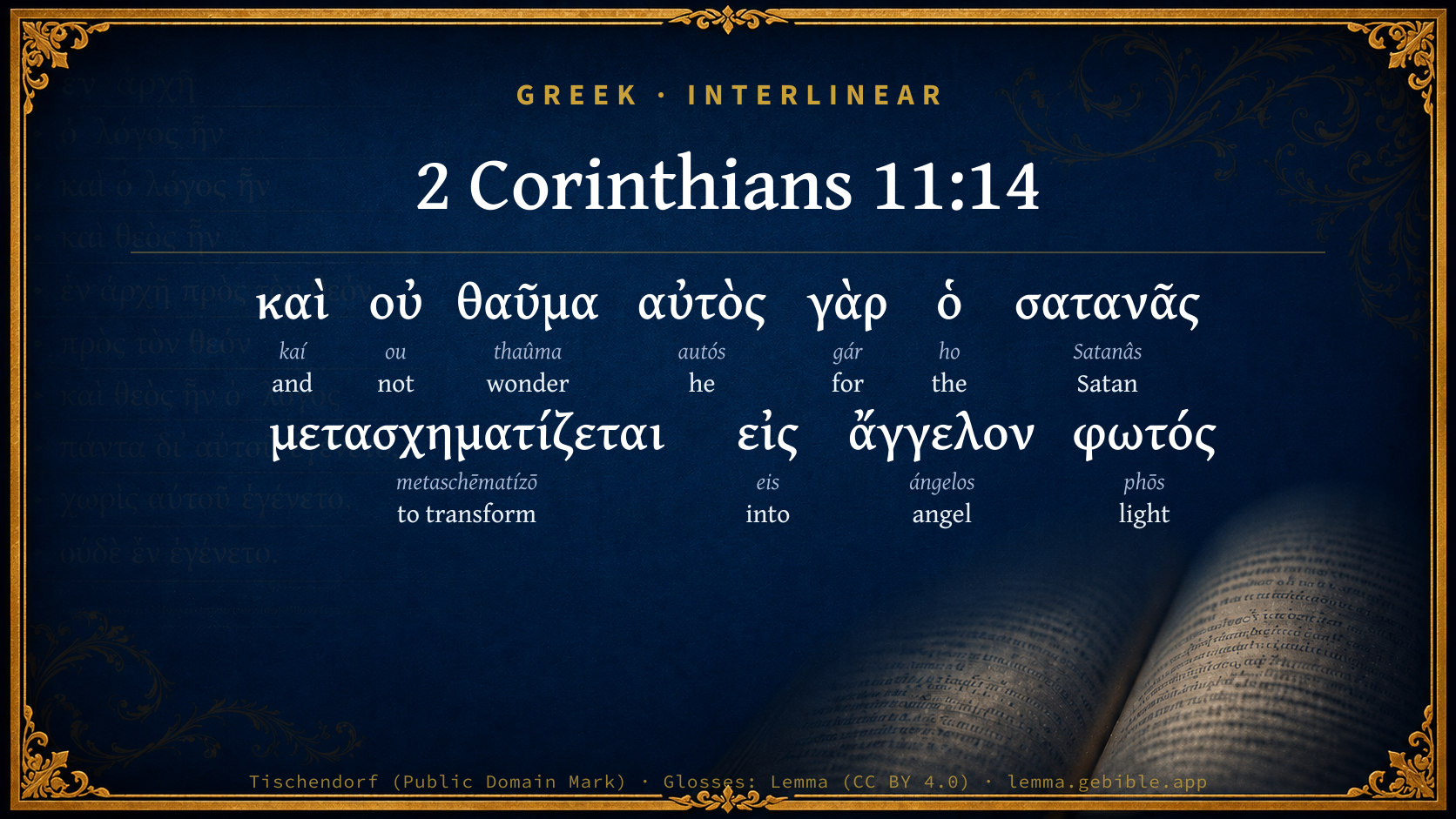
Greek (Tischendorf 8th ed.) 2 Corinthians 11:14 appears in the Greek New Testament. The text above is from the Tischendorf 8th edition. Each word links to its Strong’s number and a concise gloss. Click any word for its full Thayer’s Greek Lexicon entry.
Download image
Cite this verse

2 Corinthians 11:14 (World English Bible). Public Domain. Lemma interlinear Bible study tool, https://lemma.gebible.app/v/2-corinthians/11/14.

Show BibTeX & RIS
BibTeX
RIS
English Translation
And no wonder, for even Satan masquerades as an angel of light.
World English Bible · Public Domain
Highlights
  • 1 first appearance in the Greek New Testament
Full analysis ↓
Download a study sheet

One document with this verse’s original text, its word-by-word gloss line, the meaning frame, cross-references with their text, attributed commentary, and full source and license credits — printable, and it pastes into notes with its structure intact.

This verse Autodidact and up

Study sheet (.html) Plain text (.txt)

A passage Seminary Student

Up to 50 verses in one chapter. A passage sheet keeps up to 6 commentary sources and 12 cross-references per verse, in the order this page ranks them, and says so on the sheet whenever that leaves anything out. Ask for a single verse and you get the Autodidact verse sheet above.

Everything on this page stays free to read, with no account — the sheet is a download of what is already on screen, not access to it.

Want to remove ads? Support Godless Engineer
Compare translations 3

The same verse in 3 English versions, stacked beneath the original-language interlinear above. Click any original word for its lexicon entry.

Each is an independent rendering of the whole verse — the interlinear is not word-aligned to these translations.

Highlighted words mark where these versions differ — a whole-verse word diff, not a word-by-word alignment.

  • World English Bible Public Domain
    And no wonder, for even Satan masquerades as an angel of light.
  • King James Version Public Domain
    And no marvel; for Satan himself is transformed into an angel of light.
  • unfoldingWord Literal Text CC BY-SA 4.0
    And no wonder, for Satan himself disguises himself an angel of light.

unfoldingWord Literal Text — © unfoldingWord, licensed CC BY-SA 4.0. Word-aligned USFM3 via Door43 (git.door43.org/unfoldingWord/en_ult).

Versions to compare (up to 4)

3 of 4 selected

Show all 19 translations

Every available English version of this verse, each an independent rendering of the whole verse.

  • World English Bible Public Domain
    And no wonder, for even Satan masquerades as an angel of light.
  • Berean Standard Bible Public Domain
    And no wonder, for Satan himself masquerades as an angel of light.
  • Majority Standard Bible Public Domain
    And no wonder, for Satan himself masquerades as an angel of light.
  • King James Version Public Domain
    And no marvel; for Satan himself is transformed into an angel of light.
  • American Standard Version (1901) Public Domain
    And no marvel; for even Satan fashioneth himself into an angel of light.
  • Revised Version (1885) Public Domain
    And no marvel; for even Satan fashioneth himself into an angel of light.
  • Geneva Bible (1599) Public Domain
    And no marueile: for Satan himselfe is transformed into an Angel of light.
  • Douay-Rheims (1899) Public Domain
    And no wonder: for Satan himself transformeth himself into an angel of light.
  • Young's Literal Translation Public Domain
    and no wonder -- for even the Adversary doth transform himself into a messenger of light;
  • Literal Standard Version CC BY-SA 4.0
    and no wonder—for even Satan transforms himself into a messenger of light;
  • Unlocked Literal Bible CC BY-SA 4.0
    And this is no surprise, for even Satan disguises himself as an angel of light.
  • unfoldingWord Literal Text CC BY-SA 4.0
    And no wonder, for Satan himself disguises himself an angel of light.
  • Darby Bible Public Domain
    And [it is] not wonderful, for Satan himself transforms himself into an angel of light.
  • World Messianic Bible Public Domain
    And no wonder, for even Satan masquerades as an angel of light.
  • Webster's Bible Public Domain
    And no wonder; for Satan himself is transformed into an angel of light.
  • Free Bible Version CC BY-SA 4.0
    Don't be surprised at this for even Satan himself pretends to be an angel of light.
  • Bible in Basic English Public Domain
    And it is no wonder; for even Satan himself is able to take the form of an angel of light.
  • Text-Critical English NT CC BY 4.0
    And no wonder, for even Satan disguises himself as an angel of light.
  • Tyndale New Testament (1534) Public Domain
    And no marvayle for satan him silfe is chaunged into the fassion of an angell of light.

Literal Standard Version (2020), Covenant Press — licensed CC BY-SA 4.0. Text via the HelloAO Bible API (eBible.org). Unlocked Literal Bible (unfoldingWord) — licensed CC BY-SA 4.0. Text via the HelloAO Bible API (eBible.org). unfoldingWord Literal Text — © unfoldingWord, licensed CC BY-SA 4.0. Word-aligned USFM3 via Door43 (git.door43.org/unfoldingWord/en_ult). Free Bible Version, Dr. Jonathan Gallagher — licensed CC BY-SA 4.0. Text via the HelloAO Bible API (eBible.org).

Word by word

More ways to search: Search by grammar → Find every occurrence → Compare this word →

Practice this passage: Drill this verse → Learn its vocabulary →

About this verse

These counts appear in no published source. They are computed here, from the morphology-tagged text and Lemma’s own curated glosses. What Lemma adds →

11
words
11
distinct lemmas
Pauline Epistles
section

Notable vocabulary

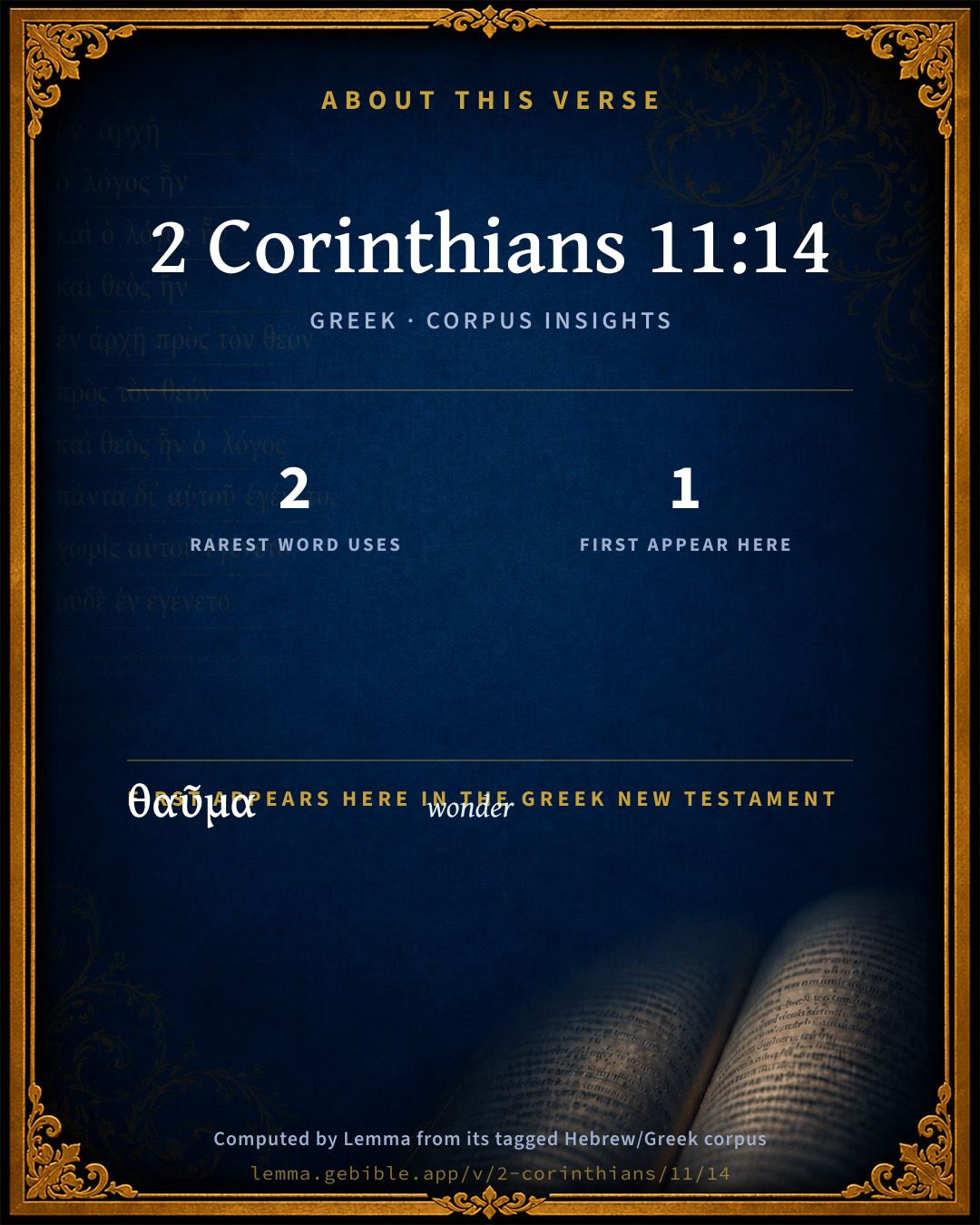
The rarest word here is θαῦμα wonder G2295 — appearing just 2 times in the whole Greek New Testament.

First appearance in Scripture

This word makes its first canonical appearance in the Greek New Testament here:

  • θαῦμα wonder G2295

Shared distinctive vocabulary

θαῦμα wonder G2295 occurs in 2 verses of the Greek New Testament. Also found in:
Cross-references

6

Topical passages linked to 2 Corinthians 11:14 in the Treasury of Scripture Knowledge — connected by theme and wording, ordered by reader-vote popularity; previews shown in the World English Bible.

  • Galatians 1:8 But even though we, or an angel from heaven, should preach to you any gospel other than that which we preached to you, let him be cursed.
  • 2 Corinthians 2:11 that no advantage may be gained over us by Satan; for we are not ignorant of his schemes.
  • 2 Corinthians 11:3 But I am afraid that somehow, as the serpent deceived Eve in his craftiness, so your minds might be corrupted from the simplicity that is in Christ.
  • Revelation 12:9 The great dragon was thrown down, the old serpent, he who is called the devil and Satan, the deceiver of the whole world. He was thrown down to the earth, and his angels were thrown down with him.
  • Matthew 4:1–10 Then Jesus was led up by the Spirit into the wilderness to be tempted by the devil.
  • Genesis 3:1–5 Now the serpent was more subtle than any animal of the field which Yahweh God had made. He said to the woman, "Yes, has God said, 'You shall not eat of any tree of the garden?'"

Cross-references courtesy of OpenBible.info (CC BY 4.0).

Commentary

Notes on 2 Corinthians 11:14 from classic Christian and Jewish commentators (each source and its license shown beneath its notes). The classic Christian expositions comment on the surrounding passage and are grouped to its opening verse, so a note may address several verses; the Jewish commentaries on the Tanakh (Rashi and others) are per-verse, so they appear only where the commentator wrote on this verse.

Lemma curates 59 commentaries, every one of them public domain or Creative Commons licensed, each selected and text-cleaned for this edition rather than reprinted as found. About our sources →

Bengel's Gnomon

Johann Albrecht Bengel

2Co 11:14. Οὐ θαυμαστὸν, and no marvel) no great thing in the following verse. It is more marvellous concerning [in the case of] Satan, inasmuch as he differs farther from an angel of light.—αὐτὸς) he himself, their author and master.—μετασχηματίζεται, transforms himself) Present, i.e. is accustomed to transform himself. He did that already in Paradise. The second Oration on the annunciation, ascribed to Gregory Thaumaturgus, in describing the character [Ethopoeia] of Mary, thus proceeds: μὴ πάλιν εἰς ἄγγελον φωτὸς μετασχηματισθεὶς ὁ ἀρχέκακος δαίμων, κ.τ.λ., the devil the author of evil not being again transformed into an angel of light, etc.—ἄγγελον φωτὸς, an angel of light) He does so, not only to injure us, but also to enjoy honour.—φωτὸς, of light) although Satan’s power is still in darkness.

Bengel's Gnomon of the New Testament — English translation (T&T Clark, Edinburgh, 1860) — public domain. Text from a community e-Sword module.

Meyer's Critical & Exegetical Commentary

Heinrich August Wilhelm Meyer

2Co_11:14-15. And that is quite natural!

καὶ οὐ θαῦμα] neque res admiranda est. Comp. Plat. Pol. vi. p. 498 D; Epin. p. 988 D; Pind. Nem. x. 95, Pyth. i. 50; Eur. Hipp. 439; Soph. Oed. R. 1132, Phil. 408; Pflugk, ad Eur. Hec. 976.

What follows is an argumentum a majori ad minus.

αὐτός] ipse Satanas, their lord and master. Comp. afterwards οἱ διάκονοι αὐτοῦ. See Hermann, ad Viger. p. 733.

εἰς ἄγγελον φωτός] into an angel of light. As the nature of God (1Jn_1:5; Rev_21:23-24) and His dwelling-place (1Ti_6:16; 1Jn_1:7) is light, a glory of light, a δόξα beaming with light, which corresponds to the most perfect holy purity, so also His servants, the good angels, are natures of light with bodies of light (1Co_15:40); hence, where they appear, light beams forth from them (Mat_28:3, al.; Act_12:7, al.; see Hahn, Theol. d. N. T. I. p. 274 f.; Weiss, bibl. Theol. p. 460). Regarding Satan, on the other hand, comp. Eph_6:12; Act_26:18; Col_1:13. He is ὁ κληρονόμος τοῦ σκότους, Ev. Nic. 20.

There is no trace in the narratives concerned to justify the assumption[331] that 2Co_11:15 points to the fall of man (Bengel, Semler, Hengstenberg, Christol. I. p. 11), or even to the temptation of Christ, Mat_4:8, in which the devil appeared as the angel to whom God had entrusted the rule of Palestine (Michaelis); but, at any rate, it is the apostles thought, and is also presupposed as known to the readers, that devilish temptations in angelic form assail man. In the O. T. this idea is not found; it recurs later, however, in the Rabbins, who, with an eccentric application of the thought, maintained that the angel who wrestled with Jacob (Gen_32:24; Hos_12:4-5) was the devil. See Eisenmenger, entdeckt. Judenth. I. p. 845. For conceptions regarding the demons analogous to our passage from Porphyry and Jamblichus, see Grotius and Elsner, Obss. p. 160.

[331] The present would not be against it. See Bengel: Solet se transformare; fecit jam in paradiso. According to Ewald, we are to think of a narrative, which was known then but is not preserved in our present O. T., to which Paul alludes, or of a narrative similar to that in Mat_4:1-11.

Meyer — Critical and Exegetical Commentary on the New Testament — English translation by Peter Christie, edited by Frederick Crombie (T&T Clark, 1880) — public domain. Text from a community e-Sword module.

Expositor's Greek Testament

ed. W. Robertson Nicoll

2Co 11:14 . καὶ οὐ θαῦμα κ . τ . λ .: and no marvel; for even Satan fashioneth himself into an angel of light . Light is the symbol of God (1Jn 1:5 , 1Ti 6:16 ) and His messengers (Mat 28:3 , Act 12:7 ), as darkness is the symbol of Satan (Luk 22:53 , Eph 6:12 , Col 1:13 ). The μετασχηματισμός of Satan has just before been in the Apostle’s mind (2Co 11:3 ), and perhaps such passages as Gen 3:1 , Job 1:6 , 1Ki 22:19-23 sufficiently account for the image. But it is more probable that some Rabbinical tradition lies behind the word used by St. Paul; cf. Apoc. Moysis (2Co 11:17 ) τότε ὁ σατανᾶς ἐγένετο ἐν εἴδει ἀγγέλου . A reference has been here found by Ewald to Mat 4:1-2 , but while it is not improbable that the Apostle had heard the story of the Lord’s Temptation, there is no clear trace of it in his Epistles.

The Expositor's Greek Testament, edited by W. Robertson Nicoll (1897–1910) — public domain. Text from a community e-Sword module.

Geneva Bible (1599)

Geneva Bible translators

By light is meant the heavenly glory, whereof the Angels are partakers.

Geneva Bible (1599) marginal notes — public domain. Text via Bolls.life.

Jamieson, Fausset & Brown

Robert Jamieson, A. R. Fausset & David Brown

is transformed--rather, "transforms himself" (compare Job 1:6); habitually; the first occasion of his doing so was in tempting Eve. "Himself" is emphatical: If their master himself, who is the "prince of darkness," the most alien to light, does so, it is less marvellous in the case of them who are his servants (Luk 22:54; Eph 6:12).

Jamieson, Fausset & Brown — Commentary Critical and Explanatory on the Whole Bible (1871) — public domain (CC PDM 1.0). Text via the HelloAO Bible API.

Adam Clarke's Commentary

Verse 14. And no marvel] καιουθαυμαστον. And no wonder; it need not surprise you what the disciples do, when you consider the character of the master.

Satan himself is transformed into an angel of light.] As in 2Co 11:3 the apostle had the history of the temptation and fall of man particularly in view, it is very likely that here he refers to the same thing. In what ever form Satan appeared to our first mother, his pretensions and professions gave him the appearance of a good angel; and by pretending that Eve should get a great increase of light, that is, wisdom and understanding, he deceived her, and led her to transgress. It is generally said that Satan has three forms under which he tempts men:

1. The subtle serpent.

2. The roaring lion.

3. The angel of light.

He often, as the angel of light, persuades men to do things under the name of religion, which are subversive of it. Hence all the persecutions, faggots, and fires of a certain Church, under pretence of keeping heresy out of the Church; and hence all the horrors and infernalities of the inquisition. In the form of heathen persecution, like a lion he has ravaged the heritage of the Lord. And by means of our senses and passions, as the subtle serpent, he is frequently deceiving us, so that often the workings of corrupt nature are mistaken for the operations of the Spirit of God.

Adam Clarke's Commentary on the Bible (1810–1826) — public domain. Text from a community e-Sword/MySword module.

John Calvin's Commentaries

14. And no marvel It is an argument from the greater to the less. “If Satan, who is the basest of all beings, nay, the head and chief of all wicked persons, transforms himself, what will his ministers do?” We have experience of both every day, for when Satan tempts us to evil, he does not profess to be what he really is. For he would lose his object, if we were made aware of his being a mortal enemy, and opposer of our salvation. Hence he always makes use of some cloak for the purpose of insnaring us, and does not immediately show his horns, (as the common expression is,) but rather makes it his endeavor to appear as an angel Even when he tempts us to gross crimes, he makes use, nevertheless, of some pretext that he may draw us, when we are off our guard, into his nets. What then, if he attacks us under the appearance of good, nay, under the very title of God? His life-guards imitate, as I have said, the same artifice. These are golden preambles — “Vicar of Christ” — “Successor of Peter” — “Servant of God’s servants,” but let the masks be pulled off, and who and what will the Pope be discovered to be? Scarcely will Satan himself, his master, surpass so accomplished a scholar in any kind of abomination. It is a well known saying as to Babylon, that she gives poison to drink in a golden cup. (Jeremiah 51:7.) Hence we must be on our guard against masks.

Should any one now ask, “Shall we then regard all with suspicion?” I answer, that the Apostle did not by any means intend this; for there are marks of discrimination, which it were the part of stupidity, not of prudence, to overlook. He was simply desirous to arouse our attention, that we may not straightway judge of the lion from the skin For if we are not hasty in forming a judgment, the Lord will order it so that the ears of the animal will be discovered ere long. Farther, he was desirous in like manner to admonish us, in forming an estimate of Christ’s servants, not to regard masks, but to seek after what is of more importance. Ministers of righteousness is a Hebraism for faithful and upright persons.

John Calvin's Commentaries (1540-1563) — public domain. Text from the Calvin Translation Society English edition (1840s-50s) via the Christian Classics Ethereal Library (ccel.org). Calvin's coverage is partial (roughly two-thirds of the Bible); uncommented books and verses are honest gaps, never fabricated. The 19th-century editor's footnotes and remarks are omitted so the notes are faithfully Calvin's own voice.

Ellicott's Commentary for English Readers

(14) For Satan himself is transformed into an angel of light.—The present tense of the original excludes the thought that reference is made to any special incident (such as the appearance of Satan among “the sons of God,” of Job_1:6) recorded in the Old Testament, or in tradition. The thought is rather that Satan is ever so transforming himself. If we are to look for any special allusion, we may find a possible explanation in the words “though we, or an angel from heaven,” in Gal_1:8. They suggest the thought, as at least a probable inference, that the Judaising teachers had claimed the authority of an angelic message for the gospel which they preached, and set this against the authority of the angelic visions which St. Luke had recorded in the case of Cornelius (Act_10:2). It is probable, we may add, that the Christ-party at Corinth, as distinct from that of Cephas, had affinities with the Jewish sect of the Essenes, and they, we know, were addicted to the worship of angels (Jos. Wars, ii. 8, § 6), and made much of revelations conveyed through their ministry. On this supposition St. Paul may, in his allusive way, mean to imply that they were mistaking a satanic for an angelic apparition. Something of the kind is obviously implied in the stress which St. Paul lays on his own visions and revelations in 2Co_12:1.

A Bible Commentary for English Readers, edited by Charles John Ellicott (1878–1897) — public domain. Text from a community e-Sword module.

The Cambridge Bible for Schools and Colleges

gen. ed. J. J. S. Perowne

14. And no marvel] No wondre, Wiclif, where we may remark that the older English expression has held its ground against the French equivalent.

Satan himself is transformed] Cf. ch. 2Co_2:11. Not that he is really so transformed, but that he appears to be so, to those who judge ‘according to the appearance,’ ch. 2Co_10:7; Gal_6:12; Php_1:15; Php_3:18; Tit_1:10-11. “Transformed into, not becoming.” Chrysostom. He reads ‘if Satan himself.’

The Cambridge Bible for Schools and Colleges (gen. ed. J. J. S. Perowne; Cambridge University Press, 1878–1918) — public domain. Text from a community e-Sword module.

John Gill's Exposition

And no marvel,.... This need not be wondered at, nor is it any new or strange thing; nor should it be thought to be incredible that there are such persons in being:

for Satan himself is transformed into an angel of light; a good angel, one that has his abode in the regions of light; and is possessed of divine and spiritual light and understanding; who is clothed and arrayed with light, this is his form and essence. The apostle speaks agreeably to the notion, of the Jews, who say (t),

"rwa Mh Mlk Mykalmhv, "that all the angels are light", the clothing of God himself;''

and they have a distinction between , "angels of the day", and angels of the night (u): now Satan, the enemy of mankind, sometimes appears in the form of one of these; as he did to Eve in the garden, and to Christ in the wilderness; and by such appearances he often imposes on mankind; pretends the greatest friendship, when he designs nothing but ruin; and under a notion of good, either honest, or pleasant, or profitable, draws on into the commission of the greatest evils; and, under a show of truth, introduces the most notorious falsehoods and errors; and, under a pretence of religion, all sorts of idolatry, superstition, and impiety; it is in this way he has succeeded in his enterprises and temptations; these are his wiles, stratagems, and cunning devices.

(t) R. Abraham Seba, Tzeror Hammor, fol. 18. 4. (u) Zohar in Numb. fol. 91. 1. & 93. 3.

John Gill's Exposition of the Whole Bible (1746–1763) — public domain (CC PDM 1.0). Text via the HelloAO Bible API.

Trapp's Complete Commentary

John Trapp

14 And no marvel; for Satan himself is transformed into an angel of light.

Ver. 14. Satan himself is, &c.] Satan, saith one, doth not always appear in one and the same fashion, but hath as many different changes as Proteus among the poets. At Lystra he appears like a comedian, as if a scene of Plutus were to be presented on the stage. At Antioch like a Jesuit, with traditions in his mouth. At Athens he sallies out like a philosopher; at Ephesus like a craftsman; and here at Corinth he is transformed into an angel of light. Fiery serpents full of deadly poison are called seraphims, Num 21:6; Isa 30:6.

John Trapp, A Commentary or Exposition upon All the Books of the Old and New Testament (1647–1656) — public domain. Text from a community e-Sword module.

Albert Barnes' Notes on the Bible

And no marvel - And it is not wonderful, 2Co 11:15. Since Satan himself is capable of appearing to be an angel of light, it is not to be deemed strange that those who are in his service also should resemble him.

For Satan himself is transformed ... - That is, he who is an apostate angel; who is malignant and wicked; who is the prince of evil, assumes the appearance of a holy angel. Paul assumes this as an indisputable and admitted truth, without attempting to prove it, and without referring to any particular instances. Probably he had in his eye cases where Satan put on false and delusive appearances for the purpose of deceiving, or where he assumed the appearance of great sanctity and reverence for the authority of God. Such instances occurred in the temptation of our first parents Gen 3:1-6, and in the temptation of the Saviour, Matt. 4. The phrase “an angel of light,” means a pure and holy angel, light being the emblem of purity and holiness. Such are all the angels that dwell in heaven; and the idea is, that Satan assumes such a form as to appear to be such an angel. Learn here:

(1) His power. He can assume such an aspect as he pleases. He can dissemble and appear to be eminently pious. He is the prince of duplicity as well as of wickedness; and it is the consummation of bad power for an individual to be able to assume any character which he pleases.

(2) His art. he is long practiced in deceitful arts. For six thousand years he has been practicing the art of delusion. And with him it is perfect.

(3) We are not to sup pose that all that appears to be piety is piety. Some of the most plausible appearances of piety are assumed by Satan and his ministers. None ever professed a profounder regard for the authority of God than Satan did when he tempted the Saviour. And if the prince of wickedness can appear to be an angel of light, we are not to be surprised if those who have the blackest hearts appear to be people of most eminent piety.

(4) We should be on our guard. We should not listen to suggestions merely because they appear to come from a pious man, nor because they seem to be prompted by a regard to the will of God. We may be always sure that, if we are to be tempted, it will be by some one having a great appearance of virtue and religion.

(5) We are not to expect that Satan will appear to man to be as bad as he is. He never shows himself openly to be a spirit of pure wickedness; or black and abominable in his character; or full of evil and hateful. He would thus defeat himself. It is for this reason that wicked people do not believe that there is such a being as Satan. Though continually under his influence and “led captive by him at his will,” yet they neither see him nor the chains which lead them, nor are they willing to believe in the existence of the one or the other.

Albert Barnes' Notes on the Bible (1834–1885) — public domain. Text from a community e-Sword/MySword module.

Matthew Poole's English Annotations

It is not at all to be wondered, that the emissaries of Satan dissemble, and pretend themselves to be what they are not, for even Satan himself, who is the prince of darkness, in order to the deceiving and seducing of souls, transformeth himself

into an angel of light; that is, puts on the appearance and form of a good angel. He calls them angels of light, because they were wont to appear in a lightsome brightness; or because of that glory in which they behold the face of God; or because of those great measures of heavenly knowledge which those blessed spirits have. All tempted souls have an experiment of this; for none is tempted to evil under the appearance of evil, (evil as evil being what a reasonable soul cannot be courted to). The devil therefore, in all his temptations to sin, though his end be to ruin and destroy, yet appeareth as an angel of light; moving the soul to evil under the notion and appearance of good.

Matthew Poole's English Annotations on the Holy Bible (1683–1685) — public domain. Text from a community e-Sword/MySword module.

Whedon's Commentary on the Bible

Daniel D. Whedon

14. Transformed… light—This may be an allusion to the appearance of Satan at the temptation, and Milton on that hint has so described the scene.

Daniel D. Whedon (gen. ed.), Commentary on the Old and New Testaments (1874–1909) — public domain. Text from a community e-Sword module.

The Pulpit Commentary

Even Satan ... angel of light. This is one of Satan"s devices. (2Co_2:11) The allusion may be to the temptation; (Mat_4:8, Mat_4:9) or to the appearances of Satan with the angels before God in the Book of Job; (Job_2:1) or perhaps to the Jewish hagadah, that the "angel" who wrestled with Jacob was in reality Satan.

A very beautiful angel.

I A STARTLING FACT. We learn from Paul that the most sable of Ethiopians can change his skin and the fiercest beast of prey throw off his warning garb. The blackest devil can appear as the brightest angel. This is, indeed, a transfiguration, the most marvellous of transformation scenes. As an angel of wisdom Satan appeared to Eve; as an angel versed in theology, to Christ, glibly crying, "It is written." Satan was an angel of light. He thus knows well how to play the angel. Herein is he to be feared. It is not the ugly devil we need dread so much as the pretty devil. The old Scotchman"s comment on the horned and hoofed Satan of a celebrated picture of "The Temptation" is full of point: "If that chiel cam" to me in sic an ugly shape, I think he wud hae a teuch job wi" me too.

II AN EXPLANATION OF SOME MYSTERIES.

1. The power of temptation. Men frequently fall before white temptations rather than black ones. Satan is an adept at whitewashing the sepulchre. The voice that calls us to sin sounds often more like the voice of an angel than the voice of a devil. The great adversary transforms his temptations as well as himself.

2. That wrong often seems much like right. Satan is a clever editor.

3. That folly often seems wisdom. A most dexterous counsel is the devil; as we listen to him, folly is evidently wisdom, and wisdom certainly folly. His splendid intellect overmasters ours when we cope with him alone.

III AN IMPRESSIVE WARNING.

1. To ever be on our guard. We need have our wits about us whilst we have such an enemy about us. To be careless in such peril would be suicidal. Our guard should be severe; none should be admitted within the gates but proved friends.

2. Not to judge by appearances. Our tendency is to do so, and therefore the devil transforms himself. "There is a way which seemeth right unto a man, but the end thereof are the ways of death". (Pro_14:12) We must get below the surface of things. We must take pains to ascertain the right and the good. Every trap is baited, and the fool who concludes that there can be no difference between a bait and a meal, is soon caught.

3. To seek true wisdom and discernment. Conceit in our own unaided powers is just what delights the devil, and he often preaches to us an angelic discourse upon the pleasing theme of our wonderful faculties, before demonstrating our unutterable folly and weakness. We need know that we are know nothings. Self-distrust baulks Satan. When a man is on the pinnacle of pride he can easily deal with him, but when he is in the valley of humility and self-abnegation the enemy gets sorely perplexed. Let us empty ourselves of the wind of conceit and self-sufficiency, that God may fill us with his own wisdom.

4. To ever abide with Christ. Thus alone can we be truly safe. Here alone shall we secure the victory. Christ overcame the devil when he spake least like a devil, and, if we are truly with Christ, no disguise of Satan shall deceive us, and no might of his shall overthrow us. The cress of Christ is Ithuriel"s spear, which, touching the tempter, reveals him in his true character. H.

Satanic subtleties.

himself is transformed into an angel of light." This expression suggests that the Judaic party at Corinth laid claim to some angel manifestations or revelations, and set these off against St. Paul"s claim of apostolic inspiration and authority. He really asserts here that they are deluded. It is not Divine revelations which they have received. These things in which they boast are Satanic subtleties and transformations, by which they are deceived and ensnared. There may, however, be a reference to what was so evidently in St. Paul"s mind the serpent"s deception of Eve (ver. 3). The mode in which reference is made to the incident in the garden of Eden suggests to us that St. Paul thought the serpent put on some form of beauty, or that he, in a very subtle way, explained his superior wisdom and intelligence by the fact that he fed on the fruit of that forbidden tree.

I THE SATANIC POWER OF DISGUISE. Illustrate the very various ways in which evil is made attractive. Apply to the temptations of vice and self-indulgence, to mental error, to religious wanderings and backslidings. He said a great thing, who, knowing much of the evils of Christian and Church life, exclaimed, "We are not ignorant of his Satan"s devices.

II SUCH POWER ILLUSTRATED IN RELIGIOUS LEADERS. Such as Joe Smith, the Mormon leader. All who seek to delude men for self-seeking ends are really Satanic; they are doing Satan"s work. According to the standpoint of the preacher, it may be shown that the methods by which men are deluded still are

(1) mental,

(2) ritual,

(3) moral.

Therefore we have the very earnest advice, "Prove test and try all things; hold fast that which is good. R.T.

The Pulpit Commentary (1880–1919), ed. H.D.M. Spence-Jones & Joseph S. Exell — public domain. Text from a community e-Sword module.

John Wesley's Explanatory Notes

Satan himself is transformed - Uses to transform himself; to put on the fairest appearances.

John Wesley, Explanatory Notes Upon the Whole Bible (1754–1765) — public domain. Text via the GEBible commentary corpus.

McGarvey & Pendleton's Commentaries

J. W. McGarvey

And no marvel; for even Satan fashioneth himself into an angel of light .

J. W. McGarvey (with Philip Y. Pendleton), Commentaries on the New Testament (The Fourfold Gospel, 1914; Acts; and the epistles) — public domain. Text from a community e-Sword/MySword module.

The People's New Testament

B. W. Johnson

14. And no marvel. Is it said that they appear to be Christ's ministers? Even Satan can take the shape of an angel of light. He always seeks to destroy by coming in a false guise.

B. W. Johnson's The People's New Testament with Notes (1889–1891) — public domain. Electronic text from the Christian Classics Ethereal Library (CCEL) ThML edition.

unfoldingWord translationNotes

Door43 World Missions Community

this is no surprise ... It is no great surprise if

By stating this in a negative form Paul is emphasizing that the Corinthians should expect to meet many "false apostles" (2 Corinthians 11:13). AT: "we should expect this ... We should certainly expect that" (See: Litotes)

Satan disguises himself as an angel of light

"Satan is not an angel of light, but he tries to make himself look like an angel of light"

an angel of light

Here "light" is a metaphor for righteousness. AT: "an angel of righteousness" (See: Metaphor)

his servants also disguise themselves as servants of righteousness

"his servants are not servants of righteousness, but they try to make themselves look like servants of righteousness"

translationWords

Satan

angel

light

servant

righteous

unfoldingWord translationNotes — © Distant Shores Media and the Door43 World Missions Community, licensed CC BY-SA 4.0. Source: git.door43.org/Door43/en_tn.

Cambridge Greek Testament for Schools and Colleges

14. θαῦμα (אBDFGPR) rather than θαυμαστόν (D2D3KLM).

14. καὶ οὐ θαῦμα. See critical note. Comp. ΠΛ. πολλοῦ γὰρ αὐτοὺς οὐχ ἑώρακά πω χρόνου. ΧΡ. καὶ θαῦμά γʼ οὐδέν· οὐδʼ ἐγὼ γὰρ ὁ βλέπων (Aristoph. Plut. 98, 99).

αὐτὸς γὰρ ὁ Σατανᾶς. The αὐτός prepares us for what is coming,—that these false apostles are his ministers. What the master does, his servants will do. It may be doubted whether S. Paul is here alluding to anything in Jewish tradition or in the O.T., as to Satan appearing among ‘the sons of God’ (Job 1:6). A reference to the Temptation of Christ is less unlikely. More probably he is appealing to the common experience (present tense), that in temptations what is sinful is sometimes made to look quite innocent, or even meritorious: solet se transformare (Bengel). Comp. τέκνα φωτός (Eph 5:8), νἱοὶ φωτός (1Th 5:5), and contrast ἡ ἐξουσία τοῦ σκότους (Luk 22:53; Col 1:13). That “the Judaising teachers had claimed the authority of an angelic message for the gospel which they preached, and set this against the authority of the angelic visions which St Luke had recorded in the case of Cornelius,” is not probable. And had these Corinthians read Acts? It was not yet written.

Of the various names for the evil one which are used in the N.T., four are found in 2 Corinthians 1. Σατανᾶς (2Co 2:11, here, 2Co 12:7); 2. ὁ Θεὸς τοῦ αἰῶνος τούτου (2Co 4:4); 3. Βελίαρ (2Co 6:15); 4. ὁ ὅφις (2Co 11:3). The other names which are used by S. Paul are: ὁ διάβολος (Eph 4:27; Eph 6:11, &c.); ὁ πονηρός (Eph 6:16); ὁ ἄρχων τῆς ἐξουσίας τοῦ ἀέρος (Eph 2:2); ὁ πειράζων (1Th 3:5).

Cambridge Greek Testament for Schools and Colleges (Cambridge University Press, 1896; 21 vols, various authors incl. Carr, Maclear, Plummer, Farrar, Lumby, Moule, M. R. James, Simcox) — public domain. Text from a community e-Sword module.

Alford’s Greek Testament

Henry Alford

14. ἄγγ. φωτός] God is light, and inhabits light, and His angelic attendants are surrounded with brightness, see Act 12:7; Psa 104:4: whereas Satan is the Power of darkness, see reff. and Luk 22:53.

Henry Alford, The Greek Testament (1849–1861) — public domain. Text from a community e-Sword module.

International Critical Commentary

14. καὶ οὐ θαῦμα. Both this and the v.l. θαυμαστόν are classical in this conversational use; τὸ μέντοι μὴ πείθεσθαι τοῖς λεγομένοις τοὺς πολλοὺς θαῦμα οὐδέν (Plato, Rep. 49 E D) ; ἐρᾷς· τὶ τοῦτο θαῦμὰ σὺν πολλοῖς βροτῶν (Eur. Hipp. 439); also Aristoph. Plut. 99). Non mirum (Vulg.) is similarly used in Latin; but miraculo est, not miraculum. Epictetus several times has καὶ τί θαυμαστόν;

αὐτὸς γὰρ ὁ Σατανᾶς. “Like master, like man.” If the prince of darkness can masquerade as an Angel of light, what wonder that his ministers masquerade as ministers of Christ? There is no necessity to suppose that St Paul is here alluding to some Rabbinical legend, similar to the one about Eve and the serpent, in which Satan is said to have taken the fashion of an Angel. According to some interpretations, the Angel who wrestled with Jacob was Satan. In the Prologue to the Book of Job, Satan takes no such appearance. St Paul may have known the story of our Lord’s temptation in a form which might suggest this comparison. But his own experience must have taught him how specious and plausible temptations to what is known to be wrong can be made to look, so that sin may at last look meritorious. The pres. μετασχηματίζεται points to what Satan habitually does rather than to any particular occasion. This the Corinthians, very few of whom were Jews, could understand. That those of them who were Jews knew of a legend in which Satan assumed the appearance of an Angel, is unlikely; and St Paul certainly expects to be understood in what he says here. As regards the subtlety of temptations the experience of the Corinthians would be much the same as his own.* To say that “the reference must be to some apocalyptic tale” is a great deal too strong; and Schmiedel does not lay much stress on the suggestion that there may be an allusion to heathen theophanies. Would anyone regard them as instances of Satan fashioning himself as an Angel of light? For Σατανᾶς see on 2:11; for ἄγγ. φωτός, cf. ἄγγ. ἐξ οὐρανοῦ (Gal 1:8).

οὐ θαῦμα (א B D* F G P R 17) rather than οὐ θαυμαστόν (D 2 and 3 E K L M). Both in LXX and N.T. θαῦμα is very rare, whereas θαυμαστός is very freq. in LXX and not rare in N.T. Hence the change. D d e m have ὡς ἄγγελος.

International Critical Commentary — older volumes (1896–1929), various authors — public domain. Text from a community e-Sword module.

Vincent's Word Studies in the New Testament

Marvin R. Vincent

Satan. See on Luk 10:18. The rabbinical writings represent the devil rather as the enemy of man than of God or of good. They use none of the New - Testament names for the Evil One except Satan, and contain no mention of a kingdom of Satan. Edersheim says : "Instead of the personified principle of evil to which there is response in us - we have only a clumsy and often a stupid hater." 157 It is also to be observed that in the Septuagint the usage is limited to the enemy of man, as is that of diabolov devil by which Satan is translated. See 1Ch 21:1; Est 7:4; Est 8:1; Psalm 108 (109.) 5; Job 1:6; Zec 3:1, 2.

Marvin R. Vincent, Word Studies in the New Testament (1887–1900) — public domain. Text from a community e-Sword/MySword module.

Lesson kit

Teaching starters — assembled from the data on this page, not authored interpretation. Every prompt links to the verse data it draws on. Edit before teaching.

2 Corinthians, in the Pauline Epistles, opens this verse with 11 words (11 distinct Greek lemmas). Its most distinctive word is thaûma (“wonder”). A historical commentator’s framing appears above. Read the whole chapter for the surrounding context.

Discussion questions

  1. How does “wonder” (thaûma) shape what this verse is saying?
  2. This is the first place “wonder” appears in Scripture (first appears here). What does its debut here establish?
  3. How does Revelation 17:6, which shares the word «wonder», read alongside this verse?
  4. These translations render this verse differently; the difference is in the English rendering, not the original. What questions does that raise?
  5. Compare how Bengel's Gnomon and Meyer's Critical & Exegetical Commentary read this verse. Where do they agree or differ?

Things to notice

  • 1 word makes its first canonical appearance in Scripture here.
  • These translations choose different wording for 8 words in this verse.
  • 11 distinct Greek lemmas span 11 words in this verse.

Reading settings

Reading text

Shown beneath each verse's original-language words.

Old Testament
Old Testament edition

Read the OT as the Masoretic Hebrew (MT) or the Greek Septuagint (LXX).

English shown for the Greek Septuagint (in the Hebrew ↔ Greek comparison).

Comparing translations? Open the Compare panel on any verse page to stack up to four side by side.