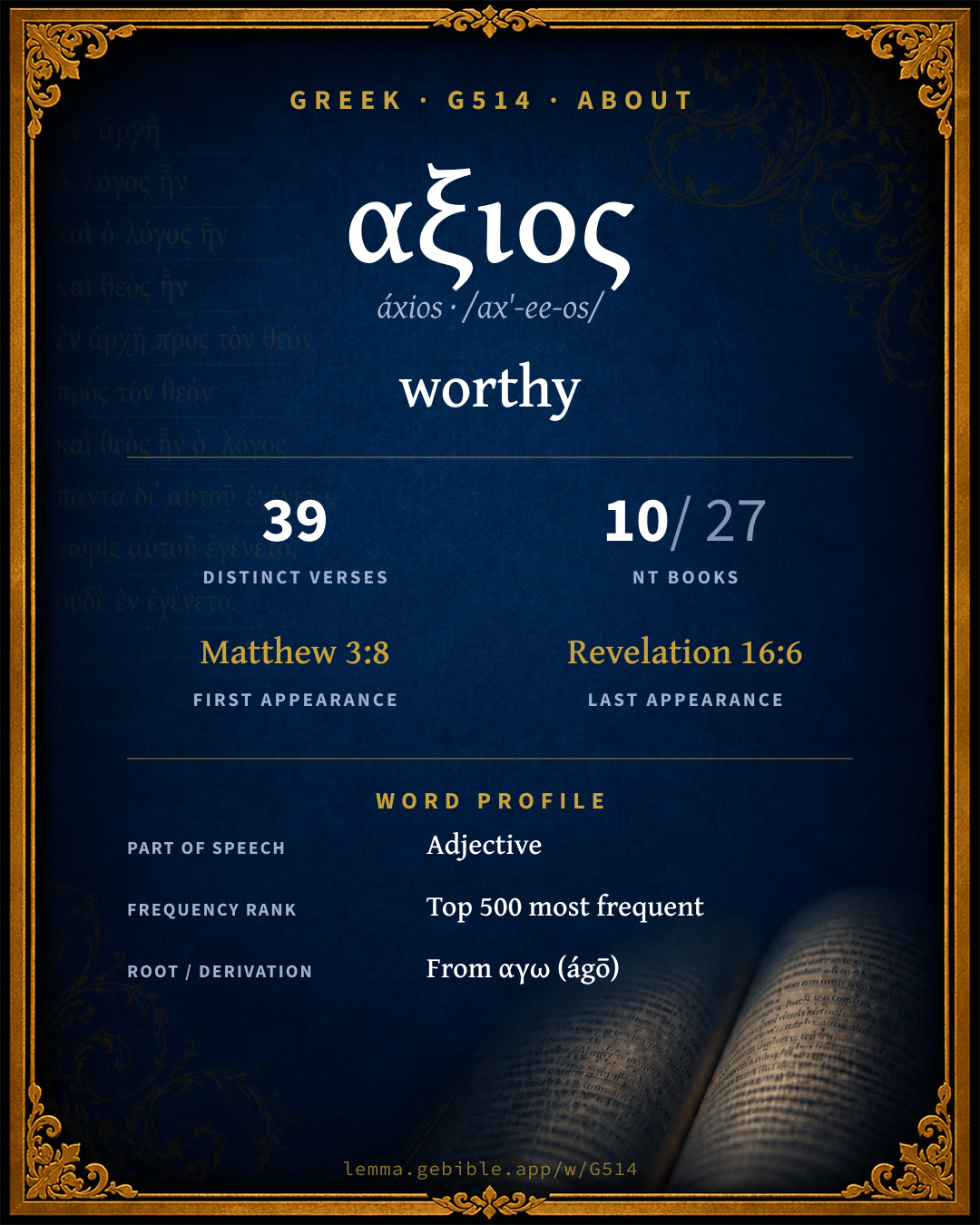
ἄξιος
worthy
‘worthy’ is one of 3 main senses fuller range ↓
Full lexicon entry — Thayer's Greek Lexicon
From Thayer's Greek Lexicon
Where this word appears
See every Nominative-case word in the Greek New Testament →
Grammar key — what these labels mean
Part of speech
- Adjective
- A word that describes or qualifies a noun.
Case
- Nominative
- The case of the subject (and the predicate nominative).
- Accusative
- The case of the direct object and of extent.
Gender
- Masculine
- Grammatically masculine.
- Neuter
- Grammatically neuter.
- Feminine
- Grammatically feminine.
Number
- Singular
- One.
- Plural
- More than one.
Grammatical forms 9 distinct
- Adjective, Nominative, Singular, Masculine 20 times (49%)
- Adjective, Accusative, Singular, Neuter 4 times (10%)
- Adjective, Nominative, Plural, Masculine 4 times (10%)
- Adjective, Accusative, Plural, Masculine 3 times (7%)
- Adjective, Accusative, Plural, Neuter 3 times (7%)
- Adjective, Nominative, Singular, Neuter 3 times (7%)
- Adjective, Nominative, Singular, Feminine 2 times (5%)
- Adjective, Accusative, Singular, Masculine 1 time (2%)
+1 more form (1 occurrence)
Parsed forms decoded from the imported morphology (Robinson–Tischendorf, public domain), counted across 41 parsed occurrences — not distinct verses.
Every verse where G514 appears — 39 distinct verses across 10 books. Click any verse to open its interlinear word-by-word view. Verse text shown in the World English Bible for context — . Each verse’s Greek form is shown with its reference; the English is not keyword-highlighted, since the data carries no word-level English alignment. Use “Compare translations” on any verse to read it across multiple English versions. This concordance covers the Greek New Testament; Septuagint (Greek Old Testament) occurrences of this word are not indexed here.
Matthew 7 verses
- Matthew 3:8 ἄξιον adj acc sg masc Therefore bring forth fruit worthy of repentance!
- Matthew 10:10 ἄξιος adj nom sg masc Take no bag for your journey, neither two coats, nor shoes, nor staff: for the laborer is worthy of his food.
- Matthew 10:11 ἄξιός adj nom sg masc Into whatever city or village you enter, find out who in it is worthy; and stay there until you go on.
- Matthew 10:13 ἀξία ἀξία adj nom sg fem adj nom sg fem If the household is worthy, let your peace come on it, but if it isn't worthy, let your peace return to you.
- Matthew 10:37 ἄξιος ἄξιος adj nom sg masc adj nom sg masc He who loves father or mother more than me is not worthy of me; and he who loves son or daughter more than me isn't worthy of me.
- Matthew 10:38 ἄξιος adj nom sg masc He who doesn't take his cross and follow after me, isn't worthy of me.
- Matthew 22:8 ἄξιοι adj nom pl masc "Then he said to his servants, 'The wedding is ready, but those who were invited weren't worthy.
Luke 8 verses
- Luke 3:8 ἀξίους adj acc pl masc Bring forth therefore fruits worthy of repentance, and don't begin to say among yourselves, 'We have Abraham for our father;' for I tell you that God is able to raise up children to Abraham from these stones!
- Luke 7:4 ἄξιός adj nom sg masc When they came to Jesus, they begged him earnestly, saying, "He is worthy for you to do this for him,
- Luke 10:7 ἄξιος adj nom sg masc Remain in that same house, eating and drinking the things they give, for the laborer is worthy of his wages. Don't go from house to house.
- Luke 12:48 ἄξια adj acc pl neut but he who didn't know, and did things worthy of stripes, will be beaten with few stripes. To whoever much is given, of him will much be required; and to whom much was entrusted, of him more will be asked.
- Luke 15:19 ἄξιος adj nom sg masc I am no more worthy to be called your son. Make me as one of your hired servants."'
- Luke 15:21 ἄξιος adj nom sg masc The son said to him, 'Father, I have sinned against heaven, and in your sight. I am no longer worthy to be called your son.'
- Luke 23:15 ἄξιον adj nom sg neut Neither has Herod, for I sent you to him, and see, nothing worthy of death has been done by him.
- Luke 23:41 ἄξια adj acc pl neut And we indeed justly, for we receive the due reward for our deeds, but this man has done nothing wrong."
John 1 verse
Acts 7 verses
- Acts 13:25 ἄξιος adj nom sg masc As John was fulfilling his course, he said, 'What do you suppose that I am? I am not he. But behold, one comes after me the sandals of whose feet I am not worthy to untie.'
- Acts 13:46 ἀξίους adj acc pl masc Paul and Barnabas spoke out boldly, and said, "It was necessary that God's word should be spoken to you first. Since indeed you thrust it from you, and judge yourselves unworthy of eternal life, behold, we turn to the Gentiles.
- Acts 23:29 ἄξιον adj acc sg neut I found him to be accused about questions of their law, but to have nothing laid to his charge worthy of death or of bonds.
- Acts 25:11 ἄξιον adj acc sg neut For if I have done wrong, and have committed anything worthy of death, I don't refuse to die; but if none of those things is true that they accuse me of, no one can give me up to them. I appeal to Caesar!"
- Acts 25:25 ἄξιον adj acc sg neut But when I found that he had committed nothing worthy of death, and as he himself appealed to the emperor I determined to send him.
- Acts 26:20 ἄξια adj acc pl neut but declared first to them of Damascus, at Jerusalem, and throughout all the country of Judea, and also to the Gentiles, that they should repent and turn to God, doing works worthy of repentance.
- Acts 26:31 ἄξιον adj acc sg neut When they had withdrawn, they spoke one to another, saying, "This man does nothing worthy of death or of bonds."
Romans 2 verses
- Romans 1:32 ἄξιοι adj nom pl masc who, knowing the ordinance of God, that those who practice such things are worthy of death, not only do the same, but also approve of those who practice them.
- Romans 8:18 ἄξια adj nom pl neut For I consider that the sufferings of this present time are not worthy to be compared with the glory which will be revealed toward us.
1 Corinthians 1 verse
2 Thessalonians 1 verse
1 Timothy 4 verses
- 1 Timothy 1:15 ἄξιος adj nom sg masc The saying is faithful and worthy of all acceptance, that Christ Jesus came into the world to save sinners; of whom I am chief.
- 1 Timothy 4:9 ἄξιος adj nom sg masc This saying is faithful and worthy of all acceptance.
- 1 Timothy 5:18 ἄξιος adj nom sg masc For the Scripture says, "You shall not muzzle the ox when it treads out the grain." And, "The laborer is worthy of his wages."
- 1 Timothy 6:1 ἀξίους adj acc pl masc Let as many as are bondservants under the yoke count their own masters worthy of all honor, that the name of God and the doctrine not be blasphemed.
Hebrews 1 verse
Revelation 7 verses
- Revelation 3:4 ἄξιοί adj nom pl masc Nevertheless you have a few names in Sardis that did not defile their garments. They will walk with me in white, for they are worthy.
- Revelation 4:11 ἄξιος adj nom sg masc "Worthy are you, our Lord and God, the Holy One, to receive the glory, the honor, and the power, for you created all things, and because of your desire they existed, and were created!"
- Revelation 5:2 ἄξιος adj nom sg masc I saw a mighty angel proclaiming with a loud voice, "Who is worthy to open the book, and to break its seals?"
- Revelation 5:4 ἄξιος adj nom sg masc And I wept much, because no one was found worthy to open the book, or to look in it.
- Revelation 5:9 ἄξιος adj nom sg masc They sang a new song, saying, "You are worthy to take the book, And to open its seals: For you were killed, And bought us for God with your blood, Out of every tribe, language, people, and nation,
- Revelation 5:12 ἄξιός adj nom sg masc saying with a loud voice, "Worthy is the Lamb who has been killed to receive the power, wealth, wisdom, strength, honor, glory, and blessing!"
- Revelation 16:6 ἄξιοί adj nom pl masc For they poured out the blood of the saints and the prophets, and you have given them blood to drink. They deserve this."
About this entry
At a glance — auto-summarized from this page’s data, not written by a person. Every figure links to its source below. This summary describes the numbers; it doesn’t interpret them.
The Greek adjective αξιος centers on the idea of “worthy.” Debuting at Matthew 3:8, it then recurs through the corpus. Spanning 39 verses in 10 books, it ranks among the moderately common words of the Greek New Testament. Thayer's distinguishes 3 senses for it. Sharing its root, it stands alongside αγω, αγγελος and αγε. Dig into 39-verse concordance and the renderings breakdown below.
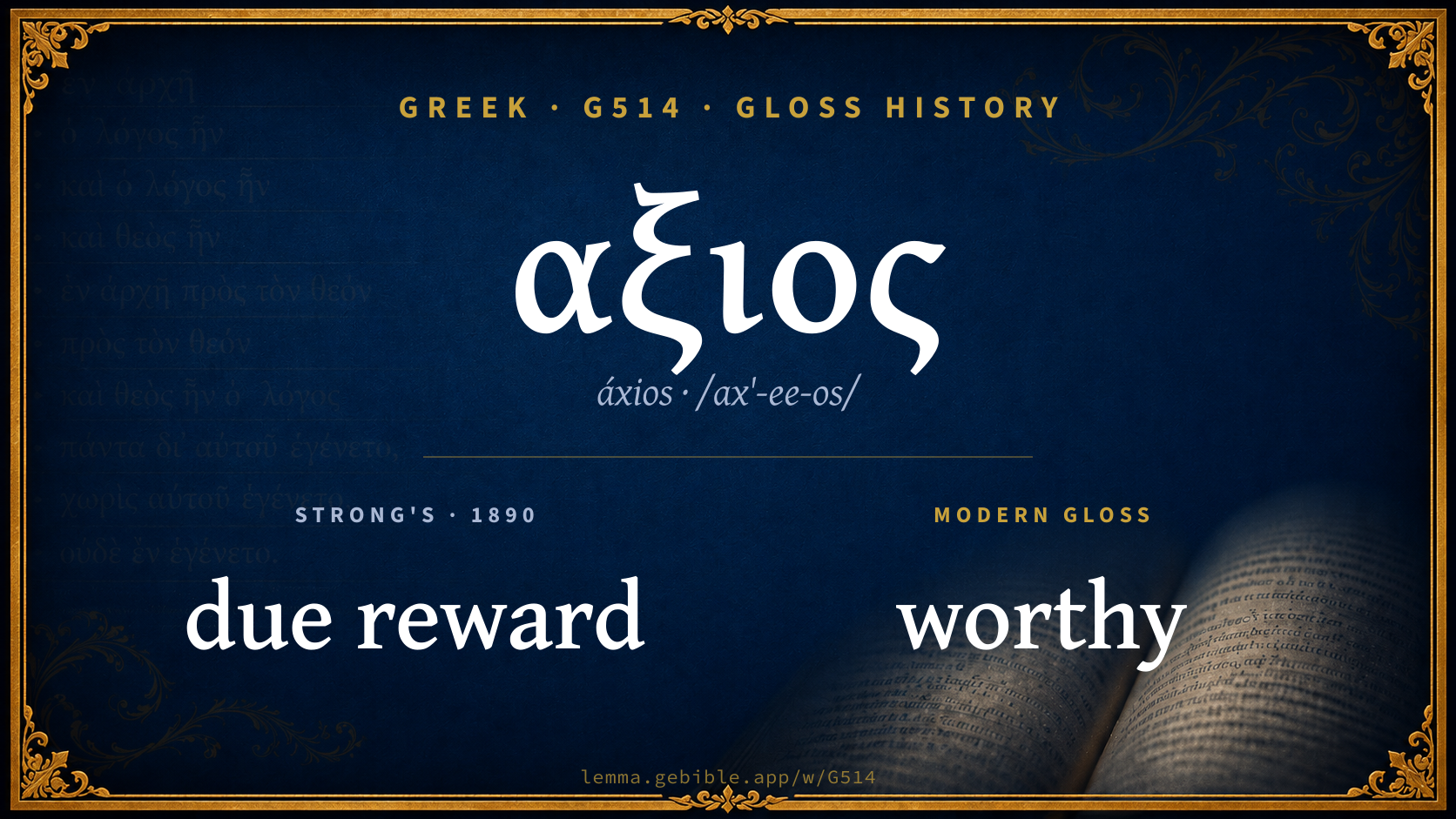
Gloss history
Strong's 1890 vs modern scholarship
About this word
Strong's G514 catalogs a Greek word from the Greek New Testament.
These counts are not copied from any lexicon or concordance. They are computed here, from the morphology-tagged Greek New Testament. What Lemma adds →
- 39
- distinct verses
- The word appears in 39 distinct verses.
- 10 / 27
- NT books
- The word appears in 10 of 27 New Testament books.
- #364
- by frequency
- Top 500 most frequent Greek words (rank 364 of 5,347 Greek words by occurrence).
View all 39 occurrences in the concordance →
By section of the New Testament
By traditional corpus
Conventional, traditional groupings — biblical authorship is debated, so this is a traditional corpus grouping, not an authorship claim. Some books belong to more than one corpus (Luke is in both the Gospels and the Lukan corpus, and so on), so these shares overlap and need not total 100%. Each figure is a share of the word’s 39 distinct verses.
- Gospels 16 verses · 41%
- Lukan (Luke–Acts) 15 verses · 38%
- Johannine 8 verses · 21%
- Pauline corpus 8 verses · 21%
- Revelation 7 verses · 18%
- Hebrews 1 verse · 3%
How translations render this word
Counts come from each version’s own published word-to-Strong’s tagging or interlinear alignment — an approximate guide to how each version renders this word, not a word-level alignment the data otherwise carries. Because each total is that version’s own tagged count, the per-version totals vary from one another and need not match the appearance or distinct-verse counts above. These counts may also differ from a printed concordance because Lemma counts each distinctly tagged rendering and does not collapse phrase taggings into a single head-word total. This is a fixed set of word-tagged versions (KJV, ASV, BSB, ULT) and does not change with the reading translation you choose elsewhere. Each version’s license is shown beside its name below (and on Sources).
- King James Version: Worthy 33×, Meet 4×
- American Standard Version: Worthy 35×, Meet 2×
- Berean Standard Bible: Worthy 32×, Deserve 2×, Keeping with 2×
- unfoldingWord Literal Text: Worthy 34×, Is worthy 4×
King James Version Public Domain
Renders G514 across 40 tagged occurrences — most commonly:
Plus 3 renderings that appear only once — usually multi-word phrases or single function words the recovered tagging swept in, not distinct renderings. Not rendered by a distinct English word in 1 further occurrence.
American Standard Version Public Domain
Renders G514 across 40 tagged occurrences — most commonly:
Plus 3 renderings that appear only once — usually multi-word phrases or single function words the recovered tagging swept in, not distinct renderings.
Berean Standard Bible Public Domain
Renders G514 across 40 tagged occurrences — most commonly:
Plus 4 renderings that appear only once — usually multi-word phrases or single function words the recovered tagging swept in, not distinct renderings. Not rendered by a distinct English word in 1 further occurrence.
unfoldingWord Literal Text CC BY-SA 4.0
Renders G514 across 41 tagged occurrences — most commonly:
Plus 3 renderings that appear only once — usually multi-word phrases or single function words the recovered tagging swept in, not distinct renderings.
Senses in Thayer's
The 3 senses Thayer's distinguishes for this word, in lexicon order (not ranked by frequency or importance). The full entry — with sub-senses — is in the Lexicon Entry tab.
- weighing, having weight, having the weight of another thing of like value, worth as much
- befitting, congruous, corresponding to a thing
- of one who has merited anything worthy
Word origin
Derived from αγω (ágō) (G71) — to lead.
Probably from G71 ; deserving comparable or suitable (as if drawing praise): - due reward meet [un-] worthy.
— Strong’s Exhaustive Concordance (1890), public domain.
Forms in the corpus
The 9 distinct written forms G514 takes in the Greek New Testament, most frequent first — each parse links to that case’s occurrences in the concordance.
| Form | Parsing | Example | Uses |
|---|---|---|---|
| ἄξιος áxios | Adjective, Nominative, Singular, Masculine | Matthew 10:10 | 17 |
| ἄξιον áxion | Adjective, Accusative, Singular, Neuter | Acts 23:29 | 7 |
| ἄξια áxia | Adjective, Accusative, Plural, Neuter | Luke 12:48 | 4 |
| ἀξίους axíous | Adjective, Accusative, Plural, Masculine | Luke 3:8 | 3 |
| ἄξιός áxiós | Adjective, Nominative, Singular, Masculine | Matthew 10:11 | 3 |
| ἀξία axía | Adjective, Nominative, Singular, Feminine | Matthew 10:13 | 2 |
| ἄξιοί áxioí | Adjective, Nominative, Plural, Masculine | Revelation 3:4 | 2 |
| ἄξιοι áxioi | Adjective, Nominative, Plural, Masculine | Matthew 22:8 | 2 |
| ἄξιόν áxión | Adjective, Nominative, Singular, Neuter | 2 Thessalonians 1:3 | 1 |
Same root — word family
Other Thayer's entries built from the same root as G514, grouped by Strong’s listed origin. These share a root / origin per the lexicon — not necessarily a shared meaning. Each links to that word’s own entry.
Derives from
Shares the same root
- αγγελος ángelos G32 angel
- αγε áge G33 come
- αγελη agélē G34 herd
- αγρα ágra G61 prey
- αγρος agrós G68 land
- αγωγη agōgḗ G72 conduct
- αγων agṓn G73 assembly
- ηγεομαι hēgéomai G2233 to govern
Derived from this word
Compare all same-root words → Showing 4 of 12 — not the complete family. They share a root, not necessarily a meaning.
Septuagint usage
The same Greek word αξιος appears 11 times in the Greek Old Testament (Septuagint), across 11 verses in 7 books.
- 11
- LXX occurrences
- Tagged occurrences of this Greek word in the Septuagint.
- 11
- verses
- Distinct Septuagint verses containing this word.
- 7 / 39
- OT books
- The word appears in 7 of the 39 Old Testament books.
Sample Septuagint occurrences
- Genesis 23:9 ἄξιος
- Deuteronomy 25:2 ἄξιος
- 1 Chronicles 21:22 ἄξιος
- Esther 7:4 ἄξιος
- Job 11:6 ἄξιος
- Proverbs 3:15 ἄξιος
- Malachi 2:13 ἄξιος
Septuagint occurrences (same lexeme)
Every verse where the same Strong’s number (G514) appears in the Greek Septuagint. Verse text shown in the World English Bible for context; the Greek form is the matched word — the English is not keyword-highlighted.
- Genesis 23:9 ἄξιος that he may give me the cave of Machpelah, which he has, which is in the end of his field. For the full price let him give it to me in the midst of you for a possession of a burying-place."
- Deuteronomy 25:2 ἄξιος and it shall be, if the wicked man be worthy to be beaten, that the judge shall cause him to lie down, and to be beaten before his face, according to his wickedness, by number.
- 1 Chronicles 21:22 ἄξιος Then David said to Ornan, Give me the place of this threshing floor, that I may build thereon an altar to Yahweh: for the full price shall you give it me, that the plague may be stayed from the people.
- 1 Chronicles 21:24 ἄξιος King David said to Ornan, No; but I will most assuredly buy it for the full price: for I will not take that which is your for Yahweh, nor offer a burnt-offering without cost.
- Esther 7:4 ἄξιος for we are sold, I and my people, to be destroyed, to be slain, and to perish. But if we had been sold for bondservants and bondmaids, I had held my peace, although the adversary could not have compensated for the king's damage.
- Job 11:6 ἄξιος That he would show you the secrets of wisdom! For true wisdom has two sides. Know therefore that God exacts of you less than your iniquity deserves.
- Job 30:1 ἄξιος "But now those who are younger than I, have me in derision, Whose fathers I would have disdained to put with my sheep dogs.
- Job 33:27 ἄξιος He sings before men, and says, 'I have sinned, and perverted that which was right, And it didn't profit me.
- Proverbs 3:15 ἄξιος She is more precious than rubies. None of the things you can desire are to be compared to her.
- Proverbs 8:11 ἄξιος For wisdom is better than rubies. All the things that may be desired can't be compared to it.
- Malachi 2:13 ἄξιος This again you do: you cover the altar of Yahweh with tears, with weeping, and with sighing, because he doesn't regard the offering any more, neither receives it with good will at your hand.
These are occurrences of the same Greek lexeme (G514) in the Septuagint — not a translation of any one Hebrew word. The store carries no word-level Hebrew↔Greek alignment, so no Hebrew original is asserted here. Counts come from the recovered LXX Strong's tagging — high-frequency vocabulary is well covered, while rare or late forms may be untagged — so they reflect tagged occurrences and may slightly undercount.