
Acts 7:30

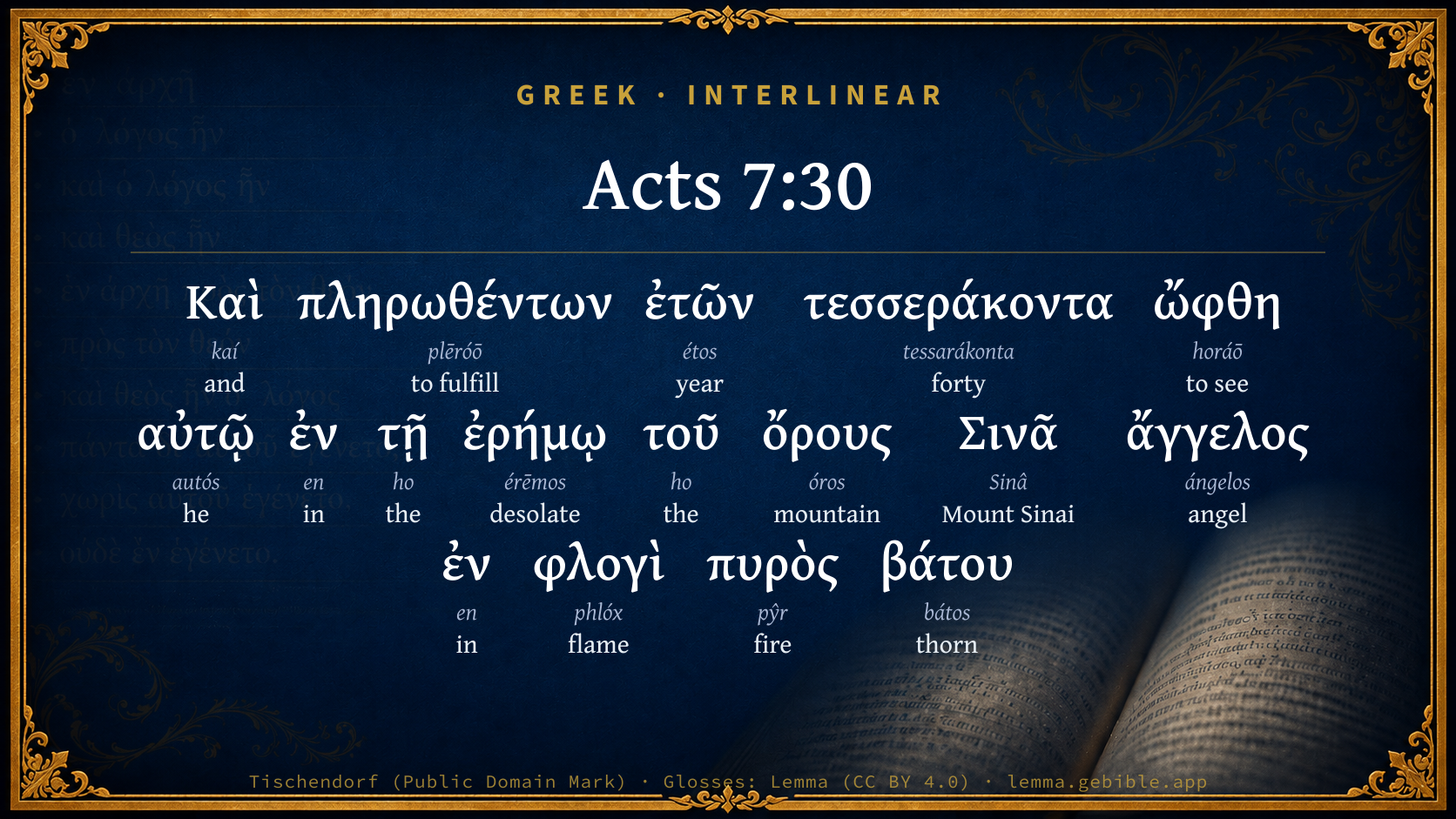
Greek (Tischendorf 8th ed.) Acts 7:30 appears in the Greek New Testament. The text above is from the Tischendorf 8th edition. Each word links to its Strong’s number and a concise gloss. Click any word for its full Thayer’s Greek Lexicon entry.
Download image
Cite this verse

Acts 7:30 (World English Bible). Public Domain. Lemma interlinear Bible study tool, https://lemma.gebible.app/v/acts/7/30.

Show BibTeX & RIS
BibTeX
RIS
English Translation
"When forty years were fulfilled, an angel of the Lord appeared to him in the wilderness of Mount Sinai, in a flame of fire in a bush.
World English Bible · Public Domain
Highlights
  • 1 first appearance in the Greek New Testament
Full analysis ↓
Download a study sheet

One document with this verse’s original text, its word-by-word gloss line, the meaning frame, cross-references with their text, attributed commentary, and full source and license credits — printable, and it pastes into notes with its structure intact.

This verse Autodidact and up

Study sheet (.html) Plain text (.txt)

A passage Seminary Student

Up to 50 verses in one chapter. A passage sheet keeps up to 6 commentary sources and 12 cross-references per verse, in the order this page ranks them, and says so on the sheet whenever that leaves anything out. Ask for a single verse and you get the Autodidact verse sheet above.

Everything on this page stays free to read, with no account — the sheet is a download of what is already on screen, not access to it.

Want to remove ads? Support Godless Engineer
Compare translations 3

The same verse in 3 English versions, stacked beneath the original-language interlinear above. Click any original word for its lexicon entry.

Each is an independent rendering of the whole verse — the interlinear is not word-aligned to these translations.

Highlighted words mark where these versions differ — a whole-verse word diff, not a word-by-word alignment.

  • World English Bible Public Domain
    "When forty years were fulfilled, an angel of the Lord appeared to him in the wilderness of Mount Sinai, in a flame of fire in a bush.
  • King James Version Public Domain
    And when forty years were expired, there appeared to him in the wilderness of mount Sina an angel of the Lord in a flame of fire in a bush.
  • unfoldingWord Literal Text CC BY-SA 4.0
    And 40 years having been filled, an angel appeared to him in the wilderness of Mount Sinai, in a flame of fire in a bush.

unfoldingWord Literal Text — © unfoldingWord, licensed CC BY-SA 4.0. Word-aligned USFM3 via Door43 (git.door43.org/unfoldingWord/en_ult).

Versions to compare (up to 4)

3 of 4 selected

Show all 19 translations

Every available English version of this verse, each an independent rendering of the whole verse.

  • World English Bible Public Domain
    "When forty years were fulfilled, an angel of the Lord appeared to him in the wilderness of Mount Sinai, in a flame of fire in a bush.
  • Berean Standard Bible Public Domain
    After forty years had passed, an angel appeared to Moses in the flames of a burning bush in the desert near Mount Sinai.
  • Majority Standard Bible Public Domain
    After forty years had passed, an angel of the Lord appeared to Moses in the flames of a burning bush in the desert near Mount Sinai.
  • King James Version Public Domain
    And when forty years were expired, there appeared to him in the wilderness of mount Sina an angel of the Lord in a flame of fire in a bush.
  • American Standard Version (1901) Public Domain
    And when forty years were fulfilled, an angel appeared to him in the wilderness of Mount Sinai, in a flame of fire in a bush.
  • Revised Version (1885) Public Domain
    And when forty years were fulfilled, an angel appeared to him in the wilderness of mount Sinai, in a flame of fire in a bush.
  • Geneva Bible (1599) Public Domain
    And when fourtie yeres were expired, there appeared to him in the wildernes of mout Sina, an Angel of the Lord in a flame of fire, in a bush.
  • Douay-Rheims (1899) Public Domain
    And when forty years were expired, there appeared to him in the desert of mount Sina, an angel in a flame of fire in a bush.
  • Young's Literal Translation Public Domain
    and forty years having been fulfilled, there appeared to him in the wilderness of mount Sinai a messenger of the Lord, in a flame of fire of a bush,
  • Literal Standard Version CC BY-SA 4.0
    and forty years having been fulfilled, there appeared to him in the wilderness of Mount Sinai [the] Messenger of the LORD, in a flame of fire of a bush,
  • Unlocked Literal Bible CC BY-SA 4.0
    When forty years were past, an angel appeared to him in the wilderness of Mount Sinai, in a flame of fire in a bush.
  • unfoldingWord Literal Text CC BY-SA 4.0
    And 40 years having been filled, an angel appeared to him in the wilderness of Mount Sinai, in a flame of fire in a bush.
  • Darby Bible Public Domain
    And when forty years were fulfilled, an angel appeared to him in the wilderness of mount Sinai, in a flame of fire of a bush.
  • World Messianic Bible Public Domain
    “When forty years were fulfilled, an angel of the Lord appeared to him in the wilderness of Mount Sinai, in a flame of fire in a bush.
  • Webster's Bible Public Domain
    And when forty years had expired, there appeared to him in the wilderness of mount Sina, an angel of the Lord in a flame of fire in a bush.
  • Free Bible Version CC BY-SA 4.0
    Forty years later, in the desert of Mount Sinai, an angel appeared to him in the flames of a burning bush.
  • Bible in Basic English Public Domain
    At the end of forty years, an angel came to him in the waste land of Sinai, in the flame of a burning thorn-tree.
  • Text-Critical English NT CC BY 4.0
    “After forty years had passed, an angel of the Lord appeared to him in the wilderness of Mount Sinai, in a flame of fire in a bush.
  • Tyndale New Testament (1534) Public Domain
    And when.xl. yeares were expired ther appered to him in the wyldernes of mounte Syna an angell of the Lorde in a flamme of fyre in a busshe.

Literal Standard Version (2020), Covenant Press — licensed CC BY-SA 4.0. Text via the HelloAO Bible API (eBible.org). Unlocked Literal Bible (unfoldingWord) — licensed CC BY-SA 4.0. Text via the HelloAO Bible API (eBible.org). unfoldingWord Literal Text — © unfoldingWord, licensed CC BY-SA 4.0. Word-aligned USFM3 via Door43 (git.door43.org/unfoldingWord/en_ult). Free Bible Version, Dr. Jonathan Gallagher — licensed CC BY-SA 4.0. Text via the HelloAO Bible API (eBible.org).

Word by word

More ways to search: Search by grammar → Find every occurrence → Compare this word →

Practice this passage: Drill this verse → Learn its vocabulary →

Σινᾶ
Sinâ
G4614
“Mount Sinai”
Noun, Proper, indeclinable
Part of Speech
Noun · Proper, indeclinable
Full Thayer's Definition

Origin: of hebrew origin H5514

TDNT: 11:42,1

Sinai = "thorny" 1. a mountain or rather a mountainous region in the peninsula of Arabia Petraea, made famous by the giving of the Mosaic law
  1. Καὶ kaí G2532 “and” Conjunction
  2. πληρωθέντων plēróō G4137 “to fulfill” Verb, Aorist, Passive, Participle, Genitive, Plural, Neuter
  3. ἐτῶν étos G2094 “year” Noun, Genitive, Plural, Neuter
  4. τεσσεράκοντα tessarákonta G5062 “forty” Adjective, Numeral (indeclinable)
  5. ὤφθη horáō G3708 “to see” Verb, Aorist, Passive, Indicative, 3rd person, Singular
  6. αὐτῷ autós G846 “he” Personal pronoun, Dative, Singular, Masculine
  7. ἐν en G1722 “in” Preposition
  8. τῇ ho G3588 “the” Article, Dative, Singular, Feminine
  9. ἐρήμῳ érēmos G2048 “desolate” Adjective, Dative, Singular, Feminine
  10. τοῦ ho G3588 “the” Article, Genitive, Singular, Neuter
  11. ὄρους óros G3735 “mountain” Noun, Genitive, Singular, Neuter
  12. ἄγγελος ángelos G32 “angel” Noun, Nominative, Singular, Masculine
  13. ἐν en G1722 “in” Preposition
  14. φλογὶ phlóx G5395 “flame” Noun, Dative, Singular, Feminine
  15. πυρὸς pŷr G4442 “fire” Noun, Genitive, Singular, Neuter
  16. βάτου bátos G942 “thorn” Noun, Genitive, Singular, Feminine

About this verse

These counts appear in no published source. They are computed here, from the morphology-tagged text and Lemma’s own curated glosses. What Lemma adds →

17
words
15
distinct lemmas
Acts
section

Notable vocabulary

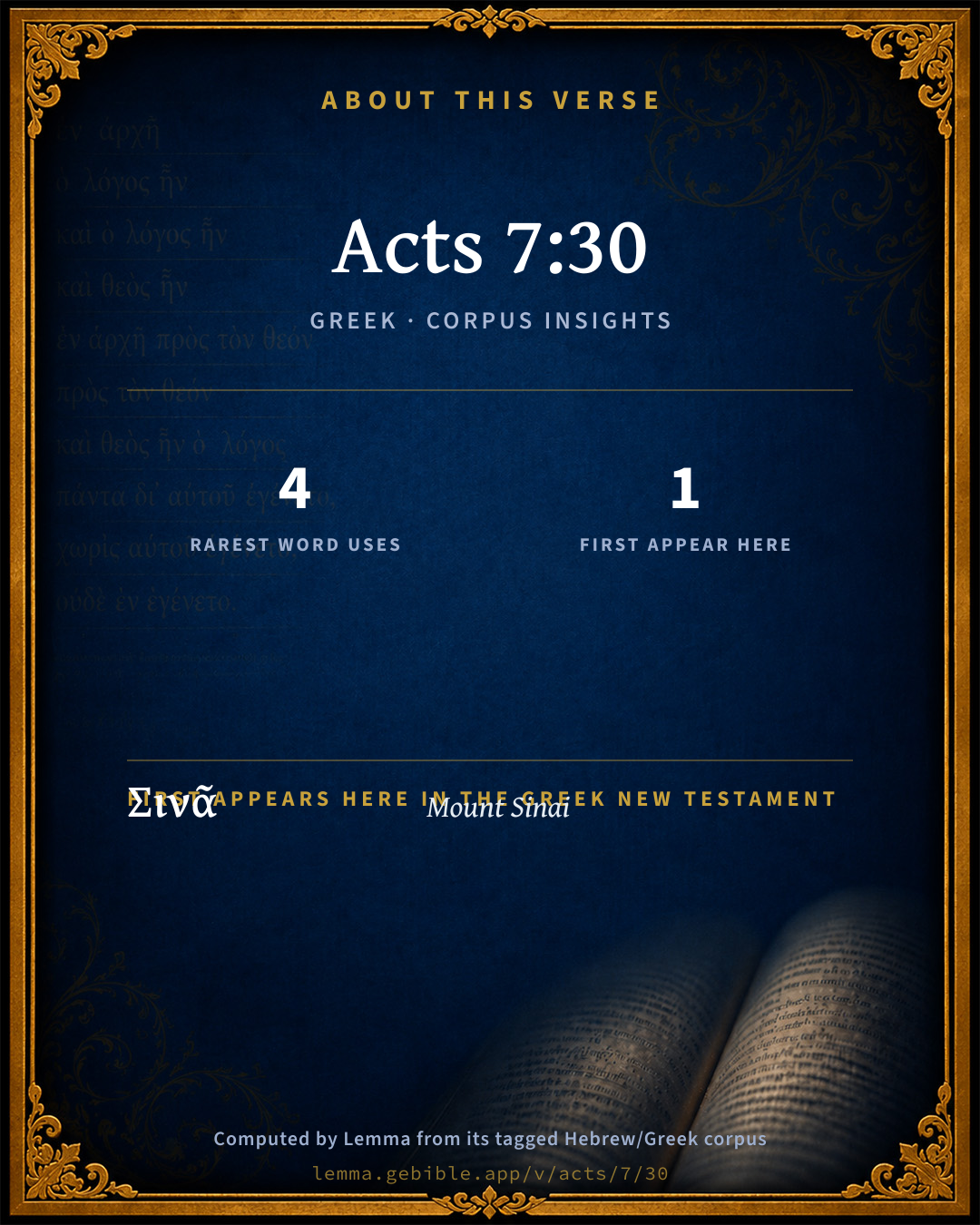
The rarest word here is Σινᾶ Mount Sinai G4614 — appearing just 4 times in the whole Greek New Testament.

First appearance in Scripture

This word makes its first canonical appearance in the Greek New Testament here:

  • Σινᾶ Mount Sinai G4614

Shared distinctive vocabulary

Σινᾶ Mount Sinai G4614 occurs in 4 verses of the Greek New Testament. Also found in:
Repetition

Words recur within this verse:

Cross-references

23

Topical passages linked to Acts 7:30 in the Treasury of Scripture Knowledge — connected by theme and wording, ordered by reader-vote popularity; previews shown in the World English Bible.

  • Exodus 3:1–2 Now Moses was keeping the flock of Jethro, his father-in-law, the priest of Midian, and he led the flock to the back of the wilderness, and came to God's mountain, to Horeb.
  • Isaiah 43:2 When you pass through the waters, I will be with you; and through the rivers, they shall not overflow you: when you walk through the fire, you shall not be burned, neither shall the flame kindle on you.
  • Acts 7:35 "This Moses, whom they refused, saying, 'Who made you a ruler and a judge?'--God has sent him as both a ruler and a deliverer by the hand of the angel who appeared to him in the bush.
  • Exodus 3:6 Moreover he said, "I am the God of your father, the God of Abraham, the God of Isaac, and the God of Jacob." Moses hid his face; for he was afraid to look at God.
  • Isaiah 63:9 In all their affliction he was afflicted, and the angel of his presence saved them: in his love and in his pity he redeemed them; and he bore them, and carried them all the days of old.
  • Acts 7:32 'I am the God of your fathers, the God of Abraham, the God of Isaac, and the God of Jacob.' Moses trembled, and dared not look.
  • Genesis 22:15–18 The angel of Yahweh called to Abraham a second time out of the sky,
  • Genesis 48:15–16 He blessed Joseph, and said, "The God before whom my fathers Abraham and Isaac did walk, the God who has fed me all my life long to this day,
  • Exodus 7:7 Moses was eighty years old, and Aaron eighty-three years old, when they spoke to Pharaoh.
  • Deuteronomy 4:20 But Yahweh has taken you, and brought you forth out of the iron furnace, out of Egypt, to be to him a people of inheritance, as at this day.
  • Psalms 66:12 You allowed men to ride over our heads. We went through fire and through water, But you brought us to the place of abundance.
  • Daniel 3:27 The satraps, the deputies, and the governors, and the king's counselors, being gathered together, saw these men, that the fire had no power on their bodies, nor was the hair of their head singed, neither were their pants changed, nor had the smell of fire passed on them.
  • Mark 12:26 But about the dead, that they are raised; haven't you read in the book of Moses, about the Bush, how God spoke to him, saying, 'I am the God of Abraham, the God of Isaac, and the God of Jacob?'
  • Acts 7:17 "But as the time of the promise came close which God had sworn to Abraham, the people grew and multiplied in Egypt,
  • Genesis 16:7–13 The angel of Yahweh found her by a fountain of water in the wilderness, by the fountain in the way to Shur.
  • Genesis 32:24–30 Jacob was left alone, and wrestled with a man there until the breaking of the day.
  • Exodus 19:1–2 In the third month after the children of Israel had gone forth out of the land of Egypt, on that same day they came into the wilderness of Sinai.
  • Deuteronomy 33:16 For the precious things of the earth and the fullness of it, The good will of him who lived in the bush. Let [the blessing] come on the head of Joseph, On the crown of the head of him who was separate from his brothers.
  • Hosea 12:3–5 In the womb he took his brother by the heel; And in his manhood he had power with God.
  • Malachi 3:1 "Behold, I send my messenger, and he will prepare the way before me; and the Lord, whom you seek, will suddenly come to his temple; and the messenger of the covenant, whom you desire, behold, he comes!" says Yahweh of hosts.
  • Luke 20:37 But that the dead are raised, even Moses showed at the bush, when he called the Lord 'The God of Abraham, the God of Isaac, and the God of Jacob.'
  • Galatians 4:25 For this Hagar is Mount Sinai in Arabia, and answers to the Jerusalem that exists now, for she is in bondage with her children.
  • 1 Kings 19:8 He arose, and ate and drink, and went in the strength of that food forty days and forty nights to Horeb the Mount of God.

Cross-references courtesy of OpenBible.info (CC BY 4.0).

Where the printed editions differ

1 variant

Places in this verse where the major printed Greek editions disagree on the wording in a way that affects the translation — a comparison of editions, not a manuscript-by-manuscript collation. The editions are the modern critical texts (Nestlé-Aland 28/27, SBL, Westcott-Hort, Tregelles, Tyndale House) and the traditional texts behind the KJV (the Textus Receptus and the Byzantine/Majority text). It is not a claim about which reading is original.

  1. Extra text
    κυρίου

    “of [the] Lord”

    In TRByz Not in NA28NA27TynSBLWHTreg

    κυρίου (kuriou) 'of [the] Lord' is only in traditional manuscripts (TR+Byz)

Textual data: Translators Amalgamated Greek New Testament (STEPBible TAGNT) · CC BY 4.0.

Commentary

Notes on Acts 7:30 from classic Christian and Jewish commentators (each source and its license shown beneath its notes). The classic Christian expositions comment on the surrounding passage and are grouped to its opening verse, so a note may address several verses; the Jewish commentaries on the Tanakh (Rashi and others) are per-verse, so they appear only where the commentator wrote on this verse.

Lemma curates 59 commentaries, every one of them public domain or Creative Commons licensed, each selected and text-cleaned for this edition rather than reprinted as found. About our sources →

Matthew Henry's Commentary

Stephen here proceeds in his story of Moses; and let any one judge whether these are the words of one that was a blasphemer of Moses or no; nothing could be spoken more honourably of him. Here is,

I. The vision which he saw of the glory of God at the bush (Act 7:30): When forty years had expired (during all which time Moses was buried alive in Midian, and was now grown old, and one would think past service), that it might appear that all his performances were products of a divine power and promise (as it appeared that Isaac was a child of promise by his being born of parents stricken in years), now, at eighty years old, he enters upon that post of honour to which he was born, in recompence for his self-denial at forty years old. Observe, 1. Where God appeared to him: In the wilderness of Mount Sinai, Act 7:30. And, when he appeared to him there, that was holy ground (Act 7:33), which Stephen takes notice of, as a check to those who prided themselves in the temple, that holy place, as if there were no communion to be had with God but there; whereas God met Moses, and manifested himself to him, in a remote obscure place in the wilderness of Sinai. They deceive themselves if they think God is confined to places; he can bring his people into a wilderness, and there speak comfortably to them. 2. How he appeared to him: In a flame of fire (for our God is a consuming fire), and yet the bush, in which this fire was, though combustible matter, was not consumed, which, as it represented the state of Israel in Egypt (where, though they were in the fire of affliction, yet they were not consumed), so perhaps it may be looked upon as a type of Christ's incarnation, and the union between the divine and human nature: God, manifested in the flesh, was as the flame of fire manifested in the bush. 3. How Moses was affected with this: (1.) He wondered at the sight, Act 7:31. It was a phenomenon with the solution of which all his Egyptian learning could not furnish him. He had the curiosity at first to pry into it: I will turn aside now, and see this great sight; but the nearer he drew the more he was struck with amazement; and, (2.) He trembled, and durst not behold, durst not look stedfastly upon it; for he was soon aware that it was not a fiery meteor, but the angel of the Lord; and no other than the Angel of the covenant, the Son of God himself. This set him a trembling. Stephen was accused for blaspheming Moses and God (Act 6:11), as if Moses had been a little god; but by this it appears that he was a man, subject to like passions as we are, and particularly that of fear, upon any appearance of the divine majesty and glory.

II. The declaration which he heard of the covenant of God (Act 7:32): The voice of the Lord came to him; for faith comes by hearing; and this was it: I am the God of Isaac, and the God of Jacob; and therefore, 1. "I am the same that I was." The covenant God made with Abraham some ages ago was, I will be to thee a God, a God all-sufficient. "Now," saith God, "that covenant is still in full force; it is not cancelled nor forgotten, but I am, as I was, the God of Abraham, and now I will make it to appear so;" for all the favours, all the honours God put upon Israel, were founded upon this covenant with Abraham, and flowed from it. 2. "I will be the same that I am." For if the death of Abraham, Isaac, and Jacob, cannot break the covenant-relation between God and them (as by this it appears it cannot), then nothing else can: and then he will be a God, (1.) To their souls, which are now separated from their bodies. Our Saviour by this proves the future state, Mat 22:31, Mat 22:32. Abraham is dead, and yet God is still his God, therefore Abraham is still alive. God never did that for him in this world which would answer the true intent and full extent of that promise, that he would be the God of Abraham; and therefore it must be done for him in the other world. Now this is that life and immortality which are brought to light by the gospel, for the full conviction of the Sadducees, who denied it. Those therefore who stood up in defence of the gospel, and endeavoured to propagate it, were so far from blaspheming Moses that they did the greatest honour imaginable to Moses, and that glorious discovery which God made of himself to him at the bush. (2.) To their seed. God, in declaring himself thus the God of their fathers, intimated his kindness to their seed, that they should be beloved for the fathers' sakes, Rom 11:28; Deu 7:8. Now the preachers of the gospel preached up this covenant, the promise made of God unto the fathers; unto which promise those of the twelve tribes that did continue serving God hoped to come, Act 26:6, Act 26:7. And shall they, under colour of supporting the holy place and the law, oppose the covenant which was made with Abraham and his seed, his spiritual seed, before the law was given, and long before the holy place was built? Since God's glory must be for ever advanced, and our glorying for ever silenced, God will have our salvation to be by promise, and not by the law; the Jews therefore who persecuted the Christians, under pretence that they blasphemed the law, did themselves blaspheme the promise, and forsook all their own mercies that were contained in it.

III. The commission which God gave him to deliver Israel out of Egypt. The Jews set up Moses in competition with Christ, and accused Stephen as a blasphemer because he did not do so too. But Stephen here shows that Moses was an eminent type of Christ, as he was Israel's deliverer. When God had declared himself the God of Abraham he proceeded, 1. To order Moses into a reverent posture: "Put off thy shoes from thy feet. Enter not upon sacred things with low, and cold, and common thoughts. Keep thy foot, Ecc 5:1. Be not hasty and rash in thy approaches to God; tread softly." 2. To order Moses into a very eminent service. When he is ready to receive commands, he shall have commission. He is commissioned to demand leave from Pharaoh for Israel to go out of his land, and to enforce that demand, Act 7:34. Observe, (1.) The notice God took both of their sufferings and of their sense of their sufferings: I have seen, I have seen their affliction, and have heard their groaning. God has a compassionate regard to the troubles of his church, and the groans of his persecuted people; and their deliverance takes rise from his pity. (2.) The determination he fixed to redeem them by the hand of Moses: I am come down to deliver them. It should seem, though God is present in all places, yet he uses that expression here of coming down to deliver them because that deliverance was typical of what Christ did, when, for us men, and for our salvation, he came down from heaven; he that ascended first descended. Moses is the man that must be employed: Come, and I will send thee into Egypt: and, if God send him, he will own him and give him success.

IV. His acting in pursuance of this commission, wherein he was a figure of the Messiah. And Stephen takes notice here again of the slights they had put upon him, the affronts they had given him, and their refusal to have him to reign over them, as tending very much to magnify his agency in their deliverance. 1. God put honour upon him whom they put contempt upon (Act 7:35): This Moses whom they refused (whose kind offers and good offices they rejected with scorn, saying, Who made thee a ruler and a judge? Thou takest too much upon thee, thou son of Levi, Num 16:3), this same Moses did God send to be a ruler, and a deliverer, by the hand of the angel which appeared to him in the bush. It may be understood either that God sent to him by the hand of the angel going along with him he became a complete deliverer. Now, by this example, Stephen would intimate to the council that this Jesus whom they now refused, as their fathers did Moses, saying, Who made thee a prophet and a king? Who gave thee this authority? even this same has God advanced to be a prince and a Saviour, a ruler and a deliverer; as the apostles had told them awhile ago (Act 5:30, Act 5:31), that the stone which the builders refused was become the head-stone in the corner, Act 4:11. 2. God showed favour to them by him, and he was very forward to serve them, though they had thrust him away. God might justly have refused them his service, and he might justly have declined it; but it is all forgotten: they are not so much as upbraided with it, Act 4:36. He brought them out, notwithstanding, after he had shown wonders and signs in the land of Egypt (which were afterwards continued for the completing of their deliverance, according as the case called for them) in the Red Sea and in the wilderness forty years. So far is he from blaspheming Moses that he admires him as a glorious instrument in the hand of God for the forming of the Old Testament church. But it does not at all derogate from his just honour to say that he was but an instrument, and that he is outshone by this Jesus, whom he encourages these Jews yet to close with, and to come into his interest, not fearing but that then they should be received into his favour, and receive benefit by him, as the people of Israel were delivered by Moses, though they had once refused him.

V. His prophecy of Christ and his grace, Act 4:37. He not only was a type of Christ (many were so that perhaps had not an actual foresight of his day), but Moses spoke of him (Act 4:37): This is that Moses who said unto the children of Israel, A prophet shall the Lord your God raise up unto you of your brethren. This is spoken of as one of the greatest honours God put upon him (nay, as that which exceeded all the rest), that by him he gave notice to the children of Israel of the great prophet that should come into the world, raised their expectation of him, and required them to receive him. When his bringing them out of Egypt is spoken of it is with an emphasis of honour, This is that Moses, Exo 6:26. And so it is here, This is that Moses. Now this is very full to Stephen's purpose; in asserting that Jesus should change the customs of the ceremonial law, he was so far from blaspheming Moses that really he did him the greatest honour imaginable, by showing how the prophecy of Moses was accomplished, which was so clear, that, as Christ told them himself, If they had believed Moses, they would have believed him, Joh 5:46. 1. Moses, in God's name, told them that, in the fulness of time, they should have a prophet raised up among them, one of their own nation, that should be like unto him (Deu 18:15, Deu 18:18), - a ruler and a deliverer, a judge and a lawgiver, like him, - who should therefore have authority to change the customs that he had delivered, and to bring in a better hope, as the Mediator of a better testament. 2. He charged them to hear that prophet, to receive his dictates, to admit the change he would make in their customs, and to submit to him in every thing; "and this will be the greatest honour you can do to Moses and to his law, who said, Hear you him; and came to be a witness to the repetition of this charge by a voice from heaven, at the transfiguration of Christ, and by his silence gave consent to it," Mat 17:5.

VI. The eminent services which Moses continued to do to the people of Israel, after he had been instrumental to bring them out of Egypt, Act 7:38. And herein also he was a type of Christ, who yet so far exceeds him that it is no blasphemy to say, "He has authority to change the customs that Moses delivered." It was the honour of Moses, 1. That he was in the church in the wilderness; he presided in all the affairs of it for forty years, was king in Jeshurun, Deu 33:5. The camp of Israel is here called the church in the wilderness; for it was a sacred society, incorporated by a divine charter under a divine government, and blessed with divine revelation. The church in the wilderness was a church, though it was not yet perfectly formed, as it was to be when they came to Canaan, but every man did that which was right in his own eyes, Deu 12:8, Deu 12:9. It was the honour of Moses that he was in that church, and many a time it had been destroyed if Moses had not been in it to intercede for it. But Christ is the president and guide of a more excellent and glorious church than that in the wilderness was, and is more in it, as the life and soul of it, than Moses could be in that. 2. That he was with the angel that spoke to him in the mount Sinai, and with our fathers - was with him in the holy mount twice forty days, with the angel of the covenant, Michael, our prince. Moses was immediately conversant with God, but never lay in his bosom as Christ did from eternity. Or these words may be taken thus: Moses was in the church in the wilderness, but it was with the angel that spoke to him in mount Sinai, that is, at the burning bush; for that was said to be at mount Sinai (Act 7:30); that angel went before him, and was guide to him, else he could not have been a guide to Israel; of this God speaks (Exo 23:20), I send an angel before thee, and Exo 33:2. And see Num 20:16. He was in the church with the angel, without whom he could have done no service to the church; but Christ is himself that angel which was with the church in the wilderness, and therefore has an authority above Moses. 3. That he received the lively oracles to give unto them; not only the ten commandments, but the other instructions which the Lord spoke unto Moses, saying, Speak them to the children of Israel. (1.) The words of God are oracles, certain and infallible, and of unquestionable authority and obligation; they are to be consulted as oracles, and by them all controversies must be determined. (2.) They are lively oracles, for they are the oracles of the living God, not of the dumb and dead idols of the heathens: the word that God speaks is spirit and life; not that the law of Moses could give life, but it showed the way to life: If thou wilt enter into life, keep the commandments. (3.) Moses received them from God, and delivered nothing as an oracle to the people but what he had first received from God. (4.) The lively oracles which he received from God he faithfully gave to the people, to be observed and preserved. It was the principal privilege of the Jews that to them were committed the oracles of God; and it was by the hand of Moses that they were committed. As Moses gave them not that bread, so neither did he give them that law from heaven (Joh 6:32), but God gave it to them; and he that gave them those customs by his servant Moses might, no doubt, when he pleased, change the customs by his Son Jesus, who received more lively oracles to give unto us than Moses did.

VII. The contempt that was, after this, and notwithstanding this, put upon him by the people. Those that charged Stephen with speaking against Moses would do well to answer what their own ancestors had done, and they tread in their ancestors' steps. 1. They would not obey him, but thrust him from them, Act 7:39. They murmured at him, mutinied against him, refused to obey his orders, and sometimes were ready to stone him. Moses did indeed give them an excellent law, but by this it appeared that it could not make the comers there unto perfect (Heb 10:1), for in their hearts they turned back again into Egypt, and preferred their garlic and onions there before the manna they had under the guidance of Moses, or the milk and honey they hoped for in Canaan. Observe, Their secret disaffection to Moses, with their inclination to Egyptianism, if I may so call it. This was, in effect, turning back to Egypt; it was doing it in heart. Many that pretend to be going forward towards Canaan, by keeping up a show and profession of religion, are, at the same time, in their hearts turning back to Egypt, like Lot's wife to Sodom, and will be dealt with as deserters, for it is the heart that God looks at. Now, if the customs that Moses delivered to them could not prevail to change them, wonder not that Christ comes to change the customs, and to introduce a more spiritual way of worship. 2. They made a golden calf instead of him, which besides the affront that was thereby offered to God, was a great indignity to Moses: for it was upon this consideration that they made the calf, because "as for this Moses, who brought us out of the land of Egypt, we know not what is become of him; therefore make us gods of gold;" as if a calf were sufficient to supply the want of Moses, and as capable of going before them into the promised land. So they made a calf in those days when the law was given them, and offered sacrifices unto the idol, and rejoiced in the work of their own hands. So proud were they of their new god that when they had sat down to eat and drink, they rose up to play! By all this it appears that there was a great deal which the law could not do, in that it was weak through the flesh; it was therefore necessary that this law should be perfected by a better hand, and he was no blasphemer against Moses who said that Christ had done it.

Matthew Henry's Commentary on the Whole Bible (1708–1710) — public domain (CC PDM 1.0). Text via the HelloAO Bible API.

The Biblical Illustrator

Joseph S. Exell

Act_7:30-34

And when the forty years were expired there appeared to him an angel of the Lord in a flame of fire in a bush.

The burning bush

A sign and a type--

I. Of Israel. As in Egypt, it resembled a degenerate and wild thorn hedge, burning, but not consumed, in the glow of the brick-kiln, and in the heat of trial.

II. Of The Messiah. According to His human lowliness--a thorn bush, and Divine glory--the flame in the bush, inseparable in one person--the bush not consumed.

III. Of the Christian Church, in its insignificant cross form, constant trial, and indistructible powers of life. This bush has now burned fez nearly two thousand years, and yet we have never seen its ashes. (K. Gerok.)

Moses trembled.--

The fear of Moses

I. Its nature.

1. It was not slavish fear.

2. But pious humility. How good is it for a teacher, who must so often stand upon holy ground, to experience this trembling, not only at the commencement, but during the continuance of his ministry.

II. Its effects. This filial fear and reverence will be--

1. A barrier by which useless words, vain gestures, and other sinful things will be prevented.

2. An incentive to speak and act as before God, in God, and from God. (Apostolic Pastor.)

Put off thy shoes.

An exhortation to put off earthly stains and conceited pride in the presence of God.

1. For ministers, in the study and in the pulpit.

2. For hearers in their church-going and at worship. (K. Gerok.)

I have seen, I have seen the affliction of My people.--

The greater our need the nearer God

1. He sees the sufferings of His people.

2. He hears the sighs of believers.

3. He comes down at the proper time.

4. He sends out His servants. (K. Gerok.)

The people of God

I. God has a people. My people.

1. Chosen by Him.

2. In covenant with Him.

II. Where they live. In Egypt.

1. A house of bondage.

2. A transient residence.

3. Among a strange people.

III. What they suffer. Affliction. In some shape or form this is the Christians earthly lot.

1. Inflicted by man.

2. Permitted by God.

3. Working out spiritual ends.

IV. The Divine notice of their case.

1. God sees their affliction.

2. God hears their groaning.

3. God works out their deliverance. (J. W. Burn.)

This Moses … brought them out after that he had showed wonders and signs.--

The miracles of Moses and Christ

The Divine authority of the Jewish lawgiver was chiefly seen and heard in thunderings and lightnings, great plagues and fearful judgments--in the darkened air, the flashing firmament, the corrupted waters, the divided sea, the rending earth, lamenting families, armies overwhelmed and terror-stricken nations: so that most emphatically does the sacred historian, in summing up the character of Moses as a worker of miracles, declare that none ever equalled him in all that mighty hand, and in all that great terror which he showed in the land of Egypt. The glory of our Saviours miracles is of a different kind, and better suited to the genius of His dispensation. He gave indeed abundant testimony that it was not for want of power He did not signalise His mission like Moses--when, e.g., over His Cross the sky was shrouded with a pall of funereal darkness, while fierce earthquakes tore the flinty rocks, and the temple vail was rent asunder by an unseen hand, and the buried dead arose. But the characteristic tone of the Redeemers marvellous works was of another and a benignant kind. The Mighty Man of Wonders, by whom come grace and truth went about doing good. Consolation and joy and bright-eyed health attended all His steps. Mercy went before His face; and at His heavenly smile diseases vanished, pain expired, fear ceased to quiver, sorrow dried her tearful countenance, the broken heart was made whole. (A. S. Patterson, M. A.)

The Biblical Illustrator, edited by Joseph S. Exell (c. 1880s–1900s) — public domain. Text from a community e-Sword module.

Joseph Benson's Commentary

Act 7:30-34. When forty years were expired — That is, forty after his leaving Egypt; during which time Israel had continued under this bondage, and Moses, inured to hardships and poverty, and to contemplation and devotion, had been trained up and prepared, in the humble and retired life of a shepherd, for the great work for which God designed him; see on Exo 2:22; there appeared to him in the wilderness of mount Sina — Which lay in the confines of the Midianite country, not far from the Red sea; an angel of the Lord — The Son of God, as appears from his styling himself Jehovah; (see on Exo 3:2;) a name which cannot, without the highest presumption, be assumed by any created angel, since he whose name alone is Jehovah, is the Most High over all the earth, Psalm lxxxiii, 18. It was therefore the Angel of the covenant: Mal 3:1, the Angel of God’s presence, Isa 63:9, who delivered the law to Moses, and was with the church in the wilderness, and gave them possession of Canaan as the Captain of the Lord’s host, Jos 5:14. In a flame of fire in a bush — Which, though of combustible matter, was not consumed; representing the state of Israel in Egypt, where, though they were in the fire of affliction, yet they were not consumed by it, but miraculously preserved as a people, and even increased. When Moses saw it, he wondered at the sight — Wondered why the bush, which burned, was not consumed: it was a phenomenon, with the solution of which all his Egyptian learning could not furnish him. And as he drew near to behold, the voice of the Lord came unto him, saying, I am the God of thy fathers, &c. — Expressions sufficiently showing that the person speaking was not a mere angel, but possessed of true Deity, and therefore, as being also styled an angel, or messenger, was the Son of God, the Father’s Messenger to men. Then Moses trembled — Moses, upon this, perceiving that God himself was there present, and spake to him, trembled at this appearance of his majesty, and durst not behold with a curious regard, as he had intended. Then said the Lord, Put off thy shoes — An ancient token of reverence; for the place is holy ground — The holiness of places depends on the peculiar presence of God there. See the note on Exo 2:5. “It was formerly in the eastern nations, and is now in the southern, esteemed a ceremony of respect, to put off the shoes when approaching a superior, lest any of the dirt or dust cleaving to the shoes should be brought near him, and that the person approaching barefoot might tread more cautiously. This, which perhaps was introduced at first in court apartments, where rich carpets might be used, the King of kings requires to be done in a desert, as a token of the infinitely greater reverence due to him. See Jos 5:15, and Ecc 5:1. On the same principle, it seems, the priests ministered thus in the tabernacle and temple, no direction being given for shoes or sandals as a part of their dress, though all the rest of it was so particularly prescribed.” I have seen, I have seen the affliction — See note on Exo 2:7-8.

Joseph Benson's Commentary on the Old and New Testaments (1811–1818) — public domain. Text from a community e-Sword module.

Lange's Commentary on the Holy Scriptures

B.—the calling of moses

Act_7:30-34

30And when forty years were expired [fulfilled], there appeared to him in the wilderness of mount Sina [Sinai] an angel18 of the Lord [om. of the L.] in a flame of fire19 in [of] a bush. 31[But] When Moses saw it, he wondered20 at the sight: and as [but as] he drew near to behold it, the [a] voice of the Lord came unto him21 [om. unto him], 32Saying, I am the God of thy fathers, the God of Abraham22, and the God of Isaac, and the God of Jacob [of Abr., and of Is. and of Jacob]. Then [But] Mosestrembled, and durst [ventured] not [to] behold. 33Then said the Lord [But the Lord said] to him, Put off thy shoes from thy feet: for the place where23 thou standest isholy ground. 34I have seen, I have seen [34. I have indeed seen] the affliction [ill treatment] of my people which is in Egypt, and I have heard their groaning [sighing], and am come down to deliver them. And now come, I will [om. will] send24 thee into [to] Egypt.

EXEGETICAL AND CRITICAL

Act_7:30. a. And when forty years were expired.—See the Exeg. note on Act_7:24 above.—The wilderness of Mount Sina [Sinai], that is, the Desert of Arabia, or the Sinaitic peninsula, is designated by Stephen as the region in which the call was given to Moses. It is not here expressly stated, but rather assumed as a well-known fact, that the angel appeared in the immediate vicinity of mount Horeb [Exo_3:1]; it was, at least, that event which gave the name of the mount, Sinai, to the wilderness itself. That name alone occurs in the New Testament, while, in the Old Testament it is used interchangeably with that of Horeb, with the following qualification:—when the narrative refers to the circumstances connected with the giving of the law, and to the sojourning of the Israelites near that mount, the latter receives, with a, single exception [Exo_33:6], the name of Sinai alone; but previously to the arrival of the people at that spot, and after their departure from it, the mountain receives the name of Horeb exclusively. This circumstance has led Robinson (Bibl. Res. I. 120. ed. 1856) to infer very justly that Horeb was the general name of the whole group of mountains, and that Sinai was the name applied to that particular mount on which the law was given.

b. An angel.—If the correct reading be ἄγγελος without κυρίου, (and such appears to be the case), the specific conception connected with מַלְאַךְ יְהוָֹה is, unquestionably, no longer suggested by it. Besides, that conception would not be unmistakably expressed even in the reading: ἄγγελος κυρίου, since, as in the Sept., the word angel is not preceded by the article in Exo_3:2. [The question to which the author alludes, is the following: ‘Was this “angel of Jehovah,” (also called the angel of the covenant) a visible manifestation of God himself, and, specially, of the Logos, as a foreshadowing of his future incarnation, or was this angel a created being, one of the heavenly hosts?’ The former view is that of many church fathers, and the earlier Protestant theologians. It has, in recent times, been adopted by Hengstenberg, Delitzsch (formerly), Nitzsch, Keil, Hævernick, Ebrard, J. P. Lange, Stier, Auberlen, Thomasius, and Kurtz, (formerly). Alford, in a note on this passage, unequivocally adheres to it. The latter view was held by Augustine, Jerome, and, at a later period, by the Socinians, Arminians and Rationalists. But it has also been advocated by Hofmann (Weiss. u. Erf.), Baumgarten, Tholuck (Com. on John , 5 th ed.), Delitzsch (more recently), Kurtz (in the second ed. of Hist. of the Old Cov. § 50) and, apparently, by the author, as the tone of the remarks just made here, and also below (Doctr. and Eth. No. 1.) seems to indicate.—Tr.].—The reading: πυοὶ φλ. β. represents the flaming fire of the bush as the most striking feature of the scene, while the other reading, φλογὶ πυρ. β. directs attention rather to the fiery flame; they do not, however, essentially differ in sense. The bush which flames without being consumed by the fire, and in which the angel of Jehovah is present, is the place in which God is revealed. The flaming fire, which did not consume the bush, was not natural fire, but a supernatural light, corresponding to the δόξα of God when He manifests Himself.

Act_7:31-33. a. Moses .… wondered.—Stephen does not, in a slavish manner, merely recite the terms employed in the Mosaic narrative, but repeats the substance of the latter with freedom and animation. Thus when he introduces the word ἐθαύμαζεν, the imperfect tense (which is the better reading), conveys the following thought, [Winer: Gram. § 40. 3]:—When Moses first beheld that appearance, he gazed with wonder for a time, before he determined to approach nearer, in order to observe (κατανοῆσαι) the whole more accurately.

b. The voice of the Lord came unto him.—The word spoken by the angel, as the messenger of God, not in his own name, but in that of God, was, in truth, the word of God, and his voice was the voice of God. Here, again, Stephen departs from the text of the Old Testament: according to the latter, the command that Moses should put off his sandals because the place was holy, Exo_3:5, preceded God’s manifestation of himself as the God of the patriarchs, Act_7:6. Moses was directed to unloose and put away his sandals, that is, the soles which were fastened with thongs above the feet. The reason may be found in the oriental custom, according to which no visitor was permitted to enter a temple or other holy place, without having previously removed the covering of the feet. The act was both a mark of profound reverence, and also obviated the danger of introducing dust or any other impurity into the sanctuary by means of the sandals. According to rabbinic traditions, the priests performed their duties in the temple of Jerusalem only after having removed the covering of the feet.

Act_7:34. I have seen, I have seen.—The words ἰδὼν εἶδον, both here and in the Septuagint, furnish an illustration of the mode of Grecizing the Hebrew verb with the infinitive absolute; and it may be added, that an analogous form of expression can be found in classic Greek writers [comp. Winer: Gram. N. T. §45. 8]. The emphasis which is expressed by the participial repetition of the verb, here denotes a seeing or a looking on, which is both long continued, and also produces sympathy and causes grief.

DOCTRINAL AND ETHICAL

1. The theological, mooted point, involved in the proposition: “The Angel of Jehovah, who repeatedly appears in the Old Test., and, at times, speaks in the name of God himself, is identical with the eternal Son of God, who appeared, previously to his incarnation, in the form of an angel,” is not sustained by the language of Stephen; he speaks merely of an angel, whereas “the angel of Jehovah” is mentioned in Exo_3:2. [See note 1, appended to the text.—Tr.]

2. The fear and trembling of Moses (Act_7:32), as soon as he became conscious that God himself was present and was distinctly manifested, were perfectly natural results in the case of a man whose heart was not perverted and callous. It is, besides, a significant fact that this revelation of God occurred in the immediate vicinity of the same mountain which was, soon afterwards, chosen as the scene of the giving of the law. We are not authorized by the narrative, it is true, to infer that it was the divine purpose to convey to Moses, at this early period, a conception of the solemn and impressive scenes which would attend the giving of the law. Still, his first impressions of the exalted majesty, holiness, and δόξα of God, must have been combined with alarm and fear. His fears were succeeded by a feeling of encouragement. The divine words, Act_7:34, were reviving and cheering, for they expressed love (τοῦ λαοῦ μου), pity, and saving grace.

3. The place where Moses stood was holy ground, simply for the reason that God was there present and revealed himself. The spot itself possessed no sanctity of its own as distinguished from any other; it became holy ground solely for the reason that it was the sovereign will of God to reveal himself there rather than elsewhere. The whole purpose of the discourse of Stephen required him to insist on this point. This principle is, indeed, in strict accordance with the entire Mosaic legislation, according to the tenor of which, as far as the locality of a divine revelation is concerned, all is made by God himself to depend on his own choice of the place where he will “record his name,” Exo_21:24.

Footnotes:

[18]Act_7:30. a. External evidence of a decisive character cannot be produced either for the reading ἄγγελος, or for ἄγγελος κυρίου; the former is supported by A. B. C., the latter by D. E. H.; the ancient versions [Vulg. angelus] also vary considerably. The point must, consequently, be decided by internal evidence. Now, if κυρίου were the original reading, it would scarcely have been omitted; it could far more easily have been subsequently added, particularly as the original Hebrew in Exo_3:2 is מַלְאַךְ יְהוָֹה, and the Sept. also reads ἄγγ. κυρίου. Hence Lach. and Tisch. [and Alf.] have very properly cancelled [Cod. Sin. omits κυρ. after ἅγγ.—Tr.]

[19]Act_7:30. b. Tischendorf reads πυρὶ φλογός [with A. C. E.] instead of φλογὶ πυρός [of text. rec., which is adopted by Lach. and Alf. with B (e sil). D. H. and also Cod. Sin.]; both readings are likewise furnished by the MSS. of the Sept. in Exo_3:2, with nearly the same weight of authority for each reading. [The current printed text of the Sept., in accordance with B. reads πυρὶ φλ.; but A. and ed. Ald. (1518), and Complut. Pol. (1517 ff.) exhibit φλ. πυρ. (Landschreiber’s Add. to Stier and Th.’s Pol. Bib.)—Tr.]. φλ. π. is the easier reading, and, therefore, liable to suspicion.

[20]Act_7:31. a. Ἐθαύμαζεν in D. E. H. [and Cod. Sin.] and many small mss. is preferable to the aorist ἐθαύμασεν [of text. rec.] which is found in A. B. (e sil). C. The imperfect is quite appropriate in this connection [and is adopted by Tisch. and Alf. while Lach. prefers the aorist.—Tr.]

[21]Act_7:31. b. It is true that in a number of MSS. [C. Vulg., etc.] κυρίου is followed by πρὸς αὐτόν; but as these two words are wanting in A. B. [Syr.] and several Oriental manuscripts, they must be regarded as a gloss. [The words πρὸς αὐτόν are omitted in Cod. Sin.—Tr.]

[22]Act_7:32. The fuller reading: ὁ Θεὸς Ἀβρ. καὶ ὁ Θεὸς Ἰσ. κ. ὁ Θ. Ἰακ. in D. E. H. [and Vulg.] is more elaborate than ὁ Θεὸς Ἀβρ. καὶ Ἰσ. κ. Ἰακ., found in A. B. C. [and Cod. Sin.] and preferred by Lach. and Tisch. [and Alf.; but Meyer considers it a later adaptation to Act_3:13 above.—Tr.]

[23]Act_7:33. Ἐφ ̓ ᾦ is far more strongly supported [by A. B. C. Cod. Sin.] than ἐν ᾦ, which is found only in E. H., and appears to have been borrowed from the text of the Sept.: the former has, accordingly, been preferred by Lach., Tisch., and Meyer [and Alf.].

[24]Act_7:34. The future, ἀποστελῶ, of the text. rec. is supported by only one important MSS., namely, H., while A. B. C. D. have the present, ἀποστέλλω, and E. also, which reads ἀποστίλλω (where the ε was omitted only by a lapsus pennæ), advocates the present tense, which the latest critics have unanimously adopted. [Alf. retains the apparently undisputed reading of the Sept. in Exo_3:10, i.e. ἀποστείλω, the subjunctive aorist (de Wette; see Winer: Gr. N. T. § 41. 4). Both Tisch. (ed. 1849) and Lach. adopt the same reading, (aor. subj. and not pres. or fut. indic.), referring to A. B. C. D. E., as the authorities.—Cod. Sin. exhibits the form ἀποστίλω, which also represents ἀποστείλω.—Tr.]

______

For Hom. and Pract. see on (Act_7:35-43)

Lange's Commentary on the Holy Scriptures (Critical, Doctrinal, and Homiletical), ed. John Peter Lange, English translation edited by Philip Schaff (1864–1880) — public domain. Text from a community e-Sword module.

Bengel's Gnomon

Johann Albrecht Bengel

Act 7:30. Ἄγγελος, an angel) The Son of GOD. See foll, verses. Moses at first did not know who it was, but presently after recognised Him from the voice.—πυρὶ φλογὸς, in a flame of fire) signifying the majesty of GOD, who was present.

Bengel's Gnomon of the New Testament — English translation (T&T Clark, Edinburgh, 1860) — public domain. Text from a community e-Sword module.

Expositor's Greek Testament

ed. W. Robertson Nicoll

Act 7:30 . πληρωθέντων , see Act 7:23 , cf. Exo 7:7 , “fulfilled,” R.V. ὤφθη , Act 7:2 , so the second fundamental revelation of God to Israel took place in the wilderness far away from the Promised Land (Weiss), see also Act 7:33 . τεσσαράκοντα , cf. Act 1:3 . Σινᾶ : there is no contradiction between this and Exo 3:1 , where the appearance is said to take place in Horeb, for whilst in the N.T. and Josephus Sinai only is named for the place of the law-giving, in the O.T. the two names are interchanged, cf. also Sir 48:7 . According to Hamburger the two names are identical, signifying in a narrower sense only one mountain, the historical mountain of the giving of the law, but in a wider sense given to a whole group of mountains. Thus Hamburger declines to accept the view that Horeb was the name of the whole ridge of mountain-cluster, whilst Sinai specially denotes the mountain of the law-giving, since Horeb is also used for the same event ( cf. Exo 3:1 ; Exo 17:6 ; Exo 33:6 ), Real-Encyclopädie des Judentums , i., 7, 940. See also B.D. 1 , “Sinai,” Wendt, edition (1899), in loco ; Schaff-Herzog, Encyclopœdia , iv., “Sinai” (also for literature); and Grimm-Thayer, sub v . According to Sayce, Higher Criticism and the Monuments , p. 263 ff., Sinai is a mountain of Seir, rather than of the Sinaitic peninsula so called. The same writer lays stress upon the fact that Sinai is associated with Seir and Edom, Deu 33:2 , Jdg 5:4-5 , and maintains that it is nowhere in the O.T. transported to the Sinaitic peninsula of our modern maps. The word Σινᾶ is an indeclinable noun τό ( sc. , ὄρος ); Josephus τὸ Σιναῖον and τὸ Σιναῖον ὄρος ; Grimm-Thayer, Winer-Schmiedel, p. 91, Blass, Gram. , 8, 32; and see also Sayce, u. s. , p. 268, 269, and Patriarchal Palestine , p. 259, who renders as adjective “(the mountain) which belongs to Sin,” i.e. , like desert which it overlooked, to the worship of the Babylonian Moon-God Sin in that region. ἄγγελος : in Exo 3:2 “the angel of the Lord,” but in Act 7:7 “the Lord said,” so here in Act 7:31 “the voice of the Lord said,” cf. Act 7:33 . For the same mode of expression cf. Act 27:23 with Act 23:11 . In this Angel, the Angel of the Lord, cf. Exo 3:2 with Act 7:6 ; Act 7:14 and Gen 22:11 with Act 7:12 ; the Angel of the Presence, Exo 33:11 , cf. Isa 63:9 (Act 7:38 below), although Jewish interpreters varied, the Fathers saw the Logos, the Eternal Word of the Father. See references in Felten, in loco , and Liddon, Bampton Lectures , Lect. ii., and “Angel,” B.D. 2 . Otherwise we can only say that Jehovah Himself speaks through the Angel (Weiss, Blass, in loco ). ἐν φλογὶ πυρὸς βάτου : words interchanged as in LXX A, Exo 3:2 ; according to Hebrew πυρὸς ἐκ τοῦ βάτου πυρός here = an adjective, rubus incensus (Blass, Weiss); cf. 2Th 1:8 , ἐν πυρὶ φλογός . For gender of βάτος see Act 7:35 .

The Expositor's Greek Testament, edited by W. Robertson Nicoll (1897–1910) — public domain. Text from a community e-Sword module.

Geneva Bible (1599)

Geneva Bible translators

Now he calleth the Son of God an Angel, for he is the Angel of great counsel, and therefore, straightway after he showeth him, saying to Moses, I am that God of thy Fathers, etc.

Geneva Bible (1599) marginal notes — public domain. Text via Bolls.life.

Jamieson, Fausset & Brown

Robert Jamieson, A. R. Fausset & David Brown

an angel of the Lord--rather, "the Angel of the Covenant," who immediately calls Himself JEHOVAH (Compare Act 7:38).

Jamieson, Fausset & Brown — Commentary Critical and Explanatory on the Whole Bible (1871) — public domain (CC PDM 1.0). Text via the HelloAO Bible API.

Adam Clarke's Commentary

Verse 30. In a flame of fire in a bush.] See this and the following verses largely explained in the notes, see Clarke Ex 3:1-8.

Adam Clarke's Commentary on the Bible (1810–1826) — public domain. Text from a community e-Sword/MySword module.

John Calvin's Commentaries

30. And when forty years were expired. As Moses was no blockish man, every one of us may easily gather how many things might have come into his mind which might have caused him to mistrust his calling. The shifts and sleights of Satan are captious. We are more than bent naturally to distrustfulness; what doubts soever arise in our minds concerning the word of God we do easily admit the same. It was a hard exchange to be thrust from earthly delights and a sumptuous life unto the painful and base office of feeding sheep; and especially forasmuch as Moses saw so much time spent, and being in the mean season sent into the wilderness, what other thing could he imagine with himself but that that was vain and a plain mock which the Lord had promised? Forasmuch as being now fourscore years of age, he was occupied about the feeding of his father-in-law’s sheep, when could he have hoped that there should have been any use of him in delivering the people? It is good for us oftentimes to call to mind these combats of the godly until they be thoroughly imprinted in our memory, lest our minds faint, and our hearts fail us, if the Lord make us stay longer than we could wish. Again, Moses giveth a notable example of modesty, seeing that in all that time he attempteth nothing; he raiseth no tumults, neither intrudeth himself any way to bear rule, as troublesome men use to do; but employeth himself in his shepherd’s function as diligently as if he should never have been called unto any greater charge. But whilst he tarrieth the Lord’s leisure so patiently, he [the Lord] appeareth unto him at length.

The angel of the Lord appeared unto him. It is first demanded who this angel was? and, secondly, why he appeared in such a form? For after that Luke had called him an angel, he bringeth him in immediately speaking thus: I am the God of Abraham, etc. Some answer, As God doth sometimes attribute and impart unto his ministers those things which are most proper to himself, so it is no absurd or inconvenient thing, if they have his name given them; but seeing this angel affirmeth manifestly that he is the eternal God, who alone is, and in whom all things have their being, we must needs restrain this title unto the essence of God; for it can by no means agree to the angels. It might be said more fitly, that because the angel speaketh in the name of the Lord, he taketh upon him his person, as if he declared his commandments word for word, as out of the mouth of God, which manner of speaking is usual in the prophets; but when Luke shall say afterwards, that this was the same angel through whose assistance and guiding Moses delivered the people: and Paul, in the 10th chapter of the First to the Corinthians, (1 Corinthians 10:4) doth affirm that Christ was that guide, there is no cause why we should now wonder that the angel taketh to himself that which is proper to God alone.

Therefore, let us, first of all, set down this for a surety, that there was never since the beginning any communication between God and men, save only by Christ; for we have nothing to do with God, unless the Mediator be present to purchase his favor for us. Therefore, this place doth plentifully prove the divinity of Christ, and teacheth that he is of the same essence with the Father. Furthermore, he is called an angel, not only because he had the angels always to bear him company, and to be, as it were, his apparitors: but because that deliverance of the people did shadow the redemption of us all, for whose sake Christ was to be sent of his Father, that he might take upon him the shape of a servant together with our flesh. It is certain, indeed, that God did never appear unto men as he is, but under some shape agreeable to their capacity; notwithstanding, there is another reason why Christ is called by this name, because he being appointed by the eternal counsel of God to be unto men the minister of salvation, doth appear unto Moses to this end. Neither is that contrary to this doctrine, which is written in the 2nd chapter to the Hebrews, (Hebrews 2:16) that Christ never took the angels, but the seed of Abraham; for although he took upon him the shape of an angel for a time, yet did he never take the nature of angels, as we know that he was made very man.

It resteth that we speak somewhat of the burning bush. That is common, that God doth apply the signs unto the things by a certain likelihood, and this is almost the common order and way of the sacraments. Furthermore, this was the fittest thing that could have been shown to Moses, to confirm his faith in the present business. He knew in what state he had left his nation. Although there were a greater number of men, yet were they not unlike to a bush. For the thicker the bush is, and the more store of shrubs it hath, the more subject is it to take fire, that it may burn on every side; so the people of Israel were but a weak band, and such as was laid open to all injuries; and this unwarlike multitude being pressed down even with their own weight, had incensed the cruelty of Pharaoh only with the prosperous success of increasing. Therefore, the people being oppressed with cruel tyranny, is, as it were, a pile of wood set on fire at every corner, neither is there any thing which keepeth it from being consumed to ashes, save this, because the Lord sitteth in the midst thereof; and although the [an] undoubted fire of persecution did then burn, yet because the Church of God is never free from afflictions in the world, the continual estate thereof is after a sort painted out in this place. For what other thing are we but fuel for fire? And there fly abroad innumerable fire-brands of Satan continually, which set on fire both our bodies and also our minds; but the Lord delivereth and defendeth us, by his wonderful and singular goodness, from being consumed. Therefore, the fire must needs burn, that it may burn us in this life; but because the Lord dwelleth in the midst of us, he shall so preserve us that afflictions shall do us no harm, as it is also said in the 46th Psalm, (Psalm 46:5.)

John Calvin's Commentaries (1540-1563) — public domain. Text from the Calvin Translation Society English edition (1840s-50s) via the Christian Classics Ethereal Library (ccel.org). Calvin's coverage is partial (roughly two-thirds of the Bible); uncommented books and verses are honest gaps, never fabricated. The 19th-century editor's footnotes and remarks are omitted so the notes are faithfully Calvin's own voice.

Ellicott's Commentary for English Readers

(30) There appeared to him in the wilderness.—With the exception of the substitution of Sina, or Sinai, for the less familiar Horeb, the fact is stated in nearly the same words as in Exo_3:2. The reference to this revelation, besides the bearing it had on the main argument of the speech, was indirectly an answer to the charge that he had spoken “blasphemous words against Moses.” Both in the Hebrew and the LXX. the word “angel” is, as here, without the article.

In a bush.—The Hebrew word seneh is used for a species of thorny acacia, which still grows in the wilderness of Sinai. The Greek word, in the LXX. and here, was used commonly for the bramble, or any prickly shrub.

A Bible Commentary for English Readers, edited by Charles John Ellicott (1878–1897) — public domain. Text from a community e-Sword module.

The Cambridge Bible for Schools and Colleges

gen. ed. J. J. S. Perowne

30. And when forty years were expired] Thus making, with the forty years mentioned in Act_7:23, eighty years, the age at which Moses went unto Pharaoh (Exo_7:7).

there appeared to him in the wilderness of mount Sina an angel of the Lord] It is better to conform the New Testament orthography in familiar names to that of the Old, and so write Sinai, The oldest authorities omit the words “of the Lord.”

The Cambridge Bible for Schools and Colleges (gen. ed. J. J. S. Perowne; Cambridge University Press, 1878–1918) — public domain. Text from a community e-Sword module.

John Gill's Exposition

And when forty years were expired,.... "Forty other years" the Arabic version reads; for so long the Jews (g) say Moses kept Jethro's flock, and so many years he lived in Midian; and so the Syriac version, "when then he had filled up forty years"; which agrees exactly with the account of the Jewish writers observed on Act 7:23 who say, that he was forty years in Pharaoh's court, and forty years in Midian; so that he was now, as they (h) elsewhere justly observe, fourscore years of age:

there appeared to him in the wilderness of Mount Sinai; the same with Horeb, Exo 3:1 where it is said, "Moses came to the mountain of God, even to Horeb"; where he saw the sight of the burning bush, and out of which the angel appeared to him: and Stephen is to be justified in calling it Mount Sinai; the account which Jerom (i) gives of it is this;

"Horeb is the Mount of God in the land of Midian, by Mount Sinai, above Arabia, in the desert, to which is joined the mountain and desert of the Saracenes, called Pharan: but to me it seems, that the same mountain was called by two names, sometimes Sinai, and sometimes Horeb;''

and in which he was right. Some think the same mountain had two tops, and one went by one name, and the other by another; or one side of the mountain was called Horeb, from its being dry and desolate; and the other Sinai, from the bushes and brambles which grew upon it. So "Sinin", in the Misna (k), signifies the thin barks of bramble bushes; and the bush hereafter mentioned, in the Hebrew language, is called "Seneh"; from whence, with the Jews, it is said to have its name.

"Says (l) R. Eliezer, from the day the heavens and the earth were created, the name of this mountain was called Horeb; but after the holy blessed God appeared to Moses out of the midst of the bush, from the name of the bush "(Seneh)", Horeb was called Sinai.''

Some say the stones of this mountain, when broken, had the resemblance of bramble bushes (m) in them. Add to this, that Josephus (n) calls this mountain by the same name as Stephen does, when he is reciting the same history. Moses, he says,

"led the flock to the Sinaean mountain, as it is called: this is the highest mountain in that country, and best for pasture, abounding in good herbage; and because it was commonly believed the Divine Being dwelt there, it was not before fed upon, the shepherds not daring to go up to it.''

Here Moses was keeping the flock of his father-in-law; for to such a life did he condescend, who for forty years had been brought up in the court of Pharaoh, king of Egypt. Here appeared to him

an angel of the Lord, and who was no other than the God of Abraham, Isaac, and Jacob, as appears from Act 7:32 and was the second person in the Trinity, the Son of God, the angel of the divine presence, and of the covenant, an uncreated angel. And this is the sense of many of the Jewish writers, who interpret it of the angel the Redeemer, the God of Bethel (o); though Jonathan the paraphrast seems to understand it of a created angel, whose name he calls Zagnugael (p), and some say it was Michael, and some Gabriel (q).

In a flame of fire in a bush; and which yet was not consumed by it. This bush was a bramble bush, or thorn; so Aben Ezra (r) says it was a kind of thorn, and observes, that in the Ishmaelitish or Turkish language, the word signifies a kind of dry thorn; and so Philo the Jew says (s), it was a thorny plant, and very weak; and therefore it was the more wonderful, that it should be on fire, and not consumed. Josephus (t) affirms, that neither its verdure, nor its flowers were hurt, nor any of its fruitful branches consumed, though the flame was exceeding fierce. The Jerusalem Targum of Exo 3:2 is,

"and he saw and beheld the bush burned with fire, and the bush "became green"; or, as Buxtorf renders it, "emitted a moisture", and was not burnt.''

This sight, the Arabic writers (u) say, Moses saw at noon day. Artapanus (w), an ancient writer, makes mention of this burning, but takes no notice of the bush; yea, denies that there was anything woody in the place, and represents it only as a stream of fire issuing out of the earth: his words are,

"as he (Moses) was praying, suddenly fire broke out of the earth, and burned, when there was nothing woody, nor any matter fit for burning in the place.''

But Philo better describes it; speaking of the bush, he says (x),

"no one bringing fire to it, suddenly it burned, and was all in a flame from the root to the top, as if it was from a flowing fountain, and remained whole and unhurt, as if it was no fuel for the fire, but was nourished by it.''

The Jews allegorize this vision different ways: sometimes they say (y),

"the fire designs the Israelites, who are compared to fire, as it is said, Oba 1:18 "the house of Jacob shall be a fire"; and the bush denotes the nations of the world, which are compared to thorns and thistles; so shall the Israelites be among the people, their fire shall not consume the people, who are like to thorns and briers; nor shall the nations of the world extinguish their flame, which is the words of the law: but in the world to come, the fire of the Israelites shall consume all people, who are compared to thorns and thistles, according to Isa 33:12'

But it is much better observed in the same place;

"the bush pricks, afflicts, and gives pain, why does he (the Lord) dwell in affliction and anguish? because he saw the Israelites in great affliction, he also dwelt with them in affliction, as it is said, Isa 63:9 "in all their affliction he was afflicted"''

And very appropriately is it remarked by Philo (z);

"the burning bush (says he) is a symbol of the oppressed, the flaming fire, of the oppressors; and whereas that which was burning was not burnt, it shows, that they that are oppressed shall not perish by those who attempt it; and that their attempt shall be in vain, and they shall escape safe.''

And so Aben Ezra has this note on Exo 3:2.

"the enemy is compared to fire, and Israel to the bush, wherefore it was not burnt:''

this may be very well considered as an emblem of the state of the Jewish people in fiery trials, and very severe afflictions; who were like a bush for the number of its twigs and branches, they being many, and for its weakness and liableness to be consumed by fire, and yet wonderfully preserved by the power and presence of God among them.

(g) Pirke Eliezer, c. 40. (h) Sepher Cosri, fol. 38. 1. & Moses Kotsensis praefat ad Mitzvot Tora. (i) De locis Hebraicis, fol. 92. E. (k) Misn. Celim, c. 10. sect. 6. (l) Pirke Eliezer, c. 41. Aben Ezra in Exod. iii. 2. (m) R. Moses Narbonensis apud Drusii Preterita in loc. Vid. Hilleri Onomasticum, p. 523. (n) Antiqu l. 2. c. 12. sect. 1. (o) R. Menachem in Ainsworth in Exod. iii. 2. (p) Targum Jon. in ib. (q) Shemot Rabba, sect. 2. fol. 92. 4. (r) Comment. in Exod. iii. 2. (s) De Vita Mosis, l. 1. p. 612, 613. (t) In loc. supra citat. (u) Patricides, p. 26. Elmacinus, p. 47. apud Hottinger. Smegma Oriental. l. 1. c. 8. p. 415. (w) Apud Euseb. Evangel. praepar. l. 9. c. 27. p. 434. (x) Ut supra. (De Vita Mosis, l. 1. p. 612, 613.) (y) Pirke Eliezer, c. 40. Vid. Shemot Rabba, sect. 2. fol. 92. 4. (z) Ut supra. (De Vita Mosis, l. 1. p. 612, 613.)

John Gill's Exposition of the Whole Bible (1746–1763) — public domain (CC PDM 1.0). Text via the HelloAO Bible API.

Trapp's Complete Commentary

John Trapp

30 And when forty years were expired, there appeared to him in the wilderness of mount Sina an angel of the Lord in a flame of fire in a bush.

Ver. 30. See Exo 3:2.

John Trapp, A Commentary or Exposition upon All the Books of the Old and New Testament (1647–1656) — public domain. Text from a community e-Sword module.

Albert Barnes' Notes on the Bible

And when forty years ... - At the age of 80 years. This, however, was known by tradition. It is not expressly mentioned by Moses. It is said, however, to have been after the king of Egypt had died Exo 2:23; and the tradition is not improbable.

In the wilderness of mount Sina - In the desert adjacent to, or that surrounded Mount Sinai. In Exo 3:1, it is said that this occurred at Mount “Horeb.” But there is no contradiction; Horeb and Sinai are different peaks or elevations of the same mountain. They are represented as springing from the same base, and branching out in different elevations. The mountains, according to Burckhardt, are a prodigious pile, comprehending many peaks, and about thirty miles in diameter. From one part of this mountain, Sinai, the Law was given to the children of Israel.

An angel of the Lord - The word “angel” means properly a “messenger” (see the notes on Mat 1:20), and is applied to the invisible spirits in heaven, to people, to the winds, to the pestilence, or to whatever is appointed as a messenger “to make known” or to execute the will of God. The mere “name,” therefore, can determine nothing about the “nature” of the messenger. That “name” might be applied to any messenger, even an inanimate object. The nature and character of this messenger are to be determined by other considerations. The word may denote that the “bush on fire” was the messenger. But a comparison with the other places where this occurs will show that it was a celestial messenger, and perhaps that it was the Messiah who was yet to come, appearing to take the people of Israel under his own charge and direction. Compare Joh 1:11, where the Jews are called “his own.” In Exo 3:2, it is said that the angel of the Lord appeared in a flame of fire; in Exo 3:4 it is said that Yahweh spake to him out of the midst of the bush; language which implies that God was there, and which is strongly expressive of the doctrine that the angel was Yahweh. In Exo 23:20-21, God says, “I send an angel before thee, to keep thee in the way, and to bring thee into the place which I have prepared. Beware of him, and obey “his” voice,” etc., Exo 23:23; Exo 32:34; Exo 33:2. In all these places this angel is mentioned as an extraordinary messenger sent to conduct them to the land of Canaan. He was to guide them, to defend them, and to drive out the nations before them. All these circumstances seem to point to the conclusion that this was no other than the future deliverer of the world, who came then to take his people under his own guidance, as emblematic of the redemption of his people.

In a flame of fire - That is, in what “appeared” to be a flame of fire. The “bush” or clump of trees seemed to be on fire, or to be illuminated with a special splendor. God is often represented as encompassed with this splendor, or glory, Luk 2:9; Mat 17:1-5; Act 9:3; Act 12:7.

In a bush - In a grove, or clump of trees. Probably the light was seen issuing from the “midst” of such a grove.

Albert Barnes' Notes on the Bible (1834–1885) — public domain. Text from a community e-Sword/MySword module.

Haydock's Catholic Bible Commentary

In a flame of fire, in a bush.[3] Literally, in the fire of a flame of the bush. The sense must be, that the bush seemed on fire, and in a flame, and yet was not consumed. (Witham)

===============================

[BIBLIOGRAPHY]

In igne flammæ rubi, Greek: en phlogi puros batou. In flamma ignis rubi.

George Leo Haydock (1774–1849), Haydock's Catholic Family Bible and Commentary, 1859 edition — public domain. Excludes Psalms (Douay-Rheims chapter numbering differs from Protestant) and Deuterocanonical books (Catholic canon only).

Matthew Poole's English Annotations

Forty years; so long it pleased God to try Moses’s faith, and his people’s patience.

Mount Sinai, in the desert of Arabia, where the law was afterwards delivered, Exo 18:5; 19:3.

An angel; not a created, but the uncreated Angel; the Angel of the new covenant, as may be seen Act 7:32, and by Moses putting off his shoes because the place was holy, Exo 3:2,5; he is also in Exo 3:4 called the Lord. God still appeared in such a manner as was most instructive to them he appeared to, and to us; as here in a flame of fire in a bush to show that he was with his people in all their sufferings, and would so provide, that they should not be consumed by them; they might be purified, but should not be destroyed.

Matthew Poole's English Annotations on the Holy Bible (1683–1685) — public domain. Text from a community e-Sword/MySword module.

Whedon's Commentary on the Bible

Daniel D. Whedon

30. Wilderness of mount Sinai—in the second chapter of Exodus, whence this narrative is taken, the mountain is named not Sinai, but Horeb. Horeb is, perhaps, the name of the mountain group, and Sinai the name of the particular mountain of the law.

Angel… in a flame—See our note on Act_7:2.

30. Philip ran—The chariot of the eunuch moved gently, so as not to impede the reading, and Philip by a quick pace could overtake it.

Heard him read—The Oriental reads even to himself alone with a full voice.

Understandest—The question of Philip, for the purpose of vivacity, contains a play upon words in the Greek, for which the nearest parallel we can invent would be, Heedest what thou readest? (See note on Act_7:5.) Though he understood not to the bottom, yet his heart understood enough of the divine word to feed its spiritual life on. God’s word has several bottoms, and deeper and deeper surfaces. Beneath the stratum to which the eunuch could penetrate, Philip knew the Divine Saviour lay.

Daniel D. Whedon (gen. ed.), Commentary on the Old and New Testaments (1874–1909) — public domain. Text from a community e-Sword module.

The Pulpit Commentary

Fulfilled for expired, A.V.; an angel appeared for there appeared an angel, A.V.; an angel for an angel of the Lord, A.V. and T.R.; Sinai for Sina, A.V.

Vers. 30-34. The call of Moses.

I THE MESSAGE BY FIRE. Fire is the sign of the presence of Jehovah. It denotes spiritual agency in its intensity. Fire penetrates and it purifies. It is, therefore, inimical to evil and conservative of good. Darkness of mystery is round about God, and when he comes forth from it to reveal himself to men it is in the form of fire. It is an emblem of the Holy Spirit. In the bosoms of men he glows, and the musing poet bursts forth into inspired song, and the prophet into "words that burn and thoughts that breathe of truth and power." When we ask that God will answer us by fire, we ask that be will make known his presence in the most vivid manner in feeling, and with the most mighty effect on the life. Specially the vision of the burning bush was a type of Israel unconsumed notwithstanding its fierce persecution in Egypt; of the glory of his great Representative, the Messiah a bright flame springing from the lowly bush; of the Church amidst itsage long conflicts and trials; lastly, of all truth, which "like a torch, the more it"s shook, it shines;" the more the breezes of controversy blow about it, the purer and clearer its illumination.

II THE LIVING VOICE OF THE ETERNAL. The sense of hearing as well as that of sight is addressed. So ever in the disclosures of the Divine. What we have felt in part through the hearing of the car is illustrated and confirmed by the evidence of the more skeptical organ, the eye. Or what we have witnessed with a certainty not to be gainsaid, in actual fact is presently interpreted and connected with the great principle to which it belongs by some similar voice of teaching. The utterance here is simple. It is a declaration that the God of history is the ever-present God. He who was with Abraham and Isaac and Jacob is here with Moses. Faith has always its past to fall back upon; it can renew its life in moments of weakness out of the living fount of memory.

III THE WONDER AND THE TERROR OF THE DIVINE PRESENCE. First, Moses wonders at the burning bush. Wonder is the reflection in feeling of the extraordinary, and it is the parent of curiosity. Why and whence, the spirit asks, this irruption into the course of nature? It is the appearance of the living God, is the only answer to the question. Here wonder passes into fear and trembling, which betray man"s sense of utter dependence in the presence of the Almighty and the All-holy. The sight of the unspeakable glory is shrunk from. In ordinary life nature and custom conceal God, and mercifully; for how could one glimpse of absolute truth, of Divine perfection, be endured? But terror passes into reverence, which is the blending of fear with love and confidence as the mind becomes more inured to the experience. The sandals are thrown off, as in the presence of an august sovereign. How good to feel that nature, the daily scene of a wondrous drama, the occasional theatre of magnificent spectacles, as in the tempest, the thunder-voices and fiery revelation betokening the presence of creative might, is holy ground! But the mind becomes deadened by custom. And well is it, therefore, that in those places specially consecrated to meetings with God the church, the private oratory habits of outward submission and reverence should be cultivated which may have their right influence on the whole moods of the soul.

IV THE CALL.

1. The call of man by God is ever to service on behalf of the suffering. All human suffering has an echo in the heart of God. He is the God of all compassion. He is not merely love, but love as an active will. He determines to save. Now it is a nation from outward captivity, now a generation from bondage to ignorance and fear. Light and health are the images of his energy and influence.

2. The called man is a man sent. He has a mission, and it is ever a mission to the lowly and the meek. So has it been with all the great prophets; so above all with the Christ. "I send thee into Egypt." "Where lies the Egypt to which I am sent, and where the fulfillment of my life-call must lie?" the Christian may ask. John Howard found his Egypt in the prisons of Europe, and "trod an open but unfrequented path to immortality." Our Egypt may be close at hand. Wherever we see an obsolete custom, a corrupt habit of thought, an ignorance of any kind, a spell laid upon the imagination, or a vice tyrannizing over the will of others, there is a house of bondage. God needs the co-operation of many finite deliverers that his design of an infinite deliverance may go forward. If we, like Moses and like Elijah and Isaiah, are ready with our "Here am I; send me," it will not be long before we receive our directions and our marching orders. J.

The Pulpit Commentary (1880–1919), ed. H.D.M. Spence-Jones & Joseph S. Exell — public domain. Text from a community e-Sword module.

John Wesley's Explanatory Notes

The angel - The Son of God; as appears from his styling himself Jehovah. In a flame of fire - Signifying the majesty of God then present. Exod. iii, 2.

John Wesley, Explanatory Notes Upon the Whole Bible (1754–1765) — public domain. Text via the GEBible commentary corpus.

Scofield Reference Notes

C. I. Scofield

angel

(See Scofield "Heb 1:4").

The Scofield Reference Bible (1917 edition), notes by C. I. Scofield — public domain. Text from a community e-Sword module.

Kretzmann's Popular Commentary

Paul E. Kretzmann

The call of Moses:

v. 30. And when forty years were expired, there appeared to him in the wilderness of Mount Sina an angel of the Lord in a flame of fire in a bush.

v. 31. When Moses saw it, he wondered at the sight; and as he drew near to behold it, the voice of the Lord came unto him,

v. 32. saying, I am the God of thy fathers, the God of Abraham and the God of Isaac and the God of Jacob. Then Moses trembled, and durst not behold.

v. 33. Then said the Lord to him, Put off thy shoes from thy feet; for the place where thou standest is holy ground.

v. 34. I have seen, I have seen the affliction of My people which is in Egypt, and I have heard their groaning, and am come down to deliver them. And now come, I will send thee into Egypt.

When forty years were fulfilled, after Moses had lived forty years in the wilderness near Mount Sinai, known then also as Horeb, a strange experience befell him. The angel of the Lord, Exo 3:2, the angel in the special meaning of the word, indicating the revelation of the Son of God in the Old Testament, appeared to him in a flame of fire of a bush, in a thorn bush that seemed all aflame. The phenomenon caused Moses to wonder and to draw nearer to consider the matter closely. And then the voice of the Lord came to him out of the bush, designating Himself as the God of Abraham and Isaac and Jacob. Moses, now thoroughly terrified, did not so much as dare to look closely or to investigate the miracle. But the Lord immediately gave him his charge, bidding him first of all to unlace his sandals, since the place where he was standing was holy ground. And then, with all solemnity and impressiveness, came the call of the Lord itself: Seeing I have seen (I have had more than sufficient evidence of) the affliction of My people in Egypt, and I have heard their sighing, and I have come down to set them free; and now, come here, I shall send thee into Egypt. What Moses had hoped for and had attempted to carry out without success in his own power, was now to become a fact by God’s will, according to His promise. It was now a matter of God’s appointment, not of man’s choice, and therefore of God’s almighty power to back up the call. With God’s call to rely upon, with God’s command and promise clear, every servant of the Lord may set out with cheerful trust in the assured success of his venture.

Paul E. Kretzmann, Popular Commentary of the Bible (1921–1924) — public domain. Text from a community e-Sword module.

Burkitt's Expository Notes on the New Testament

William Burkitt

St. Stephen here goes on with the history of Moses, and having, in the former verses, made mention of what occurred to him in Egypt and in Madian, here an account is given of what happened to him in the wilderness; and the first thing observable, is the appearance of God to him in a flame of fire out of the midst of a bush, which burned, but was not consumed. This bush was an emblem of the church: This bush burning pointed out the afflicted state of the church in Egypt, having a long time been in the fiery furnace there; but the burning bush, not consumed, signified the church’s preservation. God was in the midst of the bush, whilst the bush was in the midst of the burning.

Where note, How almighty God, intending to send Moses as a deliverer of his people out of Egypt, gives him a visible sign for confirming of his faith, in the sight of this burning but unconsumed bush:

1. To assure him of his people’s deliverance, that though they were now slave in Egypt, yet they should be set free, and instated in a land flowing with milk and honey; next to satisfy him that he should be the instrument to bring to pass so glorious a work.

O how gracious is God’s condescension towards his servants, who is pleased, by visible signs, to support the weakness of their faith. The Lord appeared to Moses in a flame of fire in the bush.

Observe, 2. How Moses, in the faith of God’s presence with him, protection over him, and assistance of him, goes forth for Egypt, where he works many signs and wonders before Pharoah, at last brings the people forth into the wilderness to Mount Sinai, where God gave them his law, and appointed Moses then to make a tabernacle for his worship.

Now, the use which St. Stephen makes of this, is to convince the Jews, that for above four hundred years their fathers had worshipped God without any tabernacle at all, and consequently, that now that sort of worship was abolished, God might be very acceptably served and worshipped in the absence of it.

Observe, 3. That notwithstanding Moses was raised up by God, and sent to be a deliverer into Egypt, and a lawgiver to the Israelites in the wilderness; yet they rebelled against him, and against God in him; for they ran into the vilest idolatry, even to make and worship a golden calf, to adore the host of heaven, the sun, moon, and stars, for deities; yea, they carried about with them the images and pictures of the heathen gods, Mars and Saturn, with design to worship them, for which gross idolatry God sent them into captivity beyond Babylon.

Hence learn, 1. That there is a strange inclination in man’s heart to the sin of idolatry; the reason is, because it is a worship of our own invention. Now, man is most fond of, and forward for, that service of God which is of his own finding out and setting up. We love a devotion of our own devising very dearly.

Learn, 2. That idolatry in worshipping the sun, moon, and stars, is a very ancient sin; both the old Gentiles and old Jews were guilty of it; and consequently, we may infer, that neither antiquity nor universality will bear us out in idolatrous worship. Example is no plea against a rule, nor antiquity against truth: It is no excuse to us, when we do evil, to say our forefathers did so before us.

Learn, 3. That the idolatry of the Jews was a grand iniquity, and much worse than the idolatry of the heathens; the Gentiles knew not God, but the Jews owned him, and gloried in him. But though they knew God, they worshipped him not as God.

Observe, 4. The Israelites being come out of Egypt by the conduct of Moses, and having entered the wilderness at God’s appointment and particular direction, the tabernacle for his public worship and serivce erected: This is here called, The tabernacle of witness Act 7:44; it being the place where God used to witness and manifest his glorious presence, and because the ark of the covenant, the law and the testimonies, were laid up in it, which were witnesses and declarations of God’s will how he would be served.

Now this tabernacle was an ambulatory temple, a the temple was a standing tabernacle.

This tabernacle was moveable; they carried it with them from place to place, while they sojourned in the wildrness, and at last they brought it with them into Canaan, Act 7:45. which tabernacle our forefathers brought in with Jesus, (that is, Joshua, into the possession of the Gentiles, that is, the hand of Canaan, where it continued all the days of David, till Solomon began his reign, who built the temple in a most magnificent and sumptuous manner.)

Here note, 1. That the public worship of almighty God is a moral duty, founded in the light of nature, and the common reason of mankind.

2. That solemn places for public worship have been from the beginning, before the giving of the law. The ancient devotion of the world delighted much in groves, Abraham planted a grove, and called there on the name of the Lord Gen 21:33. This was a sort of oratory or chapel, whither Abraham and his family resorted, to worship the true God. After the giving of the law, while the people of the Jews were in an unsettled condition, God was contented with a mean tabernacle; but when they were settled in Canaan, then a magnificent temple is built, in some measure suitable to the greatness and majesty of that God who was to be worshipped in it.

From whence we may infer, That the public worship of God, though it doth require inward and spiritual devotion, yet, as public, is necessarily external; and as such, it ought to express, in the best manner we are able, that profound reverence which we pay to the divine Majesty.

And therefore, that the circumstances of it should not only be decent, but very solemn and magnificent, the light of nature seems plainly to require, and the gospel doth nowhere gainsay. When David determined to build God an house for public worship, he resolved it should be exceedingly magnificent; which reolution was not a piece of ceremonial piety, but grounded upon a moral and eternal reason, of equal force in all ages; namely, that the greatest and best of Beings be most awfully adored by us in the best manner we are able; and that we declare our high regard and esteem of so glorious a Majesty, by all outward fitting testimonies of respect and reverence.

Observe, lastly, That, after the temple was built, the worship of God was not so tied to that place, as that he could not be worshipped acceptably anywhere else; for God hath declared, by the mouth of his holy prophet, That he delighted not in temples made with hands, as if He were included therein, and bound thereto. Isa 66:1-2

And thus St. Stephen, by a large induction of particulars, made good his defense, that he was not guilty of blasphemy for affirming that Christ would destroy the temple, and change the customs which Moses delivered.

He closes his apology with this argument, That which was not blaphemy to affirm of the tabernacle, though it was set up by God’s special appointment given to Moses, is not blasphemy to affirm of the temple; but it was no blasphemy to affirm the use of the tabernacle to have been temporary, and consequently alterable; therefore to affirm the same of the temple is not blasphemy; especially since the Lord hath said, That he dwelleth not in temples made with hands.

William Burkitt's Expository Notes on the New Testament (1700–1703) — public domain. Text from a community e-Sword module.

McGarvey & Pendleton's Commentaries

J. W. McGarvey

30-37. There were other incidents in the life of Moses fully as much to his purpose as this; and to these he proceeds to advert. (30) " And when forty years were completed, there appeared to him, in the wilderness of Mount Sinai, an angel of the Lord in a flame of fire in a bush. (31) When Moses saw it, he wondered at the sight, and as he drew near to observe it, the voice of the Lord came to him. (32) I am the God of your fathers, the God of Abraham, and the God of Isaac, and the God of Jacob. Then Moses trembled, and did not dare to observe it. (33) And the Lord said to him, Put off thy shoes from thy feet; for the place on which thou standest is holy ground. (34) I have surely seen the affliction of my people who are in Egypt, and have heard their groaning, and have come down to deliver them; and now, come, I will send thee into Egypt. (35) The same Moses whom they rejected, saying, Who made thee a ruler and a judge? the same did God send to be a ruler and a deliverer, by the hand of the angel who appeared to him at the bush. (36) He led them out, after doing wonders and signs in the land of Egypt, and in the Red Sea, and in the wilderness forty years. (37) This is the same Moses who said to the children of Israel, A prophet shall the Lord your God raise up to you from your brethren like me; him shall ye hear. " In this passage, the speaker has not only presented, in a most emphatic manner, the contrast between the rejection of Moses by his brethren, and his appointment by God to the very office of ruler and deliverer, which they refused him, but has also made a further advance toward his final purpose, by introducing the prophesy uttered by this same Moses concerning the Messiah. This prophesy was still more apposite, because it refuted the charge that he had spoken blasphemy against Moses, in saying that Christ would change the customs appointed by him. If Moses himself foretold the coming of a successor who should supersede him, he alone pays proper respect to Moses who submits to his successor.

J. W. McGarvey (with Philip Y. Pendleton), Commentaries on the New Testament (The Fourfold Gospel, 1914; Acts; and the epistles) — public domain. Text from a community e-Sword/MySword module.

The People's New Testament

B. W. Johnson

30–34. For the call of Moses, see Exod. 3:1–10.

B. W. Johnson's The People's New Testament with Notes (1889–1891) — public domain. Electronic text from the Christian Classics Ethereal Library (CCEL) ThML edition.

Cambridge Greek Testament for Schools and Colleges

30. Omit κυρίου with אABC. Vulg. has ‘angelus’ only.

30. ἐτῶν τεσσεράκοντα, forty years, thus making, with the forty years mentioned in Act 7:23, eighty years, the age at which Moses went unto Pharaoh (Exo 7:7).

ὤφθη … ἄγγελος, an angel appeared to him. It is better to write Sinai than to conform to the Greek spelling Σινᾶ. See previous verse.

Cambridge Greek Testament for Schools and Colleges (Cambridge University Press, 1896; 21 vols, various authors incl. Carr, Maclear, Plummer, Farrar, Lumby, Moule, M. R. James, Simcox) — public domain. Text from a community e-Sword module.

Alford’s Greek Testament

Henry Alford

30. ἐτ. τεσς.] This follows from the tradition of ver. 23, combined with Exo 7:7, ‘Moses in palatio Pharaonis degit XL annos, in Midiane XL annos, et ministravit Israel XL annos.’ Bereshith Rabba, f. 115. 3. (Mey.)

Σινᾶ] Horeb, Exo 3:1. But both were points of the same mountain range, and the names were convertibly used. In Exod., Levit., and Numb., the law is said to have been given from Sinai; in Deut. from Horeb. ‘The desert of Mount Sina’ is the desert in which Mt. S. is situated. So ‘the Peak of Derbyshire,’ originally no doubt some single hill, has come to mean the whole district in which that hill is situated.

ἄγγελος] Here, as continually in the O. T., the angel bears the authority and presence of God Himself: which angel, since God giveth not his glory to another, must have been the great Angel of the covenant, the מַלְאַךְ פָּנָיו of Isa 63:9, ‘the Angel of His Presence,’—the Son of God. See below on εἰς διαταγὰς ἀγγέλων, ver. 53.

Stier remarks, that this second appearance of God, to Moses (see ver. 2), introduces the legal dispensation, as the first, to Abraham, the patriarchal.

The readings of the LXX, as well as of our text, vary between πυρὶ φλογός (B) and φλογὶ πυρός (A). The Heb. is בְּלבַּת־אַשׁ. The construction is, in the fiery flame (or, the flaming fire) of a bush.

Henry Alford, The Greek Testament (1849–1861) — public domain. Text from a community e-Sword module.

Lesson kit

Teaching starters — assembled from the data on this page, not authored interpretation. Every prompt links to the verse data it draws on. Edit before teaching.

Acts, in the Acts, opens this verse with 17 words (15 distinct Greek lemmas). Its most distinctive word is Sinâ (“Mount Sinai”). A historical commentator’s framing appears above. Read the whole chapter for the surrounding context.

Discussion questions

  1. The word Sinâ carries the sense “Mount Sinai.” How does it shape the verse?
  2. This is the first place “Mount Sinai” appears in Scripture (first appears here). What does its debut here establish?
  3. How does Acts 7:38, which shares the word «Mount Sinai», read alongside this verse?
  4. What does the repetition of “in” (2× in this one verse) do in this verse?
  5. The translations on this page render this verse differently — a whole-verse word diff, not a word-by-word alignment. What might account for the different wordings?
  6. Compare how Matthew Henry's Commentary and The Biblical Illustrator read this verse. Where do they agree or differ?

Things to notice

  • 1 word makes its first canonical appearance in Scripture here.
  • These translations choose different wording for 12 words in this verse.
  • “in” occurs 2× in this single verse.
  • 15 distinct Greek lemmas span 17 words in this verse.

Reading settings

Reading text

Shown beneath each verse's original-language words.

Old Testament
Old Testament edition

Read the OT as the Masoretic Hebrew (MT) or the Greek Septuagint (LXX).

English shown for the Greek Septuagint (in the Hebrew ↔ Greek comparison).

Comparing translations? Open the Compare panel on any verse page to stack up to four side by side.