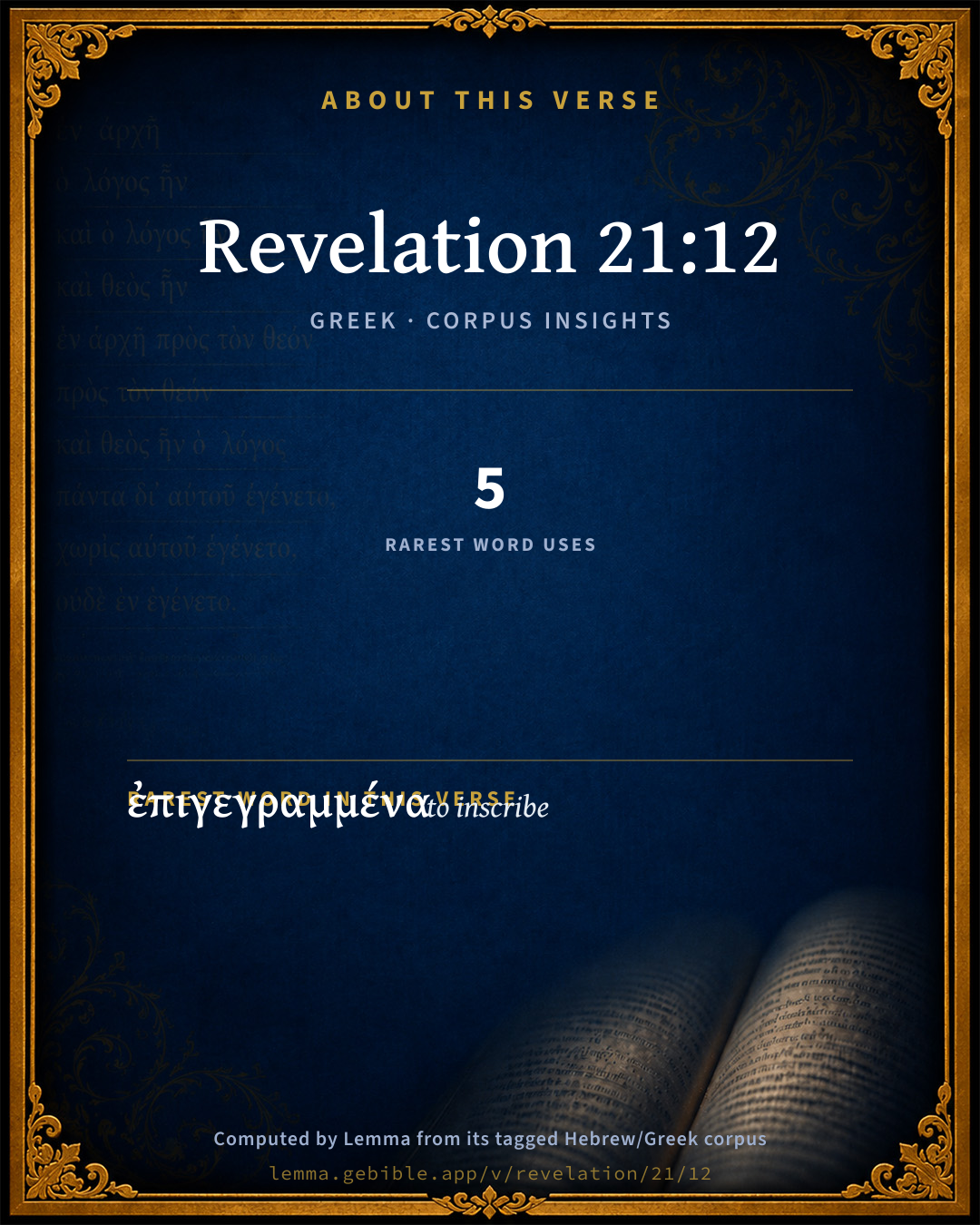
Revelation 21:12

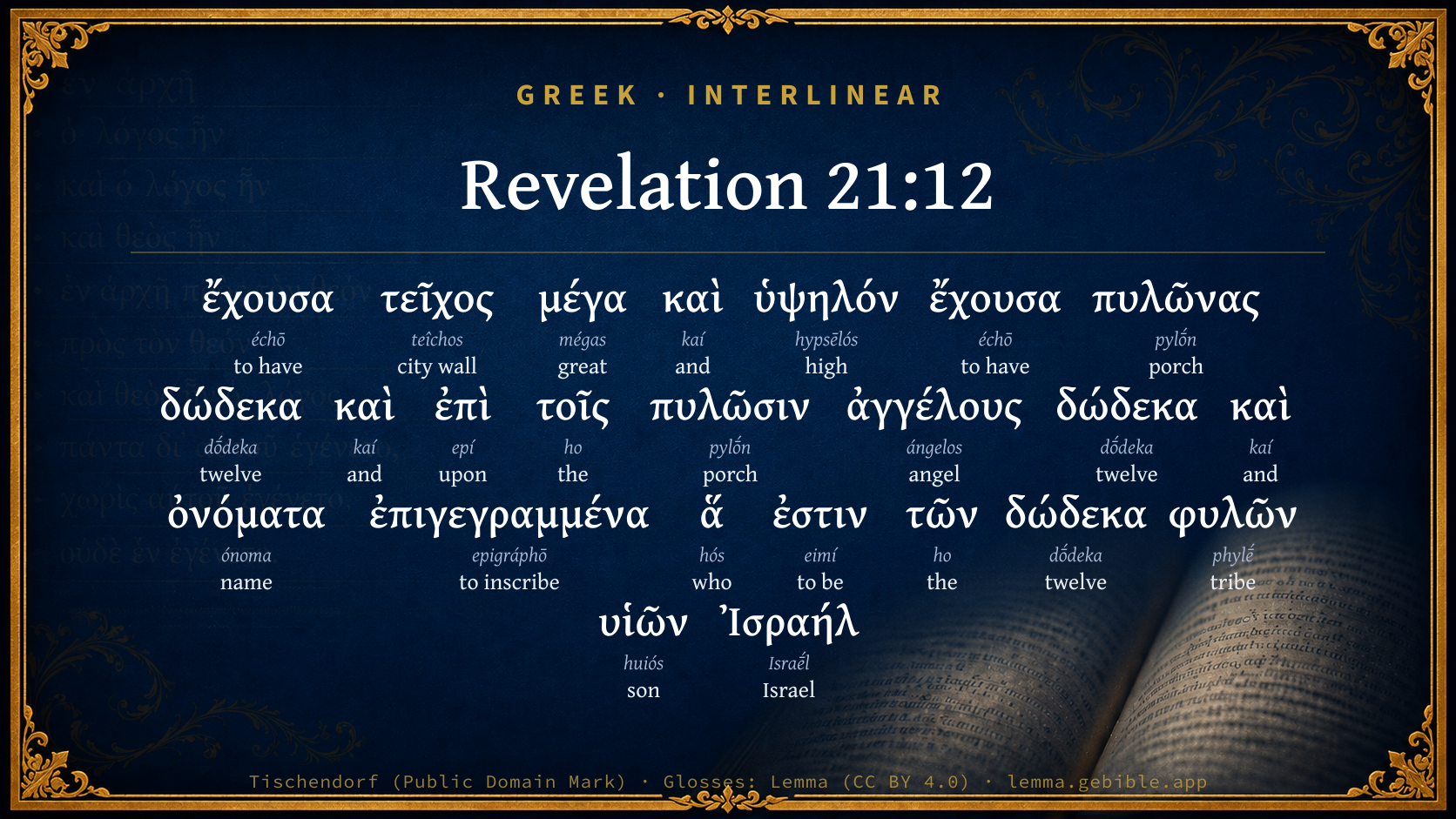
Greek (Tischendorf 8th ed.) Revelation 21:12 appears in the Greek New Testament. The text above is from the Tischendorf 8th edition. Each word links to its Strong’s number and a concise gloss. Click any word for its full Thayer’s Greek Lexicon entry.
Download image
Cite this verse

Revelation 21:12 (World English Bible). Public Domain. Lemma interlinear Bible study tool, https://lemma.gebible.app/v/revelation/21/12.

Show BibTeX & RIS
BibTeX
RIS
English Translation
having a great and high wall; having twelve gates, and at the gates twelve angels; and names written on them, which are the names of the twelve tribes of the children of Israel.
World English Bible · Public Domain
Download a study sheet

One document with this verse’s original text, its word-by-word gloss line, the meaning frame, cross-references with their text, attributed commentary, and full source and license credits — printable, and it pastes into notes with its structure intact.

This verse Autodidact and up

Study sheet (.html) Plain text (.txt)

A passage Seminary Student

Up to 50 verses in one chapter. A passage sheet keeps up to 6 commentary sources and 12 cross-references per verse, in the order this page ranks them, and says so on the sheet whenever that leaves anything out. Ask for a single verse and you get the Autodidact verse sheet above.

Everything on this page stays free to read, with no account — the sheet is a download of what is already on screen, not access to it.

Want to remove ads? Support Godless Engineer
Compare translations 3

The same verse in 3 English versions, stacked beneath the original-language interlinear above. Click any original word for its lexicon entry.

Each is an independent rendering of the whole verse — the interlinear is not word-aligned to these translations.

Highlighted words mark where these versions differ — a whole-verse word diff, not a word-by-word alignment.

  • World English Bible Public Domain
    having a great and high wall; having twelve gates, and at the gates twelve angels; and names written on them, which are the names of the twelve tribes of the children of Israel.
  • King James Version Public Domain
    And had a wall great and high, and had twelve gates, and at the gates twelve angels, and names written thereon, which are the names of the twelve tribes of the children of Israel:
  • unfoldingWord Literal Text CC BY-SA 4.0
    Having a great and high wall having 12 gates and 12 angels at the gates and names having been written that are the 12 tribes of the sons of Israel.

unfoldingWord Literal Text — © unfoldingWord, licensed CC BY-SA 4.0. Word-aligned USFM3 via Door43 (git.door43.org/unfoldingWord/en_ult).

Versions to compare (up to 4)

3 of 4 selected

Show all 19 translations

Every available English version of this verse, each an independent rendering of the whole verse.

  • World English Bible Public Domain
    having a great and high wall; having twelve gates, and at the gates twelve angels; and names written on them, which are the names of the twelve tribes of the children of Israel.
  • Berean Standard Bible Public Domain
    The city had a great and high wall with twelve gates inscribed with the names of the twelve tribes of Israel, and twelve angels at the gates.
  • Majority Standard Bible Public Domain
    The city had a great and high wall with twelve gates inscribed with the names of the twelve tribes of Israel, and twelve angels at the gates.
  • King James Version Public Domain
    And had a wall great and high, and had twelve gates, and at the gates twelve angels, and names written thereon, which are the names of the twelve tribes of the children of Israel:
  • American Standard Version (1901) Public Domain
    having a wall great and high; having twelve gates, and at the gates twelve angels; and names written thereon, which are `the names' of the twelve tribes of the children of Israel:
  • Revised Version (1885) Public Domain
    having a wall great and high; having twelve gates, and at the gates twelve angels; and names written thereon, which are the names of the twelve tribes of the children of Israel:
  • Geneva Bible (1599) Public Domain
    And had a great wall and hie, and had twelue gates, and at the gates twelue Angels, and the names written, which are the twelue tribes of the children of Israel.
  • Douay-Rheims (1899) Public Domain
    And it had a wall great and high, having twelve gates, and in the gates twelve angels, and names written thereon, which are the names of the twelve tribes of the children of Israel.
  • Young's Literal Translation Public Domain
    having also a wall great and high, having twelve gates, and at the gates twelve messengers, and names written thereon, which are `those' of the twelve tribes of the sons of Israel,
  • Literal Standard Version CC BY-SA 4.0
    also having a great and high wall, having twelve gates, and at the gates twelve messengers, and names written thereon, which are [those] of the twelve tribes of the sons of Israel—
  • Unlocked Literal Bible CC BY-SA 4.0
    It had a great, high wall with twelve gates, with twelve angels at the gates. On the gates were written the names of the twelve tribes of the children of Israel.
  • unfoldingWord Literal Text CC BY-SA 4.0
    Having a great and high wall having 12 gates and 12 angels at the gates and names having been written that are the 12 tribes of the sons of Israel.
  • Darby Bible Public Domain
    having a great and high wall; having twelve gates, and at the gates twelve angels, and names inscribed, which are those of the twelve tribes of [the] sons of Israel.
  • World Messianic Bible Public Domain
    having a great and high wall with twelve gates, and at the gates twelve angels, and names written on them, which are the names of the twelve tribes of the children of Israel.
  • Webster's Bible Public Domain
    And had a wall great and high, and had twelve gates, and at the gates twelve angels, and names written on them, which are the names of the twelve tribes of the children of Israel.
  • Free Bible Version CC BY-SA 4.0
    The city wall was high and thick, with twelve gates guarded by twelve angels. On the gates were inscribed the names of the twelve tribes of Israel.
  • Bible in Basic English Public Domain
    She had a wall great and high, with twelve doors, and at the doors twelve angels; and names on them, which are the names of the twelve tribes of the children of Israel.
  • Text-Critical English NT CC BY 4.0
    It had a great, high wall with twelve gates. Twelve angels were at the gates, and on the gates were written the names of the twelve tribes of the sons of Israel.
  • Tyndale New Testament (1534) Public Domain
    and had walles grett and hye and had xii gates and at the gates xii. angels: and names written which are the xii. trybes of Israell:

Literal Standard Version (2020), Covenant Press — licensed CC BY-SA 4.0. Text via the HelloAO Bible API (eBible.org). Unlocked Literal Bible (unfoldingWord) — licensed CC BY-SA 4.0. Text via the HelloAO Bible API (eBible.org). unfoldingWord Literal Text — © unfoldingWord, licensed CC BY-SA 4.0. Word-aligned USFM3 via Door43 (git.door43.org/unfoldingWord/en_ult). Free Bible Version, Dr. Jonathan Gallagher — licensed CC BY-SA 4.0. Text via the HelloAO Bible API (eBible.org).

Word by word

More ways to search: Search by grammar → Find every occurrence → Compare this word →

Practice this passage: Drill this verse → Learn its vocabulary →

ἐπιγεγραμμένα
epigráphō
G1924
“to inscribe”
Verb, Perfect, Passive, Participle, Accusative, Plural, Neuter
Part of Speech
Verb
Tense
Perfect
Voice
Passive
Mood
Participle
Case
Accusative
Number
Plural
Gender
Neuter
Full Thayer's Definition

Origin: from G1909 and G1125

TDNT: None

1. to write upon, inscribe 2. metaph. to write upon the mind
  1. ἔχουσα échō G2192 “to have” Verb, Present, Active, Participle, Nominative, Singular, Feminine
  2. τεῖχος teîchos G5038 “city wall” Noun, Accusative, Singular, Neuter
  3. μέγα mégas G3173 “great” Adjective, Accusative, Singular, Neuter
  4. καὶ kaí G2532 “and” Conjunction
  5. ὑψηλόν hypsēlós G5308 “high” Adjective, Accusative, Singular, Neuter
  6. ἔχουσα échō G2192 “to have” Verb, Present, Active, Participle, Nominative, Singular, Feminine
  7. πυλῶνας pylṓn G4440 “porch” Noun, Accusative, Plural, Masculine
  8. δώδεκα dṓdeka G1427 “twelve” Adjective, Numeral (indeclinable)
  9. καὶ kaí G2532 “and” Conjunction
  10. ἐπὶ epí G1909 “upon” Preposition
  11. τοῖς ho G3588 “the” Article, Dative, Plural, Masculine
  12. πυλῶσιν pylṓn G4440 “porch” Noun, Dative, Plural, Masculine
  13. ἀγγέλους ángelos G32 “angel” Noun, Accusative, Plural, Masculine
  14. δώδεκα dṓdeka G1427 “twelve” Adjective, Numeral (indeclinable)
  15. καὶ kaí G2532 “and” Conjunction
  16. ὀνόματα ónoma G3686 “name” Noun, Accusative, Plural, Neuter
  17. ἅ hós G3739 “who” Relative pronoun, Nominative, Plural, Neuter
  18. ἐστιν eimí G1510 “to be” Verb, Present, Active, Indicative, 3rd person, Singular
  19. τῶν ho G3588 “the” Article, Genitive, Plural, Feminine
  20. δώδεκα dṓdeka G1427 “twelve” Adjective, Numeral (indeclinable)
  21. φυλῶν phylḗ G5443 “tribe” Noun, Genitive, Plural, Feminine
  22. υἱῶν huiós G5207 “son” Noun, Genitive, Plural, Masculine
  23. Ἰσραήλ Israḗl G2474 “Israel” Noun, Proper, indeclinable

About this verse

These counts appear in no published source. They are computed here, from the morphology-tagged text and Lemma’s own curated glosses. What Lemma adds →

24
words
17
distinct lemmas
Revelation
section

Notable vocabulary

The rarest word here is ἐπιγεγραμμένα to inscribe G1924 — appearing just 5 times in the whole Greek New Testament.

Shared distinctive vocabulary

ἐπιγεγραμμένα to inscribe G1924 occurs in 5 verses of the Greek New Testament. Also found in:

Repetition

Words recur within this verse:

  • δώδεκα twelve G1427 ×3
  • ἔχουσα to have G2192 ×2
  • πυλῶνας porch G4440 ×2
  • καὶ and G2532 ×3
  • τοῖς the G3588 ×2

Cross-references

16

Topical passages linked to Revelation 21:12 in the Treasury of Scripture Knowledge — connected by theme and wording, ordered by reader-vote popularity; previews shown in the World English Bible.

  • Ezekiel 48:31–34 and the gates of the city shall be after the names of the tribes of Israel, three gates northward: the gate of Reuben, one; the gate of Judah, one; the gate of Levi, one.
  • Revelation 7:4–8 I heard the number of those who were sealed, one hundred forty-four thousand, sealed out of every tribe of the children of Israel:
  • Revelation 21:17–21 Its wall is one hundred forty-four cubits, by the measure of a man, that is, of an angel.
  • Isaiah 54:12 I will make your pinnacles of rubies, and your gates of emeralds, and all your border of precious stones.
  • Revelation 21:25 Its gates will in no way be shut by day (for there will be no night there),
  • Psalms 122:7 Peace be within your walls, And prosperity within your palaces.
  • Numbers 2:2–32 "The children of Israel shall encamp every man by his own standard, with the ensigns of their fathers' houses: at a distance from the tent of meeting shall they encamp around it."
  • Nehemiah 12:27 At the dedication of the wall of Jerusalem they sought the Levites out of all their places, to bring them to Jerusalem, to keep the dedication with gladness, both with giving thanks, and with singing, with cymbals, psalteries, and with harps.
  • Psalms 51:18 Do well in your good pleasure to Zion. Build the walls of Jerusalem.
  • Isaiah 60:18 Violence shall no more be heard in your land, desolation nor destruction within your borders; but you shall call your walls Salvation, and your gates Praise.
  • Ezra 9:9 For we are bondservants; yet our God has not forsaken us in our bondage, but has extended loving kindness to us in the sight of the kings of Persia, to give us a reviving, to set up the house of our God, and to repair the ruins of it, and to give us a wall in Judah and in Jerusalem.
  • Matthew 18:10 See that you don't despise one of these little ones, for I tell you that in heaven their angels always see the face of my Father who is in heaven.
  • Luke 15:10 Even so, I tell you, there is joy in the presence of the angels of God over one sinner repenting."
  • Luke 16:22 It happened that the beggar died, and that he was carried away by the angels to Abraham's bosom. The rich man also died, and was buried.
  • Acts 26:7 which our twelve tribes, earnestly serving night and day, hope to attain. Concerning this hope I am accused by the Jews, King Agrippa!
  • Hebrews 1:14 Aren't they all ministering spirits, sent out to do service for the sake of those who will inherit salvation?

Cross-references courtesy of OpenBible.info (CC BY 4.0).

Commentary

Notes on Revelation 21:12 from classic Christian and Jewish commentators (each source and its license shown beneath its notes). The classic Christian expositions comment on the surrounding passage and are grouped to its opening verse, so a note may address several verses; the Jewish commentaries on the Tanakh (Rashi and others) are per-verse, so they appear only where the commentator wrote on this verse.

Lemma curates 59 commentaries, every one of them public domain or Creative Commons licensed, each selected and text-cleaned for this edition rather than reprinted as found. About our sources →

Tyndale Open Study Notes

Tyndale Open Resources

21:12-14 In this vision, the twelve tribes of Israel represent the redeemed people of God (see 7:4-8; see also Rom 9:6-7). The foundation for this community of God’s redeemed is the twelve apostles of the Lamb. In Jesus, God’s promise to bless all of the families of the earth through Abraham has been fully realized (Gen 12:3).

Tyndale Open Study Notes — © Tyndale Open Resources, licensed CC BY-SA 4.0. Text via the HelloAO Bible API.

Bengel's Gnomon

Johann Albrecht Bengel

Rev 21:12. Ἔχουσα) Respecting the nominative case see Apparat. p. 778.[230]—ΤΕῖΧΟς—ΠΥΛῶΝΑς, a wall—gates) An inverted Chiasmus: comp. Rev 21:12-13 with Rev 21:14.—ἐπὶ) Here it is said ἘΠῚ ΠΥΛῶΣΙΝ ὈΝΌΜΑΤΑ• But Eze 48:31, ΑἹ ΠΎΛΑΙ ἘΠʼ ὈΝΌΜΑΣΙ ΤῶΝ ΦΥΛῶΝ ΤΟῦ ἸΣΡΑΉΛ. ἘΠῚ (עַל) has a variety of meaning; it does not mean a higher place only.

[230] AB have ἔχουσα: Rec. Text, ἔχουσαν τε, without good authority. So in the case of the 2d ἔχουσα, which Vulg. also supports, besides AB.—E.

Bengel's Gnomon of the New Testament — English translation (T&T Clark, Edinburgh, 1860) — public domain. Text from a community e-Sword module.

Meyer's Critical & Exegetical Commentary

Heinrich August Wilhelm Meyer

Rev_21:12-21. The wall and the gates of the city. The harmonious proportions are given,[4297] according to the holy number twelve of the O. T. people of God.

ἈΓΓΈΛΟΥς ΔΏΔΕΚΑ. Correctly, Bengel: They keep watch, and serve as an ornament. More definite references dare not be sought; as soon as we reflect that the new Jerusalem is no longer threatened by enemies, and therefore needs no watchmen of its gates, explanations result like that of Hengstenb., viz., that these angels symbolize the Divine protection against enemies which could be conceived of only by an imagination filled with terrors, proceeding from the Church militant.

ὈΝΌΜΑΤΑ ἘΠΙΓΕΓΡΑΜΜΈΝΑ, Κ.Τ.Λ. It does not follow that John wanted this idea, based upon Eze_48:31 sqq., to be understood as it occurs in Jewish theology,[4298] viz., that members of one tribe could make use of only one door.

As the walls on all four sides have each three gates (Rev_21:13), it follows (Rev_21:14) that there are twelve sections of the wall, each of which is supported by a ΘΕΜΈΛΙΟς; four of these are to be regarded as massive corner-stones, since these support the corner-pieces which extend from the third gate of the one side to the first gate of the following side. The twelve corner-stones lie open to view, at least so far that their splendor can be perceived,[4299] and the inscriptions found thereon, viz., the names of the twelve apostles of the Lamb, can be read. In explanation of the latter idea, Calov., etc., have properly appealed to Eph_2:20. [See Note XCV., p. 485.]

[4297] Cf. Eze_48:30 sqq.

[4298] Cf. De Wette.

[4299] Cf. Rev_21:19 sq.

NOTES BY THE AMERICAN EDITOR

XCV. Rev_21:14. ὀνόματα τῶν δώδεκα ἀποστόλων

Calov.: The apostles, who, by their living voice and literary records, founded the Church, and upon whose doctrine and writings it rests as on an immovable foundation. Hengstenberg: The twelve apostles are the most noble bulwark of the Church, the chief channel through which the preserving grace of God flows forth to it. If, even in the new Jerusalem, they are the foundation on which the security of the Church against all conceivable dangers depends, they must also be the bulwark through all periods of the Church militant. But this passage, and that of Mat_19:28, where the twelve apostles appear in the regeneration,the new Jerusalem,as the heads of the Church, are a sufficient answer to those who maintain that the apostolate is a continuous institution, and expect salvation for the Church by subjection to pretended new apostles. The Lord himself, and the disciple whom he loved, knew only of twelve apostles. The twelve apostles are forever. That in the corner-stone, besides the apostles, there are also prophets, is only a seeming variation. For that the prophets are not those of the O. T., but of the N. T., and personally identical with the apostles, is clear from the parallel passages Rev_3:5, Rev_4:11.

Meyer — Critical and Exegetical Commentary on the New Testament — English translation by Peter Christie, edited by Frederick Crombie (T&T Clark, 1880) — public domain. Text from a community e-Sword module.

Geneva Bible (1599)

Geneva Bible translators

A particular description (as I noted, verse 2) of the celestial Church. First, by the essential parts of the same, under the similitude of a city to verse 12. Secondly, from foreign accidents, unto the end of the chapter. Thirdly, by the effects, in the beginning of the next chapter, the essential parts are noted the matter and the form in the whole work: of these the superficies and foundation of the wall are entire parts (as they use to be called) which parts are first described in figure, unto verse 14 and afterward more exactly.

He meaneth the Prophets, who are the messengers of God, and watchmen of the Church.

According to the number of the tribes, of which chap. 7. For here the outward part is attributed unto the old Testament, and the foundation of the new Testament.

Geneva Bible (1599) marginal notes — public domain. Text via Bolls.life.

Jamieson, Fausset & Brown

Robert Jamieson, A. R. Fausset & David Brown

And--A and B omit. Eze 48:30-35, has a similar description, which implies that the millennial Jerusalem shall have its exact antitype in the heavenly Jerusalem which shall descend on the finally regenerated earth.

wall great and high--setting forth the security of the Church. Also, the exclusion of the ungodly.

twelve angels--guards of the twelve gates: an additional emblem of perfect security, while the gates being never shut (Rev 21:25) imply perfect liberty and peace. Also, angels shall be the brethren of the heavenly citizens.

names of . . . twelve tribes--The inscription of the names on the gates implies that none but the spiritual Israel, God's elect, shall enter the heavenly city. As the millennium wherein literal Israel in the flesh shall be the mother Church, is the antitype to the Old Testament earthly theocracy in the Holy Land, so the heavenly new Jerusalem is the consummation antitypical to the spiritual Israel, the elect Church of Jews and Gentiles being now gathered out: as the spiritual Israel now is an advance upon the previous literal and carnal Israel, so the heavenly Jerusalem shall be much in advance of the millennial Jerusalem.

Jamieson, Fausset & Brown — Commentary Critical and Explanatory on the Whole Bible (1871) — public domain (CC PDM 1.0). Text via the HelloAO Bible API.

Adam Clarke's Commentary

Verse 12. Had a wall great and high] An almighty defense.

Twelve gates] A gate for every tribe of Israel, in the vicinity of which gate that tribe dwelt; so that in coming in and going out they did not mix with each other. This description of the city is partly taken from Eze 48:30-35.

In Synopsis Sohar, p. 115, n. 27, it is said: "In the palace of the world to come there are twelve gates, each of which is inscribed with one of the twelve tribes, as that of Reuben, of Simeon, c.: he, therefore, who is of the tribe of Reuben is received into none of the twelve gates but his own and so of the rest."

Adam Clarke's Commentary on the Bible (1810–1826) — public domain. Text from a community e-Sword/MySword module.

Ellicott's Commentary for English Readers

(12, 13) And had a wall great and high . . .—Or, better (for the construction is continued), Having a wall great and high, and having twelve gate-towers, and at the gate-towers twelve angels, and names inscribed which are (names) of the twelve tribes of the sons of Israel: from the sun-rising (i.e., facing east) three gate-towers; from the north three gate-towers, from the south three gate-towers; from the sun-setting three gate-towers. On this arrangement of gates Numbers 2, Ezekiel 48, and Revelation 7 should be compared. In the encampment in the wilderness (Numbers 2) the tribes were arranged as follows: on the east, Judah, Issachar, Zebulun; on the south, Reuben, Simeon, Gad; on the west, Ephraim, Manasseh, Benjamin; on the north, Dan, Asher, Naphtali. There is perhaps allusion in the present passage to this wilderness encampment, and to the re-adjustment of the order of the tribes in Ezekiel (Ezekiel 48); but there is more than order here: the gates lie open to all quarters; there is no refusal of admission to any people. The representatives of all nations, and kindreds, and people, and tongues, are (Rev_7:9) in the city of Christ; in Him there is neither barbarian, Scythian, bond nor free, but all are one. The diversities of human nationality and character, of age and race, and climate, are brought into one communion and fellowship. (Comp. Note on Rev_7:4.) “The wall great and high” is mentioned to assure us of the security and peace of that city where no foe “or thief approacheth” (Isa_26:1; Zec_2:5).

A Bible Commentary for English Readers, edited by Charles John Ellicott (1878–1897) — public domain. Text from a community e-Sword module.

The Cambridge Bible for Schools and Colleges

gen. ed. J. J. S. Perowne

12. and had] Lit. having; but there is a break in the construction, at least as marked as that given by the A. V.

a wall great and high] Its exact height is stated in Rev_21:17.

twelve gates … Israel] So Eze_48:31-34. Probably the order of the names on the gates would be the same as there; but the order can hardly be pressed as important, since it is quite different from that of the foursquare encampment in the wilderness, Numbers 2. The 12 gates of heaven in Enoch xxxiii–xxxv. do not really present a very close parallel to these.

twelve angels] As porters and sentinels. Such officers are in keeping with the image of a well-ordered city, though in fact neither they, nor walls and gates, are practically needed in this City of Peace.

The Cambridge Bible for Schools and Colleges (gen. ed. J. J. S. Perowne; Cambridge University Press, 1878–1918) — public domain. Text from a community e-Sword module.

John Gill's Exposition

And had a wall great and high,.... Not the Spirit of God, who separates, sanctifies, and preserves the saints, as Cocceius thinks, for this account respects not the church militant; nor the eternal decree of God, the unpassable gulf between heaven and hell, which everlastingly fixes the state of men; for this regards not the ultimate state of happiness: many interpreters understand it of the doctrine of the Gospel, which, as it secures the church now from heretics, and is like a wall very strong and well built, is durable and impregnable; and may be called "great", because of the great Author of it, and the great things contained in it; and "high", since it is not to be reached by carnal minds; so none but such who have embraced it shall enter into the new Jerusalem; for all liars, and forgers of doctrinal lies, and who embrace the antichristian lies, shall be without. Though rather the almighty power of God, which guards his church and people now, and will be their defence in this state, is meant; and which shows the state not to be that of the ultimate glory, which will need no wall, but this will; since an attempt will be made upon the saints in it, though it will be a foolish and fruitless one: and this wall of divine power is very great indeed, and is insuperable by men; God himself is a wall of fire about his people; though it may be best to interpret this of salvation itself, which is by Jesus Christ, if we compare with this text Isa 26:1 for those, and those only, who are interested in it, will dwell in the new Jerusalem; and salvation in this state will be enjoyed in its fulness; and this is very great in its author, objects, and matter, being wrought out by the great God, for great sinners, at a great expense, and including grace and glory, and not to be got over or enjoyed by those who have no interest in it.

And had twelve gates; though, strictly speaking, there is but one gate, and that a strait one, which is the Lord Jesus Christ, his person, blood, righteousness, regenerating and sanctifying grace; for as he is the only door into the sheepfold, the church, in its present state, or he only that has faith in him has a right to enter there, and is the only way to heaven and eternal happiness; so he is the only gate into the new Jerusalem, or such only will be admitted there, who are interested in him: but these gates are said to be twelve, in allusion to the twelve apostles, who pointed out to men the way of salvation by Christ; and to the twelve tribes of Israel, who represent all the elect of God, who enter in thereat; and to the twelve gates of Ezekiel's city, Eze 48:31.

And at the gates twelve angels; meaning either the ministering spirits, in allusion to the cherubim in Gen 3:24 who are watchers, and encamp about the saints now, and will, as it were, stand sentinels in this camp of the saints, as it is called, Rev 20:8 and besides, will be made use of in gathering the saints from the several parts of the world, and introducing them into this state; or else the apostles and ministers of the word, often called angels in this book, who will shine with peculiar lustre now, and will appear at the head of the several companies they have been useful to, and bring them as their joy and crown of rejoicing into this glorious state: this clause is wanting in the Alexandrian copy, and in the Syriac version. The Jews speak of "princes", being appointed over the gates of heaven, east, west, north, and south, with the keys in their hands, whose names they give us (f).

And names written thereon, which are the names of the twelve tribes of the children of Israel; not literal, but mystical Israel, whom God has chosen to salvation, Christ has redeemed by his blood, and the Spirit calls by his grace; denoting that all, and each of these, have a right to enter into the new Jerusalem, and will be admitted there, and none but they. In like manner the Jews (g) make mention of a court of the Lord,

"which has twelve gates, according to the computation of the tribes of Israel; on one gate is written Reuben, on another is written Simeon; and so all the tribes of Israel are written on those gates; in the time they go up to appear before the Lord of the world, whoever goes up to this gate, (on which the tribe of Reuben is written,) if he is of the tribe of Reuben they open to him, (and receive him,) if not they cast him without; and so of all whom they do not receive; they open to none but to him who is of that tribe, or whose name is written on the gate.''

(f) Raziel, fol. 35. 2. (g) Zohar in Numb. fol. 70. 4.

John Gill's Exposition of the Whole Bible (1746–1763) — public domain (CC PDM 1.0). Text via the HelloAO Bible API.

Trapp's Complete Commentary

John Trapp

12 And had a wall great and high, and had twelve gates, and at the gates twelve angels, and names written thereon, which are the names of the twelve tribes of the children of Israel:

Ver. 12. And had a wall] Far better than that of Babylon. Indeed this celestial China needs no wall to divide it from the Tartars; this is Arabia Felix, the people whereof live in security, and fear no enemy. They are in a far happier condition than the people of Tombutum in Africa, which are said to spend their whole time in singing and dancing.

And had twelve gates] Thebes had a hundred gates, and was therefore called εκατομτυλος, but nothing so well set and so commodious for passengers as this city with twelve gates.

Twelve angels] As porters to let in, not as swordsmen to keep out, as the angel that stood sentinel at the porch of Paradise, Gen 3:24.

John Trapp, A Commentary or Exposition upon All the Books of the Old and New Testament (1647–1656) — public domain. Text from a community e-Sword module.

Albert Barnes' Notes on the Bible

And had a wall great and high - Ancient cities were always surrounded with walls for protection, and John represents this as enclosed in the usual manner. The word “great” means that it was thick and strong. Its height also is particularly noticed, for it was unusual. See Rev 21:16.

And had twelve gates - Three on each side. The number of the gates correspond to the number of the tribes of the children of Israel, and to the number of the apostles. The idea seems to be that there would be ample opportunity of access and egress.

And at the gates twelve angels - Stationed there as guards to the New Jerusalem. Their business seems to have been to watch the gates that nothing improper should enter; that the great enemy should not make an insidious approach to this city as he did to the earthly paradise.

And names written thereon - On the gates.

Which are the names of the twelve tribes of the children of Israel - So in the city which Ezekiel saw in vision, which John seems also to have had in his eye. See Eze 48:31. The inscription in Ezekiel denoted that that was the residence of the people of God; and the same idea is denoted here. The New Jerusalem is the eternal residence of the children of God, and this is indicated at every gate. None can enter who do not belong to that people; all who are within are understood to be of their number.

Albert Barnes' Notes on the Bible (1834–1885) — public domain. Text from a community e-Sword/MySword module.

Matthew Poole's English Annotations

And had a wall, that is, this city, by which is meant the church of God,

had a wall great and high. Walls are for the protection and defence of a place; the higher and greater they are, the greater defence and protection they give. By this God is meant, who is often called his people’s Rock and Defence.

And had twelve gates: the use of the gates of a city, are to let persons in and out. The church is said to have twelve gates, because of the free liberty of access to the church while it was militant, and to signify that the church in heaven will be made up of persons come into it from all parts; or for the greater state and glory of it. Some think, because of the twelve apostles, who were the first ministers of the gospel who admitted men into this church.

And at the gates twelve angels; denoting the guard of angels about the church; unless by angels ministers be to be understood, proportioned to the several parts of the church.

And names written thereon, which are the names of the twelve tribes of the children of Israel; because as, of old, only the twelve tribes of God’s chosen people Israel made up the church in that period; so only God’s elect and peculiar people, typified by that Israel, come in at the gates of this church. It is very observable, how God affects the number of twelve in the affairs of his church.

Matthew Poole's English Annotations on the Holy Bible (1683–1685) — public domain. Text from a community e-Sword/MySword module.

Whedon's Commentary on the Bible

Daniel D. Whedon

12. Twelve gates—Three, four, and twelve are the predominant numbers; of the last, the twelve tribes are expressly said to be the basis. And the twelve tribes are symbolically the eternal Israel of this eternal city and land. They form the nations of its blessed territory.

Twelve angels—The porters of the twelve gates, which are, however, ever open. The angel warders, doubtless, see that the citizens of each tribe from the rural regions enter the gate over which its own tribal name is inscribed. There is a divine order, a well organized polity, in this new land and capital. Anarchy belongs to the other place.

Daniel D. Whedon (gen. ed.), Commentary on the Old and New Testaments (1874–1909) — public domain. Text from a community e-Sword module.

The Pulpit Commentary

And had a wall great and high; having a wall. Omit each introductory "and." The wall is a type of the absolute security of the heavenly city; not that any further assault is expected. In Eze_38:11 Gog and Magog prey upon the unwalled villages. And had twelve gates, and at the gates twelve angels, and names written thereon, which are the names of the twelve tribes of the children of Israel. (cf. the description in Eze 48) Twelve; as signifying completeness, (cf. Rev_4:9 Rev_7:4-8) and as being the number of the tribes of Israel, which are the type of the spiritual Israel of God. Gates; rather, portals. The picture of the angels placed at the portals, still fulfilling their mission as guardians of men, shows the absolute security of the city. The names are written thereon: as on the stones of the ephod (Exo_28:9) and breastplate. (Exo_39:14) Contrast the names of blasphemy. (Rev_18:3)

The Pulpit Commentary (1880–1919), ed. H.D.M. Spence-Jones & Joseph S. Exell — public domain. Text from a community e-Sword module.

John Wesley's Explanatory Notes

Twelve angels - Still waiting upon the heirs of salvation.

John Wesley, Explanatory Notes Upon the Whole Bible (1754–1765) — public domain. Text via the GEBible commentary corpus.

Scofield Reference Notes

C. I. Scofield

angels

(See Scofield "Heb 1:4").

The Scofield Reference Bible (1917 edition), notes by C. I. Scofield — public domain. Text from a community e-Sword module.

The People's New Testament

B. W. Johnson

12. Twelve gates. As many as there were tribes and apostles. Twelve angels. As gate-keepers to prevent the unclean from entrance. Names written thereon. The names of the twelve tribes of Israel. These were typical of the true Israel, the saints, and shows that all who belong to the true Israel will enter.

B. W. Johnson's The People's New Testament with Notes (1889–1891) — public domain. Electronic text from the Christian Classics Ethereal Library (CCEL) ThML edition.

Expositor's Greek Testament

ed. W. Robertson Nicoll

ἔχουσα . The constr. becomes still more irregular, the participles agreeing with an imaginary nominative, ἡ πόλις , sugg. by ὁ φωστήρ . The inscribed names denote the catholicity of the church and its continuity with the ancient people of God. A writer who could compose, or incorporate, or retain (as we choose to put it), passages like Rev 5:9 and Rev 14:4 , is not to be suspected of particularism here. Even on the score of poetic congruity, the new Jerusalem implied such an archaic and traditional allusion to the twelve tribes. The angelic guardians of the gates are an Isaianic trait added to the Ezekiel picture.

The Expositor's Greek Testament, edited by W. Robertson Nicoll (1897–1910) — public domain. Text from a community e-Sword module.

Cambridge Greek Testament for Schools and Colleges

12. ἔχουσα. א reads ἔχοντι.

ἔχουσα. א* reads ἔχοντας, Primas[825] qui habet.

[825] Primasius, edited by Haussleiter.

ἀγγέλους. Primas[826] has angulos.

[826] Primasius, edited by Haussleiter.

12. ἔχουσα. A nominative participle in this context might in itself be a Hebraism rather than an anacoluthon: and this may be the construction here, though Hebrew has no direct equivalent to ἔχω.

ὑψηλόν. Its exact height is stated in Rev 21:17.

ἔχουσα … Ἰσραήλ. So Eze 48:31-34. Probably the order of the names on the gates would be the same as there; but the order can hardly be pressed as important, since it is quite different from that of the four-square encampment in the wilderness, Numbers 2. The 12 gates of heaven in Enoch xxxiii–xxxv. do not really present a very close parallel to these.

ἀγγέλους δώδεκα. As porters and sentinels to keep out intruders, not invaders, who never molest this City of Peace; the guards, like the walls and gates are for order rather than for defence.

Cambridge Greek Testament for Schools and Colleges (Cambridge University Press, 1896; 21 vols, various authors incl. Carr, Maclear, Plummer, Farrar, Lumby, Moule, M. R. James, Simcox) — public domain. Text from a community e-Sword module.

Vincent's Word Studies in the New Testament

Marvin R. Vincent

And had [εχουσαν τε] . Rev., more simply and literally, having.

Gates [πυλωνας] . Properly large gates. See on Luk 16:20; Act 12:13. Compare Eze 48:30 sqq.

Marvin R. Vincent, Word Studies in the New Testament (1887–1900) — public domain. Text from a community e-Sword/MySword module.

Lesson kit

Teaching starters — assembled from the data on this page, not authored interpretation. Every prompt links to the verse data it draws on. Edit before teaching.

Revelation, in the Revelation, opens this verse with 24 words (17 distinct Greek lemmas). Its most distinctive word is epigráphō (“to inscribe”). A historical commentator’s framing appears above. Read the whole chapter for the surrounding context.

Discussion questions

  1. What does “to inscribe” (epigráphō) contribute to the verse as a whole?
  2. How does Mark 15:26, which shares the word «to inscribe», read alongside this verse?
  3. What does the repetition of “twelve” (3× in this one verse) do in this verse?
  4. The translations on this page render this verse differently — a whole-verse word diff, not a word-by-word alignment. What might account for the different wordings?
  5. Compare how Tyndale Open Study Notes and Bengel's Gnomon read this verse. Where do they agree or differ?

Things to notice

  • These translations choose different wording for 9 words in this verse.
  • “twelve” occurs 3× in this single verse.
  • 17 distinct Greek lemmas span 24 words in this verse.

Reading settings

Reading text

Shown beneath each verse's original-language words.

Old Testament
Old Testament edition

Read the OT as the Masoretic Hebrew (MT) or the Greek Septuagint (LXX).

English shown for the Greek Septuagint (in the Hebrew ↔ Greek comparison).

Comparing translations? Open the Compare panel on any verse page to stack up to four side by side.