Revelation 21:17

Greek (Tischendorf 8th ed.) Revelation 21:17 appears in the Greek New Testament. The text above is from the Tischendorf 8th edition. Each word links to its Strong’s number and a concise gloss. Click any word for its full Thayer’s Greek Lexicon entry.
Download image
Cite this verse

Revelation 21:17 (World English Bible). Public Domain. Lemma interlinear Bible study tool, https://lemma.gebible.app/v/revelation/21/17.

Show BibTeX & RIS
BibTeX
RIS
English Translation
Its wall is one hundred forty-four cubits, by the measure of a man, that is, of an angel.
World English Bible · Public Domain
Download a study sheet

One document with this verse’s original text, its word-by-word gloss line, the meaning frame, cross-references with their text, attributed commentary, and full source and license credits — printable, and it pastes into notes with its structure intact.

This verse Autodidact and up

Study sheet (.html) Plain text (.txt)

A passage Seminary Student

Up to 50 verses in one chapter. A passage sheet keeps up to 6 commentary sources and 12 cross-references per verse, in the order this page ranks them, and says so on the sheet whenever that leaves anything out. Ask for a single verse and you get the Autodidact verse sheet above.

Everything on this page stays free to read, with no account — the sheet is a download of what is already on screen, not access to it.

Want to remove ads? Support Godless Engineer
Compare translations 3

The same verse in 3 English versions, stacked beneath the original-language interlinear above. Click any original word for its lexicon entry.

Each is an independent rendering of the whole verse — the interlinear is not word-aligned to these translations.

Highlighted words mark where these versions differ — a whole-verse word diff, not a word-by-word alignment.

  • World English Bible Public Domain
    Its wall is one hundred forty-four cubits, by the measure of a man, that is, of an angel.
  • King James Version Public Domain
    And he measured the wall thereof, an hundred and forty and four cubits, according to the measure of a man, that is, of the angel.
  • unfoldingWord Literal Text CC BY-SA 4.0
    And he measured her wall, 144 cubits by the measurement of a man, which is of an angel.

unfoldingWord Literal Text — © unfoldingWord, licensed CC BY-SA 4.0. Word-aligned USFM3 via Door43 (git.door43.org/unfoldingWord/en_ult).

Versions to compare (up to 4)

3 of 4 selected

Show all 19 translations

Every available English version of this verse, each an independent rendering of the whole verse.

  • World English Bible Public Domain
    Its wall is one hundred forty-four cubits, by the measure of a man, that is, of an angel.
  • Berean Standard Bible Public Domain
    And he measured its wall to be 144 cubits, by the human measure the angel was using.
  • Majority Standard Bible Public Domain
    And he measured its wall to be 144 cubits, by the human measure the angel was using.
  • King James Version Public Domain
    And he measured the wall thereof, an hundred and forty and four cubits, according to the measure of a man, that is, of the angel.
  • American Standard Version (1901) Public Domain
    And he measured the wall thereof, a hundred and forty and four cubits, `according to' the measure of a man, that is, of an angel.
  • Revised Version (1885) Public Domain
    And he measured the wall thereof, a hundred and forty and four cubits, according to the measure of a man, that is, of an angel.
  • Geneva Bible (1599) Public Domain
    And hee measured the wall thereof, an hundreth fourtie and foure cubites, by the measure of man, that is, of the Angell.
  • Douay-Rheims (1899) Public Domain
    And he measured the wall thereof an hundred and forty-four cubits, the measure of a man, which is of an angel.
  • Young's Literal Translation Public Domain
    and he measured its wall, an hundred forty-four cubits, the measure of a man, that is, of the messenger;
  • Literal Standard Version CC BY-SA 4.0
    And he measured its wall—one hundred forty-four cubits, the measure of a man, that is, of the messenger;
  • Unlocked Literal Bible CC BY-SA 4.0
    He also measured its wall, 144 cubits thick by human measurement (which is also the angel's measure).
  • unfoldingWord Literal Text CC BY-SA 4.0
    And he measured her wall, 144 cubits by the measurement of a man, which is of an angel.
  • Darby Bible Public Domain
    And he measured its wall, a hundred [and] forty-four cubits, [a] man's measure, that is, [the] angel's.
  • World Messianic Bible Public Domain
    Its wall is one hundred forty-four cubits, by the measure of a man, that is, of an angel.
  • Webster's Bible Public Domain
    And he measured the wall of it a hundred and forty four cubits, according to the measure of a man, that is, of the angel.
  • Free Bible Version CC BY-SA 4.0
    He measured the wall and it was 144 cubits thick in human measurements that the angel was using.
  • Bible in Basic English Public Domain
    And he took the measure of its wall, one hundred and forty-four cubits, after the measure of a man, that is, of an angel.
  • Text-Critical English NT CC BY 4.0
    Its wall was one hundred forty-four cubits according to human measurement, which the angel was using.
  • Tyndale New Testament (1534) Public Domain
    And he measured the wall therof. an cxliiii. cubittes: the measure that the angell had was after the measure that man vseth.

Literal Standard Version (2020), Covenant Press — licensed CC BY-SA 4.0. Text via the HelloAO Bible API (eBible.org). Unlocked Literal Bible (unfoldingWord) — licensed CC BY-SA 4.0. Text via the HelloAO Bible API (eBible.org). unfoldingWord Literal Text — © unfoldingWord, licensed CC BY-SA 4.0. Word-aligned USFM3 via Door43 (git.door43.org/unfoldingWord/en_ult). Free Bible Version, Dr. Jonathan Gallagher — licensed CC BY-SA 4.0. Text via the HelloAO Bible API (eBible.org).

Word by word

More ways to search: Search by grammar → Find every occurrence → Compare this word →

Practice this passage: Drill this verse → Learn its vocabulary →

πηχῶν
pēchys
G4083
“cubit”
Noun, Genitive, Plural, Masculine
Part of Speech
Noun
Case
Genitive
Number
Plural
Gender
Masculine
Full Thayer's Definition

Origin: of uncertain affinity

TDNT: None

1. a cubit 2. a measure of length equal to distance from the joint of the elbow to the tip of the middle finger (i.e. about 18 inches, (.5 m) but its precise length varied and is disputed)
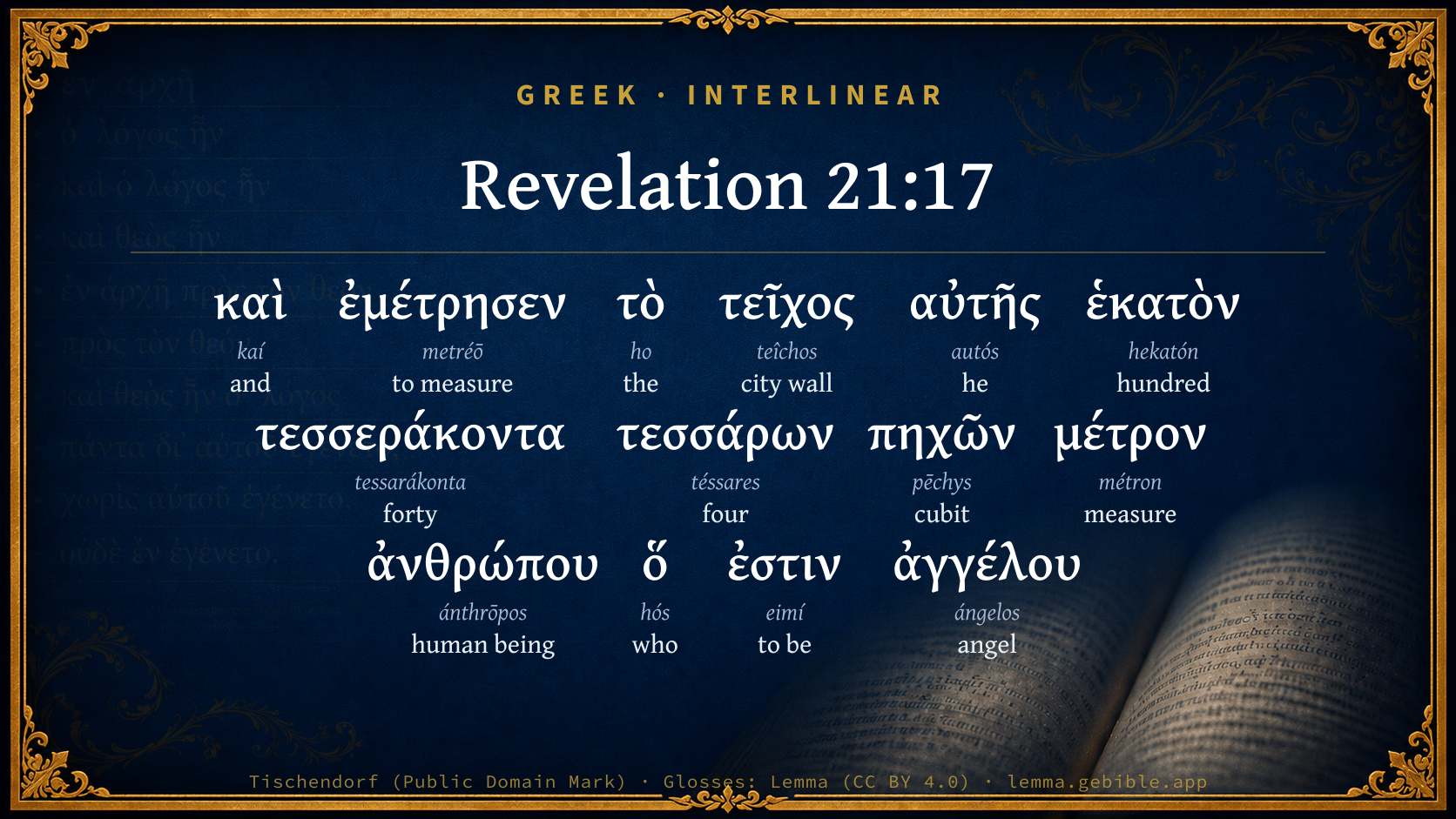
  1. καὶ kaí G2532 “and” Conjunction
  2. ἐμέτρησεν metréō G3354 “to measure” Verb, Aorist, Active, Indicative, 3rd person, Singular
  3. τὸ ho G3588 “the” Article, Accusative, Singular, Neuter
  4. τεῖχος teîchos G5038 “city wall” Noun, Accusative, Singular, Neuter
  5. αὐτῆς autós G846 “he” Personal pronoun, Genitive, Singular, Feminine
  6. ἑκατὸν hekatón G1540 “hundred” Adjective, Numeral (indeclinable)
  7. τεσσεράκοντα tessarákonta G5062 “forty” Adjective, Numeral (indeclinable)
  8. τεσσάρων téssares G5064 “four” Adjective, Genitive, Plural, Masculine
  9. μέτρον métron G3358 “measure” Noun, Accusative, Singular, Neuter
  10. ἀνθρώπου ánthrōpos G444 “human being” Noun, Genitive, Singular, Masculine
  11. ὅ hós G3739 “who” Relative pronoun, Nominative, Singular, Neuter
  12. ἐστιν eimí G1510 “to be” Verb, Present, Active, Indicative, 3rd person, Singular
  13. ἀγγέλου ángelos G32 “angel” Noun, Genitive, Singular, Masculine

About this verse

These counts appear in no published source. They are computed here, from the morphology-tagged text and Lemma’s own curated glosses. What Lemma adds →

14
words
14
distinct lemmas
Revelation
section

Notable vocabulary

The rarest word here is πηχῶν cubit G4083 — appearing just 4 times in the whole Greek New Testament.

Shared distinctive vocabulary

πηχῶν cubit G4083 occurs in 4 verses of the Greek New Testament. Also found in:

Cross-references

5

Topical passages linked to Revelation 21:17 in the Treasury of Scripture Knowledge — connected by theme and wording, ordered by reader-vote popularity; previews shown in the World English Bible.

  • Deuteronomy 3:11 (For only Og king of Bashan remained of the remnant of the Rephaim; behold, his bedstead was a bedstead of iron; isn't it in Rabbah of the children of Ammon? nine cubits was the length of it, and four cubits the breadth of it, after the cubit of a man.)
  • Revelation 7:4 I heard the number of those who were sealed, one hundred forty-four thousand, sealed out of every tribe of the children of Israel:
  • Revelation 13:18 Here is wisdom. He who has understanding, let him calculate the number of the beast, for it is the number of a man. His number is six hundred sixty-six.
  • Revelation 14:3 They sing a new song before the throne, and before the four living creatures and the elders. No one could learn the song except the one hundred forty-four thousand, those who had been redeemed out of the earth.
  • Revelation 21:9 One of the seven angels who had the seven bowls, who were loaded with the seven last plagues came, and he spoke with me, saying, "Come here. I will show you the wife, the Lamb's bride."

Cross-references courtesy of OpenBible.info (CC BY 4.0).

Commentary

Notes on Revelation 21:17 from classic Christian and Jewish commentators (each source and its license shown beneath its notes). The classic Christian expositions comment on the surrounding passage and are grouped to its opening verse, so a note may address several verses; the Jewish commentaries on the Tanakh (Rashi and others) are per-verse, so they appear only where the commentator wrote on this verse.

Lemma curates 59 commentaries, every one of them public domain or Creative Commons licensed, each selected and text-cleaned for this edition rather than reprinted as found. About our sources →

Joseph Benson's Commentary

Rev 21:17-18. And he measured the wall thereof — That is, Lowman thinks, the height of the wall; one hundred and forty-four cubits — The square of twelve: about seventy-two yards high, according to the lesser cubit, or about eighty-six yards according to the greater, a height sufficient to express the most perfect security against all attempts of any surprise by an enemy. Doddridge understands these cubits of the thickness of the wall, with the same view, namely, to signify the great strength of the city, and that it might defy all assailants. According to the measure of a man — A measure common among men; that is, of the angel — For such was the measuring-rod, made use of by the angel. And the building of the wall was of jasper — The wall appeared to be built with unparalleled strength and magnificence, not of brick, or squared and polished stones, but of some precious stone, as solid, firm, and beautiful as a jasper. And the city was of pure gold — Namely, its houses and other buildings, separate from the wall; like unto clear glass — Or crystal. It seems it is the city in general, and not the gold, which is represented as shining like glass or crystal. It is not easy to understand how pure gold should shine like crystal: but a city adorned with crystal, set in gold, may easily be supposed to shine in that manner.

Joseph Benson's Commentary on the Old and New Testaments (1811–1818) — public domain. Text from a community e-Sword module.

Tyndale Open Study Notes

Tyndale Open Resources

21:17 In the ancient world, walls were important not only to the defense and boundary of a city, but also to its status. That these walls are 216 feet thick (Greek 144 cubits) indicates the strength of God’s redeemed people. The measurement of 144 cubits again uses a multiple of 12 to represent God’s people. A cubit was the length of a man’s forearm, with a standard length of about 18 inches.

Tyndale Open Study Notes — © Tyndale Open Resources, licensed CC BY-SA 4.0. Text via the HelloAO Bible API.

Bengel's Gnomon

Johann Albrecht Bengel

Rev 21:17. Καὶ ἐμέτρησε τὸ τεῖχος αὐτῆς, ἑκατὸν τεσσαράκοντα τεσσάρων μέτρον ἀνθρώπου ὅ ἐστιν ἀγγέλου) After ἑκατὸν τεσσαράκοντα τεσσάρων many have added πηχῶν:[233] but we have shown in the Apparatus, see Ed. ii. on this passage, that more than one ancient witness is without this word. It is certain that they are not walls, but the measures of one wall, which are noticed: and even reeds might be understood. The 12,000 stadia show the height also of the city; the 144 either reeds or cubits give the height of the wall, which is not much less than the height of the city, or rather equal to it. For height is especially regarded in walls, as the epithets even of the Greek and Latin poets prove. The 12,000 stadia, since they are mentioned absolutely, were those in use among men: the 144 either cubits or reeds were not those of men, but angelico-human, much greater than those of men. Whether there were 144 reeds or cubits, the comparison of the 12,000 stadia exhibits the same height of wall. But yet there is a strong argument which advises us rather to take them as reeds. For it is not shown how many cubits a reed contains: and it might contain four cubits, because four cubits measure the stature of a man; or six cubits, as in Eze 40:5. Therefore, if the wall was of 144 cubits, it would not be known of how many reeds also it was: and therefore the golden reed, which is called the measure, would be an unknown, that is, no measure in reality. The height of the wall was ascertained, the angel applying his reed 144 times. The measure of the reed is frequently noticed in Ezekiel in a similar argument, and by ellipsis; and in one instance, ch. Eze 42:17, just as here in the Apocalypse. The Greeks have inserted πήχεις. See Meyer de Ultimis Ezech. p. 26, etc. The Hebrews often construe the numeral adjective and the substantive in the plural and singular number; for instance, וארבעת אלפים מדה, Eze 48:30; Eze 48:33. And thus John, ἙΚΑΤῸΝ ΤΕΣΣΑΡΆΚΟΝΤΑ ΤΕΣΣΆΡΩΝ ΜΈΤΡΟΝ. John ἈΝΘΡΩΠΟΕΙΔῶς ἘΘΕΏΡΗΣΕ, saw in human appearance, as Andreas of Cæsarea says, the angel measurer: therefore “that measuring pole,” says Grotius, “was of the same size as the stature of the human form, in which the angel appeared, and therefore the cubits also were according to that measure.” Grotius might have spared the clause respecting the cubits.

[233] So AB Vulg. But h omits πηχῶν; there is no other very old authority for the omission.—E.

Bengel's Gnomon of the New Testament — English translation (T&T Clark, Edinburgh, 1860) — public domain. Text from a community e-Sword module.

Geneva Bible (1599)

Geneva Bible translators

He addeth this, because the Angel had the shape of a man.

Geneva Bible (1599) marginal notes — public domain. Text via Bolls.life.

Jamieson, Fausset & Brown

Robert Jamieson, A. R. Fausset & David Brown

hundred . . . forty . . . four cubits--twelve times twelve: the Church-number squared. The wall is far beneath the height of the city.

measure of a man, that is, of the angel--The ordinary measure used by men is the measure here used by the angel, distinct from "the measure of the sanctuary." Men shall then be equal to the angels.

Jamieson, Fausset & Brown — Commentary Critical and Explanatory on the Whole Bible (1871) — public domain (CC PDM 1.0). Text via the HelloAO Bible API.

Adam Clarke's Commentary

Verse 17. The wall-a hundred and forty and four cubits] This is twelve, the number of the apostles, multiplied by itself: for twelve times twelve make one hundred and forty-four.

The measure of a man, that is, of the angel.] The cubit, so called from cubitus, the elbow, is the measure from the tip of the elbow to the tip of the middle finger, and is generally reckoned at one foot and a half, or eighteen inches; though it appears, from some measurements at the pyramids of Egypt, that the cubit was, at least in some cases, twenty-one inches.

By the cubit of a man we may here understand the ordinary cubit, and that this was the angel's cubit who appeared in the form of a man. Or suppose we understand the height of the man as being here intended, and that this was the length of the measuring rod. Now allowing this height and rod to be six feet, and that this was intended to have some kind of symbolical reference to the twelve tribes, mentioned Re 21:12, represented by the twelve gates; and to the twelve apostles, represented by the twelve thresholds or foundations; then twenty-four, the number of the tribes and apostles, multiplied by six, make precisely the number one hundred and forty-four.

Adam Clarke's Commentary on the Bible (1810–1826) — public domain. Text from a community e-Sword/MySword module.

Ellicott's Commentary for English Readers

(17) And he measured the wall thereof . . .—Better. And he measured its wall by an hundred and forty-four cubits (i.e., in height), man’s measure, which is angel’s. The measurement is in man’s measure, but the reed was handled by an angel; the measure is true for men and true for angels; it may mean that the angel used the ordinary human measure, but may it not imply that the vision is true for all, for the earthly and for the heavenly? it is man’s measure, it is angel’s measure; the human will not find the picture untrue, though the city is not literal: it is figurative, but not mere figure. The recurrence of the number hundred and forty-four recalls us to the figurative character of the description. (Comp. Note on Rev_7:4.)

A Bible Commentary for English Readers, edited by Charles John Ellicott (1878–1897) — public domain. Text from a community e-Sword module.

The Cambridge Bible for Schools and Colleges

gen. ed. J. J. S. Perowne

17. he measured the wall] We should naturally understand, the height of it. The walls of the historical Babylon are differently stated as having been 200, 300, or nearly 340 feet high. But we are told that they were about 80 feet in breadth (Hdt. I. 178:5: cf. Jer_51:58): so if we do admit that the City here is conceived as 340 miles high, there is a sort of proportion in making its walls not less than 73 yards thick.

according to … the angel] Rather, of an angel. Angels use, he means, a cubit of the same length as men—viz. the average length of the forearm, from the elbow to the finger-tip. It is perhaps implied, that angels are not of superhuman stature.

The Cambridge Bible for Schools and Colleges (gen. ed. J. J. S. Perowne; Cambridge University Press, 1878–1918) — public domain. Text from a community e-Sword module.

John Gill's Exposition

And he measured the wall thereof, an hundred and forty and four cubits,.... The root of which is twelve, for twelve times twelve is a hundred and forty four; which number is mystical and apostolical, and suited to the perfect state of this church: hence twelve gates, and twelve angels at them, and the names of the twelve tribes on them, and twelve foundations of the wall, and twelve thousand furlongs, the measure of the city.

According to the measure of a man, that is, of the angel; who talked with John, and measured the city, gates, and wall, and who appeared in the form of a man; and his reed might be, as some have supposed, the length of a man, six cubits, or six feet, as in Eze 40:5 and may denote that this business requires the utmost wisdom and understanding of a man, and even of an angel, to look into, and find out; see Rev 13:18 and also may signify the angelic state of the saints at this time, when the children of the resurrection will be like the angels of God, for immortality and glory.

John Gill's Exposition of the Whole Bible (1746–1763) — public domain (CC PDM 1.0). Text via the HelloAO Bible API.

Trapp's Complete Commentary

John Trapp

17 And he measured the wall thereof, an hundred and forty and four cubits, according to the measure of a man, that is, of the angel.

Ver. 17. An hundred and twenty four cubits] A cubit is six handfuls.

That is, of the angel] That appeared as a man, but bigger and higher than ordinary; now because this holy city is thus measured, and that with the measure of a man, some think it to be of the Church militant. But some other passages in this and the following chapters cannot be otherwise taken according to the letter, than of the state of full perfection. They do best, in my opinion, that take in both.

John Trapp, A Commentary or Exposition upon All the Books of the Old and New Testament (1647–1656) — public domain. Text from a community e-Sword module.

Albert Barnes' Notes on the Bible

And he measured the wall thereof - In respect to its “height.” Of course, its length corresponded with the extent of the city.

An hundred and forty and four cubits - This would be, reckoning the cubit at eighteen inches, two hundred and sixteen feet. This is less than the height of the walls of Babylon, which Herodotus says were three hundred and fifty feet high. See the introduction to chapter 13 of Isaiah. As the walls of a city are designed to protect it from external foes, the height mentioned here gives all proper ideas of security; and we are to conceive of the city itself as towering immensely above the walls. Its glory, therefore, would not be obscured by the wall that was thrown around it for defense.

According to the measure of a man - The measure usually employed by men. This seems to be added in order to prevent any mistake as to the size of the city. It is an “angel” who makes the measurement, and without this explanation it might perhaps be supposed that he used some measure not in common use among people, so that, after all, it would be impossible to form any definite idea of the size of the city.

That is, of the angel - That is, “which is the measure employed by the angel.” It was, indeed, an angel who measured the city, but the measure which he employed was that in common use among people.

Albert Barnes' Notes on the Bible (1834–1885) — public domain. Text from a community e-Sword/MySword module.

Haydock's Catholic Bible Commentary

The measure of a man, which is of an Angel.[2] This seems, without doubt, the sense of it. (Witham)

===============================

[BIBLIOGRAPHY]

Mensura hominis, quæ est Angeli; Greek: metron anthropou, o estin aggelou.

====================

George Leo Haydock (1774–1849), Haydock's Catholic Family Bible and Commentary, 1859 edition — public domain. Excludes Psalms (Douay-Rheims chapter numbering differs from Protestant) and Deuterocanonical books (Catholic canon only).

Matthew Poole's English Annotations

This could not be the measure of the compass, (it was for that much too little), nor of the height or breadth, (for either of them it was much too great), from whence Dr. Potter concluded, it must be the square measure; so as the height and breadth of it was twelve cubits, for twelve times twelve make one hundred and forty-four.

According to the measure of a man, that is, of the angel; as men use to measure, and as this angel measured, who appeared as a man in this action.

Matthew Poole's English Annotations on the Holy Bible (1683–1685) — public domain. Text from a community e-Sword/MySword module.

Whedon's Commentary on the Bible

Daniel D. Whedon

17. The foursquare city was lined by a low foursquare wall; low, that is, in comparison with the vast height of the city itself. One hundred and forty-four cubits are two hundred and sixteen feet.

Measure of a man— That is, a human, not some great celestial measure, although made by the angel.

Daniel D. Whedon (gen. ed.), Commentary on the Old and New Testaments (1874–1909) — public domain. Text from a community e-Sword module.

The Pulpit Commentary

And he measured the wall thereof, a hundred and forty and four cubits. (For the signification of the number, see on Rev_7:4) The parallel between the shape of the city as just related and the holy of holies (vide supra) almost seems to have insensibly suggested the transition from stadia to cubits. The discrepancy between the height of the city, which is twelve thousand furlongs (ver. 16), and the height of the wall, which is a hundred and forty-four cubits, has led to the suggestion that in the height of the city is included the hill on which it stands (Alford). Others understand that the wall is purposely described as of small height, because the writer wishes to indicate that "the most inconsiderable wall is sufficient to exclude all that is impure" (Dusterdieck). According to the measure of a man, that is, of the angel; of an angel. That is, the measure here used by the angel is that used by men. (cf. "the number of a man," Rev_13:18)

The Pulpit Commentary (1880–1919), ed. H.D.M. Spence-Jones & Joseph S. Exell — public domain. Text from a community e-Sword module.

Scofield Reference Notes

C. I. Scofield

angel

(See Scofield "Heb 1:4")

The Scofield Reference Bible (1917 edition), notes by C. I. Scofield — public domain. Text from a community e-Sword module.

The People's New Testament

B. W. Johnson

17. The wall thereof, an hundred and forty and four cubits. Again we have twelve times twelve, the square of a favorite and sacred number. The city has twelve gates, twelve angels, twelve foundations, and a wall twelve times twelve cubits high. That is, of the angel. The measure of a man and of an angel will be the same in the New Jerusalem.

B. W. Johnson's The People's New Testament with Notes (1889–1891) — public domain. Electronic text from the Christian Classics Ethereal Library (CCEL) ThML edition.

Cambridge Greek Testament for Schools and Colleges

17. ἐμέτρησεν is omitted in B2.

τεῖχος. א has χιλος (i.e. χεῖλος) which oddly might mean glacis, and so make sense.

17. ἐμέτρησεν τὸ τεῖχος. We should naturally understand, the height of it. The walls of the historical Babylon are differently stated as having been 200, 300, or nearly 340 feet high. But we are told that they were about 80 feet in breadth (Hdt. I. clxxviii. 5: cf. Jer 51:58): so if we do admit that the City here is conceived as 340 miles high, there is a sort of proportion in making its walls not less than 72 yards thick.

μέτρον ἀνθρώπου, ὅ ἐστιν ἀγγέλου. In Ezekiel, Daniel and Zechariah angels often appear and are named as men. If this Book followed the same usage we might suppose that angelic cubits are meant, thus enhancing the size. In Ezekiel it is explained that the reed is 6 royal cubits, each being a handbreadth beyond the ordinary cubit. Apart from such reminiscences the sense would be that angels use a cubit of the same length as men, viz. the average length of the forearm, from the elbow to the finger-tip. It might be implied that angels are not of superhuman stature.

Cambridge Greek Testament for Schools and Colleges (Cambridge University Press, 1896; 21 vols, various authors incl. Carr, Maclear, Plummer, Farrar, Lumby, Moule, M. R. James, Simcox) — public domain. Text from a community e-Sword module.

Vincent's Word Studies in the New Testament

Marvin R. Vincent

Cubits [πηχων] . The word originally means that part of the arm between the hand and the elbow - joint, the forearm. Hence a cubit or ell, a measure of the distance from the joint of the elbow to the tip of the middle finger, i e., about a foot and a half. The precise length, however, is disputed. Cubit is from the Latin cubitus the elbow, on which one reclines (cubat). Some take the one hundred and forty - four cubits as representing the height of the wall; others the thickness. If the height, then they must be interpreted as equal to the twelve thousand furlongs, since the length and the breadth and the height of the city are equal (ver. 16). It is to be noted, however, that there is a distinction between the measure of the city and the measure of the wall. "The most inconsiderable wall" remarks Dusterdieck, "is sufficient to exclude all that is impure."

The measure of a man, that is, of the angel. "It is to be the dwelling - place of men; and even, therefore, when an angel measures it, he measures it according to the measure of a man" (Milligan).

Marvin R. Vincent, Word Studies in the New Testament (1887–1900) — public domain. Text from a community e-Sword/MySword module.

Lesson kit

Teaching starters — assembled from the data on this page, not authored interpretation. Every prompt links to the verse data it draws on. Edit before teaching.

Revelation, in the Revelation, opens this verse with 14 words (14 distinct Greek lemmas). Its most distinctive word is pēchys (“cubit”). A historical commentator’s framing appears above. Read the whole chapter for the surrounding context.

Discussion questions

  1. How does “cubit” (pēchys) shape what this verse is saying?
  2. Matthew 6:27 shares the word «cubit» with this verse. How do the two illuminate each other?
  3. The translations on this page render this verse differently — a whole-verse word diff, not a word-by-word alignment. What might account for the different wordings?
  4. Reading how Joseph Benson's Commentary and Tyndale Open Study Notes read this verse, where do the two commentators agree and where do they part?

Things to notice

Reading settings

Reading text

Shown beneath each verse's original-language words.

Old Testament
Old Testament edition

Read the OT as the Masoretic Hebrew (MT) or the Greek Septuagint (LXX).

English shown for the Greek Septuagint (in the Hebrew ↔ Greek comparison).

Comparing translations? Open the Compare panel on any verse page to stack up to four side by side.