

2 Corinthians 12:7
Greek (Tischendorf 8th ed.) 2 Corinthians 12:7 appears in the Greek New Testament. The text above is from the Tischendorf 8th edition. Each word links to its Strong’s number and a concise gloss. Click any word for its full Thayer’s Greek Lexicon entry.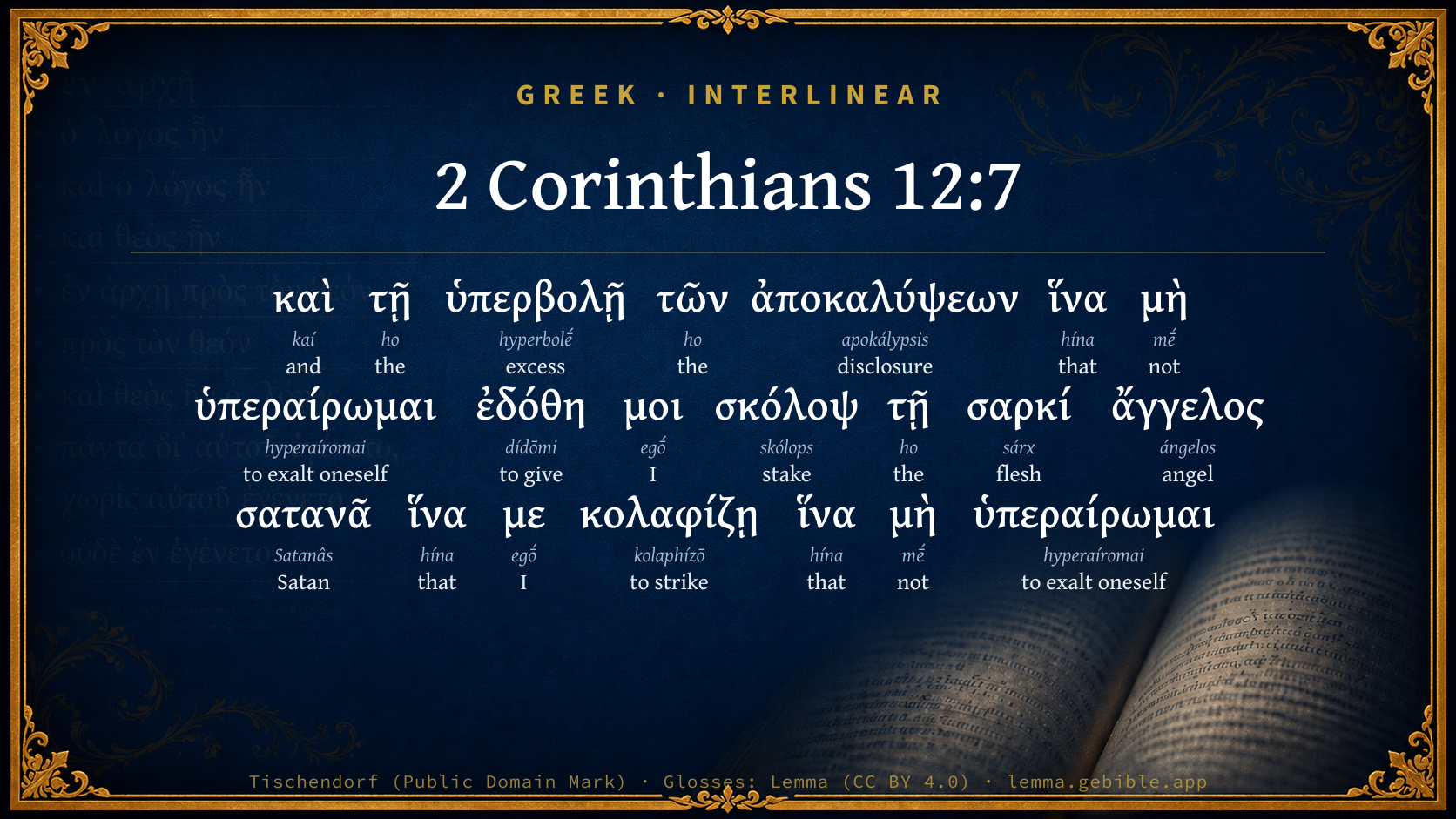
By reason of the exceeding greatness of the revelations, that I should not be exalted excessively, there was given to me a thorn in the flesh, a messenger of Satan to buffet me, that I should not be exalted excessively.
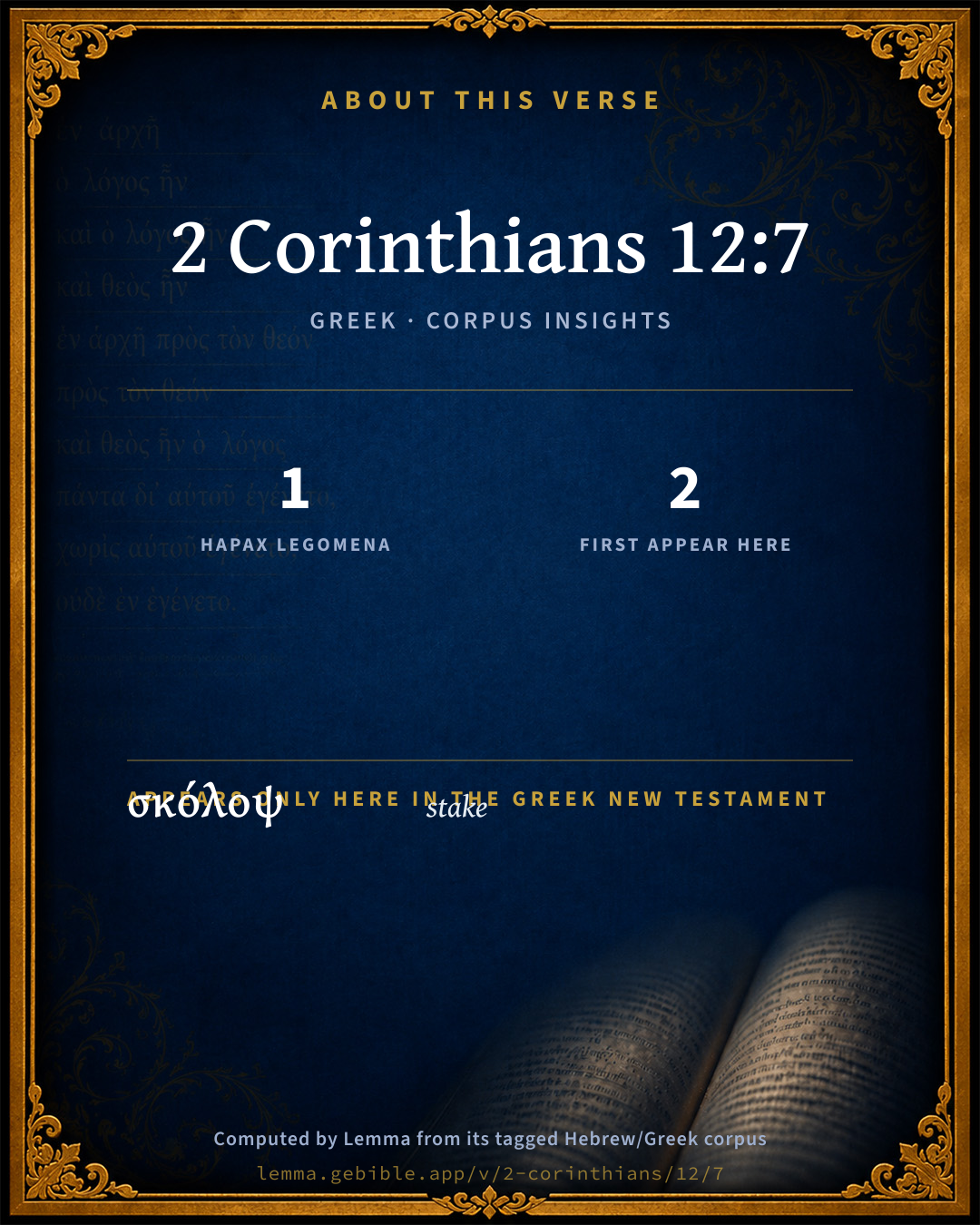
- 1 hapax legomenon — only here in the Greek New Testament
- 2 first appearances in the Greek New Testament
Download a study sheet
One document with this verse’s original text, its word-by-word gloss line, the meaning frame, cross-references with their text, attributed commentary, and full source and license credits — printable, and it pastes into notes with its structure intact.
This verse Autodidact and up
A passage Seminary Student
Up to 50 verses in one chapter. A passage sheet keeps up to 6 commentary sources and 12 cross-references per verse, in the order this page ranks them, and says so on the sheet whenever that leaves anything out. Ask for a single verse and you get the Autodidact verse sheet above.
Everything on this page stays free to read, with no account — the sheet is a download of what is already on screen, not access to it.
Compare translations 3
The same verse in 3 English versions, stacked beneath the original-language interlinear above. Click any original word for its lexicon entry.
Each is an independent rendering of the whole verse — the interlinear is not word-aligned to these translations.
Highlighted words mark where these versions differ — a whole-verse word diff, not a word-by-word alignment.
-
World English Bible Public Domain
By reason of the exceeding greatness of the revelations, that I should not be exalted excessively, there was given to me a thorn in the flesh, a messenger of Satan to buffet me, that I should not be exalted excessively.
-
King James Version Public Domain
And lest I should be exalted above measure through the abundance of the revelations, there was given to me a thorn in the flesh, the messenger of Satan to buffet me, lest I should be exalted above measure.
-
unfoldingWord Literal Text CC BY-SA 4.0
And because of the surpassing of the revelations, therefore, so that I would not become arrogant, a thorn in the flesh was given to me—a messenger of Satan—so that he might buffet me, so that I would not become arrogant.
unfoldingWord Literal Text — © unfoldingWord, licensed CC BY-SA 4.0. Word-aligned USFM3 via Door43 (git.door43.org/unfoldingWord/en_ult).
Show all 19 translations
Every available English version of this verse, each an independent rendering of the whole verse.
-
World English Bible Public Domain
By reason of the exceeding greatness of the revelations, that I should not be exalted excessively, there was given to me a thorn in the flesh, a messenger of Satan to buffet me, that I should not be exalted excessively.
-
Berean Standard Bible Public Domain
or because of these surpassingly great revelations. So to keep me from becoming conceited, I was given a thorn in my flesh, a messenger of Satan, to torment me.
-
Majority Standard Bible Public Domain
or because of these surpassingly great revelations. So to keep me from becoming conceited, I was given a thorn in my flesh, a messenger of Satan, to torment me.
-
King James Version Public Domain
And lest I should be exalted above measure through the abundance of the revelations, there was given to me a thorn in the flesh, the messenger of Satan to buffet me, lest I should be exalted above measure.
-
American Standard Version (1901) Public Domain
And by reason of the exceeding greatness of the revelations, that I should not be exalted overmuch, there was given to me a thorn in the flesh, a messenger of Satan to buffet me, that I should not be exalted overmuch.
-
Revised Version (1885) Public Domain
And by reason of the exceeding greatness of the revelations—wherefore, that I should not be exalted overmuch, there was given to me a thorn in the flesh, a messenger of Satan to buffet me, that I should not be exalted overmuch.
-
Geneva Bible (1599) Public Domain
And lest I should be exalted out of measure through the aboundance of reuelations, there was giuen vnto me a pricke in the flesh, the messenger of Satan to buffet mee, because I should not be exalted out of measure.
-
Douay-Rheims (1899) Public Domain
And lest the greatness of the revelations should exalt me, there was given me a sting of my flesh, an angel of Satan, to buffet me.
-
Young's Literal Translation Public Domain
and that by the exceeding greatness of the revelations I might not be exalted overmuch, there was given to me a thorn in the flesh, a messenger of the Adversary, that he might buffet me, that I might not be exalted overmuch.
-
Literal Standard Version CC BY-SA 4.0
and that by the exceeding greatness of the revelations I might not be exalted too much, there was given to me a thorn in the flesh, a messenger of Satan, that he might batter me, that I might not be exalted too much.
-
Unlocked Literal Bible CC BY-SA 4.0
To keep me from boasting because of the surpassing greatness of the revelations, a thorn in the flesh was given to me, a messenger from Satan to afflict me—so I would not become overly proud.
-
unfoldingWord Literal Text CC BY-SA 4.0
And because of the surpassing of the revelations, therefore, so that I would not become arrogant, a thorn in the flesh was given to me—a messenger of Satan—so that he might buffet me, so that I would not become arrogant.
-
Darby Bible Public Domain
And that I might not be exalted by the exceeding greatness of the revelations, there was given to me a thorn for the flesh, a messenger of Satan that he might buffet me, that I might not be exalted.
-
World Messianic Bible Public Domain
By reason of the exceeding greatness of the revelations, that I should not be exalted excessively, a thorn in the flesh was given to me: a messenger of Satan to torment me, that I should not be exalted excessively.
-
Webster's Bible Public Domain
And lest I should be exalted above measure through the abundance of the revelations, there was given to me a thorn in the flesh, the messenger of Satan to buffet me, lest I should be exalted above measure.
-
Free Bible Version CC BY-SA 4.0
Also, because these revelations were so amazingly great, and so that I wouldn't become proud, I was given a “thorn in my flesh” —a messenger from Satan to hurt me so that I wouldn't become proud.
-
Bible in Basic English Public Domain
And because the revelations were so very great, in order that I might not be overmuch lifted up, there was given to me a thorn in the flesh, one sent from Satan to give me pain.
-
Text-Critical English NT CC BY 4.0
And to keep me from becoming conceited because of the surpassing greatness of the revelations I received, there was given to me a thorn in the flesh, a messenger of Satan to harass me so that I would not become conceited.
-
Tyndale New Testament (1534) Public Domain
And lest I shuld be exalted out of measure thorow the aboundance of revelacions ther was geven vnto me vnquyetnes of the flesshe the messenger of Satan to buffet me: be cause I shuld not be exalted out of measure
Literal Standard Version (2020), Covenant Press — licensed CC BY-SA 4.0. Text via the HelloAO Bible API (eBible.org). Unlocked Literal Bible (unfoldingWord) — licensed CC BY-SA 4.0. Text via the HelloAO Bible API (eBible.org). unfoldingWord Literal Text — © unfoldingWord, licensed CC BY-SA 4.0. Word-aligned USFM3 via Door43 (git.door43.org/unfoldingWord/en_ult). Free Bible Version, Dr. Jonathan Gallagher — licensed CC BY-SA 4.0. Text via the HelloAO Bible API (eBible.org).
Word by word
More ways to search: Search by grammar → Find every occurrence → Compare this word →
Practice this passage: Drill this verse → Learn its vocabulary →
- Appears 1× in the Greek New Testament
- First appears here
- Part of Speech
- Noun
- Case
- Nominative
- Number
- Singular
- Gender
- Masculine
Full Thayer's Definition
- καὶ kaí G2532 “and” Conjunction
- τῇ ho G3588 “the” Article, Dative, Singular, Feminine
- ὑπερβολῇ hyperbolḗ G5236 “excess” Noun, Dative, Singular, Feminine
- τῶν ho G3588 “the” Article, Genitive, Plural, Feminine
- ἀποκαλύψεων apokálypsis G602 “disclosure” Noun, Genitive, Plural, Feminine
- ἵνα hína G2443 “that” Conjunction
- μὴ mḗ G3361 “not” Particle, Negative
- ὑπεραίρωμαι hyperaíromai G5229 “to exalt oneself” Verb, Present, Passive, Subjunctive, 1st person, Singular
- ἐδόθη dídōmi G1325 “to give” Verb, Aorist, Passive, Indicative, 3rd person, Singular
- μοι egṓ G1473 “I” Personal pronoun, 1st person, Dative, Singular
- σκόλοψ skólops G4647 “stake” Noun, Nominative, Singular, Masculine
- τῇ ho G3588 “the” Article, Dative, Singular, Feminine
- σαρκί sárx G4561 “flesh” Noun, Dative, Singular, Feminine
- ἄγγελος ángelos G32 “angel” Noun, Nominative, Singular, Masculine
- σατανᾶ Satanâs G4567 “Satan” Noun, Genitive, Singular, Masculine
- ἵνα hína G2443 “that” Conjunction
- με egṓ G1473 “I” Personal pronoun, 1st person, Accusative, Singular
- κολαφίζῃ kolaphízō G2852 “to strike” Verb, Present, Active, Subjunctive, 3rd person, Singular
- ἵνα hína G2443 “that” Conjunction
- μὴ mḗ G3361 “not” Particle, Negative
- ὑπεραίρωμαι hyperaíromai G5229 “to exalt oneself” Verb, Present, Passive, Subjunctive, 1st person, Singular
About this verse
These counts appear in no published source. They are computed here, from the morphology-tagged text and Lemma’s own curated glosses. What Lemma adds →
- 21
- words
- 14
- distinct lemmas
- Pauline Epistles
- section
Notable vocabulary
1 hapax legomenon — a word that appears only here in the entire Greek New Testament:
- σκόλοψ stake G4647
First appearance in Scripture
These words make their first canonical appearance in the Greek New Testament here:
Shared distinctive vocabulary
ὑπεραίρωμαι to exalt oneself G5229 occurs in 2 verses of the Greek New Testament. Also found in:
Cross-references
20Topical passages linked to 2 Corinthians 12:7 in the Treasury of Scripture Knowledge — connected by theme and wording, ordered by reader-vote popularity; previews shown in the World English Bible.
- Numbers 33:55 But if you will not drive out the inhabitants of the land from before you, then shall those who you let remain of them be as pricks in your eyes, and as thorns in your sides, and they shall vex you in the land in which you dwell.
- Judges 2:3 Therefore I also said, I will not drive them out from before you; but they shall be [as thorns] in your sides, and their gods shall be a snare to you.
- 2 Chronicles 32:25–26 But Hezekiah didn't render again according to the benefit done to him; for his heart was lifted up: therefore there was wrath on him, and on Judah and Jerusalem.
- Genesis 32:31 The sun rose on him as he passed over Peniel, and he limped because of his thigh.
- Galatians 4:13 but you know that because of weakness of the flesh I preached the Gospel to you the first time.
- Daniel 5:20 But when his heart was lifted up, and his spirit was hardened so that he dealt proudly, he was deposed from his kingly throne, and they took his glory from him:
- 1 Corinthians 5:5 are to deliver such a one to Satan for the destruction of the flesh, that the spirit may be saved in the day of the Lord Jesus.
- Deuteronomy 8:14 then your heart be lifted up, and you forget Yahweh your God, who brought you forth out of the land of Egypt, out of the house of bondage;
- 2 Chronicles 26:16 But when he was strong, his heart was lifted up, so that he did corruptly, and he trespassed against Yahweh his God; for he went into the temple of Yahweh to burn incense on the altar of incense.
- Job 2:7 So Satan went forth from the presence of Yahweh, and struck Job with painful sores from the sole of his foot to his head.
- 1 Timothy 3:6 not a new convert, lest being puffed up he fall into the same condemnation as the devil.
- Genesis 32:25 When he saw that he didn't prevail against him, he touched the hollow of his thigh, and the hollow of Jacob's thigh was strained, as he wrestled.
- Deuteronomy 17:20 that his heart not be lifted up above his brothers, and that he not turn aside from the commandment, to the right hand, or to the left: to the end that he may prolong his days in his kingdom, he and his children, in the midst of Israel.
- 2 Chronicles 32:31 However in [the business of] the ambassadors of the princes of Babylon, who sent to him to inquire of the wonder that was done in the land, God left him, to try him, that he might know all that was in his heart.
- Ezekiel 28:24 There shall be no more a pricking brier to the house of Israel, nor a hurting thorn of any that are round about them, that did despite to them; and they shall know that I am the Lord Yahweh.
- 1 Corinthians 4:11 Even to this present hour we hunger, thirst, are naked, are beaten, and have no certain dwelling place.
- 2 Corinthians 10:5 throwing down imaginations and every high thing that is exalted against the knowledge of God, and bringing every thought into captivity to the obedience of Christ;
- 2 Corinthians 11:20 For you bear with a man, if he brings you into bondage, if he devours you, if he takes you captive, if he exalts himself, if he strikes you on the face.
- Matthew 26:67 Then they spit in his face and beat him with their fists, and some slapped him,
- Luke 13:16 Ought not this woman, being a daughter of Abraham, whom Satan had bound eighteen long years, be freed from this bondage on the Sabbath day?"
Cross-references courtesy of OpenBible.info (CC BY 4.0).
Where the printed editions differ
1 variantPlaces in this verse where the major printed Greek editions disagree on the wording in a way that affects the translation — a comparison of editions, not a manuscript-by-manuscript collation. The editions are the modern critical texts (Nestlé-Aland 28/27, SBL, Westcott-Hort, Tregelles, Tyndale House) and the traditional texts behind the KJV (the Textus Receptus and the Byzantine/Majority text). It is not a claim about which reading is original.
-
Extra text
Διὸ
“Therefore”
In NA28NA27TynSBLWHTreg Not in TRByzΔιὸ (Dio) 'Therefore' is only in older manuscripts (NA28+NA27+Tyn+SBL+WH+Treg)
Textual data: Translators Amalgamated Greek New Testament (STEPBible TAGNT) · CC BY 4.0.
Lesson kit
Teaching starters — assembled from the data on this page, not authored interpretation. Every prompt links to the verse data it draws on. Edit before teaching.
2 Corinthians, in the Pauline Epistles, opens this verse with 21 words (14 distinct Greek lemmas). Its most distinctive word is skólops (“stake”). A historical commentator’s framing appears above. Read the whole chapter for the surrounding context.
Discussion questions
- What does “stake” (skólops) contribute to the verse as a whole?
- This verse holds 1 word here found nowhere else in the Greek New Testament. What might the rare word draw attention to?
- 2 words here appear for the first time in Scripture. What is being introduced at this debut?
- 2 Thessalonians 2:4 shares the word «to exalt oneself» with this verse. How do the two illuminate each other?
- “to exalt oneself” occurs 2× in this one verse. What is the effect of the repetition?
- These translations render this verse differently; the difference is in the English rendering, not the original. What questions does that raise?
- Reading how The Cambridge Bible for Schools and Colleges and The Biblical Illustrator read this verse, where do the two commentators agree and where do they part?
Things to notice
- 1 word in this verse appears nowhere else in the Greek New Testament.
- 2 words make their first canonical appearance in Scripture here.
- These translations choose different wording for 22 words in this verse.
- “to exalt oneself” occurs 2× in this single verse.
- 14 distinct Greek lemmas span 21 words in this verse.
Commentary
Notes on 2 Corinthians 12:7 from classic Christian and Jewish commentators (each source and its license shown beneath its notes). The classic Christian expositions comment on the surrounding passage and are grouped to its opening verse, so a note may address several verses; the Jewish commentaries on the Tanakh (Rashi and others) are per-verse, so they appear only where the commentator wrote on this verse.
Lemma curates 59 commentaries, every one of them public domain or Creative Commons licensed, each selected and text-cleaned for this edition rather than reprinted as found. About our sources →
The Cambridge Bible for Schools and Colleges
gen. ed. J. J. S. Perowne
The Cambridge Bible for Schools and Colleges (gen. ed. J. J. S. Perowne; Cambridge University Press, 1878–1918) — public domain. Text from a community e-Sword module.
The Biblical Illustrator
Joseph S. Exell
The Biblical Illustrator, edited by Joseph S. Exell (c. 1880s–1900s) — public domain. Text from a community e-Sword module.
Joseph Benson's Commentary
Joseph Benson's Commentary on the Old and New Testaments (1811–1818) — public domain. Text from a community e-Sword module.
The Pulpit Commentary
The Pulpit Commentary (1880–1919), ed. H.D.M. Spence-Jones & Joseph S. Exell — public domain. Text from a community e-Sword module.
Tyndale Open Study Notes
Tyndale Open Resources
Tyndale Open Study Notes — © Tyndale Open Resources, licensed CC BY-SA 4.0. Text via the HelloAO Bible API.
Bengel's Gnomon
Johann Albrecht Bengel
Bengel's Gnomon of the New Testament — English translation (T&T Clark, Edinburgh, 1860) — public domain. Text from a community e-Sword module.
Meyer's Critical & Exegetical Commentary
Heinrich August Wilhelm Meyer
Meyer — Critical and Exegetical Commentary on the New Testament — English translation by Peter Christie, edited by Frederick Crombie (T&T Clark, 1880) — public domain. Text from a community e-Sword module.
Expositor's Greek Testament
ed. W. Robertson Nicoll
The Expositor's Greek Testament, edited by W. Robertson Nicoll (1897–1910) — public domain. Text from a community e-Sword module.
Cambridge Greek Testament for Schools and Colleges
Cambridge Greek Testament for Schools and Colleges (Cambridge University Press, 1896; 21 vols, various authors incl. Carr, Maclear, Plummer, Farrar, Lumby, Moule, M. R. James, Simcox) — public domain. Text from a community e-Sword module.
Alford’s Greek Testament
Henry Alford
Henry Alford, The Greek Testament (1849–1861) — public domain. Text from a community e-Sword module.
Geneva Bible (1599)
Geneva Bible translators
Geneva Bible (1599) marginal notes — public domain. Text via Bolls.life.
Jamieson, Fausset & Brown
Robert Jamieson, A. R. Fausset & David Brown
Jamieson, Fausset & Brown — Commentary Critical and Explanatory on the Whole Bible (1871) — public domain (CC PDM 1.0). Text via the HelloAO Bible API.
Adam Clarke's Commentary
Adam Clarke's Commentary on the Bible (1810–1826) — public domain. Text from a community e-Sword/MySword module.
John Calvin's Commentaries
John Calvin's Commentaries (1540-1563) — public domain. Text from the Calvin Translation Society English edition (1840s-50s) via the Christian Classics Ethereal Library (ccel.org). Calvin's coverage is partial (roughly two-thirds of the Bible); uncommented books and verses are honest gaps, never fabricated. The 19th-century editor's footnotes and remarks are omitted so the notes are faithfully Calvin's own voice.
Ellicott's Commentary for English Readers
A Bible Commentary for English Readers, edited by Charles John Ellicott (1878–1897) — public domain. Text from a community e-Sword module.
John Gill's Exposition
John Gill's Exposition of the Whole Bible (1746–1763) — public domain (CC PDM 1.0). Text via the HelloAO Bible API.
Trapp's Complete Commentary
John Trapp
John Trapp, A Commentary or Exposition upon All the Books of the Old and New Testament (1647–1656) — public domain. Text from a community e-Sword module.
Albert Barnes' Notes on the Bible
Albert Barnes' Notes on the Bible (1834–1885) — public domain. Text from a community e-Sword/MySword module.
Haydock's Catholic Bible Commentary
George Leo Haydock (1774–1849), Haydock's Catholic Family Bible and Commentary, 1859 edition — public domain. Excludes Psalms (Douay-Rheims chapter numbering differs from Protestant) and Deuterocanonical books (Catholic canon only).
Matthew Poole's English Annotations
Matthew Poole's English Annotations on the Holy Bible (1683–1685) — public domain. Text from a community e-Sword/MySword module.
Whedon's Commentary on the Bible
Daniel D. Whedon
Daniel D. Whedon (gen. ed.), Commentary on the Old and New Testaments (1874–1909) — public domain. Text from a community e-Sword module.
John Wesley's Explanatory Notes
John Wesley, Explanatory Notes Upon the Whole Bible (1754–1765) — public domain. Text via the GEBible commentary corpus.
Scofield Reference Notes
C. I. Scofield
The Scofield Reference Bible (1917 edition), notes by C. I. Scofield — public domain. Text from a community e-Sword module.
Burkitt's Expository Notes on the New Testament
William Burkitt
William Burkitt's Expository Notes on the New Testament (1700–1703) — public domain. Text from a community e-Sword module.
McGarvey & Pendleton's Commentaries
J. W. McGarvey
J. W. McGarvey (with Philip Y. Pendleton), Commentaries on the New Testament (The Fourfold Gospel, 1914; Acts; and the epistles) — public domain. Text from a community e-Sword/MySword module.
The People's New Testament
B. W. Johnson
B. W. Johnson's The People's New Testament with Notes (1889–1891) — public domain. Electronic text from the Christian Classics Ethereal Library (CCEL) ThML edition.
International Critical Commentary
International Critical Commentary — older volumes (1896–1929), various authors — public domain. Text from a community e-Sword module.
Vincent's Word Studies in the New Testament
Marvin R. Vincent
Marvin R. Vincent, Word Studies in the New Testament (1887–1900) — public domain. Text from a community e-Sword/MySword module.