Judges 4:8

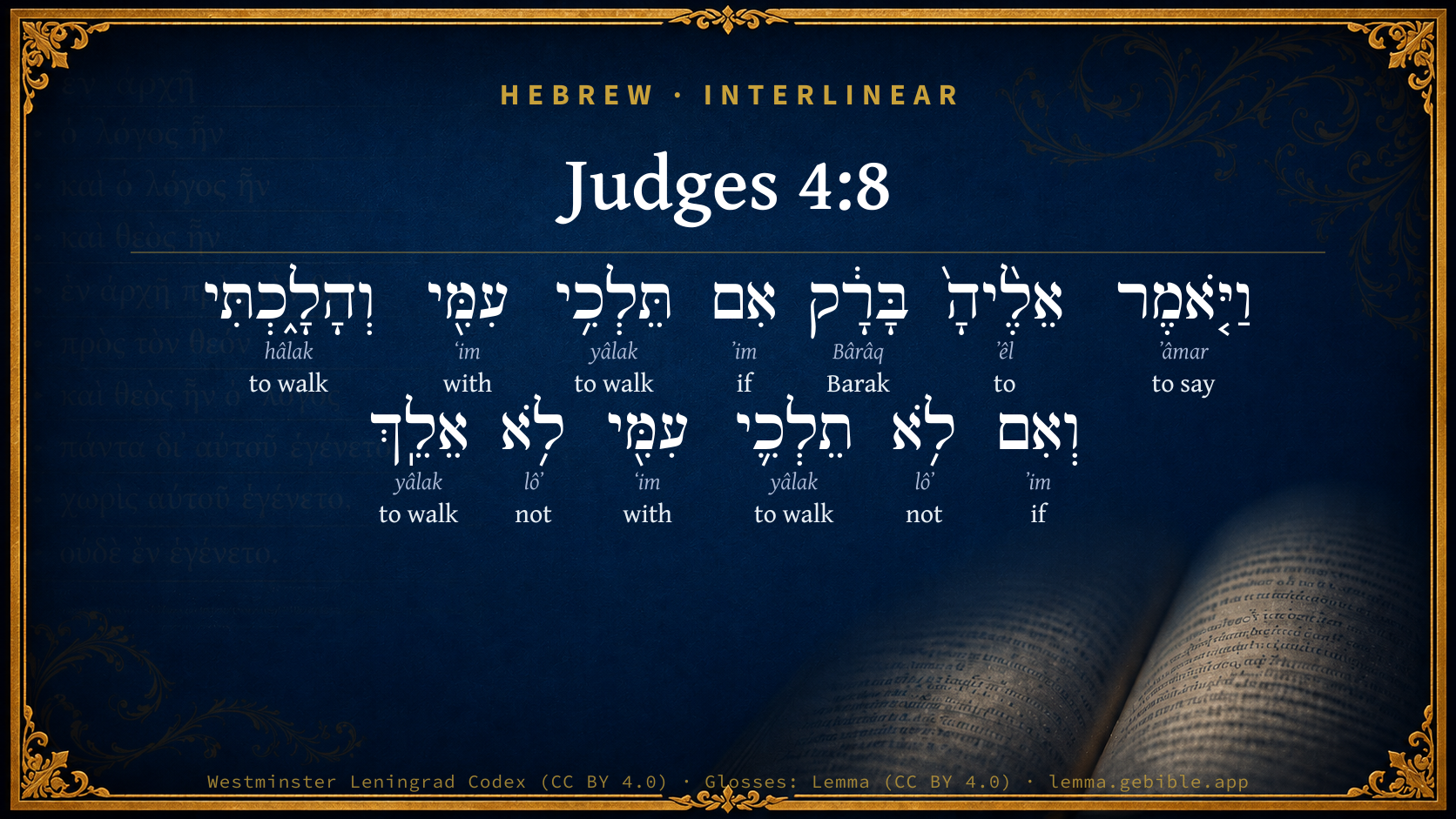
Hebrew (Westminster Leningrad Codex) Judges 4:8 appears in the Hebrew Old Testament. The text above is from the Westminster Leningrad Codex. Each word links to its Strong’s number, a concise gloss, and parsing drawn from the Open Scriptures Hebrew Bible morphology. Click any word for its full Brown-Driver-Briggs (BDB) entry.
Download image
Cite this verse

Judges 4:8 (World English Bible). Public Domain. Lemma interlinear Bible study tool, https://lemma.gebible.app/v/judges/4/8.

Show BibTeX & RIS
BibTeX
RIS
English Translation
Barak said to her, If you will go with me, then I will go; but if you will not go with me, I will not go.
World English Bible · Public Domain
Download a study sheet

One document with this verse’s original text, its word-by-word gloss line, the meaning frame, cross-references with their text, attributed commentary, and full source and license credits — printable, and it pastes into notes with its structure intact.

This verse Autodidact and up

Study sheet (.html) Plain text (.txt)

A passage Seminary Student

Up to 50 verses in one chapter. A passage sheet keeps up to 6 commentary sources and 12 cross-references per verse, in the order this page ranks them, and says so on the sheet whenever that leaves anything out. Ask for a single verse and you get the Autodidact verse sheet above.

Everything on this page stays free to read, with no account — the sheet is a download of what is already on screen, not access to it.

Want to remove ads? Support Godless Engineer
Compare translations 3

The same verse in 3 English versions, stacked beneath the original-language interlinear above. Click any original word for its lexicon entry.

Each is an independent rendering of the whole verse — the interlinear is not word-aligned to these translations.

Highlighted words mark where these versions differ — a whole-verse word diff, not a word-by-word alignment.

  • World English Bible Public Domain
    Barak said to her, If you will go with me, then I will go; but if you will not go with me, I will not go.
  • King James Version Public Domain
    And Barak said unto her, If thou wilt go with me, then I will go: but if thou wilt not go with me, then I will not go.
  • unfoldingWord Literal Text CC BY-SA 4.0
    And Barak said to her, “If you will go with me, then I will go, but if you will not go with me, I will not go.”

unfoldingWord Literal Text — © unfoldingWord, licensed CC BY-SA 4.0. Word-aligned USFM3 via Door43 (git.door43.org/unfoldingWord/en_ult).

Versions to compare (up to 4)

3 of 4 selected

Show all 18 translations

Every available English version of this verse, each an independent rendering of the whole verse.

  • World English Bible Public Domain
    Barak said to her, If you will go with me, then I will go; but if you will not go with me, I will not go.
  • Berean Standard Bible Public Domain
    Barak said to her, “If you will go with me, I will go; but if you will not go with me, I will not go.”
  • Majority Standard Bible Public Domain
    Barak said to her, “If you will go with me, I will go; but if you will not go with me, I will not go.”
  • King James Version Public Domain
    And Barak said unto her, If thou wilt go with me, then I will go: but if thou wilt not go with me, then I will not go.
  • American Standard Version (1901) Public Domain
    And Barak said unto her, If thou wilt go with me, then I will go; but if thou wilt not go with me, I will not go.
  • Revised Version (1885) Public Domain
    And Barak said unto her, If thou wilt go with me, then I will go: but if thou wilt not go with me, I will not go.
  • Geneva Bible (1599) Public Domain
    And Barak sayd vnto her, If thou wilt go with me, I will go: but if thou wilt not goe with me, I will not go.
  • Douay-Rheims (1899) Public Domain
    And Barac said to her: If thou wilt come with me, I will go: if thou wilt not come with me, I will not go.
  • Young's Literal Translation Public Domain
    And Barak saith unto her, `If thou dost go with me, then I have gone; and if thou dost not go with me, I do not go;'
  • Literal Standard Version CC BY-SA 4.0
    And Barak says to her, “If you go with me, then I have gone; and if you do not go with me, I do not go”;
  • Unlocked Literal Bible CC BY-SA 4.0
    Barak said to her, “If you go with me, I will go, but if you do not go with me, I will not go.”
  • unfoldingWord Literal Text CC BY-SA 4.0
    And Barak said to her, “If you will go with me, then I will go, but if you will not go with me, I will not go.”
  • Darby Bible Public Domain
    Barak said to her, "If you will go with me, I will go; but if you will not go with me, I will not go."
  • World Messianic Bible Public Domain
    Barak said to her, “If you will go with me, then I will go; but if you will not go with me, I will not go.”
  • Webster's Bible Public Domain
    And Barak said to her, if thou wilt go with me, then I will go: but if thou wilt not go with me, then I will not go.
  • Free Bible Version CC BY-SA 4.0
    Barak replied, “If you come with me, I'll go; but if you don't come with me, I won't go.”
  • Bible in Basic English Public Domain
    And Barak said to her, If you will go with me then I will go; but if you will not go with me I will not go.
  • JPS Tanakh (1917) Public Domain
    And Barak said unto her: 'If thou wilt go with me, then I will go; but if thou wilt not go with me, I will not go.'

Literal Standard Version (2020), Covenant Press — licensed CC BY-SA 4.0. Text via the HelloAO Bible API (eBible.org). Unlocked Literal Bible (unfoldingWord) — licensed CC BY-SA 4.0. Text via the HelloAO Bible API (eBible.org). unfoldingWord Literal Text — © unfoldingWord, licensed CC BY-SA 4.0. Word-aligned USFM3 via Door43 (git.door43.org/unfoldingWord/en_ult). Free Bible Version, Dr. Jonathan Gallagher — licensed CC BY-SA 4.0. Text via the HelloAO Bible API (eBible.org).

Word by word

More ways to search: Search by grammar → Find every occurrence → Compare this word →

Practice this passage: Drill this verse → Learn its vocabulary →

בָּרָ֔ק
Bârâq
H1301
“Barak”
Noun, Proper
Part of Speech
Noun
Type
Proper
Full BDB Definition

Origin: the same as H1300

TWOT: None

Barak = "lightning" or " lightning flash" - son of Abinoam of Kedesh who, incited by Deborah, a prophetess of Ephraim, delivered the Israelites from the yoke of Jabin by routing the Canaanites in the plain of Jezreel
  1. וַיֹּ֤אמֶר ʼâmar H559 “and · to say” Conjunction + Verb, Qal, Sequential Imperfect, 3rd Person, Masculine, Singular
  2. אֵלֶ֨יהָ֙ ʼêl H413 “to · her” Preposition + Suffix, Personal, 3rd Person, Feminine, Singular
  3. אִם ʼim H518 “if” Conjunction
  4. תֵּלְכִ֥י yâlak H3212 “to walk” Verb, Qal, Imperfect, 2nd Person, Feminine, Singular
  5. עִמִּ֖י ʻim H5973 “with · me” Preposition + Suffix, Personal, 1st Person, Common, Singular
  6. וְהָלָ֑כְתִּי hâlak H1980 “and · to walk” Conjunction + Verb, Qal, Sequential Perfect, 1st Person, Common, Singular
  7. וְאִם ʼim H518 “and · if” Conjunction + Conjunction
  8. לֹ֥א lôʼ H3808 “not” Particle, Negative
  9. תֵלְכִ֛י yâlak H3212 “to walk” Verb, Qal, Imperfect, 2nd Person, Feminine, Singular
  10. עִמִּ֖י ʻim H5973 “with · me” Preposition + Suffix, Personal, 1st Person, Common, Singular
  11. לֹ֥א lôʼ H3808 “not” Particle, Negative
  12. אֵלֵֽךְ yâlak H3212 “to walk” Verb, Qal, Imperfect, 1st Person, Common, Singular

About this verse

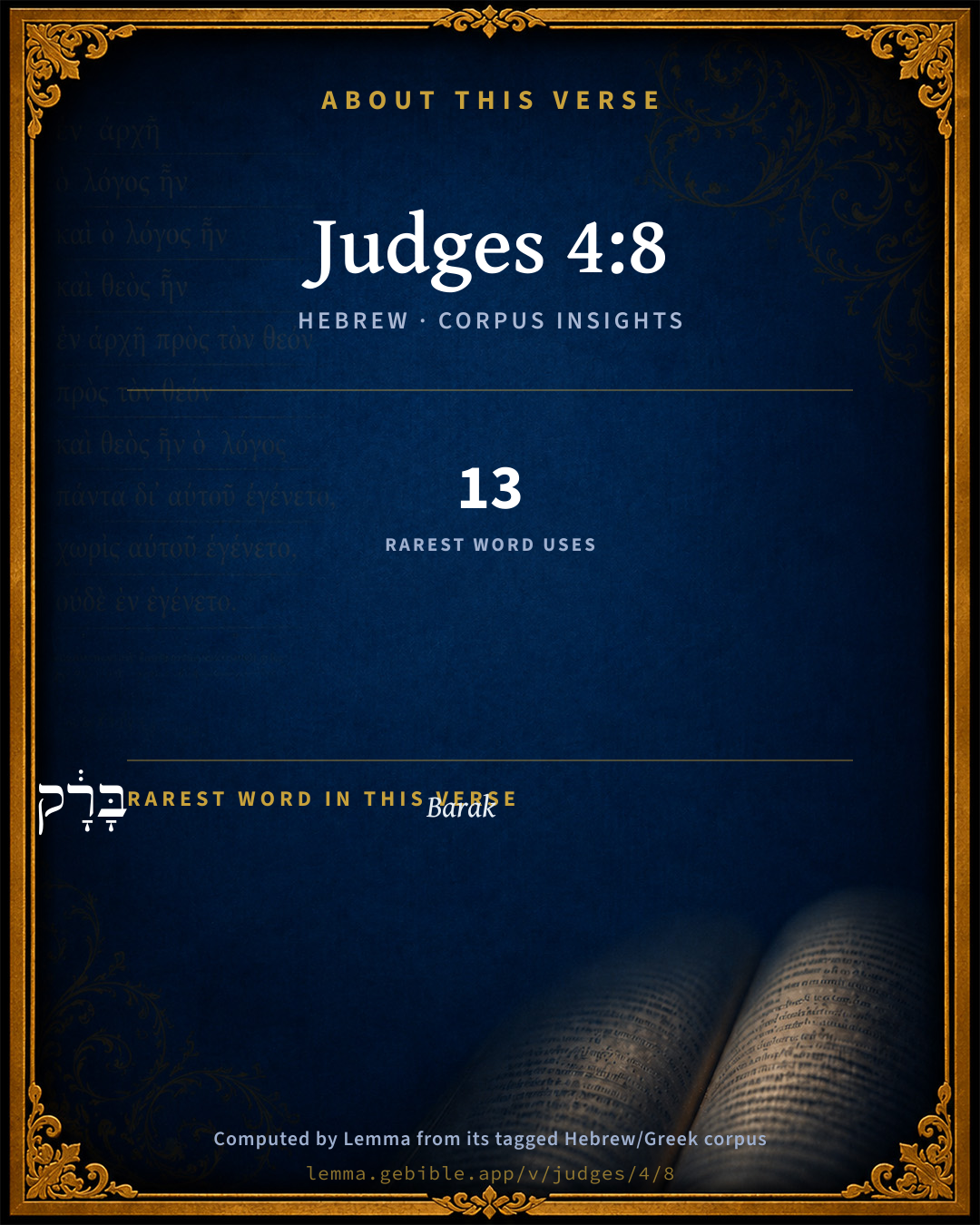
These counts appear in no published source. They are computed here, from the morphology-tagged text and Lemma’s own curated glosses. What Lemma adds →

13
words
8
distinct lemmas
Historical
section

Notable vocabulary

The rarest word here is בָּרָ֔ק Barak H1301 — appearing just 13 times in the whole Hebrew Bible.

Shared distinctive vocabulary

בָּרָ֔ק Barak H1301 occurs in 12 verses of the Hebrew Bible. Also found in:

Grammatical profile

  • 5 verbs
  • 1 noun
  • 3 prepositions
  • 2 conjunctions
  • 2 particles

Verb forms

  • וַיֹּ֤אמֶר Qal · Sequential Imperfect
  • תֵּלְכִ֥י Qal · Imperfect
  • וְהָלָ֑כְתִּי Qal · Sequential Perfect
  • תֵלְכִ֛י Qal · Imperfect
  • אֵלֵֽךְ Qal · Imperfect

Repetition

Words recur within this verse — often emphatic in Hebrew:

  • תֵּלְכִ֥י to walk H3212 ×3
  • אִם if H518 ×2
  • עִמִּ֖י with H5973 ×2
  • לֹ֥א not H3808 ×2

Hebrew & Septuagint length

In English translation the verse runs 26 words from the Hebrew and 39 from the Septuagint (LXX English) — the Septuagint runs noticeably longer here. See the side-by-side →

A rough comparison of the two English renderings, which tokenize alike — not a word-level alignment.

Word counts can differ between the Hebrew and the Greek without any difference in meaning — e.g. the Hebrew direct-object marker אֵת has no separate Greek word, and Greek often adds the article ὁ.

Cross-references

2

Topical passages linked to Judges 4:8 in the Treasury of Scripture Knowledge — connected by theme and wording, ordered by reader-vote popularity; previews shown in the World English Bible.

  • Exodus 4:10–14 Moses said to Yahweh, "Oh, Lord, I am not eloquent, neither before now, nor since you have spoken to your servant; for I am slow of speech, and of a slow tongue."
  • Matthew 14:30–31 But when he saw that the wind was strong, he was afraid, and beginning to sink, he cried out, saying, "Lord, save me!"

Cross-references courtesy of OpenBible.info (CC BY 4.0).

Hebrew and Greek witnesses Masoretic Hebrew ↔ Greek Septuagint

The same verse in the two great witnesses to the Old Testament, shown verse-for-verse.

Here the Septuagint runs noticeably longer than the Hebrew — LXX2012 (modern English Septuagint) 39 words vs World English Bible 26. A rough length comparison of the two English translations, not a word-level alignment — read both below.

These are two independent witnesses, not word-aligned to each other, and the Septuagint is shown in lemma (dictionary) form.

Hebrew Judges 4:8 Masoretic · Westminster Leningrad Codex

וַיֹּ֤אמֶר אֵלֶ֨יהָ֙ בָּרָ֔ק אִם תֵּלְכִ֥י עִמִּ֖י וְהָלָ֑כְתִּי וְאִם לֹ֥א תֵלְכִ֛י עִמִּ֖י לֹ֥א אֵלֵֽךְ

Barak said to her, If you will go with me, then I will go; but if you will not go with me, I will not go.

World English Bible · Public Domain

Greek LXX Judges 4:8 Septuagint · lemma form

καί εἶπον πρός αὐτός βαρακ ἐάν πορεύομαι μετά ἐγώ πορεύομαι καί ἐάν μή πορεύομαι οὐ πορεύομαι ὅτι οὐ οἶδα ὁ ἡμέρα ἐν ὅς εὐοδόω ὁ ἄγγελος κύριος μετά ἐγώ

And Barac said to her, If you will go with me, I will go; and if you will not go, I will not go; for I know not the day on which the Lord prospers his messenger with me.

LXX2012 (modern English Septuagint) · Public Domain

On this verse, Ellicott's Commentary for English Readers discusses the Septuagint’s reading. Read the note in Commentary ↓

Hebrew: Westminster Leningrad Codex (CC BY 4.0). Greek: Septuagint (public domain); English from LXX2012 (modern English Septuagint) (Public Domain). How the Septuagint differs from the Hebrew →

Targum (Aramaic paraphrase)

1

The Targum is the ancient Jewish Aramaic paraphrase of the Hebrew Scriptures — an interpretive translation, not the Hebrew text itself. Onkelos (literal) and Pseudo-Jonathan (expansive) render the Torah, and Jonathan the Prophets. Coverage is partial: where no permissively-licensed English translation exists for a verse, only the Aramaic is shown. This is verse-level text, not a word-by-word alignment to the Hebrew.

  1. Targum Jonathan Prophets (Joshua–Malachi)
    וַאֲמַר לָהּ בָּרָק אִם תֵּיזְלִין עִמִי וְאֵיזִיל וְאִם לָא תֵּיזְלִין עִמִי לָא אֵיזִיל:

    (no public-domain English translation for this verse)

    Targum Jonathan — Aramaic: “Mikraot Gedolot” (public domain). English: “Sefaria Community Translation” (CC0 1.0 (public-domain dedication)); “London "Chaldee Paraphrase," 1871” (public domain). Text via Sefaria.

Commentary

Notes on Judges 4:8 from classic Christian and Jewish commentators (each source and its license shown beneath its notes). The classic Christian expositions comment on the surrounding passage and are grouped to its opening verse, so a note may address several verses; the Jewish commentaries on the Tanakh (Rashi and others) are per-verse, so they appear only where the commentator wrote on this verse.

Lemma curates 59 commentaries, every one of them public domain or Creative Commons licensed, each selected and text-cleaned for this edition rather than reprinted as found. About our sources →

Trapp's Complete Commentary

John Trapp

Jdg 4:8 And Barak said unto her, If thou wilt go with me, then I will go: but if thou wilt not go with me, [then] I will not go.

Ver. 8. If thou wilt go with me.] He is famous for his faith, {Heb 11:32-33} and yet here he showeth some unbelief. Let us be faithful in weakness, though but weak in faith, and pray, "Lord, I believe; help thou mine unbelief" Albeit in some respects it was not amiss for Barak to desire Deborah’s company, viz., to advise him and pray for him, as being a prophetess. Neither fearful nor rash. Neque timide, neque temere, should be the soldier’s motto.

John Trapp, A Commentary or Exposition upon All the Books of the Old and New Testament (1647–1656) — public domain. Text from a community e-Sword module.

Joseph Benson's Commentary

Jdg 4:8. If thou wilt go with me, then I will go — No doubt he thought he had great reason for making this resolution, because he might want her advice in doubtful matters, and her authority also, both to raise men and to keep them together in good order, and likewise to inspire them with courage. His offer to go with her shows the truth of his faith, for which he is praised, Heb 11:32; but his refusal to go without her shows the weakness of his faith, that he could not trust God’s bare word, as he ought to have done, without the pledge of the presence of his prophetess.

Joseph Benson's Commentary on the Old and New Testaments (1811–1818) — public domain. Text from a community e-Sword module.

Geneva Bible (1599)

Geneva Bible translators

Fearing his own weakness and his enemy’s power, he desireth the prophetess to go with him to assure him of God’s will from time to time.

Geneva Bible (1599) marginal notes — public domain. Text via Bolls.life.

Jamieson, Fausset & Brown

Robert Jamieson, A. R. Fausset & David Brown

Barak said unto her, If thou wilt go with me, then I will go--His somewhat singular request to be accompanied by Deborah was not altogether the result of weakness. The Orientals always take what is dearest to the battlefield along with them; they think it makes them fight better. The policy of Barak, then, to have the presence of the prophetess is perfectly intelligible as it would no less stimulate the valor of the troops, than sanction, in the eyes of Israel, the uprising against an oppressor so powerful as Jabin.

Jamieson, Fausset & Brown — Commentary Critical and Explanatory on the Whole Bible (1871) — public domain (CC PDM 1.0). Text via the HelloAO Bible API.

Ellicott's Commentary for English Readers

(8) If thou wilt go with me.—The enterprise seemed so daring and so hopeless, that if not for his own sake, yet for the sake of his army, Barak felt how much would be gained by the presence of the inspired prophetess. The LXX. has the remarkable addition, “Because I know not the day in which the Lord prospers the angel with me.” This is a sort of excuse for his want of perfect faith. He depends on Deborah to give him the immediate augury of victory. “In the Messenian war the soldiers fought bravely because their seers were present” (Pausan. iv. 16—Cassel).

A Bible Commentary for English Readers, edited by Charles John Ellicott (1878–1897) — public domain. Text from a community e-Sword module.

The Cambridge Bible for Schools and Colleges

gen. ed. J. J. S. Perowne

8. If thou wilt go with me] By having the prophetess with him, Barak could count upon divine guidance, cf. Jdg_4:14. The LXX. cod. B and Luc. brings this out by adding ‘for I know not the day whereon the angel of the Lord may prosper me,’ which looks like the rendering of a Hebr. sentence, but is of questionable originality, and may be based on Jdg_5:23.

The Cambridge Bible for Schools and Colleges (gen. ed. J. J. S. Perowne; Cambridge University Press, 1878–1918) — public domain. Text from a community e-Sword module.

John Gill's Exposition

And Barak said unto her,.... To Deborah, after she had delivered the words of the Lord unto him:

if thou wilt go with me, then I will go; which showed faith hi the word of the Lord, for which he is commended, and a readiness to do the will of God, and courage to engage in such a work with a powerful adversary, and is therefore reckoned among the heroes for faith, Heb 11:32,

but if thou wilt not go with me, then I will not go; which though it might discover some weakness in him, yet showed the high opinion he had of Deborah as a judge of Israel, and prophetess of the Lord; being desirous that he might have her with him to pray to God for him, to give him advice and counsel on any emergency, she being as the oracle God; and whereby he testified his regard to the Lord, and to his presence, which he concluded he should have, the prophetess being with him; and more especially his reason for insisting on her going with him might be to prevail upon the inhabitants of Naphtali and Zebulun to go with him, who he might fear would not believe him, or pay any regard to his words, and be in dread of engaging with the enemy, unless she was present; which he supposed would satisfy them as to the mind of God in it, and animate them, and give them heart and spirit.

John Gill's Exposition of the Whole Bible (1746–1763) — public domain (CC PDM 1.0). Text via the HelloAO Bible API.

Albert Barnes' Notes on the Bible

Barak, like Gideon Jdg 6:15, Jdg 6:36, Jdg 6:40, and Abraham Gen 15:2-3; Gen 17:18, and Moses Exo 4:10, Exo 4:13, and Peter Mat 14:30-31, exhibited some weakness of faith at first. But this only makes his example more profitable for our encouragement, though he himself suffered some lost by his weakness Jdg 4:9.

Albert Barnes' Notes on the Bible (1834–1885) — public domain. Text from a community e-Sword/MySword module.

Haydock's Catholic Bible Commentary

Not go. Septuagint and St. Augustine (q. 26,) add, "because I know not when the Lord will send his angel to grant me success." St. Paul (Hebrews xi. 32,) praises the faith of Barac, so that he spoke thus out of prudence, that the people, seeing (Calmet) their revered prophetess in his company, (Haydock) might not condemn the undertaking as too rash and perilous. He therefore entreats her, in this earnest manner, to come with him, and point out the time when he must attack the enemy.

George Leo Haydock (1774–1849), Haydock's Catholic Family Bible and Commentary, 1859 edition — public domain. Excludes Psalms (Douay-Rheims chapter numbering differs from Protestant) and Deuterocanonical books (Catholic canon only).

Matthew Poole's English Annotations

His offer to go with her shows the truth of his faith, for which he is praised, Heb 11:32; but his refusal to go without her shows the weakness of his faith, that he could not trust God’s bare word, as he ought to have done, without the pledge of the presence of his prophetess, whom he thought God would preserve and deliver, and himself for her sake.

Matthew Poole's English Annotations on the Holy Bible (1683–1685) — public domain. Text from a community e-Sword/MySword module.

Whedon's Commentary on the Bible

Daniel D. Whedon

8. If thou wilt not go with me, then I will not go — The great general at once recognizes that Jehovah speaks in Deborah, and that as messenger of God she is not only his own superior, but her presence the pledge of his success. Pausanias says, that in the Messinian war “The soldiers fought bravely because their seers were present.”

Daniel D. Whedon (gen. ed.), Commentary on the Old and New Testaments (1874–1909) — public domain. Text from a community e-Sword module.

The Pulpit Commentary

HOMILIES BY W.F. ADENEY Vers. 8, 9. Deborah and Barak.

I THEY WHO UNDERTAKE TO ADVOCATE DIFFICULT TASKS SHOULD BE WILLING TO SHARE THE RESPONSIBILITY OF THE EXECUTION OF THEM. Deborah urges Barak to fight; Barak will raise the standard only on condition that the prophetess will accompany him. There are prophets who sit with Deborah under the palm tree and advise noble deeds while they excuse themselves from facing the danger of achieving them. In the spiritual warfare of the Church we find critics who can see the defects of the work others are doing, and advise great improvements, yet who will never encounter the perils of the mission-field or the drudgery of more homely work. It is well to devise good measures, but it is better, like Deborah, to help in the execution of them.

II IN THE BATTLE OF LIFE A GREAT VARIETY OF SERVICE IS REQUISITE FOR FINAL SUCCESS. Deborah cannot lead the army, but she can inspire it. Barak cannot prophesy, but he can fight. Thus Deborah cannot secure victory without Barak, nor Barak without Deborah. We are members one of another, and all the members have not the same office. There is work for the seer and work for the warrior. The world always needs its prophets and its heroes. The worker without the thinker will blunder into confusion; the thinker without the worker will fail for want of power to execute his designs. Brain work is at least as important as mechanical work. It is therefore foolish for practical men to despise the men of thought as mere theorists, and foolish for the thinkers to treat the active men of business with philosophical contempt. It is peculiarly woman"s work to cheer and encourage those who are called to the dangerous tasks of life. Wives and mothers who dissuade their husbands and sons from their duty because it appears to be dangerous are indulging in weak and foolish affection. The highest love will seek to encourage those who are loved in all that is great and noble.

III IN THE SERVICE OF GOD THE FIRST REQUISITE FOR SUCCESS IS THE INSPIRING AID OF THE SPIRIT OF GOD. Deborah is a prophetess. She is gifted with the wisdom and enthusiasm of direct inspiration, and thus becomes the inspirer of Barak and his troops. Barak feels that if Deborah goes with him God"s counsel and encouragement will be given him. Do we not trust too much to the mere machinery of our Church organisations in the execution of our work? One prophet in our midst is worth a thousand dull, earthly-minded men The great need of the Church in her battle with the evil of the world is the presence of the Spirit of God in light and power, to guide and to energise her dark and weak efforts. It is foolish to go up to our spiritual warfare without seeking the presence of God to accompany us. (Exo_33:15) If God go with us we shall need no special order of prophets, for then every soldier of Christ will be a prophet. A. (Joe_2:28)

The Pulpit Commentary (1880–1919), ed. H.D.M. Spence-Jones & Joseph S. Exell — public domain. Text from a community e-Sword module.

John Wesley's Explanatory Notes

I will not go - His offer to go with her, shews the truth of his faith, for which he is praised, Hebrew xi, 32, but his refusal to go without her, shews the weakness of his faith, that he could not trust God's bare word, as he ought to have done, without the pledge of the presence of his prophetess.

John Wesley, Explanatory Notes Upon the Whole Bible (1754–1765) — public domain. Text via the GEBible commentary corpus.

Keil & Delitzsch

C. F. Keil & F. Delitzsch

Barak replied that he would not go unless she would go with him - certainly not for the reason suggested by Bertheau, viz., that he distrusted the divine promise given to him by Deborah, but because his mistrust of his own strength was such that he felt too weak to carry out the command of God. He wanted divine enthusiasm for the conflict, and this the presence of the prophetess was to infuse into both Barak and the army that was to be gathered round him. Deborah promised to accompany him, but announced to him as the punishment for this want of confidence in the success of his undertaking, that the prize of victory - namely, the defeat of the hostile general - should be taken out of his hand; for Jehovah would sell (i.e., deliver up) Sisera into the hand of a woman, viz., according to Jdg 4:17., into the hand of Jael. She then went with him to Kedesh, where Barak summoned together Zebulun and Naphtali, i.e., the fighting men of those tribes, and went up with 10,000 men in his train ("at his feet," i.e., after him, Jdg 4:14; cf. Exo 11:8 and Deu 11:6) to Tabor ("went up:" the expression is used here to denote the advance of an army against a place). Kedesh, where the army assembled, was higher than Tabor. זעק, Hiphil with acc., to call together (cf. Sa2 20:4-5). Before the engagement with the foe is described, there follows in Jdg 4:11 a statement that Heber the Kenite had separated himself from his tribe, the children of Hobab, who led a nomad life in the desert of Judah (Jdg 1:16), and had pitched his tents as far as the oak forest at Zaanannim (see at Jos 19:33) near Kedesh. This is introduced because of its importance in relation to the issue of the conflict which ensued (Jdg 4:17 ff). נפרד with Kametz is a participle, which is used in the place of the perfect, to indicate that the separation was a permanent one.

Keil & Delitzsch — Biblical Commentary on the Old Testament (1861–1891) — public domain (CC PDM 1.0). Text via the HelloAO Bible API. (Old Testament only.)

unfoldingWord translationNotes

Door43 World Missions Community

General Information:

Barak has a discussion with Deborah.

Barak

See how you translated this man's name in Judges 4:6.

the road on which you are going will not lead to your honor

The choice Barak makes is spoken of as if Barak were choosing a road on which to travel. And, "honor" is spoken of as if it were a destination to which one travels. AT: "no one will honor you for what you do" (See: Metaphor)

for Yahweh will sell Sisera into the hand of a woman

Here "hand" refers to her power to kill him. AT: "for Yahweh will cause a woman to defeat Sisera" (See: Metonymy)

Sisera

See how you translated this man's name in Judges 4:2.

Deborah

See how you translated this woman's name in Judges 4:4.

translationWords

honor

Yahweh

Kedesh

unfoldingWord translationNotes — © Distant Shores Media and the Door43 World Missions Community, licensed CC BY-SA 4.0. Source: git.door43.org/Door43/en_tn.

Lesson kit

Teaching starters — assembled from the data on this page, not authored interpretation. Every prompt links to the verse data it draws on. Edit before teaching.

Judges, in the Historical, opens this verse with 13 words (8 distinct Hebrew lemmas). Its most distinctive word is Bârâq (“Barak”). The Greek Septuagint runs longer here. A historical commentator’s framing appears above. Read the whole chapter for the surrounding context.

Discussion questions

  1. The word Bârâq carries the sense “Barak.” How does it shape the verse?
  2. Judges 4:6 shares the word «Barak» with this verse. How do the two illuminate each other?
  3. “to walk” occurs 3× in this one verse. What is the effect of the repetition?
  4. Compared with the Hebrew, the Septuagint runs longer here. What questions does that raise?
  5. The translations on this page render this verse differently — a whole-verse word diff, not a word-by-word alignment. What might account for the different wordings?
  6. The verb «וַיֹּ֤אמֶר» is Qal Sequential Imperfect. How does its form color the action?
  7. Reading how Trapp's Complete Commentary and Joseph Benson's Commentary read this verse, where do the two commentators agree and where do they part?

Things to notice

  • These translations choose different wording for 2 words in this verse.
  • “to walk” occurs 3× in this single verse.
  • 8 distinct Hebrew lemmas span 13 words in this verse.

Reading settings

Reading text

Shown beneath each verse's original-language words.

Old Testament
Old Testament edition

Read the OT as the Masoretic Hebrew (MT) or the Greek Septuagint (LXX).

English shown for the Greek Septuagint (in the Hebrew ↔ Greek comparison).

Comparing translations? Open the Compare panel on any verse page to stack up to four side by side.