

2 Peter 2:4
Greek (Tischendorf 8th ed.) 2 Peter 2:4 appears in the Greek New Testament. The text above is from the Tischendorf 8th edition. Each word links to its Strong’s number and a concise gloss. Click any word for its full Thayer’s Greek Lexicon entry.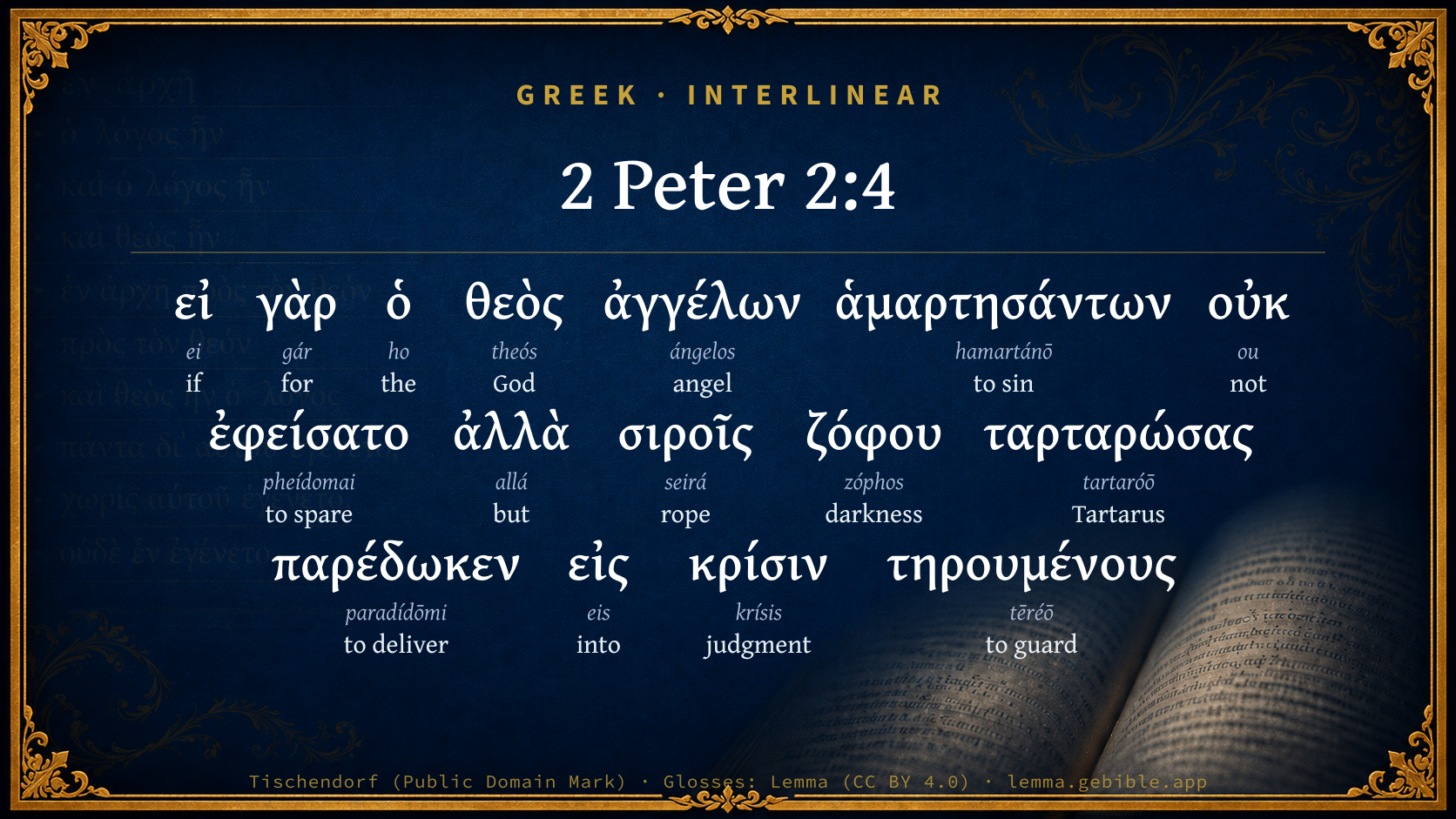
For if God didn't spare angels when they sinned, but cast them down to Tartarus, and committed them to pits of darkness, to be reserved to judgment;
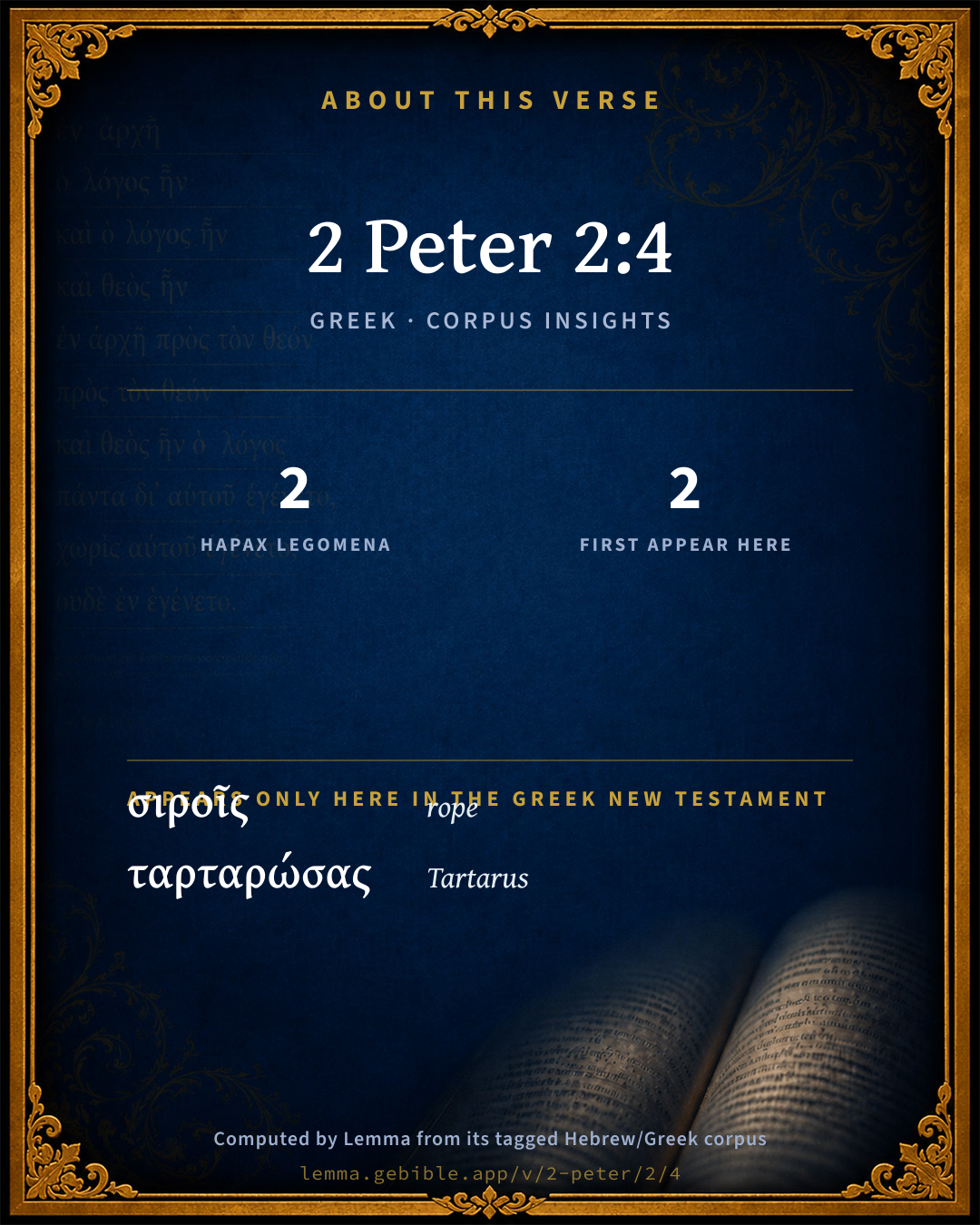
- 2 hapax legomena — only here in the Greek New Testament
- 2 first appearances in the Greek New Testament
Download a study sheet
One document with this verse’s original text, its word-by-word gloss line, the meaning frame, cross-references with their text, attributed commentary, and full source and license credits — printable, and it pastes into notes with its structure intact.
This verse Autodidact and up
A passage Seminary Student
Up to 50 verses in one chapter. A passage sheet keeps up to 6 commentary sources and 12 cross-references per verse, in the order this page ranks them, and says so on the sheet whenever that leaves anything out. Ask for a single verse and you get the Autodidact verse sheet above.
Everything on this page stays free to read, with no account — the sheet is a download of what is already on screen, not access to it.
Compare translations 3
The same verse in 3 English versions, stacked beneath the original-language interlinear above. Click any original word for its lexicon entry.
Each is an independent rendering of the whole verse — the interlinear is not word-aligned to these translations.
Highlighted words mark where these versions differ — a whole-verse word diff, not a word-by-word alignment.
-
World English Bible Public Domain
For if God didn't spare angels when they sinned, but cast them down to Tartarus, and committed them to pits of darkness, to be reserved to judgment;
-
King James Version Public Domain
For if God spared not the angels that sinned, but cast them down to hell, and delivered them into chains of darkness, to be reserved unto judgment;
-
unfoldingWord Literal Text CC BY-SA 4.0
For if God did not spare angels who had sinned, but, in chains of darkness throwing down to Tartarus, he handed over those being kept for judgment;
unfoldingWord Literal Text — © unfoldingWord, licensed CC BY-SA 4.0. Word-aligned USFM3 via Door43 (git.door43.org/unfoldingWord/en_ult).
Show all 19 translations
Every available English version of this verse, each an independent rendering of the whole verse.
-
World English Bible Public Domain
For if God didn't spare angels when they sinned, but cast them down to Tartarus, and committed them to pits of darkness, to be reserved to judgment;
-
Berean Standard Bible Public Domain
For if God did not spare the angels when they sinned, but cast them deep into hell, placing them in chains of darkness to be held for judgment;
-
Majority Standard Bible Public Domain
For if God did not spare the angels when they sinned, but cast them deep into hell, placing them in chains of darkness to be held for judgment;
-
King James Version Public Domain
For if God spared not the angels that sinned, but cast them down to hell, and delivered them into chains of darkness, to be reserved unto judgment;
-
American Standard Version (1901) Public Domain
For if God spared not angels when they sinned, but cast them down to hell, and committed them to pits of darkness, to be reserved unto judgment;
-
Revised Version (1885) Public Domain
For if God spared not angels when they sinned, but cast them down to hell, and committed them to pits of darkness, to be reserved unto judgment;
-
Geneva Bible (1599) Public Domain
For if God spared not the Angels that had sinned, but cast them downe into hell, and deliuered them into chaines of darkenes, to be kept vnto damnation:
-
Douay-Rheims (1899) Public Domain
For if God spared not the angels that sinned, but delivered them, drawn down by infernal ropes to the lower hell, unto torments, to be reserved unto judgment:
-
Young's Literal Translation Public Domain
For if God messengers who sinned did not spare, but with chains of thick gloom, having cast `them' down to Tartarus, did deliver `them' to judgment, having been reserved,
-
Literal Standard Version CC BY-SA 4.0
For if God did not spare messengers having sinned, but having cast [them] down to Tartarus with chains of deepest gloom, delivered [them], having been reserved to judgment,
-
Unlocked Literal Bible CC BY-SA 4.0
For God did not spare the angels who sinned. Instead he handed them down to Tartarus to be kept in chains of lower darkness until the judgment.
-
unfoldingWord Literal Text CC BY-SA 4.0
For if God did not spare angels who had sinned, but, in chains of darkness throwing down to Tartarus, he handed over those being kept for judgment;
-
Darby Bible Public Domain
For if God spared not [the] angels who had sinned, but having cast them down to the deepest pit of gloom has delivered them to chains of darkness [to be] kept for judgment;
-
World Messianic Bible Public Domain
For if God didn’t spare angels when they sinned, but cast them down to Tartarus, and committed them to pits of darkness to be reserved for judgment;
-
Webster's Bible Public Domain
For if God spared not the angels that sinned, but cast them down to hell, and delivered them into chains of darkness, to be reserved to judgment;
-
Free Bible Version CC BY-SA 4.0
For God didn't even spare the angels when they sinned. He threw them into Tartarus, holding them in dark pits ready for judgment.
-
Bible in Basic English Public Domain
For if God did not have pity for the angels who did evil, but sent them down into hell, to be kept in chains of eternal night till they were judged;
-
Text-Critical English NT CC BY 4.0
For if God did not spare angels when they sinned, but cast them down to Tartarus and committed them to chains of darkness to be kept for judgment;
-
Tyndale New Testament (1534) Public Domain
For yf god spared not the angels that synned but cast them doune into hell and delyuered them in chaynes of darknes to be kept vnto iudgement.
Literal Standard Version (2020), Covenant Press — licensed CC BY-SA 4.0. Text via the HelloAO Bible API (eBible.org). Unlocked Literal Bible (unfoldingWord) — licensed CC BY-SA 4.0. Text via the HelloAO Bible API (eBible.org). unfoldingWord Literal Text — © unfoldingWord, licensed CC BY-SA 4.0. Word-aligned USFM3 via Door43 (git.door43.org/unfoldingWord/en_ult). Free Bible Version, Dr. Jonathan Gallagher — licensed CC BY-SA 4.0. Text via the HelloAO Bible API (eBible.org).
Word by word
More ways to search: Search by grammar → Find every occurrence → Compare this word →
Practice this passage: Drill this verse → Learn its vocabulary →
- Appears 1× in the Greek New Testament
- First appears here
- Part of Speech
- Noun
- Case
- Dative
- Number
- Plural
- Gender
- Masculine
Full Thayer's Definition
- εἰ ei G1487 “if” Conditional
- γὰρ gár G1063 “for” Conjunction
- ὁ ho G3588 “the” Article, Nominative, Singular, Masculine
- θεὸς theós G2316 “God” Noun, Nominative, Singular, Masculine
- ἀγγέλων ángelos G32 “angel” Noun, Genitive, Plural, Masculine
- ἁμαρτησάντων hamartánō G264 “to sin” Verb, Aorist, Active, Participle, Genitive, Plural, Masculine
- οὐκ ou G3756 “not” Particle, Negative
- ἐφείσατο pheídomai G5339 “to spare” Verb, Aorist, Middle deponent, Indicative, 3rd person, Singular
- ἀλλὰ allá G235 “but” Conjunction
- σιροῖς seirá G4577 “rope” Noun, Dative, Plural, Masculine
- ζόφου zóphos G2217 “darkness” Noun, Genitive, Singular, Masculine
- ταρταρώσας tartaróō G5020 “Tartarus” Verb, Aorist, Active, Participle, Nominative, Singular, Masculine
- παρέδωκεν paradídōmi G3860 “to deliver” Verb, Aorist, Active, Indicative, 3rd person, Singular
- εἰς eis G1519 “into” Preposition
- κρίσιν krísis G2920 “judgment” Noun, Accusative, Singular, Feminine
- τηρουμένους tēréō G5083 “to guard” Verb, Present, Passive, Participle, Accusative, Plural, Masculine
About this verse
These counts appear in no published source. They are computed here, from the morphology-tagged text and Lemma’s own curated glosses. What Lemma adds →
- 16
- words
- 16
- distinct lemmas
- General Epistles
- section
Notable vocabulary
2 hapax legomena — words that appear only here in the entire Greek New Testament:
First appearance in Scripture
These words make their first canonical appearance in the Greek New Testament here:
Shared distinctive vocabulary
ζόφου darkness G2217 occurs in 5 verses of the Greek New Testament. Also found in:
Cross-references
24Topical passages linked to 2 Peter 2:4 in the Treasury of Scripture Knowledge — connected by theme and wording, ordered by reader-vote popularity; previews shown in the World English Bible.
- Jude 1:6 Angels who didn't keep their first domain, but deserted their own dwelling place, he has kept in everlasting bonds under darkness for the judgment of the great day.
- Matthew 25:41 Then he will say also to those on the left hand, 'Depart from me, you cursed, into the eternal fire which is prepared for the devil and his angels;
- Romans 8:32 He who didn't spare his own Son, but delivered him up for us all, how would he not also with him freely give us all things?
- Revelation 20:1–3 I saw an angel coming down out of heaven, having the key of the abyss and a great chain in his hand.
- Revelation 12:7–9 There was war in the sky. Michael and his angels made war on the dragon. The dragon and his angels made war.
- Isaiah 14:12 How you are fallen from heaven, day-star, son of the morning! How you are cut down to the ground, who laid the nations low!
- Revelation 20:10 The devil who deceived them was thrown into the lake of fire and sulfur, where the beast and the false prophet are also. They will be tormented day and night forever and ever.
- Ezekiel 7:4 My eye shall not spare you, neither will I have pity; but I will bring your ways on you, and your abominations shall be in the midst of you: and you shall know that I am Yahweh.
- Ezekiel 5:11 Therefore, as I live, says the Lord Yahweh, surely, because you have defiled my sanctuary with all your detestable things, and with all your abominations, therefore will I also diminish [you]; neither shall my eye spare, and I also will have no pity.
- Luke 10:18 He said to them, "I saw Satan having fallen like lightning from heaven.
- Job 4:18 Behold, he puts no trust in his servants. He charges his angels with error.
- 1 John 3:8 He who sins is of the devil, for the devil has been sinning from the beginning. To this end the Son of God was revealed, that he might destroy the works of the devil.
- Luke 8:31 They begged him that he would not command them to go into the abyss.
- 2 Peter 2:5 and didn't spare the ancient world, but preserved Noah with seven others, a preacher of righteousness, when he brought a flood on the world of the ungodly;
- 2 Peter 2:11 whereas angels, though greater in might and power, don't bring a railing judgment against them before the Lord.
- Matthew 8:29 Behold, they cried out, saying, "What do we have to do with you, Jesus, Son of God? Have you come here to torment us before the time?"
- Mark 5:7 and crying out with a loud voice, he said, "What have I to do with you, Jesus, you Son of the Most High God? I adjure you by God, don't torment me."
- John 8:44 You are of your Father, the devil, and you want to do the desires of your father. He was a murderer from the beginning, and doesn't stand in the truth, because there is no truth in him. When he speaks a lie, he speaks on his own; for he is a liar, and the father of it.
- 2 Peter 2:9 the Lord knows how to deliver the godly out of temptation and to keep the unrighteous under punishment for the day of judgment;
- Ezekiel 7:9 My eye shall not spare, neither will I have pity: I will bring on you according to your ways; and your abominations shall be in the midst of you; and you shall know that I, Yahweh, do strike.
- Deuteronomy 29:20 Yahweh will not pardon him, but then the anger of Yahweh and his jealousy will smoke against that man, and all the curse that is written in this book shall lie on him, and Yahweh will blot out his name from under the sky.
- Job 21:30 That the evil man is reserved to the day of calamity? That they are led forth to the day of wrath?
- Romans 11:21 for if God didn't spare the natural branches, neither will he spare you.
- Jude 1:13 wild waves of the sea, foaming out their own shame; wandering stars, for whom the blackness of darkness has been reserved forever.
Cross-references courtesy of OpenBible.info (CC BY 4.0).
Where the printed editions differ
1 variantPlaces in this verse where the major printed Greek editions disagree on the wording in a way that affects the translation — a comparison of editions, not a manuscript-by-manuscript collation. The editions are the modern critical texts (Nestlé-Aland 28/27, SBL, Westcott-Hort, Tregelles, Tyndale House) and the traditional texts behind the KJV (the Textus Receptus and the Byzantine/Majority text). It is not a claim about which reading is original.
-
Different wording
σειραῖς
“in chains”
In NA28NA27SBLTRByz Not in TynWHTregσειροῖς (seirois) 'in a pit' occurs in a few manuscripts (Tyn+WH+Treg) instead of σειραῖς (seirais) 'in chains' in older manuscripts (NA28+NA27+SBL+TR+Byz)
Textual data: Translators Amalgamated Greek New Testament (STEPBible TAGNT) · CC BY 4.0.
Lesson kit
Teaching starters — assembled from the data on this page, not authored interpretation. Every prompt links to the verse data it draws on. Edit before teaching.
2 Peter, in the General Epistles, opens this verse with 16 words (16 distinct Greek lemmas). Its most distinctive word is seirá (“rope”). A historical commentator’s framing appears above. Read the whole chapter for the surrounding context.
Discussion questions
- The word seirá carries the sense “rope.” How does it shape the verse?
- This verse holds 2 words here found nowhere else in the Greek New Testament. What might the rare words draw attention to?
- 2 words here appear for the first time in Scripture. What is being introduced at this debut?
- Hebrews 12:18 shares the word «darkness» with this verse. How do the two illuminate each other?
- The translations on this page render this verse differently — a whole-verse word diff, not a word-by-word alignment. What might account for the different wordings?
- Reading how The Biblical Illustrator and Joseph Benson's Commentary read this verse, where do the two commentators agree and where do they part?
Things to notice
- 2 words in this verse appear nowhere else in the Greek New Testament.
- 2 words make their first canonical appearance in Scripture here.
- These translations choose different wording for 21 words in this verse.
- 16 distinct Greek lemmas span 16 words in this verse.
Commentary
Notes on 2 Peter 2:4 from classic Christian and Jewish commentators (each source and its license shown beneath its notes). The classic Christian expositions comment on the surrounding passage and are grouped to its opening verse, so a note may address several verses; the Jewish commentaries on the Tanakh (Rashi and others) are per-verse, so they appear only where the commentator wrote on this verse.
Lemma curates 59 commentaries, every one of them public domain or Creative Commons licensed, each selected and text-cleaned for this edition rather than reprinted as found. About our sources →
The Biblical Illustrator
Joseph S. Exell
The Biblical Illustrator, edited by Joseph S. Exell (c. 1880s–1900s) — public domain. Text from a community e-Sword module.
Joseph Benson's Commentary
Joseph Benson's Commentary on the Old and New Testaments (1811–1818) — public domain. Text from a community e-Sword module.
Whedon's Commentary on the Bible
Daniel D. Whedon
Daniel D. Whedon (gen. ed.), Commentary on the Old and New Testaments (1874–1909) — public domain. Text from a community e-Sword module.
Tyndale Open Study Notes
Tyndale Open Resources
Tyndale Open Study Notes — © Tyndale Open Resources, licensed CC BY-SA 4.0. Text via the HelloAO Bible API.
Bengel's Gnomon
Johann Albrecht Bengel
Bengel's Gnomon of the New Testament — English translation (T&T Clark, Edinburgh, 1860) — public domain. Text from a community e-Sword module.
Meyer's Critical & Exegetical Commentary
Heinrich August Wilhelm Meyer
Meyer — Critical and Exegetical Commentary on the New Testament — English translation by Peter Christie, edited by Frederick Crombie (T&T Clark, 1880) — public domain. Text from a community e-Sword module.
Expositor's Greek Testament
ed. W. Robertson Nicoll
The Expositor's Greek Testament, edited by W. Robertson Nicoll (1897–1910) — public domain. Text from a community e-Sword module.
Cambridge Greek Testament for Schools and Colleges
Cambridge Greek Testament for Schools and Colleges (Cambridge University Press, 1896; 21 vols, various authors incl. Carr, Maclear, Plummer, Farrar, Lumby, Moule, M. R. James, Simcox) — public domain. Text from a community e-Sword module.
Geneva Bible (1599)
Geneva Bible translators
Geneva Bible (1599) marginal notes — public domain. Text via Bolls.life.
Jamieson, Fausset & Brown
Robert Jamieson, A. R. Fausset & David Brown
Jamieson, Fausset & Brown — Commentary Critical and Explanatory on the Whole Bible (1871) — public domain (CC PDM 1.0). Text via the HelloAO Bible API.
Adam Clarke's Commentary
Adam Clarke's Commentary on the Bible (1810–1826) — public domain. Text from a community e-Sword/MySword module.
John Calvin's Commentaries
John Calvin's Commentaries (1540-1563) — public domain. Text from the Calvin Translation Society English edition (1840s-50s) via the Christian Classics Ethereal Library (ccel.org). Calvin's coverage is partial (roughly two-thirds of the Bible); uncommented books and verses are honest gaps, never fabricated. The 19th-century editor's footnotes and remarks are omitted so the notes are faithfully Calvin's own voice.
Ellicott's Commentary for English Readers
A Bible Commentary for English Readers, edited by Charles John Ellicott (1878–1897) — public domain. Text from a community e-Sword module.
The Cambridge Bible for Schools and Colleges
gen. ed. J. J. S. Perowne
The Cambridge Bible for Schools and Colleges (gen. ed. J. J. S. Perowne; Cambridge University Press, 1878–1918) — public domain. Text from a community e-Sword module.
John Gill's Exposition
John Gill's Exposition of the Whole Bible (1746–1763) — public domain (CC PDM 1.0). Text via the HelloAO Bible API.
Trapp's Complete Commentary
John Trapp
John Trapp, A Commentary or Exposition upon All the Books of the Old and New Testament (1647–1656) — public domain. Text from a community e-Sword module.
Albert Barnes' Notes on the Bible
Albert Barnes' Notes on the Bible (1834–1885) — public domain. Text from a community e-Sword/MySword module.
Haydock's Catholic Bible Commentary
George Leo Haydock (1774–1849), Haydock's Catholic Family Bible and Commentary, 1859 edition — public domain. Excludes Psalms (Douay-Rheims chapter numbering differs from Protestant) and Deuterocanonical books (Catholic canon only).
Matthew Poole's English Annotations
Matthew Poole's English Annotations on the Holy Bible (1683–1685) — public domain. Text from a community e-Sword/MySword module.
The Pulpit Commentary
The Pulpit Commentary (1880–1919), ed. H.D.M. Spence-Jones & Joseph S. Exell — public domain. Text from a community e-Sword module.
John Wesley's Explanatory Notes
John Wesley, Explanatory Notes Upon the Whole Bible (1754–1765) — public domain. Text via the GEBible commentary corpus.
Kretzmann's Popular Commentary
Paul E. Kretzmann
Paul E. Kretzmann, Popular Commentary of the Bible (1921–1924) — public domain. Text from a community e-Sword module.
Burkitt's Expository Notes on the New Testament
William Burkitt
William Burkitt's Expository Notes on the New Testament (1700–1703) — public domain. Text from a community e-Sword module.
The People's New Testament
B. W. Johnson
B. W. Johnson's The People's New Testament with Notes (1889–1891) — public domain. Electronic text from the Christian Classics Ethereal Library (CCEL) ThML edition.
unfoldingWord translationNotes
Door43 World Missions Community
unfoldingWord translationNotes — © Distant Shores Media and the Door43 World Missions Community, licensed CC BY-SA 4.0. Source: git.door43.org/Door43/en_tn.
Alford’s Greek Testament
Henry Alford
Henry Alford, The Greek Testament (1849–1861) — public domain. Text from a community e-Sword module.
Vincent's Word Studies in the New Testament
Marvin R. Vincent
Marvin R. Vincent, Word Studies in the New Testament (1887–1900) — public domain. Text from a community e-Sword/MySword module.