Revelation 14:17

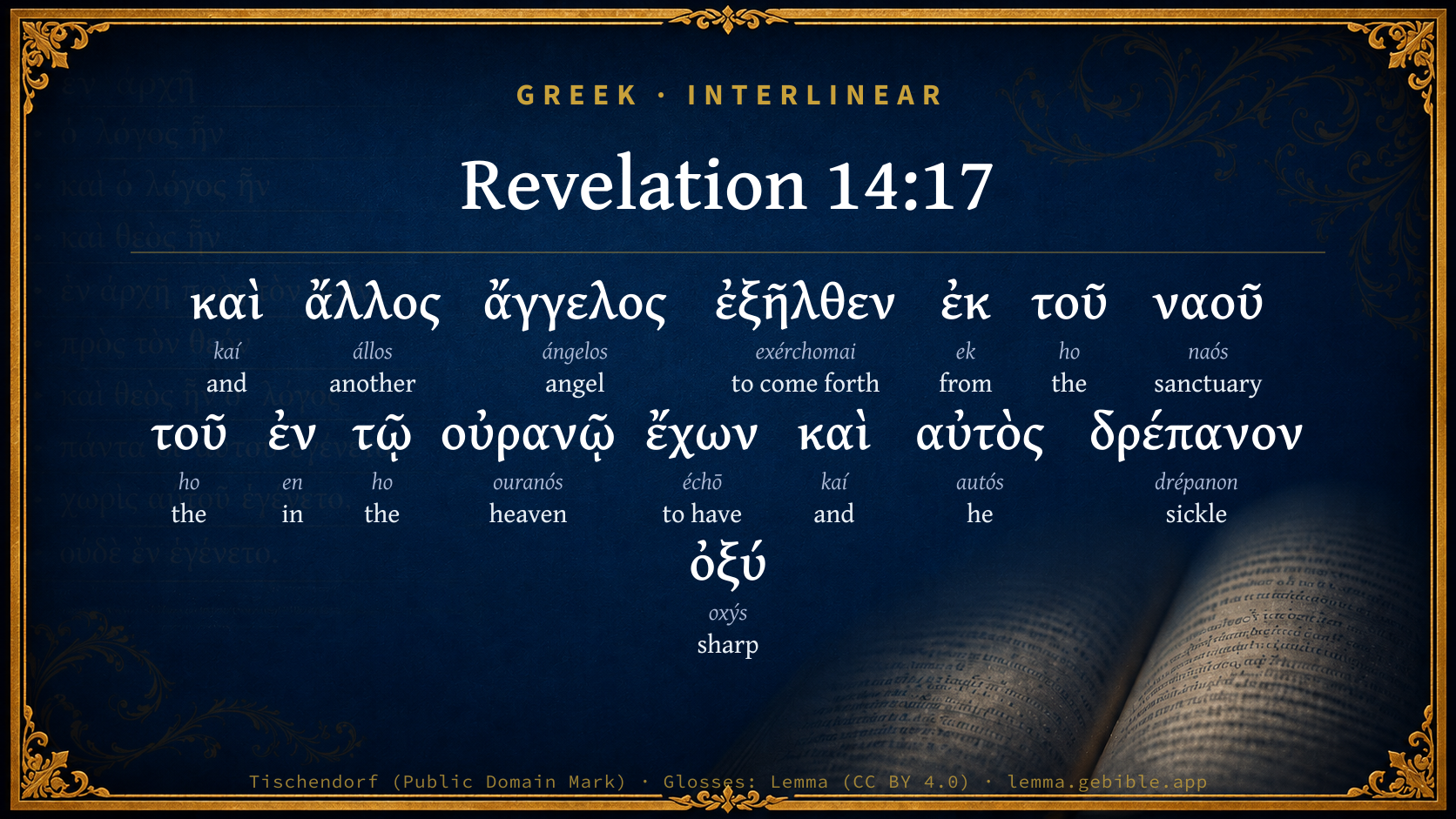
Greek (Tischendorf 8th ed.) Revelation 14:17 appears in the Greek New Testament. The text above is from the Tischendorf 8th edition. Each word links to its Strong’s number and a concise gloss. Click any word for its full Thayer’s Greek Lexicon entry.
Download image
Cite this verse

Revelation 14:17 (World English Bible). Public Domain. Lemma interlinear Bible study tool, https://lemma.gebible.app/v/revelation/14/17.

Show BibTeX & RIS
BibTeX
RIS
English Translation
Another angel came out from the temple which is in heaven. He also had a sharp sickle.
World English Bible · Public Domain
Download a study sheet

One document with this verse’s original text, its word-by-word gloss line, the meaning frame, cross-references with their text, attributed commentary, and full source and license credits — printable, and it pastes into notes with its structure intact.

This verse Autodidact and up

Study sheet (.html) Plain text (.txt)

A passage Seminary Student

Up to 50 verses in one chapter. A passage sheet keeps up to 6 commentary sources and 12 cross-references per verse, in the order this page ranks them, and says so on the sheet whenever that leaves anything out. Ask for a single verse and you get the Autodidact verse sheet above.

Everything on this page stays free to read, with no account — the sheet is a download of what is already on screen, not access to it.

Want to remove ads? Support Godless Engineer
Compare translations 3

The same verse in 3 English versions, stacked beneath the original-language interlinear above. Click any original word for its lexicon entry.

Each is an independent rendering of the whole verse — the interlinear is not word-aligned to these translations.

Highlighted words mark where these versions differ — a whole-verse word diff, not a word-by-word alignment.

  • World English Bible Public Domain
    Another angel came out from the temple which is in heaven. He also had a sharp sickle.
  • King James Version Public Domain
    And another angel came out of the temple which is in heaven, he also having a sharp sickle.
  • unfoldingWord Literal Text CC BY-SA 4.0
    And another angel came out from the temple in heaven, also having a sharp sickle himself.

unfoldingWord Literal Text — © unfoldingWord, licensed CC BY-SA 4.0. Word-aligned USFM3 via Door43 (git.door43.org/unfoldingWord/en_ult).

Versions to compare (up to 4)

3 of 4 selected

Show all 19 translations

Every available English version of this verse, each an independent rendering of the whole verse.

  • World English Bible Public Domain
    Another angel came out from the temple which is in heaven. He also had a sharp sickle.
  • Berean Standard Bible Public Domain
    Then another angel came out of the temple in heaven, and he too had a sharp sickle.
  • Majority Standard Bible Public Domain
    Then another angel came out of the temple in heaven, and he too had a sharp sickle.
  • King James Version Public Domain
    And another angel came out of the temple which is in heaven, he also having a sharp sickle.
  • American Standard Version (1901) Public Domain
    Another angel came out from the temple which is in heaven, he also having a sharp sickle.
  • Revised Version (1885) Public Domain
    And another angel came out from the temple which is in heaven, he also having a sharp sickle.
  • Geneva Bible (1599) Public Domain
    Then an other Angel came out of the Temple, which is in heauen, hauing also a sharpe sickle.
  • Douay-Rheims (1899) Public Domain
    And another angel came out of the temple which is in heaven, he also having a sharp sickle.
  • Young's Literal Translation Public Domain
    And another messenger did come forth out of the sanctuary that `is' in the heaven, having -- he also -- a sharp sickle,
  • Literal Standard Version CC BY-SA 4.0
    And another messenger came forth out of the temple that [is] in Heaven, having—he also—a sharp sickle,
  • Unlocked Literal Bible CC BY-SA 4.0
    Another angel came out from the temple in heaven; he also had a sharp sickle.
  • unfoldingWord Literal Text CC BY-SA 4.0
    And another angel came out from the temple in heaven, also having a sharp sickle himself.
  • Darby Bible Public Domain
    And another angel came out of the temple which [is] in the heaven, he also having a sharp sickle.
  • World Messianic Bible Public Domain
    Another angel came out of the temple which is in heaven. He also had a sharp sickle.
  • Webster's Bible Public Domain
    And another angel came out of the temple which is in heaven, he also having a sharp sickle.
  • Free Bible Version CC BY-SA 4.0
    Another angel came out of the Temple in heaven. He also had a sharp sickle.
  • Bible in Basic English Public Domain
    And another angel came out from the house of God which is in heaven, having a sharp curved blade.
  • Text-Critical English NT CC BY 4.0
    Then another angel came out of the temple in heaven; he too had a sharp sickle.
  • Tyndale New Testament (1534) Public Domain
    And another angell came oute of the temple which is in heven havynge also a sharpe sycle.

Literal Standard Version (2020), Covenant Press — licensed CC BY-SA 4.0. Text via the HelloAO Bible API (eBible.org). Unlocked Literal Bible (unfoldingWord) — licensed CC BY-SA 4.0. Text via the HelloAO Bible API (eBible.org). unfoldingWord Literal Text — © unfoldingWord, licensed CC BY-SA 4.0. Word-aligned USFM3 via Door43 (git.door43.org/unfoldingWord/en_ult). Free Bible Version, Dr. Jonathan Gallagher — licensed CC BY-SA 4.0. Text via the HelloAO Bible API (eBible.org).

Word by word

More ways to search: Search by grammar → Find every occurrence → Compare this word →

Practice this passage: Drill this verse → Learn its vocabulary →

δρέπανον
drépanon
G1407
“sickle”
Noun, Accusative, Singular, Neuter
Part of Speech
Noun
Case
Accusative
Number
Singular
Gender
Neuter
Full Thayer's Definition

Origin: from drepo (to pluck)

TDNT: None

1. a sickle, a pruning-hook, a hooked vine knife, such as reapers and vinedressers use
  1. καὶ kaí G2532 “and” Conjunction
  2. ἄλλος állos G243 “another” Adjective, Nominative, Singular, Masculine
  3. ἄγγελος ángelos G32 “angel” Noun, Nominative, Singular, Masculine
  4. ἐξῆλθεν exérchomai G1831 “to come forth” Verb, Aorist, Active, Indicative, 3rd person, Singular
  5. ἐκ ek G1537 “from” Preposition
  6. τοῦ ho G3588 “the” Article, Genitive, Singular, Masculine
  7. ναοῦ naós G3485 “sanctuary” Noun, Genitive, Singular, Masculine
  8. τοῦ ho G3588 “the” Article, Genitive, Singular, Masculine
  9. ἐν en G1722 “in” Preposition
  10. τῷ ho G3588 “the” Article, Dative, Singular, Masculine
  11. οὐρανῷ ouranós G3772 “heaven” Noun, Dative, Singular, Masculine
  12. ἔχων échō G2192 “to have” Verb, Present, Active, Participle, Nominative, Singular, Masculine
  13. καὶ kaí G2532 “and” Conjunction
  14. αὐτὸς autós G846 “he” Personal pronoun, Nominative, Singular, Masculine
  15. ὀξύ oxýs G3691 “sharp” Adjective, Accusative, Singular, Neuter

About this verse

These counts appear in no published source. They are computed here, from the morphology-tagged text and Lemma’s own curated glosses. What Lemma adds →

16
words
13
distinct lemmas
Revelation
section

Notable vocabulary

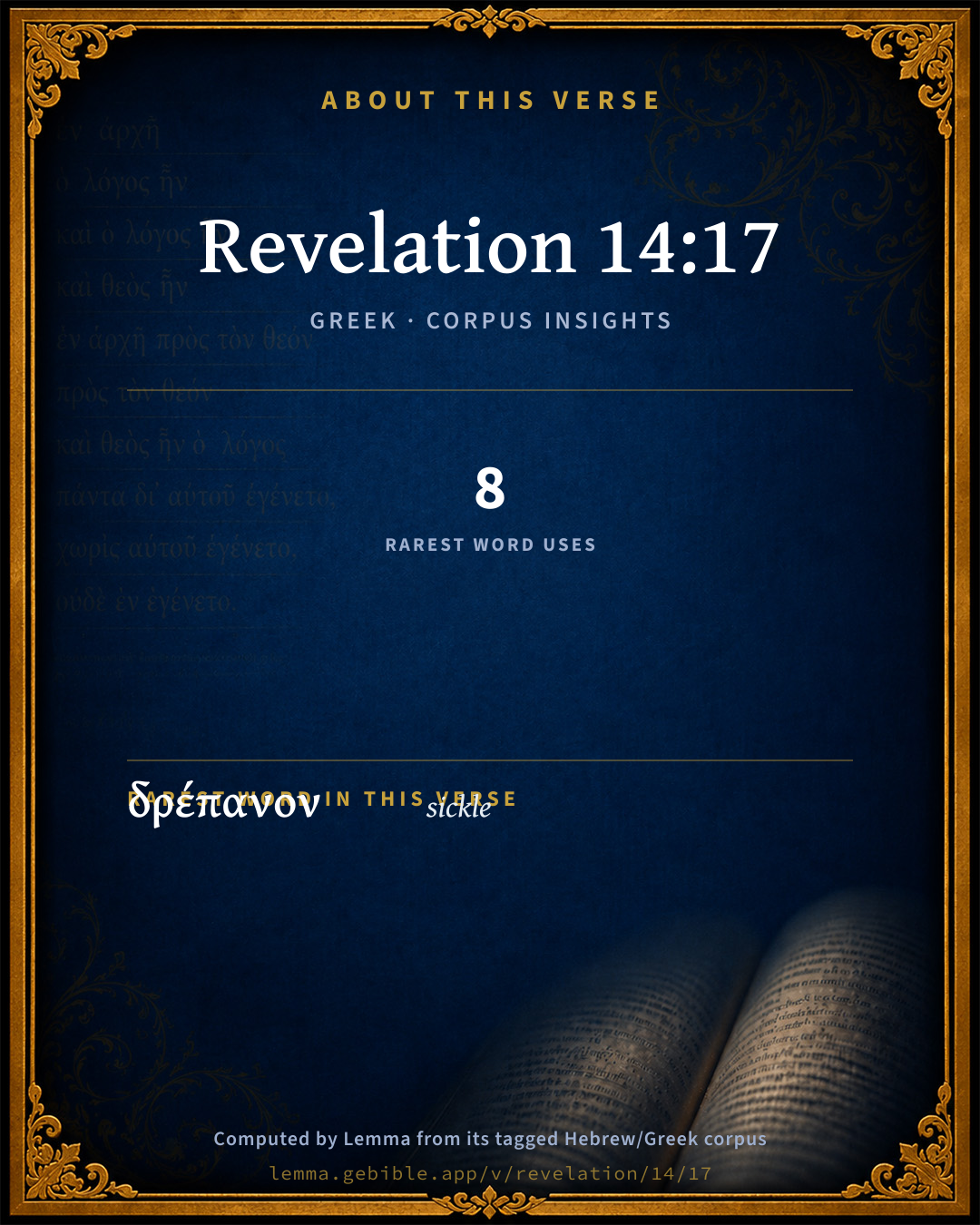
The rarest word here is δρέπανον sickle G1407 — appearing just 8 times in the whole Greek New Testament.

Shared distinctive vocabulary

δρέπανον sickle G1407 occurs in 7 verses of the Greek New Testament. Also found in:

Repetition

Words recur within this verse:

Cross-references

4

Topical passages linked to Revelation 14:17 in the Treasury of Scripture Knowledge — connected by theme and wording, ordered by reader-vote popularity; previews shown in the World English Bible.

  • Revelation 14:14–15 I looked, and behold, a white cloud; and on the cloud one sitting like a son of man, having on his head a golden crown, and in his hand a sharp sickle.
  • Revelation 14:18 Another angel came out from the altar, he who has power over fire, and he called with a great voice to him who had the sharp sickle, saying, "Send forth your sharp sickle, and gather the clusters of the vine of the earth, for the earth's grapes are fully ripe!"
  • Revelation 15:5–6 After these things I looked, and the temple of the tabernacle of the testimony in heaven was opened.
  • Revelation 16:1 I heard a loud voice out of the temple, saying to the seven angels, "Go and pour out the seven bowls of the wrath of God on the earth!"

Cross-references courtesy of OpenBible.info (CC BY 4.0).

Commentary

Notes on Revelation 14:17 from classic Christian and Jewish commentators (each source and its license shown beneath its notes). The classic Christian expositions comment on the surrounding passage and are grouped to its opening verse, so a note may address several verses; the Jewish commentaries on the Tanakh (Rashi and others) are per-verse, so they appear only where the commentator wrote on this verse.

Lemma curates 59 commentaries, every one of them public domain or Creative Commons licensed, each selected and text-cleaned for this edition rather than reprinted as found. About our sources →

Joseph Benson's Commentary

Rev 14:17-20. And another angel came out of the temple which is in heaven — As the former had done; he also having a sharp sickle — To assist in this execution, and finish the destruction of the enemies of the truth. And another angel, just at that instant, came out from the altar — Of burnt-offering, from whence the martyrs had cried for vengeance. Which angel, it is said, had power over fire — This, according to Daubuz, is spoken in allusion to the office of that priest who was appointed by lot in the temple-service to take care of the fire upon the altar, and who was therefore called the priest over the fire. Grotius interprets it, habens ministerium iræ divinæ, having the office of God’s vengeance. And he cried with a loud voice — With great vehemence; to him that had the sharp sickle — Being sent to bring a message to him; saying, Thrust in thy sharp sickle, and gather the clusters, &c. — Begin to put in execution the righteous judgments of God on this wicked generation; for her grapes are fully ripe — The time of God’s vengeance, his appointed time, is fully come, for the iniquities of the inhabitants of the earth have made them fully ripe for destruction. And the angel thrust in his sickle — Immediately upon this order the angel began to cut down those wicked persons whose iniquities had made them ripe for destruction; and gathered — Or lopped off the grapes of the vine of the earth, and cast them into the great wine- press of the wrath of God — Which seemed to stand ready to receive them; that is, delivered them over to divine vengeance, which should press them hard with grievous afflictions, as grapes are pressed in a wine-press. And the wine-press was trodden without the city — The images in this vision are very strong and expressive. The largest wine-presses used to be in some places out of the city. This expression, therefore, seems to intimate the great numbers that should be involved in this general destruction. And the blood came out of the wine-press even unto the horses-bridles, &c. — Which is a strong hyperbolical expression, to signify a vast slaughter and effusion of blood; a way of speaking not unknown to the Jews, for the Jerusalem Talmud, describing the woful slaughter which the Roman Emperor Adrian made of the Jews at the destruction of the city of Bitter, saith, that “the horses waded in blood up to the nostrils.” Nor are similar examples wanting even in classic authors; for Silius Italicus, speaking of Hannibal’s descent into Italy, useth a like expression of “the bridles flowing with much blood.” The stage where this bloody tragedy is acted is without the city, by the space of a thousand and six hundred furlongs, which, as Mr. Mede ingeniously observes, is the measure of stato dello chiesa, or the state of the Roman Church, or St. Peter’s patrimony, which, reaching from the walls of Rome unto the river Po and the marshes of Verona, contains the space of two hundred Italian miles, which make exactly sixteen hundred furlongs.

Joseph Benson's Commentary on the Old and New Testaments (1811–1818) — public domain. Text from a community e-Sword module.

The Preacher's Complete Homiletical Commentary

Joseph S. Exell (gen. ed.)

CRITICAL AND EXEGETICAL NOTES

Rev_14:20. “The number here, four multiplied into itself, and then multiplied by a hundred is symbolical of a judgment complete and full, and reaching to all corners of the earth.”

MAIN HOMILETICS OF THE PARAGRAPH.—Rev_14:17-20

The Harvest of the Earth for Crushing.—The harvest of the earth is not only the ingathering of the saints. It includes the ingathering of those whose earth-lives have been a failure: who have died in their sin; who stand on the earth, in the great reaping day, in their sin. The farmer of the yearly harvest gathers in much besides good wheat: wheat that has gone bad, weeds, and chaff even, with the good wheat. If there is a barn for the good wheat, there is a fire in the field for burning up the bad, the mock wheat, the tares, and the weeds. And this seems to have suggested to the writer his vision of the other side of the last great harvest scene. But, in accordance with the symbolic ideas of the times, he takes the yield of the vines to represent the evil side of earth’s harvest. It is a simple and natural symbol. The corn of the fields is the source of renewed life and health: it is the fitting symbol of the good results of earth’s endeavour. The fruits of the vine have been, in all ages, since Noah stepped forth upon the cleansed earth, the fruitful source of vice, and self-indulgence, and misery, to men. So the clusters of the vine are represented as cast into the winepress, and trodden under foot; crushed down; made by stern discipline to become something other than they are. The men who have come through their earth story self-indulgent, defiant of God, and refusers of His holy gospel, must be gathered in with the stern sickle of the angel, cast like grape-clusters into the great winepress of the wrath of God. What can there be for them in that great day but “indignation and wrath, tribulation and anguish, upon every soul of man that doeth evil?”

I. They who die in their sins are kept for their judgment.—In the indulging of the larger hope that one day all men will be saved, it is forgotten that, through the long ages, men have died in their sins. There is a fact which must be taken into full account. Thousands of completed earth-lives have proved moral failures. Thousands of men now exist somewhere who resisted every good influence, lived without God and without hope in the world, and died in defiant rebellion against the God who made them and the Saviour who redeemed them; crimson-stained in their souls with all the pollutions of earth. They must be in keeping against their judgment day, as truly as the blessed dead are in keeping for their reward. Do we not needlessly confuse ourselves, by regarding the earth-trial of humanity as a perfect and final trial? We expect the results to be perfect, and then set ourselves to invent theories concerning the future, which can have no value, because they have no foundation. We want the issue to be that everybody comes out righteous at last; and Scripture gives no ground whatever for such an interpretation. Our Lord’s parable of the tares should destroy any such ideas once for all. What we need to see is that man is a limited and imperfect being, placed in limited and imperfect circumstances; subjected to a limited and imperfect trial; and the issues will bear the character of the probation, and will include both failure and success. It is not, indeed, a question of it will. It does. Men do come through the probation of the earth-life evil still—worse evil for the misused probation. There must be a judgment day which they are awaiting, when the Divine dealing with their failure must be made known to them and to all; and God must be clearly seen to stand for ever for the right and against the wrong. He must do something with the vintage, as well as with the grain, of the harvest of the earth. What He will do no man knows, or can know. If the discipline of the earth-life has failed to accomplish its due result, they must go into the great winepress of the wrath of God, which must be punishment, need not be destruction, and may be the sterner, harder discipline in new and other spheres.

II. They who stand in their sins are ready for their judgment.—The vision seems to deal with those who are “alive and remain unto the coming of the Lord”; but, by reason of their self-willedness and rebellion, have no interest in, only the dread of, that coming. They are represented by the hanging clusters of over-ripe grapes; their cup of iniquity is full. The angel is bidden, Send forth thy sharp sickle, and gather the clusters of the vine of the earth; for her grapes are fully ripe. Then the number of the wicked, the number of life-failures, will be complete, as the number of the saints—the life-successes, will be complete; and the story of the earth may be wound up. Can we find more fitting words in which to express the result of it all, so far as that result can come into human ken, than the solemn words of our Divine Lord, “And these shall go away into eternal punishment, but the righteous into eternal life”? Can we do any more than wonder, with a great wondering, what can be the lot of the wicked, when that lot is figured so impressively as in this passage: “And the angel cast his sickle into the earth, and gathered the vintage of the earth, and cast it into the winepress, the great winepress of the wrath of God. And the winepress was trodden without the city, and there came out blood from the winepress, even unto the bridles of the horses, as far as a thousand and six hundred furlongs”? Whether, then, we die in our sins, or stand in our sins when God’s harvest-day dawns, there is no escaping the just and fiery indignation. That day will overtake some as a thief. “And many of them that sleep in the dust of the earth shall awake, some to everlasting life, and some to shame and everlasting contempt.”

“Then, O my Lord, prepare

My soul for that great day.

O wash me in Thy precious blood,

And take my sins away.”

The Preacher's Complete Homiletical Commentary (gen. ed. Joseph S. Exell; Funk & Wagnalls, c. 1892) — public domain (pre-1929). A full-Bible homiletical/sermon-outline anthology covering 65 of 66 books (2 John is absent from the source module). Text from a community e-Sword module.

Meyer's Critical & Exegetical Commentary

Heinrich August Wilhelm Meyer

Rev_14:17-20. Another angel,[3555] likewise coming from the heavenly temple, and therefore from God himself, intrusted with a work symbolizing the final judgment, has, as one like the Son of man (Rev_14:14), a sharp sickle, by which the ripened clusters in the vineyard of the earth are to be harvested. Not only does this occur at the command brought again by another angel, but the clusters are also pressed.

[3555] Cf. Rev_14:15.

καὶ αὐτός. The formula[3556] marks only that the same thing is said by this person as by the person designated in Rev_14:14; but in other respects the persons are by no means put on the same level,[3557] so that it does not follow from Rev_14:17 that the one like the Son of man is an angel. Still less, however, can it be inferred to the contrary, from Rev_14:14, that the ἄγγελος (Rev_14:17) is not an angel, but the Lord himself.[3558]

The other angel (Rev_14:18), who brings to the one mentioned in Rev_14:17 the command for harvesting the vineyard of the earth, is in a twofold respect significantly characterized, according to his place of starting: ἐξῆλθεν ἐκ τοῦ θυσιαστηρίου, and according to his peculiar power: ὁ ἔχων ἐξουσίαν ἐπὶ τοῦ πυρός. He came forth out of the altar.[3559] This idea is derived from the ἐκ, which is to be rendered here from,[3560] as little as the ἀπό in Rev_9:13. Its meaning is to be derived from the description (Rev_8:3 sqq.),[3561] in connection with the designation of the ἐξουσία which the angel has over fire.[3562] The same altar beneath which the souls of the martyrs lie, crying for vengeance, and from which not only the fire is taken which, cast upon the earth, gives the signal in general for the trumpet-visions announcing the beginning of the vengeance, but whence, also, in the sixth trumpet-vision especially, the voice sounds that calls forth a destructive army upon the earth, appears significantly in this passage as the proper place of an angel who transmits the command for the execution of judgment, and who, since he has power over fire,[3563] manifests himself as one whose sending brings an answer to the prayers of the martyrs, and thus, by his entire manner and appearance, recalls the blood-guilt of the enemies whose blood is now to cover the earth (Rev_14:20).

ΤΡΎΓΗΣΟΝ. Luk_6:44.

ΚΑῚ ἜΒΑΛΕΝ, Κ.Τ.Λ., Rev_14:19. Cf. Rev_14:16. Here, however, the figure is not limited to the mere cutting-off of the clusters, but the pressing also follows: ΚΑῚ ἜΒΑΛΕΝ ΕἸς ΤῊΝ ΛΗΝῸΝ Τ. ΘΥΜ. Τ. Θ. ΤῸΝ ΜΕΓ. In reference to the remarkable combination of the masc. ΤῸΝ ΜΕΓ. with the fem. ΤῊΝ ΛΗΝ,[3564] cf. Winer, p. 490, who explains the masc. by the fact that ὁ λην. also occurs. But a reason why this change of the gen. has happened is scarcely to be found. At all events, Pro_18:14 should be recalled, where the word רוּח occurs first as masc. because the spirit appears in more forcible activity, and afterwards as fem., because, since it suffers from disease, it is represented in feminine weakness. So, too, the masc. τόν μέγ. could be attached to the ordinary feminine form τὴν λην., because this form appears appropriate to the representation of the wrath of God as active in the pressing.

καὶ ἐπατήθη ἡ λην. The standing expression: cf. Joe_3:13; Isa_63:2 sq.

ἔξωθεν τῆς πόλεως. The city, without further designation, cannot be Rome,[3565] but only Jerusalem; yet not the heavenly Jerusalem,[3566] also not Jerusalem so far as the holy city represents the Church,[3567] but the real, earthly Jerusalem, against which, as is stated in Rev_20:9, the hosts of the world rush, but will be annihilated there before the holy city.[3568] Incorrectly, Grotius: This did not occur in the city, because there were no Jews there.[3569]

αἰμα. In Isa_63:3, LXX., the blood is also expressly mentioned, which is properly meant by the figure of the juice of grapes.

ἄχρι τῶν χαλινῶν τῶν ἰππων, κ.τ.λ. How fearful the bloodshed is, is illustrated by designating it as a stream of blood which is so deep as to reach to the reins of the horses wading therein, while its extent is given as sixteen hundred furlongs.[3570] In this sense, the first expression, ἄχρι τ. χαλ. τ. ἵππ., is understood by almost all expositors;[3571] but the reference to the extent of the stream of blood is not without difficulty. Passing by purely arbitrary explanations,[3572] only two possibilities are offered: either the designation of the measure must be regarded as schematical, whether it depend upon the adoption of an hyperbole not to be urged with respect to details,[3573] or the number four[3574] be considered as a root, and then the number 1,600 reduced to 4 × 4 × 100,[3575] or 40 × 40,[3576] or 4 × 400,[3577] be taken in the sense which Victorin.[3578] and Beda already have; or the sixteen hundred furlongs must be understood accurately and properly, so that the length of Palestine is designated,according to the statement of Jerome, who[3579] says: From Dan to Beersheba, which is extended scarcely to the distance of clx. miles. In accordance with this are the explanations not only of Eichh., Heinr., Züll., Ewald, etc., who[3580] maintained that the scene of Rev_14:20 is in the Holy Land, but also of C. a Lap., etc., who understand by the Holy Land the Church; and of Grot. and Beng., who, in a different respect, wanted to reach the meaning that the bloodshed occurred even beyond the boundaries of Palestine.[3581] But the entire explanation, based upon the statement of Jerome, is hardly tenable, because, if John had wished, by means of a geographical designation of length, to refer to the Holy Land, the number must have been accurate. But this is not the case; for, as a Roman mile contained eight furlongs,[3582] the one hundred and sixty Roman miles of Jerome would correspond to twelve hundred and eighty, but not to sixteen hundred stadia.[3583] It is highly probable, therefore, that the schematic number, which is intended to represent the vast extent of the stream of blood proceeding from the horns of the altar, has grown in a similar way from the number four, which refers to all four ends of the earth,[3584] to that in which, in Rev_7:4, Rev_14:1, the number one hundred and forty-four thousand has been developed from the holy radical twelve.

[3556] Cf. Rev_14:10.

[3557] De Wette.

[3558] Against Hengstenb.

[3559] Mentioned in Rev_8:3 sqq., Rev_16:7.

[3560] Ew. i., De Wette, Ebrard.

[3561] Cf. Rev_6:9, Rev_9:13, Rev_16:7.

[3562] ἐπὶ τ. πυρ., as Rev_11:6; cf. Rev_6:8.

[3563] Viz., of that altar; cf. Grot., Vitr., Ewald; but not over fire in general (cf. Rev_16:5), for this general reference is here entirely out of place.

[3564] The MSS. allow neither τὸν λην.

τὸν μέγ., nor τὴν λην.

την μεγ. ἡ λην. occurs also in Rev_14:20; Rev_19:15. Lücke (Einl., II., p. 464) regards it possible, even though very harsh, for the τον μἐγαν, by a construction according to the sense, to refer to τοῦ θυμοῦ τ. θ., and to have the meaning of τοῦ μεγάλου. Yet he also recurs to Winers explanation.

[3565] Hammond, Wetst., Calov., Hilgenf., Kienlen, etc.

[3566] Beda, Marlorat., who recall that the lost shall suffer pain outside of heaven, viz., in hell.

[3567] Hengstenb.: It is declared that not the members of the Church, but the world outside the Church, shall be judged.

[3568] Cf. Eichh., Züll., Ew., De Wette, etc.

[3569] Cf. the close of the verse.

[3570] On the ἀπὸ before σταδ., cf. Meyer on Joh_11:18.

[3571] Nevertheless, many of the older commentators have allegorized also here. Thus Victorin. found it indicated that also the princes, Beda that even the devil, would not be exempt. Hengstenb., incorrectly, brings in the horsemen of Rev_19:14. Cf. Ebrard.

[3572] e.g., Wetst., who referred it to the vastness of Othos camp on the Po.

[3573] Zeger.

[3574] Cf. Rev_7:1.

[3575] Hengstenb.

[3576] Ebrard.

[3577] Marlorat., Vitr., etc.

[3578] Throughout all the four parts of the world.

[3579] Ep. ad Dard. Opp., T. III., p. 46.

[3580] Cf. the ἐξ τ. πὁλεως.

[3581] Grot. refers to the fact that Trajan put to death Jews in Syria, Egypt, etc.

[3582] Cf. Winer, Rwb., II. 588. Stadium.

[3583] Another circumstance is, that the length of the Holy Land is not sixteen hundred stadia, i.e., forty German miles, but, as Jerome correctly says, scarcely one hundred and sixty Roman miles, i.e., thirty-two German miles.Ew. ii., indeed, tries to find in the text only a large round number, by mentioning at the same time, that clusters of grapes appear, e.g., on coins, as a symbol of the Holy Land. But he errs in finding a devastation of the Holy Land here set forth,while the subject has really to do with the inhabitants of the earth, whose place of execution, as in Rev_20:9, is outside the city, and, therefore, in the Holy Land,and in urging the special reference of the cluster of grapes to the Holy Land; and thereby injures the parallelism between the harvest, Rev_14:15 sqq., and the wine harvest, Rev_14:18 sqq., which then affords only a more general significance.

[3584] Cf. Rev_4:6.

In the systematic connection of the entire Apocalyptic development, the vision (Rev_14:14-20) has the same relation to the express description of the actual final judgment (ch. 17 sqq.), as the sixth seal-vision (Rev_6:12 sqq.) has already to the fulfilment of the mystery of God,[3585] which does not occur until in the seventh seal. Both the sense and the expression[3586] show that the judgment portrayed in Rev_14:14 sqq. is the final judgment itself; this is indicated also by the appearance on the cloud of one like the Son of man (Rev_14:14), and therefore of the coming Judge himself, besides the special point in Rev_14:20 (ἔξ. τ. πολ.) comprised in the account of Rev_20:9. But, on the other hand, it is to be observed that a complete account of the catastrophe is not yet given; in what way the various enemies (the secular power, the false prophet, even the dragon himself) are judged, is not at all described here; add to this, that the manifestation of the Judge (Rev_14:14-17) does not at all correspond with what is to be expected according to Rev_1:7,[3587] and that immediately afterwards, in Rev_14:19 sqq., it is an angel, and not the Lord himself, who appears as executor of the vengeance. From all this, it is to be inferred that the vision (Rev_14:14-20)[3588] brings, it is true, a preliminary representation of the final judgment, but, nevertheless, that the systematic introduction of the complete account is not disturbed; because of its proleptical character, the scheme of the prophetical development does not become apparent, and especially the actual end is not set before us in Rev_14:20, in the sense, as though by recapitulating in some way with Rev_15:1,[3589] it were again retraced.[3590]

Vitr. interprets Rev_14:14-20 of the judgment of the false (i.e., the Papal) Church.

[3585] Cf. Rev_10:7.

[3586] Rev_14:16 : ἐθερίσθη; Rev_14:19 : ἐτρύγησε, ἔβαλεν; Rev_14:20 : ἐπατηθη.

[3587] Cf. Rev_6:2; Rev_6:12 sqq., Rev_11:15 sqq.

[3588] Cf. also Rev_14:1-6.

[3589] Cf. Introduction, p. 13 sq.

[3590] Against Beda, etc.

Meyer — Critical and Exegetical Commentary on the New Testament — English translation by Peter Christie, edited by Frederick Crombie (T&T Clark, 1880) — public domain. Text from a community e-Sword module.

Geneva Bible (1599)

Geneva Bible translators

The other type (as I said, verse14) is the vintage: the manner whereof is one with that which went before, if thou except this, that the grape gathering is more exact in seeking out everything, than is the harvest labor. This is therefore a more grievous judgment, both because it succeedeth the other, and because it is understood to be executed with great diligence.

Geneva Bible (1599) marginal notes — public domain. Text via Bolls.life.

Jamieson, Fausset & Brown

Robert Jamieson, A. R. Fausset & David Brown

out of the temple . . . in heaven-- (Rev 11:19).

Jamieson, Fausset & Brown — Commentary Critical and Explanatory on the Whole Bible (1871) — public domain (CC PDM 1.0). Text via the HelloAO Bible API.

John Gill's Exposition

And another angel came out of the temple which is in heaven,.... It is a strange conceit of Mr. Brightman's, that this angel is Thomas Lord Cromwell, in the days of King Henry the Eighth, a sincere favourer of pure religion; and that the following angel is Thomas Cranmer, archbishop of Canterbury, a martyr, that had power over fire; and that the vintage, here spoken of, refers to the destroying of religious houses, and disposing of abbey lands to other uses; which was done under the king's authority, by the former of these, at the instigation of the latter, when those who were set over that business made such havoc of the goods of the Papists, that their houses seemed to swim in their spoils, as in a river of pressed grapes. Dr. Goodwin much better interprets it of God's vengeance upon the carnal Protestants and professors of religion; since it is an angel out of the temple that will execute it, and another from the altar, zealous of God's worship, that will provoke to it; and since the winepress will be trodden without the city, the church; and which began in the wars in Germany, in the last age, and will have its full accomplishment when the whole outward court is given to the Gentiles; but how these, who are but a few, when compared with the wicked of the world, should be called the vine of the earth, I see not. Mr. Daubuz thinks this vision of the vintage has had, at least in part, its fulfilment in the late wars in the times of Queen Anne, the Popish countries being then made the seat of war, in which they suffered much; rather they come nearest to the truth of the matter, who take this to be the battle of the great God Almighty, under the sixth vial, Rev 16:14 fought by the word of God, the King of kings, and Lord of lords, who will tread the winepress of the fierceness and wrath of Almighty God, Rev 19:15 when the beast and false prophet will both be destroyed: but inasmuch as Babylon is before declared to be fallen, Rev 14:8 and since the gathering in of the Lord's wheat at the first resurrection is designed by the harvest, it is best to understand this vintage of the perdition of ungodly men by fire, at the conflagration of the world, which will be at the beginning of the thousand years' reign, and of the gathering of them in at the second resurrection, at the end of it, for the destruction of them in hell, soul and body. And by this "angel" is meant, not the saints of the most High; for though they may be said to come out of the temple, the church, and shall judge the world, yet they will not be employed in gathering together the wicked, and casting them into the lake of fire, or winepress of God's wrath: rather the ministering spirits are intended, who are the reapers at the end of the world, and who will gather the wicked, and bind them like tares in bundles, and cast them into the furnace of fire; though it is best to interpret this of Christ himself, who is often called an Angel in Scripture, as the Angel of God's presence; and the Angel of the covenant; and frequently in this book, as in Rev 7:2 because, as Mediator, he is God's messenger; and he may be said to do that, which he does by others, as instruments, as to gather the vine of the earth, and cast it into the winepress; and he may be said to "come out of the temple which is in heaven": whether this be understood of heaven itself, which the temple, and especially the most holy place in it, was a figure of; here Christ is, and from hence he is expected to come, and will come at the last day, as Judge of all the earth; or of the church of God, for here Christ dwells, and grants his gracious and spiritual presence until his second and personal coming, with all his saints: and now he will have them all with him, both quick and dead, and will be personally in his temple, the church, in the great congregation of the righteous, and out from among them will he display his power in the destruction of the wicked; and the rather he may be thought to be intended, since none but a divine person ever trod the winepress of God's wrath; see Isa 63:1 to which may be added what follows,

he also having a sharp sickle; the same who is described as like to the son of man, on a white cloud, with a golden crown on his head, and such a sickle in his hand, Rev 14:14 which is expressive of the same judiciary power and authority.

John Gill's Exposition of the Whole Bible (1746–1763) — public domain (CC PDM 1.0). Text via the HelloAO Bible API.

Trapp's Complete Commentary

John Trapp

17 And another angel came out of the temple which is in heaven, he also having a sharp sickle.

Ver. 17. And another angel] The community of faithful Christians that combine against Antichrist, to pull him out of his throne and cut his comb.

John Trapp, A Commentary or Exposition upon All the Books of the Old and New Testament (1647–1656) — public domain. Text from a community e-Sword module.

Albert Barnes' Notes on the Bible

And another angel - The fifth in order. This angel came for a different purpose - with reference to the cutting off of the enemies of God, represented by the gathering of a vintage. Compare Mat 13:41; Mat 24:31.

Came out of the temple which is in heaven - Sent or commissioned by God. See the notes on Rev 14:15.

He also having a sharp sickle - On the word “sickle,” see the notes on Rev 14:14.

Albert Barnes' Notes on the Bible (1834–1885) — public domain. Text from a community e-Sword/MySword module.

Matthew Poole's English Annotations

This angel some will have to be some instrument God would make use of to cut down antichrist: others would have it to be the word of God in the mouth of his ministers, which, Heb 4:12, is sharper than a two-edged sword, piercing to the dividing asunder of soul and spirit; and thus they judge this angel to be the same with the rider upon the white horse, Rev 19:11-21, out of whose mouth went a sharp sword, Rev 14:15.

Matthew Poole's English Annotations on the Holy Bible (1683–1685) — public domain. Text from a community e-Sword/MySword module.

Whedon's Commentary on the Bible

Daniel D. Whedon

17. And—The misty forms of the white cloud, its occupant, and the harvest field, have all instantly disappeared. But a second and more terrible, though equally transient, volume of the sky-picture appears in its place to complete the series of omens. To the harvest of wrath succeeds the vintage of blood. By the phrase temple in heaven Dusterdieck and Alford are somewhat nonplussed. The word heaven means, as often elsewhere, the firmamental heaven, (note Rev_4:11,) or sky. And the simple meaning is, that a visional temple, with its altar, outlined itself in the sky-vision as part of the omen scenery.

Angel… sharp sickle—The Lord of the harvest has reaped the grain; but leaves to his servants the treading of the bloody winepress. The blood-red colour of the juice of the grape suggests the thought of carnage; and the pressure by which it is crushed out suggests the wrath that compels the carnage. The image is taken from Isa_63:3, where Jehovah’s treading the winepress and pouring forth the blood of the grape, is an image of the crushing of the wicked powers in behalf of his people.

Daniel D. Whedon (gen. ed.), Commentary on the Old and New Testaments (1874–1909) — public domain. Text from a community e-Sword module.

The Pulpit Commentary

And another angel came out of the temple which is in heaven, he also having a sharp sickle; from the shrine, or sanctuary (as before, see on ver. 15), the dwelling place of the undivided Trinity, from whence come God"s judgments. (Alford; cf. Rev_11:19)

The Pulpit Commentary (1880–1919), ed. H.D.M. Spence-Jones & Joseph S. Exell — public domain. Text from a community e-Sword module.

Scofield Reference Notes

C. I. Scofield

angel

(See Scofield "Heb 1:4").

The Scofield Reference Bible (1917 edition), notes by C. I. Scofield — public domain. Text from a community e-Sword module.

Kretzmann's Popular Commentary

Paul E. Kretzmann

The wine-press of God’s wrath:

v. 17. And another angel came out of the temple which is in heaven, he also having a sharp sickle.

v. 18. And another angel came out from the altar, which had power over fire; and cried with a loud cry to him that had the sharp sickle, saying, Thrust in thy sharp sickle, and gather the clusters of the vine of the earth; for her grapes are fully ripe.

v. 19. And the angel thrust in his sickle into the earth, and gathered the vine of the earth, and cast it into the great wine-press of the wrath of God.

v. 20. And the wine-press was trodden with out the city, and blood came out of the wine-press, even unto the horse-bridles, by the space of a thousand and six hundred furlongs.

See Isa 63:4-6. This picture carries the same idea as the previous one, but instead of the harvest of grain we have here the harvest of grapes: And another angel came out of the temple which is in heaven, he also having a sharp sickle; and still another angel came out of the altar, having power over the fire, and he shouted with a loud voice to him that had the sharp sickle, saying, Send forth thy sharp sickle and cull the grape-clusters from the vine of the earth, for its grapes have matured. Here the fire of God’s wrath, of God’s Judgment, is in evidence. The final Judgment will not be a partial judgment, but will strike fruit, branches, stem, and roots. Not only the grapes are gathered, but all the shoots and branches are cut off. The fruit of sin and unbelief has reached its full maturity, the patience of the Lord is exhausted.

The result is pictured in a scene which is almost ghastly in its vividness: And the angel cast his sickle on the earth and harvested the vine of the earth, and threw it into the great wine-press of the wrath of God; and the winepress was trodden outside of the city, and there came out blood from the wine-press up to the bridles of the horses. a space of a thousand six hundred stadia. This is the second death. Outside of the city of God, the Church of Christ, the heavenly Jerusalem, is the place of wrath. There the grapes that have grown in the soil of the spiritual Sodom and Gomorrah are pressed out. The battle is won. The blood of the enemies flows forth in a stream like an immense flood, measuring, since a stadium is between 600 and 625 feet, almost two hundred miles in width, with a depth of about five feet. The victory of the Lord is complete, His righteous wrath is punishing the unbelievers and scoffers with an eternal punishment.

Summary

In a series of pictures the seer shows the bliss of the perfected saints, the work of the Reformation, and the final harvest of the wrath of God upon the unbelievers.

Paul E. Kretzmann, Popular Commentary of the Bible (1921–1924) — public domain. Text from a community e-Sword module.

Burkitt's Expository Notes on the New Testament

William Burkitt

In the former verses we meet with the metaphor of an harvest, in these we meet with that of a vintage; there the wicked were compared to rice corn fit for the harvest, here to ripe grapes fit for the winepress; signifying by both, that the wicked, by filling up the measure of their sins, do make themselves ripe and ready for judgment.

Note here, 1. That as the true church is called a vine, so is the wicked antichristian church here called; but with this addition, a vine of the earth, cleaving to, and only favouring of, the earth; a good name will signify little in judgment; to be called Christians, virgins, &c. what will it profit, without burning and shining lamps?

Note, 2. Whereas the grapes of this vine are said to be not only ripe, but fully ripe, how great is the forbearance and long-suffering of God towards to wicked! Maximum miraculum est Dei longanimitas, the patience of God towards sinners is the greatest miracle in the world: but though lasting it will not be everlasting; when long abused, it turns at last into fury; ripening in sin, is a sure prognostication of judgment at hand.

Note, 3. The vine with all its clusters are gathered, small and great, one and another, all shall appear before the bar of Christ, Rev 20:12 I saw the dead small and great stand before God: and the books were opened, and the dead were judged out of those books.

Note, 4. Whither this degenerated vine, with all its clusters, was cast, namely, into the wine-press of God’s wrath, which is called a great wine-press, because it can contain all the wicked; it will hold them all, be they never so many; and is said to be trodden, that is, by Christ, denoting the severity of that vengeance which will be inflicted upon sinners; the grapes which have hung a long time ripening in the sun are severely pressed at last.

Note, 5. That the blood which came out of the wine-press (the blood of the grape) was so much in quantity, that it came up the the horses’ bridles, by the space of a thousand and six hundred furlongs; all metaphorical expressions, signifying that wine is the wrath of God, and the cup of his indignation; and the hyperbolical expression of its height, reaching as high as the horses’ bridles; and of its length, reaching more than a thousand furlongs, shows that mighty deluge and inundation of God’s wrath, which the wicked in general, and all Antichrist’s followers in particular, shall not only drink of, but swim in: and as they shed the blood of the saints abundantly, in like manner God will give them blood to drink in great abundance.

Note lastly, That although these two metaphors of the harvest and the vintage signify one thing, only the vision is doubled, like Pharaoh’s dream, to show the certainty thereof, yet we may conceive that the similitude of a vintage here holds forth greater judgment than the harvest: Almighty God, in his providential dispensation towards the wicked, proceeds gradually; as they proceed from one degree of wickedness, so does he from one degree of wrath and vengeance, to another; the vintage follows the harvest, the sharp sickle follows the sickle, the harvest is said to be ripe, the vintage to be fully ripe; if the flood of God’s anger in this life will not wash sinners clean, the deluge of his wrath in the next will wash them quite away: Blood came out of the wine-press, even to the horses’ bridles, by the space of a thousand and six hundred furlongs.

Eternal thanks to Christ the Lamb, who has delivered his from this dreadful wrath to come!

William Burkitt's Expository Notes on the New Testament (1700–1703) — public domain. Text from a community e-Sword module.

The People's New Testament

B. W. Johnson

17–20. Another angel came out of the temple which is in heaven, he also having a sharp sickle. The ripened harvest of the saints has been gathered first. That was symbolized in verses 14–16. The gathering of the wicked to judgment is now shown in the symbols. Another angel comes forth with a sickle in his hand. Christ, by his angels, was the great reaper of the righteous harvest. They that are Christ's are gathered by him at his coming, but the wicked are gathered by another, here presented as an angel reaper.

B. W. Johnson's The People's New Testament with Notes (1889–1891) — public domain. Electronic text from the Christian Classics Ethereal Library (CCEL) ThML edition.

unfoldingWord translationNotes

Door43 World Missions Community

Connecting Statement:

John continues describing his vision about the earth being harvested.

who had authority over the fire

Here "authority over" refers to responsibility to tend the fire.

translationWords

angel

temple

heaven

altar

authority

fire

voice

grape

vine

unfoldingWord translationNotes — © Distant Shores Media and the Door43 World Missions Community, licensed CC BY-SA 4.0. Source: git.door43.org/Door43/en_tn.

Cambridge Greek Testament for Schools and Colleges

17. ἅλλος ἄγγελος. It is a possible view that he gathers the grapes for the Reaper to tread.

Cambridge Greek Testament for Schools and Colleges (Cambridge University Press, 1896; 21 vols, various authors incl. Carr, Maclear, Plummer, Farrar, Lumby, Moule, M. R. James, Simcox) — public domain. Text from a community e-Sword module.

Alford’s Greek Testament

Henry Alford

17-20.] The vintage of wrath. And another angel (the ἄλλος may perhaps refer to the three angels who have already appeared in this vision: or, which is more probable, referring to the last-mentioned Agent, may be a general term, not necessarily implying that He was a mere angel) came out from the temple which was in heaven (from which come forth God’s judgments: see ch. 11:19), having himself also (as well as that other: but the καὶ αὐτός rather raises a distinction between the two personages than sets them on an equality: there is some slight degree of strangeness, after what has gone before, in this angel having a sickle) a sharp sickle. And another angel came out from the altar (viz. that elsewhere several times mentioned, ch. 6:9, 8:3, 16:7, in connexion with the fulfilment of God’s judgments in answer to the prayers of His saints), he who hath power over the fire (viz. that on the altar; the same angel who is introduced ch. 8:3-5 as presenting the prayers of the saints, and casting some of the fire of the altar to the earth as introductory to the judgments of the trumpets), and he cried with a great cry to him who had the sharp sickle (it is to be observed that the whole description of this angel, coming from the altar of vengeance, differs widely from any thing in the former part of the vision, and favours the idea that this vintage is of a different nature from that harvest), saying, Put in thy sharp sickle, and gather the bunches of the vine of the earth, because her grapes are ripe. And the angel (no such expression is used above, ver. 16. There it is ὁ καθήμενος ἐπὶ τῆς νεφέλης. All these signs of difference are worthy of notice) put in (reff.) his sickle into the earth, and gathered the vine of the earth, and cast (viz. what he had gathered) into the great winepress of the wrath of God (the curious combination, τὴν ληνὸν … τὸν μέγαν, is only to be accounted for by an uncertainty in the gender of the substantive (it is masc. Gen 30:38, Gen 30:41 ed. Rom. See Winer, edn. 6, § 59. 4, b), and perhaps a tendency, when emphatically subjoining an epithet describing greatness, to substitute the worthier gender.

Any thing corresponding to this feature is entirely wanting in the previous description of the harvest. See on it, ch. 19:15, and the prophetic passages in reff. especially Isa. from which the symbolism comes). And the winepress was trodden (reff.) outside the city (see below), and blood (so Isa 63:3) came forth from the winepress as far as to the bits of the horses, to the distance (ref.) of a thousand six hundred stadii (it is exceedingly difficult to say what the meaning is, further than that the idea of a tremendous final act of vengeance is denoted. The city evidently = ἡ πόλις ἡ ἔξωθεν of ch. 11:2 (not that of ib. 8, see note there), viz. Jerusalem, where the scene has been tacitly laid, with occasional express allusions such as that in our ver. 1. The blood coming forth from the treading of the winepress is in accordance with the O. T. prophecy alluded to, Isa 63:3. It is in the depth, and the distance indicated, that the principal difficulty lies. The number of stadii is supposed by some to be the length of the Holy Land as given by Jerome (Ep. (cxxix.) ad Dard., 4, vol. i. p. 971) at 160 Roman miles. But the great objection to this is, that 160 miles = 1280, not 1600 stadii. Another view has been, that 1600 has been chosen as a square number, = 40 × 40, or 4 × 400, or 4 × 4 × 100. Victorinus explains it “per omnes mundi quatuor partes: quaternitas enim est conquaternata, sicut in quatuor faciebus et quadriformibus et rotis quadratis.” He gives a very curious interpretation of the depth,—“usque ad principes populorum.” We may fairly say, either that the number is assigned simply to signify completeness and magnitude (in which case some other apocalyptic numbers which have been much insisted on will fall perhaps under the same canon of interpretation), or else this is one of the riddles of the Apocalypse to which not even a proximate solution has ever yet been given).

Henry Alford, The Greek Testament (1849–1861) — public domain. Text from a community e-Sword module.

Vincent's Word Studies in the New Testament

Marvin R. Vincent

Temple [ναου] . Properly, sanctuary. See on Mt 4:5.

Marvin R. Vincent, Word Studies in the New Testament (1887–1900) — public domain. Text from a community e-Sword/MySword module.

Lesson kit

Teaching starters — assembled from the data on this page, not authored interpretation. Every prompt links to the verse data it draws on. Edit before teaching.

Revelation, in the Revelation, opens this verse with 16 words (13 distinct Greek lemmas). Its most distinctive word is drépanon (“sickle”). A historical commentator’s framing appears above. Read the whole chapter for the surrounding context.

Discussion questions

  1. How does “sickle” (drépanon) shape what this verse is saying?
  2. Mark 4:29 shares the word «sickle» with this verse. How do the two illuminate each other?
  3. “the” occurs 3× in this one verse. What is the effect of the repetition?
  4. These translations render this verse differently; the difference is in the English rendering, not the original. What questions does that raise?
  5. Reading how Joseph Benson's Commentary and The Preacher's Complete Homiletical Commentary read this verse, where do the two commentators agree and where do they part?

Things to notice

Reading settings

Reading text

Shown beneath each verse's original-language words.

Old Testament
Old Testament edition

Read the OT as the Masoretic Hebrew (MT) or the Greek Septuagint (LXX).

English shown for the Greek Septuagint (in the Hebrew ↔ Greek comparison).

Comparing translations? Open the Compare panel on any verse page to stack up to four side by side.