
Revelation 9:14

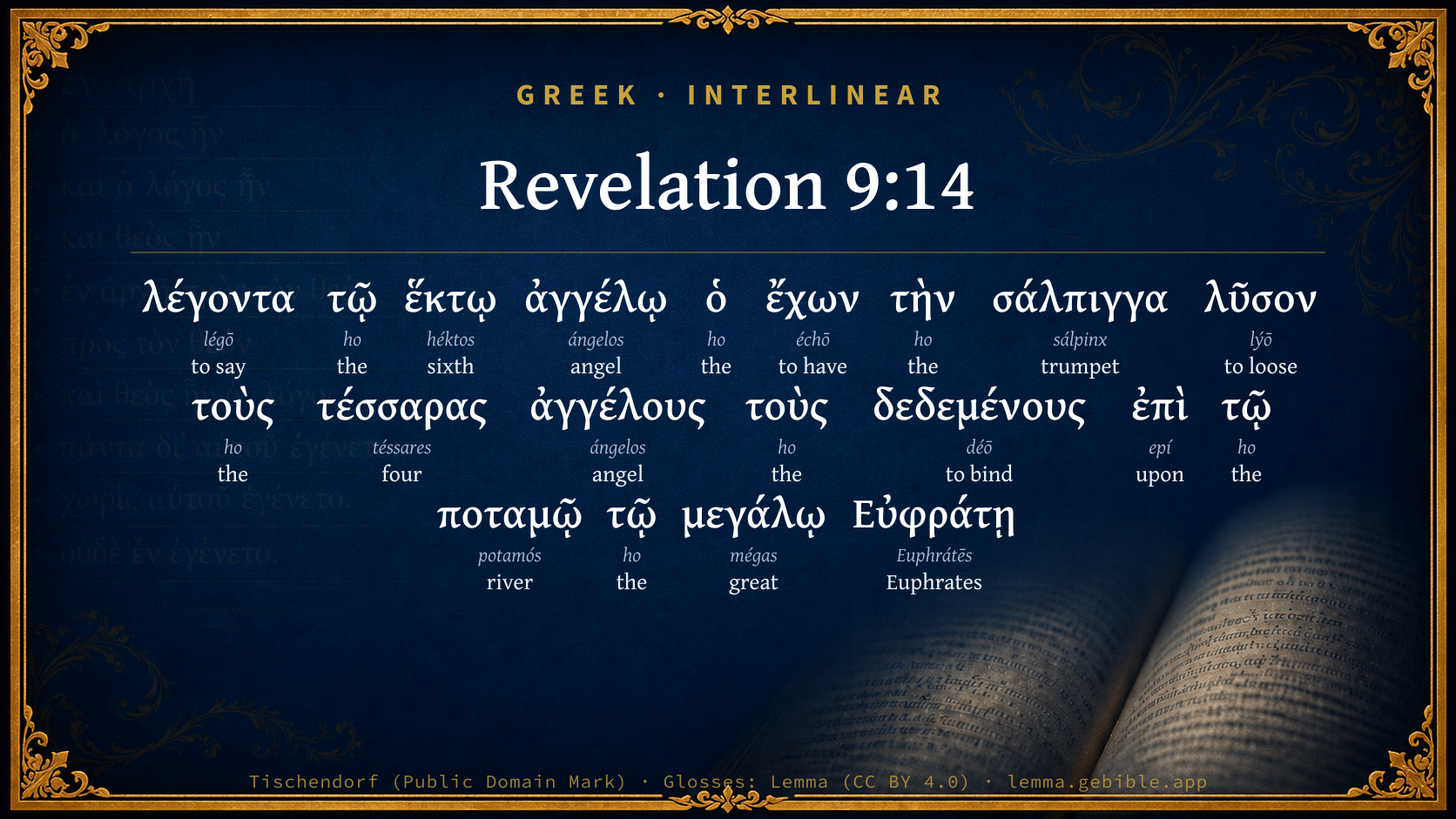
Greek (Tischendorf 8th ed.) Revelation 9:14 appears in the Greek New Testament. The text above is from the Tischendorf 8th edition. Each word links to its Strong’s number and a concise gloss. Click any word for its full Thayer’s Greek Lexicon entry.
Download image
Cite this verse

Revelation 9:14 (World English Bible). Public Domain. Lemma interlinear Bible study tool, https://lemma.gebible.app/v/revelation/9/14.

Show BibTeX & RIS
BibTeX
RIS
English Translation
saying to the sixth angel who had one trumpet, "Free the four angels who are bound at the great river Euphrates!"
World English Bible · Public Domain
Highlights
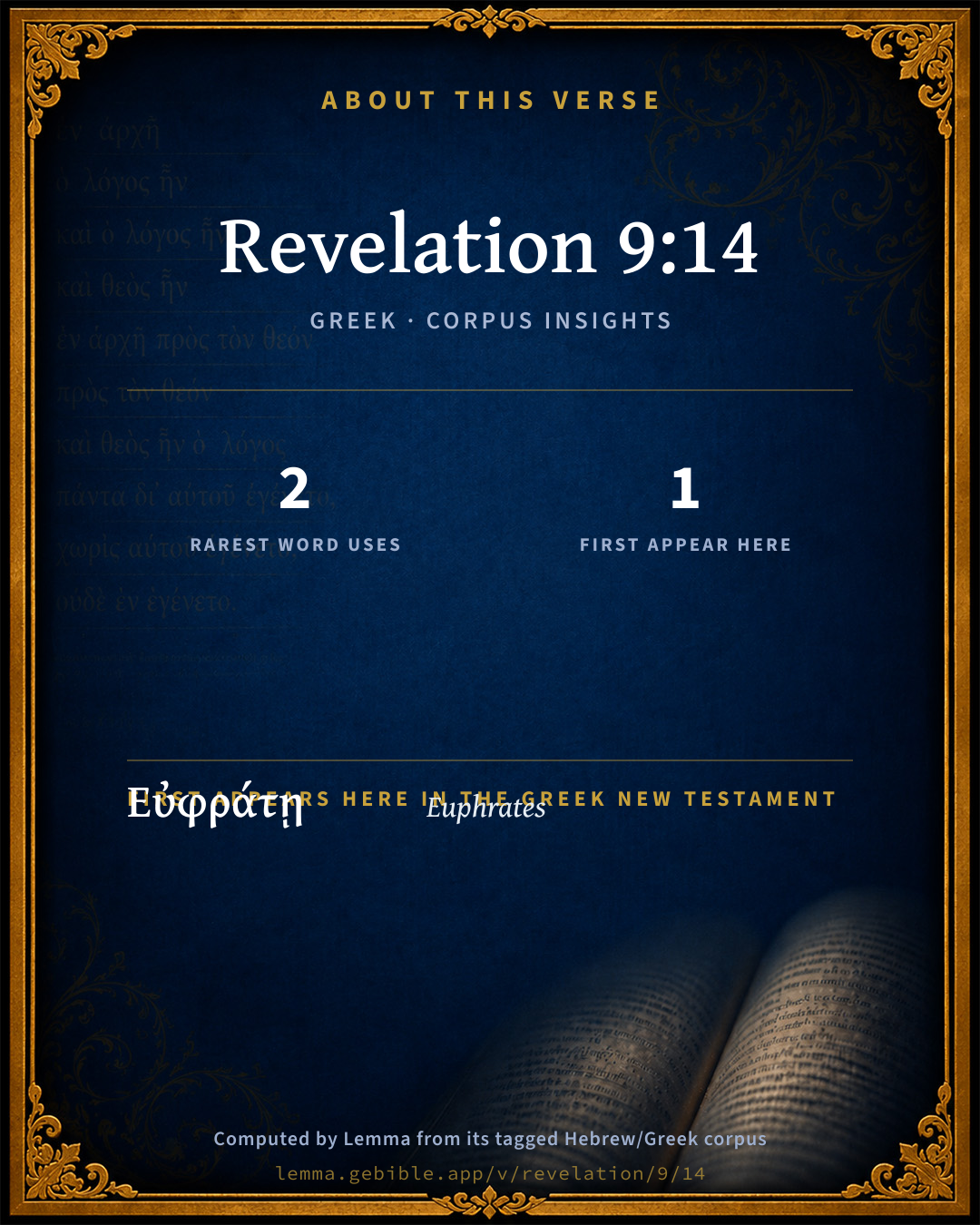
  • 1 first appearance in the Greek New Testament
Full analysis ↓
Download a study sheet

One document with this verse’s original text, its word-by-word gloss line, the meaning frame, cross-references with their text, attributed commentary, and full source and license credits — printable, and it pastes into notes with its structure intact.

This verse Autodidact and up

Study sheet (.html) Plain text (.txt)

A passage Seminary Student

Up to 50 verses in one chapter. A passage sheet keeps up to 6 commentary sources and 12 cross-references per verse, in the order this page ranks them, and says so on the sheet whenever that leaves anything out. Ask for a single verse and you get the Autodidact verse sheet above.

Everything on this page stays free to read, with no account — the sheet is a download of what is already on screen, not access to it.

Want to remove ads? Support Godless Engineer
Compare translations 3

The same verse in 3 English versions, stacked beneath the original-language interlinear above. Click any original word for its lexicon entry.

Each is an independent rendering of the whole verse — the interlinear is not word-aligned to these translations.

Highlighted words mark where these versions differ — a whole-verse word diff, not a word-by-word alignment.

  • World English Bible Public Domain
    saying to the sixth angel who had one trumpet, "Free the four angels who are bound at the great river Euphrates!"
  • King James Version Public Domain
    Saying to the sixth angel which had the trumpet, Loose the four angels which are bound in the great river Euphrates.
  • unfoldingWord Literal Text CC BY-SA 4.0
    saying to the sixth angel, the one having the trumpet, “Release the four angels having been bound at the great river Euphrates.”

unfoldingWord Literal Text — © unfoldingWord, licensed CC BY-SA 4.0. Word-aligned USFM3 via Door43 (git.door43.org/unfoldingWord/en_ult).

Versions to compare (up to 4)

3 of 4 selected

Show all 19 translations

Every available English version of this verse, each an independent rendering of the whole verse.

  • World English Bible Public Domain
    saying to the sixth angel who had one trumpet, "Free the four angels who are bound at the great river Euphrates!"
  • Berean Standard Bible Public Domain
    saying to the sixth angel with the trumpet, “Release the four angels who are bound at the great river Euphrates.”
  • Majority Standard Bible Public Domain
    saying to the sixth angel with the trumpet, “Release the four angels who are bound at the great river Euphrates.”
  • King James Version Public Domain
    Saying to the sixth angel which had the trumpet, Loose the four angels which are bound in the great river Euphrates.
  • American Standard Version (1901) Public Domain
    one saying to the sixth angel that had one trumpet, Loose the four angels that are bound at the great river Euphrates.
  • Revised Version (1885) Public Domain
    one saying to the sixth angel, which had the trumpet, Loose the four angels which are bound at the great river Euphrates.
  • Geneva Bible (1599) Public Domain
    Saying to the sixt Angel, which had the trumpet, Loose the foure Angels, which are bound in the great riuer Euphrates.
  • Douay-Rheims (1899) Public Domain
    Saying to the sixth angel, who had the trumpet: Loose the four angels, who are bound in the great river Euphrates.
  • Young's Literal Translation Public Domain
    saying to the sixth messenger who had the trumpet, `Loose the four messengers who are bound at the great river Euphrates;'
  • Literal Standard Version CC BY-SA 4.0
    saying to the sixth messenger who had the trumpet, “Loose the four messengers who are bound at the great river Euphrates”;
  • Unlocked Literal Bible CC BY-SA 4.0
    The voice said to the sixth angel who had the trumpet, “Release the four angels who are bound at the great Euphrates River.”
  • unfoldingWord Literal Text CC BY-SA 4.0
    saying to the sixth angel, the one having the trumpet, “Release the four angels having been bound at the great river Euphrates.”
  • Darby Bible Public Domain
    saying to the sixth angel that had the trumpet, Loose the four angels which are bound at the great river Euphrates.
  • World Messianic Bible Public Domain
    saying to the sixth angel who had the shofar, “Free the four angels who are bound at the great river Euphrates!”
  • Webster's Bible Public Domain
    Saying to the sixth angel who had the trumpet, Loose the four angels who are bound in the great river Euphrates.
  • Free Bible Version CC BY-SA 4.0
    speaking to the sixth angel that had the trumpet: “Release the four angels that are tied up beside the great River Euphrates.”
  • Bible in Basic English Public Domain
    Saying to the sixth angel who had the horn, Make free the four angels who are chained at the great river Euphrates.
  • Text-Critical English NT CC BY 4.0
    saying to the sixth angel who had the trumpet, “Release the four angels who are bound at the great river Euphrates.”
  • Tyndale New Testament (1534) Public Domain
    saying to the sixte angell which had the trompe: Loose the iiii. angelles which are bounde in the grett ryver Eufrates.

Literal Standard Version (2020), Covenant Press — licensed CC BY-SA 4.0. Text via the HelloAO Bible API (eBible.org). Unlocked Literal Bible (unfoldingWord) — licensed CC BY-SA 4.0. Text via the HelloAO Bible API (eBible.org). unfoldingWord Literal Text — © unfoldingWord, licensed CC BY-SA 4.0. Word-aligned USFM3 via Door43 (git.door43.org/unfoldingWord/en_ult). Free Bible Version, Dr. Jonathan Gallagher — licensed CC BY-SA 4.0. Text via the HelloAO Bible API (eBible.org).

Word by word

More ways to search: Search by grammar → Find every occurrence → Compare this word →

Practice this passage: Drill this verse → Learn its vocabulary →

Εὐφράτῃ
Euphrátēs
G2166
“Euphrates”
Noun, Dative, Singular, Masculine
Part of Speech
Noun
Case
Dative
Number
Singular
Gender
Masculine
Full Thayer's Definition

Origin: of foreign origin, cf G6578

TDNT: None

Euphrates = "the good and abounding river" 1. a large, famous river which rises in the mountains of Armenia Major, flows through Assyria, Syria, Mesopotamia and the city of Babylon, and empties into the Gulf of Persia
  1. λέγοντα légō G3004 “to say” Verb, Present, Active, Participle, Accusative, Singular, Masculine
  2. τῷ ho G3588 “the” Article, Dative, Singular, Masculine
  3. ἕκτῳ héktos G1623 “sixth” Adjective, Dative, Singular, Masculine
  4. ἀγγέλῳ ángelos G32 “angel” Noun, Dative, Singular, Masculine
  5. ὁ ho G3588 “the” Article, Nominative, Singular, Masculine
  6. ἔχων échō G2192 “to have” Verb, Present, Active, Participle, Nominative, Singular, Masculine
  7. τὴν ho G3588 “the” Article, Accusative, Singular, Feminine
  8. σάλπιγγα sálpinx G4536 “trumpet” Noun, Accusative, Singular, Feminine
  9. λῦσον lýō G3089 “to loose” Verb, Aorist, Active, Imperative, 2nd person, Singular
  10. τοὺς ho G3588 “the” Article, Accusative, Plural, Masculine
  11. τέσσαρας téssares G5064 “four” Adjective, Accusative, Plural, Masculine
  12. ἀγγέλους ángelos G32 “angel” Noun, Accusative, Plural, Masculine
  13. τοὺς ho G3588 “the” Article, Accusative, Plural, Masculine
  14. δεδεμένους déō G1210 “to bind” Verb, Perfect, Passive, Participle, Accusative, Plural, Masculine
  15. ἐπὶ epí G1909 “upon” Preposition
  16. τῷ ho G3588 “the” Article, Dative, Singular, Masculine
  17. ποταμῷ potamós G4215 “river” Noun, Dative, Singular, Masculine
  18. τῷ ho G3588 “the” Article, Dative, Singular, Masculine
  19. μεγάλῳ mégas G3173 “great” Adjective, Dative, Singular, Masculine

About this verse

These counts appear in no published source. They are computed here, from the morphology-tagged text and Lemma’s own curated glosses. What Lemma adds →

20
words
13
distinct lemmas
Revelation
section

Notable vocabulary

The rarest word here is Εὐφράτῃ Euphrates G2166 — appearing just 2 times in the whole Greek New Testament.

First appearance in Scripture

This word makes its first canonical appearance in the Greek New Testament here:

  • Εὐφράτῃ Euphrates G2166

Shared distinctive vocabulary

Εὐφράτῃ Euphrates G2166 occurs in 2 verses of the Greek New Testament. Also found in:
Repetition

Words recur within this verse:

  • ἀγγέλῳ angel G32 ×2
  • τῷ the G3588 ×7

Cross-references

8

Topical passages linked to Revelation 9:14 in the Treasury of Scripture Knowledge — connected by theme and wording, ordered by reader-vote popularity; previews shown in the World English Bible.

  • Revelation 16:12 The sixth poured out his bowl on the great river, the Euphrates. Its water was dried up, that the way might be made ready for the kings that come from the sunrise.
  • Genesis 2:14 The name of the third river is Hiddekel: this is the one which flows in front of Assyria. The fourth river is the Euphrates.
  • 2 Samuel 8:3 David struck also Hadadezer the son of Rehob, king of Zobah, as he went to recover his dominion at the River.
  • Revelation 9:15 The four angels were freed who had been prepared for that hour and day and month and year, so that they might kill one third of mankind.
  • Jeremiah 51:63 It shall be, when you have made an end of reading this book, that you shall bind a stone to it, and cast it into the midst of the Euphrates:
  • Revelation 7:1 After this, I saw four angels standing at the four corners of the earth, holding the four winds of the earth, so that no wind would blow on the earth, or on the sea, or on any tree.
  • Revelation 8:6 The seven angels who had the seven trumpets prepared themselves to sound.
  • Revelation 8:2 I saw the seven angels who stand before God, and seven trumpets were given to them.

Cross-references courtesy of OpenBible.info (CC BY 4.0).

Commentary

Notes on Revelation 9:14 from classic Christian and Jewish commentators (each source and its license shown beneath its notes). The classic Christian expositions comment on the surrounding passage and are grouped to its opening verse, so a note may address several verses; the Jewish commentaries on the Tanakh (Rashi and others) are per-verse, so they appear only where the commentator wrote on this verse.

Lemma curates 59 commentaries, every one of them public domain or Creative Commons licensed, each selected and text-cleaned for this edition rather than reprinted as found. About our sources →

Bengel's Gnomon

Johann Albrecht Bengel

Rev 9:14. Ὁ ἔχων[98]) See App. In what manner τῷ ἀγγέλῳ ὁ ἔχων is said, will be plain from the note on ch. Rev 20:2.—ΜΕΓΆΛῼ) I have said that this frequent epithet of the Euphrates is more necessary at ch. Rev 16:12 than at ch. Rev 9:14. Wolf thinks that it is equally adapted to the two passages: but the greatness, or the width and depth of the river, certainly increases the miraculousness of its being dried up: Psa 74:15. But here the same greatness of the river does not so greatly apply to the angels who are bound in the river: nay, it is even more inappropriate, if the angels were bound in that quarter, where that river is less; a matter which no one can either affirm or deny. However it is, the commentary of Apringius is added to the authorities which are without this adjective.[99] The great river Euphrates is also read, Deu 1:7; Jos 1:4; but it is the river Euphrates, Deu 11:24, in the Hebrew: for in that place also in the Greek τοῦ μεγάλου is added. Nor is the article repeated without reason, τῷ ποταμῷ τῷ Εὐφράτῃ; for thus we read, Gen 19:9, τὸν ἀνδρὰ τὸν Λώτ. In Ezek. it is often read, ἐπὶ τοῦ ποταμοῦ τοῦ Χοβάρ. It is Apposition.

[98] ὁ ἔχων, AB. ὃς εἶχε, Rec. Text. Vulg. Cypr. h, “qui habebat” (h, “portabat.”—E.

[99] A Vulg. h, Cypr. 322, support μεγάλῳ, with Rec. Text.—E.

Bengel's Gnomon of the New Testament — English translation (T&T Clark, Edinburgh, 1860) — public domain. Text from a community e-Sword module.

Expositor's Greek Testament

ed. W. Robertson Nicoll

Rev 9:14 . The sixth angel takes part in the action. The Euphrates had been the ideal Eastern boundary of Israel’s territory: it now formed the frontier between Rome and her dreaded neighbour, the Parthian Empire (Philo, leg. ad C [913] § ii.; Verg. Georg . i. 509; Tac. Hist. iv. 51).

[913] . Codex Ephraemi (sæc. v.), the Paris palimpsest, edited by Tischendorf in 1843.

The Expositor's Greek Testament, edited by W. Robertson Nicoll (1897–1910) — public domain. Text from a community e-Sword module.

Geneva Bible (1599)

Geneva Bible translators

As if he should have said, These hitherto have been so bound by the power of God, that they could not freely run upon all men as themselves lusted, but were stayed and restrained at that great flood of Euphrates, that is, in their spiritual Babylon (for this is a Paraphrase of the spiritual Babylon by the limits of the spiritual Babylon long since overthrown) that they might not commit those horrible slaughters which they long breathed after. Now go to: let loose those four Angels, that is, administers of the wrath of God, in that number that is convenient to the slaughtering of the four quarters of the world: stir them up and give them the bridle, that rushing of that Babylon of theirs, which is the seat of the wicked ones, they may fly upon all the world, therein to rage, and most licentiously to exercise their tyranny, as God hath ordained. This was done when Gregory the ninth by public authority established for law his own Decretals, by which he might freely lay trains for the life of simple men. For who is it that seeth not that the laws Decretal most of them are as snares to catch souls withal? Since that time (O good God!) how great slaughters have there been? how great massacres? All histories are full of them: and this our age aboundeth with most horrible and monstrous examples of the same.

Geneva Bible (1599) marginal notes — public domain. Text via Bolls.life.

Jamieson, Fausset & Brown

Robert Jamieson, A. R. Fausset & David Brown

in, &c.--Greek, "epi to potamo"; "on," or "at the great river."

Euphrates--(Compare Rev 16:12). The river whereat Babylon, the ancient foe of God's people was situated. Again, whether from the literal region of the Euphrates, or from the spiritual Babylon (the apostate Church, especially ROME), four angelic ministers of God's judgments shall go forth, assembling an army of horsemen throughout the four quarters of the earth, to slay a third of men, the brunt of the visitation shall be on Palestine.

Jamieson, Fausset & Brown — Commentary Critical and Explanatory on the Whole Bible (1871) — public domain (CC PDM 1.0). Text via the HelloAO Bible API.

Adam Clarke's Commentary

Verse 14. Loose the four angels] These four angels bound-hitherto restrained, in the Euphrates, are by some supposed to be the Arabs, the Saracens, the Tartars, or the Turks; by others, Vespasian's four generals, one in Arabia, one in Africa, one in Alexandria, and one in Palestine.

Adam Clarke's Commentary on the Bible (1810–1826) — public domain. Text from a community e-Sword/MySword module.

The Cambridge Bible for Schools and Colleges

gen. ed. J. J. S. Perowne

14. Loose the four angels] We are reminded of the four angels of Rev_7:1, but it is hardly possible that they are the same as these. The plagues held back by them, on “the earth, the sea, and the trees,” have come already, Rev_8:7-9 : moreover, these angels do not stand “on the four corners of the earth,” but in one not very remote part of it. No satisfactory explanation of their meaning has been given: nor can we be sure whether the name Euphrates is to be taken literally. We hear of it again in Rev_16:12, where the arguments for and against a literal interpretation seem almost equally balanced.

The Cambridge Bible for Schools and Colleges (gen. ed. J. J. S. Perowne; Cambridge University Press, 1878–1918) — public domain. Text from a community e-Sword module.

John Gill's Exposition

Saying to the sixth angel which had the trumpet,.... The sixth trumpet, which was given him, and he had prepared himself to sound, and had sounded:

loose the four angels which are bound in the great river Euphrates; not the four angels in Rev 7:1; they stood upon the four corners of the earth; these were in, or at the river Euphrates; they held the four winds, that they should not blow, or restrained the savage nations, that they should not hurt; these are bound themselves, that they might not do mischief; nor are angels by nature at all intended; not evil angels, though they are bound in chains of darkness, and are reserved to judgment, they are admitted indeed to rove about in the air and earth, but are under the restraints of the power and providence of God; nor good angels, who are at the divine beck, and go in and out, and are detained and sent forth according to the pleasure of God, and are sometimes employed in killing great numbers of men; see Sa2 24:15; but men are here meant, as appears from Rev 9:16, and particularly the Turks, as most interpreters agree; who dwelt on the other side the river Euphrates, and were let loose, or suffered to pass over that river into the eastern empire, to ruin and destroy it, as they did: these are called "angels", because of their might and force, their power and strength, with which they bore all before them; and for their great swiftness and rapidity in the victories and conquests which the Ottoman family obtained; who, from very small beginnings, raised themselves, in a very little time, to a large monarchy, and founded the Turkish empire, which, from them, is to this day called the Ottoman empire. Ottoman the First subdued great part of Bithynia, and fixed the seat of his kingdom at Prusa; or rather his son Urchanes, who conquered Mysia, Lycaonia, Phrygia, Caria, and the rest, to the Hellespont, and the Euxine sea. Amurath his son took Callipolis, Hadrianople, and the adjacent provinces. Bajazet added to the empire Thessalia, Macedonia, Phocis, Attica, Mysia, and Bulgaria; and Mahomet the Second took Constantinople itself, and thereby put an end to the eastern empire; and all this was done in a very few years: it is said of this last, that he conquered two empires, and twelve kingdoms, and above two hundred cities (a). And these Ottoman Turks may be called angels, or messengers, because they were the messengers and executioners of God's wrath upon the eastern empire: they are signified by "four angels", either, as some think, because of the four names of Saracens, Turks, Tartars, and Arabians, though all Mahometans, under which they went, before they were united under one emperor, Ottoman; or rather because of the four principalities, or governments, into which they were divided, while they were upon the banks of, or near to the river Euphrates; the seat of one being at Iconium, another at Bagdad, a third at Aleppo, and a fourth at Damascus; and chiefly because, when they passed the river Euphrates, they had four princes at the head of them, Soliman Shak, and his three sons. Soliman himself, as he passed, not knowing the fords of the river, was drowned in it; at which his sons being so affrighted, two of them, Sankur Zengi, and Gun Tugdi, returned to Persia, but the third, Ortogrules, with his three sons (which made "four" again) Condoz, Sarubani, and Othman, or Ottoman, continued, to whom Aladdin, sultan of Iconium, gave them some land among the mountains of Armenia (b); and from hence, by degrees, as before observed, a large empire was raised. Now these are said to be "bound in the great river Euphrates"; which river is to be literally understood, and is the same with that which is so called in Gen 2:14, and ran through Mesopotamia and Chaldea, and was the boundary of the Roman empire; so it was fixed by Hadrian (c); and beyond which the Turks, before this time did rarely go, and if they did, retired again: for till this time, as the historian says (d), the Turks had Asia, , "within Euphrates", and the Arabians Coelo-Syria and Phoenicia. Now here these were bound; they were not suffered to pass the river, or to make any inroads of any consequence further into the Roman empire; they were restrained, by the decree of God, from proceeding any further till this time; which, as he fixes a decreed place for the sea, that its waves should come thus far, and no further, so he restrains princes from their enterprises, and settles the bounds of empires, as long as he pleases; and they were kept back by the power of God from pouring in upon the empire, and pouring forth their fury upon it, who causes the wrath of men to praise him, and restrains the remainder of it; and they were also prevented from coming any further, as yet, through the internal divisions among themselves, and by the victories of the Christians in Palestine.

(a) Petav. Rationem. Temp. par. 1. l. 9. c. 7. (b) Pocock, Supplem. Hist. Dynast. Abulpharaji, p. 41, 42. (c) Rufi Fest. Brev. p. 368. Eutrop. Hist. Roman. l. 8. p. 502. (d) Nicephor. Gregor. Hist. Roman, l. 2. p. 29.

John Gill's Exposition of the Whole Bible (1746–1763) — public domain (CC PDM 1.0). Text via the HelloAO Bible API.

Trapp's Complete Commentary

John Trapp

14 Saying to the sixth angel which had the trumpet, Loose the four angels which are bound in the great river Euphrates.

Ver. 14. Loose the four angels] That is, those four potent peoples, the Arabians, the Saracens, the Tartars, and the Turks, that they may march out against Christendom, to murder and massacre the third part of men. These are called angels, because sent of God to revenge the quarrel of his covenant.

John Trapp, A Commentary or Exposition upon All the Books of the Old and New Testament (1647–1656) — public domain. Text from a community e-Sword module.

Albert Barnes' Notes on the Bible

Saying to the sixth angel, which had the trumpet - See the notes at Rev 8:2.

Loose, ... - This power, it would seem, was given to the sixth angel in addition to his office of blowing the trumpet. All this, of course, was in vision, and cannot be literally interpreted. The meaning is, that the effect of his blowing the trumpet would be the same as if angels that had been bound should be suddenly loosed and suffered to go forth over the earth; that is, some event would occur which would be properly symbolized by such an act.

The four angels - Compare the notes at Rev 8:2. It was customary to represent important events as occurring under the ministry of angels. The general meaning here is, that in the vicinity of the river Euphrates there were mighty powers which had been bound or held in check, which were now to be let loose upon the world. What we are to look for in the fulfillment is evidently this - some power that seemed to be kept back by an invisible influence as if by angels, now suddenly let loose and suffered to accomplish the purpose of desolation mentioned in the subsequent verses. It is not necessary to suppose that angels were actually employed in these restraints, though no one can demonstrate that their agency was not concerned in the transactions here referred to. Compare the notes on Dan 10:12-13. It has been made a question why the number four is specified, and whether the forces were in any sense made up of four divisions, nations, or people. While nothing certain can be determined in regard to that, and while the number four may be used merely to denote a great and strong force, yet it must be admitted that the most obvious interpretation would be to refer it to some combination of forces, or to some union of powers, that was to accomplish what is here said. If it had been a single nation, it would have been more in accordance with the usual method in prophecy to have represented them as restrained by an angel, or by angels in general, without specifying any number.

Which are bound - That is, they seemed to be bound. There was something which held them, and the forces under them, in check, until they were thus commanded to go forth. In the fulfillment of this it will be necessary to look for something of the nature of a check or restraint on these forces, until they were commissioned to go forth to accomplish the work of destruction.

In the great river Euphrates - The well-known river of that name, commonly called, in the Scriptures, “the great river,” and, by way of eminence, “the river,” Exo 23:31; Isa 8:7. This river was on the east of Palestine; and the language used here naturally denotes that the power referred to under the sixth trumpet would spring up in the East, and that it would have its origin in the vicinity of that river. Those interpreters, therefore, who apply this to the invasion of Judaea by the Romans have great difficulty in explaining this - as the forces employed in the destruction of Jerusalem came from the West, and not from the East. The fair interpretation is, that there were forces in the vicinity of the Euphrates which were, up to this period, bound or restrained, but which were now suffered to spread woe and sorrow over a considerable portion of the world.

Albert Barnes' Notes on the Bible (1834–1885) — public domain. Text from a community e-Sword/MySword module.

Matthew Poole's English Annotations

By these four angels, or instruments of God to execute his vengeance, I find the most valuable interpreters understanding the Turks, considered as distinct from the Saracens, and succeeding of them, whose empire began in Ottoman, Anno 1296, or thereabouts. Mr. Mede saith these four angels denote so many sultanies or kingdoms, into which the Turks were dispersed, having passed the river Euphrates, which river is famous for four things:

1. It was the boundary of David and Solomon’s kingdom, Deu 11:24; Jos 1:4.

2. It was that river by which Babylon stood, Jer 13:4-6.

3. It was the boundary of the Roman empire, beyond which it could never extend itself.

4. And it also was the seat of the Turks, who having some years before come over the Euphrates, first divided themselves into a tetrarchy; of which one in Asia, another at Aleppo, another at Damascus, a fourth at Antioch.

Mr. Mede gives us a table or diagram of it, Clav. Apoc. 40. p. 102. Here they were bounded for a while, but about the year 1300 they were loosed, and began further to invade Europe; which is the severe providence of God, conceived to be here foretold as the consequent of this sixth angel’s sounding. The Turks who, though come over the river Euphrates, had hitherto by the providence of God been bounded near unto it, not much contending to enlarge their territories, now joined together with the Saracens under Ottoman, and went further into Europe, and could by no means be stopped till they had got the empire of Constantinople.

Matthew Poole's English Annotations on the Holy Bible (1683–1685) — public domain. Text from a community e-Sword/MySword module.

Whedon's Commentary on the Bible

Daniel D. Whedon

14. The great river Euphrates—Literal Greek, in the river, the great Euphrates. Alford notes that this river-symbol has been the puzzle of commentators. It certainly will be insoluble to any one who looks to the literal Euphrates, or to any Eastern locality, for the meaning. It was upon that great real river, illustrious in profane and sacred history, that Babylon was founded. But in our Apocalypse, Babylon is symbolically antichrist’s capital. And we are expressly told that the waters upon which Babylon “sitteth” “are,” (Rev_9:15,) “peoples and nations.” That is, they are the human supporters of antichrist universally, without regard to locality. And thus while the locustine influences come upon the earth from the bottomless pit and from Abaddon, the tumults and blood-sheds of war spring up from the masses of men; from the lust of the flesh and the wild ambitions of the depraved heart. The four angels are the war-spirits in and among those “peoples and nations.” They are four, the cosmical number, implying that no particular war is meant, but the sum total of wars during the Christian ages. These are bound by divine restraint until the hour determined by divine justice. Then the word goes forth, Loose! and the four war-angels spring in all directions on their mission of vengeance.

Daniel D. Whedon (gen. ed.), Commentary on the Old and New Testaments (1874–1909) — public domain. Text from a community e-Sword module.

The Pulpit Commentary

Saying to the sixth angel which had the trumpet. Tregelles reads, "Saying to the sixth angel, Thou that hast the trumpet," etc.; but the common rendering is much more probable. Here the angel is represented as directly causing the incidents which follow; in the other cases, we are only told that each angel "sounded." Loose the four angels which are hound in the great river Euphrates. This vision has led to a great variety of interpretations. Some are obviously absurd; in all these is considerable doubt and difficulty. The following is offered as a possible solution to some extent, though it is not pretended that every difficulty is satisfactorily disposed of. In making this suggestion, the following circumstances have been borne in mind:

(1) The trumpet visions seem constructed upon a systematic plan, and therefore it seems likely that this judgment, like the fifth and the seventh, is a spiritual one (vide supra).

(2) The objects of this punishment are those who commit the sins described in vers. 20, 21.

(3) The vision must have borne some meaning for these to whom it was first delivered. It seems unlikely, therefore, that events are here portrayed which could not possibly have been foreseen and understood by the early Christians. This seems to exclude (except possibly in a secondary sense) all reference to the papacy, etc. (as Wordsworth).

(4) Whether the angels here described are good angels or bad angels makes no material difference to the main part of the vision, which is to set forth punishment for the ungodly, sanctioned or originated by God.

(5) The object of the punishment is to bring men to repentance, but it largely fails to do so (ver. 21). We therefore conclude that the whole judgment portrays the spiritual evils which afflict the ungodly in this life, and which give them, as it were, a foretaste of their doom in the life to come. Sin frequently brings unrest and trouble immediately in its train; seldom, if ever, peace and satisfaction. The stings of sin are, perhaps, none the less potent because their effect is frequently unseen by the general public. The terror of the murderer, the shame of the thief, the abasement and physical suffering of the impure, the delirium tremens of the drunkard, are very real torments. The number of such inflictions is, indeed, great enough to be described as "two myriads of myriads" (ver. 16): they destroy a part, but not the greater part (ver. 15, "the third part") of men; and yet how largely they fail to bring men to repentance! Such punishment is a foretaste of hell, as seems to be foreshadowed in the "fire and smoke and brimstone" of vers. 17, 18. Wordsworth and others contend that the "four angels" are good angels, who have been hitherto restrained. As remarked above, the point is not a material one, but it seems more probable that evil angels are intended. Their loosing does not necessarily mean that they are loosed at a time subsequent to this vision, but only that they are under the control of God, Who allows them freedom to carry out this mission. Thus also, in the case of the other judgments, it has been pointed out that the period of their operation may extend throughout all ages, from the beginning to the end of the world. They arise from the Euphrates. Many writers point out that this river was looked upon by the Israelites as the natural source from which sprang their enemies. (see Isa_7:20 Isa_8:7 Jer_46:10) Indeed, the Euphrates was looked upon as the boundary of the Jewish kingdom; (Gen_15:18 Deu_1:7 Jos_1:4 2Sa_8:3 1Ch_5:9) hence those coming from out of the Euphrates were frequently enemies. The expression may be merely accessory to the general filling up of the picture, or it may teach us that the punishments which follow flow from their natural source, viz. men"s sins. (cf. Rev_16:12, where the Euphrates is certainly alluded to as the source from whence arise hostile hosts)

The Pulpit Commentary (1880–1919), ed. H.D.M. Spence-Jones & Joseph S. Exell — public domain. Text from a community e-Sword module.

John Wesley's Explanatory Notes

Loose the four angels - To go every way; to the four quarters. These were evil angels, or they would not have been bound. Why, or how long, they were bound we know not.

John Wesley, Explanatory Notes Upon the Whole Bible (1754–1765) — public domain. Text via the GEBible commentary corpus.

Scofield Reference Notes

C. I. Scofield

angel

(See Scofield Heb 1:4).

The Scofield Reference Bible (1917 edition), notes by C. I. Scofield — public domain. Text from a community e-Sword module.

The People's New Testament

B. W. Johnson

14. Loose the four angels which are bound at the great river Euphrates. The four angels represent four agencies which had been restrained and kept from advancing.

B. W. Johnson's The People's New Testament with Notes (1889–1891) — public domain. Electronic text from the Christian Classics Ethereal Library (CCEL) ThML edition.

Cambridge Greek Testament for Schools and Colleges

14. λέγοντα. B2 reads λέγοντος; Text. Rec[331] λέγουσαν with P 1.

[331] Rec. Textus Receptus as printed by Scrivener.

14. λέγοντα. If the reading be right, rather in irregular apposition to φωνὴν than a false concord.

ὁ ἔχων τὴν σάλπιγγα. Rightly taken by the versions as in apposition to τῷ ἕκτῳ ἀγγέλῳ; in another Book it would be safer to take it as a vocative, like ὁ δεσπότης, Rev 5:10.

Λῦσου τοὺς τέσσαρας ἀγγέλους. We are reminded of the four angels of Rev 7:1, but it is hardly possible that they are the same as these. The plagues held back by them, on “the earth, the sea, and the trees,” have come already, Rev 8:7-9: moreover, these angels do not stand “on the four corners of the earth,” but in one not very remote part of it. No satisfactory explanation of their meaning has been given: nor can we be sure whether the name Euphrates is to be taken literally. We hear of it again in Rev 16:12, where the arguments for and against a literal interpretation seem almost equally balanced.

Cambridge Greek Testament for Schools and Colleges (Cambridge University Press, 1896; 21 vols, various authors incl. Carr, Maclear, Plummer, Farrar, Lumby, Moule, M. R. James, Simcox) — public domain. Text from a community e-Sword module.

Vincent's Word Studies in the New Testament

Marvin R. Vincent

In the great river [επι] . Rev., more correctly, at.

Euphrates. The Euphrates was known as the great River, the River, the Flood. It rises in the mountains of Armenia, breaks through the Taurus range and runs south and southeast until it joins the Tigris in lower Babylonia Its total length is from 1, 600 to 1, 800 miles, and it is navigable for small craft twelve hundred miles from its mouth. It was the boundary - line of Israel on the northeast (Gen 14:18; Deu 1:7; Jos 1:4. Compare 2Sa 8:3 - 8; 1Ki 4:21). It thus formed the natural defense of the chosen people against the armies of Assyria. The melting of the mountain snows causes an annual flood, beginning in March and increasing until May. These floods became an emblem of the judgments inflicted by God upon Israel by means of Babylon and Assyria. The brook of Shiloah which flowed past Zion and Moriah was a type of the temple and of its mighty and gracious Lord; and the refusal of allegiance to God by the chosen people is represented as their rejection of the waters of Shiloah which flows softly, and their punishment therefor by the bringing in of the waters of the mighty and great river (Isa 8:5 - 8; compare Jer 17:13). To the prophets the Euphrates was the symbol of all that was disastrous in the divine judgments.

Marvin R. Vincent, Word Studies in the New Testament (1887–1900) — public domain. Text from a community e-Sword/MySword module.

Lesson kit

Teaching starters — assembled from the data on this page, not authored interpretation. Every prompt links to the verse data it draws on. Edit before teaching.

Revelation, in the Revelation, opens this verse with 20 words (13 distinct Greek lemmas). Its most distinctive word is Euphrátēs (“Euphrates”). A historical commentator’s framing appears above. Read the whole chapter for the surrounding context.

Discussion questions

  1. How does “Euphrates” (Euphrátēs) shape what this verse is saying?
  2. This is the first place “Euphrates” appears in Scripture (first appears here). What does its debut here establish?
  3. How does Revelation 16:12, which shares the word «Euphrates», read alongside this verse?
  4. What does the repetition of “angel” (2× in this one verse) do in this verse?
  5. The translations on this page render this verse differently — a whole-verse word diff, not a word-by-word alignment. What might account for the different wordings?
  6. Compare how Bengel's Gnomon and Expositor's Greek Testament read this verse. Where do they agree or differ?

Things to notice

  • 1 word makes its first canonical appearance in Scripture here.
  • These translations choose different wording for 9 words in this verse.
  • “angel” occurs 2× in this single verse.
  • 13 distinct Greek lemmas span 20 words in this verse.

Reading settings

Reading text

Shown beneath each verse's original-language words.

Old Testament
Old Testament edition

Read the OT as the Masoretic Hebrew (MT) or the Greek Septuagint (LXX).

English shown for the Greek Septuagint (in the Hebrew ↔ Greek comparison).

Comparing translations? Open the Compare panel on any verse page to stack up to four side by side.