Revelation 15:7

Greek (Tischendorf 8th ed.) Revelation 15:7 appears in the Greek New Testament. The text above is from the Tischendorf 8th edition. Each word links to its Strong’s number and a concise gloss. Click any word for its full Thayer’s Greek Lexicon entry.
Download image
Cite this verse

Revelation 15:7 (World English Bible). Public Domain. Lemma interlinear Bible study tool, https://lemma.gebible.app/v/revelation/15/7.

Show BibTeX & RIS
BibTeX
RIS
English Translation
One of the four living creatures gave to the seven angels seven golden bowls full of the wrath of God, who lives forever and ever.
World English Bible · Public Domain
Download a study sheet

One document with this verse’s original text, its word-by-word gloss line, the meaning frame, cross-references with their text, attributed commentary, and full source and license credits — printable, and it pastes into notes with its structure intact.

This verse Autodidact and up

Study sheet (.html) Plain text (.txt)

A passage Seminary Student

Up to 50 verses in one chapter. A passage sheet keeps up to 6 commentary sources and 12 cross-references per verse, in the order this page ranks them, and says so on the sheet whenever that leaves anything out. Ask for a single verse and you get the Autodidact verse sheet above.

Everything on this page stays free to read, with no account — the sheet is a download of what is already on screen, not access to it.

Want to remove ads? Support Godless Engineer
Compare translations 3

The same verse in 3 English versions, stacked beneath the original-language interlinear above. Click any original word for its lexicon entry.

Each is an independent rendering of the whole verse — the interlinear is not word-aligned to these translations.

Highlighted words mark where these versions differ — a whole-verse word diff, not a word-by-word alignment.

  • World English Bible Public Domain
    One of the four living creatures gave to the seven angels seven golden bowls full of the wrath of God, who lives forever and ever.
  • King James Version Public Domain
    And one of the four beasts gave unto the seven angels seven golden vials full of the wrath of God, who liveth for ever and ever.
  • unfoldingWord Literal Text CC BY-SA 4.0
    And one of the four living creatures gave to the seven angels seven golden bowls being full of the wrath of the God living to the ages of the ages.

unfoldingWord Literal Text — © unfoldingWord, licensed CC BY-SA 4.0. Word-aligned USFM3 via Door43 (git.door43.org/unfoldingWord/en_ult).

Versions to compare (up to 4)

3 of 4 selected

Show all 19 translations

Every available English version of this verse, each an independent rendering of the whole verse.

  • World English Bible Public Domain
    One of the four living creatures gave to the seven angels seven golden bowls full of the wrath of God, who lives forever and ever.
  • Berean Standard Bible Public Domain
    Then one of the four living creatures gave the seven angels seven golden bowls full of the wrath of God, who lives forever and ever.
  • Majority Standard Bible Public Domain
    Then one of the four living creatures gave the seven angels seven golden bowls full of the wrath of God, who lives forever and ever.
  • King James Version Public Domain
    And one of the four beasts gave unto the seven angels seven golden vials full of the wrath of God, who liveth for ever and ever.
  • American Standard Version (1901) Public Domain
    And one of the four living creatures gave unto the seven angels seven golden bowls full of the wrath of God, who liveth for ever and ever.
  • Revised Version (1885) Public Domain
    And one of the four living creatures gave unto the seven angels seven golden bowls full of the wrath of God, who liveth for ever and ever.
  • Geneva Bible (1599) Public Domain
    And one of the foure beastes gaue vnto the seuen Angels seuen golden vials full of the wrath of God, which liueth for euermore.
  • Douay-Rheims (1899) Public Domain
    And one of the four living creatures gave to the seven angels seven golden vials, full of the wrath of God, who liveth for ever and ever.
  • Young's Literal Translation Public Domain
    and one of the four living creatures did give to the seven messengers seven golden vials, full of the wrath of God, who is living to the ages of the ages;
  • Literal Standard Version CC BY-SA 4.0
    and one of the four living creatures gave to the seven messengers seven golden bowls, full of the wrath of God, who is living through the ages of the ages;
  • Unlocked Literal Bible CC BY-SA 4.0
    One of the four living creatures gave to the seven angels seven golden bowls full of the wrath of God, who lives forever and ever.
  • unfoldingWord Literal Text CC BY-SA 4.0
    And one of the four living creatures gave to the seven angels seven golden bowls being full of the wrath of the God living to the ages of the ages.
  • Darby Bible Public Domain
    And one of the four living creatures gave to the seven angels seven golden bowls, full of the fury of God, who lives to the ages of ages.
  • World Messianic Bible Public Domain
    One of the four living creatures gave to the seven angels seven golden bowls full of the wrath of God, who lives forever and ever.
  • Webster's Bible Public Domain
    And one of the four living beings gave to the seven angels seven golden vials full of the wrath of God, who liveth for ever and ever.
  • Free Bible Version CC BY-SA 4.0
    One of the four living creatures gave to the seven angels seven golden bowls full of the judgment of God, who lives for ever and ever.
  • Bible in Basic English Public Domain
    And one of the four beasts gave to the seven angels seven gold vessels full of the wrath of God, who is living for ever and ever.
  • Text-Critical English NT CC BY 4.0
    Then one of the four living creatures gave the seven angels seven golden bowls full of the wrath of God, who lives forever and ever.
  • Tyndale New Testament (1534) Public Domain
    And one of the fowre beestes gave vnto the seve angells vii. golden vialles full of the wrath of God which lyveth for ever more.

Literal Standard Version (2020), Covenant Press — licensed CC BY-SA 4.0. Text via the HelloAO Bible API (eBible.org). Unlocked Literal Bible (unfoldingWord) — licensed CC BY-SA 4.0. Text via the HelloAO Bible API (eBible.org). unfoldingWord Literal Text — © unfoldingWord, licensed CC BY-SA 4.0. Word-aligned USFM3 via Door43 (git.door43.org/unfoldingWord/en_ult). Free Bible Version, Dr. Jonathan Gallagher — licensed CC BY-SA 4.0. Text via the HelloAO Bible API (eBible.org).

Word by word

More ways to search: Search by grammar → Find every occurrence → Compare this word →

Practice this passage: Drill this verse → Learn its vocabulary →

γεμούσας
gémō
G1073
“to be full”
Verb, Present, Active, Participle, Accusative, Plural, Feminine
Part of Speech
Verb
Tense
Present
Voice
Active
Mood
Participle
Case
Accusative
Number
Plural
Gender
Feminine
Full Thayer's Definition

Origin: a root word

TDNT: None

1. to be full, filled, full
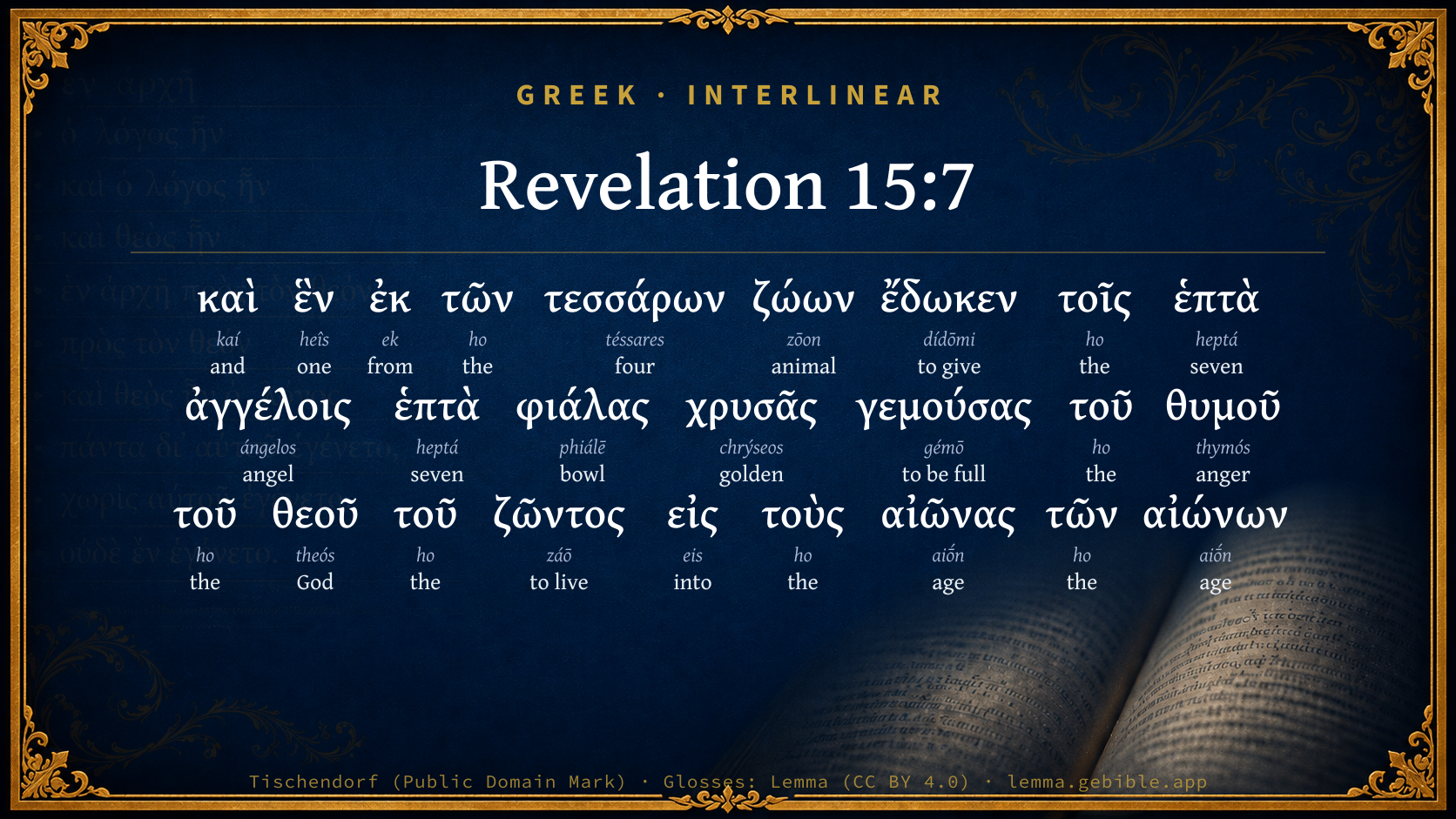
  1. καὶ kaí G2532 “and” Conjunction
  2. ἓν heîs G1520 “one” Adjective, Nominative, Singular, Neuter
  3. ἐκ ek G1537 “from” Preposition
  4. τῶν ho G3588 “the” Article, Genitive, Plural, Neuter
  5. τεσσάρων téssares G5064 “four” Adjective, Genitive, Plural, Neuter
  6. ζώων zōon G2226 “animal” Noun, Genitive, Plural, Neuter
  7. ἔδωκεν dídōmi G1325 “to give” Verb, Aorist, Active, Indicative, 3rd person, Singular
  8. τοῖς ho G3588 “the” Article, Dative, Plural, Masculine
  9. ἑπτὰ heptá G2033 “seven” Adjective, Numeral (indeclinable)
  10. ἀγγέλοις ángelos G32 “angel” Noun, Dative, Plural, Masculine
  11. ἑπτὰ heptá G2033 “seven” Adjective, Numeral (indeclinable)
  12. φιάλας phiálē G5357 “bowl” Noun, Accusative, Plural, Feminine
  13. χρυσᾶς chrýseos G5552 “golden” Adjective, Accusative, Plural, Feminine
  14. τοῦ ho G3588 “the” Article, Genitive, Singular, Masculine
  15. θυμοῦ thymós G2372 “anger” Noun, Genitive, Singular, Masculine
  16. τοῦ ho G3588 “the” Article, Genitive, Singular, Masculine
  17. θεοῦ theós G2316 “God” Noun, Genitive, Singular, Masculine
  18. τοῦ ho G3588 “the” Article, Genitive, Singular, Masculine
  19. ζῶντος záō G2198 “to live” Verb, Present, Active, Participle, Genitive, Singular, Masculine
  20. εἰς eis G1519 “into” Preposition
  21. τοὺς ho G3588 “the” Article, Accusative, Plural, Masculine
  22. αἰῶνας aiṓn G165 “age” Noun, Accusative, Plural, Masculine
  23. τῶν ho G3588 “the” Article, Genitive, Plural, Masculine
  24. αἰώνων aiṓn G165 “age” Noun, Genitive, Plural, Masculine

About this verse

These counts appear in no published source. They are computed here, from the morphology-tagged text and Lemma’s own curated glosses. What Lemma adds →

25
words
17
distinct lemmas
Revelation
section

Notable vocabulary

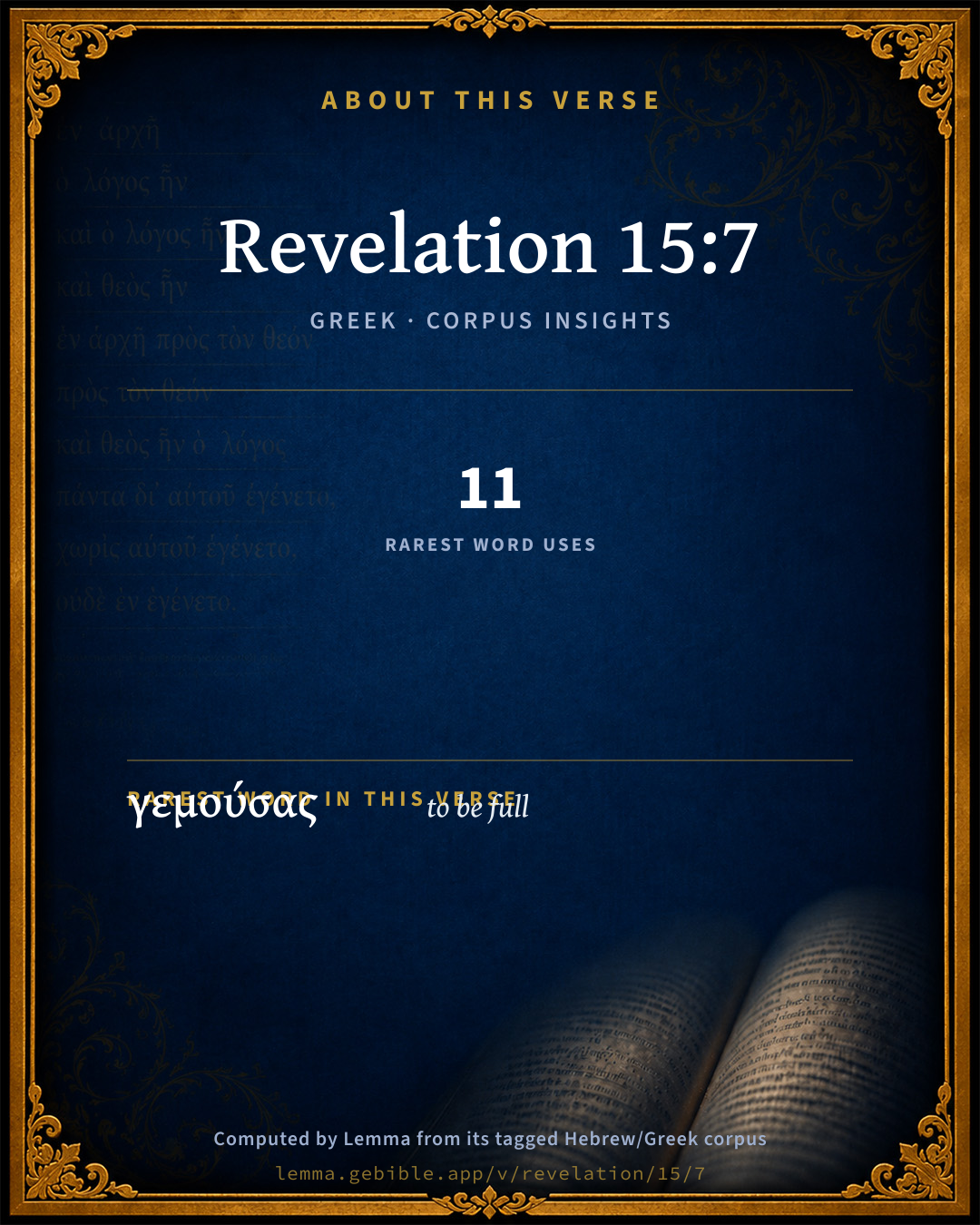
The rarest word here is γεμούσας to be full G1073 — appearing just 11 times in the whole Greek New Testament.

Shared distinctive vocabulary

γεμούσας to be full G1073 occurs in 11 verses of the Greek New Testament. Also found in:

Repetition

Words recur within this verse:

  • ἑπτὰ seven G2033 ×2
  • αἰῶνας age G165 ×2
  • τῶν the G3588 ×7

Cross-references

9

Topical passages linked to Revelation 15:7 in the Treasury of Scripture Knowledge — connected by theme and wording, ordered by reader-vote popularity; previews shown in the World English Bible.

  • Revelation 5:8 Now when he had taken the book, the four living creatures and the twenty-four elders fell down before the Lamb, each one having a harp, and golden bowls full of incense, which are the prayers of the saints.
  • Revelation 10:6 and swore by him who lives forever and ever, who created heaven and the things that are in it, the earth and the things that are in it, and the sea and the things that are in it, that there will no longer be delay,
  • Revelation 16:2–17:1 The first went, and poured out his bowl into the earth, and it became a harmful and evil sore on the people who had the mark of the beast, and who worshiped his image.
  • Revelation 15:1 I saw another great and marvelous sign in the sky: seven angels having the seven last plagues, for in them God's wrath is finished.
  • Revelation 21:9 One of the seven angels who had the seven bowls, who were loaded with the seven last plagues came, and he spoke with me, saying, "Come here. I will show you the wife, the Lamb's bride."
  • Psalms 75:8 For in the hand of Yahweh there is a cup, Full of foaming wine mixed with spices. He pours it out. Indeed the wicked of the earth drink and drink it to its very dregs.
  • Jeremiah 25:15 For thus says Yahweh, the God of Israel, to me: take this cup of the wine of wrath at my hand, and cause all the nations, to whom I send you, to drink it.
  • Revelation 4:6–9 Before the throne was something like a sea of glass, similar to crystal. In the midst of the throne, and around the throne were four living creatures full of eyes before and behind.
  • 1 Thessalonians 1:9 For they themselves report concerning us what kind of a reception we had from you; and how you turned to God from idols, to serve a living and true God,

Cross-references courtesy of OpenBible.info (CC BY 4.0).

Commentary

Notes on Revelation 15:7 from classic Christian and Jewish commentators (each source and its license shown beneath its notes). The classic Christian expositions comment on the surrounding passage and are grouped to its opening verse, so a note may address several verses; the Jewish commentaries on the Tanakh (Rashi and others) are per-verse, so they appear only where the commentator wrote on this verse.

Lemma curates 59 commentaries, every one of them public domain or Creative Commons licensed, each selected and text-cleaned for this edition rather than reprinted as found. About our sources →

The Biblical Illustrator

Joseph S. Exell

Rev_15:7-8

Seven golden vials full of the wrath of god.

The wrath of God

Observe--

1. That what was called seven plagues in the foregoing verse is here called seven golden vials full of the wrath of God: in this verse vials are full cups. Vials of wrath are prepared when the measures of a peoples sins are filled up; full cups of sin are followed with full vials of Gods wrath. Next, these vials are said to be of gold, signifying that these judgments proceed from a just God, with whom there is no corruption nor iniquity in judgments, He being holy in all His ways, and righteous in all His works. These vials are also said to be full of the wrath of God, who liveth for ever and ever, as an aggravation of the same, it not being like the wrath of a mortal man, of short continuance; it is the wrath of Him that ever lives to maintain His wrath, and to uphold and sustain the sinner under the execution and infliction of this wrath, that the sinner cannot run from Him.

2. The executioners of this wrath are said to be seven angels. The angels, which are merciful attendants upon the godly, are also at Gods command, the executioners of His wrath upon the wicked. These angels are here said to be seven, to signify that Gods judgments upon His Churchs adversaries shall be heavy and great; one angel plagued all Egypt, and destroyed Sennacheribs mighty host, but here went out seven angels to destroy antichrist.

3. The tremendous dreadfulness of this wrath, intimated by filling the temple with smoke, thereby signifying that the wrath of God, kindled against His enemies, shall be unto them like a devouring and consuming fire, before the flame of which burst forth, a cloud of smoke appears. Learn--That almighty God is glorified in the destruction as well as in the salvation of sinners; His glory is as well seen in His smoking wrath against the wicked, as in His saving mercy towards the godly. The temple was filled with smoke, from the glory of God, and from His power; it follows, no man was able to enter into the temple; that is, to deprecate Gods anger and supplicate His mercy, or to avert the plagues threatened and now just ready to be inflicted; when mercy has been long offered and despised, the Lord at last becomes inexorable, and will suffer none to intercede or plead with Him (Jer_15:1). (W. Burkitt, M. A.)

.

The Biblical Illustrator, edited by Joseph S. Exell (c. 1880s–1900s) — public domain. Text from a community e-Sword module.

Tyndale Open Study Notes

Tyndale Open Resources

15:7 the four living beings: See 4:6-8. • a gold bowl: These bowls are probably like the offering pans that were used in ancient worship (see Exod 37:16).

Tyndale Open Study Notes — © Tyndale Open Resources, licensed CC BY-SA 4.0. Text via the HelloAO Bible API.

Bengel's Gnomon

Johann Albrecht Bengel

Rev 15:7. Φιάλας, vials) φιάλη δέ φασιν, ἀγγεῖον λεβητοειδὲς πεπλατυσμένον ἄνωθεν.—Eustathius. The breadth of the vials at the upper part contributes to the vastness of the sudden outpouring. Many think, that the vials bring in the third woe. But see Erkl. Offenb. p. 808.

Bengel's Gnomon of the New Testament — English translation (T&T Clark, Edinburgh, 1860) — public domain. Text from a community e-Sword module.

Expositor's Greek Testament

ed. W. Robertson Nicoll

Rev 15:7-8 . The φιάλαι shallow bowls or saucers, do not exhale a smoke (like the censer of Rev 8:4 ) grateful to God; they are filled with poisonous, hot, bitter wine, while the smoke pours from the divine majesty, whose intense holiness (Rev 15:4 , as in O.T. theophanies) is breaking out in judgments against human sin ( δόξα = the divine δύναμις in action or expression). Smouldering fires of indignation are now on the point of bursting into punishment from the arsenal of anger. Hence, till the plagues are over, God’s presence is unendurable (as in Enoch xiv. 18 f.). This emphasis on the unapproachable, austere majesty of God is consonant with the general religious feeling reflected in the Apocalypse ( cf. on Rev 1:2 ).

The Expositor's Greek Testament, edited by W. Robertson Nicoll (1897–1910) — public domain. Text from a community e-Sword module.

Geneva Bible (1599)

Geneva Bible translators

Of these before, Rev. 4:7.

Geneva Bible (1599) marginal notes — public domain. Text via Bolls.life.

Jamieson, Fausset & Brown

Robert Jamieson, A. R. Fausset & David Brown

one of the four beasts--Greek, "living creatures." The presentation of the vials to the angels by one of the living creatures implies the ministry of the Church as the medium for manifesting to angels the glories of redemption (Eph 3:10).

vials--"bowls"; a broad shallow cup or bowl. The breadth of the vials in their upper part would tend to cause their contents to pour out all at once, implying the overwhelming suddenness of the woes.

full of . . . wrath--How sweetly do the vials full of odors, that is, the incense-perfumed prayers of the saints, contrast with these!

Jamieson, Fausset & Brown — Commentary Critical and Explanatory on the Whole Bible (1871) — public domain (CC PDM 1.0). Text via the HelloAO Bible API.

Ellicott's Commentary for English Readers

(7) And one of the four . . .—Better, And one from among the four living beings gave to the seven angels seven golden vials (or, bowls) full, &c. The vials are the shallow bowls which were used for incense. They are filled with the wrath of God, and that wrath is now to be poured out “upon the kingdoms that have not called upon God’s name” (Psa_79:6). These vials are given by one of the living creatures who represent creation; it is thus through creation that the wrath of God can visit the rebellious; that wrath of God is simply the operation of God’s righteous law against sin. His statutes are eternally righteous. He has given to all things a law which cannot be broken; that law is adverse to evil, and will in the end root it out, for it does the bidding of God, who lives unto the ages of the ages.

A Bible Commentary for English Readers, edited by Charles John Ellicott (1878–1897) — public domain. Text from a community e-Sword module.

The Cambridge Bible for Schools and Colleges

gen. ed. J. J. S. Perowne

7. vials] See on Rev_5:8.

The Cambridge Bible for Schools and Colleges (gen. ed. J. J. S. Perowne; Cambridge University Press, 1878–1918) — public domain. Text from a community e-Sword module.

John Gill's Exposition

And one of the four beasts,.... Or living creatures: now we hear of them, as of the four and twenty elders, under the blowing of the seventh trumpet, Rev 11:16 with which this vision is contemporary; these living creatures are the ministers of the Gospel; See Gill on Rev 4:6 and this was one, or the first of them, who was like a lion, for fortitude and courage, and whose voice was as the noise of thunder, Rev 4:7 and so fitly represents those ministers who shall give out the vials of God's wrath: not any particular person is designed, who shall be at this time; and much less Luke the evangelist, as Lord Napier thinks; nor Peter, who prophesied of the last time, Pe2 3:10 as Grotius; but a set of Gospel ministers, comparable to one of the living creatures John had before seen; of whom it is said, that they

gave unto the seven angels seven golden vials full of the wrath of God, who liveth for ever and ever: these seven vials are for the seven last plagues to be put into, and out of which they are to be taken, or poured, and inflicted; see Rev 21:9 hence it appears, that the seven plagues, and the wrath of God, are the same thing, and both design God's judgments upon antichrist; and these being expressed by "vials", which are measures, and large ones, show the large abundance and plenteous effusion of God's wrath, and the secret, sudden, and irresistible power of it; and yet that it will be poured out in measure, according to righteous judgment, and therefore it is put into vials; and these golden ones, expressive of the purity, holiness, and justice of the divine proceedings: and it will be very terrible; it will be, not the wrath of men, but of God, and a cup of the fierceness of his wrath; it will be the wrath of the living God, of him that lives for ever, and as he is, such will his wrath be; it will continue for ever, for this wrath will issue in the everlasting destruction of antichrist: so the wrath of God is signified by a wine cup of fury, Jer 25:15 and that destruction, and those plagues which God designed to bring upon Pharaoh, are by Jonathan ben Uzziel, in his Targum on Gen 40:12 called "a vial of wrath", which he should drink of: and in the pouring out of there seven vials, there is in some of them a manifest allusion to the plagues of Egypt. So the cup of trembling, in Isa 51:17 is by the Targumists called "a vial", and also "the cup of fury", Isa 51:22 and that these vials were not small narrow mouthed vessels, but large broad mouthed ones, and more properly basins or bowls, is manifest from the use of the word with Jewish writers. The dishes on which the loaves of the shewbread were set, each of which loaves was ten hands breadth long, and five broad (q), are by the Targums of Jonathan and Jerusalem on Exo 25:29 called "vials"; and so the chargers offered at the dedication of the tabernacle, Num 7:13 are, by the same, rendered vials, which weighed 130 shekels; and so the silver bowl they offered, is, by Josephus (r), called a vial: the bowls in Amo 6:6 are, by the Targum there, said to be "silver vials". The lordly dish brought by Jael to Sisera, Jdg 5:25 the Targum calls the vial of the mighty ones; and the earthen vessels used at the trial of the suspected wife, and at the cleansing of the leper, are both by Jewish writers said to be "vials" (s). Now these vials were given to the seven angels by one of the living creatures, the ministers of the word; from whence it seems that these angels design members of churches, as distinct from ministers; and may intend civil magistrates, and very principal ones, as kings of the earth, who, in this state of things, and times, will belong to the churches, and will be the instruments of destroying antichrist: and these vials may be said to be given to them by the ministers, since they will execute this vengeance in consequence of their prayers, and the churches', called vials full of odours, Rev 5:8 and because these great men will be stirred up by the ministers of the Gospel, and by their ministrations, to do this work; see Rev 18:4.

(q) Misn. Menachot, c. 11. sect. 4, 5. (r) Antiqu. l. 3. c. 8. sect. 10. (s) Misn. Sota, c. 2. sect. 2. Joseph Antiqu. l. 3. c. 11. sect. 6. Misn. Negaim, c. 10. sect. 1.

John Gill's Exposition of the Whole Bible (1746–1763) — public domain (CC PDM 1.0). Text via the HelloAO Bible API.

Trapp's Complete Commentary

John Trapp

7 And one of the four beasts gave unto the seven angels seven golden vials full of the wrath of God, who liveth for ever and ever.

Ver. 7. And one of the four beasts] The faithful pastors, by their divine discourses of the pure worship of God, the intolerable tyranny of Antichrist, &c., stir up the spirits of God’s servants to set themselves against that man of sin, and to execute upon him the judgment written. "This honour have all his saints," Psa 149:9.

Seven golden vials] Vessels of large content, but narrow mouths; they pour out slowly, but drench deeply, and distil effectually the wrath of God, which may be let out in minims, and yet do great matters; as there may be much poison in little drops. These vials are said to be golden, to show that this anger is holy.

Full of the wrath of God] Filled out of the cup of his wrath, mentioned in the former chapter.

John Trapp, A Commentary or Exposition upon All the Books of the Old and New Testament (1647–1656) — public domain. Text from a community e-Sword module.

Albert Barnes' Notes on the Bible

And one of the four beasts - See the notes on Rev 4:6-7. Which one of the four is not mentioned. From the explanation given of the design of the representation of the “four beasts,” or living creatures, in the notes on Rev 4:6-7, it would seem that the meaning here is, that the great principles of that divine government would be illustrated in the events which are now to occur. In events that were so closely connected with the honor of God and the triumph of his cause on the earth, there was a propriety in the representation that these living creatures, symbolizing the great principles of divine administration, would be particularly interested.

Gave unto the seven angels seven golden vials - The word used here - φιάλη phialē - means properly, “a bowl or goblet, having more breadth than depth” (Robinson, Lexicon). Our word vial, though derived from this, means rather a thin long bottle of glass, used particularly by apothecaries and druggists. The word would be better rendered by “bowl” or “goblet,” and probably the representation here was of such bowls as were used in the temple service. See the notes on Rev 5:8. They are called in Rev 16:1, “vials of the wrath of God”; and here they are said to be “full of the wrath of God.” The allusion seems to be to a drinking cup or goblet filled with poison, and given to persons to drink - an allusion drawn from one of the methods of punishment in ancient times. See the notes on Rev 14:10. These vials or goblets thus became emblems of divine wrath, to be inflicted on the beast and his image.

Full of the wrath of God - Filled with what represented his wrath; that is, they seemed to be filled with a poisonous mixture, which being poured upon the earth, the sea, the rivers, the sun, the seat of the beast, the river Euphrates, and into the air, was followed by severe divine judgments on this great anti-Christian power. See Rev 16:2-4, Rev 16:8,Rev 16:10, Rev 16:12, Rev 16:17.

Who liveth forever and ever - The eternal God. The particular object in referring to this attribute here appears to be, that though there may seem to be delay in the execution of his purposes, yet they will be certainly accomplished, as he is the ever-living and unchangeable God. He is not under a necessity of abandoning his purposes, like people, if they are not soon accomplished.

Albert Barnes' Notes on the Bible (1834–1885) — public domain. Text from a community e-Sword/MySword module.

Matthew Poole's English Annotations

And one of the four beasts; one of those four beasts round about the throne, Rev 4:6.

Gave unto the seven angels; the seven angels mentioned Rev 15:6.

Seven golden vials: a vial is a plain pot or glass with a wide mouth, used to drink in: these were

full of the wrath of God, who liveth for ever and ever. The meaning is no more than that the seven angels, before mentioned, were commissioned from God, by one plague after another, to bring antichrist to his ruin.

Matthew Poole's English Annotations on the Holy Bible (1683–1685) — public domain. Text from a community e-Sword/MySword module.

Whedon's Commentary on the Bible

Daniel D. Whedon

7. One of the four beasts—The four living creatures represent creation; and correspondently the first four plagues are poured out upon different parts of the created framework. It seems most obvious that these four plagues are in the order, not of chronological succession, but of the suitable occurrence of the objects. The attempt, therefore, to assign dates of year or month is illegitimate. And as the seven-series of the plagues does not, like those of the seals and trumpets, mount up to the scenes of the dissolution and final judgment, but images a judgment limited to the earth’s surface, so the whole seven vials are given by one of the four creational beasts.

Vials—Rather, saucers; being, as Alford says, “a shallow bowl or cup, usually without a stand or foot, in which they drew [a liquid] out of the crater or goblet.” It is as if these angels drew from the “wine” of the divine justice in their saucers, or drinking cups, the measure of judgment for Babylon.

Full of the wrath—As if the wrath were a condensed liquid.

Daniel D. Whedon (gen. ed.), Commentary on the Old and New Testaments (1874–1909) — public domain. Text from a community e-Sword module.

The Pulpit Commentary

And one of the four beasts gave unto the seven angels; four living beings. These, as representing life on the earth, (see on Rev_4:6 Rev_5:9) are appropriately chosen as the medium for conveying to the angels the plagues about to be inflicted on men. This description is very like what is related of the cherubim from which the idea of the living beings is evolved (see on Rev_4:6) in Eze_10:7, "And one cherub stretched forth his hand from between the cherubims unto the fire that was between the cherubims, and took thereof, and put it into the hands of him that was clothed with linen: who took it, and went out." (On the "seven angels," see on ver. 1) Seven golden vials full of the wrath of God, who liveth forever and ever.

Seven; as showing the complete nature of the wrath of God (cf. ver. 1," In them is fulfilled," etc.). Golden; the characteristic of the heavenly things and places, (cf. Rev_4:4 Rev_21:18, etc.) and which is also sometimes used of other things to indicate gorgeousness and unusual splendour. (cf. Rev_18:16) (On "vials," see on Rev_5:8, and compare with Rev_14:10, "the cup of his indignation. Compare the expression, "who liveth forever and ever," with the possible reading of ver. 3, "thou King of the ages."

The Pulpit Commentary (1880–1919), ed. H.D.M. Spence-Jones & Joseph S. Exell — public domain. Text from a community e-Sword module.

John Wesley's Explanatory Notes

And one of the four living creatures gave the seven angels - After they were come out of the temple. Seven golden phials - Or bowls. The Greek word signifies vessels broader at the top than at the bottom. Full of the wrath of God, who liveth forever and ever - A circumstance which adds greatly to the dreadfulness of his wrath.

John Wesley, Explanatory Notes Upon the Whole Bible (1754–1765) — public domain. Text via the GEBible commentary corpus.

Scofield Reference Notes

C. I. Scofield

angels

(See Scofield "Heb 1:4").

The Scofield Reference Bible (1917 edition), notes by C. I. Scofield — public domain. Text from a community e-Sword module.

Burkitt's Expository Notes on the New Testament

William Burkitt

Observe here, 1. That what was called seven plagues in the foregoing verse, is here called seven golden vials full of the wrath of God; in this verse vials are full cups. Vials of wrath are prepared when the measures of a people’s sins are filled up; full cups of sin are followed with full vials of God’s wrath.

Next, these vials are said to be of gold, signifying, that these judgments proceed from a just God, with whom there is no corruption nor iniquity in judgments, he being holy in all his ways, and righteous in all his works. These vials are also said to be full of the wrath of God, who liveth for ever and ever, as an aggravation of the same, it not being like the wrath of a mortal man, of short continuance, but of endless duration; it is the wrath of him that ever lives to maintain his wrath, and to uphold and sustain the sinner under the execution and infliction of his wrath, that the sinner cannot run from him.

O what a fearful thing is it to fall into the hands of the living God, whose wrath is both intolerable and interminable! the sinner can neither stand under it, nor flee from it.

Observe, 2. The executioners of this wrath are said to be seven angels. The angels which are merciful attendants upon the godly, are also at God’s command the executioners of his wrath upon the wicked. These angels are here said to be seven, to signify that God’s judgments upon his church’s adversaries shall be heavy and great, one angel plagued all Egypt, and destroyed Sennacherib’s mighty host, but here went out seven angels to destroy antichrist.

Observe, 3. The tremendous dreadfulness of this wrath, intimated by filling the temple with smoke; thereby signifying, that the wrath of God kindled against his enemies shall be unto them like a devouring and consuming fire, before the flame of which burst forth, a cloud of smoke appears. And the temple was filled with smoke form the glory of God and from his power.

Learn thence, that Almighty God is glorified in the destruction, as well as in the salvation, of sinners; his glory is as well seen in his smoking wrath against the wicked, as in his saving mercy towards the godly. The temple was filled with smoke from the glory of God, and from his power; it follows,--No man was able to enter into the temple; that is, to deprecate God’s anger, and supplicate his mercy, or to avert the plagues threatened, and now just ready to be inflicted: when mercy has been long offered and despised, the Lord at last becomes inexorable, and will suffer none to intercede or plead with him: Jeremiah 15.

Though Moses and Samuel stood before me, yet my mind cannot be towards this people; cast them out of my sight, &c. The sins of a people may sometimes grow to such an height, that Almighty God will no longer be entreated; and when we know it, it is our duty to cease praying for them, Woe, woe, woe be unto such a people!

William Burkitt's Expository Notes on the New Testament (1700–1703) — public domain. Text from a community e-Sword module.

The People's New Testament

B. W. Johnson

7. And one of the four living creatures. For notes on the Four Living Creatures see chapter 4. As the servant and agent of the Almighty he hands the seven vials of God's wrath to the angels. The Revision has “bowls” instead of “vials.” The thought is that in succession seven plagues are to be poured upon the earth.

B. W. Johnson's The People's New Testament with Notes (1889–1891) — public domain. Electronic text from the Christian Classics Ethereal Library (CCEL) ThML edition.

unfoldingWord translationNotes

Door43 World Missions Community

the four living creatures

"living being" or "living thing." See how you translated "living creatures" in Revelation 4:6

seven golden bowls full of the wrath of God

The image of the wine in the bowls can be stated clearly. The word "wrath" here refers to punishment. The wine is a symbol for punishment. AT: "seven gold bowls full of the wine that represents the wrath of God" (See: Assumed Knowledge and Implicit Information Symbolic Language)

until the seven plagues of the seven angels were completed

"until the seven angels finished sending the seven plagues to the earth"

translationWords

life

creature

angel

gold

wrath

God

eternity

temple

glory

power

plague

unfoldingWord translationNotes — © Distant Shores Media and the Door43 World Missions Community, licensed CC BY-SA 4.0. Source: git.door43.org/Door43/en_tn.

Cambridge Greek Testament for Schools and Colleges

7. ἓν ἐκ. א 1 omit ἓν.

ἑπτὰ φιάλας. א fu[518] omit ἑπτά.

[518] Codex Fuldensis 6th century at Fulda.

7. φιάλας. See on Rev 5:8.

Cambridge Greek Testament for Schools and Colleges (Cambridge University Press, 1896; 21 vols, various authors incl. Carr, Maclear, Plummer, Farrar, Lumby, Moule, M. R. James, Simcox) — public domain. Text from a community e-Sword module.

Vincent's Word Studies in the New Testament

Marvin R. Vincent

Vials [φιαλας] . Rev., bowls. See on ch. Rev 5:8.

Marvin R. Vincent, Word Studies in the New Testament (1887–1900) — public domain. Text from a community e-Sword/MySword module.

Lesson kit

Teaching starters — assembled from the data on this page, not authored interpretation. Every prompt links to the verse data it draws on. Edit before teaching.

Revelation, in the Revelation, opens this verse with 25 words (17 distinct Greek lemmas). Its most distinctive word is gémō (“to be full”). A historical commentator’s framing appears above. Read the whole chapter for the surrounding context.

Discussion questions

  1. The word gémō carries the sense “to be full.” How does it shape the verse?
  2. Matthew 23:25 shares the word «to be full» with this verse. How do the two illuminate each other?
  3. “seven” occurs 2× in this one verse. What is the effect of the repetition?
  4. These translations render this verse differently; the difference is in the English rendering, not the original. What questions does that raise?
  5. Reading how The Biblical Illustrator and Tyndale Open Study Notes read this verse, where do the two commentators agree and where do they part?

Things to notice

Reading settings

Reading text

Shown beneath each verse's original-language words.

Old Testament
Old Testament edition

Read the OT as the Masoretic Hebrew (MT) or the Greek Septuagint (LXX).

English shown for the Greek Septuagint (in the Hebrew ↔ Greek comparison).

Comparing translations? Open the Compare panel on any verse page to stack up to four side by side.