

Luke 7:24
Greek (Tischendorf 8th ed.) Luke 7:24 appears in the Greek New Testament. The text above is from the Tischendorf 8th edition. Each word links to its Strong’s number and a concise gloss. Click any word for its full Thayer’s Greek Lexicon entry.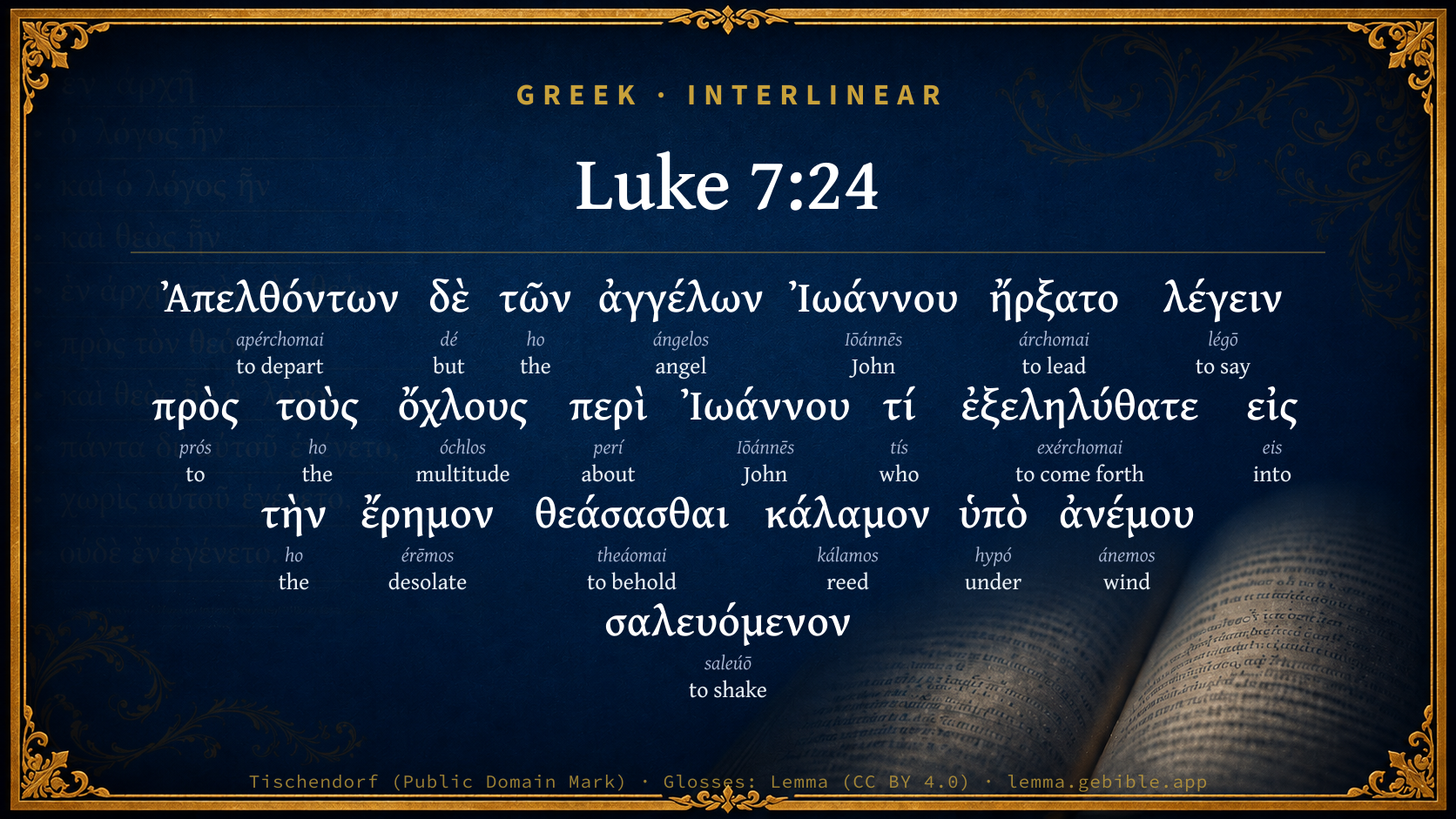
When John's messengers had departed, he began to tell the multitudes about John, "What did you go out into the wilderness to see? A reed shaken by the wind?
Download a study sheet
One document with this verse’s original text, its word-by-word gloss line, the meaning frame, cross-references with their text, attributed commentary, and full source and license credits — printable, and it pastes into notes with its structure intact.
This verse Autodidact and up
A passage Seminary Student
Up to 50 verses in one chapter. A passage sheet keeps up to 6 commentary sources and 12 cross-references per verse, in the order this page ranks them, and says so on the sheet whenever that leaves anything out. Ask for a single verse and you get the Autodidact verse sheet above.
Everything on this page stays free to read, with no account — the sheet is a download of what is already on screen, not access to it.
Compare translations 3
The same verse in 3 English versions, stacked beneath the original-language interlinear above. Click any original word for its lexicon entry.
Each is an independent rendering of the whole verse — the interlinear is not word-aligned to these translations.
Highlighted words mark where these versions differ — a whole-verse word diff, not a word-by-word alignment.
-
World English Bible Public Domain
When John's messengers had departed, he began to tell the multitudes about John, "What did you go out into the wilderness to see? A reed shaken by the wind?
-
King James Version Public Domain
And when the messengers of John were departed, he began to speak unto the people concerning John, What went ye out into the wilderness for to see? A reed shaken with the wind?
-
unfoldingWord Literal Text CC BY-SA 4.0
Then after the messengers of John had gone away, he began to say to the crowds concerning John, “What did you go out into the wilderness to see? A reed shaken by the wind?
unfoldingWord Literal Text — © unfoldingWord, licensed CC BY-SA 4.0. Word-aligned USFM3 via Door43 (git.door43.org/unfoldingWord/en_ult).
Show all 19 translations
Every available English version of this verse, each an independent rendering of the whole verse.
-
World English Bible Public Domain
When John's messengers had departed, he began to tell the multitudes about John, "What did you go out into the wilderness to see? A reed shaken by the wind?
-
Berean Standard Bible Public Domain
After John’s messengers had left, Jesus began to speak to the crowds about John: “What did you go out into the wilderness to see? A reed swaying in the wind?
-
Majority Standard Bible Public Domain
After John’s messengers had left, Jesus began to speak to the crowds about John: “What did you go out into the wilderness to see? A reed swaying in the wind?
-
King James Version Public Domain
And when the messengers of John were departed, he began to speak unto the people concerning John, What went ye out into the wilderness for to see? A reed shaken with the wind?
-
American Standard Version (1901) Public Domain
And when the messengers of John were departed, he began to say unto the multitudes concerning John, What went ye out into the wilderness to behold? a reed shaken with the wind?
-
Revised Version (1885) Public Domain
And when the messengers of John were departed, he began to say unto the multitudes concerning John, What went ye out into the wilderness to behold? a reed shaken with the wind?
-
Geneva Bible (1599) Public Domain
And when the messengers of Iohn were departed, hee began to speake vnto the people, of Iohn, What went ye out into the wildernes to see? A reede shaken with the winde?
-
Douay-Rheims (1899) Public Domain
And when the messengers of John were departed, he began to speak to the multitudes concerning John. What went ye out into the desert to see a reed shaken with the wind
-
Young's Literal Translation Public Domain
And the messengers of John having gone away, he began to say unto the multitudes concerning John: `What have ye gone forth to the wilderness to look on? a reed by the wind shaken?
-
Literal Standard Version CC BY-SA 4.0
And the messengers of John having gone away, He began to say to the multitudes concerning John: “What have you gone forth into the wilderness to look on? A reed shaken by the wind?
-
Unlocked Literal Bible CC BY-SA 4.0
After John's messengers had gone away, Jesus began to say to the crowds about John, “What did you go out into the desert to see? A reed shaken by the wind?
-
unfoldingWord Literal Text CC BY-SA 4.0
Then after the messengers of John had gone away, he began to say to the crowds concerning John, “What did you go out into the wilderness to see? A reed shaken by the wind?
-
Darby Bible Public Domain
And the messengers of John having departed, he began to speak to the crowds concerning John: What went ye out into the wilderness to behold? a reed shaken by the wind?
-
World Messianic Bible Public Domain
When Yochanan’s messengers had departed, he began to tell the multitudes about Yochanan, “What did you go out into the wilderness to see? A reed shaken by the wind?
-
Webster's Bible Public Domain
And when the messengers of John had departed, he began to speak to the people concerning John, What went ye out into the wilderness to see? A reed shaken with the wind?
-
Free Bible Version CC BY-SA 4.0
After the messengers from John had left, Jesus began telling the crowd, “About John: what did you expect to see when you went out to meet him in the desert? Some reed blown about by the wind?
-
Bible in Basic English Public Domain
And when the men who were sent by John had gone away, he said to the people, about John, What did you go out into the waste land to see? a tall stem moving in the wind?
-
Text-Critical English NT CC BY 4.0
When John's messengers had gone away, Jesus began to speak to the crowds about John: “What did you go out into the wilderness to see? A reed shaken by the wind?
-
Tyndale New Testament (1534) Public Domain
When the messengers of Iohn were departed he began to speake vnto the people of Iohn What wet ye oute into the wildernes for to se? went ye to se arede shaken with the wynde?
Literal Standard Version (2020), Covenant Press — licensed CC BY-SA 4.0. Text via the HelloAO Bible API (eBible.org). Unlocked Literal Bible (unfoldingWord) — licensed CC BY-SA 4.0. Text via the HelloAO Bible API (eBible.org). unfoldingWord Literal Text — © unfoldingWord, licensed CC BY-SA 4.0. Word-aligned USFM3 via Door43 (git.door43.org/unfoldingWord/en_ult). Free Bible Version, Dr. Jonathan Gallagher — licensed CC BY-SA 4.0. Text via the HelloAO Bible API (eBible.org).
Word by word
More ways to search: Search by grammar → Find every occurrence → Compare this word →
Practice this passage: Drill this verse → Learn its vocabulary →
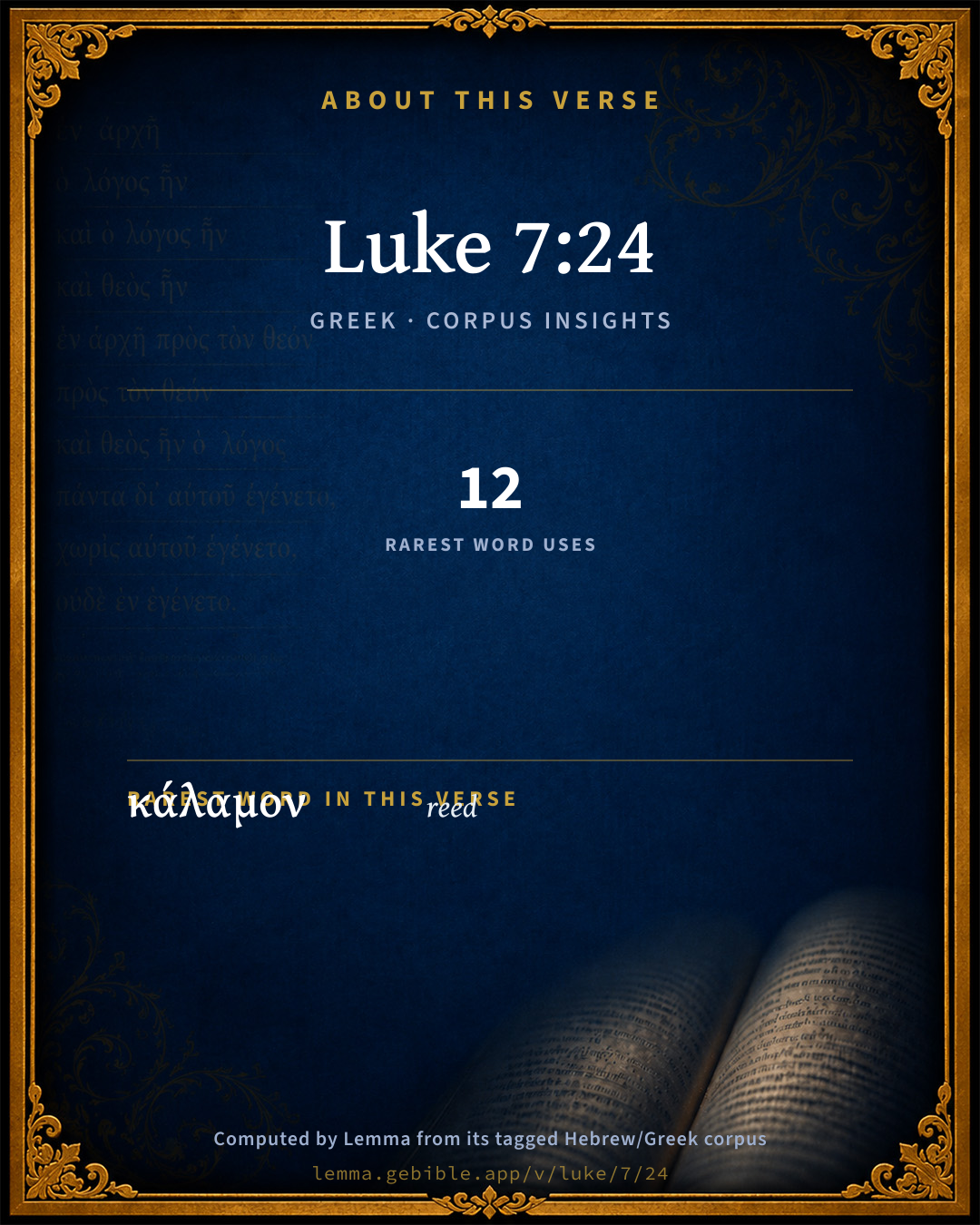
- Appears 12× in the Greek New Testament
- First appears at Matthew 11:7
- Part of Speech
- Noun
- Case
- Accusative
- Number
- Singular
- Gender
- Masculine
Full Thayer's Definition
- Ἀπελθόντων apérchomai G565 “to depart” Verb, Aorist, Active, Participle, Genitive, Plural, Masculine
- δὲ dé G1161 “but” Conjunction
- τῶν ho G3588 “the” Article, Genitive, Plural, Masculine
- ἀγγέλων ángelos G32 “angel” Noun, Genitive, Plural, Masculine
- Ἰωάννου Iōánnēs G2491 “John” Noun, Genitive, Singular, Masculine
- ἤρξατο árchomai G756 “to lead” Verb, Aorist, Middle deponent, Indicative, 3rd person, Singular
- λέγειν légō G3004 “to say” Verb, Present, Active, Infinitive
- πρὸς prós G4314 “to” Preposition
- τοὺς ho G3588 “the” Article, Accusative, Plural, Masculine
- ὄχλους óchlos G3793 “multitude” Noun, Accusative, Plural, Masculine
- περὶ perí G4012 “about” Preposition
- Ἰωάννου Iōánnēs G2491 “John” Noun, Genitive, Singular, Masculine
- τί tís G5101 “who” Interrogative pronoun, Accusative, Singular, Neuter
- ἐξεληλύθατε exérchomai G1831 “to come forth” Verb, Perfect, Active, Indicative, 2nd person, Plural
- εἰς eis G1519 “into” Preposition
- τὴν ho G3588 “the” Article, Accusative, Singular, Feminine
- ἔρημον érēmos G2048 “desolate” Adjective, Accusative, Singular, Feminine
- θεάσασθαι theáomai G2300 “to behold” Verb, Aorist, Middle deponent, Infinitive
- κάλαμον kálamos G2563 “reed” Noun, Accusative, Singular, Masculine
- ὑπὸ hypó G5259 “under” Preposition
- ἀνέμου ánemos G417 “wind” Noun, Genitive, Singular, Masculine
- σαλευόμενον saleúō G4531 “to shake” Verb, Present, Passive, Participle, Accusative, Singular, Masculine
About this verse
These counts appear in no published source. They are computed here, from the morphology-tagged text and Lemma’s own curated glosses. What Lemma adds →
- 22
- words
- 19
- distinct lemmas
- Gospels
- section
Cross-references
11Topical passages linked to Luke 7:24 in the Treasury of Scripture Knowledge — connected by theme and wording, ordered by reader-vote popularity; previews shown in the World English Bible.
- Ephesians 4:14 that we may no longer be children, tossed back and forth and carried about with every wind of doctrine, by the trickery of men, in craftiness, after the wiles of error;
- Luke 1:80 The child was growing, and becoming strong in spirit, and was in the desert until the day of his public appearance to Israel.
- Luke 3:2 in the high priesthood of Annas and Caiaphas, the word of God came to John, the son of Zacharias, in the wilderness.
- John 1:23 He said, "I am the voice of one crying in the wilderness, 'Make straight the way of the Lord,' as Isaiah the prophet said."
- Matthew 3:1–5 In those days, John the Baptizer came, preaching in the wilderness of Judea, saying,
- 2 Corinthians 1:17–20 When I therefore was thus determined, did I show fickleness? Or the things that I purpose, do I purpose according to the flesh, that with me there should be the "Yes, yes" and the "No, no?"
- James 1:6–8 But let him ask in faith, without any doubting, for he who doubts is like a wave of the sea, driven by the wind and tossed.
- 2 Peter 2:17 These are wells without water, clouds driven by a storm; for whom the blackness of darkness has been reserved forever.
- 2 Peter 3:17 You therefore, beloved, knowing these things beforehand, beware lest, being carried away with the error of the wicked, you fall from your own steadfastness.
- Matthew 11:7–8 As these went their way, Jesus began to say to the multitudes concerning John, "What did you go out into the wilderness to see? A reed shaken by the wind?
- Mark 1:4–5 John came baptizing in the wilderness and preaching the baptism of repentance for forgiveness of sins.
Cross-references courtesy of OpenBible.info (CC BY 4.0).
Lesson kit
Teaching starters — assembled from the data on this page, not authored interpretation. Every prompt links to the verse data it draws on. Edit before teaching.
Luke, in the Gospels, opens this verse with 22 words (19 distinct Greek lemmas). Its most distinctive word is kálamos (“reed”). A historical commentator’s framing appears above. Read the whole chapter for the surrounding context.
Discussion questions
- What does “reed” (kálamos) contribute to the verse as a whole?
- Matthew 11:7 shares the word «reed» with this verse. How do the two illuminate each other?
- “John” occurs 2× in this one verse. What is the effect of the repetition?
- These translations render this verse differently. What is at stake in choosing one wording over another?
- Reading how The Biblical Illustrator and Whedon's Commentary on the Bible read this verse, where do the two commentators agree and where do they part?
Things to notice
- These translations choose different wording for 19 words in this verse.
- “John” occurs 2× in this single verse.
- 19 distinct Greek lemmas span 22 words in this verse.
Commentary
Notes on Luke 7:24 from classic Christian and Jewish commentators (each source and its license shown beneath its notes). The classic Christian expositions comment on the surrounding passage and are grouped to its opening verse, so a note may address several verses; the Jewish commentaries on the Tanakh (Rashi and others) are per-verse, so they appear only where the commentator wrote on this verse.
Lemma curates 59 commentaries, every one of them public domain or Creative Commons licensed, each selected and text-cleaned for this edition rather than reprinted as found. About our sources →
The Biblical Illustrator
Joseph S. Exell
The Biblical Illustrator, edited by Joseph S. Exell (c. 1880s–1900s) — public domain. Text from a community e-Sword module.
Whedon's Commentary on the Bible
Daniel D. Whedon
Daniel D. Whedon (gen. ed.), Commentary on the Old and New Testaments (1874–1909) — public domain. Text from a community e-Sword module.
Godbey's Commentary on the New Testament
William B. Godbey
William B. Godbey, Commentary on the New Testament (1896–1900) — public domain. Text from a community e-Sword module.
Expositor's Greek Testament
ed. W. Robertson Nicoll
The Expositor's Greek Testament, edited by W. Robertson Nicoll (1897–1910) — public domain. Text from a community e-Sword module.
Godet's Commentaries
Frédéric Louis Godet
Frédéric Louis Godet — Commentaries on Luke, John, Romans, and 1 Corinthians — English translation (T&T Clark, Edinburgh, 1870s–1890s) — public domain. Text from a community e-Sword module.
Geneva Bible (1599)
Geneva Bible translators
Geneva Bible (1599) marginal notes — public domain. Text via Bolls.life.
Ellicott's Commentary for English Readers
A Bible Commentary for English Readers, edited by Charles John Ellicott (1878–1897) — public domain. Text from a community e-Sword module.
The Cambridge Bible for Schools and Colleges
gen. ed. J. J. S. Perowne
The Cambridge Bible for Schools and Colleges (gen. ed. J. J. S. Perowne; Cambridge University Press, 1878–1918) — public domain. Text from a community e-Sword module.
John Gill's Exposition
John Gill's Exposition of the Whole Bible (1746–1763) — public domain (CC PDM 1.0). Text via the HelloAO Bible API.
Matthew Poole's English Annotations
Matthew Poole's English Annotations on the Holy Bible (1683–1685) — public domain. Text from a community e-Sword/MySword module.
The Pulpit Commentary
The Pulpit Commentary (1880–1919), ed. H.D.M. Spence-Jones & Joseph S. Exell — public domain. Text from a community e-Sword module.
John Wesley's Explanatory Notes
John Wesley, Explanatory Notes Upon the Whole Bible (1754–1765) — public domain. Text via the GEBible commentary corpus.
Scofield Reference Notes
C. I. Scofield
The Scofield Reference Bible (1917 edition), notes by C. I. Scofield — public domain. Text from a community e-Sword module.
Kretzmann's Popular Commentary
Paul E. Kretzmann
Paul E. Kretzmann, Popular Commentary of the Bible (1921–1924) — public domain. Text from a community e-Sword module.
Burkitt's Expository Notes on the New Testament
William Burkitt
William Burkitt's Expository Notes on the New Testament (1700–1703) — public domain. Text from a community e-Sword module.
unfoldingWord translationNotes
Door43 World Missions Community
unfoldingWord translationNotes — © Distant Shores Media and the Door43 World Missions Community, licensed CC BY-SA 4.0. Source: git.door43.org/Door43/en_tn.
Cambridge Greek Testament for Schools and Colleges
Cambridge Greek Testament for Schools and Colleges (Cambridge University Press, 1896; 21 vols, various authors incl. Carr, Maclear, Plummer, Farrar, Lumby, Moule, M. R. James, Simcox) — public domain. Text from a community e-Sword module.
Alford’s Greek Testament
Henry Alford
Henry Alford, The Greek Testament (1849–1861) — public domain. Text from a community e-Sword module.
International Critical Commentary
International Critical Commentary — older volumes (1896–1929), various authors — public domain. Text from a community e-Sword module.
Vincent's Word Studies in the New Testament
Marvin R. Vincent
Marvin R. Vincent, Word Studies in the New Testament (1887–1900) — public domain. Text from a community e-Sword/MySword module.