Hebrews 1:6

Greek (Tischendorf 8th ed.) Hebrews 1:6 appears in the Greek New Testament. The text above is from the Tischendorf 8th edition. Each word links to its Strong’s number and a concise gloss. Click any word for its full Thayer’s Greek Lexicon entry.
Download image
Cite this verse

Hebrews 1:6 (World English Bible). Public Domain. Lemma interlinear Bible study tool, https://lemma.gebible.app/v/hebrews/1/6.

Show BibTeX & RIS
BibTeX
RIS
English Translation
Again, when he brings in the firstborn into the world he says, "Let all the angels of God worship him."
World English Bible · Public Domain
Download a study sheet

One document with this verse’s original text, its word-by-word gloss line, the meaning frame, cross-references with their text, attributed commentary, and full source and license credits — printable, and it pastes into notes with its structure intact.

This verse Autodidact and up

Study sheet (.html) Plain text (.txt)

A passage Seminary Student

Up to 50 verses in one chapter. A passage sheet keeps up to 6 commentary sources and 12 cross-references per verse, in the order this page ranks them, and says so on the sheet whenever that leaves anything out. Ask for a single verse and you get the Autodidact verse sheet above.

Everything on this page stays free to read, with no account — the sheet is a download of what is already on screen, not access to it.

Want to remove ads? Support Godless Engineer
Compare translations 3

The same verse in 3 English versions, stacked beneath the original-language interlinear above. Click any original word for its lexicon entry.

Each is an independent rendering of the whole verse — the interlinear is not word-aligned to these translations.

Highlighted words mark where these versions differ — a whole-verse word diff, not a word-by-word alignment.

  • World English Bible Public Domain
    Again, when he brings in the firstborn into the world he says, "Let all the angels of God worship him."
  • King James Version Public Domain
    And again, when he bringeth in the firstbegotten into the world, he saith, And let all the angels of God worship him.
  • unfoldingWord Literal Text CC BY-SA 4.0
    But again, when he brings the firstborn into the world, he says, “And let all the angels of God worship him.”

unfoldingWord Literal Text — © unfoldingWord, licensed CC BY-SA 4.0. Word-aligned USFM3 via Door43 (git.door43.org/unfoldingWord/en_ult).

Versions to compare (up to 4)

3 of 4 selected

Show all 19 translations

Every available English version of this verse, each an independent rendering of the whole verse.

  • World English Bible Public Domain
    Again, when he brings in the firstborn into the world he says, "Let all the angels of God worship him."
  • Berean Standard Bible Public Domain
    And again, when God brings His firstborn into the world, He says: “Let all God’s angels worship Him.”
  • Majority Standard Bible Public Domain
    And again, when God brings His firstborn into the world, He says: “Let all God’s angels worship Him.”
  • King James Version Public Domain
    And again, when he bringeth in the firstbegotten into the world, he saith, And let all the angels of God worship him.
  • American Standard Version (1901) Public Domain
    And when he again bringeth in the firstborn into the world he saith, And let all the angels of God worship him.
  • Revised Version (1885) Public Domain
    And when he again bringeth in the firstborn into the world he saith, And let all the angels of God worship him.
  • Geneva Bible (1599) Public Domain
    And againe, when he bringeth in his first begotten Sonne into the worlde, hee saith, And let all the Angels of God worship him.
  • Douay-Rheims (1899) Public Domain
    And again, when he bringeth in the first begotten into the world, he saith: And let all the angels of God adore him.
  • Young's Literal Translation Public Domain
    and when again He may bring in the first-born to the world, He saith, `And let them bow before him -- all messengers of God;'
  • Literal Standard Version CC BY-SA 4.0
    And when again He may bring the firstborn into the world, He says, “And let them worship Him—all messengers of God”;
  • Unlocked Literal Bible CC BY-SA 4.0
    But again, when God brings the firstborn into the world, he says, “All God's angels must worship him.”
  • unfoldingWord Literal Text CC BY-SA 4.0
    But again, when he brings the firstborn into the world, he says, “And let all the angels of God worship him.”
  • Darby Bible Public Domain
    and again, when he brings in the firstborn into the habitable world, he says, And let all God's angels worship him.
  • World Messianic Bible Public Domain
    When he again brings in the firstborn into the world he says, “Let all the angels of God worship him.”
  • Webster's Bible Public Domain
    And again, when he bringeth in the first-begotten into the world, he saith, And let all the angels of God worship him.
  • Free Bible Version CC BY-SA 4.0
    Also, when he brought his firstborn Son into the world, he said, “Let all God's angels worship him.”
  • Bible in Basic English Public Domain
    And again, when he is sending his only Son into the world, he says, Let all the angels of God give him worship.
  • Text-Critical English NT CC BY 4.0
    And again, when he brings his firstborn into the world, he says, “Let all the angels of God worship him.”
  • Tyndale New Testament (1534) Public Domain
    And agayne when he bringeth in the fyrst begotten sonne in to the worlde he sayth: And all the angels of God shall worshippe him.

Literal Standard Version (2020), Covenant Press — licensed CC BY-SA 4.0. Text via the HelloAO Bible API (eBible.org). Unlocked Literal Bible (unfoldingWord) — licensed CC BY-SA 4.0. Text via the HelloAO Bible API (eBible.org). unfoldingWord Literal Text — © unfoldingWord, licensed CC BY-SA 4.0. Word-aligned USFM3 via Door43 (git.door43.org/unfoldingWord/en_ult). Free Bible Version, Dr. Jonathan Gallagher — licensed CC BY-SA 4.0. Text via the HelloAO Bible API (eBible.org).

Word by word

More ways to search: Search by grammar → Find every occurrence → Compare this word →

Practice this passage: Drill this verse → Learn its vocabulary →

πρωτότοκον
prōtótokos
G4416
“firstborn”
Adjective, Accusative, Singular, Masculine, Superlative
Part of Speech
Adjective
Case
Accusative
Number
Singular
Gender
Masculine
Degree
Superlative
Full Thayer's Definition

Origin: from G4413 and the alternate of G5088

TDNT: 20:32,0

1. the firstborn a. of man or beast b. of Christ, the first born of all creation
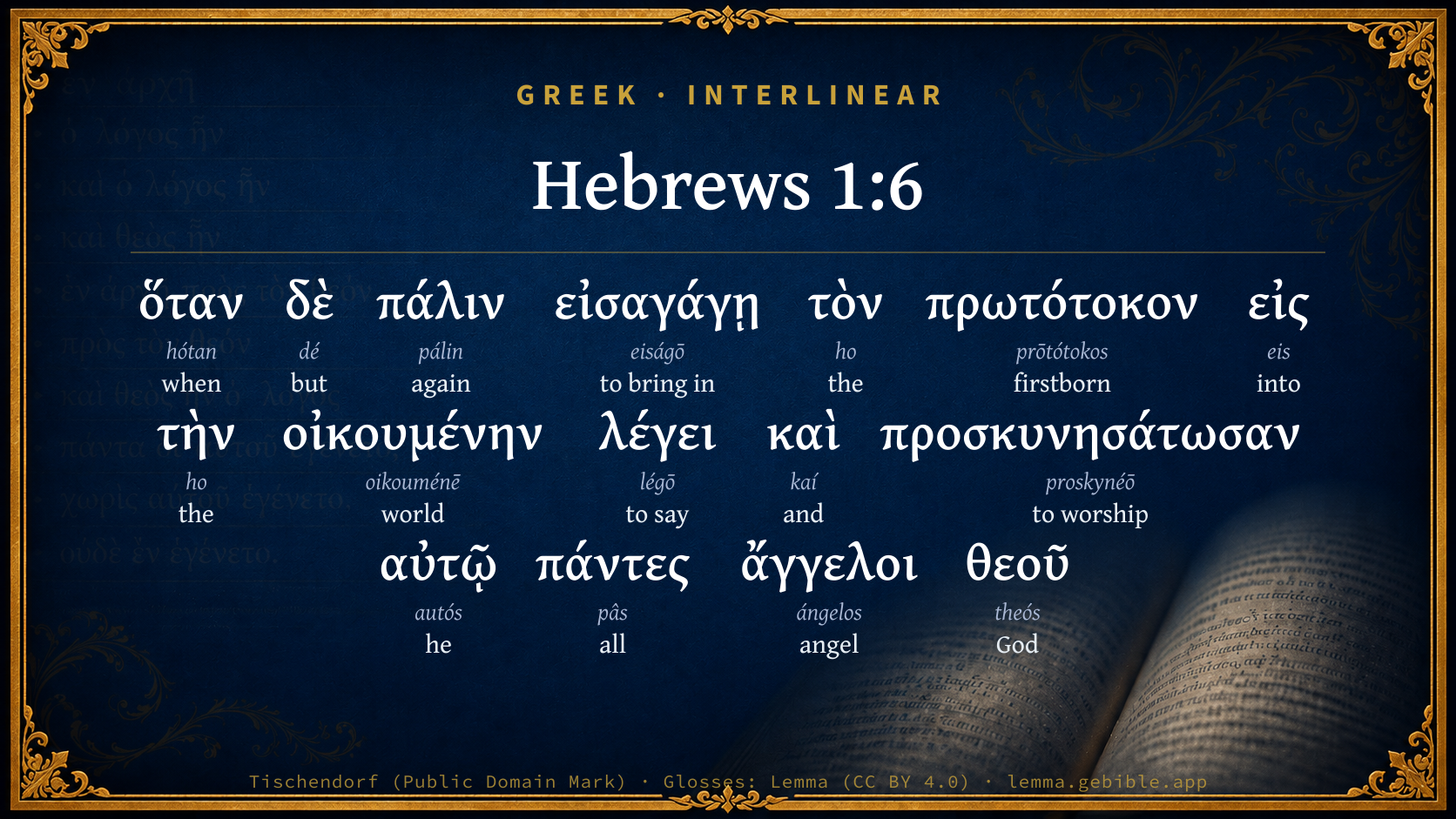
  1. ὅταν hótan G3752 “when” Conjunction
  2. δὲ dé G1161 “but” Conjunction
  3. πάλιν pálin G3825 “again” Adverb
  4. εἰσαγάγῃ eiságō G1521 “to bring in” Verb, Aorist, Active, Subjunctive, 3rd person, Singular
  5. τὸν ho G3588 “the” Article, Accusative, Singular, Masculine
  6. εἰς eis G1519 “into” Preposition
  7. τὴν ho G3588 “the” Article, Accusative, Singular, Feminine
  8. οἰκουμένην oikouménē G3625 “world” Noun, Accusative, Singular, Feminine
  9. λέγει légō G3004 “to say” Verb, Present, Active, Indicative, 3rd person, Singular
  10. καὶ kaí G2532 “and” Conjunction
  11. προσκυνησάτωσαν proskynéō G4352 “to worship” Verb, Aorist, Active, Imperative, 3rd person, Plural
  12. αὐτῷ autós G846 “he” Personal pronoun, Dative, Singular, Masculine
  13. πάντες pâs G3956 “all” Adjective, Nominative, Plural, Masculine
  14. ἄγγελοι ángelos G32 “angel” Noun, Nominative, Plural, Masculine
  15. θεοῦ theós G2316 “God” Noun, Genitive, Singular, Masculine

About this verse

These counts appear in no published source. They are computed here, from the morphology-tagged text and Lemma’s own curated glosses. What Lemma adds →

16
words
15
distinct lemmas
General Epistles
section

Notable vocabulary

The rarest word here is πρωτότοκον firstborn G4416 — appearing just 8 times in the whole Greek New Testament.

Shared distinctive vocabulary

πρωτότοκον firstborn G4416 occurs in 8 verses of the Greek New Testament. Also found in:

Repetition

A word recurs within this verse:

Cross-references

16

Topical passages linked to Hebrews 1:6 in the Treasury of Scripture Knowledge — connected by theme and wording, ordered by reader-vote popularity; previews shown in the World English Bible.

  • Psalms 97:7 Let all them be shamed who serve engraved images, Who boast in their idols. Worship him, all you gods!
  • Colossians 1:18 He is the head of the body, the assembly, who is the beginning, the firstborn from the dead; that in all things he might have the preeminence.
  • 1 Peter 3:22 who is at the right hand of God, having gone into heaven, angels and authorities and powers being made subject to him.
  • Deuteronomy 32:43 Rejoice, you nations, [with] his people: For he will avenge the blood of his servants, Will render vengeance to his adversaries, Will make expiation for his land, for his people.
  • Colossians 1:15 who is the image of the invisible God, the firstborn of all creation.
  • John 1:14 The Word became flesh, and lived among us. We saw his glory, such glory as of the one and only Son of the Father, full of grace and truth.
  • Revelation 5:9–12 They sang a new song, saying, "You are worthy to take the book, And to open its seals: For you were killed, And bought us for God with your blood, Out of every tribe, language, people, and nation,
  • Revelation 1:5 and from Jesus Christ, the faithful witness, the firstborn of the dead, and the ruler of the kings of the earth. To him who loves us, and washed us from our sins by his blood;
  • Romans 8:29 For whom he foreknew, he also predestined to be conformed to the image of his Son, that he might be the firstborn among many brothers.
  • Luke 2:9–14 Behold, an angel of the Lord stood by them, and the glory of the Lord shone around them, and they were terrified.
  • Proverbs 8:24–25 When there were no depths, I was brought forth, When there were no springs abounding with water.
  • 1 John 4:9 By this was God's love revealed in us, that God has sent his one and only Son into the world that we might live through him.
  • John 1:18 No one has seen God at any time. The one and only Son, who is in the bosom of the Father, he has declared him.
  • Hebrews 1:5 For to which of the angels did he say at any time, "You are my Son, Today have I become your father?" and again, "I will be to him a Father, And he will be to me a Son?"
  • John 3:16 For God so loved the world, that he gave his one and only Son, that whoever believes in him should not perish, but have eternal life.
  • Hebrews 10:5 Therefore when he comes into the world, he says, "Sacrifice and offering you didn't desire, But a body did you prepare for me;

Cross-references courtesy of OpenBible.info (CC BY 4.0).

Commentary

Notes on Hebrews 1:6 from classic Christian and Jewish commentators (each source and its license shown beneath its notes). The classic Christian expositions comment on the surrounding passage and are grouped to its opening verse, so a note may address several verses; the Jewish commentaries on the Tanakh (Rashi and others) are per-verse, so they appear only where the commentator wrote on this verse.

Lemma curates 59 commentaries, every one of them public domain or Creative Commons licensed, each selected and text-cleaned for this edition rather than reprinted as found. About our sources →

Albert Barnes' Notes on the Bible

And again - Margin, “When he bringeth in again.” The proper construction of this sentence probably is, “But when, moreover, he brings in,” etc. The word “again” refers not to the fact that the Son of God is brought “again” into the world, implying that he had been introduced before; but it refers to the course of the apostle’s argument, or to the declaration which is made about the Messiah in another place. “The name Son is not only given to him as above, but also in another place, or on another occasion when he brings in the first-begotten into the world.” “When he bringeth in.” When he introduces. So far as the “language” here is concerned this might refer to the birth of the Messiah, but it is evident from the whole connection that the writer means to refer to something that is said in the Old Testament. This is plain because the passage occurs among quotations designed to prove a specific point - that the Son of God, the Author of the Christian system, was superior to the angels.

A declaration of the writer here, however true and solemn, would not have answered the purpose. A “proof-text” was missing; a text which would be admitted by those to whom he wrote to bear on the point under consideration. The meaning then is, “that on another occasion different from those to which he had referred, God, when speaking of the Messiah, or when introducing him to mankind, had used language showing that he was superior to the angels.” The meaning of the phrase, “when he bringeth in,” therefore, I take to be, when he introduces him to people; when he makes him known to the world - to wit, by the declaration which he proceeds immediately to quote. “The first-begotten.” Christ is called the “first-begotten,” with reference to his resurrection from the dead, in Rev 1:5, and Col 1:18. It is probable here, however, that the word is used, like the word “first-born,” or “first-begotten” among the Hebrews, by way of eminence.

As the first-born was the principal heir, and had special privileges, so the Lord Jesus Christ sustains a similar rank in the universe of which God is the Head and Father; see notes on Joh 1:14, where the word “only-begotten” is used to denote the dignity and honor of the Lord Jesus. “Into the world.” When he introduces him to mankind, or declares what he is to be. “He saith, And let all the angels of God worship him.” Much difficulty has been experienced in regard to this quotation, for it cannot be denied that it is intended to be a quotation. In the Septuagint these very words occur in Deu 32:43, where they are inserted in the Song of Moses. But they are not in the Hebrew, nor are they in all the copies of the Septuagint. The Hebrew is, “Rejoice, O ye nations with his people; for he will avenge the blood of his servants, and will render vengeance to his adversaries.” The Septuagint is, “Rejoice ye heavens with him; and let all the angels of God worship him. Let the nations rejoice with his people, and let all the sons of God be strong in him, for he has avenged the blood of his sons.” But there are objections to our supposing that the apostle had this place in his view, which seem to me to settle the matter.

(1) One is, that the passage is not in the Hebrew; and it seems hardly credible that in writing to Hebrews, and to those residing in the very country where the Hebrew Scriptures were constantly used, he should adduce as a proof-text on an important doctrine what was not in their Scriptures.

(2) A second is, that it is omitted in all the ancient versions except the Septuagint.

(3) A third is, that it is impossible to believe that the passage in question in Deuteronomy had any reference to the Messiah. It does not relate to his “introduction” to the world. It would not occur to any reader that it had any such reference. The context celebrates the victory over the enemies of Israel which God will achieve. After saying that “his arrows would be drunk with blood, and that his sword would devour flesh with the blood of the slain and of captives, from the time when he began to take vengeance on an enemy,” the Septuagint (not the Hebrew) immediately asserts, “let the heavens rejoice at the same time with him, and let all the angels of God worship him.” That is, “Let the inhabitants of the heavenly world rejoice in the victory of God over the enemies of his people, and let them pay their adoration to him.” But the Messiah does not appear to be alluded to anywhere in the context; much less described as “introduced into the world.”

There is, moreover, not the slightest evidence that it was ever supposed by the Jews to have any such reference; and though it might be said that the apostle merely quoted “language” that expressed his meaning - as we often do when we are familiar with any well-known phrase that will exactly suit our purpose and convey an idea - yet it should be remarked that this is not the way in which this passage is quoted. It is a “proof-text,” and Paul evidently meant to be understood as saying that that passage had a “fair” reference to the Messiah. It is evident, moreover, that it would be admitted to have such a reference by those to whom he wrote. It is morally certain, therefore, that this was not the passage which the writer intended to quote. The probability is, that the writer here referred to Psa 97:7, (in the Septuagint Psa 96:7). In that place, the Hebrew is, “worship him, all ye gods” כל אלהים kaal 'elohiym - “all ye ‘elohiym.”

In the Septuagint it is, “Let all his angels worship him;” where the translation is literal, except that the word “God” - “angels of God” - is used by the apostle instead of “his” - “all his angels” - as it is in the Septuagint. The word “gods” - אלהים 'elohiym - is rendered by the word “angels” - but the word may have that sense. Thus, it is rendered by the Septuagint; in Job 20:15; and in Psa 8:6; Psa 137:1. It is well known that the word אלהים 'elohiym may denote “kings” and “magistrates,” because of their rank and dignity; and is there anything improbable in the supposition that, for a similar reason, the word may be given also to “angels”? The fair interpretation of the passage then would be, to refer it to “angelic beings” - and the command in Psa 97:1-12 is for them to do homage to the Being there referred to. The only question then is, whether the Psalm can be regarded properly as having any reference to the Messiah? Did the apostle fairly and properly use this language as referring to him? On this we may remark:

(1) That the fact that he uses it thus may be regarded as proof that it would be admitted to be proper by the Jews in his time, and renders it probable that it was in fact so used.

(2) Two Jewish Rabbis of distinction - Rashi and Kimchi - affirm that all the Psalms Psa. 93–101 are to be regarded as referring to the Messiah. Such was, and is, the opinion of the Jews.

(3) There is nothing in the Psalm which forbids such a reference, or which can be shown to be inconsistent with it. Indeed the whole Psalm might be taken as beautifully descriptive of the “introduction” of the Son of God into the world, or as a sublime and glorious description of his advent. Thus, in Heb 1:1, the earth is called on to rejoice that the Lord reigns. In Heb 1:2-5, he is introduced or described as coming in the most magnificent manner - clouds and darkness attend him; a fire goes before him; the lightnings play; and the hills melt like wax - a sublime description of his coming, with appropriate symbols, to reign, or to judge the world. In Heb 1:6, it is said that all people shall see his glory; in Heb 1:7, that all who worship graven images shall be confounded, and “all the angels are required to do him homage;” and in Heb 1:8-12, the effect of his advent is described as filling Zion with rejoicing, and the hearts of the people of God with gladness. It cannot be proveD, therefore, that this Psalm had no reference to the Messiah; but the presumption is that it had, and that the apostle has quoted it not only as it was usually regarded in his time, but as it was designed by the Holy Ghost. If so, then it proves, what the writer intended, that the Son of God should be adored by the angels; and of course that he was superior to them. It proves also more. Whom would God require the angels to adore? A creature? A man? A fellow-angel? To ask these questions is to answer them. He could require them to worship none but God, and the passage proves that the Son of God is divine.

Albert Barnes' Notes on the Bible (1834–1885) — public domain. Text from a community e-Sword/MySword module.

Tyndale Open Study Notes

Tyndale Open Resources

1:6 The supreme (or firstborn) Son shared the authority of the father, inherited most of his property, and was especially favored. In the New Testament, “firstborn” most frequently refers to Christ’s supremacy both in the church and in the created order; his resurrection is often given as the evidence for this status (Acts 13:33; Rom 1:4; 8:29; Col 1:15, 18; Rev 1:5; cp. Heb 12:23, where believers are called firstborn children). • “Let all of God’s angels worship him”: This quotation from Deut 32:43 demonstrates the lower status of the angels in that they worship the Son (see also Ps 97:7).

Tyndale Open Study Notes — © Tyndale Open Resources, licensed CC BY-SA 4.0. Text via the HelloAO Bible API.

Bengel's Gnomon

Johann Albrecht Bengel

Heb 1:6. Ὅταν δὲ πάλιν εἰσαγάγῃ τὸν πρωτότοκον εἰς τὴν οἰκουμένην, and again, when He brings His First-begotten into the world) Comp. with ὅταν, when, ὅταν in Jas 1:2, joined with the 2d Aor. subj. The particle δὲ, but, intimates that something more important is to follow. Not only is the Son greater than angels, but He is worshipped by angels. ἡ οἰκουμένη, is the world subject to Christ, ch. Heb 2:5, as the First-begotten; see the psalm last quoted, and presently about to be quoted. This introduction implies something more than a mission, or mere sending. Both, however, take for granted τὴν προΰπαρξιν, the pre-existence of the Son of GOD; and His entrance into the world corresponds to that pre-existence: ch. Heb 10:5. He entered, by the will of GOD, when He presented Himself to do the will of GOD, ch. Heb 10:5; with which comp. ch. Heb 9:11; when He came into the world, as He is everywhere said to have done. Πάλιν, again, is brought in, corresponding to the common word, likewise, where scripture upon scripture is quoted, Heb 1:5, ch. Heb 2:13, Heb 10:30; but the meaning of this particle is more clearly seen when it is enclosed in a parenthesis, the verb, I say, or some other of that kind, being supplied, in this manner: But when (I shall again state what GOD says concerning His Son) He brings in His First-begotten. So Joh 12:39, They could not believe, because (I shall again quote Isaiah) the same prophet says, He has blinded, etc. Mat 5:33, Ye have heard (I shall again bring forward an example) that it was said to the ancients. For the forms of quotation are somewhat freely introduced into a speech; ch. Heb 8:5, ὃρα γὰρ φησι, instead of For, He says, See.

The appellation, First-begotten, includes the appellation, Son, and further shows the force of its signification. For it involves the rights of primogeniture, which the Only-begotten most eminently possesses. Paul also uses similar language, Rom 8:29; Col 1:15; Col 1:18. In this passage, the appellation, First-begotten, includes the description of the subject of Whom the Psalm is treating, with the Ætiology[7] or reason given for the predicate, viz. He is brought in, for He is the First-begotten.—λέγει, He says) An abbreviated mode of expression. When the bringing in was predicted, the word was given; when the bringing in was accomplished, the same word was fulfilled. He says, viz. GOD; comp Heb 1:5. Therefore the word αὐτῷ, Him, presently after, refers to the Son.—καὶ προσκυνησάτωσαν αὐτῷ πάντες ἄγγελοι Θεοῦ, and let all the angels of GOD worship Him) LXX., Deuteronomy 32, before Deu 1:43, has these words: εὐφράνθητε οὐρανοὶ ἅμα αὐτῷ καὶ προσκυνησάτωσαν αὐτῷ πάντες ἄγγελοι Θεοῦ, which are wanting in the Hebrew text and in the Chaldee Paraphrase. Mill is of opinion that the omission was occasioned long ago by the recurrence of the verb הרנינו. Then [after the words in the LXX. at the beginning of Deu 1:43] there follows in Moses, εὐφράνθητε ἔθνη μετὰ τοῦ λαοῦ αὐτοῦ, הרנינו גוים עמו (where á after î is wanting), which Paul, Rom 15:10, also refers to the times of the Messiah. Moses, especially in the Song, wrote of Christ. Nevertheless, Psa 97:7 has, ΠΡΟΣΚΥΝΉΣΑΤΕ ΑὐΤῷ ΠΆΝΤΕς ΟἹ ἌΓΓΕΛΟΙ ΑὐΤΟῦ; and Paul refers to this psalm, for the bringing in of the First-begotten into the world, in this passage, corresponds to the inscription of the psalm in the LXX, τῷ Δαβὶδ, ὅτε ἡ γῆ αὐτοῦ καθίσταται, that is, of David, when the land is brought under his authority, as Oederus has observed.

[7] Ætiologia. See Append.

Bengel's Gnomon of the New Testament — English translation (T&T Clark, Edinburgh, 1860) — public domain. Text from a community e-Sword module.

Meyer's Critical & Exegetical Commentary

Heinrich August Wilhelm Meyer

Heb_1:6. Ὅταν, with the conjunctive aorist, takes the place of the Latin futurum exactum. See Winer, Gramm., 7 Aufl. p. 289. Ὅταν εἰσαγάγῃ cannot consequently mean, as was still assumed by Bleek I., and recently by Reuss:[35] when He brings in, but only: when He shall have brought in. To take πάλιν, however, with the Peshito, Erasmus, Luther, Calvin, Jac. Cappellus, Schlichting, Grotius, Limborch, Hammond, Bengel, Wolf, Carpzov, Cramer, Valckenaer, Schulz, Kuinoel, Bleek, Stengel, Ebrard, Bloomfield, Reuss, alii, as Heb_1:5, i.e. merely as the formula for linking on a new citation, is forbidden by the position of the words. It must then have been written: πάλιν δέ, ὅταν εἰσαγάγῃ … λέγει. The possibility of an inversion of the ΠΆΛΙΝ is defended, it is true, by Bleek, after the precedent of Carpzov, on the authority of two passages in Philo (Legg. Allegor. iii. p. 66; ed. Mangey, p. 93). But neither of these presents a case analogous to the one before us, nor does an inversion of the πάλιν at all take place in them. For in both ΠΆΛΙΝ has the signification in turn, or on the other hand, inasmuch as in the former two classes of persons (ὁ δὲ νοῦν τὸν ἴδιον ἀπολείπων and Ὁ ΔἙ ΠΆΛΙΝ ἈΠΟΔΙΔΡΆΣΚΩΝ ΘΕΌΝ), in the latter two classes of ΔΌΞΑΙ or opinions (Ἡ ΜῈΝ ΤῸΝ ἘΠῚ ΜΈΡΟΥς, ΤῸΝ ΓΕΝΝΗΤῸΝ ΚΑῚ ΘΝΗΤῸΝ ἈΠΟΛΙΠΟῦΣΑ and Ἡ ΔῈ ΠΆΛΙΝ ΘΕῸΝ ἈΠΟΔΟΚΙΜΆΖΟΥΣΑ), are compared together by way of contrast, in such wise that in both ΠΆΛΙΝ only serves for bringing the ΔΈ into stronger relief, and in both has occupied its legitimate place. By virtue of its position, ΠΆΛΙΝ, in our passage, can be construed only with ΕἸΣΑΓΆΓῌ, in such wise that a bringing again of the First-born into the world, which is an event still belonging to the future, is spoken of. In the former member of Heb_1:6 the reference can accordingly be neither to the time of the Incarnation of the Son (Chrysostom, Primasius, Calvin, Owen, Calov, Bengel, Storr, Kuinoel [Stuart: or beginning of His ministry], Bleek II. alii); nor to the time of the Resurrection and Exaltation to heaven (Schlichting, Grotius, Hammond, Wittich, Braun, Wetstein, Rambach, Peirce, Whitby, and others); nor, as Bleek I. supposed, to a moment yet preceding the Incarnation of Christ, in which the Father had, by a solemn act as it were, conducted forth and presented the Son to the beings created by Him, as the First-born, as their Creator and Ruler, who was to uphold and guide all things,[36]which in any case would be an entirely singular thought in the N. T.,but simply and alone to the coming again of Christ to judgment, and the accomplishment of the Messianic kingdom. So, rightly, Gregory Nyssen, contra Eunom. Orat. iii. p. 541; Cornelius a Lapide, Cameron [Mede: for the inauguration of His millennial kingdom], Gerhard, Calmet, Camerarius, Estius, Gomar, Böhme, de Wette, Tholuck, Bisping, Hofmann (Schriftbew. I. p. 172, 2d ed.), Delitzsch, Riehm (Lehrbegr. des Hebräerbr. p. 306, 617), Alford, Conybeare, Maier, Moll, Kurtz, Ewald, MCaul, Woerner. The objection brought by Bleek and Ebrard against this interpretation of the former member, required as it is by the exigencies of the grammar, viz. that the discourse could not turn on the bringing again of the First-born into the world, unless an earlier bringing in of the same into the world, or at least a former being of the Son ἐν τῇ οἰκουμένῃ had been explicitly spoken of, is invalidated by Heb_1:1; Heb_1:3, where certainly the discourse was already of the historic appearing of the Son on earth, and thus of a first bringing in of the same into the world. The additional objection of Bleek, however, that the author would hardly have limited the scope of a divine summons to the angels to do homage to the First-born to a time even in his day future, is set aside by the consideration that, according to Heb_2:9, Christ was during His earthly life humbled to a condition beneath the angels, and only the Parousia itself is the epoch at which His majesty will be unfolded in full glory.

ΤῸΝ ΠΡΩΤΌΤΟΚΟΝ] in the N. T. only here without more precisely defining addition; comp. however, Psa_89:28 (27). That the expression must not be regarded as equivalent to ΜΟΝΟΓΕΝΉς, as is done by Primasius, Oecumenius (ΤῸ ΔῈ ΠΡΩΤΌΤΟΚΟΝ ΟὐΚ ἘΠῚ ΔΕΥΤΈΡΟΥ ΛΈΓΕΙ ἈΛΛʼ ἘΠῚ ἙΝῸς ΚΑῚ ΜΌΝΟΥ ΤΟῦ ΓΕΝΝΗΘΈΝΤΟς ἘΚ ΤΟῦ ΠΑΤΡΌς), Clarius, and even now by Stengel, is self-evident. But neither is it identical with the ΠΡΩΤΌΤΟΚΟς ΠΆΣΗς ΚΤΊΣΕΩς, Col_1:15, in such wise that the temporal priority of Christ, as the eternal Logos, over all creatures, and the notion of His precedence over all creatures, necessarily resulting therefrom, should be contained in the word (Bleek, Grimm in the Theol. Literaturbl. to the Darmstadt A. K.-Z., No. 29, p. 662; Riehm, Lehrbegr. des Hebräerbr. p. 292 f.; Kurtz, Ewald, and others). For this interpretation is excluded by the absoluteness of the expression in our passage. Rather is Christ called the First-born with respect to Christians, who are His brethren (Heb_2:11 f.), and therefore likewise υἱοί of God (Heb_2:10). Comp. also Rom_8:29.

As, for the rest, the author of the Epistle to the Hebrews terms Christ the First-born Son of God; so does Philo also term the Logos the First-born Son. Comp. de Agricultura, p. 195 B (ed. Mangey, I. p. 308): τὸν ὀρθὸν αὑτοῦ λόγον, πρωτόγονον υἱύν. De Confus. Ling. p. 329 (ed. Mang. I. p. 415): τοῦτον μὲν γὰρ πρεσβύτατον υἱὸν ὃ τῶν ὄντων ἀνέτειλε πατήρ, ὅν ἐτέρωθι πρωτόγονον ὠνόμασεν, al.

ἡ οἰκουμένη] the world, not in the widest sense (equivalent to οἱ αἰῶνες, Bleek; or to Ἡ ΟἸΚΟΥΜΈΝΗ Ἡ ΜΈΛΛΟΥΣΑ, Böhme); but, since the former member has reference to the Parousia, the habitable earth.

λέγει] sc. ὁ θεός, not Ἡ ΓΡΑΦΉ (Grotius, Clericus, Böhme, and others). The present is chosen, because the utterance of God, which shall infallibly be made in the future, stands already noted down in the Scripture.

The citation is not derived from Psa_97:7, but from Deu_32:43. For, in the former passage, the LXX. have a reading divergent from that of our text, in the words: καὶ προσκυνήσατε αὐτῷ πάντες [οἱ] ἄγγελοι αὐτοῦ, whereas in the Codex Vaticanus of Deu_32:43, the words occur as in our text; while the ΚΑΊ, taken up by the author into his citation, manifestly pointsseeing that it is without any importance for his reasoningto the verbatim reproduction of an O. T. utterance. Now, it is true our author follows in other cases a form of the Sept. text which bears affinity less to that contained in the Codex Vaticanus than to that in the Codex Alexandrinus, and the latter displays the variation from the Cod. Vat. Deu_32:43, in so far as ΥἹΟῚ ΘΕΟῦ is found therein in place of ἌΓΓΕΛΟΙ ΘΕΟῦ. But the Song of Moses, of which Deu_32:43 forms the conclusion, is communicated anew, in many MSS. of the LXX., and so also in the Codex Alexandrinus, in a second recension, having its place after the Psalms; and in this second recension the Codex Alexandrinus, too, reads ἌΓΓΕΛΟΙ ΘΕΟῦ, only the article ΟἹ has been interpolated between ΠΆΝΤΕς and ἌΓΓΕΛΟΙ. It is probable, therefore, that the author of the Epistle to the Hebrews did not take the citation direct from Deu_32:43, but mediately, i.e. from that second recension of the hymn.

It remains to be said that the words of the citation are wanting in the Hebrew; they are found only in the LXX.

προσκυνεῖν] with the dative only in the case of later classic authors, whereas the earlier combine the accusative with this verb. Comp. Lobeck, ad Phryn. p. 463; Bernhardy, Syntax, p. 113, 266. The N. T. has both constructions, as besides them the Hebraizing turns προσκυνεῖν ἐνώπιον, or ἜΜΠΡΟΣΘΈΝ ΤΙΝΟς, or ΤῶΝ ΠΟΔῶΝ ΤΙΝΟς. See the Lexicons.

ΑὐΤῷ] That this pronoun of the third person was to be referred to the Messiah naturally suggested itself, inasmuch as Jehovah is the subject speaking immediately before in the Song.

[35] Comp. Reuss, Lépître aux Hébreux. Essai dune traduction accompagnée dun commentaire (Nouvelle Revue de Théologie, vol. v. 4e, 5e, et 6e livraison, Strasb. et Paris 1860, p. 199).

[36] In like manner Reuss, l.c. p. 201: Il est plus naturel de songer au moment, où le monde nouvellement créé était sommé de reconnaître le Fils comme créateur. A ce moment, les anges seuls étaient les êtres formant pour ainsi dire lEglise du Verbe (comme Heb_12:22), et qui pouvaient recevoir lordre de Dieu dadorer le Fils.

Meyer — Critical and Exegetical Commentary on the New Testament — English translation by Peter Christie, edited by Frederick Crombie (T&T Clark, 1880) — public domain. Text from a community e-Sword module.

Expositor's Greek Testament

ed. W. Robertson Nicoll

Heb 1:6 . ὅταν δὲ πάλιν εἰσαγάγῃ … “And when He shall again have brought the first-begotten into the world [of men], He says, “And let all God’s angels worship Him”. Having shown that “Son” is a designation reserved for the Messiah and not given to any of the angels, the writer now advances a step and adduces a Scripture which shows that the relation of angels to the Messiah is one of worship. It is not easy to determine whether πάλιν merely indicates a fresh quotation (so Bleek, Bruce, etc.) as in Heb 1:5 ; or should be construed with εἰσαγάγῃ . On the whole, the latter is preferable. Both the position of πάλιν and the tense of εἰσαγ . seem to make for this construction. The “bringing in” is still future. Apparently it is to the second Advent reference is made; cf. Heb 9:28 . To refer εἰσαγ . to the incarnation, with Chrysostom, Calvin, Bengel, Bruce (see esp. Schoettgen); or to the resurrection with Grotius; or to an imagined introduction of the Son to created beings at some past period, with Bleek, is, as Weiss says, “sprachwidrig”. Rendall remarks: “The words bring in have here a legal significance; they denote the introduction of an heir into his inheritance, and are used by the LXX with reference to putting Israel in possession of his own land both in the time of Joshua and at the Restoration (Exo 6:8 ; Exo 15:17 ; Deu 30:5 ).” This throws light not only on εἰσαγ . but also on πρωτότοκον and οἰκουμένην , and confirms the interpretation of the clause as referring to the induction of the first-born into His inheritance, the world of men. πρωτότ . is used of Christ (1) in relation to the other children of Mary (Luk 2:7 ; Mat 1:25 ); (2) in relation to other men (Rom 8:29 ; Col 1:18 ); (3) in relation to creation (Col 1:15 ). Nowhere else in N.T. is it used absolutely; but cf. Psa 89:27 . “I will make him first-born,” i.e. , superior in dignity and closer in intimacy. λέγει , the present is used because the words recorded in Scripture and still unfulfilled are meant. These words, καὶ προσκυνησάτωσαν … occur verbatim in Moses’ song (Deu 32:43 ). In the Alexandrian text, from which this writer usually quotes, we find υἱοὶ Θεοῦ ( v . Swete’s LXX), but in a copy of the song subjoined to the Psalter this MS. itself has ἄγγελοι . The words are not represented in the Hebrew, and are supposed by Delitzsch to have been added in the liturgical use of Moses’ song. The part of the song to which they are attached represents the coming of God to judgment, a fact which further favours the view that it is the second Advent our author has in view.

The Expositor's Greek Testament, edited by W. Robertson Nicoll (1897–1910) — public domain. Text from a community e-Sword module.

Geneva Bible (1599)

Geneva Bible translators

The Lord was not content to have spoken it once, but repeateth it in another place.

Geneva Bible (1599) marginal notes — public domain. Text via Bolls.life.

Jamieson, Fausset & Brown

Robert Jamieson, A. R. Fausset & David Brown

And--Greek, "But." Not only this proves His superiority, BUT a more decisive proof is Psa 97:7, which shows that not only at His resurrection, but also in prospect of His being brought into the world (compare Heb 9:11; Heb 10:5) as man, in His incarnation, nativity (Luk 2:9-14), temptation (Mat 4:10-11), resurrection (Mat 28:2), and future second advent in glory, angels were designed by God to be subject to Him. Compare Ti1 3:16, "seen of angels"; God manifesting Messiah as one to be gazed at with adoring love by heavenly intelligences (Eph 3:10; Th2 1:9-10; Pe1 3:22). The fullest realization of His Lordship shall be at His second coming (Psa 97:7; Co1 15:24-25; Phi 2:9). "Worship Him all ye gods" ("gods," that is, exalted beings, as angels), refers to God; but it was universally admitted among the Hebrews that God would dwell, in a peculiar sense, in Messiah (so as to be in the Talmud phrase, "capable of being pointed to with the finger"); and so what was said of God was true of, and to be fulfilled in, Messiah. KIMCHI says that the ninety-third through the hundred first Psalms contain in them the mystery of Messiah. God ruled the theocracy in and through Him.

the world--subject to Christ (Heb 2:5). As "the first-begotten" He has the rights of primogeniture (Rom 8:29); Col 1:15-16, Col 1:18). In Deu 32:43, the Septuagint has, "Let all the angels of God worship Him," words not now found in the Hebrew. This passage of the Septuagint may have been in Paul's mind as to the form, but the substance is taken from Psa 97:7. The type David, in the Psa 89:27 (quoted in Heb 1:5), is called "God's first-born, higher than the kings of the earth"; so the antitypical first-begotten, the son of David, is to be worshipped by all inferior lords, such as angels ("gods," Psa 97:7); for He is "King of kings and Lord of lords" (Rev 19:16). In the Greek, "again" is transposed; but this does not oblige us, as ALFORD thinks, to translate, "when He again shall have introduced," &c., namely, at Christ's second coming; for there is no previous mention of a first bringing in; and "again" is often used in quotations, not to be joined with the verb, but parenthetically ("that I may again quote Scripture"). English Version is correct (compare Mat 5:33; Greek, Joh 12:39).

Jamieson, Fausset & Brown — Commentary Critical and Explanatory on the Whole Bible (1871) — public domain (CC PDM 1.0). Text via the HelloAO Bible API.

Adam Clarke's Commentary

Verse 6. And again, when he bringeth in the firstbegotten] This is not a correct translation of the Greek, Ὁταν δε παλιν εισαγαγῃ τον πρωτοτοκον εις την οικουμενην. But when he bringeth again, or the second time, the first-born into the habitable world. This most manifestly refers to his resurrection, which might be properly considered a second incarnation; for as the human soul, as well as the fulness of the Godhead bodily, dwelt in the man, Christ Jesus on and during his incarnation, so when he expired upon the cross, both the Godhead and the human spirit left his dead body; and as on his resurrection these were reunited to his revivified manhood, therefore, with the strictest propriety, does the apostle say that the resurrection was a second bringing of him into the world.

I have translated οικουμενη the habitable world, and this is its proper meaning; and thus it is distinguished from κοσμος, which signifies the terraqueous globe, independently of its inhabitants; though it often expresses both the inhabited and uninhabited parts. Our Lord's first coming into the world is expressed by this latter word, Heb 10:5: Wherefore when he cometh into the world, διο εισερχομενος εις τον κοσμον, and this simply refers to his being incarnated, that he might be capable of suffering and dying for man. But the word is changed on this second coming, I mean his resurrection, and then οικουμενη is used; and why? (fancy apart) because he was now to dwell with man; to send his gospel everywhere to all the inhabitants of the earth, and to accompany that Gospel wherever he sent it, and to be wherever two or three should be gathered together in his name. Wherever the messengers of Jesus Christ go, preaching the kingdom of God, even to the farthest and most desolate parts of the earth where human beings exist, there they ever find Christ; he is not only in them, and with them, but he is in and among all who believe on him through their word.

Let all the angels of God worship him.] The apostle recurs here to his former assertion, that Jesus is higher than the angels, Heb 1:4, that he is none of those who can be called ordinary angels or messengers, but one of the most extraordinary kind, and the object of worship to all the angels of God. To worship any creature is idolatry, and God resents idolatry more than any other evil. Jesus Christ can be no creature, else the angels who worship him must be guilty of idolatry, and God the author of that idolatry, who commanded those angels to worship Christ.

There has been some difficulty in ascertaining the place from which the apostle quotes these words; some suppose Ps 97:7: Worship him, all ye gods; which the Septuagint translate thus: Προσκυνησατε αυτῳ, παντες αγγελοι αυτου. Worship him, all ye his angels; but it is not clear that the Messiah is intended in this psalm, nor are the words precisely those used here by the apostle. Our marginal references send us with great propriety to the Septuagint version of De 32:43, where the passage is found verbatim et literatim; but there is nothing answering to the words in the present Hebrew text. The apostle undoubtedly quoted the Septuagint, which had then been for more than 300 years a version of the highest repute among the Jews; and it is very probable that the copy from which the Seventy translated had the corresponding words. However this may be, they are now sanctioned by Divine authority; and as the verse contains some singular additions, I will set it down in a parallel column with that of our own version, which was taken immediately from the Hebrew text, premising simply this, that it is the last verse of the famous prophetic song of Moses, which seems to point out the advent of the Messiah to discomfit his enemies, purify the land, and redeem Israel from all his iniquities.

De 32:43, from the Hebrew

De 32:43, from the Septuagint.

. . . . . . . . . . . . . . . . . . . . . . . . . . . . . . . . . . . . . . . . . . . . . . . . . . . . . . . Rejoice, O ye nations, with his people; . . . . . . . . . . . . . . . . . . . . . . . . . . . . . . . . . . . . . . . . . . . . . . . . . . . . for he will avenge the the blood of his servants; . . . . . . . and will render vengeance to his adversaries: . . . . and . . . . . . . . . will be merciful to his land and to his people.

Rejoice, ye heaven, together with him; and let all the angels of God worship him. Rejoice, ye Gentiles, with his people; and let the children of God be strengthened in him; for he will avenge blood of his children; he will avenge, and will repay judgment to his adversaries; and those who hate him will he recompense: and the Lord will purge the land of his people.

This is a very important verse; and to it, as it stands in the Septuagint, St. Paul has referred once before; see Ro 15:10. This very verse, as it stands now in the Septuagint, thus referred to by an inspired writer, shows the great importance of this ancient version; and proves the necessity of its being studied and well understood by every minister of Christ. In Rom. 3: there is a large quotation-from Psalm 14:, where there are six whole verses in the apostle's quotation which are not found in the present Hebrew text, but are preserved in the Septuagint! How strange it is that this venerable and important version, so often quoted by our Lord and all his apostles, should be so generally neglected, and so little known! That the common people should be ignorant of it, is not to be wondered at, as it has never been put in an English dress; but that the ministers of the Gospel should be unacquainted with it may be spoken to their shame.

Adam Clarke's Commentary on the Bible (1810–1826) — public domain. Text from a community e-Sword/MySword module.

John Calvin's Commentaries

6. And again, when he bringeth or introduceth , etc. He now proves by another argument that Christ is above the angels, and that is because the angels are bidden to worship him. (Psalm 97:7.) It hence follows that he is their head and Prince. But it may seem unreasonable to apply that to Christ which is spoken of God only. Were we to answer that Christ is the eternal God, and therefore what belongs to God may justly be applied to him, it would not perhaps be satisfactory to all; for it would avail but little in proving a doubtful point, to argue in this case from the common attributes of God.

The subject is Christ manifested in the flesh, and the Apostle expressly says, that the Spirit thus spoke when Christ was introduced into the world; but this would not have been said consistently with truth except the manifestation of Christ be really spoken of in the Psalm. And so the case indeed is; for the Psalm commences with an exhortation to rejoice; nor did David address the Jews, but the whole earth, including the islands, that is, countries beyond the sea. The reason for this joy is given, because the Lord would reign. Further, if you read the whole Psalm, you will find nothing else but the kingdom of Christ, which began when the Gospel was published; nor is the whole Psalm anything else but a solemn decree, as it were, by which Christ was sent to take possession of His kingdom. Besides, what joy could arise from His kingdom, except it brought salvation to the whole world, to the Gentiles as well as to the Jews? Aptly then does the Apostle say here, that he was introduced into the world, because in that Psalm what is described is his coming to men.

The Hebrew word, rendered angels, is Elohim — gods; but there is no doubt but that the Prophet speaks of angels; for the meaning is, that there is no power so high but must be in subjection to the authority of this king, whose advent was to cause joy to the whole world.

John Calvin's Commentaries (1540-1563) — public domain. Text from the Calvin Translation Society English edition (1840s-50s) via the Christian Classics Ethereal Library (ccel.org). Calvin's coverage is partial (roughly two-thirds of the Bible); uncommented books and verses are honest gaps, never fabricated. The 19th-century editor's footnotes and remarks are omitted so the notes are faithfully Calvin's own voice.

Ellicott's Commentary for English Readers

(6) And again.—There seems little doubt that the true translation is, And when He again leadeth (literally, shall have led) the Firstborn into the world He saith. The position of “again” (in the Greek) shows that it does not indicate a new step in the argument, but must be joined with “leadeth.” The speaker (“He saith”) is God, speaking in the word of Scripture; in this Epistle quotations from the Old Testament are usually thus introduced. The quotation involves some difficulty. It cannot be directly taken from Psa_97:7, “worship Him, all His angels;” for the citations from the Greek Bible in this Epistle are usually so exact that we cannot believe the writer would have so altered the form of the sentence now before us. In Deu_32:43, however, we find words identical with those of the text in most copies of the LXX.; but there is nothing answering to them in the Hebrew, and there is no sufficient reason for supposing that the clause has dropped out of the Hebrew text. There are similarities (both of subject and of diction) between the Psalm and the last section of the Song of Moses, which make it easy to see how the words could find their way into the Song. The Psalm belongs to a cycle (Psalms 93, 95-99) whose theme is the triumphant announcement of the coming of God’s kingdom, by which was denoted (as the readers of the Epistle knew) the kingdom of Christ. In the divine plan the predicted Theophany was coincident with the fulfilment of the Messianic hope. In both Psalm and Song we read of the judgment exercised and the vengeance inflicted by the enthroned King. (Comp. Psa_2:9.) This agreement in tone and subject renders less important the question whether the Hebrew original of the Song really contained the words. The thought was familiar from Scripture, and in this very connection. When the Messiah, reigning as the Firstborn of God (see Heb_1:5), shall appear for judgment—that is, when God leadeth a second time His Firstborn into “the world of men” (see Heb_2:5), that He may receive full possession of His inheritance—He saith, And let all angels of God worship Him. The word here rendered “leadeth in” is in frequent use for the introduction of Israel (typically God’s “firstborn,” Exo_4:22) into the land of Canaan. It should, perhaps, be noted that, though in Psa_97:7 “angels” may not be perfectly exact as a rendering of the Hebrew Elohim, the verse so distinctly expresses the homage done to the King by superhuman powers, that its fitness for the argument here is obvious.

A Bible Commentary for English Readers, edited by Charles John Ellicott (1878–1897) — public domain. Text from a community e-Sword module.

The Cambridge Bible for Schools and Colleges

gen. ed. J. J. S. Perowne

6. And again, when he bringeth in the firstbegotten into the world] The older and literal rendering is as in the R. V., “and when he, again, shall have brought in …” The A. V. takes the word “again” (palin) as merely introducing a new quotation, as in Heb_1:5, and in Heb_2:13, Heb_4:5, &c. The word “again,” says Bp. Wordsworth, serves the purpose of inverted commas (see Rom_15:10-12). In that case it is displaced by an accidental hyperbaton or trajection, as this transmission of a word into another clause is called. If however the “again” belongs to the verb it can only be explained of Christ’s second coming to judge the world (Mat_25:31) unless the writer, assuming the point of view of the ancient prophet, alludes to the Resurrection. But since the mere displacement of the palin is certainly possible, it is better to accept this simple explanation than either to adopt these latter theories or to suppose that there had been some previous and premundane presentation of the Son to all created beings. Hypotheses non fingo is a rule even more necessary for the theologian than for the scientist.

bringeth in] The Greek verb is in the aorist subjunctive (εἰσαγαγῇ), and means “shall have brought in,” exactly as in Exo_13:5; Exo_13:11 (where the same word occurs in the LXX.) and as in Luk_17:10, “when ye shall have done all that is commanded you” (ποιήσητε).

the firstbegotten] Rather, “first-born.” This title (see Psa_89:27) was always applied in a Messianic sense to Christ as “the first-born of all creation” (Col_1:15; and the first-born of many brethren (Heb_2:10-11).

into the world] The Greek word here used is not kosmos the material world, but oikoumene “the habitable world.”

he saith] The language of the Scriptures is regarded as a permanent, continuous, and living utterance (Heb_3:7, Heb_5:6, Heb_8:8-10, Heb_10:5, &c.).

And let all the angels of God worship him] It is doubtful whether the quotation is from Psa_97:7 “worship Him all ye gods (Elohim)”—where the word Elohim is rendered “angels” in the LXX. as in Psa_8:5—or rather from Deu_32:43, where there is an “and,” and where the LXX. either added these words or found them in the Hebrew text. The Messianic application of the word is natural in the latter passage, for there Jehovah is the speaker, and if the “him” is applied to the ideal Israel, the ideal Israel was the Jasher or “upright man,” and was the type of the Messiah. The Apostles and Evangelists always describe Christ as returning “with the Holy Angels” (Mat_25:31; Mar_8:38), and describe “all Angels and authorities” as “subject unto Him” (1Pe_3:22; Rev_5:11-13).

The Cambridge Bible for Schools and Colleges (gen. ed. J. J. S. Perowne; Cambridge University Press, 1878–1918) — public domain. Text from a community e-Sword module.

John Gill's Exposition

And again, when he bringeth the first begotten into the world;.... By "the first begotten" is meant Christ. This is a name given him in the Old Testament, and is what the Hebrews were acquainted with, and therefore the apostle uses it; it is in Psa 89:27 from whence it seems to be taken here, and which the ancient Jews (u) acknowledge is to be understood of the Messiah; who, as the Son of God, is the only begotten of the Father, and was begotten from eternity, as before declared, and before any creature had a being, and therefore called the firstborn of every creature, Col 1:15 and is sometimes styled the first begotten from the dead; he rose the first in time, and is the first in causality and dignity: and he may be called the firstborn, with respect to the saints, who are of the same nature with him, and are partakers of the divine nature, and are adopted into the family of God, though they are not in the same class of sonship with him; and the bringing of him into the world may refer to his second coming, for this seems agreeable from the natural order of the words, which may be rendered, "when he shall bring again", &c. that is, a second time, and from Psa 97:1 from whence the following words are cited; and from the glory he shall then have from the angels, who will come with him, and minister to him; and not to his resurrection from the dead, when he was exalted above angels, principalities, and powers; though, as we read the words, they seem to regard his first coming in to this habitable world, at his incarnation and birth, when he was attended with angels, and worshipped by them, according to the order of God the Father, as follows:

he saith, and let all the angels of God worship him; these words are cited from Psa 97:7 where the angels are called Elohim, gods. So Aben Ezra on the place observes, that there are some (meaning their doctors) who say, that "all the gods are the angels"; and Kimchi says, that the words are not imperative, but are in the past tense, instead of the future,

all the angels have worshipped him; that is, they shall worship him; as they have done, so they will do. According to our version, they are called upon to worship God's firstborn, his only begotten Son, with a religious worship and adoration, even all of them, not one excepted; which shows, that Christ, as the first begotten, is the Lord God, for he only is to be served and worshipped; and that if angels are to worship him, men ought; and that angels are not to be worshipped, and that Christ is preferable to them; and the whole sets forth the excellency and dignity of his person. Philo the Jew (w) often calls the Logos, or Word of God, his first begotten.

(u) Shemot Rabba, sect. 19. fol. 104. 4. (w) De Agricultura, p. 195. De Confus. Ling. p. 329, 341. Somniis, p. 597.

John Gill's Exposition of the Whole Bible (1746–1763) — public domain (CC PDM 1.0). Text via the HelloAO Bible API.

Trapp's Complete Commentary

John Trapp

6 And again, when he bringeth in the firstbegotten into the world, he saith, And let all the angels of God worship him.

Ver. 6. When he bringeth in the first begotten] He is the "only begotten," and yet is called the first begotten; because he hath the right of firstborn over his brethren, and was begotten before the world was.

And let all the angels of God] The manhood of itself could not be thus adored (because it is a creature), but as it is received into unity of person with the Deity, and hath a partner agency therewith, according to its measure, in the work of redemption and mediation, Php 2:9.

John Trapp, A Commentary or Exposition upon All the Books of the Old and New Testament (1647–1656) — public domain. Text from a community e-Sword module.

Haydock's Catholic Bible Commentary

Let all the Angels of God adore him. These words seem to be cited out of Psalm xcvi. 7. according to the Septuagint. And they seem to be an invitation, and a command to the Angels to adore Jesus Christ, when at the end of the world he shall come to judgment. This is one of the proofs which St. Paul here brings, to shew that the Angels are inferior to Christ, because they are commanded to adore him. (Witham) --- God shews the superiority of his divine Son over the Angels, in ordering the latter to adore him. Wherever the person of Christ is, there it ought to be adored by both men and Angels, therefore in the blessed sacrament [of the Eucharist].

George Leo Haydock (1774–1849), Haydock's Catholic Family Bible and Commentary, 1859 edition — public domain. Excludes Psalms (Douay-Rheims chapter numbering differs from Protestant) and Deuterocanonical books (Catholic canon only).

Matthew Poole's English Annotations

This is a further proof of the great gospel Minister being more excellent than angels, by God’s command to them to worship him.

And again, when he bringeth in the first-begotten into the world: παλιν some refer to God the Father’s speech, as: Again he saith: others think it too gross a transposition, and unusual in the Scripture, and so read it as it stands in the Greek text: He again, or a second time, bringeth, &c. This hath started a query about what time it is that the Father saith this, and that he brought in the First-born into the world? Some say it was at his incarnation; others, at his coming to judgment. Considering the former proofs brought out of Psa 2:7, and 2Sa 7:14, it seems most fairly to be at his resurrection and ascension, when the decree was proclaimed of his being the great King; and he was actually exalted far above all gods, whether angels or men: compare Psa 2:7, with Psa 97:1,9, and Act 13:33, to which agrees Col 1:15,18. Then was the demonstration of what a royal Head he was to be, and how acknowledged by all, Phi 2:9-11.

He saith, And let all the angels of God worship him; he powerfully and effectually publisheth his command unto his angels, as recorded by his prophet in his word. Psa 97:7, where the sense of the Hebrew text is full: Bow down to him all ye Elohim, or gods; which the Septuagint renders angels, and is so quoted by Paul here; and the Spirit warrants it: so is it rendered, Deu 32:43. That translation was commonly used by the dispersed Graecising Hebrews. This title is attributed to angels, Psa 8:5. By their worship they do obey the Father, and own their subjection to his Son at his resurrection, Mat 28:2; Luk 24:4; Joh 20:12; and at his ascension, Act 1:9,10; Re 5:11,12; so that the worshipped is more excellent than the worshippers.

Matthew Poole's English Annotations on the Holy Bible (1683–1685) — public domain. Text from a community e-Sword/MySword module.

Whedon's Commentary on the Bible

Daniel D. Whedon

6. And—As the last verse touches the coronation of the eternal Son, so this verse describes his induction into the rule of the world.

Again— Understood by our translators and by many commentators as correlated to the again of the last verse, as introducing a superadded quotation. Others make it qualify bringeth in; as if reading, when he again bringeth in; as referring to some second being, brought in after a first. Alford and Delitzsch refer it to the second advent; very arbitrarily, for it needs some previous mention of the first advent to make it allowable. If a second bringing into the inhabited world is to be supposed, then we should refer it to his resurrection, which was the time of a return and of exaltation, closing the period of his humiliation. See note on Mat_28:18. Then all power in heaven and in earth was given unto him. So Eph_1:19-20 : “He raised him from the dead, and set him at his own right hand in the heavenly places, far above all principality, and power, and dominion, and every name that is named,” etc. Then, of course, was fulfilled the requirement on all supernal powers to do him homage. But to describe the second advent as a bringing of the Son into the world is entirely unbiblical.

First-begotten—Because eternally begotten. For even if God has been eternally engaged in creating, still the Son is in order of nature first. And when the Son is called first-begotten, it is implied both that his being begotten is prior in order and superior in nature; for creation and formation are in a lower sense figured as generation. And it is as first-begotten that he is, by the divine primogeniture, heir. Heb_1:1. So he is firstborn of every creature, Col_1:15; firstborn among earthly rulers, Psa_89:27; firstborn from the dead, Col_1:18; Rev_1:5. Here the term stands alone, and it alludes to the this day, that is, primordially, have I begotten thee, (of the last verse,) as God manifest, prior to and above all created things.

World—Not cosmos, or frame-world, nor aeon, or time-world; but oikoumene, the inhabited earth.

He [God] saith—Quoted, perhaps, from Psa_97:7, which reads in the Septuagint, “Worship him, all his angels.” Yet the precise words are found in the Septuagint in Deu_32:43, which the Jewish doctors held also Messianic. Indeed, Delitzsch maintains that in the Old Testament, Jehovah, when described as coming, manifestive, administering the affairs of the world, implies Jehovah, the Word, the Son, the ultimate Messiah. The words in Deuteronomy are in the Seventy, but not in the Hebrew. They may, indeed, be supposed to have been in the Hebrew copy used by the Septuagint translators, but dropped out from other copies. They may have been transferred from the psalm, being, perhaps, an essentially accurate reading in some copy of the Septuagint, and even in the copy used by our author. More probably the addition to the Septuagint of Deu_32:42 is made up from Isaiah 44:33, Psalm 117:7, and Psa_29:1, springing probably from the liturgical use in the Jewish synagogue of the song of Moses, that is, its use in the chanting of the song in the public worship. Our author, therefore, even if quoting a superaddition to the song, quotes a superaddition acknowledged by his readers, and really made up of inspired words. All the psalms from 93 to 150 were by the Jews held predictive of the Messiah. Psalms 97 is an expansion of our author’s words in Heb_1:2, appointed heir of all things.

This quotation is an expansion, also, of Psa_2:7-12, which all confess, who confess any Messiah, to be Messianic. It describes the firstborn, the eternal Son, as God manifest, ruling over nature and overruling all things to the highest ultimate moral good. And when, by the Father, he is thus installed over all, the very highest intelligences are required to do him homage.

In our English version, as in the Hebrew, Psa_97:7 reads, “Worship him, all ye gods;” and the connexion indicates the idea that the heathen deities are to submit to Jehovah. In accordance with the idea that behind the idol there is a demon, the Jewish Church preferred to extend the term to include all supernaturals. Stuart shows that elohim (gods) is a term repeatedly rendered in the Septuagint by angel, as Job_20:15; Psa_8:6; Psa_137:1. The writer of Hebrews does the same in Heb_2:7, in quoting Psa_8:6, as he does in this present verse.

Daniel D. Whedon (gen. ed.), Commentary on the Old and New Testaments (1874–1909) — public domain. Text from a community e-Sword module.

The Pulpit Commentary

And again, when he bringeth in the first-begotten into the world, he saith, And let all the angels of God worship him. The most obvious translation of the Greek here seems at first sight to be, "But whenever he i.e. God shall again bring or, "bring back the Firstborn into the inhabited world, he saith;" otan eisagah denoting the indefiniteness of future time, and the position of palin connecting it most naturally with eisagagh . If such be the force of palin , the reference must be to the second advent; which, however, is not suggested by the context, in which there has been no mention of a first advent, but only of the assignation to the Messiah of the name of Son. This supposed reference to a second advent may be avoided by disconnecting palin in sense from eisagagh |, and taking it (as in the verse immediately preceding, and elsewhere in the Epistle) as only introducing a new quotation. And the Greek will bear this interpretation, though the order of the words, taken by themselves, is against it. The "Firstborn" (prwtotokov) is evidently the So; previously spoken of; the word is so applied (Psa_89:27) in a passage undoubtedly founded on the text last quoted. The same word is applied in the New Testament to Christ, as "the Firstborn among many brethren," "the Firstborn of every creature," "the Firstborn from the dead". (Rom_8:29 Col_1:15, Col_1:18) And the idea conveyed by these passages may have been in the writer"s mind, and intended to be understood by his Christian readers. But for the immediate purpose of his argument he may be supposed to refer only to this designation as applied in the Old Testament to the SON already spoken of. Thus the meaning may be, "But, again, with reference to the time when he shall introduce this SON, the Firstborn, into our inhabited world, he speaks thus of the angels." Or it may be, "But whenever he shall bring a second time into the world the Firstborn who has already once appeared, he speaks thus of the angels." But the first meaning seems more suitable to the general context. The force of the writer"s argument is the same, whichever view we take; the point being that, at the time of the advent of the So, whatever advent may be meant, the angels appear only as attendant worshippers. As to the understood nominative to "saith," we may suppose it to be "God," as in ver. 5. But it is to be observed that legei , without an expressed nominative, is a usual formula for introducing a scriptural quotation. The question remains What is the text quoted, and how can it be understood as bearing the meaning here assigned to it? In the Hebrew Bible we find nothing like it, except in Psa_97:7, "Worship him, all ye gods," A.V; where the LXX has proskunhsate autw pantev oi aggeloi Yeou . Deu_32:43 we find in the LXX, though not in the Masoretic text, kaitwsan autw pantev aggeloi Yeou : the very words, including the introductory kai , which are quoted. Hence, the quotations in this Epistle being mainly from the LXX, we may conclude that this is the text referred to. It occurs towards the end of the Song of Moses, in connection with its concluding picture of the LORD"S final triumph, in which the nations are called upon to rejoice with his people, when he would avenge the blood of his servants, and render vengeance to his adversaries, and make atonement for (Greek, ekkayariei) his land and for his people. Viewed in the light of later prophecy, this triumph is identified with that of the Messiah"s kingdom, and is therefore that of the time of bringing "the Firstborn into the world." Rom_15:10, where "Rejoice, ye Gentiles," etc., from the same passage, is applied to the time of Christ. It is no objection to the quotation that, as it stands in the Epistle, "the Firstborn," though not mentioned in the original, seems to be regarded as the object of the angels" worship. The passage is simply cited as it stands, the reader being left to draw his own inference; and the main point of it is that the angels in "that day" are not, like the Son, sharers of the throne, but only worshippers.

Vers. 6. The Son of God the Recipient of the worship of the angels.

"And again, when he bringeth in the First-begotten," etc. This verse, as Ebrard remarks, "is unquestionably one of the most difficult in the whole Epistle." We have in it:

1. An august relationship. "His First-begotten." This title is appropriately applied to the Son of God:

(1) Because he existed before all creatures. "He is the Firstborn of all creation"; (Col_1:15) "In the beginning was the Word.

(2) Because it was given to him in prophecy. "I will make him my Firstborn," etc. (Psa_89:27)

(3) Because of his miraculous conception. (see Mat_1:18-25 Luk_1:30-35)

(4) Because of his resurrection from the dead. "He is the Firstborn from the dead". (Col_1:18 Rev_1:5) And it may well be that in this place all these applications of the title are combined in setting forth the unique and august relation of the Divine Son to the God and Father.

2. A remarkable epoch. "And again, when he bringeth in the First-begotten into the world." There is much diversity of opinion as to what event in the history of the Son of God is referred to here. Some take it as denoting the resurrection of our Lord. Others, his second coming; as Alford, who translates," But when he again hath introduced the First-begotten into the world." And others, his incarnation. "It cannot be "a second bringing in of the Firstborn into the world" that is here spoken of," says Ebrard, "seeing that nothing has been said of a first." This seems to us the correct interpretation. It is very significant that the heavenly intelligences should be summoned to worship him "even when he was entering upon his profound self-humiliation." The angel Gabriel foretold his birth, (Luk_1:26) the angel of the Lord announced it, and a multitude of the heavenly host celebrated it in joyful worship-song. (Luk_2:9-14) This introduction of the First-begotten into the inhabited world is the greatest epoch in history. Antecedent ages looked onward to it; subsequent ages date from it, and have been influenced by it to a degree far surpassing human conception.

3. A significant command. "He saith, And let all the angels of God worship him." Whether these words are quoted from Deu_32:43 (Septuagint) or Psa_97:7, or whether both passages were in the mind of the writer, we shall not attempt to determine. To us it seems most probable that he quotes from Deuteronomy. But we turn to the homiletic suggestions of the quotation.

I ANGELS WORSHIP, THEREFORE WORSHIP IS BECOMING IN ALL INTELLIGENT BEINGS. Angels are the highest created beings. If worship is necessary for them, it is necessary for those also who are less in their faculties and lower in their positions, yet capable of reverent approach to the Supreme Being. Man needs worship for the right and harmonious development of his being. Without worship the highest powers of his nature will decline and die for want of exercise, and its holiest possibilities will not even be attempted. Moreover, since worship is appropriate and becoming in the angels of God, it is not less so in his human creatures. No attitude is more befitting in us than that of adoration.

II ANGELS WORSHIP THE SON OF GOD, THEREFORE HE IS WORTHY OF THE WORSHIP OF ALL INTELLIGENT BEINGS. We make this statement on the following grounds:

1. Angels, by virtue of their intelligence, are capable of estimating his claims to their worship.

2. Angels, because of their holiness, would not pay their worship to one who was not worthy of it. Hence, in worshipping the First-begotten of the Father, they are an example to us. Their worship attests his worthiness.

III "ALL THE ANGELS OF GOD WORSHIP" THE SON OF GOD, THEREFORE HE IS WORTHY OF THE WORSHIP OF EVEN THE HIGHEST CREATURES. Angels even of the highest rank worship him. (Isa_6:1-3 1Pe_3:22 Rev_5:11-14) Hence we infer that the most intelligent, the wisest, the mightiest, the most exalted of men should worship him.

IV ANGELS ARE UNDER OBLIGATIONS TO WORSHIP THE SON OF GOD, BUT MAN IS UNDER MORE AND MIGHTIER OBLIGATIONS TO WORSHIP HIM. Angels are commanded to worship him. "He saith, Let all the angels," etc. They worship him because of what he is in himself; because he is essentially Divine, and supremely, infinitely perfect the effulgence of the Father"s glory," etc. They worship him also because of what he is in relation to them. He is their Creator and Sustainer. These reasons for worshipping the Son apply to us as much as to these heavenly intelligences; and, in addition to these, we are impelled to worship him by a motive more tender in its character and more mighty in its constraining force than any of these. He is our Savior. He gave himself for us. He died for us. He redeemed us with his own precious blood. And now "he ever liveth to make intercession for us." How sacred and strong, then, are the obligations which bind us to worship him! Worthy is the Lamb that hath been slain to receive the power," etc.; (Rev_5:12) "O come let us sing unto the Lord," etc. (Psa_95:1-7) W. J.

The Pulpit Commentary (1880–1919), ed. H.D.M. Spence-Jones & Joseph S. Exell — public domain. Text from a community e-Sword module.

John Wesley's Explanatory Notes

And again - That is, in another scripture. He - God. Saith, when he bringeth in his first-begotten - This appellation includes that of Son, together with the rights of primogeniture, which the first- begotten Son of God enjoys, in a manner not communicable to any creature. Into the world - Namely, at his incarnation. He saith, Let all the angels of God worship him - So much higher was he, when in his lowest estate, than the highest angel. Psalm xcvii, 7.

John Wesley, Explanatory Notes Upon the Whole Bible (1754–1765) — public domain. Text via the GEBible commentary corpus.

Scofield Reference Notes

C. I. Scofield

world

"oikoumene" = inhabited earth. (See Scofield "Luk 2:1").

The Scofield Reference Bible (1917 edition), notes by C. I. Scofield — public domain. Text from a community e-Sword module.

Godbey's Commentary on the New Testament

William B. Godbey

6. “First begotten” means the first to be giorified from the dead, i.e., the first one raised from the dead in the transfigured glory. Elijah, Elisha and Christ had raised people from the dead before the resurrection of Jesus. But we have no evidence that any of them received the transfigured body, but simply their mortal body subject to dissolution, as formerly. Hence, Jesus was the first one to rise from the dead in His transfigured glory. “Into the world” literally means into the inhabited universe, and here means heaven instead of earth, as we see from the subsequent portion of the verse, because God says, “Let all the angels of God worship Him.” So this verse describes our Savior’s glorious congratulation and reception into heaven when He ascended up from Mt. Olivet in His transfigured body.

William B. Godbey, Commentary on the New Testament (1896–1900) — public domain. Text from a community e-Sword module.

The People's New Testament

B. W. Johnson

6. When he again bringeth the first born into the world. Macknight thinks that Christ was brought into the world the first time when he was born at Bethlehem; that the time referred to here is when he comes again to judge the world. Whatever the time referred to, Ps. 97:7 shows his superiority to the angels for it says, “Let all the angels of God worship him.”

B. W. Johnson's The People's New Testament with Notes (1889–1891) — public domain. Electronic text from the Christian Classics Ethereal Library (CCEL) ThML edition.

unfoldingWord translationNotes

Door43 World Missions Community

General Information:

The first quotation in this section, "All God's angels ... him," comes from one of the books that Moses wrote. The second quotation, "He is the one who makes ... fire," is from the Psalms.

the firstborn

This means Jesus. The author refers to him as the "firstborn" to emphasize the Son's importance and authority over everyone else. It does not imply that there was a time before Jesus existed or that God has other sons like Jesus. AT: "his honored Son, his only Son" (See: Metaphor)

he says

"God says"

He is the one who makes his angels spirits, and his servants flames of fire

Possible meanings are 1) "God has made his angels to be spirits who serve him with power like flames of fire" or 2) God makes the wind and flames of fire his messengers and servants. In the original language the word for "angel" is the same as "messenger," and the word for "spirits" is the same as "wind." With either possible meaning, the point is that the angels serve the Son because he is superior. (See: Metaphor)

translationWords

firstborn

worship

spirit

servant

fire

unfoldingWord translationNotes — © Distant Shores Media and the Door43 World Missions Community, licensed CC BY-SA 4.0. Source: git.door43.org/Door43/en_tn.

Cambridge Greek Testament for Schools and Colleges

6. ὅταν δὲ πάλιν εἰσαγάγῃ. The older and literal rendering is as in the margin of the R. V., “and when he, again, shall have brought in …” The A.V. takes the word “again” (πάλιν) as merely introducing a new quotation, as in Heb 1:5, and in Heb 2:13, Heb 4:5, &c. The word “again,” says Bp Wordsworth, serves the purpose of inverted commas (see Rom 15:10-12). In that case it is displaced by an accidental hyperbaton or trajection, as this transmission of a word into another clause is called. If however the “again” belongs to the verb it can only be explained of Christ’s second coming to judge the world (Mat 25:31), unless the writer, assuming the point of view of the ancient prophet, alludes to the Resurrection. Chrysostom and others refer it to the Incarnation. But since the mere displacement of the πάλιν is certainly possible, it is better to accept this simple explanation than either to adopt these latter theories or to suppose that there had been some previous and premundane presentation of the Son to all created beings. Hypotheses non fingo is a rule even more necessary for the theologian than for the scientist.

εἰσαγάγῃ. The aorist subjunctive means “shall have brought in,” exactly as in Exo 13:5; Exo 13:11 (where the same word occurs in the LXX.) and as in Luk 17:10, “when ye shall have done all that is commanded you” (ποιήσητε). It is the Latin futurum exactum implying uncertainty of time.

τὸν πρωτότοκον, “first-born.” This title (see Psa 89:27) was always applied in a Messianic sense to Christ as “the first-born of all creation” (Col 1:15); and the first-born of many brethren (Heb 2:10-11).

εἰς τὴν οἰκουμένην, “into the inhabited earth.”

λέγει. The language of the Scriptures is regarded as a permanent, continuous, and living utterance (Heb 3:7, Heb 5:6, Heb 8:8-10, Heb 10:5, &c.).

Καὶ προσκυνησάτωσαν αὐτῷ πάντες ἄγγελοι θεοῦ. It is doubtful whether the quotation is from Psa 97:7 “worship Him all ye gods (Elohim)”—where the word Elohim is rendered “angels” in the LXX. as in Psa 8:5—or rather from Deu 32:43, where there is an “and,” and where the LXX. either added these words or found them in the Hebrew text. The Messianic application of the word is natural in the latter passage, for there Jehovah is the speaker, and if the “him” is applied to the ideal Israel, the ideal Israel was the Jashar or “upright man,” and was the type of the Messiah. The Apostles and Evangelists always describe Christ as returning “with the Holy Angels” (Mat 25:31; Mar 8:38), and describe “all Angels and authorities” as “subject unto him” (1Pe 3:22; Rev 5:11-13).

Cambridge Greek Testament for Schools and Colleges (Cambridge University Press, 1896; 21 vols, various authors incl. Carr, Maclear, Plummer, Farrar, Lumby, Moule, M. R. James, Simcox) — public domain. Text from a community e-Sword module.

Alford’s Greek Testament

Henry Alford

6.] But (δέ, because a further proof, and a more decisive one as regards the angels, is about to be adduced) when He again (or, ‘when again He’? Does πάλιν introduce a new citation, or does it belong to εἰσαγάγῃ, and denote a new and second introduction? This latter view is taken by many, principally the ancient expositors, Chrys., Thl., (not Thdrt. appy.,) , Œc., Anselm, Thos. Aquin., &c., and lately by Tholuck, De Wette, Lünemann, and Delitzsch,—interpreting the ‘second introduction’ diversely: some, as His incarnation, contrasted with His everlasting generation, or His creating of the world, which they treat as His first introduction: so Primasius, al.: others (Wittich, Surenhus., Peirce, al.), as His resurrection, contrasted with His incarnation: others (Greg.-nyss. contra Eunom. ii. vol. ii. p. 504 ed. Migne, Corn.-a-lap., Camerar., Gerhard, Calmet, Estius, Mede, Tholuck, De Wette, Lünemann, Delitzsch, Hofmann, in his Schriftbeweis, i. p. 151, al.), to His second coming, as contrasted with His first. The other view supposes a transposition of the adverb πάλιν, = πάλιν δέ, ὅταν εἰσαγάγῃ. And this is taken by the Syr., Erasm., Luth., Calv., Beza, Cappellus, Schlichting, Grot., Hammond, Owen, Bengel, Wolf, Kuin., al. Bleek discusses the question, and adopts this meaning: Ebrard sets it down as certain, and congratulates himself on being “spared the fruitless trouble of deciding which are the two introductions.” But I think we shall find the matter not quite so clear, nor so easily to be dismissed. The two passages of Philo adduced by Bleek (after Carpzov) for the transposition of πάλιν, do not touch the present construction. They are, ὁ δὲ πάλιν ἀποδιδράσκων θεὸν.… φησιν, Leg. Alleg. iii. 9, vol. i. p. 93: and ἡ δὲ πάλιν θεὸν ἀποδοκιμάζουσα κ.τ.λ. ib. Now in both of these, as Lünemann has pointed out, the contrary suppositions have preceded: ὁ δὲ νοῦν τὸν ἴδιον ἀπολείπων … ὁ δὲ πάλιν ἀποδιδρ. κ.τ.λ.: ἡ μὲν γὰρ τὸν ἐπὶ μέρους, τὸν γεννητὸν κ. θνητὸν ἀπολιποῦσα.… ἡ δὲ πάλιν κ.τ.λ.: and consequently in both, πάλιν has the meaning of e contra, and necessarily stands after the subject of the sentence, as δέ would: and as we find it repeatedly in Plato, e. g. Gorg. § 83, νῦν δὲ πάλιν αὖθις (or αὐτὸς) ταὐτὸν τοῦτο ἔπαθε: Laches, § 22, νῦν δʼ αὖ πάλιν φαμὲν κ.τ.λ.: Rep. x. § 11, ἐπειδὴ τοίνυν κεκριμέναι εἰσίν, ἐγὼ πάλιν ἀπαιτῶ κ.τ.λ. Now manifestly no such meaning can here have place (notwithstanding that Storr and Wahl so give it): nor can I find any analogous instance in prose of a transposition of πάλιν in its ordinary sense. In this Epistle, when it is joined to a verb, it always has the sense of ‘a second time:’ e. g. ch. 4:7; 5:12; 6:1, 6. This being the case, I must agree with those who join πάλιν with εἰσαγάγῃ. And of the meanings which they assign to the phrase πάλιν εἰσαγ., I conceive the only allowable one to be, the second coming of our Lord to judgment. See more below) hath (‘shall have:’ this rendering, the ‘futurus exactus,’ is required by grammar: cf. the same verb in Exo 13:5, Exo 13:11, καὶ ἔσται ἡνίκα ἐὰν (ὡς ἂν) εἰσαγάγῃ σε κύριος ὁ θεός σου εἰς τὴν γῆν τῶν Χαναναίων κ.τ.λ.: Luk 17:10, ὃταν ποιήσητε πάντα … λέγετε, “when ye shall have done,” &c.: Mat 21:40, ὅταν ἔλθῃ ὁ κύριος …, τί ποιήσει; See numerous other instances cited in Winer, § 42.5. It would certainly appear from all usage that the present rendering is quite inadmissible) introduced (in what sense? See some of the interpretations above. But even those who hold the trajection of πάλιν are not agreed as to the introduction here referred to. Some hold one of the above-mentioned meanings, some another. I have discussed the meaning fully below, and gathered that the word can only refer to the great entering of the Messiah on His kingdom. At present, the usage of εἰσάγειν must be considered. It is the ‘verbum solenne’ for the ‘introducing’ the children of Israel into the land of promise, the putting them into possession of their promised inheritance: see Exod. above, and indeed Exod., Levit., Num., Deut., passim: also Ps. 77:54. It is sometimes used absolutely in this sense: e. g. Exo 23:23, εἰσάξει σε πρὸς τὸν Αμοῤῥαῖον κ. Χετταῖον κ.τ.λ. We have it again in Neh 1:9, of the second introduction, or restoration of Israel to the promised land. The Prophets again use it of the ultimate restoration of Israel: cf. Isa 14:2; Isa 56:7: Jer 3:14: Eze 34:13; Eze 36:24; Eze 37:21: Zec 8:8. This fact, connected with the circumstances to be noted below, makes it probable that the word here also has this solemn sense of ‘putting in possession of,’ as of an inheritance. The sense ordinarily given, of ‘bringing into the world,’ the act of the Father corresponding to the εἰσέρχεσθαι εἰς τὸν κόσμον (ch. 10:5) of the Son, appears to be unexampled. Estius remarks, “Juxta hunc sensum (that given above) magis apparet ἐνέργεια vocis ‘introducere:’ quatenus ea significatur id quod jurisperiti vocant inducere seu mittere in possessionem”) the firstborn (only here is the Son of God so called absolutely. It is His title by præ-existence, πρωτότοκος πάσης κτίσεως, Col 1:15 (where see the word itself discussed):—by prophecy, Ps. 88:27, πρωτότοκον θήσομαι αὐτόν, ὑψηλὸν παρὰ τοῖς βασιλεῦσι τῆς γῆς:—by birth, Luk 2:7, see also Mat 1:18-25:—by victory over death, Col 1:18, πρωτότοκος ἐκ τῶν νεκρῶν: Rev 1:5:—and here, where he is absolutely ὁ πρωτότοκος, it will be reasonable to regard all these references as being accumulated—Him, who is the Firstborn,—of the universe, of the new manhood, of the risen dead. And thus the inducting Him in glory into His inheritance is clothed with even more solemnity. All angels, all men, are but the younger sons of God, compared to him, the firstborn) into the earth (not = κόσμον, ch. 10:5: the ‘inhabited earth:’ and very frequently used by the LXX in prophetic passages, where the future judgments of God on mankind are spoken of. Cf. Psa 9:8; 95:13: Isa 10:23; Isa 13:5, Isa 13:9; Isa 14:26; Isa 24:1 al. fr., and see below on the citation. The usage would not indeed be decisive against referring the words to Christ’s entrance into the human nature, but is much more naturally satisfied by the other interpretation), He (i. e. God, the subject of ver. 5) saith, And let all the angels of God worship Him—(there are two places from which these words might come; and the comparison of the two will be very instructive as to the connexion and citation of prophecy. 1. The words themselves, including the καί, which has no independent meaning here; come from Deu 32:43, where they conclude the dying song of Moses with a triumphant description of the victory of God over His enemies, and the avenging of His people. It will cause the intelligent student of Scripture no surprise to find such words cited directly of Christ, into whose hand all judgment is committed: however such Commentators as Stuart and De Wette may reject the idea of the citation being from thence, because no trace of a Messianic reference is there found. One would have imagined that the words οὔτε ἔστιν ὃς ἐξελεῖται ἐκ τῶν χειρῶν μου, occurring just before, ver. 39 (cf. Joh 10:28), would have prevented such an assertion. But those who see not Christ every where in the Old Testament, see Him no where. The fact of the usual literal citation of the LXX by our Writer, decides the point as far as the place is concerned from which the words are immediately taken. But here a difficulty arises. The words in the LXX, Deu 32:43, εὐφράνθητε οὐρανοὶ ἅμα αὐτῷ, καὶ προσκυνησάτωσαν αὐτῷ πάντες ἄγγελοι θεοῦ, do not exist in our present Hebrew text. It is hardly however probable, that they are an insertion of the LXX, found as they are (with one variation presently to be noticed) in nearly all the mss. The translators probably found them in their Heb. text, which, especially in the Pentateuch, appears to have been an older and purer recension than that which we now possess. It is true that have here υἱοὶ θεοῦ, and in the third clause of the verse ἄγγελοι θεοῦ: while the Ed-vat. reads as here. But our Writer cites from the Alexandrine text: and it has been noticed that the Alexandrine ms. itself in a second copy of this song, subjoined to the Psalter, reads ἄγγελοι, only prefixing to it οἱ. And Justin Martyr, Dial. 130, p. 222, quotes the words as here. 2. The other passage from which they might come is Psa 96:7, where however they do not occur verbatim, but we read προσκυνήσατε αὐτῷ πάντες ἄγγελοι αὐτοῦ. This, especially the omission of the καί, which clearly belongs to the citation, is against the supposition of their being taken from thence: but it does not therefore follow that the Psalm was not in the sacred Writer’s mind, or does not apply to the same glorious period of Messiah’s triumph in its ultimate reference. Indeed the similarity of the two expressions of triumph is remarkable, and the words in the Psalm must be treated as a reference to those in Deut. at least in the LXX rendering, for the Heb. seems rather (as Delitzsch in loc.) to regard the gods of the heathen nations (“Worship Him, all ye gods”). As a corroboration of the view, that the Psalm was in the Writer’s mind, it may be mentioned, that in introducing the description of the divine Majesty in ver. 4, we read ἔφαναν αἱ ἀστραπαὶ αὐτοῦ τῇ οἰκουμένῃ. Ebrard denies the reference to the Psalm, but has some valuable remarks on the Messianic import of the passage in Deut. See also the whole subject and context of it set forth in Delitzsch.

προσκυνέω classically governs the accus. Some exceptions are found in which it has a dat., e. g. Hippocrates, Præcept. i. p. 29, κακοτροπίῃ προσκυνεῦντες: and more among the later authors, and in Philo and Josephus. See Bernhardy, Synt. p. 113 and 266, and Kypke on Mat 2:8).

Henry Alford, The Greek Testament (1849–1861) — public domain. Text from a community e-Sword module.

Vincent's Word Studies in the New Testament

Marvin R. Vincent

Third quotation, marking the relation of angels to the Son. And again, when he bringeth in, etc. [οταν δε παλιν εισαγαγη] . Const. again with bringe th in. "When he a second time bringeth the first - begotten into the world." Referring to the second coming of Christ. Others explain again as introducing a new citation as in ver. 5; but this would require the reading palin de otan and again, when. In Hebrews, palin, when joined to a verb, always means a second time. See Heb 5:12; Heb 6:1,

Heb 1:2It will be observed that in this verse, and in Heb 5:7, 8, God is conceived as spoken of rather than as speaking; the subject of legei saith being indefinite. This mode of introducing citations differs from that of Paul. The author 's conception of the inspiration of Scripture leads him to regard all utterances of Scripture, without regard to their connection, as distinct utterances of God, or the Holy Spirit, or the Son of God; whereas, by Paul, they are designated either as utterances of Scripture in general, or of individual writers. Very common in this Epistle are the expressions, "God saith, said, spake, testifieth," or the like. See ch. Heb 2:11, 13; Heb 3:7; Heb 4:4, 7; Heb 7:21; Heb 10:5, 8, 15, 30. Comp. with these Rom 1:17; Rom 2:24; Rom 4:17; Rom 7:7; Rom 9:13; Rom 10:5, 16, 20, 21; Rom 11:2. %Otan eijsagagh whenever he shall have brought. The event is conceived as occurring at an indefinite time in the future, but is viewed as complete. Comp. Joh 16:4; Act 24:22. This use of otan with the aorist subjunctive never describes an event or series of events as completed in the past.

The first - begotten [τον πρωτοτοκον] . Mostly in Paul and Hebrews. Comp. Rom 8:29; Col 1:15, 18; Rev 1:5. Monogenhv only - begotten (Joh 1:14, 18; Joh 3:16, 18; 1Jo 4:9, never by Paul) describes the unique relation of the Son to the Father in his divine nature : prwottokov first - begotten describes the relation of the risen Christ in his glorified humanity to man. The comparison implied in the word is not limited to angels. He is the first - born in relation to the creation, the dead, the new manhood, etc. See Col 1:15, 18. The rabbinical writers applied the title first - born even to God. Philo (De Confus. Ling. § 14) speaks of the Logos as prwtogonov or presbutatov the first - born or eldest son.

And let all the angels of God worship him [και προσκυνησατωσαν αυτω παντες αγγελοι θεου] . Proskunein to worship mostly in the Gospels, Acts, and Apocrypha. In Paul only 1Co 14:25. Very often in LXX Originally, to kiss the hand to : thence, to do homage to. Not necessarily of an act of religious reverence (see Mt 9:18; Mt 20:20), but often in N. T. in that sense. Usually translated worship, whether a religious sense is intended or not : see on Act 10:25. The quotation is not found in the Hebrew of the O. T., but is cited literally from LXX, Deu 32:43. It appears substantially in Psa 96:7. For the writer of Hebrews the LXX was Scripture, and is quoted throughout without regard to its correspondence with the Hebrew.

Marvin R. Vincent, Word Studies in the New Testament (1887–1900) — public domain. Text from a community e-Sword/MySword module.

Westcott on Hebrews & the Epistles of John

Brooke Foss Westcott

6. ὅταν δ] This third quotation is not a mere continuation (καὶ πάλιν) but a contrast (δ. It marks the relation of angels to the Son and not of the Son to God; and again it points forward to an end not yet reached.

ὅταν δὲ π. εἰσ The πάλιν has been taken (1) as a particle of connexion and also (2) as qualifying εἰσαγάγῃ.

In tho first case it has recoivod two interpretations.

(a) again, as simply giving a now quotation as in the former clause, ii. 13; iv. 5; x. 30 &a But it is fatal

to this view, which is given by Old Lat. (deinde ilorum cum inducit) and Syr., that such a transposition of πάλιν is without parallel (yot see Wisdom xiv. 1). The ease with which we can introduce the word ‘again’ parenthotically hides this difficulty.

(ὃ) on the other hand, in contrast. In this way πάλιν would serve to emphasise the contrast suggested by 1 John ii. 8. .

Such a use is not without parallels, Philo, Leg. Alloꝗ. iii. ὃ 9 (i. 93 M.) ὁ δὲ πάλιν ἀποδιδράσκων θεόν... ἡ δὲ πάλιν θεὸν ἀποδοκιμάζονσα..., and the sense is perfoctly consistent with the scope of the passage. It would leave the interpretation of ‘tho bringing in of the Son’ undefined.

(2) But it appears to be more natural to connect πάλι» with εἰσαγάγῃ (Vulg. ef cum iterum introducit) and so to refer the words definitely to the second coming of the Lord. This interpretation is well given by Gregory πρώτως γίνεσθαι τοῦτο διὰ τῆς κατὰ τὴν λέξιν ταύτην σημασίας ἐνδείκνυται. ἐπὶ γὰρ τῆς ἐπαναλήψεως τῶν ἅπαξ γεγονότων τῇ λέξει ταύτῃ κεχρήμεθα. οὐκοῦν τὴν ἐπὶ τῷ τέλει τῶν αἰώνων φοβερὰν αὐτοῦ ἐπιφάνειαν σημαίνει τῷ λόγῳ ὅτεοὐκέτι ἐντῇ τοῦ δούλον καθορᾶται μορφῇ, ἀλλ᾽ ἐπὶ τοῦ θρόνον τῆς βασιλείας μεγαλοπρεπῶς προκαθήμενος καὶ ὑπὸ τῶν ἀγγέλων πάντων περὶ αὐτὸν προσκυνούμενοε. (c. Eunom. iv., Migne, Eunom. ii. id. Ὁ. 504.)

The advantago of tuking πάλιν as ‘on the other hand’ is that the words thon bring into one catogory the many preparatory introductions of the ‘firstborn’ into the world together with the final one. But one main objoct of the Epistle is to meet a feeling of present disappointment. The first introduction of the Son into the world, described in v. 2, had not issued in an open triumph and satisfied men’s desirea, 80 that there was good reason

brings out the special force of the term hero, as distinguished from υἱός. It reprosonts the Son in [is relation to the whole family, the whole order, which is united with Ilim. Ilis triamph, His new birth (γεγέννηκα), is theirs also (comp. 1 Pot. i. 3). The thought lies deep in the foundations of social life. The privileges and responsibilities of the firstborn son were distinctly recognised in the Old Testament (Deut. xxi. 15 ff. [inheritance]; 2 Chron. xxi. 3 [kingdom]; as they form a most important element in the primitive conception of the family, the true unit of society (Malne, Ancient Law, 233 ff.). The eldest son, according to early ideas, was the representative of his generation, by whom the property and offices of the

ἀδελφοῖς. Compare Bp Lightfoot on Coloss. i. 15.

els τὴν οἰκουμ] Vulg. tn orbem terra, Comp. o. ii. 5 note; Acts xvii.

λέγει] he saith, not he will say. The words already written find their accomplishment at that supreme crisis. The different tenses used of the divine voice in this chapter are singularly instructive. The aor. in ©. 5 (εἶπεν) marks a word spoken at a definite moment. The perf. in ὁ. 13 (εἴρηκεν) marks a word which having been spoken of old is now finding fulfilment. Here the pres. regards the future as already realised.

The contrast of λέγω and εἴρηκα is seon clearly in John xv. 15 (comp. xii, so). .

1 And of the angels He saith,

Who maketh His angels winds,

And fis ministers a Aame of fire;

8 but of the Son 116 saith,

God ts Thy throne for ever and ever,

And the esceptre of uprightness is the sceptre of His kingdom.

{or Thy throne, O God, ts for ever and ever,

And the sceptre of uprighiness is the scepire of Thy kingdom.)

9 Thou luvedst righteousness and hatedst iniquity ;

Therefore God, Thy God, anointed Thee with the oti of gladness above Thy fellows.

Brooke Foss Westcott (1825–1901), The Epistle to the Hebrews (1889) and The Epistles of St John (1883) — public domain (pre-1929). Text recovered from Internet Archive / Google Books OCR scans. Westcott’s Gospel of John commentary is not included (its OCR lost the chapter running-heads required for reliable verse-keying). Some Greek quoted in the Hebrews volume is imperfectly rendered by the OCR.

Lesson kit

Teaching starters — assembled from the data on this page, not authored interpretation. Every prompt links to the verse data it draws on. Edit before teaching.

Hebrews, in the General Epistles, opens this verse with 16 words (15 distinct Greek lemmas). Its most distinctive word is prōtótokos (“firstborn”). A historical commentator’s framing appears above. Read the whole chapter for the surrounding context.

Discussion questions

  1. The word prōtótokos carries the sense “firstborn.” How does it shape the verse?
  2. How does Luke 2:7, which shares the word «firstborn», read alongside this verse?
  3. What does the repetition of “the” (2× in this one verse) do in this verse?
  4. These translations render this verse differently. What is at stake in choosing one wording over another?
  5. Compare how Albert Barnes' Notes on the Bible and Tyndale Open Study Notes read this verse. Where do they agree or differ?

Things to notice

Reading settings

Reading text

Shown beneath each verse's original-language words.

Old Testament
Old Testament edition

Read the OT as the Masoretic Hebrew (MT) or the Greek Septuagint (LXX).

English shown for the Greek Septuagint (in the Hebrew ↔ Greek comparison).

Comparing translations? Open the Compare panel on any verse page to stack up to four side by side.