
Revelation 8:12

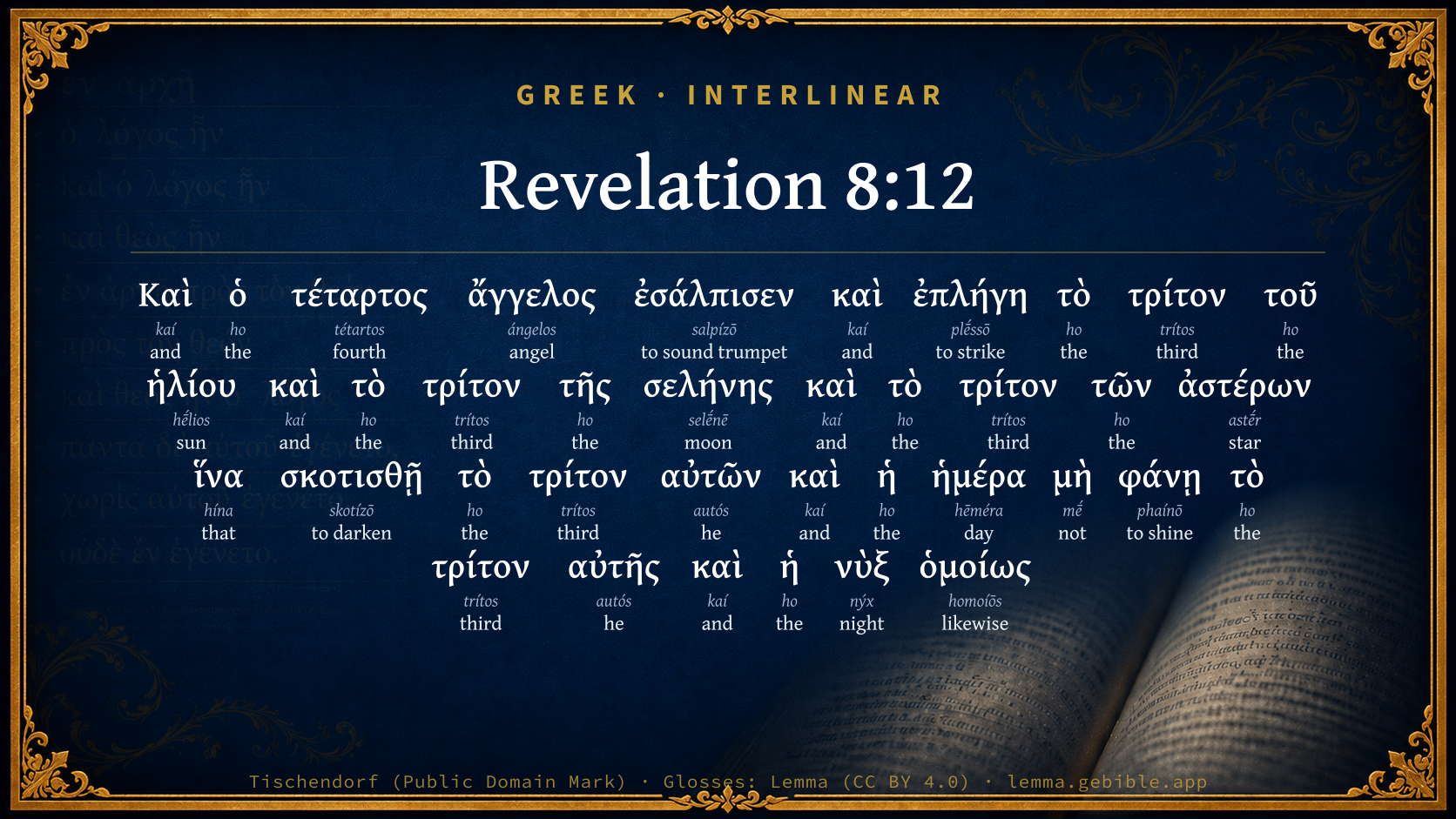
Greek (Tischendorf 8th ed.) Revelation 8:12 appears in the Greek New Testament. The text above is from the Tischendorf 8th edition. Each word links to its Strong’s number and a concise gloss. Click any word for its full Thayer’s Greek Lexicon entry.
Download image
Cite this verse

Revelation 8:12 (World English Bible). Public Domain. Lemma interlinear Bible study tool, https://lemma.gebible.app/v/revelation/8/12.

Show BibTeX & RIS
BibTeX
RIS
English Translation
The fourth angel sounded, and one third of the sun was struck, and one third of the moon, and one third of the stars; so that one third of them would be darkened, and the day wouldn't shine for one third of it, and the night in the same way.
World English Bible · Public Domain
Highlights
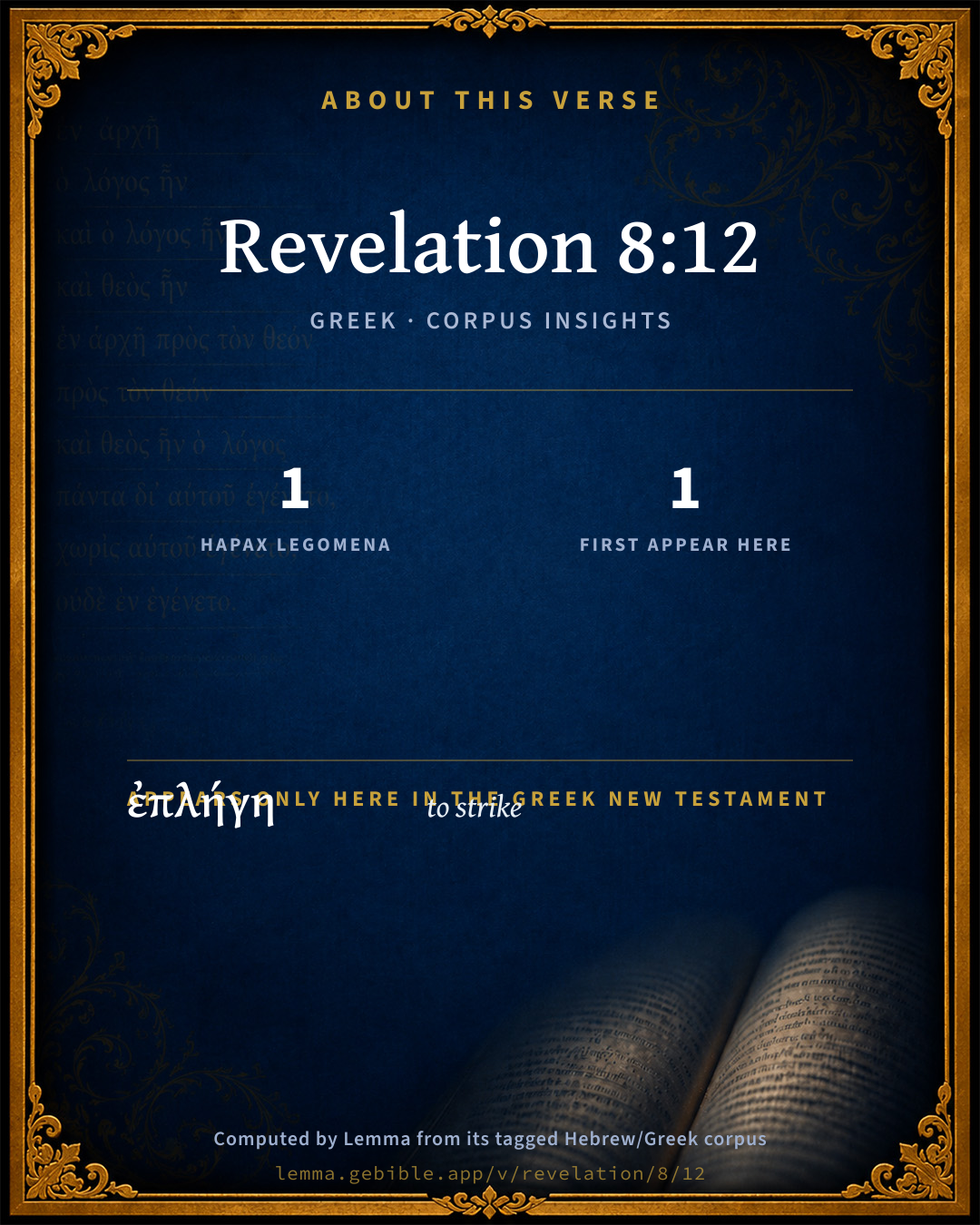
  • 1 hapax legomenon — only here in the Greek New Testament
  • 1 first appearance in the Greek New Testament
Full analysis ↓
Download a study sheet

One document with this verse’s original text, its word-by-word gloss line, the meaning frame, cross-references with their text, attributed commentary, and full source and license credits — printable, and it pastes into notes with its structure intact.

This verse Autodidact and up

Study sheet (.html) Plain text (.txt)

A passage Seminary Student

Up to 50 verses in one chapter. A passage sheet keeps up to 6 commentary sources and 12 cross-references per verse, in the order this page ranks them, and says so on the sheet whenever that leaves anything out. Ask for a single verse and you get the Autodidact verse sheet above.

Everything on this page stays free to read, with no account — the sheet is a download of what is already on screen, not access to it.

Want to remove ads? Support Godless Engineer
Compare translations 3

The same verse in 3 English versions, stacked beneath the original-language interlinear above. Click any original word for its lexicon entry.

Each is an independent rendering of the whole verse — the interlinear is not word-aligned to these translations.

Highlighted words mark where these versions differ — a whole-verse word diff, not a word-by-word alignment.

  • World English Bible Public Domain
    The fourth angel sounded, and one third of the sun was struck, and one third of the moon, and one third of the stars; so that one third of them would be darkened, and the day wouldn't shine for one third of it, and the night in the same way.
  • King James Version Public Domain
    And the fourth angel sounded, and the third part of the sun was smitten, and the third part of the moon, and the third part of the stars; so as the third part of them was darkened, and the day shone not for a third part of it, and the night likewise.
  • unfoldingWord Literal Text CC BY-SA 4.0
    And the fourth angel trumpeted, and a third of the sun was struck, and a third of the moon and a third of the stars, so that a third of them were darkened, and the day, a third of it did not shine, and likewise the night.

unfoldingWord Literal Text — © unfoldingWord, licensed CC BY-SA 4.0. Word-aligned USFM3 via Door43 (git.door43.org/unfoldingWord/en_ult).

Versions to compare (up to 4)

3 of 4 selected

Show all 19 translations

Every available English version of this verse, each an independent rendering of the whole verse.

  • World English Bible Public Domain
    The fourth angel sounded, and one third of the sun was struck, and one third of the moon, and one third of the stars; so that one third of them would be darkened, and the day wouldn't shine for one third of it, and the night in the same way.
  • Berean Standard Bible Public Domain
    Then the fourth angel sounded his trumpet, and a third of the sun and moon and stars were struck. A third of the stars were darkened, a third of the day was without light, and a third of the night as well.
  • Majority Standard Bible Public Domain
    Then the fourth angel sounded his trumpet, and a third of the sun and moon and stars were struck. A third of the stars were darkened, a third of the day was without light, and a third of the night as well.
  • King James Version Public Domain
    And the fourth angel sounded, and the third part of the sun was smitten, and the third part of the moon, and the third part of the stars; so as the third part of them was darkened, and the day shone not for a third part of it, and the night likewise.
  • American Standard Version (1901) Public Domain
    And the fourth angel sounded, and the third part of the sun was smitten, and the third part of the moon, and the third part of the stars; that the third part of them should be darkened, and the day should not shine for the third part of it, and the night in like manner.
  • Revised Version (1885) Public Domain
    And the fourth angel sounded, and the third part of the sun was smitten, and the third part of the moon, and the third part of the stars; that the third part of them should be darkened, and the day should not shine for the third part of it, and the night in like manner.
  • Geneva Bible (1599) Public Domain
    And the fourth Angel blew the trumpet, and the thirde part of the sunne was smitten, and the thirde part of the moone, and the thirde part of the starres, so that the thirde part of them was darkened: and the day was smitten, that the thirde part of it could not shine, and likewise the night.
  • Douay-Rheims (1899) Public Domain
    And the fourth angel sounded the trumpet, and the third part of the sun was smitten, and the third part of the moon, and the third part of the stars, so that the third part of them was darkened, and the day did not shine for a third part of it, and the night in like manner.
  • Young's Literal Translation Public Domain
    And the fourth messenger did sound, and smitten was the third of the sun, and the third of the moon, and the third of the stars, that darkened may be the third of them, and that the day may not shine -- the third of it, and the night in like manner.
  • Literal Standard Version CC BY-SA 4.0
    And the fourth messenger sounded the trumpet, and the third of the sun was struck, and the third of the moon, and the third of the stars, that the third of them may be darkened, and that the day may not shine—the third of it, and the night in like manner.
  • Unlocked Literal Bible CC BY-SA 4.0
    The fourth angel sounded his trumpet, and a third of the sun was struck, as well as a third of the moon and a third of the stars. So a third of them turned dark; a third of the day and a third of the night had no light.
  • unfoldingWord Literal Text CC BY-SA 4.0
    And the fourth angel trumpeted, and a third of the sun was struck, and a third of the moon and a third of the stars, so that a third of them were darkened, and the day, a third of it did not shine, and likewise the night.
  • Darby Bible Public Domain
    And the fourth angel sounded [his] trumpet: and the third part of the sun was smitten, and the third part of the moon, and the third part of the stars; so that the third part of them should be darkened, and that the day should not appear [for] the third part of it, and the night the same.
  • World Messianic Bible Public Domain
    The fourth angel sounded, and one third of the sun was struck, and one third of the moon, and one third of the stars, so that one third of them would be darkened; and the day wouldn’t shine for one third of it, and the night in the same way.
  • Webster's Bible Public Domain
    And the fourth angel sounded, and the third part of the sun was smitten, and the third part of the moon, and the third part of the stars; so that the third part of them was darkened, and the day shone not for a third part of it, and the night likewise.
  • Free Bible Version CC BY-SA 4.0
    The fourth angel blew his trumpet. One third of the sun, moon, and stars were struck so a third of them would be darkened, and a third part of the day would not give light, similarly the night.
  • Bible in Basic English Public Domain
    And at the sounding of the fourth angel, a third part of the sun, and of the moon, and of the stars was made dark, so that there was no light for a third part of the day and of the night.
  • Text-Critical English NT CC BY 4.0
    The fourth angel sounded his trumpet, and a third of the sun was struck, and a third of the moon and a third of the stars, so that a third of them were darkened. A third of the day was without light, and also a third of the night.
  • Tyndale New Testament (1534) Public Domain
    And the fourth angell blew and the thyrde parte of the sunne was smytten and the thyrde parte of the mone and the thyrde part of starres: so that the thyrde parte of them was darckned. And the daye was smytten that the thyrde part of it shulde not shyne and lyke wyse the nyght.

Literal Standard Version (2020), Covenant Press — licensed CC BY-SA 4.0. Text via the HelloAO Bible API (eBible.org). Unlocked Literal Bible (unfoldingWord) — licensed CC BY-SA 4.0. Text via the HelloAO Bible API (eBible.org). unfoldingWord Literal Text — © unfoldingWord, licensed CC BY-SA 4.0. Word-aligned USFM3 via Door43 (git.door43.org/unfoldingWord/en_ult). Free Bible Version, Dr. Jonathan Gallagher — licensed CC BY-SA 4.0. Text via the HelloAO Bible API (eBible.org).

Word by word

More ways to search: Search by grammar → Find every occurrence → Compare this word →

Practice this passage: Drill this verse → Learn its vocabulary →

ἐπλήγη
plḗssō
G4141
“to strike”
Verb, Aorist, Passive, Indicative, 3rd person, Singular
Part of Speech
Verb
Tense
Aorist
Voice
Passive
Mood
Indicative
Person
3rd person
Number
Singular
Full Thayer's Definition

Origin: apparently another form of G4111 (through the idea of flattening out)

TDNT: None

1. to strike, smite
  1. Καὶ kaí G2532 “and” Conjunction
  2. ὁ ho G3588 “the” Article, Nominative, Singular, Masculine
  3. τέταρτος tétartos G5067 “fourth” Adjective, Nominative, Singular, Masculine
  4. ἄγγελος ángelos G32 “angel” Noun, Nominative, Singular, Masculine
  5. ἐσάλπισεν salpízō G4537 “to sound trumpet” Verb, Aorist, Active, Indicative, 3rd person, Singular
  6. καὶ kaí G2532 “and” Conjunction
  7. τὸ ho G3588 “the” Article, Nominative, Singular, Neuter
  8. τρίτον trítos G5154 “third” Adjective, Nominative, Singular, Neuter
  9. τοῦ ho G3588 “the” Article, Genitive, Singular, Masculine
  10. ἡλίου hḗlios G2246 “sun” Noun, Genitive, Singular, Masculine
  11. καὶ kaí G2532 “and” Conjunction
  12. τὸ ho G3588 “the” Article, Nominative, Singular, Neuter
  13. τρίτον trítos G5154 “third” Adjective, Nominative, Singular, Neuter
  14. τῆς ho G3588 “the” Article, Genitive, Singular, Feminine
  15. σελήνης selḗnē G4582 “moon” Noun, Genitive, Singular, Feminine
  16. καὶ kaí G2532 “and” Conjunction
  17. τὸ ho G3588 “the” Article, Nominative, Singular, Neuter
  18. τρίτον trítos G5154 “third” Adjective, Nominative, Singular, Neuter
  19. τῶν ho G3588 “the” Article, Genitive, Plural, Masculine
  20. ἀστέρων astḗr G792 “star” Noun, Genitive, Plural, Masculine
  21. ἵνα hína G2443 “that” Conjunction
  22. σκοτισθῇ skotízō G4654 “to darken” Verb, Aorist, Passive, Subjunctive, 3rd person, Singular
  23. τὸ ho G3588 “the” Article, Nominative, Singular, Neuter
  24. τρίτον trítos G5154 “third” Adjective, Nominative, Singular, Neuter
  25. αὐτῶν autós G846 “he” Personal pronoun, Genitive, Plural, Masculine
  26. καὶ kaí G2532 “and” Conjunction
  27. ἡ ho G3588 “the” Article, Nominative, Singular, Feminine
  28. ἡμέρα hēméra G2250 “day” Noun, Nominative, Singular, Feminine
  29. μὴ mḗ G3361 “not” Particle, Negative
  30. φάνῃ phaínō G5316 “to shine” Verb, Aorist, Passive, Subjunctive, 3rd person, Singular
  31. τὸ ho G3588 “the” Article, Accusative, Singular, Neuter
  32. τρίτον trítos G5154 “third” Adjective, Accusative, Singular, Neuter
  33. αὐτῆς autós G846 “he” Personal pronoun, Genitive, Singular, Feminine
  34. καὶ kaí G2532 “and” Conjunction
  35. ἡ ho G3588 “the” Article, Nominative, Singular, Feminine
  36. νὺξ nýx G3571 “night” Noun, Nominative, Singular, Feminine
  37. ὁμοίως homoíōs G3668 “likewise” Adverb

About this verse

These counts appear in no published source. They are computed here, from the morphology-tagged text and Lemma’s own curated glosses. What Lemma adds →

38
words
18
distinct lemmas
Revelation
section

Notable vocabulary

1 hapax legomenon — a word that appears only here in the entire Greek New Testament:

  • ἐπλήγη to strike G4141

First appearance in Scripture

This word makes its first canonical appearance in the Greek New Testament here:

  • ἐπλήγη to strike G4141

Shared distinctive vocabulary

σκοτισθῇ to darken G4654 occurs in 5 verses of the Greek New Testament. Also found in:
Repetition

Words recur within this verse:

  • τρίτον third G5154 ×5
  • ὁ the G3588 ×11
  • Καὶ and G2532 ×6
  • αὐτῶν he G846 ×2

Cross-references

25

Topical passages linked to Revelation 8:12 in the Treasury of Scripture Knowledge — connected by theme and wording, ordered by reader-vote popularity; previews shown in the World English Bible.

  • Joel 2:31 The sun will be turned into darkness, And the moon into blood, Before the great and terrible day of Yahweh comes.
  • Isaiah 13:10 For the stars of the sky and the constellations of it shall not give their light; the sun shall be darkened in its going forth, and the moon shall not cause its light to shine.
  • Joel 2:10 The earth quakes before them. The heavens tremble. The sun and the moon are darkened, And the stars withdraw their shining.
  • Zechariah 13:8–9 It shall happen that in all the land," says Yahweh, Two parts in it will be cut off and die; But the third will be left in it.
  • Matthew 24:29 But immediately after the oppression of those days, the sun will be darkened, the moon will not give its light, the stars will fall from the sky, and the powers of the heavens will be shaken;
  • 2 Thessalonians 2:9–12 even he whose coming is according to the working of Satan with all power and signs and lying wonders,
  • Revelation 6:12 I saw when he opened the sixth seal, and there was a great earthquake. The sun became black as sackcloth made of hair, and the whole moon became as blood.
  • Revelation 8:7–12 The first sounded, and there followed hail and fire, mixed with blood, and they were thrown to the earth. One third of the earth was burnt up, and one third of the trees were burnt up, and all green grass was burnt up.
  • Exodus 10:21–29 Yahweh said to Moses, "Stretch out your hand toward the sky, that there may be darkness over the land of Egypt, even darkness which may be felt."
  • Joel 3:15 The sun and the moon are darkened, And the stars withdraw their shining."
  • Mark 13:24 But in those days, after that oppression, the sun will be darkened, the moon will not give its light,
  • Luke 23:44–45 It was now about the sixth hour, and darkness came over the whole land until the ninth hour.
  • Revelation 9:15 The four angels were freed who had been prepared for that hour and day and month and year, so that they might kill one third of mankind.
  • Revelation 9:18 By these three plagues were one third of mankind killed: by the fire, the smoke, and the sulfur, which proceeded out of their mouths.
  • Jeremiah 4:23 I saw the earth, and, behold, it was waste and void; and the heavens, and they had no light.
  • Ezekiel 32:7–8 When I shall extinguish you, I will cover the heavens, and make the stars of it dark; I will cover the sun with a cloud, and the moon shall not give its light.
  • Matthew 27:45 Now from the sixth hour there was darkness over all the land until the ninth hour.
  • Mark 15:33 When the sixth hour had come, there was darkness over the whole land until the ninth hour.
  • Luke 21:25 There will be signs in the sun, moon, and stars; and on the earth anxiety of nations, in perplexity for the roaring of the sea and the waves;
  • 2 Corinthians 4:4 in whom the god of this world has blinded the minds of the unbelieving, that the light of the Gospel of the glory of Christ, who is the image of God, should not dawn on them.
  • Revelation 12:4 His tail drew one third of the stars of the sky, and threw them to the earth. The dragon stood before the woman who was about to give birth, so that when she gave birth he might devour her child.
  • Revelation 16:8–9 The fourth poured out his bowl on the sun, and it was given to him to scorch men with fire.
  • Isaiah 24:23 Then the moon shall be confounded, and the sun ashamed; for Yahweh of Hosts will reign on Mount Zion, and in Jerusalem; and before his elders shall be glory.
  • Amos 8:9 "It will happen in that day," says the Lord Yahweh, "That I will cause the sun to go down at noon, And I will darken the earth in the clear day.
  • Acts 2:20 The sun will be turned into darkness, And the moon into blood, Before the great and glorious day of the Lord comes.

Cross-references courtesy of OpenBible.info (CC BY 4.0).

Commentary

Notes on Revelation 8:12 from classic Christian and Jewish commentators (each source and its license shown beneath its notes). The classic Christian expositions comment on the surrounding passage and are grouped to its opening verse, so a note may address several verses; the Jewish commentaries on the Tanakh (Rashi and others) are per-verse, so they appear only where the commentator wrote on this verse.

Lemma curates 59 commentaries, every one of them public domain or Creative Commons licensed, each selected and text-cleaned for this edition rather than reprinted as found. About our sources →

The Cambridge Bible for Schools and Colleges

gen. ed. J. J. S. Perowne

The Fourth Trumpet, Rev_8:12-13

12. the third part of the sun, &c.] Here we may think either of the Egyptian plague of darkness, Exo_10:21 sqq., or of a reversal (as in the last case) of the blessing of Isa_30:26. There, as here, there seems to be no distinction made between an increase, or decrease, in the intensity of light and in its duration.

so as the third part of them was] More accurately, that the third part of them might (lit. may) “be darkened, and the day not shine, &c.”

The Cambridge Bible for Schools and Colleges (gen. ed. J. J. S. Perowne; Cambridge University Press, 1878–1918) — public domain. Text from a community e-Sword module.

Joseph Benson's Commentary

Rev 8:12. And the fourth angel sounded, and the third part of the sun was smitten, &c. — A fit representation to express the last desolation of the imperial city, which God’s righteous judgment doomed, as Babylon heretofore, to a loss of all power and of all authority. Darkening, smiting, or the setting of the sun, moon, and stars, says Sir I. Newton, are put for the setting of a kingdom, or the desolation thereof, proportional to the darkness. And when darkness is opposed to light, as light is a symbol of joy and safety, so darkness is a symbol of misery and adversity; according to the style of Jer 13:16, Give glory to the Lord before he cause darkness, and before your feet stumble upon the dark mountains, &c. The darkness of the sun, moon, and stars, is likewise observed to denote a general deficiency in government, as the prophets describe a day of severe judgment. See Isa 13:10-11; Eze 32:7-8. In pointing out the accomplishment of this prophecy, and showing how the great lights of the Roman empire were eclipsed and darkened, and remained in darkness, Bishop Newton observes, Genseric left the western empire in a weak and desperate condition. It struggled hard, and gasped, as it were, for breath, through eight short and turbulent reigns, for the space of twenty years, and at length expired in the year 476, under Momyllus, or Augustulus, as he was named in derision, being a diminutive Augustus. This change was effected by Odoacer, king of the Heruli, who, coming to Rome with an army of barbarians, stripped Momyllus of the imperial robes, put an end to the very name of the western empire, and caused himself to be proclaimed king of Italy. His kingdom indeed was of no long duration: for after a reign of sixteen years, he was overcome and slain in the year 493 by Theodoric, who founded the kingdom of the Ostrogoths in Italy, which continued about sixty years under his successors. Thus was the Roman sun extinguished in the western emperor, but the other lesser luminaries, the moon and stars, still subsisted; for Rome was still allowed to have her senate and consuls, and other subordinate magistrates, as before. These lights, we may suppose, shone more faintly under barbarian kings than under Roman emperors; but they were not totally suppressed and extinguished till after the kingdom of the Ostrogoths was destroyed by the emperor of the east’s lieutenants, and Italy was made a province of the eastern empire. Longinus was sent in the year 556 by the Emperor Justin II. to govern Italy with absolute authority; and he changed the whole form of the government, abolished the senate and consuls, and all the former magistrates in Rome and Italy, and in every city of note constituted a new governor with the title of duke. He himself presided over all; and, residing at Ravenna, and not at Rome, he was called the exarch of Ravenna, as were also his successors in the same office. Rome was degraded to the same level with other places, and, from being the queen of cities and empress of the world, was reduced to a poor dukedom, and made tributary to Ravenna, which she had used to govern.

Joseph Benson's Commentary on the Old and New Testaments (1811–1818) — public domain. Text from a community e-Sword module.

Whedon's Commentary on the Bible

Daniel D. Whedon

FOURTH TRUMPET—The smitten luminaries, Rev_8:12.

12. Smitten—The wrath expressed by fire and burning in previous trumpets is expressed by a smite in this. This may arise from the fact that to darken luminaries by a fire is a contradictory conception.

Third part of the sun—It is the third part of the sun and of each star that is darkened, not the one third of the number of luminaries, nor the whole number one third of the time. Assuming a natural, healthful standard of the amount of light, the perpetual diminution of one third would produce a ghastly twilight, a chill, and a depression of spirits and health provocative of disease and death. Vivid picture of the sad effects of our loss of divine favour by apostasy and persistent sin.

Day… third part of it—Not a third part of the time but of the degree of light.

Night likewise—This smite of the moon and stars darkens the dimness of night, as that of the sun the brightness of day.

Daniel D. Whedon (gen. ed.), Commentary on the Old and New Testaments (1874–1909) — public domain. Text from a community e-Sword module.

Tyndale Open Study Notes

Tyndale Open Resources

8:12 the fourth angel: On the fourth day of creation, God made the sun . . . the moon, and . . . the stars (Gen 1:14-19). • the day was dark: This judgment replicates the ninth plague in Egypt (Exod 10:21-23).

Tyndale Open Study Notes — © Tyndale Open Resources, licensed CC BY-SA 4.0. Text via the HelloAO Bible API.

Bengel's Gnomon

Johann Albrecht Bengel

Rev 8:12. Ἐπλήγη, was smitten) That was done in the fifth century, when Italy and Rome, the seat of empire, were occupied and obscured by foreign nations.

Bengel's Gnomon of the New Testament — English translation (T&T Clark, Edinburgh, 1860) — public domain. Text from a community e-Sword module.

Meyer's Critical & Exegetical Commentary

Heinrich August Wilhelm Meyer

Rev_8:12. The fourth trumpet brings damage to sun, moon, and stars, whereof the third of all is darkened, and thus the light is withdrawn from a third of the day and of the night, ἐπλήγη. That a preternatural striking is to be thought of,[2492] which has as its consequence the intended darkening (ἽΝΑ ΣΚΟΤ.), Wolf already mentions, in opposition to the leaning towards the rabbinical way, whereby the darkening itself of sun and moon is represented as a smiting.[2493] The miraculous eclipse is in itself, as already according to the O. T. representation,[2494] a foretoken of the coming day of judgment;[2495] the limitation of the same, however, to a third of the sun, moon, and stars, and consequently to a third of the day and night ruled over by them,[2496] corresponds to similar statements in the preceding trumpet-visions.

ΚΑῚ Ἡ ἩΜΈΡΑ ΜῊ ΦΆΝῌ, viz., as the apposition ΤῸ ΤΡΊΤΟΝ ΑὐΤῆς more explicitly says, the third part of the day. And likewise the night. The words cannot mean that the light proceeding from the smitten stars has lost the third of its brilliancy, the reverse of Isa_30:26;[2497] still less does the expression bear the explanation of Ebrard, that the third of the stars was smitten with respect to time, so that they were darkened only for a third of the day, contrasted with nighttime, while for the other two-thirds they are bright. But the idea is this: Since a third of the sun is eclipsed, a third of the day (regarded in its temporal length) is deprived of its sunlight, and the night likewise of the shining of moon and stars. So De Wette, who judges likewise that here the sameness between the third of the stars and the third of day and night is carried out even to what is unnatural. The exception is correctly taken, and therefore expressed without impiety, because the present vision of John is to him as little as all the rest an absolutely objective incident, a likeness presented him by God as complete;[2498] of course, also, no real fiction,[2499] but a view communicated through the prophets own subjectivity.

[2492] Cf. Exo_7:25.

[2493] Succa, p. 29, Revelation 1 : When the sun is struck, it is a bad sign to the whole world. In Wetst.

[2494] Joh_3:4; Amo_8:9. Cf. Exo_10:21

[2495] Cf. also Rev_6:12 sqq.

[2496] Gen_1:16.

[2497] Beng., Züll., Böhmer, Klief.

[2498] Against the inspiration theory of Hengstenb., etc.

[2499] Against Eichh., Ew., De Wette, etc.

The allegorical expositors find here[2500] the obscuration, confusion, and diminution of beneficial institutions, whether of a spiritual or a political kind. Beda proposes the disturbance of the Church by false brethren; N. de Lyra, the heresy of Eutyches. The injury done by Islam is understood by Stern, who mentions the fact, that instead of the full moon the Church has become a half moon (ἐπλήγη

τὸ τρίτον τ. σελ.), and many stars have vanished, i.e., the sees of many bishops have been overthrown. Wetst.,[2501] Herder, etc., propose political confusion; so, too, Vitr., Beng., who, however, have in mind the incursions of the Goths and Vandals into the Eastern Empire, and Hengstenb., who very generally understands sad times full of the calamities of war. Böhmer combines the reference to Jewish temporal relations with his interpretation of sun and moon as applying to spiritual things, already employed on Rev_6:12 : That sun and moon and stars are smitten with darkness, we explain from the fact that sad prophecies have transpired, and the law has begun to be neglected. But the end of prophecy and the law has not, as yet, actually come, on which account only a third thereof is regarded as having been obscured.

[2500] Cf. Rev_6:12 sqq.

[2501] There was pure ἀναρχία, the magistrates were despised, all Judaea conspired for sedition.

Concerning the visions coming with the first four trumpets, which are to be distinguished from the three immediately following (Rev_8:13), it is to be remarked in general: 1. The plagues described in them, which concern the entire sphere of the visible world (the earth, Rev_8:7; the sea, Rev_8:8-9; the waters of the main land, Rev_8:10-11; the stars, day and night, Rev_8:12; cf. Beng., Ew., etc.), are perceptible not only to unbelievers, but also to believers.[2502] This necessarily lies in the very nature of the plagues; and the sealing correctly understood (Rev_7:2 sqq.) in no way gives any other idea.[2503] 2. The allegorical explanation, and the reference founded thereon to events or circumstances of ecclesiastical or civil history,of which Ebrard emphasizes the latter,[2504] has no foundation whatever in the text, and, therefore, leads necessarily to arbitrary suppositions. But the context, according to which the trumpet-visions proceed from the seventh seal, shows that this vision, in its eschatological significance, has reference to the end to be expected already after the sixth[2505] and in the seventh seal; viz., the actual coming of the Lord, in connection with which the plagues described by the first six seals are to be regarded as premonitory signs of the impending end of the same character as those described in the fundamental prophecy of Mat_24:29. The same relation as subsists there between Mat_8:29 and Mat_8:6-7, recurs in the signs portrayed in the four trumpet-visions and those described in the seal-visions. It is true that the sixth seal already has introduced foretokens of the nature of Mat_24:29, and this is developed in close connection until the description of the last end; but by the fact that in Rev_7:1, between the sixth and seventh seals, the four angels come forth who are to bring a new plague, the final development is further postponed. And if now the final catastrophe actually proceeds from the seventh seal,as is to be expected after Rev_6:17,yet this occurs only after a further development, which, as first of all in the first four trumpet-visions, brings with it new foretokens of the coming end. The introductory significance of this sign is expressed in the fact that only a third of the earth is concerned; thus a new course is designated after the points marked by the already strong signs of the sixth seal. Yet that a progress occurs, and that the trumpet-visions do not, in any way, again prevail before the sixth seal, the context indicates by the fact that the plagues befalling a third of the earth mark an advance when compared with the plagues of the fourth seal (Rev_6:8).

[2502] Against De Wette, etc.

[2503] Cf., on the other hand, Rev_9:4.

[2504] Cf. also Hengstenb.

[2505] Rev_6:12 sqq.

Meyer — Critical and Exegetical Commentary on the New Testament — English translation by Peter Christie, edited by Frederick Crombie (T&T Clark, 1880) — public domain. Text from a community e-Sword module.

Expositor's Greek Testament

ed. W. Robertson Nicoll

Rev 8:12 . “So as to darken a third part of them, and ( i.e. ) to prevent a third of the day from shining ( φάνῃ , or φάνῃ Win.) and of the night likewise”. Daylight is shortened by a third, and the brightness of an Eastern night correspondingly lessened ( cf. the Egyptian plague of darkness). The writer either forgets or ignores the fact that he has already cleared the heaven of stars (Rev 6:13 ).

The Expositor's Greek Testament, edited by W. Robertson Nicoll (1897–1910) — public domain. Text from a community e-Sword module.

Geneva Bible (1599)

Geneva Bible translators

The fourth execution upon these lightsome bodies of heaven, which minister unto this inferior world.

Geneva Bible (1599) marginal notes — public domain. Text via Bolls.life.

Jamieson, Fausset & Brown

Robert Jamieson, A. R. Fausset & David Brown

third part--not a total obscuration as in the sixth seal (Rev 6:12-13). This partial obscuration, therefore, comes between the prayers of the martyrs under the fifth seal, and the last overwhelming judgments on the ungodly under the sixth seal, at the eve of Christ's coming.

the night likewise--withdrew a third part of the light which the bright Eastern moon and stars ordinarily afford.

Jamieson, Fausset & Brown — Commentary Critical and Explanatory on the Whole Bible (1871) — public domain (CC PDM 1.0). Text via the HelloAO Bible API.

Adam Clarke's Commentary

Verse 12. The third part of the sun - moon - stars, was smitten] Supposed to mean Rome, with her senates, consuls, &c., eclipsed by Odoacer, king of the Heruli, and Theodoric, king of the Ostrogoths, in the fifth century. But all this is uncertain.

Adam Clarke's Commentary on the Bible (1810–1826) — public domain. Text from a community e-Sword/MySword module.

Ellicott's Commentary for English Readers

(12) And the fourth angel . . .—Translate, And the fourth angel sounded, and there was smitten the third part of the sun, and the third part of the moon, and the third part of the stars; that the third part of them might be darkened, and the day might not appear as to its third part, and the night in like manner. The dimness which thus falls on the lights of heaven carries us back to the plague of darkness (Exo_10:21-23); but yet there is this difference: there the children of Israel had light in their dwellings while all the rest of the land suffered the darkness that might be felt; here, however, the darkness is only such as results from the withdrawal of the third part of the light of the sun by day, and of the moon and the stars (so much more brilliant and needful in Eastern lands than in our own) by night. It is a day of the Lord in which the light is not clear nor dark—not day nor night (Zec_14:6-7). There will be periods in which the lights which guide men will give forth uncertain glimmers; upon the earth there will be distress of nations, men’s hearts failing them for fear, and for looking after those things which are coming on the earth, for the powers of heaven shall be shaken (Luk_21:25-26). Such times of darkness and sorrow must be. It is through seasons such as these, when the lights of human wisdom and of spiritual guidance seem alike obscured, that the Church must go forward. The chaos precedes creation, and it is through chaos again that the Church of Christ must pass to the new heaven and new earth. These trumpet-visions, if read by the side of the story of Genesis, seem like the undoing of creation: the vegetation is smitten, the earth and sea are intermingled, the lights of the heavens are darkened, the living things in seas and streams are destroyed; but

“Fresher life the world shall draw

From their decay.”

The pulling down must precede the building up; the removing of the degenerate is one step in the way to the regeneration.

A Bible Commentary for English Readers, edited by Charles John Ellicott (1878–1897) — public domain. Text from a community e-Sword module.

John Gill's Exposition

And the fourth angel sounded,.... His trumpet. Some think this refers to the Eutychian heresy, which confounded the two natures of Christ, and of two made one mixed nature, neither human nor divine; and brought great darkness upon the doctrine of Christ's person, the sun of righteousness and into the church, signified by the moon, and among the ministers of the word, the stars. Others are of opinion that that darkness which preceded the rise of the Papacy, and introduced it, is here intended:

and the third part of the sun was smitten and the third part of the moon, and the third part of the stars, so as the third part of them was darkened, and the day shone not for a third part of it, and the night likewise; when the doctrine concerning the person and offices of Christ, who is the sun and light of the world, was obscured by heresies; and the discipline of the church, which, like the moon, has all its light, beauty, and order from Christ, was sadly defaced by the introduction of Jewish and Paganish rites and ceremonies; and the ministers, the stars, were drawn by the tail of the drag on, and cast to the earth, became corrupt in their principles, and carnal and sensual in their lives; so that it was a time of great darkness and gloominess, night and day: but rather this trumpet has respect to that darkness and ignorance which the above barbarous nations, the Goths, Huns, Vandals, and Heruli, spread, and left throughout the empire; for from this time there was a visible decline, as of evangelical light and knowledge, so of all kind of useful knowledge, and nothing but ignorance, stupidity, and barbarity, took place everywhere; and which were very assisting to the man of sin, antichrist, to fix and settle his dominion over the kingdoms which rose up out of the empire at this time; and it also refers to the entire destruction of the western Roman empire, which is expressed by much the same figures as the ruin of the Roman Pagan empire, in Rev 6:12; and which the various irruptions of these savage people issued in; compare with this Eze 32:7, where the destruction of the Egyptian monarchy is signified in like terms: Jerom, who lived about the time of the first inundation of these nations, in very mournful language expresses the inhumanity and impiety of them, and the ruin they threatened the empire with; and, says (w), "Romanus orbis ruit", "the Roman empire is falling". About the year 455, when Rome was taken by Genseric the Vandal, the empire was divided into ten kingdoms; and in the year 476, Augustulus, the last of the Roman emperors, was obliged to quit his imperial dignity: the Heruli, a people of the same kind with the Goths, and originally Scythians, as they, under their king and leader Odoacer seized on Italy, took Rome, killed Orestes and his brother Paul, and deposed Augustulus, the last of the Roman emperors, and banished him into Campania; and so the western empire ceased, Odoacer taking upon him the title of king of Italy, and translated the seat of the empire from Rome to Ravenna (x); and then might the sun be truly said to be smitten: but still, though Odoacer the Herulian reigned in Italy, the Roman form of government was not altered, the consulship and senate still continued, as they did also under Theodoric the Goth, his successor; but when Italy was recovered by Narses, the Emperor Justinian's general, these, with other magistrates, ceased, and Rome became a dukedom, and was subject to an exarch of Ravenna; and then the moon and stars were smitten also. The phrase of smiting the sun, moon, and stars, is Jewish; for the Jews express the eclipses of the luminaries in this way, and say (y) that when the luminaries "are smitten", it is an ill omen; when , "the sun is smitten", it is an ill sign to the nations of the world; and when , "the moon is smitten", it is a bad omen to the nations of Israel (z) and so the phrase, "the day shone not", is also Jewish; it is said (a) of some Rabbins, that they sat and studied in the law , "until the day shone"; and when "the day shone", they rose up and went on their way.

(w) Epitaph. Nepotian. fol. 9. l. Tom. 1. vid. etiam Epist. ad Gerontiam, fol. 32. E. & Epitaph. Fabiolae, fol. 68. H. (x) Vid. Casssiodor. Chronicon in Zenon. 47. Hist. Eccl. Magdeburg. cent. 5. c. 16. p. 876. Petav. Rationar. Temp. par. 1. c. 18. p. 304. (y) Jarchi in Gen. 1. 14. (z) T. Bab. Succa, fol. 29. 1. Yalkut Simeoni, par. 2. fol. 62. 1. (a) Zohar in Deut. fol. 113. 3.

John Gill's Exposition of the Whole Bible (1746–1763) — public domain (CC PDM 1.0). Text via the HelloAO Bible API.

Trapp's Complete Commentary

John Trapp

12 And the fourth angel sounded, and the third part of the sun was smitten, and the third part of the moon, and the third part of the stars; so as the third part of them was darkened, and the day shone not for a third part of it, and the night likewise.

Ver. 12. And the third part of the sun] The prelates and patriarchs.

And the third part of the moon] The inferior church officers.

And the third part of the stars] The community of Christians. All began to be spread over with gross ignorance, not only of heavenly truths, but of human sciences, which are here called the night in comparison of gospel light. Gregory the Great (thought to be that angel mentioned in the next verse), though better than any who succeeded him in the Popedom, calling himself the servant of God’s servants, and carrying himself modestly in the days of Mauritius the emperor, yet when Mauritius was slain by the traitor Phocas, how basely did he claw the traitor, and collogue with him; commending to his care the Church of Rome and often minding him of Peter’s primacy, and of that speech of our Saviour, "Thou art Peter," &c. for no other end but that he might enlarge his jurisdiction over all Churches, by the favour of that parricide?

And the day shone not] It was a gloomy and dismal day with the purer Church of Christ.

John Trapp, A Commentary or Exposition upon All the Books of the Old and New Testament (1647–1656) — public domain. Text from a community e-Sword module.

Albert Barnes' Notes on the Bible

And the fourth angel sounded - See the notes at Rev 8:6-7.

And the third part of the sea was smitten - On the phrase the third part, see the notes on Rev 8:7. The darkening of the heavenly luminaries is everywhere an emblem of any great calamity - as if the light of the sun, moon, and stars should be put out. See the notes on Rev 6:12-13. There is no certain evidence that this refers to rulers, as many have supposed, or to anything that would particularly affect the government as such. The meaning is, that calamity would come as if darkness should spread over the sun, the moon, and the stars, leaving the world in gloom. What is the precise nature of the calamity is not indicated by the language, but anything that would diffuse gloom and disaster would accord with the fair meaning of the symbol. There are a few circumstances, however, in regard to this symbol which may aid us in determining its application:

(1) It would follow in the series of calamities that were to occur.

(2) It would be separated in some important sense - of time, place, or degree - from those which were to follow, for there is a pause here Rev 8:13, and the angel proclaims that more terrible woes are to succeed this series.

(3) Like the preceding, it is to affect “one third part” of the world; that is, it is to be a calamity as if a third part of the sun, the moon, and the stars were suddenly smitten and darkened.

(4) It is not to be total. It is not as if the sun, the moon, and the stars were entirely blotted out, for there was still some remaining light; that is, there was a continuance of the existing state of things - as if these heavenly bodies should still give an obscure and partial light.

(5) Perhaps it is also intended by the symbol that there would be light again. The world was not to go into a state of total and permanent night. For a third part of the day, and a third part of the night, this darkness reigned; but does not this imply that there would be light again - that the obscurity would pass away, and that the sun, and moon, and stars would shine again? That is, is it not implied that there would still be prosperity in some future period? Now, in regard to the application of this, if the explanation of the preceding symbols is correct, there can be little difficulty. If the previous symbols referred to Alaric, to Genseric, and to Attila, there can be no difficulty in applying this to Odoacer, and to his reign - a reign in which, in fact, the Roman dominion in the West came to an end, and passed into the hands of this barbarian. Anyone has only to open the Decline and Fall of the Roman Empire, to see that this is the next event that should be symbolized if the design were to represent the downfall of the empire.

These four great barbarian leaders succeed each other in order, and under the last, Odoacer, the barbarian dominion was established; for it is here that the existence of the Roman power, as such, ended. The Western empire terminated, according to Mr. Gibbon (ii. p. 380), about 476 or 479 a.d. Odoacer was “King of Italy” from 476 a.d. to 490 a.d. (Gibbon, ii. 379). The Eastern empire still lingered, but calamity, like blotting out the sun, and moon, and stars, had come over that part of the world which for so many centuries had constituted the seat of power and dominion. Odoacer was the son of Edecon, a barbarian, who was in the service of Attila, and who left two sons - Onulf and Odoacer. The former directed his steps to Constantinople; Oloacer “led a wandering life among the barbarians of Noricum, with a mind and fortune suited to the most desperate adventures; and when he had fixed his choice, he piously visited the cell of Severinus, the popular saint of the country, to solicit his approbation and blessing. The lowness of the door would not admit the lofty stature of Odoacer; he was obliged to stoop; but in that humble attitude the saint could discern the symptoms of his future greatness; and addressing him in a prophetic tone, ‘Pursue,’ said he, ‘your design; proceed to Italy; you will soon cast away this coarse garment of skins; and your wealth will be adequate to the liberality of your mind.’ The barbarian, whose daring spirit accepted and ratified this prediction, was admitted into the service of the Western empire, and soon obtained an honorable rank in the guards.

His manners were gradually polished, his military skill improved; and the confederates of Italy would not have elected him for their general unless the exploits of Odoacer had established a high opinion of his courage and capacity. Their military acclamations saluted him with the title of king; but he abstained during his whole reign from the use of the purple and the diadem, lest he should offend those princes whose subjects, by their accidental mixture, had formed the victorious army which time and policy might insensibly unite into a great nation” (Gibbon, ii. 379, 380). In another place Mr. Gibbon says: “Odoacer was the first barbarian who reigned in Italy, over a people who had once asserted their superiority above the rest of mankind. The disgrace of the Romans still excites our respectful compassion, and we fondly sympathize with the imaginary grief and indignation of their degenerate posterity. But the calamities of Italy had gradually subdued the proud consciousness of freedom and glory. In the age of Roman virtue the provinces were subject to the arms, and the citizens to the laws, of the republic; until those laws were subverted by civil discord, and both the city and the provinces became the servile property of a tyrant. The forms of the constitution which alleviated or disguised their abject slavery were abolished by time and violence; the Italians alternately lamented the presence or the absence of the sovereigns whom they detested or despised; and the succession of five centuries inflicted the various evils of military license, capricious despotism, and elaborate oppression.

During the same period the barbarians had emerged from obscurity and contempt, and the warriors of Germany and Scythia were introduced into the provinces, as the servants, the allies, and at length the masters of the Romans, whom they insulted or protected,” ii. 381, 382. Of the effect of the reign of Odoacer Mr. Gibbon remarks: “In the division and decline of the empire the tributary harvests of Egypt and Africa were withdrawn; the numbers of the inhabitants continually decreased with the means of subsistence; and the country was exhausted by the irretrievable losses of war, famine, and pestilence. Ambrose has deplored the ruin of a populous district, which had been once adorned with the flourishing cities of Bologna, Modena, Rhegium, and Placentia. Pope Gelasius was a subject of Odoacer; and he affirms, with strong exaggeration, that in Aemilia, Tuscany, and the adjacent provinces the human species was almost extirpated. One-third of those ample estates, to which the ruin of Italy is originally imputed, was extorted for the use of the conquerors,” ii. 383.

Yet the light was not wholly extinct. It was “a third part” of it which was put out; and it was still true that some of the forms of the ancient constitution were observed - that the light still lingered before it wholly passed away. In the language of another, “The authority of the Roman name had not yet entirely ceased. The senate of Rome continued to assemble as usual. The consuls were appointed yearly, one by the Eastern emperor, one by Italy and Rome. Odoacer himself governed Italy under a title - that of Patrician - conferred on him by the Eastern emperor. There was still a certain, though often faint, recognition of the supreme imperial authority. The moon and the stars might seem still to shine in the West, with a dim reflected light. In the course of the events, however, which rapidly followed in the next half-century, these too were extinguished. After above a century and a half of calamities unexampled almost, as Dr. Robertson most truly represents it, in the history of nations, the statement of Jerome - a statement couched under the very Apocalyptic figure of the text, but prematurely pronounced on the first taking of Rome by Alaric - might be considered at length accomplished: ‘Clarissimum terrarum lumen extincturn est’ - ‘The world’s glorious sun has been extinguished;’ or, as the modern poet Byron (Childe Harold, canto iv.) has expressed it, still under the Apocalyptic imagery:

‘She saw her glories star by star expire, ‘

Till not even one star remained to glimmer in the vacant and dark night” (Elliott, i. 360, 361).

I have thus endeavored to explain the meaning of the four first trumpets under the opening of the seventh seal, embracing the successive severe blows struck on the empire by Alaric, Genseric, Attila, and Odoacer, until the empire fell, to rise no more. I cannot better conclude this part of the exposition than in the words of Mr. Gibbon, in his reflections on the fall of the empire. “I have now accomplished,” says he, “the laborious narrative of the decline and fall of the Roman empire, from the fortunate age of Trajan and the Antonines to its total extinction in the West, about five centuries after the Christian era. At that unhappy period the Saxons fiercely struggled with the natives for the possession of Britain; Gaul and Spain were divided between the powerful monarchies of the Franks and the Visigoths, and the dependent kingdoms of the Suevi and the Burgundians; Africa was exposed to the cruel persecution of the Vandals, and the savage insults of the Moors; Rome and Italy, as far as the banks of the Danube, were afflicted by an army of barbarian mercenaries, whose lawless tyranny was succeeded by the reign of Theodoric the Ostrogoth. All the subjects of the empire, who, by the use of the Latin language, more particularly deserved the name and privileges of Romans, were oppressed by the disgrace and calamities of foreign conquest; and the victorious nations of Germany established a new system of manners and government in the western countries of Europe. The majesty of Rome was faintly represented by the princes of Constantinople, the feeble and imaginary successors of Augustus” (vol. ii. pp. 440, 441). “The splendid days of Augustus and Trajan were eclipsed by a cloud of ignorance (a fine illustration of the language ‘the third part of the sun was smitten, and the day shone not, and the night likewise’); and the barbarians subverted the laws and palaces of Rome” (ibid. p. 446).

Thus ended the history of the Gothic period, and, as I suppose, the immediate symbolic representation of the affairs of the Western empire. An interval now occurs Rev 8:13 in the sounding of the trumpets, and the scene is transferred, in the three remaining trumpets, to the Eastern parts of the empire. After that the attention is directed again to the West, to contemplate Rome under a new form, and exerting a new influence in the nations, under the papacy, but destined ultimately to pass away in its spiritual power, as its temporal power had yielded to the elements of internal decay in its bosom, and to the invasions of the northern hordes.

Albert Barnes' Notes on the Bible (1834–1885) — public domain. Text from a community e-Sword/MySword module.

Haydock's Catholic Bible Commentary

The third part of the sun was smitten. This may signify a third part of men killed in those wars, or (according to the opinion that refers all to antichrist’s time) that in those days the sun and moon shall not give above a third part of their light. (Witham) --- Here we behold a noble figure of the Church, which whilst in its most flourishing state, like the sun, is suddenly obscured, and a third part extinguished by the heresy and schism of the Greeks, under Photius, which began in 866, and infected all orders of Christians, clergy and laity, princes and individuals, signified by the sun, moon, and stars. (Pastorini)

George Leo Haydock (1774–1849), Haydock's Catholic Family Bible and Commentary, 1859 edition — public domain. Excludes Psalms (Douay-Rheims chapter numbering differs from Protestant) and Deuterocanonical books (Catholic canon only).

Matthew Poole's English Annotations

Interpreters (setting aside one or two, who conceit the Revelation is nothing but a repetition of things that happened in Judea before John’s time) generally agree, that the period of time to which this prophecy relates, is from the year 480, when the western empire ceased. The history of the age next following, both relating to civil and ecclesiastical things, doth so fit this prophecy, that interpreters are much divided about the sense of it, whether it be to be understood of the miseries befalling the Roman empire or the church in that time; for, as great princes in the former, so great lights in the latter, are metaphorically expressed in Scripture under the notions of the sun, moon, and stars, in regard of the great influence they have upon men, as those luminaries of heaven have upon the earth. Mr. Mede understands it of political magistrates, here expressed (as in Joseph’s dream) by the sun, moon, and stars: and to show us how the event fitted the prophecy, he tells us out of the best authors, that when Odoacer had routed Augustulus, and turned him out of the empire, himself ruled Rome under the title of a king sixteen years, and destroyed all their old magistracy, but after two years restored it. That Theodoricus, following him in the government of Italy, restored all their rights again, which so continued under three kings (all Goths) for near fifty years. But after the year 546, Rome was taken and burnt once and again, and a third part of it demolished by Totilas. Others understand it of Pelagius, or some famous heretic in that time. But to speak freely, the words of the prophecy, and the histories we have, rather agree to Mr. Mede’s sense; for (except Pelagius, who began about the year 406) we read of none in this age to whom the words of this prophecy will agree in any good sense.

Matthew Poole's English Annotations on the Holy Bible (1683–1685) — public domain. Text from a community e-Sword/MySword module.

The Pulpit Commentary

And the fourth angel sounded, and the third part of the sun was smitten, and the third part of the moon, and the third part of the stars. Still the created universe is the direct object of these visitations. The planets were smitten, but we are not told with what instrument. As Alford points out, this may teach us not to lay too great stress upon that part of the visions which describes the means. Our attention is to be fixed upon the effect, the stroke, not upon the mountain or the star by whose means the result is attained. (For the signification of the third part, vide supra. ) In the Bible, frequent use is made of this figure to express trouble and commotion. (see Isa_13:10 Isa_24:23 Jer_15:9 Eze_32:7 Amo_8:9 Mat_24:29) The sun, etc., are also looked upon as examples of stability. Thus Psa_72:5, "As long as the sun and moon endure". (see also Psa_72:17 Psa_89:36) The vision may therefore be suggestive of God"s power over things the most permanent and stable, and thus demonstrate to Christians his ability to punish "the ungodly who prosper in the world." Thus Job_9:7 attributes omnipotence to God, "which commandeth the sun, and it riseth not; and scaleth up the stars". (see also Psa_136:8 Jer_31:35) Thus, then, God can turn even the benign influences of the sun and planets into means for the destruction of man. In the countless evils which have their origin in the excess or defect of the power of the sun, we may see an illustration of the fulfilment of this judgment. We may point out that the very existence of such visitations as are here portrayed preclude the possibility of the fulfilment of the trumpet visions being subsequent in time to those of the seals. So as the third part of them was darkened, and the day shone not for a third part of it, and the night likewise; that the third part of them should be darkened, and the day should not shine for the third part of it, and the night in like manner. Probably, total darkness for a third part of the day and night is meant; not a third of the usual amount of light during the whole day and night (as Bengel and others). Renan, as a preterist, sees the fulfilment in the eclipses of A.D. 68. De Lyra, Wordsworth, and others see in this judgment a symbol of the infidelity, heresies, apostasies, and confusions in the world in the seventh century and at other times. Vitringa, adopting the historical view, refers the fulfilment to particular periods of the Roman empire.

The Pulpit Commentary (1880–1919), ed. H.D.M. Spence-Jones & Joseph S. Exell — public domain. Text from a community e-Sword module.

John Wesley's Explanatory Notes

And the fourth angel sounded, and the third part of the sun was smitten - Or struck. After the emperor Theodosius died, and the empire was divided into the eastern and the western, the barbarous nations poured in as a flood. The Goths and Hunns in the years 403 and 405 fell upon Italy itself with an impetuous force; and the former, in the year 410, took Rome by storm, and plundered it without mercy. In the year 452 Attila treated the upper part of Italy in the same manner. In 455 Valentinian the Third was killed, and Genseric invited from Afric. He plundered Rome for fourteen days together. Recimer plundered it again in 472. During all these commotions, one province was lost after another, till, in the year 476, Odoacer seized upon Rome, deposed the emperor, and put an end to the empire itself. An eclipse of the sun or moon is termed by the Hebrews, a stroke. Now, as such a darkness does not come all at once, but by degrees, so likewise did the darkness which fell on the Roman, particularly the western empire; for the stroke began long before Odoacer, namely, when the barbarians first conquered the capital city. And the third part of the moon, and the third part of the stars; so that the third part of them was darkened - As under the first, second, and third trumpets by "the earth," "sea, " and "rivers," are to be understood the men that inhabit them; so here by the sun, moon, and stars, may be understood the men that live under them, who are so overwhelmed with calamities in those days of darkness, that they can no longer enjoy the light of heaven: unless it may be thought to imply their being killed; so that the sun, moon, and stars shine to them no longer. The very same expression we find in Ezek. xxxii, 8. "I will darken all the lights of heaven over them." As then the fourth seal transcends the three preceding seals, so does the fourth trumpet the three preceding trumpets. For in this not the third part of the earth, or sea, or rivers only, but of all who are under the sun, are affected. And the day shone not for a third part thereof - That is, shone with only a third part of its usual brightness. And the night likewise - The moon and stars having lost a third part of their lustre, either with regard to those who, being dead, saw them no longer, or those who saw them with no satisfaction. The three last trumpets have the time of their continuance fixed, and between each of them there is a remarkable pause: whereas between the four former there is no pause, nor is the time of their continuance mentioned; but all together these four seem to take up a little less than four hundred years.

John Wesley, Explanatory Notes Upon the Whole Bible (1754–1765) — public domain. Text via the GEBible commentary corpus.

Scofield Reference Notes

C. I. Scofield

angel

(See Scofield "Heb 1:4").

The Scofield Reference Bible (1917 edition), notes by C. I. Scofield — public domain. Text from a community e-Sword module.

Burkitt's Expository Notes on the New Testament

William Burkitt

Observe here, 1. That by the sun, moon, and stars, in scripture prophecies, the potentates and powers of a state are understood: accordingly the darkening of the sun, moon, and stars, do understand the prevalency of ignorance and error in the church, occasioning a fearful eclipse of that saving and comfortable light which would illuminate our eyes, and direct our steps in the way that leads to eternal happiness.

Observe, 2. That in this and all the former judgments, the third part only is mentioned as smitten, which shows that the Lord corrects in measure, and delights more in mercy than in justice, and desires rather the conversion than confusion of sinners, by making the punishments of some instructive warnings unto others.

Observe, 3. God’s way of dealing with his people in giving warning of future and severe judgments before they come, I heard an angel flying through the midst of heaven, saying, Woe, woe, woe, to the inhabiters of the earth; thus God warneth of approaching judgments before they come, that sinners may repent, and his own people being forewarned, may be forearmed, ere the judgment come upon them: Praemoniti, praemuniti; Prsevisa jacula minus feriunt. Darts foreseen are dintless.

William Burkitt's Expository Notes on the New Testament (1700–1703) — public domain. Text from a community e-Sword module.

Godbey's Commentary on the New Testament

William B. Godbey

12. When the fourth angel sounds, the calamity reaches the sun, moon, and stars.

These diversified descriptions delineate the progressive character of the catastrophes destined to come upon the earth, destroying a third of the property and people, which is certainly a very large proportion. We see the calamity begins with the county and spreads out indiscriminately, infecting the social, political, and religious atmosphere. In all these prophecies, “sea” means the people. When tranquil, it emblematizes the people flourishing in prosperity and peace. When racked with storms and swept by cyclones, it typifies the people dashing hither and thither in bloody revolution The destruction of the ships symbolizes great and fearful havoc among the people. The rivers and fountains of water emblematize the subordinate departments of the government, while the sun represents the king, the moon the queen, and the stars the provincial governors. In the proclamation of the third trumpet, the star called “wormwood” falls on the earth, embitters and poisons the waters, and kills multitudes of people. The Greek word for wormwood is absinthe. It is well known in chemistry that absinthe is the poisonous element in intoxicants. Hence, this prophecy reveals Satan’s invention of whisky, which took place in the Dark Ages, and has flooded the world with crime and misery, and populated hell with countless millions.

The Roman Empire was the upholder of civil government. With her fall ancient civilization passed away, and a period of darkness in history, significantly denominated the Dark Ages, came on, flooding the world with anarchy, bloodshed, and every species of crime, while ignorance and superstition everywhere threw a dismal nightmare, obliterating every vestige of ancient civilization. During this awful period of desolation, robbery, murder, rapine, debauchery, and lawlessness, not one man in a thousand could read or write. This was Satan’s millennium, during which time he sat upon the throne of the world, and reigned without a rival.

The four first trumpets proclaim the sad inauguration of Satan’s millennium in progressive stages. Pursuant to the first trumpet, the infection comes upon the whole earth, contaminating the atmosphere of every nation annunciated by the second trumpet. The malady reaches the people, infecting all classes of society with an incorrigible revolutionary spirit, disrupting all the foundations of the social fabric. At the time the third angel sounds his trumpet, the infection has interpenetrated all the subordinate departments of national governments, so the proconsuls, satraps, and deputies can no longer enforce their authority. The fourth trumpet is the general signal for the toppling of thrones and the falling of kingdoms, till the world is left without a government competent to protect its citizens. Meanwhile, marauding bands of robbers and murderers take possession, and life and liberty are held only by the stern arbitrament of the sword.

The four first trumpets thus proclaim the progressive disintegration of all human governments, till they literally topple and fall; and the devil’s millennium, fully inaugurated, inundates the world in an ocean of anarchy, heresy, bloodshed, and every species of crime. Meanwhile, universal political corruption and dilapidation flood all nations. A corresponding infection everywhere settles down on the visible Church, transforming it from apostolic simplicity and purity first into the proud, worldly ecclesiasticism of the Constantinian Age, and then into the appalling corruptions, shocking barbarities, bloody persecutions, and atrocious criminality of the diabolical papacy, outraging Satan himself with the horrific Inquisition. When I was in St. Peter’s Church at Rome, I saw the bronze statue of St. Dominic, cruel horror depicted on his grim visage, and the infuriated dog standing by, with a firebrand in his mouth. This is the historic symbol of the Inquisition, of which St. Dominic was the author. And you see how the Catholic Church has canonized him as a paragon saint!

William B. Godbey, Commentary on the New Testament (1896–1900) — public domain. Text from a community e-Sword module.

The People's New Testament

B. W. Johnson

12. And the fourth angel sounded. Again the scene changes. Now it is the third part of the sun, and of the moon, and of the stars that is smitten, and darkness follows. The sun is a symbol of the supreme ruler, and the moon and stars of inferior dignities. If the Roman emperor, ruler of the world, should be cast from power, his empire overthrown, the consuls, senators, and great men who supported his power be cast to the dust, and a period of intellectual and moral darkness should follow, it would fully meet the symbolism.

B. W. Johnson's The People's New Testament with Notes (1889–1891) — public domain. Electronic text from the Christian Classics Ethereal Library (CCEL) ThML edition.

unfoldingWord translationNotes

Door43 World Missions Community

a third of the sun was struck

Causing something bad to happen to the sun is spoken of as striking, or hitting, it. This can be stated with an active verb. AT: "a third of the sun changed" or "God changed a third of the sun" (See: Metaphor and Active or Passive)

a third of them turned dark

Possible meanings are 1) "one third of the time they were dark" or 2) "one third of the sun, one third of the moon, and one third of the stars became dark"

a third of the day and a third of the night had no light

"there was no light during one third of the day and one third of the night" or "they did not shine during one third of the day and one third of the night"

translationWords

angel

trumpet

darkness

light

unfoldingWord translationNotes — © Distant Shores Media and the Door43 World Missions Community, licensed CC BY-SA 4.0. Source: git.door43.org/Door43/en_tn.

Cambridge Greek Testament for Schools and Colleges

12, 13. THE FOURTH TRUMPET

12. ἵνα σκοτισθῇ … ὁμοίως. Primas[301] cod. flor[302] read ut minus lucerent (cod. flor[303] ita ut tertia pars eorum obscuraretur) et dies eandem partem amitteret et nox similiter. Tyc[304] read ut obscuraretur et appareret; B2 reads καὶ τὸ τρίτον αὐτῆς μὴ φάνῃ ἡμέρα.

[301] Primasius, edited by Haussleiter.

[302] flor. Codex Toletanus 10th century at Madrid.

[303] flor. Codex Toletanus 10th century at Madrid.

[304] Tyconius.

12. τὸ τρίτον τοῦ ἡλίον. Here we may think either of the Egyptian plague of darkness, Exo 10:21 sqq., or of a reversal (as in the last case) of the blessing of Isa 30:26. There, as here, there seems to be no distinction made between an increase, or decrease, in the intensity of light and in its duration.

ἵνα σκοτισθῇ. Lit. “that the third part of them may be darkened.” But in ordinary Greek we should have the optative instead of the subjunctive mood, possibly the present instead of the aorist tense.

Cambridge Greek Testament for Schools and Colleges (Cambridge University Press, 1896; 21 vols, various authors incl. Carr, Maclear, Plummer, Farrar, Lumby, Moule, M. R. James, Simcox) — public domain. Text from a community e-Sword module.

Lesson kit

Teaching starters — assembled from the data on this page, not authored interpretation. Every prompt links to the verse data it draws on. Edit before teaching.

Revelation, in the Revelation, opens this verse with 38 words (18 distinct Greek lemmas). Its most distinctive word is plḗssō (“to strike”). A historical commentator’s framing appears above. Read the whole chapter for the surrounding context.

Discussion questions

  1. How does “to strike” (plḗssō) shape what this verse is saying?
  2. This verse holds 1 word here found nowhere else in the Greek New Testament. What might the rare word draw attention to?
  3. The word “to strike” first appears here in Scripture. What is being introduced at this debut?
  4. Matthew 24:29 shares the word «to darken» with this verse. How do the two illuminate each other?
  5. “third” occurs 5× in this one verse. What is the effect of the repetition?
  6. The translations on this page render this verse differently — a whole-verse word diff, not a word-by-word alignment. What might account for the different wordings?
  7. Reading how The Cambridge Bible for Schools and Colleges and Joseph Benson's Commentary read this verse, where do the two commentators agree and where do they part?

Things to notice

  • 1 word in this verse appears nowhere else in the Greek New Testament.
  • 1 word makes its first canonical appearance in Scripture here.
  • These translations choose different wording for 14 words in this verse.
  • “third” occurs 5× in this single verse.
  • 18 distinct Greek lemmas span 38 words in this verse.

Reading settings

Reading text

Shown beneath each verse's original-language words.

Old Testament
Old Testament edition

Read the OT as the Masoretic Hebrew (MT) or the Greek Septuagint (LXX).

English shown for the Greek Septuagint (in the Hebrew ↔ Greek comparison).

Comparing translations? Open the Compare panel on any verse page to stack up to four side by side.