Revelation 10:9

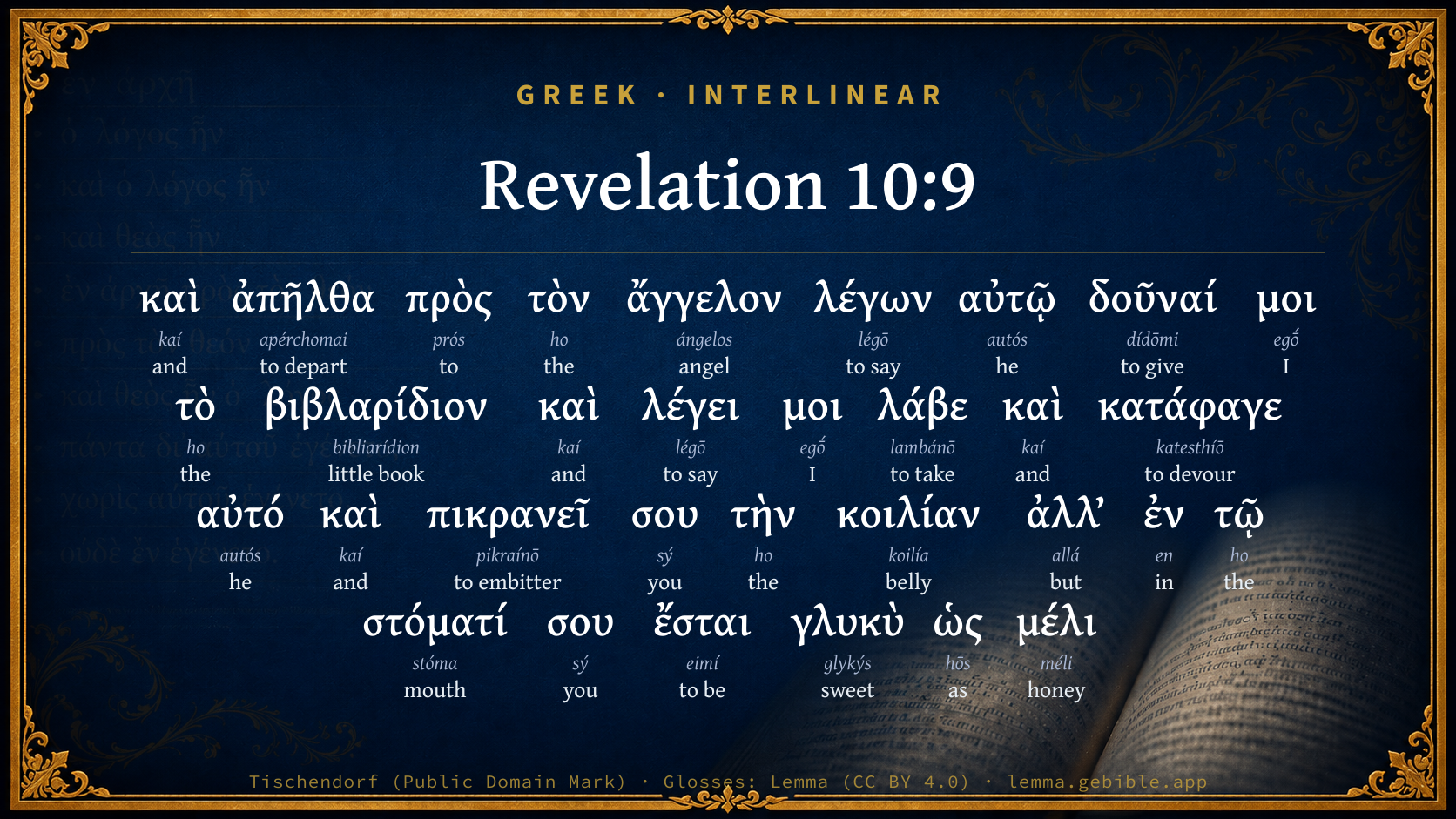
Greek (Tischendorf 8th ed.) Revelation 10:9 appears in the Greek New Testament. The text above is from the Tischendorf 8th edition. Each word links to its Strong’s number and a concise gloss. Click any word for its full Thayer’s Greek Lexicon entry.
Download image
Cite this verse

Revelation 10:9 (World English Bible). Public Domain. Lemma interlinear Bible study tool, https://lemma.gebible.app/v/revelation/10/9.

Show BibTeX & RIS
BibTeX
RIS
English Translation
I went to the angel, telling him to give me the little book. He said to me, "Take it, and eat it up. It will make your stomach bitter, but in your mouth it will be as sweet as honey."
World English Bible · Public Domain
Download a study sheet

One document with this verse’s original text, its word-by-word gloss line, the meaning frame, cross-references with their text, attributed commentary, and full source and license credits — printable, and it pastes into notes with its structure intact.

This verse Autodidact and up

Study sheet (.html) Plain text (.txt)

A passage Seminary Student

Up to 50 verses in one chapter. A passage sheet keeps up to 6 commentary sources and 12 cross-references per verse, in the order this page ranks them, and says so on the sheet whenever that leaves anything out. Ask for a single verse and you get the Autodidact verse sheet above.

Everything on this page stays free to read, with no account — the sheet is a download of what is already on screen, not access to it.

Want to remove ads? Support Godless Engineer
Compare translations 3

The same verse in 3 English versions, stacked beneath the original-language interlinear above. Click any original word for its lexicon entry.

Each is an independent rendering of the whole verse — the interlinear is not word-aligned to these translations.

Highlighted words mark where these versions differ — a whole-verse word diff, not a word-by-word alignment.

  • World English Bible Public Domain
    I went to the angel, telling him to give me the little book. He said to me, "Take it, and eat it up. It will make your stomach bitter, but in your mouth it will be as sweet as honey."
  • King James Version Public Domain
    And I went unto the angel, and said unto him, Give me the little book. And he said unto me, Take it, and eat it up; and it shall make thy belly bitter, but it shall be in thy mouth sweet as honey.
  • unfoldingWord Literal Text CC BY-SA 4.0
    And I went to the angel, telling him to give the little scroll to me. And he says to me, “Take and eat it, and it will make your stomach bitter, but in your mouth it will be sweet like honey.”

unfoldingWord Literal Text — © unfoldingWord, licensed CC BY-SA 4.0. Word-aligned USFM3 via Door43 (git.door43.org/unfoldingWord/en_ult).

Versions to compare (up to 4)

3 of 4 selected

Show all 19 translations

Every available English version of this verse, each an independent rendering of the whole verse.

  • World English Bible Public Domain
    I went to the angel, telling him to give me the little book. He said to me, "Take it, and eat it up. It will make your stomach bitter, but in your mouth it will be as sweet as honey."
  • Berean Standard Bible Public Domain
    And I went to the angel and said, “Give me the small scroll.” “Take it and eat it,” he said. “It will make your stomach bitter, but in your mouth it will be as sweet as honey.”
  • Majority Standard Bible Public Domain
    And I went to the angel and said, “Give me the small scroll.” “Take it and eat it,” he said. “It will make your stomach bitter, but in your mouth it will be as sweet as honey.”
  • King James Version Public Domain
    And I went unto the angel, and said unto him, Give me the little book. And he said unto me, Take it, and eat it up; and it shall make thy belly bitter, but it shall be in thy mouth sweet as honey.
  • American Standard Version (1901) Public Domain
    And I went unto the angel, saying unto him that he should give me the little book. And he saith unto me, Take it, and eat it up; and it shall make thy belly bitter, but in thy mouth it shall be sweet as honey.
  • Revised Version (1885) Public Domain
    And I went unto the angel, saying unto him that he should give me the little book. And he saith unto me, Take it, and eat it up; and it shall make thy belly bitter, but in thy mouth it shall be sweet as honey.
  • Geneva Bible (1599) Public Domain
    So I went vnto the Angel, and saide to him, Giue me the litle booke. And he said vnto me, Take it, and eate it vp, and it shall make thy belly bitter, but it shalbe in thy mouth as sweete as honie.
  • Douay-Rheims (1899) Public Domain
    And I went to the angel, saying unto him, that he should give me the book. And he said to me: Take the book, and eat it up: and it shall make thy belly bitter, but in thy mouth it shall be sweet as honey.
  • Young's Literal Translation Public Domain
    and I went away unto the messenger, saying to him, `Give me the little scroll;' and he saith to me, `Take, and eat it up, and it shall make thy belly bitter, but in thy mouth it shall be sweet -- as honey.'
  • Literal Standard Version CC BY-SA 4.0
    and I went away to the messenger, saying to him, “Give me the little scroll”; and he says to me, “Take, and eat it up, and it will make your belly bitter, but in your mouth it will be sweet as honey.”
  • Unlocked Literal Bible CC BY-SA 4.0
    Then I went to the angel and told him to give me the little scroll. He said to me, “Take the scroll and eat it. It will make your stomach bitter, but in your mouth it will be as sweet as honey.”
  • unfoldingWord Literal Text CC BY-SA 4.0
    And I went to the angel, telling him to give the little scroll to me. And he says to me, “Take and eat it, and it will make your stomach bitter, but in your mouth it will be sweet like honey.”
  • Darby Bible Public Domain
    And I went to the angel, saying to him to give me the little book. And he says to me, Take and eat it up: and it shall make thy belly bitter, but in thy mouth it shall be sweet as honey.
  • World Messianic Bible Public Domain
    I went to the angel, telling him to give me the little book. He said to me, “Take it and eat it. It will make your stomach bitter, but in your mouth it will be as sweet as honey.”
  • Webster's Bible Public Domain
    And I went to the angel, and said to him, Give me the little book. And he said to me, Take it, and eat it, and it shall make thy belly bitter, but it shall be in thy mouth sweet as honey.
  • Free Bible Version CC BY-SA 4.0
    So I went to the angel, and asked him to give me the little scroll. He said to me, “Take it and eat it up. It will be sour in your stomach, but sweet as honey in your mouth.”
  • Bible in Basic English Public Domain
    And I went to the angel, and said to him, Give me the little book. And he said to me: Put it in your mouth; and it will make your stomach bitter, but in your mouth it will be sweet as honey.
  • Text-Critical English NT CC BY 4.0
    So I went over to the angel and asked him to give me the little scroll. And he said to me, “Take the scroll and eat it. It will make yoʋr stomach bitter, but in yoʋr mouth it will be as sweet as honey.”
  • Tyndale New Testament (1534) Public Domain
    And I went vnto the angell and sayde to him: geve me the lytle boke and he sayd vnto me: take it and eate it vp and it shall make thy belly bytter but it shalbe in thy mouth as swete as hony.

Literal Standard Version (2020), Covenant Press — licensed CC BY-SA 4.0. Text via the HelloAO Bible API (eBible.org). Unlocked Literal Bible (unfoldingWord) — licensed CC BY-SA 4.0. Text via the HelloAO Bible API (eBible.org). unfoldingWord Literal Text — © unfoldingWord, licensed CC BY-SA 4.0. Word-aligned USFM3 via Door43 (git.door43.org/unfoldingWord/en_ult). Free Bible Version, Dr. Jonathan Gallagher — licensed CC BY-SA 4.0. Text via the HelloAO Bible API (eBible.org).

Word by word

More ways to search: Search by grammar → Find every occurrence → Compare this word →

Practice this passage: Drill this verse → Learn its vocabulary →

βιβλαρίδιον
bibliarídion
G974
“little book”
Noun, Accusative, Singular, Neuter
Part of Speech
Noun
Case
Accusative
Number
Singular
Gender
Neuter
Full Thayer's Definition

Origin: a diminutive of G975

TDNT: None

1. a little book
  1. καὶ kaí G2532 “and” Conjunction
  2. ἀπῆλθα apérchomai G565 “to depart” Verb, Aorist, Active, Indicative, 1st person, Singular
  3. πρὸς prós G4314 “to” Preposition
  4. τὸν ho G3588 “the” Article, Accusative, Singular, Masculine
  5. ἄγγελον ángelos G32 “angel” Noun, Accusative, Singular, Masculine
  6. λέγων légō G3004 “to say” Verb, Present, Active, Participle, Nominative, Singular, Masculine
  7. αὐτῷ autós G846 “he” Personal pronoun, Dative, Singular, Masculine
  8. δοῦναί dídōmi G1325 “to give” Verb, Aorist, Active, Infinitive
  9. μοι egṓ G1473 “I” Personal pronoun, 1st person, Dative, Singular
  10. τὸ ho G3588 “the” Article, Accusative, Singular, Neuter
  11. καὶ kaí G2532 “and” Conjunction
  12. λέγει légō G3004 “to say” Verb, Present, Active, Indicative, 3rd person, Singular
  13. μοι egṓ G1473 “I” Personal pronoun, 1st person, Dative, Singular
  14. λάβε lambánō G2983 “to take” Verb, Aorist, Active, Imperative, 2nd person, Singular
  15. καὶ kaí G2532 “and” Conjunction
  16. κατάφαγε katesthíō G2719 “to devour” Verb, Aorist, Active, Imperative, 2nd person, Singular
  17. αὐτό autós G846 “he” Personal pronoun, Accusative, Singular, Neuter
  18. καὶ kaí G2532 “and” Conjunction
  19. πικρανεῖ pikraínō G4087 “to embitter” Verb, Future, Active, Indicative, 3rd person, Singular
  20. σου sý G4771 “you” Personal pronoun, 2nd person, Genitive, Singular
  21. τὴν ho G3588 “the” Article, Accusative, Singular, Feminine
  22. κοιλίαν koilía G2836 “belly” Noun, Accusative, Singular, Feminine
  23. ἀλλ’ allá G235 “but” Conjunction
  24. ἐν en G1722 “in” Preposition
  25. τῷ ho G3588 “the” Article, Dative, Singular, Neuter
  26. στόματί stóma G4750 “mouth” Noun, Dative, Singular, Neuter
  27. σου sý G4771 “you” Personal pronoun, 2nd person, Genitive, Singular
  28. ἔσται eimí G1510 “to be” Verb, Future, Middle deponent, Indicative, 3rd person, Singular
  29. γλυκὺ glykýs G1099 “sweet” Adjective, Nominative, Singular, Neuter
  30. ὡς hōs G5613 “as” Adverb
  31. μέλι méli G3192 “honey” Noun, Nominative, Singular, Neuter

About this verse

These counts appear in no published source. They are computed here, from the morphology-tagged text and Lemma’s own curated glosses. What Lemma adds →

32
words
22
distinct lemmas
Revelation
section

Notable vocabulary

The rarest word here is βιβλαρίδιον little book G974 — appearing just 4 times in the whole Greek New Testament.

Shared distinctive vocabulary

βιβλαρίδιον little book G974 occurs in 4 verses of the Greek New Testament. Also found in:

Repetition

Words recur within this verse:

Cross-references

6

Topical passages linked to Revelation 10:9 in the Treasury of Scripture Knowledge — connected by theme and wording, ordered by reader-vote popularity; previews shown in the World English Bible.

  • Ezekiel 3:1–3 He said to me, Son of man, eat that which you find; eat this scroll, and go, speak to the house of Israel.
  • Jeremiah 15:16 Your words were found, and I ate them; and your words were to me a joy and the rejoicing of my heart: for I am called by your name, Yahweh, God of hosts.
  • Ezekiel 2:8 But you, son of man, hear what I tell you; don't be you rebellious like that rebellious house: open your mouth, and eat that which I give you.
  • Job 23:12 I haven't gone back from the commandment of his lips. I have treasured up the words of his mouth more than my necessary food.
  • Ezekiel 3:14 So the Spirit lifted me up, and took me away; and I went in bitterness, in the heat of my spirit; and the hand of Yahweh was strong on me.
  • Colossians 3:6 for which things' sake the wrath of God comes on the children of disobedience.

Cross-references courtesy of OpenBible.info (CC BY 4.0).

Commentary

Notes on Revelation 10:9 from classic Christian and Jewish commentators (each source and its license shown beneath its notes). The classic Christian expositions comment on the surrounding passage and are grouped to its opening verse, so a note may address several verses; the Jewish commentaries on the Tanakh (Rashi and others) are per-verse, so they appear only where the commentator wrote on this verse.

Lemma curates 59 commentaries, every one of them public domain or Creative Commons licensed, each selected and text-cleaned for this edition rather than reprinted as found. About our sources →

Bengel's Gnomon

Johann Albrecht Bengel

Rev 10:9. Δοῦναι) Some few read δὸς, for the sake of an easy construction: by far the greatest number read δοῦναι: whence formerly the Latin translator rendered it, ut daret (to give), and thus also the Syriac Version. But the direct style agrees with the present address in preference to the indirect. As to what remains, the Infinitive is put for the Imperative. For this change of Mood is frequent with the Greeks, as we have shown on Chrysost. de Sacerd. p. 510, and the next page. Add Biblioth. Brem. Class, viii. p. 945, and following. The very word δοῦναι for δὸς is found in Theocritus. The Hebrew idiom also admits of this, on which see Dign. Speidelii Gramm. Hebr. p. 139. And the Septuagint on Gen 45:19, renders קחו, λαβεῖν—καὶ παραγίνεσθε. Add Luk 9:3; Rom 12:15; Php 3:16. Such a figure makes the style characteristic of feeling,[104] and gives to it either a sense of majesty, especially where God is the speaker, or modesty, as here. For John from time to time, in this book, has expressed great reverence, and that almost to excess, towards the inhabitants of heaven: ch. Rev 7:14, Rev 19:10, Rev 22:8: δοῦναι therefore, instead of δὸς,[105] corresponds with that modesty, which he exhibited towards the angel in asking for the little book. After the example of John, we ought to unite humility of heart and searching of the prophets: and Lampe on Psalms 131, if you take it rightly, befittingly explains this union.

[104] See Appendix on Moratus Sermo.

[105] Δοῦναι, ABC; “ut daret,” h Vulg. Δὸς, Rec. Text, without good authority.—E.

Bengel's Gnomon of the New Testament — English translation (T&T Clark, Edinburgh, 1860) — public domain. Text from a community e-Sword module.

Expositor's Greek Testament

ed. W. Robertson Nicoll

Rev 10:9-10 . The prophet absorbs the word of God; in our phrase, he makes it his own or identifies himself with it (Jer 15:16 ). To assimilate this revelation of the divine purpose seems to promise a delightful experience, but the bliss and security of the saints, he soon realises, involve severe trials ( cf. Rev 11:2 , Rev 12:13 f., etc.) for them as well as catastrophes for the world. Hence the feeling of disrelish with which he views his new vocation as a seer. The distasteful experience is put first, in Rev 10:9 , as being the unexpected element in the situation. (The omission of bitterness in LXX of Eze 3:14 renders it unlikely that this additional trait of unpleasant taste is due, as Spitta thinks, to an erroneous combination of Eze 3:2 ; Eze 3:14 ). The natural order occurs in Rev 10:10 . The only analogous passage in early Christian literature is in the “Martyrdom of Perpetua” (4. cf. Weinel, 196, 197). Wetstein cites from Theophrastus the description of an Indian shrub οὗ ὁ καρπὸς … ἐσθιόμενος γλυκὺς . οὗτος ἐν τῇ κοιλίᾳ δηγμὸν ποιεῖ καὶ δυσεντερίαν . Before the happy consummation (Rev 10:7 ), a bitter prelude is to come, which is the subject of national and political prophecies. In order to underline his divine commission for this task of punitive prediction, he recalls his inspiration.

The Expositor's Greek Testament, edited by W. Robertson Nicoll (1897–1910) — public domain. Text from a community e-Sword module.

Jamieson, Fausset & Brown

Robert Jamieson, A. R. Fausset & David Brown

I went--Greek, "I went away." John here leaves heaven, his standing-point of observation heretofore, to be near the angel standing on the earth and sea.

Give--A, B, C, and Vulgate read the infinitive, "Telling him to give."

eat it up--appropriate its contents so entirely as to be assimilated with (as food), and become part of thyself, so as to impart them the more vividly to others. His finding the roll sweet to the taste at first, is because it was the Lord's will he was doing, and because, divesting himself of carnal feeling, he regarded God's will as always agreeable, however bitter might be the message of judgment to be announced. Compare Psa 40:8, Margin, as to Christ's inner complete appropriation of God's word.

thy belly bitter--parallel to Eze 2:10, "There was written therein lamentations, and mourning, and woe."

as honey-- (Psa 19:10; Psa 119:103). Honey, sweet to the mouth, sometimes turns into bile in the stomach. The thought that God would be glorified (Rev 11:3-6, Rev 11:11-18) gave him the sweetest pleasure. Yet, afterwards the belly, or carnal natural feeling, was embittered with grief at the prophecy of the coming bitter persecutions of the Church (Rev 11:7-10); compare Joh 16:1-2. The revelation of the secrets of futurity is sweet to one at first, but bitter and distasteful to our natural man, when we learn the cross which is to be borne before the crown shall be won. John was grieved at the coming apostasy and the sufferings of the Church at the hands of Antichrist.

Jamieson, Fausset & Brown — Commentary Critical and Explanatory on the Whole Bible (1871) — public domain (CC PDM 1.0). Text via the HelloAO Bible API.

Adam Clarke's Commentary

Verse 9. Take it, and eat it up] Fully comprehend its meaning; study it thoroughly.

Adam Clarke's Commentary on the Bible (1810–1826) — public domain. Text from a community e-Sword/MySword module.

The Cambridge Bible for Schools and Colleges

gen. ed. J. J. S. Perowne

9. I went] Apparently from his place in heaven to the earth: but there are difficulties in tracing coherently the changes in the point of view.

and said unto him, Give me, &c.] Read, saying unto him that he should give me.

eat it up] Eze_2:8; Eze_3:3.

it shall make thy belly bitter] This Ezekiel’s roll did not do. We may presume that this little book, like the O. T. one, contained “lamentations, and mourning, and woe.” To both prophets, the first result of absorbing the words of God and making them their own (Jer_15:16) is delight at communion with Him and enlightenment by Him: but the Priest of the Lord did not feel, as the Disciple of Jesus did, the after-thought of bitterness—the Christ-like sorrow for those against whom God’s wrath is revealed, who “knew not the time of their visitation.”

“It grieves so sore his tender heart

To see God’s ransom’d world in fear and wrath depart.”

It is generally held, in one form or another, that this “little book” symbolises or contains “the mystery of God,” the approaching completion of which has just been announced. Some needlessly combine with this the theory (see note on Rev_10:1) that it contains the whole or part of this book of the Revelation. But really the surest clue to its meaning is the parallel passage in Ezekiel: if we say that the book contains “the Revelation of God’s Judgement” (remembering how that Revelation is described in Rom_1:18) we shall speak as definitely as is safe.

The Cambridge Bible for Schools and Colleges (gen. ed. J. J. S. Perowne; Cambridge University Press, 1878–1918) — public domain. Text from a community e-Sword module.

John Gill's Exposition

And I went to the angel,.... According to the order given him; he was not disobedient to the heavenly vision; and, indeed, whither should any go knowledge but to him who has the words of eternal life, and is the great prophet of the church? and to whom should John go to qualify him for prophesying, but to him, who, as man and Mediator, had this revelation of future things given him? Rev 1:1;

and said unto him, give me the little book; he did not take it without his leave, but in a modest and humble manner asks him to give it him, that he might deliver out the prophecies in it to others: so ordinary prophets and ministers of the word should go to Christ, to have their eyes opened, their understandings enlightened, that they may understand the Scriptures, and explain them to others:

and he said unto me, take it, and eat it up; which must be understood not literally, but mystically; and the sense is this, take the book, and diligently peruse it, and with as much eagerness as an hungry man would eat a meal; so greedy are some persons of reading, and as it were of devouring books; hence Cicero called (q) Cato "helluo librorum", a glutton at books: and in such manner John is bid to take and eat this book, and look into it, and read it over diligently, and consider what was in it, and meditate upon it, and digest the things contained in it, and lay them up in his mind and memory; and for the present hide and conceal them, in like manner as he was bid to seal, and not write what the seven thunders uttered; and so, though this book is represented to him as open in the angel's hand, yet he must take it and eat it, and hide it in his belly, because the things in it as yet were not to be accomplished: so for ordinary prophesying, or preaching, the ministers of the word should diligently read the Scriptures, constantly meditate on them, digest the truths of the Gospel in their own minds, and lay them up in the treasury of their hearts, and bring them forth from thence in due season:

and it shall make thy belly bitter, but it shall be in thy mouth sweet as honey; as Ezekiel's roll was to him when he ate it, Eze 3:1; the Alexandrian copy, instead of "thy belly", reads "thy heart".

(q) Cicero de Fittibus Bon. & Mal. l. 3. c. 1.

John Gill's Exposition of the Whole Bible (1746–1763) — public domain (CC PDM 1.0). Text via the HelloAO Bible API.

Trapp's Complete Commentary

John Trapp

9 And I went unto the angel, and said unto him, Give me the little book. And he said unto me, Take it, and eat it up; and it shall make thy belly bitter, but it shall be in thy mouth sweet as honey.

Ver. 9. Give me the little book] Let preachers ply the throne of grace, if ever they will preach to purpose. Bene orasse, est bene studuisse, said Luther. Three things make a preacher, reading, prayer, and temptation. He that will understand God’s riddles must plough with this heifer, the Spirit, which is not given but to them that ask it.

And eat it up] By reading and meditation; ministers must so devour and digest the Holy Scriptures, that as good scribes they may draw out new and old for the use of the Church upon all occasions. Jacobus de Voragine was so called, quod esset veluti vorago bibliorum, because he as it were devoured the Bible. (Alsted. Chron.) So Petrus Comestor for the same reason. Joannes Gatius, a Sicilian, was so well versed in the Scriptures, and so great a divine, that he once said, Si libri sacri perirent, se per Dei gratiam restiturum, That if the Bible were lost out of the world, he could restore it: Some think that Ezra did so after the Babylonish captivity, but I cannot think so. (Vide Pareum in Gen. Proleg.)

John Trapp, A Commentary or Exposition upon All the Books of the Old and New Testament (1647–1656) — public domain. Text from a community e-Sword module.

Albert Barnes' Notes on the Bible

And I went unto the angel - This is symbolic action, and is not to be understood literally. As it is not necessary to suppose that an angel literally descended, and stood upon the sea and the land, so it is not necessary to suppose that there was a literal act of going to him, and taking the book from his hand and eating it.

Give me the little book - In accordance with the command in Rev 10:8. We may suppose, in regard to this:

(a)That the symbol was designed to represent that the book was to be used in the purpose here referred to, or was to be an important agent or instrumentality in accomplishing the purpose. The book is held forth in the hand of the angel as a striking emblem. There is a command to go and take it from his hand for some purpose not yet disclosed. All this seems to imply that the book - or what is represented by it - would be an important instrument in accomplishing the purpose here referred to.

The application for the book might intimate that, on the part of him who made it, there would be some strong desire to possess it. He goes, indeed, in obedience to the command; but, at the same time, there would naturally be a desire to be in possession of the volume, or to know the contents (compare Rev 5:4), and his approach to the angel for the book would be most naturally interpreted as expressive of such a wish.

And he said unto me, Take it - As if he had expected this application; or had come down to furnish him with this little volume, and had anticipated that the request would be made. There was no reluctance in giving it up; there was no attempt to withhold it; there was no prohibition of its use. The angel had no commission, and no desire to retain it for himself, and no hesitation in placing it in the bands of the seer on the first application. Would not the readiness with which God gives his Bible into the hands of human beings, in contradistinction from all human efforts to restrain its use, and to prevent its free circulation, be well symbolized by this act?

And eat it up - There is a similar command in Eze 3:1. Of course, this is to he understood figuratively, for no one would interpret literally a command to eat a manuscript or volume. We have in common use a somewhat similar phrase, when we speak of devouring a book, which may illustrate this, and which is not liable to be misunderstood. In Jer 15:16, we have similar language: “Thy words were found, and I did eat them; and thy word was unto me the joy and rejoicing of my heart.” Thus, in Latin, the words propinare, imbibere, devorare, deglutire, etc., are used to denote the greediness with which knowledge is acquired. Compare in the Apocrypha, 2 Esdras 14:38-40. The meaning here, then, is plain. He was to possess himself of the contents of the book; to receive it into his mind; to apply it, as we do food, for spiritual nourishment - truth having, in this respect, the same relation to the mind which food has to the body. If the little book was a symbol of the Bible, it would refer to the fact that the truths of that book became the nourisher and supporter of the public mind.

And it shall make thy belly bitter - This is a circumstance which does not occur in the corresponding place in Eze 3:1-3. The expression here must refer to something that would occur after the symbolical action of “eating” the little book, or to some consequence of eating it - for the act of eating it is represented as pleasant: “in thy mouth sweet as honey.” The meaning here is, that the effect which followed from eating the book was painful or disagreeable - as food would be that was pleasant to the taste, but that produced bitter pain when eaten. The fulfillment of this would be found in one of two things:

(a) It might mean that the message to be delivered in consequence of devouring the book, or the message which it contained, would be of a painful or distressing character; that with whatever pleasure the book might be received and devoured, it would be found to contain a communication that would be indicative of woe or sorrow. This was the case with the little book that Ezekiel was commanded to eat up. Thus, in speaking of this book, it is said, “And it was written within and without: and there was written therein lamentations, and mourning, and woe,” Eze 2:10. Compare Rev 3:4-9, where the contents of the book, and the effect of proclaiming the message which it contained, are more fully stated. So here the meaning may be, that, however gladly John may have taken the book, and with whatever pleasure he may have devoured its contents, yet that it would be found to be charged with the threatening of wrath, and with denunciations of a judgment to come, the delivery of which would be well represented by the “bitterness” which is said to have followed from “eating” the volume. Or.

(b) it may mean that the consequence of devouring the book, that is, of embracing its doctrines, would be persecutions and trouble - well represented by the “bitterness” that followed the “eating” of the volume. Either of these ideas would be a fulfillment of the proper meaning of the symbol; for, on the supposition that either of these occurred in fact, it would properly be symbolized by the eating of a volume that was sweet to the taste, but that made the belly bitter.

But it shall be in thy mouth sweet as honey - So in Eze 3:3. The proper fulfillment of this it is not difficult to understand. It would well represent the pleasure derived from divine truth - the sweetness of the Word of God - the relish with which it is embraced by those that love it. On the supposition that the “little book” here refers to the Bible, and to the use which would be made of it in the times referred to, it would properly denote the relish which would exist for the sacred volume, and the happiness which would be found in its perusal; for this very image is frequently employed to denote this. Thus, in Psa 19:10; “More to be desired are they than gold, yea, than much fine gold; sweeter also than honey and the honeycomb.” Psa 119:103; “how sweet are thy words unto my taste! yea, sweeter than honey to my mouth.” We are then to look for the fulfillment of this in some prevailing delight or satisfaction, in the times referred to, in the Word of the Lord, or in the truths of revelation.

Albert Barnes' Notes on the Bible (1834–1885) — public domain. Text from a community e-Sword/MySword module.

Haydock's Catholic Bible Commentary

Take the book, and devour it. See Ezechiel ii. and iii. It was sweet in my mouth; I was delighted to read and hear the victories and glory of God’s faithful servants; but it became bitter in my belly, when I considered the judgments of God upon so many sinners, who by their own wilful blindness were lost for eternity. (Witham) --- This mysterious book, presented to St. John precisely between the sound of the sixth and seventh trumpet, or rather between the irruption announced at the sound of the sixth trumpet, and the persecution which is then to follow and to precede the sound of the seventh trumpet, appears to represent the book of the gospel, which shall be given to the Jews at the end of the sixth age of the Church. This book will be then to them full of sweetness, because they will see in it the tender love of Jesus Christ; but at the same time it will cause bitterness, because they will see in it with grief their infidelity and that of their fathers. (Bible de Vence)

George Leo Haydock (1774–1849), Haydock's Catholic Family Bible and Commentary, 1859 edition — public domain. Excludes Psalms (Douay-Rheims chapter numbering differs from Protestant) and Deuterocanonical books (Catholic canon only).

Matthew Poole's English Annotations

Take it, and eat it up: thus Ezekiel was bidden to eat the roll; and it was in his mouth as sweet as honey, Eze 2:8; 3:3. The eating of a book signifies the due reading of it, digesting it, and meditating upon the matters in it.

And it shall make thy belly bitter, but it shall be in thy mouth sweet as honey; it should be sweet in his month, as it was the revelation of the mind and will of God, (which is sweet to all pious souls; see Jer 15:16), but in his belly it should be bitter, being the revelation of the Divine will, as to the bringing such terrible judgments upon an impenitent people.

Matthew Poole's English Annotations on the Holy Bible (1683–1685) — public domain. Text from a community e-Sword/MySword module.

Whedon's Commentary on the Bible

Daniel D. Whedon

9. Eat it up—Receive it within thee, and assimilate within and to thyself. Be impregnated with the prophetic power, as the great final seer of the New Testament.

Daniel D. Whedon (gen. ed.), Commentary on the Old and New Testaments (1874–1909) — public domain. Text from a community e-Sword module.

The Pulpit Commentary

And I went unto the angel, and said unto him, Give me the little book; and I went away to the angel, telling him to give me the little book. Alford understands that the seer goes from his position in heaven to the angel on earth. But he is probably, in his vision, already on the earth (see on ver. 1). And he said unto me, Take it, and eat it up; he saith. This part of the vision is founded on Eze_2:9-10; Eze_3:1-3. The act is no doubt intended to convey the idea that the seer is to carefully receive, to digest thoroughly, as it were, his message in order to deliver it faithfully. Thus in Eze_3:10 the prophet is told, "All my words that I shall speak unto thee receive in thine heart, and hear with thine ears. And go, get thee to them of the captivity, unto the children of thy people, and speak unto them," etc. And it shall make thy belly bitter, but it shall be in thy mouth sweet as honey; cf. the vision of Eze 2:9-3, where the sweetness only is immediately mentioned; but the bitterness is implied later on in Eze_3:14. The sweetness expresses the pleasure and readiness with which St. John receives his commission; the bitterness symbolizes the grief which possesses him when he thoroughly takes in the nature of his message. The pleasure with which he receives the angel"s commands may proceed from joy at the thought that the final overthrow of the wicked is the final deliverance of the saints; or it may be that he feels himself honoured at being chosen as the medium for conveying God"s message.

Compare the readiness of Isa_6:8 to fulfil a similar office, and his subsequent fear and hesitation. (Isa_7:4) The bitterness of the seer follows when he realizes the terrible nature of the judgment he is to announce. (cf. Jer_8:21, "For the hurt of the daughter of my people am I hurt Various other explanations, more or less allegorical, have been suggested. Thus Andreas explains that the first sweetness of sin is afterwards converted into bitterness. Origen, quoted in the "Speaker"s Commentary," "Very sweet is this the book of Scripture when first perceived, but bitter to the conscience within." Maurice supposes that St. John"s joy proceeds from the expectation that the book will announce the fall of the great Babel empire of the world, and his disappointment follows when he discovers that it predicts the fall of Jerusalem. Bede explains that the bitterness in the belly indicates the reception by the seer, but the sweetness in the mouth is the declaration to others.

The Pulpit Commentary (1880–1919), ed. H.D.M. Spence-Jones & Joseph S. Exell — public domain. Text from a community e-Sword module.

John Wesley's Explanatory Notes

Eat it up - The like was commanded to Ezekiel. This was an emblem of thoroughly considering and digesting it. And it will make thy belly bitter, but it will be sweet as honey in thy mouth - The sweetness betokens the many good things which follow, chap. xi, 1, 15, &c.; the bitterness, the evils which succeed under the third woe.

John Wesley, Explanatory Notes Upon the Whole Bible (1754–1765) — public domain. Text via the GEBible commentary corpus.

Scofield Reference Notes

C. I. Scofield

angel (See Scofield "Heb 1:4")

Take it Cf. Eze 2:8; Eze 2:9; Eze 3:1-3.

(See Scofield "Eze 3:3")

The Scofield Reference Bible (1917 edition), notes by C. I. Scofield — public domain. Text from a community e-Sword module.

Cambridge Greek Testament for Schools and Colleges

9. ἀπῆλθον. Lach[364] Tisch[365] W. H[366] read ἀπῆλθα with A.

[364] Lachmann’s larger edition.

[365] Tischendorf: eighth edition; where the text aud notes differ the latter are cited.

[366] H. Westcott aud Hort.

9. ἀπῆλθον. Apparently from his place in heaven to the earth; if the Vision which begins at Rev 4:1 is continued throughout the book, there are difficulties in tracing coherently the changes in the point of view.

κατάφαγε αὐτό. Eze 2:8; Eze 3:3.

πικρανεῖ σου τὴν κοιλίαν. This Ezekiel’s roll did not do. We may presume that this little book, like the O.T. one, contained “lamentations, and mourning, and woe.” To both prophets, the first result of absorbing the words of God and making them their own (Jer 15:16) is delight at communion with Him and enlightenment by Him: but the Priest of the Lord did not feel, as the Disciple of Jesus did, the afterthought of bitterness—the Christ-like sorrow for those against whom God’s wrath is revealed, who “knew not the time of their visitation.”

“Else had it bruised too sore his tender heart

To see God’s ransom’d world in wrath and flame depart.” (Keble.) It is generally held, in one form or another, that this “little book” symbolises or contains “the mystery of God,” the approaching completion of which has just been announced. Some needlessly combine with this the theory (see note on Rev 5:1) that it contains the whole or part of this Book of the Revelation. But really the surest clue to its meaning is the parallel passage in Ezekiel: if we say that the book contains “the Revelation of God’s Judgement” (remembering how that Revelation is described in Rom 1:18), we shall speak as definitely as is safe.

Cambridge Greek Testament for Schools and Colleges (Cambridge University Press, 1896; 21 vols, various authors incl. Carr, Maclear, Plummer, Farrar, Lumby, Moule, M. R. James, Simcox) — public domain. Text from a community e-Sword module.

Vincent's Word Studies in the New Testament

Marvin R. Vincent

I went [απηλθον] . The preposition ajpo has the force of away. I went away from the place where I was standing.

Eat it up. Compare Eze 3:1 - 3; Jer 14:16.

Marvin R. Vincent, Word Studies in the New Testament (1887–1900) — public domain. Text from a community e-Sword/MySword module.

Lesson kit

Teaching starters — assembled from the data on this page, not authored interpretation. Every prompt links to the verse data it draws on. Edit before teaching.

Revelation, in the Revelation, opens this verse with 32 words (22 distinct Greek lemmas). Its most distinctive word is bibliarídion (“little book”). A historical commentator’s framing appears above. Read the whole chapter for the surrounding context.

Discussion questions

  1. How does “little book” (bibliarídion) shape what this verse is saying?
  2. How does Revelation 10:2, which shares the word «little book», read alongside this verse?
  3. What does the repetition of “to say” (2× in this one verse) do in this verse?
  4. The translations on this page render this verse differently — a whole-verse word diff, not a word-by-word alignment. What might account for the different wordings?
  5. Compare how Bengel's Gnomon and Expositor's Greek Testament read this verse. Where do they agree or differ?

Things to notice

Reading settings

Reading text

Shown beneath each verse's original-language words.

Old Testament
Old Testament edition

Read the OT as the Masoretic Hebrew (MT) or the Greek Septuagint (LXX).

English shown for the Greek Septuagint (in the Hebrew ↔ Greek comparison).

Comparing translations? Open the Compare panel on any verse page to stack up to four side by side.