Revelation 11:15

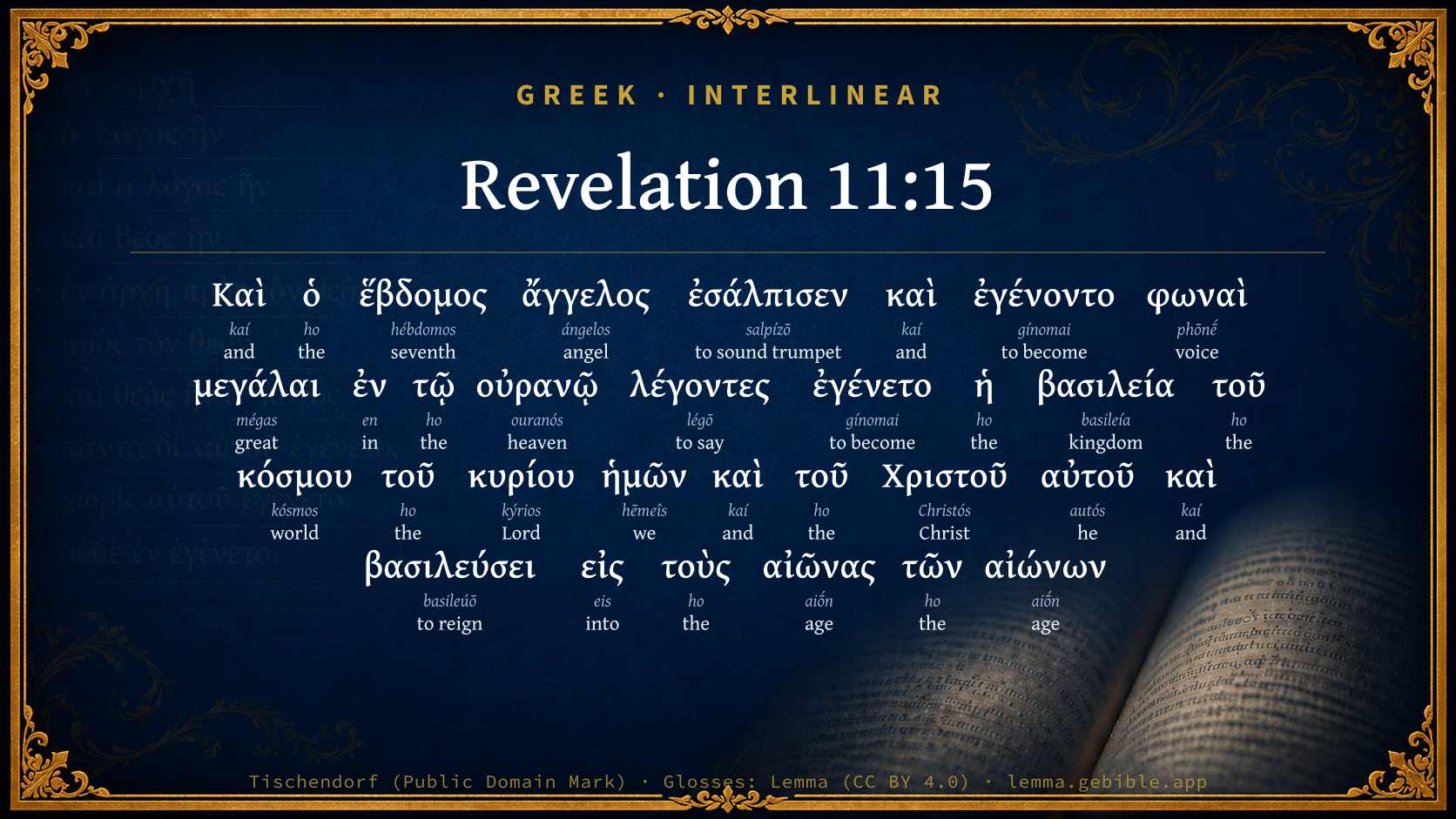
Greek (Tischendorf 8th ed.) Revelation 11:15 appears in the Greek New Testament. The text above is from the Tischendorf 8th edition. Each word links to its Strong’s number and a concise gloss. Click any word for its full Thayer’s Greek Lexicon entry.
Download image
Cite this verse

Revelation 11:15 (World English Bible). Public Domain. Lemma interlinear Bible study tool, https://lemma.gebible.app/v/revelation/11/15.

Show BibTeX & RIS
BibTeX
RIS
English Translation
The seventh angel sounded, and great voices in heaven followed, saying, "The kingdom of the world has become the Kingdom of our Lord, and of his Christ. He will reign forever and ever!"
World English Bible · Public Domain
Download a study sheet

One document with this verse’s original text, its word-by-word gloss line, the meaning frame, cross-references with their text, attributed commentary, and full source and license credits — printable, and it pastes into notes with its structure intact.

This verse Autodidact and up

Study sheet (.html) Plain text (.txt)

A passage Seminary Student

Up to 50 verses in one chapter. A passage sheet keeps up to 6 commentary sources and 12 cross-references per verse, in the order this page ranks them, and says so on the sheet whenever that leaves anything out. Ask for a single verse and you get the Autodidact verse sheet above.

Everything on this page stays free to read, with no account — the sheet is a download of what is already on screen, not access to it.

Want to remove ads? Support Godless Engineer
Compare translations 3

The same verse in 3 English versions, stacked beneath the original-language interlinear above. Click any original word for its lexicon entry.

Each is an independent rendering of the whole verse — the interlinear is not word-aligned to these translations.

Highlighted words mark where these versions differ — a whole-verse word diff, not a word-by-word alignment.

  • World English Bible Public Domain
    The seventh angel sounded, and great voices in heaven followed, saying, "The kingdom of the world has become the Kingdom of our Lord, and of his Christ. He will reign forever and ever!"
  • King James Version Public Domain
    And the seventh angel sounded; and there were great voices in heaven, saying, The kingdoms of this world are become the kingdoms of our Lord, and of his Christ; and he shall reign for ever and ever.
  • unfoldingWord Literal Text CC BY-SA 4.0
    And the seventh angel trumpeted, and loud voices happened in heaven, saying, “The kingdom of the world has become of our Lord and of his Christ, and he will reign to the ages of the ages.”

unfoldingWord Literal Text — © unfoldingWord, licensed CC BY-SA 4.0. Word-aligned USFM3 via Door43 (git.door43.org/unfoldingWord/en_ult).

Versions to compare (up to 4)

3 of 4 selected

Show all 19 translations

Every available English version of this verse, each an independent rendering of the whole verse.

  • World English Bible Public Domain
    The seventh angel sounded, and great voices in heaven followed, saying, "The kingdom of the world has become the Kingdom of our Lord, and of his Christ. He will reign forever and ever!"
  • Berean Standard Bible Public Domain
    Then the seventh angel sounded his trumpet, and loud voices called out in heaven: “The kingdom of the world has become the kingdom of our Lord and of His Christ, and He will reign forever and ever.”
  • Majority Standard Bible Public Domain
    Then the seventh angel sounded his trumpet, and loud voices called out in heaven: “The kingdom of the world has become the kingdom of our Lord and of His Christ, and He will reign forever and ever.”
  • King James Version Public Domain
    And the seventh angel sounded; and there were great voices in heaven, saying, The kingdoms of this world are become the kingdoms of our Lord, and of his Christ; and he shall reign for ever and ever.
  • American Standard Version (1901) Public Domain
    And the seventh angel sounded; and there followed great voices in heaven, and they said, The kingdom of the world is become `the kingdom' of our Lord, and of his Christ: and he shall reign for ever and ever.
  • Revised Version (1885) Public Domain
    And the seventh angel sounded; and there followed great voices in heaven, and they said, The kingdom of the world is become the kingdom of our Lord, and of his Christ: and he shall reign for ever and ever.
  • Geneva Bible (1599) Public Domain
    And the seuenth Angell blewe the trumpet, and there were great voyces in heauen, saying, The kingdomes of this worlde are our Lordes, and his Christes, and he shall reigne for euermore.
  • Douay-Rheims (1899) Public Domain
    And the seventh angel sounded the trumpet: and there were great voices in heaven, saying: The kingdom of this world is become our Lord's and his Christ's, and he shall reign for ever and ever. Amen.
  • Young's Literal Translation Public Domain
    And the seventh messenger did sound, and there came great voices in the heaven, saying, `The kingdoms of the world did become `those' of our Lord and of His Christ, and he shall reign to the ages of the ages!'
  • Literal Standard Version CC BY-SA 4.0
    And the seventh messenger sounded the trumpet, and there came great voices in Heaven, saying, “The kingdoms of the world became [those] of our Lord and of His Christ, and He will reign through the ages of the ages!”
  • Unlocked Literal Bible CC BY-SA 4.0
    Then the seventh angel sounded his trumpet, and loud voices spoke in heaven and said, “The kingdom of the world has become the kingdom of our Lord and of his Christ. He will reign forever and ever.”
  • unfoldingWord Literal Text CC BY-SA 4.0
    And the seventh angel trumpeted, and loud voices happened in heaven, saying, “The kingdom of the world has become of our Lord and of his Christ, and he will reign to the ages of the ages.”
  • Darby Bible Public Domain
    And the seventh angel sounded [his] trumpet: and there were great voices in the heaven, saying, The kingdom of the world of our Lord and of his Christ is come, and he shall reign to the ages of ages.
  • World Messianic Bible Public Domain
    The seventh angel sounded, and great voices in heaven followed, saying, “The kingdom of the world has become the Kingdom of our Lord and of his Messiah. He will reign forever and ever!”
  • Webster's Bible Public Domain
    And the seventh angel sounded; and there were great voices in heaven, saying, The kingdoms of this world are become the kingdoms of our Lord, and of his Christ; and he will reign for ever and ever.
  • Free Bible Version CC BY-SA 4.0
    The seventh angel blew his trumpet, and loud voices shouted in heaven, “The kingdom of the world has become the kingdom of our Lord, and of his Christ, and he shall reign for ever and ever.”
  • Bible in Basic English Public Domain
    And at the sounding of the seventh angel there were great voices in heaven, saying, The kingdom of the world has become the kingdom of our Lord, and of his Christ, and he will have rule for ever and ever.
  • Text-Critical English NT CC BY 4.0
    Then the seventh angel sounded his trumpet, and there were loud voices in heaven, saying, “The kingdom of the world has become the kingdom of our Lord and of his Christ, and he will reign forever and ever.”
  • Tyndale New Testament (1534) Public Domain
    And the seventh angell blewe and therwere made great voyces in heven sayinge: the kyngdoms of this worlde are oure lordes and his christes and he shall raygne for ever more.

Literal Standard Version (2020), Covenant Press — licensed CC BY-SA 4.0. Text via the HelloAO Bible API (eBible.org). Unlocked Literal Bible (unfoldingWord) — licensed CC BY-SA 4.0. Text via the HelloAO Bible API (eBible.org). unfoldingWord Literal Text — © unfoldingWord, licensed CC BY-SA 4.0. Word-aligned USFM3 via Door43 (git.door43.org/unfoldingWord/en_ult). Free Bible Version, Dr. Jonathan Gallagher — licensed CC BY-SA 4.0. Text via the HelloAO Bible API (eBible.org).

Word by word

More ways to search: Search by grammar → Find every occurrence → Compare this word →

Practice this passage: Drill this verse → Learn its vocabulary →

ἕβδομος
hébdomos
G1442
“seventh”
Adjective, Nominative, Singular, Masculine
Part of Speech
Adjective
Case
Nominative
Number
Singular
Gender
Masculine
Full Thayer's Definition

Origin: ordinal from G2033

TDNT: 12:27,2

1. seventh
  1. Καὶ kaí G2532 “and” Conjunction
  2. ὁ ho G3588 “the” Article, Nominative, Singular, Masculine
  3. ἄγγελος ángelos G32 “angel” Noun, Nominative, Singular, Masculine
  4. ἐσάλπισεν salpízō G4537 “to sound trumpet” Verb, Aorist, Active, Indicative, 3rd person, Singular
  5. καὶ kaí G2532 “and” Conjunction
  6. ἐγένοντο gínomai G1096 “to become” Verb, Aorist, Middle deponent, Indicative, 3rd person, Plural
  7. φωναὶ phōnḗ G5456 “voice” Noun, Nominative, Plural, Feminine
  8. μεγάλαι mégas G3173 “great” Adjective, Nominative, Plural, Feminine
  9. ἐν en G1722 “in” Preposition
  10. τῷ ho G3588 “the” Article, Dative, Singular, Masculine
  11. οὐρανῷ ouranós G3772 “heaven” Noun, Dative, Singular, Masculine
  12. λέγοντες légō G3004 “to say” Verb, Present, Active, Participle, Nominative, Plural, Masculine
  13. ἐγένετο gínomai G1096 “to become” Verb, Aorist, Middle deponent, Indicative, 3rd person, Singular
  14. ἡ ho G3588 “the” Article, Nominative, Singular, Feminine
  15. βασιλεία basileía G932 “kingdom” Noun, Nominative, Singular, Feminine
  16. τοῦ ho G3588 “the” Article, Genitive, Singular, Masculine
  17. κόσμου kósmos G2889 “world” Noun, Genitive, Singular, Masculine
  18. τοῦ ho G3588 “the” Article, Genitive, Singular, Masculine
  19. κυρίου kýrios G2962 “Lord” Noun, Genitive, Singular, Masculine
  20. ἡμῶν hēmeîs G2249 “we” Personal pronoun, 1st person, Genitive, Plural
  21. καὶ kaí G2532 “and” Conjunction
  22. τοῦ ho G3588 “the” Article, Genitive, Singular, Masculine
  23. Χριστοῦ Christós G5547 “Christ” Noun, Genitive, Singular, Masculine
  24. αὐτοῦ autós G846 “he” Personal pronoun, Genitive, Singular, Masculine
  25. καὶ kaí G2532 “and” Conjunction
  26. βασιλεύσει basileúō G936 “to reign” Verb, Future, Active, Indicative, 3rd person, Singular
  27. εἰς eis G1519 “into” Preposition
  28. τοὺς ho G3588 “the” Article, Accusative, Plural, Masculine
  29. αἰῶνας aiṓn G165 “age” Noun, Accusative, Plural, Masculine
  30. τῶν ho G3588 “the” Article, Genitive, Plural, Masculine
  31. αἰώνων aiṓn G165 “age” Noun, Genitive, Plural, Masculine

About this verse

These counts appear in no published source. They are computed here, from the morphology-tagged text and Lemma’s own curated glosses. What Lemma adds →

32
words
20
distinct lemmas
Revelation
section

Notable vocabulary

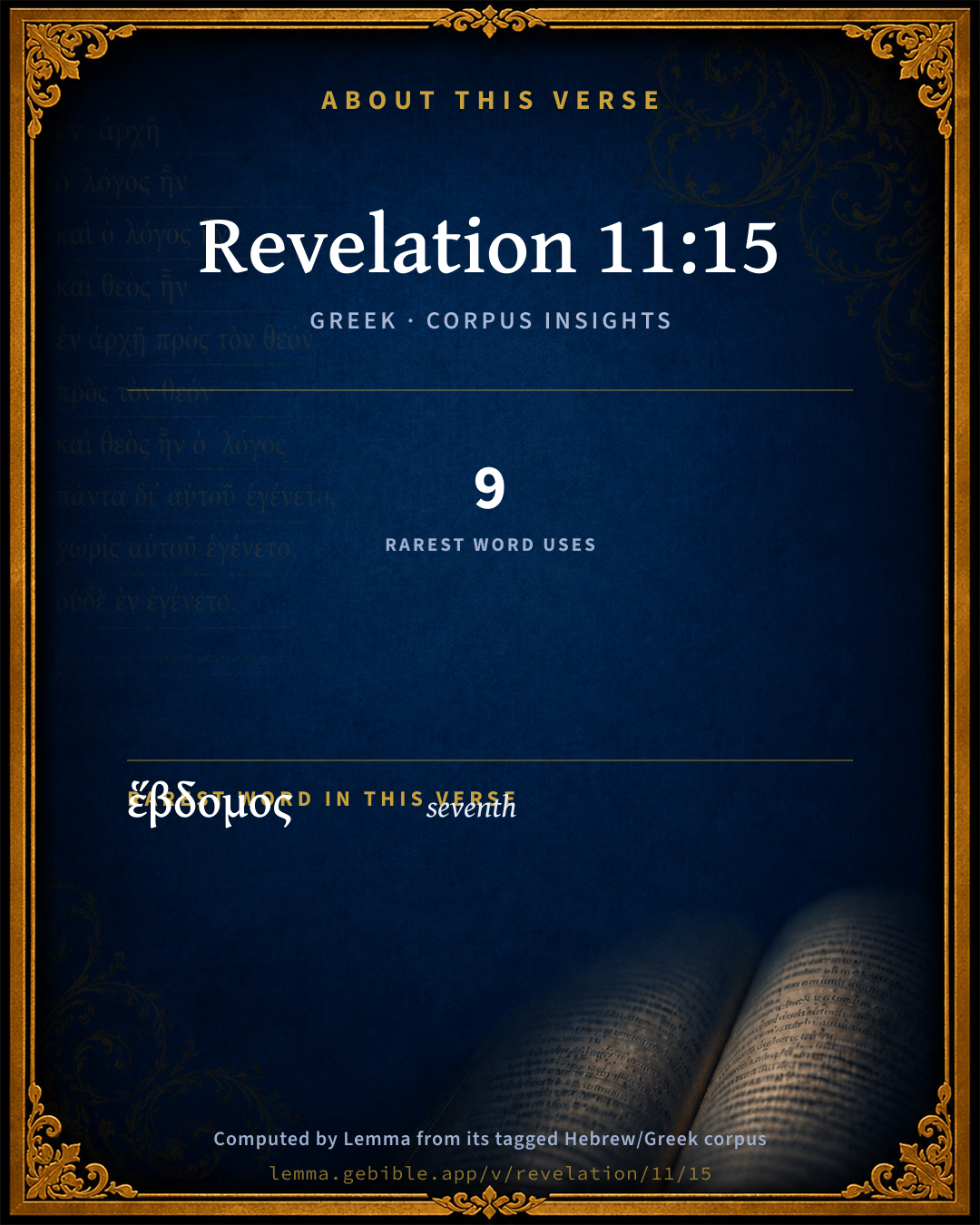
The rarest word here is ἕβδομος seventh G1442 — appearing just 9 times in the whole Greek New Testament.

Shared distinctive vocabulary

ἕβδομος seventh G1442 occurs in 8 verses of the Greek New Testament. Also found in:

Repetition

Words recur within this verse:

  • ἐγένοντο to become G1096 ×2
  • αἰῶνας age G165 ×2
  • ὁ the G3588 ×8
  • Καὶ and G2532 ×4

Cross-references

49

Topical passages linked to Revelation 11:15 in the Treasury of Scripture Knowledge — connected by theme and wording, ordered by reader-vote popularity; previews shown in the World English Bible.

  • Daniel 7:14 There was given him dominion, and glory, and a kingdom, that all the peoples, nations, and languages should serve him: his dominion is an everlasting dominion, which shall not pass away, and his kingdom that which shall not be destroyed.
  • Revelation 12:10 I heard a loud voice in heaven, saying, "Now is come the salvation, the power, and the Kingdom of our God, and the authority of his Christ; for the accuser of our brothers has been thrown down, who accuses them before our God day and night.
  • Daniel 7:27 The kingdom and the dominion, and the greatness of the kingdoms under the whole the sky, shall be given to the people of the saints of the Most High: his kingdom is an everlasting kingdom, and all dominions shall serve and obey him.
  • Revelation 10:7 but in the days of the voice of the seventh angel, when he is about to sound, then the mystery of God is finished, as he declared to his servants, the prophets.
  • Zechariah 14:9 Yahweh will be King over all the earth. In that day Yahweh will be one, and his name one.
  • Revelation 19:1 After these things I heard something like a loud voice of a great multitude in heaven, saying, "Hallelujah! Salvation, power, and glory belong to our God:
  • Luke 1:33 and he will reign over the house of Jacob forever. There will be no end to his Kingdom."
  • Exodus 15:18 Yahweh shall reign forever and ever."
  • Daniel 2:44–45 In the days of those kings shall the God of heaven set up a kingdom which shall never be destroyed, nor shall the sovereignty of it be left to another people; but it shall break in pieces and consume all these kingdoms, and it shall stand forever.
  • Daniel 7:18 But the saints of the Most High shall receive the kingdom, and possess the kingdom forever, even forever and ever.
  • Revelation 16:17 The seventh poured out his bowl into the air. A loud voice came forth out of the temple of heaven, from the throne, saying, "It is done!"
  • Psalms 86:9 All nations you have made will come and worship before you, Lord. They shall glorify your name.
  • Micah 4:7 And I will make that which was lame a remnant, And that which was cast far off a strong nation: And Yahweh will reign over them on Mount Zion from then on, even forever.
  • Hebrews 1:8 but of the Son he says, "Your throne, O God, is forever and ever; The scepter of uprightness is the scepter of your Kingdom.
  • Isaiah 9:7 Of the increase of his government and of peace there shall be no end, on the throne of David, and on his kingdom, to establish it, and to uphold it with justice and with righteousness from henceforth even forever. The zeal of Yahweh of Hosts will perform this.
  • Revelation 15:4 Who wouldn't fear you, Lord, And glorify your name? For you only are holy. For all the nations will come and worship before you. For your righteous acts have been revealed."
  • Zephaniah 3:9–10 For then I will purify the lips of the peoples, that they may all call on the name of Yahweh, to serve him shoulder to shoulder.
  • Psalms 2:2 The kings of the earth take a stand, And the rulers take counsel together, Against Yahweh, and against his anointed, saying,
  • Psalms 22:27–28 All the ends of the earth shall remember and turn to Yahweh. All the relatives of the nations shall worship before you.
  • Psalms 72:11 Yes, all kings shall fall down before him. All nations shall serve him.
  • Psalms 89:15–17 Blessed are the people who learn to acclaim you. They walk in the light of your presence, Yahweh.
  • Psalms 110:4 Yahweh has sworn, and will not change his mind: "You are a priest forever in the order of Melchizedek."
  • Psalms 146:10 Yahweh will reign forever; Your God, O Zion, to all generations. Praise Yah!
  • Isaiah 2:2–3 It shall happen in the latter days, that the mountain of Yahweh's house shall be established on the top of the mountains, And shall be raised above the hills; And all nations shall flow to it.
  • Isaiah 27:13 It shall happen in that day, that a great trumpet shall be blown; and they shall come who were ready to perish in the land of Assyria, and those who were outcasts in the land of Egypt; and they shall worship Yahweh in the holy mountain at Jerusalem.
  • Isaiah 49:22–23 Thus says the Lord Yahweh, Behold, I will lift up my hand to the nations, and set up my ensign to the peoples; and they shall bring your sons in their bosom, and your daughters shall be carried on their shoulders.
  • Isaiah 60:3–14 Nations shall come to your light, and kings to the brightness of your rising.
  • Ezekiel 37:25 They shall dwell in the land that I have given to Jacob my servant, in which your fathers lived; and they shall dwell therein, they, and their children, and their children's children, forever: and David my servant shall be their prince for ever.
  • Micah 4:1–2 But in the latter days, It will happen that the mountain of Yahweh's temple will be established on the top of the mountains, And it will be exalted above the hills; And peoples will stream to it.
  • Zechariah 2:11 Many nations shall join themselves to Yahweh in that day, and shall be my people; and I will dwell in the midst of you, and you shall know that Yahweh of Hosts has sent me to you.
  • Luke 15:10 Even so, I tell you, there is joy in the presence of the angels of God over one sinner repenting."
  • Revelation 8:2–6 I saw the seven angels who stand before God, and seven trumpets were given to them.
  • Revelation 19:6 I heard something like the voice of a great multitude, and like the voice of many waters, and like the voice of mighty thunders, saying, "Hallelujah! For the Lord our God, the Almighty, reigns!
  • Isaiah 44:23 Sing, you heavens, for Yahweh has done it; shout, you lower parts of the earth; break forth into singing, you mountains, O forest, and every tree therein: for Yahweh has redeemed Jacob, and will glorify himself in Israel.
  • Isaiah 49:6–7 yes, he says, It is too light a thing that you should be my servant to raise up the tribes of Jacob, and to restore the preserved of Israel: I will also give you for a light to the Gentiles, that you may be my salvation to the end of the earth.
  • Isaiah 55:5 Behold, you shall call a nation that you don't know; and a nation that didn't know you shall run to you, because of Yahweh your God, and for the Holy One of Israel; for he has glorified you.
  • Daniel 7:22 until the ancient of days came, and judgment was given to the saints of the Most High, and the time came that the saints possessed the kingdom.
  • Hosea 2:23 I will sow her to me in the earth; And I will have mercy on her who had not obtained mercy; And I will tell those who were not my people, 'You are my people;' And they will say, 'My God!'"
  • Amos 9:11–12 In that day I will raise up the tent of David who is fallen, and close up its breaches, and I will raise up its ruins, and I will build it as in the days of old;
  • Zechariah 8:20–23 Thus says Yahweh of Hosts: "Many peoples, and the inhabitants of many cities will yet come;
  • Matthew 6:13 Bring us not into temptation, but deliver us from the evil one. For yours is the Kingdom, the power, and the glory forever. Amen.'
  • Revelation 8:12 The fourth angel sounded, and one third of the sun was struck, and one third of the moon, and one third of the stars; so that one third of them would be darkened, and the day wouldn't shine for one third of it, and the night in the same way.
  • Revelation 9:1 The fifth angel sounded, and I saw a star from the sky which had fallen to the earth. The key to the pit of the abyss was given to him.
  • Revelation 9:13 The sixth angel sounded. I heard a voice from the horns of the golden altar which is before God,
  • Revelation 17:14 These will war against the Lamb, and the Lamb will overcome them, for he is Lord of lords, and King of kings. They also will overcome who are with him, called and chosen and faithful."
  • Revelation 20:4 I saw thrones, and they sat on them, and judgment was given to them. I saw the souls of those who had been beheaded for the testimony of Jesus, and for the word of God, and such as didn't worship the beast nor his image, and didn't receive the mark on their forehead and on their hand. They lived, and reigned with Christ for the thousand years.
  • Jeremiah 16:19 Yahweh, my strength, and my stronghold, and my refuge in the day of affliction, to you shall the nations come from the ends of the earth, and shall say, Our fathers have inherited nothing but lies, [even] vanity and things in which there is no profit.
  • Malachi 1:11 For from the rising of the sun even to the going down of the same, my name is great among the nations, and in every place incense will be offered to my name, and a pure offering: for my name is great among the nations," says Yahweh of Hosts.
  • Luke 15:6 When he comes home, he calls together his friends and his neighbors, saying to them, 'Rejoice with me, for I have found my sheep which was lost!'

Cross-references courtesy of OpenBible.info (CC BY 4.0).

Where the printed editions differ

2 variants

Places in this verse where the major printed Greek editions disagree on the wording in a way that affects the translation — a comparison of editions, not a manuscript-by-manuscript collation. The editions are the modern critical texts (Nestlé-Aland 28/27, SBL, Westcott-Hort, Tregelles, Tyndale House) and the traditional texts behind the KJV (the Textus Receptus and the Byzantine/Majority text). It is not a claim about which reading is original.

  1. Different wording
    ἐγένετο

    “Has become”

    In NA28NA27TynSBLWHTregByz Not in TR

    ἐγένοντο (egenonto) 'Have become' occurs in traditional manuscripts (TR) instead of ἐγένετο (egeneto) 'Has become' in older manuscripts (NA28+NA27+Tyn+SBL+WH+Treg+Byz)

  2. Different wording
    βασιλεία

    “kingdom”

    In NA28NA27TynSBLWHTregByz Not in TR

    βασιλεῖαι (basileiai) 'kingdoms' occurs in traditional manuscripts (TR) instead of βασιλεία (basileia) 'kingdom' in older manuscripts (NA28+NA27+Tyn+SBL+WH+Treg+Byz)

Textual data: Translators Amalgamated Greek New Testament (STEPBible TAGNT) · CC BY 4.0.

Commentary

Notes on Revelation 11:15 from classic Christian and Jewish commentators (each source and its license shown beneath its notes). The classic Christian expositions comment on the surrounding passage and are grouped to its opening verse, so a note may address several verses; the Jewish commentaries on the Tanakh (Rashi and others) are per-verse, so they appear only where the commentator wrote on this verse.

Lemma curates 59 commentaries, every one of them public domain or Creative Commons licensed, each selected and text-cleaned for this edition rather than reprinted as found. About our sources →

The Cambridge Bible for Schools and Colleges

gen. ed. J. J. S. Perowne

The Seventh Trumpet, Rev_11:15-19. Chap. Rev_12:7-12

15. great voices] Cf. Rev_16:17.

The kingdoms of this world &c.] Read, The kingdom of the world is become our Lord’s and His Christ’s. The phrase “His Christ” is founded on the O. T. phrase “the Lord’s Anointed;” cf. St Luk_2:26.

he shall reign] Who? Our Lord or His Christ? St John probably would have regarded the question as meaningless, though comparing Rev_11:1 (see note on “therein”) it is not likely that he used the sing, consciously to imply that Christ and His Father are One. It would be more to the point to compare “Christ the Lord” in St Luk_2:11 with “the Lord’s Christ” already quoted.

The Cambridge Bible for Schools and Colleges (gen. ed. J. J. S. Perowne; Cambridge University Press, 1878–1918) — public domain. Text from a community e-Sword module.

The Biblical Illustrator

Joseph S. Exell

Rev_11:15

The kingdoms of this world are become the kingdoms of our Lord and of His Christ.

Ave, Imperator

This text is generally quoted in a missionary connection, and associated with the conversion of the heathen. But it is of much wider scope than that. There are plenty of Christians that want converting, plenty of Churches that want Christianising. The progress of all life in our planet has been a progress from the animal upward to the intellectual, the moral, the spiritual; from mere brute force to the dominion of thought and reason. Ages back mere bigness of mass seemed to count for everything. The so-called antediluvian monsters were rampant. As life developed mere bigness became of less and less account, and brain became of more account. Those who can influence mind are the true monarchs of creation. This is the realm in which Christs supreme triumphs are to take place. Christ will fascinate and possess the mind of the world, and the mind will rule all the rest. Strong beliefs win strong men, and then make them stronger. The masculine but humane morality of Jesus Christ must more and more commend itself to the thinking and influential portion of society. Ideas and institutions which have been long prevalent go down before a superior idea. So shall it be with many world-ideas in presence of the truth of Christ. Many institutions have lived and done their work. They have served their day and generation, but now they have waxed old, and are ready to decay and vanish away in the presence of a nobler ideal. Still, we are not to disparage the old because the new has come. The present forms of animal life are far superior in development and attainment to those whose remains are found in the tertiary rocks. But the forms of to-day could not have existed without the forms that went before. Those very things which Christs law and spirit will supplant have been important factors in human progress. When the Apocalyptic dream of the New Jerusalem, the Christian state, the city of God, finally and triumphantly established upon earth, shall find complete fulfilment, it will be characterised by a fuller embodiment of the law of Christ in every sphere of human relationship and conduct. For instance, the kingdom of Art shall become the kingdom of our Lord and of His Christ. It has become so to a great extent. All the noblest paintings, all the grandest buildings in the world during the Christian era, have been the product of the Christian imagination. Certainly the sublimest music owns this inspiration. We need not fear the complete annexation of this kingdom, because the genius of the true Christianity is hopeful and happy. The kingdom of Literature would, in like manner, come under the dominance of Christian ideas. It is hard to say at present whether this tremendous engine for good or evil works most good or evil. What a blessed thing it will be when the domain of literature becomes the domain of Christ; when nothing will be written or read the tendency of which is not to the true elevation and edification of the human mind; when editors shall all be men of conscience, and the venal pen shall be as much an archaeological curiosity as the stone hatchet; when we shall be able to take up any book and feel that it will be safe for our children to read; when we can open even the latest novel from Paris with the confidence that none of our finer sensibilities will be shocked, and that an atmosphere will not be introduced into the home whose poisonous vapours we should shudder to think that our young people will breathe. The kingdom of Commerce, too, shall one day fall under the rule of Christ. That will be indeed a blessed day when men can trust one another, and when all shall be worthy of that trust; when another mans property shall be as sacred in our eyes as our own; when public funds shall be administered with the same scrupulous integrity with which our own are dispensed. The realm of Amusements, too, shall come under the same rule. The prophecy will find its fulfilment not in the expression of any particular forms of recreation, but in the Christianising of them all. And will it not be a grand day when the kingdom of Politics shall be sanctified by the Spirit of Christ? When debates shall be purged from the pettiness of personality and the rancour of recrimination; when offices shall be filled with the sole aim that the commonwealth shall receive the services of its most capable citizens; and when the statesmans ruling principle shall be not to catch votes, but to redress wrongs and establish righteousness. And then may we not hope that even the Church itself in that happy day shall come under the dominion of the law of Christ? No longer to be the collection of ecclesiastical antiquities, the museum of theological curiosities, the arena of strife and debate that it is to-day, but the abode of ideal men and women, the home of all the sweet and pure Christian virtues. Then Christians shall no longer bite and devour one another; giving the enemy occasion to blaspheme. Their energies shall be converted into light, and not into heat, and men will be willing to rejoice in that light. But how shall those great results, of which we have spoken in other spheres, be achieved unless the Church be first true to herself? It is through her that these beneficent impulses upon society must come. We must begin by being ideal Christians if the world is to become an ideal world. (J. Halsey.)

The glory awaiting the Church on earth

I. The probable condition of the world in the accomplishment of this prediction. It will be characterised by--

1. The universal dissemination of Christian knowledge.

2. The general prevalence of religious life.

3. The increase and glory of the Christian Church.

4. The diffusion of happiness throughout the world. Christianity is the parent of morality, industry, patriotism, public spirit.

II. The probable means by which this great event will be produced.

1. The preaching of the gospel.

2. The active zeal of Christians.

3. The operations of Divine providence.

4. The effusion of the Holy Spirit.

III. The duties which arise in anticipating this great consummation.

1. To seek the possession of personal religion.

2. To render all assistance to accelerate the advent of this glorious period.

3. To unite in prayer for the accomplishment of this prediction. (Homilist.)

The kingdom of God

We can imagine, I suppose, that when the Revelation of St. John the Divine was taken to the different Christian Churches, in the upper chambers where they were accustomed to meet together, or in the secret places where they gathered for fear of persecution, after they had read these glowing pages, they must have parted with new feelings of hope in their hearts. They would expect that a time would come speedily when the persecutions would be memories of the past, and the kingdom would be set up, of which they had been reading in such vivid colours. Yet the day passed by, and the Roman power remained, and the Temple, sacred to Diana at Ephesus, was as stable as ever. It happened then as it has happened to many a one since. So it must have been with many of those of the ancient Church, when, all eager and expectant, they found the vision was sealed for the time; they must go their way and tarry until the time should come when the promise would be fulfilled. We can scarcely be surprised at finding that they looked for a very literal fulfilment in the shape of a kingdom which should, by the exercise of power, bear down all opposition. They were told of a great king who went forth conquering and to conquer. The tradition of the old Jewish Church was of a people going forth as the Lords messengers to crush down all the Lords enemies. Again, the majority of Christian people, when they found that the promise could not be realised in that way, looked for something totally different. The promise seemed impossible of literal fulfilment. The kingdom of God became totally distinct from the kingdom of the world. It was something which could only be reached when this world was over. When persecution broke out, when the people were dragged to prison, men felt that the kingdom of God was not of this world, but of that which is to come. And so, little by little, people had that expectation for the realisation of this promise. Does the Christian Church of to-day have the same expectation? Is there any possibility of the realisation of this promise? I would suggest that the realisation is to come through our changed ideas about the kingdom of God; that the kingdom of God does not mean power victorious, but that it means love victorious; that the kingdom of God means what St. Paul does when he writes, Be not overcome of evil, but overcome evil with good. What I want to leave in your minds is the conviction that the crown of thorns is the crown of glory; that the Cross is the throne on which Christ is exalted. What do these two things mean--the crown of thorns and the cross of shame? They mean the extremest manifestation of infinite love. Christ has said that love is greater than hate; love is greater than infamy. And that is the only principle on which the kingdom of this world will become the kingdom of our Lord and of His Christ; and He shall reign for ever and ever. The Christian Church is slowly abandoning the idea of conquering by mere power. The Christian Church is slowly losing the idea of the kingdom of this world becoming the kingdom of our Lord and of His Christ in the persons of those who pass away beyond this world, and become the subjects of a kingdom which has nothing to do with this world. His kingdom shall come on this earth by the individual members copying the example of Jesus Christ, and believing in the revelation of that love which overcame sin; so that the people who live upon this earth shall be willing subjects of Divine love, and living in perfect love to their fellow-men. (Bp. Courtney.)

Missionary prospects

It is related of Hannibal that, when he had led his men to one of the higher ridges of the Alps, they began to murmur, and requested that they should be reconducted to their native country. Standing on an eminence and waving his hand, the intrepid Carthaginian General directed their attention to the plains of Piedmont below. Behold, said he, these fruitful vineyards and luxuriant fields. A few more struggles, and they are all your own. These were inspiring words, and they had the desired effect. May we not apply them to the subject of missions, and say, Behold, from the mount of promise, the nations of the earth at the feet of the Churchs exalted Head! A few more struggles on the part of His followers, and voices shall be heard, not in heaven only, but from the innumerable and widely scattered tongues of earth, giving utterance to the joyous announcement, The kingdoms of this world are become, etc.

The kingdom of heaven and its progress

You might as well stand on the banks of the Mississippi and be afraid it was going to run up stream as to suppose that the current of Christendom can run more than one way. What would you think of a man who should stand moonstruck over an eddy, and because that didnt go right forward, declare that the whole flood had got out of its course? So in the stream of time. The things that appear in our day all have bearing on the coming triumph of the gospel and the reign of the Kingdom of Heaven on earth. (H. W. Beecher.)

Jesus will conquer the world

Yonder in the cathedral at Vienna the Emperor Frederick is represented, standing with arm uplifted, and at the tip of his extended fingers are the five vowels, A, E, I, O, U, which, being interpreted, means, Austria est imperare obi universo--Austria will conquer the world. Another and a gander figure meets the gaze of every Christian of to-day, no matter where his standpoint, and the inscription thereon is in letters of fire: Jesus est imperare obi universo--Jesus will conquer the world. (C. W. Boot.)

The Biblical Illustrator, edited by Joseph S. Exell (c. 1880s–1900s) — public domain. Text from a community e-Sword module.

Joseph Benson's Commentary

Rev 11:15-18. And the seventh angel sounded, &c. — With the sounding of this angel, the third wo commences, which is rather implied than expressed, as it will be described more fully hereafter. The third wo brought on the inhabitants of the earth, is the ruin and downfall of the antichristian kingdom: and then, and not till then, according to the heavenly chorus, the kingdoms of this world will become the kingdoms of our Lord and of his Christ, and he shall reign for ever and ever — St. John is rapt and hurried away as it were to a view of the happy millennium, without considering the steps preceding and conducting to it. At the same time, the four and twenty elders — Or the ministers of the church, (Rev 11:16-18,)

are represented as praising and glorifying God, for manifesting his power and kingdom more than he had done before. They give likewise an intimation of some succeeding events, as the anger of the nations, Gog and Magog, (Rev 20:8,) and the wrath of God, displayed in their destruction, (Rev 20:9,) and the rewarding of all the good, small and great, as well as the punishing of the wicked. Here we have only a summary account of the circumstances and occurrences of the seventh trumpet, but the particulars will be dilated and enlarged upon hereafter. And thus are we arrived at the consummation of all things, through a series of prophecies, extending from the apostle’s days to the end of the world. It is this series which has been our clew to conduct us in our interpretation of these prophecies: and though some of them may be dark and obscure, considered in themselves, yet they receive light and illustration from others preceding and following. All together, they are, as it were, a chain of prophecies, whereof one link depends on and supports another. If any parts remain yet obscure and unsatisfactory, they may perhaps be cleared up by what the apostle himself hath added by way of explanation.

Joseph Benson's Commentary on the Old and New Testaments (1811–1818) — public domain. Text from a community e-Sword module.

Lange's Commentary on the Holy Scriptures

PART SECOND

THE END OF THE WORLD

[Rev_11:15 to Rev_22:5]

SECTION FIFTH

Developed Antichriatianity. The seven-headed Dragon and his Image [Erscheinungsbild]: the seven-headed Beast

Rev_11:15-18

A.—THE HEAVEN-PICTURE ABOVE THE ANTICHRISTIANITY ON EARTH; OR THE PRECURSORY TRIUMPH OVER THE DRAGON, AND HIS FALL FROM HEAVEN TO THE EARTH

Rev_11:15—Rev_12:12

a. Pre-celebration of the Victory

Rev_11:15-19

15And the seventh angel sounded [trumpeted]; and there were great voices in [ins. the] heaven, saying, The kingdoms [kingdom]25 of this [the] world are [is] become the kingdoms of [om. the kingdoms of] our Lord [Lord’s], and of [om. of] his Christ 16[Christ’s]; and he shall reign forever and ever [into the ages of the ages]. And the26 four and twenty [twenty-four] elders, which [who]2 sat [sit]27 before God on 17[upon] their seats [thrones], fell upon their faces, and worshipped God, Saying, We give thee thanks, O Lord God Almighty [or All-ruler28], which [who] art, and [ins. who] wast, and art to come [om., and art to come]29; because thou hast taken to thee [om. to thee] thy great power, and hast reigned. 18And the nations30 were angry [wroth], and thy wrath is come, and the time of the dead, that they should [om., that they should-ins. to] be judged, and that thou shouldest [om. that thou shouldest-ins. to] give [ins. the] reward unto thy servants the prophets, and to [om. to] the saints, and them that [those who] fear thy name, [ins. the] small and [ins. the great]31; and shouldest [om. shouldest-ins. to] destroy them which [those who] destroy the earth. 19And the temple of God [ins. which was in the heaven]32 was opened in heaven [om. in heaven], and there was seen in his temple the ark of his testament [covenant]: and there were lightnings, and voices, and thunderings [thunders], and an earthquake, and [ins. a] great hail.

Footnotes:

[25]Rev_11:15. The plural of the Rec. is based upon a misapprehension of the passage. [Modern Critical Editors read ἐγένετο ἡ βασιλεία with א. A. B*. C. P. Vulg., etc. The Rec. is supported by only 1, 7.—E. R. C.]

[26]Rev_11:16. [Lach. omits the οἱ in both instances, the former with א*. A., the latter with A. B*., etc.; Alf. brackets both; both are given by Treg. and Tisch., the former with cא. B*. C. P., the latter with א. C. P.—E. R. C.]

[27]Rev_11:16. [Gb., Treg., Tisch. (8th Ed.) give κάθηνται with א*et c.. B*. C., etc.; Lach., Tisch. (1859), Alf., καθήμενοι with A. P.—E. R. C.]

[28]Rev_11:17, [See Add. Comm. on Rev_1:8, p. 93.—E. R. C.]

[29]Rev_11:17. The third item is here om. by the best Codd. [Modern Crit. Eds. om. with א. A. B*. C. P., Am., Fuld., Harl., etc.—E. R. C.]

[30]Rev_11:18. [See Add. Comm. on Rev_11:2.—E. R. C.]

[31]Rev_11:18. On an erroneous accusative in Cod. A., and in some others, see Düsterdieck. [Lach., Alf., and Treg., with א*. A. C., read τοὺς μικροὺς καὶ τοὺς μεγάλους; Tisch., with אcc. B*. P., gives τοῖς μικροῖς, κ. τ. λ..—E. R. C.]

[32]Rev_11:19. The reading ὁ ἐν τῷ οὐρανῷ. Alf. om. ὁ with א. B.; Treg. and Tisch. give it with A. C. P., etc. Crit. Eds. generally give οὐρανῷ without the add. of ἄνω as in א*.—E. R. C.]

Lange's Commentary on the Holy Scriptures (Critical, Doctrinal, and Homiletical), ed. John Peter Lange, English translation edited by Philip Schaff (1864–1880) — public domain. Text from a community e-Sword module.

Tyndale Open Study Notes

Tyndale Open Resources

11:15-19 The seventh trumpet (“the third terror,” 11:14; see also 9:12) presents a scene of final judgment and the eternal Kingdom. As in 7:9-17, this scene provides a dramatic window into the ultimate Christian hope with God. In the midst of a picture of judgment, the reader is reminded of eternity with God.

11:15 Loud voices in the court of heaven sing a victory hymn; the earth has been transformed into the realm of our Lord and his Christ, who is enthroned as king forever.

Tyndale Open Study Notes — © Tyndale Open Resources, licensed CC BY-SA 4.0. Text via the HelloAO Bible API.

Bengel's Gnomon

Johann Albrecht Bengel

Rev 11:15. [114] Ὁ ἛΒΔΟΜΟς, the seventh) The principal trumpet is that of the seventh angel. This closely approached the very times of the apostles: but it was about to have a long continuance. The near approach of the events, which were about to follow in it, were often viewed by the apostles separately, and held forth by them to the view of the faithful: but in consequence of the length of the interval, scoffers denied the end itself, in which the course of the events was about to issue; while the faithful did not fully comprehend the long continuance of the interval. Each class furnished the apostles with a reason for explaining the mystery more fully: 2Pe 3:2; 2 Thessalonians 2.

[114] ἡ οὐαὶ ἡ τρίτη, the third woe) This is predicted finally, ch. Rev 12:12 : then ch. 13 and 14 it actually follows.—V. g.

Whether Gabriel is the angel here meant, we propose in the German Exegesis as a subject of consideration for the reader. And the very name גבריאל agrees; for אל is God, and גבר a man, strong. Therefore that name exhibits the sum of the message to Mary, Luk 1:31; Luk 1:35; and here of the commencement of the trumpet in heaven: for, ch. Rev 12:5, there is born υἱὸς ἄῤῥην; that is, אל גבור, Isa 9:5. I give no definition; I make no conjecture; I only inquire. But that which follows I affirm: This trumpet is the most important of all, which both of itself has here a most joyful meaning, and renders joyful all the trumpets of the former angels, but only to the inhabitants of heaven. Wherefore they are not to be heard, who here prefer to interpret sorrowful trumpets, used by the Jews in excommunication, rather than festive trumpets. The injury arising from the abuse of Jewish antiquities, in the explanation of the New Testament, and especially of the Apocalypse, is greater than the advantage arising from the use of the same. Truth is learned from the very clearness of the text, containing its own αὐτάρκειαν (self-dependent completeness); the abuse introduces errors. We see other examples on ch. Rev 13:18 (Annot. ii. § 2), and on ch. Rev 14:20, Rev 17:9, note 1. It would be better not to have recourse to the books of the Jews, if no better reward for the labour could be carried off from them.—ἐν τῷ οὐρανῷ, in heaven) This is strictly parallel with that passage of Dan 2:44, “IN the days of those kings (not, after they shall be destroyed), the God OF HEAVEN shall set up a kingdom.” He is called the God of heaven, as showing His majesty in heaven. Comp. altogether Rev 11:13, note. Afterwards the action descends to the earth. See shortly afterwards concerning the kingdom of the world.—λέγοντες) See App. Ed. ii. So ch. Rev 4:1. Many read, ἡ φωνὴ λέγων.[115] See also ch. Rev 5:12, and the remarks which we have made above on ch. Rev 9:13-14, and Wolf’s remarks on Rev 14:7, Rev 19:1. Dionysius of Alexandria thus expressed his opinion respecting the writer of the Apocalypse, not 200 years afterwards: ΔΙΆΛΕΚΤΟΝ ΜΈΝΤΟΙ ΚΑῚ ΓΛῶΣΣΑΝ ΟὐΚ ἈΚΡΙΒῶς ἙΛΛΗΝΊΖΟΥΣΑΝ ΑὐΤΟῦ ΒΛΈΠΩ, ἈΛΛʼ ἸΔΙΏΜΑΣΙ ΜῈΝ ΒΑΡΒΑΡΙΚΟῖς ΧΡΏΜΕΝΟΝ, ΚΑΊ ΠΟΥ ΚΑῚ ΣΟΛΟΙΚΊΖΟΝΤΑ. But, says Lightfoot, he forms this judgment concerning dialect and phraseology, who was acquainted with neither, and he censures as a fault that which chiefly commends this book. For John θεοδίδακτος (being taught of God), everywhere in his Apocalypse assumed the style of the Old Testament: while this man, who was ignorant of the Hebrew language, reckoned as a SOLECISM the whole of that, which was THE DIALECT OF GOD, and believed that that which he could not understand was barbarous.—Op. Posth. f. 145. But yet the readings of the Apocalypse (which present the appearance of a solecism), as Dionysius demonstrates, are ancient, are repeated, and have an analogy to one another: but those which follow the ordinary syntax have been introduced by copyists, many ages after Dionysius.—ἐγένετο ἡ βασιλεία τοῦ κόσμου, the kingdom of the world is become) This reading of an early age is much more glorious than that of the hasty copyist, ἐγένοντο αἱ βασιλεῖαι,[116] Κ.Τ.Λ. Blemishes of such a character, and of such importance, as I have noticed, ch. Rev 1:18, Rev 3:12, Rev 5:14, Rev 6:11, Rev 11:2; Rev 11:17, Rev 14:1, Rev 15:3, Rev 17:8; Rev 17:16, Rev 20:4, Rev 21:24, Rev 22:19, etc., remain in those editions, which are eagerly reprinted the revision which applies a remedy to them (I do not complain on my own account) lies neglected. See Pref. § viii. Admon. 20. We return to the passage. The kingdoms of the world give way to the kingdom of the world. Thus Obadiah, Oba 1:21, and the Psalms repeatedly. Vitringa indeed correctly says, The fulfilment of this oracle is in vain sought in the time of Constantine: Anacr. Ap. p. 512; but at the same time he thinks that this prophecy will be fulfilled after the destruction of the beast. In both points D. Lange assents to him. Here a true analysis of the text is especially necessary: moreover we have presented such a one above, in the Introduction to the Apoc. Number 6. Many separate the natural sequence of ch. 11 and those which follow; but it vindicates itself. See Erkl. Offenb. p. 71 and following, 552, 564, etc. The third woe, which is set forth in ch. Rev 12:12, and is described particularly in ch. 13, is long ago in course, of accomplishment: and from things present it is distinguished, what things are past under the trumpet of the seventh angel, and what are still future.—τοῦ Κυρίου[117]) See App. Crit. Ed. ii. Κυρίου is here used as a proper name (as Grotius and Le Buy admit), with which that which immediately follows, καὶ Χριστοῦ αὐτοῦ, best agrees: for the expression is, the Lord’s Christ, משיה יהוה, not the Christ of OUR Lord. And thus in the Apocalypse the inhabitants of heaven say, God, Lord, our God, the Lord our God; but never, our Lord. Athanasius, in his Synopsis on this passage, and Rupertus, in his Comm. p. 308, were of the same opinion, if they did not retain the same reading.—ΚΑῚ ΤΟῦ ΧΡΙΣΤΟῦ ΑὐΤΟῦ, and of His Christ, or Anointed) This is the first appellation of Christ in this prophetic Treatise, after the Introduction of the book, namely, in the mention of the Kingdom under the trumpet of the seventh angel. For Christ is called a King antonomastically,[118] as Hiller observes, Syntagm. p. 356. Comp. Brent’s Homily xlii. on Acts, and Explan. of Catech. p. 114 and following, and p. 23. Elisha the prophet was anointed, 1Ki 19:16; priests were anointed, Exo 28:41; but with especial propriety, Kings. Whence the title of Anointed, put absolutely, denotes nothing but a king. The usual expression is, the Lord’s anointed, not the anointed king: but [in the case of the priest] the only expression used is, the priest that is anointed, by way of epithet: Lev 4:5. Nay, the Anointed is even expressly distinguished from the priest, 1Sa 2:35; Psa 132:16-17. In the whole Evangelic history, the name, Christ, is never set forth under the title of priest; it very frequently is under the name of king. And moreover, as often as the Messiah is mentioned in the Scripture, there is a reference to his Kingdom. The priestly office and the prophetical also are both contained in the kingly (which by a metaphor is the meaning of Shepherd also: ch. Rev 12:5). See Heb 2:17, note. Among the Gentiles also, one man has often borne the kingly office in addition to the priestly, sometimes under the title of priest, sometimes under that of king.

[115] AB Vulg. read λέγοντες. Rec. Text, λέγουσαι, with C.—E.

[116] Ἐγένετο ἡ βασιλεια, ABCh Vulg. Ἐγένοντο αἱ βασιλεῖαι, Rec. Text, without good authority.—E.

[117] So AC Vulg.: but h, “Dei.” AC Vulg. and the best authorities read ἡμῶν, in opposition to Bengel.—E.

[118] See Appendix on Antonomasia.

Bengel's Gnomon of the New Testament — English translation (T&T Clark, Edinburgh, 1860) — public domain. Text from a community e-Sword module.

Meyer's Critical & Exegetical Commentary

Heinrich August Wilhelm Meyer

Rev_11:15. ἐγένοντο φωναὶ μεγ., κ.τ.λ. To whom these voices belonged, is neither to be asked nor to be answered. Ewald wants to ascribe them to the four beasts;[2961] De Wette, to the angels; Beng., to various dwellers in heaven, angels and men. Hengstenb. tries to show that the innumerable hosts, Rev_7:9 sq., are to be understood. This is incorrect, because the hosts which John there sees proleptically in heaven do not as yet correspond in Rev_11:15, with the progressive course of the visions, but are not actually in heaven until Rev_15:2 sqq.[2962] Also in Rev_11:15-19 Hengstenb. mistakes the proleptical reference correctly understood by C. a Lap., Beng., Ew., De Wette, etc., by regarding all the contents of the seventh trumpet (the third woe) exhausted already with Rev_11:19. Still more preposterously, Ebrard limits the seventh trumpet to Rev_11:15-18.[2963]

ἘΝ Τῷ ΟὐΡΑΝῷ, where John is not as yet,[2964] but whither the look of the seer is directed.[2965]

ΛΈΓΟΝΤΕς. Cf. Rev_4:8, Rev_5:13. Ἡ ΒΑΣΙΛΕΊΑ ΤΟῦ ΚΌΣΜΟΥ. The regal dominion over the world.[2966] Instead of the obj. gen., in Rev_17:18, ἘΠΊ follows. Cf. also Rev_1:6, Rev_12:10. The immediately following ΚΑῚ ΒΑΣΙΛΕΎΣΕΙ presupposes not only the active idea of Ἡ ΒΑΣΙΛΕΊΑ, but also this reading. Incorrectly, Luther, according to the var. supported by Ew. ii., ἘΓΈΝΟΝΤΟ ΑἹ ΒΑΣΙΛΕῖΑΙ: the kingdoms of this world.

The proleptical[2967] in the songs of the heavenly voices lies in this, that immediately after the sound of the trumpet, and yet before any thing else has actually occurred of what is afterwards celebrated with similar songs of praise,[2968] they say, ἘΓΈΝΕΤΟ Ἡ ΒΑΣ., Κ.Τ.Λ.[2969] In reality the dominion over the world does not become Gods and that of his Anointed until the wrathful judgment described, viz., until ch. 18, yea, in another respect until Rev_20:10, has actually dislodged from its assumed dominion all ungodly and antichristian power, which, by its rebellion[2970] against the only King and Lord, had usurped, to an extent, a part of his βασιλεία. The inner justification of the prolepsiswhich Hengstenb. acknowledges only at Rev_11:15-18 in the relation to Rev_11:19, where he finds the final judgmentlies in the fact that the seventh trumpet has already actually sounded; that one, therefore, from which the real fulfilment of the mystery of God will infallibly proceed.[2971] But even if only a special series of further visions leads to that final consummation, yet the prospective celebration of that glorious result, especially in the mouth of the dwellers in heaven, has, after the sounding of the seventh trumpet, its full justification and beautiful significance; the allusion, however, in connection with this, to redemption, as the proper root of the fact here celebrated,[2972] is entirely out of place.

τοῦ κυρίου ἡμῶν καὶ τοῦ χριστοῦ αὐτοῦ. Not only the expression,[2973] but also the idea, points back to Psa_2:2, for the Lords Anointed is the Son of God because of the βασιλεία, which is taken in general, indeed, from the nations,[2974] yet only for their destruction.

The ἡμῶν with τ. κυρίου does not give here a statement strange in itself concerning the co-regency of the saints,[2975] but corresponds, as also Rev_12:10, Rev_19:1, Rev_5:6, to the joy of those who now behold their Lord and God, whom they themselves serve, in his victorious dominion over the judged world.

κ. βασιλεύσει εἰς τοὺς αἰῶνας τ. αἰών. For, after his overthrow of all powers opposed to God, no new enemy could arise. The subj. to βασιλεύσει is ὁ κύριος ἡμῶν;[2976] but his Christ is manifestly understood as partner of this ΒΑΣΙΛΕΊΑ.[2977]

[2961] Rev_4:8.

[2962] Cf. Rev_19:1 sqq.

[2963] See on Rev_11:19.

[2964] Cf. Rev_10:1.

[2965] De Wette.

[2966] Beng., De Wette, Hengstenb., etc.

[2967] Also Klief.

[2968] Cf. Rev_19:1 sqq.

[2969] Cf. Rev_11:17 sq.: εἵληφας

ἐβασίλευσας

ἦλθεν.

[2970] Beng.

[2971] Beng., De Wette, etc.

[2972] Hengstenb.

[2973] Cf. Rev_12:10; Act_4:26.

[2974] Cf. Rev_11:18.

[2975] Hengstenb.

[2976] According to Rev_11:17 : κύριος ὁ θεὸς ὁ παντοκρ.

[2977] Beng., De Wette.

Rev_11:15-19. At the blast of the seventh trumpet, which[2960] will bring the glorious end, songs of praise resound in heaven which proclaim the fulfilment as having already occurred (Rev_11:15-18). At the opening of the heavenly temple of God, the ark of the covenant therein is visible, and lightnings, and other signs, indicating the judgments belonging to the actual fulfilment of the mystery of God, occur.

[2960] Cf. Rev_10:7.

Meyer — Critical and Exegetical Commentary on the New Testament — English translation by Peter Christie, edited by Frederick Crombie (T&T Clark, 1880) — public domain. Text from a community e-Sword module.

Expositor's Greek Testament

ed. W. Robertson Nicoll

Rev 11:15 . The rout of Satan (Rev 12:10 and Rev 20:4-10 ) means the absolute messianic ( ὁ Χ . only in these sections = “messiah” in the eschatological sense) authority of God, as the destruction or submission of paganism ( cf. Rev 11:13 ) means the true coming of the eschatological βασιλεία ( cf. Rev 19:1-6 , after Rome’s downfall). The apocalyptic motto is not so much “The Lord reigns,” as “The Lord is to reign”. Meanwhile he overrules, and every preliminary judgment shoots the pious mind forward to anticipate the final triumph. Linguistically τοῦ Χριστοῦ might mean here as in Hab 3:13 God’s chosen people, but the usage of the Apocalypse puts this out of the question. There is no need to delete the words here as a gloss (so, e.g. , Baljon, von Soden, Rauch) or the similar phrase in En. 48:10 (with Dalman).

The Expositor's Greek Testament, edited by W. Robertson Nicoll (1897–1910) — public domain. Text from a community e-Sword module.

Cambridge Greek Testament for Schools and Colleges

Rev 11:15-19. Rev 12:7-12. THE SEVENTH TRUMPET

15. ἐγένετο ἡ βασιλεία. Text. Rec[378] reads ἐγένοντο αἱ βασιλεῖαι with 1 and 7.

[378] Rec. Textus Receptus as printed by Scrivener.

τοῦ κὁσμου. And[379] Primas[380] and 28 omit.

[379] Andreas Archbishop of Caesarea.

[380] Primasius, edited by Haussleiter.

τοῦ κυρίου ἡμῶν καὶ τοῦ Χριστοῦ αὐτοῦ. Areth[381] after κόσμου goes on τοῦ κυρίου ἡμῶν Ἰησοῦ Χριστου. Primas[382] and Ambros. Dei nostri et Christi sui.

[381] Arethas, Archbishop of Caesarea.

[382] Primasius, edited by Haussleiter.

15. φωναὶ μεγάλαι. Cf. Rev 16:17.

ἐγένετο ἡ βασιλεία τοῦ κόσμου τοῦ κυρίου ἡμῶν καὶ τοῦ Χριστοῦ αὐτοῦ. The only possible translation of the text is “the kingdom of the world is become our Lord’s and His Christ’s”; but the position of ἐγένετο is strange. The phrase “His Christ” is founded on the O.T. phrase “the Lord’s Anointed,” cf. St Luk 2:28.

βασιλεύσει. Who? Our Lord or His Christ? St John probably would have regarded the question as meaningless, though comparing Rev 11:1 (see note on ἐν αὐτῷ) it is not likely that he used the sing. consciously to imply that Christ and His Father are One, which is implied Rev 20:6. It would be more to the point to compare “Christ the Lord” in St Luk 2:11 with “the Lord’s Christ” already quoted.

Cambridge Greek Testament for Schools and Colleges (Cambridge University Press, 1896; 21 vols, various authors incl. Carr, Maclear, Plummer, Farrar, Lumby, Moule, M. R. James, Simcox) — public domain. Text from a community e-Sword module.

Geneva Bible (1599)

Geneva Bible translators

The narration hath two parts: an acclamation of the heavenly creatures, in this verse, and both an adoration by all the Elders, verse 16, and also a most ample thanksgiving, verses 17, 18. The sense of the acclamation is, Now the Lord is entered on his kingdom, and hath restored his Church, in which most mightily recovered from the profanation of the Gentiles, he may glorify himself. Namely, that which the Lord ordained when first he ordained his Church, that the faith of the Saints doth now behold as accomplished.

Of whose sounding the trumpet Christ expressly foretold, Rev. 10:7, and this is the second part of this Chapter, containing a general history of the Christian Church, from the time of Boniface 8 unto the consummation of the victory declared by voice from heaven. In this history there are three branches: a preparation by the sound of the Angels trumpet: a narration by the voice of heavenly Angels and Elders: and a confirmation by sign.

Geneva Bible (1599) marginal notes — public domain. Text via Bolls.life.

Jamieson, Fausset & Brown

Robert Jamieson, A. R. Fausset & David Brown

sounded--with his trumpet. Evidently "the LAST trumpet." Six is close to seven, but does not reach it. The world judgments are complete in six, but by the fulfilment of seven the world kingdoms become Christ's. Six is the number of the world given over to judgment. It is half of twelve, the Church's number, as three and a half is half of seven, the divine number for completeness. BENGEL thinks the angel here to have been Gabriel, which name is compounded of El, GOD, and Geber, MIGHTY MAN (Rev 10:1). Gabriel therefore appropriately announced to Mary the advent of the mighty God-man: compare the account of the man-child's birth which follows (Rev 12:1-6), to which this forms the transition though the seventh trumpet in time is subsequent, being the consummation of the historical episode, the twelfth and thirteen chapters. The seventh trumpet, like the seventh seal and seventh vial, being the consummation, is accompanied differently from the preceding six: not the consequences which follow on earth, but those IN HEAVEN, are set before us, the great voices and thanksgiving of the twenty-four elders in heaven, as the half-hour's silence in heaven at the seventh seal, and the voice out of the temple in heaven, "It is done," at the seventh vial. This is parallel to Dan 2:44, "The God of heaven shall set up a kingdom, which shall never be destroyed: and the kingdom shall not be left to other people, but it shall break to pieces all these kingdoms, and it shall stand for ever." It is the setting up of Heaven's sovereignty over the earth visibly, which, when invisibly exercised, was rejected by the earthly rulers heretofore. The distinction of worldly and spiritual shall then cease. There will be no beast in opposition to the woman. Poetry, art, science, and social life will be at once worldly and Christian.

kingdoms--A, B, C, and Vulgate read the singular, "The kingdom (sovereignty) of (over) the world is our Lord's and His Christ's." There is no good authority for English Version reading. The kingdoms of the world give way to the kingdom of (over) the world exercised by Christ. The earth-kingdoms are many: His shall be one. The appellation "Christ," the Anointed, is here, where His kingdom is mentioned appropriately for the first time used in Revelation. For it is equivalent to KING. Though priests and prophets also were anointed, yet this term is peculiarly applied to Him as King, insomuch that "the Lord's anointed" is His title as KING, in places where He is distinguished from the priests. The glorified Son of man shall rule mankind by His transfigured Church in heaven, and by His people Israel on earth: Israel shall be the priestly mediator of blessings to the whole world, realizing them first.

he--not emphatic in the Greek.

shall reign for ever and ever--Greek, "unto the ages of the ages." Here begins the millennial reign, the consummation of "the mystery of God" (Rev 10:7).

Jamieson, Fausset & Brown — Commentary Critical and Explanatory on the Whole Bible (1871) — public domain (CC PDM 1.0). Text via the HelloAO Bible API.

Adam Clarke's Commentary

Verse 15. There were great voices in heaven] All the heavenly host-angels and redeemed human spirits, joined together to magnify God; that he had utterly discomfited his enemies and rendered his friends glorious. This will be truly the case when the kingdoms of this world become the kingdoms of God and of his Christ, But when shall this be? Some say, that is meant by these words has already taken place in the destruction of the Jewish state, and sending the Gospel throughout the Gentile world. Others say that it refers to the millennium, and to the consummation of all things.

Adam Clarke's Commentary on the Bible (1810–1826) — public domain. Text from a community e-Sword/MySword module.

Ellicott's Commentary for English Readers

THE SEVENTH TRUMPET—THE LAST WOE TRUMPET.

(15) And the seventh angel . . .—Better, And the seventh angel sounded; and there were great voices in the heaven (persons) saying, The kingdom of the world is become (the possession) of our Lord, and of His Christ, and He shall reign to the ages of ages. The literal translation is, The kingdom of the world is become our Lord’s, and of His Christ. As far as the expression “our Lord’s” is concerned, there is no need that any word, such as kingdom or possession, should be supplied, but the additional phrase “of His Christ” creates an awkwardness, and the word “possession,” or inheritance, may not inappropriately be used from the Psalm which foretells this final establishment of the kingdom of the anointed Messiah, the Christ of God. “Ask of me, and I shall give thee the heathen for thine inheritance, and the uttermost parts of the earth for thy possession” (Psa_2:8). It is the kingdom—not, as in the English version, “the kingdoms”—of the world which has become Christ’s possession. The contest is not for the kingdoms, the separate nationalities: the varying political systems might exist, as far as mere organisation is concerned, under the rule of Christ; the contest is for the kingdom of the world. Satan was willing to surrender the kingdoms of the world to our Lord on condition of a homage which would have left him still in possession of the kingdom of the world. But now the close of the contest is the overthrow of the kingdom of evil, the establishment of the kingdom of good: that is, of God; and He shall reign for ever and ever. Dean Alford pointed out that our familiarity with the “Hallelujah Chorus” tempted us to put an emphasis on the word He which is not sanctioned by the Greek; it is the reign of the Lord which is the prominent thought. The reign is unto the ages of ages. Surely this means always. We are not told whose voices sing this chorus; it is just the tumultuous sound of heavenly voices, growing into natural and irresistible chorus as the trumpet heralds the approach of the glorious end.

A Bible Commentary for English Readers, edited by Charles John Ellicott (1878–1897) — public domain. Text from a community e-Sword module.

John Gill's Exposition

And the seventh angel sounded,.... The last of the seven angels, who had trumpets given them to sound, Rev 8:2. The days of the voice of this angel, as in Rev 10:7, cannot refer to the times of Constantine; for though there was then a strange turn of affairs in favour of the kingdom of Christ, when there was a great spread of the Gospel, and large conversions in many places, and many churches were raised and formed in several countries, and the whole empire became Christian; yet this, as we have seen, came to pass under the sixth seal, before any of the trumpets were sounded, and much less this seventh and last; nor do they belong to the times of the Reformation in Germany. Brightman fixes the sounding of this trumpet to the year 1558, when the kings of Sweden and Denmark set up the Gospel in their kingdoms, and reformed them from Popery; and when Queen Elizabeth came to the throne of England, and rooted out great part of the Romish superstition: but it is certain that this angel has not yet sounded his trumpet, and therefore cannot refer to anything past, but to what is to come; we are yet under the sixth trumpet; the outward court is not yet given to the Gentiles; the witnesses are not slain, and much less risen and ascended; the earthquake, the fall of the tenth part of the city, and the slaughter of seven thousand names of men, with what will follow thereon, are things yet to come; the Turkish woe is not over, and antichrist still reigns, and the kingdoms of this world are far from appearing to be the kingdoms of Christ. Some think, and indeed the generality of interpreters, that this respects the voice of the archangel, and trump of God, the last trump, which will sound at the resurrection of the dead, and the day of judgment; but none of these appear in the account of things under this trumpet; but rather the whole has a view to the spiritual reign of Christ, when both the eastern and western antichrist will be destroyed; the Gospel will be carried all over the world, and there will be large conversions both among Jews and Gentiles, and Christ will reign in a spiritual manner over all the earth. Hence it follows,

and there were great voices in heaven; these are either the voices of the angels in heaven, who rejoice at every appearance, and breaking forth of Christ's kingdom and glory, as in Rev 5:11; and indeed, if they rejoice at the conversion of one sinner, at a single addition to Christ's interest, then much more will they, when the kingdoms of this world become his; or rather these may be the voices of the multitude of the saints in the churches, the same company with those in Rev 19:1; who express their joy at the judgment of the great whore, and at the marriage of the Lamb; and who, as here, are attended with the thanksgivings and hallelujahs of the four and twenty elders: and it may be, that these are also the voices of the four living creatures, the ministers of the word, since the four and twenty elders generally follow them, Rev 4:9; they may be the witnesses, who were silenced, but are now raised up, and are ascended into heaven, and their mouths are opened, and their voices heard again:

saying, the kingdoms of this world are become the kingdoms of our Lord, and of his Christ; by "the kingdoms of this world" are meant worldly kingdoms, which are set up by worldly power, and are supported by worldly policy, and subsist upon worldly principles and maxims; the government of which proceeds upon worldly ends and views; in distinction from the kingdom of Christ, which is not of this world, and is not supported by any such methods; and they are the kingdoms, into which the world is divided, which, and the glory of them, Satan showed to Christ, and insolently offered to give him them, if he would worship him; but these were to come to Christ in another way, and at another time. The Alexandrian copy, and some others, the Complutensian edition, the Vulgate Latin version, and all the Oriental versions, read in the singular number, "the kingdom of this world"; the whole government of it, which is his by right of nature, and will be overturned, and overturned again and again, till he comes, whose right it is; and then all power, rule, and authority, will be put down, and his kingdom, which will tilt the face of the whole earth, will take place: all the antichristian states and kingdoms are here intended, particularly the kingdoms into which the Roman empire, sometimes called the whole world, Luk 2:1, is divided, which are ten; one of the ten, a tenth part of the city or jurisdiction of Rome, will fall at the close of the sixth trumpet, and the other nine, or the other nine parts, will fall at the sounding of the seventh; the ten kings, that have given their kingdoms to the beast, will have an aversion to the whore, hate her, and burn her flesh, will fall off from her, and into the hands of Christ; there will be a general and thorough reformation from Popery in all the kingdoms of the Roman empire: but though these are greatly intended, yet not only they, but the Mahometan nations also, as the Turkish woe will now be over, and the great river Euphrates dried up, to make way for the kings of the east, those large kingdoms and countries of China, Tartary, and Persia; and these now under the power of the Turk will embrace the Christian faith; and also all the Pagan nations are to be taken into the account, and who will now enjoy the light of the Gospel: and all, and everyone those Pagan, Papal, and Mahometan kingdoms, will "become the kingdoms of our Lord, and of his Christ"; by "our Lord" may be designed God the Father, who is the Lord of the whole earth, the Lord God Almighty, and is acknowledged as such by angels and men; and by "his Christ", his Son Jesus Christ, who is equal with him; and what belongs to the one belongs to the other; and who, as Mediator, is his anointed One; anointed to be prophet, priest, and King; anointed with the oil of gladness, the Holy Ghost; see Psa 2:2, where the same distinction is. In the Targum on Isa 4:2 mention is made of , "the Messiah"; or "Christ of Jehovah": and in the same Targum on Isa 53:10, it is said, "they shall look" , "upon the kingdom of their Messiah"; though it may be rather that Christ is designed by both these phrases, and the words be rendered, "our Lord, even his Christ"; since the phrase, "our Lord", as well as Christ, is generally understood of Jesus Christ in the New Testament; and who is Lord of all, of angels, and of men, and the Christ of God. Now these kingdoms will become his, not merely by right, for so they are his already, by right of nature, and creation, and preservation; but these have shaken off his government, and have refused to have him to reign over them, and have fallen into the hands of usurpers, as Satan, the god of this world, the Romish antichrist, that reigns over the kings of the earth, and Mahomet the king of the locusts; but now these will, in fact, come into his hands, and be under his government; they will acknowledge him as their Lord and Sovereign, and fear and worship him, as King of saints: and this will be brought about, not by force of arms, as Mahomet got his dominions; nor by policy and fraud, by imposture and lying wonders, by which the pope of Rome has obtained his authority over the nations; but partly by the pouring out of the vials of God's wrath upon the seat of the beast, and upon the river Euphrates, that is, both upon the pope and Turk, which will weaken and destroy their power and authority, and make way for Christ to set up his kingdom; and partly, and chiefly, by the preaching of the Gospel: now will an open door be set, which none can shut; many will run to and fro, and knowledge will be increased; the earth will be covered with it, as the sea with waters; multitudes of souls everywhere will be converted; a nation will be born at once; churches will be set up in every place, which are Christ's kingdom, where he reigns, and where his subjects are, and his laws are put in execution; where his word will be now faithfully preached, his ordinances purely administered, and he, in his person, office, and grace, will be alone exalted: the consequence of which will be,

and he shall reign for ever and ever; no usurper will ever start up more, or obtain, neither Satan, nor the beast, nor the false prophet, shall ever regain their power and authority any more; neither Paganism, nor Judaism, nor antichristianism, either Papal or Mahometan, shall ever have place more: Christ will reign in this spiritual way, more or less, until he comes personally, and then he will reign with his people on earth a thousand years; and when they are ended, he will reign with them in heaven to all eternity; for though, at the end of these years, he shall deliver up the kingdom to the Father, yet he will not cease to reign; indeed he will not reign in the same manner, but he will reign with equal power and authority, and over, and with the same persons. The Vulgate Latin version adds, "Amen".

John Gill's Exposition of the Whole Bible (1746–1763) — public domain (CC PDM 1.0). Text via the HelloAO Bible API.

Trapp's Complete Commentary

John Trapp

15 And the seventh angel sounded; and there were great voices in heaven, saying, The kingdoms of this world are become the kingdoms of our Lord, and of his Christ; and he shall reign for ever and ever.

Ver. 15. Great voices in heaven] i.e. Great joy and triumph in the Church militant.

Are become the kingdoms] They have renounced Popery, given up their names to the gospel, and received the Reformation.

For ever and ever] Not for a thousand years only, as the millenaries hold.

John Trapp, A Commentary or Exposition upon All the Books of the Old and New Testament (1647–1656) — public domain. Text from a community e-Sword module.

Albert Barnes' Notes on the Bible

And the seventh angel sounded - See the notes on Rev 8:2, Rev 8:6-7. This is the last of the trumpets, implying, of course, that under this the series of visions was to end, and that this was to introduce the state of things under which the affairs of the world were to be wound up. The place which this occupies in the order of time, is when the events pertaining to the colossal Roman power - the fourth kingdom of Daniel Dan. 2–7 - should have been completed, and when the reign of the saints Dan 7:9-14, Dan 7:27-28 should have been introduced. This, both in Daniel and in John, is to occur when the mighty power of the papacy shall have been overthrown at the termination of the twelve hundred and sixty years of its duration. See the notes on Dan 7:25. In both Daniel and John the termination of that persecuting power is the commencement of the reign of the saints; the downfall of the papacy, the introduction of the kingdom of God, and its establishment on the earth.

And there were great voices in heaven - As of exultation and praise. The grand consummation had come, the period so long anticipated and desired when God should reign on the earth had arrived, and this lays the foundation for joy and thanksgiving in heaven.

The kingdoms of this world - The modern editions of the New Testament (see Tittmann and Hahn) read this in the singular number - “The kingdom of this world has become,” etc. According to this reading, the meaning would be, either that the sole reign over this world had become that of the Lord Jesus; or, more probably, that the dominion over the earth had been regarded as one in the sense that Satan had reigned over it, but had now become the kingdom of God; that is, that “the kingdoms of this world are many considered in themselves; but in reference to the sway of Satan, there is only one kingdom ruled over by the ‘god of this world’” (Prof. Stuart). The sense is not materially different whichever reading is adopted; though the authority is in favor of the latter (Wetstein). According to the common reading, the sense is, that all the kingdoms of the earth, being many in themselves, had been now brought under the one scepter of Christ; according to the other, the whole world was regarded as in fact one kingdom - that of Satan - and the scepter had now passed from his hands into those of the Saviour.

The kingdoms of our Lord - Or, the kingdom of our Lord, according to the reading adopted in the previous part of the verse. The word “Lord” here evidently has reference to God as such - represented as the original source of authority, and as giving the kingdom to his Son. See the notes on Dan 7:13-14; compare Psa 2:8. The word “Lord” - Κυριος Kurios - implies the notion of possessor, owner, sovereign, supreme ruler - and is thus properly given to God. See Mat 1:22; Mat 5:33; Mar 5:19; Luk 1:6, Luk 1:28; Act 7:33; Heb 8:2, Heb 8:10; Jam 4:15, al. saepe.

And of his Christ - Of his anointed; of him who is set apart as the Messiah, and consecrated to this high office. See the notes on Mat 1:1. He is called “his Christ,” because he is set apart by him, or appointed by him to perform the work appropriate to that office on earth. Such language as what occurs here is often employed, in which God and Christ are spoken of as, in some respects, distinct - as sustaining different offices, and performing different works. The essential meaning here is, that the kingdom of this world had now become the kingdom of God under Christ; that is, that that kingdom is administered by the Son of God.

And he shall reign forever and ever - A kingdom is commenced which shall never terminate. It is not said that this would be on the earth; but the essential idea is, that the scepter of the world had now, after so long a time, come into his hands never more to pass away. The fuller characteristics of this reign are stated in a subsequent part of this book Rev. 20–22. What is here stated is in accordance with all the predictions in the Bible. A time is to come when, in the proper sense of the term, God is to reign on the earth; when his kingdom is to be universal; when his laws shall be everywhere recognized as binding; when all idolatry shall come to an end; and when the understandings and the hearts of people everywhere shall bow to his authority. Compare Psa 2:8; Isa 9:7; Isa 11:9; Isa 45:22; 60; Dan 2:35, Dan 2:44-45; Dan 7:13-14, Dan 7:27-28; Zec 14:9; Mal 1:11; Luk 1:33. On this whole subject, see the very ample illustrations and proofs in the notes on Dan 2:44-45; Dan 7:13-14, Dan 7:27-28; compare the notes on Rev. 20–22.

Albert Barnes' Notes on the Bible (1834–1885) — public domain. Text from a community e-Sword/MySword module.

Haydock's Catholic Bible Commentary

The seventh Angel, &c. The saints and blessed spirits and heaven are represented praising God with loud voices, at the approaching of the kingdom of God; some understand at the end and consummation of the wicked world, after the destruction of antichrist, when the blessed shall reign in heaven: but others expound this of the triumph of the Christian faith and Church, when the providence of God putting an end to the persecutions against the Christian religion, by the miserable end of Dioclesian, Maximian, Maxentius, &c., made the kingdom of this world (the powerful Roman empire) become the kingdom of our Lord, by his raising Constantine the great to the empire, and under him making the faith of Christ triumph over all its persecutors and adversaries. (Witham)

George Leo Haydock (1774–1849), Haydock's Catholic Family Bible and Commentary, 1859 edition — public domain. Excludes Psalms (Douay-Rheims chapter numbering differs from Protestant) and Deuterocanonical books (Catholic canon only).

Matthew Poole's English Annotations

And the seventh angel sounded; the last of those angels mentioned Rev 8:2.

And there were great voices in heaven, saying; St. John in his vision heard great acclamations and shoutings for the victory which Christ and his gospel had got over the beast.

The kingdoms of this world are become the kingdoms of our Lord, and of his Christ; and he shall reign for ever and ever; so that a great part of the world, casting off the papacy, that new Gentilism, together with all their abominable idolatries and superstitions, embraced the truth of the gospel. Here ariseth a great question, whether the seven vials, of which we shall find the 16th chapter treating, {Rev 16:1-21} do belong all to the seventh trumpet, or some of them belong to the sixth trumpet, of which mention hath been before made. Great divines are on both sides as to this question. Mr. Pool, in his Latin Synopsis, hath collected together their reasons, of which I shall give a short account, leaving my reader for a fuller satisfaction to the Latin Synopsis.

Those who think that the seven vials do all relate to the seventh trumpet, and contemporize with it, in defence of their opinion say:

1. That the seven seals, and the seven trumpets, and the seven vials, are all mentioned in the same form of speech; and therefore the seven vials are not to be divided, some to one trumpet, some to another.

2. Because the seventh trumpet and the seven vials are one and the same thing, nothing being revealed under the seven vials which doth not belong to the seventh trumpet; they agree in their titles of woes, in the nature of the revelations, in their objects, both the one and the other declaring the ruin of antichrist; both of them are mentioned as the last plagues to come upon the world before the last day.

3. All the vials are of the same nature, declaring but the judgments by which God, setting up the kingdom of Christ, would ruin antichrist; they only differ in the degrees of the plagues, each one rising higher than the other.

4. The seventh trumpet cannot declare the ruin of antichrist, unless the seven vials be poured out under it, for they show the means by which he must be destroyed.

5. The seventh trumpet soundeth immediately upon the slaying of the witnesses, and contemporizeth with the whole course of their renewed liberty, and therefore the period signified by it must be before the fall of antichrist, declared by the sixth vial.

6. The seventh trumpet soundeth immediately after the expiration of the twelve hundred and sixty days; before the end of which none of the vials were poured out.

Those who think that divers of the vials were poured out, or shall be poured out, before the sounding of this seventh trumpet, say, that the beast’s kingdom beginning to fall under the sixth trumpet, several of the vials, declaring the degrees of his falling, must belong to that. It appeareth by all we have in this chapter Rev 11:7-15, that antichrist’s kingdom was in a great measure weakened under the sixth trumpet, particularly from Rev 11:11-13. To which those who think that all the vials related to the seventh trumpet say, that they grant that there were some preparations to the final ruin of antichrist, during the period of the sixth trumpet, but the seven vials signify the further progress and perfection of his ruin, which falls under the period signified by the seventh trumpet. This being premised, I proceed with the text.

It is doubted here whether those words, are become the kingdoms of our Lord, and of his Christ, be to be understood as being actually so, or now beginning to be so. Those who make the sense that they now actually were so, must understand the time to be the day of judgment, or some time next to it, and consequently must think that five at least of the seven vials, mentioned Rev 16:1-21, belonged to the sixth trumpet. Those who make the sense, are beginning to become the kingdoms of the Lord, or shall shortly be so, may make all the seven vials to belong to the seventh trumpet. By becoming the kingdoms of the Lord Christ, he means in outward profession; so as antichrist shall reign no more, but they shall be ruled by the officers of the Lord Christ, until they be taken up to reign with him in glory.

Matthew Poole's English Annotations on the Holy Bible (1683–1685) — public domain. Text from a community e-Sword/MySword module.

Whedon's Commentary on the Bible

Daniel D. Whedon

15. Great voices in heaven—Alford suggests that these voices were from the four living beings as distinguished from the twenty-four elders.” But that destroys the mysterious beauty of the apostle’s thought, which is, that the voices rolled and reverberated spontaneously through the heavens with no apparent utterer. They were as if the celestial spaces spake them.

Kingdoms—The preferable reading seems to be kingdom, in the singular, of course including the italic repetition of the word inserted by the translators. The world’s kingdom, no longer the devil’s kingdom, has become God’s and his Christ’s kingdom.

Throughout this lofty prelude, the consummation of the entire events of the seventh trumpet is announced as already completed. The utterers take their mental stand-point at the end of the whole history, and contemplate its future completion as already past. This is the prophetic future-preterite; the past tense for the future.

The sounding of the trumpet is of course the signal for the panorama of symbols to move on. The announcement of the heavenly voices utters in one sentence the glorious result of the whole movement, and is the signal for the profound worship and thanksgiving of the elders which follow.

Daniel D. Whedon (gen. ed.), Commentary on the Old and New Testaments (1874–1909) — public domain. Text from a community e-Sword module.

The Pulpit Commentary

And the seventh angel sounded; and there were great voices in heaven, saying. The participle "saying" is masculine, legontev , in A, B; the feminine, legousai , is read in a, C, P. Though the latter would be more correct, grammatically, yet irregular construction in such cases is not uncommon in the Apocalypse. The voices were possibly those of the angels rejoicing in the triumph of the kingdom of God. Or perhaps they proceeded from the four living beings, since the elders are next mentioned (ver. 17) as offering the praises of the redeemed Church which they represent. At the opening of the seventh seal there was silence in heaven; here, at the sound of the seventh angel"s trumpet, voices are heard "in heaven," but there is silence as to the fate of the wicked, with whom the trumpet visions have been chiefly concerned. In the revelation of the fate in store for the Church, as well as in that of the doom awarded to the ungodly, the visions stop short of describing circumstances connected with the life after the judgment day. The kingdoms of this world are become the kingdoms of our Lord, and of his Christ; and he shall reign forever and ever . Egeneto h basilaia , in the singular, is found in a, A, B, C, P, and versions, and is adopted by the Revised Version. Egenonto ai basileiai , the plural, is read in two cursives. We can understand the first part of this verse by referring to Rev_12:10. God"s power and authority is established by the final overthrow of Satan. It naturally follows the account, in vers. 12, 13, of the vindication of God"s witnesses, and of the glory rendered by the rest of mankind. With God the Father is associated Christ, by whose means the overthrow of the devil is effected, and by whom his servants overcome. (cf. Rev_1:6 Rev_5:9 Rev_7:14 Rev_12:11) This is the final victory; henceforth "he shall reign forever and ever.

Vers. 15-18. The seventh trumpet and the song which is to follow.

Although we have found manifold reasons why we cannot fix dates in interpreting the Apocalypse, we find equally manifest reasons for doing that which is of far more importance even for indicating the principles which it discloses. The previous section taught us that the extent and limit of the Church of God are perfectly measured; that God will preserve for himself a succession of witnesses during the mysterious and protracted period of the Church"s witness bearing; that at some time or other there would be such an onrush of evil as if a beast were let loose from the deep abyss; that, for a while, the witnesses would be silenced; but that God would interpose, and cause providence to work where prophecy had failed, until the last obstruction to the final triumph of the Church should be taken out of the way. Then the seventh trumpet shall sound; under that seventh trumpet the end should come; and following on the end there shall be heard heaven"s triumphant song. We therefore regard the words from the fifteenth to the eighteenth verses inclusive as overleaping the rest of the book; as, in fact, retrospective, giving us a hint of the sublime satisfaction which all holy souls will feel, in the review of God"s dealings, when all those events are accomplished which the remaining chapters are about to specify. Here we propose to indicate these only in briefest outline, as the several details will be hereafter dealt with one by one.

I HOWEVER GLOOMY AND PROTRACTED THE PERIOD MAY BE THROUGH WHICH GOD"S WITNESSES MAY HAVE TO PROPHESY, LIGHT WILL BREAK AT LAST. From Rev_6:9, Rev_6:10, and Rev_8:3, Rev_8:4, we see that a great burden of prayer has been for long, long years spread out before God, the cry of which is, "Thy kingdom come." In the verses before us we catch a glimpse of the time when this prayer shall have been fulfilled, and when the fulfilment will call forth a shout of praise (vers. 15-18). And in the words of this song, which is sent up in praise to God on account of the conflict being at an end, we get an indication of what had happened ere the strife ceased, as they look upon the struggle from its further side; cf. ver. 18, "The nations were angry the spirit of revolt against God rose to its height thy wrath came;" i.e. its manifestation. In the kingdoms of olden time, when the cup of iniquity was full, the judgments of God came and swept them away. So it will be again. We nowhere get any warrant from Scripture for supposing that God will govern in a future age on any different principles from those on which he has governed in the past, or on which he governs now. But those principles will be manifested more dearly than they have been. "And the time of the dead, that they should be judged." This is spoken of as belonging to a bygone time. So that the passage brings us, by anticipation, to the other side of the judgment of the dead, actually past the dread scene in Rev_20:11-13. "And to give their reward to thy servants the prophets those who bore faithful testimony for God for the twelve hundred and sixty years, dad in sackcloth to the saints to the holy ones who were in covenant relation to God by sacrifice them that fear thy Name," "in every nation under heaven", (cf. Act_10:35) "both small and great." All life"s "poor distinctions" will vanish most utterly away in the light of the great white throne. "And to destroy them that destroy the earth." Those who destroy the earth by corrupting it with their sin, God will destroy by desolating with his judgments. This expression again overleaps the scenes of Rev_12:2, and includes all those wild and weird forms of ill which are referred to in the remaining eleven chapters of this book. These are:

(1) The dragon. (Rev_12:3, Rev_12:9)

(2) The first beast. (Rev_13:1)

(3) The second beast. (Rev_13:11)

(4) Three unclean spirits. (Rev_16:13)

(5) Babylon the Great. (Re 17)

(6) The ungodly. (Rev_20:12-15)

(7) Death and Hades. (Rev_20:14) (See the homilies under these several passages)

When the decisive judgment on all these is over, then does Jehovah take to himself his great power, and reign. And then the four and twenty elders, seated on their thrones, as if associated with their Lord in regal state, and sharers in his triumphs, rejoice over the grand issue, when every enemy is still as a stone.

II THE PARAGRAPH BEFORE US INDICATES NOT ONLY WHAT THE ISSUE WILL BE, BUT ALSO THE MAIN EVENTS WHICH WILL PRECEDE IT. (Ver. 18) (These will be found to be dealt with in the homilies on the passages indicated above. The order of those events will be found to be indicated in the homily on Rev_22:20) These verses are, in fact, as stated above, an anticipatory summary of the whole.

III WHEN THE RIGHTEOUS SEE THE ISSUE OF THE GREAT CONFLICT, THEY WILL BE FILLED WITH JOY, AND WILL GIVE VENT THERETO IN ADORING PRAISE. The results of the resurrection, of the judgment, and of the sentence, will perfectly satisfy all righteous souls (ver. 7). Let us note here that only righteous souls will be satisfied. No unrighteous man ever will be satisfied with what God does. Such will be speechless, because they know that God does only what is right, and the fact that a righteous administration condemns them can never bring them rest. So that it is not the fault of the administration if it brings torment to the ungodly, but of the ungodliness. But as for the righteous, even here they gave thanks at the remembrance of God"s holiness; how much more will they do this when it "... shall break thro" every cloud That veils and darkens his designs"!

Then, with the clearer vision with which they will be endowed in their glorified natures, with the views of the manifold wisdom of God which the unfoldings of providence shall yield, with the glory of the Son of God unveiled before them without a cloud, when redemption"s work is completed, when all the chosen are gathered, when the righteousness and love of God are perfectly vindicated, when all the ransomed ones are found as an unbroken unity at the feet of him who died for them, then will the hallelujahs of the glorified rise up in holy song! All conflicts will be past, believers will be ushered into that rest which remaineth, and the "joy of their Lord" will be complete.

In conclusion:

1. Let us not be astonished at any violent outbreaks of evil which may perplex and bewilder many. The Holy Ghost hath said, "perilous times shall come.

2. Let us not judge of the progress of the work of God by the aspect of the world at any one moment. As reasonably might one think, when he watched the ebbing tide, that the sea was disappearing!

3. Let us not forget, that however dark the avenues through which the Church of God may have to pass, yet this book has sketched them in all their darkness, and has shown us also the brightness that lies beyond them.

4. However fierce the conflicts of our age may be, never let us falter in the witness which we bear for God and the right. Ours is a good fight. "In your patience possess ye your souls." The light will break at last.

5. Finally, if we would be kept in perfect peace, let our minds ever bestayed on him who "rides upon the storm." In his own time he will say, "Peace, be still," and the tossing billows shall subside to an eternal calm.

Vers. 15-19. The final victory.

Again, as frequently in the course of the writing, the assurance of the final triumph of the truth over all opposers is clearly, definitely, and unequivocally given given to the comfort and joy of the toiling, patient, enduring followers of the Lamb. Great voices in heaven are heard, and they proclaim one all sufficient and grand truth: "The kingdom of the world is become the kingdom of our Lord, and of his Christ." This word runs through the ages. It is the word of prophecy. It has ever and ever will comfort the hearts and stimulate the faith of the Christian warrior. It is the song of assurance with which the hosts of the contending forces of "him that sitteth on the white horse" are cheered and urged to unflagging zeal. Always before the eye of faith this assurance of victory floats. It is the summing up of all the prophetic words in one. It needs no exposition. The figure is too plain. It borders on the realistic. "Jesus shall reign where"er the sun Doth his successive journeys run, His kingdom stretch from shore to shore, Till suns shall rise and set no more.

Universal, complete, and final, shall that conquest of the nations be. It is a complete rout. The long continued struggle is at an end. The truth has triumphed over error; righteousness over sin. The King long "set" upon the "holy hill of Zion" is now acknowledged as the lawful Heir, the rightful Sovereign. The holy oracles themselves define this complete reign over the individual, national, and universal life.

I THE SUPREMACY OF THE DIVINE RULE SHALL BE UNIVERSALLY ESTABLISHED AND ACKNOWLEDGED. "The kingdom of this world is become the kingdom of our Lord, and of his Christ.

II THE DIFFUSION OF DIVINE TRUTH SHALL BE UNIVERSAL. "The knowledge of the Lord shall cover the earth as the waters cover the sea.

III THE PRINCIPLES OF THAT GOVERNMENT SHALL PERMEATE NATIONAL LIFE, LITERATURE, AND INSTITUTIONS. "The little leaven shall leaven the whole lump.

IV UNDER THIS GRACIOUS RULE NATIONAL ANIMOSITIES SHALL BE AMELIORATED. "The swords shall be beaten," etc.

V CONFLICTING AND ANTAGONISTIC FORCES SHALL BE HARMONIZED. "The wolf shall dwell with the lamb, the leopard lie down with the kid," etc.

VI HUMAN LIFE SHALL BE BEAUTIFIED, ADORNED, AND BRIGHTENED. "The wilderness and the solitary place shall be glad, and the desert blossom as the rose.

VII TO THE MILD AND BENEFICENT SWAY OF THE REDEEMER SHALL BE HANDED OVER THE OUTLYING AND OUTCAST NATIONS OF THE EARTH. "He shall have the heathen for his inheritance, and the uttermost parts of the earth for his possession.

VIII THIS REIGN SHALL BE CHARACTERIZED BY THE MOST BLESSED CONDITIONS. "In his day shall righteousness prevail, and abundance of peace, so long." etc. R.G.

The Pulpit Commentary (1880–1919), ed. H.D.M. Spence-Jones & Joseph S. Exell — public domain. Text from a community e-Sword module.

John Wesley's Explanatory Notes

And the seventh angel sounded - This trumpet contains the most important and joyful events, and renders all the former trumpets matter of joy to all the inhabitants of heaven. The allusion therefore in this and all the trumpets is to those used in festal solemnities. All these seven trumpets were heard in heaven: perhaps the seventh shall once be heard on earth also, 1 Thess. iv, 16. And there were great voices - From the several citizens of heaven. At the opening of the seventh seal "there was silence in heaven;" at the sounding of the seventh trumpet, great voices. This alone is sufficient to show that the seven seals and seven trumpets do not run parallel to each other. As soon as the seventh angel sounds, the kingdom falls to God and his Christ. This immediately appears in heaven, and is there celebrated with joyful praise. But on earth several dreadful occurrences are to appear first. This trumpet comprises all that follows from these voices to chap. xxii, 5. The kingdom of the world - That is, the royal government over the whole world, and all its kingdoms, Zech. xiv, 9. Is become the kingdom of the Lord - This province has been in the enemy's hands: it now returns to its rightful Master. In the Old Testament, from Moses to Samuel, God himself was the King of his own people. And the same will be in the New Testament: he will himself reign over the Israel of God. And of his Christ - This appellation is now first given him, since the introduction of the book, on the mention of the kingdom devolving upon him, under the seventh trumpet. Prophets and priests were anointed, but more especially kings: whence that term, the anointed, is applied only to a king. Accordingly, whenever the Messiah is mentioned in scripture, his kingdom is implied. Is become - In reality, all things (and so the kingdom of the world) are God's in all ages: yet Satan and the present world, with its kings and lords, are risen against the Lord and against his Anointed. God now puts an end to this monstrous rebellion, and maintains his right to all things. And this appears in an entirely new manner, as soon as the seventh angel sounds.

John Wesley, Explanatory Notes Upon the Whole Bible (1754–1765) — public domain. Text via the GEBible commentary corpus.

Scofield Reference Notes

C. I. Scofield

angel (See Scofield "Heb 1:4").

world kosmos = world-system. Joh 7:7

(See Scofield "Rev 13:8").

The Scofield Reference Bible (1917 edition), notes by C. I. Scofield — public domain. Text from a community e-Sword module.

Kretzmann's Popular Commentary

Paul E. Kretzmann

The sounding of the seventh trumpet:

v. 15. And the seventh angel sounded; and there were great voices in heaven, saying, The kingdoms of this world are become the kingdoms of our Lord and of His Christ; and He shall reign forever and ever.

v. 16. And the four and twenty elders which sat before God on their seats fell upon their faces and worshiped God,

v. 17. saying, we give Thee thanks, O Lord God Almighty, which art, and wast, and art to come, because Thou hast taken to Thee Thy great power, and hast reigned.

v. 18. And the nations were angry, and Thy wrath is come, and the time of the dead that they should be judged, and that Thou shouldest give reward unto Thy servants, the prophets, and to the saints, and them that fear Thy name, small and great; and shouldest destroy them which destroy the earth.

v. 19. And the temple of God was opened in heaven, and there was seen in His temple the Ark of His testament; and there were lightnings and voices and thunderings and an earthquake and great hail.

Now comes the beginning of the destruction which would take away all power from the destroyer. The announcement is made in a solemn manner: And the seventh angel sounded his trumpet, and there occurred loud voices in heaven, saying, The kingdom of the earth has become that of our Lord and His Christ, and He will be King forever and ever. It is an exultant song of praise in honor of God and Christ, sung by all the angels and saints in heaven. When the end comes, Christ will not only reign in the midst of His enemies, but, being exalted above all heavens, He will deliver all kingdoms and rules and authorities and powers to God, even the Father, and He, being one with the Father, will rule with Him forever and ever, throughout all eternity.

This hymn is taken up and enlarged upon by the circle about the throne: And the twenty-four elders that were before God, that sat upon their seats, fell upon their faces and worshiped God, saying, We praise Thee, Lord God the Almighty, who is and who was, because Thou hast received Thy great power and hast reigned, and the heathen were enraged, and Thine anger was come and the time for the dead to be judged, and to give a reward to Thy servants, the prophets, and to the saints and to those that fear Thy name, the small and the great, and to destroy the destroyers of the earth. Here the Church, represented by the twenty-four elders, praises and worships Jesus Christ, the eternal Son of God, the exalted Son of Man. They praise the revelation of the wonderful power of Jehovah, which formerly was considered weakness and foolishness by the world. The form of the servant, in which Christ chose to appear while performing His work in the world is now no longer in evidence. He not only possesses almighty power, but uses this power in ruling heaven and earth. The heathen, including all the antichristian powers, were filled with rage, but it avails them nothing. For now, after so long a time of patience and mercy, the Lord’s wrath is poured out upon the earth. All the dead had to appear before the Lord for judgment, and the righteous anger of the Lord struck the destroyers of the earth, in whatever guise they were found, while those that had been faithful to the end, the prophets, the saints, those that feared His name, received a wonderful reward of mercy, everlasting life with all its bliss. Thus this vision of the end of time serves for the comfort of all Christians, especially in view of the fact that the last woe is yet to be described.

And another source of comfort for all believers is this: And the temple of God in heaven was opened, and there was seen the Ark of His covenant in the temple, and there occurred lightnings and voices and thunders and an earthquake and great hail. That is the revelation of the Kingdom of Glory as it will appear to us on the last day. The Ark of the Jewish people was taken to Babylon and never returned to its accustomed place in the second and third Temple, but the covenant of the New Testament is an eternal covenant, namely, the promise that we are His people, His children by faith in Christ Jesus, and shall live and reign with Him forever and ever, in the temple of heaven. God is faithful; He can and will keep that which we have committed to Him against that day. Meanwhile His enlightening and powerfully sounding voice goes forth in the earth in spite of Mohammed and Anti-Christ, to deliver those that are His from all floods of tribulation, but to visit His enemies with His judgments, as earthquakes and hail-storms devastate the land.

Summary

The seer records a vision full of comfort to the believers, showing that the Word of God was proclaimed by at least a few faithful witnesses in the midst of antichristian heresy, and that their witness, even after their death, did not remain without fruit; he records a scene from the end of time to show that the Lord will finally deliver those that are His from every evil work and translate them into His heavenly kingdom.

Paul E. Kretzmann, Popular Commentary of the Bible (1921–1924) — public domain. Text from a community e-Sword module.

unfoldingWord translationNotes

Door43 World Missions Community

Connecting Statement:

The last of the seven angels begins to sound his trumpet.

the seventh angel

This is the last of the seven angels. See how you translated "seventh" in Revelation 8.1. AT: "the final angel" or "angel number seven" (See: Ordinal Numbers)

loud voices spoke in heaven and said

The phrase "loud voices" represents speakers who spoke loudly. AT: "speakers in heaven spoke loudly and said"

The kingdom of the world ... the kingdom of our Lord and of his Christ

Here "kingdom" refers to the authority to rule the world. AT: "The authority to rule the world ... the authority that belongs to our Lord and his Christ" (See: Metonymy)

the world

This refers to everyone in the world. AT: "everyone in the world" (See: Metonymy)

The kingdom of the world has become the kingdom of our Lord and of his Christ

"Our Lord and his Christ are now the rulers of the world"

translationWords

angel

trumpet

heaven

kingdom

world

lord

Christ

reign

eternity

unfoldingWord translationNotes — © Distant Shores Media and the Door43 World Missions Community, licensed CC BY-SA 4.0. Source: git.door43.org/Door43/en_tn.

Alford’s Greek Testament

Henry Alford

15-19.] The seventh trumpet. And the seventh angel blew his trumpet, and there were great voices in heaven (notice, a) that the seventh seal, the seventh trumpet, and the seventh vial, are all differently accompanied from any of the preceding series in each case. b) At each seventh member of the series we hear what is done, not on earth, but in heaven,—the half-hour’s silence, the song of thanksgiving, the voice from the temple and the throne, saying, “It is done.” c) At each seventh member likewise we have it related in the form of a solemn conclusion, 1) ἐγένοντο βρονταὶ καὶ φωναὶ καὶ ἀστραπαὶ καὶ σεισμός, ch. 8:5,—2) ἐγένοντο ἀστραπαὶ καὶ φωναὶ καὶ βρονταὶ καὶ σεισμὸς καὶ χάλαζα μεγάλη, ch. 11:19,—3) ἐγένοντο ἀστραπαὶ καὶ φωναὶ καὶ βρονταὶ, καὶ σεισμὸς ἐγένετο μέγας κ.τ.λ., ch. 16:18 ff. d) At each seventh member we have plain indication in the imagery or by direct expression, that the end is come, or close at hand: 1) by the imagery of the sixth seal, and the two episodes, preceding the seventh seal: 2) by the declaration here, ἦλθεν ὁ καιρὸς τῶν νεκρῶν κριθῆναι: 3) by the Γέγονεν sounding from the temple and the throne on the pouring out of the seventh vial. e) All this forms strong ground for inference, that the three series of visions are not continuous, but resumptive: not indeed going over the same ground with one another, either of time or of occurrence, but each evolving something which was not in the former, and putting the course of God’s Providence in a different light. It is true, that the seals involve the trumpets, the trumpets the vials: but it is not in mere temporal succession: the involution and inclusion are far deeper: the world-wide vision of the seals containing the cry for vengeance, out of which is evolved the series of the trumpets: and this again containing the episodical visions of the little book and the witnesses, out of which are evolved the visions of ecclesiastical faithfulness and apostasy which follow), saying (whose these voices were, is not specified: but we may fairly assume them to have been those of the armies of heaven and the four living-beings, as distinguished from the twenty-four elders which follow.

For the masc. part., see ref.), The Kingdom of the world (i. e. over this world: ἡ βασιλεία abstract. In the received text, reading αἱ βασιλείαι, it is the kingdoms, concrete, of the world) is become (aor., but alluding to the result of the whole series of events past, and not to be expressed in English except by a perfect) our Lord’s and of His Christ (no supply, such as “the Kingdom,” is required: nor is this the case even in the rec. text. The gen. in both cases is one merely of possession), and He (no emphasis on He, as we are almost sure to lay on it, perhaps from the accent unavoidable in the Hallelujah Chorus of Handel) shall reign to the ages of the ages (this announcement necessarily belongs to the time close on the millennial reign: and this is no more than we might expect from the declaration of the strong angel in ch. 10:7). And the twenty-four elders (representing the church in glory) which before God sat upon their thrones (or, omitting the οἱ, sitting upon their thrones before God), fell upon their faces, and worshipped God, saying, We give thanks to Thee, O Lord God the Almighty (this ascription of thanks is the return for the answer to the prayers of the saints furnished by the judgments of the trumpets), who art and wast (for construction, see reff.), because Thou hast taken Thy great might and hast reigned (on the aor., see above). And the nations were angry (see ref. Ps.), and Thine anger came, and the time of the dead to be judged (another indication that the end is at hand when these words are spoken), and (the time) to give their reward to Thy servants the prophets (see reff. and especially Mat 10:41, to which reference seems to be made), and to the saints, and to them that fear Thy name, the small and the great (the three terms together include the whole church), and to destroy the destroyers of (so is the pres. part. best rendered) the earth (all this looks onward to judgments and acts of God yet to come when the words are spoken. The thanksgiving is not that God hath done all this, but that the hour is come for it all to take place. Before it does, another important series of visions has to be unfolded).

Henry Alford, The Greek Testament (1849–1861) — public domain. Text from a community e-Sword module.

Vincent's Word Studies in the New Testament

Marvin R. Vincent

The kingdoms - are become [εγενοντο αι βασιλειαι] . Read ejgeneto hJ basileia, the kingdom - is become.

Of our Lord, etc. Compare Psa 2:2 - 9.

Marvin R. Vincent, Word Studies in the New Testament (1887–1900) — public domain. Text from a community e-Sword/MySword module.

Lesson kit

Teaching starters — assembled from the data on this page, not authored interpretation. Every prompt links to the verse data it draws on. Edit before teaching.

Revelation, in the Revelation, opens this verse with 32 words (20 distinct Greek lemmas). Its most distinctive word is hébdomos (“seventh”). A historical commentator’s framing appears above. Read the whole chapter for the surrounding context.

Discussion questions

  1. How does “seventh” (hébdomos) shape what this verse is saying?
  2. How does John 4:52, which shares the word «seventh», read alongside this verse?
  3. What does the repetition of “to become” (2× in this one verse) do in this verse?
  4. The translations on this page render this verse differently — a whole-verse word diff, not a word-by-word alignment. What might account for the different wordings?
  5. Compare how The Cambridge Bible for Schools and Colleges and The Biblical Illustrator read this verse. Where do they agree or differ?

Things to notice

  • These translations choose different wording for 15 words in this verse.
  • “to become” occurs 2× in this single verse.
  • 20 distinct Greek lemmas span 32 words in this verse.

Reading settings

Reading text

Shown beneath each verse's original-language words.

Old Testament
Old Testament edition

Read the OT as the Masoretic Hebrew (MT) or the Greek Septuagint (LXX).

English shown for the Greek Septuagint (in the Hebrew ↔ Greek comparison).

Comparing translations? Open the Compare panel on any verse page to stack up to four side by side.