Luke 12:9

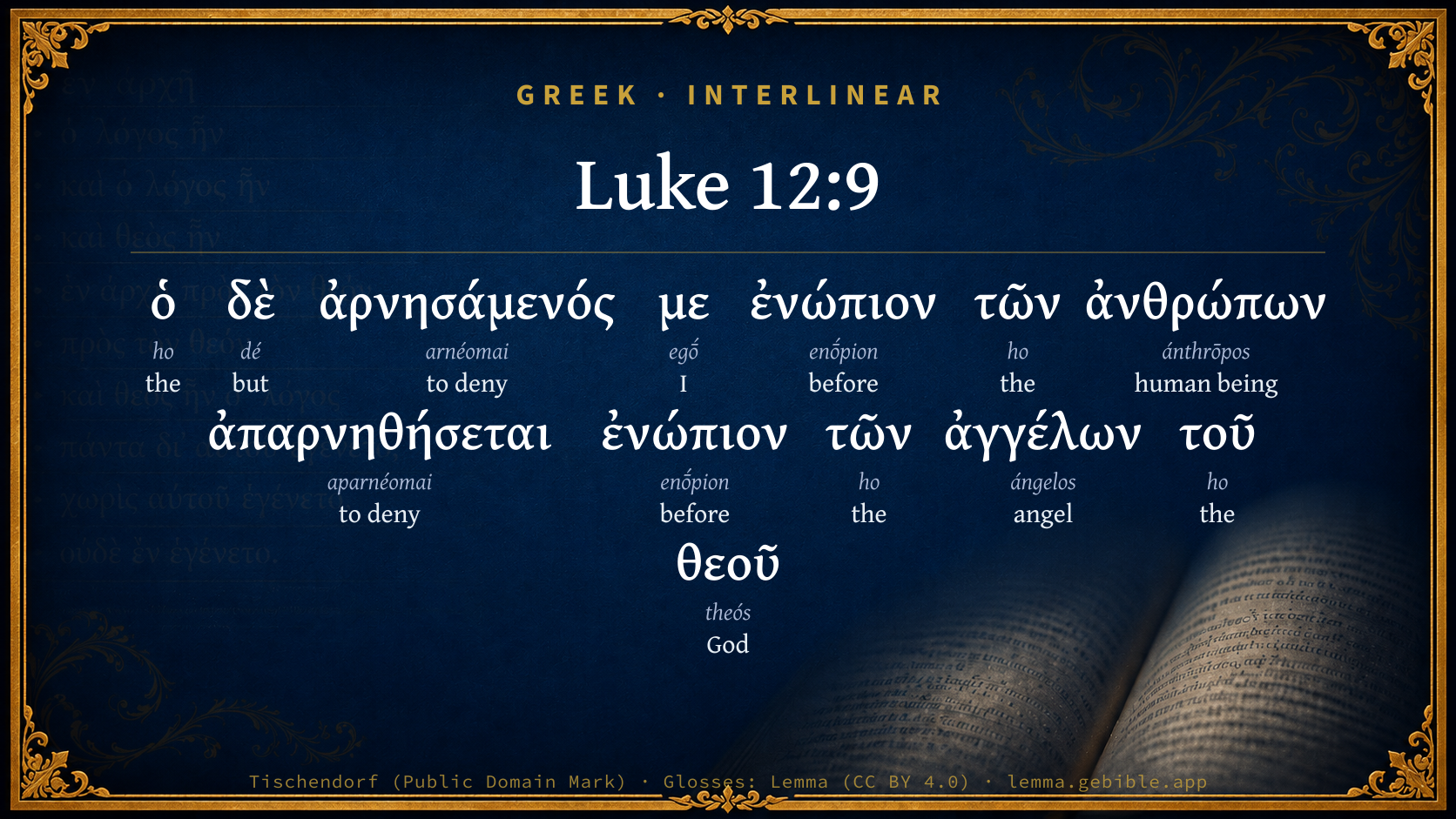
Greek (Tischendorf 8th ed.) Luke 12:9 appears in the Greek New Testament. The text above is from the Tischendorf 8th edition. Each word links to its Strong’s number and a concise gloss. Click any word for its full Thayer’s Greek Lexicon entry.
Download image
Cite this verse

Luke 12:9 (World English Bible). Public Domain. Lemma interlinear Bible study tool, https://lemma.gebible.app/v/luke/12/9.

Show BibTeX & RIS
BibTeX
RIS
English Translation
but he who denies me in the presence of men will be denied in the presence of the angels of God.
World English Bible · Public Domain
Download a study sheet

One document with this verse’s original text, its word-by-word gloss line, the meaning frame, cross-references with their text, attributed commentary, and full source and license credits — printable, and it pastes into notes with its structure intact.

This verse Autodidact and up

Study sheet (.html) Plain text (.txt)

A passage Seminary Student

Up to 50 verses in one chapter. A passage sheet keeps up to 6 commentary sources and 12 cross-references per verse, in the order this page ranks them, and says so on the sheet whenever that leaves anything out. Ask for a single verse and you get the Autodidact verse sheet above.

Everything on this page stays free to read, with no account — the sheet is a download of what is already on screen, not access to it.

Want to remove ads? Support Godless Engineer
Compare translations 3

The same verse in 3 English versions, stacked beneath the original-language interlinear above. Click any original word for its lexicon entry.

Each is an independent rendering of the whole verse — the interlinear is not word-aligned to these translations.

Highlighted words mark where these versions differ — a whole-verse word diff, not a word-by-word alignment.

  • World English Bible Public Domain
    but he who denies me in the presence of men will be denied in the presence of the angels of God.
  • King James Version Public Domain
    But he that denieth me before men shall be denied before the angels of God.
  • unfoldingWord Literal Text CC BY-SA 4.0
    but the one having denied me before men will be denied before the angels of God.

unfoldingWord Literal Text — © unfoldingWord, licensed CC BY-SA 4.0. Word-aligned USFM3 via Door43 (git.door43.org/unfoldingWord/en_ult).

Versions to compare (up to 4)

3 of 4 selected

Show all 19 translations

Every available English version of this verse, each an independent rendering of the whole verse.

  • World English Bible Public Domain
    but he who denies me in the presence of men will be denied in the presence of the angels of God.
  • Berean Standard Bible Public Domain
    But whoever denies Me before men will be denied before the angels of God.
  • Majority Standard Bible Public Domain
    But whoever denies Me before men will be denied before the angels of God.
  • King James Version Public Domain
    But he that denieth me before men shall be denied before the angels of God.
  • American Standard Version (1901) Public Domain
    but he that denieth me in the presence of men shall be denied in the presence of the angels of God.
  • Revised Version (1885) Public Domain
    but he that denieth me in the presence of men shall be denied in the presence of the angels of God.
  • Geneva Bible (1599) Public Domain
    But hee that shall denie mee before men, shall be denied before the Angels of God.
  • Douay-Rheims (1899) Public Domain
    But he that shall deny me before men, shall be denied before the angels of God.
  • Young's Literal Translation Public Domain
    and he who hath denied me before men, shall be denied before the messengers of God,
  • Literal Standard Version CC BY-SA 4.0
    and he who has denied Me before men, will be denied before the messengers of God,
  • Unlocked Literal Bible CC BY-SA 4.0
    but he who denies me before men will be denied before the angels of God.
  • unfoldingWord Literal Text CC BY-SA 4.0
    but the one having denied me before men will be denied before the angels of God.
  • Darby Bible Public Domain
    but he that shall have denied me before men shall be denied before the angels of God;
  • World Messianic Bible Public Domain
    but he who denies me in the presence of men will be denied in the presence of God’s angels.
  • Webster's Bible Public Domain
    But he that denieth me before men, shall be denied before the angels of God.
  • Free Bible Version CC BY-SA 4.0
    but those who deny me will be denied before God's angels.
  • Bible in Basic English Public Domain
    But if anyone says before men that he has no knowledge of me, I will say that I have no knowledge of him before the angels of God.
  • Text-Critical English NT CC BY 4.0
    but whoever denies me before men will be denied before the angels of God.
  • Tyndale New Testament (1534) Public Domain
    And he that denyeth me before men: shalbe denyed before the angels of God.

Literal Standard Version (2020), Covenant Press — licensed CC BY-SA 4.0. Text via the HelloAO Bible API (eBible.org). Unlocked Literal Bible (unfoldingWord) — licensed CC BY-SA 4.0. Text via the HelloAO Bible API (eBible.org). unfoldingWord Literal Text — © unfoldingWord, licensed CC BY-SA 4.0. Word-aligned USFM3 via Door43 (git.door43.org/unfoldingWord/en_ult). Free Bible Version, Dr. Jonathan Gallagher — licensed CC BY-SA 4.0. Text via the HelloAO Bible API (eBible.org).

Word by word

More ways to search: Search by grammar → Find every occurrence → Compare this word →

Practice this passage: Drill this verse → Learn its vocabulary →

ἀπαρνηθήσεται
aparnéomai
G533
“to deny”
Verb, Future, Passive, Indicative, 3rd person, Singular
Part of Speech
Verb
Tense
Future
Voice
Passive
Mood
Indicative
Person
3rd person
Number
Singular
Full Thayer's Definition

Origin: from G575 and G720

TDNT: 1:471,*

1. to deny a. to affirm that one has no acquaintance or connection with someone b. to forget one's self, lose sight of one's self and one's own interests
  1. ὁ ho G3588 “the” Article, Nominative, Singular, Masculine
  2. δὲ dé G1161 “but” Conjunction
  3. ἀρνησάμενός arnéomai G720 “to deny” Verb, Aorist, Middle deponent, Participle, Nominative, Singular, Masculine
  4. με egṓ G1473 “I” Personal pronoun, 1st person, Accusative, Singular
  5. ἐνώπιον enṓpion G1799 “before” Adverb
  6. τῶν ho G3588 “the” Article, Genitive, Plural, Masculine
  7. ἀνθρώπων ánthrōpos G444 “human being” Noun, Genitive, Plural, Masculine
  8. ἐνώπιον enṓpion G1799 “before” Adverb
  9. τῶν ho G3588 “the” Article, Genitive, Plural, Masculine
  10. ἀγγέλων ángelos G32 “angel” Noun, Genitive, Plural, Masculine
  11. τοῦ ho G3588 “the” Article, Genitive, Singular, Masculine
  12. θεοῦ theós G2316 “God” Noun, Genitive, Singular, Masculine

About this verse

These counts appear in no published source. They are computed here, from the morphology-tagged text and Lemma’s own curated glosses. What Lemma adds →

13
words
9
distinct lemmas
Gospels
section

Notable vocabulary

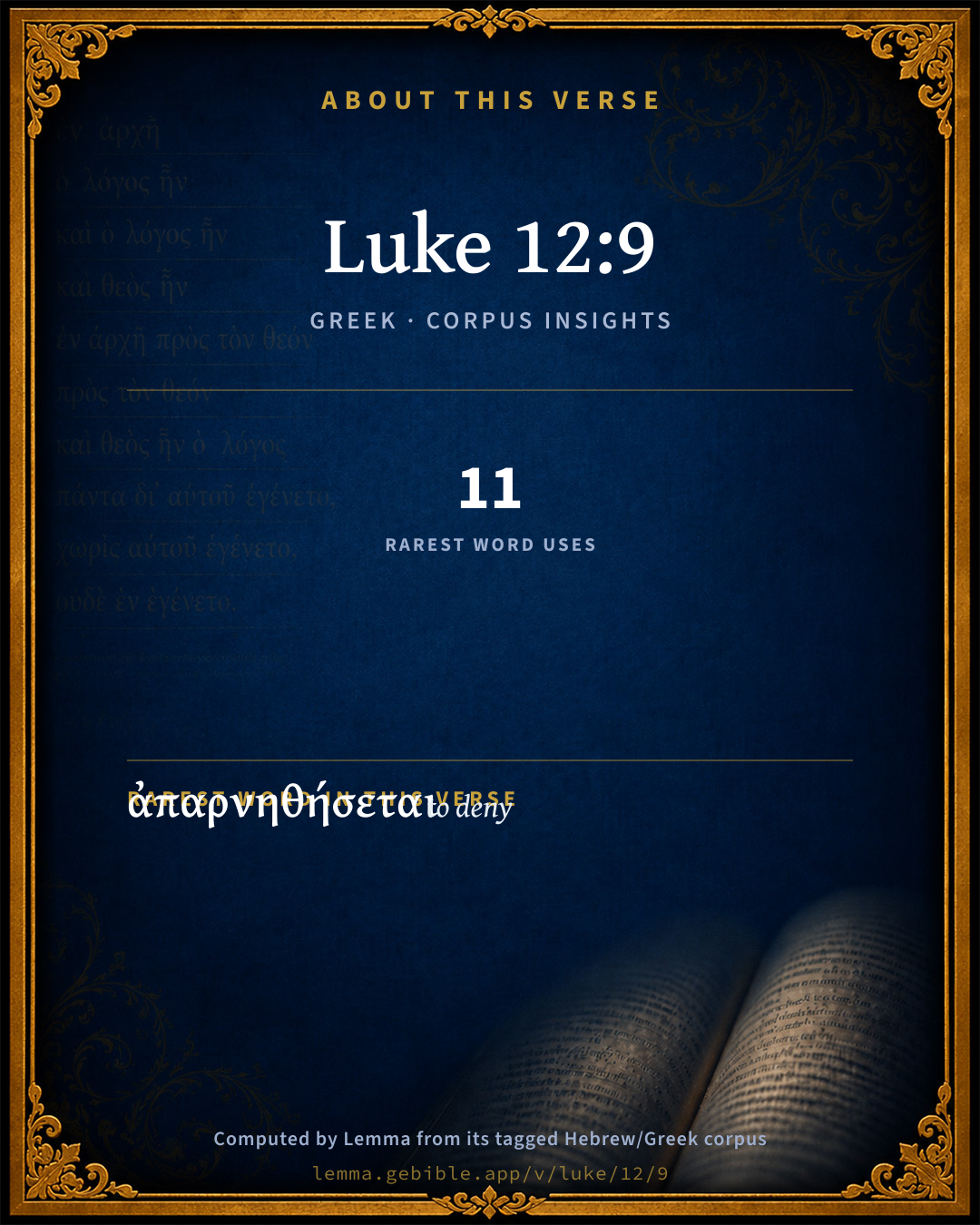
The rarest word here is ἀπαρνηθήσεται to deny G533 — appearing just 11 times in the whole Greek New Testament.

Shared distinctive vocabulary

ἀπαρνηθήσεται to deny G533 occurs in 11 verses of the Greek New Testament. Also found in:

Repetition

Words recur within this verse:

  • ἐνώπιον before G1799 ×2
  • ὁ the G3588 ×4

Cross-references

13

Topical passages linked to Luke 12:9 in the Treasury of Scripture Knowledge — connected by theme and wording, ordered by reader-vote popularity; previews shown in the World English Bible.

  • 2 Timothy 2:12 If we endure, We will also reign with him. If we deny him, He also will deny us.
  • Mark 8:38 For whoever will be ashamed of me and of my words in this adulterous and sinful generation, the Son of Man also will be ashamed of him, when he comes in the glory of his Father with the holy angels."
  • Matthew 7:23 Then I will tell them, 'I never knew you. Depart from me, you who work iniquity.'
  • Matthew 10:33 But whoever denies me before men, him I will also deny before my Father who is in heaven.
  • Luke 9:26 For whoever will be ashamed of me and of my words, of him will the Son of Man be ashamed, when he comes in his glory, and the glory of the Father, and of the holy angels.
  • Revelation 3:8 "I know your works (behold, I have set before you an open door, which no one can shut), that you have a little power, and kept my word, and didn't deny my name.
  • Matthew 25:12 But he answered, 'Most assuredly I tell you, I don't know you.'
  • 1 John 2:23 Whoever denies the Son, the same doesn't have the Father. He who confesses the Son has the Father also.
  • Matthew 25:41 Then he will say also to those on the left hand, 'Depart from me, you cursed, into the eternal fire which is prepared for the devil and his angels;
  • Luke 13:26–27 Then you will begin to say, 'We ate and drink in your presence, and you taught in our streets.'
  • Matthew 25:31 "But when the Son of Man comes in his glory, and all the holy angels with him, then he will sit on the throne of his glory.
  • Acts 3:13–14 The God of Abraham, Isaac, and Jacob, the God of our fathers, has glorified his Servant Jesus, whom you delivered up, and denied in the presence of Pilate, when he had determined to release him.
  • 1 John 2:28 Now, little children, remain in him, that when he appears, we may have boldness, and not be ashamed before him at his coming.

Cross-references courtesy of OpenBible.info (CC BY 4.0).

Commentary

Notes on Luke 12:9 from classic Christian and Jewish commentators (each source and its license shown beneath its notes). The classic Christian expositions comment on the surrounding passage and are grouped to its opening verse, so a note may address several verses; the Jewish commentaries on the Tanakh (Rashi and others) are per-verse, so they appear only where the commentator wrote on this verse.

Lemma curates 59 commentaries, every one of them public domain or Creative Commons licensed, each selected and text-cleaned for this edition rather than reprinted as found. About our sources →

The Biblical Illustrator

Joseph S. Exell

Luk_12:9

He that denieth Me before men

On denying Christ

I.

HOW MANY WAYS CHRIST AND HIS TRUTHS MAY BE DENIED; AND WHAT IS THE DENIAL HERE CHIEFLY INTENDED. Here, first, in general I assert that we may deny Him in all those acts that are capable of being morally good or evil; those are the proper scene in which we act our confessions or denials of Him. Accordingly, therefore, all ways of denying Christ I shall comprise under these three.

1. We may deny Him and His truths by an erroneous, heretical judgment.

2. We may deny Christ verbally and by oral expressions. Now our words are the interpreters of our hearts, the transcripts of the judgment, with some farther addition of good or evil. He that interprets, usually enlarges.

3. We may deny Christ in our actions and practice; and these speak much louder than our tongues. To have an orthodox belief and a true profession, concurring with a bad life, is only to deny Christ with a greater solemnity. Belief and profession will speak thee a Christian but very faintly, when thy conversation proclaims thee an infidel. Many, while they have preached Christ in their sermons, have read a lecture of atheism in their practice. As for the manner of our denying the deity of Christ here prohibited, I conceive it was by words and oral expressions verbally to deny and disacknowledge it. This I ground upon these reasons--

1. Because it was such a denial as was before men, and therefore consisted in open profession; for a denial in judgment and practice, as such, is not always before men.

2. Because it was such a denial or confession of Him as would appear in preaching; but this is managed in words and verbal profession. But now, if we take the words as they are, a general precept equally relating to all times and to all persons, though delivered only upon a particular occasion to the apostles (as I suppose they are to be understood), so I think they comprehend all the three ways mentioned of confessing or denying Christ, but principally in respect of practice, and that--

(1) Because by this He is most honoured or dishonoured.

(2) Because without this the other two cannot save.

(3) Because those who are ready enough to confess Him both in judgment and profession are for the most part very prone to deny Him shamefully in their doings. Pass we now to a second thing, viz., to show--

II. WHAT ARE THE CAUSES INDUCING MEN TO DENY CHRIST IN HIS TRUTHS. I shall propose three.

1. The seeming supposed absurdity of many truths. Upon this heresy always builds. The seeming paradoxes attending gospel truths cause men of weak, prejudiced intellectuals to deny them, and in them, Christ; being ashamed to own faith so much, as they think, to the disparagement of their reason.

2. The second thing causing men to deny the truths of Christ is their unprofitableness. And no wonder if here men forsake the truth and assert interest. To be pious is the way to be poor. Truth still gives its followers its own badge and livery, a despised nakedness.

3. Their apparent danger. To be resolute in a good cause is to bring upon ourselves the punishments due to a bad.

III. We proceed now to the third thing, which is to show HOW FAR A MAN MAY CONSULT HIS SAFETY IN TIME OF PERSECUTION WITHOUT DENYING CHRIST. This he may do two ways.

1. By withdrawing his person. Martyrdom is an heroic act of faith; an achievement beyond an ordinary pitch of it; to you, says the Spirit, it is given to suffer (Php_1:29). It is a peculiar additional gift; it is a distinguishing excellency of degree, not an essential consequent of its nature. Be ye harmless as doves, says Christ; and it is as natural to them to take flight upon danger, as to be innocent. Let every man thoroughly consult the temper of his faith, and weigh his courage with his fears, his weakness, and his resolutions together, and take the measure of both, and see which preponderates; and, if his spirit faints, if his heart misgives and melts at the very thoughts of the fire, let him fly, and secure his own soul, and Christs honour.

2. By concealing his judgment. A man sometimes is no more bound to speak than to destroy himself; and as nature abhors this, so religion does not command that. In the times of the primitive Church, when the Christians dwelt amongst heathens, it is reported of a certain maid, how she came from her fathers house to one of the tribunals of the Gentiles, and declared herself a Christian, spit in the judges face, and so provoked him to cause her to be executed. But will any say that this was to confess Christ or die a martyr? He that, uncalled for, uncompelled, comes and proclaims a persecuted truth for which he is surely to die, only dies a confessor to his own folly, and a sacrifice to his own rashness. Martyrdom is stamped such only by Gods command; and he that ventures upon it without a call must endure it without a reward. Christ will say, Who required this at your hands? His gospel does not dictate imprudence; no evangelical precept justles out that of a lawful self-preservation. He, therefore, that thus throws himself upon the sword, runs to heaven before he is sent for; where, though perhaps Christ may in mercy receive the man, yet He will be sure to disown the martyr.

IV. Having thus despatched the third thing, I proceed to show WHAT IT IS FOR CHRIST TO DENY US BEFORE HIS FATHER IN HEAVEN. Hitherto we have treated of mens carriage to Christ in this world; now we will describe His carriage to them in the other. These words clearly relate to the last judgment: and they are a summary description of His proceeding with men at that day. And here we will consider--

1. The action itself--He will deny them.

2. The circumstance of the action--He will deny them before His Father and the holy angels. (R. South, D. D.)

Some ways of denying Christ

1. We deny Christ when we advocate opinions which tend to lessen the authority of His religious teachings.

2. It is denying Christ to represent Him as a mere man. He Himself said, I and My Father are one. He that hath seen Me, hath seen the Father. And He commended Thomas for addressing Him as my Lord and my God. How can any one affirm that He was only a man without the guilt of denying Him?

3. We may often deny Christ by silence. No doubt some well-meaning people at times do harm by introducing religion into conversation under unsuitable circumstances, or by harsh polemical replies to what some unbeliever has said. But most of us are in far greater danger of a culpable silence when Christs truth ought to be vindicated, and Christs own claim to reverence and trust ought to be earnestly and lovingly declared.

4. We may deny Christ by appearing at places and engaging in pursuits which irreligious people themselves recognize as unsuitable for an earnest Christian.

5. We deny Christ by neglecting efforts to spread the saving knowledge of Him at home and abroad. The Confederate general, Albert Sidney Johnston, in the last letter he wrote before he fell at Shiloh, said, The popular test of a military mans merit is success. It is a hard test, but it is the true one. We do not believe that success is always the true test of merit, but beyond question it is the popular test. Now, many irreligious people consider that Christianity is upon the whole a comparative failure. Large portions of the world it has never even nominally conquered. Some countries in which it once existed, including the Holy Land, have long been Mohammedan. And in the countries called Christian, a large proportion of the people are not really the subjects of Christs spiritual reign, The hasty observer is wrong in concluding that Christs work in the world is a failure; but must we not feel grief and shame at the thought that he has right plausible ground for such a conclusion? Just in proportion as we fail of any effort to spread Christs spiritual reign, we give men an excuse for rejecting His authority and neglecting His salvation. And thus to act is in a distressing manner to deny Christ.

6. In fact, a Christian is always and everywhere either confessing Christ or denying Him. Every wrong act performed, every duty disregarded or imperfectly discharged, every indication of a character not conformed to His will and likened to His image, is, by the very necessity of the case, a denial of our Lord and Saviour. (J. A. Broadus, D. D.)

Denial of Christ

Note here--

1. That not to confess Christ is, in His account, to deny Him and to be ashamed of Him.

2. That whosoever shall deny or be ashamed of Christ, either in His person, in His gospel, or in His members, for any fear or favour of man, shall with shame be disowned and eternally rejected by Him at the dreadful judgment of the great day. Christ may be denied three ways--doctrinally, by an erroneous and heretical judgment; verbally, by oral expressions; vitally, by a wicked and unholy life--but woe to the soul that denies Christ any of these ways. (W. Burkitt.)

David Straiton, the Scottish martyr

In the seventeenth century, David Straiton, a Scotchman, was one day in a solitary place Where the New Testament was being read. When the words of this verse sounded in his ears, he threw himself on his knees and said, For Thy mercys sake, Lord, let me never deny Thee or Thy truth for fear of death or corporeal pains. At his trial he firmly defended the truth, and not only died for it himself, but greatly cheered his fellow-martyr, Norman Gourlay.

Ashamed of Christ

What would the Queen think of her soldiers, if they should swear they were loyal and true, and were to say, Your Majesty, we prefer not to wear these regimentals, let us wear the dress of civilians! We are right honest men and upright, but do not care to stand in your ranks, acknowledged as your soldiers; we had rather slink into the enemys camp, and into your camps too, and not wear anything that would mark us as being your soldiers. Ah! some of you do the same with Christ. You are going to be secret Christians, are you, and slink into the devils camp and into Christs camp, but acknowledged by none? (C. H. Spurgeon.)

The Biblical Illustrator, edited by Joseph S. Exell (c. 1880s–1900s) — public domain. Text from a community e-Sword module.

John Gill's Exposition

But he that denieth me before men,.... That is, that continues to deny Christ, and lives and dies a denier of him; for otherwise it is possible for a person to deny Jesus to be the Son of God, or the Messiah, and afterwards confess him, as a Pagan or Jew; and through temptation, a real Christian may be left for a while, in one shape or another, to deny him and his truths, and afterwards truly repent, and at last be saved, as Peter; but they that deny Christ publicly, and persist in it,

shall be denied before the angels of God: they will be denied by Christ as belonging to him; they will be denied admission into heaven; they will be covered with shame and confusion publicly; they will be sent into everlasting burnings, and be ever tormented with fire and brimstone, in the presence of the holy angels.

John Gill's Exposition of the Whole Bible (1746–1763) — public domain (CC PDM 1.0). Text via the HelloAO Bible API.

The Pulpit Commentary

But he that denieth me before men shall be denied before the angels of God. Splendid as would the recompense be to the faithful and the loyal, equally shameful would be the guerdon meted out to the cowardly and faint-hearted. Before the same glorious throng would the King detail the failure, through slavish fear, of those whom he had chosen for so royal a service. Such an announcement as this proclamation of glory and of shame before the holy angels, in which stupendous scene he, the poor Galilaean Rabbi, was to play the part of the Almighty Judge, could only have been made in the last weeks preceding his Passion. All reticence was then laid aside. Before friend and foe, in public and in private, in these last solemn weeks Jesus tore away the veil of reticence with which he had been pleased hitherto in great measure to shroud his lofty claims, and the Master now declared before all that he was the King of kings, the Lord alike of angels and of men. In the face of such an announcement, his prosecution by the priests and the Pharisee party for blasphemy naturally follows. He was either a daring impostor or. In the latter ease, to the poor Galilee Rabbi belonged the Name of names which no Jew dared to pronounce.

The Pulpit Commentary (1880–1919), ed. H.D.M. Spence-Jones & Joseph S. Exell — public domain. Text from a community e-Sword module.

International Critical Commentary

9. ἀπαρνηθήσεται ἐνώπιον τῶν ἀγγέλων. This expressive compound verb is used of Peter’s denial of Christ (22:34, 61; Mat 26:34, Mat 26:75, Mar 14:30, Mar 14:72). In Mt. we have ἀρνήσομαι κἀγὼ αὐτὸν ἔμπροσθεν τοῦ πατρός μου. Note that Lk. has his favourite ἐνώπιον for ἔμπροσθεν (see on 1:15), and that he has “the Angels of God” where Mt. has “My Father”: comp. 15:10.

International Critical Commentary — older volumes (1896–1929), various authors — public domain. Text from a community e-Sword module.

Lesson kit

Teaching starters — assembled from the data on this page, not authored interpretation. Every prompt links to the verse data it draws on. Edit before teaching.

Luke, in the Gospels, opens this verse with 13 words (9 distinct Greek lemmas). Its most distinctive word is aparnéomai (“to deny”). A historical commentator’s framing appears above. Read the whole chapter for the surrounding context.

Discussion questions

  1. How does “to deny” (aparnéomai) shape what this verse is saying?
  2. How does Matthew 16:24, which shares the word «to deny», read alongside this verse?
  3. What does the repetition of “before” (2× in this one verse) do in this verse?
  4. These translations render this verse differently. What is at stake in choosing one wording over another?
  5. Compare how The Biblical Illustrator and John Gill's Exposition read this verse. Where do they agree or differ?

Things to notice

  • These translations choose different wording for 9 words in this verse.
  • “before” occurs 2× in this single verse.
  • 9 distinct Greek lemmas span 13 words in this verse.

Reading settings

Reading text

Shown beneath each verse's original-language words.

Old Testament
Old Testament edition

Read the OT as the Masoretic Hebrew (MT) or the Greek Septuagint (LXX).

English shown for the Greek Septuagint (in the Hebrew ↔ Greek comparison).

Comparing translations? Open the Compare panel on any verse page to stack up to four side by side.