Hebrews 1:7

Greek (Tischendorf 8th ed.) Hebrews 1:7 appears in the Greek New Testament. The text above is from the Tischendorf 8th edition. Each word links to its Strong’s number and a concise gloss. Click any word for its full Thayer’s Greek Lexicon entry.
Download image
Cite this verse

Hebrews 1:7 (World English Bible). Public Domain. Lemma interlinear Bible study tool, https://lemma.gebible.app/v/hebrews/1/7.

Show BibTeX & RIS
BibTeX
RIS
English Translation
Of the angels he says, "Who makes his angels winds, And his servants a flame of fire."
World English Bible · Public Domain
Download a study sheet

One document with this verse’s original text, its word-by-word gloss line, the meaning frame, cross-references with their text, attributed commentary, and full source and license credits — printable, and it pastes into notes with its structure intact.

This verse Autodidact and up

Study sheet (.html) Plain text (.txt)

A passage Seminary Student

Up to 50 verses in one chapter. A passage sheet keeps up to 6 commentary sources and 12 cross-references per verse, in the order this page ranks them, and says so on the sheet whenever that leaves anything out. Ask for a single verse and you get the Autodidact verse sheet above.

Everything on this page stays free to read, with no account — the sheet is a download of what is already on screen, not access to it.

Want to remove ads? Support Godless Engineer
Compare translations 3

The same verse in 3 English versions, stacked beneath the original-language interlinear above. Click any original word for its lexicon entry.

Each is an independent rendering of the whole verse — the interlinear is not word-aligned to these translations.

Highlighted words mark where these versions differ — a whole-verse word diff, not a word-by-word alignment.

  • World English Bible Public Domain
    Of the angels he says, "Who makes his angels winds, And his servants a flame of fire."
  • King James Version Public Domain
    And of the angels he saith, Who maketh his angels spirits, and his ministers a flame of fire.
  • unfoldingWord Literal Text CC BY-SA 4.0
    And on the one hand, with regard to the angels, he says, “The one making his angels spirits, and his servants flames of fire.”

unfoldingWord Literal Text — © unfoldingWord, licensed CC BY-SA 4.0. Word-aligned USFM3 via Door43 (git.door43.org/unfoldingWord/en_ult).

Versions to compare (up to 4)

3 of 4 selected

Show all 19 translations

Every available English version of this verse, each an independent rendering of the whole verse.

  • World English Bible Public Domain
    Of the angels he says, "Who makes his angels winds, And his servants a flame of fire."
  • Berean Standard Bible Public Domain
    Now about the angels He says: “He makes His angels winds, His servants flames of fire.”
  • Majority Standard Bible Public Domain
    Now about the angels He says: “He makes His angels winds, His servants flames of fire.”
  • King James Version Public Domain
    And of the angels he saith, Who maketh his angels spirits, and his ministers a flame of fire.
  • American Standard Version (1901) Public Domain
    And of the angels he saith, Who maketh his angels winds, And his ministers a flame a fire:
  • Revised Version (1885) Public Domain
    And of the angels he saith, Who maketh his angels winds, And his ministers a flame of fire:
  • Geneva Bible (1599) Public Domain
    And of the Angels he saith, He maketh the spirites his messengers, and his ministers a flame of fire.
  • Douay-Rheims (1899) Public Domain
    And to the angels indeed he saith: He that maketh his angels spirits, and his ministers a flame of fire.
  • Young's Literal Translation Public Domain
    and unto the messengers, indeed, He saith, `Who is making His messengers spirits, and His ministers a flame of fire;'
  • Literal Standard Version CC BY-SA 4.0
    and to the messengers, indeed, He says, “The [One] who is making His messengers spirits, and His ministers a flame of fire”;
  • Unlocked Literal Bible CC BY-SA 4.0
    About the angels he says, “He is the one who makes his angels spirits, and his servants flames of fire.”
  • unfoldingWord Literal Text CC BY-SA 4.0
    And on the one hand, with regard to the angels, he says, “The one making his angels spirits, and his servants flames of fire.”
  • Darby Bible Public Domain
    And as to the angels he says, Who makes his angels spirits and his ministers a flame of fire;
  • World Messianic Bible Public Domain
    Of the angels he says, “He makes his angels winds, and his servants a flame of fire.”
  • Webster's Bible Public Domain
    And of the angels he saith, Who maketh his angels spirits, and his ministers a flame of fire.
  • Free Bible Version CC BY-SA 4.0
    Regarding the angels, he says, “He makes his angels winds, and his servants flames of fire,”
  • Bible in Basic English Public Domain
    And of the angels he says, Who makes his angels winds, and his servants flames of fire:
  • Text-Critical English NT CC BY 4.0
    Of the angels he says, “He makes his angels winds, and his servants a flame of fire,”
  • Tyndale New Testament (1534) Public Domain
    And of the angels he sayth: He maketh his angels spretes and his ministres flammes of fyre.

Literal Standard Version (2020), Covenant Press — licensed CC BY-SA 4.0. Text via the HelloAO Bible API (eBible.org). Unlocked Literal Bible (unfoldingWord) — licensed CC BY-SA 4.0. Text via the HelloAO Bible API (eBible.org). unfoldingWord Literal Text — © unfoldingWord, licensed CC BY-SA 4.0. Word-aligned USFM3 via Door43 (git.door43.org/unfoldingWord/en_ult). Free Bible Version, Dr. Jonathan Gallagher — licensed CC BY-SA 4.0. Text via the HelloAO Bible API (eBible.org).

Word by word

More ways to search: Search by grammar → Find every occurrence → Compare this word →

Practice this passage: Drill this verse → Learn its vocabulary →

λειτουργοὺς
leitourgós
G3011
“minister”
Noun, Accusative, Plural, Masculine
Part of Speech
Noun
Case
Accusative
Number
Plural
Gender
Masculine
Full Thayer's Definition

Origin: from a derivative of G2992 and G2041

TDNT: 07:49,5

1. a public minister, a servant of the state 2. a minister, servant a. so of military labourers b. of the temple 1. of one busied with holy things 2. of a priest c. of the servants of a king
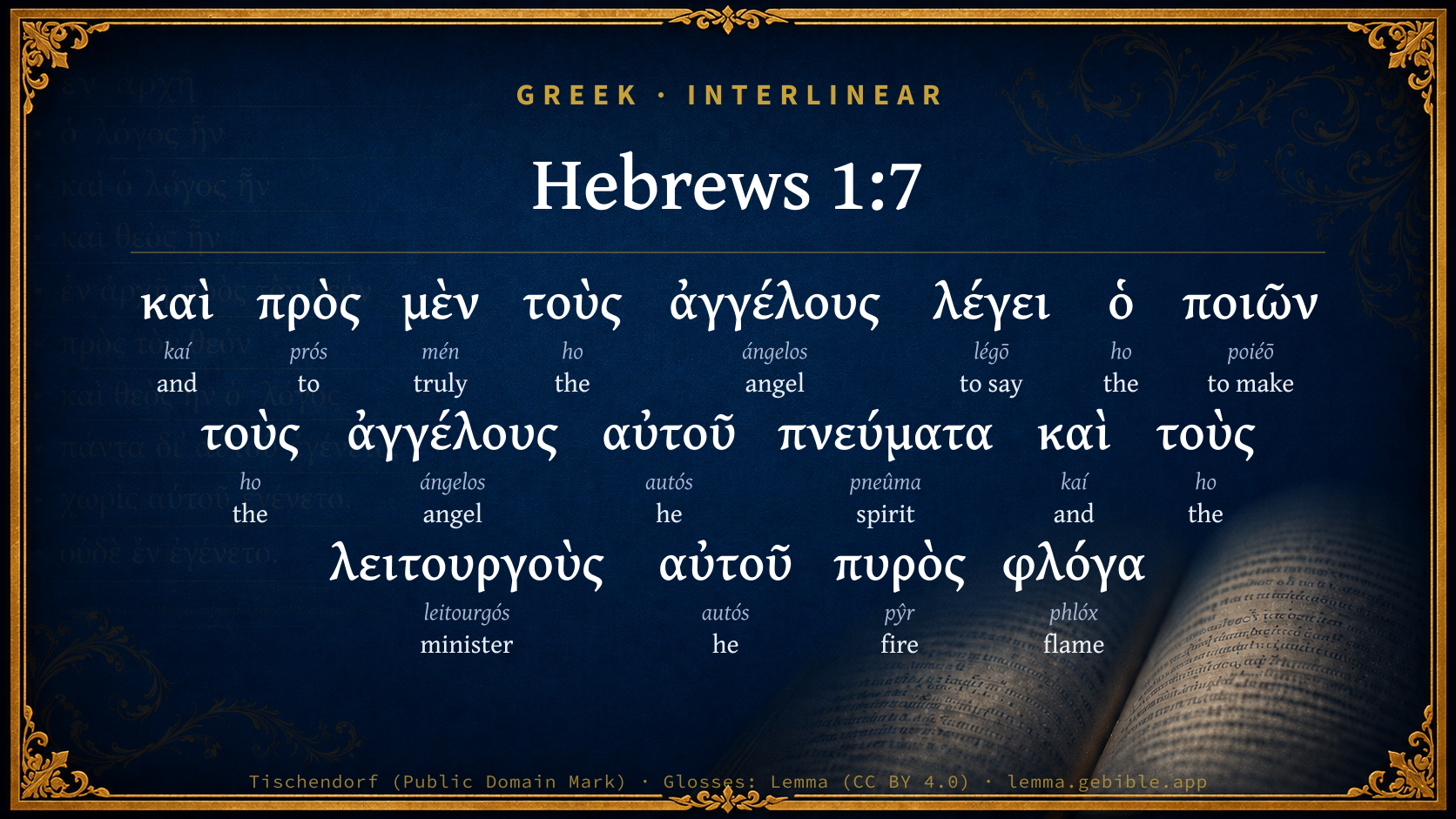
  1. καὶ kaí G2532 “and” Conjunction
  2. πρὸς prós G4314 “to” Preposition
  3. μὲν mén G3303 “truly” Particle
  4. τοὺς ho G3588 “the” Article, Accusative, Plural, Masculine
  5. ἀγγέλους ángelos G32 “angel” Noun, Accusative, Plural, Masculine
  6. λέγει légō G3004 “to say” Verb, Present, Active, Indicative, 3rd person, Singular
  7. ὁ ho G3588 “the” Article, Nominative, Singular, Masculine
  8. ποιῶν poiéō G4160 “to make” Verb, Present, Active, Participle, Nominative, Singular, Masculine
  9. τοὺς ho G3588 “the” Article, Accusative, Plural, Masculine
  10. ἀγγέλους ángelos G32 “angel” Noun, Accusative, Plural, Masculine
  11. αὐτοῦ autós G846 “he” Personal pronoun, Genitive, Singular, Masculine
  12. πνεύματα pneûma G4151 “spirit” Noun, Accusative, Plural, Neuter
  13. καὶ kaí G2532 “and” Conjunction
  14. τοὺς ho G3588 “the” Article, Accusative, Plural, Masculine
  15. αὐτοῦ autós G846 “he” Personal pronoun, Genitive, Singular, Masculine
  16. πυρὸς pŷr G4442 “fire” Noun, Genitive, Singular, Neuter
  17. φλόγα phlóx G5395 “flame” Noun, Accusative, Singular, Feminine

About this verse

These counts appear in no published source. They are computed here, from the morphology-tagged text and Lemma’s own curated glosses. What Lemma adds →

18
words
12
distinct lemmas
General Epistles
section

Notable vocabulary

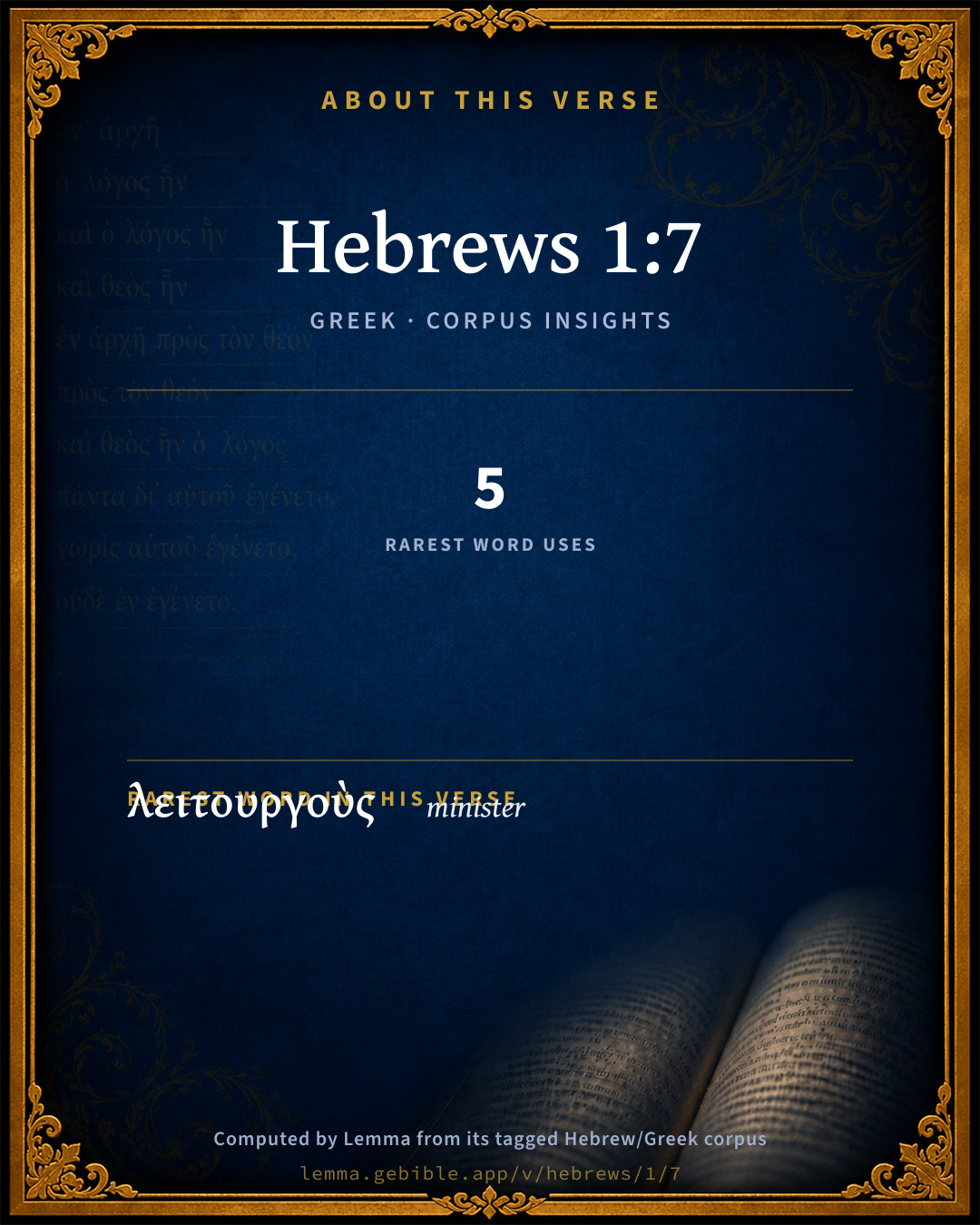
The rarest word here is λειτουργοὺς minister G3011 — appearing just 5 times in the whole Greek New Testament.

Shared distinctive vocabulary

λειτουργοὺς minister G3011 occurs in 5 verses of the Greek New Testament. Also found in:

Repetition

Words recur within this verse:

  • ἀγγέλους angel G32 ×2
  • τοὺς the G3588 ×4
  • καὶ and G2532 ×2
  • αὐτοῦ he G846 ×2

Cross-references

7

Topical passages linked to Hebrews 1:7 in the Treasury of Scripture Knowledge — connected by theme and wording, ordered by reader-vote popularity; previews shown in the World English Bible.

  • Psalms 104:4 He makes his messengers winds; His servants flames of fire.
  • Hebrews 1:14 Aren't they all ministering spirits, sent out to do service for the sake of those who will inherit salvation?
  • 2 Kings 6:17 Elisha prayed, and said, Yahweh, Please open his eyes, that he may see. Yahweh opened the eyes of the young man; and he saw: and, behold, the mountain was full of horses and chariots of fire round about Elisha.
  • 2 Kings 2:11 It happened, as they still went on, and talked, that behold, [there appeared] a chariot of fire, and horses of fire, which parted them both apart; and Elijah went up by a whirlwind into heaven.
  • Ezekiel 1:13–14 As for the likeness of the living creatures, their appearance was like burning coals of fire, like the appearance of torches: [the fire] went up and down among the living creatures; and the fire was bright, and out of the fire went forth lightning.
  • Zechariah 6:5 The angel answered me, "These are the four winds of the sky, which go forth from standing before the Lord of all the earth.
  • Daniel 7:10 A fiery stream issued and came forth from before him: thousands of thousands ministered to him, and ten thousand times ten thousand stood before him: the judgment was set, and the books were opened.

Cross-references courtesy of OpenBible.info (CC BY 4.0).

Commentary

Notes on Hebrews 1:7 from classic Christian and Jewish commentators (each source and its license shown beneath its notes). The classic Christian expositions comment on the surrounding passage and are grouped to its opening verse, so a note may address several verses; the Jewish commentaries on the Tanakh (Rashi and others) are per-verse, so they appear only where the commentator wrote on this verse.

Lemma curates 59 commentaries, every one of them public domain or Creative Commons licensed, each selected and text-cleaned for this edition rather than reprinted as found. About our sources →

Joseph Benson's Commentary

Heb 1:7-9. Of the angels — Speaking of them; he — David; saith, Who maketh — Or rather, who made; his angels spirits, &c. — That is, the greatest thing said of angels is, that they are beings not clogged with flesh, and who are zealous and active in the service of God like flames of fire. The expressions intimate not only their office, but also their nature, which is very excellent; the metaphor being taken from the most swift, subtle, and efficacious things on earth; but, nevertheless, infinitely below the majesty of the Son. For unto the Son he saith — Of him the psalmist speaks in more exalted language, expressive of his sovereign, universal, and everlasting dominion, saying, Thy throne — That is, thy reign, which the word throne implies; O God, is for ever and ever — These words are quoted from the 45th Psalm, which, in the opinion of “some commentators, was composed concerning Solomon’s marriage with Pharaoh’s daughter. But could Solomon, with any propriety, be addressed by the title of God? Or could it be said of him that his kingdom, which lasted only forty years, was eternal? It was not even eternal in his posterity; and with respect to his loving righteousness, and hating wickedness, it but ill applies to one who, in his old age, became an encourager of idolatry, through the influence of women. This Psalm, therefore, is applicable only to Christ. Further, Solomon’s marriage with Pharaoh’s daughter being expressly condemned as contrary to the law, (1Ki 11:2,) to suppose that this Psalm was composed in honour of that event, is certainly an ill-founded imagination. The rabbins, in their commentaries, affirm that it was written wholly concerning the Messiah. Accordingly, they translate the title of the Psalm as we do, A Song of Loves: the LXX., ωδη υπερ του αγαπητου, a song concerning the Beloved: a title justly given to the Messiah, whom God, by voices from heaven, declared his beloved Son.” — Macknight. Pierce says, “They who imagine this Psalm is an epithalamium upon Solomon’s marrying Pharaoh’s daughter, must suppose that it is here foretold that Solomon was to have a numerous progeny by her, whom he should set up for princes up and down the world, by one of whom he should be succeeded, 1Ki 11:16, Instead of thy father shall be thy children, when thou mayest make princes in all the earth. But this cannot be true; for besides that we read not of any children Solomon had by Pharaoh’s daughter, it is certain that Rehoboam, who succeeded him, was the son of Naamah, an Ammonitess, 2Ch 12:13. And so far was he from being able to set his sons to rule over other countries, that it was with great difficulty his successors kept two tribes of the twelve steadfast to them. The whole tenor of the Psalm directs us plainly to understand it of some excellent prince, who was highly favoured of God, and not of such a degenerate one as Solomon became, God also having testified his displeasure against him. Further, how unlikely is it that Heb 1:2 should be understood of Solomon? Nothing could be more suitably said of Christ than what we there meet with: Grace is poured into thy lips, therefore God hath blessed thee for ever: but was such language fit to be used concerning a man who became a most notorious idolater? Was not the promise conditional that was made to Solomon of blessedness, and had he not forfeited it by breaking the condition? The last verse of the Psalm seems also very unlikely to belong to Solomon: I will make thy name to be remembered in all generations; therefore shall the people praise thee for ever and ever. Certainly a greater than Solomon is here: and the primitive Christians were much in the right, who universally agreed in applying the Psalm to Christ, and him only.” See notes on Psalms 45.

A sceptre of righteousness is the sceptre of thy kingdom — That is, thy reign, of which the sceptre is the ensign, is full of justice and equity. Or, thy government is exercised for maintaining truth and righteousness in the world. Thou hast loved righteousness, &c. — Thou art infinitely pure and holy; therefore God — Who, as thou art Mediator, is thy God, hath anointed thee with the oil of gladness — With the Holy Ghost, the fountain of joy; above thy fellows — Above all the children of men. For God gave not the Spirit by measure unto him, Joh 3:34. In other words, God bestowed on him, as a prophet, priest, and king, endowments, whereby he excelled all his associates (as μετοχοι signifies) in those offices. “Anciently, kings, priests, and prophets were consecrated to their several offices by the ceremony of solemn unction with perfumed oil, called in the Psalm the oil of gladness, because it occasioned great joy, both to the person anointed, and to those who were present at the ceremony. Wherefore the Son, being appointed of God to the high offices of universal King, Priest, and Prophet among men, he is called, by way of eminence, the Lord’s Messiah, Christ, or Anointed One. But the oil with which God anointed or consecrated him to these offices was not any material oil, nor was the unction external, but internal, with the Holy Ghost. We may therefore understand the Psalm as a prediction of the descent of the Holy Ghost on Jesus at his baptism, whereby was signified God’s giving him the Spirit without measure.”

Joseph Benson's Commentary on the Old and New Testaments (1811–1818) — public domain. Text from a community e-Sword module.

Whedon's Commentary on the Bible

Daniel D. Whedon

7. And—We have here (Heb_1:7-9) another contrast between angels and the Son. The former are but natural instruments, the latter is God, ruling in righteousness, forever.

Spirits—Rather, winds; and thus we have the parallelism, maketh his angels winds, and his servants a flame of fire. Angels are so made that they may transform themselves into, and serve the work of, winds, and of lightning flashes or atmospheric blazes. Our author’s exact words are found in the Alexandrian Septuagint. The Hebrew at first seems to have a slightly different sense. Psa_104:4. In that psalm, Heb_1:3 says, “who maketh the clouds his chariot,” and hence some infer that this cited verse should read, he maketh the winds his messengers, which would exclude any reference to literal angels. But, in fact, in the verse cited, the Hebrew reverses the order of the words of Heb_1:3, and reads, maketh his angels winds, which is the true rendering. Alford gives quotations from Schottgen and Wetstein showing that our author gives the meaning as held by the Jewish Church. Schemoth Rabba, § 25, fol. 123, 3, says, “God is called God of hosts, because he does with his angels whatsoever he wills. Whensoever he wills he makes them sitting; (Jdg_6:11;) sometimes he makes them standing; (Isa_6:2;) sometimes he makes them similar to women; (Zec_5:9;) sometimes to men; (Gen_18:2;) sometimes he makes them winds, (Psa_104:4,) the citation of the present verse. Sometimes fire, ibidem.”

Daniel D. Whedon (gen. ed.), Commentary on the Old and New Testaments (1874–1909) — public domain. Text from a community e-Sword module.

The Pulpit Commentary

And of the angels he saith, Who maketh his angels spirits, and his ministers a flame of fire. A further intimation of the position assigned in the Old Testament to angels, contrasted by means of men and de , with further quotations with reference to the SON. A difficulty has been felt with regard to this passage (cited, as usual, from the LXX) on the ground of the original Hebrew being supposed not to bear the meaning assigned to it. Hence the writer of the Epistle is said to have made use of an erroneous rendering for the purpose of his argument. Certainly the context of the psalm, in which God is represented as arraying himself in the glories and operating through the powers of nature, suggests no other meaning than that he uses the winds as his messengers, etc., in the same poetical sense in which he was said in the preceding verse to make the clouds his chariot; cf. Psa_148:8, Fire and hail, snow and vapors, stormy wind fulfilling his word." If so, there is no necessary reference in the original psalm to angels. But it is to be observed, on the other hand, that the structure of ver. 4 is not in the Hebrew identical with that of "he maketh the clouds his chariot" in ver. 3, and hence, in itself, suggests some difference of meaning. For

(1) a different verb is used; and

(2) the order of the accusatives following the verb is reversed; in both which respects the I,XX correctly follows the Hebrew. In ver. 3 the verb is (o tiyei in the LXX), the primary meaning of which is "to set," "to place," and, when followed by two accusatives as object and predicate, denotes" to constitute or render a person or thing what the predicate expresses." In ver. 4 the verb is hc (oo poiwn in the LXX), the primary meaning of which, when used actively, is "to form," "to fabricate." It is used of God making the heaven and the earth. (Gen_1:7, 16 2:2, etc.) When elsewhere, as here, it is followed by two accusatives, one of them (which may come either first or second in order) is found to denote the material out of which anything is formed. Thus Exo_38:3, "He made all the vessels (of) brass". (cf. Exo_30:25 Exo_36:14 Exo_37:15, Exo_37:23) Hence an obvious meaning of ver. 4, so far as the mere language is concerned, would be, "He maketh or, "formeth his messengers or, "angels of winds, and his ministers of a flaming fire." (Winds certainly, not spirits, because of the context. But here the Greek pneumata is, in itself, as ambiguous as the Hebrew twOjWr and was as probably meant to denote winds. ) According to this rendering, the meaning of the verse would seem to be that, out of the natural elements of wind and fire, some special agencies are called into being or operation; not simply that winds and fire generally are used for God"s purposes. The change of phraseology between vers. 3 and 4 certainly suggests some change in the idea of the psalmist. What, then, are these agencies? What is meant by the "messengers" and "ministers" connected with the elements of wind and fire? The author of the Epistle (and probably the LXX too, though the words aggeloi and leitourgoi are, in themselves, as ambiguous as the Hebrew) saw in these words a reference to the angels, who are denoted by the same two words in Psa_103:20, Psa_103:21, and who are undoubtedly spoken of elsewhere in the Old Testament as operating in the forces of nature (as in the death of the Egyptian firstborn, the pestilence in the time of David, and the destruction of Sennacherib"s army), and seem, in some sense, to be identified with the winds themselves in Psa_18:10, "He rode upon a cherub, and did fly: yea, he did fly upon the wings of the wind;" and in Psa_35:5, "Let them be as chaff before the wind; and let the angel of the LORD chase them." We say that the LXX, as well as the author of the Epistle, probably intended to express this meaning. It is, indeed, more than probable; for, ambiguous as may be the words aggeloi and leitourgoi in themselves, the structure of the Greek sentence (in which "his angels" and "his ministers" are the objects, arid "winds" and "flames of fire" the predicates), seems to necessitate this meaning, which is further probable from what we know of Alexandrian angelology. It may thus well be that, whether or net the LXX (rendering, as it does, the Hebrew word for word) gives the exact force of the original phrase, it hits its essential meaning, as intimating angelic agency in nature. And the learned Jews of Alexandria, followed as they are by the later rabbis generally, and by the writer of this Epistle, were, to say the least, as likely to understand the Hebrew as any modern scholars. The question, however, is not, after all, of great importance. For let us grant that the writer of the Epistle unwittingly adduced an erroneous rendering in the course of his argument. What then? It is not necessary to suppose that the inspiration of the sacred writers was such as to enlighten them in matters of Hebrew criticism. If it guarded them from erroneous teaching, it was sufficient for its purpose. And in this case the passage, as cited, at any rate expresses well the general doctrine of the Old Testament about angels, viz. that, unlike the Son, they are but subordinate agents of the Divine purposes, and connected especially with the operations of nature. It is to be observed, too, that the quotations generally in this Epistle are adduced, not as exhaustive proofs, but rather as suggestive of the general teaching of the Old Testament, with which the readers are supposed to be familiar.

Vers. 7-9. The Son and the angels.

"And of the angels he saith, Who maketh his angels," etc. Here are two quotations from the Psalms; the first from Psa_104:4, the second Psa_45:6, Psa_45:7. Whether the latter Psalm applied primarily to Solomon or any other king of ancient Israel or not, it seems to us quite clear that it applies to the ideal King, the Messiah. Our text presents additional illustrations of the great superiority of the Son to the angels.

I THE ANGELS ARE MESSENGERS OF GOD, THE SON IS HIMSELF GOD. They are messengers who execute his behests. His angels do his commandments, hearkening unto the voice of his word". (cf. Dan_9:21 Luk_1:19, Luk_1:26) But the Son is called God by the Father. "Unto the Son he saith, Thy throne, O God, is for ever and ever." Since God the Father thus addresses him he must really be God; for he calls persons and things by names which correspond to their natures. There is a wide interval between the most honored messenger and the only begotten Son and Heir of the Father, between the highest of created beings and the uncreated God.

II THE ANGELS ARE SERVANTS, THE SON IS THE SOVEREIGN. They are "his ministers." They serve him swiftly and joyfully. All their service is religious in its spirit. Their work is indeed worship. But, however important the nature of their service, however exalted its spirit, however perfect its performance, they are still servants and subjects. But the Son is the Sovereign. The Father saith unto him, "Thy throne, O God, is for ever and ever," etc. The throne and scepter are symbols of royal authority. "All authority hath been given unto me," said our Lord, in heaven and on earth;" "I sat down with my Father in his throne;" "His kingdom ruleth over all.

III THE ANGELS SERVE IN THE PHENOMENA AND FORCES OF NATURE, THE SON REIGNS RIGHTEOUSLY IN A SPIRITUAL EMPIRE. "Who maketh his angels winds, and his ministers a flame of fire." These words are variously interpreted. Dean Perowne (on Psa_104:4) says, "He clothes his messengers with the might, the swiftness, the all-pervading subtlety of wind and fire." Alford"s exposition is different: "He makes his messengers winds, i.e. he causes his messengers to act in or by means of the winds; his servants flames of fire, i.e. commissions them to assume the agency or form of flame for his purposes." And Ebrard: "Throughout the New Testament (for example, Rom_8:38 1Pe_3:22) the angels, at least a class of them, are regarded as dunameiv of God, i.e. as personal creatures furnished with peculiar powers, through whom God works wonders in the kingdom of nature, and whom he accordingly makes to be storm-winds and flames of fire," in as far as he lets them, so to speak, incorporate themselves with these elements and operations of nature. It is a truth declared in the Holy Scriptures of great speculative importance, that the miracles of nature, for example the lightnings and trumpet-sounds on Sinai, are not wrought immediately and directly by God, the Governor of the world, but are called forth at his will by exalted creatures specially qualified for this work. This position the angels hold; they are there to work terrible wonders in the sphere of nature before the eyes of a yet uncultivated people." But the relation of the Son to man is spiritual, and his rule is supremely righteous. The eighth verse gives us three ideas concerning his government.

1. It is perfectly righteous. "The scepter of uprightness is the scepter of thy kingdom.

(1) His rule over man as an individual is righteous. All his requirements are in harmony with and tend to promote our well-being. In keeping his commandments "there is great reward.

(2) His rule over man in his social relations is righteous. What could be more equitable or more wise than the great rule laid down by our Lord for the regulation of our conduct toward each other? things whatsoever ye would that men should do to you, do ye even so to them.

(3) His rule over man in his relations to God is righteous. He requires us to obey, reverence, and love God. Is it not reasonable and equitable that the most excellent and gracious Being should he loved? that the greatest and most glorious Being should be reverenced? that our Creator, Sustainer, and Sovereign should be obeyed? The Law is holy, and the commandment is holy and just; and good." His reign is not only equitable, but benevolent.

2. It is perfectly righteous because of his love of righteousness. He reigns in uprightness, not as a matter of policy, but of principle; this grand feature of his government springs from his own infinite affection for righteousness, and the perfect righteousness of his character. "Thou hast loved righteousness, and hated iniquity;" "The righteous Lord loveth righteousness.

3. It is perpetual because it is perfectly righteous. "Thy throne, O God, is for ever and ever." His reign is eternal because it is equitable. "The throne is established by righteousness." Earthly "Empires wane and wax, Are founded, flourish, and decay." But of the increase of his government and peace there shall be no end," etc. . (Isa_9:7) "He shall reign over the house of Jacob for ever; and of his kingdom there shall be no end.

IV THE JOY OF THE ANGELS IS MUCH INFERIOR TO THAT OF THE SON. "Therefore God, thy God, hath anointed thee with the oil of gladness above thy fellows" Notice:

1. The nature of this anointing. "Anointed thee with the oil of gladness." This anointing does not indicate the inauguration of our Lord to his mediatorial office. The figure is taken from the custom of anointing the head of the guests at festivals, (Psa_23:5) and is intended to set forth the supreme joy of the Son upon the completion of his redemptive work, and his exaltation to "the right hand of the Majesty on high.

2. The reason of this anointing. "Thou hast loved righteousness, and hated iniquity; therefore God, thy God, hath anointed thee." Because of the perfection of his character, and of his life and work upon earth, the Father has blessed him with supreme joy.

3. The extent of this anointing. "Above thy fellows," or associates. Since the design of the writer is to exhibit the superiority of the Son "to the angels, we must, I think, take metocouv as representing other heavenly beings, partakers in the same glorious and sinless state with himself, though not in the strict sense his "fellows. His joy is deeper, higher, greater, intenser than that of any angel. Behold, then, how much greater is the Son than the angels in all the points which have come under our notice! W.J.

The Pulpit Commentary (1880–1919), ed. H.D.M. Spence-Jones & Joseph S. Exell — public domain. Text from a community e-Sword module.

Tyndale Open Study Notes

Tyndale Open Resources

1:7 This verse quotes Ps 104:4 to show that the angels are messengers or servants and, therefore, of a lesser rank than the Son, whom they serve. • In the Old Testament, angels are sometimes associated with winds and fire (see Exod 3:2; Judg 6:21; 13:16, 20; 2 Sam 22:11; Pss 18:10; 35:5), which is why angels are mentioned in connection with God’s lordship over nature.

Tyndale Open Study Notes — © Tyndale Open Resources, licensed CC BY-SA 4.0. Text via the HelloAO Bible API.

Bengel's Gnomon

Johann Albrecht Bengel

Heb 1:7. Πρὸς, unto) [Engl. Vers. of, i.e. in reference to] “He saith to the angels,” by an indirect speech; comp πρὸς, to, Heb 11:18, note, [“In reference to whom it was said, In Isaac shall thy seed be called.”] The apostle seems also to have had in his mind Psalm 130:20, which immediately precedes the passage, Psa 104:4.—λέγει, He saith) viz. God, by the prophet.—ὁ ποιῶν—φλόγα) LXX., in exactly as many letters, Psa 104:4. Πνεύματα, spirits, and πυρὸς φλόγα, a flame of fire, signify not only the office of angels, but their very nature, which is no doubt of surpassing excellence, as the metaphor is taken from things the most efficacious and the most subtile, but yet very far inferior to the majesty of the Son. Therefore the expression, ποιῶν, who maketh, intimates that the angels are creatures, made by His command; but the Son is eternal, Heb 1:8, and the Creator, Heb 1:10. The subject, viz. ἄγγελοι, angels, and λειτουργοὶ, ministers, as is proved by their being put with the article,[8] has its antithesis in Heb 1:8-9. Moreover, the antithesis of Who makes, intimating the creation of the angels, is found in Heb 1:10-11. I consider it to be the predicate of the Father; comp. Heb 1:8.

[8] The article always distinguishes the subject from the predicate: therefore we cannot translate, “Who maketh winds His angels, or messengers, and a flame of fire His ministers.”—ED.

Bengel's Gnomon of the New Testament — English translation (T&T Clark, Edinburgh, 1860) — public domain. Text from a community e-Sword module.

Meyer's Critical & Exegetical Commentary

Heinrich August Wilhelm Meyer

Heb_1:7. Πρός] with regard to, as Luk_20:19; Act_12:21; Rom_10:21, and frequently. Comp. Matthiae, p. 1181; Winer, Gramm., 7 Aufl. p. 378.

μέν] corresponds to the δέ of Heb_1:8, thus places Heb_1:7 in express opposition to Heb_1:8.

λέγει] namely, God, in the Scripture.

The citation is from Psa_104:4, according to the LXX. (Cod. Alex., whereas Cod. Vatican, has πῦρ φλέγον instead of πυρὸς φλόγα). The psalm praises Jehovah as the Creator and Sustainer of all nature. In the Hebrew the words cited read: עֹשֶׂה מַלְאָכָיו רוּחוֹת מְשָׁרְתָיו אֵשׁ לֹהֵט, and, having respect to their connection with what precedes and that which follows, no doubt can obtain on the point that they are to be rendered,what is objected thereto by Hofmann (Schriftbew. I. p. 325 f., 2 Aufl.), Delitzsch, and Alford is untenable,God makes winds His messengers, and flames of fire (lightnings) His servants, in such wise that the thought is expressed: as the whole of nature, so are also winds and lightnings servants of God the Lord.[37] Otherwise have the LXX. apprehended the sense of the words, as is shown by the addition of the article before ἀγγέλους and λειτουργούς, and they are followed by our author. [So the Targum also.] They have taken τοὺς ἀγγέλους αὐτοῦ and τοὺς λειτουργοὺς αὐτοῦ as the objects, ̔νεύματα and πυρὸς φλόγα, on the other hand, as the predicates to ποιῶν, thus have found the meaning of the words: He makes His angels winds, and His servants a flame of fire. If we now observe the scope of the thought of those declarations of Scripture concerning the Son which follow, Heb_1:8-12, placed as they are in antithetical relation to the one before us, it is evident that the author must have discovered the inferiority of the angels compared with the Son, as attested in Scripture, in a twofold respect(1) that the angels are servants, whereas the Son is ruler; (2) that the angels are mutable and perishable, whereas the Son abides the same for ever.

The conception of such a subjection on the part of the angels, that they must submit even to be changed into elements, is, moreover, not uncommon among the Rabbins. Comp. e.g. Shemoth rabba, sec. 25, fol. 123. 3 : aliquando ipsos (angelos) facit ventos, q. d. qui facis angelos tuos ventos, aliquando ignem, q. d. ministros tuos flammam ignis. Jalkut Simeoni, part II. fol. 11. 3 : Angelus dixit ad Manoah: nescio ad cujus imaginem ego factus sim; nam Deus singulis horis nos immutat; cur ergo nomen meum interrogas? Nonnunquam facit nosi ignem, alias ventum, interdum viros, alias denique angelos. See in general, Schöttgen and Wetstein ad loc.

πνεύματα] not: spirits (Luther, Erasmus, Paraphrase; Clarius, Piscator, Owen, Seb. Schmidt, Brochmann, Bengel, Böhme), but: winds.

λειτουργούς] only another name for ἀγγέλους.

[37] Comp., as to the thought, Xenophon, Memorabilia, iv. 3. 14, where quite similarly lightning and winds (κεραυνός and ἄνεμοι) are called ὑπηρέται τῶν θεῶν.

Heb_1:7-12. Contrastful comparison of a declaration of Scripture characterizing the angels, and two declarations characterizing the Son.

Meyer — Critical and Exegetical Commentary on the New Testament — English translation by Peter Christie, edited by Frederick Crombie (T&T Clark, 1880) — public domain. Text from a community e-Sword module.

Expositor's Greek Testament

ed. W. Robertson Nicoll

Heb 1:7 . καὶ πρὸς μὲν τοὺς ἀγγέλους λέγει .… The πρὸς μὲν of this verse is balanced by πρὸς δὲ in Heb 1:8 ; and in both πρός is to be rendered “with reference to,” or “of” as in Luk 20:19 ; Rom 10:21 ; Xen., Mem. , iv. 2 15. Cf. Winer, p. 505: and our own expression “speak to such and such a point”. ὁ ποιῶν κ . τ . λ . cited from Psa 104:4 , Lünemann and others hold that the Hebrew is wrongly rendered and means “who maketh winds his messengers” not “who maketh His angels winds”. Calvin, too, finds no reference to angels in the words. He believes that in this Hymn of Creation the Psalmist, to illustrate how God is in all nature, says “who maketh the winds his messengers,” i.e. , uses for his purposes the apparently wildest of natural forces, and “flaming fire his ministers,” the most rapid, resistless and devouring of agents controlled by the Divine hand. Cf. Shakespeare, “thought-executing fires”. The writer accepts the LXX translation and it serves his purpose of exhibiting that the characteristic function of angels is service, and that their form and appearance depend upon the will of God. This was the current Jewish view. Many of the sayings quoted by Schoettgen and Weber suggest that with some of the Rabbis the belief in angels was little more than a way of expressing their faith in a spiritual, personal power behind the forces of nature. “When they are sent on a mission to earth, they are wind: when they stand before God they are fire.” The angel said to Manoah, “I know not after what image I am made, for God changes us every hour; why, then, dost thou ask after my name? Sometimes He makes us fire, at others wind; sometimes men, at other times angels.” Sometimes they appear to have no individual existence at all, but are merely the light-radiance or halo of God’s glory. “No choir of angels sings God’s praises twice, for each day God creates new hosts which sing His praises and then vanish into the stream of fire from under the throne of His glory whence they came.” Cf. also the Book of Jubilees, ii. 2. “On the first day He created the heavens which are above and the earth and the waters and all the spirits which serve before Him the angels of the presence, and the angels of sanctification, and the angels of the spirit of the winds, and the angels of the spirit of the clouds, and of darkness, and of snow and of hail, and of hoar frost, and the angels of the voices of the thunder and of the lightning, and the angels of the spirits of cold and of heat, and of winter and of spring, and of autumn and of summer, and of all the spirits of His creatures which are in the heavens and on the earth, the abysses and the darkness, eventide and the light, dawn and day which He hath prepared in the knowledge of His heart.” One thing all these citations serve to bring out is that the angels were merely servants; like the physical forces of nature they were dependent and perishable. In contrast to these qualities are those ascribed to the Son.

The Expositor's Greek Testament, edited by W. Robertson Nicoll (1897–1910) — public domain. Text from a community e-Sword module.

Geneva Bible (1599)

Geneva Bible translators

Cherub, Ps 18:11.

Seraph, Isa. 6:2.

Geneva Bible (1599) marginal notes — public domain. Text via Bolls.life.

Jamieson, Fausset & Brown

Robert Jamieson, A. R. Fausset & David Brown

of--The Greek is rather, "In reference TO the angels."

spirits--or "winds": Who employeth His angels as the winds, His ministers as the lightnings; or, He maketh His angelic ministers the directing powers of winds and flames, when these latter are required to perform His will. "Commissions them to assume the agency or form of flames for His purposes" [ALFORD]. English Version, "maketh His angels spirits," means, He maketh them of a subtle, incorporeal nature, swift as the wind. So Psa 18:10, "a cherub . . . the wings of the wind." Heb 1:14, "ministering spirits," favors English Version here. As "spirits" implies the wind-like velocity and subtle nature of the cherubim, so "flame of fire" expresses the burning devotion and intense all-consuming zeal of the adoring seraphim (meaning "burning), Isa 6:1. The translation, "maketh winds His messengers, and a flame of fire His ministers (!)," is plainly wrong. In the Psa 104:3-4, the subject in each clause comes first, and the attribute predicated of it second; so the Greek article here marks "angels" and "ministers" as the subjects, and "winds" and "flame of fire," predicates, Schemoth Rabba says, "God is called God of Zebaoth (the heavenly hosts), because He does what He pleases with His angels. When He pleases, He makes them to sit (Jdg 6:11); at other times to stand (Isa 6:2); at times to resemble women (Zac 5:9); at other times to resemble men (Gen 18:2); at times He makes them 'spirits'; at times, fire." "Maketh" implies that, however exalted, they are but creatures, whereas the Son is the Creator (Heb 1:10): not begotten from everlasting, nor to be worshipped, as the Son (Rev 14:7; Rev 22:8-9).

Jamieson, Fausset & Brown — Commentary Critical and Explanatory on the Whole Bible (1871) — public domain (CC PDM 1.0). Text via the HelloAO Bible API.

Adam Clarke's Commentary

Verse 7. Who maketh his angels spirits] They are so far from being superior to Christ, that they are not called God's sons in any peculiar sense, but his servants, as tempests and lightnings are. In many respects they may have been made inferior even to man as he came out of the hands of his Maker, for he was made in the image and likeness of God; but of the angels, even the highest order of them, this is never spoken. It is very likely that the apostle refers here to the opinions of the Jews relative to the angels. In Pirkey R. Elieser, c. 4, it is said: "The angels which were created the second day, when they minister before God, נעשין של אש become fire." In Shemoth Rabba, s. 25, fol. 123, it is said: "God is named the Lord of hosts, because with his angels he doth whatsoever he wills: when he pleases, he makes them sit down; Jdg 6:11: And the angel of the Lord came, and sat under a tree. When he pleases, he causes them to stand; Isa 6:2: The seraphim stood. Sometimes he makes them like women; Zec 5:9: Behold there came two women, and the wind was in their wings. Sometimes he makes them like men; Ge 18:2: And, lo, three men stood by him. Sometimes he makes them spirits; Ps 104:4: Who maketh his angels spirits. Sometimes he makes them fire; ibid. His ministers a flame of fire."

In Yalcut Simeoni, par. 2, fol. 11, it is said: "The angel answered Manoah, I know not in whose image I am made, for God changeth us every hour: sometimes he makes us fire, sometimes spirit, sometimes men, and at other times angels." It is very probable that those who are termed angels are not confined to any specific form or shape, but assume various forms and appearances according to the nature of the work on which they are employed and the will of their sovereign employer. This seems to have been the ancient Jewish doctrine on this subject.

Adam Clarke's Commentary on the Bible (1810–1826) — public domain. Text from a community e-Sword/MySword module.

John Calvin's Commentaries

7. And to the angels, etc. To the angels means of the angels. But the passage quoted seems to have been turned to another meaning from what it appears to have; for as David is there describing the manner in which we see the world to be governed, nothing is more certain than the winds are mentioned, which he says are made messengers by the Lord, for he employs them as his runners; so also, when he purifies the air by lightnings, he shows what quick and swift ministers he has to obey his orders. But this has nothing to do with angels. Some have had recourse to an allegory, as though the Apostle explained the plain, and as they say, the literal sense allegorically of angels. But it seems preferable to me to consider this testimony is brought forward for this purpose, that it might by a similitude be applied to angels, and in this way David compares winds to angels, because they perform offices in this world similar to what the angels do in heaven; for the winds are, as it were, visible spirits. And, doubtless, as Moses, describing the creation of the world, mentioned only those things which are subject to our senses, and yet intended that higher things should be understood; so David in describing the world and nature, represented to us on a tablet what ought to be understood respecting the celestial orders. Hence I think that the argument is one of likeness or similarity, when the Apostle transfers to angels what properly applies to the winds.

John Calvin's Commentaries (1540-1563) — public domain. Text from the Calvin Translation Society English edition (1840s-50s) via the Christian Classics Ethereal Library (ccel.org). Calvin's coverage is partial (roughly two-thirds of the Bible); uncommented books and verses are honest gaps, never fabricated. The 19th-century editor's footnotes and remarks are omitted so the notes are faithfully Calvin's own voice.

Ellicott's Commentary for English Readers

(7) Spirits.—Better, winds. It is very difficult to assign any clear meaning to the ordinary rendering,—unless, indeed, we were to adopt the very strange opinion of many of the earlier commentators, that the stress is laid on “maketh” in the sense of “createth.” The parallelism in these two lines of Hebrew poetry is complete, “angels” answering to “ministers,” “winds” to “a flame of fire.” The meaning appears to be that God, employing His messengers for His varied purposes, sends them forth in what manner He may please, clothing them with the appearance of the resistless wind or the devouring fire. (We may contrast 1Ki_19:11-12.) The force of the passage lies in the vividness with which it presents the thought of the Most High served by angels who “at His bidding speed,” untiring as the wind, subtle as the fire. We feel much more distinctly than we can put into words the infinite contrast between such ministers and the Son seated at the right hand of God. The quotation is taken from Psa_104:4, without any variation in the Greek. Whether this translation faithfully represents the original is a question that has been warmly discussed. Not that there is any doubt that such a rendering of the Hebrew is in itself natural; but it is often alleged that the context requires an inversion of the words, Who maketh winds His messengers, flaming fire His ministers. The point cannot be examined here; we will only express a decided opinion that the translation defended above not only expresses the meaning of the Hebrew, but perfectly accords with the context of the Psalm.

A Bible Commentary for English Readers, edited by Charles John Ellicott (1878–1897) — public domain. Text from a community e-Sword module.

The Cambridge Bible for Schools and Colleges

gen. ed. J. J. S. Perowne

7. And of the angels he saith] Rather, “And, with reference to the Angels, He saith.” He has shewn that the title of “Son” is too special and too super-eminent to be ever addressed to Angels; he proceeds to shew that the Angels are but subordinate ministers, and that often God clothes them with “the changing garment of natural phenomena” transforming them, as it were, into winds and flames.

Who maketh his angels spirits, and his ministers a flame of fire] Rather, “who maketh His Angels winds,” for the Angels are already “spirits” (Heb_1:14). This must be the meaning here, though the words might also be rendered “Who maketh winds His messengers, and fiery flame His ministers.” This latter rendering, though grammatically difficult, accords best with the context of Psa_104:4 where, however, the Targum has “Who maketh His messengers swift as winds, His ministers strong as flaming fire.” The Rabbis often refer to the fact that God makes His Angels assume any form He pleases, whether men (Gen_18:2) or women (Zec_5:9) or wind or flame (Exo_3:2; 2Ki_6:17). Thus Milton says:

“For spirits as they please

Can either sex assume, or both; so soft

And uncompounded is their essence pure;

Not tied or manacled with joint or limb

Nor founded on the brittle strength of bones,

Like cumbrous flesh; but in what shape they choose

Dilated or condensed, bright or obscure,

Can execute their aery purposes.”

But that mutable and fleeting form of existence which is the glory of the Angels would be an inferiority in the Son. He could not be clothed, as they are at God’s will, in the fleeting robes of varying material phenomena. Calvin, therefore, is much too rash and hasty when he says that the writer here draws his citation into a sense which does not belong to it, and that nothing is more certain than that the original passage has nothing to do with angels. With a wider knowledge of the views of Philo, and other Rabbis, he would have paused before pronouncing a conclusion so sweepingly dogmatic. The “Hebrew” readers of the Epistle, like the writer, were evidently familiar with Alexandrian conceptions. Now in Philo there is no sharp distinction between the Logos (who is a sort of non-incarnate Messiah) and the Logoi who are sometimes regarded as Angels just as the Logos Himself is sometimes regarded as an Archangel (see Siegfried’s Philo, p. 22). The Rabbis too explained the “us” of Gen_1:26 (“Let us make man”) as shewing that the Angels had a share in creation, see Sanhedrin, p. 38, 2. Such a passage as Rev_19:10 may help to shew the reader that the proof of Christ’s exaltation above the Angels was necessary.

The Cambridge Bible for Schools and Colleges (gen. ed. J. J. S. Perowne; Cambridge University Press, 1878–1918) — public domain. Text from a community e-Sword module.

John Gill's Exposition

Or "to the angels", as in the following verse, "to the Son", which stands opposed to this; and the words said to them, or of them, are found in Psa 104:4

who maketh his angels spirits, and his ministers a flame of fire: this cannot be understood of the wind and lightning, and of God's making these his messengers and ministers to do his will; for such a sense is not suitable to the scope of the psalm, from whence they are taken, nor to the order of the words in which they stand; for it is not said he makes spirits, or winds, his angels, and flaming fire his ministers, but the reverse; and is contrary to the design of the apostle in citing them, which is to show the superiority of Christ to angels, of whom it is said, that they are made spirits: they are "spirits", created ones, and so differ from God the Creator: they are incorporeal ones, and so differ from men; they are immaterial, and so die not; they are spiritual substances subsisting in themselves: and they are "made" such by God the Father, and by the Son the Lord Jesus Christ, within the six days of the creation, and all at once; for it is not to be supposed that the Lord is daily making them; and this proves the Son to be God, as well as more excellent than the angels; unless this is to be understood of the daily disposal of them in providence, in causing winds, thunder, lightning, and the like. Some choose to supply the word with "as", and read, who maketh his angels as winds; for invisibility, velocity, power, and penetration: "and his ministers as a flame of fire"; and these are the same with the angels, for they are ministers to God; they attend his presence; are ready to perform any service for him; they sing his praise, and are his chariots in which he rides: and they are ministers to Christ; they attended at his incarnation: were solicitous for his preservation, ministered to him in distress, assisted at his resurrection, and accompanied him in his ascension, and will be with him at his second coming: and they are as a flame of fire, so called from their great power, force, and swiftness; and from their burning love, and flaming zeal, hence named seraphim; and because they are sometimes the executioners of God's wrath, and will descend in flaming fire, when Christ shall be revealed from heaven: angels sometimes appear in fiery forms; the chariots and horses of fire, by which Elijah was carried up to heaven, were no other than angels, in such forms: so the Jews (x) say of the angels,

"all the angels, their horses are horses of fire, and their chariots fire, and their bows fire, and their spears fire, and all their instruments of war fire.''

And they have a notion, that an angel is half water, and half fire (y).

(x) Sepher Jetzirah, p. 16. Ed. Rittangel. (y) T. Hieros. Roshhashana, fol. 58. 1.

John Gill's Exposition of the Whole Bible (1746–1763) — public domain (CC PDM 1.0). Text via the HelloAO Bible API.

Trapp's Complete Commentary

John Trapp

7 And of the angels he saith, Who maketh his angels spirits, and his ministers a flame of fire.

Ver. 7. A flame of fire] Hence they are called seraphims, because they flame, like heavenly salamanders, in the fire of pure and perfect love to God and his people; and cherubims, from their winged swiftness; swift they are as the wind; which may seem to be the sense of this text, compared with Psa 104:4-5.

John Trapp, A Commentary or Exposition upon All the Books of the Old and New Testament (1647–1656) — public domain. Text from a community e-Sword module.

Albert Barnes' Notes on the Bible

And of the angels he saith, Who maketh his angels spirits - He gives to them an inferior name, and assigns to them a more humble office. They are mere ministers, and have not ascribed to them the name of “Son.” They have a name which implies a more humble rank and office - the name “spirit,” and the appellation of a “flame of fire.” They obey his will as the winds and the lightnings do. The “object” of the apostle in this passage is to show that the angels serve God in a ministerial capacity - as the winds do; while the Son is Lord of all. The one serves him passively, as being wholly under his control; the other acts as a Sovereign, as Lord over all, and is addressed and regarded as the equal with God. This quotation is made from Psa 104:4. The passage “might” be translated, “Who maketh his angels winds, and his ministers a flame of fire;” that is, “who makes his angels like the winds, or as swift as the winds, and his ministers as rapid, as terrible, and as resistless as the lightning.”

So Doddridge renders it; and so did the late Dr. John P. Wilson (manuscript notes). The passage in the Psalm is susceptible, I think, of another interpretation, and might be regarded as meaning, “who makes the winds his messengers, and the flaming fire his ministers;” and perhaps this is the sense which would most naturally occur to a reader of the Hebrew. The Hebrew, however, will admit of the construction here put upon it, and it cannot be proved that it was the original intention of the passage to show that the angels were the mere servants of God, rapid, quick, and prompt to do his will - like the winds. The Chaldee Paraphrase renders this passage in the Psalm, “Who makes his messengers swift as the wind; his ministers strong like a flame of fire.” Prof. Stuart maintains that the passage in the Psalms cannot mean “who makes the winds his messengers,” but that the intention of the Psalmist is to describe the “invisible” as well as the “visible” majesty of God, and that he refers to the angels as a part of the retinue which goes to make up His glory.

This does not seem to me to be perfectly certain; but still it cannot be demonstrated that Paul has made an improper use of the passage. It is to be presumed that he, who had been trained in the knowledge of the Hebrew language, would have had a better opportunity of knowing its fair construction than we can; and it is morally certain that he would employ the passage “in an argument” as it was commonly understood by those to whom he wrote - that is, to those who were familiar with the Hebrew language and literature. If he has so used the passage; if he has - as no one can disprove - put the fair construction on it, then it is just in point. It proves that the angels are the “attendant servants” of God; employed to grace his train, to do his will, to accompany him as the clouds and winds and lightnings do, and to occupy a subordinate rank in his creation. “Flame of fire.” This probably refers to lightning - which is often the meaning of the phrase. The word “ministers” here, means the same as angels, and the sense of the whole is, that the attending retinue of God, when he manifests himself with great power and glory, is like the winds and the lightning. His angels are like them. They are prompt to do his will - rapid, quick, obedient in his service; they are in all respects subordinate to him, and occupy, as the winds and the lightnings do, the place of servants. They are not addressed in language like what is applied to the Son of God, and they must all be far inferior to him.

Albert Barnes' Notes on the Bible (1834–1885) — public domain. Text from a community e-Sword/MySword module.

Haydock's Catholic Bible Commentary

Maketh his Angels,[5] spirits: and his ministers, a flame of fire. St. Augustine, on Psalm ciii., and St. Gregory, hom. xxxiv. in Evang., would have the sense and construction of the words to be, who maketh the blessed spirits to be also his Angels, or messengers to announce and executed his will: (messengers and Angels signify the same in the Greek) Calvin and Beza by spirits, here understand the winds, as if the sense was only, who maketh the winds and flames of fire, that is, thunder and lightning, the messengers and instruments of his divine will, in regard of men, whom he punisheth. But this exposition agrees not with the rest of the text, nor with the design of St. Paul, which is to shew Christ above all the Angels, and above all creatures. St. Paul therefore is to be understood of Angels or angelic spirits: but then the sense may be, who maketh his Angels like the winds, or like a flame of fire, inasmuch as they execute his divine will with incredible swiftness, like the winds, and with a force and activity not unlike that of fire. (Witham)

===============================

[BIBLIOGRAPHY]

Greek: O poion tous Aggelous autou pneumata, not Greek: ta pneumata, the Greek article being put before Angels, and not before spirits, may seem to favour that exposition, which compares Angels to the winds and to a flame of fire.

====================

George Leo Haydock (1774–1849), Haydock's Catholic Family Bible and Commentary, 1859 edition — public domain. Excludes Psalms (Douay-Rheims chapter numbering differs from Protestant) and Deuterocanonical books (Catholic canon only).

Matthew Poole's English Annotations

He adds another demonstration of the gospel Minister’s exceeding angels, because he hath the name of God, and angels are called only God’s ministers: for the Creator of angles, who best understandeth their nature and office, by his Spirit testifieth what they are, Psa 104:4.

Who maketh his angels spirits; he created them such as they are, spiritual, intellectual, and immortal substances, the highest in this sort and kind of creatures. πνευματα do not here signify winds, as if the Spirit compared angels to them for their swiftness and power, but spiritual, intellectual beings, as the Son of man is; and in this it is the attribute, and not the subject, that which is predicated or spoken of angels.

And his ministers a flame of fire; they are but ministers and servants, who reveal or perform his will to those to whom God sends them; honourable officers of the great King, fulfilling his pleasure, Heb 1:14, executing all his commands, and going and coming at his beck, Psa 103:20,21. Though they are seraphims, bright, glorious, and excellent creatures, they are but the grand officers of state in heaven, encompassing God’s throne, waiting for his commands, which they obey and fulfil as swiftly as the winds or flashes of lightning could despatch them. Though they are styled by the Spirit cherubims, Gen 3:24; compare Eze 1:5; 10:1-15; and seraphims, Isa 6:6; for their light, glory, and excellency; yet still are they creatures, and below the Son, because his servants.

Matthew Poole's English Annotations on the Holy Bible (1683–1685) — public domain. Text from a community e-Sword/MySword module.

John Wesley's Explanatory Notes

Who maketh his angels - This implies, they are only creatures, whereas the Son is eternal, ver. 8; and the Creator himself, ver. 10. Spirits and a flame of fire - Which intimates not only their office, but also their nature; which is excellent indeed, the metaphor being taken from the most swift, subtle, and efficacious things on earth; but nevertheless infinitely below the majesty of the Son. Psalm civ, 4.

John Wesley, Explanatory Notes Upon the Whole Bible (1754–1765) — public domain. Text via the GEBible commentary corpus.

Burkitt's Expository Notes on the New Testament

William Burkitt

Still our apostle goes on, comparing Christ and the angels together, and giving a transcendent preference to their one before the other. The angels are ministering servants, but Christ a Son; the angels are the prime instruments of the Father’s providence, most zealous and active to accomplish his pleasure, by the Son is God: Thy throne, O God, is for ever and ever.

God, not by analogy and deputation, as princes are, not with a limitation and diminution, as Moses was made a god to Pharaoh, but absolutely and really, as subsisting in the divine nature; to the Son he saith, Thy throne, O God, is for ever and ever.

Learn hence, That is the divine nature of Jesus Christ that gives stability and fixedness, yea, immutability and unchangeableness, to his throne and kingdom: Thy throne, O God, is for ever and ever. And whereas the sceptres of earthly kings are often unrighteously managed, and their thrones do ruinously fall, the sceptre of righteousness is the sceptre of Christ’s kingdom; that is, all the laws, and the whole administration of his kingdom by his word and Spirit, are all just and equal, righteous and holy: A sceptre for righteousness is the sceptre of thy kingdom.

And farther, the apostle declares, that the righteous administration of Christ in he kingdom, proceeds from his own habitual righteousness and love thereunto: Thou hast loved righteousness, and hated iniquity, and for that reason was dignified and exalted by God over and above all his fellows.

Learn hence, That Jesus Christ as Mediator, because of his love to righteousness, and hatred to sin, is dignified and advanced by God, not only above all men, byt likewise above all angels. Therefore God, even thy God, hath anointed thee above thy fellows.

William Burkitt's Expository Notes on the New Testament (1700–1703) — public domain. Text from a community e-Sword module.

Godbey's Commentary on the New Testament

William B. Godbey

7. “He maketh the winds his messengers and the flames of fire His ministers.” The Holy Ghost fills the material world, going wherever the atmosphere interpenetrates, offering life to all human spirits, whether in heathendom or Christendom. The wind is the symbol of regeneration (Joh 3:8), while fire everywhere emblematizes sanctification. The wind is the breath of life, and the fire consumes all impurity. Hence, the Holy Ghost administers regeneration to all sinners, and sanctification to all Christians who will receive Him. We here have God’s definition of His ministers, “a flame of fire.” Remember, this is the only definition God gives of His ministers in all the Bible. So, if you would be a minister of God, you must get filled with the fire of the Holy Ghost. Then you will be a moving cyclone of sin-consuming flame whithersoever you go. Reader, do you not want to be a minister of God? You need but one qualification, and that is the baptism with the Holy Ghost and fire.

William B. Godbey, Commentary on the New Testament (1896–1900) — public domain. Text from a community e-Sword module.

The People's New Testament

B. W. Johnson

7. But of the angels he saith. The quotations made show how God speaks to and of the Son, but quite different are the words used of the angels. He maketh his angels spirits. In the Revision we have “winds” instead of “spirits.” The Greek word is Pneumata, a word which uniformly in the New Testament means spirit, and spirits in the plural, and I believe that “spirits” is the better rendering. The passage is quoted from Ps. 104:4 and means that he maketh spirits his messengers, or angels, and flaming ones (the burning seraphs) his ministers. It is incongruous with the thought to introduce into the passage winds and lightnings, natural phenomena, when the theme is the status of angel intelligences.

B. W. Johnson's The People's New Testament with Notes (1889–1891) — public domain. Electronic text from the Christian Classics Ethereal Library (CCEL) ThML edition.

Cambridge Greek Testament for Schools and Colleges

7. καὶ πρὸς μὲν τοὺς ἀγγέλους λέγει, “and with reference to the Angels, He saith.” The λέγειν πρὸς here resembles the Latin dicere in aliquem, Winer, p. 505. He has shewn that the title of “Son” is too special and too super-eminent to be ever addressed to Angels; he proceeds to shew that the Angels are but subordinate ministers, and that often God clothes them with “the changing garment of natural phenomena,” transforming them, as it were, into winds and flames.

Ὁ ποιῶν τοὺς ἀγγέλους αὐτοῦ πνεύματα καὶ τοὺς λειτουργοὺς αὐτοῦ τυρὸς φλόγα, “who maketh His Angels winds,” for the Angels are already “spirits” (Heb 1:14). This must be the meaning here, though the words might also be rendered “Who maketh winds His messengers, and fiery flames His ministers.” This latter rendering, though grammatically difficult, accords best with the context of Psa 104:4, where, however, the Targum has “Who maketh His messengers swift as winds, His ministers strong as flaming fire.” The Rabbis often refer to the fact that God makes His Angels assume any form He pleases, whether men (Gen 18:2) or women (Zec 5:9) or wind or flame (Exo 3:2; 2Ki 6:17). Thus Milton says:

“For spirits as they please

Can either sex assume, or both; so soft

And uncompounded is their essence pure;

Not tied or manacled with joint or limb

Nor founded on the brittle strength of bones,

Like cumbrous flesh; but in what shape they choose,

Dilated or condensed, bright or obscure,

Can execute their aery purposes.”

But that mutable and fleeting form of existence which is the glory of the Angels would be an inferiority in the Son. He could not be clothed, as they are at God’s will, in the fleeting robes of varying material phenomena. Calvin, therefore, is much too rash and hasty when he says that the writer here draws his citation into a sense which does not belong to it, and that nothing is more certain than that the original passage has nothing to do with angels. With a wider knowledge of the views of Philo, and other Rabbis, he would have paused before pronouncing a conclusion so sweepingly dogmatic. The “Hebrew” readers of the Epistle, like the writer, were evidently familiar with Alexandrian conceptions. Now in Philo there is no sharp distinction between the Logos (who is a sort of non-incarnate Messiah) and the Logoi, who are sometimes regarded as Angels just as the Logos Himself is sometimes regarded as an Archangel (see Siegfried’s Philo, p. 22). The Rabbis too explained the “us” of Gen 1:26 (“Let us make man”) as shewing that the Angels had a share in creation, see Sanhedrin, p. 38, 2. Such a passage as Rev 19:10 may help to shew the reader that the proof of Christ’s exaltation above the Angels was necessary.

Cambridge Greek Testament for Schools and Colleges (Cambridge University Press, 1896; 21 vols, various authors incl. Carr, Maclear, Plummer, Farrar, Lumby, Moule, M. R. James, Simcox) — public domain. Text from a community e-Sword module.

Alford’s Greek Testament

Henry Alford

7.] And (with reference) indeed to (πρός as in reff.: but not exactly correspondent in the two cases πρὸς τ. ἀγγέλους and πρὸς τ. ἀγγέλους: the fact being, as Bl., that πρός with a person, after λέγειν and similar verbs, implies direction of the saying towards the person, usually by direct address, but sometimes by indirect reference. So Bengel here: “Ad angelos indirecto sermone, ad filium directo sermone:” μέν, corresponding to δέ below) the angels He (God) saith, Who maketh his angels winds (see below) and his ministers a flame of fire (the citation is after the LXX according to the Alexandrine ms., which indeed commonly agrees with the citations in this Epistle. And as the words stand in the Greek, the arrangement and rendering of them is unquestionably as above (see this argued below). But here comes in no small difficulty as to the sense of the original Hebrew. It stands thus: after stating, vv. 2, 3, that God takes light for His raiment, and the heavens for a tent, and the clouds for a chariot, we read, עֹשֶׂה מַלְאָכָיו רוּחוֹה מְשָֽׁרְתָיו אֵשׁ לֹהֵט, ver. 4. And it is usually contended that these words can only mean, from the context, “who maketh the winds his messengers, and flames of fire his servants.” But, granting that this is so, the argument from the context can only be brought in as subsidiary to that from the construction of the passage. And it will be observed that in this verse the order of the Hebrew words is not the same as that in the former verses, where we have הַשָּׂם עָבִים רְכוּבוֹ, “who maketh clouds his chariots.” For this transposition those who insist as above have given no reason: and I cannot doubt that the LXX have taken the right view of the construction: that מַלְאָכָיו is the object, and רוּחוֹת the predicate, and so in the other clause: and that the sense is, “who maketh his messengers winds, his servants flames of fire,” whatever these words may be intended to import. And this latter enquiry will I imagine be not very difficult to answer. He makes his messengers winds, i. e. He causes his messengers to act in or by means of the winds; his servants flames of fire, i. e. commissions them to assume the agency or form of flames for His purposes. It seems to me that this, the plain sense of the Hebrew as it stands, is quite as agreeable to the context as the other. And thus the Rabbis took it, as we see by the citations in Schöttgen and Wetstein. So Schemoth Rabba, § 25, fol. 123. 3: “Deus dicitur Deus Zebaoth, quia cum angelis suis facit quæcumque vult. Quando vult, facit ipsos sedentes, Jud 1:6, Jud 1:11. Aliquando facit ipsos stantes, Isa 6:2. Aliquando facit similes mulieribus, Zec 5:9. Aliquando viris, Gen 18:2. Aliquando facit ipsos spiritus, Psa 104:4. Aliquando ignem, ib.:” and many other Rabbinical testimonies. The construction maintained above is also defended by Hofmann, Schriftbeweis, i. p. 283, and proved to be the only admissible one by Delitzsch, whose commentary has been published since this note was written. The only accommodation of the original passage made by the Writer, is the very slight one of applying the general terms “His messengers” and “His servants” to the angels, which indeed can be their only meaning. And this I should be bold to maintain, even though it be against Calvin (“Locus quem citat, videtur in alienum sensum trahi … nihil certius est quam hic fieri mentionem ventorum quos dicit a Domino fieri nuntios … nihil hoc ad angelos pertinet”), Kuinoel (“Verum enimvero Psalmi l. l., de angelis, tanquam personis, sermo esse non potest”), De Wette (on the Psalm: Sinn: er bedient sich der Winde u. Feuerflammen als seine Wertzeuge: von Engeln als himmlischen Wesen ist hier gar nicht die Rede), Bleek, Ebrard, Lünemann, al. See the whole literature of the passage in the three last. Singularly enough, the ancient Commentators confine their attention to the part. ποιῶν, and seem simply to have taken the accusatives as epithets in apposition: e. g. Chrys.: ιδού, ἡ μεγίστη διαφορά· ὅτι οἱ μὲν κτιστοί, ὁ δὲ ἄκτιστος· κ. διὰ τί πρὸς μὲν τοὺς ἀγγέλους αὐτοῦ φησιν· ὁ ποιῶν, πρὸς δὲ τὸν υἱόν, διὰ τί οὐκ εἶπεν, ὁ ποιῶν; Similarly Thl. and Thdrt. (on the Psalm also). The sense of the words I have endeavoured to give in some measure above. It is evident that πνεύματα must be rendered winds, not “spirits:” from both the context in the Psalm and the correspondence of the two clauses, and also from the nature of the subject. πάντες εἰσὶν πνεύματα, as asserted below, ver. 14: therefore it could not with any meaning be said, that He maketh them spirits): but to (that this πρός is used of direct address, and not, as Delitzsch, al., of indirect reference, is manifest by ὁ θρόνος σου following: see also above. The difficulty mentioned by Ebrard, that thus we shall have the Writer implying that Psa_45 is a direct address to the Son of God, is not obviated by the indirect understanding of πρός, but is inherent in the citation itself, however the preposition is rendered) the Son,—Thy throne, O God (ὁ θεός is probably vocative: both here and in the Hebrew: and is so taken even by modern Unitarians (see Yates, Vindication of Unitarianism, p. 183, and notes), who seek their refuge by explaining away θεός. To suppose the words a parenthetical exclamation to God, or the meaning “Thy God-like Throne,” or “Thy throne of God” (see De W. in Psal.), i. e. ‘the throne of Thy God,’ seems forcing them from their ordinary construction. The rendering of Grot., adopted by some modern Socinians, “Thy throne is God for ever and ever,” is not touched by any of the principal Commentators on the Psalm, and seems repugnant to the decorum (for Ps. 72:26, ἡ μερίς μου ὁ θεὸς εἰς τὸν αἰῶνα, is no case in point, the idea being wholly different) and spirit of the passage. I need hardly adduce instances of ὁ with a nom. as a form of the vocative: they will be found in the reff.) (is) for ever and ever (see Psa 103:5; Psa 110:3, 8, 10; and fuller still 9:5, εἰς τὸν αἰῶνα κ. εἰς τὸν αἰῶνα τοῦ αἰῶνος); and (see var. readd.

Hofmann, Schriftbeweis i. 148, maintains that this καί, splitting as it does the citation into two, is intended by the Writer to mark off the former portion as addressed to Jehovah, and the latter only to the King, as indicated by ὁ θεός σου. But, as Delitzsch well replies, he would thus be cutting asunder the thread of his own argument, which depends on the address to the Son as ὁ θεός, as exalting Him above the angels) the rod (i. e. sceptre: see especially Est 4:11: Jdg 5:14 (see Bertheau in loc.): Amo 1:5 (this latter in Heb. and E. V., not in LXX), where the same Heb. word שֵׁבֶט occurs) of thy kingdom is the rod of straightness (i. e. righteousness, justice: see reff. to LXX. Notice that the position of ἡ ῥάβδος τῆς εὐθύτητος in all probability, according to usage, points it out as the predicate; and the other, ἡ ῥ. τ. β. σου, is the subject). Thou lovedst (the Writer refers the words to the whole life of our Lord on earth, as a past period) righteousness, and hatedst lawlessness (in Aא &c. (see var. readd.) and in LXX-A, iniquity: which is therefore very probably the right reading, but is hardly strongly enough attested): for this cause (as διό, Php 2:9: because of His love of righteousness and hatred of lawlessness, shewn by his blameless life and perfect obedience on earth. Some take διὰ τοῦτο here, and עַל־כֵּן in the Psalm, as introducing not the consequence, but the reason of what has preceded: so Aug. Enarr. in Psa_44. § 19, vol. iv. pt. i., “Propterea unxitte, ut diligeres justitiam, et odires iniquitatem:” Thos. Aq., Schöttgen, al. In ver. 2 of the same Ps. the same ambiguity occurs: and there Bl. pronounces the sense to be decidedly “because” and not “therefore,” which latter however the E. V. has, and De W. without remark: and so also Aug. But the sense in both places seems decidedly ‘therefore,’ and not ‘because:’ the eternal blessing of ver. 2, and the anointing with the oil of gladness here, being much more naturally results of the inherent beauty and merit of the high Person addressed, than means whereby these are conferred) God, thy God (many Commentators of eminence, both ancient and modern, maintain that the first ὁ θεός here is as before, vocative. Some of them use the strongest language on the point: e. g. Aug. on the Psalm,—with regard to the Greek: “O tu Deus, unxit te Deus tuus. Deus unguitur a Deo. Etenim in Latino putatur idem casus nominis repetitus: in Græco autem evidentissima distinctio est, quia unum nomen est quod compellatur et alterum ab eo qui compellat, unxit te Deus. O tu Deus, unxit te Deus tuus: quomodo si diceret, Propterea unxit te o tu Deus, Deus tuus. Sic accipite, sic intelligite, sic in Græco evidentissimum est.” And it is also assumed by Thl. (ὅτι δὲ τὸ Ὁ θεός, ἀντὶ τοῦ Ὦ θεέ ἐστι, μάρτυς ἀξιόπιστος ὁ ἐχθρὸς Σύμμαχος, ἐκδοὺς οὕτω· Διὰ τοῦτο ἔχρισέ σε, θεέ, ὁ θεός σου ἔλαιον χαρᾶς παρὰ ἑταίρους σου), Ps-Anselm (“Sicut et in Hebræo et Græco patet, primum nomen Dei vocativo casu intelligendum est, sequens nominativo”), Wolf, Bengel, Kuinoel, De Wette, Bleek, Lünemann, Stier, Ebrard, &c. The last goes so far as to say that the Heb. will not bear the construction of the two nominatives in apposition: “It is impossible that אֱלֹהֶיךָ can be in apposition with אֱלֹהִים: even in a vocative address, such a juxtaposition would be foreign to the spirit of Hebrew idiom: certainly here in a nominative sentence, or connexion of subjects, such a redundance would be the more out of place, that an emphasis of this kind would be entirely aimless and uncalled for.” But against such a dictum I may set the simple fact that, in a vocative sentence, the apposition does occur in Psa 43:4 (42. LXX), both in the Heb. and in the Gr.—אֱלֹהִים אֱלֹהָי, ὁ θεός, ὁ θεός μου, “O God, my God:” and in a nominative sentence again, with the very same words as here, in Psa_50 (49):7, אֱלֹהִים אֱלֹהֶיךָ אָנֹכִי, ὁ θεός, ὁ θεός σου εἰμὶ ἐγώ, “I am God, (even) thy God.” See also Psa_57 (56):7, ὁ θεός, ὁ θεὸς ἡμῶν, “God, (even) our God.” So that I confess I am unable to see the necessity of interpreting either the Hebrew or the Greek in the way proposed. I take both as giving two nominatives in apposition, ‘God, thy God.’ And so Origen appears to have taken it, Contra Cels. vi. § 79, vol. i. 692, καὶ διὰ τοῦτο ἔχρισε καὶ αὐτοὺς ὁ θεός, ὁ θεὸς τοῦ χριστοῦ, ἔλαιον ἀγαλλιάσεως (Chrys. and Thdrt. do not touch it), Grot., Estius (Calvin does not touch it), Owen, al. Delitzsch leaves it undecided, conceding that the vocative acceptation is inconsistent with the usage of the “Elohimpsalmen,” but balancing this by the consideration that the sense would be consistent with the usage of references to the Messiah, as Isa 9:5; Isa 11:2) anointed thee (how? and when? We must distinguish this anointing from the ἔχρισεν αὐτὸν ὁ θεὸς πνεύματι ἁγίῳ κ. δυνάμει of Act 10:38, and the ἔχρισέν με of Isa 61:1. For it is a consequent upon the righteous course of the Son of God in his Humanity, and therefore belongs to his triumph, in which He is exalted above his μέτοχοι (see below). Again the ‘oil of gladness’ below seems rather to point to a festive and triumphant, than to an inaugurative unction. We should therefore rather take the allusion to be, as in Psa 23:5; Psa 92:10, to the custom of anointing guests at feasts: so that, as the King in the Psalm is anointed with the oil of rejoicing above his fellows, because of his having loved righteousness and hated iniquity, so Christ, in the jubilant celebration of His finished course at his exaltation in heaven, is anointed with the festive oil παρὰ τοὺς μετόχους αὐτοῦ (see below). There is of course an allusion also in ἔχρισεν to the honoured and triumphant Name χριστός) with (χρίω is found with a double accus. in the N. T. and LXX (reff.); usually elsewhere with a dative. But, as Bl. remarks, the construction is in accordance with Greek idiomatic usage. He compares Aristoph. Acharn. 114, ἵνα μή σε βάψω βάμμα Σαρδιανικόν: Pind. Isthm. vi. 18, πίσω σφε Δίρκας ἁγνὸν ὕδωρ) oil of rejoicing (see above: oil indicative of joy, as it is of superabundance: cf. Isa 61:3) beyond thy fellows (i. e. in the Psalm, “other kings,” as De W., Ebrard, al.: hardly “brothers by kin” (other sons of David), as Grot., al. But to whom does the Writer apply the words? Chrys. says, τίνες δέ εἰσιν οἱ μέτοχοι, ἀλλʼ ἢ οἱ ἄνθρωποι; τουτέστι, τὸ πνεῦμα οὐκ ἐκ μέτρου ἔλαβεν ὁ χριστός: Thdrt., μέτοχοι δὲ ἡμεῖς καὶ κοινωνοὶ οὐ τῆς θεότητος, ἀλλὰ τῆς ἀνθρωπότητος: and so Bengel, citing ὡραῖος κάλλει παρὰ τοὺς υἱοὺς τῶν ἀνθρώπων, ver. 2 (3) of this Psalm. Thdrt. on the Psalm (Bl.), Calvin (“Nos sibi adoptavit consortes”), Beza, al., think of believers, the adopted into God’s family: Wittich, Braun, Cramer (in Bl.), of the high-priests, prophets, and kings, in the O. T., anointed as types of Christ: Klee, of all creatures: Kuinoel and Ebrard, as in the Psalm, of other kings. Camero says, “μετόχους in officio nullos, in natura humana omnes homines, in gratia omnes fideles habet Christus.” Still we may answer to all these, that they do not in any way satisfy the requirements of the context. Were it the intent of the Writer to shew Christ’s superiority over his human brethren of every kind, we might accept one or other of these meanings: but as this is not his design, but to shew His superiority to the angels, we must I think take μετόχους as representing other heavenly beings, partakers in the same glorious and sinless state with Himself, though not in the strict sense, His ‘fellows.’ De Wette objects to this sense, that the Writer places the angels far beneath Christ: Delitzsch, that the angels are not anointed, whereas there is no necessity in the text for understanding that the μέτοχοι are also anointed: the παρά may consist in the very fact of the anointing itself:—and Ebrard, speaking as usual strongly, says that “neither the Psalmist, nor our author if in his senses, could have applied the word to the angels.” But this need not frighten us: and we may well answer with Lünemann, “1. that the general comparison here being that of Christ with the angels, the fresh introduction of this point of comparison in ver. 9 cannot of itself appear inappropriate. 2. Granted, that just before, in ver. 7, the angels are placed far beneath Christ,—we have this very inferiority here marked distinctly by παρά. 3. The angels are next to Christ in rank, by the whole course of this argument: to whom then would the Writer more naturally apply the term μέτοχοι, than to them?” I may add, 4. that the comparison here is but analogous to that in ver. 4, of which indeed it is an expansion: and, 5. that thus only can the figure of anointing at a triumphant festival be carried out consistently: that triumph having taken place on the exaltation of the Redeemer to the Father’s right hand and throne (ver. 8), when, the whole of the heavenly company, His μέτοχοι in glory and joy, being anointed with the oil of gladness, His share and dignity was so much greater than theirs. This meaning is held by Peirce, Olshausen, Bleek, Lünemann. Some, as Grot., Limborch, Böhme, Owen, join the interpretations—“angels and men.” Certainly, if the former, then the latter; but these are not present in the figure here used). It remains that we should consider the general import, and application here, of Psa_45. From what is elsewhere found in this commentary, it will not be for a moment supposed that I can give in to the view of such writers as De Wette and Hupfeld, who maintain that it was simply an ode to some king, uncertain whom, and has no further reference whatever. Granting that in its first meaning it was addressed to Solomon (for to him the circumstances introduced seem best to apply, e. g. the palace of ivory, ver. 9, cf. 1Ki 10:18: the gold from Ophir, ver. 10, cf. 1Ki 9:28: the daughter of Tyre with her gift, ver. 13, cf. 2Ch 2:3-16),—or even, with Delitzsch, to Joram, on his marriage with the Tyrian Athaliah,—we must yet apply to it that manifest principle, without which every Hebrew ode is both unintelligible and preposterous, that the theocratic idea filled the mind of the Writer and prompted his pen: and that the Spirit of God used him as the means of testifying to that King, who stood veritably at the head of the theocracy in the divine counsels. Thus considered, such applications as this lose all their difficulty; and we cease to feel ourselves obliged in every case to enquire to whom and on what occasion the Psalm was probably first addressed. And even descending to the low and mere rationalistic ground taken by De Wette and Hupfeld, we are at least safer than they are, holding as we do a meaning in which both Jews and Christians have so long concurred, as against the infinite diversity of occasion and reference which divides their opinions of the Psalm.

Henry Alford, The Greek Testament (1849–1861) — public domain. Text from a community e-Sword module.

Vincent's Word Studies in the New Testament

Marvin R. Vincent

Fourth quotation, Psa 103:4, varies slightly from LXX in substituting a flame of fire for flaming fire.

Who maketh his angels spirits [ο ποιων τους αγγελους αυτου πνευματα] . For spirits rend. winds 169 This meaning is supported by the context of the Psalm, and by Joh 3:8. Pneuma often in this sense in Class. In LXX, 1Ki 18:45; 1Ki 19:11; 2Ki 3:17; Job 1:19. Of breath in N. T., 2Th 2:8; Rev 11:11. In Hebrew, spirit and wind are synonymous. The thought is according to the rabbinical idea of the variableness of the angelic nature. Angels were supposed to live only as they ministered. Thus it was said : "God does with his angels whatever he will. When he wishes he makes them sitting : sometimes he makes them standing : sometimes he makes them winds, sometimes fire." " The subjection of the angels is such that they must submit even to be changed into elements. "" The angel said to Manoah, 'I know not to the image of what I am made; for God changes us each hour : wherefore then dost thou ask my name? Sometimes he makes us fire, sometimes wind." ' The emphasis, therefore, is not on the fact that the angels are merely servants, but that their being is such that they are only what God makes them according to the needs of their service, and are, therefore, changeable, in contrast with the Son, who is ruler and unchangeable. There would be no pertinency in the statement that God makes his angels spirits, which goes without saying. The Rabbis conceived the angels as perishable. One of them is cited as saying, "Day by day the angels of service are created out of the fire. stream, and sing a song, and disappear, as is said in Lam 3:23, 'they are new every morning. '" For leitourgouv ministers, see on ministration, Luk 1:23, and ministered, Act 13:2.

Marvin R. Vincent, Word Studies in the New Testament (1887–1900) — public domain. Text from a community e-Sword/MySword module.

Westcott on Hebrews & the Epistles of John

Brooke Foss Westcott

7. πρὸς pev...]of...in reference to... Rom. x. 21; Luke xii. 41; xx. 19 (6. xi. 18). The contrast butweon ‘tho angels’ and ‘the Son’ is accentuated the original text of Pa. civ. 4 has been disputed, but the construction adopted by the Lxx., the Targum (comp. Shemoth R. ὃ 25, p. 189 Winsche) and A. V. scoms to be certainly correct. The words admit equully to be taken ‘waking winds his messengers (angels)’ (‘making his messengers out of winds’), and ‘making his messengers (angels) winds’; but the order of the words and, on a closer

The variablences of the angelic nature was dwelt upon by Jewish theologians. Angels were supposed to live only as they ministered. In a remarkable passage of Shemoth R. (§ 15, p. 107 Wiinsche) the angels are represented as ‘new every morning.’ ‘The angels are renewed every morning and after they have praised God they return to the stream of fire out of which thoy came (Lam. ili. 23).’ The same idea is repeated in many places, as, for oxample, at length in Bereshith R. § 78, pp. 378 f. (Winsche).

Brooke Foss Westcott (1825–1901), The Epistle to the Hebrews (1889) and The Epistles of St John (1883) — public domain (pre-1929). Text recovered from Internet Archive / Google Books OCR scans. Westcott’s Gospel of John commentary is not included (its OCR lost the chapter running-heads required for reliable verse-keying). Some Greek quoted in the Hebrews volume is imperfectly rendered by the OCR.

Lesson kit

Teaching starters — assembled from the data on this page, not authored interpretation. Every prompt links to the verse data it draws on. Edit before teaching.

Hebrews, in the General Epistles, opens this verse with 18 words (12 distinct Greek lemmas). Its most distinctive word is leitourgós (“minister”). A historical commentator’s framing appears above. Read the whole chapter for the surrounding context.

Discussion questions

  1. What does “minister” (leitourgós) contribute to the verse as a whole?
  2. Romans 13:6 shares the word «minister» with this verse. How do the two illuminate each other?
  3. “angel” occurs 2× in this one verse. What is the effect of the repetition?
  4. The translations on this page render this verse differently — a whole-verse word diff, not a word-by-word alignment. What might account for the different wordings?
  5. Reading how Joseph Benson's Commentary and Whedon's Commentary on the Bible read this verse, where do the two commentators agree and where do they part?

Things to notice

Reading settings

Reading text

Shown beneath each verse's original-language words.

Old Testament
Old Testament edition

Read the OT as the Masoretic Hebrew (MT) or the Greek Septuagint (LXX).

English shown for the Greek Septuagint (in the Hebrew ↔ Greek comparison).

Comparing translations? Open the Compare panel on any verse page to stack up to four side by side.