Hebrews 1:13

Greek (Tischendorf 8th ed.) Hebrews 1:13 appears in the Greek New Testament. The text above is from the Tischendorf 8th edition. Each word links to its Strong’s number and a concise gloss. Click any word for its full Thayer’s Greek Lexicon entry.
Download image
Cite this verse

Hebrews 1:13 (World English Bible). Public Domain. Lemma interlinear Bible study tool, https://lemma.gebible.app/v/hebrews/1/13.

Show BibTeX & RIS
BibTeX
RIS
English Translation
But of which of the angels has he said at any time, "Sit at my right hand, Until I make your enemies the footstool of your feet?"
World English Bible · Public Domain
Download a study sheet

One document with this verse’s original text, its word-by-word gloss line, the meaning frame, cross-references with their text, attributed commentary, and full source and license credits — printable, and it pastes into notes with its structure intact.

This verse Autodidact and up

Study sheet (.html) Plain text (.txt)

A passage Seminary Student

Up to 50 verses in one chapter. A passage sheet keeps up to 6 commentary sources and 12 cross-references per verse, in the order this page ranks them, and says so on the sheet whenever that leaves anything out. Ask for a single verse and you get the Autodidact verse sheet above.

Everything on this page stays free to read, with no account — the sheet is a download of what is already on screen, not access to it.

Want to remove ads? Support Godless Engineer
Compare translations 3

The same verse in 3 English versions, stacked beneath the original-language interlinear above. Click any original word for its lexicon entry.

Each is an independent rendering of the whole verse — the interlinear is not word-aligned to these translations.

Highlighted words mark where these versions differ — a whole-verse word diff, not a word-by-word alignment.

  • World English Bible Public Domain
    But of which of the angels has he said at any time, "Sit at my right hand, Until I make your enemies the footstool of your feet?"
  • King James Version Public Domain
    But to which of the angels said he at any time, Sit on my right hand, until I make thine enemies thy footstool?
  • unfoldingWord Literal Text CC BY-SA 4.0
    But to which of the angels has he ever said, “Sit at my right hand until I make your enemies a footstool your feet”?

unfoldingWord Literal Text — © unfoldingWord, licensed CC BY-SA 4.0. Word-aligned USFM3 via Door43 (git.door43.org/unfoldingWord/en_ult).

Versions to compare (up to 4)

3 of 4 selected

Show all 19 translations

Every available English version of this verse, each an independent rendering of the whole verse.

  • World English Bible Public Domain
    But of which of the angels has he said at any time, "Sit at my right hand, Until I make your enemies the footstool of your feet?"
  • Berean Standard Bible Public Domain
    Yet to which of the angels did God ever say: “Sit at My right hand until I make Your enemies a footstool for Your feet”?
  • Majority Standard Bible Public Domain
    Yet to which of the angels did God ever say: “Sit at My right hand until I make Your enemies a footstool for Your feet”?
  • King James Version Public Domain
    But to which of the angels said he at any time, Sit on my right hand, until I make thine enemies thy footstool?
  • American Standard Version (1901) Public Domain
    But of which of the angels hath he said at any time, Sit thou on my right hand, Till I make thine enemies the footstool of thy feet?
  • Revised Version (1885) Public Domain
    But of which of the angels hath he said at any time, Sit thou on my right hand, Till I make thine enemies the footstool of thy feet?
  • Geneva Bible (1599) Public Domain
    Vnto which also of the Angels saide he at any time, Sit at my right hand, til I make thine enemies thy footestoole?
  • Douay-Rheims (1899) Public Domain
    But to which of the angels said he at any time: Sit on my right hand, until I make thy enemies thy footstool?
  • Young's Literal Translation Public Domain
    And unto which of the messengers said He ever, `Sit at My right hand, till I may make thine enemies thy footstool?'
  • Literal Standard Version CC BY-SA 4.0
    And to which of the messengers did He ever say, “Sit at My right hand, || Until I may make Your enemies Your footstool?”
  • Unlocked Literal Bible CC BY-SA 4.0
    But to which of the angels has God said at any time, “Sit at my right hand until I make your enemies a stool for your feet”?
  • unfoldingWord Literal Text CC BY-SA 4.0
    But to which of the angels has he ever said, “Sit at my right hand until I make your enemies a footstool your feet”?
  • Darby Bible Public Domain
    But as to which of the angels said he ever, Sit at my right hand until I put thine enemies [as] footstool of thy feet?
  • World Messianic Bible Public Domain
    But which of the angels has he told at any time, “Sit at my right hand, until I make your enemies the footstool of your feet?”
  • Webster's Bible Public Domain
    But to which of the angels said he at any time, Sit on my right hand, until I make thy enemies thy footstool?
  • Free Bible Version CC BY-SA 4.0
    But he never said to any angel, “Sit at my right hand until I place your enemies in subjection under your feet.”
  • Bible in Basic English Public Domain
    But of which of the angels has he said at any time, Take your seat at my right hand till I put all those who are against you under your feet?
  • Text-Critical English NT CC BY 4.0
    To which of the angels did God ever say, “Sit at my right hand until I make yoʋr enemies a footstool for yoʋr feet”?
  • Tyndale New Testament (1534) Public Domain
    Vnto which of the angels sayde he at eny tyme? Sit on my ryght honde tyll I make thyne enemyes thy fote stole.

Literal Standard Version (2020), Covenant Press — licensed CC BY-SA 4.0. Text via the HelloAO Bible API (eBible.org). Unlocked Literal Bible (unfoldingWord) — licensed CC BY-SA 4.0. Text via the HelloAO Bible API (eBible.org). unfoldingWord Literal Text — © unfoldingWord, licensed CC BY-SA 4.0. Word-aligned USFM3 via Door43 (git.door43.org/unfoldingWord/en_ult). Free Bible Version, Dr. Jonathan Gallagher — licensed CC BY-SA 4.0. Text via the HelloAO Bible API (eBible.org).

Word by word

More ways to search: Search by grammar → Find every occurrence → Compare this word →

Practice this passage: Drill this verse → Learn its vocabulary →

ὑποπόδιον
hypopódion
G5286
“footstool”
Noun, Accusative, Singular, Neuter
Part of Speech
Noun
Case
Accusative
Number
Singular
Gender
Neuter
Full Thayer's Definition

Origin: from a compound of G5259 and G4228

TDNT: None

1. a footstool a. to make one a footstool of one's feet, i.e. to subject, to reduce under one's power b. metaph. taken from the practice of conquerors who placed their feet on the necks of their conquered enemies
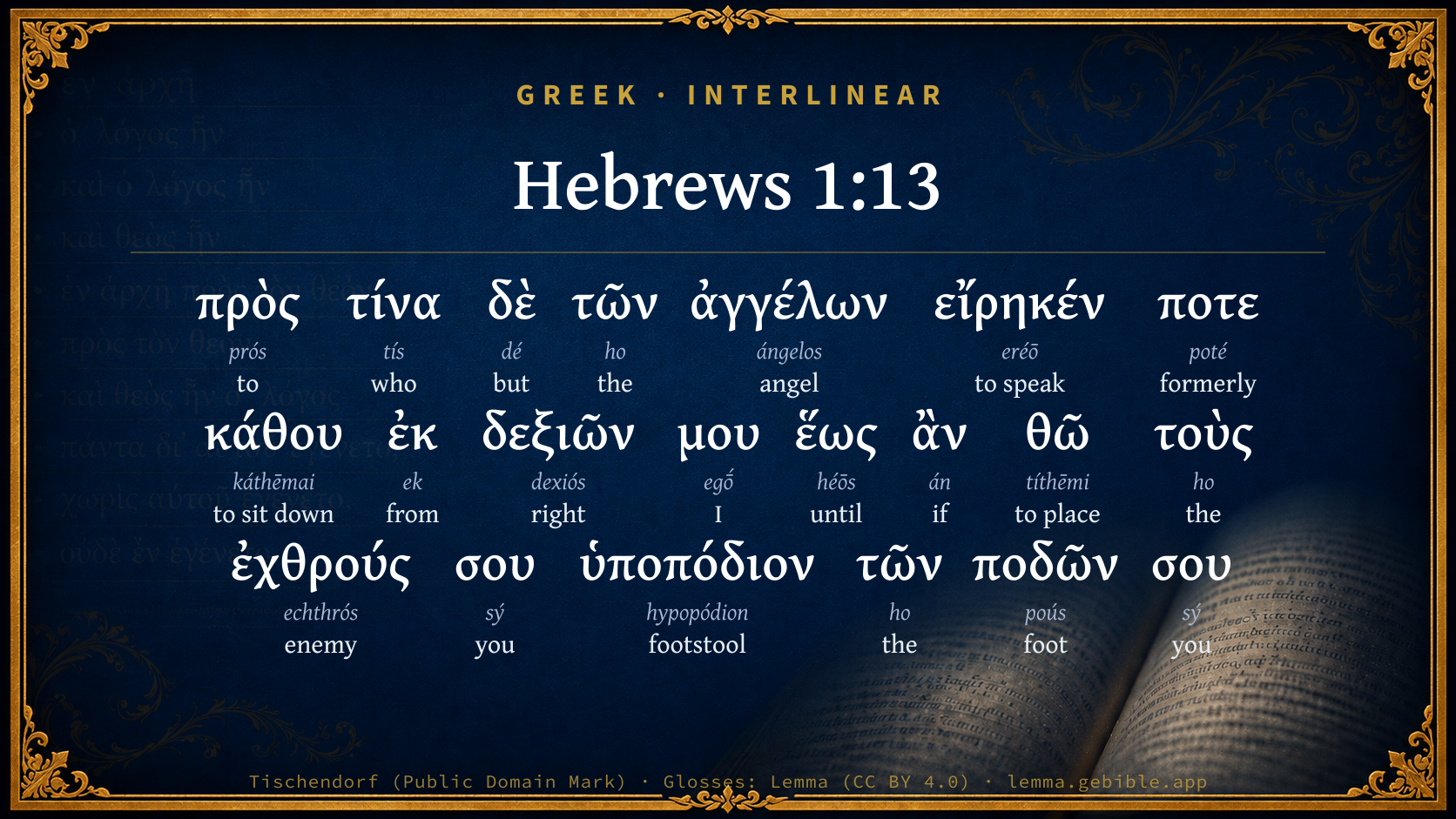
  1. πρὸς prós G4314 “to” Preposition
  2. τίνα tís G5101 “who” Interrogative pronoun, Accusative, Singular, Masculine
  3. δὲ dé G1161 “but” Conjunction
  4. τῶν ho G3588 “the” Article, Genitive, Plural, Masculine
  5. ἀγγέλων ángelos G32 “angel” Noun, Genitive, Plural, Masculine
  6. εἴρηκέν eréō G2046 “to speak” Verb, Perfect, Active, Indicative, 3rd person, Singular, Attic form
  7. ποτε poté G4218 “formerly” Particle
  8. κάθου káthēmai G2521 “to sit down” Verb, Present, Middle or Passive deponent, Imperative, 2nd person, Singular
  9. ἐκ ek G1537 “from” Preposition
  10. δεξιῶν dexiós G1188 “right” Adjective, Genitive, Plural, Masculine
  11. μου egṓ G1473 “I” Personal pronoun, 1st person, Genitive, Singular
  12. ἕως héōs G2193 “until” Adverb
  13. ἂν án G302 “if” Particle
  14. θῶ títhēmi G5087 “to place” Verb, Aorist, Active, Subjunctive, 1st person, Singular
  15. τοὺς ho G3588 “the” Article, Accusative, Plural, Masculine
  16. ἐχθρούς echthrós G2190 “enemy” Adjective, Accusative, Plural, Masculine
  17. σου sý G4771 “you” Personal pronoun, 2nd person, Genitive, Singular
  18. τῶν ho G3588 “the” Article, Genitive, Plural, Masculine
  19. ποδῶν poús G4228 “foot” Noun, Genitive, Plural, Masculine
  20. σου sý G4771 “you” Personal pronoun, 2nd person, Genitive, Singular

About this verse

These counts appear in no published source. They are computed here, from the morphology-tagged text and Lemma’s own curated glosses. What Lemma adds →

21
words
18
distinct lemmas
General Epistles
section

Notable vocabulary

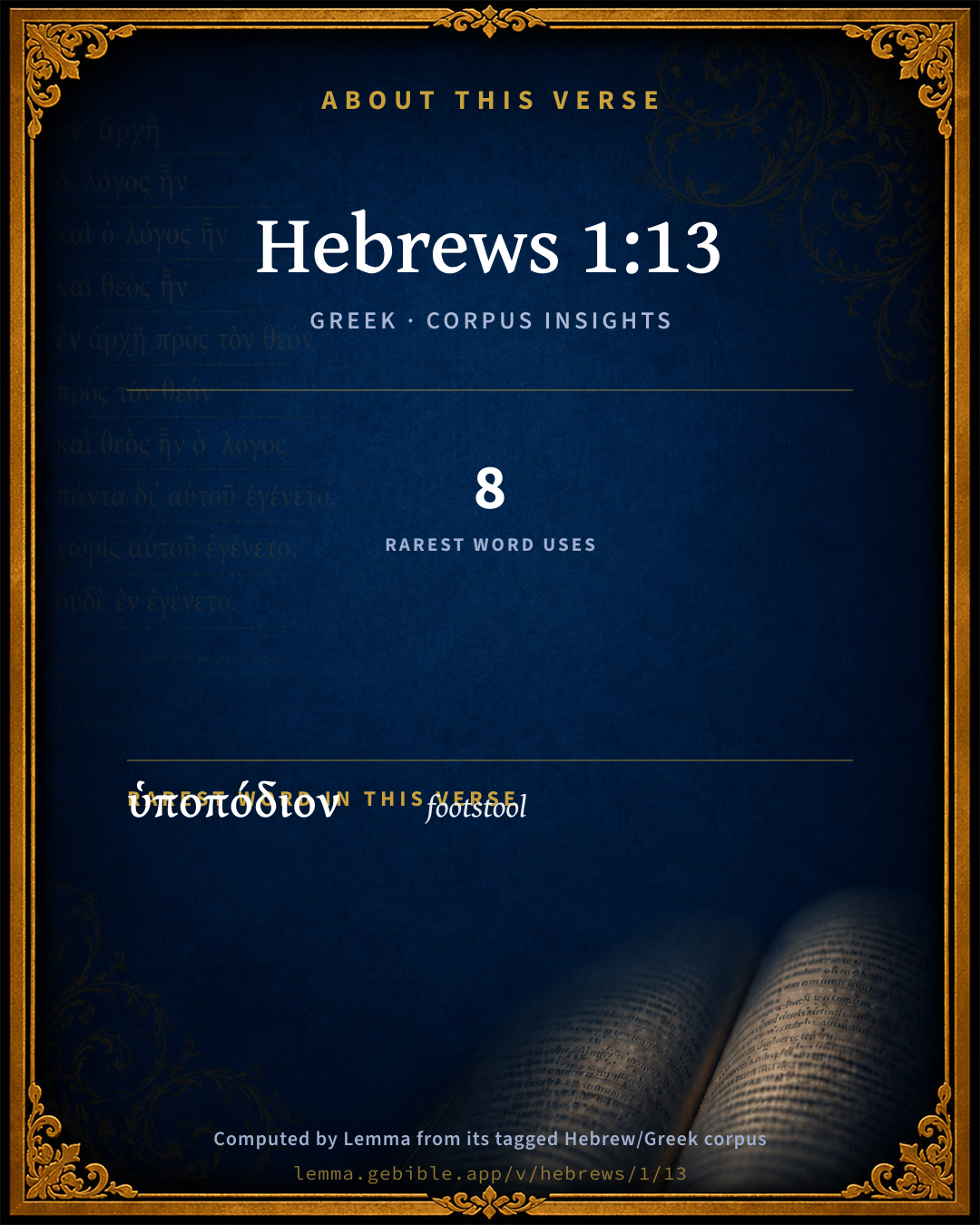
The rarest word here is ὑποπόδιον footstool G5286 — appearing just 8 times in the whole Greek New Testament.

Shared distinctive vocabulary

ὑποπόδιον footstool G5286 occurs in 8 verses of the Greek New Testament. Also found in:

Repetition

Words recur within this verse:

Cross-references

16

Topical passages linked to Hebrews 1:13 in the Treasury of Scripture Knowledge — connected by theme and wording, ordered by reader-vote popularity; previews shown in the World English Bible.

  • Psalms 110:1 Yahweh says to my Lord, "Sit at my right hand, Until I make your enemies your footstool for your feet."
  • Mark 12:36 For David himself said in the Holy Spirit, 'The Lord said to my Lord, Sit at my right hand, Until I make your enemies the footstool of your feet.'
  • Matthew 22:44 'The Lord said to my Lord, Sit on my right hand, Until I make your enemies a footstool for your feet?'
  • Hebrews 10:12–13 but he, when he had offered one sacrifice for sins for ever, sat down on the right hand of God;
  • Acts 2:34–36 For David didn't ascend into the heavens, but he says himself, 'The Lord said to my Lord, "Sit by my right hand,
  • 1 Corinthians 15:25–26 For he must reign until he has put all his enemies under his feet.
  • Hebrews 1:3 His Son is the radiance of his glory, the very image of his substance, and upholding all things by the word of his power, when he had by himself made purification for our sins, sat down on the right hand of the Majesty on high;
  • Psalms 132:18 I will clothe his enemies with shame, But on himself, his crown will be resplendant."
  • Luke 20:42 David himself says in the book of Psalms, 'The Lord said to my Lord, "Sit at my right hand,
  • Acts 7:55 But he, being full of the Holy Spirit, looked up steadfastly into heaven, and saw the glory of God, and Jesus standing on the right hand of God,
  • Revelation 19:11–21 I saw the heaven opened, and behold, a white horse, and he who sat on it is called Faithful and True. In righteousness he judges and makes war.
  • Psalms 21:8–9 Your hand will find out all of your enemies. Your right hand will find out those who hate you.
  • Joshua 10:24 It happened, when they brought forth those kings to Joshua, that Joshua called for all the men of Israel, and said to the chiefs of the men of war who went with him, Come near, put your feet on the necks of these kings. They came near, and put their feet on the necks of them.
  • Isaiah 63:3–6 I have trodden the winepress alone; and of the peoples there was no man with me: yes, I trod them in my anger, and trampled them in my wrath; and their lifeblood is sprinkled on my garments, and I have stained all my clothing.
  • Luke 19:27 But bring those enemies of mine who didn't want me to reign over them here, and kill them before me.'"
  • Revelation 20:15 If anyone was not found written in the book of life, he was cast into the lake of fire.

Cross-references courtesy of OpenBible.info (CC BY 4.0).

Commentary

Notes on Hebrews 1:13 from classic Christian and Jewish commentators (each source and its license shown beneath its notes). The classic Christian expositions comment on the surrounding passage and are grouped to its opening verse, so a note may address several verses; the Jewish commentaries on the Tanakh (Rashi and others) are per-verse, so they appear only where the commentator wrote on this verse.

Lemma curates 59 commentaries, every one of them public domain or Creative Commons licensed, each selected and text-cleaned for this edition rather than reprinted as found. About our sources →

Joseph Benson's Commentary

Heb 1:13. But to which of the angels said he at any time, Sit thou, &c. — In this interrogation a vehement negation is included; He said not at any time to any of the angels, as he said to his Son in the human nature, Psa 110:1. Sit thou on my right hand — Reign thou over the universe; till, &c. — He never spake these words, or the like, concerning them; there is no testimony to that purpose recorded in the whole book of God, the only means of such knowledge, and rule of our faith in such things. Our Lord (Mat 22:43) spake of it to the Pharisees as a thing certain, and allowed by all the Jewish doctors, that David wrote the cxth Psalm (from which this quotation is made) by inspiration of the Spirit, concerning Christ. This passage, therefore, is rightly applied to Christ by the writer of this epistle. See note on Psa 110:1. I make thine enemies thy footstool — The eastern princes used to tread on the necks of their vanquished enemies, in token of their utter subjection, Jos 10:24. And some of the more haughty ones, in mounting their horses, used their enemies as a footstool. This passage, therefore, is a prediction of the entire conquest of evil angels and wicked men, Christ’s enemies. Are they not all ministering spirits, &c. — The apostle having proved the pre- eminence of the Son, as Mediator of the new covenant, above all the angels, from the attributes of honour and glory that are ascribed to him in the Scripture, that he might not appear to argue merely in a negative manner, from what is not said concerning them, he adds here such a description of their natures and office, or employment as shows that indeed no such thing can be rightly affirmed concerning them, as he had before manifested to be spoken and recorded concerning the Son: 1st, As to their nature, they are πνευματα, spirits, or spiritual substances; not qualities, or natural faculties, as the Sadducees imagined: and 2d, As to their offices, they are πνευματα λειτουργικα, ministering spirits. So they are termed Psa 103:21. Bless the Lord all ye his hosts, λειτουργοι αυτου, ye ministers of his that do his pleasure. And how they execute their office we here learn. They are εις διακονιαν αποστελλομενα, sent forth unto a ministry: δια τους μελλοντας κληρονομειν σωτηριαν, on account, or for the sake of those that shall be heirs of salvation — Perhaps this is said in allusion to the Hebrew name of angels, which properly signifies messengers. The word all is here emphatical, denoting that even the highest orders of angels, dominions, thrones, principalities, and powers bow the knee and are subject to Jesus; ministering in the affairs of the world according to his direction. But although the Scriptures speak of all the angels as thus ministering, the word all does not imply that every individual angel is actually employed in this way, but that every one is subject to be so employed. It must be observed also, that the expression is not, sent forth to minister to, but δια, for — Or on account of; them who shall be heirs of salvation. And herein the harmony subsisting between both parts of God’s family is still preserved. As in the service of the church the ministers thereof do not, properly speaking, minister to man, but to the Lord in the behalf of men, (Act 13:2,) so is it with these spirits also; they are sent forth to minister for the good of men, but properly it is the Lord to whom they minister. His servants they are, not ours: rather, they are our fellow-servants. As all the servants of a king, though otherwise they greatly differ, agree in this, that they are all servants to the same person. Wherefore this passage affords no ground for believing that every heir of salvation has a guardian angel assigned him. Of the ministry of angels for the benefit of the heirs of salvation we have many examples both in the Old and in the New Testament.

Joseph Benson's Commentary on the Old and New Testaments (1811–1818) — public domain. Text from a community e-Sword module.

The Pulpit Commentary

But to which of the angels said he (properly, hath he said) at any time, Sit on my right hand, until I make thine enemies thy footstool? A final and crowning quotation is thus adduced, in the form in which the first quotation referring to the SON (ver. 5) had been introduced, to complete the view of his superiority to the angels. The quota-lion is from Psalm 110, the reference of which to the Messiah is settled beyond controversy to Christian believers, not only by its being quoted or alluded to more frequently than any other psalm with that reference in the New Testament, (Act_2:34 Act_7:55, 56 Rom_8:34 Eph_1:20-22 1Pe_3:22 Heb_1:3, Heb_1:13, 14 8:1 10:12, 13) and by the introduction of its language into the Church"s earliest Creeds, but also by the authority of our Lord himself, as recorded by all the three synoptical evangelists. (Mat_22:41 Mar_12:35 Luk_20:41) Hence readers of this Commentary will not require a confutation of the arguments of any modern rationalistic critics who have disputed the Messianic meaning of the psalm. Their arguments rest really on their a priori denial of a "spirit of prophecy" in the psalms generally; in their refusal to recognize, what the later prophets recognized, an unfulfilled ideal in what the psalmists wrote of theocratic kings. Let us once recognize fills, and we shall perceive in this psalm peculiar marks of the spirit of prophecy, reaching beyond any contemporary fulfillment, not only in the assignment to the King of a scat at the right hand of the heavenly throne, but also in his remarkable designation as a "Priest after the order of Melchizedek," of which more will be said under Hebrews 5 and Heb 7 of this Epistle. It is to be observed also how prophets, long after the psalm was written, regarded its ideal as still awaiting fulfillment; e.g. Daniel, (Dan_7:13, etc.) whose vision of the Son of man brought near before the Ancient of days, and having an everlasting dominion given him, is referred to by our Lord (Mat_26:64) in connection with the psalm, as awaiting fulfillment in himself; and Zechariah, (Zec_6:12, etc.) who takes up the idea of the psalm in speaking of the Branch, who was to unite in himself royalty and priesthood. The psalm is entitled, "A psalm of David." Though this title is prefixed to some psalms the contents of which suggest a later date, and is not, therefore, considered proof of authorship, it proves at least the tradition and belief of the Jews when the Hebrew Psalter was arranged in its existing form. But we have in this case evidence in the three Gospels of its universal acceptance as a psalm of David by the Jews in the time of our Lord; and, what is of more weight, of his having himself referred to it as such. The whole point of his argument with the Pharisees depends on the acknowledgment of David being the speaker, as well as of the Messiah being the Person spoken of. None of the Pharisees thought of disputing either of these premises; they were evidently received as indisputable; nor can it be conceived (as has been irreverently suggested) that our Lord did not thus give his own sanction to their truth. Nor, further, is there in the psalm itself any internal evidence against its Davidic authorship, though, but for the above testimony to the contrary, it might have been the composition of a prophet of David"s day, or written by David for use by his people the term, "my lord," having thus a primary reference to him. In either of these cases we might suppose the original conception of ver. 1 to have been that of David himself being enthroned on Zion at the side of the "King of glory" (Psalm 24) who had come in;" while ver. 4 might possibly have been suggested by David"s organization of the services of the tabernacle, and by the personal part he took in the ritual when the ark was removed to Zion. Even so, the quotation would answer the purpose of the argument according to the view of the drift of Messianic psalms which has been explained above. But, even independently of the distinct import of our Lord"s words, there are reasons (pointed out by Delitzsch) against the supposition of even a primary reference to David in the words, "my lord." Two may be mentioned:

(1) that the assignment of sacerdotal functions to an earthly king is contrary to the whole spirit of the Old Testament;

(2) that God"s own throne is elsewhere represented as, not in Zion, but above the heavens. Now, the conclusion thus arrived at, that David himself is speaking throughout the psalm of another than himself, gives a peculiar force to this final quotation, in that the Antitype is distinguished from and raised above the type more evidently than in other Messianic psalms. In others (as we have regarded them) the typical king himself is the primary object in view, though ideally glorified so as to foreshadow One greater than himself; here the typical king seems to have a distinct vision of the Messiah apart from himself, and speaks of him as his lord. It does not follow that David"s own position and circumstances did not form a basis for his vision. We perceive traces of them in "the rod of thy strength out of Zion," and in the picture which follows of the submission of heathen kings after warfare and slaughter. But vers. 1 and 4 point still to another than himself whom he foresees in the spirit of prophecy. The psalm begins, literally translated, "The voice or, "oracle," Hebrew of Jehovah to my lord, Sit thou on my right hand," etc. This sounds like more than a mere echo of Nathan"s message, the language being different and still more significant. And that such a vision of a future fulfillment of the promise was not foreign to the mind of David appears from his "last words", (2Sa_23:1, etc.) where also the significant word saun is used. And now, mark what the language of this "oracle" implies not merely the enthronement of the Son on Zion as God"s Vicegerent, but his session at the right hand of God himself, i.e. at the right hand of the Majesty on high;" God"s own throne being ever (as has been said above) regarded as above the heavens, or, if on earth, above the cherubim. Such, then, being the meaning of the oracle" (and it is the meaning uniformly given it in the New Testament), well may it be adduced as the final and crowning proof of the position above the angels assigned to the SON in prophecy.

Vers. 13, 14. The sovereignty of the Son and the service of the angels.

"But to which of the angels said he at any time," etc.? The writer is still treating of the preeminence of the Son over the angels; and he shows it in the facts that he is a Sovereign and they are servants.

I THE SOVEREIGNTY OF THE SON OF GOD. "But to which of the angels said he at any time, sit on my right hand until I make thine enemies thy footstool?" This quotation the writer makes from Psalm 110. This psalm is confessedly Messianic. It is frequently quoted in the New Testament as applying to our Lord. "And no psalm more clearly finds its ultimate reference and completion only in Christ." The quotation teaches that:

1. The Son is exalted to the mediatorial throne. "Sit thou on my right band." "He sat down on the right hand of the Majesty on high." (See our notes on "The exaltation of his position" as stated in ver. 3.)

2. He is exalted by the highest will. "But to which of the angels said he at any time," etc.? "The Lord said unto my Lord, Sit thou at my right hand," etc.; "Him God exalted with his right band to be a Prince and a Savior.

3. He is exalted with the sublimest expectation. "Till I make thine enemies the footstool of thy feet." Here are several points.

(1) Our Lord has enemies; e.g. ignorance, superstition, unbelief, vice, crime, wicked men, etc.

(2) These enemies will certainly be subjugated to him. Their subjugation is guaranteed by the Most High: "Till I make," etc.

(3) These enemies will be completely subjugated to him. "Thine enemies the footstool of thy feet." The reference is to the ancient custom of conquerors placing their feet upon the necks of vanquished nobles or princes in token of their complete subjection. (cf. Jos_10:24)

(4) He is waiting their subjugation with assured expectation.

II THE SERVICE OF THE ANGELS OF GOD. "Are they not all ministering spirits," etc.? Notice:

1. The nature of the angels. "Spirits." We do not enter upon the question whether angels are pure spirits or not. It seems to us that they are not without some form or vesture; that they are not "unclothed, but clothed upon." Their bodies are spiritual. "There is a natural body, there is also a spiritual body." Angelic forms are not gross and material, but refined and ethereal. They do not impede their activities or clog their aspirations, but are the exquisite vesture of their bring and the suitable vehicle of their power. (On the qualities of these spirits, see introduction of our homily on vers. 3, 4.)

2. The office of the angels. "Ministering spirits.

(1) They are servants of God. Alford: "The diakonia is not a waiting upon men, but a fulfillment of their office as diakonoi of God. " And Robert Hall: "They are not the servants of the Church, but the servants of Christ for the benefit of the Church." They are "ministers of his that do his pleasure". (Psa_103:20, Psa_103:21)

(2) They are servants of God on behalf of his people. "Sent forth to minister for them who shall be heirs of salvation;" or, "Sent forth for ministry on account of those who shall be heirs of salvation." Christians are called "heirs of salvation" because they "are children of God; and if children, then heirs; heirs of God, and joint-heirs with Christ". (Rom_8:14-17) And the salvation which they shall inherit is not mere deliverance from danger or release from the penalty of sin; but complete and everlasting salvation; transformation into the image and participation in the blessedness of the Lord. Unto these children of God angels minister. The nature of their ministry in ancient times we are able to gather from the Bible; e.g. to Lot; (Ge 19) to Elijah; (1Ki_19:4-8) to Elisha; (2Ki_6:16, 2Ki_6:17) to Daniel; (Dan_6:22 Dan_9:20-27 Dan_10:10-21) to Zacharias; (Luk_1:11-20) to Mary; (Luk_1:26-38) to the shepherds; (Luk_2:9-14) to Mary Magdalene and other women; (Luk_24:4-7 Joh_20:11-13) to the apostles immediately after the Ascension; (Act_1:10, Act_1:11) to the apostles in prison; (Act_5:19, Act_5:20) to St. Peter; (Act_12:7-10) to St. Paul. (Act_27:23, Act_27:24) They also ministered to our Lord after his temptation in the wilderness, (Mat_4:11) and in his agony in Gethsemane. (Luk_22:43) And there are statements of Holy Scripture which bear upon their ministry. "The angel of the Lord encampeth round about them that fear him," etc.; (Psa_34:7) "He shall give his angels charge over thee," etc. (Psa_91:11, Psa_91:12) They minister to us now chiefly by their influence upon our spirits. They quicken within us true thoughts and pure feelings; they help us to detect Satanic suggestions and to repel Satanic solicitations; they inspire the timid with courage, and whisper hope to the despondent" And the wearied heart grows strong, As an angel strengthened him, Fainting in the garden dim "Neath the world"s vast woe and wrong. (Johann Rist.)

They suggest caution and watchfulness to the unwary; by their serene invisible presence they solace the sufferer; and they serve about the dying bed of the saint, and convey the emancipated spirit to its heavenly rest. "Lazarus... was carried by the angels into Abraham"s bosom.

(3) They are commissioned by God for this service. He appoints to each one his sphere of ministry; and by him they are "scat forth" to fulfill their commissions. "Oh, th" exceeding grace Of highest God that loves his creatures so, And all his works with mercy doth embrace, That blessed angels he sends to and fro. To serve to wicked man, to serve his wicked foe. "How oft do they their silver bowers leave, To come to succor us that succor want! How oft do they with golden pinions cleave The flitting skies, like flying pursuivant, Against foul fiends to aid us militant! They for us fight, and watch, and duly ward, And their bright squadrons round about us plant; And all for love, and nothing for reward. Oh, why should heavenly God to men have such regard? (Spenser.)

CONCLUSION. Learn:

1. The dignity of the Christian. Angels minister unto him. God cares for him; for he sends forth the angels to promote his interests.

2. The dignity of service. Angels, the highest orders of created beings, serve God by ministering unto little children, distressed Christians, and afflicted saints.

3. The supreme dignity of the Son of God. He "came not to be ministered unto, but to minister, and to give his life a ransom for many;" and now he "is on the right hand of God, having gone into heaven; angels and authorities and powers being made subject unto him," Well does Dr. J. H. Newman say, "When we survey Almighty God surrounded by his holy angels, his thousand thousands of ministering spirits, and ten thousand times ten thousand standing before him, the idea of his awful majesty rises before us more powerfully and impressively. We begin to see how little we are, how altogether mean and worthless in ourselves, and how high he is and fearful. The very lowest of his angels is indefinitely above us in this our present state; how high, then, must be the Lord of angels! The very seraphim hide their faces before his glory, while they praise him; how shamefaced, then, should sinners be when they come into his presence! W.J.

Vers. 13, 14. The contrast between our Lord and the angels reappears in the impressive quotation from Psalm 110, which is so entirely Messianic that it is alluded to no less than ten times in the range of the New Testament. It affirms the superiority and supremacy of our Lord in so conclusive a manner that no ingenuity of perverse interpretation can successfully apply it to any monarch, priest, or warrior whatsoever. All enemies who steadfastly resist his claim must be overthrown by his righteous and sovereign might. Some have been brought down and are now under his feet. Rebellious Jerusalem was overthrown. Western idolatries have left their witness to his power in broken columns and deserted temples. Hereafter systems of evil, false philosophies corrupt institutions, impenitent and irreconcilable men, and probably some nations, must yield to his judicial sentence and final punishment. Some things he will dash in pieces like a potter"s vessel. He sits at the right hand of the Father; but the angels are ministering spirits, and go forth at his bidding to assist and protect those who shall in time enjoy the fullness of salvation. B.

The Pulpit Commentary (1880–1919), ed. H.D.M. Spence-Jones & Joseph S. Exell — public domain. Text from a community e-Sword module.

Tyndale Open Study Notes

Tyndale Open Resources

1:13 In climactic fashion, the author ends his string of Old Testament quotations (see study note on 1:5-14) by quoting from Ps 110:1 in celebration of Christ’s exaltation (see also study notes on Luke 20:42-43; 22:69; 1 Cor 15:25; Eph 1:19-22). • The image of the Son’s enemies as a footstool under his feet represents their absolute subjugation (see Heb 2:8). In the ancient world, a victorious king would place his foot on the neck or back of an enemy as a symbolic act of domination.

Tyndale Open Study Notes — © Tyndale Open Resources, licensed CC BY-SA 4.0. Text via the HelloAO Bible API.

Bengel's Gnomon

Johann Albrecht Bengel

Heb 1:13. Δὲ, but) An Epitasis. [See Append.]

Bengel's Gnomon of the New Testament — English translation (T&T Clark, Edinburgh, 1860) — public domain. Text from a community e-Sword module.

Meyer's Critical & Exegetical Commentary

Heinrich August Wilhelm Meyer

Heb_1:13. Further citation from Psa_110:1, according to the LXX. The psalm was looked upon universally in the time of Christ (comp. Mat_22:44 ff.; Mar_12:35 ff.; Luk_20:41 ff.), and also in later times by many Rabbins (see Wetstein on Mat_22:44), as a prophecy relating to the Messiah; inasmuch as on the ground of the superscription לְדָוִד David himself was regarded as the author of it, and in connection with this view the reference to the Messiah was easily proved on the ground of the words at the beginning: to my Lord speaketh Jehovah, according to which David acknowledges, in addition to his God, also a Lord over him. The superscription לְדָוִד, nevertheless, indicates not the writer, but the subject of the psalm. It is in its historic sense an oracle pronounced to David, when the latter was preparing for war against his powerful foes. See Ewald on the Psalm.

πρὸς τίνα δέ] δέ he in the third place, as often occurs after prepositional combinations. Comp. Klotz, ad Devar. p. 378 f.; Hartung, Partikellehre, I. p. 190 f.; Ellendt, Lexic. Soph. I. p. 397; Winer, Gramm., 7 Aufl. p. 519.

The sitting at the right hand, figure of the highest honour and dominion, see on Heb_1:3.

ὑποπόδιον τῶν ποδῶν σου] the footstool of Thy feet. There lies in the expression an allusion to the custom of the victor of placing his foot upon the neck of the vanquished, in token of the complete subjection of the latter; comp. Jos_10:24.

ὑποπόδιον] first used in the Greek of a later age. Comp. Sturz, de dial. Alex. et Maced. p. 199.

Meyer — Critical and Exegetical Commentary on the New Testament — English translation by Peter Christie, edited by Frederick Crombie (T&T Clark, 1880) — public domain. Text from a community e-Sword module.

Jamieson, Fausset & Brown

Robert Jamieson, A. R. Fausset & David Brown

Quotation from Psa 110:1. The image is taken from the custom of conquerors putting the feet on the necks of the conquered (Jos 10:24-25).

Jamieson, Fausset & Brown — Commentary Critical and Explanatory on the Whole Bible (1871) — public domain (CC PDM 1.0). Text via the HelloAO Bible API.

Adam Clarke's Commentary

Verse 13. But to which of the angels] We have already seen, from the opinions and concessions of the Jews, that, if Jesus Christ could be proved to be greater than the angels, it would necessarily follow that he was God: and this the apostle does most amply prove by these various quotations from their own Scriptures; for he shows that while he is the supreme and absolute Sovereign, they are no more than his messengers and servants, and servants even to his servants, i.e. to mankind.

Adam Clarke's Commentary on the Bible (1810–1826) — public domain. Text from a community e-Sword/MySword module.

John Calvin's Commentaries

13. But to whom of the angels, etc. He again by another testimony extols the excellency of Christ, that it might hence be evident how much he is above the angels. The passage is taken from Psalms 110:1, and it cannot be explained of any but of Christ. For as it was not lawful for kings to touch the priesthood, as is testified by the leprosy of Uzziah; and as it appears that neither David, nor any other of his successors in the kingdom, was ordained a priest, it follows, that a new kingdom as well as a new priesthood is here introduced, since the same person is made a king and a priest. Besides, the eternity of the priesthood is suitable to Christ alone.

Now, in the beginning of the Psalm he is set at God’s right hand. This form of expression, as I have already said, means the same, as though it was said, that the second place was given him by the Father; for it is a metaphor which signifies that he is the Father’s vicegerent and his chief minister in exercising authority, so that the Father rules through him. No one of the angels bears so honorable an office; hence Christ far excels all.

Until I make, etc. As there are never wanting enemies to oppose Christ’s kingdom, it seems not to be beyond the reach of danger, especially as they who attempt to overthrow it possess great power, have recourse to various artifices, and also make all their attacks with furious violence. Doubtless, were we to regard things as they appear, the kingdom of Christ would seem often to be on the verge of ruin. But the promise, that Christ shall never be thrust from his seat, takes away from us every fear; for he will lay prostrate all his enemies. These two things, then, ought to be borne in mind, — that the kingdom of Christ shall never in this world be at rest, but that there will be many enemies by whom it will be disturbed; and secondly, that whatever its enemies may do, they shall never prevail, for the session of Christ at God’s right hand will not be for a time, but to the end of the world, and that on this account all who will not submit to his authority shall be laid prostrate and trodden under his feet

If any one asks, whether Christ’s kingdom shall come to an end, when all his enemies shall be subdued; I give this answer, — that his kingdom shall be perpetual, and yet in such a way as Paul intimates in 1 Corinthians 15:25; for we are to take this view, — that God who is not known to us in Christ, will then appear to us as he is in himself. And yet Christ will never cease to be the head of men and of angels; nor will there be any diminution of his honor. But the solution of this question must be sought from that passage.

John Calvin's Commentaries (1540-1563) — public domain. Text from the Calvin Translation Society English edition (1840s-50s) via the Christian Classics Ethereal Library (ccel.org). Calvin's coverage is partial (roughly two-thirds of the Bible); uncommented books and verses are honest gaps, never fabricated. The 19th-century editor's footnotes and remarks are omitted so the notes are faithfully Calvin's own voice.

Ellicott's Commentary for English Readers

(13) But to which of the angels.—The final appeal is made to that Psalm which more frequently than any other is quoted in reference to Christ, and which we have already seen to be the source of all the New Testament references to the Saviour’s session at the right hand of God. It is not necessary to say much here respecting Psalms 110, to which so many allusions will be made in the course of this Epistle. That it was regularly understood by the Jews of our Lord’s time to be a Messianic Psalm is clear both from Mat_22:43-44, and from the independent notices which we possess. Most probably, it stands alone amongst the Psalms as being simply prophetic: the words of Heb_1:1 have never been addressed either to angels or to an earthly king. On the special words of the quotation see Heb_1:3.

Said he at any time.—Better, hath He ever said.

Until I make . . .—Literally, until I shall have made Thine enemies a footstool of Thy feet.

A Bible Commentary for English Readers, edited by Charles John Ellicott (1878–1897) — public domain. Text from a community e-Sword module.

The Cambridge Bible for Schools and Colleges

gen. ed. J. J. S. Perowne

13. until I make thine enemies thy footstool] This same passage from Psa_110:1 had been quoted by our Lord, in its Messianic sense, to the Scribes and Pharisees, without any attempt on their part to challenge His application of it (Mat_22:41-44). It is also referred to by St Peter in Act_2:34 and by St Paul (1Co_15:25). The Greek expression for “till” implies entire indefiniteness of time. The reference is to the oriental custom of putting the feet on the necks of conquered kings (Jos_10:24).

The Cambridge Bible for Schools and Colleges (gen. ed. J. J. S. Perowne; Cambridge University Press, 1878–1918) — public domain. Text from a community e-Sword module.

John Gill's Exposition

But to which of the angels said he at any time,.... That is, he never said to any of them in his council, or covenant; he never designed to give them any such honour, as hereafter expressed; he never promised it to them, or bestowed it on them; he never called up any of them to so high a place, or to such a dignity:

sit on my right hand, until I make thine enemies thy footstool; yet this he said to his Son, Psa 110:1 for to him, the Messiah, are they spoken, and have had their fulfilment in him: See Gill on Mat 22:44; and therefore he must be greater than the angels.

John Gill's Exposition of the Whole Bible (1746–1763) — public domain (CC PDM 1.0). Text via the HelloAO Bible API.

Trapp's Complete Commentary

John Trapp

13 But to which of the angels said he at any time, Sit on my right hand, until I make thine enemies thy footstool?

Ver. 13. Sit on my right hand] As mine equal in honour and power. It seems to be a metaphor from some king, who, having an only begotten, lets him in the throne as heir and successor to reign with him, and use right of dominion over all as partner in the empire. Thus David dealt by Solomon, Vespasian by Titus, and our Henry II by his eldest son Henry, whom he crowned while he was yet alive; though afterwards he suffered him not to be what himself had made him.

Until I make thine enemies, &c.] Till the mystery of man’s redemption be finished, death the last enemy destroyed, 1Co 15:26, the saints perfected and placed at his right hand, Mat 25:33; Rev 3:21; Psa 45:1-17.

John Trapp, A Commentary or Exposition upon All the Books of the Old and New Testament (1647–1656) — public domain. Text from a community e-Sword module.

Albert Barnes' Notes on the Bible

But to which of the angels - The apostle adduces one other proof of the exaltation of the Son of God above the angels. He asks where there is an instance in which God had addressed any one of the angels, and asked him to sit at his right hand until he should subdue his enemies under him? Yet that high honor had been conferred on the Son of God; and he was therefore far exalted above them. “Sit on my right hand;” see notes on Heb 1:3. This passage is taken from Psa 110:1, a Psalm that is repeatedly quoted in this Epistle as referring to the Messiah, and the very passage before is applied by the Saviour to himself, in Mat 22:43-44, and by Peter it is applied to him in Act 2:34-35. There can be no doubt, therefore, of its applicability to the Messiah. “Until I make thine enemies thy footstool.” Until I reduce them to entire subjection. A footstool is what is placed under the feet when we sit on a chair, and the phrase here means that an enemy is entirely subdued; compare notes on 1Co 15:25. The phrase “to make an enemy a footstool,” is borrowed from the custom of ancient warriors who stood on the necks of vanquished kings on the occasion of celebrating a triumph over them as a token of their complete prostration and subjection; see notes on Isa 10:6. The enemies here referred to are the foes of God and of his religion, and the meaning is, that the Messiah is to be exalted until all those foes are subdued. Then he will give up the kingdom to the Father; see notes on 1Co 15:24-28. The exaltation of the Redeemer, to which the apostle refers here, is to the mediatorial throne. In this he is exalted far above the angels. His foes are to be subdued to him, but angels are to be employed as mere instruments in that great work.

Albert Barnes' Notes on the Bible (1834–1885) — public domain. Text from a community e-Sword/MySword module.

Haydock's Catholic Bible Commentary

Sit on my right hand, &c. The ancient Jews themselves understood this 109th psalm of their Messias, nor could they answer Christ’s words, (Matthew xxii. 45.) when he shewed them by these same words, that their Messias was not only the Son of David, but also the Lord of David, of whom it was said: the Lord said to my Lord, sit thou on my right hand, until I make thy enemies thy footstool. See also 1 Corinthians xv. 52. and in this epistle, Chap. x. 13. --- Are they not all ministering spirits? &c. The apostle, in this chapter, not only shews how much the dignity of Christ is superior to that of the highest Angels, but also his divinity; and that he is both true God and true man, as the ancient Fathers took notice against the Arians. (Witham) --- The holy Angels, says St. Augustine, to whose society we aspire, help us without difficulty, because their notion is pure and free. (De Civit. lib. 11. chap. xxxi.) Having then Jesus Christ for our advocate and mediator at the right hand of God, and his Angels for our guardians, ministering spirits, what can we wish for more?

George Leo Haydock (1774–1849), Haydock's Catholic Family Bible and Commentary, 1859 edition — public domain. Excludes Psalms (Douay-Rheims chapter numbering differs from Protestant) and Deuterocanonical books (Catholic canon only).

Matthew Poole's English Annotations

But to which of the angels said he at any time? This introduceth the last demonstration of the gospel Minister’s pre-eminency for state, office, and name, above angels. The form is thus; He that is God’s fellow, and right-hand man, is more excellent, and hath a better name, than those who are only ministers to his saints. This is to be the state of Christ he proves here; for to none of the angels did Jehovah ever say this, he never gave them that honour by his word. It is an interrogatory challenge to the Hebrews to produce that text in Scripture, which doth assert, that at any time, in any place, God gave such an honorary word to angels: this was impossible for them to do. Though God the Father never said this to any angel, yet did he say this, and records it in the Scripture, to the Lord Christ. And it was a word to him constitutivum rei, fixing the very thing. This is recorded in Psa 110:1, where God’s powerful word settled Christ in the honour, glory, and dignity of universal lordship over angels and men, so as to reign over them, 1Co 15:25; which administration he is now in the flesh solemnly managing at the right hand of his Father, Heb 1:3, ever since his ascension, and so is to continue.

Sit on my right hand, until I make thine enemies thy footstool; during all the time of this world, until by his power he reduce, subdue, and subjugate all to him, even every thing and person that should be adverse to his sovereign person and kingdom, all devils and men, subjugating of them to the basest condition, to be trod under his feet, as mire in the street, utterly destroying them, when he glorifieth his saints, 2Th 1:7-10. The term of this word

until doth not denote the end of his reign, as if after this he should not reign, but is declarative of his reign all the time before: though his enemies were many and strong, yet it is said, 1Co 15:24,28, that then he shall deliver up the kingdom to his Father. As to his natural kingdom, which is his as God the Son, that is, equally enjoyed with the Father, and that for ever, there is no end of it; but as to his mediatory kingdom, given him by choice, and in a special manner appropriated to him as God-man for his season, this, when his work is done, and all his enemies subdued, he will resign unto the Father, that God may be all in all.

Matthew Poole's English Annotations on the Holy Bible (1683–1685) — public domain. Text from a community e-Sword/MySword module.

Whedon's Commentary on the Bible

Daniel D. Whedon

13. Sit on my right hand—Words applicable to Christ’s exaltation at his ascension. See notes on Heb_1:3; Mat_28:18.

Until—During the interval between that ascension and the completion of the work of his second coming.

Make… footstool—Note on Act_2:35. This is to be being accomplished during the present dispensation, and fully accomplished at the final judgment.

Daniel D. Whedon (gen. ed.), Commentary on the Old and New Testaments (1874–1909) — public domain. Text from a community e-Sword module.

John Wesley's Explanatory Notes

Psalm cx, 1.

John Wesley, Explanatory Notes Upon the Whole Bible (1754–1765) — public domain. Text via the GEBible commentary corpus.

Burkitt's Expository Notes on the New Testament

William Burkitt

This verse contains a farther proof of Christ’s pre-eminence above the angels, and that he is in reality the Son of God; namely, because he sits in the quality of a Son, at the right hand of God the Father; equal to him in dignity, power, and glory, commanding all the visible and invisible world, most easily, yet irresistibly; though gradually, subduing his enemies to a consummate and complete victory.

To which of the angels said he at any time? The words are an interrogation, which have the force of a vehement negation: and imply that God the Father did never say this to any of the angels, nor put such honour upon any of them, as to say, Sit on my right hand until I make thy foes thy footstool; but to Christ he said it, Psa 110:1. The Lord said unto my Lord, Sit thou on my right hand, until I make thine enemies thy footstool.

Learn hence, 1. That Jesus Christ is a spiritual King; and as such has many enemies to his kingdom and government. Sin is an enemy to Christ and his kingcom; and makes an universal opposition to Christ and his government; Satan is a sworn enemy to Christ and his throne, and he exerts his enmity temptations and persecutions. The world is an enemy also in the things of it, in the men of it, in the rule of it. The law is an enemy to Christ and his kingdom, not absolutely, but accidentally, by reason of the consequences that attend it. It slays them, Rom 7:9-11 which is the work of an enemy. In a word, death, the grave, and hell, are Christ’s enemies.

2. All Christ’s enemies shall, in Christ’s time, be made his footstool they are conquering now initially and gradually, they shall be conquered ere long finally and perfectly; and all his people shall be made complete sharers in his victory and conquest.

3. Christ’s sitting at God’s right hand, in a certain and assured expectation of having his foes become his footstool, is an undoubted proof of the divinity of his person, and that he is essentially and really God. To none of the angels, or any of the creatures, said he, at any time, Sit on my right hand; but to the Son he said, Sit on my right hand, &c.

William Burkitt's Expository Notes on the New Testament (1700–1703) — public domain. Text from a community e-Sword module.

Godbey's Commentary on the New Testament

William B. Godbey

13...”Sit Thou on my right hand until I make Thy enemies Thy footstool.” This verse reveals the congratulation of the So by the Father when He flew up from Mt. Olivet, having triumphed on the cross and victoriously evacuated the sepulcher, thus having gloriously consummated the expiatory work, for whose execution He evacuated His celestial throne. This gushing, welcome reception on the part of the Father was an indisputable confirmation of His perfect satisfaction with the work wrought by His son, vindicatory of the violated law, and expiatory of a guilty world. Therefore, the Father actually crowns Him mediatorial King forever, having the sole and perfect right to rule this world in righteousness and live through all eternity. Jesus is Prophet, Priest and King simultaneously. Yet these offices have their respective periods of predominance. While on earth, His prophetic office predominated, and He was the most indefatigable preacher the world ever saw. When He offered up His body on the cross, a sacrifice for the whole world, His official High Priesthood became predominant, and has so continued ever since, and will be pre-eminent till he descends on His royal throne, to inaugurate the millennial reign. Then His Kingship will rise pre-eminent, brighten through the millennial ages, and sweep on through all eternity. Since the Son has actually redeemed this world by His blood, and conquered it by His heroic labor and suffering, He has the sole right to possess and rule it forever. Therefore, it is the province of the Fatter as the executive of the Diving Government, to enforce the claim of His Son over all the kingdoms of the earth. Consequently, in His royal, Fatherly, congratulatory reception, He says, “Well done, my Son; sit down on the mediatorial throne till I make all of thine enemies thy footstool.” This the Father has been faithful to do in His castigatory judgments against wicked nations in all ages, but the grand finale of this fulfillment will be consummated during the great Tribulation.

“I beheld till the throne was cast down and the Ancient of days did sit, whose garment was white as snow, and the hair of His head like pure wool; His throne was like the fiery flame, and his wheels as burning fire. A fiery stream issued and came forth before Him; a thousand thousands ministered unto Him, and ten thousand times ten thousand stood before Him: the judgment was set, and the books were opened.” (Dan 7:9-10)

I saw in the night visions, and behold, one like the Son of man came with the clouds of heaven, and came to the Ancient of days, and they brought Him near before Him. And there was given Him dominion and glory and a kingdom that all people, nations and languages should serve Him; His dominion is an everlasting dominion which shall not pass away, and His kingdom that which shall not be destroyed.” (Dan 7:13-14)

We see clearly and unequivocally in these visions of Daniel the final and summary fulfillment of the Father’s promise to the Son, to make His enemies His footstool. We see clearly how the Father will come down in the great Tribulation and shake every potentate from his throne, both political and ecclesiastical, thus preparing the way for the universal reign of His Son. “I beheld till the thrones were cast down.” The connection shows plainly and positively that these thrones are none other than all the dominions of this world, both political and ecclesiastical. Whiteness signifies the perfect purity of God and His administration. Fire, throughout the Bible, symbolizes destruction. No one will question that the Ancient of days means the Father, in contradistinction to the Son. Now remember, the Father has no incarnation. Hence, He will be utterly invisible, though present on the earth in His awful castigatory judgments. While the Ancient of days will be invisible, Antichrist will rise, visible to mortal eyes, and lead myriads after him to perdition. The “horn” here mentioned means the pope, who will be Antichrist in the Tribulation, speaking “great words.” “I beheld till the beast was slain and his body given to the burning flame.” Beast here means human government in contradistinction to the Theocracy. The fact that the beast was slain and his body given to the burning flame, can mean nothing less than the utter destruction of all human kingdoms. God’s original plan was to rule the world by righteousness, love and wisdom, both in state and church. When the people became so wicked as to utterly reject the divine government they set up governments of their own, ruled by men instead of God. The Holy Ghost constantly in the prophecies designates them “wild beast governments.” The Greek word theerion, meaning a cruel, bloodthirsty wild beast, is constantly used by the Holy Ghost to designate human governments. This is strictly pertinent, because they all rule by brute force, selfish and cruel as the grave. These wild beast powers have already killed enough people in wars to populate the globe fourteen times. Still the people, blinded by the devil, hold on to the wild beast, and reject God who has always wanted to rule the world in peace, righteousness and love. Theologians have generally applied these prophecies to the final judgment, which is utterly untrue, because here we see the Ancient of days, i.e., the Father, presides; whereas in the final judgment, at the end of time, the Son will encumber the judgment seat. You clearly see the connection of the Son and the Father, in the execution of these judgments. The Father comes and casts down all human thrones, destroys all human power, political and ecclesiastical, for Babylon falls meanwhile (Rev 18:2), and with her all human ecclesiasticism goes down. Since the Son of God has the sole right to the sovereignty of this world, in both church and state, all human governments, both political and ecclesiastical, which are not really subordinated to divine rule, are His uncompromising enemies, and destined to fall beneath His conquering tread. In these prophecies you plainly see the Father descending in His awful retributive judgments, and preparing the whole world for the reign of His Son. After which the Son rides down on the throne of His glory and enters upon the millennial reign.

“But the saints of the Most High shall take the kingdom and possess the kingdom forever, ever’ forever and ever.” (Dan 7:8)

“Until the Ancient of days came, and judgment was given to the saints of the Most High; and the time came that the saints possessed the kingdom.” (Dan 7:22)

Away with the popular theology which construes this to be the spiritual kingdom. Common sense teaches you that every saint has already received the spiritual kingdom, otherwise he could not be a saint. There is no possible evasion of the conclusion that “the kingdom” here means the government of the world, political and ecclesiastical. Christ will rule the world during the millennial ages through the instrumentality of His transfigured saints. Since He is to encumber the final judgment throne, and then reign over the sanctified, renovated and celestialized world forever, “to His kingdom there will be no end.” Hence, you see the pertinency of the declaration that the saints will “possess the kingdom forever, even forever and ever.”

William B. Godbey, Commentary on the New Testament (1896–1900) — public domain. Text from a community e-Sword module.

The People's New Testament

B. W. Johnson

13, 14. Sit thou on my right hand. Quoted from Ps. 110:1. Make thy enemies thy footstool. The custom is alluded to of putting the feet on the necks of conquered enemies. See Josh. 10:24, 25. This passage is applied to Christ in Acts 2:35, and in 1 Cor. 15:25.

B. W. Johnson's The People's New Testament with Notes (1889–1891) — public domain. Electronic text from the Christian Classics Ethereal Library (CCEL) ThML edition.

unfoldingWord translationNotes

Door43 World Missions Community

General Information:

This quotation comes from another Psalm.

But to which of the angels has God said at any time ... feet"?

The author uses a question to emphasize that God has never said this to an angel. AT: "But God has never said to an angel at any time ... feet.'" (See: Rhetorical Question)

Sit at my right hand

To sit at the "right hand of God" is a symbolic action of receiving great honor and authority from God. AT: "Sit in the place of honor beside me" (See: Symbolic Action)

until I make your enemies a stool for your feet

Christ's enemies are spoken of as if they will become an object on which a king rests his feet. This image represents defeat and dishonor for his enemies. (See: Metaphor)

Are not all angels spirits ... inherit salvation?

The author uses this question to remind the readers that angels are not as powerful as Christ, but they have a different role. AT: "All angels are spirits who ... inherit salvation." (See: Rhetorical Question)

for those who will inherit salvation

Receiving what God has promised believers is spoken of as if it were inheriting property and wealth from a family member. AT: "for those whom God will save" (See: Metaphor)

translationWords

angel

right hand

inherit

save

unfoldingWord translationNotes — © Distant Shores Media and the Door43 World Missions Community, licensed CC BY-SA 4.0. Source: git.door43.org/Door43/en_tn.

Cambridge Greek Testament for Schools and Colleges

13. ὑποπόδιον. This same passage from Psa 110:1 had been quoted by our Lord, in its Messianic sense, to the Scribes and Pharisees, without any attempt on their part to challenge His application of it (Mat 22:41-44). It is also referred to by St Peter in Act 2:34 and by St Paul (1Co 15:25). The Greek expression for “till” (ἕως ἂν) implies entire indefiniteness of time. The reference is to the oriental custom of putting the feet on the necks of conquered kings (Jos 10:24).

Cambridge Greek Testament for Schools and Colleges (Cambridge University Press, 1896; 21 vols, various authors incl. Carr, Maclear, Plummer, Farrar, Lumby, Moule, M. R. James, Simcox) — public domain. Text from a community e-Sword module.

Alford’s Greek Testament

Henry Alford

13.] But (the contrast is again taken up from ver. 8. δέ is often found after the second word of a sentence and even later, when a preposition begins it: so κατὰ πόλεις δέ, Herod. viii. 68. 2: ἐν τοῖς πρῶτοι δέ Ἀθηναῖοι, Thuc. i. 6:.… οὐχ ὑπὸ ἐραστοῦ δὲ κ.τ.λ., Plato, Phædr. 227 d: ξὺν τύχῃ δὲ πρόσφερε, Soph. Philoct. 764: πρὸς κακῶν δʼ ἀνδρῶν μαθών, ib. 959: ἐν νυκτὶ δυσκύμαντα δʼ ὠρώρει κακά, Æsch Agam. 653. See also other cases without the prepositional construction, in Klotz ad Devar. p. 379: Hartung, Partikellehre, i. p. 190: the account to be given being, that the particle may be thus postponed, whenever for any reason the previous words can be considered as one) to whom of the angels hath He (God, as before) ever said, Sit thou on my right hand (see above on ver. 3. The phrase ἐκ δεξιῶν is not found in classical writers: but we have in Diod. Sic. iv. 56, τὴν γῆν ἔχοντας ἐξ εὐωνύμων. It is very common of standing or sitting or being on the right hand of another, in Hellenistic Greek: see reff.) until I place thine enemies (as) a footstool (ὑποπόδιον, a word of later Greek, found in Athenæus, v. p. 192 e, ὁ γὰρ θρόνος.… ἐλευθέριός ἐστι καθέδρα σὺν ὑποποδίῳ: and xii. p. 514 f., Sextus Empir., al. The allusion is to the custom of putting the feet on the necks of conquered enemies, see Jos 10:24 f.) of thy feet? Hardly any Psalm is so often quoted in the N. T. with reference to Christ, as Psa 110. And no Psalm more clearly finds its ultimate reference and completion only in Christ, as even those confess, e. g. Bleek and De Wette, who question its being immediately addressed to Him at first: and regard the argument of our Lord to the Pharisees, founded on this place, as merely one ‘ex concesso.’ On the theocratic principle of interpretation, there is not the slightest difficulty in the application of the words directly to Him who is (and was ever regarded, even in David’s time, as Ebrard well shews against Bleek) Israel’s King, the Head and Chief of the theocracy.

And see this further carried out in the note on ch. 5:6. Delitzsch, in loc., has devoted several pages to the discussion of the subject and arrangement of the Psalm.

Henry Alford, The Greek Testament (1849–1861) — public domain. Text from a community e-Sword module.

Vincent's Word Studies in the New Testament

Marvin R. Vincent

Seventh quotation, Psalm 109. No one of the angels was ever enthroned at God 's right hand.

Sit [καθου] . Or be sitting, as distinguished from ejkaqisen, ver. 3, which marked the act of assuming the place.

On my right hand [εκ δεξιων μου] . Lit. "from my right hand." The usual formula is ejn dexia. The genitive indicates moving from the right hand and taking the seat. The meaning is, "be associated with me in my royal dignity." Comp. Dan 7:13, 14, and the combination of the Psalm and Dan. in Christ 's words, Mr 14:62. Comp. also Mt 24:30; Act 2:34; 1Co 14:25; 1Pe 3:22.

Marvin R. Vincent, Word Studies in the New Testament (1887–1900) — public domain. Text from a community e-Sword/MySword module.

Westcott on Hebrews & the Epistles of John

Brooke Foss Westcott

13. πρὸς τίνα δέ...) But of which... The writer appears to turn aside from the contemplation of the unchangeableness of God seen in the Person of Christ to the thought of the conflict between good and evil wrought out in time. Here also the supreme ominence of the Son is conspicuous. The language used of Him has been used of no angel. He serenely waits for 8 sure and absolute victory while they are busied with ministerial offices. For xpos see v. 7 note. The contrast between τίνι εἶπέν wore (v. 5) and πρὸς τίνα εἴρηκέν wore is full of meaning. κάθου... The verb marks the continuance of tho Sossion as distinguished from the assumption of the place (v. 3 ἐκάθισεν). Oomp. Luke xxii. 69. For the image see Zech. vi. 13; Schdttgen on Matt. xxii. 44.

ἐκ δεξιῶν] This phrase, which is with one exception (Mk. xvi. 5 ἐν τοῖς def.) the uniform phrase iu the Synoptists, is used twice only in this Epistle. Elsewhere Ὁ. 3; viii. 1 (note);

author himself.

des ἂν θῶ) Oompare 1 Cor. xv. 28. Our powers are inadequate to realise that end.

ὑποπόδιον τῶν wx.) Oompare Josh. x. 24 f.

Brooke Foss Westcott (1825–1901), The Epistle to the Hebrews (1889) and The Epistles of St John (1883) — public domain (pre-1929). Text recovered from Internet Archive / Google Books OCR scans. Westcott’s Gospel of John commentary is not included (its OCR lost the chapter running-heads required for reliable verse-keying). Some Greek quoted in the Hebrews volume is imperfectly rendered by the OCR.

Lesson kit

Teaching starters — assembled from the data on this page, not authored interpretation. Every prompt links to the verse data it draws on. Edit before teaching.

Hebrews, in the General Epistles, opens this verse with 21 words (18 distinct Greek lemmas). Its most distinctive word is hypopódion (“footstool”). A historical commentator’s framing appears above. Read the whole chapter for the surrounding context.

Discussion questions

  1. How does “footstool” (hypopódion) shape what this verse is saying?
  2. How does Matthew 5:35, which shares the word «footstool», read alongside this verse?
  3. What does the repetition of “the” (3× in this one verse) do in this verse?
  4. These translations render this verse differently. What is at stake in choosing one wording over another?
  5. Compare how Joseph Benson's Commentary and The Pulpit Commentary read this verse. Where do they agree or differ?

Things to notice

Reading settings

Reading text

Shown beneath each verse's original-language words.

Old Testament
Old Testament edition

Read the OT as the Masoretic Hebrew (MT) or the Greek Septuagint (LXX).

English shown for the Greek Septuagint (in the Hebrew ↔ Greek comparison).

Comparing translations? Open the Compare panel on any verse page to stack up to four side by side.