
Revelation 8:3

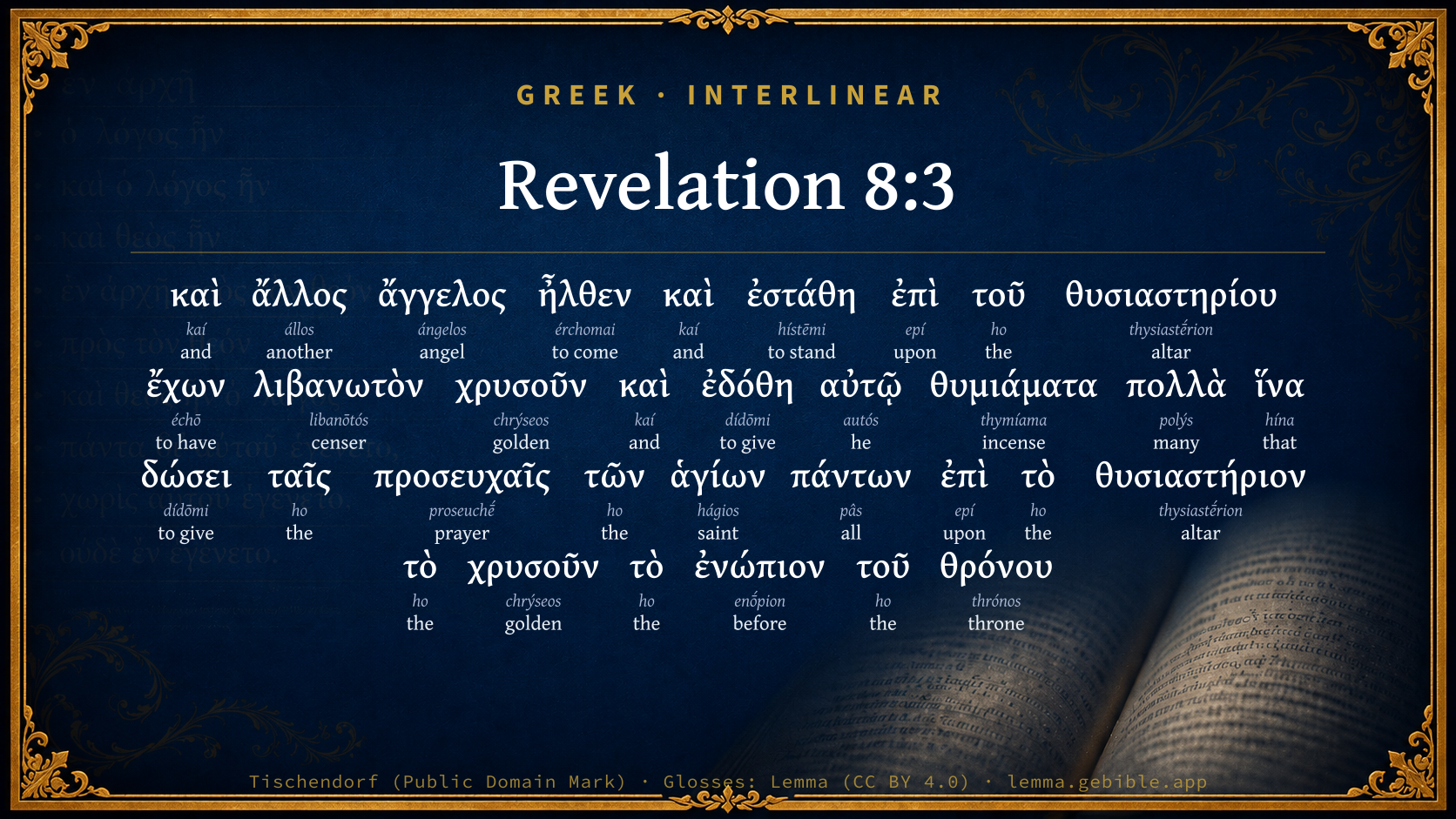
Greek (Tischendorf 8th ed.) Revelation 8:3 appears in the Greek New Testament. The text above is from the Tischendorf 8th edition. Each word links to its Strong’s number and a concise gloss. Click any word for its full Thayer’s Greek Lexicon entry.
Download image
Cite this verse

Revelation 8:3 (World English Bible). Public Domain. Lemma interlinear Bible study tool, https://lemma.gebible.app/v/revelation/8/3.

Show BibTeX & RIS
BibTeX
RIS
English Translation
Another angel came and stood over the altar, having a golden censer. Much incense was given to him, that he should add it to the prayers of all the saints on the golden altar which was before the throne.
World English Bible · Public Domain
Highlights
  • 1 first appearance in the Greek New Testament
Full analysis ↓
Download a study sheet

One document with this verse’s original text, its word-by-word gloss line, the meaning frame, cross-references with their text, attributed commentary, and full source and license credits — printable, and it pastes into notes with its structure intact.

This verse Autodidact and up

Study sheet (.html) Plain text (.txt)

A passage Seminary Student

Up to 50 verses in one chapter. A passage sheet keeps up to 6 commentary sources and 12 cross-references per verse, in the order this page ranks them, and says so on the sheet whenever that leaves anything out. Ask for a single verse and you get the Autodidact verse sheet above.

Everything on this page stays free to read, with no account — the sheet is a download of what is already on screen, not access to it.

Want to remove ads? Support Godless Engineer
Compare translations 3

The same verse in 3 English versions, stacked beneath the original-language interlinear above. Click any original word for its lexicon entry.

Each is an independent rendering of the whole verse — the interlinear is not word-aligned to these translations.

Highlighted words mark where these versions differ — a whole-verse word diff, not a word-by-word alignment.

  • World English Bible Public Domain
    Another angel came and stood over the altar, having a golden censer. Much incense was given to him, that he should add it to the prayers of all the saints on the golden altar which was before the throne.
  • King James Version Public Domain
    And another angel came and stood at the altar, having a golden censer; and there was given unto him much incense, that he should offer it with the prayers of all saints upon the golden altar which was before the throne.
  • unfoldingWord Literal Text CC BY-SA 4.0
    And another angel came and was stationed at the altar having a golden censer, and much incense was given to him so that he would offer with the prayers of all the saints on the golden altar before the throne.

unfoldingWord Literal Text — © unfoldingWord, licensed CC BY-SA 4.0. Word-aligned USFM3 via Door43 (git.door43.org/unfoldingWord/en_ult).

Versions to compare (up to 4)

3 of 4 selected

Show all 19 translations

Every available English version of this verse, each an independent rendering of the whole verse.

  • World English Bible Public Domain
    Another angel came and stood over the altar, having a golden censer. Much incense was given to him, that he should add it to the prayers of all the saints on the golden altar which was before the throne.
  • Berean Standard Bible Public Domain
    Then another angel, who had a golden censer, came and stood at the altar. He was given much incense to offer, along with the prayers of all the saints, on the golden altar before the throne.
  • Majority Standard Bible Public Domain
    Then another angel, who had a golden censer, came and stood at the altar. He was given much incense to offer, along with the prayers of all the saints, on the golden altar before the throne.
  • King James Version Public Domain
    And another angel came and stood at the altar, having a golden censer; and there was given unto him much incense, that he should offer it with the prayers of all saints upon the golden altar which was before the throne.
  • American Standard Version (1901) Public Domain
    And another angel came and stood over the altar, having a golden censer; and there was given unto him much incense, that he should add it unto the prayers of all the saints upon the golden altar which was before the throne.
  • Revised Version (1885) Public Domain
    And another angel came and stood over the altar, having a golden censer; and there was given unto him much incense, that he should add it unto the prayers of all the saints upon the golden altar which was before the throne.
  • Geneva Bible (1599) Public Domain
    Then another Angel came and stoode before the altar hauing a golden censer, and much odours was giuen vnto him, that hee shoulde offer with the prayers of all Saintes vpon the golden altar, which is before the throne.
  • Douay-Rheims (1899) Public Domain
    And another angel came, and stood before the altar, having a golden censer; and there was given to him much incense, that he should offer of the prayers of all saints upon the golden altar, which is before the throne of God.
  • Young's Literal Translation Public Domain
    and another messenger did come, and he stood at the altar, having a golden censer, and there was given to him much perfume, that he may give `it' to the prayers of all the saints upon the golden altar that `is' before the throne,
  • Literal Standard Version CC BY-SA 4.0
    and another messenger came, and he stood at the altar, having a golden censer, and there was given to him much incense, that he may give [it] to the prayers of all the holy ones on the golden altar that [is] before the throne,
  • Unlocked Literal Bible CC BY-SA 4.0
    Another angel came, holding a golden incense bowl, standing at the incense altar. Much incense was given to him so that he would offer it with the prayers of all the saints on the golden incense altar before the throne.
  • unfoldingWord Literal Text CC BY-SA 4.0
    And another angel came and was stationed at the altar having a golden censer, and much incense was given to him so that he would offer with the prayers of all the saints on the golden altar before the throne.
  • Darby Bible Public Domain
    And another angel came and stood at the altar, having a golden censer; and much incense was given to him, that he might give [efficacy] to the prayers of all saints at the golden altar which [was] before the throne.
  • World Messianic Bible Public Domain
    Another angel came and stood over the altar, having a golden censer. Much incense was given to him, that he should add it to the prayers of all the holy ones on the golden altar which was before the throne.
  • Webster's Bible Public Domain
    And another angel came and stood at the altar, having a golden censer; and there was given to him much incense, that he should offer it with the prayers of all saints upon the golden altar which was before the throne.
  • Free Bible Version CC BY-SA 4.0
    Then another angel came and stood at the altar. He had a golden censer and he was given a large quantity of incense to add to the prayers of all the saints on the golden altar that stands in front of the throne.
  • Bible in Basic English Public Domain
    And another angel came and took his place at the altar, having a gold vessel for burning perfume; and there was given to him much perfume, so that he might put it with the prayers of all the saints on the gold altar which was before the high seat.
  • Text-Critical English NT CC BY 4.0
    Then another angel with a golden censer came and stood at the altar. He was given a large amount of incense to offer with the prayers of all the saints on the golden altar before the throne.
  • Tyndale New Testament (1534) Public Domain
    And another angell cam and stode before the aultre havynge a golden senser and moche of odoures was geven vnto him that he shulde offre of the prayers of all saynctes apon the golden aultre which was before the seate.

Literal Standard Version (2020), Covenant Press — licensed CC BY-SA 4.0. Text via the HelloAO Bible API (eBible.org). Unlocked Literal Bible (unfoldingWord) — licensed CC BY-SA 4.0. Text via the HelloAO Bible API (eBible.org). unfoldingWord Literal Text — © unfoldingWord, licensed CC BY-SA 4.0. Word-aligned USFM3 via Door43 (git.door43.org/unfoldingWord/en_ult). Free Bible Version, Dr. Jonathan Gallagher — licensed CC BY-SA 4.0. Text via the HelloAO Bible API (eBible.org).

Word by word

More ways to search: Search by grammar → Find every occurrence → Compare this word →

Practice this passage: Drill this verse → Learn its vocabulary →

λιβανωτὸν
libanōtós
G3031
“censer”
Noun, Accusative, Singular, Masculine
Part of Speech
Noun
Case
Accusative
Number
Singular
Gender
Masculine
Full Thayer's Definition

Origin: from G3030

TDNT: 08:23,5

1. the gum exuding from a frankincense tree 2. a censer
  1. καὶ kaí G2532 “and” Conjunction
  2. ἄλλος állos G243 “another” Adjective, Nominative, Singular, Masculine
  3. ἄγγελος ángelos G32 “angel” Noun, Nominative, Singular, Masculine
  4. ἦλθεν érchomai G2064 “to come” Verb, Aorist, Active, Indicative, 3rd person, Singular
  5. καὶ kaí G2532 “and” Conjunction
  6. ἐστάθη hístēmi G2476 “to stand” Verb, Aorist, Passive, Indicative, 3rd person, Singular
  7. ἐπὶ epí G1909 “upon” Preposition
  8. τοῦ ho G3588 “the” Article, Genitive, Singular, Neuter
  9. θυσιαστηρίου thysiastḗrion G2379 “altar” Noun, Genitive, Singular, Neuter
  10. ἔχων échō G2192 “to have” Verb, Present, Active, Participle, Nominative, Singular, Masculine
  11. χρυσοῦν chrýseos G5552 “golden” Adjective, Accusative, Singular, Masculine
  12. καὶ kaí G2532 “and” Conjunction
  13. ἐδόθη dídōmi G1325 “to give” Verb, Aorist, Passive, Indicative, 3rd person, Singular
  14. αὐτῷ autós G846 “he” Personal pronoun, Dative, Singular, Masculine
  15. θυμιάματα thymíama G2368 “incense” Noun, Nominative, Plural, Neuter
  16. πολλὰ polýs G4183 “many” Adjective, Nominative, Plural, Neuter
  17. ἵνα hína G2443 “that” Conjunction
  18. δώσει dídōmi G1325 “to give” Verb, Future, Active, Indicative, 3rd person, Singular
  19. ταῖς ho G3588 “the” Article, Dative, Plural, Feminine
  20. προσευχαῖς proseuchḗ G4335 “prayer” Noun, Dative, Plural, Feminine
  21. τῶν ho G3588 “the” Article, Genitive, Plural, Masculine
  22. ἁγίων hágios G40 “saint” Adjective, Genitive, Plural, Masculine
  23. πάντων pâs G3956 “all” Adjective, Genitive, Plural, Masculine
  24. ἐπὶ epí G1909 “upon” Preposition
  25. τὸ ho G3588 “the” Article, Accusative, Singular, Neuter
  26. θυσιαστήριον thysiastḗrion G2379 “altar” Noun, Accusative, Singular, Neuter
  27. τὸ ho G3588 “the” Article, Accusative, Singular, Neuter
  28. χρυσοῦν chrýseos G5552 “golden” Adjective, Accusative, Singular, Neuter
  29. τὸ ho G3588 “the” Article, Accusative, Singular, Neuter
  30. ἐνώπιον enṓpion G1799 “before” Adverb
  31. τοῦ ho G3588 “the” Article, Genitive, Singular, Masculine
  32. θρόνου thrónos G2362 “throne” Noun, Genitive, Singular, Masculine

About this verse

These counts appear in no published source. They are computed here, from the morphology-tagged text and Lemma’s own curated glosses. What Lemma adds →

33
words
21
distinct lemmas
Revelation
section

Notable vocabulary

The rarest word here is λιβανωτὸν censer G3031 — appearing just 2 times in the whole Greek New Testament.

First appearance in Scripture

This word makes its first canonical appearance in the Greek New Testament here:

  • λιβανωτὸν censer G3031

Shared distinctive vocabulary

λιβανωτὸν censer G3031 occurs in 2 verses of the Greek New Testament. Also found in:
Repetition

Words recur within this verse:

  • ἐπὶ upon G1909 ×2
  • θυσιαστηρίου altar G2379 ×2
  • χρυσοῦν golden G5552 ×2
  • ἐδόθη to give G1325 ×2
  • τοῦ the G3588 ×7
  • καὶ and G2532 ×3

Cross-references

26

Topical passages linked to Revelation 8:3 in the Treasury of Scripture Knowledge — connected by theme and wording, ordered by reader-vote popularity; previews shown in the World English Bible.

  • Revelation 5:8 Now when he had taken the book, the four living creatures and the twenty-four elders fell down before the Lamb, each one having a harp, and golden bowls full of incense, which are the prayers of the saints.
  • Psalms 141:2 Let my prayer be set before you like incense; The lifting up of my hands like the evening sacrifice.
  • Revelation 8:4 The smoke of the incense, with the prayers of the saints, went up before God out of the angel's hand.
  • Luke 1:10 The whole multitude of the people were praying outside at the hour of incense.
  • Malachi 1:11 For from the rising of the sun even to the going down of the same, my name is great among the nations, and in every place incense will be offered to my name, and a pure offering: for my name is great among the nations," says Yahweh of Hosts.
  • Revelation 9:13 The sixth angel sounded. I heard a voice from the horns of the golden altar which is before God,
  • Exodus 37:25–26 He made the altar of incense of acacia wood. It was square: its length was a cubit, and its breadth a cubit. Its height was two cubits. Its horns were of one piece with it.
  • Leviticus 16:12–13 He shall take a censer full of coals of fire from off the altar before Yahweh, and two handfuls of sweet incense beaten small, and bring it within the veil:
  • Numbers 16:46–47 Moses said to Aaron, Take your censer, and put fire therein from off the altar, and lay incense thereon, and carry it quickly to the congregation, and make atonement for them: for there is wrath gone out from Yahweh; the plague is begun.
  • 2 Chronicles 26:16–20 But when he was strong, his heart was lifted up, so that he did corruptly, and he trespassed against Yahweh his God; for he went into the temple of Yahweh to burn incense on the altar of incense.
  • Hebrews 9:4 having a golden altar of incense, and the ark of the covenant overlaid on all sides with gold, in which was a golden pot holding the manna, Aaron's rod that budded, and the tables of the covenant;
  • Exodus 40:26 He put the golden altar in the tent of meeting before the veil;
  • Hebrews 4:15–16 For we don't have a high priest who can't be touched with the feeling of our infirmities, but one who has been in all points tempted like we are, yet without sin.
  • Hebrews 7:25 Therefore he is also able to save to the uttermost those who draw near to God through him, seeing he ever lives to make intercession for them.
  • Hebrews 10:19–22 Having therefore, brothers, boldness to enter into the holy place by the blood of Jesus,
  • 1 John 2:1–2 My little children, I write these things to you so that you may not sin. If anyone sins, we have a Counselor with the Father, Jesus Christ, the righteous.
  • Exodus 3:2–18 The angel of Yahweh appeared to him in a flame of fire out of the midst of a bush. He looked, and behold, the bush burned with fire, and the bush was not consumed.
  • Exodus 30:1–8 "You shall make an altar to burn incense on. You shall make it of acacia wood.
  • 1 Kings 7:50 and the cups, and the snuffers, and the basins, and the spoons, and the fire pans, of pure gold; and the hinges, both for the doors of the inner house, the most holy place, and for the doors of the house, [to wit], of the temple, of gold.
  • Amos 9:1 I saw the Lord standing beside the altar, and he said, "Strike the tops of the pillars, that the thresholds may shake; and break them in pieces on the head of all of them; and I will kill the last of them with the sword: there shall not one of them flee away, and there shall not one of them escape.
  • Acts 7:30–32 "When forty years were fulfilled, an angel of the Lord appeared to him in the wilderness of Mount Sinai, in a flame of fire in a bush.
  • Romans 8:34 Who is he who condemns? It is Christ who died, yes rather, who was raised from the dead, who is at the right hand of God, who also makes intercession for us.
  • Genesis 48:15–16 He blessed Joseph, and said, "The God before whom my fathers Abraham and Isaac did walk, the God who has fed me all my life long to this day,
  • Revelation 6:9 When he opened the fifth seal, I saw underneath the altar the souls of those who had been killed for the Word of God, and for the testimony of the Lamb which they had.
  • Revelation 7:2 I saw another angel ascend from the sunrise, having the seal of the living God. He cried with a loud voice to the four angels to whom it was given to harm the earth and the sea,
  • Revelation 10:1 I saw a mighty angel coming down out of the sky, clothed with a cloud. A rainbow was on his head. His face was like the sun, and his feet like pillars of fire.

Cross-references courtesy of OpenBible.info (CC BY 4.0).

Commentary

Notes on Revelation 8:3 from classic Christian and Jewish commentators (each source and its license shown beneath its notes). The classic Christian expositions comment on the surrounding passage and are grouped to its opening verse, so a note may address several verses; the Jewish commentaries on the Tanakh (Rashi and others) are per-verse, so they appear only where the commentator wrote on this verse.

Lemma curates 59 commentaries, every one of them public domain or Creative Commons licensed, each selected and text-cleaned for this edition rather than reprinted as found. About our sources →

The Cambridge Bible for Schools and Colleges

gen. ed. J. J. S. Perowne

The Angel with the Golden Censer, Rev_8:3-6

3. another angel] In Tobit, l.c. it is the seven Angels themselves who present the prayers of the Saints before God: but, though the detail varies, the passages agree in assigning a priestly work to Angels on behalf of God’s people on earth.

at the altar] More literally, on the altar, R. V. “over the altar.” The golden altar of Incense in the Tabernacle was only a cubit square and two cubits high (Exo_30:2), and we have no reason to suppose that the analogous one either in the first or the second Temple was larger: perhaps we may gather from 2Ch_5:5, that the altar in the first Temple was identical with the one in the Tabernacle. But the altar of burnt-offering was rather a large platform than what we commonly imagine an altar (see 1Ma_1:59, where the small Greek “idol altar” stands on the “altar of God” as its basement—it cannot be substituted for it): in the Tabernacle it was 5 cubits square, in Solomon’s Temple 20, in Zerubbabel’s probably the same, and in Herod’s 50 according to Josephus, 32 according to the Mishna. In the Temple at any rate, the height of the altar was such that the officiating priests had to come up upon a ledge surrounding it (and such an ascent is contemplated in Exo_20:26). Probably here, though the Angel is offering incense not burnt offering, the Altar where he officiates is conceived as rather of the larger type: see on Rev_6:9.

censer] Plainly the sense here, though the Greek word properly means “incense.”

offer it with] Literally, give (i.e. add) it to the prayers; and if the literal translation requires a gloss, that of the A. V. can hardly be the right one. Apparently the image is, that the prayers of the Saints are already lying on the Altar, and the Angel, in modern liturgical phrase, “censes the holy things.” Thus disappears the supposed theological necessity for identifying this Angel with the Lord Jesus: “the prayers of all saints” are presented by Him and by no one else, as is implied in Rev_5:8-9; where the incense is the prayers of the Saints, not something added to them. But here the Angels offer their own worship, as it is “given to them,” in union, perhaps in subordination, to those of the redeemed. The prayers here spoken of are those of all saints, not of the Martyrs exclusively: still, it is well to notice that the Altar where we offer our prayers is apparently the same where they poured out their lives, Rev_6:9.

The Cambridge Bible for Schools and Colleges (gen. ed. J. J. S. Perowne; Cambridge University Press, 1878–1918) — public domain. Text from a community e-Sword module.

The Biblical Illustrator

Joseph S. Exell

Rev_8:3-5

Much incense.

The all-fragrant incense

I. The angel and the altar. It is the altar that stood in the holy place that is here referred to in the third verse, not the brazen altar; it is the golden altar, the altar of incense; the altar of prayer and praise; the altar at which the priests ministered, and where also blood was sprinkled. In what respects it differed from the mercy-seat (at the place of prayer) does not quite appear. At this altar all who are Gods priests, all His royal priesthood, officiate. Here specially they stand, as pleaders with God, as intercessors on behalf of His own or against His enemies. To this altar the angel comes (not one of the seven), and here he takes his stand for a special purpose.

II. The angel and the censer. He comes to act as priest; a priestly messenger from God.

III. The angel and the incense. It is no empty censer that he holds; it is not for show that he waves it. Incense is there; incense not his, but supplied by another, though by whom is not said. There was given him. It is much incense, or, literally, many incenses, out of which were to come innumerable wreaths of fragrant smoke.

IV. The angel and the fire. The angel having emptied the censer of its incense, fills it with fire; the pouring out of the one from the censer being the signal for the coming in of the other into that vessel from which the incense had been poured out.

1. Prayer remains often long unanswered. The reasons for the long delay are often far beyond our reach; but in the end they will be found infinitely wise and gracious.

2. Prayer is not lost. It lies on the golden altar which is before the throne. We lay each petition there, as we say, for Christs sake.

3. Prayer will be answered. Delay will only add to the fulness of the answer, and increase our joy when it comes. And it will come. He is faithful that promised. He cannot deny Himself.

4. The answer will come in connection with Christs surpassing excellence. His fragrance is to be cast upon these long-lying prayers, that seem without life or motion, and they shall arise.

5. Prayer is often answered in ways we little thought of. (H. Bonar, D. D.)

Our prayers presented in heaven

I. The employment in which pious men are stated to engage.

1. Prayer is the habit by which pious men on earth are always prominently distinguished. There is not one in the universe of our intelligent race who is not under obligation to pray. While men in the alienation of unconverted nature violate the obligation, and indulge in passions and in habits which are utterly incompatible with its performance, men on the other hand, who have been the subject of renovating influence, are, from the moment of receiving it, imbued with the principles and with the instincts of prayer.

2. Prayer thus distinguishing pious men is directed for important and comprehensive objects. It commonly has respect to temporal objects, craving the communication of temporal benefits. But these must always be secondary, and should be desired with a reservation to the Divine wisdom as to whether it will be for our well-being or for our disadvantage to receive them. And then the prayers of the saints, when rightly offered, must not merely be personal, directed to their own welfare, but intercessory, directed to the welfare of others.

3. Prayer thus distinguishing pious men, and directed for important and comprehensive objects, is always attended by peculiar characteristics--humility; a deep conviction of insignificance in the presence of a God so great, and of impurity in the presence of a God so holy.

II. The manner in which that employment is commended before God. An angel is represented as coming and standing at the altar; and there was given unto him much incense, etc.

1. Observe, first, the person. There is satisfactory evidence to identify the Saviour with the angel who is here presented to us. It is He who takes the prayers of the saints and presents them before the throne.

2. Notice the station. He is represented as coming and standing at the altar, having a golden censer, and the altar, moreover, is described as the golden altar. The Jewish priest could not stand by the altar of incense unless he had first of all offered an atonement for sin: and when there is a vision of our Lord Jesus as the High Priest of our profession standing by the golden altar, the necessary assumption is, that He too had first offered an atonement for sin.

3. Observe the act. It is stated that there was given to Him much incense, that He might offer it, with the prayers of all saints, upon the golden altar which was before the throne. Here, then, is the exercise of the Saviours office of Intercessor in identification with the prayers of the saints; and it is a most sublime and a most thrilling thought, that there is no prayer offered in humility, faith, and earnestness, for objects which are coincident with the Word of God, but what is borne upward and presented by the Saviour before the throne of the heavenly Father. And whether prayer be offered in the midnight darkness or in the noontide light--whether prayer be offered in the secret chamber or in the public assembly--whether prayer be offered in the mansion or in the cottage, in the prison-house or in the palace, in the tropics or at the poles, it rises upward, becomes interwoven and identified with the much incense of the Saviours merits, and so penetrates into the very holiest of all.

III. The result in which the employment so commended must terminate.

1. The success of the prayers of the saints is invariable. The success of the prayers presented on this occasion is indicated by the expression that the smoke of the furnace ascended up before God out of the angels hand. The ascent of the prayers, mingled with the incense, out of the hand of the angel before God is intended to signify its acceptance. May we not deduce this fact from the Divine nature of our Redeemer? Is not His will one with the will of the Father? and must not what He deigns to present in His condescension as Mediator before the Father be accepted by the Father in connection with Himself? Then, again, may not this fact be deduced from the value of the atonement which He has offered upon the Cross? Is that defective? Is that presented with doubt and uncertainty in the presence-chamber of the celestial palace? Has it not been sealed by His resurrection from the dead, and by His ascension into heaven and His enthronement in royalty there? Is it possible for the Intercessor to plead His atonement in vain? Then, again, this fact may also be deduced directly from the express declaration of the Sacred Writings.

2. The success of the prayers of the saints shall be manifest. The angel took the censer and filled it with fire of the altar, and cast it into the earth: and there were voices, and thunderings, and lightnings, and an earthquake--physical signs and convulsions pronouncing Amen to the one delightful truth. (J. Parsons.)

Christs work of intercession in heaven

I. It is a work for the performance of which he is divinely commissioned. Another angel, it is said, came and stood at the altar. Who this angel was we are not indeed expressly told. However, the work in which the angel who came and stood by the altar engaged, was proper only to one person--to Him who is the High Priest of our profession, Christ Jesus. He is another angel, not only distinct from the seven before mentioned who stood before God, but different from them in kind, having obtained by inheritance a more excellent name than they; yet He participates in their name, too, as being like them a commissioned minister of Jehovah. He glorified not Himself to be made an High Priest, but was called of God, as was Aaron. Of Him, as well as of the Spirit, it may be said that He maketh intercession for the saints, according to the will of God. His mediation in all its parts is the discharge of a trust committed to Him by that very Being against whom we had rebelled.

II. It is a work for the performance of which He is amply furnished, having the golden censer and much incense given Him to offer. When it is said that there was given to Him much incense, we are not to conceive that the offering was not of that which was His own. In accordance with the symbolical rite to which the vision is accommodated, it might seem to be put into His hands by another. But this act can have reference only to the assignment to Him of His office, or to His being endowed with all requisite qualifications for its discharge. A body was prepared for Him. The Holy Spirit was given Him not by measure. The incense was thus provided, which He was, as it were, to kindle and make to rise to God in sweet odour by His voluntary humiliation.

III. It is a wore which insures the acceptance of the prayers that are offered in His name, and for the blessings of His salvation. The first sincere prayer for mercy and grace which is intrusted to this great High Priest, in the faith that He will bring it with acceptance before the throne, makes the distinction between the sinner who has no part in Him, and the man who, by giving himself to Christ, has been numbered with His saints. He doubtless intercedes for many who yet know not His name, nor have trusted in His grace; and it is owing to His interposition on their behalf that they are not cut off in their sins, but in His time brought to the knowledge of the truth, and to the faith of Gods elect. There is also, we may admit, a direct intercession of Christ for His people, asking for them blessings besides or beyond what they are led to ask for themselves. We often know not what we ought to pray for, what would be really good for us; but He knows what things we have need of; and whatever is necessary to their complete restoration to holiness and happiness, will be included in His requests for those who have an interest in His mediation. But we may learn from the representation here given, that that mediation is not to be conducted in such a way as to dispense with their own prayers.

IV. This work He carries on in behalf of all His saints. No prayer that rises from earth reaches the throne of grace but that which He presents. But none that is offered in His name is forgotten or omitted in the ministrations of this great High Priest. His understanding is infinite. There is room in His heart for all that will come to seek refuge there; among the unnumbered millions that may look to Him for pity and help, and commit their cause to Him, there is not one for whom He will not interest Himself as much as if his case alone engaged His sympathy. (J. Henderson, D. D.)

Practical lessons drawn from the doctrine of Christs intercession

I. It should impress us with a deep sense of the evil of sin. That there is involved in every act of it such daring presumption, and base ingratitude, and brutish folly, and foul malignity, as could not, but for the much incense offered with them by the exalted High Priest, have been otherwise than as a smoke in his nostrils, fire burning all the day, rendering our prayers and services offensive to Him who sitteth on the throne, provoking the eyes of His glory.

II. It affords us the richest encouragement in prayer. Are you only willing to come to God by Christ, to owe all the blessings you need to His mediation with Him whom you had offended? He is ready to intercede for you, and we know that Him the Father heareth always. Often has the voice of human eloquence been roused in behalf of the wretched in vain. It has pleaded the woes and wrongs of the oppressed, to hearts so hardened in selfishness and cruel in hate as to be callous to the most pathetic appeals; but the pleadings of this great Advocate are never unsuccessful. The justice and the mercy of God unite in conceding all that He asks.

III. It shows us how vain and superstitious it is to trust in departed saints or in angels to intercede for us. Whatever may be our speculations or conjectures as to the acquaintance, which saints in glory, or our departed friends in particular, may have with things done on earth, or the interest they may yet take in our affairs; however fondly we may dream at times that they may be employed, as we are told angels are, in some ministrations in behalf of those whom they have left in this vale of tears, let us feel assured that we need no other advocate with the Father in His holy place on high than Jesus Christ the righteous. Upon Him alone let us depend, to Him directly let us go, and say, in opposition to those who would point us to other intercessors, To whom else should we go?--He hath the words of eternal life.

IV. The faith of Christs intercession should contribute to render us decided and undaunted in confessing His name and in doing the work to which He calls. Surely you have nothing to apprehend of ultimate loss or injury in the service of this exalted Redeemer! For though you should have to suffer a while for His names sake, or after His example, it is that when His glory shall be revealed, ye also may be glad with exceeding joy. And while you have committed to Him the keeping of your souls, you need not fear for aught that may be coming on the earth. He will keep you from the hour of temptation which shall come upon all the world. Does He not pray for this, not that you should be taken out of the world ere you have fulfilled the course allotted for you, but that you should be kept from the evil, that your faith may not fail, that you may be sanctified through the truth revealed in Gods Word, and so fitted to dwell with Him at last in the mansions He hath gone to prepare for you in His Fathers house. You need not in any case tremble for the interests of His Church; amid the agitations which seem to threaten the overthrow of all human institutions, and the convulsions which shake and affright the nations, these are secure under the protection of her exalted Head. (J. Henderson, D. D.)

Christs incense perfuming the prayers of all saints

I. All the saints are devout and praying persons. This is plainly intimated in the text, where we read of the prayers of all saints. It is an essential part of their character as saints to be so. It is a branch of their daily business to pray to God. The history of the saints shows this. Ever since God hath had a people in the world they have been described as men that called upon the name of the Lord; as the generation of them that seek Him. It is said that every one that is godly seeketh the Lord. The lives of good men in later ages show this. They all practised devotion and recommended it to others. The saints esteem it highly reasonable in itself, that as dependent creatures they should own their dependence upon God; that, as needy creatures, they should seek a supply of their wants from Him; that as sinful creatures they should implore His mercy; and as weak creatures should beg grace to help in time of need.

II. There are many imperfections attending the prayers of the saints. This is implied in the text, where we read of much incense being offered with them. It is supposed they were sincere; else they could not be the prayers of saints, nor would incense have been added to them. But the addition of the incense plainly intimates that they were imperfect and polluted, and of themselves unfit to be received by a pure and holy God.

III. It is the intercession of Christ which renders the prayers of saints acceptable to God. These Christians prayed themselves, and Christ, having the golden censer full of incense, intimates that He prayed likewise, offering His own prayers with theirs and for them. He seconds and enforces their petitions. He intercedes that those sinful defects which cleave to their prayers may be pardoned and excused, and their imperfect services accepted of God. These prayers of Christ are enforced by a just, proper, and effectual plea; even His own merit, His perfect righteousness and obedience, even unto death, which are so pleasing to God, that, on that account, He grants mercy to men. His intercession is founded on what He hath done and suffered; so that He hath a just claim to be heard, asking nothing but what He hath already purchased for His people, and God, by His promise and covenant, stands engaged to bestow. Now to this intercession of Christ it is owing that the prayers of the saints are acceptable to God. Application:

1. They who do not make a serious business of prayer are not saints.

2. The intercession of Christ will not excuse the neglect of prayer, or the allowed defects of it.

3. How glorious and how amiable doth Christ appear as an intercessor!

4. What deep humility becometh the greatest saints.

5. Let us fix our dependence on the intercession of Christ for the acceptance of our prayers. (Job Orton, D. D.)

Fire of the altar.

Fire from the altar

Fire is the great consumer. It always bespeaks wrath, torture, and destruction to the wicked. It is the common figure of Divine terribleness toward the guilty--one of the great agents in the administrations of the great day. And when the sublime Priest-Angel of heaven turns His fire-filled censer on the earth, we have come to the day that shall burn as an oven, in the which all the proud and ungodly shall be as stubble to the devouring flames (Mal_4:1). This fire is taken from the altar. It is one of the fearful characteristics of Gods gracious operations, that they heighten the damnation of the disobedient and the unbelieving. It is not Adams guilt, for there is full remedy in Christ against that. It is not the condemnation in which the gospel finds them, for it comes with a full and everlasting reprieve. But here is the mischief--that when the great and costly salvation of God is carried to them they despise it and make light of it, and go their way as if it were nonsense or nothing. Out of the very altar of sacrifice, therefore, comes their damnation. It is the saving word refused, which is a savor of death unto death in them that perish. Perdition is simply abused or perverted grace. It is the same censer, filled with the same ingredients, only turned dawnward in the case of those who believe not. (J. A. Seiss, D. D.)

The Biblical Illustrator, edited by Joseph S. Exell (c. 1880s–1900s) — public domain. Text from a community e-Sword module.

Tyndale Open Study Notes

Tyndale Open Resources

8:3-4 The prayers of God’s people ask for God’s ultimate justice and judgment (6:10-11; see also 5:8; Ezra 9:5-6; Ps 141:2; Dan 9:21). The mixture of incense and prayers that reaches God’s presence shows that God hears their prayers (see Rev 6:9-11) and is prepared to act.

Tyndale Open Study Notes — © Tyndale Open Resources, licensed CC BY-SA 4.0. Text via the HelloAO Bible API.

Bengel's Gnomon

Johann Albrecht Bengel

Rev 8:3. Καὶ ἄλλος ἄγγελος ἦλθε, καὶ ἐστάθη ἐπὶ τοῦ θυσιαστηρίου ἔχων λιβανωτὸν χρυσοῦν· καὶ ἐδόθη αὐτῷ θυμιάματα πολλἁ, ἵνα δώσῃ ταῖς προσευχαῖς τῶρ ἁγίων, κ.τ.λ., and another angel came and stood at the altar, having a golden censer; and there was given unto him much incense, that he should offer it [simultaneously] with the prayers of saints, etc.) Respecting the angel who offers the prayers of the saints, the Hebrews, in Elle Shemoth Rabba, sect. 21, speak after this manner: When the Israelites pray, they are not all found to pray altogether, but each synagogue (or congregation, בנסת) prays separately, first this synagogue, then another; and when all the synagogues have finished all their prayers,

אותן עטרות ונותנין בראשו של הק״ ב״ה״ שנא׳ עדיך בל בשר יבואו ואין עדיך אלא עטרה שנא׳ כי כלם כעדי תלבשי׃

The angel who presides over the prayers, bears all the prayers which they have prayed in all the synagogues, and forms them into crowns, and places them (instead of נותנין I think that נותנן should be read) on the head of God S. B., as it is said in Psa 65:2, all flesh shall come as thy crown (for עדיך is so explained in that passage, as is more plainly apparent from what follows; whereas in reality it ought to be explained, to thee): but the word עדיך denotes nothing but a crown, as it is said, Isa 49:18, and thou shalt clothe thee with them as with a crown.—Christopher Cartwright, in Mellif. Hebr., lib. iii. c. 8. Therefore the Hebrews say that there is an angel who presides over the prayers of their assemblies: the Apocalypse only says, that there is an angel who offers incense, while the saints pray: ταῖς προσευχαῖς, Rev 8:3-4, is the Ablative case, denoting accompaniment, as Rom 11:11; Rom 11:30-31, τῷ αὐτῶν παραπτώματι, τῇ τούτων ἀπειθείᾳ, τῷ ὑμετέρῳ ἐλέει. We have noted down more examples from other quarters at Chrysost. de Sacerdot., p. 514. There are some who here understand σύν: you might as conveniently understand ἐπί; but neither of the two is necessary. Nay, rather the Ablative case put absolutely, ταῖς προσευχαῖς, has greater force. The incense of the angel, and the prayers of the saints on earth, are simultaneous: but the prayers of the saints are acceptable to God through Jesus Christ, not through the angel. [See what is the character of genuine prayer. It is the prayer of saints, which the incense of the angel accompanies, and Christ Himself renders acceptable in the presence of the Father. Dost thou then pray in such a manner, that thy prayers may come as a memorial before GOD?—V. g.] Under the name of angels, Thummius, in adm. de Error. Wigel, p. 280, affirms that created angels are pointed out in the New Testament, and especially in the Apocalypse: and in this very passage this is acknowledged by Nic. Selneccer in his Commentaries on the Ap., by L. and Andr. Osiander, by Beza, Hogelius, p. 277; also by Chemnitius, Part iii. Exam. Cone. Trid., f. 189, whom on this account Melch. Kromajec. in Ap. p. 111, praises, and Arnd. de V. C. i. ii. c. 35. To these are to be added D. Joach. Lange and Dimpelius. The liturgy [divine service performed] in heaven, with its effect in the world, is here set forth.—ἐπὶ τὸ) A skilful variety of cases: the angel stood ἐπὶ τοῦ θυσιαστηρίου, by the said of [near—at] the altar; and offered the incense ἐπὶ τὸ θυσιαστήριον, upon the altar.

Bengel's Gnomon of the New Testament — English translation (T&T Clark, Edinburgh, 1860) — public domain. Text from a community e-Sword module.

Meyer's Critical & Exegetical Commentary

Heinrich August Wilhelm Meyer

Rev_8:3-5. ἄλλος ἄγγελος. The repeated[2418] reference here to Christ[2419] has occasioned the greatest number of arbitrary expedients in the interpretation of what follows: e.g., that by ἜΧΩΝ ΛΙΒ. ΧΡΥΣ., reference is made to the self-sacrifice of Christ;[2420] that the ἘΓΈΜΙΣΕΝ, Κ.Τ.Λ., Rev_8:5, is to be understood of the fulness of the Godhead, or Spirit, in Christ;[2421] that the fire cast upon the earth is to be regarded as a gracious visitation,[2422] as the power of the gospel concerning Christs love;[2423] and the ΦΩΝΑΊ, ΒΡΟΝΤΑΊ, ἈΣΤΡΑΠΑῚ, of the words and miracles of Christ, and ΣΕΊΣΜΟς, of the movement occasioned thereby among the hearers.[2424] The other angel, just as the one mentioned in Rev_7:2, is to be regarded an actual angel;[2425] yet the text gives no more accurate designation whatever.[2426]

ἘΣΤΆΘΗ ἘΠῚ ΤΟῦ ΘΥΣΙΑΣΤΗΡΊΟΥ. The ἘΠῚ does not mean juxta, alongside of, and nothing more;[2427] but it designates with evident exactness, that the angel so presents himself at the altar, that he rises above it.[2428]

The question started here, as on Rev_6:9, as to whether the altar is to be regarded an altar of incense,[2429] or an altar for burnt offerings,[2430] will be decided not only from the context in itself, but also from the seeming type, Lev_16:12; and Ebrard thus comes to the decision that the altar, mentioned Rev_8:3 a (ἐπὶ τ. ΘΥΣΙΑΣΤ.) and Rev_8:5, is the altar for burnt offerings, while the golden altar (Rev_8:3 b) is the altar of incense. But as the question itself is not without an arbitrary assumption, so the answers, also, are without sufficient foundation in the context, into which strange conceptions of many kinds have entered. As to the appeal to Leviticus 16, that passage is essentially different from ours, because it is there said that the high priest, on the great day of atonement, is to take coals in a censer from the altar of burnt offerings, and with it and the incense strewed thereon, shall come, not to the altar of incense in the sanctuary,[2431] but to the ark of the covenant within the holy of holies. Nothing, therefore, is said in Lev_16:12, of the altar of incense, so that the analogy of that passage, even apart from a dissimilarity otherwise in the whole and in details, renders any proof impossible that the golden altar, Rev_8:3, is the altar of incense. In general, however, the entire description of heavenly locality, as it is presented in Rev_4:1, gives us no right whatever for conceiving of the same as after the model of the earthly temple with a holy of holies, a holy place, a veil, different altars, etc., whereby then such conceptions are rendered necessary, as that of Züll., Hengstenb., that in ch. 4 and this passage, the veil before the holy of holies is closed, but in Rev_11:19 it is opened; or that of Hofm., that we must fancy the roof of the heavenly temple absent, in order to render possible the idea that Jehovah appears enthroned above the cherubim, yet without a sight being gained of the ark of the covenant. Entirely arbitrary, also, is the explanation of Ebrard: that the entire scene, ch. 4, was plainly visible, indeed, at the beginning without the temple, and that later[2432] a heavenly temple appeared, as it were, upon a lower terrace, below and in front of the elevation on which the throne stood. The description of the scenery, Rev_4:1 sqq., is destitute throughout of any express representation of a heavenly temple. Such a representation, including the ark of the covenant, appears first at Rev_11:19,[2433] just where the scene is changed. In the scenery which has remained unchanged from Rev_4:1, the altar becomes noticeable in Rev_6:9, which, according to the context, must be regarded as having a certain analogy with the altar of burnt-offering, although on this account it must not be considered that the entire heavenly locality, with the throne of God, and the sea of glass, appears as the temple. For the article already compels us to identify the altar mentioned in Rev_8:3 a with that of Rev_6:9. To infer, however, that, as in Rev_8:3 a, only τ. θυσιαστ., and in Rev_8:3 b, τ. θυσιαστ. τὸ χρυσὸυν is mentioned, so in two clauses of Rev_8:3 two different altars are designated, is a precipitate inference, since it is not at all remarkable that a more definite description is not given until Rev_8:3 b, where an employment at the altar is spoken of. On the altar, which in Rev_6:9 appears as in a certain respect having the character of an altar of burnt-offering, incense is burned, whereby a certain analogy with the altar of incense is obtained; but the interpretation is entirely inconceivable, since the altar is regarded as fully corresponding neither with the one nor the other.[2434]

ἜΧΩΝ ΛΙΒΑΝΩΤῸΝ ΧΡΥΣΟῦΝ. Without doubt ΛΙΒΑΝΩΤΌς elsewhere means incense;[2435] but no necessity follows, hence, for writing in this passage, where a vessel for incense is manifestly meant, instead of Ὁ ΛΙΒΑΝΩΤΌς, Ἡ ΛΙΒΑΝΩΤΊς, or ΛΙΒΑΝΩΤΡΊς,[2436] or ΤῸ ΛΙΒΑΝΩΤΌΝ,[2437] of which, besides, the latter form, in its proper sense, cannot be distinguished from Ὁ ΛΙΒΑΝΩΤΌς.

ΚΑῚ ἘΔΌΘΗ

ἽΝΑ ΔΏΣΕΙ ΤΑῖς ΠΡΟΣΕΥΧΑῖς, Κ.Τ.Λ. It is arbitrary to adjust[2438] the difficult. ΤΑῖς ΠΡΟΣΕΥΧΑῖς, by erasing the words ΤΑῖς ΠΡΟς Τ. ἉΓ. ΠΑΝΤ. (Rev_8:3) and Τ. ΠΡΟς Τ. ἉΓ. (Rev_8:4), or to change it into ΤᾺς ΠΡΟΣΕΥΧΆς,[2439] or without this emendation to explain it in the sense of Grot.[2440] Incorrect, too, is the effort to complete it by substituting ἘΝ, so as to make the meaning: In the midst of prayers.[2441] The dat. in Rev_8:3, in its combination with ΔΏΣΕΙ, is without all difficulty, since it is entirely regular[2442] to express the remote object towards which the giving is directed: in order that he should give (the ΘΥΜ. ΠΟΛΛ.) to the prayers of all saints. The significance of this act was correctly described already by Calov.: that he should give ΤΑῖς ΠΡ., to the prayers of the saints, the same things, i.e., to render these prayers of good odor.[2443] For upon the ground of Rev_8:3, the expression, Rev_8:4, ΚΑῚ ἈΝΈΒΗ Ὁ ΚΑΠΝῸς ΤῶΝ ΘΥΜΙΑΜΆΤΩΝ ΤΑῖς ΠΡΟΣΕΥΧΑῖς Τ. ἉΓ. is to be explained; but not in the mode of Ebrard,[2444] who attempts to interpret it, Ὁ ΚΑΠΝ. ΤῶΝ ΘΥΜ. ΤῶΝ ΤΑῖς ΠΡΟΣΕΥΧ. ΔΟΘΈΝΤΩΝ [the smoke of the incense given to the prayers],by regarding the dat. here as standing for the gen. of possession, after the manner of the Hebrew ל,for the immediate combination of the dat. ΤΑῖς ΠΡ. with the conception Τ. ΘΥΜ., is contrary to all Greek modes of thought and expression;[2445] but the dat. ΤΑῖς ΠΡΟΣΕΥΧ. can, in its relation to Ὁ ΚΑΠΝ. Τ. ΘΥΜ., depend only upon the verb ἈΝΈΒΗ, as, in accordance with the idea expressed in Rev_8:3, it must be regarded a dat. commodi: The smoke of the incense for the prayers rose up, i.e., indicating their being heard.[2446] The view of Kliefoth, that the incense serves only to carry up the prayers, appears to me not to agree well with the expression, Rev_8:13, ἽΝΑ ΔΏΣ. Τ. ΠΡΟΣΕΥΧ. And the idea that the prayers are sure of being heard,not merely rendered capable of being granted,which Klief. tries to avoid, is nevertheless prominent.

Besides, the activity of the angel, described in Rev_8:3-4, in no way establishes the inference of an angelic intercession,[2447] in the sense of Roman-Catholic dogmatics. In the first place, it is in general impracticable to transform the individual points of Apocalyptic visions directly into dogmatical results; and then, in this case, the function ascribed to the angel, just as to the twenty-four elders in Rev_5:8, is in no way properly that of a mediator, but of a servant.[2448] The incense, therefore, which he gives the prayers of saints, has first been given him; the angel thus in no way effects it by himself, that the prayers brought by his hand are acceptable to God, but the prayers of the saints can be received before God, even without any service of the angel, just because they proceed from saints;[2449] and that now they are carried before God as a heavenly incense-offering by the angel, to be heard and immediately fulfilled, lies also not in his own will, but in that of God, who in the seventh seal is just about to execute his judgment, and from whom himself comes the incense, whose perfume, indicating the hearing of the prayers of the saints, ascends from the hand of the angel as the ministering spirit,[2450] or the fellow-servant of the saints,[2451] who are themselves priests.[2452]

ΚΑῚ ΕἼΛΗΦΕΝ, Κ.Τ.Λ. The angel had put down his censer after he had poured its contents (Rev_8:3) on the altar,[2453] while the smoke ascended (Rev_8:4). Now (Rev_8:5) he again takes it into his hand for a service that is new, but inwardly connected with what has happened in Rev_8:3-4; from the same fire of the altar which had consumed the incense, he fills his censer, and then casts these glowing coals, taken from the altar, upon the earth;[2454] in consequence of this, there are voices, thunderings, lightnings, and an earthquake, the signs of the Divine judgment now breaking forth, as the seven angels also, as soon as the noise breaking the heavenly silence rises from the earth, make ready to sound their trumpets (Rev_8:6). The inner connection between Rev_8:5 and Rev_8:3-4 has been correctly described already by C. a Lap.: Through the petitions of the saints, praying for vengeance upon the godless and their persecutors, fiery vengeance, i.e., thunderings, lightnings, and the succeeding plagues of the seven angels and trumpets, are sent down upon the godless.[2455] The idea has been suggested by Ebrard, that the fire of judgment is that in which the martyrs were burned; this is not once said in Rev_6:10, although in this passage the idea is positively expressed that the fire which was cast upon the earth is from that whereby the incense was consumed, so that the judgment, therefore, appears to be a consequence of the heard prayers. For hereby, also, the chief contents of the prayers of all saints, and not merely those of martyrs (Rev_6:10), are made known. They have as their object that to which all the hopes and endurance of the saints in general are directed, viz., the coming of the Lord,[2456] and the judgment accompanying it; the martyrs also in their way prayed for this.

[2418] Cf. Rev_7:2.

[2419] Beda, Vieg., Zeger, Vitr., Calov., Böhmer.

[2420] Himself having become the censer (Beda).

[2421] Joh_3:34; Col_2:9. Beda.

[2422] Luk_12:49. Beda.

[2423] Calov.

[2424] Beda, etc.

[2425] So here also Hengstenb.

[2426] Against Grot.: The angel of the prayers of the Church.

[2427] Grot., Beng.; cf. also Hengstenb., Ebrard, etc.

[2428] Cf. Amo_9:1.

[2429] Grot., De Wette, Hengstenb.

[2430] Vitr., Beng., Züll., Hofm.

[2431] Ebrard.

[2432] First in Rev_6:9, and, in its more definite determination, Rev_8:3 sqq.

[2433] Cf. Rev_15:5.

[2434] Also against Ew. ii.

[2435] 1Ch_9:29, LXX. Cf. the Scholiast, on Aristophanes, Nubb.: λίβανος

αὐτὸ το δένδρον, λιβανωτὸς δὲ ὁ καρπὸς τοῦ λιβάνου. [λίβανοςthe tree itself; but λιβανωτὸς, the fruit of the tree]; and Ammonius: λίβανος μὲν γὰρ κοινῶς καὶ τὸ δένδρον καὶ τὸ θυμιώμενον· λιβανωτὸς δὲ μόνον τὸ θυμιώμενον [λίβανος, in common both the tree and the incense; λιβανωτὸς, the incense only].

[2436] Grot.

[2437] Wolf.

[2438] Schöttg.

[2439] Castalio, Grot.

[2440] He received much incense, that he might cast this incense, which is the prayers of all saints, upon the altar.

[2441] Eichh., Heinr.

[2442] Winer, p. 196.

[2443] Cf. Vitr., Ew., De Wette, Ebrard.

[2444] Cf. already Castalio, also Ew. ii.

[2445] For even the LXX. in the passages cited by Ebrard (2Sa_3:2; Deu_1:3) renders the Hebrew preposition by the gen.

[2446] Cf. Winer, p. 203.

[2447] Boss.

[2448] Bengel, etc.

[2449] Cf. Rev_5:8, Rev_6:10.

[2450] Cf. Rev_8:5 sqq.

[2451] Heb_1:14.

[2452] Rev_19:10.

[2453] Cf. Rev_1:6, Rev_5:10, Rev_7:15.

[2454] Cf. Eze_10:2.

[2455] Cf. Beng., Ew., De Wette, Hengstenb.

[2456] Cf. Rev_22:17; Rev_22:20.

Meyer — Critical and Exegetical Commentary on the New Testament — English translation by Peter Christie, edited by Frederick Crombie (T&T Clark, 1880) — public domain. Text from a community e-Sword module.

Expositor's Greek Testament

ed. W. Robertson Nicoll

Rev 8:3 . Between royalty and ritual the scenery of the Apocalypse fluctuates. It is assumed (as at Rev 6:9 ), after Rev 7:15 perhaps, that heaven is a temple, although this is not expressly stated till Rev 11:19 ; nor is it homogeneous with the throne-description in chap. 4. λιβανωτόν (“incense,” ἅπ . λεγ . N.T.) is used by mistake for the classical λιβανωτρίν (LXX, πυρ [ ε ] ιον or θυίσκη ) = “censer,” as already in an inscription of the second century B.C. (Dittenberger’s Sylloge Inscript. Grace. 588 156 ) λιβανωτίς is employed by confusion for “frankincense”. Golden censers ( 1Ma 1:22 ) and golden bowls ( φιάλαι ) were among the furniture of the temple ( 1EEst 2:13 ). On prayers as an offering, see Act 10:4 . The symbolism is borrowed from the temple-ritual; when the saucer of incense had been emptied over the burning coals placed on the altar of incense, the people bowed in prayer, as the fragrant cloud of smoke rose up. Wellhausen’s deletion of 3 b , 4 as a gloss is therefore unnecessary. John is consoling the church ( cf. on Rev 6:10 ) by the assurance that their prayers for the coming of the kingdom are not breathed in vain.

The Expositor's Greek Testament, edited by W. Robertson Nicoll (1897–1910) — public domain. Text from a community e-Sword module.

Geneva Bible (1599)

Geneva Bible translators

This is the great Emperor, the Lord Jesus Christ our King and Savior: who both maketh intercession to God the Father for the Saints, filling the heavenly Sanctuary with most sweet odor, and offering up their prayers, as the Calves and burnt sacrifices of their lips, in this verse: in such sort as every one of them (so powerful is that sweet savor of Christ, and the efficacy of his sacrifice) are held in reconcilement with God and themselves made most acceptable unto him, verse 4. And then also out of his treasury, and from the same sanctuary poureth forth upon the world the fire of his wrath, adding also divine tokens thereto: and by that means (as of old the Heralds of Rome were wont to do) he proclaimeth war against the rebellious world.

Geneva Bible (1599) marginal notes — public domain. Text via Bolls.life.

Jamieson, Fausset & Brown

Robert Jamieson, A. R. Fausset & David Brown

another angel--not Christ, as many think; for He, in Revelation, is always designated by one of His proper titles; though, doubtless, He is the only true High Priest, the Angel of the Covenant, standing before the golden altar of incense, and there, as Mediator, offering up His people's prayers, rendered acceptable before God through the incense of His merit. Here the angel acts merely as a ministering spirit (Heb 1:4), just as the twenty-four elders have vials full of odors, or incense, which are the prayers of saints (Rev 5:8), and which they present before the Lamb. How precisely their ministry, in perfuming the prayers of the saints and offering them on the altar of incense, is exercised, we know not, but we do know they are not to be prayed TO. If we send an offering of tribute to the king, the king's messenger is not allowed to appropriate what is due to the king alone.

there was given unto him--The angel does not provide the incense; it is given to him by Christ, whose meritorious obedience and death are the incense, rendering the saints' prayers well pleasing to God. It is not the saints who give the angel the incense; nor are their prayers identified with the incense; nor do they offer their prayers to him. Christ alone is the Mediator through whom, and to whom, prayer is to be offered.

offer it with the prayers--rather as Greek, "give it TO the prayers," so rendering them efficacious as a sweet-smelling savor to God. Christ's merits alone can thus incense our prayers, though the angelic ministry be employed to attach this incense to the prayers. The saints' praying on earth, and the angel's incensing in heaven, are simultaneous.

all saints--The prayers both of the saints in the heavenly rest, and of those militant on earth. The martyrs' cry is the foremost, and brings down the ensuing judgments.

golden altar--antitype to the earthly.

Jamieson, Fausset & Brown — Commentary Critical and Explanatory on the Whole Bible (1871) — public domain (CC PDM 1.0). Text via the HelloAO Bible API.

Adam Clarke's Commentary

Verse 3. Another angel] About to perform the office of priest.

Having a golden censer] This was a preparation peculiar to the day of expiation. "On other days it was the custom of the priest to take fire from the great altar in a silver censer, but on the day of expiation the high priest took the fire from the great altar in a golden censer; and when he was come down from the great altar, he took incense from one of the priests, who brought it to him, and went with it to the golden altar; and while he offered the incense the people prayed without in silence, which is the silence in heaven for half an hour." See Sir Isaac Newton.

Much incense, that he should offer it] Judgments of God are now about to be executed; the saints-the genuine Christians, pray much to God for protection. The angelic priest comes with much incense, standing between the living and those consigned to death, and offers his incense to God WITH the prayers of the saints.

Adam Clarke's Commentary on the Bible (1810–1826) — public domain. Text from a community e-Sword/MySword module.

Ellicott's Commentary for English Readers

(3) And another angel came and stood at (or, over) the altar, having a golden censer. —The appearance of this other angel has given rise to some questioning, and some strained explanations. Some have thought that by this other angel we are to understand Christ Himself. This is very doubtful: the designation “another angel” (see Rev_7:2) is against this view. There is really no need to ask who the several angels are: the book is symbolical. The angels are not particular personages, but symbolical of those agencies—whether personal, or natural, or supernatural—which are employed by Him who sitteth on the throne. The angel stood at the altar. The altar mentioned in Rev_6:2 corresponded with the altar of burnt sacrifice, which stood in the open court in front of the tabernacle or temple. The symbolism of the Apocalypse being so largely built up out of Jewish materials, we need not be surprised to find the altar of incense introduced here. This altar was of gold, and was situated in the holy place. Here the priest was wont to burn incense, while the people outside were praying. We have an example of the custom in the history of Zecharias (Luk_1:8-11). The scene described by St. Luke bears a close resemblance to this, and gives a key to the symbolism. The prayers of the people and the smoke of the incense are ascending together. The angel has a golden censer. The word here rendered censer is used sometimes for the incense, but the epithet “golden” shows that it is the vessel to hold the incense which is intended. The censer is of gold, as was the altar, and as are so many things in the Apocalypse. (See Rev_4:4; Rev_5:8; Rev_15:6-7; Rev_21:15; Rev_21:21.)

And there was given unto him much incense . . .—Literally, And there was given to him much incense that he might (not “offer it with,” as English version, but) give it to the prayers of all the saints upon the golden altar which was before the throne. The incense was to be mingled with the prayers of the saints. The incense was added to give a fragrance to the prayers of the saints, and render them acceptable before God. The action of the angel has been spoken of as though it might give countenance to the erroneous doctrine of the mediatorship of saints and angels. It is only when we persist in viewing symbols as literal facts that there is any danger of such an inference. Dogmas, whose only foundation is in the incidental symbolism of a prophetic book, are ill-grounded. It is a safe canon that doctrinal inferences from metaphors are always to be suspected. The angel here is a mere symbol of a divinely- appointed agency. No personal angel actually ever did what is described here: how could incense mix with prayers? The whole is symbolical of the truth, that the prayers of all the saints need to be rendered acceptable by the infusion of some divine element. The best prayers of the best saints are weak, and polluted and imperfect at the best. The incense which is added to the prayers is not supplied by the angel: it is first given to him, and he then mingles it with the prayers of all saints. It is hard to forget here Him whose offering and sacrifice became a savour of sweet smell (Eph_5:1-2). The altar is described as the golden altar—i.e., the altar of incense, as noted above. It is well for us to remember Dean Alford’s caution that we must not attempt to force the details of any of these visions into accordance with the arrangements of the tabernacle. “A general analogy in the use and character of the heavenly furniture is all that we can look for” (Alford, in loco).

A Bible Commentary for English Readers, edited by Charles John Ellicott (1878–1897) — public domain. Text from a community e-Sword module.

John Gill's Exposition

And another angel came,.... The Ethiopic version adds, "from the east", as in Rev 7:2; pointing to the same angel, and who is intended: for not a created angel, as Gabriel, or any other, is meant; nor any mere man, at least not Pope Damasus, who lived in Constantine's time, as Lyra thought; nor Constantine himself, which is the opinion of Brightman, who thinks that his, and the desires of other good men to make peace, and compose the differences occasioned by the Arian heresy, are designed by the incense and prayers; and this being brought about at the counsel of Nice, when the Arian blasphemy was condemned, and truth confirmed, is intended by the ascent of the smoke of the incense with the prayers, out of the angels hands; when there followed upon this great contentions, heart burnings, and persecutions, signified by fire, voices, thunderings, &c. and others, have been of opinion that the Emperor Theodosius is designed, and that respect is had to his prayer both in the church, and at the head of his army, before the battle with Eugenius, the saints in the mean while putting up united prayers to God for success, and which was obtained; and this victory was attended with a miraculous tempest, and gave a deadly blow to the Pagan religion. Yet neither of those, but Christ himself, the Angel of the covenant, and of God's presence, is here intended, who appeared in an angelic form; so the high priest in the day of atonement was called (r), "an angel", or messenger, to which the allusion is;

and stood at the altar; either of burnt offerings, and may be rendered "stood upon it"; and so may represent his sacrifice, which had been lately offered up for the sins of his people, he being both altar, sacrifice, and priest; or rather the altar of incense, since mention is made of a censer and of incense, and the smoke of it; and seeing this altar is a golden one, as that was, and is before the throne, as that was before the vail by the ark of the testimony; Exo 30:1; and so Christ is here introduced as the high priest, advocate, and intercessor for his people, though both altars may be respected in this verse: "the altar" may design the altar of burnt offering from whence the coals were taken in the censer; and the "golden altar" the altar of incense where the coals being brought the incense was put upon them, and offered; and here he "stood" as everyone concerned in the service of the sanctuary did (s):

having a golden censer; the Ethiopic version adds, "of fire": for this was a vessel in which were put burning coals of fire taken from off the altar before the Lord Lev 16:12, and which may denote the sufferings of Christ, he pains he endured in his body the sorrows of his soul, and the wrath of God which was poured like fire upon him; the altar from which they were taken off was typical of Christ: in his divine nature which is the altar that sanctifies the gift, and gave virtue to his blood and sacrifice; and all this being before the Lord may show that Christ's sufferings were according to the will of God, were grateful to him, and always before him; for these burning coals in the censer were also carried within the vail, representing heaven, where Christ entered by his own blood and where he is as a Lamb that had been slain, the efficacy of whose death always continues; and this being a golden censer shows the excellency and perpetuity of Christ's sacrifice and intercession. In the daily service the priest used a silver censer, but on the day of atonement a golden one (t); though at the daily sacrifice there was a vessel used, called like to a large golden bushel, in which was a smaller vessel full of incense (u), and may be what is here designed:

and there was given unto him much incense; the intercession of Christ is meant by "the incense", which, like that, is sweet and fragrant, very grateful and acceptable to God and also pure and holy; for though it is made for transgressors, yet in a way of righteousness, and consistent with the holiness and justice of God; nor is there any like it, nor should there be any besides it; the intercession of angels, and saints departed, ought to be rejected: and it is perpetual, or will be for ever; see Exo 30:7; and whereas it is said to be "much", this is an allusion either to the many spices used in the composition of the incense, see Exo 30:34; the Jews say (w), that eleven sorts of spices were ordered to Moses, and the wise men have added three more, in all fourteen; or to the priest's handfuls of incense, which he took and brought within the vail on the day of atonement, Lev 16:12; and which were added to, and were over and above the quantity used every day (x); and even in the daily service the pot of incense was not only filled, but "heaped up" (y); now this may denote the fulness of Christ's intercession, which is for all his elect, called and uncalled, greater or lesser believers, and for all things for them, as their cases be; for conversion, discoveries of pardon, preservation, perseverance, and glorification; and to support this, he has a fulness of merit, which makes his intercession efficacious; for incense was put upon the burning coals in the censer, or upon the fire before the Lord, Lev 16:13, signifying that Christ's intercession proceeds upon his sufferings and death: his blood and sacrifice, from whence all his pleas and arguments are taken in favour of his people, and which always prevail: and this is said to be given him, as his whole work and office as Mediator, and every branch of it is; he is appointed to this work, is allowed to do it, and is accepted in it, by him that sits upon the throne: in the daily offering of the incense, one took the incense and gave it into the hand of his friend, or the priest that was next him; and if he wanted instruction how to offer it, he taught him, nor might anyone offer incense until the president bid him (z); to which there seems to be an allusion here: now the end of this was,

that he should offer it with the prayers of all saints upon the golden altar which was before the throne; the Vulgate Latin and Ethiopic versions add, "of God"; the prayers of the saints, rightly performed, are themselves compared to incense, being very grateful and acceptable to God, Psa 141:2; and the Arabic version here renders it in connection with the preceding clause, and explanative of that, "and there was given unto him much incense and much spice, which are the prayers of the saints", as in Rev 5:8; and at the time of incense the people prayed; see Luk 1:10; and these are spiritual sacrifices, which Christ the high priest presents for the saints, perfumes with the incense of his mediation, and makes acceptable to God, being offered upon, and coming up from that altar which is before him, and which gives value to everything that is put upon it: and they are the prayers of saints, who are set apart by God the Father, whose sins are expiated by the blood of Christ, and who are sanctified by the Spirit of God; who draw nigh to God with a true heart, and call upon him out of a pure heart, and in sincerity and truth; the prayers of such righteous ones, through faith in Christ, avail much with God; and the prayers of all saints are regarded by Christ, and presented by him, whether they be rich or poor, high or low, greater or lesser believers. The Jews often speak of an angel, whose name is Sandalphon, who is appointed over the prayers of the righteous, and takes them and presents them to God (a): so Raphael in the Apocrypha:

"I am Raphael, one of the seven holy angels, which present the prayers of the saints, and which go in and out before the glory of the Holy One.'' (Tobit 12:15)

says he was one of the seven holy angels that carry up the prayers of the saints; and the heretic Elxai, who was originally a Jew, talked of the holy angels of prayer (b): so the Jews say, that God "by", or "through his Word", receives the prayers of Israel, and has mercy on them (c). In the Greek text it is, "that he should give", &c. that is, the "incense", agreeably to the Hebrew phrase in Num 16:47, and elsewhere.

(r) Misn. Yoma, c. 1. sect. 5. (s) Maimon. Biath. Hamikdash, c. 5. sect. 17. (t) Yoma, c. 4. sect. 4. (u) Misn. Tamid. c. 5. sect. 4. (w) Maimon. Cele Hamikdash, c. 2. sect. 1, 2. (x) Yoma, c. 5. sect. 1. & T. Bab. Yoma, fol. 47. 1. (y) Misn. Tamid. c. 5. sect. 4. (z) Misn. Tamid. c. 6. sect. 3. Maimon. Tamidin, c. 3. sect. 8, 9. (a) Zohar in Gen. fol. 97. 2. & in Exod. fol. 99. 1. Shemot Rabba, sect. 21. fol. 106. 2. (b) Epiphan. Contr. Haeres. l. 1. Haeres. 19. (c) Targum in Hos. xiv. 8.

John Gill's Exposition of the Whole Bible (1746–1763) — public domain (CC PDM 1.0). Text via the HelloAO Bible API.

Trapp's Complete Commentary

John Trapp

3 And another angel came and stood at the altar, having a golden censer; and there was given unto him much incense, that he should offer it with the prayers of all saints upon the golden altar which was before the throne.

Ver. 3. And another angel] An angel after another manner; not by nature, but by office. Christ, the Angel of the covenant. For I cannot be of his mind (Mr Brightman) who makes this angel to be Constantine; the odours given him, to be the power of calling the council; the golden altar, Christ in the midst of this holy assembly; the thick cloud of odours, the whole matter brought most happily to effect; which yet is a pious interpretation.

Much incense] The merit of his own precious passion, Heb 9:24; Heb 13:5.

Upon the golden altar] viz. Himself, as Rev 6:9.

John Trapp, A Commentary or Exposition upon All the Books of the Old and New Testament (1647–1656) — public domain. Text from a community e-Sword module.

Albert Barnes' Notes on the Bible

And another angel came - Who this angel was is not mentioned, nor have we any means of determining. Of course a great variety of opinion has been entertained on the subject (see Poole’s Synopsis) - some referring it to angels in general; others to the ministry of the church; others to Constantine; others to Michael; and many others to the Lord Jesus. All that we know is, that it was an angel who thus appeared, and there is nothing inconsistent in the supposition that anyone of the angels in heaven may have been appointed to perform what is here represented. The design seems to be, to represent the prayers of the saints as ascending in the anticipation of the approaching series of wonders in the world - and there would be a beautiful propriety in representing them as offered by an angel, feeling deep interest in the church, and ministering in behalf of the saints.

And stood at the altar - In heaven - represented as a temple with an altar, and with the usual array of things employed in the worship of God. The altar was the appropriate place for him to stand when about to offer the prayers of the saints for that is the place where the worshipper stood under the ancient dispensation. Compare the Mat 5:23-24 notes; Luk 1:11 note. In the latter place an angel is represented as appearing to Zacharias “on the right side of the altar of incense.”

Having a golden censer - The firepan, made for the purpose of carrying fire, on which to burn incense in time of worship. See it described and illustrated in the notes on Heb 9:4. There seems reason to suppose that the incense that was offered in the ancient worship was designed to be emblematic of the prayers of saints, for it was the custom for worshippers to be engaged in prayer at the time the incense was offered by the priest. See Luk 1:10.

And there was given unto him much incense - See the notes on Luk 1:9. A large quantity was here given to him, because the occasion was one on which many prayers might be expected to be offered.

That he should offer it with the prayers - Margin, “add it to.” Greek, “that he should give it with” - δώση dōsē. The idea is plain, that, when the prayers of the saints ascended, he would also burn the incense, that it might go up at the same moment, and be emblematic of them. Compare the notes on Rev 5:8.

Of all saints - Of all who are holy; of all who are the children of God. The idea seems to be, that, at this time, all the saints would unite in calling on God, and in deprecating his wrath. As the events which were about to occur were a matter of common interest to the people of God, it was to be supposed that they would unite in common supplication.

Upon the golden altar - The altar of incense. This in the tabernacle and in the temple was overlaid with gold.

Which was before the throne - This is represented as a temple-service, and the altar of incense is, with propriety, placed before his seat or throne, as it was in the tabernacle and temple. In the temple, God is represented as occupying the mercy-seat in the holy of holies, and the altar of incense is in the holy place before that. See the description of the temple in the notes on Mat 21:12.

Albert Barnes' Notes on the Bible (1834–1885) — public domain. Text from a community e-Sword/MySword module.

Haydock's Catholic Bible Commentary

Stood before the altar, having a golden censer. In the visions is an allusion to the tabernacle and its parts. The altar of perfumes was in the sanctum, hard by the entrance into the sanctum sanctorum [the holy of holies], and here the golden altar is said to be before the throne of God. The incense from the censer is said to be the prayers of all the Saints, which the Angel offered up. The altar seems to signify our Saviour Christ, as the prayers of all the faithful are always made through the merits of Christ, our only chief Mediator or Redeemer. By the fire cast upon the earth, (ver. 5.) is signified the fire of divine charity, now to be exercised by the ways of justice, to draw persons to their conversion by punishments. (Witham) --- We may observe both in this and other places of the Apocalypse, that St. John makes continual allusions to what was done in the temple of Jerusalem, for which he gives us symbolical reasons. Thus on the present occasion, the incense which was offered morning and evening in the temple, on the golden altar, is represented as done here in heaven. (Calmet)

George Leo Haydock (1774–1849), Haydock's Catholic Family Bible and Commentary, 1859 edition — public domain. Excludes Psalms (Douay-Rheims chapter numbering differs from Protestant) and Deuterocanonical books (Catholic canon only).

Matthew Poole's English Annotations

And another angel came; by this angel I understand Christ, as do many very valuable authors; nor, indeed, can what is said of this angel agree to any other but him, who is called an Angel, Gen 48:16, and the Angel of the covenant, Mal 3:1. Here is a manifest allusion to the order of the Jewish worship; they had an altar of incense, Exo 30:1, upon which the high priest was to burn incense every morning and evening, Rev 8:7,8. Whilst the priest was burning incense, as appears, Luk 1:10, the people, were without, praying. Christ is here represented as

having a golden censer. The high priest’s censer amongst the Jews was of brass; but he was a more excellent High Priest.

And there was given unto him much incense; by which is meant the infinite merit of his death, to be offered up by himself (who is the golden altar) with the prayers of all his saints. By all this Christ is represented to us, as interceding for his saints that were to live after this time, during all troubles that were immediately to begin, and to follow on, during the reign of antichrist.

Matthew Poole's English Annotations on the Holy Bible (1683–1685) — public domain. Text from a community e-Sword/MySword module.

Whedon's Commentary on the Bible

Daniel D. Whedon

3. Another angel—Who serves as priest to burn the incense. Compare our notes of Luk_1:8-11. We suppose the theophanic throne, with its court assemblage, to occupy the holy of holies. As the crowds of the last chapter have disappeared, the golden altar of incense is seen in its place in the front apartment.

Censer… incense—See note on Heb_9:4.

Should offer it with the prayers—Literal Greek, should give it to the prayers. The prayers are ascending, and the angel-priest gives the incense as accessory to the prayers, to imbue them with its acceptable fragrance and buoy them up to an approving God.

All the saints—Not of the martyrs alone. The martyrs called once for retribution (Rev_6:9) on their persecutors; but the great body of saints always, with the martyrs often, call for grace and mercy, both on themselves and on the world.

Altar… before… throne—And, therefore, the incense and prayers coming direct to God.

Daniel D. Whedon (gen. ed.), Commentary on the Old and New Testaments (1874–1909) — public domain. Text from a community e-Sword module.

The Pulpit Commentary

And another angel came. No particular angel is specified. Some writers, unable to accept the passage as meaning that the Church"s prayers are offered by means of an angel, prefer to believe that Christ himself is indicated. (Thus Bede, Elliott, Primasius, Vitringa.) But, besides that the difficulty has no real existence, the same expression occurs in Rev_7:2, where there is no doubt of its meaning. Moreover, in no passage of the book is our Lord represented under the form of an angel. With regard to the office of the angels, Alford remarks (while supporting the view that the word here bears the ordinary signification), "They are simply leitourgika ppneumata , and the action here described is a portion of that their ministry. Through whom the prayers are offered, we all know. He is our only Mediator and channel of grace." So also Wordsworth, "The angel is not here represented as giving efficacy to the prayers of all saints, but as taking part in them. There is a communication of prayer between all saints (namely, the saints departed, and the saints on earth), and the holy angels in heaven." And stood at the altar. The Revisers, accepting the reading of a, B, C, Andreas, adopt over the altar.

The Authorized reading follows A, P, 1, 17, 36. Alford remarks, Epi with genitive, not simply juxta, not ante, but super; so that his form appeared above it." The altar has been already mentioned. (Rev_6:9) If the view there taken be correct, and the brazen altar of sacrifice intended, the two altars mentioned in this verse are not identical; the second represents the golden altar of incense which stood before the veil, (Exo_30:6) but which now stands before the throne of God, the veil having disappeared. This view seems to be the correct one. The second altar is distinguished from the first by the addition of the qualification, "which was before the throne," as well as by the epithet "golden facts which are not mentioned in connection with the throne alluded to in Rev_6:9. The order of events followed here, though not given in minute detail, resembles the ceremony of the Jewish worship. In the temple, the priest took burning coals from off the brazen altar, and proceeded to the altar of incense, on which to burn incense. (Lev_16:12, Lev_16:13) There appears to be a kind of progression in the insight which the seer affords us of the heavenly worship. In Rev_4:1 a door is opened, and St. John sees into heaven; he is, as it were, without the sanctuary. In this place he is permitted to advance in his vision within the sanctuary, and to observe the golden altar. In Rev_11:19 and Rev_15:5 the most holy place is disclosed, and the ark of the covenant is seen. Alford and Dusterdieck believe only one altar is here mentioned, and identify it with that of Rev_6:9. De Wette, Hengstenberg, Wordsworth, think one altar only is intended, and that it is the altar of incense. Bengel, Ebrard, Vitringa, support the view given above. Bossuct says the altar is Christ, to whom the angel brings incense, that is, the prayers of the saints. Having a golden censer. The word libanwtov is found only here and in 1Ch_9:29 (LXX). In the latter place it is rightly rendered "frankincense;" but the meaning here evidently requires "censer." It is described as of gold, in the same way that all the furniture of the heavenly realms is described in the Apocalypse. And there was given unto him much incense. Apparently following the analogy of the temple service, the first angel brings in his golden censer fire from the brazen altar of sacrifice, and now there is "given unto him," by another angel, incense to burn at the golden altar of incense. (For incense, see on Rev_5:8) That he should offer it with the prayers of all saints; add it unto the prayers of all the saints (Revised Version). The prayers are to be incensed, so as to (typically) render them pure and acceptable to God. Upon the golden altar which was before the throne. That is, probably, the altar of incense, distinct from the altar mentioned earlier in this verse (see above).

Vers. 3-6. Prayer.

The vision of the opening of the seven seals is completed. We are not told what took place when the seventh seal was opened, only that then there was a solemn pause silence in heaven for half an hour." Alter the opening of the sixth seal the progress of events was interrupted, that the mark and impress of God might be put upon the Israel of God those out of the Jewish nation who were to be delivered out of the impending judgments. Then was shown, also, the beatific vision of the great multitude of the saved out of all nations. Then comes the opening of the seventh seal (ver. 1); but of its contents we have no record; perhaps in this world we never shall have. We are told only of the "silence" that ensued. That silence may point to the blessed calm of heaven, where God hides his people "in his pavilion from the strife of tongues." And also to the amazement and fear which had fallen on the foes of the Church, a little while before so loud and fierce, now so still in awful fear. And now begins a new series of visions, not succeeding the former in order of time, but parallel and simultaneous, and running up to the same issue. This new series is that of the seven trumpets. Seven angels are seen to whom the trumpets are given, but ere they sound there is seen that of which these verses (3-6) tell the angel at the golden altar, the altar of incense which stood before the throne. To this angel is given much incense, which he mingles with that which is already on the altar. This vision is not alone mysterious, but full of interest and instruction. It teaches us much concerning prayer.

I THAT IT IS CHARACTERISTIC OF ALL SAINTS. God"s holy ones, his saints, all of them pray. Their prayers are represented as being on the altar before the throne. There are none of the holy ones whose prayers are not there. Prayer is common to them all. "Behold, he prayeth," was the Lord"s unanswerable argument to Ananias, that Saul the persecutor was really converted. And it is ever a sign that a man belongs to the company of the "holy ones," the saints.

II THEY ALL PRAY IN THE NAME OF THE LORD JESUS CHRIST. Their prayers are on the altar. The altar sacrifice ever tells of Christ and of his perfect sacrifice, the ground of all our hopes, the source of all our salvation, and the basis of all our prayers. And hence the prayers of all saints are represented as resting on the altar, as the incense, type of all such prayers (ver. 8), rests thereon. The name of Christ may not be uttered in word, but when any appeal to God as he is made known to us only in Christ, and especially in Christ on the cross, and when they pray in the spirit the lowly, meek, trusting spirit of Christ, then, though his blessed name may not be mentioned, their prayers are really in his name, and find acceptance thereby. The Lord"s prayer does not name Christ, but assuredly it is a prayer in his name. And thus all true prayer is in him, and rests on the altar of his sacrifice.

III THAT THE BLESSED ONES IN HEAVEN JOIN THEIR PRAYERS WITH OURS. There is a communion of saints. Great question has arisen as to who the angel was that is seen in this vision, standing at the altar with much incense. Some, as Hengstenberg, affirm that he represents no one; that he is to be regarded as having no symbolical significance, but as only belonging to the form, not the substance, of the vision. Others, the Church of Rome, that he is one of the angel intercessors; and hence is deduced that Church"s doctrine of the worship of angels and saints. Others again, Protestants, in order to avoid this doctrine, say the angel is none other than the Lord Jesus Christ; that he is here interceding for his people as he is wont to do. But in this book the Lord Jesus Christ is never called an angel, nor represented as taking the place or form of an angel. Further, the "much incense" is said to be "given to" the angel, just as the trumpets were given to the seven angels. But the Lord Jesus Christ intercedes for us, not on the ground of any excellence that is given to him, but on the ground of his own inherent worth, and what he himself has done and suffered on our behalf. He has redeemed us by "his own blood." Furthermore, it is to be noted that that which the angel brings to the altar is the same as that which is already there. Incense is "the prayers of saints," and their prayers are incense. That, therefore, which the angel brings is not something different from what is on the altar, but merely an addition of the same kind. But that which Christ gives to our prayers is a worthiness and acceptableness such as they have not of themselves, and cannot have until given by him. It is by no means the same, but far other as the angel"s was not. And the angel brings his incense to the altar, as do the saints themselves; his prayers and theirs are accepted on the same ground. Hence, for these reasons, we cannot regard the angel spoken of here as being the Lord Jesus Christ. But we regard the angel as one of the blessed in the presence of God, one eminent in prayer, one to whom the spirit of grace and supplication had been given in large measure, and so he had "much incense." And he joins on his prayers, unites them with the prayers of all saints. No doubt he had often done so when on earth, and now he does so in heaven. There he had with them besought God to bless and keep his Church in sore peril and distress, and this prayer he continues. Why should this not be? We know the angels sympathize with the people of God on earth. There is joy amongst them over every sinner that repenteth. They, therefore, must know what transpires here, and how can they do otherwise than be in fullest sympathy with the "prayers of all saints"? Can we think that they cease to care for those they loved on earth now that they themselves are in heaven? The mother in heaven for her children left here? Do those who loved on earth lose that love yonder? God forbid! Hence we look on this "angel" as one of the blessed ones who is uniting his much prayer together with that of all saints, and together their prayers, as the streaming cloud of fragrant incense, a sweet odour of acceptableness, rise up before God. "The saints on earth and all the dead But one communion make, All join in Christ their living Head, And of his grace partake.

IV SUCH PRAYERS MOVE THE HAND THAT RULES ALL THINGS. The answer of these prayers comes in the form of command for we must assume such command to sprinkle the enkindled incense on the earth. Hence the angel takes the golden censer and "fills it with the fire of the altar, and casts it upon the earth." And then at once are heard voices and thunders, and the lightning flash, and earthquakes are seen signs similar to those with which God came down upon Mount Sinai. So now he is about to interpose in response to the prayers which have been presented to him. And the seven angels prepare themselves to sound, lift their trumpets to their lips, and are about to peal forth their terrible blasts. It is all a vivid picture of the prevalence of the prayers of the people of God. Mighty things are these prayers, weapons of resistless force, fearful for the ungodly when their answer involves the sinner"s doom, but blessed always for those who pray. Why do we not avail ourselves far more than we do of this Divine force? This vision bids us pray, pray perseveringly and unitedly, pray in Christ"s name; and it shows us the holy ones in heaven praying with us, and how our prayers prevail. Who, then, would not pray? S.C.

The Pulpit Commentary (1880–1919), ed. H.D.M. Spence-Jones & Joseph S. Exell — public domain. Text from a community e-Sword module.

John Wesley's Explanatory Notes

And - In the second verse, the "trumpets were given" to the seven angels; and in the sixth, they "prepared to sound." But between these, the incense of this angel and the prayers of the saints are mentioned; the interposing of which shows, that the prayers of the saints and the trumpets of the angels go together: and these prayers, with the effects of them, may well be supposed to extend through all the seven. Another angel - Another created angel. Such are all that are here spoken of. In this part of the Revelation, Christ is never termed an angel; but, "the Lamb." Came and stood at the altar - Of burnt-offerings. And there was given him a golden censer - A censer was a cup on a plate or saucer. This was the token and the business of the office. And much incense was given-Incense generally signifies prayer: here it signifies the longing desires of the angels, that the holy counsel of God might be fulfilled. And there was much incense; for as the prayers of all the saints in heaven and earth are here joined together: so are the desires of all the angels which are brought by this angel. That he might place it - It is not said, offer it; for he was discharging the office of an angel, not a priest. With the prayers of all the saints - At the same time; but not for the saints. The angels are fellowservants with the saints, not mediators for them.

John Wesley, Explanatory Notes Upon the Whole Bible (1754–1765) — public domain. Text via the GEBible commentary corpus.

Scofield Reference Notes

C. I. Scofield

angel

(See Scofield "Heb 1:4").

The Scofield Reference Bible (1917 edition), notes by C. I. Scofield — public domain. Text from a community e-Sword module.

Burkitt's Expository Notes on the New Testament

William Burkitt

Observe here, That all along in the visions which St. John had, a representation was made to his mind of things pertaining to the Jewish worship: his visionary temple, the altar, the incense, the fire, the censer, which he saw, were in allusion to the material temple, and to the worship and service performed there at Jerusalem; and accordingly this other angel here mentioned, represented the High-priest, (who was an illustrious type of our Lord Jesus Christ,) whose office it was to offer incense at the altar, and therewith to offer up prayers for the people.

Observe, farther, That Christ is here represented as having a golden censer, whereas the high-priest’s was only of brass, to denote that he was a more excellent high-priest; and the much incense given to him, represents his abundant merits, whereby he renders the prayers of all his saints acceptable to his Father.

Learn hence, That as Christ was the only Mediator of redemption, so is he also the only Mediator of intercession; his mediation is founded upon his satisfaction: none had to do with the censer to offer incense, but he that had to do with the altar to offer sacrifice. Who durst offer to intercede with an offended God on the behalf of sinners, but he hath first satisfied the justice of God for sin? Now to satisfy an offended God is Christ’s peculiar, therefore to intercede with God authoritatively, on the behalf of offenders, is Christ’s sole prerogative.

Again, Christ’s intercession gives virtue and effect to our supplications. This truth was signified, Rev 8:4. where it is affirmed, That the smoke of the incense, which came with the prayers of the saints, ascended up before God out of the angel’s hand; that is, the virtue and efficacy of the Mediator’s merits, which came up with the prayers of the saints, and perfumed them, did both plead for and procure acceptance with God.

Behold here is the true reason why our poor and broken supplications do find acceptance with God; namely, because perfumed with the odours of Christ’s merits, and presented to the Father by his own mediation and intercession. The Father heareth him always, and so he doth all them whose prayers are offered by him.

Observe lastly, The success and efficacy of the saint’s prayers thus perfumed and presented unto God; there followed voices, and thunders, and lightnings, signifying the wonderful effects of prayer, or the terrible things that would follow after their prayers, even dreadful judgments upon the earth, that is, upon the land of Judea, say some; upon the Roman empire, say others.

However it was, we may gather thus much from it, That in times of national provocation, the fervent prayers of God’s faithful servants have a mighty prevalency with God, for staving off for a time national ruin and destruction.

William Burkitt's Expository Notes on the New Testament (1700–1703) — public domain. Text from a community e-Sword module.

The People's New Testament

B. W. Johnson

3–5. And another angel came and stood over the altar. The scene reveals the altar of the tabernacle, “a pattern made after heavenly things.” This is the altar of sacrifice from which the coal was always taken to light the incense (Lev. 16:13). This angel receives the incense and offers it upon the golden altar, the altar of incense. The incense is “the prayers of the saints;” these to reach the throne must be lighted from the altar of sacrifice; or by faith in the blood of the Lamb of God.

B. W. Johnson's The People's New Testament with Notes (1889–1891) — public domain. Electronic text from the Christian Classics Ethereal Library (CCEL) ThML edition.

unfoldingWord translationNotes

Door43 World Missions Community

he would offer it

"he would offer the incense to God by burning it"

the angel's hand

This refers to the bowl in the angel's hand. AT: "the bowl in the angel's hand" (See: Metonymy)

filled it with fire

The word "fire" here probably refers to burning coals. AT: "filled it with burning coals" or "filled it with coals of fire" (See: Metonymy)

translationWords

angel

gold

incense

altar

pray

believe

throne

fire

unfoldingWord translationNotes — © Distant Shores Media and the Door43 World Missions Community, licensed CC BY-SA 4.0. Source: git.door43.org/Door43/en_tn.

Cambridge Greek Testament for Schools and Colleges

3–5. THE ANGEL WITH THE GOLDEN CENSER

3. ἐπὶ τοῦ θυσιαστηρίον. Lachmann and Text. Rec[285] read ἐπὶ τὸ θυσιαστήριον with Revelation 1; Primas[286] reads super altarium dei here, and below ad aram dei auream for ἐπὶ τὸ θ. τὸ χρυσοῦν: and in Rev 8:5 ex igni arae dei for ἐκ τοῦ πυρὸς τοῦ θυσιαστηρίον. The same abbreviation could be read θεοῦ and θυσιαστηρίου, which may explain the conflation in the Old Latin Text.

[285] Rec. Textus Receptus as printed by Scrivener.

[286] Primasius, edited by Haussleiter.

θυμιάματα. Primas[287] reads supplicamenta.

[287] Primasius, edited by Haussleiter.

3. ἄλλος ἄγγελος. In Tobit l.c. it is the seven Angels themselves who present the prayers of the Saints before God: but, though the detail varies, the passages agree in assigning a priestly work to Angels on behalf of God’s people on earth.

ἐπὶ τοῦ θυσιαστηρίον. The golden altar of incense in the Tabernacle was only a cubit square and two cubits high (Exo 30:2), and we have no reason to suppose that the analogous one either in the first or the second Temple was larger: perhaps we may gather from 2Ch 5:5 that the former had identically the same one. But the altar of burnt-offering was a large platform rather than what we commonly imagine an altar (see 1Ma 1:59, where the small Greek “idol altar” stands on the “altar of God” as its basement-it cannot he substituted for it): in the Tabernacle it was five cubits square, in Solomon’s Temple 20, in Zerubbabel’s probably the same, and in Herod’s 50 according to Josephus, 32 according to the Mishna. In the Temple at any rate, the height of the altar was such that the officiating priests had to come up upon a ledge surrounding it (and such an ascent is contemplated in Exo 20:26). Probably here, though the Angel is offering incense not burnt-offering, the Altar where he officiates is conceived as rather of the larger type: see on Rev 6:9. It is certainly superfluous to suppose that the Vision is accommodated to the Jewish ritual, in which the priest took fire from the altar of burnt-offering to light his incense on the golden altar.

λιβανωτὸν must mean “censer” here, though the Greek word properly means “incense.”

δώσει ταῖς προσευχαῖς. Literally, “give it to the prayers”; and if the literal translation requires a gloss, that of the A. V[309] can hardly be the right one. The sense is not absolutely clear, this is the one place in this Book where the dative does not mark a personal or personified recipient. It would hardly be stranger if it were by the prayers of the saints that the Angel offered incense here, and that the incense went up, as in next verse. Apparently the image is, that the prayers of the saints are already lying on the Altar, and the Angel, in modern liturgical phrase, “censes the holy things.” Thus disappears the supposed theological necessity for identifying this Angel with the Lord Jesus: “the prayers of all saints” are presented by Him and by no one else, as is implied in Rev 5:8-9, where the incense is the prayers of the saints, not something added to them. But here the Angels offer their own worship, as it is “given to them,” in union, perhaps in subordination, to those of the redeemed. The prayers here spoken of are those of all saints, not of the Martyrs exclusively: still, it is well to notice that the Altar where we offer our prayers is apparently the same where they poured out their lives, Rev 6:9.

[309] Authorised Version.

Cambridge Greek Testament for Schools and Colleges (Cambridge University Press, 1896; 21 vols, various authors incl. Carr, Maclear, Plummer, Farrar, Lumby, Moule, M. R. James, Simcox) — public domain. Text from a community e-Sword module.

Vincent's Word Studies in the New Testament

Marvin R. Vincent

At the altar [επι το θυσιαστηριον] . The best texts read qusiasthriou, which justifies the Rev., "over the altar." For altar, see on chapter Rev 6:9. Interpreters differ as to whether the altar meant is the brazen altar, as in chapter Rev 6:9, or the altar of incense, as in chapter Rev 9:13. There seems to be no reason for changing the reference from the brazen altar (see on chapter Rev 6:9), especially as both altars are mentioned in this verse. The officiating priest in the tabernacle or temple took the fire for his censer from the brazen altar, and then offered the incense upon the golden altar.

Censer. See on chapter Rev 5:8.

Incense. See on chapter Rev 5:8.

Offer it with the prayers [δωση ταις προσευχαις] . Lit., should give it unto the prayers. Rev., add it unto the prayers. So that the prayers and the incense might ascend together. Proseuch is always used of prayer to God.

Golden altar. The altar of incense. Exo 30:1 - 6; Exo 39:38.

Marvin R. Vincent, Word Studies in the New Testament (1887–1900) — public domain. Text from a community e-Sword/MySword module.

Lesson kit

Teaching starters — assembled from the data on this page, not authored interpretation. Every prompt links to the verse data it draws on. Edit before teaching.

Revelation, in the Revelation, opens this verse with 33 words (21 distinct Greek lemmas). Its most distinctive word is libanōtós (“censer”). A historical commentator’s framing appears above. Read the whole chapter for the surrounding context.

Discussion questions

  1. How does “censer” (libanōtós) shape what this verse is saying?
  2. The word “censer” first appears here in Scripture. What is being introduced at this debut?
  3. Revelation 8:5 shares the word «censer» with this verse. How do the two illuminate each other?
  4. “upon” occurs 2× in this one verse. What is the effect of the repetition?
  5. These translations render this verse differently. What is at stake in choosing one wording over another?
  6. Reading how The Cambridge Bible for Schools and Colleges and The Biblical Illustrator read this verse, where do the two commentators agree and where do they part?

Things to notice

  • 1 word makes its first canonical appearance in Scripture here.
  • These translations choose different wording for 10 words in this verse.
  • “upon” occurs 2× in this single verse.
  • 21 distinct Greek lemmas span 33 words in this verse.

Reading settings

Reading text

Shown beneath each verse's original-language words.

Old Testament
Old Testament edition

Read the OT as the Masoretic Hebrew (MT) or the Greek Septuagint (LXX).

English shown for the Greek Septuagint (in the Hebrew ↔ Greek comparison).

Comparing translations? Open the Compare panel on any verse page to stack up to four side by side.