

Hebrews 2:9
Greek (Tischendorf 8th ed.) Hebrews 2:9 appears in the Greek New Testament. The text above is from the Tischendorf 8th edition. Each word links to its Strong’s number and a concise gloss. Click any word for its full Thayer’s Greek Lexicon entry.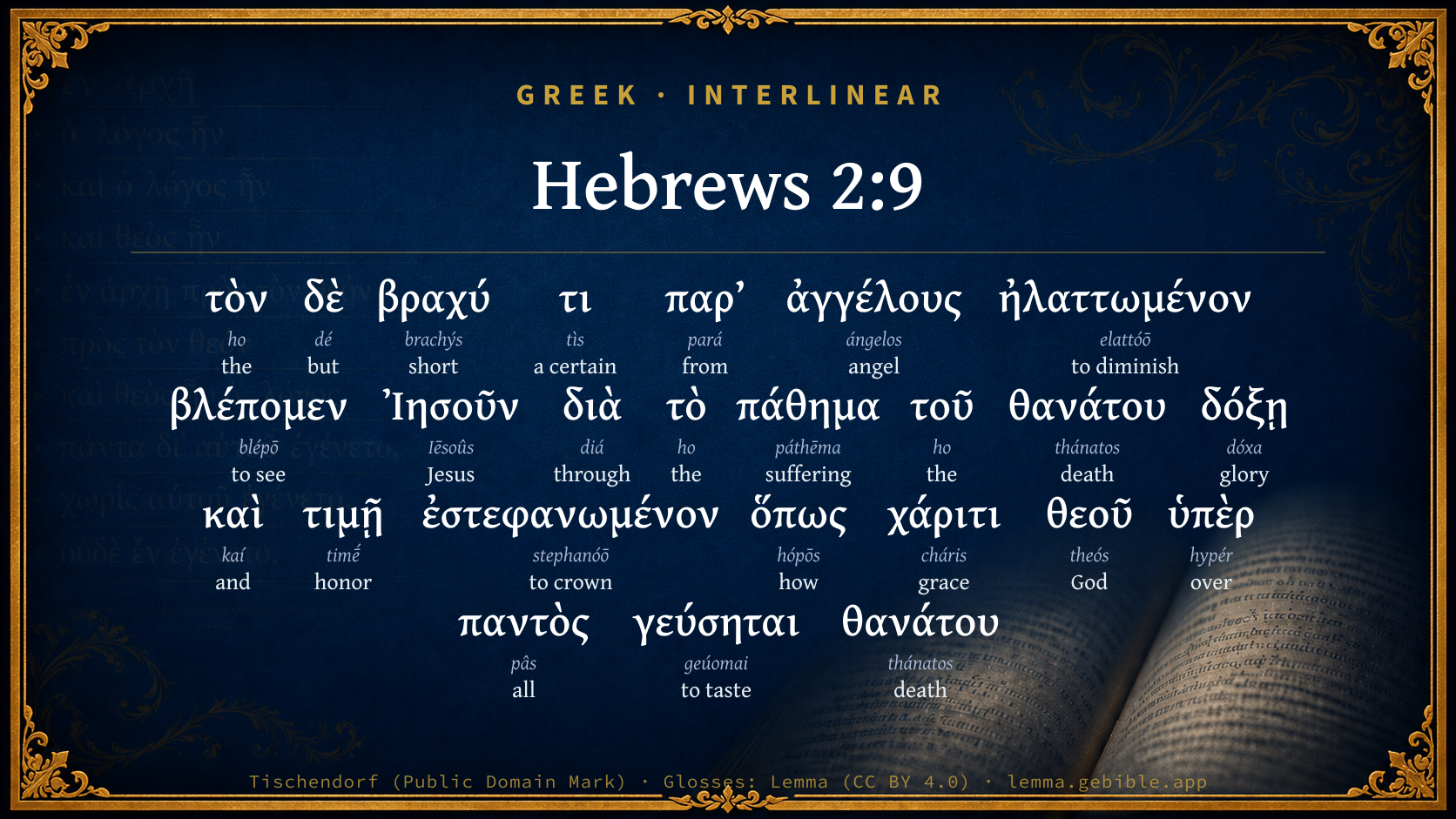
But we see him who has been made a little lower than the angels, Jesus, because of the suffering of death crowned with glory and honor, that by the grace of God he should taste of death for everyone.
Download a study sheet
One document with this verse’s original text, its word-by-word gloss line, the meaning frame, cross-references with their text, attributed commentary, and full source and license credits — printable, and it pastes into notes with its structure intact.
This verse Autodidact and up
A passage Seminary Student
Up to 50 verses in one chapter. A passage sheet keeps up to 6 commentary sources and 12 cross-references per verse, in the order this page ranks them, and says so on the sheet whenever that leaves anything out. Ask for a single verse and you get the Autodidact verse sheet above.
Everything on this page stays free to read, with no account — the sheet is a download of what is already on screen, not access to it.
Compare translations 3
The same verse in 3 English versions, stacked beneath the original-language interlinear above. Click any original word for its lexicon entry.
Each is an independent rendering of the whole verse — the interlinear is not word-aligned to these translations.
Highlighted words mark where these versions differ — a whole-verse word diff, not a word-by-word alignment.
-
World English Bible Public Domain
But we see him who has been made a little lower than the angels, Jesus, because of the suffering of death crowned with glory and honor, that by the grace of God he should taste of death for everyone.
-
King James Version Public Domain
But we see Jesus, who was made a little lower than the angels for the suffering of death, crowned with glory and honour; that he by the grace of God should taste death for every man.
-
unfoldingWord Literal Text CC BY-SA 4.0
but we see Jesus, the one made a little lower than the angels, crowned with glory and honor because of his suffering of death, so that by the grace of God he might taste of death on behalf of everyone.
unfoldingWord Literal Text — © unfoldingWord, licensed CC BY-SA 4.0. Word-aligned USFM3 via Door43 (git.door43.org/unfoldingWord/en_ult).
Show all 19 translations
Every available English version of this verse, each an independent rendering of the whole verse.
-
World English Bible Public Domain
But we see him who has been made a little lower than the angels, Jesus, because of the suffering of death crowned with glory and honor, that by the grace of God he should taste of death for everyone.
-
Berean Standard Bible Public Domain
But we see Jesus, who was made a little lower than the angels, now crowned with glory and honor because He suffered death, so that by the grace of God He might taste death for everyone.
-
Majority Standard Bible Public Domain
But we see Jesus, who was made a little lower than the angels, now crowned with glory and honor because He suffered death, so that by the grace of God He might taste death for everyone.
-
King James Version Public Domain
But we see Jesus, who was made a little lower than the angels for the suffering of death, crowned with glory and honour; that he by the grace of God should taste death for every man.
-
American Standard Version (1901) Public Domain
But we behold him who hath been made a little lower than the angels, `even' Jesus, because of the suffering of death crowned with glory and honor, that by the grace of God he should taste of death for every `man'.
-
Revised Version (1885) Public Domain
But we behold him who hath been made a little lower than the angels, even Jesus, because of the suffering of death crowned with glory and honour, that by the grace of God he should taste death for every man.
-
Geneva Bible (1599) Public Domain
But we see Iesus crowned with glory and honour, which was made litle inferiour to the Angels, through the suffering of death, that by Gods grace he might taste death for all men.
-
Douay-Rheims (1899) Public Domain
But we see Jesus, who was made a little lower than the angels, for the suffering of death, crowned with glory and honour: that, through the grace of God, he might taste death for all.
-
Young's Literal Translation Public Domain
and him who was made some little less than messengers we see -- Jesus -- because of the suffering of the death, with glory and honour having been crowned, that by the grace of God for every one he might taste of death.
-
Literal Standard Version CC BY-SA 4.0
and we see Him who was made [a] little less than messengers—Jesus—because of the suffering of death, having been crowned with glory and honor, that by the grace of God He might taste of death for everyone.
-
Unlocked Literal Bible CC BY-SA 4.0
But we see him who was made lower than the angels for a little while, Jesus, crowned with glory and honor because of his suffering and death, so that by God's grace he might taste death for everyone.
-
unfoldingWord Literal Text CC BY-SA 4.0
but we see Jesus, the one made a little lower than the angels, crowned with glory and honor because of his suffering of death, so that by the grace of God he might taste of death on behalf of everyone.
-
Darby Bible Public Domain
but we see Jesus, who [was] made some little inferior to angels on account of the suffering of death, crowned with glory and honour; so that by the grace of God he should taste death for every thing.
-
World Messianic Bible Public Domain
But we see him who has been made a little lower than the angels, Yeshua, because of the suffering of death crowned with glory and honor, that by the grace of God he should taste of death for everyone.
-
Webster's Bible Public Domain
But we see Jesus, who was made a little lower than the angels for the suffering of death, crowned with glory and honor; that he by the grace of God should taste death for every man.
-
Free Bible Version CC BY-SA 4.0
But we see Jesus, for a little while placed a little lower than the angels, through the suffering of death crowned with glory and honor. Through God's grace Jesus experienced death for everyone.
-
Bible in Basic English Public Domain
But we see him who was made a little lower than the angels, even Jesus, crowned with glory and honour, because he let himself be put to death so that by the grace of God he might undergo death for all men.
-
Text-Critical English NT CC BY 4.0
But we do see Jesus, who for a little while was made lower than the angels, now crowned with glory and honor because he suffered death, so that by the grace of God he might taste death for everyone.
-
Tyndale New Testament (1534) Public Domain
Neverthelesse we yet se not all thynges subdued but him that was made lesse the the angelles: we se that it was Iesus which is crouned with glory and honour for the sofferinge of death: that he by the grace of god shulde tast of deeth for all men.
Literal Standard Version (2020), Covenant Press — licensed CC BY-SA 4.0. Text via the HelloAO Bible API (eBible.org). Unlocked Literal Bible (unfoldingWord) — licensed CC BY-SA 4.0. Text via the HelloAO Bible API (eBible.org). unfoldingWord Literal Text — © unfoldingWord, licensed CC BY-SA 4.0. Word-aligned USFM3 via Door43 (git.door43.org/unfoldingWord/en_ult). Free Bible Version, Dr. Jonathan Gallagher — licensed CC BY-SA 4.0. Text via the HelloAO Bible API (eBible.org).
Word by word
More ways to search: Search by grammar → Find every occurrence → Compare this word →
Practice this passage: Drill this verse → Learn its vocabulary →
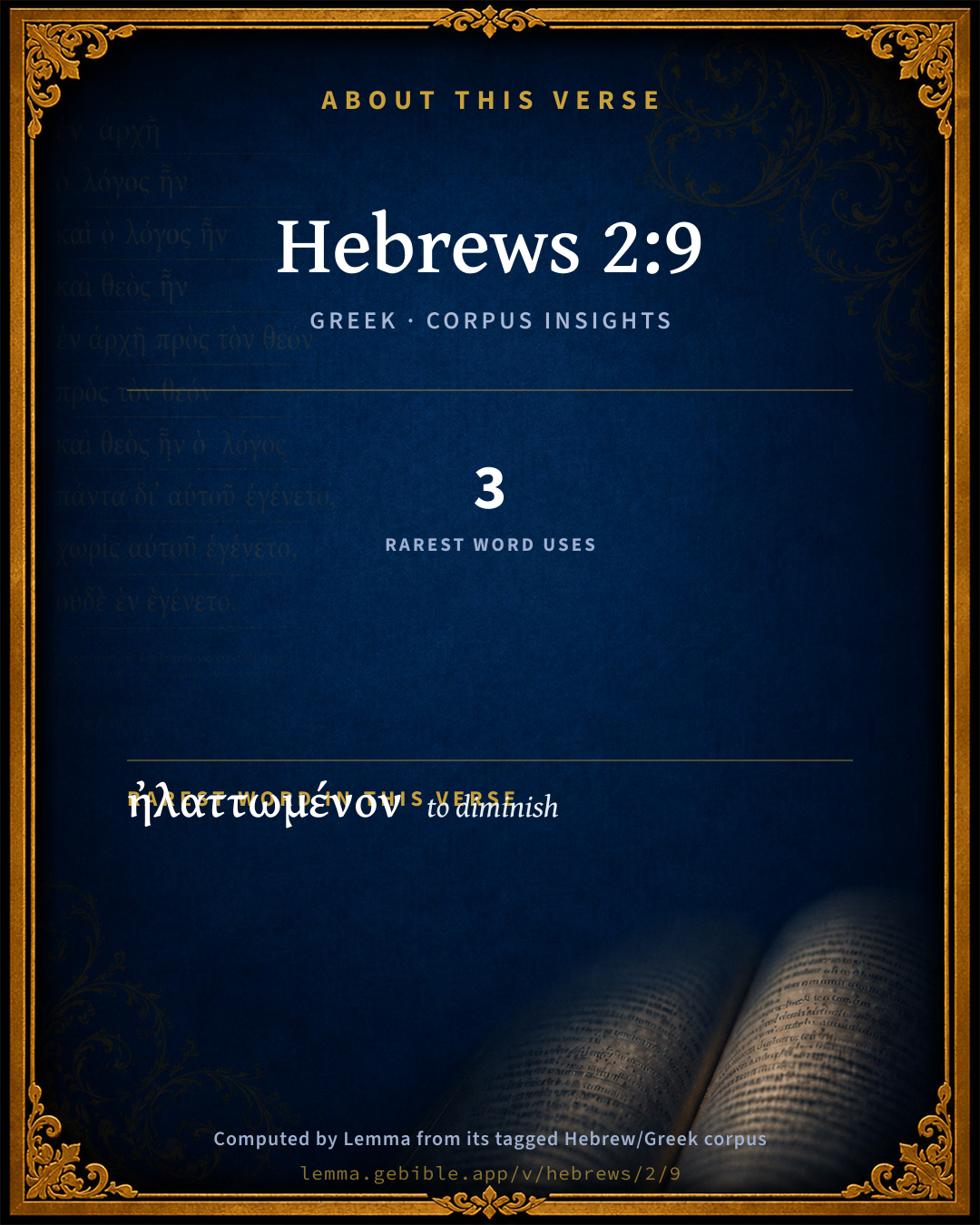
- Appears 3× in the Greek New Testament
- First appears at John 3:30
- Part of Speech
- Verb
- Tense
- Perfect
- Voice
- Passive
- Mood
- Participle
- Case
- Accusative
- Number
- Singular
- Gender
- Masculine
Full Thayer's Definition
- τὸν ho G3588 “the” Article, Accusative, Singular, Masculine
- δὲ dé G1161 “but” Conjunction
- βραχύ brachýs G1024 “short” Adjective, Accusative, Singular, Neuter
- τι tìs G5100 “a certain” Indefinite pronoun, Accusative, Singular, Neuter
- παρ’ pará G3844 “from” Preposition
- ἀγγέλους ángelos G32 “angel” Noun, Accusative, Plural, Masculine
- ἠλαττωμένον elattóō G1642 “to diminish” Verb, Perfect, Passive, Participle, Accusative, Singular, Masculine
- βλέπομεν blépō G991 “to see” Verb, Present, Active, Indicative, 1st person, Plural
- Ἰησοῦν Iēsoûs G2424 “Jesus” Noun, Accusative, Singular, Masculine
- διὰ diá G1223 “through” Preposition
- τὸ ho G3588 “the” Article, Accusative, Singular, Neuter
- πάθημα páthēma G3804 “suffering” Noun, Accusative, Singular, Neuter
- τοῦ ho G3588 “the” Article, Genitive, Singular, Masculine
- θανάτου thánatos G2288 “death” Noun, Genitive, Singular, Masculine
- δόξῃ dóxa G1391 “glory” Noun, Dative, Singular, Feminine
- καὶ kaí G2532 “and” Conjunction
- τιμῇ timḗ G5092 “honor” Noun, Dative, Singular, Feminine
- ἐστεφανωμένον stephanóō G4737 “to crown” Verb, Perfect, Passive, Participle, Accusative, Singular, Masculine
- ὅπως hópōs G3704 “how” Adverb
- χάριτι cháris G5485 “grace” Noun, Dative, Singular, Feminine
- θεοῦ theós G2316 “God” Noun, Genitive, Singular, Masculine
- ὑπὲρ hypér G5228 “over” Preposition
- παντὸς pâs G3956 “all” Adjective, Genitive, Singular, Masculine
- γεύσηται geúomai G1089 “to taste” Verb, Aorist, Middle deponent, Subjunctive, 3rd person, Singular
- θανάτου thánatos G2288 “death” Noun, Genitive, Singular, Masculine
About this verse
These counts appear in no published source. They are computed here, from the morphology-tagged text and Lemma’s own curated glosses. What Lemma adds →
- 25
- words
- 22
- distinct lemmas
- General Epistles
- section
Cross-references
34Topical passages linked to Hebrews 2:9 in the Treasury of Scripture Knowledge — connected by theme and wording, ordered by reader-vote popularity; previews shown in the World English Bible.
- Philippians 2:7–9 but emptied himself, taking the form of a servant, being made in the likeness of men.
- Revelation 5:9 They sang a new song, saying, "You are worthy to take the book, And to open its seals: For you were killed, And bought us for God with your blood, Out of every tribe, language, people, and nation,
- Romans 5:18 So then as through one trespass, all men were condemned; even so through one act of righteousness, all men were justified to life.
- 1 John 2:2 And he is the atoning sacrifice for our sins, and not for ours only, but also for the whole world.
- 1 John 4:9–10 By this was God's love revealed in us, that God has sent his one and only Son into the world that we might live through him.
- Acts 2:33 Being therefore exalted by the right hand of God, and having received from the Father the promise of the Holy Spirit, he has poured out this, which you now see and hear.
- John 3:16 For God so loved the world, that he gave his one and only Son, that whoever believes in him should not perish, but have eternal life.
- 2 Corinthians 5:15 He died for all, that those who live should no longer live to themselves, but to him who for their sakes died and rose again.
- John 1:29 The next day, he saw Jesus coming to him, and said, "Behold, the Lamb of God, who takes away the sin of the world!
- Romans 5:8 But God commends his own love toward us, in that while we were yet sinners, Christ died for us.
- Hebrews 10:5 Therefore when he comes into the world, he says, "Sacrifice and offering you didn't desire, But a body did you prepare for me;
- John 12:32 And I, if I am lifted up from the earth, will draw all people to myself."
- Genesis 3:15 I will put enmity between you and the woman, and between your offspring and her offspring. He will bruise your head, and you will bruise his heel."
- Isaiah 53:2–10 For he grew up before him as a tender plant, and as a root out of a dry ground: he has no form nor comeliness; and when we see him, there is no beauty that we should desire him.
- Hebrews 7:25 Therefore he is also able to save to the uttermost those who draw near to God through him, seeing he ever lives to make intercession for them.
- Romans 8:32 He who didn't spare his own Son, but delivered him up for us all, how would he not also with him freely give us all things?
- 1 Timothy 2:6 who gave himself as a ransom for all; the testimony in its own times;
- Hebrews 8:3 For every high priest is appointed to offer both gifts and sacrifices. Therefore it is necessary that this high priest also have something to offer.
- Isaiah 7:14 Therefore the Lord himself will give you a sign. Behold, the virgin will conceive, and bear a son, and shall call his name Immanuel.
- Acts 3:13 The God of Abraham, Isaac, and Jacob, the God of our fathers, has glorified his Servant Jesus, whom you delivered up, and denied in the presence of Pilate, when he had determined to release him.
- 2 Corinthians 5:21–6:1 For him who knew no sin he made to be sin on our behalf; so that in him we might become the righteousness of God.
- Galatians 4:4 But when the fullness of the time came, God sent out his Son, born to a woman, born under the law,
- 1 Peter 1:21 who through him are believers in God, who raised him from the dead, and gave him glory; so that your faith and hope might be in God.
- Psalms 21:3–5 For you meet him with the blessings of goodness; You set a crown of fine gold on his head.
- Matthew 16:28 Most assuredly I tell you, there are some standing here who will in no way taste of death, until they see the Son of Man coming in his Kingdom."
- John 8:52 Then the Jews said to him, "Now we know that you have a demon. Abraham died, and the prophets; and you say, 'If a man keeps my word, he will never taste of death.'
- John 10:17 Therefore the Father loves me, because I lay down my life, that I may take it again.
- Romans 8:3 For what the law couldn't do, in that it was weak through the flesh, God did, sending his own Son in the likeness of sinful flesh and for sin, he condemned sin in the flesh;
- Isaiah 11:1 There shall come forth a shoot out of the stock of Jesse, and a branch out of his roots shall bear fruit.
- Matthew 6:28 Why are you anxious about clothing? Consider the lilies of the field, how they grow. They don't toil, neither do they spin,
- Mark 9:1 He said to them, "Most assuredly I tell you, there are some standing here who will in no way taste death until they see the Kingdom of God come with power."
- Hebrews 2:7 You made him a little lower than the angels; You crowned him with glory and honor.
- Revelation 19:12 His eyes are a flame of fire, and on his head are many crowns. He has names written and a name written which no one knows but he himself.
- Luke 9:27 But I tell you the truth: There are some of those who stand here, who will in no way taste of death, until they see the Kingdom of God."
Cross-references courtesy of OpenBible.info (CC BY 4.0).
Where the printed editions differ
1 variantPlaces in this verse where the major printed Greek editions disagree on the wording in a way that affects the translation — a comparison of editions, not a manuscript-by-manuscript collation. The editions are the modern critical texts (Nestlé-Aland 28/27, SBL, Westcott-Hort, Tregelles, Tyndale House) and the traditional texts behind the KJV (the Textus Receptus and the Byzantine/Majority text). It is not a claim about which reading is original.
-
Different wording
χάριτι
“by [the] grace”
In NA28NA27TynWHTregTRByz Not in SBLχωρὶς (chōris) 'without' occurs in a few manuscripts (SBL) instead of χάριτι (chariti) 'by [the] grace' in older manuscripts (NA28+NA27+Tyn+WH+Treg+TR+Byz)
Textual data: Translators Amalgamated Greek New Testament (STEPBible TAGNT) · CC BY 4.0.
Lesson kit
Teaching starters — assembled from the data on this page, not authored interpretation. Every prompt links to the verse data it draws on. Edit before teaching.
Hebrews, in the General Epistles, opens this verse with 25 words (22 distinct Greek lemmas). Its most distinctive word is elattóō (“to diminish”). A historical commentator’s framing appears above. Read the whole chapter for the surrounding context.
Discussion questions
- How does “to diminish” (elattóō) shape what this verse is saying?
- How does John 3:30, which shares the word «to diminish», read alongside this verse?
- What does the repetition of “death” (2× in this one verse) do in this verse?
- The translations on this page render this verse differently — a whole-verse word diff, not a word-by-word alignment. What might account for the different wordings?
- Compare how Ellicott's Commentary for English Readers and The Biblical Illustrator read this verse. Where do they agree or differ?
Things to notice
- These translations choose different wording for 14 words in this verse.
- “death” occurs 2× in this single verse.
- 22 distinct Greek lemmas span 25 words in this verse.
Commentary
Notes on Hebrews 2:9 from classic Christian and Jewish commentators (each source and its license shown beneath its notes). The classic Christian expositions comment on the surrounding passage and are grouped to its opening verse, so a note may address several verses; the Jewish commentaries on the Tanakh (Rashi and others) are per-verse, so they appear only where the commentator wrote on this verse.
Lemma curates 59 commentaries, every one of them public domain or Creative Commons licensed, each selected and text-cleaned for this edition rather than reprinted as found. About our sources →
Ellicott's Commentary for English Readers
A Bible Commentary for English Readers, edited by Charles John Ellicott (1878–1897) — public domain. Text from a community e-Sword module.
The Biblical Illustrator
Joseph S. Exell
The Biblical Illustrator, edited by Joseph S. Exell (c. 1880s–1900s) — public domain. Text from a community e-Sword module.
Whedon's Commentary on the Bible
Daniel D. Whedon
Daniel D. Whedon (gen. ed.), Commentary on the Old and New Testaments (1874–1909) — public domain. Text from a community e-Sword module.
The People's New Testament
B. W. Johnson
B. W. Johnson's The People's New Testament with Notes (1889–1891) — public domain. Electronic text from the Christian Classics Ethereal Library (CCEL) ThML edition.
Tyndale Open Study Notes
Tyndale Open Resources
Tyndale Open Study Notes — © Tyndale Open Resources, licensed CC BY-SA 4.0. Text via the HelloAO Bible API.
Bengel's Gnomon
Johann Albrecht Bengel
Bengel's Gnomon of the New Testament — English translation (T&T Clark, Edinburgh, 1860) — public domain. Text from a community e-Sword module.
Meyer's Critical & Exegetical Commentary
Heinrich August Wilhelm Meyer
Meyer — Critical and Exegetical Commentary on the New Testament — English translation by Peter Christie, edited by Frederick Crombie (T&T Clark, 1880) — public domain. Text from a community e-Sword module.
Vincent's Word Studies in the New Testament
Marvin R. Vincent
Marvin R. Vincent, Word Studies in the New Testament (1887–1900) — public domain. Text from a community e-Sword/MySword module.
Geneva Bible (1599)
Geneva Bible translators
Geneva Bible (1599) marginal notes — public domain. Text via Bolls.life.
Jamieson, Fausset & Brown
Robert Jamieson, A. R. Fausset & David Brown
Jamieson, Fausset & Brown — Commentary Critical and Explanatory on the Whole Bible (1871) — public domain (CC PDM 1.0). Text via the HelloAO Bible API.
Adam Clarke's Commentary
Adam Clarke's Commentary on the Bible (1810–1826) — public domain. Text from a community e-Sword/MySword module.
John Calvin's Commentaries
John Calvin's Commentaries (1540-1563) — public domain. Text from the Calvin Translation Society English edition (1840s-50s) via the Christian Classics Ethereal Library (ccel.org). Calvin's coverage is partial (roughly two-thirds of the Bible); uncommented books and verses are honest gaps, never fabricated. The 19th-century editor's footnotes and remarks are omitted so the notes are faithfully Calvin's own voice.
The Cambridge Bible for Schools and Colleges
gen. ed. J. J. S. Perowne
The Cambridge Bible for Schools and Colleges (gen. ed. J. J. S. Perowne; Cambridge University Press, 1878–1918) — public domain. Text from a community e-Sword module.
John Gill's Exposition
John Gill's Exposition of the Whole Bible (1746–1763) — public domain (CC PDM 1.0). Text via the HelloAO Bible API.
Trapp's Complete Commentary
John Trapp
John Trapp, A Commentary or Exposition upon All the Books of the Old and New Testament (1647–1656) — public domain. Text from a community e-Sword module.
Albert Barnes' Notes on the Bible
Albert Barnes' Notes on the Bible (1834–1885) — public domain. Text from a community e-Sword/MySword module.
Haydock's Catholic Bible Commentary
George Leo Haydock (1774–1849), Haydock's Catholic Family Bible and Commentary, 1859 edition — public domain. Excludes Psalms (Douay-Rheims chapter numbering differs from Protestant) and Deuterocanonical books (Catholic canon only).
Matthew Poole's English Annotations
Matthew Poole's English Annotations on the Holy Bible (1683–1685) — public domain. Text from a community e-Sword/MySword module.
The Pulpit Commentary
The Pulpit Commentary (1880–1919), ed. H.D.M. Spence-Jones & Joseph S. Exell — public domain. Text from a community e-Sword module.
John Wesley's Explanatory Notes
John Wesley, Explanatory Notes Upon the Whole Bible (1754–1765) — public domain. Text via the GEBible commentary corpus.
Scofield Reference Notes
C. I. Scofield
The Scofield Reference Bible (1917 edition), notes by C. I. Scofield — public domain. Text from a community e-Sword module.
Godbey's Commentary on the New Testament
William B. Godbey
William B. Godbey, Commentary on the New Testament (1896–1900) — public domain. Text from a community e-Sword module.
unfoldingWord translationNotes
Door43 World Missions Community
unfoldingWord translationNotes — © Distant Shores Media and the Door43 World Missions Community, licensed CC BY-SA 4.0. Source: git.door43.org/Door43/en_tn.
Cambridge Greek Testament for Schools and Colleges
Cambridge Greek Testament for Schools and Colleges (Cambridge University Press, 1896; 21 vols, various authors incl. Carr, Maclear, Plummer, Farrar, Lumby, Moule, M. R. James, Simcox) — public domain. Text from a community e-Sword module.
Westcott on Hebrews & the Epistles of John
Brooke Foss Westcott
Brooke Foss Westcott (1825–1901), The Epistle to the Hebrews (1889) and The Epistles of St John (1883) — public domain (pre-1929). Text recovered from Internet Archive / Google Books OCR scans. Westcott’s Gospel of John commentary is not included (its OCR lost the chapter running-heads required for reliable verse-keying). Some Greek quoted in the Hebrews volume is imperfectly rendered by the OCR.