
Revelation 14:10

Greek (Tischendorf 8th ed.) Revelation 14:10 appears in the Greek New Testament. The text above is from the Tischendorf 8th edition. Each word links to its Strong’s number and a concise gloss. Click any word for its full Thayer’s Greek Lexicon entry.
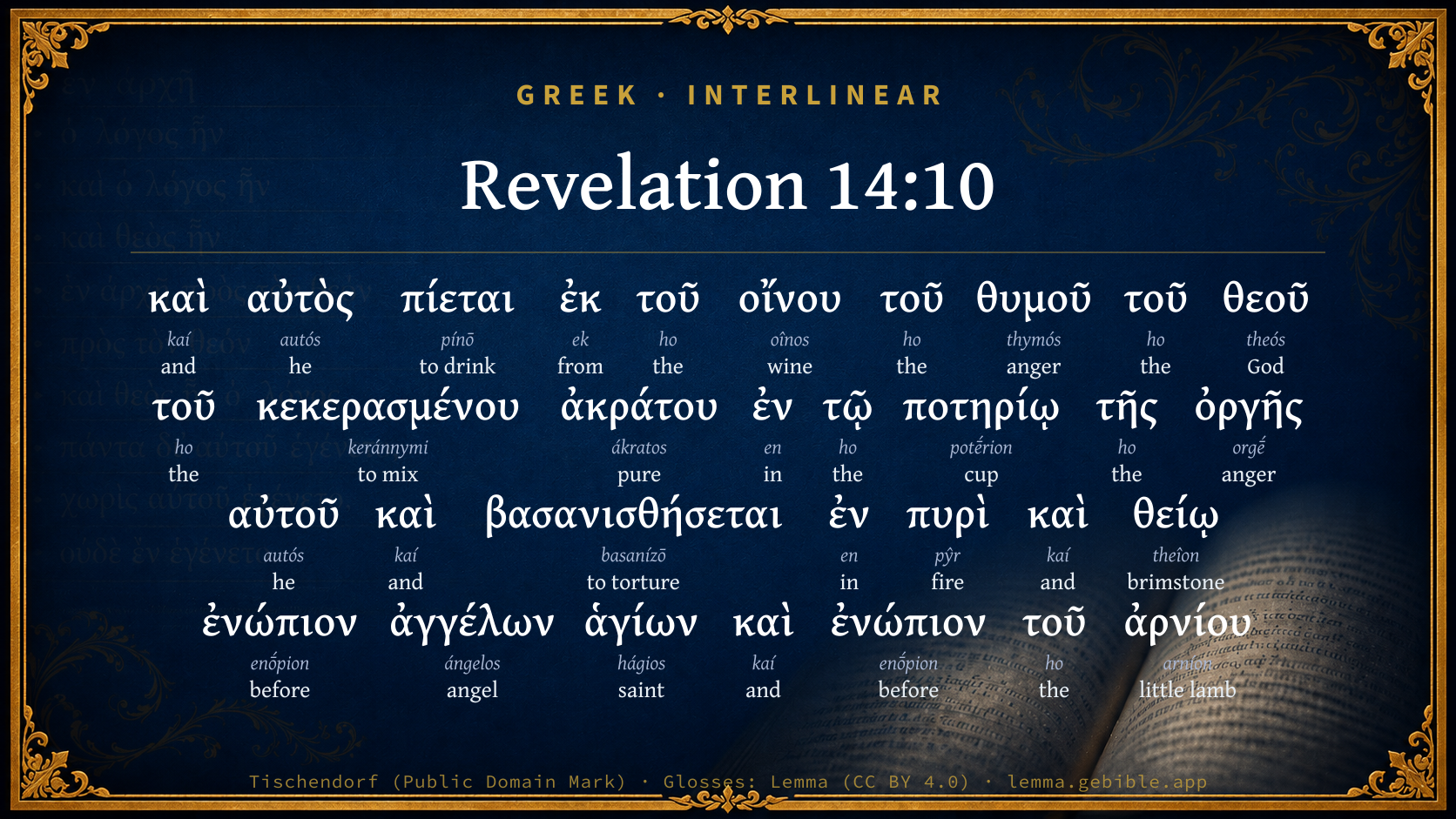
Download image
Cite this verse

Revelation 14:10 (World English Bible). Public Domain. Lemma interlinear Bible study tool, https://lemma.gebible.app/v/revelation/14/10.

Show BibTeX & RIS
BibTeX
RIS
English Translation
he also will drink of the wine of the wrath of God, which is prepared unmixed in the cup of his anger. He will be tormented with fire and sulfur in the presence of the holy angels, and in the presence of the Lamb.
World English Bible · Public Domain
Highlights
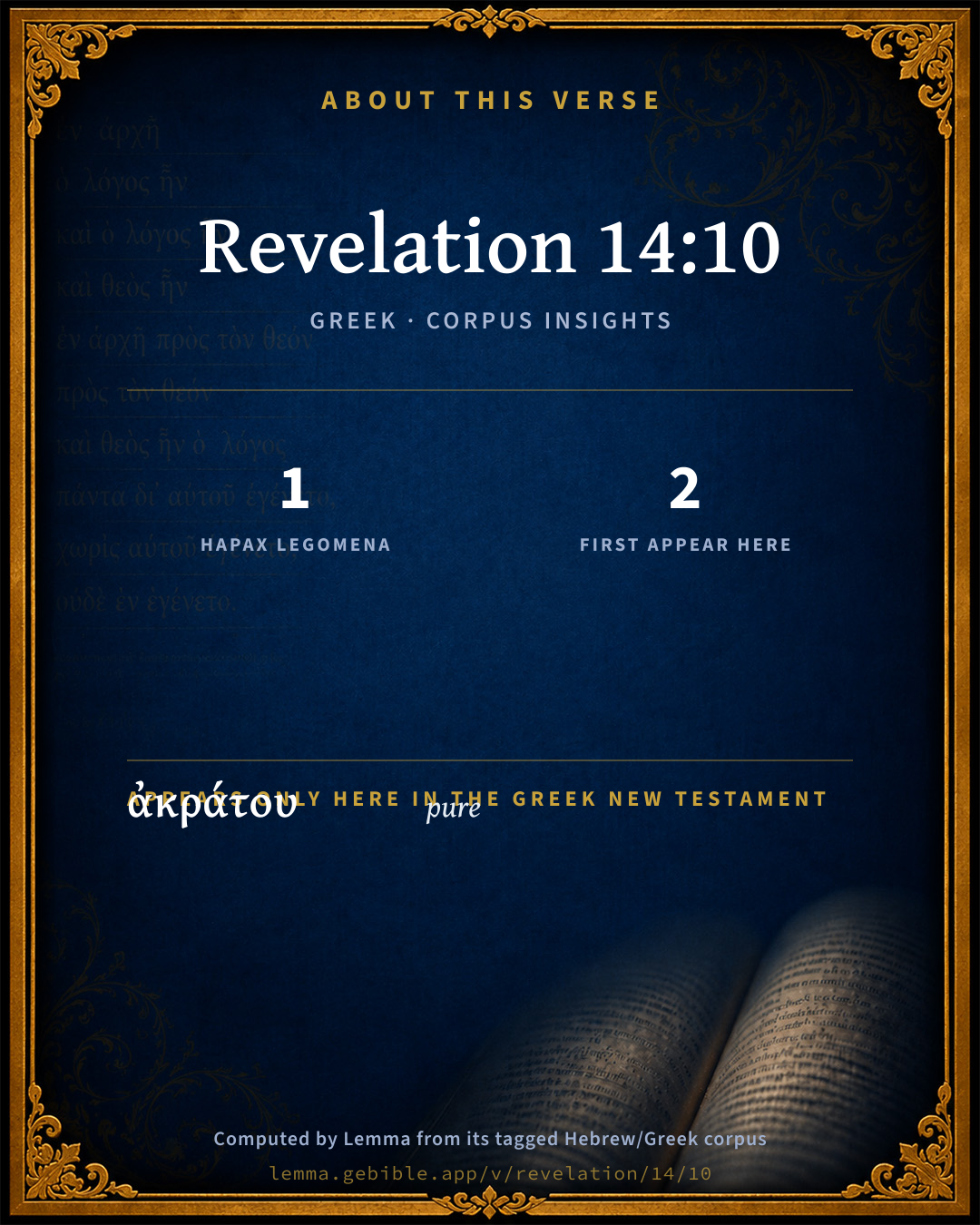
  • 1 hapax legomenon — only here in the Greek New Testament
  • 2 first appearances in the Greek New Testament
Full analysis ↓
Download a study sheet

One document with this verse’s original text, its word-by-word gloss line, the meaning frame, cross-references with their text, attributed commentary, and full source and license credits — printable, and it pastes into notes with its structure intact.

This verse Autodidact and up

Study sheet (.html) Plain text (.txt)

A passage Seminary Student

Up to 50 verses in one chapter. A passage sheet keeps up to 6 commentary sources and 12 cross-references per verse, in the order this page ranks them, and says so on the sheet whenever that leaves anything out. Ask for a single verse and you get the Autodidact verse sheet above.

Everything on this page stays free to read, with no account — the sheet is a download of what is already on screen, not access to it.

Want to remove ads? Support Godless Engineer
Compare translations 3

The same verse in 3 English versions, stacked beneath the original-language interlinear above. Click any original word for its lexicon entry.

Each is an independent rendering of the whole verse — the interlinear is not word-aligned to these translations.

Highlighted words mark where these versions differ — a whole-verse word diff, not a word-by-word alignment.

  • World English Bible Public Domain
    he also will drink of the wine of the wrath of God, which is prepared unmixed in the cup of his anger. He will be tormented with fire and sulfur in the presence of the holy angels, and in the presence of the Lamb.
  • King James Version Public Domain
    The same shall drink of the wine of the wrath of God, which is poured out without mixture into the cup of his indignation; and he shall be tormented with fire and brimstone in the presence of the holy angels, and in the presence of the Lamb:
  • unfoldingWord Literal Text CC BY-SA 4.0
    he will also drink from the wine of the wrath of God having been poured undiluted into the cup of his anger, and he will be tormented with fire and sulfur before the holy angels and before the Lamb.

unfoldingWord Literal Text — © unfoldingWord, licensed CC BY-SA 4.0. Word-aligned USFM3 via Door43 (git.door43.org/unfoldingWord/en_ult).

Versions to compare (up to 4)

3 of 4 selected

Show all 19 translations

Every available English version of this verse, each an independent rendering of the whole verse.

  • World English Bible Public Domain
    he also will drink of the wine of the wrath of God, which is prepared unmixed in the cup of his anger. He will be tormented with fire and sulfur in the presence of the holy angels, and in the presence of the Lamb.
  • Berean Standard Bible Public Domain
    he too will drink the wine of God’s anger, poured undiluted into the cup of His wrath. And he will be tormented in fire and sulfur in the presence of the holy angels and of the Lamb.
  • Majority Standard Bible Public Domain
    he too will drink the wine of God’s anger, poured undiluted into the cup of His wrath. And he will be tormented in fire and sulfur in the presence of the holy angels and of the Lamb.
  • King James Version Public Domain
    The same shall drink of the wine of the wrath of God, which is poured out without mixture into the cup of his indignation; and he shall be tormented with fire and brimstone in the presence of the holy angels, and in the presence of the Lamb:
  • American Standard Version (1901) Public Domain
    he also shall drink of the wine of the wrath of God, which is prepared unmixed in the cup of his anger; and he shall be tormented with fire and brimstone in the presence of the holy angels, and in the presence of the Lamb:
  • Revised Version (1885) Public Domain
    he also shall drink of the wine of the wrath of God, which is prepared unmixed in the cup of his anger; and he shall be tormented with fire and brimstone in the presence of the holy angels, and in the presence of the Lamb:
  • Geneva Bible (1599) Public Domain
    The same shall drinke of the wine of ye wrath of God, yea, of the pure wine, which is powred into the cup of his wrath, and he shalbe tormented in fire and brimstone before the holy Angels, and before the Lambe.
  • Douay-Rheims (1899) Public Domain
    He also shall drink of the wine of the wrath of God, which is mingled with pure wine in the cup of his wrath, and shall be tormented with fire and brimstone in the sight of the holy angels, and in the sight of the Lamb.
  • Young's Literal Translation Public Domain
    he also shall drink of the wine of the wrath of God, that hath been mingled unmixed in the cup of His anger, and he shall be tormented in fire and brimstone before the holy messengers, and before the Lamb,
  • Literal Standard Version CC BY-SA 4.0
    he also will drink of the wine of the wrath of God that has been mingled unmixed in the cup of His anger, and he will be tormented in fire and brimstone before the holy messengers, and before the Lamb,
  • Unlocked Literal Bible CC BY-SA 4.0
    he will also drink some of the wine of God's wrath, the wine that has been poured undiluted into the cup of his anger. The person who drinks it will be tormented with fire and sulfur before God's holy angels and before the Lamb.
  • unfoldingWord Literal Text CC BY-SA 4.0
    he will also drink from the wine of the wrath of God having been poured undiluted into the cup of his anger, and he will be tormented with fire and sulfur before the holy angels and before the Lamb.
  • Darby Bible Public Domain
    he also shall drink of the wine of the fury of God prepared unmixed in the cup of his wrath, and he shall be tormented in fire and brimstone before the holy angels and before the Lamb.
  • World Messianic Bible Public Domain
    he also will drink of the wine of the wrath of God, which is prepared unmixed in the cup of his anger. He will be tormented with fire and sulfur in the presence of the holy angels and in the presence of the Lamb.
  • Webster's Bible Public Domain
    The same shall drink of the wine of the wrath of God, which is poured out without mixture into the cup of his indignation; and he shall be tormented with fire and brimstone in the presence of the holy angels, and in the presence of the Lamb:
  • Free Bible Version CC BY-SA 4.0
    they will also drink of the wine of God's furious opposition that is poured undiluted into the cup of his anger, and they will suffer anguish in fire and burning sulfur before the holy angels and the Lamb.
  • Bible in Basic English Public Domain
    To him will be given of the wine of God's wrath which is ready unmixed in the cup of his wrath and he will have cruel pain, burning with fire before the holy angels and before the Lamb:
  • Text-Critical English NT CC BY 4.0
    he too will drink of the wine of the wrath of God that has been mixed undiluted in the cup of his anger. He will be tormented with fire and sulfur in the presence of the holy angels and in the presence of the Lamb.
  • Tyndale New Testament (1534) Public Domain
    the same shall drynke of the wyne of the wrath of God which is powred in the cuppe of his wrath. And he shalbe punnysshed in fyre and brymstone before the holy Angels and before the lambe.

Literal Standard Version (2020), Covenant Press — licensed CC BY-SA 4.0. Text via the HelloAO Bible API (eBible.org). Unlocked Literal Bible (unfoldingWord) — licensed CC BY-SA 4.0. Text via the HelloAO Bible API (eBible.org). unfoldingWord Literal Text — © unfoldingWord, licensed CC BY-SA 4.0. Word-aligned USFM3 via Door43 (git.door43.org/unfoldingWord/en_ult). Free Bible Version, Dr. Jonathan Gallagher — licensed CC BY-SA 4.0. Text via the HelloAO Bible API (eBible.org).

Word by word

More ways to search: Search by grammar → Find every occurrence → Compare this word →

Practice this passage: Drill this verse → Learn its vocabulary →

ἀκράτου
ákratos
G194
“pure”
Adjective, Genitive, Singular, Masculine
Part of Speech
Adjective
Case
Genitive
Number
Singular
Gender
Masculine
Full Thayer's Definition

Origin: from G1 (as a negative particle) and a presumed derivative of G2767

TDNT: None

1. unmixed, pure
  1. καὶ kaí G2532 “and” Conjunction
  2. αὐτὸς autós G846 “he” Personal pronoun, Nominative, Singular, Masculine
  3. πίεται pínō G4095 “to drink” Verb, Future, Middle deponent, Indicative, 3rd person, Singular
  4. ἐκ ek G1537 “from” Preposition
  5. τοῦ ho G3588 “the” Article, Genitive, Singular, Masculine
  6. οἴνου oînos G3631 “wine” Noun, Genitive, Singular, Masculine
  7. τοῦ ho G3588 “the” Article, Genitive, Singular, Masculine
  8. θυμοῦ thymós G2372 “anger” Noun, Genitive, Singular, Masculine
  9. τοῦ ho G3588 “the” Article, Genitive, Singular, Masculine
  10. θεοῦ theós G2316 “God” Noun, Genitive, Singular, Masculine
  11. τοῦ ho G3588 “the” Article, Genitive, Singular, Masculine
  12. κεκερασμένου keránnymi G2767 “to mix” Verb, Perfect, Passive, Participle, Genitive, Singular, Masculine
  13. ἐν en G1722 “in” Preposition
  14. τῷ ho G3588 “the” Article, Dative, Singular, Neuter
  15. ποτηρίῳ potḗrion G4221 “cup” Noun, Dative, Singular, Neuter
  16. τῆς ho G3588 “the” Article, Genitive, Singular, Feminine
  17. ὀργῆς orgḗ G3709 “anger” Noun, Genitive, Singular, Feminine
  18. αὐτοῦ autós G846 “he” Personal pronoun, Genitive, Singular, Masculine
  19. καὶ kaí G2532 “and” Conjunction
  20. βασανισθήσεται basanízō G928 “to torture” Verb, Future, Passive, Indicative, 3rd person, Singular
  21. ἐν en G1722 “in” Preposition
  22. πυρὶ pŷr G4442 “fire” Noun, Dative, Singular, Neuter
  23. καὶ kaí G2532 “and” Conjunction
  24. θείῳ theîon G2303 “brimstone” Noun, Dative, Singular, Neuter
  25. ἐνώπιον enṓpion G1799 “before” Adverb
  26. ἀγγέλων ángelos G32 “angel” Noun, Genitive, Plural, Masculine
  27. ἁγίων hágios G40 “saint” Adjective, Genitive, Plural, Masculine
  28. καὶ kaí G2532 “and” Conjunction
  29. ἐνώπιον enṓpion G1799 “before” Adverb
  30. τοῦ ho G3588 “the” Article, Genitive, Singular, Neuter
  31. ἀρνίου arníon G721 “little lamb” Noun, Genitive, Singular, Neuter

About this verse

These counts appear in no published source. They are computed here, from the morphology-tagged text and Lemma’s own curated glosses. What Lemma adds →

32
words
20
distinct lemmas
Revelation
section

Notable vocabulary

1 hapax legomenon — a word that appears only here in the entire Greek New Testament:

  • ἀκράτου pure G194

First appearance in Scripture

These words make their first canonical appearance in the Greek New Testament here:

  • κεκερασμένου to mix G2767
  • ἀκράτου pure G194

Shared distinctive vocabulary

κεκερασμένου to mix G2767 occurs in 2 verses of the Greek New Testament. Also found in:
Repetition

Words recur within this verse:

  • ἐνώπιον before G1799 ×2
  • τοῦ the G3588 ×7
  • καὶ and G2532 ×4
  • αὐτὸς he G846 ×2
  • ἐν in G1722 ×2

Cross-references

37

Topical passages linked to Revelation 14:10 in the Treasury of Scripture Knowledge — connected by theme and wording, ordered by reader-vote popularity; previews shown in the World English Bible.

  • Isaiah 51:17 Awake, awake, stand up, Jerusalem, that have drunk at the hand of Yahweh the cup of his wrath; you have drunken the bowl of the cup of staggering, and drained it.
  • Psalms 75:8 For in the hand of Yahweh there is a cup, Full of foaming wine mixed with spices. He pours it out. Indeed the wicked of the earth drink and drink it to its very dregs.
  • Revelation 16:19 The great city was divided into three parts, and the cities of the nations fell. Babylon the great was remembered in the sight of God, to give to her the cup of the wine of the fierceness of his wrath.
  • Psalms 11:6 On the wicked he will rain blazing coals; Fire, sulfur, and scorching wind shall be the portion of their cup.
  • Jeremiah 25:15–17 For thus says Yahweh, the God of Israel, to me: take this cup of the wine of wrath at my hand, and cause all the nations, to whom I send you, to drink it.
  • Revelation 18:6 Return to her just as she returned, and repay her double as she did, and according to her works. In the cup which she mixed, mix to her double.
  • Revelation 19:20 The beast was taken, and with him the false prophet who worked the signs in his sight, with which he deceived those who had received the mark of the beast and those who worshiped his image. These two were thrown alive into the lake of fire that burns with sulfur.
  • Revelation 20:10 The devil who deceived them was thrown into the lake of fire and sulfur, where the beast and the false prophet are also. They will be tormented day and night forever and ever.
  • Revelation 21:8 But for the cowardly, unbelieving, sinners, abominable, murderers, sexually immoral, sorcerers, idolaters, and all liars, their part is in the lake that burns with fire and sulfur, which is the second death."
  • Genesis 19:24 Then Yahweh rained on Sodom and on Gomorrah sulfur and fire from Yahweh out of the sky.
  • Deuteronomy 29:23 [and that] the whole land of it is sulfur, and salt, [and] a burning, [that] it is not sown, nor bears, nor any grass grows therein, like the overthrow of Sodom and Gomorrah, Admah and Zeboiim, which Yahweh overthrew in his anger, and in his wrath:
  • Job 21:20 Let his own eyes see his destruction. Let him drink of the wrath of the Almighty.
  • Matthew 25:41 Then he will say also to those on the left hand, 'Depart from me, you cursed, into the eternal fire which is prepared for the devil and his angels;
  • 2 Thessalonians 1:8–9 giving vengeance to those who don't know God, and to those who don't obey the Gospel of our Lord Jesus,
  • Isaiah 30:33 For a Topheth is prepared of old; yes, for the king it is made ready; he has made it deep and large; the pile of it is fire and much wood; the breath of Yahweh, like a stream of sulfur, does kindle it.
  • Isaiah 51:21–22 Therefore hear now this, you afflicted, and drunken, but now with wine:
  • Jude 1:7 Even as Sodom and Gomorrah, and the cities around them, having, in the same way as these, given themselves over to sexual immorality and gone after strange flesh, are set forth as an example, suffering the punishment of eternal fire.
  • Isaiah 29:9 Stay you and wonder; take your pleasure and be blind: they are drunken, but not with wine; they stagger, but not with strong drink.
  • Isaiah 34:9 The streams of [Edom] shall be turned into pitch, and the dust of it into sulfur, and the land of it shall become burning pitch.
  • Jeremiah 25:27 You shall tell them, Thus says Yahweh of Hosts, the God of Israel: Drink you, and be drunken, and spew, and fall, and rise no more, because of the sword which I will send among you.
  • Ezekiel 20:48 All flesh shall see that I, Yahweh, have kindled it; it shall not be quenched.
  • Habakkuk 2:16 You are filled with shame, and not glory. You will also drink, and be exposed! The cup of Yahweh's right hand will come around to you, and disgrace will cover your glory.
  • Matthew 13:41–42 The Son of Man will send out his angels, and they will gather out of his Kingdom all things that cause stumbling, and those who do iniquity,
  • Matthew 13:49–50 So will it be in the end of the world. The angels will come forth, and separate the wicked from among the righteous,
  • Revelation 9:17–18 Thus I saw the horses in the vision, and those who sat on them, having breastplates of fiery red, hyacinth blue, and sulfur yellow; and the heads of lions. Out of their mouths proceed fire, smoke, and sulfur.
  • Revelation 18:3 For all the nations have drunk of the wine of the wrath of her sexual immorality, the kings of the earth committed sexual immorality with her, and the merchants of the earth grew rich from the abundance of her luxury."
  • Job 18:15 There shall dwell in his tent that which is none of his. Sulfur shall be scattered on his habitation.
  • Psalms 37:34 Wait for Yahweh, and keep his way, And he will exalt you to inherit the land. When the wicked are cut off, you shall see it.
  • Psalms 60:3 You have shown your people hard things. You have made us drink the wine that makes us stagger.
  • Psalms 91:8 You will only look with your eyes, And see the recompense of the wicked.
  • Jeremiah 49:12 For thus says Yahweh: Behold, they to whom it didn't pertain to drink of the cup shall assuredly drink; and are you he who shall altogether go unpunished? you shall not go unpunished, but you shall surely drink.
  • Jeremiah 51:57 I will make drunk her princes and her wise men, her governors and her deputies, and her mighty men; and they shall sleep a perpetual sleep, and not wake up, says the King, whose name is Yahweh of Hosts.
  • Lamentations 4:21 Rejoice and be glad, daughter of Edom, that dwell in the land of Uz: The cup shall pass through to you also; you shall be drunken, and shall make yourself naked.
  • Matthew 20:22 But Jesus answered, "You don't know what you are asking. Are you able to drink the cup that I am about to drink, and be baptized with the baptism that I am baptized with?" They said to him, "We are able."
  • Matthew 26:39 He went forward a little, fell on his face, and prayed, saying, "My Father, if it is possible, let this cup pass away from me; nevertheless, not what I desire, but what you desire."
  • Psalms 52:6 The righteous also will see it, and fear, And laugh at him, saying,
  • Psalms 73:10 Therefore their people return to them, And they drink up waters of abundance.

Cross-references courtesy of OpenBible.info (CC BY 4.0).

Commentary

Notes on Revelation 14:10 from classic Christian and Jewish commentators (each source and its license shown beneath its notes). The classic Christian expositions comment on the surrounding passage and are grouped to its opening verse, so a note may address several verses; the Jewish commentaries on the Tanakh (Rashi and others) are per-verse, so they appear only where the commentator wrote on this verse.

Lemma curates 59 commentaries, every one of them public domain or Creative Commons licensed, each selected and text-cleaned for this edition rather than reprinted as found. About our sources →

Bengel's Gnomon

Johann Albrecht Bengel

Rev 14:10. Ἐκ τοῦ οἴνου τοῦ θυμοῦ—ἐν τῷ ποτηρίῳ τῆς ὀργῆς, of the wine of wrath—in the cup of indignation) As the wine is to the cup, so is wrath to indignation. A designed difference of words: ch. Rev 16:19, Rev 19:15. ἡ ὀργὴ leads τὸν θυμὸν into action. Comp. Rom 2:8, note. חמה is θυμὸς, חרן ὀργὴ, in the LXX.—τοῦ κεκερασμένου ἀκράτου, which is poured in without mixture) κεράννυμι, I mix, is used generally for I pour in, even of unmixed wine.—ἄκρατον is unmixed, with which nought of grace or hope is blended. Such an unmixed potion is already mingled and prepared for the worshippers of the beast. There is at hand both a salvation, which awaits the saints, and a punishment, which overhangs the wicked. Psalms 75 (74):9, ποτήριον ἐν χειρὶ Κυρίου οἴνου ἀκράτου, πλῆρες κεράσματος.

Bengel's Gnomon of the New Testament — English translation (T&T Clark, Edinburgh, 1860) — public domain. Text from a community e-Sword module.

Meyer's Critical & Exegetical Commentary

Heinrich August Wilhelm Meyer

Rev_14:10. The καὶ αὐτός[3504] represents the details, as well as likewise the harlot herself, incurring the judgment.[3505]

πίεται (fut.). Winer, p. 84.

The οἶνος τοῦ θυμοῦ τ. θ. is represented in the ποτήριον τῆς ὀργῆς αὐτου; but the dreadful power of this wine of wrath is rendered conspicuous, since it is itself designated: τοῦ κεκερασμένου ἀκράτου. It is meant that in the cup of indignation there is found unmixed wine (ἀκρατος, Psa_74:9, LXX.), i.e., not tempered with water, and hence that the wine of wrath, thus set forth, works with its entire force. The contradiction in the words occurring in the connection of κεκερασμ. and ἀκράτ. is without difficulty, because[3506] the custom of adapting the wine for ordinary use, by mixing it with water, has brought with it a usage of words in which the κερᾷν, without giving prominence to its special signification, attains the further sense of ἐγχέειν εἰς κέρας, διδόναι πιεῖν, etc.[3507] So Ewald: I have drunken wine so prepared (mixed) as to be pure; De Wette, Ebrard, etc. According to Züll., the ἀκράτου is regarded not as undiluted wine, but as designating the compounded, i.e., with additions, as spices, myrrh, opiates, etc., whereby the Orientals make their wine still stronger; and thus it is indicated that the Divine cup of indignation contains no wine but a pure mixture, pure essence of mixtures. Hengstenb. interprets artificially, in a still different way.

καὶ βασανισθήσονται. Cf. Rev_9:5. The punishment of hell here described (ἐν πυρὶ κ. θείῳ, Rev_9:17, Rev_20:10) is not, with Grotius, to be resolved into pangs of conscience.

ἐνώπιον τῶν ἁγίων ἀγγ. κ. ἐν τ. ἀρνίον. Incorrectly, De Wette: According to the judgment. Rather, they suffer this their pain before the eyes of the holy angels, and of the Lamb despised and persecuted by the worshippers of the beast, which appears just on this account to render it the more bitter.[3508]

καὶ ὁ καπνὸς τοῦ βασανισμοῦ αὐτῶν, κ.τ.λ., according to Isa_34:10. Cf. Isa_19:3. It is to be observed, that in this passage βασανισμός is passive, in the sense of βάσανος. Cf., on the other hand, Isa_9:5.

ούκ ἔχουσιν ἀνάπαυσιν, κ.τ.λ., viz., in their βασανιαμός.[3509] The expression as Rev_4:8.

καὶ εἴ τις λαμβ. With grave emphasis this expression, individualizing the general conception, οί προσκυνοῦντες, affirms that every one who in any way resigns himself to the beast[3510] incurs that eternal torment.

[3504] Cf. Rev_14:17.

[3505] Cf. Ewald.

[3506] Cf. Wetst.

[3507] Rev_18:6.

[3508] Cf. Rev_11:12; Luk_16:23 sqq. Hengstenb.

[3509] Rev_20:10.

[3510] De Wette.

Meyer — Critical and Exegetical Commentary on the New Testament — English translation by Peter Christie, edited by Frederick Crombie (T&T Clark, 1880) — public domain. Text from a community e-Sword module.

Expositor's Greek Testament

ed. W. Robertson Nicoll

Rev 14:10 . κεκερασμένου here as in Rev 18:6 by oxymoron = “poured out,” the original meaning of “mixed” (with water) being dropped. The torture (depicted from Isa 34:9-10 ) is inflicted before the holy angels (who evidently sit as assessors at the judgment, En. Isa 48:9 ), ἁγίων being either an epitheton ornans or an allusion to Rev 12:8-9 . Normally the prophet refrains from introducing such spectators of doom (Rev 19:20 , Rev 20:10-14 ). “Fire is the divine cruelty of the Semitic religions” (Doughty), but the torment which Judaism designed for fallen angels and apostates is assigned here to the worshippers of the Cæsars. The Apocalypse is silent upon agents of torture; they are not the angels, much less the devil (who is himself punished, Rev 20:10 ). But, like 4 Ezr 7 [ver. 36] (“the furnace of Gehenna shall be disclosed and over against it the paradise of delight”), John locates the place of torment over against the place of rest. For such grim popular fancies Enoch (xxvii. 2, 3, xlviii. 9, xc. 26, 27) is mainly responsible; there (as in Clem. Hom , xvii.) the tortures proceed under the eyes of the righteous, though (especially in the later fragments, as in John’s Apoc.) the moralisation of the idea has advanced, until Gehenna vanishes from the scene of bliss. “It is impossible for us to understand how such a sight could be compatible with heavenly happiness” (Stanton, Jewish and Christian Messiah , p. 344; cf. Lecky’s European Morals , ii. 225 f.), but the psychological basis of the ghastly expectation can be verified in the cruder types of primitive and modern religion. Most critics delete καὶ ἐνώπιον τοῦ ἀρνίου as another gloss ( cf. on Rev 14:4 ); the position of Jesus after the angels is not unexampled ( cf. Rev 1:4-5 ), even if before the holy angels were not taken (Bs., Baljon) as a periphrasis for the divine presence (Luk 12:8-9 ; Luk 15:10 ).

The Expositor's Greek Testament, edited by W. Robertson Nicoll (1897–1910) — public domain. Text from a community e-Sword module.

Jamieson, Fausset & Brown

Robert Jamieson, A. R. Fausset & David Brown

The same--Greek, "he also," as the just and inevitable retribution.

wine of . . . wrath of God-- (Psa 75:8).

without mixture--whereas wine was so commonly mixed with water that to mix wine is used in Greek for to pour out wine; this wine of God's wrath is undiluted; there is no drop of water to cool its heat. Naught of grace or hope is blended with it. This terrible threat may well raise us above the fear of man's threats. This unmixed cup is already mingled and prepared for Satan and the beast's followers.

indignation--Greek, "orges," "abiding wrath," But the Greek for "wrath" above (Greek, "thumou") is boiling indignation, from (Greek, "thuo") a root meaning "to boil"; this is temporary ebullition of anger; that is lasting [AMMONIUS], and accompanied with a purpose of vengeance [ORIGEN on Psa 2:5].

tormented . . . in the presence of . . . angels-- (Psa 49:14; Psa 58:10; Psa 139:21; Isa 66:24). God's enemies are regarded by the saints as their enemies, and when the day of probation is past, their mind shall be so entirely one with God's, that they shall rejoice in witnessing visibly the judicial vindication of God's righteousness in sinners' punishment.

Jamieson, Fausset & Brown — Commentary Critical and Explanatory on the Whole Bible (1871) — public domain (CC PDM 1.0). Text via the HelloAO Bible API.

Adam Clarke's Commentary

Verse 10. The wine of the wrath of God] As they have drunk the intoxicating wine of idolatry or spiritual fornication, they shall now drink the wine of God's wrath, which is poured out into the cup of his indignation. This is an allusion to the poisoned cup, which certain criminals were obliged to drink, on which ensued speedy death. See Clarke on Heb 2:9.

Shall be tormented with fire and brimstone] An allusion to the punishment of Sodom and Gomorrha for their unnatural crimes.

Presence of the holy angels, and-of the Lamb] These being the instruments employed in their destruction; the Lamb-the Lord Jesus Christ, acting as judge.

Adam Clarke's Commentary on the Bible (1810–1826) — public domain. Text from a community e-Sword/MySword module.

The Cambridge Bible for Schools and Colleges

gen. ed. J. J. S. Perowne

10. drink of the wine of the wrath of God] Psa_75:8 (9); Isa_51:17; Isa_51:22; Jer_25:15 sqq.

poured out without mixture] Lit. mixed unmixed: there is prob. nothing meant but the sense of the A. V., the “pouring out” of wine being usually a process of “mixing.” But the paradoxical form of expression comes from the LXX. of Psa_75:8, where the word “red” (or perhaps “foaming,” “fiery”) is translated by “unmixed,” proving that St John knows and uses the LXX. version, though he corrects it when necessary.

with fire and brimstone] Perhaps rather in. See Rev_19:20, Rev_20:15, Rev_21:8.

in the presence, &c.] It is impossible to translate these words otherwise: they prove that the holy angels, and the Lamb Himself, acquiesce or something more in the justice and necessity of God’s awful judgements. This being so, we dare not give weight to sentimental or à priori arguments against their possibility, though to our present faculties God’s future treatment of sin may be as hard to reconcile with His known attributes as His permission of its origin in the past. We are forced to pass over the one difficulty: faith and humility will pass over the other.

The Cambridge Bible for Schools and Colleges (gen. ed. J. J. S. Perowne; Cambridge University Press, 1878–1918) — public domain. Text from a community e-Sword module.

John Gill's Exposition

The same shall drink of the wine of the wrath of God,.... Which is a just punishment for their sin; that as such have drank of the wine of the wrath of Rome's fornication, Rev 14:8 so they shall now drink of the wine of God's wrath; it is usual in Scripture to express the punishment God inflicts upon wicked men by his wrath, and by the wine cup of his fury; and their suffering such punishment, by their drinking of it; see Jer 25:15 so , "the wine of wrath", is a phrase used by the Jews (q):

which is poured out without mixture, into the cup of his indignation; sometimes called a cup of fury and of trembling, Isa 51:17 and is sometimes said to be full of mixture, Psa 75:8 of various ingredients of wrath and fury; and the words may be rendered here, "which is mixed without mixture": and though it seems to carry in it a contradiction, yet is true in different senses; it may be said to be mixed as wine with various sorts, which is the stronger, and sooner inebriates and intoxicates; or in allusion to the cup the Jews gave to malefactors, to stupefy them, when going to execution, which had various things put in it for that purpose; See Gill on Mar 15:23 and so designs the several ingredients in the cup of divine indignation, or the several ways in which God expresses his wrath; and yet it is without mixture; it is judgment without mercy, pure wrath, without the least allay; not so much as a drop of cold water granted, or the least your shown, or any mitigation of fury for a moment:

and he shall be tormented with fire and brimstone: in allusion to the destruction of Sodom and Gomorrah, which are now a burning and a sulphurous lake, called Asphaltites, and is an example, pattern, and similitude of the vengeance of eternal fire, Jde 1:7 and hence the beast and false prophet are said to be cast into such a lake, Rev 19:20 and here their followers will be punished; which is expressive of the horrible torments of hell, and the dreadful punishment of the antichristian party there; see Psa 11:6 and what will aggravate their misery is, that it will be

in the presence of the holy angels, and in the presence of the Lamb; the latter will be their Judge, and will condemn them to everlasting burnings, and pronounce the sentence on them; and the former will be the executioners of it; they will gather them out, and sever them from the righteous, and cast them into the furnace of fire, and will be spectators of their punishment, and rejoice at it; and the sight of their power and glory will increase the torment of the sufferers.

(q) Zohar in Gen. fol. 51. 4.

John Gill's Exposition of the Whole Bible (1746–1763) — public domain (CC PDM 1.0). Text via the HelloAO Bible API.

Trapp's Complete Commentary

John Trapp

10 The same shall drink of the wine of the wrath of God, which is poured out without mixture into the cup of his indignation; and he shall be tormented with fire and brimstone in the presence of the holy angels, and in the presence of the Lamb:

Ver. 10. Of the wine of the wrath of God] Wine for wine. God delights to retaliate and proportion; as he that said, Fumos vendidit, fumo pereat, He sold smoke, and by smoke let him perish. Imposturam faciunt et patientur, as the emperor said of them that sold glass for pearls: They deceived others, themselves shall be deceived much more.

Without mixture] viz. Of mercy, with which God usually moderateth the cup of believers’ afflictions. See Jas 2:13. They only sip off the top of God’s cup, Illud tantum quod suavius est et limpidius: That which is so sweet and so clear. Reprobates drink the dregs. They shall have an evil, an only evil without mixture of mercy, Eze 7:5. Judgment without mercy, darkness without light. Philosophers say that in this world non dantur purae tenebrae, there is no mere darkness; but reprobates, that here preferred darkness before light, shall be cast into utter darkness without the least glimpse of light. Non surget hic afflictio. God will make an utter end; "Affliction shall not rise up the second time," Nah 1:9. The wicked shall be totally and finally consumed at once.

In the presence of the holy angels] Who shall be not spectators only, but executioners also, as once at Sodom.

In the presence of the Lamb] Notwithstanding their Agnus Dei, Lamb of God and other superstitious trumperies.

John Trapp, A Commentary or Exposition upon All the Books of the Old and New Testament (1647–1656) — public domain. Text from a community e-Sword module.

Albert Barnes' Notes on the Bible

The same shall drink of the wine of the wrath of God - See notes on Rev 14:8. The “wine of the wrath of God” is the cup in the hand of the Lord, which, when drunk, makes them reel and fall. The image would seem to have been taken from the act of holding out a cup of poison to a condemned man that he might drink and die. See the sentiment here expressed illustrated in the notes on Isa 51:17.

Which is poured out without mixture - Without being diluted with water - that is, in its full strength. In other words, there would be no mitigation of the punishment.

Into the cup of his indignation - The cup held in his hand, and given them to drink. This is expressive of his indignation, as it causes them to reel and fall. The sentiment here is substantially the same, though in another form, as what is expressed in 2Th 2:12. See the notes on that verse.

And he shall be tormented - Shall be punished in a manner that would be well represented by being burned with fire and brimstone. On the meaning of this word see the notes on Rev 9:5; Rev 11:10. Compare also Rev 18:7, Rev 18:10, Rev 18:15; Rev 20:10; Mat 8:29; Mar 5:7; Luk 8:28. The word commonly denotes “severe torture.”

With fire and brimstone - As if with burning sulphur. See the notes on Luk 17:28-30. Compare Psa 11:6; Job 18:15; Isa 30:33; Eze 38:22. The imagery is taken from the destruction of Sodom and Gomorrah, Gen 19:24. The common representation of the punishment of the wicked is, that it will be in the manner here represented, Mat 5:22; Mat 13:42; Mat 18:9; Mat 25:41; Mar 9:44-48; 2Pe 3:7; Jud 1:7; Rev 20:14. Compare the Mat 5:22 note; Mar 9:44 note.

In the presence of the holy angels - This may mean either:

(a)That the angels will be present at their condemnation Mat 25:31, or.

(b)That the punishment will be actually witnessed by the angels, as it is most probable it will be. Compare Isa 66:24; Luk 16:23-26.

And in the presence of the Lamb - The Lamb of God - the final Judge. This also may mean either that the condemnation will occur in his presence, or that the punishment will be under his eye. Both of these things will be true in regard to him; and it will be no small aggravation of the punishment of the wicked, that it will occur in the very presence of their slighted and rejected Saviour.

Albert Barnes' Notes on the Bible (1834–1885) — public domain. Text from a community e-Sword/MySword module.

Matthew Poole's English Annotations

Those that do yield a subjection to him, and profess his faith,

shall drink of the wine of the wrath of God; that is, shall feel the severity of God’s judicial dispensations, which in Scripture are expressed by the wine cup of his fury, Jer 25:15; see also Job 21:20; Psa 75:8; Isa 51:17; either from the intoxicating quality of wine, or the stupifying quality of it, when mixed with myrrh, or other stupifying things. But here it is said without mixture, which signifies their sensible feeling of the effects of Divine wrath.

And he shall be tormented with fire and brimstone in the presence of the holy angels, and in the presence of the Lamb; that is, in short, he shall go to hell at last; the exquisiteness of which torments, as to the pain of sense, is set out by fire and brimstone; brimstone being a material in which fire holds longest to torment any flesh put into it.

Matthew Poole's English Annotations on the Holy Bible (1683–1685) — public domain. Text from a community e-Sword/MySword module.

Whedon's Commentary on the Bible

Daniel D. Whedon

10. Wine of the wrath of God—The double effect of wine—first to exhilarate, and then, when drunk in full quantity, to asphyxiate—is here alluded to. The former images the exciting power of sin, the latter its destructive effect. To sip the wine is a delight; to drink the cup to its dregs is destruction.

Poured out without mixture—The Greek has a play upon words: Which is mixed without mixture. The wine was so customarily mingled with water that the Greek word mixed came to signify prepared. Hence the phrase prepared without mixture could, as here, be verbally, mixed without mixture.

Cup of his indignation—As if divine justice had a regular retributive cup.

Fire and brimstone—Imagery borrowed from Gen_19:24. “Jehovah rained upon Sodom and upon Gomorrah brimstone and fire.” The imagery of fire and brimstone for the wicked is used in Psa_11:6, and brimstone in Job_18:15. This imagery is not used in the New Testament excepting in the Apocalypse, namely, here and Rev_19:20; Rev_21:8. “The addition of brimstone to the imagery,” says Stuart, “renders it exceedingly intense: for this not only makes the fire to rage with the greatest vehemence, but it is noisome to the smell and suffocating to the breath.” Of those who maintain that final punishment is in literal fire it may be asked, Is the brimstone literal?

Presence of angels… Lamb—Their sentence and execution take place by the judgment and solemn approbation of the holiest and most merciful of Kings. Holiness and love ratify the penalties of divine justice.

Daniel D. Whedon (gen. ed.), Commentary on the Old and New Testaments (1874–1909) — public domain. Text from a community e-Sword module.

The Pulpit Commentary

The same shall drink of the wine of the wrath of God, which is poured out without mixture into the cup of his indignation; he also... which is mingled unmixed (i.e. undiluted) in the cup of his anger (Revised Version). The warning is given to men while there is yet time; the fall of Babylon, which is prophetically spoken of as having taken place (ver. 8), being yet in the future; that is to say, at the end of the world. The language in which the retribution is couched corresponds to that in which the sin is described (see on ver. 8). The verb kerannumi , which originally signified "to mix," gradually came to signify "to pour," from the ancient custom of mixing spices, etc., as well as water, with the wine. The Authorized Version "poured out," therefore, is a correct translation. The pouring is in this case not accompanied by dilution with water; that is, God"s wrath will not be tempered, but the wicked will feel the full force of his anger. And he shall be tormented with fire and brimstone in the presence of the holy angels, and in the presence of the Lamb. The figure which is here used to portray the punishment of the wicked is common in the Bible. Isa_34:9, Isa_34:10, cf. with Gen_19:28, may supply the origin of the simile. The punishment is in the presence of the angels and of the Lamb; that is, probably, the purity and bliss of heaven is visible to the wicked, and the sight of it, combined with the knowledge of its in- accessibility to themselves, is part of their torment. (cf. Luk_16:23) It is part of the wrath of God described in the first part of the verse.

The Pulpit Commentary (1880–1919), ed. H.D.M. Spence-Jones & Joseph S. Exell — public domain. Text from a community e-Sword module.

John Wesley's Explanatory Notes

He shall drink - With Babylon, chap. xvi, 19. And shall be tormented - With the beast, chap. xx, 10. In all the scripture there is not another so terrible threatening as this. And God by this greater fear arms his servants against the fear of the beast. The wrath of God, which is poured unmixed - Without any mixture of mercy; without hope. Into the cup of his indignation - And is no real anger implied in all this? O what will not even wise men assert, to serve an hypothesis!

John Wesley, Explanatory Notes Upon the Whole Bible (1754–1765) — public domain. Text via the GEBible commentary corpus.

Scofield Reference Notes

C. I. Scofield

angels

(See Scofield "Heb 1:4").

The Scofield Reference Bible (1917 edition), notes by C. I. Scofield — public domain. Text from a community e-Sword module.

The People's New Testament

B. W. Johnson

10. The same shall drink of the wine of the wrath of God. Those who received the mark of the beast, worshiped the beast, drank the wine of Babylon, shall drink the wine of God's wrath. His judgments shall be poured out on them. Shall be tormented with fire and brimstone. These are symbols, just as wine and cup are symbols. The meaning is that they shall suffer bitter anguish.

B. W. Johnson's The People's New Testament with Notes (1889–1891) — public domain. Electronic text from the Christian Classics Ethereal Library (CCEL) ThML edition.

Cambridge Greek Testament for Schools and Colleges

10. ἐν τῷ ποτηρίῳ τῆς ὀργῆς. A has ἐκ τοῦ ποτηρίου τὴν ὀργήν.

βασανισθήσεται. A has βασανισθήσονται.

ἀγγέλων ἁγίων. A has τῶν ἀγγέλων, B2 and Text. Rec[487] τῶν ἁγίων ἀγγέλων.

[487] Rec. Textus Receptus as printed by Scrivener.

10. καὶ αὐτός. He, like Babylon; his fear of the Beast will not excuse him.

πίεται ἐκ τοῦ οἴνου τοῦ θυμοῦ τοῦ θεοῦ. Psa 75:8 (9); Isa 51:17; Isa 51:22; Jer 25:15 sqq.

κεκερασμένου ἀκράτου. Lit. “mixed unmixed”: there is prob. nothing meant but the sense of the A. V[498] “poured out unmixed,” the “pouring out” of wine being usually a process of “mixing.” But the paradoxical form of expression comes from the LXX. of Psa 75:8, where the word “red” (or perhaps “foaming,” “fiery”) is translated by “unmixed,” proving that St John knows and uses the LXX. version, though not exclusively dependent on it.

[498] Authorised Version.

ἐν πυρὶ καὶ θείῳ. Probably the preposition has the same Hebraistic sense as in phrases like ἐν μαχαίρῃ, ἐν τῇ ῥομφαίᾳ though the ordinary Greek sense would be possible here. See Rev 19:20, Rev 20:15, Rev 21:8.

ἐνώπιον … ἀρνίου. Only one translation of these words is possible: they prove that the holy angels, and the Lamb Himself, acquiesce or something more in the justice and necessity of God’s awful judgements. This being so, we dare not give weight to sentimental or à priori arguments against their possibility, though to our present faculties God’s future treatment of sin may be as hard to reconcile with His known attributes as His permission of its origin in the past. We are forced to pass over the one difficulty: faith and humility will pass over the other.

Cambridge Greek Testament for Schools and Colleges (Cambridge University Press, 1896; 21 vols, various authors incl. Carr, Maclear, Plummer, Farrar, Lumby, Moule, M. R. James, Simcox) — public domain. Text from a community e-Sword module.

Vincent's Word Studies in the New Testament

Marvin R. Vincent

Poured out without mixture [κεκερασμενου ακρατου] . Lit., which is mingled unmixed. From the universal custom of mixing wine with water for drinking, the word mingle came to be used in the general sense of prepare by putting into the cup. Hence, to pour out.

Cup of His anger. Compare Psa 75:8.

Brimstone [θειω] . Commonly taken as the neuter of qeiov divine; that is, divine incense, since burning brimstone was regarded as having power to purify and to avert contagion. By others it is referred to quw to burn, and hence to sacrifice.

Marvin R. Vincent, Word Studies in the New Testament (1887–1900) — public domain. Text from a community e-Sword/MySword module.

Lesson kit

Teaching starters — assembled from the data on this page, not authored interpretation. Every prompt links to the verse data it draws on. Edit before teaching.

Revelation, in the Revelation, opens this verse with 32 words (20 distinct Greek lemmas). Its most distinctive word is ákratos (“pure”). A historical commentator’s framing appears above. Read the whole chapter for the surrounding context.

Discussion questions

  1. The word ákratos carries the sense “pure.” How does it shape the verse?
  2. 1 word here appears nowhere else in the Greek New Testament. Why might the author reach for such rare wording?
  3. 2 words make their first appearance in Scripture here. What does this debut establish?
  4. How does Revelation 18:6, which shares the word «to mix», read alongside this verse?
  5. What does the repetition of “before” (2× in this one verse) do in this verse?
  6. These translations render this verse differently; the difference is in the English rendering, not the original. What questions does that raise?
  7. Compare how Bengel's Gnomon and Meyer's Critical & Exegetical Commentary read this verse. Where do they agree or differ?

Things to notice

  • 1 word in this verse appears nowhere else in the Greek New Testament.
  • 2 words make their first canonical appearance in Scripture here.
  • These translations choose different wording for 21 words in this verse.
  • “before” occurs 2× in this single verse.
  • 20 distinct Greek lemmas span 32 words in this verse.

Reading settings

Reading text

Shown beneath each verse's original-language words.

Old Testament
Old Testament edition

Read the OT as the Masoretic Hebrew (MT) or the Greek Septuagint (LXX).

English shown for the Greek Septuagint (in the Hebrew ↔ Greek comparison).

Comparing translations? Open the Compare panel on any verse page to stack up to four side by side.