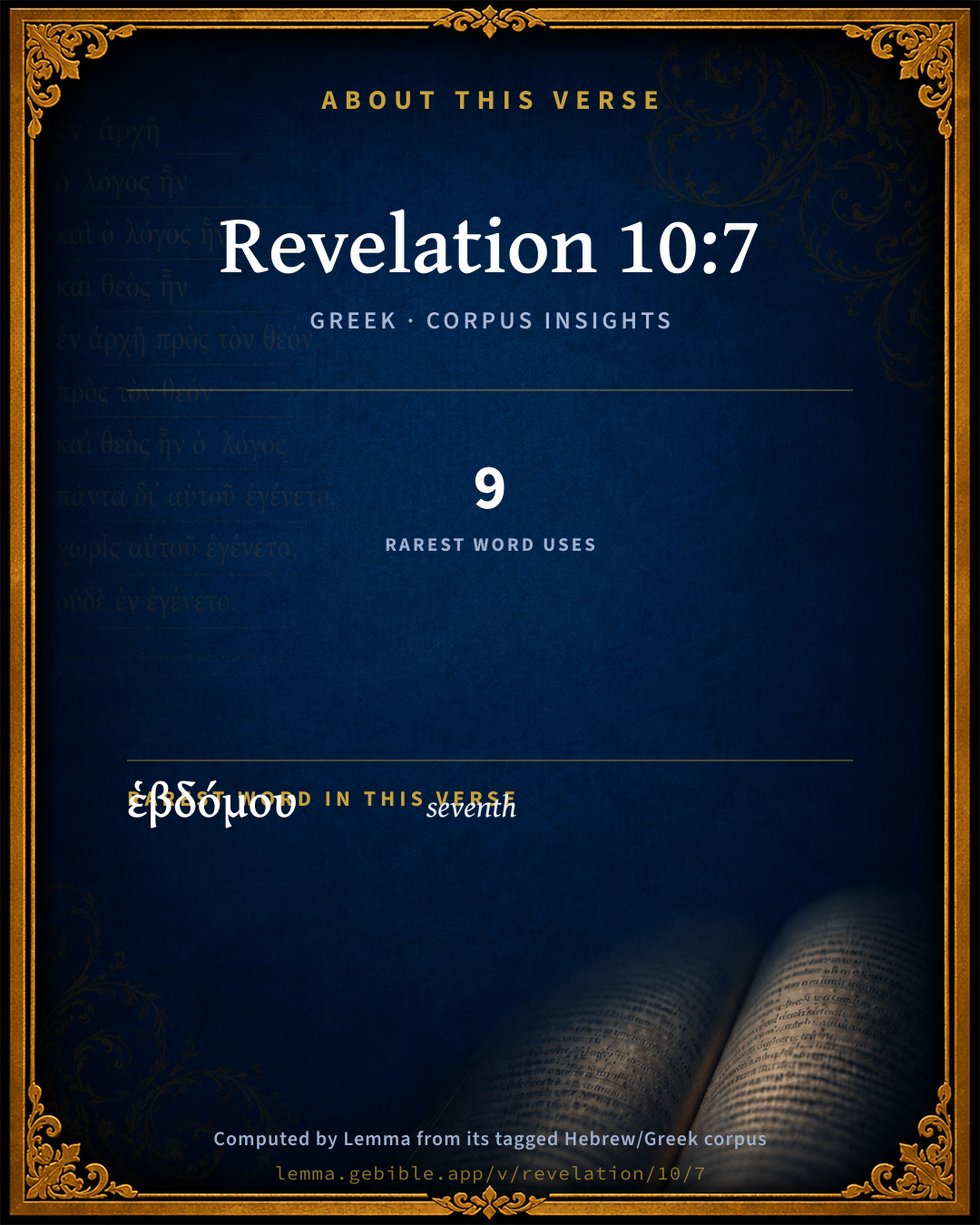
Revelation 10:7

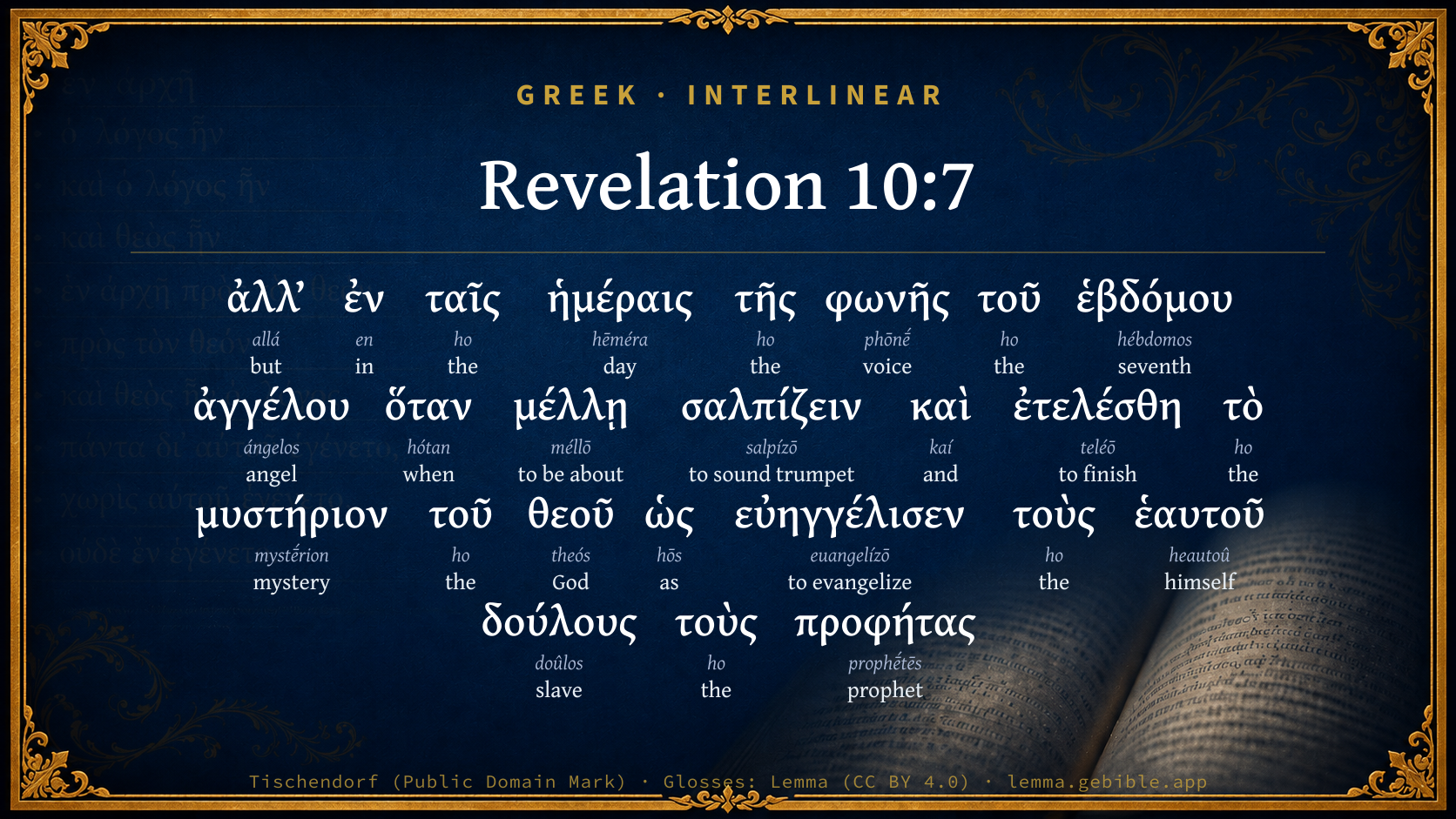
Greek (Tischendorf 8th ed.) Revelation 10:7 appears in the Greek New Testament. The text above is from the Tischendorf 8th edition. Each word links to its Strong’s number and a concise gloss. Click any word for its full Thayer’s Greek Lexicon entry.
Download image
Cite this verse

Revelation 10:7 (World English Bible). Public Domain. Lemma interlinear Bible study tool, https://lemma.gebible.app/v/revelation/10/7.

Show BibTeX & RIS
BibTeX
RIS
English Translation
but in the days of the voice of the seventh angel, when he is about to sound, then the mystery of God is finished, as he declared to his servants, the prophets.
World English Bible · Public Domain
Download a study sheet

One document with this verse’s original text, its word-by-word gloss line, the meaning frame, cross-references with their text, attributed commentary, and full source and license credits — printable, and it pastes into notes with its structure intact.

This verse Autodidact and up

Study sheet (.html) Plain text (.txt)

A passage Seminary Student

Up to 50 verses in one chapter. A passage sheet keeps up to 6 commentary sources and 12 cross-references per verse, in the order this page ranks them, and says so on the sheet whenever that leaves anything out. Ask for a single verse and you get the Autodidact verse sheet above.

Everything on this page stays free to read, with no account — the sheet is a download of what is already on screen, not access to it.

Want to remove ads? Support Godless Engineer
Compare translations 3

The same verse in 3 English versions, stacked beneath the original-language interlinear above. Click any original word for its lexicon entry.

Each is an independent rendering of the whole verse — the interlinear is not word-aligned to these translations.

Highlighted words mark where these versions differ — a whole-verse word diff, not a word-by-word alignment.

  • World English Bible Public Domain
    but in the days of the voice of the seventh angel, when he is about to sound, then the mystery of God is finished, as he declared to his servants, the prophets.
  • King James Version Public Domain
    But in the days of the voice of the seventh angel, when he shall begin to sound, the mystery of God should be finished, as he hath declared to his servants the prophets.
  • unfoldingWord Literal Text CC BY-SA 4.0
    but in the days of the sound of the seventh angel, when he is going to trumpet, then the mystery of God will be accomplished, just as he proclaimed to own servants the prophets.”

unfoldingWord Literal Text — © unfoldingWord, licensed CC BY-SA 4.0. Word-aligned USFM3 via Door43 (git.door43.org/unfoldingWord/en_ult).

Versions to compare (up to 4)

3 of 4 selected

Show all 19 translations

Every available English version of this verse, each an independent rendering of the whole verse.

  • World English Bible Public Domain
    but in the days of the voice of the seventh angel, when he is about to sound, then the mystery of God is finished, as he declared to his servants, the prophets.
  • Berean Standard Bible Public Domain
    But in the days of the voice of the seventh angel, when he is about to sound his trumpet, the mystery of God will be fulfilled, just as He proclaimed to His servants the prophets.”
  • Majority Standard Bible Public Domain
    But in the days of the voice of the seventh angel, when he begins to sound his trumpet, the mystery of God will be fulfilled, just as He proclaimed to His servants the prophets.”
  • King James Version Public Domain
    But in the days of the voice of the seventh angel, when he shall begin to sound, the mystery of God should be finished, as he hath declared to his servants the prophets.
  • American Standard Version (1901) Public Domain
    but in the days of the voice of the seventh angel, when he is about to sound, then is finished they mystery of God, according to the good tidings which he declared to his servants the prophets.
  • Revised Version (1885) Public Domain
    but in the days of the voice of the seventh angel, when he is about to sound, then is finished the mystery of God, according to the good tidings which he declared to his servants the prophets.
  • Geneva Bible (1599) Public Domain
    But in the dayes of the voyce of the seuenth Angel, when he shall beginne to blow the trumpet, euen the mysterie of God shalbe finished, as he hath declared to his seruants the Prophets.
  • Douay-Rheims (1899) Public Domain
    But in the days of the voice of the seventh angel, when he shall begin to sound the trumpet, the mystery of God shall be finished, as he hath declared by his servants the prophets.
  • Young's Literal Translation Public Domain
    but in the days of the voice of the seventh messenger, when he may be about to sound, and the secret of God may be finished, as He did declare to His own servants, to the prophets.
  • Literal Standard Version CC BY-SA 4.0
    but in the days of the voice of the seventh messenger, when he may be about to sound the trumpet, and the secret of God may be accomplished, as He declared to His own servants, to the prophets.
  • Unlocked Literal Bible CC BY-SA 4.0
    But on the day when the seventh angel is about to sound his trumpet, then the mystery of God will be accomplished, just as he proclaimed to his servants the prophets.”
  • unfoldingWord Literal Text CC BY-SA 4.0
    but in the days of the sound of the seventh angel, when he is going to trumpet, then the mystery of God will be accomplished, just as he proclaimed to own servants the prophets.”
  • Darby Bible Public Domain
    but in the days of the voice of the seventh angel, when he is about to sound the trumpet, the mystery of God also shall be completed, as he has made known the glad tidings to his own bondmen the prophets.
  • World Messianic Bible Public Domain
    but in the days of the voice of the seventh angel, when he is about to sound, then the mystery of God is finished, as he declared to his servants the prophets.
  • Webster's Bible Public Domain
    But in the days of the voice of the seventh angel, when he shall begin to sound, the mystery of God should be finished, as he hath declared to his servants the prophets.
  • Free Bible Version CC BY-SA 4.0
    But at the time when the seventh angel speaks, when he blows his trumpet, then the mystery of God will be completed—the good news he announced through his servants the prophets.
  • Bible in Basic English Public Domain
    But in the days of the voice of the seventh angel, when the sound of his horn is about to come, then will the secret of God be complete, of which he gave the good news to his servants the prophets.
  • Text-Critical English NT CC BY 4.0
    but that in the days when the seventh angel would sound his trumpet, the mystery of God would be completed, according to the good news he had announced to his servants the prophets.
  • Tyndale New Testament (1534) Public Domain
    but in the dayes of the voyce of the seventh angell when he shall begyn to blowe: even the mistery of god shalbe fynisshed as he preached by his servauntes the prophetes.

Literal Standard Version (2020), Covenant Press — licensed CC BY-SA 4.0. Text via the HelloAO Bible API (eBible.org). Unlocked Literal Bible (unfoldingWord) — licensed CC BY-SA 4.0. Text via the HelloAO Bible API (eBible.org). unfoldingWord Literal Text — © unfoldingWord, licensed CC BY-SA 4.0. Word-aligned USFM3 via Door43 (git.door43.org/unfoldingWord/en_ult). Free Bible Version, Dr. Jonathan Gallagher — licensed CC BY-SA 4.0. Text via the HelloAO Bible API (eBible.org).

Word by word

More ways to search: Search by grammar → Find every occurrence → Compare this word →

Practice this passage: Drill this verse → Learn its vocabulary →

ἑβδόμου
hébdomos
G1442
“seventh”
Adjective, Genitive, Singular, Masculine
Part of Speech
Adjective
Case
Genitive
Number
Singular
Gender
Masculine
Full Thayer's Definition

Origin: ordinal from G2033

TDNT: 12:27,2

1. seventh
  1. ἀλλ’ allá G235 “but” Conjunction
  2. ἐν en G1722 “in” Preposition
  3. ταῖς ho G3588 “the” Article, Dative, Plural, Feminine
  4. ἡμέραις hēméra G2250 “day” Noun, Dative, Plural, Feminine
  5. τῆς ho G3588 “the” Article, Genitive, Singular, Feminine
  6. φωνῆς phōnḗ G5456 “voice” Noun, Genitive, Singular, Feminine
  7. τοῦ ho G3588 “the” Article, Genitive, Singular, Masculine
  8. ἀγγέλου ángelos G32 “angel” Noun, Genitive, Singular, Masculine
  9. ὅταν hótan G3752 “when” Conjunction
  10. μέλλῃ méllō G3195 “to be about” Verb, Present, Active, Subjunctive, 3rd person, Singular
  11. σαλπίζειν salpízō G4537 “to sound trumpet” Verb, Present, Active, Infinitive
  12. καὶ kaí G2532 “and” Conjunction
  13. ἐτελέσθη teléō G5055 “to finish” Verb, Aorist, Passive, Indicative, 3rd person, Singular
  14. τὸ ho G3588 “the” Article, Nominative, Singular, Neuter
  15. μυστήριον mystḗrion G3466 “mystery” Noun, Nominative, Singular, Neuter
  16. τοῦ ho G3588 “the” Article, Genitive, Singular, Masculine
  17. θεοῦ theós G2316 “God” Noun, Genitive, Singular, Masculine
  18. ὡς hōs G5613 “as” Adverb
  19. εὐηγγέλισεν euangelízō G2097 “to evangelize” Verb, Aorist, Active, Indicative, 3rd person, Singular
  20. τοὺς ho G3588 “the” Article, Accusative, Plural, Masculine
  21. ἑαυτοῦ heautoû G1438 “himself” Reflexive pronoun, 3rd person, Genitive, Singular, Masculine
  22. δούλους doûlos G1401 “slave” Noun, Accusative, Plural, Masculine
  23. τοὺς ho G3588 “the” Article, Accusative, Plural, Masculine
  24. προφήτας prophḗtēs G4396 “prophet” Noun, Accusative, Plural, Masculine

About this verse

These counts appear in no published source. They are computed here, from the morphology-tagged text and Lemma’s own curated glosses. What Lemma adds →

25
words
19
distinct lemmas
Revelation
section

Notable vocabulary

The rarest word here is ἑβδόμου seventh G1442 — appearing just 9 times in the whole Greek New Testament.

Shared distinctive vocabulary

ἑβδόμου seventh G1442 occurs in 8 verses of the Greek New Testament. Also found in:

Repetition

A word recurs within this verse:

  • ταῖς the G3588 ×7

Cross-references

7

Topical passages linked to Revelation 10:7 in the Treasury of Scripture Knowledge — connected by theme and wording, ordered by reader-vote popularity; previews shown in the World English Bible.

  • Ephesians 3:3–9 how that by revelation the mystery was made known to me, as I wrote before in few words,
  • Romans 16:25
  • Luke 24:44–47 He said to them, "This is what I told you, while I was still with you, that all things which are written in the law of Moses, the prophets, and the psalms, concerning me must be fulfilled."
  • Amos 3:7 Surely the Lord Yahweh will do nothing, Unless he reveals his secret to his servants the prophets.
  • Acts 3:21 whom heaven must receive until the times of restoration of all things, which God spoke long ago by the mouth of his holy prophets.
  • Romans 11:25 For I don't desire, brothers, to have you ignorant of this mystery, so that you won't be wise in your own conceits, that a partial hardening has happened to Israel, until the fullness of the Gentiles has come in,
  • Revelation 11:15–18 The seventh angel sounded, and great voices in heaven followed, saying, "The kingdom of the world has become the Kingdom of our Lord, and of his Christ. He will reign forever and ever!"

Cross-references courtesy of OpenBible.info (CC BY 4.0).

Commentary

Notes on Revelation 10:7 from classic Christian and Jewish commentators (each source and its license shown beneath its notes). The classic Christian expositions comment on the surrounding passage and are grouped to its opening verse, so a note may address several verses; the Jewish commentaries on the Tanakh (Rashi and others) are per-verse, so they appear only where the commentator wrote on this verse.

Lemma curates 59 commentaries, every one of them public domain or Creative Commons licensed, each selected and text-cleaned for this edition rather than reprinted as found. About our sources →

Tyndale Open Study Notes

Tyndale Open Resources

10:7 angel blows his trumpet: See 1 Cor 15:51-54; 1 Thes 4:16. • God’s mysterious plan for the world is no surprise; the prophets who served God in the past warned that the day of the Lord would come (see Joel 2:1-3, 10-11; Amos 5:18-20; Zeph 1:14-18).

Tyndale Open Study Notes — © Tyndale Open Resources, licensed CC BY-SA 4.0. Text via the HelloAO Bible API.

Bengel's Gnomon

Johann Albrecht Bengel

Rev 10:7. Καὶ ἐτελέσθη) καὶ has a consecutive force, and then, as Joh 4:35, ἔτι τετράμηνός ἐστι, καὶ ὁ θερισμὸς ἔρχεται.—τὸ μυστήριον—τοῖς προφήταις, the mystery—to the prophets) D. Joach. Lange, in his Glory of Christ, has illustrated this mystery in a striking manner, by most copiously comparing the Apocalypse with the prophets of the Old Testament. But we have shown the time of the completion of this mystery, lately at Rev 10:6, and in other places repeatedly. It was not only announced by prophets, but also to the prophets themselves: Dan 10:12.

Bengel's Gnomon of the New Testament — English translation (T&T Clark, Edinburgh, 1860) — public domain. Text from a community e-Sword module.

Expositor's Greek Testament

ed. W. Robertson Nicoll

Rev 10:7 . Vav consec. with the Heb, pf. (LXX= καὶ and fut. indic.) here by an awkward solecism ( cf. on Rev 3:20 ) = “Then is ( i.e. , shall be) fnished the secret of God.” The final consummation (inaugurated by the advent of messiah, 12.) is to take place not later than the period of the seventh angel’s trumpet-blast, which ex hypothesi is imminent. The μυστήριον is plainly, as the context implies, full of solace and relief to God’s people. εὐηγγ . The total (exc. Rev 16:6 ) omission of εὐαγγέλιον and the restricted use of its verb in the Apocalypse may have been due to the fact that such terms had been soiled by ignoble usage in the local Ionian cult of εὐάγγελος ( e.g. , at Ephesus), with its oracular revelations and fellowship of Euangelidae . The Asiatic calendar of Smyrna contained a month called εὐαγγέλιος . The connexion between μυστήριον = “secret purpose or counsel” (as here) and μ . = “symbol, or symbolic representation” (Rev 1:20 , Rev 17:7 ) is due to the fact that in the primitive world the former was enigmatically conveyed by means of symbolic-representations in word, picture, or deed. As “every written word was once a μυστήριον ,” it was natural that the word used for the sign came to be employed for the thing signified (Hatch, Essays in Bibl. Greek , 61). The near approach of the end had been for years a matter of confidence and joy to the Christian prophets for it is they and not their predecessors who are specially in view. The special and solemn contribution of John’s Apocalypse is to identify certain events in the immediate future with the throes out of which the final bliss was to be born. These throes include the downfall of the dragon from heaven, the subsequent climax of the Beast’s influence on earth, and the assertion of God’s authority over his own and against his foe’s adherents (Rev 12:1 to Rev 14:20 ). The great and glad revelation is God seen in action, with his forces deployed for the final campaign which, with its issues of deliverance and triumph (Revelation 15-22.), forms the climax of this book. The apotheosis of the Cæsars in their life-time above all, of Domitian marked the pitch of human depravity; divine intervention was inevitable.

Up to the end of Rev 9 , the Apocalypse is fairly regular and intelligible; thereafter, criticism enters upon an intricate country, of which hardly any survey has yet succeeded in rendering a satisfactory account. The problem begins with Rev 10 . Although Rev 10:1-7 complete the preceding oracles by introducing their finale (7 = Rev 11:14 f.), while Rev 10:8-11 connect more immediately with Rev 11 , this forms no reason for suspecting that the oracle is composite. Spitta takes Rev 10:1 a , Rev 10:2-7 (except Rev 10:4 ) as the continuation of Revelation 9., followed by Rev 11:15 ; Rev 11:19 , while the rest is substantially a prelude to Rev 11:1-13 ; Briggs similarly views Rev 10:1 a , Rev 10:3-7 as the original transition between Rev 9 . and Rev 11:14-15 a , Rev 11:19 , while Rev 10:8-11Rev 10:8-11 (a vision of messiah) introduces the new source of Rev 11:1-13 , Rev 12:17 ; and Rauch regards Rev 10:1 b , Rev 10:2 a , Rev 10:5-7 ; Rev 10:4 ; Rev 10:9-11 as the opening of Rev 11:1-13 , Rev 12:1-17 , with Rev 10:1-4 a (substantially) as the preface to Rev 12:17 ., Rev 16:13-16 . These analyses are unconvincing. The alleged signs of a Hebrew original ( e.g. , Rev 10:7 , also λέγουσί μοι and λέγειμοι in Rev 10:9 ; Rev 10:11 = variant versions of ואמר לי ) are not decisive.

The Expositor's Greek Testament, edited by W. Robertson Nicoll (1897–1910) — public domain. Text from a community e-Sword module.

Geneva Bible (1599)

Geneva Bible translators

Whereof Rev. 11:15 and 16:17.

Geneva Bible (1599) marginal notes — public domain. Text via Bolls.life.

Jamieson, Fausset & Brown

Robert Jamieson, A. R. Fausset & David Brown

But--connected with Rev 10:6. "There shall be no longer time (that is, delay), but in the days of the voice of the seventh angel, when he is about to (so the Greek) sound his trumpet (so the Greek), then (literally, 'also'; which conjunction often introduces the consequent member of a sentence) the mystery of God is finished," literally, "has been finished"; the prophet regarding the future as certain as if it were past. A, C, Aleph, and Coptic read the past tense (Greek, "etelesthee"). B reads, as English Version, the future tense (Greek, "telesthee"). "should be finished" (compare Rev 11:15-18). Sweet consolation to the waiting saints! The seventh trumpet shall be sounded without further delay.

the mystery of God--the theme of the "little book," and so of the remainder of the Apocalypse. What a grand contrast to the "mystery of iniquity Babylon!" The mystery of God's scheme of redemption, once hidden in God's secret counsel and dimly shadowed forth in types and prophecies, but now more and more clearly revealed according as the Gospel kingdom develops itself, up to its fullest consummation at the end. Then finally His servants shall praise Him most fully, for the glorious consummation of the mystery in having taken to Himself and His saints the kingdom so long usurped by Satan and the ungodly. Thus this verse is an anticipation of Rev 11:15-18.

declared to--Greek, "declared the glad tidings to." "The mystery of God" is the Gospel glad tidings. The office of the prophets is to receive the glad tidings from God, in order to declare them to others. The final consummation is the great theme of the Gospel announced to, and by, the prophets (compare Gal 3:8).

Jamieson, Fausset & Brown — Commentary Critical and Explanatory on the Whole Bible (1871) — public domain (CC PDM 1.0). Text via the HelloAO Bible API.

Adam Clarke's Commentary

Verse 7. The mystery of God should be finished] What this mystery refers to who knows? Nor have we more knowledge concerning the sounding of the seventh angel. On these points there is little agreement among learned men. Whether it mean the destruction of Jerusalem, or the destruction of the papal power, or something else, we know not. And yet with what confidence do men speak of the meaning of these hidden things!

Declared to his servants the prophets.] It is most likely, therefore, that this trumpet belongs to the Jewish state.

Adam Clarke's Commentary on the Bible (1810–1826) — public domain. Text from a community e-Sword/MySword module.

The Cambridge Bible for Schools and Colleges

gen. ed. J. J. S. Perowne

7. when he shall begin to sound] More accurately, “when he shall be about to sound.”

the mystery of God] Here Abp. Whately’s paradox is hardly an exaggeration, that for “mystery” one might substitute “revelation,” without altering the sense: see on Rev_1:20.

shall be finished] The construction in the Greek is curious, but it is probably a mere Hebraism, and the sense of the A. V. right.

declared] The word is the characteristic evangelical one, “told the good news.”

The Cambridge Bible for Schools and Colleges (gen. ed. J. J. S. Perowne; Cambridge University Press, 1878–1918) — public domain. Text from a community e-Sword module.

John Gill's Exposition

But in the days of the voice of the seventh angel, when he shall begin to sound,.... This is an exception to what the angel had said and swore to, that time should be no longer; "but", or "unless", or "except the time of the voice of the seventh angel", as the Ethiopic version renders it; when a new period and sort of time should begin, very different from the former, which then should be no more; for now will be the time of Christ's kingdom on earth, which shall last a thousand years; this time will not be like the former, a time of darkness and ignorance, as was in some periods, partly through the errors and heresies which were propagated in early times, and through that barbarity and ignorance which the Goths, Huns, and Vandals, spread over the empire, when they broke into it, and chiefly through the smoke of the bottomless pit, the false doctrine and worship of the Papists and Mahometans; but in the time of the seventh angel, all this gross darkness will be removed, and it will be a time of unspeakable and everlasting light, so that there will be no need of the sun and moon, of Gospel ministrations and ordinances: nor will it be a time of affliction and persecution; time in that sense will be no more, as it has been under the ten Pagan emperors, and under the Arian emperors, and under the Papal hierarchy; for in this period there will be no more death, sorrow, crying, pain, and tears; though there will be time, it will be another sort of time, quite different from the former, which will be no more when the seventh angel once begins; and as soon as he begins to sound, this will put an end to antichristian time; and at the end of his sounding will begin the time of Christ, or the thousand years' reign: and then

the mystery of God should be finished; that is, the angel not only swears that time shall be no longer, but that also then shall be finished the mystery of God; by which is meant, not the resurrection of the dead, and the change of the living, which is called a mystery, Co1 15:51; for though when this angel sounds, and has done sounding, and Christ comes, the first resurrection, or the resurrection of the dead in Christ, will be finished, yet not the whole resurrection; for the rest of the dead will not live again till the end of the thousand years: but rather the Gospel is designed, which is often called the mystery, and the mystery of the Gospel, and contains many mysteries in it, which are styled the mysteries of God; which respect him, his being, persons, operations, and grace; and are revealed and made known by him; and the finishing of this may respect the preaching of the Gospel to all nations, which will be before the end of the world, and whereby the earth will be filled with the knowledge of the Lord, and multitudes of souls converted; wherefore it may be best of all to understand this of the church of God, the general assembly and church of the firstborn, even all the elect of God, whose number will now be finished and completed in the conversion of the Jews, and in the bringing in the fulness of the Gentiles, both which are called "mysteries", Rom 11:25; and now as the antichristian church is called "mystery", "Babylon", Rev 17:5; and "the mystery of iniquity", Th2 2:7; so the true Christian church, the new Jerusalem, coming down from heaven, and prepared as a bride adorned for her husband, may bear the name of the mystery of God; and this may also take in the mystery of all God's providences and promises, and prophecies, respecting the state of his church and people on earth:

as he hath declared to his servants and prophets; as to Isaiah in Isa 60:3, &c. and Isa 66:8; and to Daniel, in Dan 2:44 Dan 7:25; and to Zechariah, in Zac 14:9, and others; and which was a Gospel declaration, as the word signifies; it was good news and glad tidings; glorious things were declared to them, and spoken by them, concerning the city and church of God, its happy state on earth, and Christ's reign in it.

John Gill's Exposition of the Whole Bible (1746–1763) — public domain (CC PDM 1.0). Text via the HelloAO Bible API.

Trapp's Complete Commentary

John Trapp

7 But in the days of the voice of the seventh angel, when he shall begin to sound, the mystery of God should be finished, as he hath declared to his servants the prophets.

Ver. 7. The mystery of God] The conversion of the Jews, called a mystery, Rom 11:25, the bringing in of the Gentiles’ fulness, Eph 3:3-4; Eph 3:6, the kingdom of the saints of the most high, Dan 7:18, then when all the kingdoms of the world shall become the kingdoms of our Lord Jesus Christ, Rev 11:15.

John Trapp, A Commentary or Exposition upon All the Books of the Old and New Testament (1647–1656) — public domain. Text from a community e-Sword module.

Albert Barnes' Notes on the Bible

But in the days of the voice of the seventh angel - The days in the period of time embraced by the sounding of the seventh trumpet. That is, the affairs of this world would not be consummated in that period embraced in the sounding of the sixth trumpet, but in that embraced in the sounding of the seventh and last of the trumpets. Compare Rev 11:15-19.

When he shall begin to sound - That is, the events referred to will commence at the period when the angel shall begin to sound. It will not be merely during or in that period, but the sounding of the trumpet, and the beginning of those events, will be contemporaneous. In other words, then would commence the reign of righteousness - the kingdom of the Messiah the dominion of the saints on the earth.

The mystery of God should be finished - On the meaning of the word “mystery,” see the notes on Eph 1:9. It means here, as elsewhere in the New Testament, the purpose or truth of God which had been concealed, and which had not before been communicated to man. Here the particular reference is to the divine purpose which had been long concealed respecting the destiny of the world, or respecting the setting up of his kingdom, but which had been progressively unfolded by the prophets. That purpose would be “finished,” or consummated, in the time when the seventh angel should begin to sound. Then all the “mystery” would be revealed; the plan would be unfolded; the divine purpose, so long concealed, would be manifested, and the kingdom of the Messiah and of the saints would be set up on the earth. Under that period, the affairs of the world would be ultimately wound up, and the whole work of redemption completed.

As he hath declared to his servants the prophets - As he has from time to time disclosed his purposes to mankind through the prophets. The reference here is, doubtless, to the prophets of the Old Testament, though the language would include all who at any time had uttered any predictions respecting the final condition of the world. These prophecies had been scattered along through many ages; but the angel says that at that time all that had been said respecting the setting up of the kingdom of God, the reign of the saints, and the dominion of the Redeemer on the earth, would be accomplished. See the notes on Rev 11:15. From the passage thus explained, if the interpretation is correct, it will follow that the sounding of the seventh trumpet Rev 11:15-18 is properly the conclusion of this series of visions, and denotes a “catastrophe” in the action, and that what follows is the commencement of a new series of visions. This is clear, because:

(a)The whole seven seals, comprising the seven trumpets of the seventh seal, must embrace one view of all coming events - since this embraced all that there was in the volume seen all the hand of him that sat on the throne;

(b)This is properly implied in the word rendered here as “should be finished” - τελέσθη telesthē - the fair meaning of which is, that the “mystery” here referred to - the hitherto unrevealed purpose or plan of God - would, under that trumpet, be consummated or complete (see the conclusive reasoning of Prof. Stuart on the meaning of the word, vol. ii. p. 210, footnote); and,

(c)It will be found in the course of the exposition that, at Rev 11:19, there commences a new series of visions, embracing a view of the world in its religious aspect, or ecclesiastical characteristics, reaching down to the same consummation, and stating at the close of that Rev 20:1-15 more fully what is here Rev 11:15-18 designated in a more summary way - the final triumph of religion, and the establishment of the kingdom of the saints.

The present series of visions Rev. 5–11:18 relates rather to the outward or secular changes which would occur on the earth, which were to affect the welfare of the church, to the final consummation; the next series Rev 11:19; Rev 12:20 relates to the church internally, the rise of Antichrist, and the effect of the rise of that formidable power on the internal history of the church, to the time of the overthrow of that power, and the triumphant establishment of the kingdom of God. See the Analysis of the work, Intro. 5. In other words, this series of visions, terminating at Rev 11:18, refers, as the leading thing, to what would occur in relation to the Roman empire considered as a secular power, in which the church would be interested; what follows Rev 11:19; Rev. 12–20 to the Roman power considered as a great apostasy, and setting up a mighty and most oppressive domination over the true church, manifested in deep corruption and bloody persecutions, running on in its disastrous influence on the world, until that power should be destroyed, Babylon fall, and the reign of the saints be introduced.

Albert Barnes' Notes on the Bible (1834–1885) — public domain. Text from a community e-Sword/MySword module.

Haydock's Catholic Bible Commentary

Declared. Literally, evangelized, to signify the good tidings, agreeable to the gospel, of the final victory of Christ, and of that eternal life which should be the reward of the temporal sufferings of the servants of God. (Challoner)

George Leo Haydock (1774–1849), Haydock's Catholic Family Bible and Commentary, 1859 edition — public domain. Excludes Psalms (Douay-Rheims chapter numbering differs from Protestant) and Deuterocanonical books (Catholic canon only).

Matthew Poole's English Annotations

But in the days of the voice of the seventh angel; of whom, and his sounding, we shall read, Rev 11:15.

When he shall begin to sound, the mystery of God should be finished; from that time that he beginneth to sound shall begin the mystery of God to be finished; either the mystery mentioned Rev 11:15, when the kingdoms of this world shall become the kingdoms of our Lord, and his Christ; or, more generally, whatsoever God hath revealed concerning the propagation of the gospel, the ruin of antichrist, and the end of the world.

As he hath declared to his servants the prophets; whatsoever God hath declared by his servants the prophets about these things, (as to which see Isa 24:1-23; 26:1-27:13; 66:1-24; Dan 7:11,12; Zec 14:1-21; Mal 3:4), it shall be fulfilled, and begin to be fulfilled when the seventh angel shall begin to blow; within which period of time most interpreters judge we are, as being begun some time since.

Matthew Poole's English Annotations on the Holy Bible (1683–1685) — public domain. Text from a community e-Sword/MySword module.

Whedon's Commentary on the Bible

Daniel D. Whedon

7. When he shall begin to sound—Rather, whenever he is about to sound; whensoever that sounding shall take place, and how long soever it may continue. Alford and other premillennialists deny that οταν, when, here means whenever, and insist that the mystery is finished when the trumpet begins to blow. Which, in the fact, is not true; for the dragon and beast commence their career at that point. That Alford’s Greek is at fault Mr. Glasgow clearly shows. Robinson’s New Testament Lexicon thus defines ‘Οταν: “When, with the accessory idea of uncertainty, possibility, i.q., whensoever, if ever, in case that, so often as.” On the other hand, οτε signifies more strictly when, as when an actual event truly takes place.

We render the oath as follows: That there should be delay no further, but in the days of the voice of the seventh angel, whenever he is about to sound, the mystery of God shall have been finished. The antithesis lies between the further delay, and the closing with the close of the trumpet period.

The purpose of the oath is to express, not the immediacy of the second advent, but its surety. The absolute justice demanded by the seven thunders, however slow, is certain. This slowness appears in the deliberate phrases in the days, whenever, and μελλει, is about to, wrongly translated shall begin. Yet sure as that trumpet shall sound it shall be followed by no delay, for the mystery is closed, and the case is made up for final judgment.

Mystery of God—In his plan of retribution to the righteous and the wicked. Perhaps there is a slight reference to the mystery as uttered by the seven thunders and sealed up by divine command, as above recorded.

Prophets—The mysteries of divine judgment are the burden of prophecy from Enoch to John.

Daniel D. Whedon (gen. ed.), Commentary on the Old and New Testaments (1874–1909) — public domain. Text from a community e-Sword module.

The Pulpit Commentary

But in the days of the voice of the seventh angel. The meaning naturally seems to be, "There shall be no longer time; but, on the contrary, in the days of the seventh trumpet, the last judgment shall tall, the end will come, and all things will be made manifest; the mystery of God will be finished." Wordsworth renders, "No delay, save only in the days," etc., and believes that the passage points to a brief respite, during which men may yet repent. When he shall begin to sound; when he is about to sound his trumpet. Alford points out the propriety of the expression. "When the seventh angel does sound, the completed time of the fulfilment is simultaneous with his blowing, (cf. Rev_11:18) so that it is properly said that the fulfilment comes in the days when he is about to blow." The mystery of God should be finished; also (or then, as Revised Version) the mystery of God was fulfilled. "The prophetic past" (Wordsworth). "The mystery of God" is all that man does not now understand in connection with God"s dealings with man, but of the existence of which he is cognizant, e.g. the existence of evil in the world, and God"s modes of dealing with that and all mankind, which we only know in part. God"s plans are being steadily and surely worked out, though we are not able to comprehend them. As he hath declared to his servants the prophets; literally, as he evangelized his servants the prophets; or, as in the Revised Version, according to the good tidings which he declared to his servants the prophets. Thus Amo_3:7, "Surely the Lord God will do nothing, but he revealeth his secret unto his servants the prophets." The promise of the complete fulfilment of the mystery of God is good news indeed for the fainting Christian, for it tells of the end of his trials and the overthrow of his enemies.

The Pulpit Commentary (1880–1919), ed. H.D.M. Spence-Jones & Joseph S. Exell — public domain. Text from a community e-Sword module.

John Wesley's Explanatory Notes

But in the days of the voice of the seventh angel - Who sounded not only at the beginning of those days, but from the beginning to the end. The mystery of God shall be fulfilled - It is said, chap. xvii, 17, "The word of God shall be fulfilled." The word of God is fulfilled by the destruction of the beast; the mystery, by the removal of the dragon. But these great events are so near together, that they are here mentioned as one. The beginning of them is in heaven, as soon as the seventh trumpet sounds; the end is on the earth and the sea. So long as the third woe remains on the earth and the sea, the mystery of God is not fulfilled. And the angel's swearing is peculiarly for the comfort of holy men, who are afflicted under that woe. Indeed the wrath of God must be first fulfilled, by the pouring out of the phials: and then comes the joyful fulfilling of the mystery of God. As he hath declared to his servants the prophets - The accomplishment exactly answering the prediction. The ancient prophecies relate partly to that grand period, from the birth of Christ to the destruction of Jerusalem; partly to the time of the seventh angel, wherein they will be fully accomplished. To the seventh trumpet belongs all that occurs from chap. xi, 15 - chap. xxii, 5. And the third woe, which takes place under the same, properly stands, chap. xii, 12, xiii, 1-18.

John Wesley, Explanatory Notes Upon the Whole Bible (1754–1765) — public domain. Text via the GEBible commentary corpus.

Scofield Reference Notes

C. I. Scofield

angel (See Scofield "Heb 1:4").

mystery (See Scofield "Mat 13:11").

The Scofield Reference Bible (1917 edition), notes by C. I. Scofield — public domain. Text from a community e-Sword module.

Cambridge Greek Testament for Schools and Colleges

7. τοὺς ἑαυτοῦ δούλους τοὺς προφήτας. Primas[358] and vg[359] read per profetas servos suos, per servos suos prophetas = ἐν τοῖς δ. κ.τ.λ.; Text. Rec[360] has datives without ἐν with 1.

[358] Primasius, edited by Haussleiter.

[359] Vulgate.

[360] Rec. Textus Receptus as printed by Scrivener.

7. ἐν ταῖς ἡμέραις … τοῦ ἑβδόμου ἀγγέλου. This accounts for the Vision being narrated between the Sixth and Seventh Trumpets; though it also suggests that the whole of the Vision of the Trumpets may have been seen before it: indeed that the interval may have been long enough for what looked like a fulfilment of the signs which followed the first five Trumpets if not the Sixth—while the end seemed as far off as ever.

ὅταν μέλλῃ σαλπίζειν. If μέλλῃ is to be pressed we should understand that the course of God’s judgements for this world comes to au end before the Seventh Angel sounds, and that when he does, the world to come begins; but as it would be against the analogy of this book to identify the general resurrection and the condemnation of the Lost with the Third Woe, it is better to take ὅταν μέλλῃ σαλπίζειν simply as a periphrasis for the future.

καὶ ἐτελέσθη. No doubt a literal reproduction of the so-called Hebrew “preterite with vau conversive,” the only one now traceable in the book, though there are places where the Old Latin version seems to have read an aorist where our Greek MSS. read a future.

τὸ μυστήριον τοῦ θεοῦ. Here Abp Whately’s paradox is hardly an exaggeration, that for “mystery” one might substitute “revelation,” without altering the sense: see on Rev 1:20.

εὐηγγέλισεν. The active is only found in this book.

τοὺς ἑαυτοῦ δούλους. The accusative is not irregular according to New Testament usage. St Luke generally uses it for the recipients of the message when its contents are not mentioned: when both are mentioned, the message is in the accusative, the recipients in the dative; though once, Act 13:32, we have a double accusative.

Cambridge Greek Testament for Schools and Colleges (Cambridge University Press, 1896; 21 vols, various authors incl. Carr, Maclear, Plummer, Farrar, Lumby, Moule, M. R. James, Simcox) — public domain. Text from a community e-Sword module.

Vincent's Word Studies in the New Testament

Marvin R. Vincent

Shall begin to sound [μελλη σαλπιζεν] . Wrong. Rev., correctly, when he is about to sound.

The mystery [το μυστηριον] . See on Mt 13:11.

Declared [ευηγγελισεν] . The word used of declaring the good news of salvation. Here of declaring the mystery of the kingdom.

Marvin R. Vincent, Word Studies in the New Testament (1887–1900) — public domain. Text from a community e-Sword/MySword module.

Lesson kit

Teaching starters — assembled from the data on this page, not authored interpretation. Every prompt links to the verse data it draws on. Edit before teaching.

Revelation, in the Revelation, opens this verse with 25 words (19 distinct Greek lemmas). Its most distinctive word is hébdomos (“seventh”). A historical commentator’s framing appears above. Read the whole chapter for the surrounding context.

Discussion questions

  1. What does “seventh” (hébdomos) contribute to the verse as a whole?
  2. How does John 4:52, which shares the word «seventh», read alongside this verse?
  3. What does the repetition of “the” (7× in this one verse) do in this verse?
  4. These translations render this verse differently. What is at stake in choosing one wording over another?
  5. Compare how Tyndale Open Study Notes and Bengel's Gnomon read this verse. Where do they agree or differ?

Things to notice

Reading settings

Reading text

Shown beneath each verse's original-language words.

Old Testament
Old Testament edition

Read the OT as the Masoretic Hebrew (MT) or the Greek Septuagint (LXX).

English shown for the Greek Septuagint (in the Hebrew ↔ Greek comparison).

Comparing translations? Open the Compare panel on any verse page to stack up to four side by side.