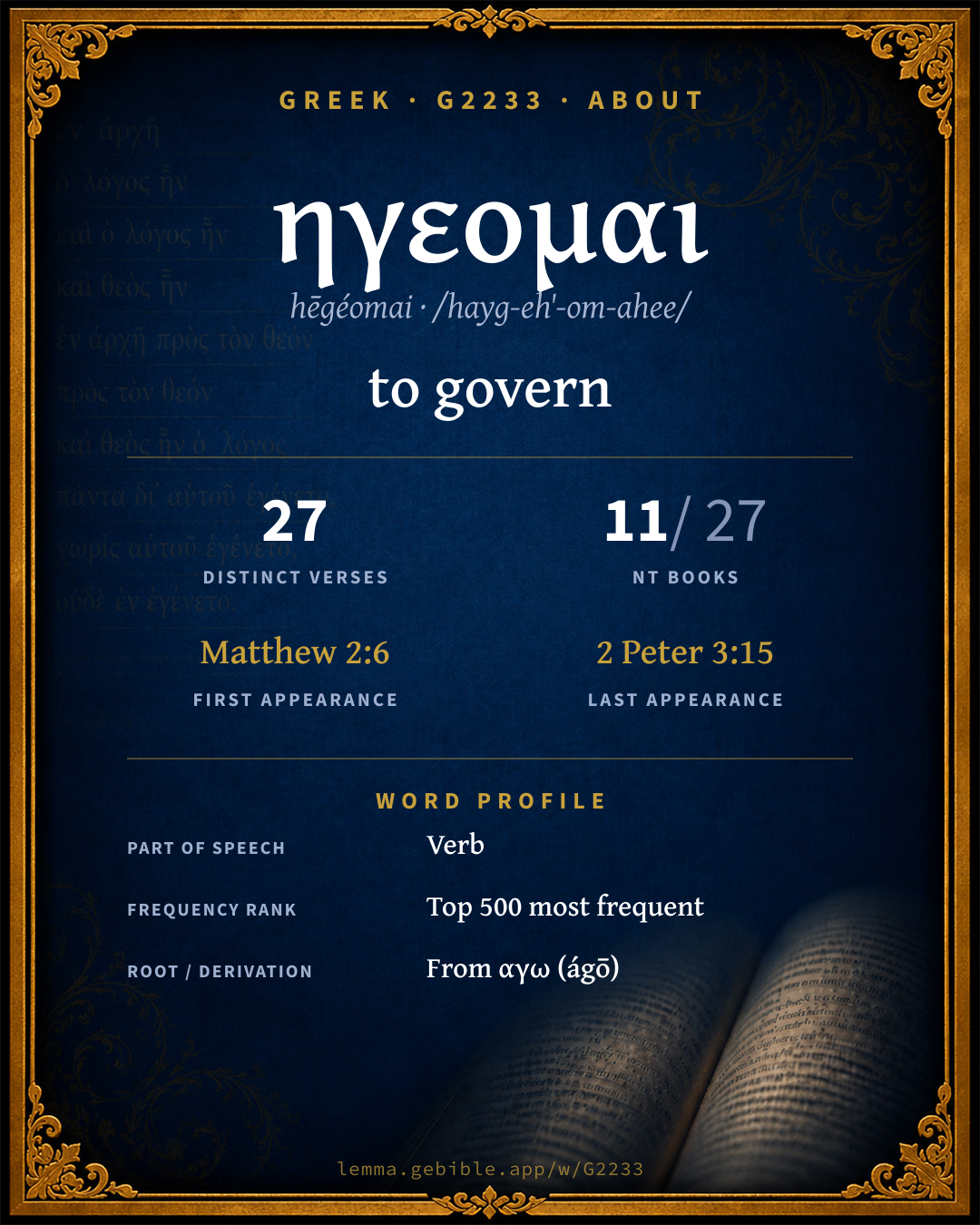
ἡγέομαι
to govern
‘to govern’ is one of 3 main senses fuller range ↓
Full lexicon entry — Thayer's Greek Lexicon
From Thayer's Greek Lexicon
Where this word appears
See every Present-tense verb in the Greek New Testament →
Grammar key — what these labels mean
Part of speech
- Verb
- An action or state-of-being word.
Tense
- Aorist
- Action viewed as a simple whole, without regard to duration — often past (perfective aspect).
- Present
- Ongoing or general action in present time (imperfective aspect).
- Perfect
- A completed past action with continuing present results.
Voice
- Middle deponent
- Middle in form but active in meaning.
- Middle or Passive deponent
- Middle/passive in form but active in meaning.
Mood
- Indicative
- States a fact or asks a factual question (the mood of reality).
- Participle
- A verbal adjective (“writing,” “having written”).
- Imperative
- Expresses a command or request.
- Infinitive
- A verbal noun (“to write”), unmarked for person or number.
Case
- Nominative
- The case of the subject (and the predicate nominative).
- Accusative
- The case of the direct object and of extent.
- Dative
- The case of the indirect object, means, or location — “to / for / with / in.”
- Genitive
- The case of source, possession, or “of” — answers “whose / from what.”
Person
- 3rd person
- The one spoken about (“he / she / it / they”).
- 1st person
- The speaker (“I / we”).
- 2nd person
- The one addressed (“you”).
Gender
- Masculine
- Grammatically masculine.
Number
- Singular
- One.
- Plural
- More than one.
Grammatical forms 16 distinct
- Verb, Aorist, Middle deponent, Indicative, 3rd person, Singular 3 times (11%)
- Verb, Present, Middle or Passive deponent, Indicative, 1st person, Singular 3 times (11%)
- Verb, Present, Middle or Passive deponent, Participle, Nominative, Singular, Masculine 3 times (11%)
- Verb, Aorist, Middle deponent, Indicative, 1st person, Singular 2 times (7%)
- Verb, Aorist, Middle deponent, Participle, Nominative, Singular, Masculine 2 times (7%)
- Verb, Present, Middle or Passive deponent, Imperative, 2nd person, Plural 2 times (7%)
- Verb, Present, Middle or Passive deponent, Participle, Accusative, Plural, Masculine 2 times (7%)
- Verb, Present, Middle or Passive deponent, Participle, Nominative, Plural, Masculine 2 times (7%)
+8 more forms (9 occurrences)
Parsed forms decoded from the imported morphology (Robinson–Tischendorf, public domain), counted across 28 parsed occurrences — not distinct verses.
Every verse where G2233 appears — 27 distinct verses across 11 books. Click any verse to open its interlinear word-by-word view. Verse text shown in the World English Bible for context — . Each verse’s Greek form is shown with its reference; the English is not keyword-highlighted, since the data carries no word-level English alignment. Use “Compare translations” on any verse to read it across multiple English versions. This concordance covers the Greek New Testament; Septuagint (Greek Old Testament) occurrences of this word are not indexed here.
Matthew 1 verse
Luke 1 verse
Acts 4 verses
- Acts 7:10 ἡγούμενον pres mid/pass.dep ptcp acc sg masc and delivered him out of all his afflictions, and gave him favor and wisdom before Pharaoh, king of Egypt. He made him governor over Egypt and all his house.
- Acts 14:12 ἡγούμενος pres mid/pass.dep ptcp nom sg masc They called Barnabas "Jupiter," and Paul "Mercury," because he was the chief speaker.
- Acts 15:22 ἡγουμένους pres mid/pass.dep ptcp acc pl masc Then it seemed good to the apostles and the elders, with the whole assembly, to choose men out of their company, and send them to Antioch with Paul and Barnabas: Judas called Barsabbas, and Silas, chief men among the brothers.
- Acts 26:2 ἥγημαι perf mid/pass.dep ind 1sg "I think myself happy, King Agrippa, that I am to make my defense before you this day concerning all the things that I am accused by the Jews,
2 Corinthians 1 verse
Philippians 5 verses
- Philippians 2:3 ἡγούμενοι pres mid/pass.dep ptcp nom pl masc doing nothing through rivalry or through conceit, but in humility, each counting others better than himself;
- Philippians 2:6 ἡγήσατο aor mid.dep ind 3sg who, existing in the form of God, didn't consider it robbery to be equal with God,
- Philippians 2:25 ἡγησάμην aor mid.dep ind 1sg But I counted it necessary to send to you Epaphroditus, my brother, fellow worker, fellow soldier, and your apostle and minister to my need;
- Philippians 3:7 ἥγημαι perf mid/pass.dep ind 1sg However, what things were gain to me, these have I counted loss for Christ.
- Philippians 3:8 ἡγοῦμαι ἡγοῦμαι pres mid/pass.dep ind 1sg pres mid/pass.dep ind 1sg Yes most assuredly, and I count all things to be loss for the excellency of the knowledge of Christ Jesus, my Lord, for whom I suffered the loss of all things, and count them nothing but refuse, that I may gain Christ
1 Thessalonians 1 verse
2 Thessalonians 1 verse
1 Timothy 2 verses
- 1 Timothy 1:12 ἡγήσατο aor mid.dep ind 3sg And I thank him who enabled me, Christ Jesus our Lord, because he counted me faithful, appointing me to service;
- 1 Timothy 6:1 ἡγείσθωσαν pres mid/pass.dep impv 3pl Let as many as are bondservants under the yoke count their own masters worthy of all honor, that the name of God and the doctrine not be blasphemed.
Hebrews 6 verses
- Hebrews 10:29 ἡγησάμενος aor mid.dep ptcp nom sg masc How much worse punishment, do you think, will he be judged worthy of, who has trodden under foot the Son of God, and has counted the blood of the covenant with which he was sanctified an unholy thing, and has insulted the Spirit of grace?
- Hebrews 11:11 ἡγήσατο aor mid.dep ind 3sg By faith, even Sarah herself received power to conceive, and she bore a child when she was past age, since she counted him faithful who had promised.
- Hebrews 11:26 ἡγησάμενος aor mid.dep ptcp nom sg masc accounting the reproach of Christ greater riches than the treasures of Egypt; for he looked to the reward.
- Hebrews 13:7 ἡγουμένων pres mid/pass.dep ptcp gen pl masc Remember your leaders, men who spoke to you the word of God, and considering the results of their conduct, imitate their faith.
- Hebrews 13:17 ἡγουμένοις pres mid/pass.dep ptcp dat pl masc Obey your leaders and submit to them, for they watch on behalf of your souls, as those who will give account, that they may do this with joy, and not with groaning, for that would be unprofitable for you.
- Hebrews 13:24 ἡγουμένους pres mid/pass.dep ptcp acc pl masc Greet all of your leaders and all the saints. The Italians greet you.
James 1 verse
2 Peter 4 verses
- 2 Peter 1:13 ἡγοῦμαι pres mid/pass.dep ind 1sg I think it right, as long as I am in this tent, to stir you up by reminding you;
- 2 Peter 2:13 ἡγούμενοι pres mid/pass.dep ptcp nom pl masc receiving the wages of unrighteousness; people who count it pleasure to revel in the day-time, spots and blemishes, reveling in their deceit while they feast with you;
- 2 Peter 3:9 ἡγοῦνται pres mid/pass.dep ind 3pl The Lord is not slow concerning his promise, as some count slowness; but is patient with us, not wishing that any should perish, but that all should come to repentance.
- 2 Peter 3:15 ἡγεῖσθε pres mid/pass.dep impv 2pl Regard the patience of our Lord as salvation; even as our beloved brother Paul also, according to the wisdom given to him, wrote to you;
About this entry
At a glance — auto-summarized from this page’s data, not written by a person. Every figure links to its source below. This summary describes the numbers; it doesn’t interpret them.
“to govern” is the headline sense of the Greek verb ηγεομαι (hēgéomai). First canonically at Matthew 2:6, it enters the text early. The Greek New Testament uses it across 27 verses — moderately common. Catalogued under 3 senses, its meaning is not single-sense. It shares a root with αγω, αγγελος and αγε. See the sense tree, 27-verse concordance, and the renderings breakdown below.
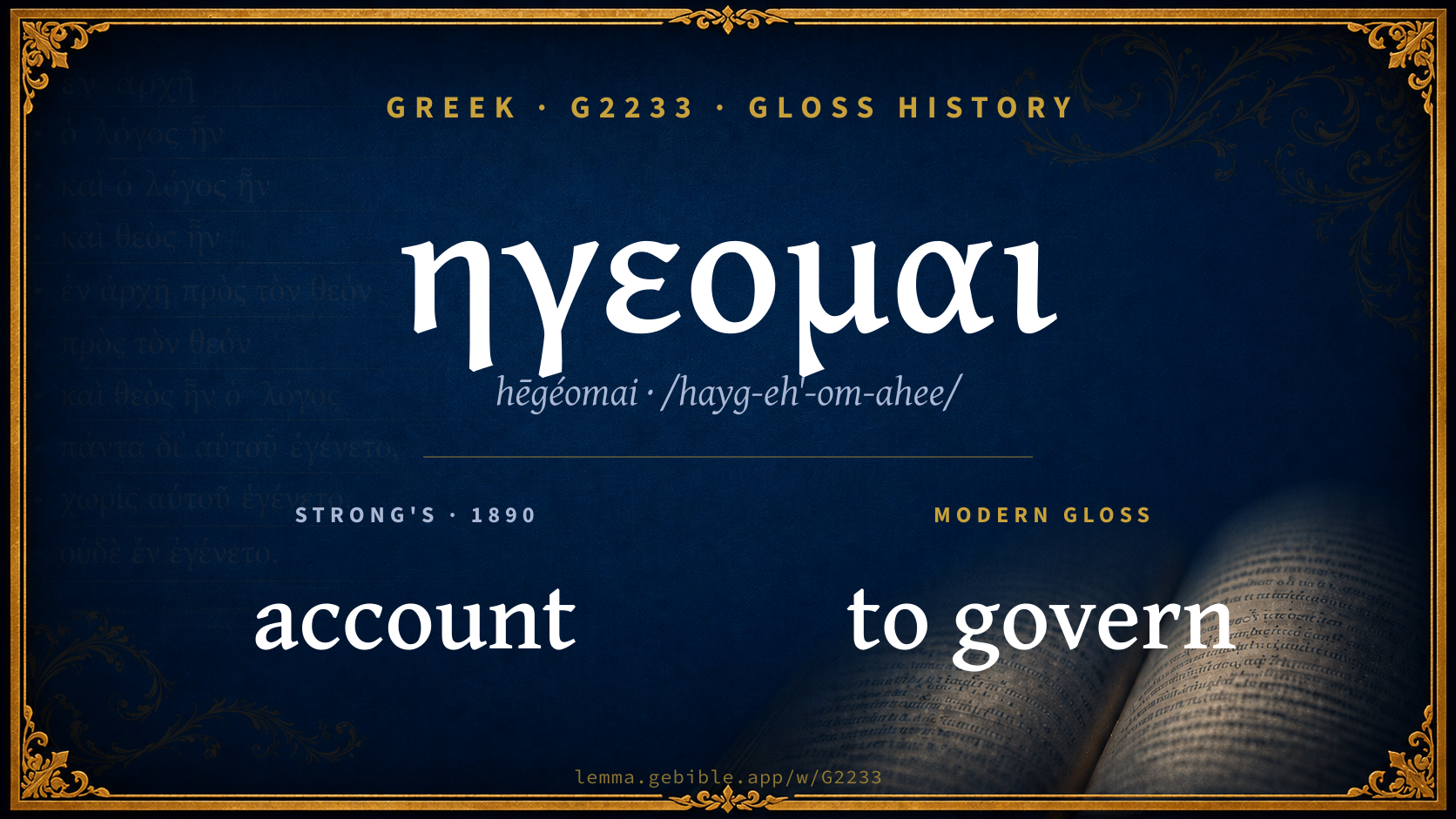
Gloss history
Strong's 1890 vs modern scholarship
About this word
Strong's G2233 catalogs a Greek word from the Greek New Testament.
These counts are not copied from any lexicon or concordance. They are computed here, from the morphology-tagged Greek New Testament. What Lemma adds →
- 27
- distinct verses
- The word appears in 27 distinct verses.
- 11 / 27
- NT books
- The word appears in 11 of 27 New Testament books.
- #485
- by frequency
- Top 500 most frequent Greek words (rank 485 of 5,347 Greek words by occurrence).
View all 27 occurrences in the concordance →
Most concentrated in
- Hebrews 6 verses 22%
- Philippians 5 verses 19%
- Acts 4 verses 15%
By section of the New Testament
By traditional corpus
Conventional, traditional groupings — biblical authorship is debated, so this is a traditional corpus grouping, not an authorship claim. Some books belong to more than one corpus (Luke is in both the Gospels and the Lukan corpus, and so on), so these shares overlap and need not total 100%. Each figure is a share of the word’s 27 distinct verses.
- Pauline corpus 10 verses · 37%
- Hebrews 6 verses · 22%
- Lukan (Luke–Acts) 5 verses · 19%
- General (Catholic) Epistles 5 verses · 19%
- Gospels 2 verses · 7%
How translations render this word
Counts come from each version’s own published word-to-Strong’s tagging or interlinear alignment — an approximate guide to how each version renders this word, not a word-level alignment the data otherwise carries. Because each total is that version’s own tagged count, the per-version totals vary from one another and need not match the appearance or distinct-verse counts above. These counts may also differ from a printed concordance because Lemma counts each distinctly tagged rendering and does not collapse phrase taggings into a single head-word total. This is a fixed set of word-tagged versions (KJV, ASV, BSB, ULT) and does not change with the reading translation you choose elsewhere. Each version’s license is shown beside its name below (and on Sources).
- King James Version: Count 3×, Have the rule 3×, Chief 2×
- American Standard Version: Count 3×, Chief 2×, Have the rule over 2×
- Berean Standard Bible: Leaders 4×, Consider 3×, I consider 2×
- unfoldingWord Literal Text: Consider 5×, I consider 5×, Leaders 3×
King James Version Public Domain
Renders G2233 across 30 tagged occurrences — most commonly:
Plus 18 renderings that appear only once — usually multi-word phrases or single function words the recovered tagging swept in, not distinct renderings.
American Standard Version Public Domain
Renders G2233 across 28 tagged occurrences — most commonly:
Plus 21 renderings that appear only once — usually multi-word phrases or single function words the recovered tagging swept in, not distinct renderings.
Berean Standard Bible Public Domain
Renders G2233 across 27 tagged occurrences — most commonly:
Plus 14 renderings that appear only once — usually multi-word phrases or single function words the recovered tagging swept in, not distinct renderings.
unfoldingWord Literal Text CC BY-SA 4.0
Renders G2233 across 35 tagged occurrences — most commonly:
Plus 14 renderings that appear only once — usually multi-word phrases or single function words the recovered tagging swept in, not distinct renderings.
Senses in Thayer's
The 3 senses Thayer's distinguishes for this word, in lexicon order (not ranked by frequency or importance). The full entry — with sub-senses — is in the Lexicon Entry tab.
- to go before
- to be a leader
- to consider, deem, account, think
Word origin
Derived from αγω (ágō) (G71) — to lead.
Middle voice of a (presumed) strengthened form of G71 ; to lead that is command (with official authority); figuratively to deem that is consider : - account (be) chief count esteem governor judge have the rule over suppose think.
— Strong’s Exhaustive Concordance (1890), public domain.
Forms in the corpus
The 16 distinct written forms G2233 takes in the Greek New Testament, most frequent first — each parse links to that tense’s occurrences in the concordance.
Same root — word family
Other Thayer's entries built from the same root as G2233, grouped by Strong’s listed origin. These share a root / origin per the lexicon — not necessarily a shared meaning. Each links to that word’s own entry.
Derives from
Shares the same root
- αγγελος ángelos G32 angel
- αγε áge G33 come
- αγελη agélē G34 herd
- αγρα ágra G61 prey
- αγρος agrós G68 land
- αγωγη agōgḗ G72 conduct
- αγων agṓn G73 assembly
- αξιος áxios G514 worthy
Derived from this word
Compare all same-root words → Showing 4 of 11 — not the complete family. They share a root, not necessarily a meaning.
Septuagint usage
The same Greek word ηγεομαι appears 100 times in the Greek Old Testament (Septuagint), across 98 verses in 21 books.
- 100
- LXX occurrences
- Tagged occurrences of this Greek word in the Septuagint.
- 98
- verses
- Distinct Septuagint verses containing this word.
- 21 / 39
- OT books
- The word appears in 21 of the 39 Old Testament books.
Sample Septuagint occurrences
- Genesis 49:10 ἡγέομαι
- Exodus 13:21 ἡγέομαι
- Deuteronomy 1:13 ἡγέομαι
- Joshua 13:21 ἡγέομαι
- 1 Samuel 15:17 ἡγέομαι
- 2 Samuel 2:5 ἡγέομαι
- 1 Kings 1:35 ἡγέομαι
- 2 Kings 1:9 ἡγέομαι
- 1 Chronicles 5:2 ἡγέομαι
- 2 Chronicles 5:2 ἡγέομαι
- Esther 1:16 ἡγέομαι
- Job 13:24 ἡγέομαι
Septuagint occurrences (same lexeme)
Every verse where the same Strong’s number (G2233) appears in the Greek Septuagint — showing the first 50 of 98. Verse text shown in the World English Bible for context; the Greek form is the matched word — the English is not keyword-highlighted.
- Genesis 49:10 ἡγέομαι The scepter will not depart from Judah, Nor the ruler's staff from between his feet, Until he comes to whom it belongs. To him will the obedience of the peoples be.
- Genesis 49:26 ἡγέομαι The blessings of your father Have prevailed above the blessings of the ancient mountains, Above the bounty of the age-old hills. They will be on the head of Joseph, On the crown of the head of him who is separated from his brothers.
- Exodus 13:21 ἡγέομαι Yahweh went before them by day in a pillar of cloud, to lead them on their way, and by night in a pillar of fire, to give them light, that they might go by day and by night:
- Exodus 23:23 ἡγέομαι For my angel shall go before you, and bring you in to the Amorite, the Hittite, the Perizzite, the Canaanite, the Hivite, and the Jebusite; and I will cut them off.
- Exodus 23:27 ἡγέομαι I will send my terror before you, and will confuse all the people to whom you come, and I will make all your enemies turn their backs to you.
- Deuteronomy 1:13 ἡγέομαι Take wise men of understanding and well known according to your tribes, and I will make them heads over you.
- Deuteronomy 1:15 ἡγέομαι So I took the heads of your tribes, wise men, and known, and made them heads over you, captains of thousands, and captains of hundreds, and captains of fifties, and captains of tens, and officers, according to your tribes.
- Deuteronomy 5:23 ἡγέομαι It happened, when you heard the voice out of the midst of the darkness, while the mountain was burning with fire, that you came near to me, even all the heads of your tribes, and your elders;
- Joshua 13:21 ἡγέομαι and all the cities of the plain, and all the kingdom of Sihon king of the Amorites, who reigned in Heshbon, whom Moses struck with the chiefs of Midian, Evi, and Rekem, and Zur, and Hur, and Reba, the princes of Sihon, who lived in the land.
- 1 Samuel 15:17 ἡγέομαι Samuel said, "Though you were little in your own sight, weren't you made the head of the tribes of Israel? Yahweh anointed you king over Israel;
- 1 Samuel 22:2 ἡγέομαι Everyone who was in distress, and everyone who was in debt, and everyone who was discontented, gathered themselves to him; and he became captain over them: and there were with him about four hundred men.
- 1 Samuel 25:30 ἡγέομαι It shall come to pass, when Yahweh shall have done to my lord according to all the good that he has spoken concerning you, and shall have appointed you prince over Israel,
- 2 Samuel 2:5 ἡγέομαι David sent messengers to the men of Jabesh Gilead, and said to them, Blessed be you of Yahweh, that you have shown this kindness to your lord, even to Saul, and have buried him.
- 2 Samuel 3:38 ἡγέομαι The king said to his servants, "Don't you know that there a prince and a great man has fallen this day in Israel?
- 2 Samuel 4:2 ἡγέομαι [Ish-bosheth], Saul's son, [had] two men who were captains of bands: the name of the one was Baanah, and the name of the other Rechab, the sons of Rimmon the Beerothite, of the children of Benjamin (for Beeroth also is reckoned to Benjamin:
- 2 Samuel 5:2 ἡγέομαι In times past, when Saul was king over us, it was you who led out and brought in Israel: and Yahweh said to you, You shall be shepherd of my people Israel, and you shall be prince over Israel.
- 2 Samuel 6:21 ἡγέομαι David said to Michal, [It was] before Yahweh, who chose me above your father, and above all his house, to appoint me prince over the people of Yahweh, over Israel: therefore will I play before Yahweh.
- 2 Samuel 7:8 ἡγέομαι Now therefore thus shall you tell my servant David, Thus says Yahweh of Hosts, I took you from the sheep pen, from following the sheep, that you should be prince over my people, over Israel;
- 1 Kings 1:35 ἡγέομαι Then you shall come up after him, and he shall come and sit on my throne; for he shall be king in my place; and I have appointed him to be prince over Israel and over Judah.
- 1 Kings 7:31 ἡγέομαι The mouth of it within the capital and above was a cubit: and the mouth of it was round after the work of a pedestal, a cubit and a half; and also on the mouth of it were engravings, and their panels were foursquare, not round.
- 1 Kings 9:5 ἡγέομαι then I will establish the throne of your kingdom over Israel forever, according as I promised to David your father, saying, There shall not fail you a man on the throne of Israel.
- 1 Kings 10:26 ἡγέομαι Solomon gathered together chariots and horsemen: and he had a thousand and four hundred chariots, and twelve thousand horsemen, that he bestowed in the chariot cities, and with the king at Jerusalem.
- 1 Kings 12:24 ἡγέομαι Thus says Yahweh, You shall not go up, nor fight against your brothers the children of Israel: return every man to his house; for this thing is of me. So they listened to the word of Yahweh, and returned and went their way, according to the word of Yahweh.
- 1 Kings 14:7 ἡγέομαι Go, tell Jeroboam, Thus says Yahweh, the God of Israel: Because I exalted you from among the people, and made you prince over my people Israel,
- 1 Kings 15:13 ἡγέομαι Also Maacah his mother he removed from being queen, because she had made an abominable image for an Asherah; and Asa cut down her image, and burnt it at the brook Kidron.
- 1 Kings 16:2 ἡγέομαι Because I exalted you out of the dust, and made you prince over my people Israel, and you have walked in the way of Jeroboam, and have made my people Israel to sin, to provoke me to anger with their sins;
- 1 Kings 16:16 ἡγέομαι The people who were encamped heard say, Zimri has conspired, and has also struck the king: therefore all Israel made Omri, the captain of the host, king over Israel that day in the camp.
- 2 Kings 1:9 ἡγέομαι Then [the king] sent to him a captain of fifty with his fifty. He went up to him: and, behold, he was sitting on the top of the hill. He spoke to him, man of God, the king has said, Come down.
- 2 Kings 1:13 ἡγέομαι Again he sent the captain of a third fifty with his fifty. The third captain of fifty went up, and came and fell on his knees before Elijah, and begged him, and said to him, man of God, please let my life, and the life of these fifty your servants, be precious in your sight.
- 2 Kings 20:5 ἡγέομαι Turn back, and tell Hezekiah the prince of my people, Thus says Yahweh, the God of David your father, I have heard your prayer, I have seen your tears: behold, I will heal you; on the third day you shall go up to the house of Yahweh.
- 1 Chronicles 5:2 ἡγέομαι For Judah prevailed above his brothers, and of him came the prince; but the birthright was Joseph's:)
- 1 Chronicles 7:40 ἡγέομαι All these were the children of Asher, heads of the fathers' houses, choice and mighty men of valor, chief of the princes. The number of them reckoned by genealogy for service in war was twenty-six thousand men.
- 1 Chronicles 9:11 ἡγέομαι and Azariah the son of Hilkiah, the son of Meshullam, the son of Zadok, the son of Meraioth, the son of Ahitub, the ruler of the house of God;
- 1 Chronicles 9:20 ἡγέομαι Phinehas the son of Eleazar was ruler over them in time past, [and] Yahweh was with him.
- 1 Chronicles 11:2 ἡγέομαι In times past, even when Saul was king, it was you who led out and brought in Israel: and Yahweh your God said to you, You shall be shepherd of my people Israel, and you shall be prince over my people Israel.
- 1 Chronicles 12:22 ἡγέομαι For from day to day men came to David to help him, until there was a great host, like the host of God.
- 1 Chronicles 12:28 ἡγέομαι and Zadok, a young man mighty of valor, and of his father's house twenty-two captains.
- 1 Chronicles 13:1 ἡγέομαι David consulted with the captains of thousands and of hundreds, even with every leader.
- 1 Chronicles 16:5 ἡγέομαι Asaph the chief, and second to him Zechariah, Jeiel, and Shemiramoth, and Jehiel, and Mattithiah, and Eliab, and Benaiah, and Obed-edom, and Jeiel, with psalteries and with harps; and Asaph with cymbals, sounding aloud;
- 1 Chronicles 17:7 ἡγέομαι Now therefore thus shall you tell my servant David, Thus says Yahweh of Hosts, I took you from the sheep pen, from following the sheep, that you should be prince over my people Israel:
- 1 Chronicles 26:24 ἡγέομαι and Shebuel the son of Gershom, the son of Moses, was ruler over the treasures.
- 1 Chronicles 27:8 ἡγέομαι The fifth captain for this fifth month was Shamhuth the Izrahite: and in his division were twenty-four thousand.
- 1 Chronicles 27:16 ἡγέομαι Furthermore over the tribes of Israel: of the Reubenites was Eliezer the son of Zichri the ruler: of the Simeonites, Shephatiah the son of Maacah:
- 2 Chronicles 5:2 ἡγέομαι Then Solomon assembled the elders of Israel, and all the heads of the tribes, the princes of the fathers' [houses] of the children of Israel, to Jerusalem, to bring up the ark of the covenant of Yahweh out of the city of David, which is Zion.
- 2 Chronicles 6:5 ἡγέομαι Since the day that I brought forth my people out of the land of Egypt, I chose no city out of all the tribes of Israel to build a house in, that my name might be there; neither chose I any man to be prince over my people Israel:
- 2 Chronicles 7:18 ἡγέομαι then I will establish the throne of your kingdom, according as I covenanted with David your father, saying, There shall not fail you a man to be ruler in Israel.
- 2 Chronicles 9:26 ἡγέομαι He ruled over all the kings from the River even to the land of the Philistines, and to the border of Egypt.
- 2 Chronicles 11:11 ἡγέομαι He fortified the strongholds, and put captains in them, and stores of food, and oil and wine.
- 2 Chronicles 11:22 ἡγέομαι Rehoboam appointed Abijah the son of Maacah to be chief, [even] the prince among his brothers; for [he was minded] to make him king.
- 2 Chronicles 17:2 ἡγέομαι He placed forces in all the fortified cities of Judah, and set garrisons in the land of Judah, and in the cities of Ephraim, which Asa his father had taken.
These are occurrences of the same Greek lexeme (G2233) in the Septuagint — not a translation of any one Hebrew word. The store carries no word-level Hebrew↔Greek alignment, so no Hebrew original is asserted here. Counts come from the recovered LXX Strong's tagging — high-frequency vocabulary is well covered, while rare or late forms may be untagged — so they reflect tagged occurrences and may slightly undercount.