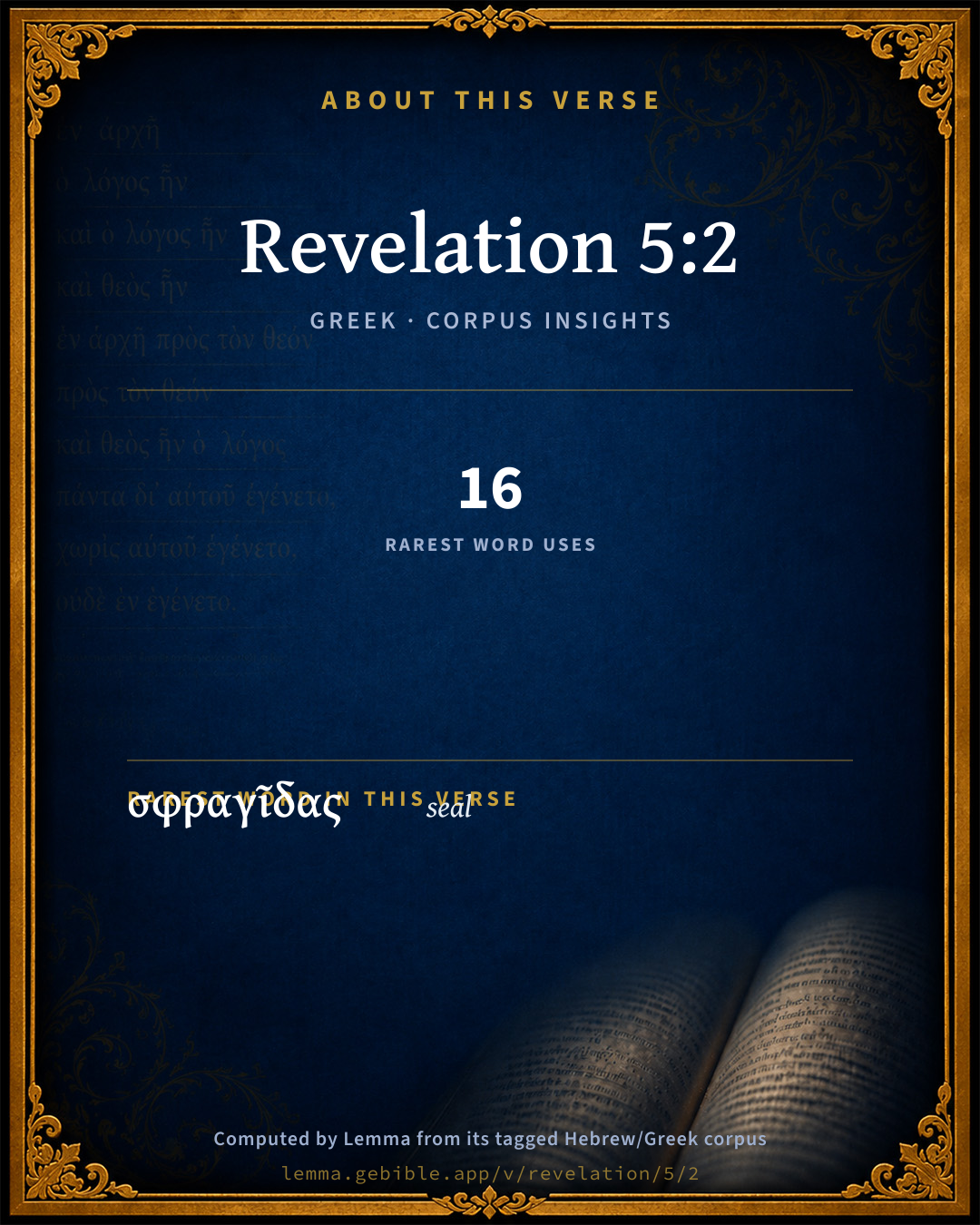
Revelation 5:2

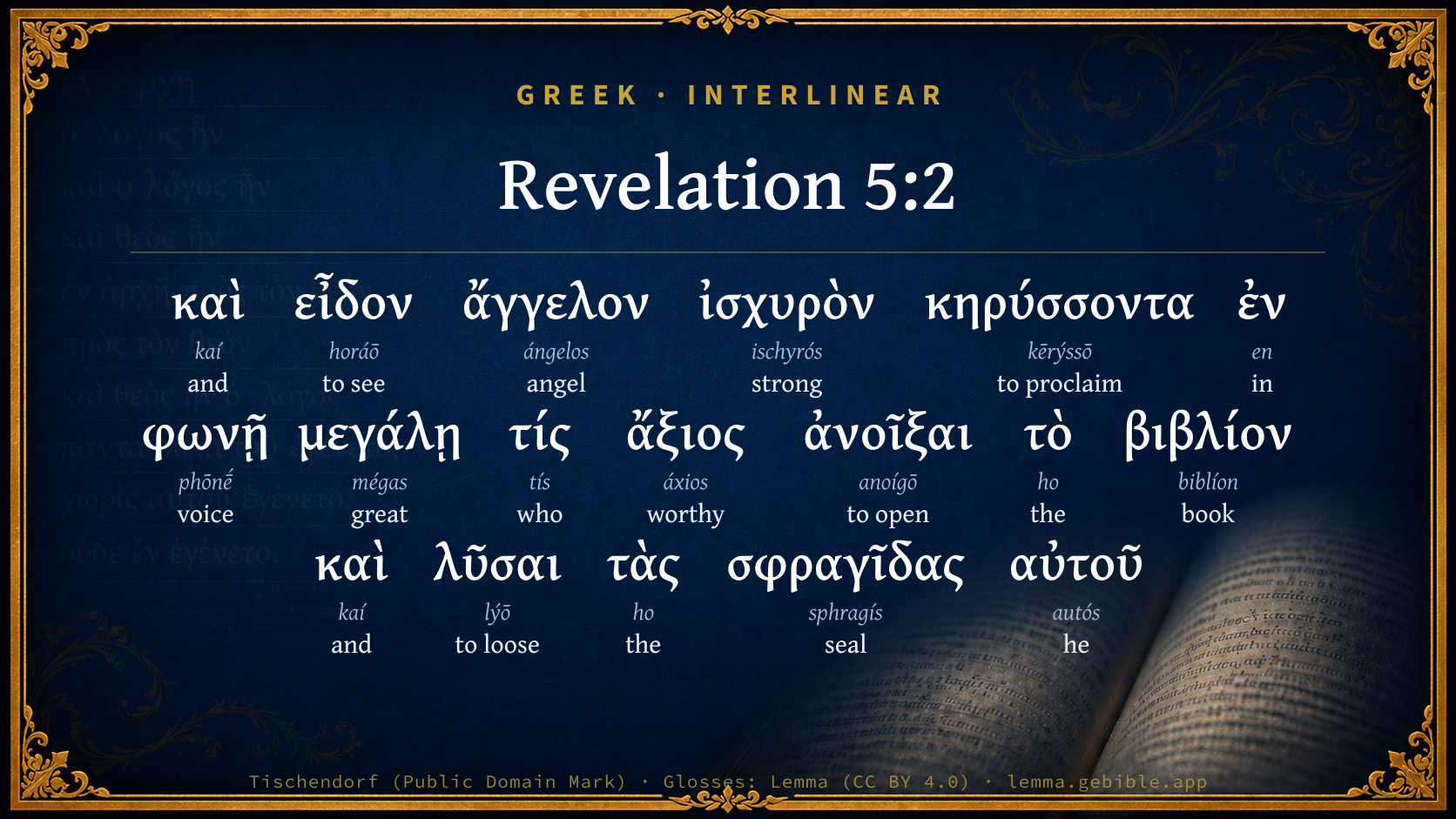
Greek (Tischendorf 8th ed.) Revelation 5:2 appears in the Greek New Testament. The text above is from the Tischendorf 8th edition. Each word links to its Strong’s number and a concise gloss. Click any word for its full Thayer’s Greek Lexicon entry.
Download image
Cite this verse

Revelation 5:2 (World English Bible). Public Domain. Lemma interlinear Bible study tool, https://lemma.gebible.app/v/revelation/5/2.

Show BibTeX & RIS
BibTeX
RIS
English Translation
I saw a mighty angel proclaiming with a loud voice, "Who is worthy to open the book, and to break its seals?"
World English Bible · Public Domain
Download a study sheet

One document with this verse’s original text, its word-by-word gloss line, the meaning frame, cross-references with their text, attributed commentary, and full source and license credits — printable, and it pastes into notes with its structure intact.

This verse Autodidact and up

Study sheet (.html) Plain text (.txt)

A passage Seminary Student

Up to 50 verses in one chapter. A passage sheet keeps up to 6 commentary sources and 12 cross-references per verse, in the order this page ranks them, and says so on the sheet whenever that leaves anything out. Ask for a single verse and you get the Autodidact verse sheet above.

Everything on this page stays free to read, with no account — the sheet is a download of what is already on screen, not access to it.

Want to remove ads? Support Godless Engineer
Compare translations 3

The same verse in 3 English versions, stacked beneath the original-language interlinear above. Click any original word for its lexicon entry.

Each is an independent rendering of the whole verse — the interlinear is not word-aligned to these translations.

Highlighted words mark where these versions differ — a whole-verse word diff, not a word-by-word alignment.

  • World English Bible Public Domain
    I saw a mighty angel proclaiming with a loud voice, "Who is worthy to open the book, and to break its seals?"
  • King James Version Public Domain
    And I saw a strong angel proclaiming with a loud voice, Who is worthy to open the book, and to loose the seals thereof?
  • unfoldingWord Literal Text CC BY-SA 4.0
    And I saw a mighty angel proclaiming in a loud voice, “Who worthy to open the scroll and to break its seals?”

unfoldingWord Literal Text — © unfoldingWord, licensed CC BY-SA 4.0. Word-aligned USFM3 via Door43 (git.door43.org/unfoldingWord/en_ult).

Versions to compare (up to 4)

3 of 4 selected

Show all 19 translations

Every available English version of this verse, each an independent rendering of the whole verse.

  • World English Bible Public Domain
    I saw a mighty angel proclaiming with a loud voice, "Who is worthy to open the book, and to break its seals?"
  • Berean Standard Bible Public Domain
    And I saw a mighty angel proclaiming in a loud voice, “Who is worthy to break the seals and open the scroll?”
  • Majority Standard Bible Public Domain
    And I saw a mighty angel proclaiming in a loud voice, “Who is worthy to break the seals and open the scroll?”
  • King James Version Public Domain
    And I saw a strong angel proclaiming with a loud voice, Who is worthy to open the book, and to loose the seals thereof?
  • American Standard Version (1901) Public Domain
    And I saw a strong angel proclaiming with a great voice, Who is worthy to open the book, and to loose the seals thereof?
  • Revised Version (1885) Public Domain
    And I saw a strong angel proclaiming with a great voice, Who is worthy to open the book, and to loose the seals thereof?
  • Geneva Bible (1599) Public Domain
    And I sawe a strong Angell which preached with a loud voice, Who is worthy to open ye booke, and to loose the seales thereof?
  • Douay-Rheims (1899) Public Domain
    And I saw a strong angel, proclaiming with a loud voice: Who is worthy to open the book, and to loose the seals thereof?
  • Young's Literal Translation Public Domain
    and I saw a strong messenger crying with a great voice, `Who is worthy to open the scroll and to loose the seals of it?'
  • Literal Standard Version CC BY-SA 4.0
    and I saw a strong messenger crying with a great voice, “Who is worthy to open the scroll and to loose its seals?”
  • Unlocked Literal Bible CC BY-SA 4.0
    I saw a mighty angel proclaiming with a loud voice, “Who is worthy to open the scroll and break its seals?”
  • unfoldingWord Literal Text CC BY-SA 4.0
    And I saw a mighty angel proclaiming in a loud voice, “Who worthy to open the scroll and to break its seals?”
  • Darby Bible Public Domain
    And I saw a strong angel proclaiming with a loud voice, Who [is] worthy to open the book, and to break its seals?
  • World Messianic Bible Public Domain
    I saw a mighty angel proclaiming with a loud voice, “Who is worthy to open the book, and to break its seals?”
  • Webster's Bible Public Domain
    And I saw a strong angel proclaiming with a loud voice, Who is worthy to open the book, and to loose its seals?
  • Free Bible Version CC BY-SA 4.0
    I saw a powerful angel shouting in a loud voice, “Who is worthy to open the scroll and break its seals?”
  • Bible in Basic English Public Domain
    And I saw a strong angel saying in a loud voice, Who is able to make the book open, and to undo its stamps?
  • Text-Critical English NT CC BY 4.0
    And I saw a mighty angel proclaiming with a loud voice, “Who is worthy to open the scroll and break its seals?”
  • Tyndale New Testament (1534) Public Domain
    And I sawe a stronge angell which cryed with a loude voyce: Who is worthy to open the boke and to loose the seales ther of.

Literal Standard Version (2020), Covenant Press — licensed CC BY-SA 4.0. Text via the HelloAO Bible API (eBible.org). Unlocked Literal Bible (unfoldingWord) — licensed CC BY-SA 4.0. Text via the HelloAO Bible API (eBible.org). unfoldingWord Literal Text — © unfoldingWord, licensed CC BY-SA 4.0. Word-aligned USFM3 via Door43 (git.door43.org/unfoldingWord/en_ult). Free Bible Version, Dr. Jonathan Gallagher — licensed CC BY-SA 4.0. Text via the HelloAO Bible API (eBible.org).

Word by word

More ways to search: Search by grammar → Find every occurrence → Compare this word →

Practice this passage: Drill this verse → Learn its vocabulary →

σφραγῖδας
sphragís
G4973
“seal”
Noun, Accusative, Plural, Feminine
Part of Speech
Noun
Case
Accusative
Number
Plural
Gender
Feminine
Full Thayer's Definition

Origin: probably strengthened from G5420

TDNT: 22:39,1

1. a seal a. the seal placed upon books b. a signet ring c. the inscription or impression made by a seal 1. of the name of God and Christ stamped upon their foreheads d. that by which anything is confirmed, proved, authenticated, as by a seal (a token or proof)
  1. καὶ kaí G2532 “and” Conjunction
  2. εἶδον horáō G3708 “to see” Verb, Aorist, Active, Indicative, 1st person, Singular
  3. ἄγγελον ángelos G32 “angel” Noun, Accusative, Singular, Masculine
  4. ἰσχυρὸν ischyrós G2478 “strong” Adjective, Accusative, Singular, Masculine
  5. κηρύσσοντα kērýssō G2784 “to proclaim” Verb, Present, Active, Participle, Accusative, Singular, Masculine
  6. ἐν en G1722 “in” Preposition
  7. φωνῇ phōnḗ G5456 “voice” Noun, Dative, Singular, Feminine
  8. μεγάλῃ mégas G3173 “great” Adjective, Dative, Singular, Feminine
  9. τίς tís G5101 “who” Interrogative pronoun, Nominative, Singular, Masculine
  10. ἄξιος áxios G514 “worthy” Adjective, Nominative, Singular, Masculine
  11. ἀνοῖξαι anoígō G455 “to open” Verb, Aorist, Active, Infinitive
  12. τὸ ho G3588 “the” Article, Accusative, Singular, Neuter
  13. βιβλίον biblíon G975 “book” Noun, Accusative, Singular, Neuter
  14. καὶ kaí G2532 “and” Conjunction
  15. λῦσαι lýō G3089 “to loose” Verb, Aorist, Active, Infinitive
  16. τὰς ho G3588 “the” Article, Accusative, Plural, Feminine
  17. αὐτοῦ autós G846 “he” Personal pronoun, Genitive, Singular, Neuter

About this verse

These counts appear in no published source. They are computed here, from the morphology-tagged text and Lemma’s own curated glosses. What Lemma adds →

18
words
16
distinct lemmas
Revelation
section

Notable vocabulary

The rarest word here is σφραγῖδας seal G4973 — appearing just 16 times in the whole Greek New Testament.

Shared distinctive vocabulary

σφραγῖδας seal G4973 occurs in 16 verses of the Greek New Testament. Also found in:

Repetition

Words recur within this verse:

Cross-references

6

Topical passages linked to Revelation 5:2 in the Treasury of Scripture Knowledge — connected by theme and wording, ordered by reader-vote popularity; previews shown in the World English Bible.

  • Isaiah 29:11–12 All vision is become to you as the words of a book that is sealed, which men deliver to one who is learned, saying, Read this, I pray you; and he says, I can't, for it is sealed:
  • Revelation 5:5 One of the elders said to me, "Don't weep. Behold, the Lion who is of the tribe of Judah, the Root of David, has overcome; he who opens the book and its seven seals."
  • Revelation 10:1 I saw a mighty angel coming down out of the sky, clothed with a cloud. A rainbow was on his head. His face was like the sun, and his feet like pillars of fire.
  • Psalms 103:20 Praise Yahweh, you angels of his, Who are mighty in strength, who fulfill his word, Obeying the voice of his word.
  • Isaiah 41:22–23 Let them bring forth, and declare to us what shall happen: declare you the former things, what they are, that we may consider them, and know the latter end of them; or show us things to come.
  • Revelation 18:21 A mighty angel took up a stone like a great millstone and cast it into the sea, saying, "Thus with violence will Babylon, the great city, be thrown down, and will be found no more at all.

Cross-references courtesy of OpenBible.info (CC BY 4.0).

Commentary

Notes on Revelation 5:2 from classic Christian and Jewish commentators (each source and its license shown beneath its notes). The classic Christian expositions comment on the surrounding passage and are grouped to its opening verse, so a note may address several verses; the Jewish commentaries on the Tanakh (Rashi and others) are per-verse, so they appear only where the commentator wrote on this verse.

Lemma curates 59 commentaries, every one of them public domain or Creative Commons licensed, each selected and text-cleaned for this edition rather than reprinted as found. About our sources →

Joseph Benson's Commentary

Rev 5:2-3. And I saw a strong angel, &c. — I beheld in my vision an angel of chief power, as attendant upon the heavenly court, making proclamation, with a strong audible voice, to every creature; a proclamation too great for a man to make, and yet not becoming the Lamb himself, and therefore made by an angel, and one of uncommon eminence. Who is worthy to open the book, &c. — Is any being able and fit to reveal and make known the counsels of God registered in this book, and to bring them into execution? And no man — Greek, ουδεις, no one, no creature; no, not the Virgin Mary herself; in heaven, nor in earth, neither under the earth — That is, none in the universe; for these are the three great regions into which the whole creation is divided; was able to open the book — To declare the counsels of God; neither to look thereon — So as to understand any part of it.

Joseph Benson's Commentary on the Old and New Testaments (1811–1818) — public domain. Text from a community e-Sword module.

Tyndale Open Study Notes

Tyndale Open Resources

5:2-3 At first, no one in the entire universe seemed to have the divine authority or power to answer the angel’s call.

Tyndale Open Study Notes — © Tyndale Open Resources, licensed CC BY-SA 4.0. Text via the HelloAO Bible API.

Bengel's Gnomon

Johann Albrecht Bengel

Rev 5:2. Ἰσχυρὸν, strong) Psa 103:20.

Bengel's Gnomon of the New Testament — English translation (T&T Clark, Edinburgh, 1860) — public domain. Text from a community e-Sword module.

Meyer's Critical & Exegetical Commentary

Heinrich August Wilhelm Meyer

Rev_5:2 sqq. ἰσχυρὸν. The adjective[1860] is by no means without meaning;[1861] but does not, however, designate an angel of higher rank,[1862] having reference to the κηρύσσ. ἐν φωνῇ μεγὰλῃ, as Rev_10:1; Rev_10:3. The angel must have great power, because with his call he is to penetrate all regions of the creation.[1863]

ἄξιος. As Joh_1:27, where, however, not the inf., but ἵνα, follows. Cf. also ἰκανός, Mat_8:8. The worthiness is the inner, ethical presupposition of the being able, Rev_5:3.

ἀνοῖξαι τὸ βιβλίον καὶ λῦσαι τὰς σφραγ. αὐτ. A hysteron proteron.[1864]

ὑποκάτω τῆς γῆς, Rev_5:3. Incorrectly, Grot.: In the sea. It designates[1865] the entire sphere of creation, according to its three great regions.[1866] By ὑποκάτω τῆς γῆς is meant[1867] Hades,[1868] as the place, not of demons,[1869] to think of which here is very strange, but of departed souls.

βλέπειν is not by reading to understand,[1870] but designates the seeing, following the opening of the book, therefore the looking in, the reading, of the same.[1871]

[1860] Cf. Psa_103:20.

[1861] A mere ornamental epithet, Eichh.

[1862] C. a Lap., Züll., Stern; cf. also De Wette. N. de Lyra Gabriel.

[1863] Vitr., Beng., Hengstenb., Ebrard, Ew. ii.

[1864] De Wette.

[1865] Cf. Rev_5:13; Php_2:10.

[1866] Beng.

[1867] Otherwise than Exo_20:4.

[1868] Ebrard.

[1869] Cf. Vitr.

[1870] Bretschneider.

[1871] Ew., De Wette, etc.

Meyer — Critical and Exegetical Commentary on the New Testament — English translation by Peter Christie, edited by Frederick Crombie (T&T Clark, 1880) — public domain. Text from a community e-Sword module.

Expositor's Greek Testament

ed. W. Robertson Nicoll

Rev 5:2 . The καὶ after ἀνοῖξαι is either epexegetic or the mark of a hysteron proteron ( cf. the awkward οὔτε βλέπειν of 3 4, unless look here means to look into the contents). The cry is a challenge rather than an appeal.

The Expositor's Greek Testament, edited by W. Robertson Nicoll (1897–1910) — public domain. Text from a community e-Sword module.

Jamieson, Fausset & Brown

Robert Jamieson, A. R. Fausset & David Brown

strong-- (Psa 103:20). His voice penetrated heaven, earth, and Hades (Rev 10:1-3).

Jamieson, Fausset & Brown — Commentary Critical and Explanatory on the Whole Bible (1871) — public domain (CC PDM 1.0). Text via the HelloAO Bible API.

Adam Clarke's Commentary

Verse 2. A strong angel] One of the chief of the angelic host.

Proclaiming] As the herald of God.

To open the book, and to loose the seals] To loose the seals that he may open the book. Who can tell what this book contains? Who can open its mysteries? The book may mean the purposes and designs of God relative to his government of the world and the Church; but we, whose habitation is in the dust, know nothing of such things. We are, however, determined to guess.

Adam Clarke's Commentary on the Bible (1810–1826) — public domain. Text from a community e-Sword/MySword module.

Ellicott's Commentary for English Readers

(2) And I saw a strong (better, mighty) angel proclaiming with (or, in) a loud voice, Who is worthy . . .—We must not let the word “worthy” pass as though it were simply equivalent to “strong enough.” It seems to imply moral fitness (comp. Rom_1:4), which is the true strength in the heavenly world. It was not lack of intellectual capacity so much as the taint of moral unworthiness which hindered the reading of the book. This is in harmony with what we have noticed before. “To commune with God, there is need of no subtle thought, no foreign tongue, no newest philosophy: ‘ the pure in heart shall see Him:’ and Fox and Bunyan can more truly make Him known than ‘masters of sentences’ and ‘ angelic doctors.’” Those who are willing to do God’s will know of God’s doctrine. This thought corresponds, too, with the stress which is laid (in Rev_5:5) on the victory of Christ. It is not simply as divine Son of God, but also as victorious Saviour and King of His people, that He opens the book: His worthiness has been established in conflict and temptation (Joh_14:30; Heb_2:9; Heb_4:15).

A Bible Commentary for English Readers, edited by Charles John Ellicott (1878–1897) — public domain. Text from a community e-Sword module.

John Gill's Exposition

And I saw a strong angel proclaiming with a loud voice,.... This was not the uncreated angel, Jesus Christ; for he is after spoken of as the lion of the tribe of Judah, and as the Lamb in the midst of the throne, but a created one; though who he was, whether Gabriel, as some say, because his name signifies the strong or mighty One of God, is not material to be known; angels are said to be mighty, and to excel in strength: this is called so here, chiefly with respect to his voice, which he, by reason of his great strength, exerted so loudly, as to be heard by all the creatures in heaven, and in earth, and under the earth however, this was not John the Baptist, but if a minister of the Gospel, rather some one since, making the following proclamation:

who is worthy to open the book, and to loose the seals thereof? suggesting, that if there was any such person, that he was desired to come, and do it; and it seems, that he must not only be one of power and ability, but of dignity and authority, a person of greatness and worth, from whence his ability arises; as he ought to be that can engage his heart to draw nigh to God, and take a book out of his right hand, this mysterious book of the Revelation, as it was indeed while sealed; and open and explain it to others, unseal it or exhibit it, as it afterwards was in the following scenes and visions, and gave a view of all that is contained in it; and not only so, but fulfil and accomplish all the prophecies in it; and who can, or is worthy to do all this, but he that sits at the right hand of God, and who is God as well as man? and this proclamation was made to stir up an earnest desire in John, and all the saints he represents, to know what was in this book; and to show the impotence of all creatures to make any discovery of it; and to illustrate, and set off with a greater foil, the glory, excellency, ability, and worth of Jesus Christ. There seems to be an allusion to the president of the temple calling to the priests under him, to attend to the several parts of service assigned them, saying unto them, , "whosoever is worthy, let him" do so and so (c).

(c) Misna Tamid, c. 1. sect. 4. & c. 5. sect. 4. 5.

John Gill's Exposition of the Whole Bible (1746–1763) — public domain (CC PDM 1.0). Text via the HelloAO Bible API.

Trapp's Complete Commentary

John Trapp

2 And I saw a strong angel proclaiming with a loud voice, Who is worthy to open the book, and to loose the seals thereof?

Ver. 2. And I saw a strong angel] Angels are very desirous to know the mystery of Christ, 1Pe 1:12, and to profit daily in that knowledge, Eph 3:10.

John Trapp, A Commentary or Exposition upon All the Books of the Old and New Testament (1647–1656) — public domain. Text from a community e-Sword module.

Albert Barnes' Notes on the Bible

And I saw a strong angel - An angel endowed with great strength, as if such strength was necessary to enable him to give utterance to the loud voice of the inquiry. “Homer represents his heralds as powerful, robust men, in order consistently to attribute to them deep-toned and powerful voices” (Prof. Stuart). The inquiry to be made was one of vast importance; it was to be made of all in heaven, all on the earth, and all under the earth, and hence an angel is introduced so mighty that his voice could be heard in all those distant worlds.

Proclaiming with a loud voice - That is, as a herald or crier. He is rather introduced here as appointed to this office than as self-moved. The design undoubtedly is to impress the mind with a sense of the importance of the disclosures about to be made, and at the same time with a sense of the impossibility of penetrating the future by any created power. That one of the highest angels should make such a proclamation would sufficiently show its importance; that such an one, by the mere act of making such a proclamation, should practically confess his own inability, and consequently the inability of all of similar rank, to make the disclosures, would show that the revelations of the future were beyond mere created power.

Who is worthy to open the book, ... - That is, who is “worthy” in the sense of having a rank so exalted, and attributes so comprehensive, as to authorize and enable him to do it. In other words, who has the requisite endowments of all kinds to enable him to do it? It would require moral qualities of an exalted character to justify him in approaching the seat of the holy God, to take the book from his hands; it would require an ability beyond that of any created being to penetrate the future, and disclose the meaning of the symbols which were employed. The fact that the book was held in the hand of him that was on the throne, and sealed in this manner, was in itself a sufficient proof that it was not his purpose to make the disclosure directly, and the natural inquiry arose whether there was anyone in the wide universe who, by rank, or character, or office, would be empowered to open the mysterious volume.

Albert Barnes' Notes on the Bible (1834–1885) — public domain. Text from a community e-Sword/MySword module.

Matthew Poole's English Annotations

There were no weak angels, but possibly this angel might, in appearance to John, look as if he were stronger than others; or rather, so judged from the great and

loud voice he used.

Who is worthy to open the book, and to loose the seals thereof? Not that he thought any was able, or worthy. We can only conclude from hence the impotency of men to search, and find out, and expound the deep things of God, and consequently the unlawfulness of too narrow a prying into his secret mysteries.

Matthew Poole's English Annotations on the Holy Bible (1683–1685) — public domain. Text from a community e-Sword/MySword module.

Whedon's Commentary on the Bible

Daniel D. Whedon

2. Strong angel—Personal physical vigour is implied in the word strong, as in Rev_10:1; Rev_18:21. The present angel is strong, as being herald and challenger for God. Who is competent to break the seals that Jehovah has stamped? Who may reveal the secrets of the future, “which the Father has reserved in his own power?” Act_1:7. Dusterdieck’s statement, that as the seven trumpets spring from the seventh seal, and the seven vials from the seventh trumpet, so the Apocalyptic revelation is at first all enclosed in the seals, is nearly true. But the sixth chapter is not in the real series, but a contrastive picture without, and over against, the seals. And as this strong angel is without the real series, so the parallel strong angel of chapter x is outside the series, both being one of the personal managers of the panorama. And as the challenging question of this verse dimly suggests Michael, so Gabriel seems suggested by Rev_10:1; where see note.

A loud voice—Which (next verse) was so loud and strong as to peal through heaven and earth.

Who is— This may be an allusion to the name Michael, which signifies, Who is like God?

Worthy—If force could have torn up the divine seals, the strong angel who issues the challenge might, perhaps, have accepted the task. It was, however, the highest worthiness, desert, dignity, alone which could presume to open the divine seals of futurity.

Daniel D. Whedon (gen. ed.), Commentary on the Old and New Testaments (1874–1909) — public domain. Text from a community e-Sword module.

The Pulpit Commentary

And I saw (see on ver. 1). A strong angel; iscuron , rendered "mighty" in Rev_10:1. Possibly, as De Wette and others think, so called because of higher rank De Lyra says Gabriel; but probably on account of the great voice, which sounded "as a lion roareth". (Rev_10:3) Proclaiming with a loud voice, Who is worthy to open the book, and to loose the seals thereof? with a great voice. "Worthy" is axiov , fit morally, as in Joh_1:27.

The Pulpit Commentary (1880–1919), ed. H.D.M. Spence-Jones & Joseph S. Exell — public domain. Text from a community e-Sword module.

John Wesley's Explanatory Notes

And I saw a strong angel - This proclamation to every creature was too great for a man to make, and yet not becoming the Lamb himself. It was therefore made by an angel, and one of uncommon eminence.

John Wesley, Explanatory Notes Upon the Whole Bible (1754–1765) — public domain. Text via the GEBible commentary corpus.

Scofield Reference Notes

C. I. Scofield

angel

(See Scofield "Heb 1:4")

The Scofield Reference Bible (1917 edition), notes by C. I. Scofield — public domain. Text from a community e-Sword module.

Burkitt's Expository Notes on the New Testament

William Burkitt

Observe, 1. Here is a proclamation made by an extraordinary angel, like an herald or officer, inquiring who was worthy, either in regard of authority, or in respect of ability, to open this book, and unloose the seals, that is, to disclose the secret counsels of God, and to make them known unto the sons of men, implying, that every angel in heaven is not worthy or meet to be the expositor of God’s mind and mysteries unto man.

Observe, 2. The great silence which there was in heaven upon this proclamation, amounting to an absolute and peremptory denial, that not any one, either in heaven or earth, or under the earth; not any angel in heaven, nor any saint living upon earth; not any dead saint under the earth, nor any devil or infernal spirit; was either worthy to open the book, or able to foresee or foretell the least event concerning the church, farther than revealed to them.

Learn hence, That neither angels nor devils do understand the mysterious counsels of God, or can reveal future things to man, any farther than as God is pleased to reveal the same unto them.

Observe, 3. St. John’s great and bitter lamentation, because no person was found worthy to open the book, and reveal unto the church the secret counsels of God concerning her, I wept much; fearing, no doubt, lest the church of God should be deprived of the benefit and comfort of this revelation. Such as are the true members of the church are greatly afflicted with all the providential dispensations of God which do befall her; but nothing goes so near them, as to have the mind and will of God hidden and concealed from her.

Observe, 4. A seasonable consolation given to St. John: one of the elders that were about the throne said to him, Weep not, for care is taken for the opening and revealing of the book. Christ, who is called the Lion of the tribe of Judah, the Son of David, as man, and the root of David, as God, is found worthy, in regard of the divinity of his person, and the prevalency of his merits, to open unto the church all the mysteries of God, which are meet and convenient for her to understand and know.

Quest. Why is Christ called the Lion of the tribe of Judah?

Ans. In allusion to Jacob’s blessing, Genesis 49 where Judah is called a lion’s whelp, denoting the dignity and superiority of that tribe above the rest.

Now Christ descended of this tribe, and is called a lion, in regard of his kingly power and strength, in regard of his stoutness and courage, in regard of his mildness and clemency, and true nobleness of spirit, to them that submit and yield unto him, and in respect of his vigilancy and watchfulness over his church; all which are the known properties of the lion; and as that creature is the king of beasts, so is Christ King of kings, and Lord of lords, the only potentate; dominion and fear are with him.

Quest. But how could Christ be called David’s root, when we know that David did not spring from him, but he from David, according to the flesh?

Ans. In a natural sense, David was the root of David. David, as man, was the root of Christ: Christ, as Mediator and Godman, was the root of David. Thus he was both David’s lord, and David’s son, Psa 110:1.

William Burkitt's Expository Notes on the New Testament (1700–1703) — public domain. Text from a community e-Sword module.

Alford’s Greek Testament

Henry Alford

2.] And I saw a strong angel (the epithet ἰσχυρόν is by no means superfluous, but corresponds to the φωνῇ μεγάλῃ below, which, as appears by what followed, penetrated heaven and earth and Hades. Compare ch. 10:1, 3 and notes) proclaiming in (reff.; the voice is the vehicle, or investiture, of the thing proclaimed) a loud voice, Who is worthy (see reff.

ἄξιος here = ἱκανός Mat 8:8) to open the book and to loose the seals of it? and no one was able, in heaven, nor yet upon the earth, nor yet under the earth (in Hades, the place of departed spirits: not, as Grot., in mari), to open the book, nor yet to look on it (if we were reading an ordinary Greek sentence, this οὐδέ would introduce a climax, which would rule the meaning to be, “nor even so much as to look upon the book,” lying there closed as it did. But the somewhat indiscriminate use of οὐδέ in the former clause, in which no such climax can be intended, removes this necessity, and enables us to take βλέπειν of an act subsequent to the ἀνοῖξαι,—the looking on the book, with a view to read it. For the claim to open the book must be founded on a claim of worthiness to see that which was contained in it).

Henry Alford, The Greek Testament (1849–1861) — public domain. Text from a community e-Sword module.

Vincent's Word Studies in the New Testament

Marvin R. Vincent

Strong. Either as being of higher rank, or with reference to the great voice.

Worthy [αξιος] . As in Joh 1:27. Morally entitled.

Marvin R. Vincent, Word Studies in the New Testament (1887–1900) — public domain. Text from a community e-Sword/MySword module.

Lesson kit

Teaching starters — assembled from the data on this page, not authored interpretation. Every prompt links to the verse data it draws on. Edit before teaching.

Revelation, in the Revelation, opens this verse with 18 words (16 distinct Greek lemmas). Its most distinctive word is sphragís (“seal”). A historical commentator’s framing appears above. Read the whole chapter for the surrounding context.

Discussion questions

  1. The word sphragís carries the sense “seal.” How does it shape the verse?
  2. Romans 4:11 shares the word «seal» with this verse. How do the two illuminate each other?
  3. “and” occurs 2× in this one verse. What is the effect of the repetition?
  4. These translations render this verse differently; the difference is in the English rendering, not the original. What questions does that raise?
  5. Reading how Joseph Benson's Commentary and Tyndale Open Study Notes read this verse, where do the two commentators agree and where do they part?

Things to notice

Reading settings

Reading text

Shown beneath each verse's original-language words.

Old Testament
Old Testament edition

Read the OT as the Masoretic Hebrew (MT) or the Greek Septuagint (LXX).

English shown for the Greek Septuagint (in the Hebrew ↔ Greek comparison).

Comparing translations? Open the Compare panel on any verse page to stack up to four side by side.