Acts 10:3

Greek (Tischendorf 8th ed.) Acts 10:3 appears in the Greek New Testament. The text above is from the Tischendorf 8th edition. Each word links to its Strong’s number and a concise gloss. Click any word for its full Thayer’s Greek Lexicon entry.
Download image
Cite this verse

Acts 10:3 (World English Bible). Public Domain. Lemma interlinear Bible study tool, https://lemma.gebible.app/v/acts/10/3.

Show BibTeX & RIS
BibTeX
RIS
English Translation
At about the ninth hour of the day, he clearly saw in a vision an angel of God coming to him, and saying to him, "Cornelius!"
World English Bible · Public Domain
Download a study sheet

One document with this verse’s original text, its word-by-word gloss line, the meaning frame, cross-references with their text, attributed commentary, and full source and license credits — printable, and it pastes into notes with its structure intact.

This verse Autodidact and up

Study sheet (.html) Plain text (.txt)

A passage Seminary Student

Up to 50 verses in one chapter. A passage sheet keeps up to 6 commentary sources and 12 cross-references per verse, in the order this page ranks them, and says so on the sheet whenever that leaves anything out. Ask for a single verse and you get the Autodidact verse sheet above.

Everything on this page stays free to read, with no account — the sheet is a download of what is already on screen, not access to it.

Want to remove ads? Support Godless Engineer
Compare translations 3

The same verse in 3 English versions, stacked beneath the original-language interlinear above. Click any original word for its lexicon entry.

Each is an independent rendering of the whole verse — the interlinear is not word-aligned to these translations.

Highlighted words mark where these versions differ — a whole-verse word diff, not a word-by-word alignment.

  • World English Bible Public Domain
    At about the ninth hour of the day, he clearly saw in a vision an angel of God coming to him, and saying to him, "Cornelius!"
  • King James Version Public Domain
    He saw in a vision evidently about the ninth hour of the day an angel of God coming in to him, and saying unto him, Cornelius.
  • unfoldingWord Literal Text CC BY-SA 4.0
    About the ninth hour of the day, he saw clearly in a vision an angel of God coming to him and saying to him, “Cornelius!”

unfoldingWord Literal Text — © unfoldingWord, licensed CC BY-SA 4.0. Word-aligned USFM3 via Door43 (git.door43.org/unfoldingWord/en_ult).

Versions to compare (up to 4)

3 of 4 selected

Show all 19 translations

Every available English version of this verse, each an independent rendering of the whole verse.

  • World English Bible Public Domain
    At about the ninth hour of the day, he clearly saw in a vision an angel of God coming to him, and saying to him, "Cornelius!"
  • Berean Standard Bible Public Domain
    One day at about the ninth hour, he had a clear vision of an angel of God who came to him and said, “Cornelius!”
  • Majority Standard Bible Public Domain
    One day at about the ninth hour, he had a clear vision of an angel of God who came to him and said, “Cornelius!”
  • King James Version Public Domain
    He saw in a vision evidently about the ninth hour of the day an angel of God coming in to him, and saying unto him, Cornelius.
  • American Standard Version (1901) Public Domain
    He saw in a vision openly, as it were about the ninth hour of the day, an angel of God coming in unto him, and saying to him, Cornelius.
  • Revised Version (1885) Public Domain
    He saw in a vision openly, as it were about the ninth hour of the day, an angel of God coming in unto him, and saying to him, Cornelius.
  • Geneva Bible (1599) Public Domain
    He sawe in a vision euidently (about the ninth houre of the day) an Angel of God comming in to him, and saying vnto him, Cornelius.
  • Douay-Rheims (1899) Public Domain
    This man saw in a vision manifestly, about the ninth hour of the day, an angel of God coming in unto him, and saying to him: Cornelius.
  • Young's Literal Translation Public Domain
    he saw in a vision manifestly, as it were the ninth hour of the day, a messenger of God coming in unto him, and saying to him, `Cornelius;'
  • Literal Standard Version CC BY-SA 4.0
    he saw in a vision openly, as it were the ninth hour of the day, a messenger of God coming in to him, and saying to him, “Cornelius”;
  • Unlocked Literal Bible CC BY-SA 4.0
    About the ninth hour of the day, he clearly saw in a vision an angel of God coming to him. The angel said to him, “Cornelius!”
  • unfoldingWord Literal Text CC BY-SA 4.0
    About the ninth hour of the day, he saw clearly in a vision an angel of God coming to him and saying to him, “Cornelius!”
  • Darby Bible Public Domain
    -- saw plainly in a vision, about the ninth hour of the day, an angel of God coming unto him, and saying to him, Cornelius.
  • World Messianic Bible Public Domain
    At about the ninth hour of the day, he clearly saw in a vision an angel of God coming to him and saying to him, “Cornelius!”
  • Webster's Bible Public Domain
    He saw in a vision evidently, about the ninth hour of the day, an angel of God coming in to him, and saying to him, Cornelius.
  • Free Bible Version CC BY-SA 4.0
    At about 3 p.m. one day he had a vision in which he saw very clearly an angel of God who came to him and called to him, “Cornelius!”
  • Bible in Basic English Public Domain
    He saw in a vision, clearly, at about the ninth hour of the day, an angel of the Lord coming to him and saying to him, Cornelius!
  • Text-Critical English NT CC BY 4.0
    About the ninth hour of the day he saw clearly in a vision an angel of God, who came in and said to him, “Cornelius!”
  • Tyndale New Testament (1534) Public Domain
    The same man sawe in a vision evydetly aboute the nynthe houre of the daye an angell of god comynge into him and sayinge vnto him: Cornelius.

Literal Standard Version (2020), Covenant Press — licensed CC BY-SA 4.0. Text via the HelloAO Bible API (eBible.org). Unlocked Literal Bible (unfoldingWord) — licensed CC BY-SA 4.0. Text via the HelloAO Bible API (eBible.org). unfoldingWord Literal Text — © unfoldingWord, licensed CC BY-SA 4.0. Word-aligned USFM3 via Door43 (git.door43.org/unfoldingWord/en_ult). Free Bible Version, Dr. Jonathan Gallagher — licensed CC BY-SA 4.0. Text via the HelloAO Bible API (eBible.org).

Word by word

More ways to search: Search by grammar → Find every occurrence → Compare this word →

Practice this passage: Drill this verse → Learn its vocabulary →

φανερῶς
phanerōs
G5320
“manifestly”
Adverb
Part of Speech
Adverb
Full Thayer's Definition

Origin: from G5318

TDNT: None

1. manifestly a. plainly, clearly b. openly
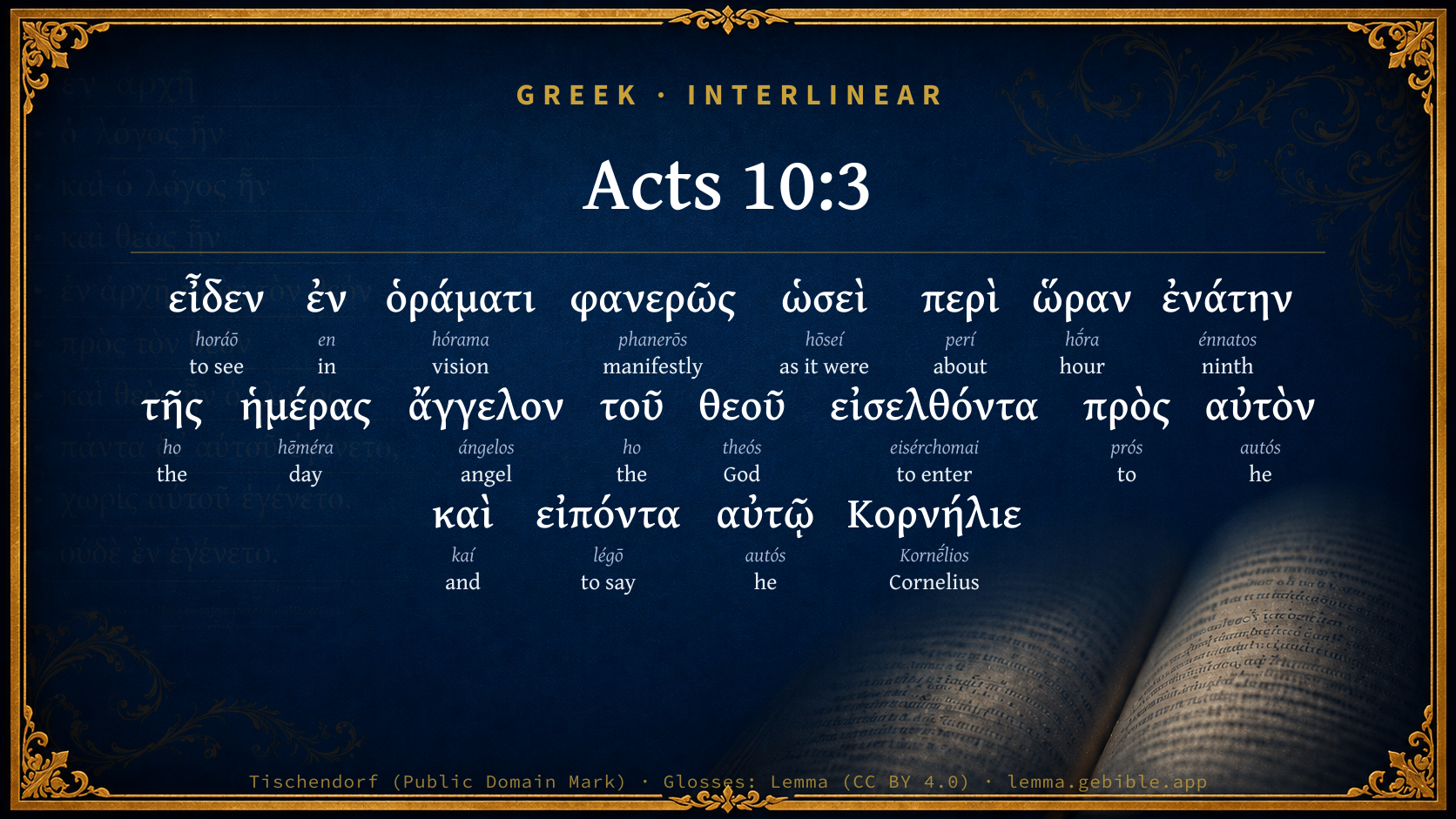
  1. εἶδεν horáō G3708 “to see” Verb, Aorist, Active, Indicative, 3rd person, Singular
  2. ἐν en G1722 “in” Preposition
  3. ὁράματι hórama G3705 “vision” Noun, Dative, Singular, Neuter
  4. ὡσεὶ hōseí G5616 “as it were” Adverb
  5. περὶ perí G4012 “about” Preposition
  6. ὥραν hṓra G5610 “hour” Noun, Accusative, Singular, Feminine
  7. ἐνάτην énnatos G1766 “ninth” Adjective, Accusative, Singular, Feminine
  8. τῆς ho G3588 “the” Article, Genitive, Singular, Feminine
  9. ἡμέρας hēméra G2250 “day” Noun, Genitive, Singular, Feminine
  10. ἄγγελον ángelos G32 “angel” Noun, Accusative, Singular, Masculine
  11. τοῦ ho G3588 “the” Article, Genitive, Singular, Masculine
  12. θεοῦ theós G2316 “God” Noun, Genitive, Singular, Masculine
  13. εἰσελθόντα eisérchomai G1525 “to enter” Verb, Aorist, Active, Participle, Accusative, Singular, Masculine
  14. πρὸς prós G4314 “to” Preposition
  15. αὐτὸν autós G846 “he” Personal pronoun, Accusative, Singular, Masculine
  16. καὶ kaí G2532 “and” Conjunction
  17. εἰπόντα légō G3004 “to say” Verb, Aorist, Active, Participle, Accusative, Singular, Masculine
  18. αὐτῷ autós G846 “he” Personal pronoun, Dative, Singular, Masculine
  19. Κορνήλιε Kornḗlios G2883 “Cornelius” Noun, Vocative, Singular, Masculine

About this verse

These counts appear in no published source. They are computed here, from the morphology-tagged text and Lemma’s own curated glosses. What Lemma adds →

20
words
18
distinct lemmas
Acts
section

Notable vocabulary

The rarest word here is φανερῶς manifestly G5320 — appearing just 3 times in the whole Greek New Testament.

Shared distinctive vocabulary

φανερῶς manifestly G5320 occurs in 3 verses of the Greek New Testament. Also found in:

Repetition

Words recur within this verse:

  • τῆς the G3588 ×2
  • αὐτὸν he G846 ×2

Cross-references

21

Topical passages linked to Acts 10:3 in the Treasury of Scripture Knowledge — connected by theme and wording, ordered by reader-vote popularity; previews shown in the World English Bible.

  • Daniel 9:20–21 While I was speaking, and praying, and confessing my sin and the sin of my people Israel, and presenting my supplication before Yahweh my God for the holy mountain of my God;
  • Acts 3:1 Peter and John were going up into the temple at the hour of prayer, the ninth hour.
  • Acts 5:19 But an angel of the Lord opened the prison doors by night, and brought them out, and said,
  • Acts 9:4 He fell on the earth, and heard a voice saying to him, "Saul, Saul, why do you persecute me?"
  • Acts 9:10 Now there was a certain disciple at Damascus named Ananias. The Lord said to him in a vision, "Ananias!" He said, "Behold, it's me, Lord."
  • Acts 10:17 Now while Peter was very perplexed in himself what the vision which he had seen might mean, behold, the men who were sent by Cornelius, having made inquiry for Simon's house, stood before the gate,
  • Acts 10:19 While Peter was pondering the vision, the Spirit said to him, "Behold, three men seek you.
  • Acts 10:30 Cornelius said, "Four days ago, I was fasting until this hour, and at the ninth hour, I prayed in my house, and behold, a man stood before me in bright clothing,
  • Exodus 33:17 Yahweh said to Moses, "I will do this thing also that you have spoken; for you have found favor in my sight, and I know you by name."
  • Job 4:15–16 Then a spirit passed before my face; The hair of my flesh stood up.
  • Isaiah 45:4 For Jacob my servant's sake, and Israel my chosen, I have called you by your name: I have surnamed you, though you have not known me.
  • Matthew 27:46 About the ninth hour Jesus cried with a loud voice, saying, "Eli, Eli, lima sabachthani?" That is, "My God, my God, why have you forsaken me?"
  • Luke 1:11 An angel of the Lord appeared to him, standing on the right side of the altar of incense.
  • Luke 2:10–11 The angel said to them, "Don't be afraid, for behold, I bring you good news of great joy which will be to all the people.
  • Luke 2:13 Suddenly, there was with the angel a multitude of the heavenly host praising God, and saying,
  • Luke 23:44–46 It was now about the sixth hour, and darkness came over the whole land until the ninth hour.
  • Acts 11:13 He told us how he had seen the angel standing in his house, and saying to him, 'Send to Joppa, and get Simon, whose surname is Peter,
  • Acts 12:7–11 And behold, an angel of the Lord stood by him, and a light shone in the cell. He struck Peter on the side, and woke him up, saying, "Stand up quickly!" His chains fell off from his hands.
  • Acts 27:23 For there stood by me this night an angel, belonging to the God whose I am and whom I serve,
  • Hebrews 1:4 having become so much better than the angels, as he has inherited a more excellent name than they have.
  • Hebrews 1:14 Aren't they all ministering spirits, sent out to do service for the sake of those who will inherit salvation?

Cross-references courtesy of OpenBible.info (CC BY 4.0).

Commentary

Notes on Acts 10:3 from classic Christian and Jewish commentators (each source and its license shown beneath its notes). The classic Christian expositions comment on the surrounding passage and are grouped to its opening verse, so a note may address several verses; the Jewish commentaries on the Tanakh (Rashi and others) are per-verse, so they appear only where the commentator wrote on this verse.

Lemma curates 59 commentaries, every one of them public domain or Creative Commons licensed, each selected and text-cleaned for this edition rather than reprinted as found. About our sources →

Joseph Benson's Commentary

Act 10:3-6. He saw — At a time, it seems, when engaged in secret devotion; in a vision — Not in a trance, like Peter; evidently — Φανερως, manifestly and plainly, so as to leave him, though not accustomed to things of this kind, no room to suspect any imposition; about the ninth hour — That is, about three in the afternoon, which, being the hour of evening sacrifice, was chosen by him as a proper season for his devotion; an angel of God — Known to be such by the brightness of his countenance and the manner of his coming in to him: and saying, Cornelius — Calling him by his name, to intimate the particular notice God took of him. And when he looked on him — Ατενισας αυτω, having fixed his eyes on him; he was afraid — And no wonder, for the wisest and best of men have been struck with fear upon the appearance of any extraordinary messenger from heaven; and said, What is it, Lord? — As if he had said, What can this mean? for the words seem to be a sudden exclamation, and prayer to God to preserve him, and let him know what was the design of so astonishing an appearance. And he (the angel) said, Thy prayers, and thine alms — With which they have been attended; have come up for a memorial before God — Far more pleasing to him than the most fragrant incense. And dare any man say, then, that these were only splendid sins? or that they were an abomination before God? And yet it is certain, in the Christian sense, Cornelius was then an unbeliever. He had not then faith in Christ. So certain it is, that every one who seeks faith in Christ, should seek it in prayer and doing good to all men. And now — Adds the angel, since God is about to give thee a very singular proof of his love, by discovering things to thee which it is of the highest importance thou shouldst know; send, therefore, to Joppa, and call for one Simon, &c.; he shall tell thee what thou oughtest to do — Two things here are remarkable, and worthy of particular attention: 1st, Cornelius is influenced continually by the fear of God; from that principle he prays and gives alms; is religious himself, and maintains religion in his family. And all this he does in such a manner as to be accepted of God therein. Nevertheless, it is now necessary he should do something further; he must embrace the Christian religion, God having now established it among men. Not, he might do this if he pleased, and it would be an improvement of his religion; but, he must do it, his doing it is indispensably necessary to his acceptance with God for the future. He that had believed the promise of the Messiah, must now believe the performance of that promise. Now God having given a further record concerning his Son than what had been given in the Old Testament prophecies, he requires men to receive that record when it is brought to them; and unless they do so, neither their prayers nor their alms can any longer come up for a memorial before him. Prayers and alms are indeed still accepted from those that believe in God and fear him, if they have not an opportunity of knowing more. But with those to whom the gospel is preached, it is necessary, in order to the acceptance of their persons, prayers, and alms, that they should believe that Jesus is the Christ, and should confide in him alone for acceptance. 2d, Though Cornelius has now an angel from heaven talking to him, yet he must not receive the gospel of Christ from this angel, nor be told by him what he ought to do, but must send for Peter to inform him. As the former observation puts a remarkable honour upon the gospel, so doth this upon the gospel ministry. It was not to angels, but to saints, persons compassed about with infirmity, that this grace was given, to preach among the Gentiles the unsearchable riches of Christ, that the excellence of the power might be of God, and the dignity of Christ’s institution supported. And as it was an honour to the apostle, that he must preach that which an angel might not, so it was a further honour, that an angel was despatched from heaven on purpose to order him to be sent for. Observe, reader, to bring a faithful minister and a willing people together, is a work worthy of an angel, and what, therefore, the greatest of men should be glad to be employed in.

Joseph Benson's Commentary on the Old and New Testaments (1811–1818) — public domain. Text from a community e-Sword module.

Tyndale Open Study Notes

Tyndale Open Resources

10:3 In Acts, visions are usually related to prayer (9:3-6, 10-16; 10:2-6, 9-12; 11:5-9; 12:9-17; 18:9-10; 22:17-21; 23:11). These visions are not chance coincidences, but expressions of God’s saving work, providing divine direction and encouragement.

Tyndale Open Study Notes — © Tyndale Open Resources, licensed CC BY-SA 4.0. Text via the HelloAO Bible API.

Bengel's Gnomon

Johann Albrecht Bengel

Act 10:3. Ἐν ὁράματι, in a vision) not in an ecstasy, as Peter.—φανερῶς, manifestly) So that it could not be a deception of the senses which was disturbing Cornelius, who was not accustomed to such things.—ἐννάτην, the ninth) This is about our third hour (three o’clock) in the afternoon: a time in which the senses are wont to be fresh and lively.

Bengel's Gnomon of the New Testament — English translation (T&T Clark, Edinburgh, 1860) — public domain. Text from a community e-Sword module.

Meyer's Critical & Exegetical Commentary

Heinrich August Wilhelm Meyer

Act_10:3. Εἶδεν is the verb belonging to ἀνὴρ … Κορνήλ., Act_10:1, and ἑκατοντ.… διαπαντός is in apposition to Κορνήλ.

The intimation made to Cornelius is a vision in a waking condition, caused by God (during the hour of prayer, which was sacred to the centurion on account of his high respect for Judaism), i.e. a manifestation of God made so as to be clearly perceptible to the inner sense of the pious man, conveyed by the medium of a clear (φανερῶς) angelic appearance in vision, which Cornelius himself, Act_10:30, describes more precisely in its distinctly seen form, just as it at once on its occurrence made the corresponding impression upon him; hence Act_10:4 : ἔμφοβος γενόμ. and τί ἐστι, κύριε. Comp. Luk_24:5. Eichhorn rationalized the narrative to the effect that Cornelius, full of longing to become acquainted with the distinguished Peter now so near him, learned the place of his abode from a citizen of Joppa at Caesarea, and then during prayer felt a peculiar elevation of mind, by which, as if by an angel, his purpose of making Peters acquaintance was confirmed. This is opposed to the whole representation; with which also Ewalds similar view fails to accord, that Cornelius, uncertain whether or not he should wish a closer acquaintance with Peter, had, as if irradiated by a heavenly certainty and directed by an angelic voice, firmly resolved to invite the apostle at once to visit him

ὡσεὶ περὶ ὥρ. ἐνάτ. (see the critical remarks): as it were about the ninth hour. Circumstantiality of expression. See Bornemann in loc.

Meyer — Critical and Exegetical Commentary on the New Testament — English translation by Peter Christie, edited by Frederick Crombie (T&T Clark, 1880) — public domain. Text from a community e-Sword module.

Expositor's Greek Testament

ed. W. Robertson Nicoll

Act 10:3 . εἶδεν : there is no ground for explaining away the force of the words by assuming that Cornelius had formerly a longing to see Peter. φανερῶς : “openly,” R.V.; manifeste , Vulgate. The words plainly are meant to exclude any illusion of the senses, not in a trance as in Act 10:10 , cf. Act 22:17 ; only here in Luke’s writings, cf. 2Ma 3:28 . ὡσεὶ ( περί ): the ὡσεί , as Blass points out, intimates the same as περί the dative which is read here by Chrysostom (omit περί ) is sometimes confused with the accusative in the sense of duration of time, see Blass on Act 10:30 , and Act 8:11 (for the accusative see Joh 4:52 , Rev 3:3 ), and Gram. , p. 93. Cornelius observed without doubt the Jewish hours of prayer, and the vision is represented as following upon, or whilst he was engaged in, prayer, and in answer to it.

The Expositor's Greek Testament, edited by W. Robertson Nicoll (1897–1910) — public domain. Text from a community e-Sword module.

Jamieson, Fausset & Brown

Robert Jamieson, A. R. Fausset & David Brown

saw . . . evidently--"distinctly."

the ninth hour of the day--three o'clock, the hour of the evening sacrifice. But he had been "fasting until that hour" (Act 10:30), perhaps from the sixth hour (Act 10:9).

Jamieson, Fausset & Brown — Commentary Critical and Explanatory on the Whole Bible (1871) — public domain (CC PDM 1.0). Text via the HelloAO Bible API.

Adam Clarke's Commentary

Verse 3. He saw in a vision evidently] The text is as plain as it can be, that an angel of God did appear to Cornelius. This was in a vision, i.e. a supernatural representation; and it was φανερως, manifestly, evidently made; and at such a time too as precluded the possibility of his being asleep; for it was about the ninth hour of the day, answering to our three o'clock in the afternoon, (See Clarke on Ac 3:1,) the time of public prayer, according to the custom of the Jews, and while Peter was engaged in that sacred duty. The angelic appearance to Cornelius was something similar to that made to Daniel, Da 9:20-23, and that especially to Zachariah, the father of John Baptist, Lu 1:11, &c.

Adam Clarke's Commentary on the Bible (1810–1826) — public domain. Text from a community e-Sword/MySword module.

John Calvin's Commentaries

3. He saw in a vision. Luke putteth vision for a kind of oracle coming from God, that we may know that Cornelius was brought unto the faith of Christ after an heavenly manner. And because men are oftentimes deceived with juggling, Luke setteth down the time to avoid all suspicion, when he mentioneth the ninth hour. And at that time they were wont to divide the day into twelve hours; from the rising of the sun until the going down thereof. Whereupon it followeth that it was fair daylight when the angel appeared, that the vision might be more evident. Although there were always seals added unto visions, that they might free the servants of God from fear of illusions, because when he appeared in dreams, yet were there such marks of certainty imparted in their minds as would not suffer them to doubt.

John Calvin's Commentaries (1540-1563) — public domain. Text from the Calvin Translation Society English edition (1840s-50s) via the Christian Classics Ethereal Library (ccel.org). Calvin's coverage is partial (roughly two-thirds of the Bible); uncommented books and verses are honest gaps, never fabricated. The 19th-century editor's footnotes and remarks are omitted so the notes are faithfully Calvin's own voice.

Ellicott's Commentary for English Readers

(3) In a vision evidently.—The adverb seems added to distinguish the manifestation from that of a dream like Joseph’s in Mat_1:20; Mat_2:13, or of a trance like St. Peter’s (Act_10:10) or St. Paul’s (Act_22:17).

About the ninth hour of the day.—This was, as in Act_3:1, one of the three hours of prayer, the hour when the evening sacrifice was offered in the Temple. Cornelius had therefore so far accepted the Jewish rules of devotion, and for him also the Law was “a schoolmaster” bringing him to Christ.

A Bible Commentary for English Readers, edited by Charles John Ellicott (1878–1897) — public domain. Text from a community e-Sword module.

The Cambridge Bible for Schools and Colleges

gen. ed. J. J. S. Perowne

3. He saw in a vision evidently [openly] i.e. he was not in a trance, as we read afterwards concerning Peter, but was employed in prayer when the angel appeared. See below, Act_10:30.

about the ninth hour of the day] This was the hour for evening prayer see Act_3:1. So we can see that Cornelius had adopted the Jewish hours of prayer.

The Cambridge Bible for Schools and Colleges (gen. ed. J. J. S. Perowne; Cambridge University Press, 1878–1918) — public domain. Text from a community e-Sword module.

John Gill's Exposition

He saw in a vision evidently,.... He was not in a dream, or in a trance, but he was thoroughly awake, and his eyes open, and was himself; it was not in the night, but in clear day:

about the ninth hour of the day; or three o'clock in the afternoon, which was the hour of prayer, Act 3:1 in which exercise he was now engaged, Act 10:30 at this time he saw

an angel of God coming to him; into the room where he was at prayer:

and saying unto him, Cornelius; he called him by his name, to let him know that he knew him, as angels are very knowing spirits; and to express his affection and friendship to him, and that he was a messenger, not of bad, but of good news to him; as well as to engage his attention to him; for he might be so intent at his devotion, that had he not called him by name, he would not have minded him.

John Gill's Exposition of the Whole Bible (1746–1763) — public domain (CC PDM 1.0). Text via the HelloAO Bible API.

Trapp's Complete Commentary

John Trapp

3 He saw in a vision evidently about the ninth hour of the day an angel of God coming in to him, and saying unto him, Cornelius.

Ver. 3. About the ninth hour] Which was the time of the evening sacrifice, when the joint prayers of the Church were ascending as incense.

John Trapp, A Commentary or Exposition upon All the Books of the Old and New Testament (1647–1656) — public domain. Text from a community e-Sword module.

Albert Barnes' Notes on the Bible

He saw in a vision - See the notes on Act 9:10.

Evidently - Openly; manifestly.

About the ninth hour - About 3 o’clock p. m. This was the usual hour of evening worship among the Jews.

An angel of God - See the notes on Mat 1:20. Compare Heb 1:14. This angel was sent to signify to Cornelius that his alms were accepted by God as an evidence of his piety, and to direct him to send for Peter to instruct him in the way of salvation. The importance of the occasion - the introduction of the gospel to a Gentile, and hence, to the entire Gentile world - was probably the chief reason why an angel was commissioned to visit the Roman centurion. Compare Act 16:9-10.

Albert Barnes' Notes on the Bible (1834–1885) — public domain. Text from a community e-Sword/MySword module.

Haydock's Catholic Bible Commentary

He saw in a vision manifestly. An angel appearing visibly to him. (Witham)

George Leo Haydock (1774–1849), Haydock's Catholic Family Bible and Commentary, 1859 edition — public domain. Excludes Psalms (Douay-Rheims chapter numbering differs from Protestant) and Deuterocanonical books (Catholic canon only).

Matthew Poole's English Annotations

In a vision; not in a dream or rapture, but sensibly and plainly.

About the ninth hour; their ninth hour was with us about three o’clock in the afternoon; being the ordinary time for the evening sacrifice; and, by consequence, their time of prayer, Act 3:1. And this devout man doth not seek God’s face in vain; Cornelius had been faithful in a little, and God would give him much; rather than he should want further instruction, who had improved what he had already, God here sends an angel, and soon after an apostle unto him.

Matthew Poole's English Annotations on the Holy Bible (1683–1685) — public domain. Text from a community e-Sword/MySword module.

Whedon's Commentary on the Bible

Daniel D. Whedon

3. In a vision evidently… ninth hour—The word vision, or, more literally, sight, indicates that it was no dream, but that he was awake; the ninth hour, three o’clock in the afternoon, declares that it was open day not night.

An angel—His radiant attire (Act_10:30) showed him to be superhuman.

Daniel D. Whedon (gen. ed.), Commentary on the Old and New Testaments (1874–1909) — public domain. Text from a community e-Sword module.

The Pulpit Commentary

Openly for evidently, A.V.; as it were about for about, A.V. and T.R.; unto for to, and to for unto, A.V. Openly; or, evidently (fanerwv), indicates the distinctness and certainty of the vision. It was, as Meyer says, a clear angelic appearance; there was no indistinctness or confusion about it, and consequently it left no kind of doubt in the mind of Cornelius. An angel; or rather, the angel; the addition of God defines it. (see Act_5:19, note)

The Pulpit Commentary (1880–1919), ed. H.D.M. Spence-Jones & Joseph S. Exell — public domain. Text from a community e-Sword module.

John Wesley's Explanatory Notes

He saw in a vision - Not in a trance, like Peter: plainly, so as to leave one not accustomed to things of this kind no room to suspect any imposition.

John Wesley, Explanatory Notes Upon the Whole Bible (1754–1765) — public domain. Text via the GEBible commentary corpus.

Scofield Reference Notes

C. I. Scofield

angel

(See Scofield "Heb 1:4").

The Scofield Reference Bible (1917 edition), notes by C. I. Scofield — public domain. Text from a community e-Sword module.

Burkitt's Expository Notes on the New Testament

William Burkitt

Observe here, 1. The extraordinary favour afforded to Cornelius; namely, the vision of an holy angel. This devout man did not seek the face of God in vain; God sends him first an angel to comfort him, then an apostle, to instruct him: He saw in a vision an angel of God.

Observe, 2. The effect which the sight of the angel had upon Cornelius; He was afraid.

Learn hence, That whilst our soul’s inhabit these mortal and sinful bodies, the appearance of angels is terrible and affrighting to them, and cannot be otherwise; partly upon a a natural, and partly upon a moral account: Upon a natural account, because the dread of spirits strikes our natural spirits, they shrink and tremble at the approach of spirits; both the spirits of men and beasts quail at it; witness the ass, Num 22:23 that Balaam rode upon: And also upon a moral account, because of our consciousness of guilt: wherever there is guilt, there will be a fear upon an extraordinary appearance of God to us, though it be but mediately by an angel.

Observe, 3. The joyful message which the angel brings to Cornelius; that his prayers and his alms were come up for a memorial before God.

Where note, That as God records all the prayers of his people, so he books all the acts of mercy which any of them at any time do exercise and shew unto his members: he takes notice of the person, of the action, of the time when, of the manner how, of the measure and degree, how much: if it be but a cup of cold water, given in love to Christ in his members, it shall not be forgotten, but recorded and rewarded.

William Burkitt's Expository Notes on the New Testament (1700–1703) — public domain. Text from a community e-Sword module.

McGarvey & Pendleton's Commentaries

J. W. McGarvey

3-6. This defect in his religious character was not a fault; it was only a misfortune. He was doing the best he knew how; and, if we may infer what he prayed for, from what he obtained in answer to his prayers, he was praying for additional knowledge, and perhaps for an interest in the salvation offered through Christ. Such a prayer, offered by such a man, is always acceptable to God. On a certain day he had fasted till in the afternoon, and at three o'clock was praying within his house, when, (3) " He saw distinctly in a vision, about the ninth hour of the day, an angel of God coming in to him and saying to him, Cornelius. (4) He looked intently upon him, and was full of fear, and said, What is it, Lord? He said to him, Thy prayers and thine alms have come up for a memorial before God. (5) And now, send men to Joppa, and call for one Simon who is surnamed Peter. (6) He is lodging with a certain Simon, a tanner, whose house is by the sea-shore. He will tell you what you ought to do. "

Here is an unconverted man praying, and his prayer is answered. But the circumstances of the man, the nature of the prayer, and the answer given, are all essentially different from those of unconverted men who are taught to pray by the Protestant sects of the present day. The man was not instructed in a knowledge of the Redeemer, and the way of salvation, and of his own interest in the same, but neglecting his duty, as in the case with the modern sinner. Neither was he praying for pardon, while postponing obedience to the gospel, as in these cases; but his prayer was for a knowledge of his duty, and he had no one by to instruct him. The answer to his prayer was given, not, as is now so often pretended, by sending forth the Spirit into his heart to speak his sins forgiven, but by sending an angel to tell him where he can find a man who will guide him in the way of salvation.

In the case of the eunuch, an angel appeared to the preacher and sent him to the inquirer. In this case, the angel appears to the inquirer, and tells him to send for the preacher. In both cases, the only work of the angel was to bring the two men together, face to face. Thus, again, we seen an insuperable necessity, in case of a scriptural conversion, for the presence and co-operation of a human agent, showing that the divine influences, whatever, and however numerous they may be, reach the heart through the word of truth. The prayer of Cornelius was answered, like that of Saul, by referring him to inspired authorities within the Church. This shows how vain, at the present day, must be every prayer for direct answers from heaven, in reference to the pardon of sins. If a verbal answer to such prayers could be obtained, we are bound to conclude, from these precedents, that it would still be, "Go to Damascus and it shall be told you," or "Send men to Joppa for Simon whose surname is Peter, and he will tell you what you ought to do." Peter and Ananias are before us now, with the same instruction which they gave then, and it is useless for us to offer for what we have in hand, prayers which Saul and Cornelius offered for what had not yet been granted. The directions given by the two teachers, in these cases, and by other inspired men, is all that God granted to sinners then, and it is certainly all that we have a right to ask for now.

The necessity for the spoken word in order to the conversion of men is not only exhibited in these mission of angels, but it also explains the occurrence, in the two cases of Cornelius and the eunuch, of an agency not discernible in other cases. If no heavenly messenger had been sent to Philip, he could not have known that there was an Ethiopian on the road to Gaza, reading his Bible, and ready to hear the gospel. And if no angel had appeared to Cornelius, he could not have known that he had any interest in the blood of Jesus, or any right to send for Peter. No human being could have informed him, because all others, including Peter, were as ignorant of it as himself. An interposition from heaven is necessary; but when it occurs, it provides only for just such demands of the case as could not be supplied without it. The multitude on Pentecost needed no such angelic aid, for the preacher was before them, and each party was conscious of the right to speak, on the one hand, and the right to obey, on the other. So with us. When we wish any information, or the enjoyment of any religious privilege, we have the apostles before us, face to face. Their words are in our hands, and may be in our minds and hearts. We have no need for heavenly apparitions or illuminations; and if we expect them, we will be disappointed, or deluded. If a man in ignorance prays for a knowledge of salvation, this incident in the case of Cornelius, instead of encouraging him to pray on, actually answers his prayer, by telling him to send for some man who understands the gospel, and will guide him as Peter did Cornelius.

Before proceeding further in this case of conversion, we wish the reader to observe that enough has occurred already to secure Cornelius' recognition as a genuine convert, by the prevailing Protestant parties of this day. Let any man come before the Church with such an experience as his, saying, "I have been for many years a devout man, worshiping God as well as I knew how, giving alms to the poor, praying continually, and teaching all my family the fear of God. Yesterday afternoon, at three o'clock, I was praying, according to my custom, when suddenly a holy angel stood before me, and said, Thy prayers and thine alms have come up for a memorial before God." Who would doubt that he was "powerfully converted," or dare to insinuate that there was anything else necessary in this case? He would receive the right-hand of fellowship at once. Yet, so different was the apostolic procedure, that the man was now only prepared to hear words by which he might be saved. How long will religious men allow their inventions and traditions to nullify the word of God?

J. W. McGarvey (with Philip Y. Pendleton), Commentaries on the New Testament (The Fourfold Gospel, 1914; Acts; and the epistles) — public domain. Text from a community e-Sword/MySword module.

The People's New Testament

B. W. Johnson

3. He saw in a vision evidently. “Openly,” distinctly. About the ninth hour. Three o'clock. One of the Jewish hours of prayer (Acts 3:1).

B. W. Johnson's The People's New Testament with Notes (1889–1891) — public domain. Electronic text from the Christian Classics Ethereal Library (CCEL) ThML edition.

unfoldingWord translationNotes

Door43 World Missions Community

the ninth hour

"three o'clock in the afternoon." This is the normal afternoon prayer time for Jews.

he clearly saw

"Cornelius clearly saw"

Your prayers and your gifts ... a memorial offering into God's presence

It is implied that his gifts and prayers had been accepted by God. AT: "God is pleased by your prayers and your gifts ... a memorial offering to him" (See: Assumed Knowledge and Implicit Information)

a tanner

a person who makes leather from animal skins

translationWords

hour

vision

angel

Cornelius

fear

pray

gift

memorial

Joppa

Peter

unfoldingWord translationNotes — © Distant Shores Media and the Door43 World Missions Community, licensed CC BY-SA 4.0. Source: git.door43.org/Door43/en_tn.

Cambridge Greek Testament for Schools and Colleges

3. εἶδεν ἐν ὁράματι φανερῶς, he saw in a vision openly, i.e. he was not in a trance, as we read afterwards concerning Peter, but was employed in prayer when the angel appeared. See below Act 10:30.

ὡσεὶ περὶ ὥραν ἐνάτην, about the ninth hour. The ὡσεὶ makes the point of time less definite. Cornelius was observing the Jewish hour of prayer, and at some time during his devotions the vision was seen by him.

ἄγγελον τοῦ θεοῦ, an angel of God, called in Act 10:30 ἀνὴρ ἐν ἐσθῆτι λαμπρᾷ.

Cambridge Greek Testament for Schools and Colleges (Cambridge University Press, 1896; 21 vols, various authors incl. Carr, Maclear, Plummer, Farrar, Lumby, Moule, M. R. James, Simcox) — public domain. Text from a community e-Sword module.

Alford’s Greek Testament

Henry Alford

3. ἐν ὁράμ. φανερῶς] not in a trance, as ver. 10, and ch. 22:17,—but with his bodily eyes: thus asserting the objective truth of the appearance.

ὡσεὶ περὶ ὥρ. ἐν.] It here appears that C. observed the Jewish hours of prayer.

Henry Alford, The Greek Testament (1849–1861) — public domain. Text from a community e-Sword module.

Vincent's Word Studies in the New Testament

Marvin R. Vincent

A vision. See on ch. Act 8:31.

Evidently [φανερως] . Better, clearly or distinctly, as opposed to a fancy.

Marvin R. Vincent, Word Studies in the New Testament (1887–1900) — public domain. Text from a community e-Sword/MySword module.

Lesson kit

Teaching starters — assembled from the data on this page, not authored interpretation. Every prompt links to the verse data it draws on. Edit before teaching.

Acts, in the Acts, opens this verse with 20 words (18 distinct Greek lemmas). Its most distinctive word is phanerōs (“manifestly”). A historical commentator’s framing appears above. Read the whole chapter for the surrounding context.

Discussion questions

  1. The word phanerōs carries the sense “manifestly.” How does it shape the verse?
  2. How does Mark 1:45, which shares the word «manifestly», read alongside this verse?
  3. What does the repetition of “the” (2× in this one verse) do in this verse?
  4. These translations render this verse differently. What is at stake in choosing one wording over another?
  5. Compare how Joseph Benson's Commentary and Tyndale Open Study Notes read this verse. Where do they agree or differ?

Things to notice

Reading settings

Reading text

Shown beneath each verse's original-language words.

Old Testament
Old Testament edition

Read the OT as the Masoretic Hebrew (MT) or the Greek Septuagint (LXX).

English shown for the Greek Septuagint (in the Hebrew ↔ Greek comparison).

Comparing translations? Open the Compare panel on any verse page to stack up to four side by side.