Hebrews 2:7

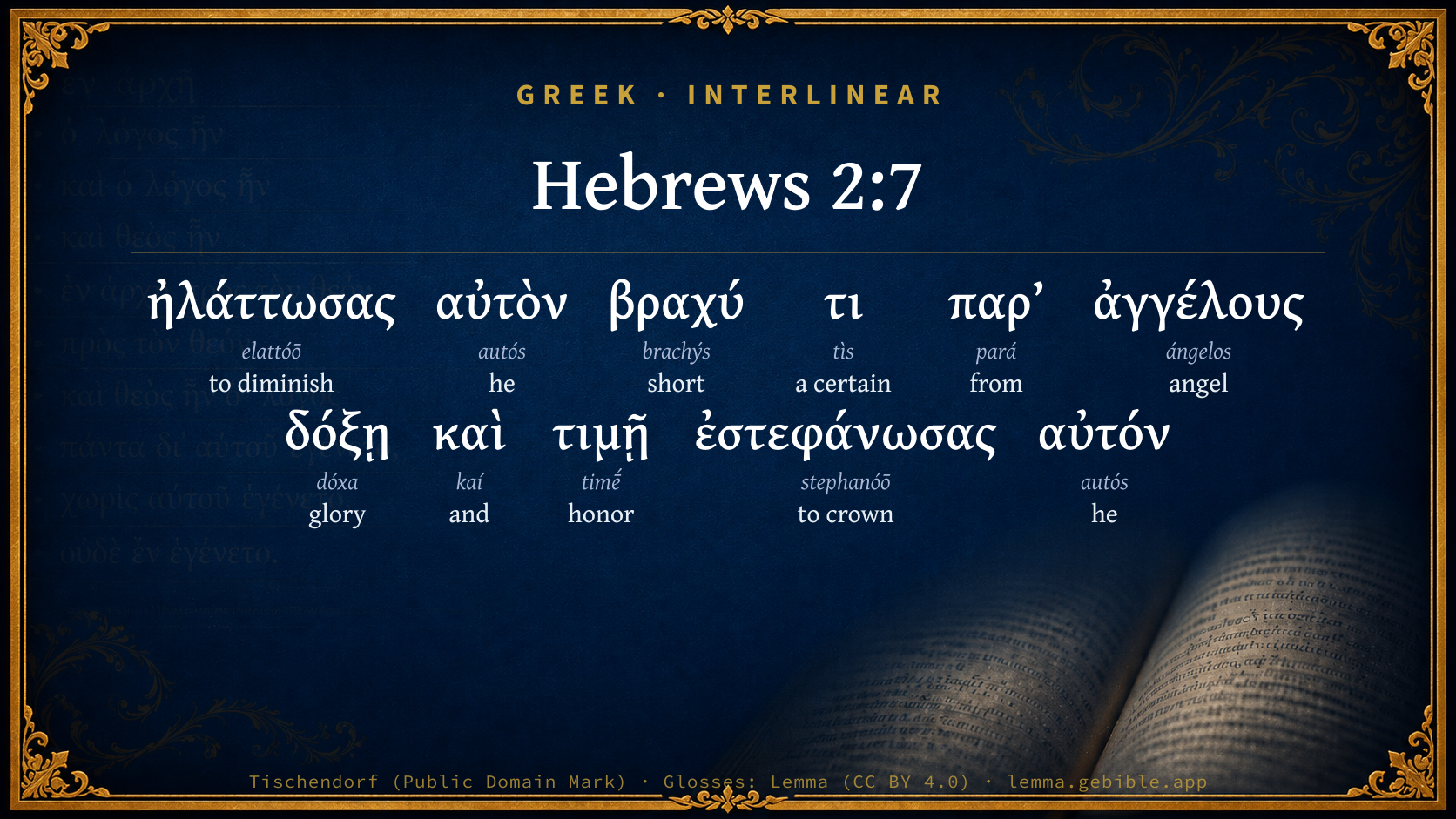
Greek (Tischendorf 8th ed.) Hebrews 2:7 appears in the Greek New Testament. The text above is from the Tischendorf 8th edition. Each word links to its Strong’s number and a concise gloss. Click any word for its full Thayer’s Greek Lexicon entry.
Download image
Cite this verse

Hebrews 2:7 (World English Bible). Public Domain. Lemma interlinear Bible study tool, https://lemma.gebible.app/v/hebrews/2/7.

Show BibTeX & RIS
BibTeX
RIS
English Translation
You made him a little lower than the angels; You crowned him with glory and honor.
World English Bible · Public Domain
Download a study sheet

One document with this verse’s original text, its word-by-word gloss line, the meaning frame, cross-references with their text, attributed commentary, and full source and license credits — printable, and it pastes into notes with its structure intact.

This verse Autodidact and up

Study sheet (.html) Plain text (.txt)

A passage Seminary Student

Up to 50 verses in one chapter. A passage sheet keeps up to 6 commentary sources and 12 cross-references per verse, in the order this page ranks them, and says so on the sheet whenever that leaves anything out. Ask for a single verse and you get the Autodidact verse sheet above.

Everything on this page stays free to read, with no account — the sheet is a download of what is already on screen, not access to it.

Want to remove ads? Support Godless Engineer
Compare translations 3

The same verse in 3 English versions, stacked beneath the original-language interlinear above. Click any original word for its lexicon entry.

Each is an independent rendering of the whole verse — the interlinear is not word-aligned to these translations.

Highlighted words mark where these versions differ — a whole-verse word diff, not a word-by-word alignment.

  • World English Bible Public Domain
    You made him a little lower than the angels; You crowned him with glory and honor.
  • King James Version Public Domain
    Thou madest him a little lower than the angels; thou crownedst him with glory and honour, and didst set him over the works of thy hands:
  • unfoldingWord Literal Text CC BY-SA 4.0
    You made him a little lower than the angels; you crowned him with glory and honor.

unfoldingWord Literal Text — © unfoldingWord, licensed CC BY-SA 4.0. Word-aligned USFM3 via Door43 (git.door43.org/unfoldingWord/en_ult).

Versions to compare (up to 4)

3 of 4 selected

Show all 19 translations

Every available English version of this verse, each an independent rendering of the whole verse.

  • World English Bible Public Domain
    You made him a little lower than the angels; You crowned him with glory and honor.
  • Berean Standard Bible Public Domain
    You made him a little lower than the angels; You crowned him with glory and honor
  • Majority Standard Bible Public Domain
    You made him a little lower than the angels; You crowned him with glory and honor,
  • King James Version Public Domain
    Thou madest him a little lower than the angels; thou crownedst him with glory and honour, and didst set him over the works of thy hands:
  • American Standard Version (1901) Public Domain
    Thou madest him a little lower than the angels; Thou crownedst him with glory and honor, And didst set him over the works of thy hands:
  • Revised Version (1885) Public Domain
    Thou madest him a little lower than the angels; Thou crownedst him with glory and honour, And didst set him over the works of thy hands:
  • Geneva Bible (1599) Public Domain
    Thou madest him a litle inferiour to ye Angels: thou crownedst him with glory and honour, and hast set him aboue the workes of thine hands.
  • Douay-Rheims (1899) Public Domain
    Thou hast made him a little lower than the angels: thou hast crowned him with glory and honour, and hast set him over the works of thy hands:
  • Young's Literal Translation Public Domain
    Thou didst make him some little less than messengers, with glory and honour Thou didst crown him, and didst set him over the works of Thy hands,
  • Literal Standard Version CC BY-SA 4.0
    You made him [a] little less than messengers, || You crowned him with glory and honor, || And set him over the works of Your hands,
  • Unlocked Literal Bible CC BY-SA 4.0
    You made man a little lower than the angels; you crowned him with glory and honor.
  • unfoldingWord Literal Text CC BY-SA 4.0
    You made him a little lower than the angels; you crowned him with glory and honor.
  • Darby Bible Public Domain
    Thou hast made him some little inferior to the angels; thou hast crowned him with glory and honour, [and hast set him over the works of thy hands;]
  • World Messianic Bible Public Domain
    You made him a little lower than the angels. You crowned him with glory and honor.
  • Webster's Bible Public Domain
    Thou madest him a little lower than the angels; thou crownedst him with glory and honor, and didst set him over the works of thy hands:
  • Free Bible Version CC BY-SA 4.0
    You set him a little lower than the angels; you crowned him with glory and honor, and placed him over all your creation.
  • Bible in Basic English Public Domain
    You made him a little lower than the angels; you gave him a crown of glory and honour, and made him ruler over all the works of your hands:
  • Text-Critical English NT CC BY 4.0
    Yoʋ made him a little lower than the angels and crowned him with glory and honor;
  • Tyndale New Testament (1534) Public Domain
    After thou haddest for a season made him lower then the angels: thou crounedst him with honour and glory and hast set him above the workes of thy hondes.

Literal Standard Version (2020), Covenant Press — licensed CC BY-SA 4.0. Text via the HelloAO Bible API (eBible.org). Unlocked Literal Bible (unfoldingWord) — licensed CC BY-SA 4.0. Text via the HelloAO Bible API (eBible.org). unfoldingWord Literal Text — © unfoldingWord, licensed CC BY-SA 4.0. Word-aligned USFM3 via Door43 (git.door43.org/unfoldingWord/en_ult). Free Bible Version, Dr. Jonathan Gallagher — licensed CC BY-SA 4.0. Text via the HelloAO Bible API (eBible.org).

Word by word

More ways to search: Search by grammar → Find every occurrence → Compare this word →

Practice this passage: Drill this verse → Learn its vocabulary →

About this verse

These counts appear in no published source. They are computed here, from the morphology-tagged text and Lemma’s own curated glosses. What Lemma adds →

11
words
10
distinct lemmas
General Epistles
section

Notable vocabulary

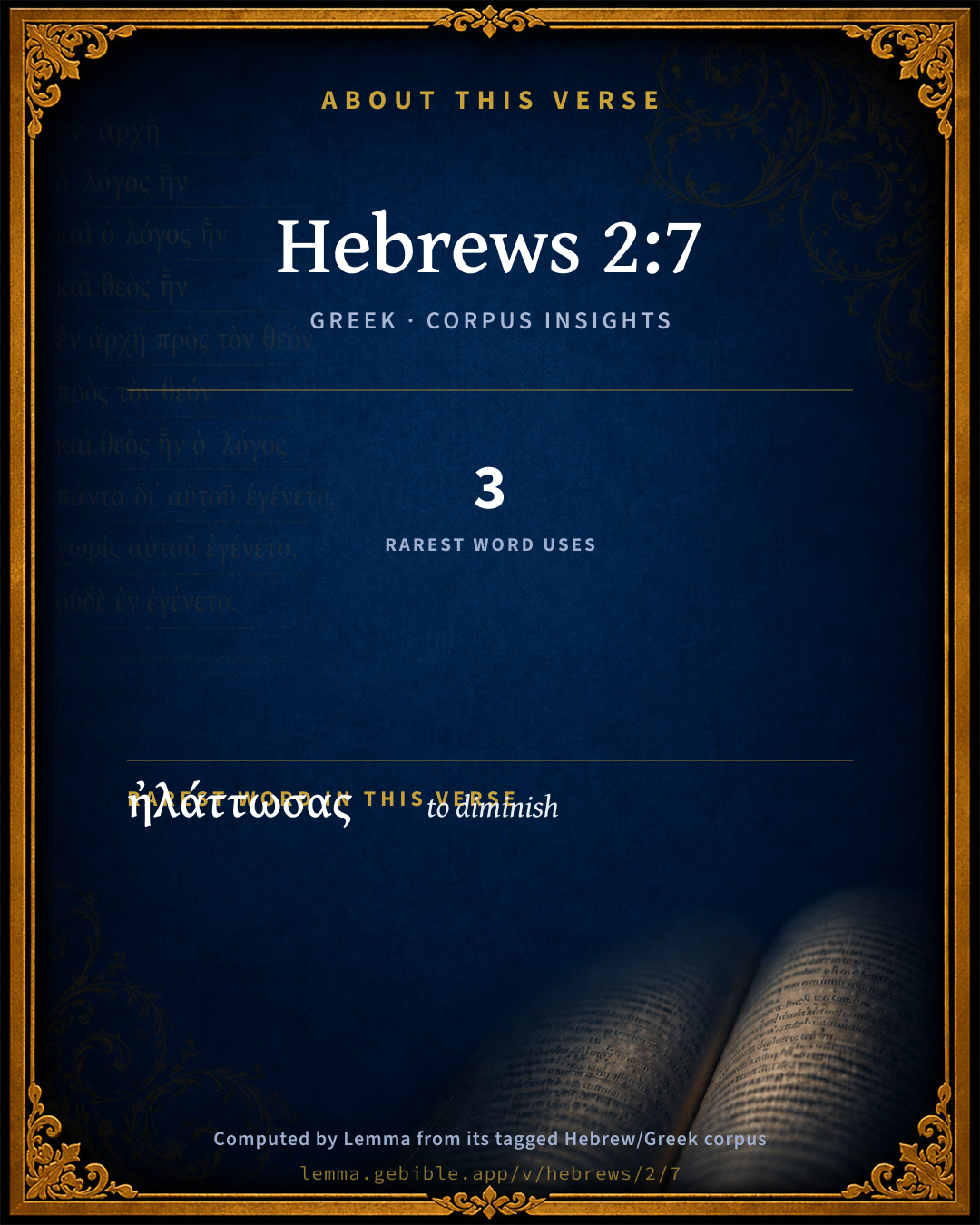
The rarest word here is ἠλάττωσας to diminish G1642 — appearing just 3 times in the whole Greek New Testament.

Shared distinctive vocabulary

ἠλάττωσας to diminish G1642 occurs in 3 verses of the Greek New Testament. Also found in:

Repetition

A word recurs within this verse:

  • αὐτὸν he G846 ×2

Cross-references

2

Topical passages linked to Hebrews 2:7 in the Treasury of Scripture Knowledge — connected by theme and wording, ordered by reader-vote popularity; previews shown in the World English Bible.

  • Psalms 8:5 For you have made him a little lower than God, And crowned him with glory and honor.
  • Philippians 2:6–7 who, existing in the form of God, didn't consider it robbery to be equal with God,

Cross-references courtesy of OpenBible.info (CC BY 4.0).

Where the printed editions differ

1 variant

Places in this verse where the major printed Greek editions disagree on the wording in a way that affects the translation — a comparison of editions, not a manuscript-by-manuscript collation. The editions are the modern critical texts (Nestlé-Aland 28/27, SBL, Westcott-Hort, Tregelles, Tyndale House) and the traditional texts behind the KJV (the Textus Receptus and the Byzantine/Majority text). It is not a claim about which reading is original.

  1. Extra text
    καὶ κατέστησας αὐτὸν ἐπὶ τὰ ἔργα τῶν χειρῶν σου·

    “and you appointed him upon the works <the> of hands of you;”

    In WHTregTR Not in NA28NA27TynSBLByz

    καὶ κατέστησας αὐτὸν ἐπὶ τὰ ἔργα τῶν χειρῶν σου· (kai katestēsas auton epi ta erga tōn cheirōn sou) 'and you appointed him upon the works of hands of you;' is only in traditional manuscripts (WH+Treg+TR)

Textual data: Translators Amalgamated Greek New Testament (STEPBible TAGNT) · CC BY 4.0.

Commentary

Notes on Hebrews 2:7 from classic Christian and Jewish commentators (each source and its license shown beneath its notes). The classic Christian expositions comment on the surrounding passage and are grouped to its opening verse, so a note may address several verses; the Jewish commentaries on the Tanakh (Rashi and others) are per-verse, so they appear only where the commentator wrote on this verse.

Lemma curates 59 commentaries, every one of them public domain or Creative Commons licensed, each selected and text-cleaned for this edition rather than reprinted as found. About our sources →

Matthew Poole's English Annotations

Thou madest him: ’ Hlattwsav, so diminished, as it supposed the subject to be in a higher condition before: this no man ever was, but the man Christ Jesus: see Phi 2:7,8.

A little lower than the angels: βπαχυ τι, may refer to his condition, and to the duration of it. He was lower a little in his nature, being a man and servant; in his condition, suffering and dying; yet this was but for a little while, being about thirty-three years in the form of a servant, and three days in the grave, Eph 4:9; so he was lesser than the angels, in the Psalm styled אל הים God’s sons, Psa 97:7, to whom he is here compared; though it be a truth he is lesser than God in the human nature.

Thou crownedst him with glory and honour; an allusion to the crowning of kings at their inauguration; so God visibly took him up to heaven, set him down on his right hand on his throne, and conferred on him the highest royal dignity, honour, and glory, though the Hebrews disesteemed him, Eph 1:20,21; 4:9,10; Php 2:9.

And didst set him over the works of thy hands; his institution to his mediatory sovereignty and dominion, as the supreme Lord of all that God made in heaven and in earth, to order, rule, command, and dispose of them as he will, Psa 8:6; compare Phi 2:10,11.

Matthew Poole's English Annotations on the Holy Bible (1683–1685) — public domain. Text from a community e-Sword/MySword module.

The Biblical Illustrator

Joseph S. Exell

Heb_2:7

A little lower than the angels

Humiliation the way to exaltation

All the forementioned branches of Christs advancement, which are here and Isa_53:12; Eph Php_2:10, audio sundry other places inferred upon His humiliation, afford unto us sundry considerable observations, as

1.

That working and suffering are the way to glory and honour.

2. That works of service and suffering were requisite for mans redemption and salvation (verse 10).

3. That God was mindful of His Son in His meanest and lowest estate, according to that which is written of the Son in relation to His Father, Thou wilt not leave My soul in hell: neither wilt Thou suffer Thy Holy One to see corruption. Thou wilt show Me the path of life, &c. (Psa_16:10-11).

4. That all the members of Christs body have good ground to be confident, that after they have done and endured what God shall call them unto, they shall be recompensed with a crown of glory (1Pe_5:4). Christ therefore is to be looked on, as well advanced as debased; in His exaltation and in His humiliation; in heaven at His Fathers right hand, as well as on the cross, or in the grave; crowned with glory, as well as with thorns (Heb_12:1). Thus will our faith be better settled and more strengthened, as Stephens was, when he saw the Son of Man standing on the right hand of God (Act_7:56). Thus shall we with much patience, contentedness and cheerfulness, do and endure what God by His providence calleth us unto, knowing that if we suffer with Christ, we shall also reign with Him (2Ti_2:12). (W. Gouge.)

Christ for a little lime made lower than the angels

It is not material, whether we understand by little, a little measure of inferiority, or little time; for both are true. But the principal thing in these words is, wherein He was made lower than the angels; and that was in this, that He was man and mortal. Man is inferior to an angel as man; and much more as mortal, because the angels never die. Now Christ had the body of a man, and a soul separable from His body till the resurrection; and that was the little time here meant, the time of His mortality. Both might be joined in one divine axiom thus. We see, for the suffering of death, crowned with glory and honour, that Jesus who for a little time was made lower than the angels. (G. Lawson.)

Dignity of man

Science may prove the insignificance of this globe in the scale of creation, but it cannot prove the insignificance of man. (B. DIsraeli.)

Descent of man

The subject of a conversation at which Carlyle was present, but took no part, was the theory of evolution. At length a pause occurring, Carlyle emphatically and with solemnity observed, Gentlemen, you are well pleased to trace your descent froth a tadpole and an ape but I would say with David, Lord, Thou hast made me but a little lower than the angels. (Leisure Hour.)

Greatness of man

But how is man little? He has competent knowledge of the character of God; he is only a little lower than the angels, and has dominion over all the works of God. He can comprehend the starry heavens; he is Godlike in his original nature; for in the image of God made He him. The sublime truths which God has revealed to man show what estimate God has of mans capacity and responsibility. A finite creature can insult the majesty of heaven as deliberately and intelligently as the archangel; he can annihilate the authority of God in his own soul, and wherever he has influence; if all finite creatures should do this--and there are no creatures who are not finite--there would be no moral universe, no Divine government. (N. Adams.)

Mans greatness

I cannot reach the stars with my hands but I pierce beyond them with my thoughts, and if things go on in the illimitable depths of the skies which would shrivel up the imagination like a dead leaf, I am greater than they, for I ask Why, and look before and after, and draw all things into the tumult of my personal life--the stars in their courses, and the whole past and future of the universe, all thing, as they move in their eternal paths, even as the tiniest pool reflects the sun and the everlasting hills. (Arnold Toynbee.)

Dignity of man

Man would not be the most distinguished being upon the earth if he were not too distinguished for it. (Goethe.)

Mans superiority

Too much stress has been laid upon the proud upright position of man, and a great deal has been said and written concerning the sublime aspect of his countenance, and the Godlike dignity of his carriage. A moments consideration will be sufficient to show that though he looks upwards with ease and facility, he cannot, in this respect, claim any superiority. The eagle, which gazes on the sun with undazzled eye, and makes his pathway among the clouds, yields not in dignity of appearance or power of locomotion to man, who merely walks upon the ground. Can man measure his beauty with the antelope, his speed with the horse, or his strength with the-elephant? It is in virtue of his intellect, of his reason, and not of his bodily form that he ranks above his fellows. It was in mind, not in body, that God made man in His own image. (Scientific Illustrations and Symbols.)

Preparation for man

How in the household are garments quilted and wrought, and curiously embroidered, and the softest things laid aside, and the cradle prepared to greet the little pilgrim of love when it comes from distant regions we know not whence! Now, no cradle for an emperors child was ever prepared with such magnificence as this world has been for man. It is Gods cradle for the race, curiously carved and decorated, flower-strewn and star-curtained. (H. W. Beecher.)

All things in subjection

The rulership of man

I. GOD WAS MINDFUL, OF THE LIMITS IN WHICH MAN WOULD EXERCISE DOMINION. All Gods inanimate creatures serve Him and us by keeping within the limits prescribed for them. The planets have their orbits, the sea its boundary. The limits in which man was to exercise dominion over nature were love and obedience to God. So long as he could say: O Lord, how excellent is Thy name in all the earth and render the service flowing from such a homage, so long could it be said of him: Thou hast put all things under his feet.

II. WHEN MAN STEPPED OUT OF THESE LIMITS, THE WORLD REFUSED TO BE LIMITED BY HIM. Truly, we see not yet, or not now, all things under him. The physician dies of the disease which he studies to cure; the seaman finds his grave in the ocean he has spent his life in learning to rule. Even the body of the Christian is subject to the laws of death and decay.

III. ONE MAN HAS KEPT WITHIN THE LIMITS OF LOVE AND OBEDIENCE TO THE FATHER AND GOD, AND NATURE THEREFORE OWNS HIM AS HER LORD, He could say: My meat is to do the will of Him that sent Me, and therefore He could move amongst disease without danger of contamination, navigate the sea as its Master, and suspend old laws, or create new ones, at His will. The grave could not hold Him; but, from dominion over this world, He ascended to the throne of the universe, even the right hand of the Majesty on high. How true of Him: Thou hast set Thy glory above the heavens. Lessons:

1. If we would rule, we must be ruled.

2. All may find their way back to their lost limits by the generous love of Christ. He tasted death for every man.

3. Every Christian, in his glorified condition, will have dominion according to his ability to exercise it for his own good, and that of others Mat_26:21). (W. Harris.)

Christ the chief Lord of the world

This agreeth to all men in general, to the faithful in special, whom God hath made kings and lords over all His creatures by Christ But principally it Is to be understood of our Saviour Christ, who is the chief Lord of the world, the King and the Mediator of the Church; He hath all power in heaven and earth. All things, yea, even the devils themselves, are put in subjection under His feet. God hath given Him a name above every name, that at the name of Jesus every knee should Php_2:9). We also by Him; because, we are members of His body and His brethren, we have an interest to all creatures: all things throughout the wide world are ours. The heaven, the earth, the birds, the beasts, the fishes, the trees, the flowers are ours; death is ours; the very devil himself is our slave and subject; God hath put him under our feet.

1. Here we may behold the dignity of Christians; all things by Jesus Christ are under our dominion. Oh, what a bountiful God is this, that hath given us so large a possession! Let us sound forth His praises lot it, and use His liberality to His glory. As God said to Peter, Arise, kill, and eat; when the sheet full of all kind of creatures was let down to him from heaven; so doth He say to us all, we may freely eat of all creatures whatsoever; but let us not abuse Gods creatures to His dishonour and our destruction. Let us use them soberly, religiously, to make us more cheerful in the service of our God.

2. Let us not stand in a slavish scare of any creature; of the stars, the winds, no, not of the devils themselves; for all are put in subjection under our feet by Jesus Christ that loved us, and hath given us a superiority over all; we shall be conquerors over them all; a singular comfort to the faithful! Satan may tempt and assault us, but God will tread him under our feet.

3. For this dominion let us thank the Lord Jesus Christ. Of ourselves we are worth nothing, stark beggars; in Christ and by Christ we have all that we have. Let us magnify Him for it. (W. Jones, D. D.)

The Biblical Illustrator, edited by Joseph S. Exell (c. 1880s–1900s) — public domain. Text from a community e-Sword module.

Joseph Benson's Commentary

Heb 2:7. Thou madest him — That Isaiah , 1 st, Man, when first created; a little lower than the angels — So the LXX., and all the old Greek translations, as also the Targum, read the clause; but the Hebrew, מעשׂ מאלהים, is a little lower than God; the word God being probably put by an ellipsis for the angels of God. Man, when first formed, was, it seems, in the scale of creatures next to angels, his soul being spiritual, intelligent, free, and immortal; but, as by his body he was allied to the earth, and to the beasts that perish, he was lower than they. But, 2d, The expression here used, βραχυ τι, may be rendered, for a little while, as it is Acts 5:44; And commanded to put the apostles forth, βραχυ τι, a little space, or while; and Luk 22:58, μετα βραχυ, after a little while. Thus translated, the clause is, Thou hast made him, for a little while, lower, or less, than the angels: in which sense the passage may be properly applied to Christ, as it here is by the apostle, whose meaning appears to be, Thou, O God, hast made thy Son, by his incarnation, humiliation, and obedience unto death, for a little while, lower than the angels. For although from Christ’s birth the angels adored his person as their Lord, yet in the outward condition of his human nature he was made exceedingly beneath their state of glory and excellence, for a little while, a short season. “That which renders this sense unquestionable,” says Dr. Owen, “is the apostle’s restraining the words precisely thereto, Heb 2:9. It was but for a little while that the person of Christ, in the nature of man, was brought into a condition more indigent than that to which the nature of angels is exposed: neither was he for that season made a little, but very much lower than the angels. And had this been the whole of his state, it could not have been an effect of that inexpressible love which the psalmist so admires. But, seeing it was but for a short season, and that for the blessed ends which the apostle speaks of, nothing could more commend it to us.” Thou crownedst him with glory and honour — That is, not only man at his first creation, to whom God gave dominion over the creatures, but also, and more especially, Jesus, after his resurrection from the dead, and ascension into heaven. Jesus was covered with the greatest ignominy when he was crucified by the Jews as a deceiver, for calling himself Christ the Son of God. But at his resurrection and subsequent exaltation that ignominy was entirely removed; and his fame, and name, and honour, as the Son of God, were, in the most illustrious manner, restored to him. See Php 2:9-11. And didst set him over the work of thy hands — As Ruler and Lord of all; namely, in a lower sense Adam when created, and more eminently Christ when raised from the dead, and set at God’s own right hand. For as he had actual dominion given him upon his ascension into heaven, so the extent of this dominion is the works of God’s hands.

Joseph Benson's Commentary on the Old and New Testaments (1811–1818) — public domain. Text from a community e-Sword module.

Tyndale Open Study Notes

Tyndale Open Resources

2:7 them: Literally him. This refers to humanity in general and is applied specifically to Christ (see study note on 2:6-8). • Christ became a little lower than the angels (or lower than the angels for only a little while), like other human beings (see also Phil 2:5-8). As a result of his suffering, he was crowned . . . with glory and honor (see Heb 2:9; Phil 2:9-11).

Tyndale Open Study Notes — © Tyndale Open Resources, licensed CC BY-SA 4.0. Text via the HelloAO Bible API.

Bengel's Gnomon

Johann Albrecht Bengel

Heb 2:7. Βραχύ τι, a very short time) The same word occurs at Luk 22:58.—παρʼ ἀγγέλους) In Psa 8:6, the Hebrew ותחסרהו מעט מאלהים has this meaning: Thou hast made the Son of Man to be a little less than God, that is, than Himself. The beautiful paraphrase of Christopher Corner is as follows: Christ having become man, humbled Himself under the cross, and abased Himself BELOW GOD, when the Divine nature remaining quiescent, and not exerting its power, God Himself and the Lord of Glory was crucified and put to death.—Expos. Psalm, p. 24. This is the force of Mem prefixed, 2Ch 15:16; Isa 52:14. See Nold. Concord. on this particle, § 21. Mem following מחסר itself, Ecc 4:8. This mode of expression we find in another of Paul’s phrases: μὴ ὢν ἶσα Θεῷ and κενώσας ἑαυτὸν; Php 2:6-7, note. But Paul retains the interpretation of the LXX interpreters as suited to his purpose; for the homonymy[11] of the Hebrew word אלהים signifies an invisible nature, and therefore, whether angelic or divine, superior to the human nature; and He, who was made lower than the angels, was certainly made lower than GOD: but He as it were anew supplies the appellation, GOD, in ch. Heb 3:4. For so the apostle is accustomed to use appropriately to his purpose the words of the LXX interpreters, and to bring before the reader anew the force of the Hebrew words, when they are more to his purpose; ch. Heb 10:8, Heb 12:6, notes.

[11] Things differing in nature called by one name by analogy. Append.—ED.

Bengel's Gnomon of the New Testament — English translation (T&T Clark, Edinburgh, 1860) — public domain. Text from a community e-Sword module.

Meyer's Critical & Exegetical Commentary

Heinrich August Wilhelm Meyer

Heb_2:7. Ἠλάττωσας αὐτὸν βραχύ τι παρʼ ἀγγέλους] Thus the LXX. translate the Hebrew ותְּחַסְרֵהוּ מְעַט מֵאֱלֹהִים. The sense of the Hebrew is: Thou hast made Him only a little lower than God, hast made Him only a little less than God. The βραχύ τι is consequently in the original a note of degree, and the whole former member ἠλάττωσας … ἀγγέλους contains in the original the same thought as the immediately following δόξῃ καὶ τιμῇ ἐστεφάνωσας αὐτόν. The author, however, takes the βραχύ τι of the LXX. in the temporal sense: for a short time (comp. Heb_2:9), and finds in the second member an opposition to the first, in such wise that in the application he refers the statement of the first clause to the humiliation of Christ, that of the second to the exaltation of Christ.

The words following these in the LXX. (as also in the Hebrew): καὶ κατέστησας αὐτὸν ἐπὶ τὰ ἔργα τῶν χειρῶν σου (comp. the critical remarks), have been left out by the author as unsuitable to his presentment. For the statement that God has set the Son of man or the Messiah over the works of creation which proceeded from the hands of God, might appear to contain a contradiction to Heb_1:10 (comp. also Heb_1:2), where earth and heaven were designated as works created by the hands of the Son.

Meyer — Critical and Exegetical Commentary on the New Testament — English translation by Peter Christie, edited by Frederick Crombie (T&T Clark, 1880) — public domain. Text from a community e-Sword module.

Expositor's Greek Testament

ed. W. Robertson Nicoll

Heb 2:7 . That God has been mindful of man and visited him is apparent in the three particulars now mentioned. βραχύ τι is “a little,” either in material, or in space, or in time. In 1Sa 14:29 , ἐγευσάμην βραχύ τι τ . μέλιτος . In Isa 57:17 , of time, διʼ ἁμαρτίαν βραχύ τι ἐλύπησα αὐτον . So in N.T., of aterial, Joh 6:7 ; of space, Act 27:28 ; of time Act 5:34 . So in classics, v . Bleek. The original of the psalm points to the translation: “Thou didst make him little lower than the angels” [in the Heb. מֵאֱלֹהִים “than God”]. There seems no reason to depart from this meaning either in this verse or in Heb 2:9 . So Alford and Westcott, but Davidson and Weiss and several others are of opinion that as the words are in Heb 2:9 applied to the Messiah, whose superiority has been so insisted upon, an allusion to His inferiority would be out of place; “and that the phrase should be used of degree in one place and time in another, when the point of the passage lies in the identity of the Son’s history with that of man, is an idea only puerile” (Davidson). But on any rendering the inferiority of Jesus to angels so far as dying goes is granted, and there is no reason why the sense of degree should not be kept in both clauses. δόξῃ καὶ τιμῇ frequently conjoined, Rev 21:26 ; 1Ti 1:17 ; Thucyd., iv. 86; Plut., Num. , 51; Lucian Somn. , 13.

The Expositor's Greek Testament, edited by W. Robertson Nicoll (1897–1910) — public domain. Text from a community e-Sword module.

Alford’s Greek Testament

Henry Alford

7.] Thou madest him a little lower than the angels (Heb., וַתִּחַסְּרֵהוּ מְעִט מֵאֱלֹהִים: which is literally, “Thou lettest him be little inferior to God.” “חָסֵר in Kal betokens ‘to be without,’ ‘to fall short of,’ and has, like all other verbs of abounding and wanting, the thing wanted in the accusative: see Gesen. § 135. 3. b. The causative Pihel, ‘to make or let want,’ takes consequently a double accusative, of the person (here ־הוּ) and of the thing (here מְעִט): see Gesen. § 136. 1. מִן is usually taken comparative, ‘in comparison of God:’ according to Hupfeld, it is properly partitive, ‘of God:’ of the attributes which constitute the essence of God.” De Wette: and thus also Calvin: “Tot decoribus ornatos esse dicit ut eorum conditio divina et cœlesti gloria non longe sit inferior.” But when De W. goes on, in treating of מְעַט, to say that some understand it, with the LXX, of time, and refers to Heb 2:6, Heb 2:7 to confirm this, I must venture to doubt, though I find the same very generally assumed (e. g. by Calvin,—“Videtur apostolus verba trahere in diversum sensum quam intellexerit David. Nam βραχύ τι videtur ad tempus referre ut sit paulisper, et imminutionem intelligit quum exinanitus fuit Christus, et gloriam ad resurrectionis diem restringit, quum David generaliter extendat ad totam hominis vitam.” And then he defends this method of quotation on the ground of there being “nihil incommodi si allusiones in verbis quærat ad ornandam præsentem causam.” Similarly Schlichting, Grotius, Hammond, Limborch, and most of the moderns: and, maintaining the sense of time in the Psalm also, Beza, Gerhard, Calov., Peirce, Michaelis, al.), whether this is so certain after all. The expression βραχύ τι is used both in the classics and in Hellenistic Greek, just as much of space and quantity, as of time; as the following examples (besides reff.) will shew, gathered from Wetst., Bleek, and from various indices: Hippocrat. de Natur. Hominum i., τὸ μὲν ὅλον βιβλίον σχεδὸν εἰς χʹ στίχους ἢ βραχύ τι ἧττον ἐκτεταμένον: Thucyd. i. 63, βραχὺ μέν τι προῆλθον ὡς βοηθήσοντες: 2Ki 16:1, καὶ Δαυεὶδ παρῆλθε βραχύ τι ἀπὸ τῆς Ῥώς: Galen, de Usu Part. xiv., ἐπειδὴ ἐν τῇ πρώτῃ διαπλάσει βραχύ τι πλημμεληθῇ: id. de Facult. Med. Simpl. v., ὑπερβάλλουσιν βραχύ τι ῥητίνῃ κ. πίττᾳ: ib. vi., φαίνεται μὲν γὰρ ἐν αὐτῇ βραχύ τι τὸ δριμύ, πλεῖστον δὲ τὸ πικρόν. Also Plato, Legg. x. p. 906 b, βραχύ δέ τι καὶ τῆς ἄν τις τῶν τοιούτων ἐνοικοῦν ἡμῖν σαφὲς ἴδοι. It is used of time in Luk 22:58: Act 5:34; Act 27:28: Isa 57:17. This being the case, I do not see why it should be at once set down that the LXX or our Writer necessarily referred it to time, either here or in ver. 9: see below. So also Kuinoel, Heinrichs, Wahl, and Bretschneider. The only point remaining for discussion is ἀγγέλους, the LXX rendering of אֱלֹהִים, and the meaning understood also by the Chaldee paraphrast. The best Hebrew scholars seem to agree that it represents, not the personal God, but the abstract qualities of Godhead, in which all that is divine, or immediately connected with the Deity, is included. This, as Hupfeld himself confesses, the angels may well be, in so far as they may be called אֱלֹהִים, or בְּנֵי אֱלֹהִים. If so, then the rendering of the LXX and our text is, though not exhaustive of the original, yet by no means an inaccurate one. The angelic nature, being the lowest of that which is divine and heavenly, marks well the terminus just beneath which man is set. And it must be remarked, that the stress of the argument here is not on this mention of the angels, but on the assertion of the sovereignty of man. The verb ἐλαττοῦν is in frequent classical use: see Palm and Rost’s Lex.: and notice the parallel from Philo in reff.): thou crownedst him with glory and honour (I must remind the reader of what has been said before; that the quotation is adduced here not of the Messiah but of man, and that on this the whole subsequent argument depends. With this view vanish the difficulties which have been raised about the original and the here-intended meaning of this clause. It is, in fact, a further setting forth of the preceding one. Man, who was left not far behind the divine attributes themselves, was also invested with kingly majesty on earth, put into the place of God Himself in sovereignty over the world. That this has only been realized in the man Jesus Christ is not brought out till below, and forms the central point of the argument. Hupfeld remarks, that כָּבוֹד וְהָדָר, here rendered δόξῃ κ. τιμῇ, is a common expression for the divine majesty, and thence for the kingly, as a reflection of the divine: and the crowning represents the kingly majesty, with which man is adorned as with a kingly crown: Calv., “Decoratum esse honoris insignibus quæ non longe a divino fulgore absint”):

Henry Alford, The Greek Testament (1849–1861) — public domain. Text from a community e-Sword module.

Geneva Bible (1599)

Geneva Bible translators

This is the first honor of the citizens of the world to come, that they are next [to] the Angels.

For they shall be in very great honor, when they shall be partakers of the kingdom. And he speaketh of the thing that shall be, as though it were already, because it is so certain.

Geneva Bible (1599) marginal notes — public domain. Text via Bolls.life.

Jamieson, Fausset & Brown

Robert Jamieson, A. R. Fausset & David Brown

a little--not as BENGEL, "a little time."

than the angels--Hebrew, "than God," "Elohim," that is, the abstract qualities of God, such as angels possess in an inferior form; namely, heavenly, spiritual, incorporeal natures. Man, in his original creation, was set next beneath them. So the man Jesus, though Lord of angels, when He emptied Himself of the externals of His Divinity (see on Phi 2:6-7), was in His human nature "a little lower than the angels"; though this is not the primary reference here, but man in general.

crownedst him with glory and honour--as the appointed kingly vicegerent of God over this earth (Gen. 1:1-2:25).

and didst set him over the works of thy hands--omitted in some of the oldest manuscripts; but read by others and by oldest versions: so Psa 8:6, "Thou madest him to have dominion over the works of thy hands."

Jamieson, Fausset & Brown — Commentary Critical and Explanatory on the Whole Bible (1871) — public domain (CC PDM 1.0). Text via the HelloAO Bible API.

Adam Clarke's Commentary

Verse 7. Thou madest him a little lower than the angels] We must again have recourse to the original from which this quotation is made: ותחסרהו מעט מאלהים vattechasserehu meat meelohim. If this be spoken of man as he came out of the hands of his Maker, it places him at the head of all God's works; for literally translated it is: Thou hast made him less than God. And this is proved by his being made in the image and likeness of God, which is spoken of no other creature either in heaven or earth; and it is very likely that in his original creation he stood at the head of all the works of God, and the next to his Maker. This sentiment is well expressed in the following lines, part of a paraphrase on this psalm, by the Rev. C. Wesley: -

"Him with glorious majesty

Thy grace vouchsafed to crown:

Transcript of the One in Three,

He in thine image shone.

Foremost of created things,

Head of all thy works he stood;

Nearest the great King of kings,

And little less than God."

If we take the words as referring to Jesus Christ, then they must be understood as pointing out the time of his humiliation, as in Heb 2:9; and the little lower, βραχυ τι, in both verses, must mean for a short time, or a little while, as is very properly inserted among our marginal readings. Adam was originally made higher than the angels, but by sin he is now brought low, and subjected to death; for the angelic nature is not mortal. Thus, taking the words in their common acceptation, man in his present state may be said to be lessened below the angels. Jesus Christ, as the eternal Logos, or God with God, could not die, therefore a body was prepared for him; and thus βραχυτι, for a short while, he was made lower than the angels, that he might be capable of suffering death. And indeed the whole of the passage suits him better than it does any of the children of men, or than even Adam himself in a state of innocence; for it is only under the feet of Jesus that all things are put in subjection, and it was in consequence of his humiliation that he had a name above every name, that at the name of Jesus every knee should bow, of things in heaven, and things in earth, and things under the earth, Php 2:9-11. Therefore he must be infinitely higher than the angels, for they, as well as all the things in heaven, bow in subjection to him.

Thou crownedst him with glory and honour] This was strictly true of Adam in his state of innocence, for he was set over all things in this lower world; all sheep and oxen, the beasts of the field, the fowl of the air, the fish of the sea, and whatsoever passeth over the paths of the seas, Ps 8:7; Ps 8:8. So far all this perfectly applies to Adam; but it is evident the apostle takes all in a much higher sense, that of universal dominion; and hence he says, he left nothing that is not put under him. These verses, collated with the above passage from the Epistle to the Philippians, mutually illustrate each other. And the crowning Christ with glory and honour must refer to his exaltation after his resurrection, in which, as the victorious Messiah, he had all power given to him in heaven and earth. And although we do not yet see all things put under him, for evil men, and evil spirits, are only under the subjection of control, yet we look forward to that time when the whole world shall be bowed to his sway, and when the stone cut out of the mountain without hands shall become great, and fill the whole earth. What was never true of the first Adam, even in his most exalted state, is true of the second Adam, the Lord Jesus Christ; and to him, and to him alone, it is most evident that the apostle applies these things; and thus he is higher than the angels, who never had nor can have such dominion and consequent glory.

Adam Clarke's Commentary on the Bible (1810–1826) — public domain. Text from a community e-Sword/MySword module.

John Calvin's Commentaries

7. Thou madest him, etc. A new difficulty now arises as to the explanation of the words. I have already shown that the passage is fitly applicable to the Son of God; but the Apostle seems now to turn the words from that meaning in which David understood them; for a little, βραχύ τι seems to refer to time, as it means a little while, and designates the abasement of Christ’s humiliation; and he confines the glory to the day of resurrection, while David extends it generally to the whole life of man.

To this I answer, that it was not the Apostle’s design to give an exact explanation of the words. For there is nothing improperly done, when verbal allusions are made to embellish a subject in hand, as Paul does in quoting a passage in Romans 10:6, from Moses, “Who shall ascend into heaven,” etc., he does not join the words “heaven and hell” for the purpose of explanation, but as ornaments. The meaning of David is this, — “O Lord, thou hast raised man to such a dignity, that it differs but little from divine or angelic honor; for he is set a ruler over the whole world.” This meaning the Apostle did not intend to overthrow, nor to turn to something else; but he only bids us to consider the abasement of Christ, which appeared for a short time, and then the glory with which he is perpetually crowned; and this he does more by alluding to expressions than by explaining what David understood.

To be mindful and to visit mean the same thing, except that the second is somewhat fuller, for it sets forth the presence of God by the effect.

John Calvin's Commentaries (1540-1563) — public domain. Text from the Calvin Translation Society English edition (1840s-50s) via the Christian Classics Ethereal Library (ccel.org). Calvin's coverage is partial (roughly two-thirds of the Bible); uncommented books and verses are honest gaps, never fabricated. The 19th-century editor's footnotes and remarks are omitted so the notes are faithfully Calvin's own voice.

The Cambridge Bible for Schools and Colleges

gen. ed. J. J. S. Perowne

7. a little lower] The “little” in the original (mëat) means “little in degree;” but is here applied to time—“for a little while”—as is clear from Heb_2:9. The writer was only acquainted with the LXX. and in Greek the βραχύ τι would naturally suggest brevity of time (comp. 1Pe_5:10). Some of the Old Greek translators who took the other meaning rendered ὄλιγος παρὰ θεόν.

than the angels] The original has “than Elohim,” i.e. than God; but the name Elohim has, as we have seen, a much wider and lower range than “Jehovah,” and the rendering “angels” is here found both in the LXX. and the Targum. It must be borne in mind that the writer is only applying the words of the Psalm, and putting them as it were to a fresh use. The Psalm is “a lyric echo of the first chapter of Genesis” “and speaks of man’s exaltation. The author is applying it to man’s lowliness (“ad suum institutum deflectit,” says Calvin, “κατ' ἐπεξεργασίαν”). Yet David’s notion, like that of Cicero, is that “Man is a mortal God,” and the writer is only touching on man’s humiliation to illustrate his exaltation of the God-Man. See Perowne on the Psalms (1. 144).

and didst set him over the works of thy hands] This clause is probably a gloss from the LXX., as it is absent from some of the best MSS. and Versions (e.g. B and the Syriac). The writer omitted it as not bearing on his argument.

The Cambridge Bible for Schools and Colleges (gen. ed. J. J. S. Perowne; Cambridge University Press, 1878–1918) — public domain. Text from a community e-Sword module.

John Gill's Exposition

Thou hast put all things in subjection under his feet,.... Good angels, men and devils, all things in heaven, earth, and sea; see Pe1 3:22

for in that he put all in subjection under him, he left nothing that is not put under him; there is no one person or thing that is not subject to Christ; the subjection is the most universal, either voluntary or involuntary; whether they will or not, they are, and must be subject; God has left nothing but what he has put under his power:

but now we see not yet all things put under him; this seems to be an objection, and even a contradiction to what is before said; which may be removed by observing, that though this general subjection is not seen by us, it does not follow that it is not; and though it is not as yet visible, yet it will be: and besides, the apostle's sense may be, that no such general subjection to any mere man has ever been seen and known; as not to Solomon, nor Ahasuerus, nor Cyrus, nor Alexander the great, nor Julius, nor Augustus Caesar, nor any other; and this he may observe, to show the non-application of this passage to any but to Jesus Christ; and this sense is confirmed by what follows.

John Gill's Exposition of the Whole Bible (1746–1763) — public domain (CC PDM 1.0). Text via the HelloAO Bible API.

Trapp's Complete Commentary

John Trapp

7 Thou madest him a little lower than the angels; thou crownedst him with glory and honour, and didst set him over the works of thy hands:

Ver. 7. A little lower] Or, for a little while, Paulisper, viz. Ab utero ad urnam, from the womb to the tomb, from his birth to his burial, from his abasement to his advancement.

And didst set him over the works] Lions hate apes, but fear men; whereof no other probable reason can be given, but this here in the text; insomuch as the most timorous men dare kick and beat the largest elephants.

John Trapp, A Commentary or Exposition upon All the Books of the Old and New Testament (1647–1656) — public domain. Text from a community e-Sword module.

Albert Barnes' Notes on the Bible

Thou madest him a little lower than the angels - Margin, “A little while inferior to.” The Greek may here mean a little inferior in rank, or inferior for a little time. But the probable meaning is, that it refers to inferiority of rank. Such is its obvious sense in Psa 8:1-9, from which this is quoted. The meaning is, that God had made man but little inferior to the angels in rank. He was inferior, but still God had exalted him almost to their rank. Feeble, and weak, and dying as he was, God had exalted him, and had given him a dominion and a rank almost like that of the angels. The wonder of the Psalmist is, that God had given to human nature so much honor - a wonder that is not at all diminished when we think of the honor done to man by his connection with the divine nature in the person of the Lord Jesus. If in contemplating the race as it appears; if when we look at the dominion of man over the lower world, we are amazed that God has bestowed so much honor on our nature, how much more should we wonder that he has honored man by his connection with the divinity. Paul applies this to the Lord Jesus. His object is to show that he is superior to the angels. In doing this he shows that he had a nature given him in itself but little inferior to the angels, and then that that had been exalted to a rank and dominion far above theirs. That such honor should be put on “man” is what is suited to excite amazement, and well may one continue to ask why it has been done? When we survey the heavens, and contemplate their glories, and think of the exalted rank of other beings, we may well inquire why has such honor been conferred on man?

Thou crownedst him with glory and honor. - That is, with exalted honor. Glory and honor here are nearly synonymous. The meaning is, that elevated honor had been conferred on human nature. A most exalted and extended dominion had been given to “man,” which showed that God had greatly honored him. This appeared eminently in the person of the Lord Jesus, “the exalted Man,” to whom this dominion was given in the widest extent.

And didst set him over ... - “Man” has been placed over the other works of God:

(1)By the original appointment Gen 1:26;

(2)Man at large - though fallen, sinful, feeble, dying;

(3)Man, eminently in the person of the Lord Jesus, in whom human nature has received its chief exaltation. This is what is particularly in the eye of the apostle - and the language of the Psalm will accurately express this exaltation.

Albert Barnes' Notes on the Bible (1834–1885) — public domain. Text from a community e-Sword/MySword module.

Haydock's Catholic Bible Commentary

Thou hast made him a little less than the Angels. Man’s nature, even the human nature of Christ in itself, is inferior to the nature of Angels, though raised to a degree of dignity above other creatures. (Witham)

George Leo Haydock (1774–1849), Haydock's Catholic Family Bible and Commentary, 1859 edition — public domain. Excludes Psalms (Douay-Rheims chapter numbering differs from Protestant) and Deuterocanonical books (Catholic canon only).

Whedon's Commentary on the Bible

Daniel D. Whedon

7. Little lower than the angels—Unfallen man belonged to a high order, but the angels were a grade above him.

Set… hands—A reference to the Genesis history, in which primeval man is exhibited as lord of the lower creation.

Daniel D. Whedon (gen. ed.), Commentary on the Old and New Testaments (1874–1909) — public domain. Text from a community e-Sword module.

The Pulpit Commentary

Thou madest him a little lower than the angels. Here the LXX takes Elohim (being a plural form) to mean "angels;" as also in Psa_97:7 and Psa_138:1. The more correct rendering of the Hebrew may be, "thou reddest him a little short of God," with reference to his having been made "in God"s image," "after God"s likeness," and having dominion over creation given him. But, if so, Elohim must be understood in its abstract sense of "Divinity" (so Genesis), rather than as denoting the Supreme Being. Otherwise, "thyself" would have been the more appropriate expression, the psalm being addressed to God. The argument is not affected by the difference of translation. Indeed, the latter rendering enhances still more the position assigned to man. Thou crownedst him with glory and worship, and didst set him over the works of thy hands. The latter clause of this sentence, which is found in the LXX, but not in the Hebrew, is omitted in several codices. It is not wanted for the purpose of the argument.

The Pulpit Commentary (1880–1919), ed. H.D.M. Spence-Jones & Joseph S. Exell — public domain. Text from a community e-Sword module.

John Wesley's Explanatory Notes

Thou hast made him - Adam. A little lower than the angels - The Hebrew is, a little lower than (that is, next to) God. Such was man as he came out of the hands of his Creator: it seems, the highest of all created beings. But these words are also in a farther sense, as the apostle here shows, applicable to the Son of God. It should be remembered that the apostles constantly cited the Septuagint translation, very frequently without any variation. It was not their business, in writing to the Jews, who at that time had it in high esteem, to amend or alter this, which would of consequence have occasioned disputes without end.

John Wesley, Explanatory Notes Upon the Whole Bible (1754–1765) — public domain. Text via the GEBible commentary corpus.

The People's New Testament

B. W. Johnson

7. Thou madest him a little lower than the angels. Man, for the time, was made lower than the angels. Yet he was crowned, as the Psalmist tells us, with glory and honor, and given dominion.

B. W. Johnson's The People's New Testament with Notes (1889–1891) — public domain. Electronic text from the Christian Classics Ethereal Library (CCEL) ThML edition.

unfoldingWord translationNotes

Door43 World Missions Community

a little lower than the angels

The author speaks of people being less important than angels as if the people are standing in a position that is lower than the angels' position. AT: "less important than the angels" (See: Metaphor)

made man ... crowned him ... his feet ... to him

Here, these phrases do not refer to a specific person but to humans in general, including both males and females. AT: "made humans ... crowned them ... their feet ... to them" (See: Generic Noun Phrases and When Masculine Words Include Women)

you crowned him with glory and honor

The gifts of glory and honor are spoken of as if they were a wreath of leaves placed on the head of a victorious athlete. AT: "you have given them great glory and honor" (See: Metaphor)

You put everything in subjection under his feet

The author speaks of humans having control over everything as if they have stepped on everything with their feet. AT: "You have given them control over everything" (See: Metaphor)

He did not leave anything not subjected to him

This double negative means that all things will be subject to Christ. AT: "God made everything subject to them" (See: Double Negatives)

we do not yet see everything subjected to him

"we know that humans are not in control of everything yet"

translationWords

crown

glory

honor

subject

unfoldingWord translationNotes — © Distant Shores Media and the Door43 World Missions Community, licensed CC BY-SA 4.0. Source: git.door43.org/Door43/en_tn.

Cambridge Greek Testament for Schools and Colleges

7. [καὶ κατὲστησας αὐτὸν ἐπὶ τὰ ἔργα τῶν χειρῶν σου]. This clause, retained in the rec., is found in אACM Vulg. &c., but not in BKL, and may be only a gloss added from the LXX.

7. βραχύ τι. The “little” in the original (meät) means “little in degree”; but is here applied to time—“for a little while”—as is clear from Heb 2:9. The writer was only acquainted with the LXX. and in Greek the βραχύ τι would naturally suggest brevity of time (comp. 1Pe 5:10). Some of the old Greek translators who took the other meaning rendered ὀλίγον παρὰ θεόν.

παρʼ ἀγγέλους. On this comparative use of παρὰ see Winer, p. 503, and the note to Heb 1:9. The original has “than Elohim,” i.e. than God; but the name Elohim has, as we have seen, a much wider and lower range than “Jehovah,” and the rendering “angels” is here found both in the LXX. and the Targum. It must be borne in mind that the writer is only applying the words of the Psalm, and putting them as it were to a fresh use. The Psalm is “a lyric echo of the first chapter of Genesis” and speaks of man’s exaltation. The author is applying it to man’s lowliness (“ad suum institutum deflectit,” says Calvin, “κατʼ ἐπεξεργασίαν”). Yet David’s notion, like that of Cicero, is that “Man is a mortal God,” and the writer is only touching on man’s humiliation to illustrate his exaltation of the God-Man. See Perowne on the Psalms (1:144).

[καὶ κατέστησας αὐτὸν ἐπὶ τὰ ἔργα τῶν χειρῶν σου]. This clause is probably a gloss from the LXX., as it is absent from some of the best MSS. and Versions (e.g. B and the Syriac). The writer omitted it as not bearing on the argument.

Cambridge Greek Testament for Schools and Colleges (Cambridge University Press, 1896; 21 vols, various authors incl. Carr, Maclear, Plummer, Farrar, Lumby, Moule, M. R. James, Simcox) — public domain. Text from a community e-Sword module.

Westcott on Hebrews & the Epistles of John

Brooke Foss Westcott

7. ἡἤλάττ. Bp. τι...) Thou madest him a little lower...Vulg. Minuisti (Old Lat. minorasti) eum paulo minus ab angels. Bpayv τι is used here of degree (compare 2 Sam. xvi. 1), and not of time (Is. Ivii. 17 uxx. ‘for a little while’). Tho Hebrew is unambiguous; and there is no reason to depart from the meaning of the original either in this place or in 2. 9.

wap’ ἀγγέλους} The original pd ND, rendered literally by Jerome a deo, ig thus interpreted by the Targum and Syr. and by the Jewish Commentators (Rashi, Kimchi, Aben-Ezra), as well as by the Lxx.

The original meaning is probably less definite than either ‘a little less than angela’ or ‘a little less than God.’ It would more nearly correspond to ‘a little less than one who has a divine naturo” ‘Thou hast made him to fall little short of being a God’ (comp. 1 Sam. xxviii. 13). To our cars ‘than God’ would be oquivalent to ‘than the Eternal,’ which would have been wholly out of place in the Psalm. And on the othor hand ‘than angels’ obscures the notion of

the ‘divine nature’ which lies in the.

For the widor sense of DID, sce Pa. Ixxxii. 1, 6 (John x. 34 f.); xxix. 1 (not Ex. xxi. 6).

δόξῃ καὶ τιμῇ} with the essential dignity and with the outward splendour which signalises it: Rom. ii. 7, 10; 1 Pet. i. 7; Apoo. iv. 9. The words occur in opposite order, 1 Tim. i. 17;

τὰ πάντα ὑποτάξαι αὖ. D, syrr me.

2 Pet. i. 17; Apoc. v.12 f. The combination is common in Lxx. eg. Kx. xxviii. 2 (τ. καὶ ὃ, ΠΆΠΑ 139%).

Brooke Foss Westcott (1825–1901), The Epistle to the Hebrews (1889) and The Epistles of St John (1883) — public domain (pre-1929). Text recovered from Internet Archive / Google Books OCR scans. Westcott’s Gospel of John commentary is not included (its OCR lost the chapter running-heads required for reliable verse-keying). Some Greek quoted in the Hebrews volume is imperfectly rendered by the OCR.

Lesson kit

Teaching starters — assembled from the data on this page, not authored interpretation. Every prompt links to the verse data it draws on. Edit before teaching.

Hebrews, in the General Epistles, opens this verse with 11 words (10 distinct Greek lemmas). Its most distinctive word is elattóō (“to diminish”). A historical commentator’s framing appears above. Read the whole chapter for the surrounding context.

Discussion questions

  1. What does “to diminish” (elattóō) contribute to the verse as a whole?
  2. How does John 3:30, which shares the word «to diminish», read alongside this verse?
  3. What does the repetition of “he” (2× in this one verse) do in this verse?
  4. These translations render this verse differently; the difference is in the English rendering, not the original. What questions does that raise?
  5. Compare how Matthew Poole's English Annotations and The Biblical Illustrator read this verse. Where do they agree or differ?

Things to notice

Reading settings

Reading text

Shown beneath each verse's original-language words.

Old Testament
Old Testament edition

Read the OT as the Masoretic Hebrew (MT) or the Greek Septuagint (LXX).

English shown for the Greek Septuagint (in the Hebrew ↔ Greek comparison).

Comparing translations? Open the Compare panel on any verse page to stack up to four side by side.