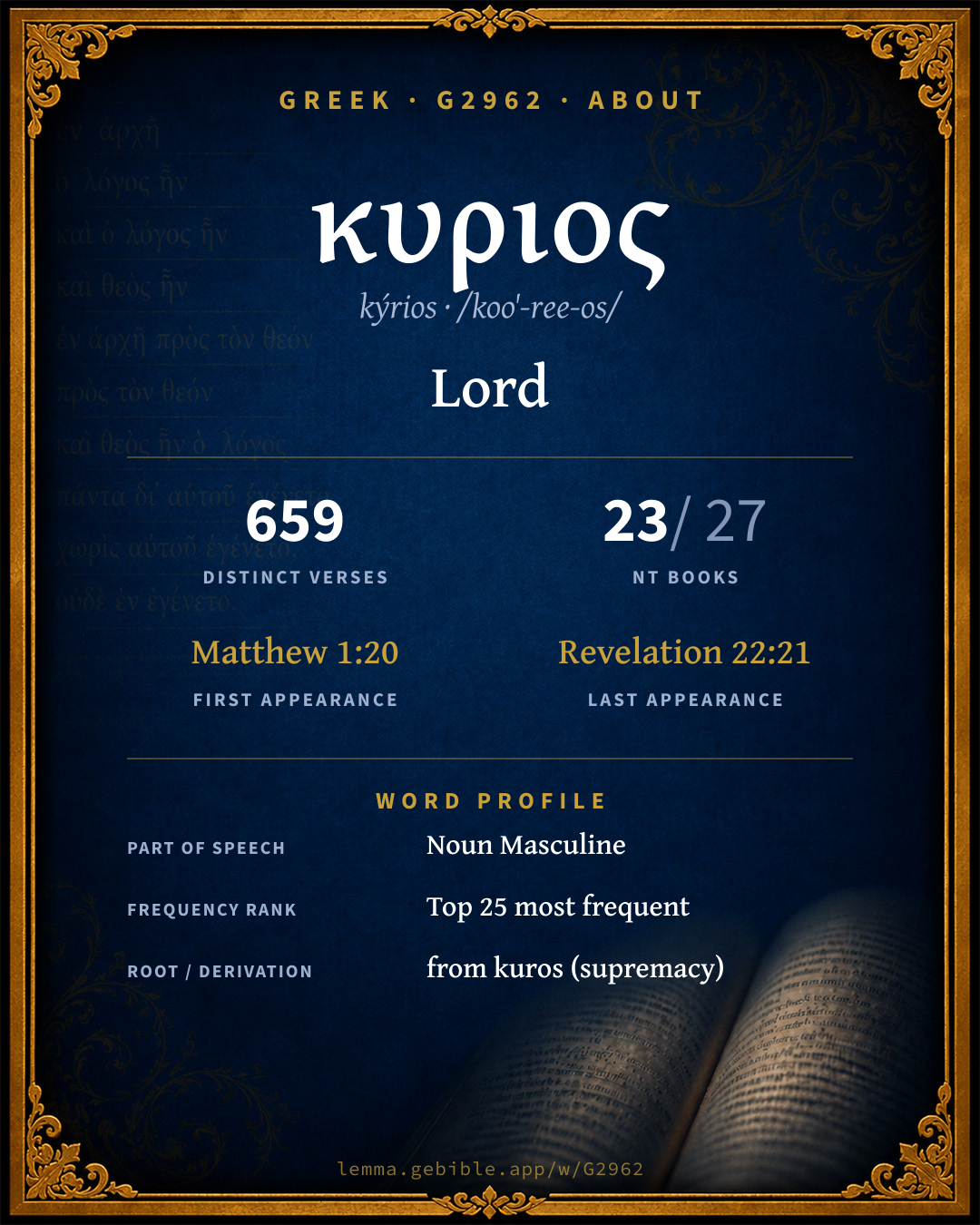
κύριος
Lord
Full lexicon entry — Thayer's Greek Lexicon
From Thayer's Greek Lexicon
Where this word appears
See every Genitive-case word in the Greek New Testament →
Grammar key — what these labels mean
Part of speech
- Noun
- A naming word — a person, place, thing, or idea.
Case
- Genitive
- The case of source, possession, or “of” — answers “whose / from what.”
- Nominative
- The case of the subject (and the predicate nominative).
- Vocative
- The case of direct address (“O Lord”).
- Dative
- The case of the indirect object, means, or location — “to / for / with / in.”
- Accusative
- The case of the direct object and of extent.
Gender
- Masculine
- Grammatically masculine.
Number
- Singular
- One.
- Plural
- More than one.
Grammatical forms 9 distinct
- Noun, Genitive, Singular, Masculine 240 times (34%)
- Noun, Nominative, Singular, Masculine 176 times (25%)
- Noun, Vocative, Singular, Masculine 117 times (16%)
- Noun, Dative, Singular, Masculine 100 times (14%)
- Noun, Accusative, Singular, Masculine 69 times (10%)
- Noun, Dative, Plural, Masculine 5 times (1%)
- Noun, Nominative, Plural, Masculine 5 times (1%)
- Noun, Genitive, Plural, Masculine 3 times (0%)
+1 more form (1 occurrence)
Parsed forms decoded from the imported morphology (Robinson–Tischendorf, public domain), counted across 716 parsed occurrences — not distinct verses.
Page 1 of 4 — showing verses 1–200 of 659 distinct verses where G2962 appears, across 23 books. Click any verse to open its interlinear word-by-word view. Verse text shown in the World English Bible for context — . Each verse’s Greek form is shown with its reference; the English is not keyword-highlighted, since the data carries no word-level English alignment. Use “Compare translations” on any verse to read it across multiple English versions. This concordance covers the Greek New Testament; Septuagint (Greek Old Testament) occurrences of this word are not indexed here.
Matthew 72 verses
- Matthew 1:20 κυρίου n gen sg masc But when he thought about these things, behold, an angel of the Lord appeared to him in a dream, saying, "Joseph, son of David, don't be afraid to take to yourself Mary, your wife, for that which is conceived in her is of the Holy Spirit.
- Matthew 1:22 κυρίου n gen sg masc Now all this has happened, that it might be fulfilled which was spoken by the Lord through the prophet, saying,
- Matthew 1:24 κυρίου n gen sg masc Joseph arose from his sleep, and did as the angel of the Lord commanded him, and took his wife to himself;
- Matthew 2:13 κυρίου n gen sg masc Now when they had departed, behold, an angel of the Lord appeared to Joseph in a dream, saying, "Arise and take the young child and his mother, and flee into Egypt, and stay there until I tell you, for Herod will seek the young child to destroy him."
- Matthew 2:15 κυρίου n gen sg masc and was there until the death of Herod; that it might be fulfilled which was spoken by the Lord through the prophet, saying, "Out of Egypt I called my son."
- Matthew 2:19 κυρίου n gen sg masc But when Herod was dead, behold, an angel of the Lord appeared in a dream to Joseph in Egypt, saying,
- Matthew 3:3 κυρίου n gen sg masc For this is he who was spoken of by Isaiah the prophet, saying, "The voice of one crying in the wilderness, Make ready the way of the Lord, Make his paths straight."
- Matthew 4:7 κύριον n acc sg masc Jesus said to him, "Again, it is written, 'You shall not test the Lord, your God.'"
- Matthew 4:10 κύριον n acc sg masc Then Jesus said to him, "Get behind me, Satan! For it is written, 'You shall worship the Lord your God, and him only shall you serve.'"
- Matthew 5:33 κυρίῳ n dat sg masc "Again you have heard that it was said to them of old time, 'You shall not make false vows, but shall perform to the Lord your vows,'
- Matthew 6:24 κυρίοις n dat pl masc "No one can serve two masters, for either he will hate the one and love the other; or else he will be devoted to one and despise the other. You can't serve both God and Mammon.
- Matthew 7:21 κύριε κύριε n voc sg masc n voc sg masc Not everyone who says to me, 'Lord, Lord,' will enter into the Kingdom of Heaven; but he who does the will of my Father who is in heaven.
- Matthew 7:22 κύριε κύριε n voc sg masc n voc sg masc Many will tell me in that day, 'Lord, Lord, didn't we prophesy in your name, in your name cast out demons, and in your name do many mighty works?'
- Matthew 8:2 κύριε n voc sg masc Behold, a leper came to him and worshiped him, saying, "Lord, if you want to, you can make me clean."
- Matthew 8:6 κύριε n voc sg masc and saying, "Lord, my servant lies in the house paralyzed, grievously tormented."
- Matthew 8:8 κύριε n voc sg masc The centurion answered, "Lord, I'm not worthy for you to come under my roof. Just say the word, and my servant will be healed.
- Matthew 8:21 κύριε n voc sg masc Another of his disciples said to him, "Lord, allow me first to go and bury my father."
- Matthew 8:25 κύριε n voc sg masc They came to him, and woke him up, saying, "Save us, Lord! We are dying!"
- Matthew 9:28 κύριε n voc sg masc When he had come into the house, the blind men came to him. Jesus said to them, "Do you believe that I am able to do this?" They told him, "Yes, Lord."
- Matthew 9:38 κυρίου n gen sg masc Pray therefore that the Lord of the harvest will send out laborers into his harvest."
- Matthew 10:24 κύριον n acc sg masc "A disciple is not above his teacher, nor a servant above his lord.
- Matthew 10:25 κύριος n nom sg masc It is enough for the disciple that he be like his teacher, and the servant like his lord. If they have called the master of the house Beelzebul, how much more those of his household!
- Matthew 11:25 κύριε n voc sg masc At that time, Jesus answered, "I thank you, Father, Lord of heaven and earth, that you hid these things from the wise and understanding, and revealed them to infants.
- Matthew 12:8 κύριος n nom sg masc For the Son of Man is Lord of the Sabbath."
- Matthew 13:27 κύριε n voc sg masc The servants of the householder came and said to him, 'Sir, didn't you sow good seed in your field? Where did this darnel come from?'
- Matthew 14:28 κύριε n voc sg masc Peter answered him and said, "Lord, if it is you, command me to come to you on the waters."
- Matthew 14:30 κύριε n voc sg masc But when he saw that the wind was strong, he was afraid, and beginning to sink, he cried out, saying, "Lord, save me!"
- Matthew 15:22 κύριε n voc sg masc Behold, a Canaanite woman came out from those borders, and cried, saying, "Have mercy on me, Lord, you son of David! My daughter is severely demonized!"
- Matthew 15:25 κύριε n voc sg masc But she came and worshiped him, saying, "Lord, help me."
- Matthew 15:27 κύριε κυρίων n voc sg masc n gen pl masc But she said, "Yes, Lord, but even the dogs eat the crumbs which fall from their masters' table."
- Matthew 16:22 κύριε n voc sg masc Peter took him aside, and began to rebuke him, saying, "Far be it from you, Lord! This will never be done to you."
- Matthew 17:4 κύριε n voc sg masc Peter answered, and said to Jesus, "Lord, it is good for us to be here. If you want, let's make three tents here: one for you, one for Moses, and one for Elijah."
- Matthew 17:15 κύριε n voc sg masc "Lord, have mercy on my son, for he is epileptic, and suffers grievously; for he often falls into the fire, and often into the water.
- Matthew 18:21 κύριε n voc sg masc Then Peter came and said to him, "Lord, how often shall my brother sin against me, and I forgive him? Until seven times?"
- Matthew 18:25 κύριος n nom sg masc But because he couldn't pay, his lord commanded him to be sold, with his wife, his children, and all that he had, and payment to be made.
- Matthew 18:27 κύριος n nom sg masc The lord of that servant, being moved with compassion, released him, and forgave him the debt.
- Matthew 18:31 κυρίῳ n dat sg masc So when his fellow servants saw what was done, they were exceedingly sorry, and came and told to their lord all that was done.
- Matthew 18:32 κύριος n nom sg masc Then his lord called him in, and said to him, 'You wicked servant! I forgave you all that debt, because you begged me.
- Matthew 18:34 κύριος n nom sg masc His lord was angry, and delivered him to the tormentors, until he should pay all that was due to him.
- Matthew 20:8 κύριος n nom sg masc When evening had come, the lord of the vineyard said to his steward, 'Call the laborers and pay them their wages, beginning from the last to the first.'
- Matthew 20:31 κύριε n voc sg masc The multitude rebuked them, telling them that they should be quiet, but they cried out even more, "Lord, have mercy on us, you son of David!"
- Matthew 20:33 κύριε n voc sg masc They told him, "Lord, that our eyes may be opened."
- Matthew 21:3 κύριος n nom sg masc If anyone says anything to you, you shall say, 'The Lord needs them,' and immediately he will send them."
- Matthew 21:9 κυρίου n gen sg masc The multitudes who went before him, and who followed kept shouting, "Hosanna to the son of David! Blessed is he who comes in the name of the Lord! Hosanna in the highest!"
- Matthew 21:30 κύριε n voc sg masc He came to the second, and said the same thing. He answered, 'I go, sir,' but he didn't go.
- Matthew 21:40 κύριος n nom sg masc When therefore the lord of the vineyard comes, what will he do to those farmers?"
- Matthew 21:42 κυρίου n gen sg masc Jesus said to them, "Did you never read in the Scriptures, 'The stone which the builders rejected, The same was made the head of the corner. This was from the Lord. It is marvelous in our eyes?'
- Matthew 22:37 κύριον n acc sg masc Jesus said to him, "'You shall love the Lord your God with all your heart, and with all your soul, and with all your mind.'
- Matthew 22:43 κύριον n acc sg masc He said to them, "How then does David in the Spirit call him Lord, saying,
- Matthew 22:44 κύριος κυρίῳ n nom sg masc n dat sg masc 'The Lord said to my Lord, Sit on my right hand, Until I make your enemies a footstool for your feet?'
- Matthew 22:45 κύριον n acc sg masc "If then David calls him Lord, how is he his son?"
- Matthew 23:39 κυρίου n gen sg masc For I tell you, you will not see me from now on, until you say, 'Blessed is he who comes in the name of the Lord!'"
- Matthew 24:42 κύριος n nom sg masc Watch therefore, for you don't know in what hour your Lord comes.
- Matthew 24:45 κύριος n nom sg masc "Who then is the faithful and wise servant, whom his lord has set over his household, to give them their food in due season?
- Matthew 24:46 κύριος n nom sg masc Blessed is that servant whom his lord finds doing so when he comes.
- Matthew 24:48 κύριος n nom sg masc But if that evil servant should say in his heart, 'My lord is delaying his coming,'
- Matthew 24:50 κύριος n nom sg masc the lord of that servant will come in a day when he doesn't expect it, and in an hour when he doesn't know it,
- Matthew 25:11 κύριε κύριε n voc sg masc n voc sg masc Afterward the other virgins also came, saying, 'Lord, Lord, open to us.'
- Matthew 25:18 κυρίου n gen sg masc But he who received the one went away and dug in the earth, and hid his lord's money.
- Matthew 25:19 κύριος n nom sg masc "Now after a long time the lord of those servants came, and reconciled accounts with them.
- Matthew 25:20 κύριε n voc sg masc He who received the five talents came and brought another five talents, saying, 'Lord, you delivered to me five talents. Behold, I have gained another five talents besides them.'
- Matthew 25:21 κύριος κυρίου n nom sg masc n gen sg masc "His lord said to him, 'Well done, good and faithful servant. You have been faithful over a few things, I will set you over many things. Enter into the joy of your lord.'
- Matthew 25:22 κύριε n voc sg masc "He also who got the two talents came and said, 'Lord, you delivered to me two talents. Behold, I have gained another two talents besides them.'
- Matthew 25:23 κύριος κυρίου n nom sg masc n gen sg masc "His lord said to him, 'Well done, good and faithful servant. You have been faithful over a few things, I will set you over many things. Enter into the joy of your lord.'
- Matthew 25:24 κύριε n voc sg masc "He also who had received the one talent came and said, 'Lord, I knew you that you are a hard man, reaping where you did not sow, and gathering where you did not scatter.
- Matthew 25:26 κύριος n nom sg masc "But his lord answered him, 'You wicked and slothful servant. You knew that I reap where I didn't sow, and gather where I didn't scatter.
- Matthew 25:37 κύριε n voc sg masc "Then the righteous will answer him, saying, 'Lord, when did we see you hungry, and feed you; or thirsty, and give you a drink?
- Matthew 25:44 κύριε n voc sg masc "Then they will also answer, saying, 'Lord, when did we see you hungry, or thirsty, or a stranger, or naked, or sick, or in prison, and didn't help you?'
- Matthew 26:22 κύριε n voc sg masc They were exceedingly sorrowful, and each began to ask him, "It isn't me, is it, Lord?"
- Matthew 27:10 κύριος n nom sg masc And they gave them for the potter's field, As the Lord commanded me."
- Matthew 27:63 κύριε n voc sg masc saying, "Sir, we remember what that deceiver said while he was still alive: 'After three days I will rise again.'
- Matthew 28:2 κυρίου n gen sg masc Behold, there was a great earthquake, for an angel of the Lord descended from the sky, and came and rolled away the stone from the door, and sat on it.
Mark 16 verses
- Mark 1:3 κυρίου n gen sg masc The voice of one crying in the wilderness, 'Make ready the way of the Lord! Make his paths straight!'"
- Mark 2:28 κύριός n nom sg masc Therefore the Son of Man is lord even of the Sabbath."
- Mark 5:19 κύριός n nom sg masc He didn't allow him, but said to him, "Go to your house, to your friends, and tell them what great things the Lord has done for you, and how he had mercy on you."
- Mark 7:28 κύριε n voc sg masc But she answered him, "Yes, Lord. Yet even the dogs under the table eat the children's crumbs."
- Mark 11:3 κύριος n nom sg masc If anyone asks you, 'Why are you doing this?' say, 'The Lord needs him;' and immediately he will send him back here."
- Mark 11:9 κυρίου n gen sg masc Those who went in front, and those who followed, cried out, "Hosanna! Blessed is he who comes in the name of the Lord!
- Mark 12:9 κύριος n nom sg masc What therefore will the lord of the vineyard do? He will come and destroy the farmers, and will give the vineyard to others.
- Mark 12:11 κυρίου n gen sg masc This was from the Lord, It is marvelous in our eyes'?"
- Mark 12:29 κύριος κύριος n nom sg masc n nom sg masc Jesus answered, "The greatest is, 'Hear, Israel, the Lord our God, the Lord is one:
- Mark 12:30 κύριον n acc sg masc you shall love the Lord your God with all your heart, and with all your soul, and with all your mind, and with all your strength.' This is the first commandment.
- Mark 12:36 κύριος κυρίῳ n nom sg masc n dat sg masc For David himself said in the Holy Spirit, 'The Lord said to my Lord, Sit at my right hand, Until I make your enemies the footstool of your feet.'
- Mark 12:37 κύριον n acc sg masc Therefore David himself calls him Lord, so how can he be his son?" The common people heard him gladly.
- Mark 13:20 κύριος n nom sg masc Unless the Lord had shortened the days, no flesh would have been saved; but for the sake of the chosen ones, whom he picked out, he shortened the days.
- Mark 13:35 κύριος n nom sg masc Watch therefore, for you don't know when the lord of the house is coming, whether at evening, or at midnight, or when the rooster crows, or in the morning;
- Mark 16:19 κύριος n nom sg masc So then the Lord Jesus, after he had spoken to them, was received up into heaven, and sat down at the right hand of God.
- Mark 16:20 κυρίου n gen sg masc They went out, and preached everywhere, the Lord working with them, and confirming the word by the signs that followed. Amen.
Luke 95 verses
- Luke 1:6 κυρίου n gen sg masc They were both righteous before God, walking blamelessly in all the commandments and ordinances of the Lord.
- Luke 1:9 κυρίου n gen sg masc according to the custom of the priest's office, his lot was to enter into the temple of the Lord and burn incense.
- Luke 1:11 κυρίου n gen sg masc An angel of the Lord appeared to him, standing on the right side of the altar of incense.
- Luke 1:15 κυρίου n gen sg masc For he will be great in the sight of the Lord, and he will drink no wine nor strong drink. He will be filled with the Holy Spirit, even from his mother's womb.
- Luke 1:16 κύριον n acc sg masc He will turn many of the children of Israel to the Lord, their God.
- Luke 1:17 κυρίῳ n dat sg masc He will go before him in the spirit and power of Elijah, 'to turn the hearts of the fathers to the children,' and the disobedient to the wisdom of the just; to make ready a people prepared for the Lord."
- Luke 1:25 κύριος n nom sg masc "Thus has the Lord done to me in the days in which he looked at me, to take away my reproach among men."
- Luke 1:28 κύριος n nom sg masc Having come in, the angel said to her, "Rejoice, you highly favored one! The Lord is with you. Blessed are you among women!"
- Luke 1:32 κύριος n nom sg masc He will be great, and will be called the Son of the Most High. The Lord God will give him the throne of his father, David,
- Luke 1:38 κυρίου n gen sg masc Mary said, "Behold, the handmaid of the Lord; be it to me according to your word." The angel departed from her.
- Luke 1:43 κυρίου n gen sg masc Why am I so favored, that the mother of my Lord should come to me?
- Luke 1:45 κυρίου n gen sg masc Blessed is she who believed, for there will be a fulfillment of the things which have been spoken to her from the Lord!"
- Luke 1:46 κύριον n acc sg masc Mary said, "My soul magnifies the Lord.
- Luke 1:58 κύριος n nom sg masc Her neighbors and her relatives heard that the Lord had magnified his mercy towards her, and they rejoiced with her.
- Luke 1:66 κυρίου n gen sg masc All who heard them laid them up in their heart, saying, "What then will this child be?" The hand of the Lord was with him.
- Luke 1:68 κύριος n nom sg masc "Blessed be the Lord, the God of Israel, For he has visited and worked redemption for his people;
- Luke 1:76 κυρίου n gen sg masc And you, child, will be called a prophet of the Most High, For you will go before the face of the Lord to make ready his ways,
- Luke 2:9 κυρίου κυρίου n gen sg masc n gen sg masc Behold, an angel of the Lord stood by them, and the glory of the Lord shone around them, and they were terrified.
- Luke 2:11 κύριος n nom sg masc For there is born to you, this day, in the city of David, a Savior, who is Christ the Lord.
- Luke 2:15 κύριος n nom sg masc It happened, when the angels went away from them into the sky, that the shepherds said one to another, "Let's go to Bethlehem, now, and see this thing that has happened, which the Lord has made known to us."
- Luke 2:22 κυρίῳ n dat sg masc When the days of their purification according to the law of Moses were fulfilled, they brought him up to Jerusalem, to present him to the Lord
- Luke 2:23 κυρίου κυρίῳ n gen sg masc n dat sg masc (as it is written in the law of the Lord, "Every male who opens the womb shall be called holy to the Lord"),
- Luke 2:24 κυρίου n gen sg masc and to offer a sacrifice according to that which is said in the law of the Lord, "A pair of turtledoves, or two young pigeons."
- Luke 2:26 κυρίου n gen sg masc It had been revealed to him by the Holy Spirit that he should not see death before he had seen the Lord's Christ.
- Luke 2:39 κυρίου n gen sg masc When they had accomplished all things that were according to the law of the Lord, they returned into Galilee, to their own city, Nazareth.
- Luke 3:4 κυρίου n gen sg masc As it is written in the book of the words of Isaiah the prophet, "The voice of one crying in the wilderness, 'Make ready the way of the Lord. Make his paths straight.
- Luke 4:8 κύριον n acc sg masc Jesus answered him, "Get behind me Satan! For it is written, 'You shall worship the Lord your God, and him only shall you serve.'"
- Luke 4:12 κύριον n acc sg masc Jesus answering, said to him, "It has been said, 'You shall not tempt the Lord your God.'"
- Luke 4:18 κυρίου n gen sg masc "The Spirit of the Lord is on me, Because he has anointed me to preach good news to the poor. He has sent me to heal the brokenhearted, To proclaim release to the captives, Recovering of sight to the blind, To deliver those who are crushed,
- Luke 4:19 κυρίου n gen sg masc And to proclaim the acceptable year of the Lord."
- Luke 5:8 κύριε n voc sg masc But Simon Peter, when he saw it, fell down at Jesus' knees, saying, "Depart from me, for I am a sinful man, Lord."
- Luke 5:12 κύριε n voc sg masc It happened, while he was in one of the cities, behold, there was a man full of leprosy. When he saw Jesus, he fell on his face, and begged him, saying, "Lord, if you want to, you can make me clean."
- Luke 5:17 κυρίου n gen sg masc It happened on one of those days, that he was teaching; and there were Pharisees and teachers of the law sitting by, who had come out of every village of Galilee, Judea, and Jerusalem. The power of the Lord was with him to heal them.
- Luke 6:5 κύριός n nom sg masc He said to them, "The Son of Man is lord of the Sabbath."
- Luke 6:46 κύριε κύριε n voc sg masc n voc sg masc "Why do you call me, 'Lord, Lord,' and don't do the things which I say?
- Luke 7:6 κύριε n voc sg masc Jesus went with them. When he was now not far from the house, the centurion sent friends to him, saying to him, "Lord, don't trouble yourself, for I am not worthy for you to come under my roof.
- Luke 7:13 κύριος n nom sg masc When the Lord saw her, he had compassion on her, and said to her, "Don't cry."
- Luke 7:19 κύριον n acc sg masc John, calling to himself two of his disciples, sent them to Jesus, saying, "Are you the one who is coming, or should we look for another?"
- Luke 9:54 κύριε n voc sg masc When his disciples, James and John, saw this, they said, "Lord, do you want us to command fire to come down from the sky, and destroy them, just as Elijah did?"
- Luke 9:61 κύριε n voc sg masc Another also said, "I want to follow you, Lord, but first allow me to bid farewell to those who are at my house."
- Luke 10:1 κύριος n nom sg masc Now after these things, the Lord also appointed seventy others, and sent them two by two ahead of him into every city and place, where he was about to come.
- Luke 10:2 κυρίου n gen sg masc Then he said to them, "The harvest is indeed plentiful, but the laborers are few. Pray therefore to the Lord of the harvest, that he may send out laborers into his harvest.
- Luke 10:17 κύριε n voc sg masc The seventy returned with joy, saying, "Lord, even the demons are subject to us in your name!"
- Luke 10:21 κύριε n voc sg masc In that same hour Jesus rejoiced in the Holy Spirit, and said, "I thank you, O Father, Lord of heaven and earth, that you have hidden these things from the wise and understanding, and revealed them to little children. Yes, Father, for so it was well-pleasing in your sight."
- Luke 10:27 κύριον n acc sg masc He answered, "You shall love the Lord your God with all your heart, with all your soul, with all your strength, and with all your mind; and your neighbor as yourself."
- Luke 10:39 κυρίου n gen sg masc She had a sister called Mary, who also sat at Jesus' feet, and heard his word.
- Luke 10:40 κύριε n voc sg masc But Martha was distracted with much serving, and she came up to him, and said, "Lord, don't you care that my sister left me to serve alone? Ask her therefore to help me."
- Luke 10:41 κύριος n nom sg masc Jesus answered her, "Martha, Martha, you are anxious and troubled about many things,
- Luke 11:1 κύριε n voc sg masc It happened, that when he finished praying in a certain place, one of his disciples said to him, "Lord, teach us to pray, just as John also taught his disciples."
- Luke 11:39 κύριος n nom sg masc The Lord said to him, "Now you Pharisees cleanse the outside of the cup and of the platter, but your inward part is full of extortion and wickedness.
- Luke 12:36 κύριον n acc sg masc Be like men watching for their lord, when he returns from the marriage feast; that, when he comes and knocks, they may immediately open to him.
- Luke 12:37 κύριος n nom sg masc Blessed are those servants, whom the lord will find watching when he comes. Most assuredly I tell you, that he will dress himself, and make them recline, and will come and serve them.
- Luke 12:41 κύριε n voc sg masc Peter said to him, "Lord, are you telling this parable to us, or to everybody?"
- Luke 12:42 κύριος κύριος n nom sg masc n nom sg masc The Lord said, "Who then is the faithful and wise steward, whom his lord will set over his household, to give them their portion of food at the right times?
- Luke 12:43 κύριος n nom sg masc Blessed is that servant whom his lord will find doing so when he comes.
- Luke 12:45 κύριός n nom sg masc But if that servant says in his heart, 'My lord delays his coming,' and begins to beat the menservants and the maidservants, and to eat and drink, and to be drunken,
- Luke 12:46 κύριος n nom sg masc then the lord of that servant will come in a day when he isn't expecting him, and in an hour that he doesn't know, and will cut him in two, and place his portion with the unfaithful.
- Luke 12:47 κυρίου n gen sg masc That servant, who knew his lord's will, and didn't prepare, nor do what he wanted, will be beaten with many stripes,
- Luke 13:8 κύριε n voc sg masc He answered, 'Lord, leave it alone this year also, until I dig around it, and fertilize it.
- Luke 13:15 κύριος n nom sg masc Therefore the Lord answered him, "You hypocrites! Doesn't each one of you free his ox or his donkey from the stall on the Sabbath, and lead him away to water?
- Luke 13:23 κύριε n voc sg masc One said to him, "Lord, are they few who are saved?" He said to them,
- Luke 13:25 κύριε n voc sg masc When once the master of the house has risen up, and has shut the door, and you begin to stand outside, and to knock at the door, saying, 'Lord, Lord, open to us!' then he will answer and tell you, 'I don't know you or where you come from.'
- Luke 13:35 κυρίου n gen sg masc Behold, your house is left to you desolate. I tell you, you will not see me, until you say, 'Blessed is he who comes in the name of the Lord!'"
- Luke 14:21 κυρίῳ n dat sg masc "That servant came, and told his lord these things. Then the master of the house, being angry, said to his servant, 'Go out quickly into the streets and lanes of the city, and bring in the poor, maimed, blind, and lame.'
- Luke 14:22 κύριε n voc sg masc "The servant said, 'Lord, it is done as you commanded, and there is still room.'
- Luke 14:23 κύριος n nom sg masc "The lord said to the servant, 'Go out into the highways and hedges, and compel them to come in, that my house may be filled.
- Luke 16:3 κύριός n nom sg masc "The manager said within himself, 'What will I do, seeing that my lord is taking away the management position from me? I don't have strength to dig. I am ashamed to beg.
- Luke 16:5 κυρίου κυρίῳ n gen sg masc n dat sg masc Calling each one of his lord's debtors to him, he said to the first, 'How much do you owe to my lord?'
- Luke 16:8 κύριος n nom sg masc "His lord commended the dishonest manager because he had done wisely, for the children of this world are, in their own generation, wiser than the children of the light.
- Luke 16:13 κυρίοις n dat pl masc No servant can serve two masters, for either he will hate the one, and love the other; or else he will hold to one, and despise the other. You aren't able to serve God and mammon."
- Luke 17:5 κυρίῳ n dat sg masc The apostles said to the Lord, "Increase our faith."
- Luke 17:6 κύριος n nom sg masc The Lord said, "If you had faith like a grain of mustard seed, you would tell this sycamore tree, 'Be uprooted, and be planted in the sea,' and it would obey you.
- Luke 17:37 κύριε n voc sg masc They answering, asked him, "Where, Lord?" He said to them, "Where the body is, there will the vultures also be gathered together."
- Luke 18:6 κύριος n nom sg masc The Lord said, "Listen to what the unrighteous judge says.
- Luke 18:41 κύριε n voc sg masc "What do you want me to do?" He said, "Lord, that I may see again."
- Luke 19:8 κύριον κύριε n acc sg masc n voc sg masc Zacchaeus stood and said to the Lord, "Behold, Lord, half of my goods I give to the poor. If I have wrongfully exacted anything of anyone, I restore four times as much."
- Luke 19:16 κύριε n voc sg masc The first came before him, saying, 'Lord, your mina has made ten more minas.'
- Luke 19:18 κύριε n voc sg masc "The second came, saying, 'Your mina, Lord, has made five minas.'
- Luke 19:20 κύριε n voc sg masc Another came, saying, 'Lord, behold, your mina, which I kept laid away in a handkerchief,
- Luke 19:25 κύριε n voc sg masc "They said to him, 'Lord, he has ten minas!'
- Luke 19:31 κύριος n nom sg masc If anyone asks you, 'Why are you untying it?' say to him: 'The Lord needs it.'"
- Luke 19:33 κύριοι n nom pl masc As they were untying the colt, the owners of it said to them, "Why are you untying the colt?"
- Luke 19:34 κύριος n nom sg masc They said, "The Lord needs it."
- Luke 19:38 κυρίου n gen sg masc saying, "Blessed is the King who comes in the name of the Lord! Peace in heaven, and glory in the highest!"
- Luke 20:13 κύριος n nom sg masc The lord of the vineyard said, 'What shall I do? I will send my beloved son. It may be that seeing him, they will respect him.'
- Luke 20:15 κύριος n nom sg masc They threw him out of the vineyard, and killed him. What therefore will the lord of the vineyard do to them?
- Luke 20:37 κύριον n acc sg masc But that the dead are raised, even Moses showed at the bush, when he called the Lord 'The God of Abraham, the God of Isaac, and the God of Jacob.'
- Luke 20:42 κύριος κυρίῳ n nom sg masc n dat sg masc David himself says in the book of Psalms, 'The Lord said to my Lord, "Sit at my right hand,
- Luke 20:44 κύριον n acc sg masc "David therefore calls him Lord, so how is he his son?"
- Luke 22:33 κύριε n voc sg masc He said to him, "Lord, I am ready to go with you both to prison and to death!"
- Luke 22:38 κύριε n voc sg masc They said, "Lord, behold, here are two swords." He said to them, "That is enough."
- Luke 22:49 κύριε n voc sg masc When those who were around him saw what was about to happen, they said to him, "Lord, shall we strike with the sword?"
- Luke 22:61 κύριος κυρίου n nom sg masc n gen sg masc The Lord turned, and looked at Peter. Then Peter remembered the Lord's word, how he said to him, "Before the rooster crows you will deny me three times."
- Luke 24:3 κυρίου n gen sg masc They entered in, and didn't find the Lord Jesus' body.
- Luke 24:34 κύριος n nom sg masc saying, "The Lord is risen indeed, and has appeared to Simon!"
John 50 verses
- John 1:23 κυρίου n gen sg masc He said, "I am the voice of one crying in the wilderness, 'Make straight the way of the Lord,' as Isaiah the prophet said."
- John 4:11 κύριε n voc sg masc The woman said to him, "Sir, you have nothing to draw with, and the well is deep. From where then have you that living water?
- John 4:15 κύριε n voc sg masc The woman said to him, "Sir, give me this water, so that I don't get thirsty, neither come all the way here to draw."
- John 4:19 κύριε n voc sg masc The woman said to him, "Sir, I perceive that you are a prophet.
- John 4:49 κύριε n voc sg masc The nobleman said to him, "Sir, come down before my child dies."
- John 5:7 κύριε n voc sg masc The sick man answered him, "Sir, I have no one to put me into the pool when the water is stirred up, but while I'm coming, another steps down before me."
- John 6:23 κυρίου n gen sg masc However boats from Tiberias came near to the place where they ate the bread after the Lord had given thanks.
- John 6:34 κύριε n voc sg masc They said therefore to him, "Lord, always give us this bread."
- John 6:68 κύριε n voc sg masc Simon Peter answered him, "Lord, to whom would we go? You have the words of eternal life.
- John 8:11 κύριε n voc sg masc She said, "No one, Lord." Jesus said, "Neither do I condemn you. Go your way. From now on, sin no more."
- John 9:36 κύριε n voc sg masc He answered, "Who is he, Lord, that I may believe in him?"
- John 9:38 κύριε n voc sg masc He said, "Lord, I believe!" and he worshiped him.
- John 11:2 κύριον n acc sg masc It was that Mary who had anointed the Lord with ointment, and wiped his feet with her hair, whose brother, Lazarus, was sick.
- John 11:3 κύριε n voc sg masc The sisters therefore sent to him, saying, "Lord, behold, he for whom you have great affection is sick."
- John 11:12 κύριε n voc sg masc The disciples therefore said, "Lord, if he has fallen asleep, he will recover."
- John 11:21 κύριε n voc sg masc Therefore Martha said to Jesus, "Lord, if you would have been here, my brother wouldn't have died.
- John 11:27 κύριε n voc sg masc She said to him, "Yes, Lord. I have come to believe that you are the Christ, God's Son, he who comes into the world."
About this entry
At a glance — auto-summarized from this page’s data, not written by a person. Every figure links to its source below. This summary describes the numbers; it doesn’t interpret them.
“Lord” is the headline sense of the Greek name κυριος (kýrios). First canonically at Matthew 1:20, it enters the text early. It appears 659 verses across 23 books of the Greek New Testament, among its most common vocabulary. See 659-verse concordance and the renderings breakdown below.
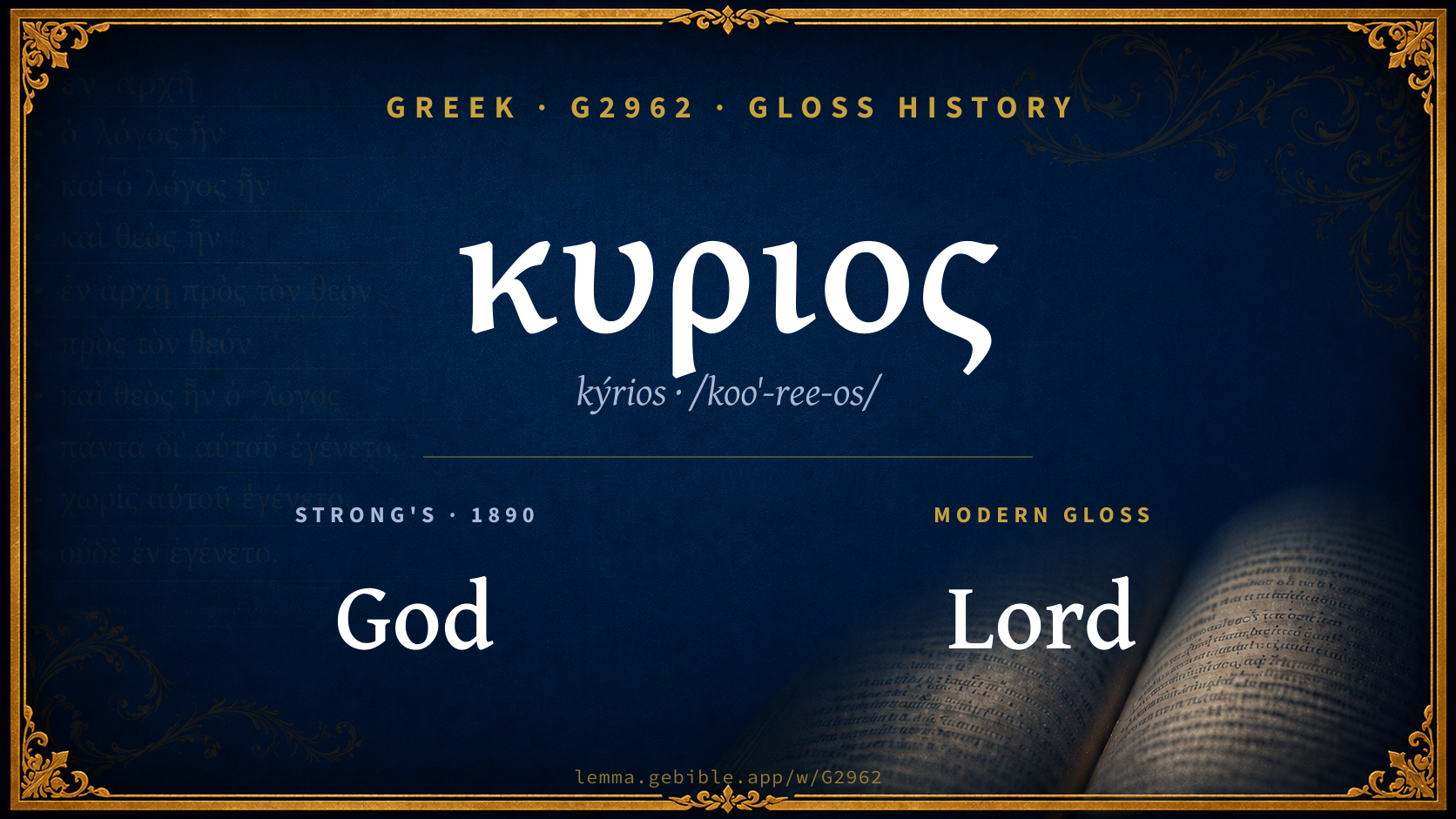
Gloss history
Strong's 1890 vs modern scholarship
About this word
Strong's G2962 catalogs a Greek word from the Greek New Testament.
These counts are not copied from any lexicon or concordance. They are computed here, from the morphology-tagged Greek New Testament. What Lemma adds →
- 659
- distinct verses
- The word appears in 659 distinct verses.
- 23 / 27
- NT books
- The word appears in 23 of 27 New Testament books.
- #24
- by frequency
- Top 25 most frequent Greek words (rank 24 of 5,347 Greek words by occurrence).
View all 659 occurrences in the concordance →
By section of the New Testament
By traditional corpus
Conventional, traditional groupings — biblical authorship is debated, so this is a traditional corpus grouping, not an authorship claim. Some books belong to more than one corpus (Luke is in both the Gospels and the Lukan corpus, and so on), so these shares overlap and need not total 100%. Each figure is a share of the word’s 659 distinct verses.
- Pauline corpus 246 verses · 37%
- Gospels 233 verses · 35%
- Lukan (Luke–Acts) 197 verses · 30%
- Johannine 71 verses · 11%
- General (Catholic) Epistles 41 verses · 6%
- Revelation 21 verses · 3%
- Hebrews 16 verses · 2%
How translations render this word
Counts come from each version’s own published word-to-Strong’s tagging or interlinear alignment — an approximate guide to how each version renders this word, not a word-level alignment the data otherwise carries. Because each total is that version’s own tagged count, the per-version totals vary from one another and need not match the appearance or distinct-verse counts above. These counts may also differ from a printed concordance because Lemma counts each distinctly tagged rendering and does not collapse phrase taggings into a single head-word total. This is a fixed set of word-tagged versions (KJV, ASV, BSB, ULT) and does not change with the reading translation you choose elsewhere. Each version’s license is shown beside its name below (and on Sources).
- King James Version: Lord 696×, Lord's 12×, Sir 10×
- American Standard Version: Lord 645×, Of 16×, Sir 9×
- Berean Standard Bible: Lord 610×, Master 42×, Lord’s 19×
- unfoldingWord Literal Text: Lord 641×, Of 60×, Master 49×
King James Version Public Domain
Renders G2962 across 748 tagged occurrences — most commonly:
Plus 12 renderings that appear only once — usually multi-word phrases or single function words the recovered tagging swept in, not distinct renderings.
American Standard Version Public Domain
Renders G2962 across 730 tagged occurrences — most commonly:
Plus 28 renderings that appear only once — usually multi-word phrases or single function words the recovered tagging swept in, not distinct renderings. Not rendered by a distinct English word in 3 further occurrences.
Berean Standard Bible Public Domain
Renders G2962 across 713 tagged occurrences — most commonly:
Plus 6 renderings that appear only once — usually multi-word phrases or single function words the recovered tagging swept in, not distinct renderings. Not rendered by a distinct English word in 3 further occurrences.
unfoldingWord Literal Text CC BY-SA 4.0
Renders G2962 across 794 tagged occurrences — most commonly:
Plus 5 renderings that appear only once — usually multi-word phrases or single function words the recovered tagging swept in, not distinct renderings.
Senses in Thayer's
The 1 sense Thayer's distinguishes for this word, in lexicon order (not ranked by frequency or importance). The full entry — with sub-senses — is in the Lexicon Entry tab.
- he to whom a person or thing belongs, about which he has power of deciding; master, lord
Word origin
Origin: from kuros (supremacy)
From κῦρος kuros ( supremacy ); supreme in authority that is (as noun) controller ; by implication Mr . (as a respectful title): - God Lord master Sir.
— Strong’s Exhaustive Concordance (1890), public domain.
Forms in the corpus
The 11 distinct written forms G2962 takes in the Greek New Testament, most frequent first — each parse links to that case’s occurrences in the concordance.
| Form | Parsing | Example | Uses |
|---|---|---|---|
| κυρίου kyríou | Noun, Genitive, Singular, Masculine | Matthew 1:20 | 240 |
| κύριος kýrios | Noun, Nominative, Singular, Masculine | Matthew 10:25 | 164 |
| κύριε kýrie | Noun, Vocative, Singular, Masculine | Matthew 7:21 | 116 |
| κυρίῳ kyríō | Noun, Dative, Singular, Masculine | Matthew 5:33 | 100 |
| κύριον kýrion | Noun, Accusative, Singular, Masculine | Matthew 4:7 | 68 |
| κύριός kýriós | Noun, Nominative, Singular, Masculine | Mark 2:28 | 12 |
| κύριοι kýrioi | Noun, Nominative, Plural, Masculine | Luke 19:33 | 6 |
| κυρίοις kyríois | Noun, Dative, Plural, Masculine | Matthew 6:24 | 5 |
| κυρίων kyríōn | Noun, Genitive, Plural, Masculine | Matthew 15:27 | 3 |
| κύριέ kýrié | Noun, Vocative, Singular, Masculine | Revelation 7:14 | 1 |
| κύριόν kýrión | Noun, Accusative, Singular, Masculine | John 20:13 | 1 |
Same root — word family
Other Thayer's entries built from the same root as G2962, grouped by Strong’s listed origin. These share a root / origin per the lexicon — not necessarily a shared meaning. Each links to that word’s own entry.
Derived from this word
- κυριακος kyriakós G2960 of the Lord
- κυριευω kyrieúō G2961 to rule
- κυριοτης kyriótēs G2963 dominion
- κυροω kyróō G2964 to ratify
Proper names from this root
People and places named from this root — a name, not an additional meaning of the word.
Compare all same-root words → Showing 4 of 7 — not the complete family. 2 of the same-root words are proper names (people or places). They share a root, not necessarily a meaning.
Bible dictionary
Public-domain dictionary articles matched to this entry by name (Lord). A biblical name can be shared by more than one person or place, so an article may treat several.
Easton's Bible Dictionary · M. G. Easton, 1897
There are various Hebrew and Greek words so rendered.
(1.) Heb. Jehovah, has been rendered in the English Bible LORD, printed in small capitals. This is the proper name of the God of the Hebrews. The form "Jehovah" is retained only in Ex. 6:3; Ps. 83:18; Isa. 12:2; 26:4, both in the Authorized and the Revised Version.
(2.) Heb. adon, means one possessed of absolute control. It denotes a master, as of slaves (Gen. 24:14, 27), or a ruler of his subjects (45:8), or a husband, as lord of his wife (18:12).
The old plural form of this Hebrew word is 'adonai. From a superstitious reverence for the name "Jehovah," the Jews, in reading their Scriptures, whenever that name occurred, always pronounced it 'Adonai.
(3.) Greek kurios, a supreme master, etc. In the LXX. this is invariably used for "Jehovah" and "Adonai."
(4.) Heb. ba'al, a master, as having domination. This word is applied to human relations, as that of husband, to persons skilled in some art or profession, and to heathen deities. "The men of Shechem," literally "the baals of Shechem" (Judg. 9:2, 3). These were the Israelite inhabitants who had reduced the Canaanites to a condition of vassalage (Josh. 16:10; 17:13).
(5.) Heb. seren, applied exclusively to the "lords of the Philistines" (Judg. 3:3). The LXX. render it by satrapies. At this period the Philistines were not, as at a later period (1 Sam. 21:10), under a kingly government. (See Josh. 13:3; 1 Sam. 6:18.) There were five such lordships, viz., Gath, Ashdod, Gaza, Ashkelon, and Ekron.
Smith's Bible Dictionary · William Smith, 1863
[God]
Classic public-domain reference works; full attribution on Sources.
Septuagint usage
The same Greek word κυριος appears 7,441 times in the Greek Old Testament (Septuagint), across 6,126 verses in 36 books.
- 7,441
- LXX occurrences
- Tagged occurrences of this Greek word in the Septuagint.
- 6,126
- verses
- Distinct Septuagint verses containing this word.
- 36 / 39
- OT books
- The word appears in 36 of the 39 Old Testament books.
Sample Septuagint occurrences
- Genesis 2:8 κύριος
- Exodus 3:2 κύριος
- Leviticus 1:1 κύριος
- Numbers 1:1 κύριος
- Deuteronomy 1:3 κύριος
- Joshua 1:1 κύριος
- Judges 1:1 κύριος
- Ruth 1:6 κύριος
- 1 Samuel 1:3 κύριος
- 2 Samuel 1:10 κύριος
- 1 Kings 1:2 κύριος
- 2 Kings 1:3 κύριος
Septuagint occurrences (same lexeme)
Every verse where the same Strong’s number (G2962) appears in the Greek Septuagint — showing the first 50 of 6,126. Verse text shown in the World English Bible for context; the Greek form is the matched word — the English is not keyword-highlighted.
- Genesis 2:8 κύριος Yahweh God planted a garden eastward, in Eden, and there he put the man whom he had formed.
- Genesis 2:15 κύριος Yahweh God took the man, and put him into the garden of Eden to dress it and to keep it.
- Genesis 2:16 κύριος Yahweh God commanded the man, saying, "Of every tree of the garden you may freely eat:
- Genesis 2:18 κύριος Yahweh God said, "It is not good that the man should be alone; I will make him a helper suitable for him."
- Genesis 2:22 κύριος He made the rib, which Yahweh God had taken from the man, into a woman, and brought her to the man.
- Genesis 3:1 κύριος Now the serpent was more subtle than any animal of the field which Yahweh God had made. He said to the woman, "Yes, has God said, 'You shall not eat of any tree of the garden?'"
- Genesis 3:8 κύριος They heard the voice of Yahweh God walking in the garden in the cool of the day, and the man and his wife hid themselves from the presence of Yahweh God among the trees of the garden.
- Genesis 3:9 κύριος Yahweh God called to the man, and said to him, "Where are you?"
- Genesis 3:13 κύριος Yahweh God said to the woman, "What is this you have done?" The woman said, "The serpent deceived me, and I ate."
- Genesis 3:14 κύριος Yahweh God said to the serpent, "Because you have done this, cursed are you above all cattle, and above every animal of the field. On your belly shall you go, and you shall eat dust all the days of your life.
- Genesis 3:21 κύριος Yahweh God made coats of skins for Adam and for his wife, and clothed them.
- Genesis 3:23 κύριος Therefore Yahweh God sent him forth from the garden of Eden, to till the ground from whence he was taken.
- Genesis 4:3 κύριος As time passed, it happened that Cain brought an offering to Yahweh from the fruit of the ground.
- Genesis 4:6 κύριος Yahweh said to Cain, "Why are you angry? Why has the expression of your face fallen?
- Genesis 4:13 κύριος Cain said to Yahweh, "My punishment is greater than I can bear.
- Genesis 4:15 κύριος Yahweh said to him, "Therefore whoever slays Cain, vengeance will be taken on him sevenfold." Yahweh appointed a sign for Cain, lest any finding him should strike him.
- Genesis 4:26 κύριος There was also born a son to Seth, and he named him Enosh. Then men began to call on Yahweh's name.
- Genesis 5:29 κύριος and he named him Noah, saying, "This same will comfort us in our work and in the toil of our hands, because of the ground which Yahweh has cursed."
- Genesis 6:3 κύριος Yahweh said, "My Spirit will not strive with man forever, because he also is flesh; yet will his days be one hundred twenty years."
- Genesis 6:5 κύριος Yahweh saw that the wickedness of man was great in the earth, and that every imagination of the thoughts of his heart was only evil continually.
- Genesis 6:8 κύριος But Noah found favor in Yahweh's eyes.
- Genesis 6:12 κύριος God saw the earth, and saw that it was corrupt, for all flesh had corrupted their way on the earth.
- Genesis 6:22 κύριος Thus Noah did. According to all that God commanded him, so he did.
- Genesis 7:1 κύριος Yahweh said to Noah, "Come with all of your household into the ark, for I have seen your righteousness before me in this generation.
- Genesis 7:5 κύριος Noah did everything that Yahweh commanded him.
- Genesis 7:16 κύριος Those who went in, went in male and female of all flesh, as God commanded him; and Yahweh shut him in.
- Genesis 8:15 κύριος God spoke to Noah, saying,
- Genesis 8:21 κύριος Yahweh smelled the sweet savor. Yahweh said in his heart, "I will not again curse the ground any more for man's sake, because the imagination of man's heart is evil from his youth; neither will I ever again strike everything living, as I have done.
- Genesis 9:12 κύριος God said, "This is the token of the covenant which I make between me and you and every living creature that is with you, for perpetual generations:
- Genesis 9:26 κύριος He said, "Blessed be Yahweh, the God of Shem; Let Canaan be his servant.
- Genesis 10:9 κύριος He was a mighty hunter before Yahweh. Therefore it is said, "Like Nimrod, a mighty hunter before Yahweh."
- Genesis 11:5 κύριος Yahweh came down to see the city and the tower, which the children of men built.
- Genesis 11:6 κύριος Yahweh said, "Behold, they are one people, and they have all one language; and this is what they begin to do. Now nothing will be withheld from them, which they intend to do.
- Genesis 11:8 κύριος So Yahweh scattered them abroad from there on the surface of all the earth. They stopped building the city.
- Genesis 11:9 κύριος Therefore the name of it was called Babel, because Yahweh confused the language of all the earth, there. From there, Yahweh scattered them abroad on the surface of all the earth.
- Genesis 12:1 κύριος Now Yahweh said to Abram, "Get out of your country, and from your relatives, and from your father's house, to the land that I will show you.
- Genesis 12:4 κύριος So Abram went, as Yahweh had spoken to him. Lot went with him. Abram was seventy-five years old when he departed out of Haran.
- Genesis 12:7 κύριος Yahweh appeared to Abram, and said, "I will give this land to your seed." He built an altar there to Yahweh, who appeared to him.
- Genesis 12:8 κύριος He left from there to the mountain on the east of Bethel, and pitched his tent, having Bethel on the west, and Ai on the east. There he built an altar to Yahweh, and called on the name of Yahweh.
- Genesis 13:4 κύριος to the place of the altar, which he had made there at the first. There Abram called on the name of Yahweh.
- Genesis 13:18 κύριος Abram moved his tent, and came and lived by the oaks of Mamre, which are in Hebron, and built an altar there to Yahweh.
- Genesis 15:1 κύριος After these things the word of Yahweh came to Abram in a vision, saying, "Don't be afraid, Abram. I am your shield, your exceedingly great reward."
- Genesis 15:4 κύριος Behold, the word of Yahweh came to him, saying, "This man will not be your heir, but he who will come forth out of your own body will be your heir."
- Genesis 15:8 κύριος He said, "Lord Yahweh, how will I know that I will inherit it?"
- Genesis 15:18 κύριος In that day Yahweh made a covenant with Abram, saying, "To your seed have I given this land, from the river of Egypt to the great river, the river Euphrates:
- Genesis 16:2 κύριος Sarai said to Abram," See now, Yahweh has restrained me from bearing. Please go in to my handmaid. It may be that I will obtain children by her." Abram listened to the voice of Sarai.
- Genesis 16:7 κύριος The angel of Yahweh found her by a fountain of water in the wilderness, by the fountain in the way to Shur.
- Genesis 16:8 κύριος He said, "Hagar, Sarai's handmaid, where did you come from? Where are you going?" She said, "I am fleeing from the face of my mistress Sarai."
- Genesis 16:9 κύριος The angel of Yahweh said to her, "Return to your mistress, and submit yourself under her hands."
- Genesis 16:10 κύριος The angel of Yahweh said to her, "I will greatly multiply your seed, that they will not be numbered for multitude."
These are occurrences of the same Greek lexeme (G2962) in the Septuagint — not a translation of any one Hebrew word. The store carries no word-level Hebrew↔Greek alignment, so no Hebrew original is asserted here. Counts come from the recovered LXX Strong's tagging — high-frequency vocabulary is well covered, while rare or late forms may be untagged — so they reflect tagged occurrences and may slightly undercount.