Genesis 11:8

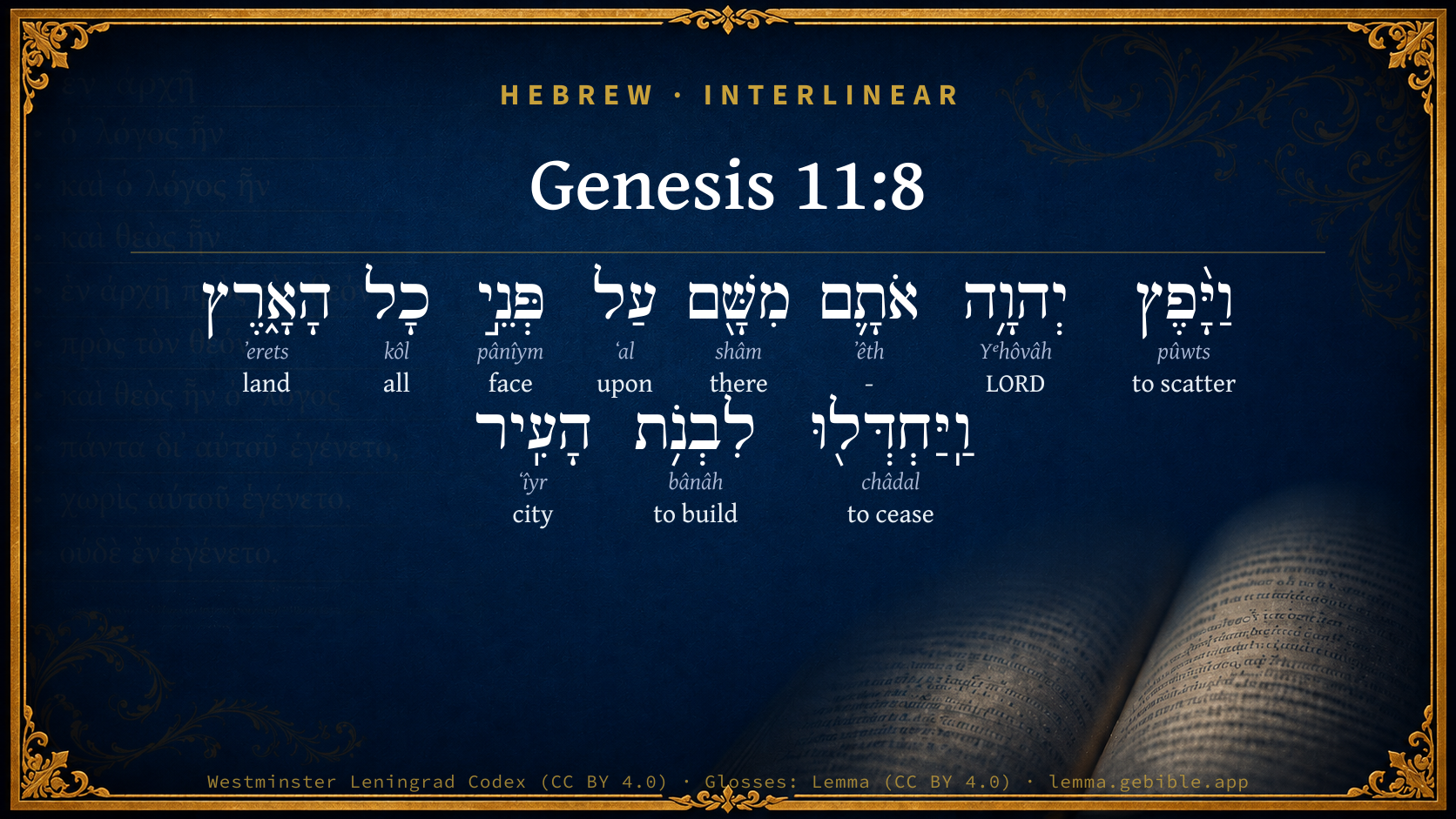
Hebrew (Westminster Leningrad Codex) Genesis 11:8 appears in the Hebrew Old Testament. The text above is from the Westminster Leningrad Codex. Each word links to its Strong’s number, a concise gloss, and parsing drawn from the Open Scriptures Hebrew Bible morphology. Click any word for its full Brown-Driver-Briggs (BDB) entry.
Download image
Cite this verse

Genesis 11:8 (World English Bible). Public Domain. Lemma interlinear Bible study tool, https://lemma.gebible.app/v/genesis/11/8.

Show BibTeX & RIS
BibTeX
RIS
English Translation
So Yahweh scattered them abroad from there on the surface of all the earth. They stopped building the city.
World English Bible · Public Domain
Highlights
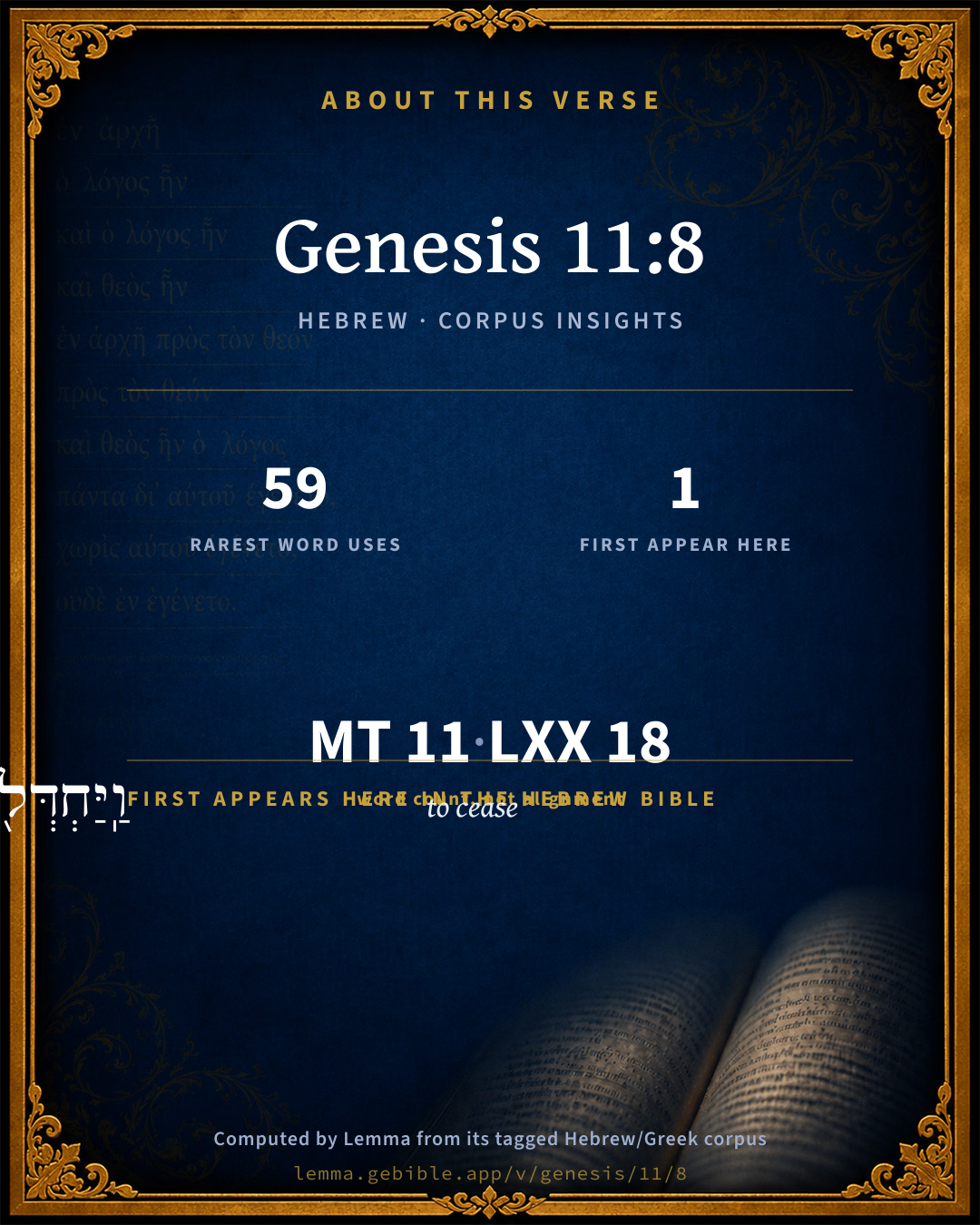
  • 1 first appearance in the Hebrew Bible
Full analysis ↓
Download a study sheet

One document with this verse’s original text, its word-by-word gloss line, the meaning frame, cross-references with their text, attributed commentary, and full source and license credits — printable, and it pastes into notes with its structure intact.

This verse Autodidact and up

Study sheet (.html) Plain text (.txt)

A passage Seminary Student

Up to 50 verses in one chapter. A passage sheet keeps up to 6 commentary sources and 12 cross-references per verse, in the order this page ranks them, and says so on the sheet whenever that leaves anything out. Ask for a single verse and you get the Autodidact verse sheet above.

Everything on this page stays free to read, with no account — the sheet is a download of what is already on screen, not access to it.

Want to remove ads? Support Godless Engineer
Compare translations 3

The same verse in 3 English versions, stacked beneath the original-language interlinear above. Click any original word for its lexicon entry.

Each is an independent rendering of the whole verse — the interlinear is not word-aligned to these translations.

Highlighted words mark where these versions differ — a whole-verse word diff, not a word-by-word alignment.

  • World English Bible Public Domain
    So Yahweh scattered them abroad from there on the surface of all the earth. They stopped building the city.
  • King James Version Public Domain
    So the LORD scattered them abroad from thence upon the face of all the earth: and they left off to build the city.
  • unfoldingWord Literal Text CC BY-SA 4.0
    Then Yahweh scattered them from there over the face of the whole earth, and they stopped building the city.

unfoldingWord Literal Text — © unfoldingWord, licensed CC BY-SA 4.0. Word-aligned USFM3 via Door43 (git.door43.org/unfoldingWord/en_ult).

Versions to compare (up to 4)

3 of 4 selected

Show all 18 translations

Every available English version of this verse, each an independent rendering of the whole verse.

  • World English Bible Public Domain
    So Yahweh scattered them abroad from there on the surface of all the earth. They stopped building the city.
  • Berean Standard Bible Public Domain
    So the LORD scattered them from there over the face of all the earth, and they stopped building the city.
  • Majority Standard Bible Public Domain
    So the LORD scattered them from there over the face of all the earth, and they stopped building the city.
  • King James Version Public Domain
    So the LORD scattered them abroad from thence upon the face of all the earth: and they left off to build the city.
  • American Standard Version (1901) Public Domain
    So Jehovah scattered them abroad from thence upon the face of all the earth: and they left off building the city.
  • Revised Version (1885) Public Domain
    So the LORD scattered them abroad from thence upon the face of all the earth: and they left off to build the city.
  • Geneva Bible (1599) Public Domain
    So ye Lord scattered them from thence vpon all the earth, and they left off to build the citie.
  • Douay-Rheims (1899) Public Domain
    And so the Lord scattered them from that place into all lands, and they ceased to build the city.
  • Young's Literal Translation Public Domain
    And Jehovah doth scatter them from thence over the face of all the earth, and they cease to build the city;
  • Literal Standard Version CC BY-SA 4.0
    And YHWH scatters them from there over the face of all the earth, and they cease to build the city;
  • Unlocked Literal Bible CC BY-SA 4.0
    So Yahweh scattered them from there across the surface of all the earth and they stopped building the city.
  • unfoldingWord Literal Text CC BY-SA 4.0
    Then Yahweh scattered them from there over the face of the whole earth, and they stopped building the city.
  • Darby Bible Public Domain
    And Jehovah scattered them thence over the face of the whole earth. And they left off building the city.
  • World Messianic Bible Public Domain
    So the LORD scattered them abroad from there on the surface of all the earth. They stopped building the city.
  • Webster's Bible Public Domain
    So the LORD scattered them abroad from thence upon the face of all the earth: and they left off to build the city.
  • Free Bible Version CC BY-SA 4.0
    The Lord sent them away from there and scattered them all over the world, and they gave up building the city.
  • Bible in Basic English Public Domain
    So the Lord God sent them away into every part of the earth: and they gave up building their town.
  • JPS Tanakh (1917) Public Domain
    So the LORD scattered them abroad from thence upon the face of all the earth; and they left off to build the city.

Literal Standard Version (2020), Covenant Press — licensed CC BY-SA 4.0. Text via the HelloAO Bible API (eBible.org). Unlocked Literal Bible (unfoldingWord) — licensed CC BY-SA 4.0. Text via the HelloAO Bible API (eBible.org). unfoldingWord Literal Text — © unfoldingWord, licensed CC BY-SA 4.0. Word-aligned USFM3 via Door43 (git.door43.org/unfoldingWord/en_ult). Free Bible Version, Dr. Jonathan Gallagher — licensed CC BY-SA 4.0. Text via the HelloAO Bible API (eBible.org).

Word by word

More ways to search: Search by grammar → Find every occurrence → Compare this word →

Practice this passage: Drill this verse → Learn its vocabulary →

וַֽיַּחְדְּל֖וּ
châdal
H2308
“and · to cease”
Conjunction + Verb, Qal, Sequential Imperfect, 3rd Person, Masculine, Plural
Part of Speech
Conjunction + Verb
Stem
Qal
Form
Sequential Imperfect
Person
3rd Person
Gender
Masculine
Number
Plural
Full BDB Definition

Origin: a primitive root

TWOT: 609

to stop, cease, desist, forego, cease to be, leave undone, forbear - (Qal) - to cease, come to an end - to cease, leave off
  1. וַיָּ֨פֶץ pûwts H6327 “and · to scatter” Conjunction + Verb, Hiphil, Sequential Imperfect, 3rd Person, Masculine, Singular
  2. יְהוָ֥ה Yᵉhôvâh H3068 “LORD” Noun, Proper
  3. אֹתָ֛ם ʼêth H853 “- · them” Particle, Direct Object + Suffix, Personal, 3rd Person, Masculine, Plural
  4. מִשָּׁ֖ם shâm H8033 “from · there” Preposition + Adverb
  5. עַל ʻal H5921 “upon” Preposition
  6. פְּנֵ֣י pânîym H6440 “face(s) of” Noun, Common, Both, Plural, Construct
  7. כָל kôl H3605 “all of” Noun, Common, Masculine, Singular, Construct
  8. הָאָ֑רֶץ ʼerets H776 “the · land” Particle, Definite Article + Noun, Common, Both, Singular, Absolute
  9. לִבְנֹ֥ת bânâh H1129 “to build” Preposition + Verb, Qal, Infinitive Construct
  10. הָעִֽיר ʻîyr H5892 “the · city” Particle, Definite Article + Noun, Common, Feminine, Singular, Absolute

About this verse

These counts appear in no published source. They are computed here, from the morphology-tagged text and Lemma’s own curated glosses. What Lemma adds →

11
words
11
distinct lemmas
Pentateuch
section

First appearance in Scripture

This word makes its first canonical appearance in the Hebrew Bible here:

  • וַֽיַּחְדְּל֖וּ to cease H2308

Shared distinctive vocabulary

וַֽיַּחְדְּל֖וּ to cease H2308 occurs in 56 verses of the Hebrew Bible. Also found in:

Grammatical profile

  • 3 verbs
  • 5 nouns
  • 1 preposition
  • 1 adverb
  • 1 particle

Verb forms

  • וַיָּ֨פֶץ Hiphil · Sequential Imperfect
  • וַֽיַּחְדְּל֖וּ Qal · Sequential Imperfect
  • לִבְנֹ֥ת Qal · Infinitive Construct

Hebrew & Septuagint length

In English translation the verse runs 19 words from the Hebrew and 23 from the Septuagint (LXX English) — closely comparable.

A rough comparison of the two English renderings, which tokenize alike — not a word-level alignment.

Word counts can differ between the Hebrew and the Greek without any difference in meaning — e.g. the Hebrew direct-object marker אֵת has no separate Greek word, and Greek often adds the article ὁ.

In the original languages it is 11 Hebrew tokens and 18 Greek tokens — but the two are counted differently (Hebrew bundles its prefixes and suffixes into one token; the Greek is in lemma form), so that isn’t a like-for-like length.

Cross-references

7

Topical passages linked to Genesis 11:8 in the Treasury of Scripture Knowledge — connected by theme and wording, ordered by reader-vote popularity; previews shown in the World English Bible.

  • Luke 1:51 He has shown strength with his arm. He has scattered the proud in the imagination of their heart.
  • Genesis 10:25 To Eber were born two sons. The name of the one was Peleg, for in his days was the earth divided. His brother's name was Joktan.
  • Genesis 10:32 These are the families of the sons of Noah, after their generations, in their nations. Of these were the nations divided in the earth after the flood.
  • Deuteronomy 32:8 When the Most High gave to the nations their inheritance, When he separated the children of men, He set the bounds of the peoples According to the number of the children of Israel.
  • Genesis 11:4 They said, "Come, let's build us a city, and a tower, whose top reaches to the sky, and let's make us a name; lest we be scattered abroad on the surface of the whole earth."
  • Genesis 11:9 Therefore the name of it was called Babel, because Yahweh confused the language of all the earth, there. From there, Yahweh scattered them abroad on the surface of all the earth.
  • Genesis 49:7 Cursed be their anger, for it was fierce; And their wrath, for it was cruel. I will divide them in Jacob, Scatter them in Israel.

Cross-references courtesy of OpenBible.info (CC BY 4.0).

Hebrew and Greek witnesses Masoretic Hebrew ↔ Greek Septuagint

The same verse in the two great witnesses to the Old Testament, shown verse-for-verse.

These are two independent witnesses, not word-aligned to each other, and the Septuagint is shown in lemma (dictionary) form.

Hebrew Genesis 11:8 Masoretic · Westminster Leningrad Codex

וַיָּ֨פֶץ יְהוָ֥ה אֹתָ֛ם מִשָּׁ֖ם עַל פְּנֵ֣י כָל הָאָ֑רֶץ וַֽיַּחְדְּל֖וּ לִבְנֹ֥ת הָעִֽיר

So Yahweh scattered them abroad from there on the surface of all the earth. They stopped building the city.

World English Bible · Public Domain

Greek LXX Genesis 11:8 Septuagint · lemma form

καί διασπείρω αὐτός κύριος ἐκεῖθεν ἐπί πρόσωπον πᾶς ὁ γῆ καί παύω οἰκοδομέω ὁ πόλις καί ὁ πύργος

And the Lord scattered them thence over the face of all the earth, and they left off building the city and the tower.

LXX2012 (modern English Septuagint) · Public Domain

On this verse, John Gill's Exposition discusses the Septuagint’s reading. Read the note in Commentary ↓

Hebrew: Westminster Leningrad Codex (CC BY 4.0). Greek: Septuagint (public domain); English from LXX2012 (modern English Septuagint) (Public Domain). How the Septuagint differs from the Hebrew →

Targum (Aramaic paraphrase)

2

The Targum is the ancient Jewish Aramaic paraphrase of the Hebrew Scriptures — an interpretive translation, not the Hebrew text itself. Onkelos (literal) and Pseudo-Jonathan (expansive) render the Torah, and Jonathan the Prophets. Coverage is partial: where no permissively-licensed English translation exists for a verse, only the Aramaic is shown. This is verse-level text, not a word-by-word alignment to the Hebrew.

  1. Targum Onkelos Torah (Genesis–Deuteronomy)
    וּבַדַּר יְיָ יָתְהוֹן מִתַּמָּן עַל אַפֵּי כָל אַרְעָא וּמְנָעוּ לְמִבְנֵי (נ''י וְאִתְמְנָע מִלְּמִבְנֵי) קַרְתָּא

    And the Lord dispersed them from thence upon the face of all the earth, and they were restrained from building the city.

    Targum Onkelos — Aramaic: “Onkelos Genesis” (public domain); “Onkelos Exodus” (public domain); “Onkelos Leviticus” (public domain); “Onkelos Numbers” (public domain); “Onkelos Deuteronomy” (public domain). English: “Sefaria Community Translation” (CC0 1.0 (public-domain dedication)); “J.W. Etheridge. The Targums of Onkelos and Jonathan Ben Uzziel on the Pentateuch. London: Longmans, Green, 1862” (public domain). Text via Sefaria.

  2. Targum Pseudo-Jonathan Torah (Genesis–Deuteronomy)
    וְאִגְלִיאַת מֵימְרָא דַיְיָ עֲלוֹי קַרְתָּא וְעִמֵיהּ שׁוּבְעִין מַלְאָכַיָא כָּל קְבֵל שׁוּבְעִין עַמְמַיָא וְכָל חַד וְחַד לִישָׁן עַמְמֵיהּ (נ"א וְרוֹשָׁם כַּתְבֵיהּ) (וּמִשָׁם כַּפְתֵיהּ) בִּידֵיהּ וּבַדְרִינוּן מִתַּמָן עַל אַנְפֵּי כָּל אַרְעָא לְשַׁבְעִין לִישְׁנִין וְלָא הֲוָה יָדַע חַד מַה דְיֵימַר חַבְרֵיהּ וַהֲווֹ קַטְלִין דֵין לְדֵין וּפְסָקוּ מִלִמִבְנֵי קַרְתָּא

    And the Word of the Lord was revealed against the city, and with Him seventy angels, having reference to seventy nations, each having its own language, and thence the writing of its own hand: and He dispersed them from thence upon the face of all the earth into seventy languages. And one knew not what his neighbour would say: but one slew the other; and they ceased from building the city.

    Targum Pseudo-Jonathan — Aramaic: “Targum Jonathan on Genesis” (public domain); “Targum Jonathan on Exodus” (public domain); “Targum Jonathan on Leviticus” (public domain); “Targum Jonathan on Numbers” (public domain); “Targum Jonathan on Deuteronomy” (public domain). English: “The Targum of Jonathan ben Uzziel, trans. J. W. Etheridge, London, 1862” (public domain). Text via Sefaria.

Commentary

Notes on Genesis 11:8 from classic Christian and Jewish commentators (each source and its license shown beneath its notes). The classic Christian expositions comment on the surrounding passage and are grouped to its opening verse, so a note may address several verses; the Jewish commentaries on the Tanakh (Rashi and others) are per-verse, so they appear only where the commentator wrote on this verse.

Lemma curates 59 commentaries, every one of them public domain or Creative Commons licensed, each selected and text-cleaned for this edition rather than reprinted as found. About our sources →

Trapp's Complete Commentary

John Trapp

Gen 11:8 So the LORD scattered them abroad from thence upon the face of all the earth: and they left off to build the city.

Ver. 8. So the Lord scattered them abroad.] Which was the evil they feared, and by this enterprise, sought to prevent. But there is neither counsel, power, nor policy against the Lord. "The fear of the wicked shall come upon him". {Pro 10:24} As it befell those wretched Jews, {Joh 11:48} "The Romans shall come," &c., and come they did accordingly. Pilate, for fear of losing his office, delivered up Christ, and was by Caius kicked off the bench.

John Trapp, A Commentary or Exposition upon All the Books of the Old and New Testament (1647–1656) — public domain. Text from a community e-Sword module.

Tyndale Open Study Notes

Tyndale Open Resources

11:8 the Lord scattered them: Similarly, Adam and Eve’s punishment for grasping at autonomy and Cain’s punishment for murder involved banishment and dispersion (3:23; 4:12, 14; 9:19; 10:5, 25, 32).

Tyndale Open Study Notes — © Tyndale Open Resources, licensed CC BY-SA 4.0. Text via the HelloAO Bible API.

John Calvin's Commentaries

8. So the Lord scattered them abroad. Men had already been spread abroad; and this ought not to be regarded as a punishment, seeing it rather flowed from the benediction and grace of God. But those whom the Lord had before distributed with honor in various abodes, he now ignominiously scatters, driving them hither and thither like the members of a lacerated body. This, therefore, was not a simple dispersion for the replenishing of the earth, that it might every where have cultivators and inhabitants; but a violent rout, because the principal bond of conjunction between them was, cut asunder.

John Calvin's Commentaries (1540-1563) — public domain. Text from the Calvin Translation Society English edition (1840s-50s) via the Christian Classics Ethereal Library (ccel.org). Calvin's coverage is partial (roughly two-thirds of the Bible); uncommented books and verses are honest gaps, never fabricated. The 19th-century editor's footnotes and remarks are omitted so the notes are faithfully Calvin's own voice.

Ellicott's Commentary for English Readers

(8) The Lord (Jehovah) scattered them abroad from thence upon the face of all the earth: and they left off to build the city.—The tendency of men, as the result of a growing diversity of language, was to separate, each tribe holding intercourse only with those who spake their own dialect; and so the Divine purpose of occupying the world was carried into effect, while the project of this ambitious knot of men to hold mankind together was frustrated, and the building of their tower ceased.

A Bible Commentary for English Readers, edited by Charles John Ellicott (1878–1897) — public domain. Text from a community e-Sword module.

The Cambridge Bible for Schools and Colleges

gen. ed. J. J. S. Perowne

8. scattered them abroad] The general result is stated; the means by which the sentence was carried out are not related. Josephus records a tradition that the Tower was overthrown by a mighty wind.

The Cambridge Bible for Schools and Colleges (gen. ed. J. J. S. Perowne; Cambridge University Press, 1878–1918) — public domain. Text from a community e-Sword module.

John Gill's Exposition

So the Lord scattered them abroad from thence, upon the face of all the earth,.... Hence that which they feared came upon them, and what they were so careful to guard against befell them, occasioned by those measures they took to secure themselves from it; for not being able to understand one another, they left off their design, and as many as spoke the same language joined together, and so parted in bodies; some went one way, and some another, and settled in different places, until at length, by degrees, the whole world was peopled by them, which was the will of God should be done, and was brought about in this way. The Heathen writers themselves ascribe this dispersion to a divine Being, as well as speaking different tongues. Eupolemus (n) says, that first the city of Babylon was built by those that were saved from the flood, who were giants; and then they built tower, so much spoken of in history, which falling by the power of God, the giants were "scattered throughout the whole earth". One would think this writer, by his language, must have read this account of Moses: some of them say the fall of the tower was by storms and tempests raised by the gods. So the Sybil in Josephus (o) says,"the gods sending winds overthrew the tower, and gave to every one his own speech, and hence the city came to be called Babylon.''Agreeably to which Abydenus (p), an Assyrian writer, relates, that"the winds being raised by the gods overthrew the mechanism (the tower) upon them (the builders of it), and out of the ruins of it was the city called Babylon, when those who were of the same language, from the gods spoke a different one, and of various sounds.''And so Hestiaeus (q), a Phoenician writer, speaking of those who came to Sennaar or Shinar of Babylon, says, from thence they were scattered; and, because of the diversity of language, formed colonies everywhere, and everyone seized on that land which offered to him. These writers indeed seem to be mistaken as to the destruction of the tower, and that by tempestuous winds; otherwise they agree with Moses in the confusion of languages, and scattering of the people at the tower of Babel: in what year this was done is not certain; it was in the days of Peleg, who was born in the year one hundred and one after the flood; and if it was at the time of his birth, as many are of opinion, both Jews (r) and Christians, it must be in the above year; but the phrase used does not determine that: the eastern writers (s) say, that it was in the fortieth year of the life of Peleg, and then it must be in the year after the flood one hundred and forty one; but others, and which is the common opinion of the Jewish chronologers (t), say it was at the end of Peleg's days; and whereas he lived two hundred and thirty nine years, this must happen in the year three hundred and forty after the flood, and so it was ten years, as they observe, before the death of Noah, and when Abraham was forty eight years of age. But of this see more in Buxtorf's dissertation concerning the confusion of the Hebrew language. It follows here:

and they left off to build the city; it seems they had finished the tower, but not the city, and therefore are only said to leave off building that; though the Samaritan and Septuagint versions add, "and the tower"; for not understanding one another, they were not able to go on with their work, for when they asked for one thing, as before observed out of Jarchi, they had another brought them; which so enraged them, that the Targum of Jonathan says they killed one another; and, say some Jewish writers (u), they fought one with another upon this occasion, until half the world fell by the sword. (Unlike traditions of the Flood, legends of the Tower of Babel and confusion of speech are not common. (12) That said, noteworthy support for the biblical account comes from Babylonia itself, where a damaged inscription reads:"Babylon corruptly proceeded to sin, and both small and great mingled on the mound. ...All day they founded their stronghold, but in the night he put a complete stop to it. In his anger he also poured out his secret counsel to scatter them abroad, he set his face, he gave a command to make foreign their speech.'' (13-15)This appears to have some basis in an historical event and is very close to the biblical account. Likewise, the Roman mythographer Hyginus (floruit 10 BC) writes:"Men for many generations led their lives without towns or laws, speaking one tongue under the rule of Jove. But after Mercury interpreted the language of men--whence an interpreter is called hermeneutes, for Mercury in Greek is called Hermes; he, too, distributed the nations--then discord began amoug the mortals.'' (16)Taken from p. 47, "Creation Technical Journey". Volumn Nine, Part 1, 1995, published by "Creation Science Foundation Ltd.", Brisbane, Australia. (12) Strickling, J. E., 1974. "Legendary evidence for the confusion of tongues." Creation Research Society Quarterly, 11:97-101. (13) Sayce, A. H. (ed.), "Records of the Past" (old Series), Vol. VII, p. 131f. (14) "Journey of American Oriental Society", 88:108-111 (1968) (15) Smith, J., 1876. "Chaldean Account of Genesis", Scribners, New York. (16) Hyginus, C. Julius, Fabulae 143. Editor)

(n) Apud Euseb. Praepar. Evangel. l. 9. c. 17. p. 418. (o) Antiqu. l. 1. c. 4. sect. 13. (p) Apud Euseb. ut supra, (Praepar. Evangel. l. 9.) c. 14. p. 416. (q) Apud Joseph. ut supra. (Antiqu. 1. 1. c. 4. sect. 13.) (r) Vid. Shalshalet Hakabala, fol. 75. 2. (s) Elmacinus, p. 28. Patricides, p. 13. apud Hottinger. Smegma Oriental. p. 267. (t) Seder Olam Rabba, c. 1. p. 1. Juchasin, fol. 8. 1. Shalshalet Hakabala, fol. 1. 2. (u) Pirke Eliezer, c. 24.

John Gill's Exposition of the Whole Bible (1746–1763) — public domain (CC PDM 1.0). Text via the HelloAO Bible API.

Matthew Poole's English Annotations

Thus they brought upon themselves the very thing they feared, and that more speedily and more mischievously to themselves; for now they were not only divided in place, but in language too, and so were unfitted for those confederacies and correspondences which they mainly designed, and for the mutual comfort and help of one another, which otherwise they might in good measure have enjoyed.

Matthew Poole's English Annotations on the Holy Bible (1683–1685) — public domain. Text from a community e-Sword/MySword module.

Whedon's Commentary on the Bible

Daniel D. Whedon

8. Scattered them — Thus, in the days of Peleg, (Gen_10:25,) was effected the division of the nations. It is possible, however, that the Shemites were not involved in this judgment, and that the primitive Shemitic tongue, from which have descended the Hebrew, Arabic, and Syriac, was the language that came out of the ark. Jewish and Gentile traditions relate that lightning split the tower to its foundations; such embellishments of the history would, however, naturally arise from imagination. The present appearance of the Borsippa tower (see on Gen_11:9) may have given rise to this tradition.

Daniel D. Whedon (gen. ed.), Commentary on the Old and New Testaments (1874–1909) — public domain. Text from a community e-Sword module.

The Pulpit Commentary

So (literally, and) the Lord scattered them abroad (as the result of the confusion of their speech) upon the face of all the earth: and they left off to build the city. Ie. as a united community, which does not preclude the idea of the Babylonians subsequently finishing the structure.

The Pulpit Commentary (1880–1919), ed. H.D.M. Spence-Jones & Joseph S. Exell — public domain. Text from a community e-Sword module.

unfoldingWord translationNotes

Door43 World Missions Community

from there

"from the city"

its name was called Babel, because there Yahweh confused

The name "Babel" sounds like the word that means "confused." Translators may want to add a footnote about this.

confused the language of the whole earth

It means that Yahweh caused the people all over the earth to no longer speak the same language. AT: "mixed up the language of the whole earth" (See: Assumed Knowledge and Implicit Information)

translationWords

Yahweh

Babel

unfoldingWord translationNotes — © Distant Shores Media and the Door43 World Missions Community, licensed CC BY-SA 4.0. Source: git.door43.org/Door43/en_tn.

Rashi

Rabbi Shlomo Yitzchaki (Rashi)

ויפץ ה' אתם משם SO THE LORD SCATTERED THEM ABROAD FROM THENCE—In this world (Sanhedrin 107b). What they had said. (Genesis 11:4) “lest we be scattered abroad” really happened to them. This is what Solomon said, (Proverbs 10:24) “What the wicked fears will come upon him” (Midrash Tanchuma, Noach 18).

Rashi on the Tanakh — English translations: “The Judaica Press complete Tanach with Rashi, translated by A. J. Rosenberg” (CC BY 4.0); “Pentateuch with Rashi's commentary by M. Rosenbaum and A.M. Silbermann, 1929-1934” (public domain); “The Metsudah Tanach series, Lakewood, N.J” (CC BY 4.0); and “The Book of Joshua, Metsudah Publications, 1997” (CC BY 4.0). Text via Sefaria.

Radak

Rabbi David Kimhi (Radak)

'ויפץ ה, G’d did not scatter the people by physically depositing them in different parts of the earth. By mixing up their languages, the people themselves started moving away from one another, in accordance with their ability to understand one another, Seeing that they were unable to communicate with one another coherently, their building project had to be aborted at any rate. The dispersal process was gradual, as methods of transportation were severely limited. People moved predominantly north from Mesopotamia, rather than to the desert regions in the southern Arabian peninsula.

לבנות העיר, if they stopped building the city, they most certainly also stopped building the Tower. The city, of smaller dimensions than originally planned, remained, seeing that one group of people speaking the same language remained there.

Radak on the Tanakh — English translations: “Sefaria Community Translation” (CC0 1.0 (public-domain dedication)); “Eliyahu Munk, HaChut Hameshulash” (CC BY 4.0); “Rabbi Mike Feuer, Jerusalem Anthology” (CC BY 4.0); and “R. David Kimhi on the first book of Psalms, Translated by R.G. Finch, London, 1919” (public domain). Text via Sefaria.

Lesson kit

Teaching starters — assembled from the data on this page, not authored interpretation. Every prompt links to the verse data it draws on. Edit before teaching.

Genesis, in the Pentateuch, opens this verse with 11 words (11 distinct Hebrew lemmas). Its most distinctive word is châdal (“to cease”). A historical commentator’s framing appears above. Read the whole chapter for the surrounding context.

Discussion questions

  1. What does “to cease” (châdal) contribute to the verse as a whole?
  2. The word “to cease” first appears here in Scripture. What is being introduced at this debut?
  3. Genesis 18:11 shares the word «to cease» with this verse. How do the two illuminate each other?
  4. The translations on this page render this verse differently — a whole-verse word diff, not a word-by-word alignment. What might account for the different wordings?
  5. The verb «וַיָּ֨פֶץ» is Hiphil Sequential Imperfect. How does its form color the action?
  6. Reading how Trapp's Complete Commentary and Tyndale Open Study Notes read this verse, where do the two commentators agree and where do they part?

Things to notice

Reading settings

Reading text

Shown beneath each verse's original-language words.

Old Testament
Old Testament edition

Read the OT as the Masoretic Hebrew (MT) or the Greek Septuagint (LXX).

English shown for the Greek Septuagint (in the Hebrew ↔ Greek comparison).

Comparing translations? Open the Compare panel on any verse page to stack up to four side by side.