Luke 6:5

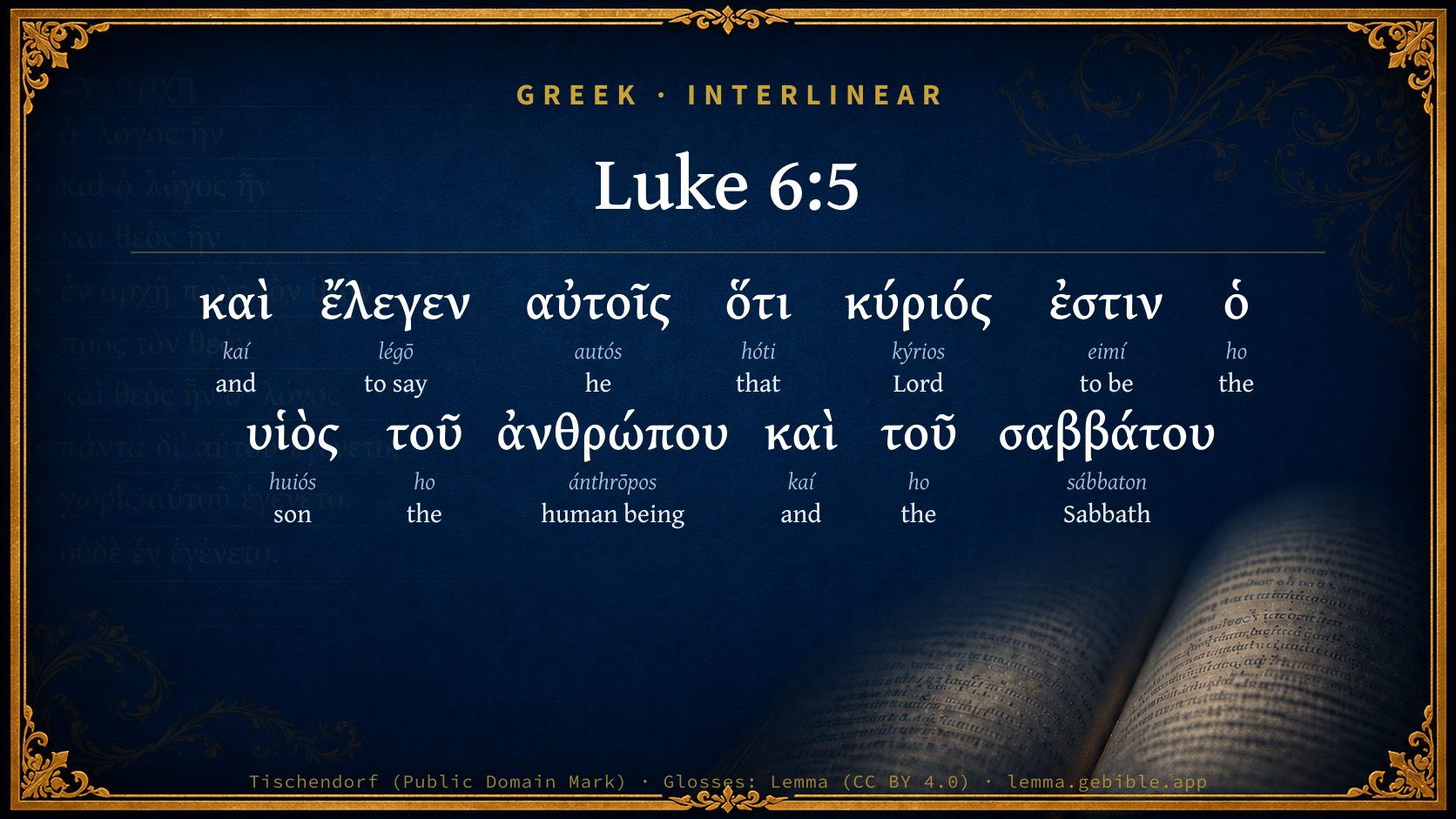
Greek (Tischendorf 8th ed.) Luke 6:5 appears in the Greek New Testament. The text above is from the Tischendorf 8th edition. Each word links to its Strong’s number and a concise gloss. Click any word for its full Thayer’s Greek Lexicon entry.
Download image
Cite this verse

Luke 6:5 (World English Bible). Public Domain. Lemma interlinear Bible study tool, https://lemma.gebible.app/v/luke/6/5.

Show BibTeX & RIS
BibTeX
RIS
English Translation
He said to them, "The Son of Man is lord of the Sabbath."
World English Bible · Public Domain
Download a study sheet

One document with this verse’s original text, its word-by-word gloss line, the meaning frame, cross-references with their text, attributed commentary, and full source and license credits — printable, and it pastes into notes with its structure intact.

This verse Autodidact and up

Study sheet (.html) Plain text (.txt)

A passage Seminary Student

Up to 50 verses in one chapter. A passage sheet keeps up to 6 commentary sources and 12 cross-references per verse, in the order this page ranks them, and says so on the sheet whenever that leaves anything out. Ask for a single verse and you get the Autodidact verse sheet above.

Everything on this page stays free to read, with no account — the sheet is a download of what is already on screen, not access to it.

Want to remove ads? Support Godless Engineer
Compare translations 3

The same verse in 3 English versions, stacked beneath the original-language interlinear above. Click any original word for its lexicon entry.

Each is an independent rendering of the whole verse — the interlinear is not word-aligned to these translations.

Highlighted words mark where these versions differ — a whole-verse word diff, not a word-by-word alignment.

  • World English Bible Public Domain
    He said to them, "The Son of Man is lord of the Sabbath."
  • King James Version Public Domain
    And he said unto them, That the Son of man is Lord also of the sabbath.
  • unfoldingWord Literal Text CC BY-SA 4.0
    And he said to them, “The Son of Man is Lord of the Sabbath.”

unfoldingWord Literal Text — © unfoldingWord, licensed CC BY-SA 4.0. Word-aligned USFM3 via Door43 (git.door43.org/unfoldingWord/en_ult).

Versions to compare (up to 4)

3 of 4 selected

Show all 19 translations

Every available English version of this verse, each an independent rendering of the whole verse.

  • World English Bible Public Domain
    He said to them, "The Son of Man is lord of the Sabbath."
  • Berean Standard Bible Public Domain
    Then Jesus declared, “The Son of Man is Lord of the Sabbath.”
  • Majority Standard Bible Public Domain
    Then Jesus declared, “The Son of Man is Lord even of the Sabbath.”
  • King James Version Public Domain
    And he said unto them, That the Son of man is Lord also of the sabbath.
  • American Standard Version (1901) Public Domain
    And he said unto them, The Son of man is lord of the sabbath.
  • Revised Version (1885) Public Domain
    And he said unto them, The Son of man is lord of the sabbath.
  • Geneva Bible (1599) Public Domain
    And he sayd vnto them, The Sonne of man is Lord also of the Sabbath day.
  • Douay-Rheims (1899) Public Domain
    And he said to them: The Son of man is Lord also of the sabbath.
  • Young's Literal Translation Public Domain
    and he said to them, -- `The Son of Man is lord also of the sabbath.'
  • Literal Standard Version CC BY-SA 4.0
    And He said to them, “The Son of Man is Lord also of the Sabbath.”
  • Unlocked Literal Bible CC BY-SA 4.0
    Then he said to them, “The Son of Man is Lord of the Sabbath.”
  • unfoldingWord Literal Text CC BY-SA 4.0
    And he said to them, “The Son of Man is Lord of the Sabbath.”
  • Darby Bible Public Domain
    And he said to them, The Son of man is Lord of the sabbath also.
  • World Messianic Bible Public Domain
    He said to them, “The Son of Man is lord of the Sabbath.”
  • Webster's Bible Public Domain
    And he said to them, That the Son of man is Lord also of the sabbath.
  • Free Bible Version CC BY-SA 4.0
    Then he told them, “The Son of man is Lord of the Sabbath.”
  • Bible in Basic English Public Domain
    And he said, The Son of man is lord even of the Sabbath.
  • Text-Critical English NT CC BY 4.0
    Then he said to them, “The Son of Man is Lord even of the Sabbath.”
  • Tyndale New Testament (1534) Public Domain
    And he sayde vnto them: The sonne of man is Lorde of the saboth daye.

Literal Standard Version (2020), Covenant Press — licensed CC BY-SA 4.0. Text via the HelloAO Bible API (eBible.org). Unlocked Literal Bible (unfoldingWord) — licensed CC BY-SA 4.0. Text via the HelloAO Bible API (eBible.org). unfoldingWord Literal Text — © unfoldingWord, licensed CC BY-SA 4.0. Word-aligned USFM3 via Door43 (git.door43.org/unfoldingWord/en_ult). Free Bible Version, Dr. Jonathan Gallagher — licensed CC BY-SA 4.0. Text via the HelloAO Bible API (eBible.org).

Word by word

More ways to search: Search by grammar → Find every occurrence → Compare this word →

Practice this passage: Drill this verse → Learn its vocabulary →

σαββάτου
sábbaton
G4521
“Sabbath”
Noun, Genitive, Singular, Neuter
Part of Speech
Noun
Case
Genitive
Number
Singular
Gender
Neuter
Full Thayer's Definition

Origin: of hebrew origin H7676

TDNT: 07:02,0

1. the seventh day of each week which was a sacred festival on which the Israelites were required to abstain from all work a. the institution of the sabbath, the law for keeping holy every seventh day of the week b. a single sabbath, sabbath day 2. seven days, a week
  1. καὶ kaí G2532 “and” Conjunction
  2. ἔλεγεν légō G3004 “to say” Verb, Imperfect, Active, Indicative, 3rd person, Singular
  3. αὐτοῖς autós G846 “he” Personal pronoun, Dative, Plural, Masculine
  4. ὅτι hóti G3754 “that” Conjunction
  5. κύριός kýrios G2962 “Lord” Noun, Nominative, Singular, Masculine
  6. ἐστιν eimí G1510 “to be” Verb, Present, Active, Indicative, 3rd person, Singular
  7. ὁ ho G3588 “the” Article, Nominative, Singular, Masculine
  8. υἱὸς huiós G5207 “son” Noun, Nominative, Singular, Masculine
  9. τοῦ ho G3588 “the” Article, Genitive, Singular, Masculine
  10. ἀνθρώπου ánthrōpos G444 “human being” Noun, Genitive, Singular, Masculine
  11. καὶ kaí G2532 “and” Conjunction
  12. τοῦ ho G3588 “the” Article, Genitive, Singular, Neuter

About this verse

These counts appear in no published source. They are computed here, from the morphology-tagged text and Lemma’s own curated glosses. What Lemma adds →

13
words
10
distinct lemmas
Gospels
section

Repetition

Words recur within this verse:

Cross-references

3

Topical passages linked to Luke 6:5 in the Treasury of Scripture Knowledge — connected by theme and wording, ordered by reader-vote popularity; previews shown in the World English Bible.

  • Mark 2:27 He said to them, "The Sabbath was made for man, not man for the Sabbath.
  • Revelation 1:10 I was in the Spirit on the Lord's day, and I heard behind me a loud voice, like a trumpet
  • Mark 9:7 A cloud came, overshadowing them, and a voice came out of the cloud, "This is my beloved Son. Listen to him."

Cross-references courtesy of OpenBible.info (CC BY 4.0).

Commentary

Notes on Luke 6:5 from classic Christian and Jewish commentators (each source and its license shown beneath its notes). The classic Christian expositions comment on the surrounding passage and are grouped to its opening verse, so a note may address several verses; the Jewish commentaries on the Tanakh (Rashi and others) are per-verse, so they appear only where the commentator wrote on this verse.

Lemma curates 59 commentaries, every one of them public domain or Creative Commons licensed, each selected and text-cleaned for this edition rather than reprinted as found. About our sources →

The Biblical Illustrator

Joseph S. Exell

Luk_6:5

That the Son of Man is Lord also of the Sabbath

A spiritual man Lord of the Sabbath

When is a son of man lord of the Sabbath-day?

To whom may the Sabbath safely become a shadow? I reply, he that has the mind of Christ may exercise discretionary lordship over the Sabbath-day. He who is in possession of the substance may let the shadow go. A man in health has done with the prescriptions of the physician. But for an unspiritual man to regulate his hours and amount of rest by his desires, is just as preposterous as for an unhealthy man to rule his appetites by his sensations. Win the mind of Christ--be like Him--and then in the reality of rest in God, the Sabbath form of rest will be superseded. Remain apart from Christ, and then you are under the law again--the fourth commandment is as necessary for you as it was for the Israelite; the prescriptive regimen which may discipline your soul to a sounder state. It is at his peril that the worldly man departs from the rule of the day of rest. Nothing can make us free from the law but the Spirit. (F. W. Robertson, M. A.)

Jesus and the two ideals

I. THE TITLE HE GIVES HIMSELF. Son of Man. We find Him both humbled and exalted as the Son of Man. As the Son of Man He hath not where to lay His head; and as the Son of Man He claims authority to forgive sin, and is Lord even of the Sabbath-day. He applied this phrase to Himself in all the different aspects of His great life. In Him, as the Son of Man, humanity is again in its Sonship of God.

II. THE CLAIM HE MAKES ON HIS OWN BEHALF, as Lord even of the Sabbath-day. The perfection of God and the perfection of man, as depicted in the Bible, are two distinct, and, out of their own spheres, incompatible ideals. These two ideals seem to have met in the Christ. He is humble and self-assertive, receptive and full. Authority and obedience meet in Him and blend. (J. Ogrnore Davies.)

The Sabbath, a saving economy

Sunday is Gods special present to the working man; and one of its chief objects is to prolong his life, and to preserve efficient his working tone. In the vital system it acts like a compensation pond; it replenishes the spirits, the elasticity and vigour which the last six days have drained away, and supplies the force which is to fill the six days succeeding. In the economy of life it answers the same purpose as, in the economy of income, is answered by a savings-bank. The frugal man who puts asides a pound to-day, and another pound next month, and who, in a quiet way, is always putting by his stated pound from time to time, when he grows old and frail gets not only the same pounds back again, but a good many pounds besides. And the conscientious man who husbands one day of existence every week--who, instead of allowing the Sunday to be trampled and torn in the hurry and scramble of life, treasures it devoutly up--will find that the Lord of the Sabbath keeps it for him, and in length of days and a hale old age gives it back with usury. The savings-bank of human existence is the weekly Sunday. (North British Review.)

The Biblical Illustrator, edited by Joseph S. Exell (c. 1880s–1900s) — public domain. Text from a community e-Sword module.

Tyndale Open Study Notes

Tyndale Open Resources

6:5 Lord, even over the Sabbath: The saying is a play on words with a double meaning. First, son of man often means “human being,” so Jesus affirmed that the Sabbath was made to serve human beings. Son of Man was also a title for the Messiah (see Dan 7:13-14). Jesus is Lord of the Sabbath because he created it.

Tyndale Open Study Notes — © Tyndale Open Resources, licensed CC BY-SA 4.0. Text via the HelloAO Bible API.

Expositor's Greek Testament

ed. W. Robertson Nicoll

Luk 6:5 . καὶ ἔλεγεν : in Lk. this important logion about the Son of Man’s Lordship over the Sabbath is simply an external annex to what goes before = and He said: instead of arising out of and crowning the argument, as in Mt., and partly in Mk., though the latter uses the same phrase in introducing the logion peculiar to him about the Sabbath being made for man. If Lk. had Mk. before him, how could he omit so important a word? Perhaps because it involved a controversial antithesis not easily intelligible to Gentiles, and because the Lordship of the Son of Man covered all in his view. How did he and his readers understand that Lordship?

The Expositor's Greek Testament, edited by W. Robertson Nicoll (1897–1910) — public domain. Text from a community e-Sword module.

Jamieson, Fausset & Brown

Robert Jamieson, A. R. Fausset & David Brown

Lord also--rather "even" (as in Mat 12:8).

of the sabbath--as naked a claim to all the authority of Him who gave the law at Mount Sinai as could possibly be made; that is, "I have said enough to vindicate the men ye carp at on My account: but in this place is the Lord of the law, and they have His sanction." (See Mar 2:28.)

Jamieson, Fausset & Brown — Commentary Critical and Explanatory on the Whole Bible (1871) — public domain (CC PDM 1.0). Text via the HelloAO Bible API.

John Gill's Exposition

And it came to pass also on another sabbath,.... Whether the following sabbath, or some time after, is not certain,

that he entered into the synagogue. The Arabic version reads, "into their synagogue", as in Mat 12:9 the synagogue of the Jews; in what place, whether at Capernaum, or some other city of Galilee, is not so clear:

and taught; explained the Scriptures to the people, and instructed them in the doctrines of the Gospel:

and there was a man whose right hand was withered; who was in the synagogue, and one of his hearers; See Gill on Mat 12:10

John Gill's Exposition of the Whole Bible (1746–1763) — public domain (CC PDM 1.0). Text via the HelloAO Bible API.

Trapp's Complete Commentary

John Trapp

5 And he said unto them, That the Son of man is Lord also of the sabbath.

Ver. 5. See Mat 12:3-4 Mar 2:24.

John Trapp, A Commentary or Exposition upon All the Books of the Old and New Testament (1647–1656) — public domain. Text from a community e-Sword module.

The Pulpit Commentary

And he said unto them, That the Son of man is Lord also of the sabbath. The Master closed his reply to the Pharisee inquirers with one of those short assertions of his awful greatness which puzzled and alarmed his jealous foes. Who, then, was he, this poor unknown Carpenter of despised and ignorant Nazareth? He was either a blasphemer too wicked to be allowed to live, or the alternative must have been a very awful thought to some of the nobler spirits among those Jerusalem learned men. Across their minds must have flitted not once or twice in that eventful period some anxious questionings as to who and what was the strange and powerful Being who had appeared in their midst.

The Pulpit Commentary (1880–1919), ed. H.D.M. Spence-Jones & Joseph S. Exell — public domain. Text from a community e-Sword module.

Cambridge Greek Testament for Schools and Colleges

5. καὶ ἔλεγεν. Marking a weighty addition to the subject, see Luk 5:36. The following utterance is one of Christ’s great intimations of Christian freedom from mere legalism.

κύριος … καὶ τοῦ σαββάτου. ‘Lord even of the Sabbath,’ though you regard the Sabbath as the most important command of the whole Law. In St Mark we have further, “the Sabbath was made for man, and not man for the Sabbath.”

This was one of no less than six great occasions on which the fury of the Pharisees had been excited by the open manner in which our Lord set aside as frivolous and unauthoritative the burdens which the Oral Law had attached to the Sabbath. The other instances are the healing of the cripple at Bethesda (Joh 5:1-16); the healing of the withered hand (Luk 6:1-11); of the blind man at Siloam (Joh 9:1-41); of the paralytic woman (Luk 13:14-17); and of the man with the dropsy (Luk 14:1-6). In laying His axe at the root of a proud and ignorant Sabbatarianism, He was laying His axe at the root of all that “miserable micrology” which they had been accustomed to take for religious life. They had turned the Sabbath from a holy delight into a revolting bondage. The Apocryphal Gospels are following a true tradition in the prominence which they give to Sabbath healing, as a charge against Him on His trial before the Sanhedrin.

In the famous Cambridge Manuscript (D), the Codex Bezae, there is here added the following passage: τῇ αὐτῇ ἡμέρᾳ θεασάμενός τινα ἐργαζόμενον τῷ σαββάτῳ εἶπεν αὐτῷ· ἄνθρωπε εἰ μὲν οἶδας τί ποιεῖς μακάριος εἶ· εἰ δὲ μὴ οἶδας ἐπικατάρατος καὶ παραβάτης εἶ τοῦ νόμου. “On the same day, observing one working on the Sabbath, He said to him O man, if indeed thou knowest what thou doest, thou art blessed: but if thou knowest not, thou art accursed, and a transgressor of the Law.” This very remarkable addition cannot be accepted as genuine on the authority of a single MS., and can only be regarded as one of the agrapha dogmata, or ‘unrecorded traditional sayings’ of our Lord. The meaning of the story is that ‘if thy work is of faith,—if thou art thoroughly persuaded in thy own mind—thou art acting with true insight; but if thy work is not of faith, it is sin.’ See Rom 14:22-23; 1Co 8:1. What renders the incident improbable is that no Jew would dare openly to violate the Law by working on the Sabbath, an act which rendered him legally liable to be stoned. The anecdote, as Grotius thought, may have been written in the margin by some follower of Marcion, who rejected the inspiration of the Old Testament.

Cambridge Greek Testament for Schools and Colleges (Cambridge University Press, 1896; 21 vols, various authors incl. Carr, Maclear, Plummer, Farrar, Lumby, Moule, M. R. James, Simcox) — public domain. Text from a community e-Sword module.

International Critical Commentary

5. κύριός ἐστιν τοῦ σαββάτου ὁ υἱὸς τοῦ ἀνθρώπου. In all three accounts Κύριος comes first with emphasis. The Son of Man controls the Sabbath, not is controlled by it. This does not mean that He abrogates it (Mat 5:17-20), but that He has power to cancel the literal observance of it in order to perform or permit what is in accordance with its spirit. Mk. gives the additional reason that “the sabbath was made for man, and not man for the sabbath,” i.e. that it was given to be a blessing, not a burden. Even the Rabbis sometimes saw this; “The sabbath is handed over to you; not, ye are handed over to the sabbath” (Edersh. L. & T. 2. p. 58). Ritual must give way to charity. The Divine character of the Law is best vindicated by making it lovable; and the Pharisees had made it an iron taskmaster. And, if the sabbath gives way to man, much more to the Son of Man. In Joh 5:17 Christ takes still higher ground. The Father knows no sabbath in working for man’s good, and the Son has the same right and liberty. For ὁ υἱὸς τοῦ ἀνθρώπου see on 5:24. The point here is that Christ as the representative of man defends man’s liberty.

Cod. D transfers ver. 5 to after ver. 10, and instead of it has the remarkable insertion: τῆς αὐτῆς ἡμέρα θεασάμενός τινα ἐργαζόμενον τῶς σαββάτως εἶπεν αὐτῶς ἄνθθρωπε, εἰ μὲν οἰδας τί ποιεῖς, μακάριος εἰ· δὲ μὴ οἰδας, ἐπικατάρατος καὶ παραβάτης εἶ τοῦ νόμου. For ἄνθρωπε comp. 12:14; ἐπικατάρατος Gal 3:10; παραβάτης νόμου, Rom 2:25, Rom 2:27; Jas 2:11. It is possible that the tradition here preserved in Cod. D is the source from which both S. Paul and S. James derive the phrase παραβάτης νόμου. In Rom. 2., where it occurs twice, we have the address ἄνθρωπε twice (vv. 1, 3). There is nothing incredible in Christ’s having seen a man working (not necessarily in public) on the sabbath. The words attributed to Christ are so unlike the undignified, silly, and even immoral inventions in the apocryphal gospels that we may believe that this traditional story is true, although it is no part of the Canonical Gospels. D has other considerable insertions Mat 20:28 and Joh 6:56. See A. Resch, Agrapha Aussercanonische Evangelienfragmente (Leipzig, 1889) pp. 36, 189.

International Critical Commentary — older volumes (1896–1929), various authors — public domain. Text from a community e-Sword module.

Vincent's Word Studies in the New Testament

Marvin R. Vincent

Lord of the Sabbath. See on Mt 12:6.

6 - 11. Compare Mt 12:9 - 14; Mr 3:1 - 6.

Marvin R. Vincent, Word Studies in the New Testament (1887–1900) — public domain. Text from a community e-Sword/MySword module.

Lesson kit

Teaching starters — assembled from the data on this page, not authored interpretation. Every prompt links to the verse data it draws on. Edit before teaching.

Luke, in the Gospels, opens this verse with 13 words (10 distinct Greek lemmas). Its most distinctive word is sábbaton (“Sabbath”). A historical commentator’s framing appears above. Read the whole chapter for the surrounding context.

Discussion questions

  1. What does “Sabbath” (sábbaton) contribute to the verse as a whole?
  2. Mark 2:27 shares this passage’s theme. How do the two illuminate each other?
  3. “the” occurs 3× in this one verse. What is the effect of the repetition?
  4. The translations on this page render this verse differently — a whole-verse word diff, not a word-by-word alignment. What might account for the different wordings?
  5. Reading how The Biblical Illustrator and Tyndale Open Study Notes read this verse, where do the two commentators agree and where do they part?

Things to notice

  • These translations choose different wording for 1 word in this verse.
  • “the” occurs 3× in this single verse.
  • 10 distinct Greek lemmas span 13 words in this verse.

Reading settings

Reading text

Shown beneath each verse's original-language words.

Old Testament
Old Testament edition

Read the OT as the Masoretic Hebrew (MT) or the Greek Septuagint (LXX).

English shown for the Greek Septuagint (in the Hebrew ↔ Greek comparison).

Comparing translations? Open the Compare panel on any verse page to stack up to four side by side.