
Luke 19:8

Greek (Tischendorf 8th ed.) Luke 19:8 appears in the Greek New Testament. The text above is from the Tischendorf 8th edition. Each word links to its Strong’s number and a concise gloss. Click any word for its full Thayer’s Greek Lexicon entry.
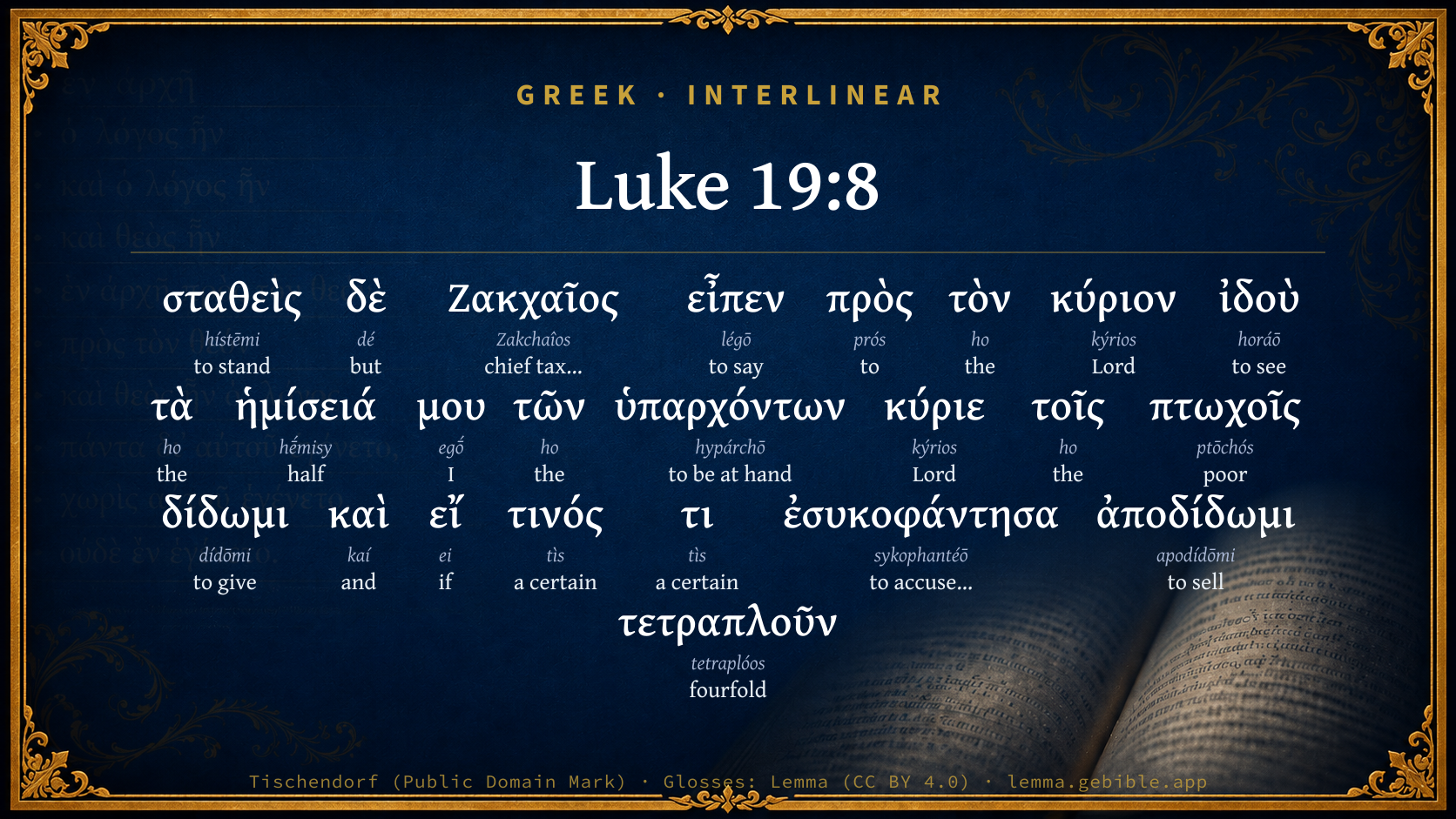
Download image
Cite this verse

Luke 19:8 (World English Bible). Public Domain. Lemma interlinear Bible study tool, https://lemma.gebible.app/v/luke/19/8.

Show BibTeX & RIS
BibTeX
RIS
English Translation
Zacchaeus stood and said to the Lord, "Behold, Lord, half of my goods I give to the poor. If I have wrongfully exacted anything of anyone, I restore four times as much."
World English Bible · Public Domain
Highlights
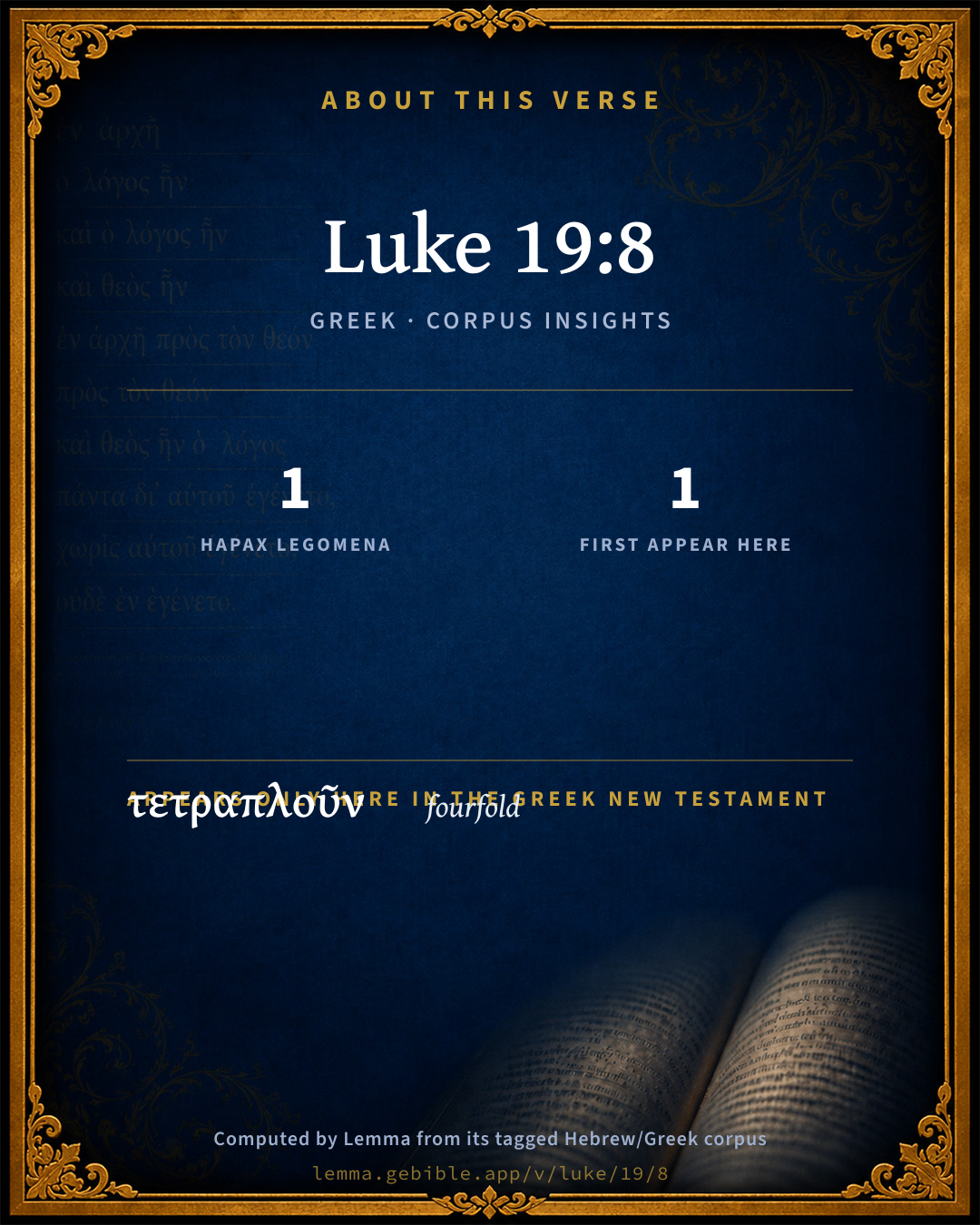
  • 1 hapax legomenon — only here in the Greek New Testament
  • 1 first appearance in the Greek New Testament
Full analysis ↓
Download a study sheet

One document with this verse’s original text, its word-by-word gloss line, the meaning frame, cross-references with their text, attributed commentary, and full source and license credits — printable, and it pastes into notes with its structure intact.

This verse Autodidact and up

Study sheet (.html) Plain text (.txt)

A passage Seminary Student

Up to 50 verses in one chapter. A passage sheet keeps up to 6 commentary sources and 12 cross-references per verse, in the order this page ranks them, and says so on the sheet whenever that leaves anything out. Ask for a single verse and you get the Autodidact verse sheet above.

Everything on this page stays free to read, with no account — the sheet is a download of what is already on screen, not access to it.

Want to remove ads? Support Godless Engineer
Compare translations 3

The same verse in 3 English versions, stacked beneath the original-language interlinear above. Click any original word for its lexicon entry.

Each is an independent rendering of the whole verse — the interlinear is not word-aligned to these translations.

Highlighted words mark where these versions differ — a whole-verse word diff, not a word-by-word alignment.

  • World English Bible Public Domain
    Zacchaeus stood and said to the Lord, "Behold, Lord, half of my goods I give to the poor. If I have wrongfully exacted anything of anyone, I restore four times as much."
  • King James Version Public Domain
    And Zacchaeus stood, and said unto the Lord: Behold, Lord, the half of my goods I give to the poor; and if I have taken any thing from any man by false accusation, I restore him fourfold.
  • unfoldingWord Literal Text CC BY-SA 4.0
    But having stood, Zacchaeus said to the Lord, “Behold, Lord, the half of my possessions I give to the poor, and if I have defrauded anything from anyone, I will restore four-fold.”

unfoldingWord Literal Text — © unfoldingWord, licensed CC BY-SA 4.0. Word-aligned USFM3 via Door43 (git.door43.org/unfoldingWord/en_ult).

Versions to compare (up to 4)

3 of 4 selected

Show all 19 translations

Every available English version of this verse, each an independent rendering of the whole verse.

  • World English Bible Public Domain
    Zacchaeus stood and said to the Lord, "Behold, Lord, half of my goods I give to the poor. If I have wrongfully exacted anything of anyone, I restore four times as much."
  • Berean Standard Bible Public Domain
    But Zacchaeus stood up and said to the Lord, “Look, Lord, half of my possessions I give to the poor, and if I have cheated anyone, I will repay it fourfold.”
  • Majority Standard Bible Public Domain
    But Zacchaeus stood up and said to the Lord, “Look, Lord, half of my possessions I give to the poor, and if I have cheated anyone, I will repay it fourfold.”
  • King James Version Public Domain
    And Zacchaeus stood, and said unto the Lord: Behold, Lord, the half of my goods I give to the poor; and if I have taken any thing from any man by false accusation, I restore him fourfold.
  • American Standard Version (1901) Public Domain
    And Zacchaeus stood, and said unto the Lord, Behold, Lord, the half of my goods I give to the poor; and if I have wrongfully exacted aught of any man, I restore fourfold.
  • Revised Version (1885) Public Domain
    And Zacchaeus stood, and said unto the Lord, Behold, Lord, the half of my goods I give to the poor; and if I have wrongfully exacted aught of any man, I restore fourfold.
  • Geneva Bible (1599) Public Domain
    And Zaccheus stood forth, and said vnto the Lord, Beholde, Lord, the halfe of my goods I giue to the poore: and if I haue taken from any man by forged cauillation, I restore him foure folde.
  • Douay-Rheims (1899) Public Domain
    But Zacheus standing, said to the Lord: Behold, Lord, the half of my goods I give to the poor; and if I have wronged any man of any thing, I restore him fourfold.
  • Young's Literal Translation Public Domain
    And Zaccheus having stood, said unto the Lord, `Lo, the half of my goods, sir, I give to the poor, and if of any one anything I did take by false accusation, I give back fourfold.'
  • Literal Standard Version CC BY-SA 4.0
    And Zaccheus having stood, said to the LORD, “Behold, half of my goods, Lord, I give to the poor, and if I took by false accusation anything of anyone, I give back fourfold.”
  • Unlocked Literal Bible CC BY-SA 4.0
    Zacchaeus stood and said to the Lord, “Look, Lord, the half of my goods I give to the poor, and if I have cheated anyone of anything, I will restore four times the amount.”
  • unfoldingWord Literal Text CC BY-SA 4.0
    But having stood, Zacchaeus said to the Lord, “Behold, Lord, the half of my possessions I give to the poor, and if I have defrauded anything from anyone, I will restore four-fold.”
  • Darby Bible Public Domain
    But Zacchaeus stood and said to the Lord, Behold, Lord, the half of my goods I give to the poor, and if I have taken anything from any man by false accusation, I return [him] fourfold.
  • World Messianic Bible Public Domain
    Zacchaeus stood and said to the Lord, “Behold, Lord, half of my goods I give to the poor. If I have wrongfully exacted anything of anyone, I restore four times as much.”
  • Webster's Bible Public Domain
    And Zaccheus stood, and said to the Lord; Behold, Lord, the half of my goods I give to the poor; and if I have taken any thing from any man by false accusation, I restore him four-fold.
  • Free Bible Version CC BY-SA 4.0
    But Zacchaeus stood up and said before the Lord, “Look, I'm giving half of everything I own to the poor, and if I've cheated anybody, I'll pay them back four times as much!”
  • Bible in Basic English Public Domain
    And Zacchaeus, waiting before him, said to the Lord, See, Lord, half of my goods I give to the poor, and if I have taken anything from anyone wrongly, I give him back four times as much.
  • Text-Critical English NT CC BY 4.0
    But Zacchaeus stood there and said to the Lord, “Behold, half of my goods, Lord, I give to the poor, and if I have extorted anything from anyone, I will pay back four times the amount.”
  • Tyndale New Testament (1534) Public Domain
    And zache stode forth and sayd vnto the Lorde: beholde Lorde the haulfe of my gooddes I geve to the povre and if I have done eny man wronge I will restore him fower folde.

Literal Standard Version (2020), Covenant Press — licensed CC BY-SA 4.0. Text via the HelloAO Bible API (eBible.org). Unlocked Literal Bible (unfoldingWord) — licensed CC BY-SA 4.0. Text via the HelloAO Bible API (eBible.org). unfoldingWord Literal Text — © unfoldingWord, licensed CC BY-SA 4.0. Word-aligned USFM3 via Door43 (git.door43.org/unfoldingWord/en_ult). Free Bible Version, Dr. Jonathan Gallagher — licensed CC BY-SA 4.0. Text via the HelloAO Bible API (eBible.org).

Word by word

More ways to search: Search by grammar → Find every occurrence → Compare this word →

Practice this passage: Drill this verse → Learn its vocabulary →

τετραπλοῦν
tetraplóos
G5073
“fourfold”
Adjective, Accusative, Singular, Neuter
Part of Speech
Adjective
Case
Accusative
Number
Singular
Gender
Neuter
Full Thayer's Definition

Origin: from G5064 and a derivative of the base of G4118

TDNT: None

1. quadruple, fourfold
  1. σταθεὶς hístēmi G2476 “to stand” Verb, Aorist, Passive, Participle, Nominative, Singular, Masculine
  2. δὲ dé G1161 “but” Conjunction
  3. Ζακχαῖος Zakchaîos G2195 “chief tax collector” Noun, Nominative, Singular, Masculine
  4. εἶπεν légō G3004 “to say” Verb, Aorist, Active, Indicative, 3rd person, Singular
  5. πρὸς prós G4314 “to” Preposition
  6. τὸν ho G3588 “the” Article, Accusative, Singular, Masculine
  7. κύριον kýrios G2962 “Lord” Noun, Accusative, Singular, Masculine
  8. ἰδοὺ horáō G3708 “to see” Verb, Aorist, Middle, Imperative, 2nd person, Singular
  9. τὰ ho G3588 “the” Article, Accusative, Plural, Neuter
  10. ἡμίσειά hḗmisy G2255 “half” Adjective, Accusative, Plural, Neuter
  11. μου egṓ G1473 “I” Personal pronoun, 1st person, Genitive, Singular
  12. τῶν ho G3588 “the” Article, Genitive, Plural, Neuter
  13. ὑπαρχόντων hypárchō G5225 “to be at hand” Verb, Present, Active, Participle, Genitive, Plural, Neuter
  14. κύριε kýrios G2962 “Lord” Noun, Vocative, Singular, Masculine
  15. τοῖς ho G3588 “the” Article, Dative, Plural, Masculine
  16. πτωχοῖς ptōchós G4434 “poor” Adjective, Dative, Plural, Masculine
  17. δίδωμι dídōmi G1325 “to give” Verb, Present, Active, Indicative, 1st person, Singular
  18. καὶ kaí G2532 “and” Conjunction
  19. εἴ ei G1487 “if” Conditional
  20. τινός tìs G5100 “a certain” Indefinite pronoun, Genitive, Singular, Masculine
  21. τι tìs G5100 “a certain” Indefinite pronoun, Accusative, Singular, Neuter
  22. ἐσυκοφάντησα sykophantéō G4811 “to accuse wrongfully” Verb, Aorist, Active, Indicative, 1st person, Singular
  23. ἀποδίδωμι apodídōmi G591 “to sell” Verb, Present, Active, Indicative, 1st person, Singular

About this verse

These counts appear in no published source. They are computed here, from the morphology-tagged text and Lemma’s own curated glosses. What Lemma adds →

24
words
19
distinct lemmas
Gospels
section

Notable vocabulary

1 hapax legomenon — a word that appears only here in the entire Greek New Testament:

  • τετραπλοῦν fourfold G5073

First appearance in Scripture

This word makes its first canonical appearance in the Greek New Testament here:

  • τετραπλοῦν fourfold G5073

Shared distinctive vocabulary

ἐσυκοφάντησα to accuse wrongfully G4811 occurs in 2 verses of the Greek New Testament. Also found in:
Repetition

Words recur within this verse:

  • κύριον Lord G2962 ×2
  • τινός a certain G5100 ×2
  • τὸν the G3588 ×4

Cross-references

16

Topical passages linked to Luke 19:8 in the Treasury of Scripture Knowledge — connected by theme and wording, ordered by reader-vote popularity; previews shown in the World English Bible.

  • 2 Samuel 12:6 He shall restore the lamb fourfold, because he did this thing, and because he had no pity!"
  • Numbers 5:7 then he shall confess his sin which he has done, and he shall make restitution for his guilt in full, and add to it the fifth part of it, and give it to him in respect of whom he has been guilty.
  • Luke 18:22–23 When Jesus heard these things, he said to him, "You still lack one thing. Sell all that you have, and distribute it to the poor. You will have treasure in heaven. Come, follow me."
  • Leviticus 6:1–6 Yahweh spoke to Moses, saying,
  • Proverbs 6:31 But if he is found, he shall restore seven times. He shall give all the wealth of his house.
  • Exodus 22:1–4 "If a man steals an ox or a sheep, and kills it, or sells it; he shall pay five oxen for an ox, and four sheep for a sheep.
  • Luke 12:33 Sell that which you have, and give gifts to the needy. Make for yourselves purses which don't grow old, a treasure in the heavens that doesn't fail, where no thief approaches, neither moth destroys.
  • Luke 16:9 I tell you, make for yourselves friends by means of unrighteous mammon, so that when you fail, they may receive you into the eternal tents.
  • 1 Samuel 12:3 Here I am: witness against me before Yahweh, and before his anointed: whose ox have I taken? or whose donkey have I taken? or whom have I defrauded? whom have I oppressed? or of whose hand have I taken a ransom to blind my eyes therewith? and I will restore it you.
  • Acts 2:44–46 All who believed were together, and had all things in common.
  • Acts 4:34–35 For neither was there among them any who lacked, for as many as were owners of lands or houses sold them, and brought the proceeds of the things that were sold,
  • 1 Timothy 6:17–18 Charge those who are rich in this present world that they not be haughty, nor have their hope set on the uncertainty of riches, but on the living God, who richly provides us with everything to enjoy;
  • James 1:10–11 and the rich, in that he is made humble, because like the flower in the grass, he will pass away.
  • Luke 11:41 But give for gifts to the needy those things which are within, and behold, all things will be clean to you.
  • Luke 3:8–14 Bring forth therefore fruits worthy of repentance, and don't begin to say among yourselves, 'We have Abraham for our father;' for I tell you that God is able to raise up children to Abraham from these stones!
  • 2 Corinthians 8:7–8 But as you abound in everything, in faith, utterance, knowledge, all earnestness, and in your love to us, see that you also abound in this grace.

Cross-references courtesy of OpenBible.info (CC BY 4.0).

Commentary

Notes on Luke 19:8 from classic Christian and Jewish commentators (each source and its license shown beneath its notes). The classic Christian expositions comment on the surrounding passage and are grouped to its opening verse, so a note may address several verses; the Jewish commentaries on the Tanakh (Rashi and others) are per-verse, so they appear only where the commentator wrote on this verse.

Lemma curates 59 commentaries, every one of them public domain or Creative Commons licensed, each selected and text-cleaned for this edition rather than reprinted as found. About our sources →

Tyndale Open Study Notes

Tyndale Open Resources

19:8 I will give them back four times: Normal restitution for a wrong committed was to add twenty percent to the value of the goods lost (Lev 5:16; Num 5:7), though the penalty for theft of an animal was four or five times its value (Exod 22:1). Zacchaeus apparently regarded his financial gains as theft and promised the required restitution.

Tyndale Open Study Notes — © Tyndale Open Resources, licensed CC BY-SA 4.0. Text via the HelloAO Bible API.

Bengel's Gnomon

Johann Albrecht Bengel

Luk 19:8. Σταθεὶς, taking his stand, standing forth) [See note on ch. Luk 18:11] with deliberate and ready mind.—τὰ ἡμίση) The Plural. So the LXX., Jos 13:31 [τοῖς ἡμίσεσιν υἱοῖς].—ἐσυκοφάντησα, I have defrauded [“by false accusation”]) An ingenuous confession, accompanied with voluntary restitution.—[τετραπλοῦν, fourfold) according to the law. For Zaccheus was an Israelite, as appears from Luk 19:9. His Hebrew name is in accordance with this view.—V. g.]

Bengel's Gnomon of the New Testament — English translation (T&T Clark, Edinburgh, 1860) — public domain. Text from a community e-Sword module.

Meyer's Critical & Exegetical Commentary

Heinrich August Wilhelm Meyer

Luk_19:8. The supposition Jesu cohortationes et monitiones tantam vim habuisse in Zacchaei animum, etc. (Kuinoel, comp. Grotius), and that the murmuring and the vow did not occur till the morning of the departure (Schleiermacher, Olshausen), has no foundation in the text, in accordance with which it was rather the immediate personal impression of Jesus that seized and took possession of the wealthy chief publican in that manner. His vow includes the consciousness of his unworthiness of the great happiness that has befallen him through the entertainment of the Messiah, and his determination, for the sake of this happiness, to make abundant compensation for his former guilt. According to Paulus, the publican wished to confute the charge παρὰ ἁμαρτ. ἀνδρί, and said εἴ τινός τι ἐσυκοφ. κ.τ.λ. in the conviction of his innocence. This is opposed to the context, opposed to the preceding τὰ ἡμίσ. κ.τ.λ., and opposed to Luk_19:10; moreover, his whole style of asserting his innocence would be an unbecoming piece of parade.

σταθείς] he stood forth before Jesus,a joyful confidence. Comp. on Luk_18:11.

ἡμίση] The form ἡμίσεα (Lachmann), which Attic writers approve, is a correction either from ἡμίση or from ἡμίσεια.[230] As to the substantival neuter, see Kühner, § 479 b; Bornemann, ad Xen. Cyrop. viii. 3. 41.

ΕἼ ΤΙΝΌς ΤΙ ἘΣΥΚΟΦ.] If I have taken anything from any one by fraud. The verb (Luk_3:14) is construed like ἀποστερεῖν τινός τι (Plut. Dem. iv.; Soph. Phil. 1267), ἀπολαύειν τινός τι (Xen. Hier. vii. 9, Mem. i. 6. 2; Plat. Crit. p. 54 A; Arist. Nub. 1231); among the Greeks with ΠΑΡΆ, Lys. p. 177, 32. The ΕἸ is not to make the matter uncertain, as though he were conscious to himself of no such extortion, but ΕἼ … ΤΙ is the milder expression of self-confession instead of Ὅ, ΤΙ. See Dissen, ad Dem. de cor. p. 195.

τετραπλοῦν] he professes himself ready for a measure of compensation, such as was ordained for theft, Ex. 21:37; 1Sa_12:3. Conip. Keil, Arch. § 154. 3. In respect of breach of trust and the like, it was ordained only that a fifth part above the value should be restored (Lev. 5:21 ff.; Num_5:6 f.).

[230] Tischendorf, namely, has adopted τὸ ἡμίσεια, in accordance with B L Q Λ א. Certainly in the classical writers ἡμίσεια (scil. μοῖρα or μερίς) is the substantival feminine of ἥμισυς, Thuc. vi. 62. 4; Plat. Leg. 12, p. 956 D, Ep. vii. p. 347 C; Dem. 430. 8; Lucian, Herm. 48; while τὰ ἡμίσεια occurs also at least in Antonin. Lib. ii. p. 16; hence it is all the more probable that Luke wrote it, but it was then changed into ἡμίσεα, and finally into ἡμίση.

Meyer — Critical and Exegetical Commentary on the New Testament — English translation by Peter Christie, edited by Frederick Crombie (T&T Clark, 1880) — public domain. Text from a community e-Sword module.

Expositor's Greek Testament

ed. W. Robertson Nicoll

Luk 19:8 . σταθεὶς : like the Pharisees (Luk 18:11 ) but in a different spirit in self-defence, not self-laudation. J. Weiss thinks the word indicates the solemn attitude of a man about to make a vow (Meyer). μ . τ . ὑπαρχόντων , the half of my goods , earnings, not of my income ( οἱ πρόσοδοι ) as Godet suggests. δίδωμι , ἀποδίδωμι : presents, probably expressing not past habit but purpose for the future. This is the regenerating effect of that generous, brave word of Jesus. It has made a new man of him. Yet the desire to see Jesus, of whom he had heard as the publicans’ friend, shows that the germ of the new man was there before. A “sinner” doubtless in the way indicated, as the εἴ τι mildly admits, but by no means, even in the past, a type of the hard, heartless, unscrupulous publican. τετραπλοῦν , four fold, as in cases of theft (Exo 22:1 , four or five fold).

The Expositor's Greek Testament, edited by W. Robertson Nicoll (1897–1910) — public domain. Text from a community e-Sword module.

Geneva Bible (1599)

Geneva Bible translators

By falsely accusing any man: and this agreeth most fitly to the master of the customer’s person: for commonly they have this trade among them when they rob and spoil the commonweal, they have nothing in their mouths, but the profit of the commonweal, and under that color they play the thieves, insomuch that if men reprove and go about to redress their robbery, and spoiling, they cry out, the commonwealth is hindered.

The example of true repentance, is known by the effect.

Geneva Bible (1599) marginal notes — public domain. Text via Bolls.life.

Jamieson, Fausset & Brown

Robert Jamieson, A. R. Fausset & David Brown

stood--before all.

said unto the Lord, Behold, Lord--Mark how frequently Luke uses this title, and always where lordly authority, dignity, or power is intended.

if I have--that is, "so far as I have," for evidently the "if" is so used (as in Phi 4:8).

taken by false accusation--defrauded, overcharged (Luk 3:12-13).

fourfold--The Roman law required this; the Jewish law, but the principal and a fifth more (Num 5:7). There was no demand made for either; but, as if to revenge himself on his hitherto reigning sin (see on Joh 20:28), and to testify the change he had experienced, besides surrendering the half of his fair gains to the poor, he voluntarily determines to give up all that was ill-gotten, quadrupled. He gratefully addressed this to the "Lord," to whom he owed the wonderful change.

Jamieson, Fausset & Brown — Commentary Critical and Explanatory on the Whole Bible (1871) — public domain (CC PDM 1.0). Text via the HelloAO Bible API.

Adam Clarke's Commentary

Verse 8. The half of my goods I give to the poor] Probably he had already done so for some time past; though it is generally understood that the expressions only refer to what he now purposed to do.

If I have taken any thing - by false accusation] εσυκοφαντησα, from συκον, a fig, and φαινω, I show or declare; for among the primitive Athenians, when the use of that fruit was first found out, or in the time of a dearth, when all sorts of provisions were exceedingly scarce, it was enacted that no figs should be exported from Attica; and this law (not being actually repealed, when a plentiful harvest had rendered it useless, by taking away the reason of it) gave occasion to ill-natured and malicious fellows to accuse all persons they found breaking the letter of it; and from them all busy informers have ever since been branded with the name of sycophants. POTTER's Antiq. vol. i. c. 21, end.

I restore him fourfold.] This restitution the Roman laws obliged the tax-gatherers to make, when it was proved they had abused their power by oppressing the people. But here was no such proof: the man, to show the sincerity of his conversion, does it of his own accord. He who has wronged his fellow must make restitution, if he have it in his power. He that does not do so cannot expect the mercy of God. See the observations at the end of Gen 42, and Nu 5:7.

Adam Clarke's Commentary on the Bible (1810–1826) — public domain. Text from a community e-Sword/MySword module.

Ellicott's Commentary for English Readers

(8) Zacchæus stood, and said unto the Lord . . .—The word for “stood” is the same as that used in the parable of the Pharisee and the Publican (Luk_18:11). Too much stress has, perhaps, been laid on its supposed force as indicating self-assertion in both cases. It does not seem to imply more than that Zacchæus, in his own house, hearing the murmurs of those who looked in at doors or windows, rose from his couch, and stood up, and in the hearing of all, said what follows. The phrase, “unto the Lord,” indicates, as elsewhere, that the facts were recorded by St. Luke at a comparatively late period. (See Note on Luk_7:11.)

The half of my goods I give . .—It seems more natural to see in this the statement of a new purpose than that of an habitual practice. In the absence of any words implying a command of this nature, we must assume either that it was a spontaneous impulse of large-hearted devotion, or, possibly, that Zacchæus had heard of the command given but a few days before to the young ruler (Luk_18:22). The promise implies immediate distribution. The compensation for wrongs that men might have suffered at his hands was to come out of the remaining half.

If I have taken any thing from any man by false accusation.—The seven words of the English text are all needed to express the one Greek word, the same as that in Luk_3:14, where see Note. It is a pity that English usage, and the modern meaning of the words, do not allow us to say, “If I have sycophanted any man.” Conscience probably reproached Zacchæus with not a few of such acts of spoliation in the past. The Greek phrase, “If I have taken anything,” hardly implies doubt as to the fact, and is used like our English “wherever.”

I restore him fourfold.—Here, also, it seems best to recognise in the words a new purpose. He is ready to compensate now for whatever wrong had been done before. There seems, indeed, something almost ludicrously incongruous in a devout man boasting that his rule of life is to make amends to those whom he deliberately cheats, and the special force of the verb practically excludes the idea of involuntary wrong.

The Law required in cases of voluntary restitution the addition of one-fifth of the value of the thing restored (Lev_6:5; Num_5:6-7).

The whole force of the history seems lost if we suppose Zacchæus, as some have done, to have been a model of a virtuous publican before he sought to see Jesus. On that supposition his words are like those of the Pharisee in the parable, a self-righteous boast. The strivings of repentance must, indeed, have begun before, and the man, when he welcomed our Lord’s presence, and trusted His words, was “justified by faith.” Is it too utterly bold a conjecture that He who saw Nathanael under the fig-tree (Joh_1:48), had seen Zacchæus in the Temple, and that the figure in the parable of Luk_18:14, was in fact a portrait?

A Bible Commentary for English Readers, edited by Charles John Ellicott (1878–1897) — public domain. Text from a community e-Sword module.

The Cambridge Bible for Schools and Colleges

gen. ed. J. J. S. Perowne

8. stood] The word means ‘taking his position’ in sight of all the crowd; see Luk_18:11.

unto the Lord] Not to the crowd who had nothing but contempt and hatred for him, but to Him who loved the nobler self which He saw in him, and of whose notice he desired to be more worthy.

the half of my goods] A vast sacrifice for one whose very position shewed that he had not been indifferent to wealth.

I give] i.e. I now propose to give; a purpose not a past habit.

by false accusation] On the word esukophantesa, see Luk_3:14.

fourfold] far more therefore than was required by the Mosaic Law, which only demanded the restitution of a fifth part beyond the principal, Num_5:7. The words neither deny nor affirm that any part of his wealth had been thus dishonestly gained.

The Cambridge Bible for Schools and Colleges (gen. ed. J. J. S. Perowne; Cambridge University Press, 1878–1918) — public domain. Text from a community e-Sword module.

John Gill's Exposition

And Jesus said unto him,.... The Persic version reads, "Jesus said to the multitude, and to his disciples"; to which well enough agree the following words:

this day is salvation come to this house: to the master of it, and it may be to others in it; the Arabic version reads, "to the inhabitants of this house". The Persic version reads, "great salvation"; by which may be meant, the Gospel, as in Heb 2:3 so called, because it brings the account of salvation by Christ, which is not discoverable by the light of nature, nor made known by the law of Moses; but the Gospel publishes and proclaims it; the ministers of it show unto men the way of salvation, and direct them, and encourage to go to Christ for it; likewise the Gospel is the means of bringing near this salvation, and of applying it to them; and when it comes with the demonstration of the Spirit, it is the power of God unto salvation: and this might be truly said to come to Zacchaeus's house; inasmuch as Christ the great preacher of it, and by whom it first began to be spoken, and was spoken by him, as it never was by any one besides, was now in his house, preaching it; the sum and substance of which lie in the words delivered by him in the following verse; and the Gospel came to him to purpose, and was effectual: sometimes it comes to a people, city, town, or family, and it is rejected, and becomes of no effect; but here it came to Zacchaeus, and into him; and wrought effectually in him, as his words in the preceding verse declare: moreover, the blessing of salvation itself, which is wrought out by Christ, and published in the Gospel, was brought home to him; he was not only made sensible that he stood in need of salvation, but this was brought near unto him, and set before him, and applied to him; he had not only hopes of it, but faith of interest in it; it was made known unto him, that Christ was his salvation; and it was revealed and applied to the rest of the family, as well as to him: sometimes the Lord takes one of a city, and two of a family; and sometimes whole families, as Lydia's and the jailor's, and here Zacchaeus's, as seems probable; for by his house may be meant, his family: though this may be understood of Christ, the author of salvation; who came into his house in a literal sense, as well as in a spiritual sense; and was made known to Zacchaeus, as his Saviour and Redeemer. The Alexandrian copy reads, "in this house": it follows,

forasmuch as he also is the son of Abraham. These words are to be considered, either as a reason, or evidence, of salvation being come to his house; and therefore cannot be understood of him as a son of Abraham, by natural descent: he was indeed a Jew, as appears by his name, and by his knowledge of the Jewish law, concerning restoration; and which may be confirmed by the silence of the Pharisees, who murmured at Christ's going along with him; who, had he been a Gentile, would not have failed to have mentioned it; but then, though this might be a reason justifying Christ in going to his house, who did not exceed the bounds of his office, as the minister of the circumcision, and as sent, and that only to the lost sheep of the house of Israel; yet this could be no reason of spiritual salvation coming to him, which was not confined to Abraham's natural seed, nor was it necessary to them, more than others, and much less general; and indeed, very few of them then in being, partook of it; for though salvation was of them, and Christ the Saviour came unto them, yet they rejected him, and died in their sins: nor is this a reason of salvation coming to his family; for though by virtue of the covenant of circumcision made with Abraham and his natural seed, there were many outward privileges bestowed upon them, yet spiritual salvation was not ensured by it to them; and with regard to that, natural descent from Abraham, and circumcision, were of no avail: but this is to be understood of him, as a son of Abraham in a spiritual sense, he being now a believer in Christ, and so one that walked in the steps of the faith of Abraham; and this was an evidence of his interest in salvation by Christ, the blessing with which he was blessed, with faithful Abraham: and also his being a son of Abraham, which is no other than to be a child of the promise, Rom 9:8 or in other words, one of God's elect, a chosen vessel of salvation, was a reason why Christ, the author of salvation, came to him, why the Gospel of salvation was made known to him, and why the blessing of salvation was applied to him. The Jews use this phrase, not only of one whose natural descent is from Abraham, but whose knowledge in divine things is considerable: so when R. Eliezer ben Arach taught the Mercava, (the mystery of Ezekiel's visions),

"R. Jochanan ben Zaccai stood and kissed his head, and said, blessed art thou, O God of Israel, that has given , "a son to Abraham", who has knowledge to understand, and to search out, and to explain the work of Mercava (d).''

For Abraham is said (e) to be a father in this sort of knowledge, for which reason, this man was genealogized a son of Abraham.

(d) T. Bab. Chagiga, fol. 14. 2. (e) Caphtor, fol. 69. 1.

John Gill's Exposition of the Whole Bible (1746–1763) — public domain (CC PDM 1.0). Text via the HelloAO Bible API.

Trapp's Complete Commentary

John Trapp

8 And Zacchaeus stood, and said unto the Lord; Behold, Lord, the half of my goods I give to the poor; and if I have taken any thing from any man by false accusation, I restore him fourfold.

Ver. 8. The half of my goods] See the like in Tyre converted, Isa 23:17-18.

I restore him fourfold] Which was the law for things stolen. Fraud is no better than theft. Restitution is necessary to remission of sin. God hates holocaustum ex rapina, burnt offerings from stolen goods, as Sultan Selymus could tell his counsellor Pyrrhus, who persuaded him to bestow the great wealth he had taken from the Persian merchants, upon some notable hospital for relief of the poor. The dying Turk commanded it rather to be restored to the right owners, which was done accordingly; to the great shame of many Christians, who mind nothing less than restitution, &c. When Henry III of England had sent the friar Minors a load of frieze {a} to clothe them, they returned the same with this message, that he ought not to give alms of what he had rent from the poor, neither would they accept of that abominable gift. Master Latimer saith, "If ye make no restitution of goods detained, ye shall cough in hell, and the devils will laugh at you." Henry VII in his last will and testament, after the disposition of his soul and body, he devised and willed restitution should be made of all such monies as had unjustly been levied by his officers. Queen Mary restored again all ecclesiastical livings assumed to the Crown, saying, that she set more by the salvation of her own soul than she did by 10 kingdoms. A bull came also from the pope at the same time, that all others should do the like, but none did. Latimer tells us that the first day that he preached about restitution, one came and gave him 20 lib. to restore. The next day another brought him 30 lib. Another time another gave him 200 lib. Mr Bradford hearing Latimer on that subject was struck in the heart for one dash of a pen which he had made without the knowledge of his master, and could never be quiet till, by the advice of Mr Latimer, restitution was made, for which he did willingly forego all the private and certain patrimony which he had on earth. I myself (saith Mr Burroughs) knew one man that had wronged another but of five shillings, and fifty years after could not be quiet till he had restored it.

{a} A kind of coarse woollen cloth, with a nap, usually on one side only; now esp. of Irish manufacture. ŒD

John Trapp, A Commentary or Exposition upon All the Books of the Old and New Testament (1647–1656) — public domain. Text from a community e-Sword module.

Albert Barnes' Notes on the Bible

The half of my goods I give to the poor - It is not necessary to understand this as affirming that this “had” been his practice, or that he said this in the way of proclaiming his own righteousness. It maybe understood rather as a purpose which he “then” formed under the teaching of Christ. He seems to have been sensible that he was a sinner. Of this he was convinced, as we may suppose, by the presence and discourse of Jesus. At first, attracted only by curiosity, or, it may be, by partial conviction that this was the Messiah, he had sought to see the Saviour; but his presence and conversation convinced him of his guilt, and he stood and openly confessed his sins, and expressed his purpose to give half his ill-gotten property to the poor. This was not a proclamation of his “own” righteousness, nor the “ground” of his righteousness, but it was the “evidence” of the sincerity of his repentance, and the confession which with the mouth is made unto salvation, Rom 10:10.

And if I have taken - His office gave him the power of oppressing the people, and it seems that he did not deny that it had been done.

By false accusation - This is the same word which in Luk 3:14 is rendered “neither accuse any falsely.” The accusation seems to have been so made that the person accused was obliged to pay much greater taxes, or so that his property came into the hands of the informer. There are many ways in which this might be done, but we do not know the exact manner.

I restore him - We cannot suppose that this had been always his practice, for no man would wantonly extort money from another, and then restore him at once four times as much; but it means that he was made sensible of his guilt; perhaps that his mind had been a considerable time perplexed in the matter, and that now he was resolved to make the restoration. This was the “evidence” of his penitence and conversion. And here it may be remarked that this is “always” an indisputable evidence of a man’s conversion to God. A man who has hoarded ill-gotten gold, if he becomes a Christian, will be disposed to do good with it. A man who has injured others - who has cheated them or defrauded them, “even by due forms of law,” must, if he be a Christian, be willing, as far as possible, to make restoration. Zacchaeus, for anything that appears to the contrary, may have obtained this property by the decisions of courts of justice, but he now felt that it was wrong; and though the defrauded people could not “legally” recover it, yet his conscience told him that, in order to his being a true penitent, he must make restitution. One of the best evidences of true conversion is when it produces this result; and one of the surest evidences that a “professed” penitent is not a “true” one, is when he is “not” disposed to follow the example of this son of Abraham and make proper restitution.

Four-fold - Four times as much as had been unjustly taken. This was the amount that was required in the Jewish law when a sheep had been stolen, and a man was convicted of the theft by trial at law, Exo 22:1. If he “confessed” it himself, without being “detected” and tried, he had only to restore what was stolen, and add to it a fifth part of its value, Num 5:6-7. The sincerity of Zacchaeus’ repentance was manifest by his being willing to make restoration as great as if it had been proved against him, evincing “his sense” of the wrong, and his purpose to make full restitution. The Jews were allowed to take “no interest” of their brethren Lev 25:35-36, and this is the reason why that is not mentioned as the measure of the restitution. When injury of this kind is done in other places, the least that is proper is to restore the principal and interest; for the injured person has a right “to all” that his property would have procured him if it had not been unjustly taken away.

Albert Barnes' Notes on the Bible (1834–1885) — public domain. Text from a community e-Sword/MySword module.

Matthew Poole's English Annotations

See here the first effects of Christ’s saving looks upon any soul. The soul presently begins to cry out with the prophet, Isa 6:5, Woe is me! For I am undone; because I am a man of unclean lips, and I dwell in the midst of a people of unclean lips: for mine eyes have seen the King, the Lord of hosts. Zacchaeus is now made sensible of his covetousness, and hardness of heart towards the poor, of his extortion and oppression, and resolves upon an effectual reformation. Christ never looks any soul in the face, but he looks his scandalous sinnings out of countenance. Acts of charity and justice are the first fruits of true repentance. The world, and the love of it, go out of the heart as soon as ever the true love of Christ comes into it; the soul knows that it cannot serve God and mammon. In case of wrong done to others, there can be no repentance, nor (consequently) any remission, without restitution and satisfaction, so far as we know it, and are able.

I restore, saith Zacchaeus. True love to Christ never giveth him bare measure. God had no where required the giving of half a man’s goods to the poor, nor the restoring of fourfold, except in case of theft, of which men were judicially convicted; in case of voluntary confession, the law was but for a fifth part, over and above the principal, its to which a person was wronged, Num 5:7. In case an ox were stolen, the thief was to restore fivefold, and in case of a sheep stolen four were to be restored, if the person had alienated it; if it were found alive in his hand, he was to restore double, Exo 22:1,4. In other cases he was to restore but double, if it came to the sentence of the judge, Exo 22:9; but in case of a voluntary confession, He was only tied to a fifth part above the principal, and to bring a trespass offering to the Lord, Lev 6:1-6. This was the case of Zacchaeus; being touched with the sense of his sin, he voluntarily confesseth, and promises the highest degree of restitution. But a true love in the soul to Christ thinks nothing too much to do in the detestation of sin, or demonstration of itself in works which may be acceptable in the sight of God.

Matthew Poole's English Annotations on the Holy Bible (1683–1685) — public domain. Text from a community e-Sword/MySword module.

Whedon's Commentary on the Bible

Daniel D. Whedon

8. And Zaccheus stood—As they arrived at his door followed by the murmuring crowd.

I give to the poor—Zaccheus is not, as some strangely construe him, telling what he has heretofore been accustomed to do; but what it is now a part of his new life to do. I hereby give.

If I have—A sorrowful and delicate way of confessing that, though not his uniform custom, yet it had been done.

By false accusation—Accusing him of selling his property to avoid his taxes, and so making gain from his penalty. The Greek word for the perpetrators of this kind of false accusation is a compound, fig-exposer; and was the epithet applied in Athens to a class of informers who exposed those who imported figs without paying the duties.

Fourfold—The Roman law of forfeit prescribed a fourfold restoration. But the law regarding the extortion of publicans simply required a restoration of the defrauded sum. David, in his excitement at the parable of Nathan, pronounced a sentence of fourfold restoration, which lighted upon himself. 2Sa_12:6. Moses required in cases of forfeit the restoration of a double amount. Exo_22:4; Exo_22:9. But Zaccheus doubles that double from his full repentant heart. The man who feels the evil of sin, and longs for a deliverance, will feel that restoration is not a law of hardship, but a relief and a delight. Though Zaccheus here probably intended no defence against the murmurers, (for there is no proof that he heard their cavils,) yet his words might well have shamed them into silence.

Daniel D. Whedon (gen. ed.), Commentary on the Old and New Testaments (1874–1909) — public domain. Text from a community e-Sword module.

The Pulpit Commentary

And Zacchaeus stood, and said unto the Lord; Behold, Lord, the half of my goods I give to the poor; and if I have taken anything from any man by false accusation, I restore him fourfold. Zacchaeus"s memorable speech was addressed not as an apologia to the murmuring, jealous crowd, either in the room or the courtyard of the house, but to his Divine Guest, who, he felt, understood him, whose great heart, he knew, sympathized with him in that life of his, so tempted and yet so full of quiet, noble acts; for the chief publican"s words do not refer to a future purpose, but they speak of a past rule of life which he had set for himself to follow, and probably had followed for a long period. So Godet, who paraphrases thus: "He whom thou hast thought good to choose as thy host is not, as is alleged, a being unworthy of thy choice. Lo, publican though I am, it is no ill-gotten gain with which I entertain thee." In a profession like his, it was easy to commit involuntary injustice. There may, too, have been, probably was, many a hard if not an unjust act worked by the chief of the tax-gatherers and his subordinates in their difficult employment.

The Pulpit Commentary (1880–1919), ed. H.D.M. Spence-Jones & Joseph S. Exell — public domain. Text from a community e-Sword module.

John Wesley's Explanatory Notes

And Zacchaeus stood - Showing by his posture, his deliberate, purpose and ready mind, and said, Behold, Lord, I give - I determine to do it immediately.

John Wesley, Explanatory Notes Upon the Whole Bible (1754–1765) — public domain. Text via the GEBible commentary corpus.

Kretzmann's Popular Commentary

Paul E. Kretzmann

The pledge of Zacchaeus and the Lord’s answer:

v. 8. And Zacchaeus stood and said unto the Lord: Behold, Lord, the half of my goods I give to the poor; and if I have taken anything from any man by false accusation, I restore him fourfold.

v. 9. And Jesus said unto him, This day is salvation come to this house, forsomuch as he also is a son of Abraham.

v. 10. For the Son of Man is come to seek and to save that which was lost.

Out of the abundance of the heart the mouth speaketh. Faith is bound to show itself in works of repentance and mercy. It had been no mere curiosity, but desire for salvation which had prompted Zacchaeus to seek the Savior, and now the personal impression created by the Lord in word and deed made his heart sure of its trust. He did not slink into a corner and make half-hearted promises, but made an open confession of his sins and an equally open statement as to his manner of making amends. He promises the Lord to give half of his goods to the poor; as a proof of his entire change of heart he makes restitution. And wherever he has defrauded any man in any manner whatsoever, he is willing to restore the unjust gain fourfold. See Exo 22:1. He did this of his own accord; it showed the sincerity of his conversion. "He had been a publican and a usurer; but now that he has the Lord as his guest, matters are changed with him, and he is ready to restore all where he has cheated any man; he also gives half of his goods to the poor. For he believes that they are all his equals and members of Christ; of which he formerly, before Christ came to him, did the opposite, taking money from the poor, grafting and harming wherever he could graft and harm. At once the matter is changed with him; he cares no more for such things; his riches are no longer his treasure, but Christ; he makes use of his goods without discrimination, not that he alone may have a full supply, but that he also may give food and assistance to the poor. " Therefore Jesus also, seeing this proof of the faith which He knew to be present in his heart, proclaims this publicly: Today salvation is come to this house, in the conversion of Zacchaeus by the advent and influence of Christ. Zacchaeus was now in truth a son of Abraham, spiritually considered, a child of the promise. Although the personal ministry of Jesus was confined principally to the children of Israel, He is come to seek and save that which was lost. All poor sinners throughout the wide world are included in His gracious counsel of redemption. That is the purpose of His coming. His seeking of the lost must be done if salvation, rescue, is to come to them all; there is none excepted.

Paul E. Kretzmann, Popular Commentary of the Bible (1921–1924) — public domain. Text from a community e-Sword module.

Burkitt's Expository Notes on the New Testament

William Burkitt

Two things are here observable: the greatness of his charity, and the justice of his restitution.

As to his charity, observe,

1. The freeness of it, not I lend, but I give.

2. The readiness of it: not I will, but I do give.

3. The justice and honesty of it, my goods, not my spoils; what is my own, and not rent from others by rapine and extortion;

4. The largeness and extensiveness of his charity: Half of my goods, not an inconsiderable pittance.

5. The fitness of his charity, To the poor, not to the rich; not to his rich heirs, but to his poor neighbors. Again, as his charity was large, so his restitution was just; as he gave half to the poor, so he restored four-fold to the wronged. What an evidence was here of a true penitent! Confession and satisfaction are both found with him. Whenever repentance is sincere and saving, there is not only a hatred of former sins, but a vigorous exercise of graces contrary to those sins.

William Burkitt's Expository Notes on the New Testament (1700–1703) — public domain. Text from a community e-Sword module.

The People's New Testament

B. W. Johnson

8. Zacchæus stood, and said. The record is silent as what had wrought so great a change. No doubt the Lord had preached to him. Half of my goods, I give to the poor. What greater proof of a change of heart! His heart had been on riches; now at once he consecrates one-half to the relief of suffering. If I have wrongfully exacted. He no doubt had, if half that is stated of the publicans was true. I restore fourfold. Not only what he has taken, but four times as much. No repentance that does not lead to restitution is genuine. “If what thou hast taken wrongfully cannot be restored to those who were wronged, give it to God; the poor are God's receivers.”

B. W. Johnson's The People's New Testament with Notes (1889–1891) — public domain. Electronic text from the Christian Classics Ethereal Library (CCEL) ThML edition.

unfoldingWord translationNotes

Door43 World Missions Community

the Lord

This refers to Jesus.

restore four times the amount

"return to them four times as much as I took from them"

salvation has come to this house

It was understood that salvation comes from God. AT: "God has saved this household" (See: Abstract Nouns and Assumed Knowledge and Implicit Information)

this house

The word "house" here refers to the people living in the house or the family. (See: Metonymy)

he too

"this man too" or "Zacchaeus also"

son of Abraham

Possible meanings are 1) "descendant of Abraham" and 2) "person who has faith as Abraham did."

the Son of Man came

Jesus is speaking about himself. AT: "I, the Son of Man, came"

the people who are lost

"the people who have wandered away from God" or "those who by sinning have wandered away from God"

translationWords

lord

restore

save

son

Abraham

Son of Man

unfoldingWord translationNotes — © Distant Shores Media and the Door43 World Missions Community, licensed CC BY-SA 4.0. Source: git.door43.org/Door43/en_tn.

Cambridge Greek Testament for Schools and Colleges

8. σταθείς. The word means ‘taking his position’ in sight of all the crowd; see Luk 18:11.

πρὸς τὸν κύριον. Not to the crowd who had nothing but contempt and hatred for him, but to Him who loved the nobler self which He saw in him, and of whose notice he desired to be more worthy.

τὰ ἡμίσεια. A vast sacrifice for one whose very position shewed that he had not been indifferent to wealth. ἡμίσεια is the reading of אBL. In classic Greek it is a fem. sing. but was used by later writers as a neut. plural.

δίδωμι. I now propose to give; a purpose not a past habit.

εἵ τινός τι ἐσυκοφάντησα. ‘Whatever I wrongfully exacted.’ The εἴ τι for ὅ, τι a little softens the bitterness of the confession. For the verb see Luk 3:14.

τετραπλοῦν. Far more therefore than was required by the Mosaic Law, which only demanded the restitution of a fifth part beyond the principal, Num 5:7; 1Sa 12:3 (but comp. Exo 22:1). The words neither deny nor affirm that any part of his wealth had been thus dishonestly gained.

Cambridge Greek Testament for Schools and Colleges (Cambridge University Press, 1896; 21 vols, various authors incl. Carr, Maclear, Plummer, Farrar, Lumby, Moule, M. R. James, Simcox) — public domain. Text from a community e-Sword module.

Alford’s Greek Testament

Henry Alford

8.] This need not have taken place in the morning; much more probably it was immediately on our Lord’s entrance into the house, while the multitude were yet murmuring in the court, and in their presence. Our Lord’s answer, σήμερον … τῷ οἴκῳ τούτῳ, looks as if He were just entering the house, not just leaving it; and the σήμ. must be the same with that in ver. 5.

σταθείς has something formal and pre-determined about it: he stood forward, with some effort and resolve: see on ch. 18:11 ff.

τὰ ἡμ.… πτωχ. δίδ.] See note on ch. 16:9. Zacchæus may well have heard of that parable from one of his publican acquaintances, or perhaps repentance may have led him at once to this act of self-denial.

ἐσυκοφ.] There is no uncertainty in εἴ τι: it = ὅ τι: whatever I have unfairly exacted from any man. See note on ch. 3:14.

Henry Alford, The Greek Testament (1849–1861) — public domain. Text from a community e-Sword module.

International Critical Commentary

8. σταθείς. Perhaps indicates a set attitude: see on 18:11. It is a solemn act done with formality. The narrative represents this declaration as the immediate result of personal contact with the goodness of Christ. He is overwhelmed by Christ’s condescension in coming to him, and is eager to make a worthy acknowledgment. That he was stung by the reproach παρὰ ἁμαρτωλῷ ἀνδρί, and wished to prove that he was not so great a sinner, is less probable. The δέ does not show that Zacchæus is answering his accusers, but that Lk. contrasts with theirs. The solemn declaration is addressed τρὸς τὸν κύριον, not to them; and the Ἰδού with which it begins indicates a sudden resolution rather than one which had been slowly reached.

τὰ ἡμίσια. “MSS. clearly certify to τὰ ἡμίσια (L alone has ἡμίσεια), apparently from a form ἡμίσιος, against τὰ ἤμισυ and still more against τὰ ἡμίση: this peculiar form occurs in an inscription from Selinus in Cilicia (C.I.G. 4428).” WH. 2. App. p.158. But editors are much divided. Lach. ἡμίσεα, Treg. Tisch. an Weiss ἡμίσεια, TR. and RV. ἡμίση, WH. ἡμίσια. May not ἡμίσεια and ἡμίσια be mere mistakes for ἡμίσεα, and ἡμίση be a supposed improvement? The neut. plur. depends upon the neut. plur. of τῶν ὑπαρχόντων. Comp. τῶν νήσων τὰς ἡμίσεας (Hdt. 2:10, 4); οἱ ἡμίσεις τῶν ἄρτων (Xen. Cyr. 4:5, 4). For τὰ ὑπάρχοντα see on 8:3.

τοῖς πτωχοῖς δίδωμι. “I hereby give to the poor”: it is an act done there and then. The present tense might mean “I am in the habit of giving” (Godet); but this is not likely. For (1) this makes Zacchæus a boaster; (2) τῶν ὑπαρχόντων has to be interpreted “income,” whereas its natural meaning is “that which one has possessed all along, capital”; (3) ἀποδίδωμι must follow δίδωμι, and it is improbable that Zacchæus was in the habit of making fourfold restitution for inadvertent acts of injustice; and a man so scrupulous as to restore fourfold would not often commit acts of deliberate injustice. Standing in Christ’s presence, he solemnly makes over half his great wealth to the poor, and with the other if engages to make reparation to those whom he has defrauded. So Iren. Tertul. Ambr. Chrys. Euthym. Theoph. Maldon. etc. Aug. and Euthym. suggest that he kept one half, not to possess it, but to have the means of restitution. That he left all and became a follower of Christ (Ambr.) is not implied, but may eventually have taken place.

εἴ τινός τι ἐσυκοφάντησα. The indic. shows that he is not in doubt about past malpractices: “if, as I know is the case, I have,” etc. Comp. Rom 5:17; Col 2:20, Col 3:1. For συκοφαντεῖν see on 3:14, the only other place in N.T. in which the verb occurs: in LXX it is not rare. The constr. τινός τι is on the analogy of ἀποστερεῖν and similar verbs.

ἀποδίδωμι τετραπλοῦν. This was almost the extreme penalty imposed by the Law, when a man was compelled to make reparation for a deliberate act of destructive robbery (Exo 22:1; 2Sa 12:6). But sevenfold was sometimes exacted (Pro 6:31). If the stolen property had not been consumed, double was to be paid (Exo 22:4, Exo 22:7). When the defrauder confessed and made voluntary restitution, the whole amount stolen, with a fifth added was sufficient (Lev 6:5; Num 5:7). Samuel promises only simple restitution if anything is proved against him (1Sa 12:3). Zacchæus is willing to treat his exactions as if they had been destructive robberies. In thus stripping himself of the chief part even of his honestly gained riches he illustrates 18:27. Ecce enim camelus, deposita gibbi sarcina, per foramen acus transit, hot est dives et publicanus, relicto onere divitiarum, contempto sensu fraudium, angustam, portam arctamque viam quæ ad vitam ducit ascendit (Bede).

International Critical Commentary — older volumes (1896–1929), various authors — public domain. Text from a community e-Sword module.

Vincent's Word Studies in the New Testament

Marvin R. Vincent

Stood [σταθεις] . See on ch. Luk 18:11. Describing a formal act, as of one who is about to make a solemn declaration. He was like the Pharisee in attitude, but not in spirit. The more formal word for standing, applied to the Pharisee in the temple, is here used of the publican.

I give. Not, It is my practice to give. Zacchaeus' statement is not a vindication, but a vow. "I now give by way of restoration."

If I have taken anything by false accusation [ει τι εσυκοφαντησα] . If - anything does not state a merely possible case, as if Zacchaeus were unconscious of any such extortion; but is a milder way of saying "Whatever I have taken." See on ch. Luk 3:14. It is an odd coincidence, nothing more, that the fig - mulberry (sycamore) should occur in connection with the fig - shewer (sycophant). It was common for the publicans to put a fictitious value on property or income, or to advance the tax to those unable to pay, and then to charge usurious interest on the private debt. On the harsh exaction of such debts, see Mt 18:28; Luk 12:58.

Fourfold. The restoration required of a thief (Exo 22:1).

Marvin R. Vincent, Word Studies in the New Testament (1887–1900) — public domain. Text from a community e-Sword/MySword module.

Lesson kit

Teaching starters — assembled from the data on this page, not authored interpretation. Every prompt links to the verse data it draws on. Edit before teaching.

Luke, in the Gospels, opens this verse with 24 words (19 distinct Greek lemmas). Its most distinctive word is tetraplóos (“fourfold”). A historical commentator’s framing appears above. Read the whole chapter for the surrounding context.

Discussion questions

  1. The word tetraplóos carries the sense “fourfold.” How does it shape the verse?
  2. 1 word here appears nowhere else in the Greek New Testament. Why might the author reach for such rare wording?
  3. This is the first place “fourfold” appears in Scripture (first appears here). What does its debut here establish?
  4. How does Luke 3:14, which shares the word «to accuse wrongfully», read alongside this verse?
  5. What does the repetition of “Lord” (2× in this one verse) do in this verse?
  6. The translations on this page render this verse differently — a whole-verse word diff, not a word-by-word alignment. What might account for the different wordings?
  7. Compare how Tyndale Open Study Notes and Bengel's Gnomon read this verse. Where do they agree or differ?

Things to notice

  • 1 word in this verse appears nowhere else in the Greek New Testament.
  • 1 word makes its first canonical appearance in Scripture here.
  • These translations choose different wording for 21 words in this verse.
  • “Lord” occurs 2× in this single verse.
  • 19 distinct Greek lemmas span 24 words in this verse.

Reading settings

Reading text

Shown beneath each verse's original-language words.

Old Testament
Old Testament edition

Read the OT as the Masoretic Hebrew (MT) or the Greek Septuagint (LXX).

English shown for the Greek Septuagint (in the Hebrew ↔ Greek comparison).

Comparing translations? Open the Compare panel on any verse page to stack up to four side by side.