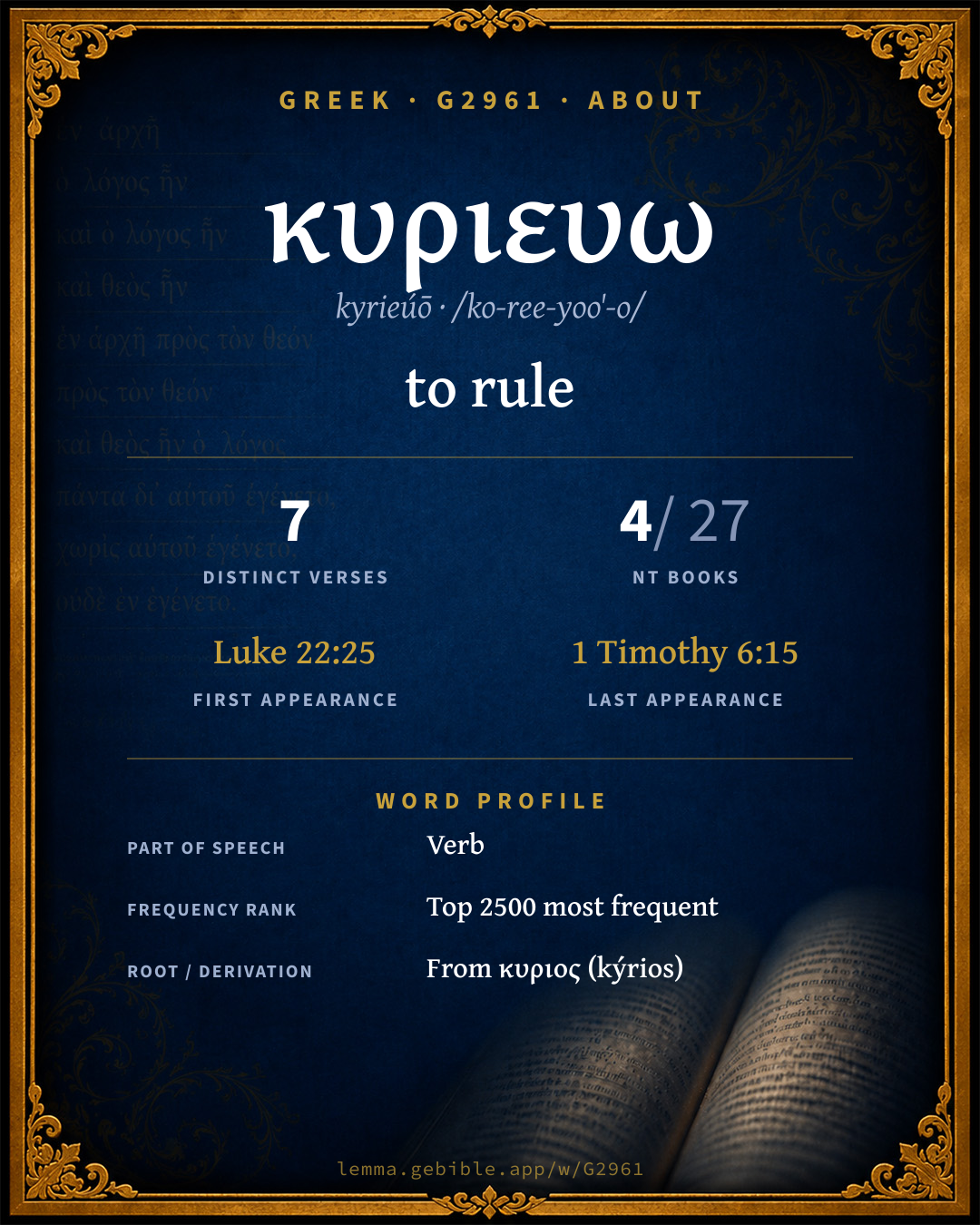
κυριεύω
to rule
‘to rule’ is one of 2 main senses fuller range ↓
Full lexicon entry — Thayer's Greek Lexicon
From Thayer's Greek Lexicon
Where this word appears
See every Present-tense verb in the Greek New Testament →
Grammar key — what these labels mean
Part of speech
- Verb
- An action or state-of-being word.
Tense
- Present
- Ongoing or general action in present time (imperfective aspect).
- Aorist
- Action viewed as a simple whole, without regard to duration — often past (perfective aspect).
- Future
- Action expected in future time.
Voice
- Active
- The subject performs the action.
Mood
- Indicative
- States a fact or asks a factual question (the mood of reality).
- Subjunctive
- Expresses probability, purpose, or possibility (the mood of contingency).
- Participle
- A verbal adjective (“writing,” “having written”).
Case
- Genitive
- The case of source, possession, or “of” — answers “whose / from what.”
Person
- 3rd person
- The one spoken about (“he / she / it / they”).
- 1st person
- The speaker (“I / we”).
Gender
- Masculine
- Grammatically masculine.
Number
- Singular
- One.
- Plural
- More than one.
Grammatical forms
- Verb, Present, Active, Indicative, 3rd person, Singular 2 times (29%)
- Verb, Aorist, Active, Subjunctive, 3rd person, Singular 1 time (14%)
- Verb, Future, Active, Indicative, 3rd person, Singular 1 time (14%)
- Verb, Present, Active, Indicative, 1st person, Plural 1 time (14%)
- Verb, Present, Active, Indicative, 3rd person, Plural 1 time (14%)
- Verb, Present, Active, Participle, Genitive, Plural, Masculine 1 time (14%)
Parsed forms decoded from the imported morphology (Robinson–Tischendorf, public domain), counted across 7 parsed occurrences — not distinct verses.
Every verse where G2961 appears — 7 distinct verses across 4 books. Click any verse to open its interlinear word-by-word view. Verse text shown in the World English Bible for context — . Each verse’s Greek form is shown with its reference; the English is not keyword-highlighted, since the data carries no word-level English alignment. Use “Compare translations” on any verse to read it across multiple English versions. This concordance covers the Greek New Testament; Septuagint (Greek Old Testament) occurrences of this word are not indexed here.
Luke 1 verse
Romans 4 verses
- Romans 6:9 κυριεύει pres act ind 3sg knowing that Christ, being raised from the dead, dies no more. Death no more has dominion over him!
- Romans 6:14 κυριεύσει fut act ind 3sg For sin will not have dominion over you. For you are not under law, but under grace.
- Romans 7:1 κυριεύει pres act ind 3sg Or don't you know, brothers (for I speak to men who know the law), that the law has dominion over a man for as long as he lives?
- Romans 14:9 κυριεύσῃ aor act subj 3sg For to this end Christ died, rose, and lived again, that he might be Lord of both the dead and the living.
2 Corinthians 1 verse
1 Timothy 1 verse
About this entry
At a glance — auto-summarized from this page’s data, not written by a person. Every figure links to its source below. This summary describes the numbers; it doesn’t interpret them.
κυριευω (kyrieúō) is a Greek verb most often rendered “to rule.” Romans dominates its distribution — 4 of 7 verses. Spanning 7 verses in 4 books, it ranks among the uncommon words of the Greek New Testament. It first appears in Luke 22:25. Its lexical range runs to 2 senses. For the data behind this summary, explore the sense tree and the renderings breakdown below.
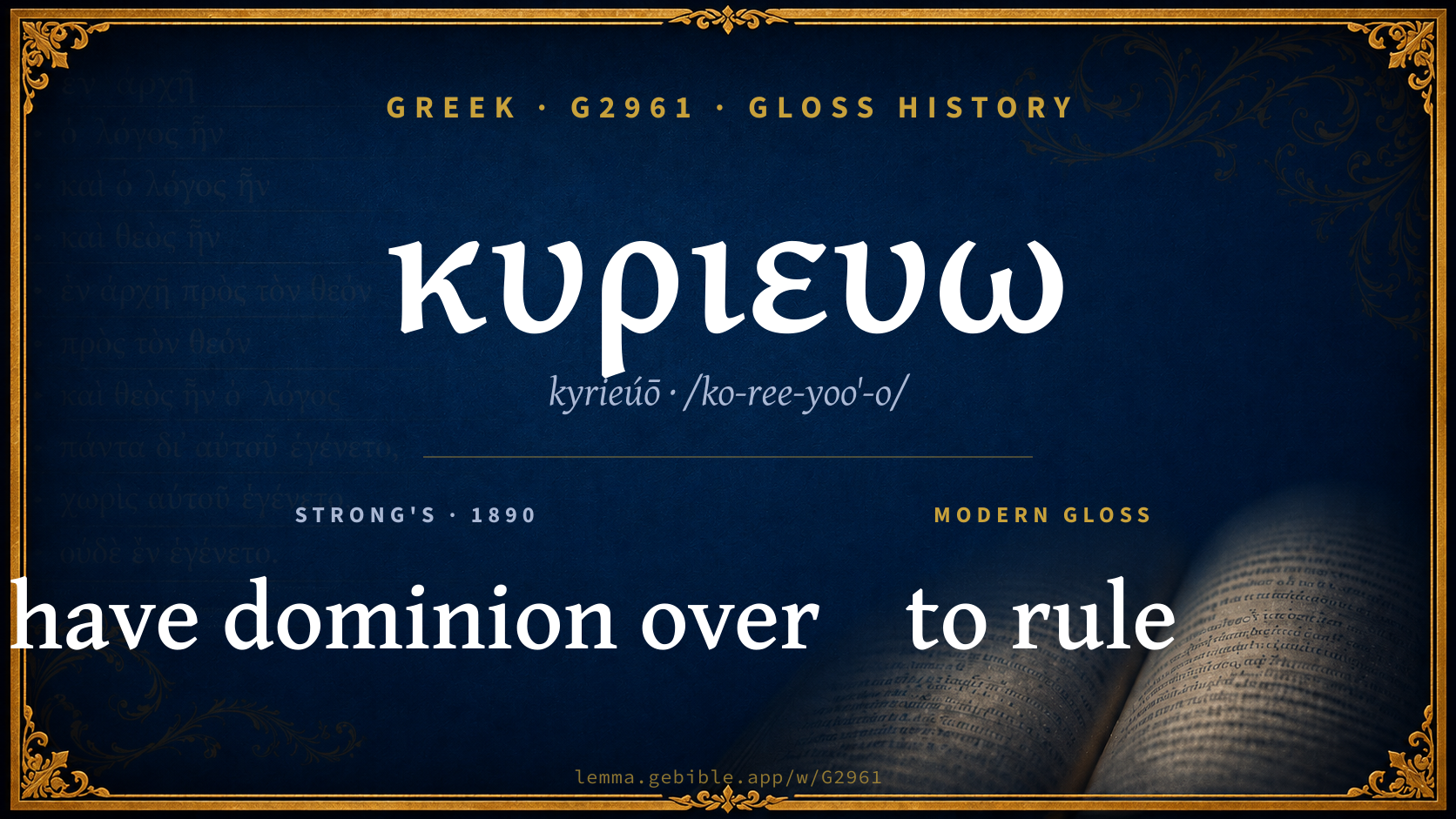
Gloss history
Strong's 1890 vs modern scholarship
About this word
Strong's G2961 catalogs a Greek word from the Greek New Testament.
These counts are not copied from any lexicon or concordance. They are computed here, from the morphology-tagged Greek New Testament. What Lemma adds →
- 7
- distinct verses
- The word appears in 7 distinct verses.
- 4 / 27
- NT books
- The word appears in 4 of 27 New Testament books.
- #1,358
- by frequency
- Top 2500 most frequent Greek words (rank 1,358 of 5,347 Greek words by occurrence).
View all 7 occurrences in the concordance →
Most concentrated in
- Romans 4 verses 57%
- Luke 1 verse 14%
- 2 Corinthians 1 verse 14%
By section of the New Testament
By traditional corpus
Conventional, traditional groupings — biblical authorship is debated, so this is a traditional corpus grouping, not an authorship claim. Some books belong to more than one corpus (Luke is in both the Gospels and the Lukan corpus, and so on), so these shares overlap and need not total 100%. Each figure is a share of the word’s 7 distinct verses.
- Pauline corpus 6 verses · 86%
- Gospels 1 verse · 14%
- Lukan (Luke–Acts) 1 verse · 14%
How translations render this word
Counts come from each version’s own published word-to-Strong’s tagging or interlinear alignment — an approximate guide to how each version renders this word, not a word-level alignment the data otherwise carries. Because each total is that version’s own tagged count, the per-version totals vary from one another and need not match the appearance or distinct-verse counts above. These counts may also differ from a printed concordance because Lemma counts each distinctly tagged rendering and does not collapse phrase taggings into a single head-word total. This is a fixed set of word-tagged versions (KJV, ASV, BSB, ULT) and does not change with the reading translation you choose elsewhere. Each version’s license is shown beside its name below (and on Sources).
- King James Version: Dominion over 1×, Exercise lordship over 1×, Hath 1×
- American Standard Version: Dominion 1×, Hath 1×, Hath dominion over 1×
- Berean Standard Bible: Has authority over 1×, Has dominion over 1×, He might be the lord of 1×
- unfoldingWord Literal Text: Be lord over 1×, He might be lord 1×, Is lord 1×
King James Version Public Domain
Renders G2961 across 9 tagged occurrences — most commonly:
American Standard Version Public Domain
Renders G2961 across 9 tagged occurrences — most commonly:
Berean Standard Bible Public Domain
Renders G2961 across 7 tagged occurrences — most commonly:
unfoldingWord Literal Text CC BY-SA 4.0
Renders G2961 across 8 tagged occurrences — most commonly:
Senses in Thayer's
The 2 senses Thayer's distinguishes for this word, in lexicon order (not ranked by frequency or importance). The full entry — with sub-senses — is in the Lexicon Entry tab.
- to be lord of, to rule, have dominion over
- to exercise influence upon, to have power over
Word origin
Derived from κυριος (kýrios) (G2962) — Lord.
From G2962 ; to rule : - have dominion over lord be Lord of exercise Lordship over.
— Strong’s Exhaustive Concordance (1890), public domain.
Forms in the corpus
The 6 distinct written forms G2961 takes in the Greek New Testament, most frequent first — each parse links to that tense’s occurrences in the concordance.
| Form | Parsing | Example | Uses |
|---|---|---|---|
| κυριεύει kyrieúei | Verb, Present, Active, Indicative, 3rd person, Singular | Romans 6:9 | 2 |
| κυριευόντων kyrieuóntōn | Verb, Present, Active, Participle, Genitive, Plural, Masculine | 1 Timothy 6:15 | 1 |
| κυριεύομεν kyrieúomen | Verb, Present, Active, Indicative, 1st person, Plural | 2 Corinthians 1:24 | 1 |
| κυριεύουσιν kyrieúousin | Verb, Present, Active, Indicative, 3rd person, Plural | Luke 22:25 | 1 |
| κυριεύσει kyrieúsei | Verb, Future, Active, Indicative, 3rd person, Singular | Romans 6:14 | 1 |
| κυριεύσῃ kyrieúsē | Verb, Aorist, Active, Subjunctive, 3rd person, Singular | Romans 14:9 | 1 |
Same root — word family
Other Thayer's entries built from the same root as G2961, grouped by Strong’s listed origin. These share a root / origin per the lexicon — not necessarily a shared meaning. Each links to that word’s own entry.
Derives from
Shares the same root
Proper names from this root
People and places named from this root — a name, not an additional meaning of the word.
Compare all same-root words → Showing 4 of 7 — not the complete family. 3 of the same-root words are proper names (people or places). They share a root, not necessarily a meaning.
Septuagint usage
The same Greek word κυριευω appears 30 times in the Greek Old Testament (Septuagint), across 27 verses in 11 books.
- 30
- LXX occurrences
- Tagged occurrences of this Greek word in the Septuagint.
- 27
- verses
- Distinct Septuagint verses containing this word.
- 11 / 39
- OT books
- The word appears in 11 of the 39 Old Testament books.
Sample Septuagint occurrences
- Genesis 3:16 κυριεύω
- Exodus 15:9 κυριεύω
- Numbers 21:18 κυριεύω
- Joshua 12:2 κυριεύω
- Judges 9:2 κυριεύω
- 2 Chronicles 14:6 κυριεύω
- Psalms 105:41 κυριεύω
- Isaiah 3:4 κυριεύω
- Jeremiah 2:31 κυριεύω
- Lamentations 5:8 κυριεύω
- Daniel 2:38 κυριεύω
Septuagint occurrences (same lexeme)
Every verse where the same Strong’s number (G2961) appears in the Greek Septuagint. Verse text shown in the World English Bible for context; the Greek form is the matched word — the English is not keyword-highlighted.
- Genesis 3:16 κυριεύω To the woman he said, "I will greatly multiply your pain in childbirth. In pain you will bring forth children. Your desire will be for your husband, and he will rule over you."
- Genesis 37:8 κυριεύω His brothers said to him, "Will you indeed reign over us? Or will you indeed have dominion over us?" They hated him all the more for his dreams and for his words.
- Exodus 15:9 κυριεύω The enemy said, 'I will pursue, I will overtake, I will divide the spoil. My desire shall be satisfied on them. I will draw my sword, my hand shall destroy them.'
- Numbers 21:18 κυριεύω The well, which the princes dug, Which the nobles of the people dug, With the scepter, [and] with their poles. From the wilderness [they traveled] to Mattanah;
- Numbers 24:7 κυριεύω Water shall flow from his buckets, His seed shall be in many waters, His king shall be higher than Agag, His kingdom shall be exalted.
- Joshua 12:2 κυριεύω Sihon king of the Amorites, who lived in Heshbon, and ruled from Aroer, which is on the edge of the valley of the Arnon, and [the city that is in] the middle of the valley, and half Gilead, even to the river Jabbok, the border of the children of Ammon;
- Joshua 15:16 κυριεύω Caleb said, He who strikes Kiriath Sepher, and takes it, to him will I give Achsah my daughter as wife.
- Joshua 24:33 κυριεύω Eleazar the son of Aaron died; and they buried him in the hill of Phinehas his son, which was given him in the hill-country of Ephraim.
- Judges 9:2 κυριεύω Please speak in the ears of all the men of Shechem, Whether is better for you, that all the sons of Jerubbaal, who are seventy persons, rule over you, or that one rule over you? Remember also that I am your bone and your flesh.
- Judges 14:4 κυριεύω But his father and his mother didn't know that it was of Yahweh; for he sought an occasion against the Philistines. Now at that time the Philistines had rule over Israel.
- Judges 15:11 κυριεύω Then three thousand men of Judah went down to the cleft of the rock of Etam, and said to Samson, "Don't you know that the Philistines are rulers over us? What then is this that you have done to us?" He said to them, As they did to me, so have I done to them.
- 2 Chronicles 14:6 κυριεύω He built fortified cities in Judah; for the land was quiet, and he had no war in those years, because Yahweh had given him rest.
- 2 Chronicles 20:6 κυριεύω and he said, Yahweh, the God of our fathers, aren't you God in heaven? and aren't you ruler over all the kingdoms of the nations? and in your hand is power and might, so that none is able to withstand you.
- Psalms 105:41 κυριεύω He opened the rock, and waters gushed out. They ran as a river in the dry places.
- Isaiah 3:4 κυριεύω I will give boys to be their princes, And children shall rule over them.
- Isaiah 3:12 κυριεύω As for my people, children are their oppressors, And women rule over them. My people, those who lead you cause you to err, And destroy the way of your paths.
- Isaiah 7:18 κυριεύω It will happen in that day that Yahweh will whistle for the fly that is in the uttermost part of the rivers of Egypt, and for the bee that is in the land of Assyria.
- Isaiah 14:2 κυριεύω The peoples shall take them, and bring them to their place; and the house of Israel shall possess them in the land of Yahweh for servants and for handmaids: and they shall take them captive whose captives they were; and they shall rule over their oppressors.
- Isaiah 19:4 κυριεύω I will give over the Egyptians into the hand of a cruel lord; and a fierce king shall rule over them, says the Lord, Yahweh of Hosts.
- Isaiah 42:19 κυριεύω Who is blind, but my servant? or deaf, as my messenger whom I send? Who is blind as he who is at peace, and blind as Yahweh's servant?
- Jeremiah 2:31 κυριεύω Generation, see the word of Yahweh. Have I been a wilderness to Israel? or a land of thick darkness? why say my people, We are broken loose; we will come no more to you?
- Jeremiah 37:3 κυριεύω Zedekiah the king sent Jehucal the son of Shelemiah, and Zephaniah the son of Maaseiah, the priest, to the prophet Jeremiah, saying, Pray now to Yahweh our God for us.
- Lamentations 5:8 κυριεύω Servants rule over us: There is none to deliver us out of their hand.
- Daniel 2:38 κυριεύω and wherever the children of men dwell, the animals of the field and the birds of the sky has he given into your hand, and has made you to rule over them all: you are the head of gold.
- Daniel 2:39 κυριεύω After you shall arise another kingdom inferior to you; and another third kingdom of brass, which shall bear rule over all the earth.
- Daniel 3:2 κυριεύω Then Nebuchadnezzar the king sent to gather together the satraps, the deputies, and the governors, the judges, the treasurers, the counselors, the sheriffs, and all the rulers of the provinces, to come to the dedication of the image which Nebuchadnezzar the king had set up.
- Daniel 11:3 κυριεύω A mighty king shall stand up, who shall rule with great dominion, and do according to his will.
These are occurrences of the same Greek lexeme (G2961) in the Septuagint — not a translation of any one Hebrew word. The store carries no word-level Hebrew↔Greek alignment, so no Hebrew original is asserted here. Counts come from the recovered LXX Strong's tagging — high-frequency vocabulary is well covered, while rare or late forms may be untagged — so they reflect tagged occurrences and may slightly undercount.