
Genesis 8:15

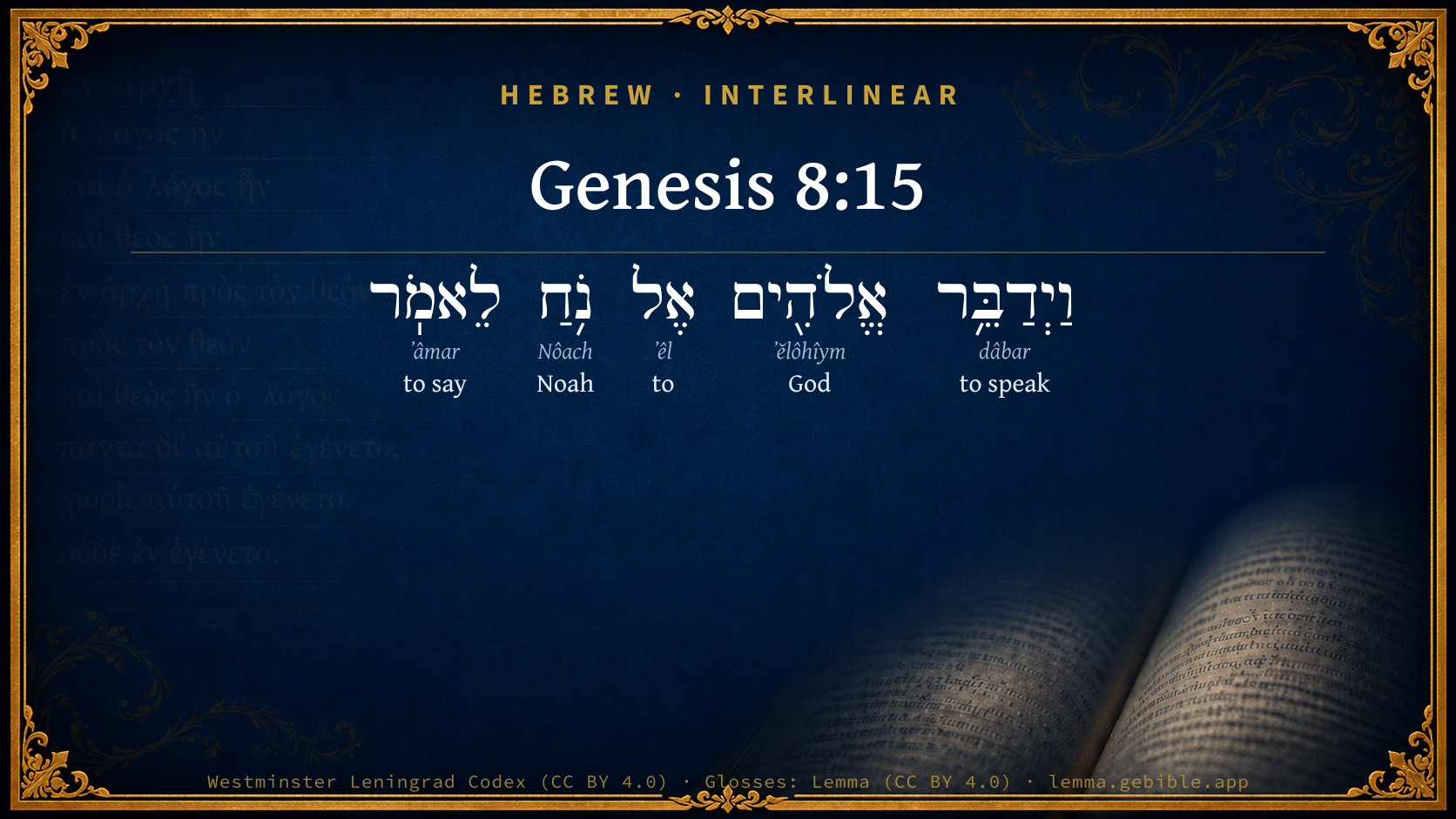
Hebrew (Westminster Leningrad Codex) Genesis 8:15 appears in the Hebrew Old Testament. The text above is from the Westminster Leningrad Codex. Each word links to its Strong’s number, a concise gloss, and parsing drawn from the Open Scriptures Hebrew Bible morphology. Click any word for its full Brown-Driver-Briggs (BDB) entry.
Download image
Cite this verse

Genesis 8:15 (World English Bible). Public Domain. Lemma interlinear Bible study tool, https://lemma.gebible.app/v/genesis/8/15.

Show BibTeX & RIS
BibTeX
RIS
English Translation
God spoke to Noah, saying,
World English Bible · Public Domain
Highlights
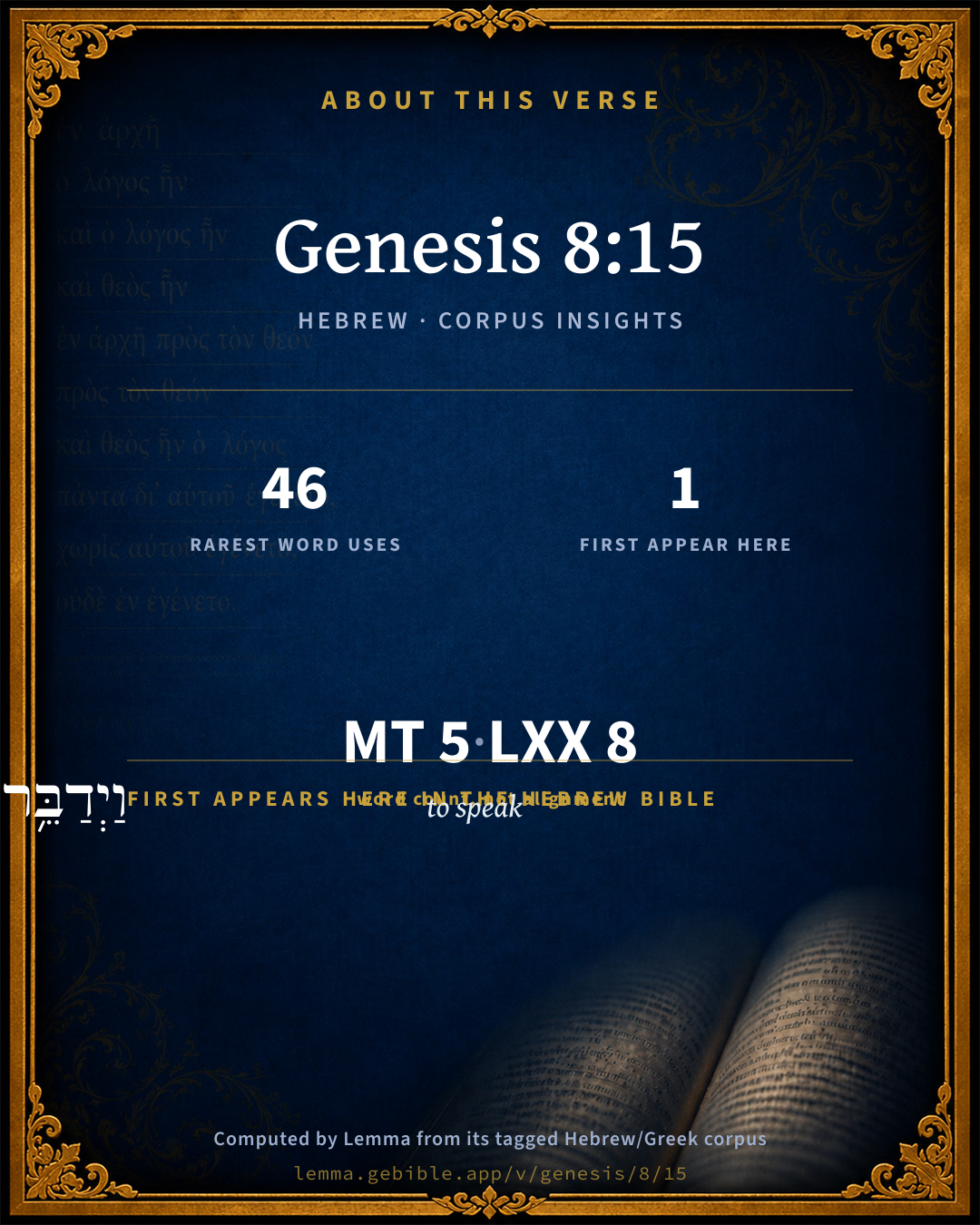
  • 1 first appearance in the Hebrew Bible
Full analysis ↓
Download a study sheet

One document with this verse’s original text, its word-by-word gloss line, the meaning frame, cross-references with their text, attributed commentary, and full source and license credits — printable, and it pastes into notes with its structure intact.

This verse Autodidact and up

Study sheet (.html) Plain text (.txt)

A passage Seminary Student

Up to 50 verses in one chapter. A passage sheet keeps up to 6 commentary sources and 12 cross-references per verse, in the order this page ranks them, and says so on the sheet whenever that leaves anything out. Ask for a single verse and you get the Autodidact verse sheet above.

Everything on this page stays free to read, with no account — the sheet is a download of what is already on screen, not access to it.

Want to remove ads? Support Godless Engineer
Compare translations 3

The same verse in 3 English versions, stacked beneath the original-language interlinear above. Click any original word for its lexicon entry.

Each is an independent rendering of the whole verse — the interlinear is not word-aligned to these translations.

Highlighted words mark where these versions differ — a whole-verse word diff, not a word-by-word alignment.

  • World English Bible Public Domain
    God spoke to Noah, saying,
  • King James Version Public Domain
    And God spake unto Noah, saying,
  • unfoldingWord Literal Text CC BY-SA 4.0
    Then God said to Noah, saying,

unfoldingWord Literal Text — © unfoldingWord, licensed CC BY-SA 4.0. Word-aligned USFM3 via Door43 (git.door43.org/unfoldingWord/en_ult).

Versions to compare (up to 4)

3 of 4 selected

Show all 18 translations

Every available English version of this verse, each an independent rendering of the whole verse.

  • World English Bible Public Domain
    God spoke to Noah, saying,
  • Berean Standard Bible Public Domain
    Then God said to Noah,
  • Majority Standard Bible Public Domain
    Then God said to Noah,
  • King James Version Public Domain
    And God spake unto Noah, saying,
  • American Standard Version (1901) Public Domain
    And God spake unto Noah, saying,
  • Revised Version (1885) Public Domain
    And God spake unto Noah, saying,
  • Geneva Bible (1599) Public Domain
    Then God spake to Noah, saying,
  • Douay-Rheims (1899) Public Domain
    And God spoke to Noe, saying:
  • Young's Literal Translation Public Domain
    And God speaketh unto Noah, saying, `Go out from the ark, thou, and thy wife, and thy sons, and thy sons' wives with thee;
  • Literal Standard Version CC BY-SA 4.0
    And God speaks to Noah, saying, “Go out from the Ark, you, and your wife, and your sons, and your sons’ wives with you;
  • Unlocked Literal Bible CC BY-SA 4.0
    God said to Noah,
  • unfoldingWord Literal Text CC BY-SA 4.0
    Then God said to Noah, saying,
  • Darby Bible Public Domain
    And God spoke to Noah, saying,
  • World Messianic Bible Public Domain
    God spoke to Noah, saying,
  • Webster's Bible Public Domain
    And God spoke to Noah, saying,
  • Free Bible Version CC BY-SA 4.0
    Then God told Noah,
  • Bible in Basic English Public Domain
    And God said to Noah,
  • JPS Tanakh (1917) Public Domain
    And God spoke unto Noah, saying:

Literal Standard Version (2020), Covenant Press — licensed CC BY-SA 4.0. Text via the HelloAO Bible API (eBible.org). Unlocked Literal Bible (unfoldingWord) — licensed CC BY-SA 4.0. Text via the HelloAO Bible API (eBible.org). unfoldingWord Literal Text — © unfoldingWord, licensed CC BY-SA 4.0. Word-aligned USFM3 via Door43 (git.door43.org/unfoldingWord/en_ult). Free Bible Version, Dr. Jonathan Gallagher — licensed CC BY-SA 4.0. Text via the HelloAO Bible API (eBible.org).

Word by word

More ways to search: Search by grammar → Find every occurrence → Compare this word →

Practice this passage: Drill this verse → Learn its vocabulary →

נֹ֥חַ
Nôach
H5146
“Noah”
Noun, Proper
Part of Speech
Noun
Type
Proper
Full BDB Definition

Origin: the same as H5118

TWOT: 1323b

Noah = "rest" - son of Lamech, father of Shem, Ham, and Japheth; builder of the ark which saved his family from the destruction of the world which God sent on the world by the flood; became the new seminal head of mankind because his family were the only survivors of the flood
  1. וַיְדַבֵּ֥ר dâbar H1696 “and · to speak” Conjunction + Verb, Piel, Sequential Imperfect, 3rd Person, Masculine, Singular
  2. אֱלֹהִ֖ים ʼĕlôhîym H430 “God(s)” Noun, Common, Masculine, Plural, Absolute
  3. אֶל ʼêl H413 “to” Preposition
  4. לֵאמֹֽר ʼâmar H559 “to say” Preposition + Verb, Qal, Infinitive Construct

About this verse

These counts appear in no published source. They are computed here, from the morphology-tagged text and Lemma’s own curated glosses. What Lemma adds →

5
words
5
distinct lemmas
Pentateuch
section

First appearance in Scripture

This word makes its first canonical appearance in the Hebrew Bible here:

  • וַיְדַבֵּ֥ר to speak H1696

Shared distinctive vocabulary

נֹ֥חַ Noah H5146 occurs in 39 verses of the Hebrew Bible. Also found in:

Grammatical profile

  • 2 verbs
  • 2 nouns
  • 1 preposition

Verb forms

  • וַיְדַבֵּ֥ר Piel · Sequential Imperfect
  • לֵאמֹֽר Qal · Infinitive Construct

Hebrew & Septuagint length

In English translation the verse runs 5 words from the Hebrew and 8 from the Septuagint (LXX English) — closely comparable.

A rough comparison of the two English renderings, which tokenize alike — not a word-level alignment.

Word counts can differ between the Hebrew and the Greek without any difference in meaning — e.g. the Hebrew direct-object marker אֵת has no separate Greek word, and Greek often adds the article ὁ.

In the original languages it is 5 Hebrew tokens and 8 Greek tokens — but the two are counted differently (Hebrew bundles its prefixes and suffixes into one token; the Greek is in lemma form), so that isn’t a like-for-like length.

Hebrew and Greek witnesses Masoretic Hebrew ↔ Greek Septuagint

The same verse in the two great witnesses to the Old Testament, shown verse-for-verse.

These are two independent witnesses, not word-aligned to each other, and the Septuagint is shown in lemma (dictionary) form.

Hebrew Genesis 8:15 Masoretic · Westminster Leningrad Codex

וַיְדַבֵּ֥ר אֱלֹהִ֖ים אֶל נֹ֥חַ לֵאמֹֽר

God spoke to Noah, saying,

World English Bible · Public Domain

Greek LXX Genesis 8:15 Septuagint · lemma form

καί εἶπον κύριος ὁ θεός ὁ νωε λέγω

And the Lord God spoke to Noe, saying,

LXX2012 (modern English Septuagint) · Public Domain

Hebrew: Westminster Leningrad Codex (CC BY 4.0). Greek: Septuagint (public domain); English from LXX2012 (modern English Septuagint) (Public Domain). How the Septuagint differs from the Hebrew →

Targum (Aramaic paraphrase)

2

The Targum is the ancient Jewish Aramaic paraphrase of the Hebrew Scriptures — an interpretive translation, not the Hebrew text itself. Onkelos (literal) and Pseudo-Jonathan (expansive) render the Torah, and Jonathan the Prophets. Coverage is partial: where no permissively-licensed English translation exists for a verse, only the Aramaic is shown. This is verse-level text, not a word-by-word alignment to the Hebrew.

  1. Targum Onkelos Torah (Genesis–Deuteronomy)
    וּמַלִּיל יְיָ עִם נֹחַ לְמֵימָר

    And the Lord spake with Noach, saying:

    Targum Onkelos — Aramaic: “Onkelos Genesis” (public domain); “Onkelos Exodus” (public domain); “Onkelos Leviticus” (public domain); “Onkelos Numbers” (public domain); “Onkelos Deuteronomy” (public domain). English: “Sefaria Community Translation” (CC0 1.0 (public-domain dedication)); “J.W. Etheridge. The Targums of Onkelos and Jonathan Ben Uzziel on the Pentateuch. London: Longmans, Green, 1862” (public domain). Text via Sefaria.

  2. Targum Pseudo-Jonathan Torah (Genesis–Deuteronomy)
    וּמַלֵיל יְיָ עִם נחַ לְמֵימָר

    And the Lord spake with Noah, saying:

    Targum Pseudo-Jonathan — Aramaic: “Targum Jonathan on Genesis” (public domain); “Targum Jonathan on Exodus” (public domain); “Targum Jonathan on Leviticus” (public domain); “Targum Jonathan on Numbers” (public domain); “Targum Jonathan on Deuteronomy” (public domain). English: “The Targum of Jonathan ben Uzziel, trans. J. W. Etheridge, London, 1862” (public domain). Text via Sefaria.

Commentary

Notes on Genesis 8:15 from classic Christian and Jewish commentators (each source and its license shown beneath its notes). The classic Christian expositions comment on the surrounding passage and are grouped to its opening verse, so a note may address several verses; the Jewish commentaries on the Tanakh (Rashi and others) are per-verse, so they appear only where the commentator wrote on this verse.

Lemma curates 59 commentaries, every one of them public domain or Creative Commons licensed, each selected and text-cleaned for this edition rather than reprinted as found. About our sources →

Matthew Henry's Commentary

Here is, I. Noah's dismission out of the ark, Gen 8:15-17. Observe, 1. Noah did not stir till God bade him. As he had a command to go into the ark (Gen 7:1), so, how tedious soever his confinement there was, he would wait for a command to go out of it again. Note, We must in all our ways acknowledge God, and set him before us in all our removes. Those only go under God's protection that follow God's direction and submit to his government. Those that steadily adhere to God's word as their rule, and are guided by his grace as their principle, and take hints from his providence to assist them in their application of general directions to particular cases, may in faith see him guiding their motions in their march through this wilderness. 2. Though God detained him long, yet at last he gave him his discharge; for the vision is for an appointed time, and at the end it shall speak, it shall speak truth (Hab 2:3), it shall not lie. 3. God had said, Come into the ark which he says, not, Come forth, but, Go forth, which intimates that God, who went in with him, staid with him all the while, till he sent him out safely; for he has said, I will not leave thee. 4. Some observe that, when they were ordered into the ark, the men and the women were mentioned separately (Gen 6:18): Thou, and thy sons, and thy wife, and thy sons' wives; hence they infer that, during the time of mourning, they were apart, and their wives apart, Zac 12:12. But now God did as it were new - marry them, sending out Noah and his wife together, and his sons and their wives together, that they might be fruitful and multiply. 5. Noah was ordered to bring the creatures out with him, that having taken the care of feeding them so long, and been at so much pains about them, he might have the honour of leading them forth by their armies, and receiving their homage.

II. Noah's departure when he had his dismission. As he would not go out without leave, so he would not, out of fear or humour, stay in when he had leave, but was in all points observant of the heavenly vision. Though he had been now a full year and ten days a prisoner in the ark, yet when he found himself preserved there, not only for a new life, but for a new world, he saw no reason to complain of his long confinement. Now observe, 1. Noah and his family came out alive, though one of them was a wicked Ham, whom, though he escaped the flood, God's justice could have taken away by some other stroke. But they are all alive. Note, When families have been long continued together, and no breaches made among them, it must be looked upon as a distinguishing favour, and attributed to the Lord's mercies. 2. Noah brought out all the creatures that went in with him, except the raven and the dove, which, probably, were ready to meet their mates at their coming out. Noah was able to give a very good account of his charge; for of all that were given to him he had lost none, but was faithful to him that appointed him, pro hac vice - on this occasion, high steward of his household.

Matthew Henry's Commentary on the Whole Bible (1708–1710) — public domain (CC PDM 1.0). Text via the HelloAO Bible API.

Jamieson, Fausset & Brown

Robert Jamieson, A. R. Fausset & David Brown

DEPARTURE FROM THE ARK. (Gen 8:15-22)

And God spake . . . Go forth--They went forth in the most orderly manner--the human occupants first, then each species "after their kinds" [Gen 8:19], literally, "according to their families," implying that there had been an increase in the ark.

Jamieson, Fausset & Brown — Commentary Critical and Explanatory on the Whole Bible (1871) — public domain (CC PDM 1.0). Text via the HelloAO Bible API.

Trapp's Complete Commentary

John Trapp

Gen 8:15 And God spake unto Noah, saying,

Ver. 15. And God spake unto Noah.] {See Trapp on "Gen 8:16"}

John Trapp, A Commentary or Exposition upon All the Books of the Old and New Testament (1647–1656) — public domain. Text from a community e-Sword module.

Albert Barnes' Notes on the Bible

- XXVII. The Ark Was Evacuated

19. משׁפחה mı̂shpāchah, “kind, clan, family.” שׁפחה shı̂pchâh, “maid-servant; related: spread.”

20. מזבח mı̂zbēach, “altar; related: slay animals, sacrifice.”

21. עלה 'olâh, “whole burnt-offering.” That which goes up. “Step; related: go up.”

Gen 8:15-19

The command to leave the ark is given and obeyed. As Noah did not enter, so neither does he leave the ark, without divine direction. “The fowl, the cattle, and the creeper.” Here, again, these three classes are specified under the general head of every living tiring. They are again to multiply on the earth. “Every living thing.” This evidently takes the place of the cattle mentioned before. “After their families.” This word denotes their tribes. It is usually applied to families or clans.

Gen 8:20-22

The offering of Noah accepted. The return to the dry land, through the special mercy of God to Noah and his house, is celebrated by an offering of thanksgiving and faith. “Builded an altar.” This is the first mention of the altar, or structure for the purpose of sacrifice. The Lord is now on high, having swept away the garden, and withdrawn his visible presence at the same time from the earth. The altar is therefore erected to point toward his dwelling-place on high. “Unto the Lord.” The personal name of God is especially appropriate here, as he has proved himself a covenant keeper and a deliverer to Noah. “Of all clean cattle, and every clean fowl.” The mention of clean birds renders it probable that these only were taken into the ark by seven pairs Gen 7:3. Every fit animal is included in this sacrifice, as it is expressive of thanksgiving for a complete deliverance. We have also here the first mention of the burnt-offering עלה 'olâh; the whole victim, except the skin, being burned on the altar. Sacrifice is an act in which the transgressor slays an animal and offers it in whole, or in part as representative of the whole, to God. In this act he acknowledges his guilt, the claim of the offended law upon his life, and the mercy of the Lord in accepting a substitute to satisfy this claim for the returning penitent. He at the same time actually accepts the mercy of the Most High, and comes forward to plead it in the appointed way of reconciliation. The burnt-offering is the most perfect symbol of this substitution, and most befitting the present occasion, when life has been granted to the inmates of the ark amidst the universal death.

Gen 8:21

The effect of this plea is here described. The Lord smelled the sweet savor. He accepted the typical substitute, and, on account of the sacrifice, the offerers, the surviving ancestors of the post-diluvian race. Thus, the re-entrance of the remnant of mankind upon the joys and tasks of life is inaugurated by an articulate confession of sin, a well-understood foreshadowing of the coming victim for human guilt, and a gracious acceptance of this act of faith. “The Lord said in his heart.” It is the inward resolve of his will. The purpose of mercy is then expressed in a definite form, suited to the present circumstances of the delivered family. “I will not again curse the soil any more on account of man.” This seems at first sight to imply a mitigation of the hardship and toil which man was to experience in cultivating the ground Gen 3:17. At all events, this very toil is turned into a blessing to him who returns from his sin and guilt, to accept the mercy, and live to the glory of his Maker and Saviour. But the main reference of the passage is doubtless to the curse of a deluge such as what was now past. This will not be renewed. “Because the imagination of his heart is evil from his youth.” This is the reason for the past judgment, the curse upon the soil: not for the present promise of a respite for the future. Accordingly, it is to be taken in close connection with the cursing of the soil, of which it assigns the judicial cause. It is explanatory of the preceding phrase, on account of man. The reason for the promise of escape from the fear of a deluge for the future is the sacrifice of Noah, the priest and representative of the race, with which the Lord is well pleased. The closing sentence of this verse is a reiteration in a more explicit form of the same promise. “Neither will I again smite all living as I have done.” There will be no repetition of the deluge that had just overswept the land and destroyed the inhabitants.

Gen 8:22

Henceforth all the days of the earth. - After these negative assurances come the positive blessings to be permanently enjoyed while the present constitution of the earth continues. These are summed up in the following terms:

HEAT

Sowing, beginning in October

Reaping, ending in June

COLD

Early fruit, in July

Fruit harvest, ending in September

The cold properly occupies the interval between sowing and reaping, or the months of January and February. From July to September is the period of heat. In Palestine, the seedtime began in October or November, when the wheat was sown. Barley was not generally sown until January. The grain harvest began early in May, and continued in June. The early fruits, such as grapes and figs, made their appearance in July and August; the full ingathering, in September and October. But the passage before us is not limited to the seasons of any particular country. Besides the seasons, it guarantees the continuance of the agreeable vicissitudes of day and night. It is probable that even these could not be distinguished during part of the deluge of waters. At all events, they did not present any sensible change when darkness reigned over the primeval abyss.

The term of this continuance is here defined. It is to last as long as the order of things introduced by the six days’ creation endures. This order is not to be sempiternal. When the race of man has been filled up, it is here hinted that the present system of nature on the earth may be expected to give place to another and a higher order of things.

Here it is proper to observe the mode of Scripture in the promise of blessing. In the infancy of mankind, when the eye gazed on the present, and did not penetrate into the future, the Lord promised the immediate and the sensible blessings of life, because these alone are as yet intelligible to the childlike race, and they are, at the same time, the immediate earnest of endless blessings. As the mind developes, and the observable universe becomes more fully comprehended, these present and sensible sources of creature happiness correspondingly expand, and higher and more ethereal blessings begin to dawn upon the mind. When the prospect of death opens to the believer a new and hitherto unknown world of reality, then the temporal and corporeal give way to the eternal and spiritual. And as with the individual, so is it with the race. The present boon is the earnest in hand, fully satisfying the existing aspirations of the infantile desire. But it is soon found that the present is always the bud of the future; and as the volume of promise is unrolled, piece by piece, before the eye of the growing race, while the present and the sensible lose nothing of their intrinsic value, the opening glories of intellectual and spiritual enjoyment add an indescribable zest to the blessedness of a perpetuated life. Let not us, then, who flow in the full tide of the latter day, despise the rudiment of blessing in the first form in which it was conferred on Noah and his descendants; but rather remember that is not the whole content of the divine good-will, but only the present shape of an ever-expanding felicity, which is limited neither by time nor sense.

Albert Barnes' Notes on the Bible (1834–1885) — public domain. Text from a community e-Sword/MySword module.

The Biblical Illustrator

Joseph S. Exell

Gen_8:15-19

Noah went forth

Mans going forth after the judgments of God -

I.

THAT HE GOES FORTH UPON THE DIVINE COMMAND (Gen_8:15-17).

1. That Noah was counselled to go forth from the ark on a day ever to be remembered.

2. That Noah was commanded to go forth from the ark when the earth was dry.

II. THAT HE GOES FORTH IN REFLECTIVE SPIRIT. We can readily imagine that Noah would go forth from the ark in very reflective and somewhat pensive mood.

1. He would think of the multitudes who had been drowned in the great waters.

2. He would think of his own immediate conduct of life, and of the future before him.

III. THAT HE GOES FORTH IN COMPANY WITH THOSE WHO HAVE SHARED HIS SAFETY.

1. He goes forth in company with the relatives of his own family. God permitted the family of Noah to be with him in the ark, to relieve his solitude, to aid his efforts, to show the protective influence of true piety; and now they are to join him in the possession of the regenerated earth, that they may enjoy its safety and aid its cultivation.

2. He goes forth in company with the life-giving agencies of the universe. (J. S.Exell, M. A.)

The Biblical Illustrator, edited by Joseph S. Exell (c. 1880s–1900s) — public domain. Text from a community e-Sword module.

The Pulpit Commentary

CHAPTER 8:15-22

Vers. 15-17. And God spake unto Noah, saying, Go forth of the ark. For which command doubtless the patriarch waited, as he had done for instructions to enter in (Gen_7:11) "being restrained by a hallowed modesty from allowing himself to enjoy the bounty of nature till he should hear the voice of God directing him to do so" (Calvin). Thou, and thy wife, and thy sons, and thy sons" wives with thee. The order is different, in Gen_7:7, whence Ambrose noteth, "non commiscetur sexus in introitu, sod commiscetur in ingressu." Bring forth with thee God having preserved alive the creatures that a twelvemonth before had been taken into the ark, and were now to be restored to their appropriate habitations on the earthevery living thing that is with thee, of all flesh, both of fowl, and of cattle, and of every creeping thing that creepeth upon the earth (cf.; Gen_7:21 Gen_9:10) that they may breed abundantlysharatz, to creep or crawl, used of reptiles and small water animals; (Gen_1:20 Gen_7:21) hence to swarm, or multiply (Gen_9:7) in the earth, and be fruitful, (Gen_1:22) and multiply literally, become numerousupon the earth.

Vers. 18, 19. And Noah went forth, in obedience to the Divine command,and his sons, and his wife, and his sons" wives with him, in obedience to Noah, to whom alone the Divine instructions werecommunicated; an early instance of filial subjection to parents. Every beast, every creeping thing, and every fowl, and whatsoever creepeth upon the earth, i.e. the chayyah, the remes, the "oph, all creepers upon the ground (cf., Gen_1:26 Gen_7:8, Gen_7:14) all of which had previously entered in. After their kinds. Hebrew, families, tribes (Gen_10:18) i.e. not confusedly, but in an orderly fashion, as they had come in, each one sorting to its kind. Went forth out of the ark.

HOMILETICS.

Vers. 15-22.

The saint and the Savior.

I THE SAVIOR"S INJUNCTION TO THE SAINT (ver. 15). The command which God addressed to Noah and the other inmates of the ark to go forth and take possession of the renovated earth may be regarded as emblematic of that Divine instruction which shall yet be given to the saints to go forth and take possession of the now heavens and the new earth, when the great gospel ship of the Christian Church, now floating on the troubled sea of life, shall have landed with its living freight upon the coasts of bliss. The Divine command to Noah was an order to pass

1. From a situation of comparative peril to a position of perfect safety. Though, certainly, before the bursting of the storm the only available shelter was that afforded by the ark, "all flesh and all in whose nostrils was the breath of life" that remained without having perished, yet even inside the ark must have seemed to the inexperienced voyagers to be at the best of only doubtful security. But now whatever danger had been connected with their twelve months" drifting across a trackless sea was at an end. And so, though only within the shelter of the Christian Church can safety be enjoyed, yet at the best it is not entirely free from peril. What with temptations and afflictions, "fears within and foes without," there always is a risk of making shipwreck of the soul; (1Ti_1:19) but when life"s voyage has been finished, and the new heavens and the new earth have been revealed, the salvation of the saints will be complete.

2. From a period of patient hoping to a season of delightful enjoying. It is doubtful if we always sufficiently realize the greatness of the strain to which the faith of the patriarch was subjected when he was shut up within the ark and left there for over a twelvemonth without any direct communication from God, with nothing for his faith to rest upon but the simple promise that he and his should be saved. At the best it was only little foretastes or earnests of God"s complete salvation which he enjoyed: first in being sheltered from the storm; next in being floated above the waters; then in touching land upon Ararat; and again in getting signs of the approaching deliverance. Throughout the entire period he could only live in hope and patiently endure. But here at length was the time of full fruition come. Go forth from the ark. And so it is with Christ"s saints universally. Here are only earnests of the inheritance; (Eph_1:14) there alone is the inheritance itself. (Col_1:12) Now is the time for hoping and waiting; (Rom_8:25) then is the season for seeing and enjoying. (1Jn_3:2) Here the saints rest upon the promise as their guarantee (2Ti_1:1; Heb_4:1) there the saints behold and experience its realization. (Heb_6:12)

3. From a condition of restrained activity to a sphere of higher and freer service. Not that Noah"s life within the ark could in any sense have been one of idleness, and neither are the lives of Christians on the earth and in the Church below; but Noah entered on another and a nobler kind of work when he left the ark than that which had engaged his powers within its precincts, and so do they who are counted worthy of attaining to Christ"s Kingdom and glory. Here, like Noah"s, the saint"s powers of service are limited and confined; there they shall attain to greater freedom and fuller (1Co_13:9-12; Rev_4:8)

II THE SAINT"S RESPONSE TO THE SAVIOR (ver. 18). The command to leave the ark which God addressed to Noah was obeyed

1. Immediately. We can imagine that everything was in a state of readiness for departure when the marching orders came, so that there was no need to interpose delay. So was it with the Hebrews when the Lord led them forth from Egypt; (Exo_12:11) so should Christians be always ready for their Master"s summons, whether to pass from affliction (Isa_3:11) or into it (Gen_22:1; Act_21:13) to enter upon a new sphere of (Isa_6:8) or retire from an old one into silence; (1Ki_17:3) to go down into the grave (2Ti_4:6) and wait for the apocalypse of the saints, (Job_14:14) or to go up into glory and partake of the inheritance of the saints in light. (Mat_24:44)

1. Universally. Not the patriarch alone, but all his family and all the creatures came forth; so did all God"s people come forth from the house of bondage; (Exo_10:26) and so will all Christ"s redeemed ones who have entered into the salvation ark of his Church emerge at last into the light and felicity of heaven (Isa_51:11; Luk_12:32; 1Co_15:22; 1Th_4:14)

1. Joyfully. This we may infer. After the twelve months" isolation, and confinement, and comparative peril we need not doubt that Noah and his family exulted with delight, and that even the lower creatures were not strangers to agreeable sensations. It was a picture of the happiness which even here the saints enjoy in the Divine interpositions on their behalf; but

2. especially of the universal thrill of gladness which God"s redeemed family, and even "the creature itself," shall experience in the palingenesia of the heavens and the earth (Isa_35:10; Rom_8:19-23)

3. Finally. They were never more to return to the ark, because never again should there he a flood. It was a delightful symbol of the completeness and finality of God"s salvation when the saints shall have been landed on the heights of bliss. (Rev_21:4 Rev_22:3-5)

III THE SAINT"S WORSHIP OF THE SAVIOR (ver. 20). As Noah"s first act on stepping forth from the ark was to build an altar unto the Lord, so the saint"s first work on reaching heaven will be to worship; and this worship will be

1. Believing. This was implied in the very thought of offering up a sacrifice to Jehovah, but specially so in the circumstances in which the patriarch was then placed. The visible symbol of the Divine presence had retired to its original dwelling-place in the heavens, and yet Noah had as little doubt as ever he had that there was a God to worship. The building of an altar, therefore, just then and there was an explicit declaration of his faith. Without faith there can be no worship of God either there or there, on earth or in heaven. (Heb_11:6)

2. Thankful. The offering of Noah was designed as an expression of his gratitude for the Lord"s mercy, and so should the worship of the saints on earth be characterized by the same spirit, (Php_4:6) as we know the adorations of the saints before the throne are. (Rev_7:12)

3. Generous. Noah took of every clean beast and every clean fowl, i.e. one of seven or one of fourteen (vide Expos.), in either case a munificent tribute to the God of his salvation. How seldom is the like liberality exhibited by Christ"s worshippers on earth! What a blessed thought it is that among the saints above there will be no temptation to such meanness as is often practiced by the saints below!

4. Sincere. It was no merely formal service that the patriarch presented. The burnt offering was a symbolic declaration of his self-consecration body, soul, and spirit to the God who had redeemed him. Of this sort is the service which Christ expects and believers should render on the earth (Mat_16:24; Luk_14:26; Rom_12:1; 1Co_6:20) Of such kind will be the worship of the saints in heaven. (Rev_22:8)

IV THE SAVIOR"S RESPONSE TO THE SAINT (vers. 21, 22). As the sacrifice of Noah was well-pleasing unto God, so will the worship of the saints find acceptance in his sight. And this acceptance of the sacrifices of the glorified, like the reception of Noah"s offering

1. Will consist in the cherishing by God of a feeling of sweet complacency towards the worshippers. As from the burning victims upon Noah"s altar there came up into the Divine nostrils a savor of rest, so from the spiritual sacrifices of Christians even here there ascends an odor of a sweet smell unto God, (Php_4:18) while in the upper sanctuary the services of the redeemed go up continually before God like the smoke of incense. (Rev_8:4)

1. Will be based upon the odor of the sacrifice of Christ, of which Noah"s was the type. It was not the actual service of Noah, considered as an opus operatum, that produced the feeling of complacency in God, (Mic_6:7) but the sacrificial work of Christ, to which the faith of the patriarch had an outlook. (Eph_5:2) For the sake of that offering up of himself once for all in the end of the world that was to be accomplished by the woman"s seed, and which Noah"s faith truly, however dimly, embraced, God accepted him and his. That same offering is the ground or basis on which all the saints sacrifices are accepted either on earth (1Pe_2:5) or in heaven. (Rev_5:6)

2. Will express itself through the perpetuation of the worshipper"s safety.

(1) By averting all evil. "There shall be no more curse, (Rev_22:3) as God determined in his heart (ver. 21), and afterwards expressed to Noah, (Gen_9:15) never more to curse the ground or flood the earth.

(2) By securing all good, which was symbolized by the confirmation of the covenant of day and night.

Lessons:

1. Live in a state of readiness for the glorious appearing of the Son of man. (Tit_1:13)

2. Expectantly wait for the manifestation of the sons of God. (Rom_8:19)

3. Learn the nature of the saint"s service in the heavenly world. (Rev_5:8)

4. Note the security for the perpetuity of heaven"s blessedness Christ"s sacrifice and God"s covenant.

The Pulpit Commentary (1880–1919), ed. H.D.M. Spence-Jones & Joseph S. Exell — public domain. Text from a community e-Sword module.

John Calvin's Commentaries

15. And God spake unto Noah. Though Noah was not a little terrified at the judgment of God, yet his patience is commended in this respect, that having the earth, which offered him a home, before his eyes, he yet does not venture to go forth. Profane men may ascribe this to timidity, or even to indolence; but holy is that timidity which is produced by the obedience of faith. Let us therefore know, that Noah was restrained, by a hallowed modesty, from allowing himself to enjoy the bounty of nature, till he should hear the voice of God directing him to do so. Moses winds this up in a few words, but it is proper that we should attend to the thing itself. All ought indeed, spontaneously, to consider how great must have been the fortitude of the man, who, after the incredible weariness of a whole year, when the deluge has ceased, and new life has shone forth, does not yet move a foot out of his sepulcher, without the command of God. Thus we see, that, by a continual course of faith, the holy man was obedient to God; because at God’s command, he entered the ark, and there remained until God opened the way for his egress; and because he chose rather to lie in a tainted atmosphere than to breathe the free air, until he should feel assured that his removal would be pleasing to God. Even in minute affairs, Scripture commends to us this self-government, that we should attempt nothing but with an approving conscience. How much less is the rashness of men to be endured in religious matters, if, without taking counsel of God, they permit themselves to act as they please. It is not indeed to be expected that God will every moment pronounce, by special oracles, what is necessary to be done; yet it becomes us to hearken attentively to his voice, in order to be certainly persuaded that we undertake nothing but what is in accordance with his word. The spirit of prudence, and of counsel, is also to be sought; of which he never leaves those destitute, who are docile and obedient to his commands. In this sense, Moses relates that Noah went out of the ark as soon as he, relying on the oracle of God, was aware that a new habitation was given him in the earth.

John Calvin's Commentaries (1540-1563) — public domain. Text from the Calvin Translation Society English edition (1840s-50s) via the Christian Classics Ethereal Library (ccel.org). Calvin's coverage is partial (roughly two-thirds of the Bible); uncommented books and verses are honest gaps, never fabricated. The 19th-century editor's footnotes and remarks are omitted so the notes are faithfully Calvin's own voice.

Ellicott's Commentary for English Readers

(15-19) Go forth . . . —At the end of exactly a solar year, thus curiously rectified, Noah, his family, and all the animals belonging to the Noachian world-circle are to leave the ark. The vast extent of the flood, and the total destruction of all that had existed before, is indicated by the repetition of the primæval command, in Gen_1:22, “to be fruitful and multiply upon the earth.” Whatever the flood may have been with respect to the whole globe, it was to Noah and his race absolutely a. new beginning of things.

A Bible Commentary for English Readers, edited by Charles John Ellicott (1878–1897) — public domain. Text from a community e-Sword module.

The Cambridge Bible for Schools and Colleges

gen. ed. J. J. S. Perowne

15–19. Noah is commanded to leave the Ark, and to replenish the Earth. (P.)

The Cambridge Bible for Schools and Colleges (gen. ed. J. J. S. Perowne; Cambridge University Press, 1878–1918) — public domain. Text from a community e-Sword module.

John Gill's Exposition

And God spake unto Noah, saying,.... Whether in a dream or vision, or by an articulate voice, appearing in an human form, or by an impulse on his mind, is not certain; however, the Lord spoke so to him, that he heard him and understood him: it was, no doubt, very rejoicing to him, since he had not heard his voice for a year or more, at least that we read of; and what he said to him was as follows.

And God spake unto Noah, saying,.... Whether in a dream or vision, or by an articulate voice, appearing in an human form, or by an impulse on his mind, is not certain; however, the Lord spoke so to him, that he heard him and understood him: it was, no doubt, very rejoicing to him, since he had not heard his voice for a year or more, at least that we read of; and what he said to him was as follows.

Genesis 8:16

gen 8:16

gen 8:16

gen 8:16Go forth of the ark,.... Though the earth was dry and fit to be inhabited, yet be would not go out without orders, as he had to go in; which he waited for before he would, and now he has them:

thou and thy wife, and thy sons, and thy sons' wives, with thee: the Jewish writers (z) observe, that the manner of Noah and his family coming out of the ark is different from that of their going into it: when they went into it then went the men by themselves, and the women by themselves, and so continued apart in the ark, the use of the marriage bed being forbidden them, being a time of distress; but now when they came out they are coupled together, signifying that they were now free to cohabit together.

(z) Pirke Eliezer, c. 23. Jarchi in loc.

John Gill's Exposition of the Whole Bible (1746–1763) — public domain (CC PDM 1.0). Text via the HelloAO Bible API.

unfoldingWord translationNotes

Door43 World Missions Community

Go out ... Take out

"Leave ... Take." Some translations read "Come out ... Bring out." (See: Go and Come)

every living creature of all flesh

"every kind of living creature." See how "all flesh" is translated in Genesis 6:12.

be fruitful, and multiply

This is an idiom. See how this is translated in Genesis 1:28. God wanted the humans and animals to reproduce, so there would be many of them. (See: Doublet and Idiom)

translationWords

God

Noah

flesh

unfoldingWord translationNotes — © Distant Shores Media and the Door43 World Missions Community, licensed CC BY-SA 4.0. Source: git.door43.org/Door43/en_tn.

Lesson kit

Teaching starters — assembled from the data on this page, not authored interpretation. Every prompt links to the verse data it draws on. Edit before teaching.

Genesis, in the Pentateuch, opens this verse with 5 words (5 distinct Hebrew lemmas). Its most distinctive word is Nôach (“Noah”). A historical commentator’s framing appears above. Read the whole chapter for the surrounding context.

Discussion questions

  1. The word Nôach carries the sense “Noah.” How does it shape the verse?
  2. The word “to speak” first appears here in Scripture. What is being introduced at this debut?
  3. Genesis 5:29 shares the word «Noah» with this verse. How do the two illuminate each other?
  4. These translations render this verse differently; the difference is in the English rendering, not the original. What questions does that raise?
  5. The verb «וַיְדַבֵּ֥ר» is Piel Sequential Imperfect. How does its form color the action?
  6. Reading how Matthew Henry's Commentary and Jamieson, Fausset & Brown read this verse, where do the two commentators agree and where do they part?

Things to notice

Reading settings

Reading text

Shown beneath each verse's original-language words.

Old Testament
Old Testament edition

Read the OT as the Masoretic Hebrew (MT) or the Greek Septuagint (LXX).

English shown for the Greek Septuagint (in the Hebrew ↔ Greek comparison).

Comparing translations? Open the Compare panel on any verse page to stack up to four side by side.