Revelation 7:14

Greek (Tischendorf 8th ed.) Revelation 7:14 appears in the Greek New Testament. The text above is from the Tischendorf 8th edition. Each word links to its Strong’s number and a concise gloss. Click any word for its full Thayer’s Greek Lexicon entry.
Download image
Cite this verse

Revelation 7:14 (World English Bible). Public Domain. Lemma interlinear Bible study tool, https://lemma.gebible.app/v/revelation/7/14.

Show BibTeX & RIS
BibTeX
RIS
English Translation
I told him, "My lord, you know." He said to me, "These are those who came out of the great tribulation. They washed their robes, and made them white in the Lamb's blood.
World English Bible · Public Domain
Download a study sheet

One document with this verse’s original text, its word-by-word gloss line, the meaning frame, cross-references with their text, attributed commentary, and full source and license credits — printable, and it pastes into notes with its structure intact.

This verse Autodidact and up

Study sheet (.html) Plain text (.txt)

A passage Seminary Student

Up to 50 verses in one chapter. A passage sheet keeps up to 6 commentary sources and 12 cross-references per verse, in the order this page ranks them, and says so on the sheet whenever that leaves anything out. Ask for a single verse and you get the Autodidact verse sheet above.

Everything on this page stays free to read, with no account — the sheet is a download of what is already on screen, not access to it.

Want to remove ads? Support Godless Engineer
Compare translations 3

The same verse in 3 English versions, stacked beneath the original-language interlinear above. Click any original word for its lexicon entry.

Each is an independent rendering of the whole verse — the interlinear is not word-aligned to these translations.

Highlighted words mark where these versions differ — a whole-verse word diff, not a word-by-word alignment.

  • World English Bible Public Domain
    I told him, "My lord, you know." He said to me, "These are those who came out of the great tribulation. They washed their robes, and made them white in the Lamb's blood.
  • King James Version Public Domain
    And I said unto him, Sir, thou knowest. And he said to me, These are they which came out of great tribulation, and have washed their robes, and made them white in the blood of the Lamb.
  • unfoldingWord Literal Text CC BY-SA 4.0
    And I said to him, “My lord, you know.” And he said to me, “These are the ones coming from the great tribulation, and they have washed their robes and made them white in the blood of the Lamb.

unfoldingWord Literal Text — © unfoldingWord, licensed CC BY-SA 4.0. Word-aligned USFM3 via Door43 (git.door43.org/unfoldingWord/en_ult).

Versions to compare (up to 4)

3 of 4 selected

Show all 19 translations

Every available English version of this verse, each an independent rendering of the whole verse.

  • World English Bible Public Domain
    I told him, "My lord, you know." He said to me, "These are those who came out of the great tribulation. They washed their robes, and made them white in the Lamb's blood.
  • Berean Standard Bible Public Domain
    “Sir,” I answered, “you know.” So he replied, “These are the ones who have come out of the great tribulation; they have washed their robes and made them white in the blood of the Lamb.
  • Majority Standard Bible Public Domain
    “Sir,” I answered, “you know.” So he replied, “These are the ones who have come out of the great tribulation; they have washed their robes and made them white in the blood of the Lamb.
  • King James Version Public Domain
    And I said unto him, Sir, thou knowest. And he said to me, These are they which came out of great tribulation, and have washed their robes, and made them white in the blood of the Lamb.
  • American Standard Version (1901) Public Domain
    And I say unto him, My lord, thou knowest. And he said to me, These are they that come of the great tribulation, and they washed their robes, and made them white in the blood of the Lamb.
  • Revised Version (1885) Public Domain
    And I say unto him, My lord, thou knowest. And he said to me, These are they which come out of the great tribulation, and they washed their robes, and made them white in the blood of the Lamb.
  • Geneva Bible (1599) Public Domain
    And I saide vnto him, Lord, thou knowest. And he saide to me, These are they, which came out of great tribulation, and haue washed their long robes, and haue made their long robes white in the blood of the Lambe.
  • Douay-Rheims (1899) Public Domain
    And I said to him: My Lord, thou knowest. And he said to me: These are they who are come out of great tribulation, and have washed their robes, and have made them white in the blood of the Lamb.
  • Young's Literal Translation Public Domain
    and I have said to him, `Sir, thou hast known;' and he said to me, `These are those who are coming out of the great tribulation, and they did wash their robes, and they made their robes white in the blood of the Lamb;
  • Literal Standard Version CC BY-SA 4.0
    And I have said to him, “Lord, you have known”; and he said to me, “These are those who are coming out of the Great Tribulation, and they washed their robes, and they made their robes white in the blood of the Lamb;
  • Unlocked Literal Bible CC BY-SA 4.0
    I said to him, “Sir, you know,” and he said to me, “These are the ones who have come out of the great tribulation. They have washed their robes and made them white in the blood of the Lamb.
  • unfoldingWord Literal Text CC BY-SA 4.0
    And I said to him, “My lord, you know.” And he said to me, “These are the ones coming from the great tribulation, and they have washed their robes and made them white in the blood of the Lamb.
  • Darby Bible Public Domain
    And I said to him, My lord, *thou* knowest. And he said to me, These are they who come out of the great tribulation, and have washed their robes, and have made them white in the blood of the Lamb.
  • World Messianic Bible Public Domain
    I told him, “My lord, you know.” He said to me, “These are those who came out of the great suffering. They washed their robes and made them white in the Lamb’s blood.
  • Webster's Bible Public Domain
    And I said to him, Sir, thou knowest. And he said to me, These are they who came out of great tribulation, and have washed their robes, and made them white in the blood of the Lamb.
  • Free Bible Version CC BY-SA 4.0
    I replied, “My Lord, you know the answer.” He told me, “These are the ones who have passed through great persecution. They washed their robes, making them white through the blood of the Lamb.
  • Bible in Basic English Public Domain
    And I said to him, My lord, you have knowledge. And he said to me, These are they who came through the great testing, and their robes have been washed and made white in the blood of the Lamb.
  • Text-Critical English NT CC BY 4.0
    I said to him, “Sir, yoʋ know.” And he said to me, “These are the ones coming out of the great tribulation. They have washed their robes and made them white in the blood of the Lamb.
  • Tyndale New Testament (1534) Public Domain
    And I sayde vnto him: lorde thou wottest. And he sayde vnto me: these are they which cam oute of gret tribulacion and made their garmetes large and made them whyte in the bloud of the lambe:

Literal Standard Version (2020), Covenant Press — licensed CC BY-SA 4.0. Text via the HelloAO Bible API (eBible.org). Unlocked Literal Bible (unfoldingWord) — licensed CC BY-SA 4.0. Text via the HelloAO Bible API (eBible.org). unfoldingWord Literal Text — © unfoldingWord, licensed CC BY-SA 4.0. Word-aligned USFM3 via Door43 (git.door43.org/unfoldingWord/en_ult). Free Bible Version, Dr. Jonathan Gallagher — licensed CC BY-SA 4.0. Text via the HelloAO Bible API (eBible.org).

Word by word

More ways to search: Search by grammar → Find every occurrence → Compare this word →

Practice this passage: Drill this verse → Learn its vocabulary →

ἐλεύκαναν
leukaínō
G3021
“to whiten”
Verb, Aorist, Active, Indicative, 3rd person, Plural
Part of Speech
Verb
Tense
Aorist
Voice
Active
Mood
Indicative
Person
3rd person
Number
Plural
Full Thayer's Definition

Origin: from G3022

TDNT: 08:01,5

1. to whiten, make white
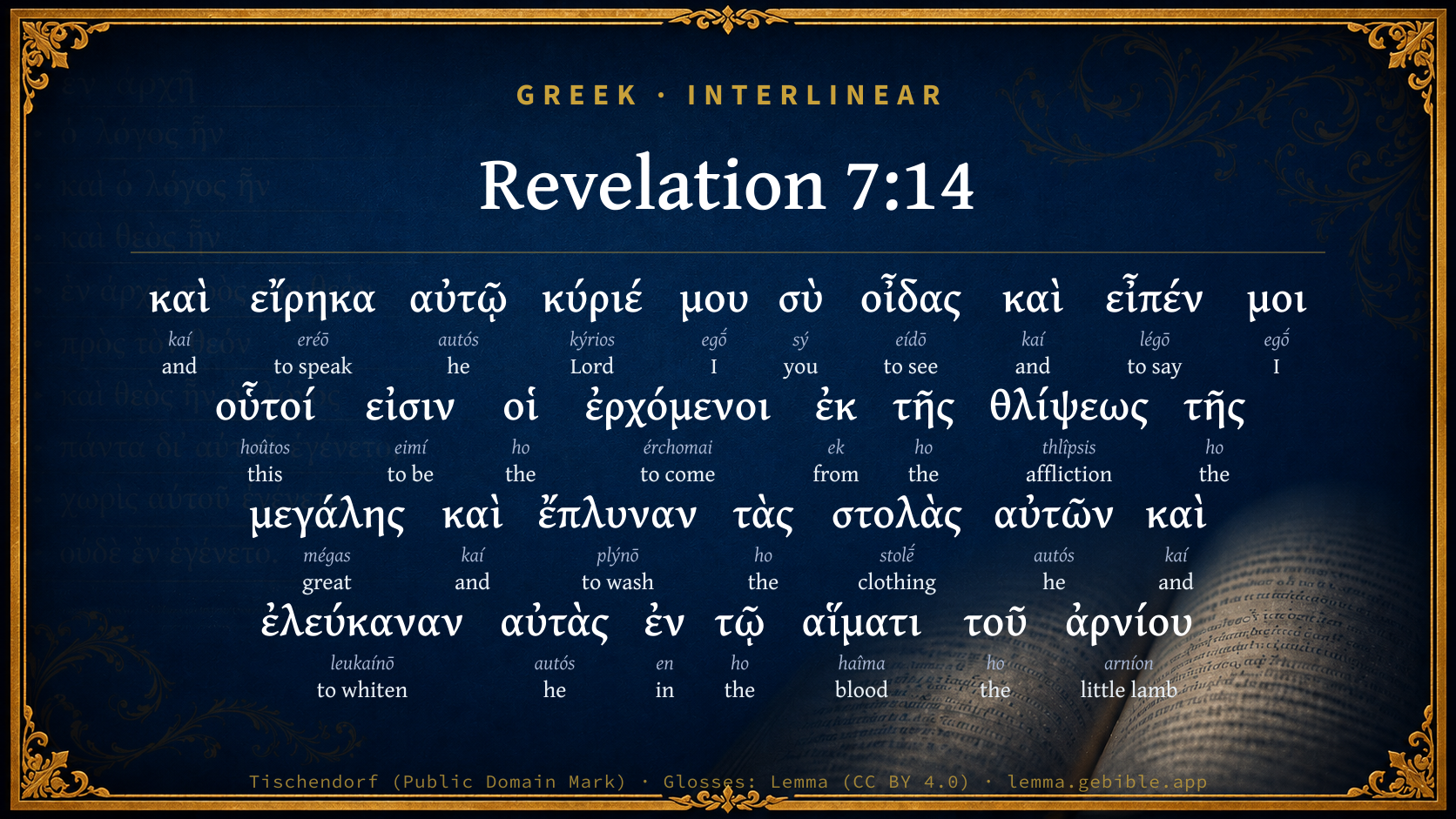
  1. καὶ kaí G2532 “and” Conjunction
  2. εἴρηκα eréō G2046 “to speak” Verb, Perfect, Active, Indicative, 1st person, Singular, Attic form
  3. αὐτῷ autós G846 “he” Personal pronoun, Dative, Singular, Masculine
  4. κύριέ kýrios G2962 “Lord” Noun, Vocative, Singular, Masculine
  5. μου egṓ G1473 “I” Personal pronoun, 1st person, Genitive, Singular
  6. σὺ sý G4771 “you” Personal pronoun, 2nd person, Nominative, Singular
  7. οἶδας eídō G1492 “to see” Verb, Perfect, Active, Indicative, 2nd person, Singular
  8. καὶ kaí G2532 “and” Conjunction
  9. εἶπέν légō G3004 “to say” Verb, Aorist, Active, Indicative, 3rd person, Singular
  10. μοι egṓ G1473 “I” Personal pronoun, 1st person, Dative, Singular
  11. οὗτοί hoûtos G3778 “this” Demonstrative pronoun, Nominative, Plural, Masculine
  12. εἰσιν eimí G1510 “to be” Verb, Present, Active, Indicative, 3rd person, Plural
  13. οἱ ho G3588 “the” Article, Nominative, Plural, Masculine
  14. ἐρχόμενοι érchomai G2064 “to come” Verb, Present, Middle or Passive deponent, Participle, Nominative, Plural, Masculine
  15. ἐκ ek G1537 “from” Preposition
  16. τῆς ho G3588 “the” Article, Genitive, Singular, Feminine
  17. θλίψεως thlîpsis G2347 “affliction” Noun, Genitive, Singular, Feminine
  18. τῆς ho G3588 “the” Article, Genitive, Singular, Feminine
  19. μεγάλης mégas G3173 “great” Adjective, Genitive, Singular, Feminine
  20. καὶ kaí G2532 “and” Conjunction
  21. ἔπλυναν plýnō G4150 “to wash” Verb, Aorist, Active, Indicative, 3rd person, Plural
  22. τὰς ho G3588 “the” Article, Accusative, Plural, Feminine
  23. στολὰς stolḗ G4749 “clothing” Noun, Accusative, Plural, Feminine
  24. αὐτῶν autós G846 “he” Personal pronoun, Genitive, Plural, Masculine
  25. καὶ kaí G2532 “and” Conjunction
  26. αὐτὰς autós G846 “he” Personal pronoun, Accusative, Plural, Feminine
  27. ἐν en G1722 “in” Preposition
  28. τῷ ho G3588 “the” Article, Dative, Singular, Neuter
  29. αἵματι haîma G129 “blood” Noun, Dative, Singular, Neuter
  30. τοῦ ho G3588 “the” Article, Genitive, Singular, Neuter
  31. ἀρνίου arníon G721 “little lamb” Noun, Genitive, Singular, Neuter

About this verse

These counts appear in no published source. They are computed here, from the morphology-tagged text and Lemma’s own curated glosses. What Lemma adds →

32
words
21
distinct lemmas
Revelation
section

Notable vocabulary

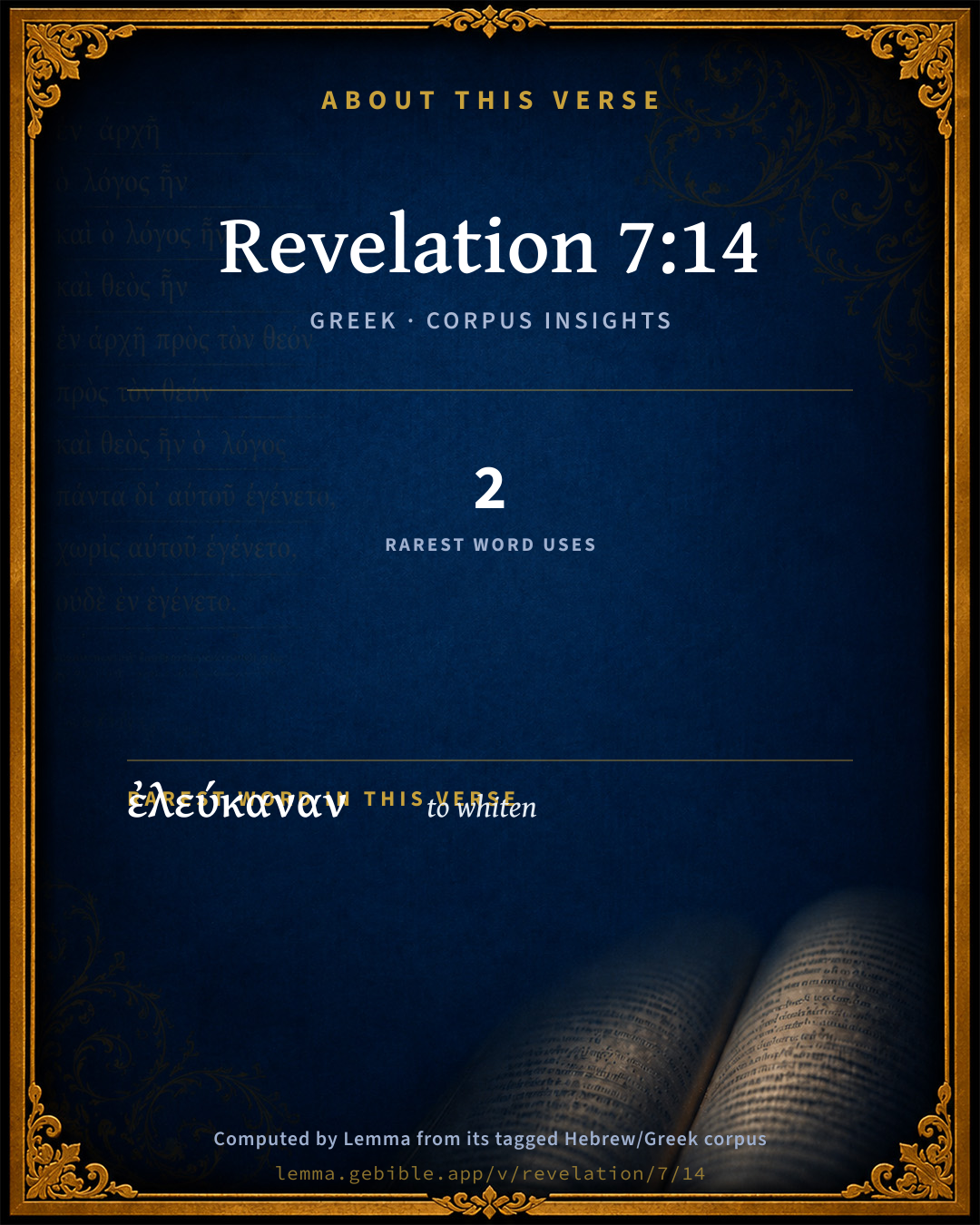
The rarest word here is ἐλεύκαναν to whiten G3021 — appearing just 2 times in the whole Greek New Testament.

Shared distinctive vocabulary

ἐλεύκαναν to whiten G3021 occurs in 2 verses of the Greek New Testament. Also found in:

Repetition

Words recur within this verse:

Cross-references

23

Topical passages linked to Revelation 7:14 in the Treasury of Scripture Knowledge — connected by theme and wording, ordered by reader-vote popularity; previews shown in the World English Bible.

  • 1 John 1:7 But if we walk in the light, as he is in the light, we have fellowship with one another, and the blood of Jesus Christ, his Son, cleanses us from all sin.
  • Revelation 22:14 Blessed are those who do his commandments, that they may have the right to the tree of life, and may enter in by the gates into the city.
  • Hebrews 13:12 Therefore Jesus also, that he might sanctify the people through his own blood, suffered outside of the gate.
  • Revelation 1:5 and from Jesus Christ, the faithful witness, the firstborn of the dead, and the ruler of the kings of the earth. To him who loves us, and washed us from our sins by his blood;
  • Revelation 12:11 They overcame him because of the Lamb's blood, and because of the word of their testimony. They didn't love their life, even to death.
  • Hebrews 9:14 how much more will the blood of Christ, who through the eternal Spirit offered himself without blemish to God, cleanse your conscience from dead works to serve the living God?
  • Isaiah 1:18 "Come now, and let us reason together," says Yahweh: "Though your sins be as scarlet, they shall be as white as snow. Though they be red like crimson, they shall be as wool.
  • 1 Peter 1:19 but with precious blood, as of a lamb without spot, the blood of Christ;
  • Zechariah 3:3–5 Now Joshua was clothed with filthy garments, and was standing before the angel.
  • Ephesians 5:26–27 that he might sanctify it, having cleansed it by the washing of water with the word,
  • 1 Corinthians 6:11 Such were some of you, but you were washed. But you were sanctified. But you were justified in the name of the Lord Jesus, and in the Spirit of our God.
  • Matthew 24:21 for then there will be great oppression, such as has not been from the beginning of the world until now, no, nor ever will be.
  • Revelation 5:9 They sang a new song, saying, "You are worthy to take the book, And to open its seals: For you were killed, And bought us for God with your blood, Out of every tribe, language, people, and nation,
  • Zechariah 13:1 "In that day there will be a spring opened to the house of David and to the inhabitants of Jerusalem, for sin and for uncleanness.
  • John 13:8–14 Peter said to him, "You will never wash my feet!" Jesus answered him, "If I don't wash you, you have no part with me."
  • John 16:33 I have told you these things, that in me you may have peace. In the world you have oppression; but cheer up! I have overcome the world."
  • Romans 5:3 Not only this, but we also rejoice in our sufferings, knowing that suffering works perseverance;
  • Revelation 17:6 I saw the woman drunken with the blood of the saints, and with the blood of the martyrs of Jesus. When I saw her, I wondered with great amazement.
  • Acts 14:22 confirming the souls of the disciples, exhorting them to continue in the faith, and that through many afflictions we must enter into the Kingdom of God.
  • Revelation 6:9–11 When he opened the fifth seal, I saw underneath the altar the souls of those who had been killed for the Word of God, and for the testimony of the Lamb which they had.
  • 2 Thessalonians 1:4 so that we ourselves boast about you in the assemblies of God for your patience and faith in all your persecutions and in the afflictions which you endure.
  • Revelation 2:9 "I know your works, oppression, and your poverty (but you are rich), and the blasphemy of those who say they are Jews, and they are not, but are a synagogue of Satan.
  • Revelation 15:2 I saw something like a sea of glass mixed with fire, and those who overcame the beast, his image, and the number of his name, standing on the sea of glass, having harps of God.

Cross-references courtesy of OpenBible.info (CC BY 4.0).

Where the printed editions differ

1 variant

Places in this verse where the major printed Greek editions disagree on the wording in a way that affects the translation — a comparison of editions, not a manuscript-by-manuscript collation. The editions are the modern critical texts (Nestlé-Aland 28/27, SBL, Westcott-Hort, Tregelles, Tyndale House) and the traditional texts behind the KJV (the Textus Receptus and the Byzantine/Majority text). It is not a claim about which reading is original.

  1. Extra text
    μου,

    “of mine,”

    In NA28NA27TynSBLWHTregByz Not in TR

    μου, (mou) 'of mine,' is only in older manuscripts (NA28+NA27+Tyn+SBL+WH+Treg+Byz)

Textual data: Translators Amalgamated Greek New Testament (STEPBible TAGNT) · CC BY 4.0.

Commentary

Notes on Revelation 7:14 from classic Christian and Jewish commentators (each source and its license shown beneath its notes). The classic Christian expositions comment on the surrounding passage and are grouped to its opening verse, so a note may address several verses; the Jewish commentaries on the Tanakh (Rashi and others) are per-verse, so they appear only where the commentator wrote on this verse.

Lemma curates 59 commentaries, every one of them public domain or Creative Commons licensed, each selected and text-cleaned for this edition rather than reprinted as found. About our sources →

Scofield Reference Notes

C. I. Scofield

tribulation

The great tribulation is the period of unexampled trouble predicted in the passages cited under that head from Psa 2:5 to Rev 7:14 and described in Revelation 11-18. Involving in a measure the whole earth Rev 3:10 it is yet distinctly "the time of Jacob’s trouble" Jer 30:7 and its vortex Jerusalem and the Holy Land. It involves the people of God who will have returned to Palestine in unbelief. Its duration is three and a half years, or the last half of the seventieth week of Daniel. (See Scofield "Dan 9:24"). Rev 11:2; Rev 11:3 The elements of the tribulation are:

(1) The cruel reign of the "beast out of the sea" Rev 13:1 who at the beginning of the three and a half years, will break his covenant with the Jews (by virtue of which they will have re-established the temple worship, Dan 9:27 and show himself in the temple, demanding that he be worshipped as God; Mat 24:15; 2Th 2:4.

(2) The active interposition of Satan "having great wrath" Rev 12:12 who gives his power to the Beast Rev 13:4; Rev 13:5.

(3) The unprecedented activity of demons Rev 9:2; Rev 9:11 and

(4) the terrible "bowl" judgments of Revelation 16.

The great tribulation will be, however, a period of salvation. An election out of Israel is seen as sealed for God Rev 7:4-8 and, with an innumerable multitude of Gentiles Rev 7:9 are said to have come "out of the great tribulation" Rev 7:14. They are not of the priesthood, the church, to which they seem to stand somewhat in the relation of the Levites to the priests under the Mosaic Covenant. The great tribulation is immediately followed by the return of Christ in glory, and the events associated therewith Mat 24:29; Mat 24:30.

See "Remnant" Isa 1:9.

(See Scofield "Rom 11:5"). "Beast" See Scofield "Dan 9:24" See Scofield "Rev 19:20" "Armageddon" Rev 16:14. See Scofield "Rev 19:17".

The Scofield Reference Bible (1917 edition), notes by C. I. Scofield — public domain. Text from a community e-Sword module.

Tyndale Open Study Notes

Tyndale Open Resources

7:14 who died in (literally who came out of): See 6:9; 20:4. • the great tribulation: A time of horrible and distressing events (see 1:9; 2:9-10; Deut 4:30-31; Matt 24:21-22; Acts 14:22). • They have washed their robes in the blood of the Lamb: This description symbolizes Christ’s redeeming death for them. • made them white: This description expresses their victory over sin and death and their acceptance by God into eternal life.

Tyndale Open Study Notes — © Tyndale Open Resources, licensed CC BY-SA 4.0. Text via the HelloAO Bible API.

Expositor's Greek Testament

ed. W. Robertson Nicoll

Rev 7:14 . κύριέ μου (“Sir”) the respectful address of an inferior to his superior in age or station, the πρεσβύτεροι being conceived as angelic beings (as in Dan 10:17 ; Dan 10:19 ; Dan 10:4 Ezr 4:3 , etc.) “Thou knowest” (and I fain would know also). The great distress is plainly the period of persecution and martyrdom (Rev 6:11 ) predicted ( e.g. , Mat 24:21 , from Dan 12:1 ) to herald the final catastrophe. It is still expected by Hermas ( Vis. ii. 2. 7, iv. 2. 5, 3. 6); but he less religiously attributes the white garments ( i.e. , purity of soul) to the virtues. As the crisis with its outcome ol faith and loyalty in all nations (Rev 7:9 ) is to be world-wide, this passage seems to imply, altnougn in a characteristically vague and incidental fashion ( cf. Rev 5:9 , Rev 14:6 , etc.), the idea of Mar 8:10 . But the situation of the Apocalypse is so acute, that mission operations are at a standstill. Instead of the gospel invading and pervading the pagan world, the latter has closed in upon the churches with threatening power, and in the brief interval before the end practically nothing can be looked for except the preservation of the faithful. Those who come out of the great distress” are further described as having washed their robes and made them white in the blood of the Lamb; which portrays their character and conduct and at the same time explains the secret of their triumphant endurance. “Mehr gedacht als geschaut ist das Bild” (J. Weiss). The great thing is not to emerge from trial, but to emerge from it with unstained faith and conscience. And this is possible, not to man’s unaided efforts, but to the sacrificial power of Christ, the experience of which forms the last line of defence in the struggle. The confessors and martyrs owed their moral purity to what they obtained through the sacrifice of Jesus. But moral purity became in this case something more intense (as the context and the emphatic language of this verse imply) than the normal Christian experience of forgiveness and holiness. By a turn of thought which is developed later by Ignatius and Tertullian ( Scorp. xii. sordes quidem baptismate abluuntur, maculae uero martyrio candidantur), it is suggested that in their martyrdom ( cf. Dan 12:10 ) these saints were able to make the redeeming power of Jesus peculiarly their own; the nature of their cruel sufferings identified them especially with their Lord. It is noticeable that the mystic union of the individual Christian with Christ mainly comes forward ward in the Apocalypse ( cf. Rev 14:13 ) when the martyrs and confessors are mentioned, as if the writer held that such an experience alone could yield the deepest consciousness of communion with One who was conceived essentially as a Lamb who had been slain, a faithful witness , etc. ( cf. Titius, 216, 217). On the high respect for martyrs, of which this forms an early trace, see Weinel, 142 144. At the same time it is to the blood of the Lamb , not to their own blood, that they owe their bliss and triumph; redemption, not martyrdom, is the essential basis of their deliverance. People might be redeemed without becoming martyrs; as, for example, either recreant Christians or those who happened to die a natural death. But no one could be a martyr without having the strength of redemption behind him.

The Expositor's Greek Testament, edited by W. Robertson Nicoll (1897–1910) — public domain. Text from a community e-Sword module.

Geneva Bible (1599)

Geneva Bible translators

The exposition of the vision, wherein the Angel telleth first the acts of the Saints, that is, their sufferings and work of faith in Christ Jesus, in this verse. Secondly their glory, both present, which consisteth in two things, that they minister unto God, and that God protecteth them, verse 15, and to come, in their perfect deliverance from all annoyances, verse 16, and in participation of all good things which even the memory of former evils shall never be able to diminish, verse 17. The cause efficient, and which containeth all these things is only one, the Lamb of God, the Lord, the Mediator, and the Savior Christ Jesus.

Geneva Bible (1599) marginal notes — public domain. Text via Bolls.life.

Jamieson, Fausset & Brown

Robert Jamieson, A. R. Fausset & David Brown

Sir--Greek, "Lord." B, C, Vulgate, Syriac, Coptic versions, and CYPRIAN read, "My Lord." A omits "My," as English Version.

thou knowest--taken from Eze 37:3. Comparatively ignorant ourselves of divine things, it is well for us to look upward for divinely communicated knowledge.

came--rather as Greek, "come"; implying that they are just come.

great tribulation--Greek, "THE great tribulation"; "the tribulation, the great one," namely, the tribulation to which the martyrs were exposed under the fifth seal, the same which Christ foretells as about to precede His coming (Mat 24:21, great tribulation), and followed by the same signs as the sixth seal (Mat 24:29-30), compare Dan 12:1; including also retrospectively all the tribulation which the saints of all ages have had to pass through. Thus this seventh chapter is a recapitulation of the vision of the six seals, Rev. 6:1-17, to fill up the outline there given in that part of it which affects the faithful of that day. There, however, their number was waiting to be completed, but here it is completed, and they are seen taken out of the earth before the judgments on the Antichristian apostasy; with their Lord, they, and all His faithful witnesses and disciples of past ages, wait for His coming and their coming to be glorified and reign together with Him. Meanwhile, in contrast with their previous sufferings, they are exempt from the hunger, thirst, and scorching heats of their life on earth (Rev 7:16), and are fed and refreshed by the Lamb of God Himself (Rev 7:17; Rev 14:1-4, Rev 14:13); an earnest of their future perfect blessedness in both body and soul united (Rev 21:4-6; Rev 22:1-5).

washed . . . robes . . . white in the blood of . . . Lamb-- (Rev 1:5; Isa 1:18; Heb 9:14; Jo1 1:7; compare Isa 61:10; Zac 3:3-5). Faith applies to the heart the purifying blood; once for all for justification, continually throughout the life for sanctification.

Jamieson, Fausset & Brown — Commentary Critical and Explanatory on the Whole Bible (1871) — public domain (CC PDM 1.0). Text via the HelloAO Bible API.

Adam Clarke's Commentary

Verse 14. Sir, thou knowest] That is, I do not know, but thou canst inform me.

Came out of great tribulation] Persecutions of every kind.

And have washed their robes] Have obtained their pardon and purity, through the blood of the Lamb.

Their white robes cannot mean the righteousness of Christ, for this cannot be washed and made white in his own blood. This white linen is said to be the righteousness of the saints, Re 19:8, and this is the righteousness in which they stand before the throne; therefore it is not Christ's righteousness, but it is a righteousness wrought in them by the merit of his blood, and the power of his Spirit.

Adam Clarke's Commentary on the Bible (1810–1826) — public domain. Text from a community e-Sword/MySword module.

Ellicott's Commentary for English Readers

(14) And I said unto him . . .—The form in which the answer of the seer is given shows how completely the elder had anticipated his thoughts; for he describes his reply as instantaneous. And I have said, My Lord—the language is that of reverent regard, but not of worship (see Rev_19:10; Rev_22:8-9)—thou knowest—i.e., it is for thee to tell me: thy knowledge and thy view-point is higher than mine; thou knowest: it is thine to speak, and mine to hearken.

And he said to me . . .—Read, And he said to me, These are they who come (the present tense is used: these are those coming) out of the great tribulation. They are those who come, not all at once, but gradually. The saints of God are continually passing into the unseen world, and taking their place among the spirits of just men made perfect. They come out of the great tribulation. Are we to limit the expression to the special and peculiar afflictions of the last great trial? There is no doubt about the emphasis which the definite article (unfortunately, ignored in our English version) gives: it is the great tribulation; but while there may yet be in store for the Church of Christ trials so great that they may be called, in comparison with those which went before, the great tribulation, it yet seems out of harmony with the spirit of the Apocalypse and the complexion of this vision to limit the phrase to some special season of trial. Is not the great tribulation the tribulation which those must encounter who are on the side of Christ and righteousness, and refuse to receive the mark of worldliness and sin on their heart, conscience, and life? In all ages it is true that we must through much tribulation enter the Kingdom of God; and the vision here is surely not of those who will come safe out of some particular trials, but of the great multitude from every age and every race who waged war against sin, and who, in the midst of that protracted conflict, endured the great tribulation which is to continue until Christ’s return. And they washed (not “have washed,” for the washing was done during their earthly life) their robes, and made them white in the blood of the Lamb. The imagery is to be found in the Gospel and in the Epistle (Joh_13:8-11; and 1Jn_1:7); its use here and in Rev_1:5 (if the reading washed is to be preferred to loosed) points to a common authorship: the emblem of the blood which washes white, or cleanses, is not used with such distinctness elsewhere in the New Testament. It is, in St. John’s lips, but a following out of the twice-repeated words which he quotes from John the Baptist at the opening of the Gospel, when he proclaimed Christ to be “the Lamb of God, which taketh away the sin of the world.” In that Lamb of God those who came out of great tribulation found the forgiveness and the spiritual power which gave them confidence and hope in the midst of life’s war and life’s weariness; for the man who knows that he is forgiven and that he is being helped to holiness is the man who thinks no fiery trial strange, but rejoices in the knowledge that his salvation is of God.

A Bible Commentary for English Readers, edited by Charles John Ellicott (1878–1897) — public domain. Text from a community e-Sword module.

The Cambridge Bible for Schools and Colleges

gen. ed. J. J. S. Perowne

14. Sir] Read, My lord: cf. Dan_10:16-17; Zec_4:5; Zec_4:13. In the latter place we have, as here, the heavenly interlocutor apparently assuming that the Seer ought to understand the vision without explanation.

thou knowest] Cf. Eze_37:3.

which came] More accurately, which come.

great tribulation] Should be, the great tribulation: the article is strongly emphasised. It probably means, “the great tribulation foretold by the Lord,” St Mat_24:21 : cf. Dan_12:1. For a similar use of the art. cf. ch. Rev_1:7, “the clouds.”

made them white in the blood] A paradox something like that of Rev_6:16 fin. For the image, cf. perhaps Rev_1:5 (but see note there); certainly Rev_22:14 (true text), and probably St John 1Jn_1:7. Heb_9:14, which is sometimes quoted, is less closely parallel: there the image seems to be taken from ritual rather than physical cleansing.

The Cambridge Bible for Schools and Colleges (gen. ed. J. J. S. Perowne; Cambridge University Press, 1878–1918) — public domain. Text from a community e-Sword module.

John Gill's Exposition

And I said unto him, sir, thou knowest,.... John replies in a very humble, modest, and respectful manner, to the elder, calling him "sir", according to the usage of the eastern people; and it is observable, that this word is much used in his Gospel, and more than in any other book; see Joh 4:11. Some copies, and the Complutensian edition, read, "my Lord"; and so do the Vulgate Latin, Syriac, and Arabic versions. John confesses his ignorance, and ascribes knowledge to the elder, and desires information of him; for the sense is, that the elder knew who they were, and from whence they came, but he did not, and therefore desires that he would inform him; and so the Arabic version renders it, "and my Lord, thou art more learned"; that is, than I am, and therefore instruct me, as he accordingly did;

and he said to me, these are they which came out of great tribulation: seeing this company designs all the elect of God, that ever were, are, or shall be in the world; "the great tribulation", out of which they came, is not to be restrained to any particular time of trouble, but includes all that has been, is, or shall be; as all the afflictions of the saints under the Old Testament; from righteous Abel to Zechariah; and all the troubles of the people of God in the times of the Maccabees, Heb 11:35; all the persecutions of the Christians by the Jews, at the first publication of the Gospel; and the persecutions under the Roman emperors, both Pagan and Arian; and the cruelties and barbarities of the Romish antichrist, during the whole time of the apostasy; and particularly the last struggle of the beast, which will be the hour of temptation, that will come upon all the world; and in general all the afflictions, reproaches, persecutions, and many tribulations of all the saints, and every member of Christ in this world, who in the new Jerusalem church state will be come out of them; which supposes them to have been in them, and yet were not overwhelmed by them, and lost in them; but, by divine support and assistance, waded through them, and were now quite clear of them, and never more to be annoyed with them; see Rev 21:4.

And have washed their robes, and made them white in the blood of the Lamb; not in the blood of bulls and goats, which could not take away sin; nor in their own blood, their sufferings for Christ, on which they did not depend, knowing there is no comparison between them, and the glory revealed in them; nor in any works of righteousness done by them, which are imperfect and filthy, and need washing; but in the blood of Christ, which cleanseth from all sin. The "robes" which they washed in his blood may either design themselves, their consciences, which this blood purges from dead works; or their outward conversation garments, which have their spots, and need continual washing; or else the robe of righteousness, and garments of salvation, or their justification, which is by the blood of Christ, Rom 5:9. The act of washing from sin, by the blood of Christ, is sometimes ascribed to Christ himself, as in Rev 1:5; but here to the saints, and designs the concern which faith has in the blood of Christ, which deals with it for justification, peace, and pardon, for the removing of sin from the conscience, and for cleansing from all impurity, both of flesh and Spirit: and the effect of this is, that their robes were "made white"; that is, that they were freed from all sin, were without fault before the throne, not having spot, or wrinkle, or any such thing. This shows that these persons had no trust in themselves, or dependence on their own merits, and works of righteousness, but wholly trusted to, and depended on the blood and righteousness of Christ; which is the only way to come out of tribulation, and enter the kingdom.

John Gill's Exposition of the Whole Bible (1746–1763) — public domain (CC PDM 1.0). Text via the HelloAO Bible API.

Trapp's Complete Commentary

John Trapp

14 And I said unto him, Sir, thou knowest. And he said to me, These are they which came out of great tribulation, and have washed their robes, and made them white in the blood of the Lamb.

Ver. 14. Which came out of great tribulation] It is but a delicacy that men dream of to divide Christ and his cross. The bishop of London, when he had degraded Richard Bayfield, martyr, kneeling upon the highest step of the altar, he smote him so hard on the breast with his crosier staff, that he threw him down backward, and brake his head so that he swooned; and when he came to himself again, he thanked God that he was delivered from the malignant Church of Antichrist, and that he was come into the true Church of Christ militant, and I hope shall be anon with him in the Church triumphant. (Acts and Mon.)

And made them white] Other blood stains what is washed in it; this blood of the spotless Lamb whitens and purifies.

John Trapp, A Commentary or Exposition upon All the Books of the Old and New Testament (1647–1656) — public domain. Text from a community e-Sword module.

Albert Barnes' Notes on the Bible

And I said unto him, Sir, thou knowest - The word “sir” in this place - κύριέ kurie, “lord” - is a form of respectful address, such as would be used when speaking to a superior, Gen 43:20; Mat 13:27; Mat 21:30; Mat 27:63; Joh 4:11, Joh 4:15, Joh 4:19, Joh 4:49; Joh 5:7; Joh 12:21; Joh 20:15. The simple meaning of the phrase “thou knowest” is, that he who had asked the question must be better informed than he to whom he had proposed it. It is, on the part of John, a modest confession that he did not know, or could not be presumed to know, and at the same time the respectful utterance of an opinion that he who addressed this question to him must be in possession of this knowledge.

And he said unto me - Not offended with the reply, and ready, as he had evidently intended to do, to give him the information which he needed.

These are they which came out of great tribulation - The word rendered “tribulation” - θλίψις thlipsis - is a word of general character, meaning “affliction,” though perhaps there is here an allusion to persecution. The sense, however, would be better expressed by the phrase great trials. The object seems to have been to set before the mind of the apostle a view of those who had suffered much, and who by their sufferings had been sanctified and prepared for heaven, in order to encourage those who might be yet called to suffer.

And have washed their robes - To wit, in the blood of the Lamb.

And made them white in the blood of the Lamb - There is some incongruity in saying that they had made them white in the blood of the Lamb; and the meaning therefore must be, that they had cleansed or purified them in that blood. Under the ancient ritual, various things about the sanctuary were cleansed from ceremonial defilement by the sprinkling of blood on them - the blood of sacrifice. In accordance with that usage, the blood of the Lamb - of the Lord Jesus - is said to cleanse and purify. John sees a great company with white robes. The means by which it is said they became white or pure is the blood of the Lamb. It is not said that they were made white as the result of their sufferings or their afflictions but by the blood of the Lamb. The course of thought here is such that it would be natural to suppose that, if at any time the great deeds or the sufferings of the saints could contribute to the fact that they will wear white robes in heaven, this is an occasion on which there might be such a reference.

But there is no allusion to that. It is not by their own sufferings and trials, their persecutions and sorrows, that they are made holy, but by the blood of the Lamb that had been shed for sinners. This reference to the blood of the Lamb is one of the incidental proofs that occur so frequently in the Scriptures of the reality of the atonement. It could be only in allusion to that, and with an implied belief in that, that the blood of the Lamb could be referred to as cleansing the robes of the saints in heaven. If he sheds his blood merely as other people have done; if he died only as a martyr, what propriety would there have been in referring to his blood more than to the blood of any other martyr? And what influence could the blood of any martyr have in cleansing the robes of the saints in heaven? The fact is, that if that were all, such language would be unmeaning. It is never used except in connection with the blood of Christ; and the language of the Bible everywhere is such as would be employed on the supposition that he shed his blood to make expiation for sin, and on no other supposition. On the general meaning of the language used here, and the sentiment expressed, see the Heb 9:14 note and 1Jo 1:7 note.

Albert Barnes' Notes on the Bible (1834–1885) — public domain. Text from a community e-Sword/MySword module.

Haydock's Catholic Bible Commentary

White in the blood of the Lamb. That is, they have been cleansed and purified from sin, by the death, merits, and grace of Christ crucified. (Witham) --- The whole of this verse must be understood in a mystical sense, for we are said to make our garments white in the blood of the Lamb, when we enter into his Church by baptism, or wash away our sins by penance or martyrdom. (Calmet)

George Leo Haydock (1774–1849), Haydock's Catholic Family Bible and Commentary, 1859 edition — public domain. Excludes Psalms (Douay-Rheims chapter numbering differs from Protestant) and Deuterocanonical books (Catholic canon only).

Matthew Poole's English Annotations

John confessing his own ignorance, applies himself to this elder for instruction, who tells him: These were the souls of them that came out of great sufferings and persecution; but he addeth, that they were such as were washed in the blood of Christ. Suffering will not bring us to heaven without having our souls washed with the blood of Christ.

Matthew Poole's English Annotations on the Holy Bible (1683–1685) — public domain. Text from a community e-Sword/MySword module.

Whedon's Commentary on the Bible

Daniel D. Whedon

14. Sir—The Greek is the original of our sir, and in modern Greek is used for that word. But Bengel, Hengstenberg, and Alford consider it here as a more reverent my Lord, approaching nigh to the attempt at worship in a future passage or two.

Thou knowest—The Greek thou, here expressly inserted, implies emphasis upon it. The knowledge to answer those questions is in thee, not in me. And the words imply a request for answer which the seer was too modest to make.

Out of great tribulation—The epithet great is emphatic, by being placed with its article after the noun, which our English idiom does not permit. Yet it is done with proper names, as Alexander the Great; and similarly this is tribulation the great. But what tribulation is here meant? Some say the “great tribulation” of Mat_24:21, just preceding the judgment-day. But plainly, this company robed in white is that of Rev_7:9, which embraces all the redeemed. The great tribulation is, therefore, the battle of probationary life under pressure of the world, the flesh, and the devil. Those fine lines of Wesley, therefore,

Who are these arrayed in white,

Brighter than the noonday sun,

Foremost of the sons of light,

Nearest the eternal throne?

so far as they represent these as martyrs or special sufferers for Christ seem to be a mistake. All Christians are these martyrs.

Washed their robes—Purified their characters. This is a very vivid image of sanctification through the atonement. It illustrates how deep the doctrine of the atonement maintained in the apocalypse. But we must look through the intense imagery at the literal fact, and not allow our imagination to be lost in the imagery. There is no literal robe, no literal washing the robe in blood. What is true is, that Christ died for our sins, and through the merit of his atonement the Holy Spirit is bestowed upon us, giving us power to resist temptation, to repress our disordered affections, and bring all into obedience to the law of Christ. And that is sanctification.

Daniel D. Whedon (gen. ed.), Commentary on the Old and New Testaments (1874–1909) — public domain. Text from a community e-Sword module.

The Pulpit Commentary

And I said unto him, Sir, thou knowest; and I say unto him, My lord (Revised Version). The expression denotes the utmost respect and reverence, which afterwards induce the seer to worship the angel. (see Rev_19:10 Rev_22:8) The structure of this part of the vision recalls Eze_37:3, "And he said unto me, Son of man, can these bones live? And I answered, O Lord God, thou knowest". (cf. Zec_4:2, Zec_4:4, 5 Joh_12:21) And he said to me, These are they which came out of great tribulation; which come out of the great tribulation (Revised Version). The repeated article is especially emphatic. The question arises What is "the great tribulation" referred to? Probably all the tribulation which has been passed through by the redeemed, all that which pertained to the life though which they have passed. This tribulation is now completed and past, and is therefore referred to as "the great tribulation." "These are they which have passed through the great tribulation of their life on earth." This is the view taken by Alford. Dusterdieck refers the expression to the last great trial of the saints before the coming of the Lord. Some point to particular persecutions as the reference intended, and others consider that "the last great trial to be expected under the seventh seal" is meant. And have washed their robes, and made them white in the blood of the Lamb; and they washed, etc. That is, during their past life, while they were experiencing the great tribulation, they washed their robes. (cf. Rev_3:4, Rev_3:5, where those who have "not defiled their garments" and those "that overcome" are to be clothed in white) Those that overcome and are undefiled, therefore, are those who have washed themselves in the blood of the Lamb, through which only their victory is possible or effective. Arethas, Bede, De Lyra, consider that the robes are washed of those who have endured martyrdom, and that they are washed in the blood of the Lamb, because it is the blood of his members.

Vers. 14, 15. The redeemed, in heaven.

"These are they," etc. We long to know something of the life to come, the unseen world, the abode of those who die in the Lord. And here in this chapter a glimpse, which suggests much more than it reveals, is given to us. Especially is this desire for knowledge concerning the blessed dead intense when any of our own beloved ones are amongst their number. And of whom is not this true? Hence we search the Scriptures to gather up any the least hint that they may give; we study the records of the transfiguration of our Lord on the holy mount; we ponder the many sayings of his apostles on this most interesting theme; and this section of the Book of the Revelation, which tells of it more expressly, has made the whole book precious for its sake. We know not where heaven is, but here we have a vivid picture of the place and those who dwell there. It was doubtless given in order to cheer the hearts of the afflicted and depressed Church of St. John"s day, and we may well believe that it ministered blessed help and hope to them, as it has done to myriads since. Note

I WHO ARE IN HEAVEN. St. John tells us that:

1. They are a multitude. Heaven is no unpeopled place. It is the answer given by the Lord to the question his disciples asked him when he was on earth, "Are there few that be saved?" Then he did not see fit to answer it plainly, but here there can be no question as to the reply. For:

2. They are "a great multitude, one that "no man can number." How could it be otherwise? Would God have created and perpetuated the race of mankind knowing for how could he not know the issue of his own work, "Known unto God are all his works? that sin and Satan would win the most of them? How, in such case, could our Lord be said to have "destroyed the works of the devil"? Without doubt sin doth abound, but grace doth much more abound. If, at the time St. John was made glad through this vision, as we are through him, already there were in heaven this mighty multitude, what must they be now? and what will they be when the end cometh, and our blessed Lord hath delivered up the kingdom to the Father? They had already "begun to be merry". (Lu 15) What must the holy mirth be now? and what shall it not be?

3. A miscellaneous multitude. "Out of every kindred and nation," etc. How greatly, then, do they err who think and teach that only those nations who here on earth have heard the joyful sound of Christ"s holy gospel can furnish contingents to that redeemed throng upon whom St. John delightedly gazed! What did our Lord go to "the spirits in prison" for, as St. Peter tells us he did, if not to bring them there the joyful tidings which here on earth they had not heard? How little we yet comprehend of "the breadth, and length, and depth, and height" of the love of Christ! Surely this vision should help us to a larger understanding of that infinite love.

4. To them all life had been full of trouble. They had all of them "come out of great tribulation." Whilst we may not omit the final tribulation of which our Lord tells in Mt 24, and to which the opening of the sixth seal refers, we cannot limit it to that. "Man is born to trouble;" he is "of few days, and full of misery." "The whole creation groaneth and travaileth together in pain until now." To how few would life be worth living were it not for he hope of a better one! But we are placed here as at a school, and the trials of life are the appointed methods of instruction whereby we unlearn evil and learn good. The poor often envy the rich; but if all were known, the lot in life, or rather ere eternal life be gained, of us all is much alike. "The rich and the poor meet together," and share in their common inheritance of trouble. But from all this they have now "come out," and are "before the throne of God and the Lamb.

5. They had all been lost but for Christ. For they had all sinned. None of them had kept their garments undefiled. But he who came "to seek and to save them that were lost" found them; by his Spirit drew them to himself; by his blood washed their sin-stained robes, and made them white; and now, all of them, not one excepted, are in heaven full of adoring gratitude to him who redeemed and saved them by his own blood. None are there on any other ground, nor can any ever be. On what, then, are we relying for the hope we all cherish of one day being where they are?

II WHAT THEY DO THERE,

1. They celebrate the heavenly harvest home. They carry "palms in their hands," branches of the palm. No reference is here to heathen uses of the palm as symbol of victory and the like. But far sweeter and holier reminiscence is awakened. The scene before us is the antitype of the most joyous and inspiriting of all the observances of Israel that of the Feast of Tabernacles. It was held at the close of the year"s outdoor labours; with it the season of rest began. "All was safely gathered in." It commemorated God"s care of them in the old wilderness days, and afterwards his continual care of them by the gifts of his providence. The feast was a most joyous one. The Jews said that he did not know joy who knew not the Feast of Tabernacles. One chief feature of the feast was the universal carrying of palm branches. (cf. Neh_8:14-17) Such is the scene from which the imagery of St. John here is drawn. It told of the troubles of the wilderness ended; the harvest home of the Church come. It speaks of everlasting joy.

2. They serve. Day and night in God"s temple is this service rendered. But in another place St. John says, "I saw no temple therein;" and hence we must understand by the temple all heaven and earth, for all, as was the ancient temple, are to be filled with his glory. And as to the service, who can describe, who can limit, who can sufficiently set forth, its beneficence, its joy, its glory?

3. They show forth the praises of God and the Lamb. (Ver. 10) Festal joy, service, worship, the worship which consists in heartfelt praise, such are the occupations of heaven.

III THEIR EXCEEDING BLESSEDNESS.

1. They want not. They neither hunger nor thirst.

2. They weary not, as in the travel and toil of the wilderness they had done, when the fierce heat of the sun smote them; and as in the hard toil of life.

3. They weep not. The poet Burns used to say he could never read this without tears. And when we think of what life is now a place of tears and that there there shall be none, one"s heart may well rejoice. But there are also the unspeakable joys that come from:

4. The realized presence and love of the Lord Jesus Christ. He shall be as a Tent to cover them, as a Shepherd to feed them, as a Guide to lead them to fountains of living water.

CONCLUSION. Have we those we love in heaven? Rejoice concerning them. Are we on the way there ourselves? S.C.

The Pulpit Commentary (1880–1919), ed. H.D.M. Spence-Jones & Joseph S. Exell — public domain. Text from a community e-Sword module.

John Wesley's Explanatory Notes

My Lord - Or, my master; a common term of respect. So Zechariah, likewise, bespeaks the angel, Zech. i, 9; iv, 4; vi, 4. Thou knowest - That is, I know not; but thou dost. These are they - Not martyrs; for these are not such a multitude as no man can number. But as all the angels appear here, so do all the souls of the righteous who had lived from the beginning of the world. Who come - He does not say, who did come; but, who come now also: to whom, likewise, pertain all who will come hereafter. Out of great affliction - Of various kinds, wisely and graciously allotted by God to all his children. And have washed their robes - From all guilt. And made them white - In all holiness. By the blood of the Lamb - Which not only cleanses, but adorns us also.

John Wesley, Explanatory Notes Upon the Whole Bible (1754–1765) — public domain. Text via the GEBible commentary corpus.

The People's New Testament

B. W. Johnson

14. Thou knowest. “I do not know but thou dost.” These are they which came out of the great tribulation. See Revision. Some great period of trial of the church is meant. They have stood the trial, and been true. Washed their robes. Have made themselves spotless by trust in the blood of Christ.

B. W. Johnson's The People's New Testament with Notes (1889–1891) — public domain. Electronic text from the Christian Classics Ethereal Library (CCEL) ThML edition.

Cambridge Greek Testament for Schools and Colleges

14. κύριέ μου. Text. Rec[277] omits μου with A 1.

[277] Rec. Textus Receptus as printed by Scrivener.

ἔπλυναν τὰς στολὰς αὐτῶν καὶ ἐλεύκαναν αὐτάς. Primas[278] omits ἔπλυναν (stolas suas Candidas fecerunt); B2 omits αὐτάς.

[278] Primasius, edited by Haussleiter.

14. εἴοηκα. The perfect here is only less difficult than εἴληφεν Rev 5:7 (where see note) because it stands alone.

Κύριέ μου. Cf. Dan 10:16-17; Zec 4:5; Zec 4:13. In the latter place we nave, as here, the heavenly interlocutor apparently assuming that the Seer ought to understand the vision without explanation.

σὺ οἶδας. Cf. Eze 37:3.

οἱ ἐρχόμενοι, “which come,” i.e. which are to come, cf. τὸ θηρίον τὸ ἀναβαῖνον, Rev 11:7.

τῆς θλίψεως τῆς μεγάλης: the article is strongly emphasised. It probably means “the great tribulation foretold by the Lord,” St Mat 24:21: cf. Dan 12:1. For a similar use of the art. cf. ch. Rev 1:7, “the clouds.”

ἐλεύκαναν αὐτὰς ἐν τῷ αἵματι. A paradox something like that of Rev 6:16 fin. For the image, cf. perhaps Rev 1:5 (but see note): certainly Rev 22:14 (true text), and probably St John 1 Eph 1:7. Heb 9:14, which is sometimes quoted, is less closely parallel: there the image seems to be taken from ritual rather than physical cleansing. Tert[281] Scorp. xii. has a curious view that the washing corresponds to baptism, and the making white to martyrdom.

[281] Tertullian as quoted by Haussleiter.

Cambridge Greek Testament for Schools and Colleges (Cambridge University Press, 1896; 21 vols, various authors incl. Carr, Maclear, Plummer, Farrar, Lumby, Moule, M. R. James, Simcox) — public domain. Text from a community e-Sword module.

Vincent's Word Studies in the New Testament

Marvin R. Vincent

I said [ειρηκα] . Lit., I have said. Rev., renders by the present, I say. See on cried. Joh 1:15.

Sir [κυριε] . Add mou my, and render, as Rev., my Lord. An address of reverence as to a heavenly being. See on Mt 21:3.

Which came [οι ερχομενοι] . The present participle. Hence, as Rev., which come.

Out of great tribulation [εκ της θλιψεως της μεγαλης] . Lit., out of the tribulation, the great (tribulation). Rev., properly, gives the force of the article, "the great." See on Mt 13:21.

Have washed [επλυναν] . The aorist tense. Rev., correctly, they washed. Only here and Luk 5:2, on which see note. For the New Testament words for washing, see on Act 16:33.

Made them white. Compare Isa 1:18; Psa 51:7; Mr 9:3. Milligan remarks that robes are the expression of character, and compares the word habit used of dress.

Marvin R. Vincent, Word Studies in the New Testament (1887–1900) — public domain. Text from a community e-Sword/MySword module.

Lesson kit

Teaching starters — assembled from the data on this page, not authored interpretation. Every prompt links to the verse data it draws on. Edit before teaching.

Revelation, in the Revelation, opens this verse with 32 words (21 distinct Greek lemmas). Its most distinctive word is leukaínō (“to whiten”). A historical commentator’s framing appears above. Read the whole chapter for the surrounding context.

Discussion questions

  1. What does “to whiten” (leukaínō) contribute to the verse as a whole?
  2. How does Mark 9:3, which shares the word «to whiten», read alongside this verse?
  3. What does the repetition of “the” (6× in this one verse) do in this verse?
  4. These translations render this verse differently. What is at stake in choosing one wording over another?
  5. Compare how Scofield Reference Notes and Tyndale Open Study Notes read this verse. Where do they agree or differ?

Things to notice

Reading settings

Reading text

Shown beneath each verse's original-language words.

Old Testament
Old Testament edition

Read the OT as the Masoretic Hebrew (MT) or the Greek Septuagint (LXX).

English shown for the Greek Septuagint (in the Hebrew ↔ Greek comparison).

Comparing translations? Open the Compare panel on any verse page to stack up to four side by side.